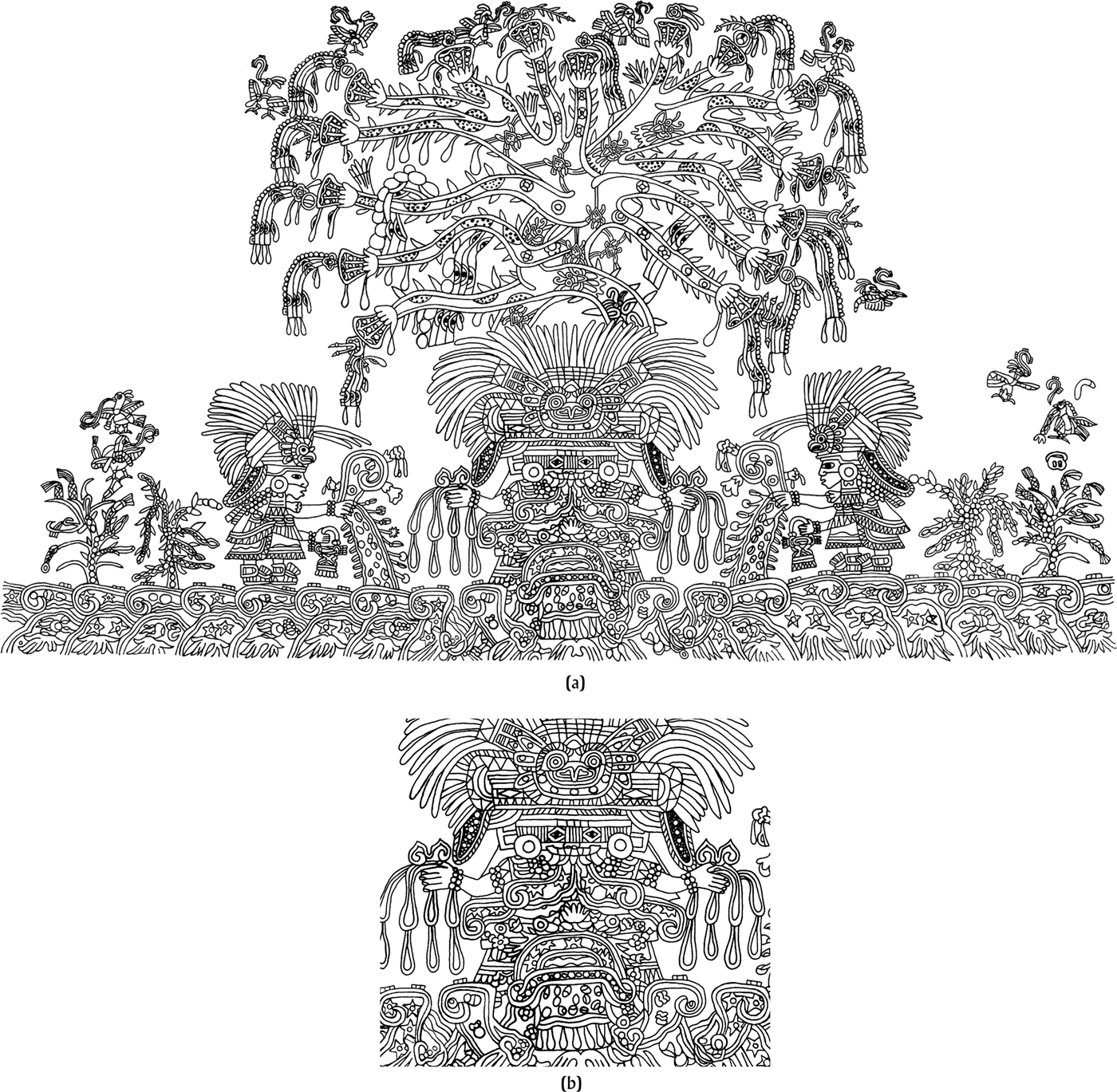
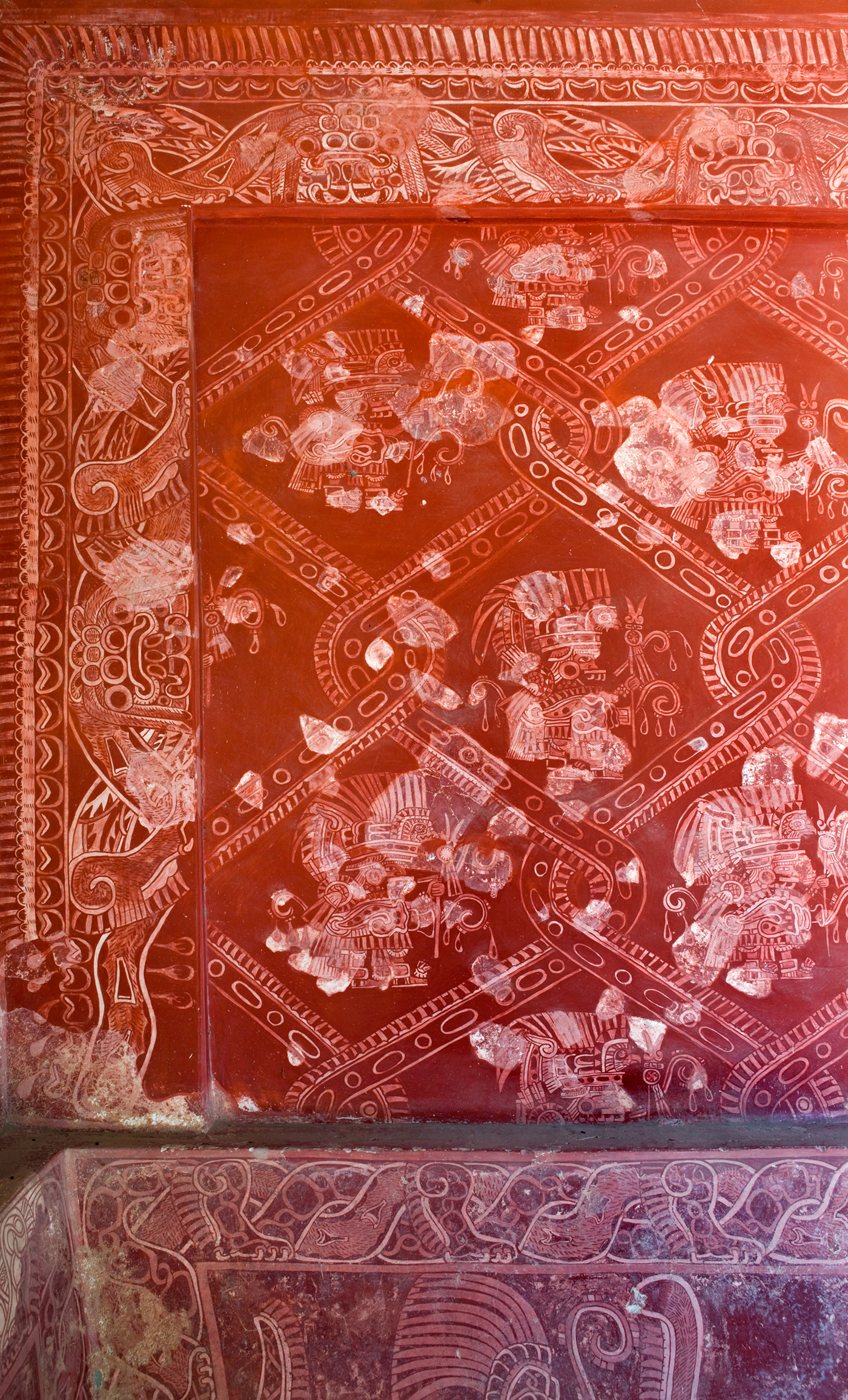
Within a span of roughly 50 years, popular thinking regarding the identity and social meaning of a principal deity at the ancient central Mexican metropolis of Teotihuacan has changed radically. In 1962, George Kubler proposed that the central figure in the polychrome Mural 3 in the Tepantitla apartment complex at Teotihuacan was not an early version of the Nahua (or Aztec) rain deity, Tlaloc, as was generally thought, but rather a female figure that he named the “Water Goddess” (Kubler Reference Kubler1962:37) (Figures 1a and 1b). Its initial identification as Tlaloc was due not only to the many excavations that revealed a strong visual presence of the rain deity at Teotihuacan (Paulinyi Reference Paulinyi2006:1), but also due to the fact that the central deity in the Tepantitla mural has an abundance of watery iconography, as well as some shared attributes with Nahua representations of Tlaloc, such as fangs and the bigotera, a term commonly used in the literature to refer to its large, curved upper lip. A decade later, Pasztory (Reference Pasztory1974) and Furst (Reference Furst and Hammond1974), in separate research, followed suit, independently challenging the masculine gender of the figure. Relying on iconographic analysis, Pasztory rejected both its identification as a male and as Tlaloc, declaring the central figure to be an earth and fertility Goddess, and proposing the name “Great Goddess” or simply the “Goddess.” The moniker found wide acceptance, although its attributions suggest a stereotypical view of females as personifying nature while also being inherent in nature (Pasztory Reference Pasztory, Berrin and Pasztory1993:55).
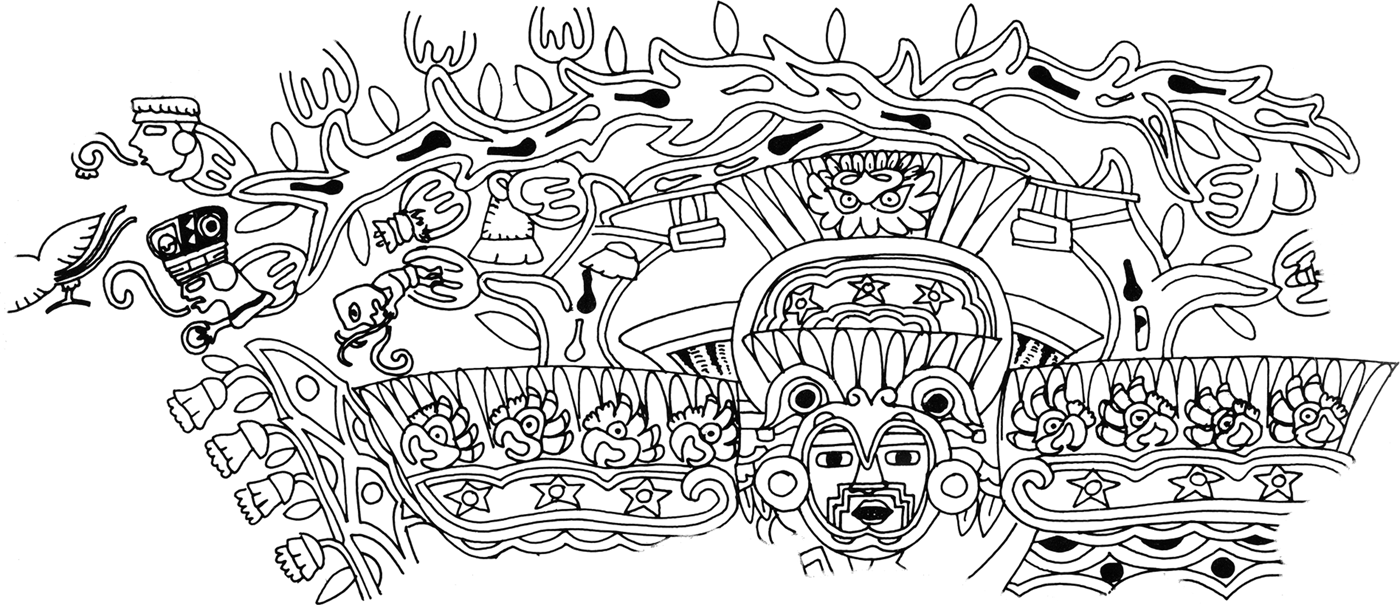
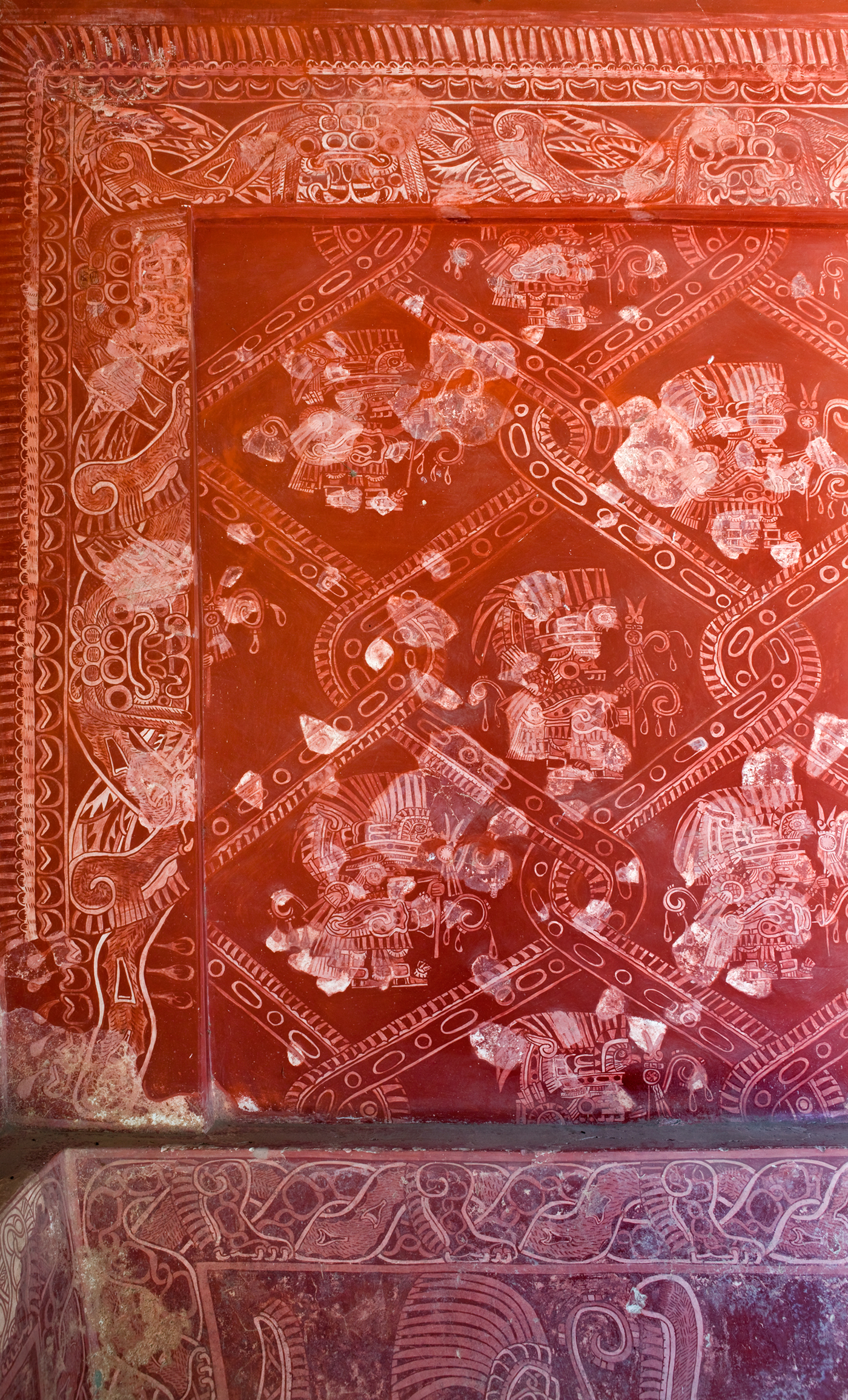
(a) Tepantitla patio mural; (b) detail, Tepantitla patio mural. Drawing by Jenni Bongard, courtesy of Annabeth Headrick.

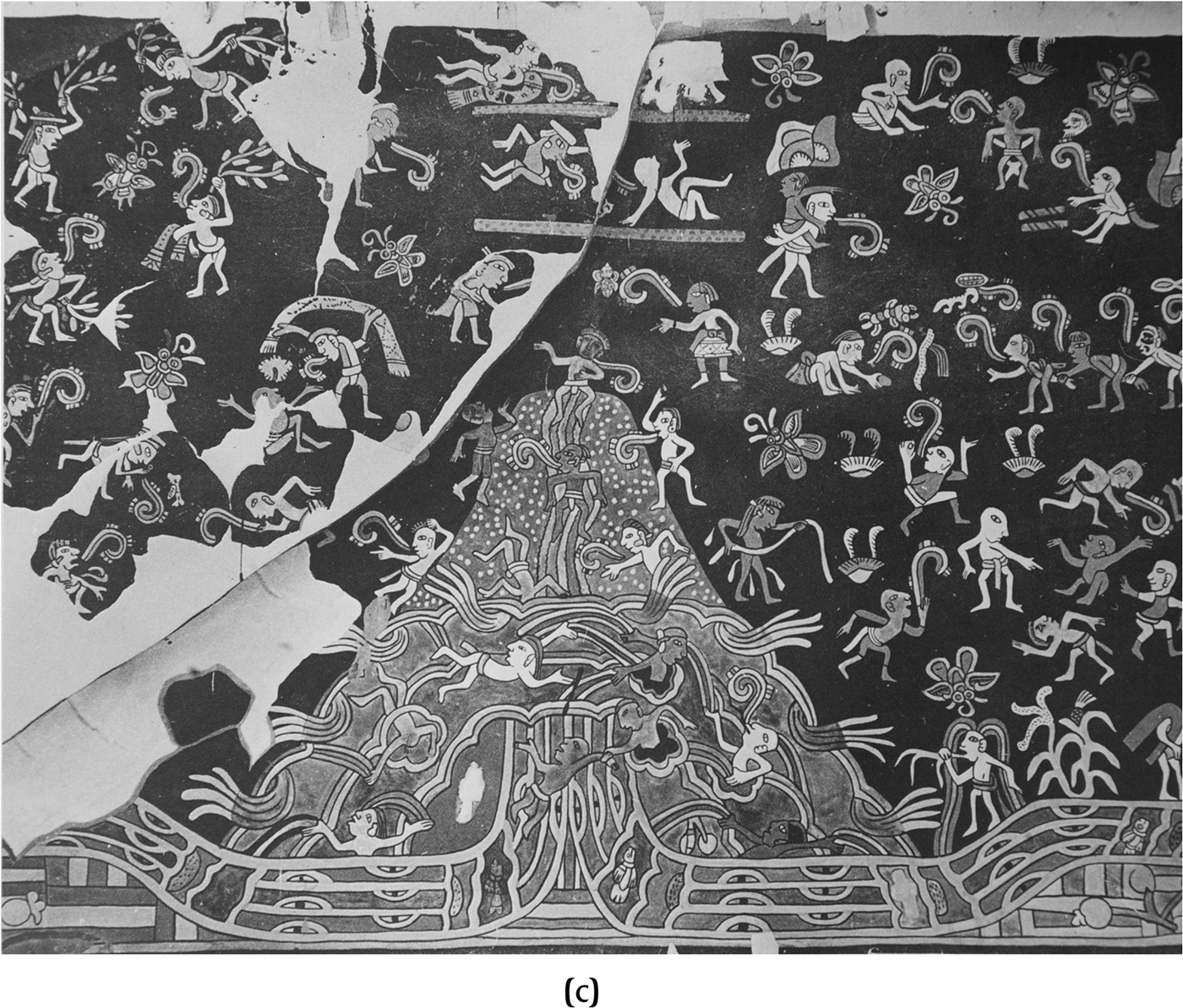
(c) Lower register of the Tepantitla patio mural. Image courtesy of the Middle American Research Institute, Tulane University.

In a climate where figures are often assumed to be male, unless breasts, a pregnant belly, or female genitalia are visible, Pasztory's work, in particular, opened the door for an ongoing debate about gender attribution at Teotihuacan, setting the stage for both the establishment of a gynaecentric cult and a major reassessment of how the visual culture should be addressed, and the work continues apace. Yet, the ready acceptance of a female gender for the deity represented at Tepantitla—described in detail below—and those deities seen elsewhere at Teotihuacan seems hasty in some regards. These gender attributions have had far-reaching consequences in promoting the concept of a Great Goddess—and, by extension, a cult of the Goddess—at Teotihuacan, assigning gender without substantiating evidence. Attempts to find important female deities at Teotihuacan have unfortunately obfuscated other lines of inquiry concerning how Teotihuacanos may have conceptualized gender. In some instances, the propagation of a Great Goddess mythology has created a fiction that relies on modern, Western stereotypes of femininity and masculinity. As Bynum (Reference Bynum1995:29) has noted, “the past is seldom usefully examined by assuming that its specific questions or their settings are the same as those of the present.” She goes on to specify that “the only past we can know is one we shape by the questions we ask; yet these questions are also shaped by the context we come from, and our context includes the past” (Bynum Reference Bynum1995:30). Hence, questions about specific aspects of the evidence on which the assertion of the gender identity of the Goddess rests deserve more rigorous scrutiny than has previously been accorded, particularly in light of recent discoveries. Likewise, a carefully reasoned assessment of how gender may have been conceived in ancient Mesoamerica is warranted. More specifically, this study addresses how ancient concepts of gender may have affected artistic representations in monumental and civic contexts at Teotihuacan, and the ways in which gender attribution has affected interpretations of Teotihuacan and its visual culture.
GENDER
Discussions of sex and gender at Teotihuacan seem to lack consistency, and in addition, most features associated with the Goddess are impossible to sex. Here, I use “sex” to mean biological and anatomical sex but, as Ardren (Reference Ardren2008:1) indicates, questions have been raised as to whether the biological concept of sex exists outside the West and, furthermore, sex, especially expressed as binary oppositions, is seen as less scientific and more as a reflection of a Western imposition (Ardren Reference Ardren2008:5). In addition, with regard to sex determination, Ardren (Reference Ardren2008:4) notes the growing awareness that even the most “scientific” archaeology relies on methodologies that are culturally constructed.”Footnote 1 Sex in artwork can only be definitively determined by the presence of primary and secondary sexual organs: genitalia and breasts. Much pre-Columbian imagery, however, is not neatly packaged with the signifiers that indicate biological sex. Human figures are frequently depicted clothed, and breasts and genitalia are hidden from view. Other criteria for determining sex, such as genetic indicators, are impossible to ascertain in the visual record.
On the other hand, “gender” is an identity that is culturally and socially constructed. In our contemporary society we tend to describe our gender as female, male, transgender, and so on. Gender is performed; it is how we dress ourselves, how we move through space, how we speak, and how we present ourselves. Today social performance of gender carries over into sexual and lifestyle patterns, typically described as lesbian, gay, bisexual, transsexual, straight, and so forth. While there may be a correlation between biological and anatomical identity, and gender identity, in the case of pre-Columbian societies “No particular relationship between gender constructs and biological characteristics can be presumed a priori” (Joyce Reference Joyce, Claassen and Beaudry1992:63–70). In addition, Herdt (Reference Herdt and Herdt1994:53) notes that not all cultures categorize people by morphology, rather for some, gender role—rather than anatomy—is the central component of gender. The idea that gender may not be determined by anatomy in some cultures is an important factor when considering the gender attribution of Teotihuacan deity imagery where key features of anatomy are not depicted.
In describing the complexities of studies that transcend binary constructions of sex and gender, Herdt (Reference Herdt and Herdt1994:25) writes “Let the reader be forewarned then, that we are dealing with matters of inherent difficulty when it comes to studying the third sex and gender.” This is echoed by Besnier (Reference Besnier and Herdt1994:286), whose opinions on gender in Polynesian culture match my own regarding gender attribution at Teotihuacan, where, in addition to the problems and complexities of labels, we must acknowledge that we are dealing with an issue of gender, not sex, a distinction that is not a clear and easy one to make.
While I recognize that it is a modern, Western presumption (and construction) that there are only two biological sexes (Trumbach Reference Trumbach and Herdt1994:111), and while I acknowledge how intimately intertwined sex and gender are, in the case of gender attribution of monumental deities at Teotihuacan it is not possible to discuss sex, as Teotihuacanos did not articulate male or female genitalia, or secondary sex characteristics in monumental representations of deities. Instead, this article focuses on constructions of gender.
NOMENCLATURE
As others before me have found, the question of what terminology is most appropriate to describe people whose gender transcends the dimorphic male/female model can be quite complicated, not the least of which is because certain vocabulary—such as berdache—has fallen in and out of favor. Two terms that can be quickly excluded from the present study are “gender liminality” and “berdache.” While Besnier opts to use the term “gender liminality” in his study of gender in Polynesian cultures, it does not seem appropriate to apply it to the visual culture at Teotihuacan, particularly because its embedded notions of outsider status and social inferiority (Besnier Reference Besnier and Herdt1994:287) do not apply to representations of deities and priests in monumental sculptures and murals at Teotihuacan. The term berdache is now viewed as derogatory and colonialist. Trexler (Reference Trexler1995:213, Note 4) traces the term to medieval Europe, when it referred to a male prostitute or slave, and Looper (Reference Looper and Ardren2002:174) cites its origins in Arab culture, where it was applied to boys who were men's lovers, preferring the term “Two-Spirit”—often used in Native North American cultures—in his discussion of third gender among Classic Maya rulers. Gutiérrez (Reference Gutiérrez1991:33) specifies that “berdache” comes from the Arabic term bradaj, meaning male prostitute. Indeed, Terry Tafoya (of Warm Springs and Taos Pueblo Nations; cited in Jacobs and Thomas Reference Jacobs and Thomas1994:7) has said, “We are saying it is time ‘berdache’ [sic] join other words that contribute nothing to scientific understanding on the dungheap of colonialistic definitions….”
Recently, some native North Americans have asked anthropologists to refer to mixed-gender people by using the term specific to the tribal group to which an individual belongs, or by using the more generic, self-referential “Two-Spirit,” the latter seen as a preferred compromise to culturally inappropriate terms (Jacobs and Thomas Reference Jacobs and Thomas1994:7). In addition to it being an accepted term among contemporary native groups, another benefit is that “Two-Spirit” does not touch upon biology. While to my knowledge “Two-Spirit” has not been used in literature to refer to deities, it has been applied to discussions of pre-Columbian peoples. For example, Reilly (Reference Reilly, Gustafson and Trevelyan2002:320) writes that “[t]he fact that Classic Maya elites wore such multi-gender costumes supports an interpretation that the concept of the Two-Spirit Person was a critical factor not only within the ideological validation of elite rule but also in those rituals of rulership in which such costumes were worn.” In addition, “Two-Spirit” suggests a degree of gender ambiguity (Matthew Looper, personal communication 2012), which is applicable to the representations of the Tepantitla deity, many of whose attributes are gender neutral. On the other hand, this term is usually applied to humans and, as such, it may be inaccurate to refer to a supernatural deity as “Two-Spirit.”
Another term, “third gender,” signifies an alternative gender to the male/female binary, but at the same time, it is a complex term with various meanings and implications. The third gender can be conflated with same-sex acts and identities, and it often refers to males performing female roles (Herdt Reference Herdt and Herdt1994:48). The implied biological component to “third gender” is reified in those cases where it is used to describe biological males who adopt the social behaviors, activities, and dress of women, or who are in some way non-masculine. Trumbach (Reference Trumbach and Herdt1994:111) writes “[b]ut the new paradigm of the early eighteenth century was not really one of two genders. There was a third illegitimate gender, namely, the adult, passive, transvestite and effeminate male, or ‘molly,’ who was supposed to desire men exclusively.” While indicating how intertwined sex and gender are, and how intimately connected the third gender is to biology, Herdt (Reference Herdt and Herdt1994:20) also states that the term “third gender” can be used generally to refer to classifications that transcend the binary model, specifying that the code of “thirdness” does not literally mean that there are only three categories.
Nevertheless, it is clear that many scholars use the “third gender” to refer specifically to males. For instance, Trumbach (Reference Trumbach and Herdt1994:136) states that “…there were [by 1800] four genders, two of them legitimated, and two [sodomists and sapphists] stigmatized.” “Fourth gender” is thus a term that can be used to refer to biological females who adopt the social roles of men, or in some way diverge from the accepted norm. In an article about Native North American gender roles, Roscoe (Reference Roscoe and Herdt1994:333, 338) identifies individuals who wear clothing that is distinct from that of both males and females, indicating the existence of this fourth gender category for whom the term berdache has sometimes been applied.Footnote 2 This raises the question of whether “third gender” is applicable to the representations of supernaturals who lack sex characteristics. It is impossible to determine the sex of images of the so-called Great Goddess and the human attendants at Tepantitla and elsewhere, therefore it seems inappropriate to use “third gender” as it is so closely entwined with sex and biology.
In fact, nearly every term has shortcomings. Exacerbating the situation, scholars may not agree on the terms’ meanings, which may be partly due to the diversity of genders and how each society views and treats individuals whose gender does not neatly fit into either a male or female category. The lack of consensus regarding appropriate vocabulary presents a challenge to scholars writing on the topic of gender and sex.
The terms that seem to have the fewest complications and that seem the most suitable in describing the mixture of male, female, and neutral attributes in representations identified as the Great Goddess are “mixed gender” and/or “multiple gender.” These terms have also been previously applied to the literature, particularly in describing the coded dress of Maya kings, as discussed below. “Mixed gender” and “multiple gender” also encompass the notion of gender ambiguity without being embroiled in notions of biological sex. This is appropriate when dealing with representations of supernatural deities who lack primary and secondary sexual characteristics, and who are, in fact, not human themselves, rather they are the products of human imagination.
THE CHALLENGES OF GENDER ATTRIBUTION AT TEOTIHUACAN
Just as the nomenclature describing gender is complex and contains layered meanings and implications, attributing gender to Teotihuacan's principal deity is anything but straightforward. Although widely known as the Great Goddess, several of the iconographic elements that are frequently characterized as feminine are difficult to sex with any certainty, as I will show. In fact, identifying gender in Teotihuacan art is particularly difficult for a number of reasons. First, and as mentioned previously, public monuments at Teotihuacan do not depict primary or secondary sex characteristics, without which gender is difficult to ascertain.Footnote 3 In spite of this, information about gender can be culled from clothing and attributes, and in this regard it is useful to examine the ways in which scholars have used clothing and costume elements to attribute gender in the Maya visual record.
A second challenge is that, unlike what we see for the Maya and Nahua, rulers of the vast Teotihuacan city-state that held sway over much of Mesoamerica for so many centuries have not yet been identified.Footnote 4 Indeed, while there is an enormous repertoire of Maya rulers dressed as various deities, the Teotihuacan visual record lacks this correspondence between deity and ruler. In other words, whereas for the Maya we are able to document how kings and queens immortalized themselves as certain deities, and can argue how and why rulers adopted the mixed-gendered dress of supernaturals (see Looper Reference Looper and Ardren2002), Teotihuacan scholars must make do without the benefit of discernable depictions of rulers.Footnote 5
In addition, while the writing system at Teotihuacan has yet to be deciphered, hieroglyphic texts have allowed Maya scholars to identify named males and females—the vast majority of whom are kings and queens—in the visual record, and to determine specific cases of cross-dressing. At this point, however, scholars must rely entirely on iconographic analysis in attributing gender to representations of figures at Teotihuacan. Even so, writing is not necessarily an objective reflection of fact; Hewitt (Reference Hewitt1999:260) notes that the Maya manipulated visual imagery, as well as written texts, in representing gender.
Representations of gender should not be assumed equivalent between humans and deities at Teotihuacan. That said, it is helpful to look at human behavior to try to understand the behavior of anthropomorphic supernaturals, who are, after all, the product of human imagination, and are based in part on human behavior. I therefore find it valuable to examine known cases (ancient and modern) of the behavior of Two-Spirit people, as they document and support the existence of mixed gender in the ancient Americas and may shed light on the gendered performance of the deity depicted in the Tepantitla mural.
Finally, no systematic analysis has been published that defines and supports gendered attributes in representations of humans in Teotihuacan art. Thus, it may be that many of the purported female attributes of the Great Goddess are a projection of scholars’ contemporary, Western concepts of what constitutes masculine and feminine, rather than a true reflection of past reality. Pendergast (Reference Pendergast, Tkaczuk and Vivian1989:70) has discussed the impact of scholars’ social context in his exploration of the disjunction between early scholars’ view of the Maya as a peaceful civilization and the later understanding of them as prone to violence and bloodshed. Similar examples of how modern social context shapes Teotihuacan scholarship can be seen in at least two ways. In several instances, many of the presumed female qualities of the Great Goddess rely on an essentialized vision of women that limits their qualities to the biological, reflecting a common Eurocentric view of the role of females. In addition, the models of gender hierarchy and complementarity that are often applied to analyses of Teotihuacan are embedded in Western conceptions of gender and sex (Stockett Reference Stockett2005:566–567) and preclude the possibility of mixed genders or gender ambiguity.
In spite of these challenges, documenting the presence of a mixed gender in antiquity and in the ethnographic record demonstrates that perspectives existed (as they still do) that transcend the Eurocentric binary model. In other words, looking at examples of mixed-gender deities in pre-Columbian pantheons, as well as examples in antiquity and ethnohistory of mixed-gender or Two-Spirit humans, sets the precedent for the possibility of a Teotihuacan world view in which the Tepantitla deity represents a mixed-gender supernatural, displaying masculine, feminine, and neutral, or ambiguous, gender characteristics.
THE MURALS OF TEPANTITLA
The site of Teotihuacan (100 b.c.–a.d. 650) flourished as an urban and ceremonial center more than half a millennium before the Nahua migrated into the Valley of Mexico. The proximity of Teotihuacan to the Mexica capital of Tenochtitlan (a.d. 1345–1521), however, influenced scholars’ perceptions about the identity of the Teotihuacanos. Due to both early misinformation about Mesoamerican chronology, as well as thematic commonalities in art from Teotihuacan and Tenochtitlan, many Mesoamericanist scholars superimposed the Nahua pantheon onto the one at Teotihuacan. The most notable example of the imposition of Nahua cosmology on Teotihuacan can be seen in the work of investigators who once labeled the goggle-eyed Storm God of Teotihuacan by its Nahuatl name, Tlaloc (Caso Reference Caso1942, 1966).
In those early days, scholars did not have much hard evidence by which to understand Teotihuacan society. Apart from the site's gigantic architectural monuments and sculptures, painted murals still visible in several elite barrios or apartment complexes provided some of the most important information about the culture. These include damaged, polychrome frescoes from the Tetitla and Techinantitla complexes, among others, as well as the most celebrated, highly elaborate murals at Tepantitla discovered by Alfonso Caso in 1933 and first published by him almost a decade later (Caso Reference Caso1942). The reconstructed imagery (for color, see Miller Reference Miller2012:99, Figure 85; Pasztory Reference Pasztory and Townsend1992a:141, Figures 8a and 8b) is distinguished by a cast of characters arranged in an upper and lower register (Figures 1a–1c). The upper register (Figure 1a) is framed by a band of two interlaced streams of liquid, indicated by the stylized wave pattern that borders each stream. One of the undulating liquid bands is filled with red, star-shaped elements, the other with anthropomorphic creatures. Interspersed among the twisted bands of liquid are profile and frontal representations of the Storm God with the characteristic goggle eyes and bigotera. In these representations the Storm God is shown with a water lily in its mouth (Uriarte Reference Uriarte2006: Figure 19). The central figure of the upper register is a frontal deity wearing an enormous headdress, behind which foliate forms emerge. The figure wears large earspools, and a fanged nosebar, however the eyes, which are diamond-shaped, are nearly obscured by a vertical fringe (Figure 1b). From the mouth emerge broad streams of liquid, also filled with red star shapes. The deity's arms are outspread, and what appears to be the edge of the sleeves of a garment—possibly a triangular cape, known in Nahuatl as a quechquemitl—is barely visible on the shoulders and upper arms. Part of the visible details of the garment include alternating red and yellow triangles, as well as small, round elements—perhaps armbands—that also appear on the wrists as beaded bracelets. From each open hand eight large, tear-shaped drops fall in two rows. The headdress has a large, predatory bird at the center and many green and red quetzal feathers are fanned out above and beside it. From behind the headdress emerge two twisted branches—one red and one yellow—of fantastic foliage. Each branch terminates with a single flower, from which pistils and long, ribbon-like stamens emerge. Droplets spill from the tips of the stamens. The branches, or perhaps vines of the plant are inhabited by butterflies and spiders. Below the mouth of the deity is a form shaped like an upside-down saucer from which seeds and flower-filled liquid spills. This form, which will be discussed in greater detail below, has been alternatively identified as the large, upper lip of the Storm God (Pasztory Reference Pasztory1976:165–169), an overturned basin (Miller Reference Miller2012:84–85), an early variation of a lunar insignia (Milbrath Reference Milbrath1995:61), and a vagina or cave (Headrick Reference Headrick2007:16, 29, 140, 143). Facing the central deity are two profile figures wearing the same headdress and bracelets as the deity. These profile figures with human faces wear short skirts, fancy sandals with fringes and ankle straps, and a garment that many scholars identify as a quechquemitl. A wide scroll embellished with flowers and filled with seeds or shells sprays upward from one hand of each attendant figure, while from the same hand a stream of seed or shell-filled liquid flows downward to the watery scrolls upon which the group stands. In another Tepantitla mural depicting a procession of priests wearing the cipactli (crocodilian) headdress, Uriarte (Reference Uriarte2006:31) describes these elements as rods, and identifies the one pointing upward as speech scrolls, representing talking or chanting. Each attendant carries in their other hand a bag with a looped handle, perhaps an incense bag, suggesting they are attendant priests or priestesses to the deity. Behind each profile figure are small plants, two of which have attracted the interest of small birds that fly above.
In the lower register (Figure 1c), almost directly below the frontal deity, is a small, conical mountain. All about the mountain, and throughout the lower register, are small human figures wearing loincloths. Speech scrolls emerge from the mouths of many of the people, as if they are singing or chanting. The human characters are involved in various activities; some carry smaller figures, others appear to dance with arms and legs akimbo, still others are engaged in playing different variations of the ball game (Uriarte Reference Uriarte2006).Footnote 6 Interspersed among this fanciful scene are spiders and butterflies, as well as a few plant forms.
IDENTIFYING ATTRIBUTES OF THE GODDESS
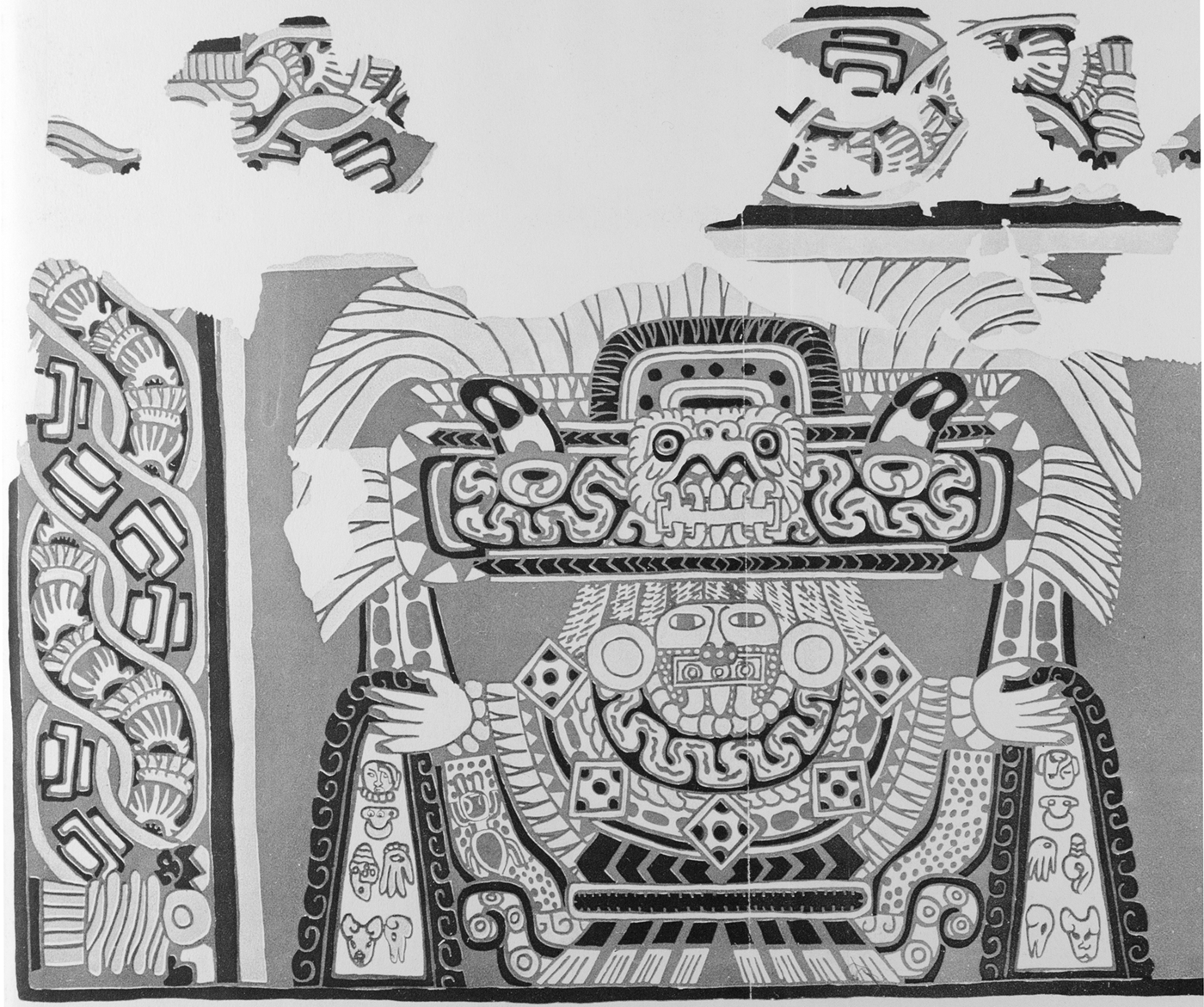
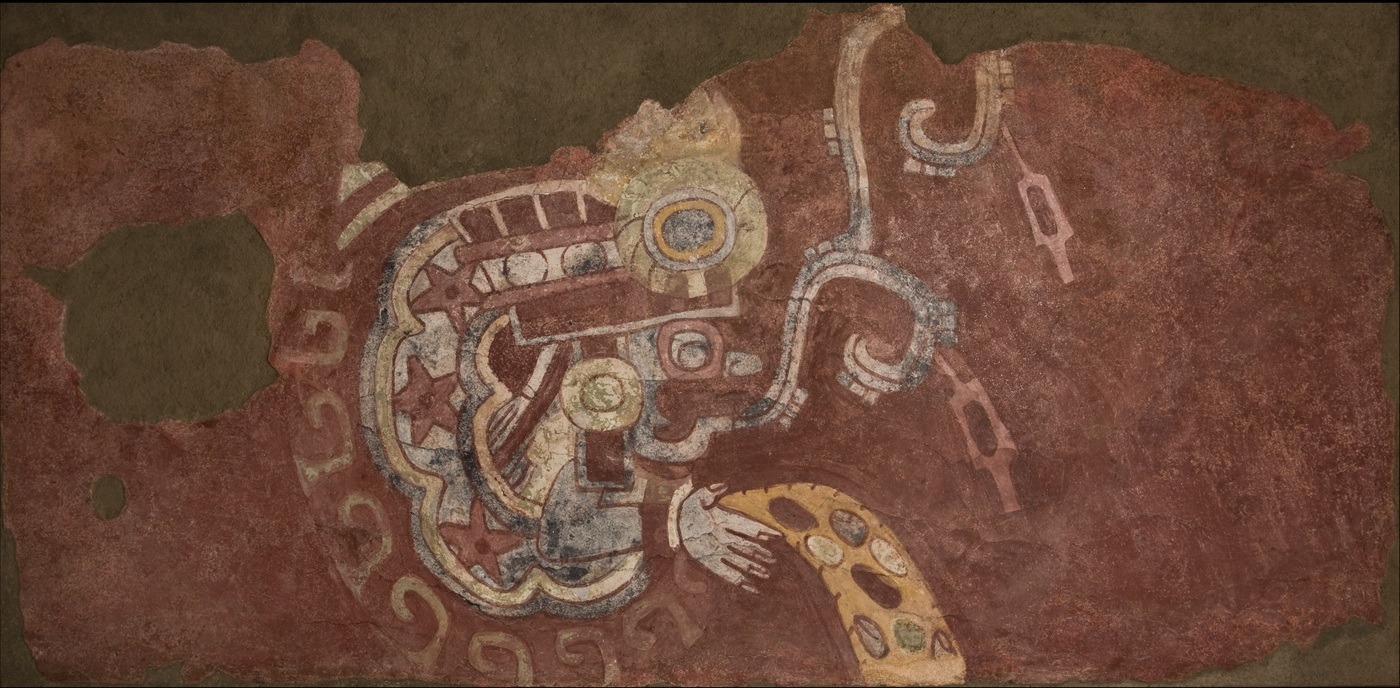
Several influential scholars have noted the primary, identifying attributes of the Great Goddess. According to Pasztory (Reference Pasztory and Berlo1992b:310), there are at least three customary characteristics distinguishing the Goddess, including (1) a nosebar that obscured the mouth, as present in the murals of Tepantitla and Tetitla (see Figures 1b and 2), (2) an avian headdress, and (3) a yellow and red zigzag band. Taube (Reference Taube1983:109) expanded on these identifying elements, saying that the most distinctive attributes of the Tepantitla deity are the fanged nosebar and her clothing, which he characterized as female, a subject expanded on below. Taube (Reference Taube1983:108) also concurs with Pasztory, noting “Aside from her gender, major features are a frame headdress with a bird medallion in the center, a curious nose bar with pendant elements suggestive of fangs, and, frequently, yellow body coloration.” Other Mesoamericanist scholars subsequently suggested different characteristics for the Goddess. For instance, Berlo writes that several of the deity's most significant attributes are the bountiful hands, the mirror, and the headdress (Berlo Reference Berlo and Berlo1992:134), and that “[h]er principal diagnostic features are butterfly wings (sometimes represented in quechquemitl-like form), and a headdress with the curled proboscis and antennae of a butterfly” (Berlo Reference Berlo and Berlo1992:136). Many of these characteristics do not identify sex, and they can only identify gender if it can be demonstrated that Teotihuacano men or women wore these attributes with some consistency. Determining the gender of a Teotihuacan deity, however, is made all the more challenging because there is an overall lack of consensus amongst scholars as to the Goddess’ principal identifying attributes. If, for example, scholars argue that a variety of different figures are representations of the Goddess, but cannot agree upon what her identifying attributes actually are, how can we accept that all these figures represent the same deity and, furthermore, how can we accept that all these figures are female?
Reproduction of a deity with fanged nosebar, Tetitla mural. Image courtesy of the Middle American Research Institute, Tulane University.

This lack of consensus regarding the Goddess’ attributes is reflected in the many names that have been bestowed upon the deity. As stated above, Taube (Reference Taube1983:108–109) suggests that the most important attributes of the Tepantitla deity are the fanged nose bar and female clothing, and notes similarities between the toothed nosebar and a spider mouth, calling the deity the “Teotihuacan Spider Woman.” Furst (Reference Furst and Hammond1974:187–217) alternates between “Mother of Water,” “Mother Goddess,” and “Earth Goddess.” Pasztory (Reference Pasztory1974, Reference Pasztory1976, Reference Pasztory, Cordy-Collins and Stern1977, Reference Pasztory and Berrin1988, Reference Pasztory and de Méndez1990, Reference Pasztory and Townsend1992a, Reference Pasztory and Berlo1992b, Reference Pasztory, Berrin and Pasztory1993), Berlo (Reference Berlo and Berlo1992:129–168), Berrin (Reference Berrin1988), and others prefer the “Great Goddess” or simply the “Goddess.” Citing connections with several central Mexican deities, Milbrath (Reference Milbrath1995: Figure 5a) suggests the Tepantitla deity is a gender-ambiguous Lunar Goddess who oversees rain and tides, and who is connected to war (a male attribute) and water (a “feminine aspect”) (Milbrath Reference Milbrath1995:60–61). Most recently, Headrick (Reference Headrick2007:15–16) has introduced the term “mountain-tree,” a gender-neutral term to refer to the deity.
As primary and secondary sex characteristics are not depicted in monumental public art, and as there is a lack of consistency in how deities are depicted, it is difficult to assign gender to them. For instance, of the Goddess’ identifying attributes, neither the nosebar nor headdress are claimed to be inherently female. Other features—liquid, the cave, tree, spider, and clothing—have alleged female fertility associations and have been key in the iconographic gender identification of the Great Goddess. Some of these presumed female symbols, however, are ambiguous signifiers that are moreover inconsistently present in images identified as the Great Goddess. In what follows, I analyze the significance of the Goddess iconography in an attempt to disentangle various interpretations of gender attribution.
The Headdress
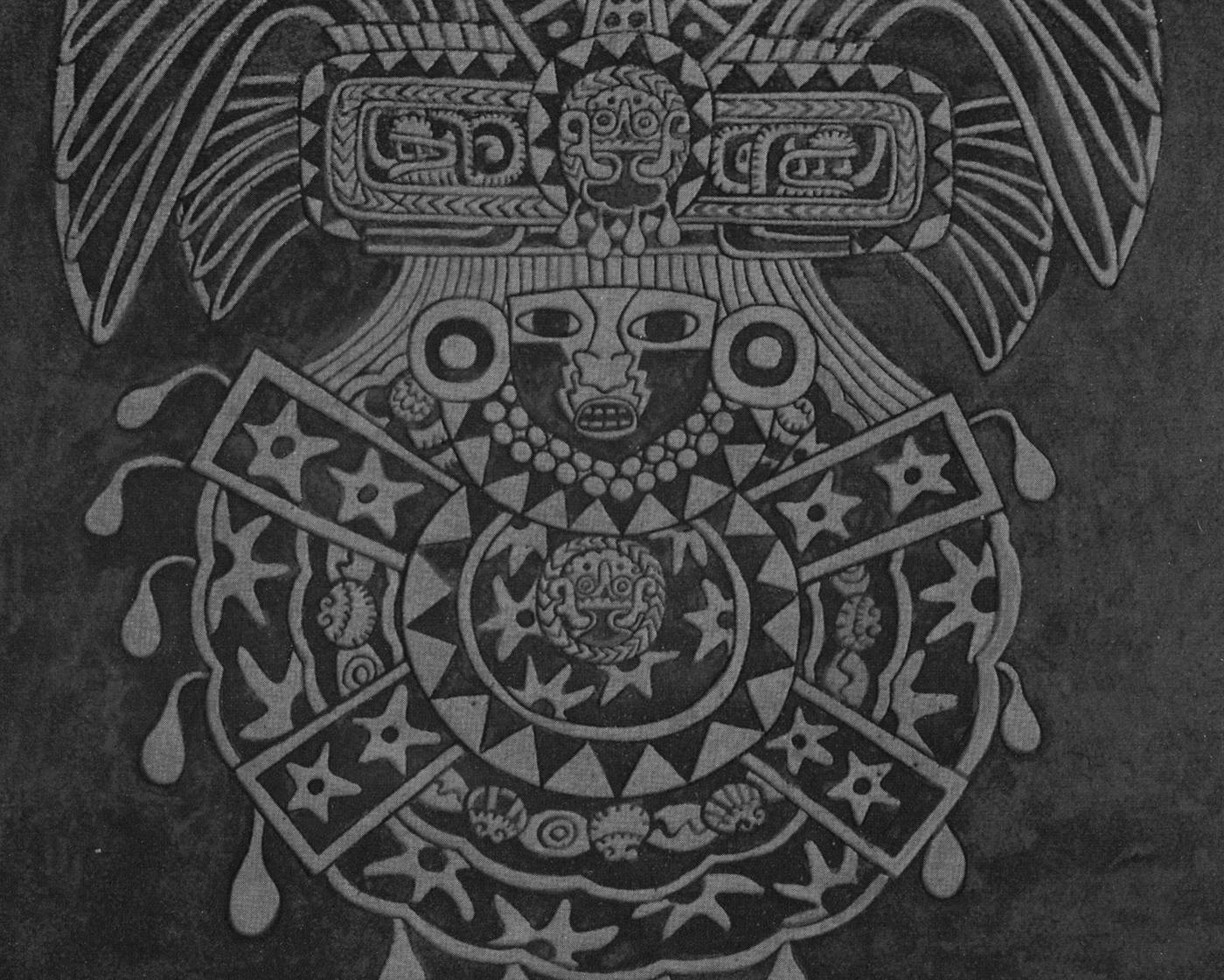
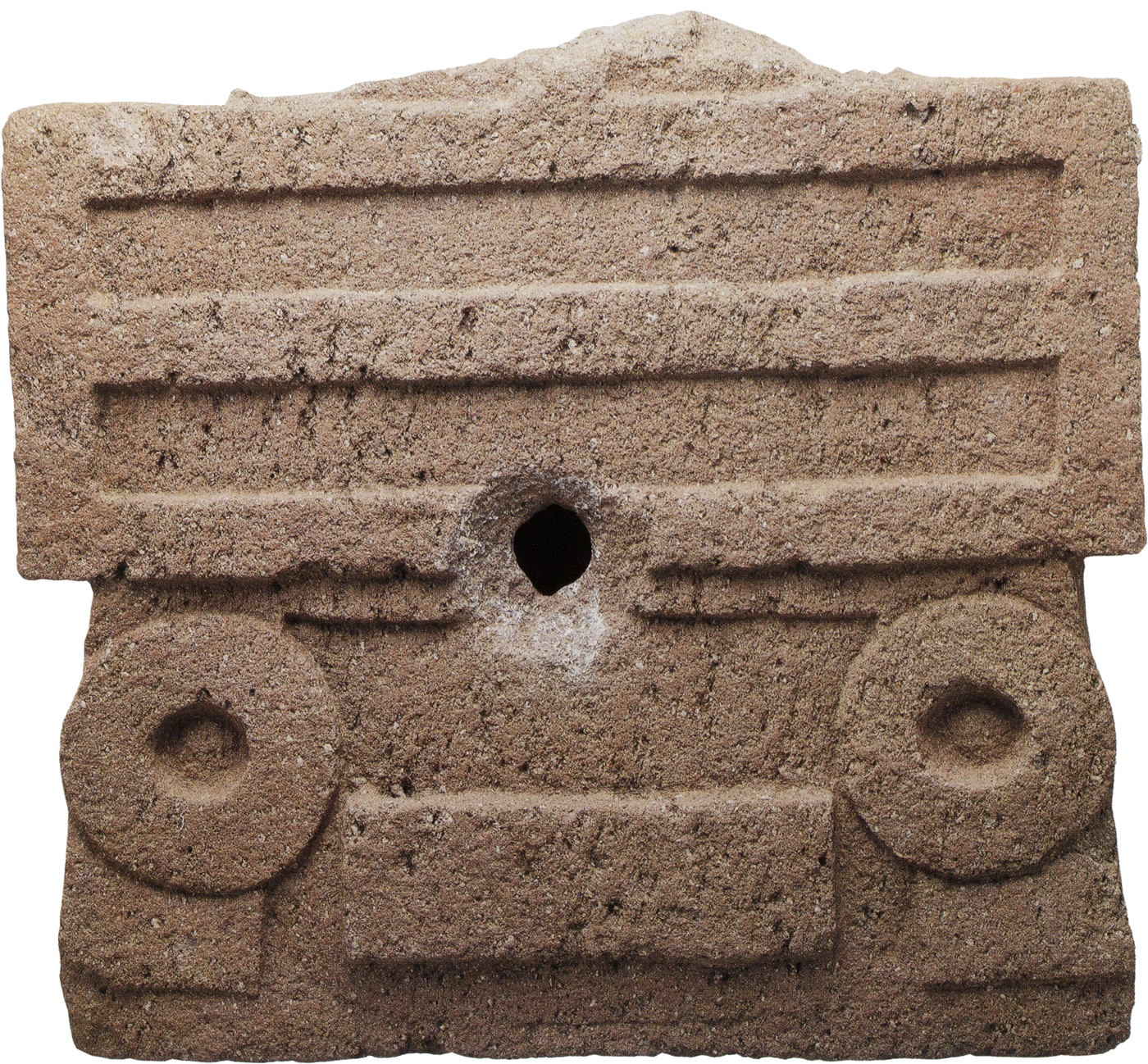
When using iconography to identify a deity, consistency is crucial, yet images that have been identified as the Goddess are inconsistent in their appearance, notably with regard to their attributes, specifically the headdress, nosebar, and red and yellow alternating triangles that create a zigzag band. Because Mesoamerican imagery typically uses distinctive headdresses to denote social class and identity, it is not immaterial that in the Palace of the Jaguars mural (Figure 3) the deity wears a very different headdress than other images that have been identified as the Great Goddess of Teotihuacan. For example, rather than wearing a headdress ornamented with a bird, as seen in the Tepantitla mural (Figures 1a and 1b), the Tetitla mural (Figure 2), the Winged deity (Figure 4), and the relief sculpture from the Street of the Dead Complex (Figure 5), the deity pictured in the Palace of the Jaguars mural (Figure 3) wears a headdress with a skull at its center, matching the one at the center of its round, shield-shaped element. Pasztory (Reference Pasztory, Cordy-Collins and Stern1977:91) and Berlo (Reference Berlo and Berlo1992:134) attribute the discrepancy to different personality traits of the Goddess; depicted here is her malevolent nature, which is also expressed when depicted with claws instead of hands. And while the headdresses depicted in both the Palace of the Jaguars mural and the relief sculpture from the Street of the Dead have profile serpents facing outwards, each has a different central image. The headdress in the Palace of the Jaguars mural has a skull at its center, whereas on the headdress seen in the Street of the Dead relief, there are three roundels at the center with two frontal owls appearing directly above the serpents. While these hatted figures differ in other ways—for example, the fanged nosebar appears in the Street of the Dead relief sculpture, whereas it is difficult to make out any nosebar in the Palace of the Jaguars mural—the presence of the serpents in both images is certainly interesting and deserving of further study. Nonetheless, the differences are significant and suggest that these are representations of distinct deities.
Palace of the Jaguars mural (modified from Miller Reference Miller1973:57, Figure 47).

Winged deity from Mural 3, Room 12, Zone 5a (modified from de la Fuente Reference de la Fuente1995:68).

Relief sculpture identified as the Goddess, Xolalpan-Metepec transition (a.d. 400–750). Reproduction authorized by the Instituto Nacional de Antropología e Historia.
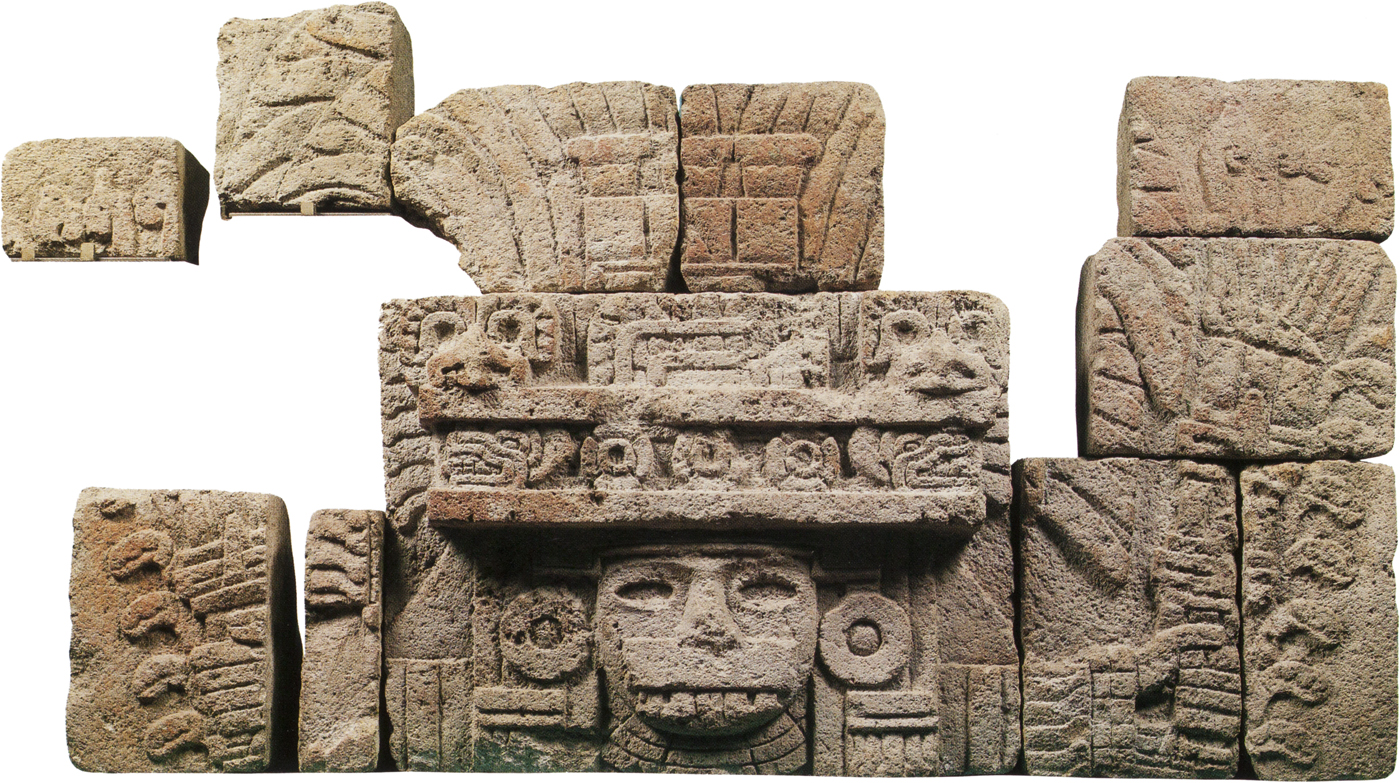
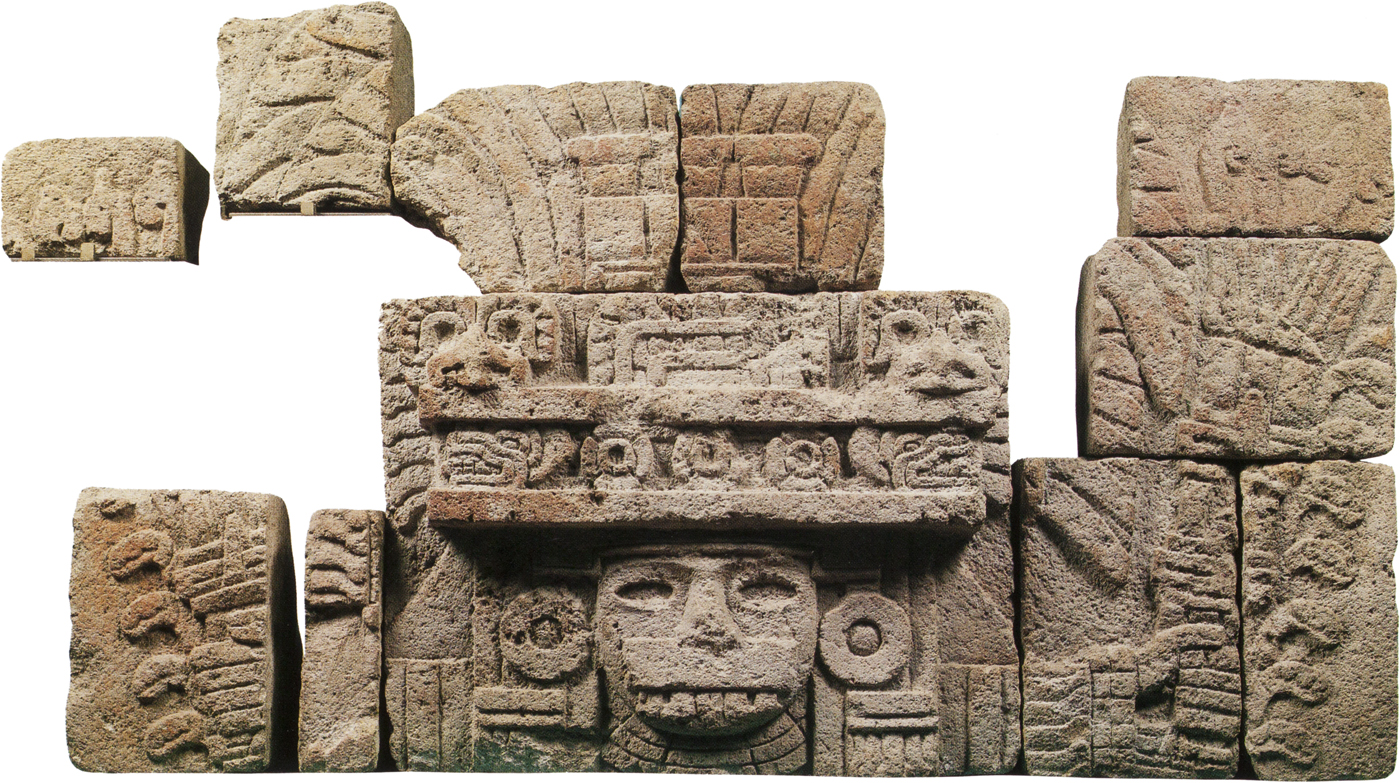
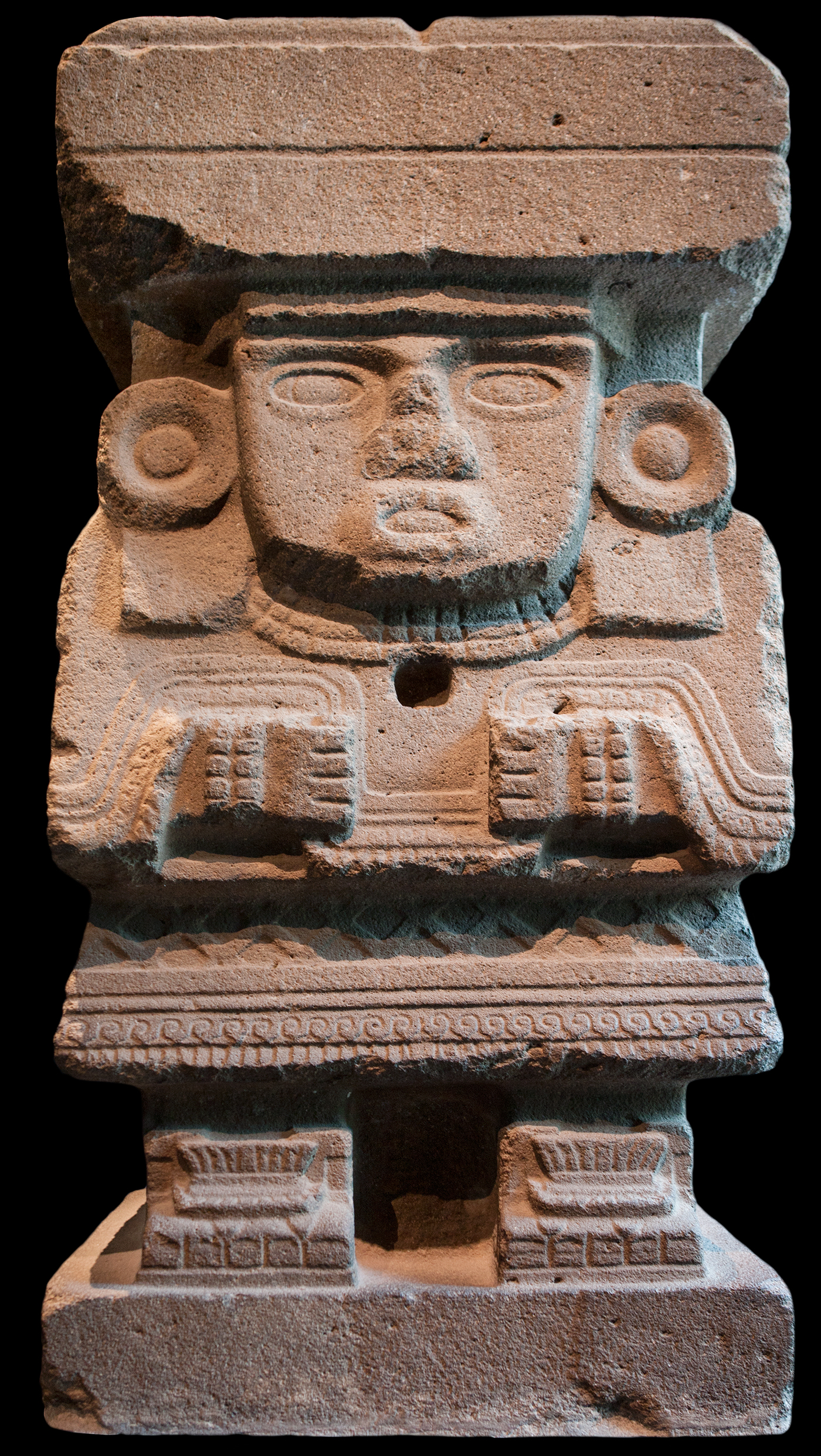
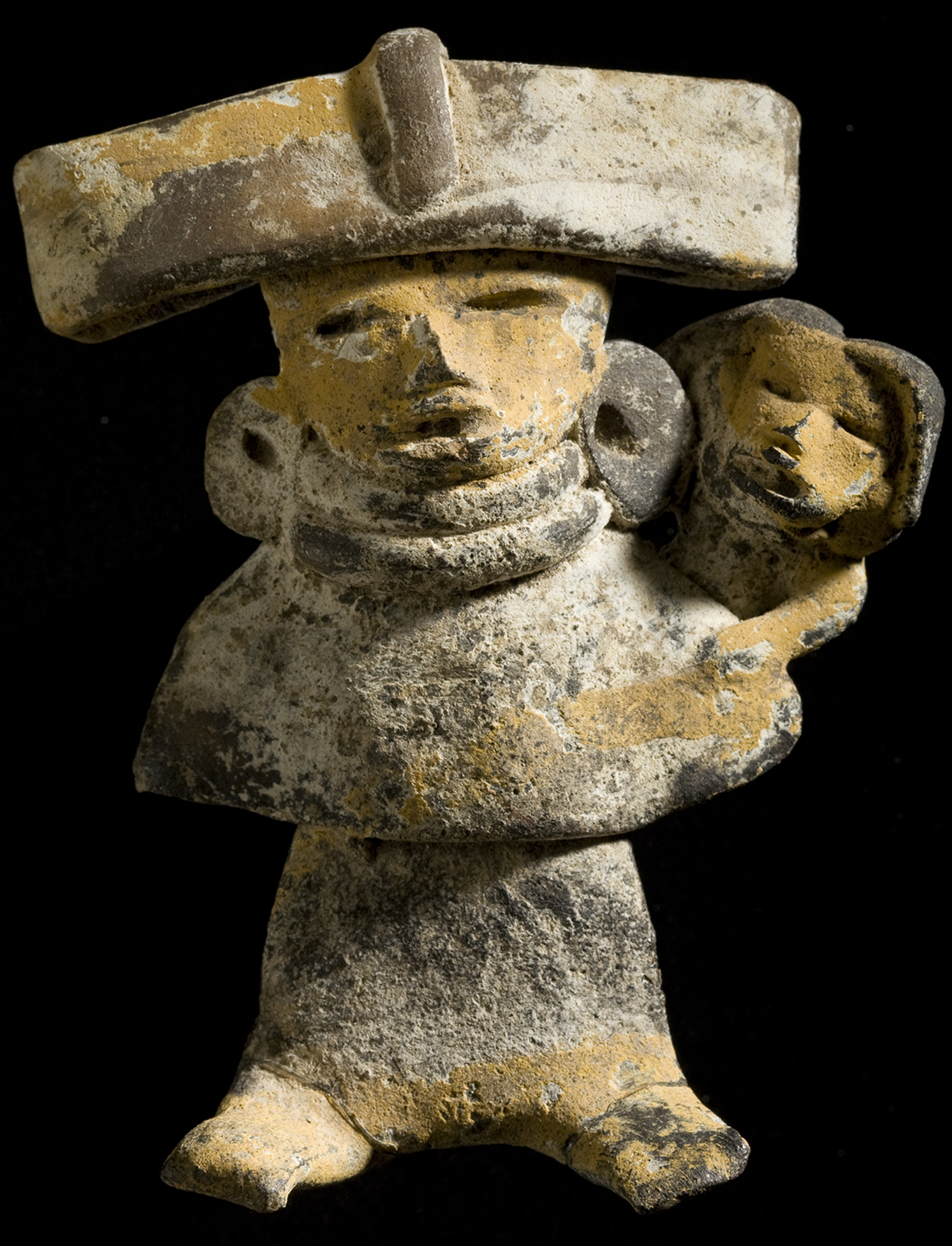
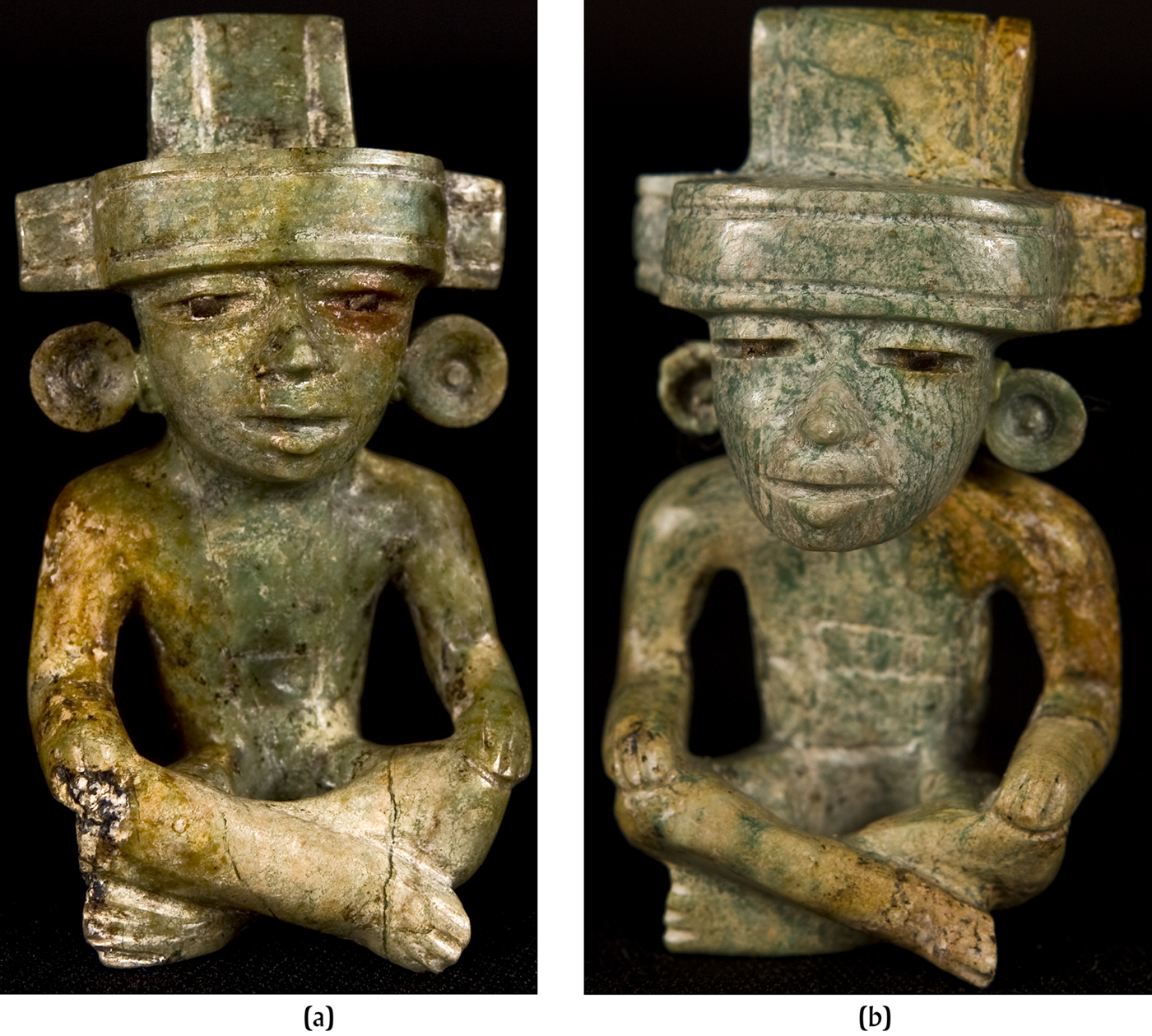
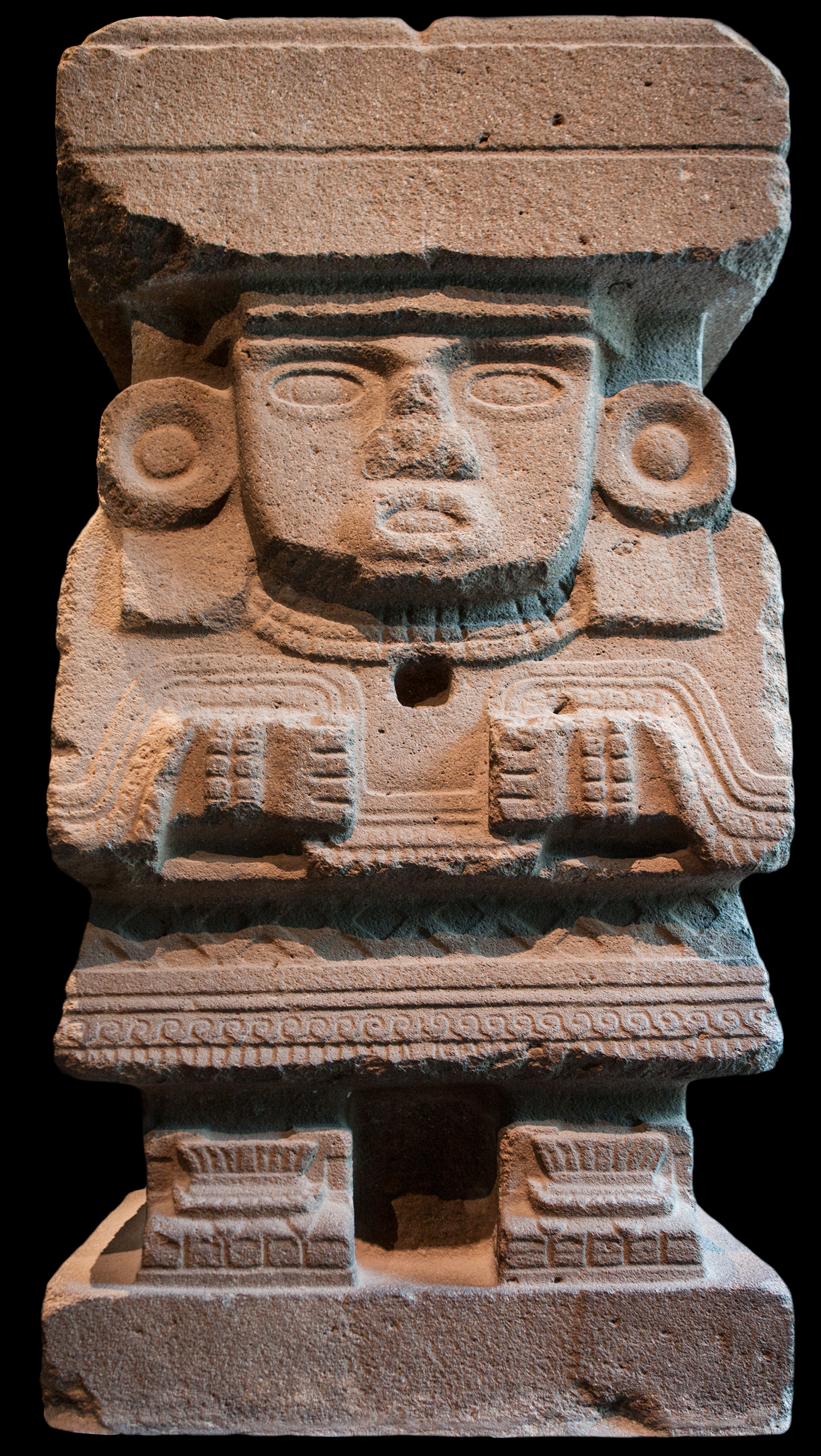
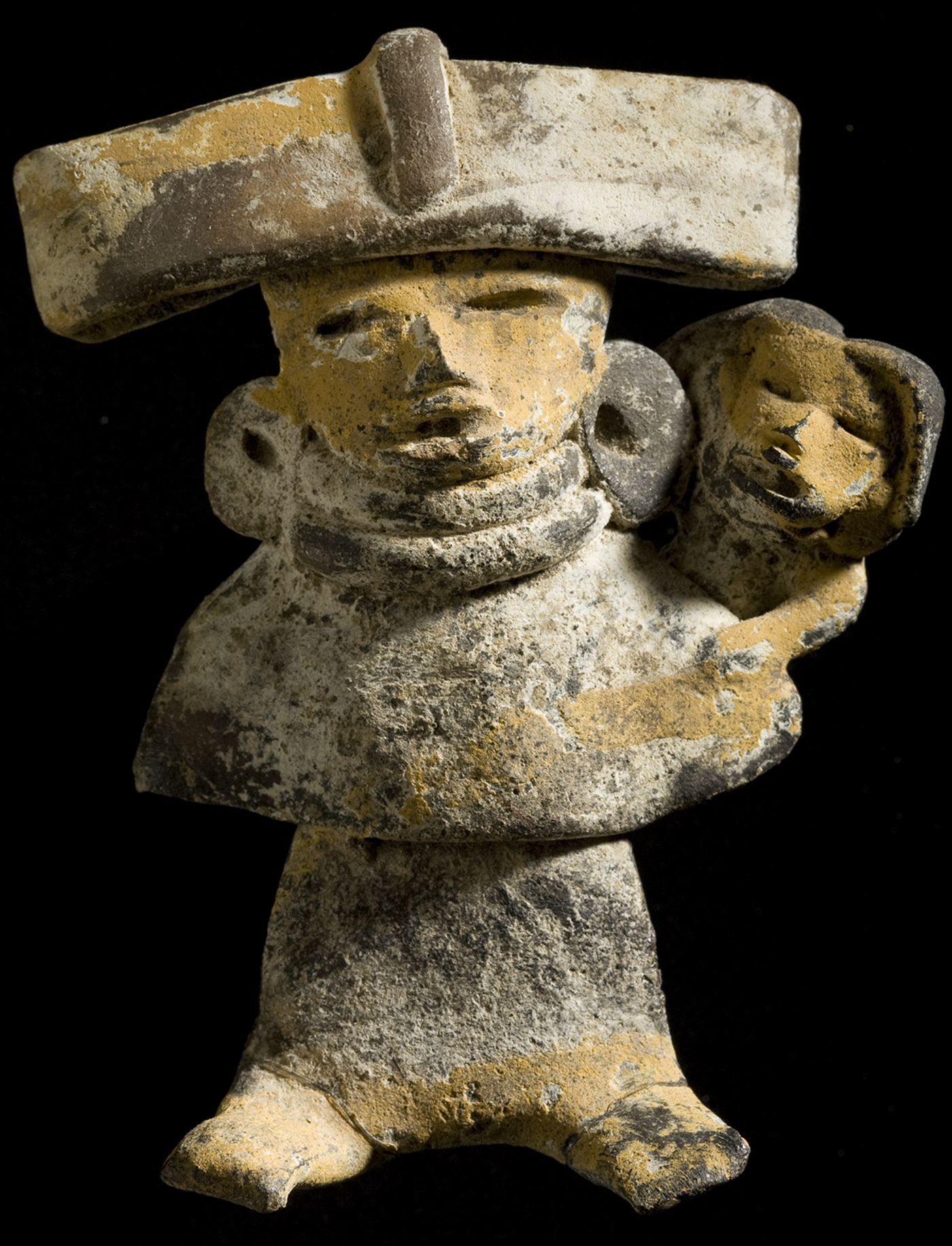
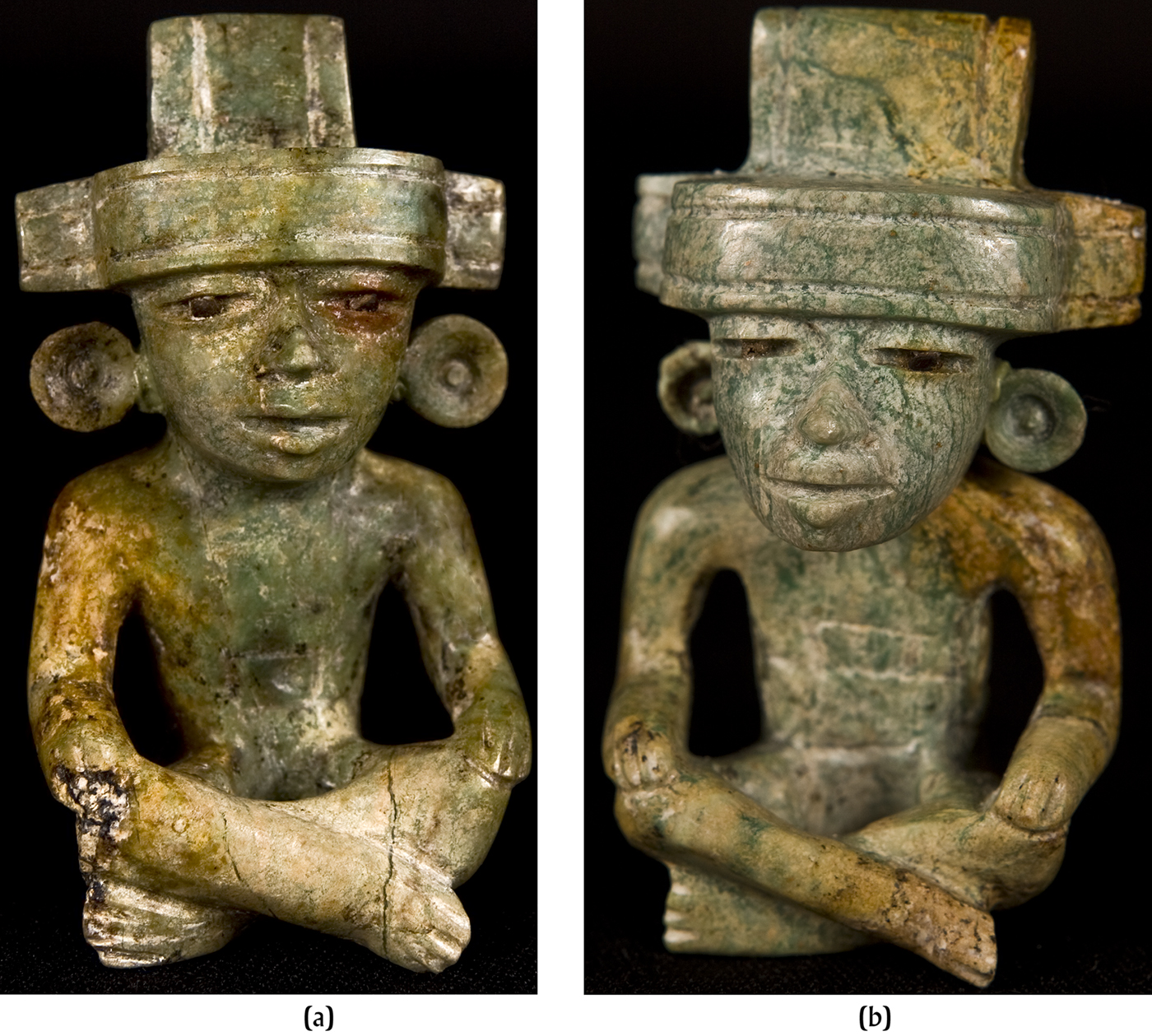
On the one hand, one might ask whether the wide-brim shape of the headdress—which has been called the frame headdress by Taube (Reference Taube1983:108), and that appears rectangular, as in the three-dimensional Colossal Statue identified as the Goddess (Figure 6)—is itself indicative of female gender. Indeed, this headdress is seen in the ceramic female figurine carrying a baby that, by virtue of activity, suggests a female gender (Figure 7). On the other hand, it may be unwise to assume that all figures carrying or holding children are female; there may be exceptions, and men may have shared in some aspects of childcare. Variations of the wide-brimmed headdress, however, also appears in figures that have previously been identified as male, such as the profile staff-bearers in the White Patio of Atetelco, who Headrick (Reference Headrick2007:Figures 1.13 and 2.8) identifies as rulers (see Figure 8), in two breastless greenstone figurines excavated from deposit three of the Pyramid of the Moon (Figure 9), and in representations of the Storm God (Figure 10), who is most often identified as male, although in some cases, discussed below, as female. As these examples show, both males and females wore rectangular headdress, albeit with feathers or other ornamentation emerging from the top part of the hats. Thus, I conclude that the wide, rectangular shape itself is not a marker of gender.
Colossal Statue Identified as the Goddess. Photo © Martirene Alcántara.
Female figurine with infant (a.d. 150–350). On loan from Constance McCormick Fearing [L.83.11.3]. Photo © 2013 Museum Associates/Los Angeles County Museum of Art.
Profile staff-bearers from the White Patio, Atetelco. Photo © Martriene Alcántara.
Greenstone figurines from the Pyramid of the Moon. Photo © Martriene Alcántara.
Storm God sowing. Photo © Martriene Alcántara.

The Nosebar
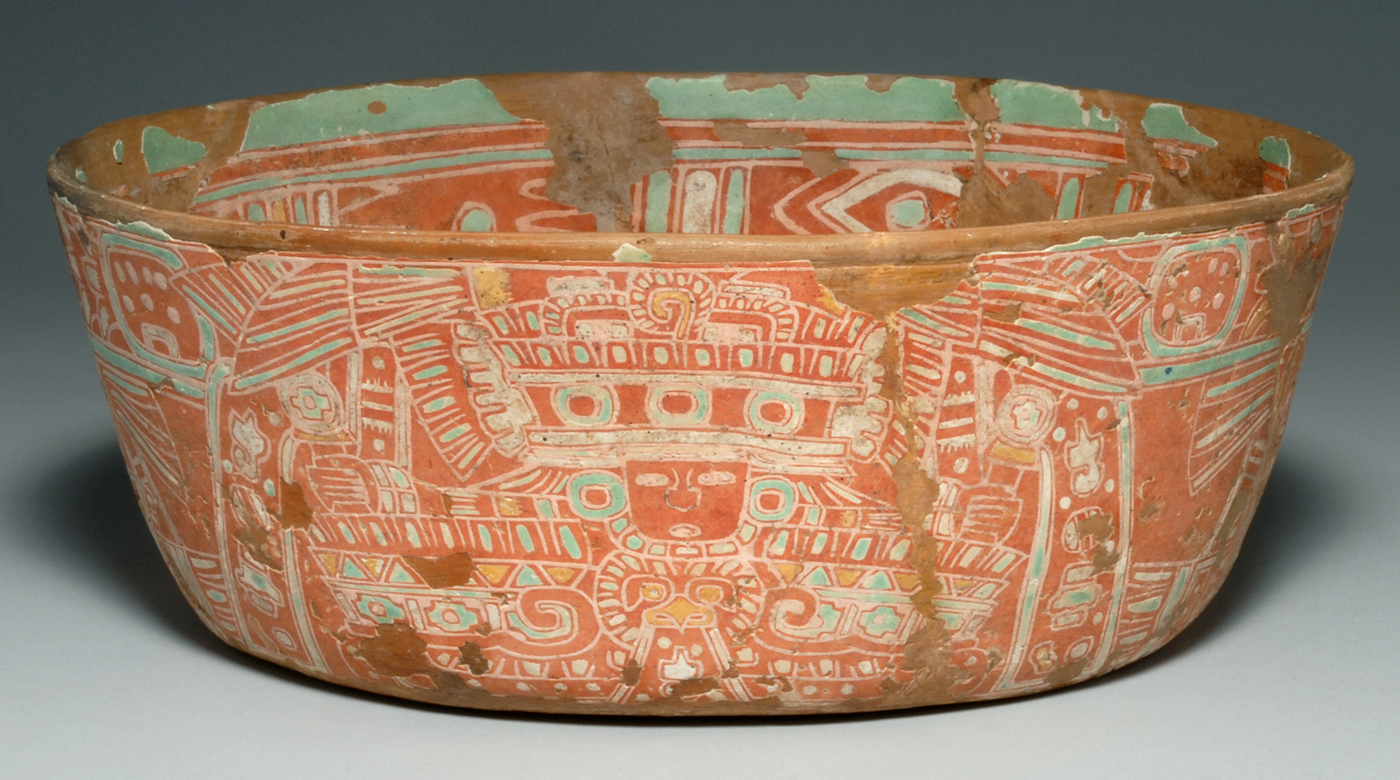
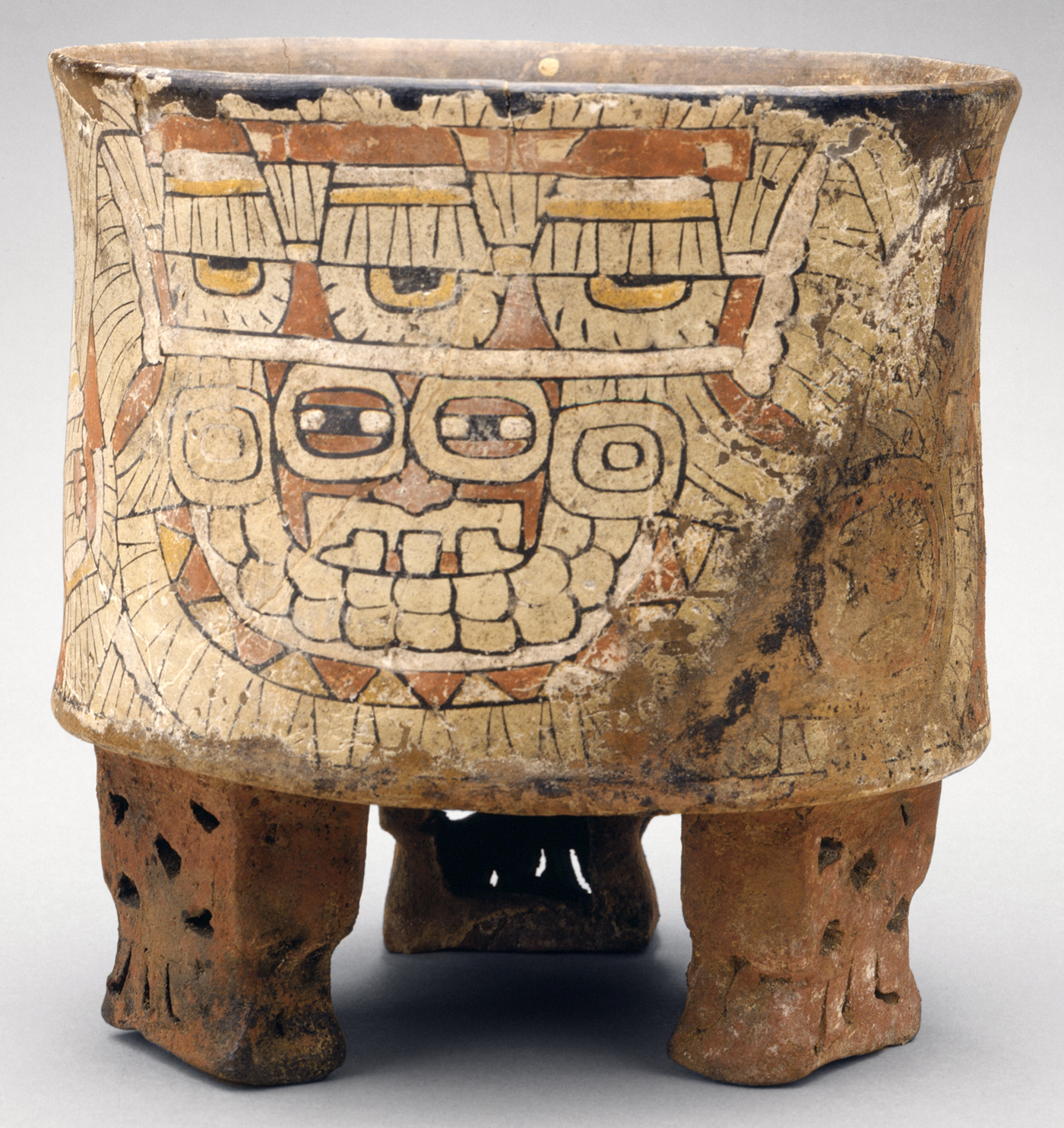
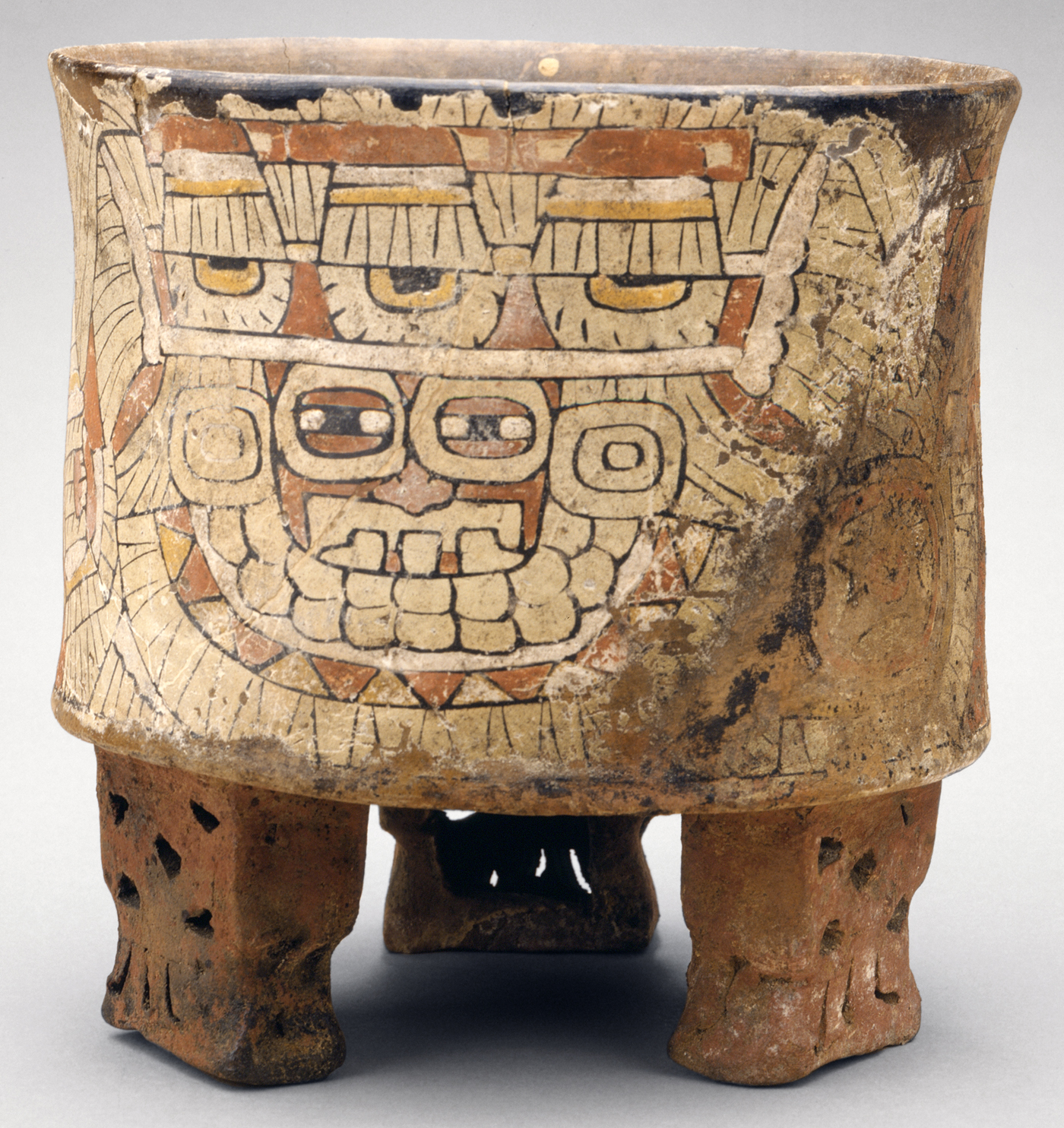
According to Pasztory's model, the nosebar is another important diagnostic attribute of the Goddess. There is nothing to suggest, however, that nosebars are female-gendered. With regard to its association with images identified as the Great Goddess, there is no shortage of inconsistencies: sometimes images identified as the Goddess wear plain, rectangular nosebars (Figure 11), others sport fanged nosebars, such as the Tepantitla and Tetitla deities (Figures 1b and 2), some of the nosebars have roundels (Figures 1b and 2), while other examples from the Street of the Dead relief and Abstract Deity do not (Figures 5 and 11), and several images discussed below, although also identified as the Goddess, lack a nosebar altogether (Figures 3, 4, 6, and 12). There are figures who have been identified as someone clearly not a deity and/or not female, and yet who wear one of the types of nosebars iterated above. The fanged nosebar is seen on figures that have been identified as female deities, such as those in the Tepantitla and Tetitla murals (Figures 1b and 2). The same nosebar is also seen on figures identified as human males, such as the goggle-eyed figure on a tripod vessel (Figure 13). This frontal figure is similar to those identified by Clara Millon as commanders of military units (see the catalog caption by Cynthia Conides in Berrin and Pasztory [Reference Pasztory, Berrin and Pasztory1993:Catalog No. 140]). In addition, human figures wearing a fanged nosebar, which Uriarte (Reference Uriarte2009:Figure 6) recognizes as similar to those worn by Tlaloc, appear on the Patio 2 mural of the White Patio of Atetelco (Figure 8). These are the same staff-carrying human figures that Headrick (Reference Headrick2007:Figures 1.13 and 2.8, 30–31; see also Footnote 4 above) identified as rulers. They emit speech scrolls from their mouths, carry large conch shells and, in addition to short skirts over loincloths, they wear magnificent avian headdresses containing red and pink triangles (not red and yellow) following the curve of each bird's head. Elsewhere I have proposed that these repeated figures instead represent a military order (Mandell Reference Mandell2009), as Headrick (Reference Headrick2007:Figures 4.2, 4.10, and 4.17) proposed for the canine and bird warriors that appear on either side of this mural in Patios 1 and 3, respectively, in the White Patio of Atetelco. The implications are either that these figures represent religious attendants to the Goddess, which to my knowledge no scholar has suggested, or that the nosebar is not a diagnostic attribute of the Goddess.
Abstract sculpture identified as a Goddess, Xolalpan (a.d. 400–600). Reproduction authorized by the Instituto Nacional de Antropología e Historia.

Teotihuacan bowl. Image © Dumbarton Oaks, Pre-Columbian Collection, Washington, DC.

Tripod vessel with image of goggle-eyed figure (a.d. 550–650). Los Angeles County Museum of Art, Gift of Constance McCormick Fearing [AC1993.217.16]. Photo © 2013 Museum Associates/ Los Angeles County Museum of Art.
Red and Yellow Triangles
The red and yellow “zigzag” triangle pattern is likewise inconsistent in images identified as the Goddess. While the Palace of the Jaguars mural does depict a “zigzag” pattern around the neck of the deity, at the center of the quadripartite symbol, and on the headdress, the pattern is made up of alternating pink and red triangles, not yellow and red, as is the case in the human warrior figures from Patio 2 of Atetelco (Figures 3 and 8), and a frescoed bowl (Figure 12) has alternating yellow and turquoise triangles. A winged image (Figure 4), a frescoed bowl (Figure 12), and an abstract sculpture (Figure 11), all identified as the Goddess, lack the zigzag bands.Footnote 7
The persistent efforts to identify female characteristics for a Great Goddess are problematic on several levels, one of which is simply that images identified as the Great Goddess share few characteristics, and scholars do not agree upon which are the most important. The lack of consensus regarding the common characteristics of the deity indicates a problematic absence of consistent diagnostics. These attributes have been assumed to have female qualities because they have been associated with figures identified as the Great Goddess. These presumed attributes appear in images that have been identified as male, and they do not appear with regularity in images identified as the Great Goddess. In fact, it has not been conclusively demonstrated that there is anything inherently feminine or female about the nosebar, avian headdress, or the red and yellow alternating triangles; a convincing case demonstrating that these particular attributes are associated with a female gender has not been made. In describing the Tepantitla deity, Cowgill (Reference Cowgill1997:150) notes the difficulty revolving around the lack of consistent diagnostics, stating that the “…attributes that may be only diacritical are treated as diagnostic…. If one does not take the nose pendant or the birds in the headdress as diagnostic of the Goddess…nothing else in the figure proves it to be female.” In addition, because the nosebar and avian headdress are also seen in images identified as male, not even these two elements prove the Tepantitla figure to be female. Moreover, the inconsistent occurrence of these elements leads to inconsistent appearances; when the proposed goddesses are grouped together, they look rather different, with distinct characteristics—sometimes with a plain nosebar, sometimes a fanged nosebar, and other times no nose ornament at all. In other words, the iconographic elements discussed here are expendable, rather than diagnostic.
CONSIDERATIONS OF THE FEMALE ATTRIBUTES OF THE GODDESS
In addition to those attributes discussed above, the Goddess is also associated with a range of visual characteristics, most of which have been put forward as representative of female fertility. I ask, what constitutes a male characteristic versus a female characteristic at Teotihuacan? The gushing waters laden with seeds and marine life, the tree, the cave, and the spider, have all been proposed as indicating fertility symbolism and an intimate relationship with femininity. This emphasis risks linking female qualities to fertility, reducing women to this biological function and, as I discuss below, it overlooks the possibility of male participation in this ritual. Ultimately, gender is more than biology, it involves ideologies, roles, relations, and all of the ways in which gender intersects with, and is influenced by, other aspects of social life. As Gero and Conkey (Reference Conkey, Gero, Gero and Conkey1991:12) caution, there can be no archaeology of gender if it is limited to and defined by gender attributions alone.
Libations
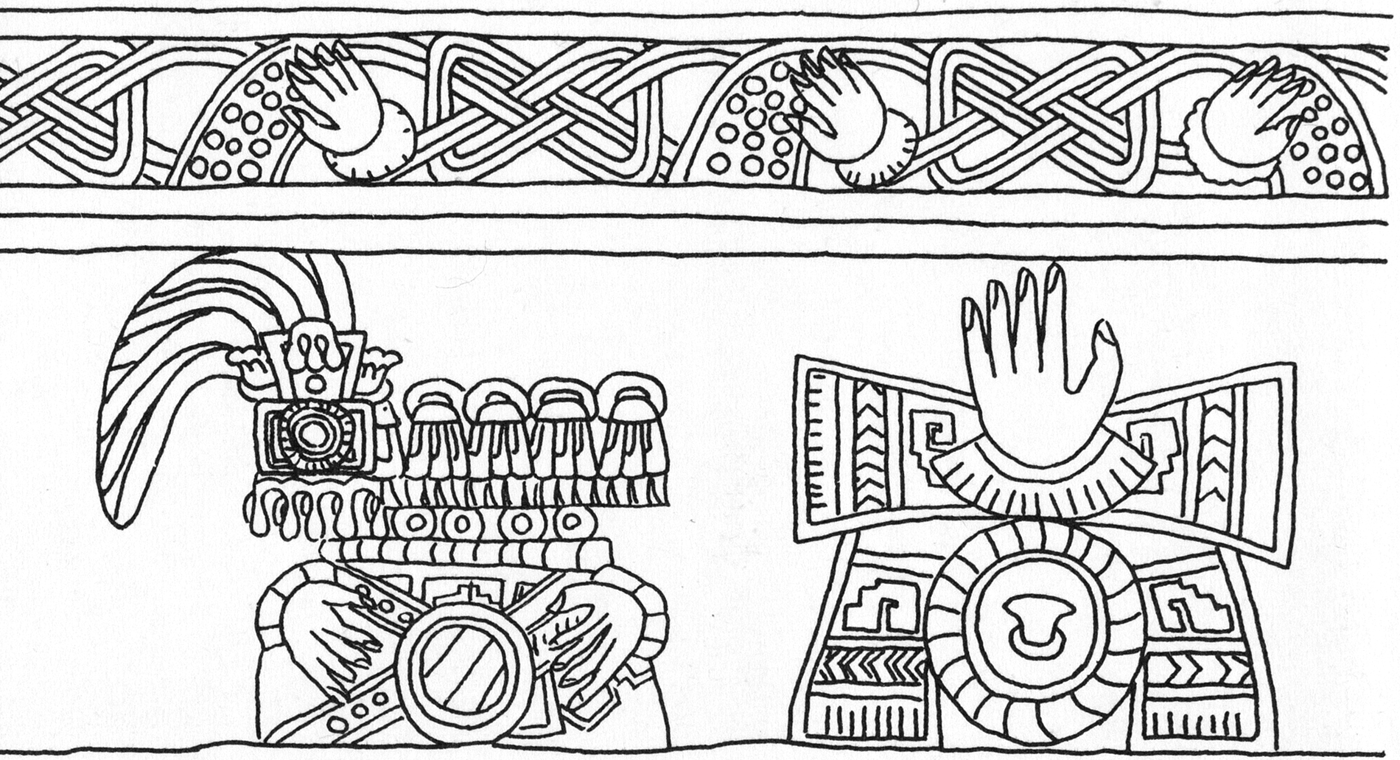
Many images have been identified as the Goddess due, in part, to an association with water—either pouring liquid from the hands or, occasionally, from the mouth. In the Tepantitla mural, individual drops of fluid appear to drip from the fingertips of the central deity (Figures 1a and 1b). In the Tetitla mural, wide, curved bands with borders decorated by curled wave patterns stream forcefully from the hands of the figures (Figure 2), and disembodied hands emphasize the action (Figure 14). In the Tepantitla and Tetitla murals the liquid is filled with shell-shaped objects, round, seed-shaped objects, as well as disembodied hands, fanged nosebars, and other enigmatic objects. There is nothing inherently female about liquid and these representations of fluid streams and libations should not be assumed to be exclusively feminine. This liquid, laden with marine life and seeds, may just as well represent semen laden with sperm, an irrefutably male characteristic. In fact, as I discuss, in Maya art fluid streams are always seen issuing from the hands of men, which might suggest a masculine association for the Teotihuacan images.
Mural with scattering hands, Tetitla. Image courtesy of the Middle American Research Institute, Tulane University.

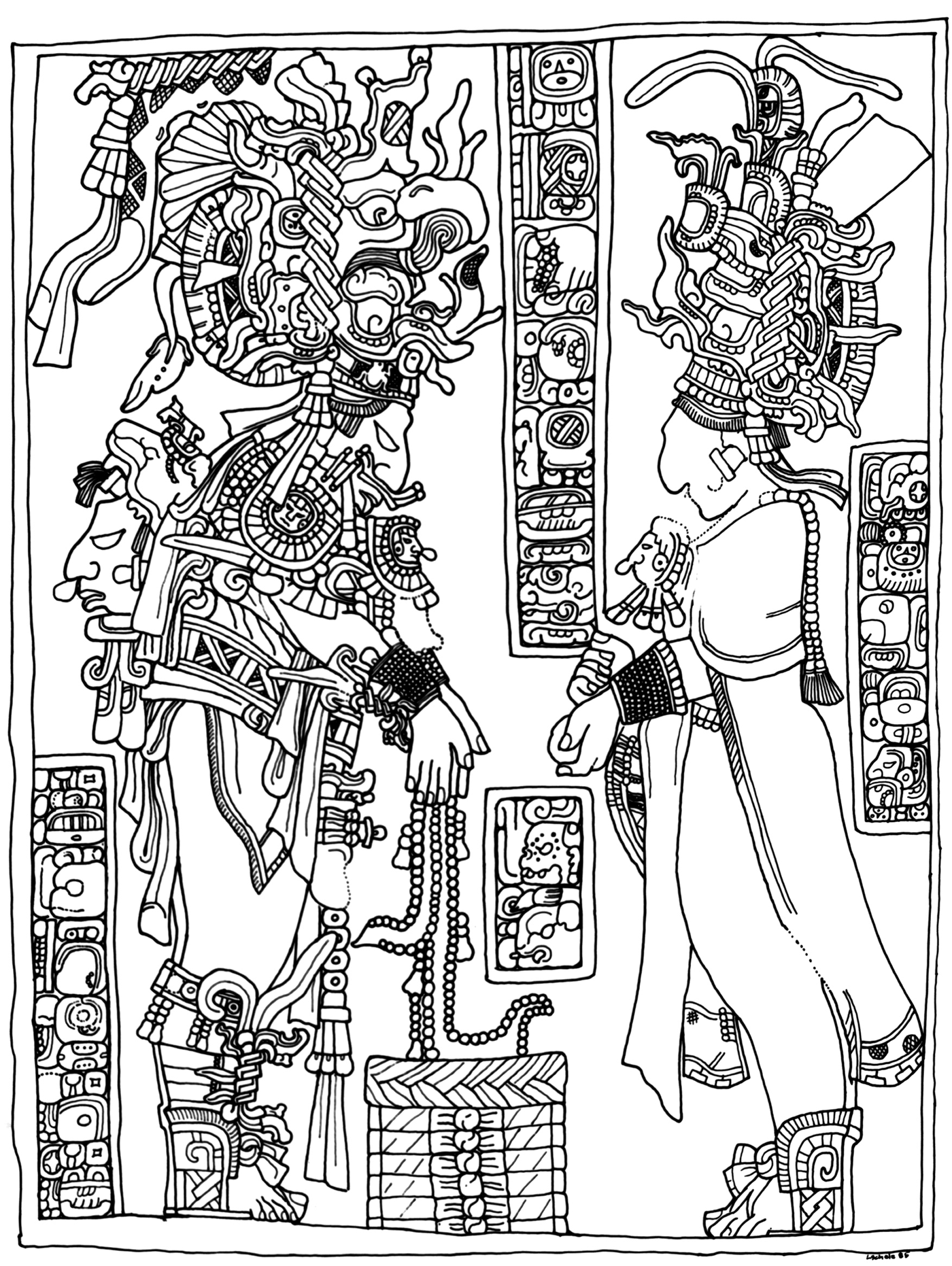
Indeed, there is a striking resemblance between the Teotihuacan images of figures (and disembodied hands) pouring liquid filled with small, round objects, and the depictions of autosacrifice by Classic Maya kings who pour streams of “divine horn(s) of plenty” from their fingers and hands (Martin Reference Martin and Grube2001:105). This similitude is not surprising given that the hand-scattering rite originated in central Mexico (Martin Reference Martin and Grube2001:105). On Lintel 2 from La Pasadita, as well as on other Maya stelae, the glyph for hand-scattering appears in concert with bloodletting rituals (Figure 15). This glyph—third from the top in the upper glyph column in Figure 15—is strikingly similar to the disembodied hands scattering seed-shaped objects at Tetitla (Figure 14). While Stuart (Reference Stuart, Benson and Griffin1988:180–187) argues that Lintel 2 at La Pasadita depicts the Maya king Bird Jaguar IV pouring blood from his hands into a basket, Bassie-Sweet (Reference Bassie-Sweet1991:65–69) cautions that it is unclear whether the drops falling from the hand-scattering pictograph are blood or, as some have suggested, balls of copal incense. Bassie-Sweet explains (Reference Bassie-Sweet1991:65–69) that blood and incense are burned together in Maya New Year ceremonies and that there is a close relationship between blood and incense; the Maya consider pom, or incense—made from tree sap or resin—to be the blood of trees.
La Pasadita, Lintel 2, Late Classic period (a.d. 600–900). Drawing by Linda Schele. © David Schele. Courtesy of the Foundation for the Advancement of Mesoamerican Studies, Inc., www.famsi.org.

In exploring the relationship between bloodletting and sexuality, Stone suggests that penile bloodletting recalled a women's menstrual cycle, allowing Maya kings to use this potent symbol of female fertility for their political benefit. She (Stone Reference Stone and Miller1988:75–76; see also Looper Reference Looper and Ardren2002:171–173) states that “[t]his particular method of shedding blood conceptually transformed the male genitalia into a doubly potent agent of fertility, capable of shedding two life-giving fluids: semen and blood. The shedding of blood from the male sexual organ also mimics the female menstrual cycle.” Thus, representations of hand scattering imagery may have both masculine and feminine connotations related to fertility and agriculture, and the motif of liquid pouring from the hands might just as well be associated with a larger concept that is mixed gendered, combining masculine and feminine fertility symbolism. Perhaps the liquid that spills from scattering hands at Teotihuacan is meant to enhance the gender fluidity of these deities.
Caves
It is certainly well documented that caves have long-standing, pan-Mesoamerican associations with creation and emergence. Throughout the ancient Americas, caves were thought of as metaphorical wombs. Heyden's (Reference Heyden and Benson1981:1–39) work on the tunnel and cave system beneath the Pyramid of the Sun at Teotihuacan factors strongly in this argument; she argues that it was likely a site that the Nahua regarded as representing Chicomoztoc, their place of origin, as well as holding equally strong meanings for Teotihuacanos. At the same time, Heyden establishes a connection between this cave and the Storm God, who, while often described by scholars as male, has been shown to have mixed-gendered qualities, as I explain below.
While thus far no association has been made between the Goddess and the Pyramid of the Sun or its famous cave, within the Tepantitla deity there is an enigmatic form that looks like an upside-down saucer, a “down-turned U-shape” (Headrick Reference Headrick2007:29; Paulinyi Reference Paulinyi2007:255), or an “inverted horseshoe-shape” (Milbrath Reference Milbrath1995:61, citing Heyden [1981] and Pasztory [Reference Pasztory1973:150]) that some have associated with a cavern. Pasztory (Reference Pasztory, Berrin and Pasztory1993:55) indicates that although the deity appears large, she is actually a bust placed on a platform, within which appears a “cavelike space…[which] like her womb, is full of seeds.” Headrick (Reference Headrick2007:29) proposes that this form represents “both a cave and the vaginal opening of the personified mountain” (Figure 1b). Milbrath, examining it within the context of central Mexican iconography in the Codex Borgia 16, suggests that it is an early variation of a Postclassic lunar insignia called a yacameztli, which may sometimes have uterine characteristics, releasing menstrual blood (Milbrath Reference Milbrath1995:61). On the other hand, Paulinyi (Reference Paulinyi2007:254, drawing on Pasztory [Reference Pasztory1973:85, Reference Pasztory1976:165–169], Reference Paulinyi, Fash and Luján2009:178) identifies this same elusive structure in the “Mural of Offerings” in the Temple of Agriculture as the Rain God's upper lip. Variations of this form appear as an upturned U-shape in the Tetitla mural (Paulinyi Reference Paulinyi2007:Figure 2) and in a ceramic representation of the Storm God (Paulinyi Reference Paulinyi2007:Figure 8), and downturned in a tecalli travertene marker (Musée du Quai Branly 2009:Catalog 41, Plate 247), a bas-relief ceramic disc (Musée du Quai Branly 2009:Catalog 71, Plate 269), with fangs in a detail from the Atetelco mural (Paulinyi Reference Paulinyi2007:Figure 6), a tripod vessel (Musée du Quai Branly 2009:Catalog 132, Plate 319), as well as in an abstract representation of the Storm God (Paulinyi Reference Paulinyi2007:Figures 10A and 10B). More recently, Paulinyi (Reference Paulinyi2014:31, 33) refers to this form as symbolic of the watery underworld.
If this puzzling form seen in the central deity at Tepantitla is a reference to the Storm God, it suggests that the iconography of the two are coupled, which subsequently calls into question its gender. The Storm God is usually identified as being male, often depicted wearing a loincloth—a garment associated with masculinity—and is referred to in colonial and secondary source documents as “Lord” or “God,” or by masculine pronouns (for representations of Tlaloc wearing a loincloth see Klein Reference Klein1980:Figure 1b; Pasztory Reference Pasztory1983:Plate 113; Townsend Reference Townsend and Townsend1992:Figures 6 and 8). Klein (Reference Klein1980:162, 198), however, has suggested that hybrid Tlaloc images are sometimes depicted as “bisexual,” including an example in which a “Tlaloc-headed ‘earth monster,’” displaying some characteristics associated with Ilamatecuhtli-Cihuacoatl and positioned in the hocker or birthing pose, is depicted with breasts. In another sculpture, this time from the underside of the monumental Coatlicue statue, Klein (Reference Klein1980:162, Figure 5) postulates that two petal-shaped forms protruding from the round midsection of this hocker-positioned Tlaloc figure may be representations of breasts. If she is correct about the identification of breasts on the Tlaloc figure carved on the underside of the great Coatlicue sculpture, then the presence of the loincloth strongly suggests the presence of a mixed-gender figure on this Aztec sculpture. In fact, at Tepantitla, the identification of the upside-down U-shape as a Rain God signifier—his bigotera, or large upper lip—would seem to enhance the mixed-gender qualities of the deity, since Tlaloc, who is usually considered male, is sometimes depicted with female characteristics. In addition, the presence of a rhomboid-shaped eye mask of the Old Fire God in the Tepantitla deity, as identified by Pasztory (Reference Pasztory, Cordy-Collins and Stern1977:87, see also Berrin and Pasztory [Reference Berrin and Pasztory1993:Catalog 9–11]), suggests that this feature embodies male qualities. The male and ambiguous gender elements, such as the fluid streams issuing from hands, along with female references, such as the quechquemitl worn by the attendants (discussed below), and perhaps the positioning of the central figure above a mountain that seems to have a water-filled cave within it, support the mixed-gender characteristics of the Tepantitla deity.
Trees
Scholars have identified the tree emerging from the Tepantitla deity's head, and the insects on it, as embodying significant gender ideologies. Pasztory (Reference Pasztory1976:153, citing León-Portilla [Reference León-Portilla and Davis1963:124–127]) views trees—bearers of fruit—as having feminine qualities, citing the Nahua belief in a particular paradise where dead Nahua children resided as the “Place of the Nursemaid Tree” or “Breast-Fruit Tree,” characterized by a tree whose leaves dripped with milk. Headrick (Reference Headrick, Brown and Stanton2003), however, interprets the two principal branches of the tree emerging from the head of the deity as being associated with two different animals: the spider and the butterfly.
With regard to the branch associated with spider imagery, and as described above, Taube (Reference Taube1983:107–189) postulated that the Tepantitla deity represented a Teotihuacan Spider Woman. Pasztory (Reference Pasztory1976:161) turned to other Mesoamerican traditions to hypothesize that the spiders visible in Teotihuacan art relate to women's arts, acknowledging the complexity of spider imagery in Mixtec, Aztec, and Maya mythology, the latter for whom the spider symbolizes the moon and fertility goddess, who is the patron of weavers and women. Headrick (Reference Headrick, Brown and Stanton2003:164) identifies the spider as female, and bases this association on Taube's (Reference Taube1983:107–189) pan-American study on spider woman myths. Pasztory (Reference Pasztory1976:160–161) links the corresponding branch of the tree with spinning, weaving, and childbirth and, thus, with the female realm.
As noted, the other branch of the tree is decorated with butterflies, which Headrick interprets as male, based on the idea first proposed by Janet Berlo (Reference Berlo and Berlo1983:79–117), that butterflies at Teotihuacan are associated with warfare, which Headrick (Reference Headrick2007:139–143) and Milbrath (Reference Milbrath1995:61) have subsequently characterized as a male enterprise. But one has to ask whether it is implausible that women at Teotihuacan could have been actual warriors, and not just metaphorical ones. Sugiyama (Reference Sugiyama2005:128, 229) has found multiple graves in which projectile points were found in association with female skeletal remains, suggesting a real connection between females and warfare or hunting. In fact, the Mixtec Lady 6 Monkey was one such female conquerer (McCafferty and McCafferty Reference McCafferty and McCafferty1994:167). Alternatively, the female skeletons found with weaponry might represent females who embodied a male gender role, as warriors, which would allow us to envision these as fourth gender individuals: biological females who take on social roles usually associated with males. In identifying the Tepantitla deity, or “mountain-tree,” as a bi-gendered being, Headrick (Reference Headrick2007:141) writes that “[t]he pairing in this image is critical…because the Tepantitla mountain-tree expresses the fundamental concept of gender roles. In essence, the two branches of the tree represent an archetypal opposition of male and female.” In her analysis, the tree possesses complementary elements symbolizing male and female qualities. Promoting gender complementarity and sexual dimorphism, Headrick (Reference Headrick2007:139–148) argues that the mountain-tree represents gender equilibrium. While it is important to be aware that gender complementarity can be charged with modern, Western notions of gender and sex (Stockett Reference Stockett2005), the possibility of a deliberate co-mingling of gender references in politically or ideologically charged artworks raises an interesting possibility, and one that is not incompatible with a mixed-gender reading of the Tepantitla deity.
CLOTHING, ORNAMENTS, AND GENDER ATTRIBUTION
Quechquemitl
In her dissertation, Pasztory (Reference Pasztory1976) analyzed the murals of the Tepantitla compound at Teotihuacan in great detail (Figures 1a and 1b). She saw gender indicators in the clothing of the profile figures accompanying the central image, whose close association is suggested by their matching headdresses (Pasztory Reference Pasztory1976:119). In particular, Pasztory (Reference Pasztory1976:119) noted that the profile figures wore shirts similar to the quechquemitl—a triangular garment usually considered a female marker. She interpreted the similarities in clothing and the shared performance space of the profile figures and the central deity as informing the gender of one another. Only the upper edge of a garment is visible in the Tepantitla deity, however, with the rest being obscured by the gush of liquid emanating from beneath the nosebar and the upside-down U-shaped form. In other words, a quechquemitl is not visible on this figure, but its presence has been deduced by the edge of the garment on the upper arms and the costume of the profile figures.
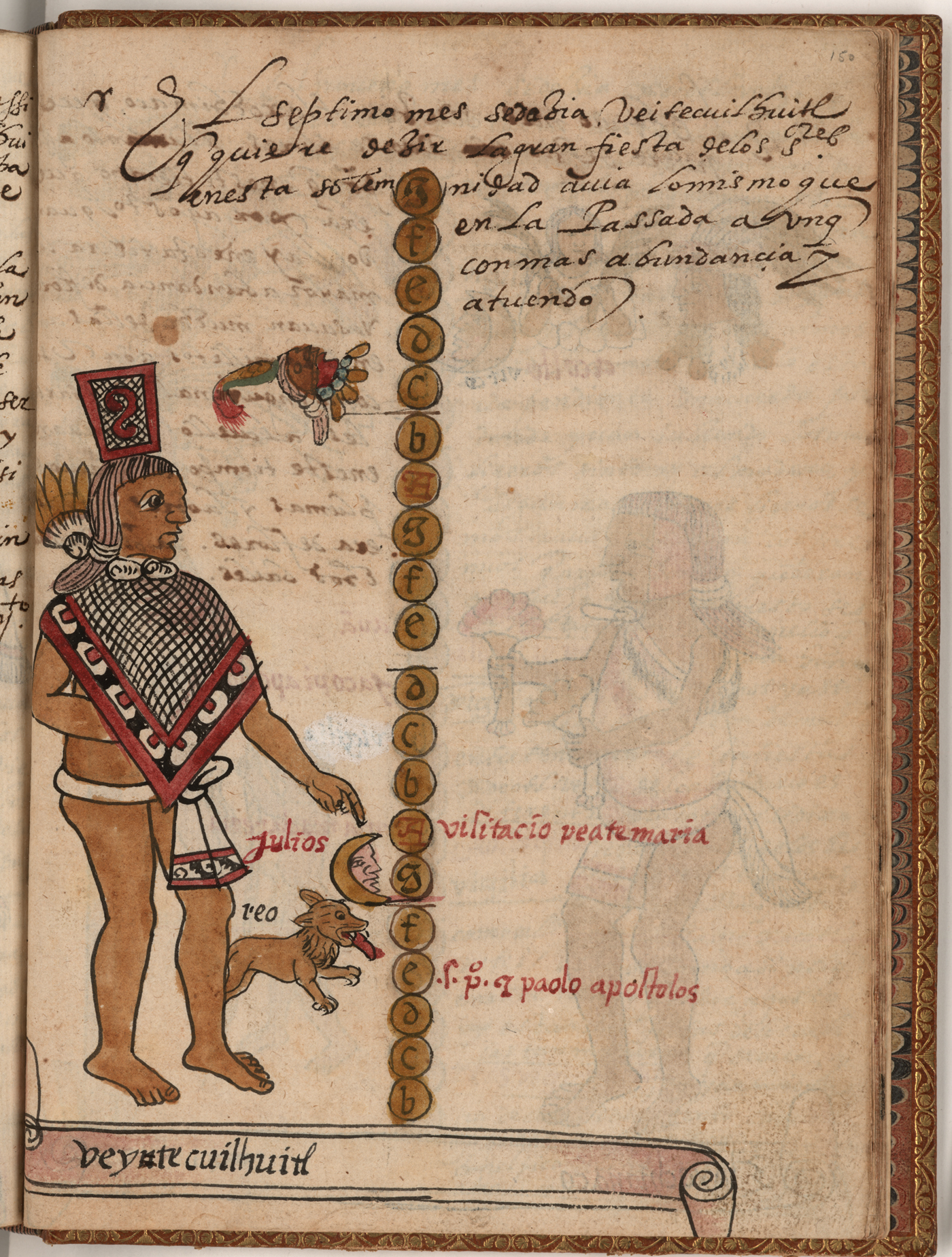
Furst's (Reference Furst and Hammond1974:197) interpretation of the scene essentially concurs with Pasztory's, although he adds that the profile figures’ presumed feminine clothing indicates that they may be priests or priestesses who impersonate the central deity. Of course, a pictorial representation of gender performance does not necessarily indicate biological sex—although in her description of two small Teotihuacan stelae, Berlo [Reference Berlo and Berlo1992:142] suggested that the triangular cape does not merely indicate gender performance but, rather, that quechquemitl indicates the female sex and, with regard to the Tepantitla deity and the accompanying profile figures, that representations of biological sex attributes are absent. Teotihuacan ceramic figures wearing capes and carrying infants on their backs, most widely accepted as a female-gendered activity, indicates that some women at Teotihuacan wore capes (Figure 7).
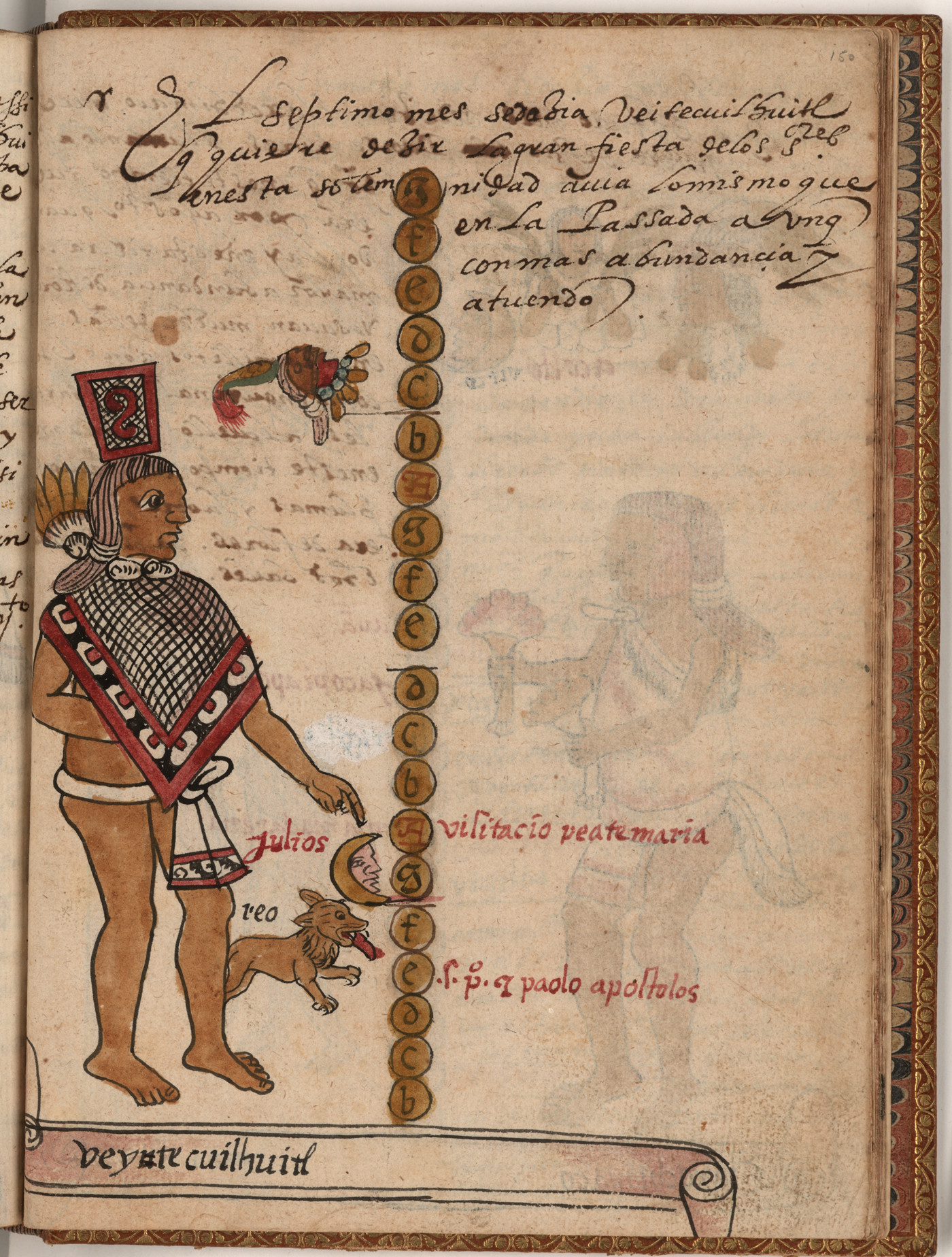
While the quechquemitl is considered the strongest indicator of the female gender for the central figure at Tepantitla, the triangular shirt or cape carried different meanings for various peoples throughout Mesoamerica, and its meaning changed over time. Anawalt (Reference Anawalt and Boone1982:41) noted that the Nahua quechquemitl was worn exclusively by goddesses and their impersonators in religious contexts, although she entertained the possibility that there may have been an androgynous meaning when depicted on male figures, such as in the Tovar Calendar, a colonial codex dating to 1585 (Anawalt Reference Anawalt and Boone1982:57–62). In the Tovar Calendar, a figure is shown wearing a quechquemitl and a maxtlatl, or loincloth, the quintessentially male garment (Figure 16). In another example, Anawalt (Reference Anawalt and Boone1982:57–58) describes a statue from the central Mexican site of Tula (a.d. 900–1150) of the storm god, Tlaloc, wearing a quechquemitl, and who, as discussed above, sometimes displays mixed-gender traits. In the case of the Tula sculpture, Anawalt (Reference Anawalt and Boone1982:58) reasons that the rain god's association with crops and fertility is the reason he is depicted wearing a female garment. Wearing the quechquemitl along with a maxtlatl has also been recorded at Cacaxtla, where McCafferty and McCafferty (Reference McCafferty and McCafferty1994:162) have questioned the gender identity of two figures in the “Battle Mural,” and, after a careful iconographic analysis, have proposed that the two individuals in question are probably, though not unequivocally, biologically female. They state that “[o]n the basis of the present costume analysis, we suggest that they were represented as gender female, while explicitly retaining the possibility that these could be biological males in female costume” (McCafferty and McCafferty Reference McCafferty and McCafferty1994:162).
Tovar Calendar figure wearing quechquemitl and maxtlatl. 30289–122. Juan de Tovar, Historia de la benida de los indios, Mexico, 1585. Courtesy of the John Carter Brown Library, Brown University.
Others have also noted that the quechquemitl was not worn exclusively by goddesses. For example, Furst (Reference Furst and Hammond1974:197) shows that the garment was also worn by Nahua noblewomen. In a different context, Heyden (Reference Heyden1977:20–21) examined the use of the quechquemitl as a symbol of military power among the Mixtec, contemporaries of the Nahua whose kingdoms lay further south in what is now the state of Oaxaca. Apparently, the Mixtec did not reserve the garment for religious practice alone.
Though the triangular cape was often worn by women throughout Mesoamerican history, these examples suggest that wearing a quechquemitl may have signified something beyond a simple female sex designation, and scholars should avoid using it as a diagnostic marker of sexual attributes at Teotihuacan. Indeed, the quechquemitl appears in few images identified as the Goddess. In fact, the cape is only visible in the Tetitla murals and a single colossal figure now housed at the Museo Nacional de Antropología in Mexico City (Figures 2 and 6). For the Tepantitla deity there are other indicators, such as the Storm God's large, upper lip, and the Old Fire God eye mask that are associated with deities thought, for the most part, to be male. Additional indicators that cannot be easily determined as female or male exist and include the alternating red and yellow triangles and the headdress, as well as the streams of liquid that appear to have mixed-gender meanings. As such, it seems hasty to declare this supernatural figure as female because the profile attendants wear the quechquemitl.
Ear Ornaments, Skirts, and Incense Bags
In addition to the quechquemitl, the ear ornaments and short skirts of Tepantitla's attendant figures have also been associated with female attire, and like the quechquemitl, they are not definitively so. Of the attendant figures, Paulinyi (Reference Paulinyi2007:247) determines that their ear ornaments—round with a feathered trapezoid at the bottom—are exclusively seen in representations of women: “Este tipo de orejera—con un colgante en forma de trapecio y emplumado en el borde inferior—es un element exclusive en las representaciones de mujeres” (This type of ear ornament—with a pendant trapezoid, feathered at the lower edge—is an element exclusively seen in representations of women [Author's translation]). One of the examples he refers to is a tecalli box with the frescoed image of a figure wearing these same ear ornaments (see Séjourné Reference Séjourné1959:Figure 171). Séjourné (Reference Séjourné1959:202) identifies the figure, however, as Xochipilli “Flower Prince,” a male god, due to the red and white face paint, which is similar to that seen on the profile figures at Tepantitla, and the presence of a “pájaro-quetzal” (parrot-quetzal) that he strokes with his right hand. If Séjourné's identification is correct, it calls into question the accuracy of the statement that this particular ear ornament is a diagnostic attribute of females. But, in any case, the frontal deity wears circular ear spools without the pendant trapezoid, so it doesn't seem justifiable to declare the deity female for this particular reason.
Another garment more often than not associated with males, rather than females, is the short skirt. It seems that Teotihuacanas may actually have favored long skirts, a trend also observed among their Maya contemporaries, who in representations such as Lintel 24 from Yaxchilan, are shown wearing long, floor length garments while their male counterparts wear knee-length kilts (see Miller Reference Miller1999:18–19, Figure 9). Scott (Reference Scott2001:42) asserts that the long skirt is traditional female attire (as is, she writes, the quechquemitl), and at least two ceramic figurines from Teotihuacan depict females wearing long skirts, as in the example where a figure wears a long skirt and carries an infant on her back (Figure 7). Males, on the other hand, are more commonly depicted wearing short kilts or loincloths, as in the lower register of the Tepantitla mural (Figure 1c). Thus, another marker once taken as one of the strongest visual indicators of a female gender—the short skirt—is found to be worn by non-females in various other contexts. In addition to wearing short skirts, the profile figures in the Tepantitla mural carry small bags—perhaps containing incense—that are seen carried by priests in Maya art.
The eclectic combination of gendered clothing worn by the attendant figures—the feminine quechquemitl and the masculine bags and short skirts—creates a mixed-gender performance. Masculine and feminine attributes are combined to create a performance that is neither male nor female gendered, but an entirely different gender that does not conform to the binary European model. Rather than presuming that these profile figures are female because they wear a quechquemitl, I suggest that they are performing a mixed gender in combining garments associated with males, such as the short skirt and incense bags, as well as articles of clothing such as the quechquemitl, frequently associated with females. And while they wear the same headdress, there are a number of differences between the clothing and attributes of the profile figures, and those of the frontal deity. For example, the frontal deity's clothing cannot be seen, there is no incense bag, and the ear ornaments are different from those worn by the profile figures.
CROSS-CULTURAL EXAMPLES OF MIXED GENDER
Interpretations of Goddess imagery at Teotihuacan generally limit gender options to male or female. Currently, none have considered the notion that iconographic ambiguities might represent a mixed gender. In her article “Abstraction and the Rise of a Utopian State at Teotihuacan,” Pasztory (Reference Pasztory and Berlo1992b:310) begins by asking the question “Why a Great Goddess and not a Great God?” I ask, why must it be only one or another? Increasingly, evidence suggests that the Tepantitla deity is mixed gender, combining attributes that largely appear to have masculine associations (the Old Fire God's diamond-shaped eyes and the Storm God's upper lip) with those that are feminine (the suggestion of the central figure's quechquemitl), or that have no association with either sex. Identification of gender would be made easier if primary sexual characteristics were visible, but like other Teotihuacan public art, the deity in the Tepantitla murals lacks definite male or female sex characteristics, with the abbreviated garment providing only a minimal and ambiguous suggestion that the central figure wears clothing usually associated with females. It is the presence of the quechquemitl on the profile figures that more strongly suggests that the central, frontal deity wears similar clothing. Without representation of sexual characteristics on monumental public art, scholars have had to look elsewhere for clues about gender performance, which raises other problems. For example, figurines thought to represent human females are not the equivalent of monumental representations of deities, even if the latter could be proven to be goddesses. In other words, it should not be assumed that conceptualizations of human gender roles are transferrable to figures in the supernatural pantheon. In fact, one has to wonder if the desire to determine whether or not pre-Columbian deities are male or female is rooted in familiarity with the Christian tradition of representing God as male, and reflecting an earlier Greek and Roman predilection for depicting deities not only as biologically male or female, but with very human characteristics, as well. This too has precedents; a recent exhibition at the J. Paul Getty Museum in Malibu, titled The Aztec Pantheon and the Art of Empire (Pohl and Lyons Reference Pohl and Lyons2010), explored comparisons between the indigenous American and Mediterranean religions made by the sixteenth-century Europeans and those who followed.
The interpretation of a pre-Columbian deity as mixed gender is not new and, in fact, examples in the Maya and Nahua visual records help to establish that gender in the ancient Americas transcended the binary European model. These cross-cultural cases are helpful in establishing a precedent, as well as advancing our understanding of the meaning behind representations of mixed gender at Teotihuacan, where I argue that the Tepantitla figure is another example of a deity that exhibits male and female traits, and can thus be considered to represent a mixed gender.
Pre-Columbian Examples of Mixed Gender
A number of scholars (Bassie-Sweet Reference Bassie-Sweet, Gustafson and Trevelyan2002; Berlo Reference Berlo and Berlo1983; Joyce Reference Joyce and Wright1996; Klein Reference Klein, Josserand and Dakin1988, Reference Klein and Trexler1994, Reference Klein and Klein2001; Looper Reference Looper and Ardren2002; McCafferty and McCafferty Reference McCafferty and McCafferty1994, Reference McCafferty, McCafferty, Terendy, Lyons and Janse-Smekal2009; Milbrath Reference Milbrath1995; Miller Reference Miller1986; Nash Reference Nash1978; Sullivan Reference Sullivan and Boone1982) have explored examples of cross-dressing, including males dressed in female clothing and/or associated with female attributes, or examples of figures associated with both male and female items. These are often within ritual, fertility contexts. Some key examples of these are described in further detail here:
Mixed gender among the Maya
As the Maya had direct contact with their Classic-period contemporaries, it is helpful to look at one example of a Maya deity that presents an alternative to the European idea that figures (in this case, the gods) are either male or female. Bassie-Sweet (Reference Bassie-Sweet, Gustafson and Trevelyan2002:171) offers a complex argument outlining how the Maya Maize Deity embodied elements that, in some manifestations, was male, but in others was female, just as the biology of the corn plant itself has both male (the tassel) and female parts (the ear). As with Teotihuacan, Classic Maya monumental art did not depict sexual characteristics, thus Mayanists have relied upon costume and identifying hieroglyphic texts to distinguish between male and female rulers. Joyce (Reference Joyce and Wright1996:182) explains that the androgynous, or sexually inexplicit, representations of Maya elites make the costume elements very important in communicating the gender identity of individuals; male and female components could be combined in ways that transcended these two dimorphic gender roles, thus costumes could be constructed that reflected genders that surpassed male and female. In addition, Looper (Reference Looper and Ardren2002:173) explains that for Maya rulers, specific costumes facilitated the negotiation of a “fluid mixed-gender realm,” offering alternatives to the binary male and female identities. The hallmark garment that exemplified this mixed-gender identity is the diamond-patterned net costume seen on Stela H from Copan, which depicts the thirteenth ruler of that city, Waxaklajuun Ubaah K'awiil, or Lord Eighteen Rabbit. Looper (Reference Looper and Ardren2002:174) explains that the net costume is worn by distinct, yet complimentary, deities and that the Maize God and Moon Goddess were “simultaneously androngynous and gender polarized,” but that moreover these two deities embodied a third gender, which Maya elites could then personify. He (Looper Reference Looper and Ardren2002:78, Note 5) distinguishes two styles of the net skirt: a short male skirt or kilt, which contrasts with the long, female version, whose hemline dipped below the knees. Thus, Stela H depicts the male ruler, wearing female clothing in his impersonation of the Maize God.
Maya women also wore mixed-gender costumes. Looper (Reference Looper and Ardren2002:183) offers an example from the Palenque Oval Palace Tablet, where Lord Hanab Pakal's mother, Lady Sak K'uk’, wears the androgynous net skirt and cape, has a masculine coiffure, and wears a loincloth. In addition, Lady Sak K'uk’ holds a war helmet, and Looper notes several other examples where women performed a mixed-gender role to participate in ceremonies that were usually only open to men (Looper Reference Looper and Ardren2002:183).
Mixed gender among the Nahua
There are important examples among the Nahua of a representation of a mixed gender individual. In addition to Tlaloc's intermittent “bisexuality,” another major Aztec deity, Tezcatlipoca, also exhibits mixed gender characteristics at times (Klein Reference Klein and Klein2001:219–221), and the Nahua creator deity Ometeotl was believed to have had male and female qualities (Joyce Reference Joyce and Wright1996:181–182; Leon Portilla Reference León-Portilla and Davis1963:96–99). In her article on Tlazolteotl-Ixcuina, Sullivan (Reference Sullivan and Boone1982:7, 17–18) notes that the “‘God’ or ‘Goddess of Filth’” known as Tlazolteotl, a name that is both male and female, was a deity whose multivalent roles embodied a range of activities, from licentious sex to childbirth, and who is sometimes depicted in association with a phallic snake, dog, or centipede, all symbols of lewdness.Footnote 8
In addition to these supernatural examples, McCafferty and McCafferty (Reference McCafferty, McCafferty, Terendy, Lyons and Janse-Smekal2009) examine cases of “deviant” and “alternative” identities, such as harlots, homosexuals, hunchbacks, and dwarves (the latter two of whom the authors indicate were considered gender ambiguous), introducing the importance of these individuals within Postclassic period (a.d. 900–1200) society in central Mexico. In so doing, have also addressed problems of gender stereotypes, particularly those of the early colonial chroniclers. The authors emphasize that the identities of these individuals, who are contrasted from ideal types of men and women, were far more socially acceptable, at least within pre-Columbian societies, than is indicated in the chronicles (McCafferty and McCafferty Reference McCafferty, McCafferty, Terendy, Lyons and Janse-Smekal2009:198). Other scholars have also documented examples of mixed-gender performances, such as Nahua priests sometimes dressing in female garb while performing rites for female deities (Pasztory Reference Pasztory1976:119–120). Leon Portilla (Reference León-Portilla and Davis1963:111) and Klein (Reference Klein, Josserand and Dakin1988) have documented that the Nahua emperor's lieutenant bore the title and office of Cihuacoatl, “Snake Woman,” and dressed in the female costume of that goddess, which Durán describes as “un hábito de mujer, todo blanco de enaguas, camisa y manto” (a woman's dress, all white underskirt, shirt, and cloak [Author's translation]) (Durán Reference Durán and Garibay1967:I:Chapter XIII,125). Klein (Reference Klein, Josserand and Dakin1988:246) explains that the act of dressing as a woman was meant to offend; “[b]y wearing the costume of their patroness, Tlacaelel reenacted and advertised his heroic conquest of the Chinampa cities while simultaneously humiliating their survivors and intimidating all who might be considering rebellion.” Indeed, the Cihuacoatl aside, it seems cross-dressing was punishable by death in Tenochtitlan: “El hombre que andaba vestido en hábito de mujer, y la mujer que andaba vestida en hábito de hombre, ambos tenian [sic] pena de muerte” (The man who went around dressed as a woman, and the woman who went around dressed as a man, both had the death penalty [Author's translation]) (Mendieta Reference Mendieta1971:2:Chapter XXIX, 137–138). These examples from the ethnographic record acceptable and unacceptable cases of what we today would call cross-dressing, demonstrating not merely its existence, but also the ways in which this act was clearly an act that was embedded with political significance for the Nahua.
Mixed gender during the Colonial and Modern periods
The continued presence of multiple-gendered individuals extends into the colonial era. Drawing upon colonial authors, Trexler (Reference Trexler1995) documents the existence of mixed-gender males in the colonial Americas, who are referred to in the literature as berdache. For example, citing Diego Muñoz Camargo and Juan de Torquemada, Trexler (Reference Trexler1995:213, Note 4) says the term bardaje appeared in the Americas in the late sixteenth century. In his chapter “The Religious Berdache,” Trexler (Reference Trexler1995:108–114) writes about the sexual relationships some Andean devotees had with divinities. He describes, among other practices, the Inka tradition of men who, from childhood, dressed in women's clothing, copying their mannerisms and speech (Trexler Reference Trexler1995:107). The religious roles played by these individuals could explain the mixed-gender performance of the deity and attendants seen in the Tepantitla murals. Perhaps the transcendent gender of the profile figures gives them special status as well as special abilities in carrying out ritual duties.
Contemporary examples of how gender roles may transcend the Western notion of binary genders exists in the town of Juchitan, in the state of Oaxaca, Mexico. Among the Zapotec of Juchitan, some men are called muxe, adopting the dress, behaviors, and social role of females. These third-gendered individuals dress in women's clothing and are, in essence, socially female while remaining biologically male. They should not be, however, confused with transvestites. The third gender muxe are accepted by society and are not considered aberrant (for more on the muxe, see Chiñas [Reference Chiñas and Murray1995]).
The fact that this mixed-gender practice exists today in Mexico, and seems to have been known in ancient times, signals that scholars should be open to the possibility of expressions of multiple genders at Teotihuacan. Certainly there are enough documented cases of a mixed-gender role in religious contexts in the Americas to consider the possibility of figures at Teotihuacan intentionally presented as mixed gendered. It is possible that for Teotihuacanos, clothing was a means of performing gender. Perhaps what we observe in the visual record is the performance of a mixed gender that is neither male, nor female, but one that is an entirely separate gender that does not fit into the binary European model.
CONCLUDING THOUGHTS
From what began in Teotihuacan scholarship as a limiting association of females and fertility, suppositions about the dominant ideology grew to monumental proportions. As others have noted, acknowledging the contemporary forces that influence scholarship is critical in avoiding imposing modern ideas onto the past (Bynum Reference Bynum1995:30–31; Conkey Reference Conkey, Klein and Quilter2001:355–356; Pendergast Reference Pendergast, Tkaczuk and Vivian1989). For example, of Tatiana Proskouriakoff's revisionist work on the role of women in Maya art in the mid-twentieth century, Pendergast (Reference Pendergast, Tkaczuk and Vivian1989:71) asked “Was her research stimulated or generated by the rising feminine consciousness, or did it exist sui generis, and simply come to be acceptable, which in the academic world can be read as publishable, as the Women's Liberation movement increased in strength?” Leaning toward the former, Conkey and Gero (Reference Conkey and Gero1997:416, see also Whelan [Reference Whelan, Duke and Wilson1995]) cite research demonstrating that scholarship on gender in antiquity has been influenced by real or perceived inequities in modern academia:
Equity issues in archaeology have consistently influenced, and been influenced by, the scholarly research on gender in past human societies. In fact, studies by Smith and du Cros…Wylie…and Hanen and Kelley…find that the interest in engendering prehistory has been directly motivated by perceived or existing gender inequities in the modern research community.
Regardless of which external influences—and their particular combinations—have shaped an interest in identifying a female goddess cult at Teotihuacan, the impact has been significant. Over time, scholars began seeing representations of the Great Goddess everywhere; she was even seen in disembodied hands, and in faceless and abstract images. Pasztory, for example, identifies a very abstract sculpture as a representation of the deity based on the presence of nosebar, earspools, and horizontal headdress (Pasztory Reference Pasztory, Berrin and Pasztory1993:Catalog 6). Similarly, Pasztory (Reference Pasztory1997:99) and Headrick (Reference Headrick and Stone2002:Figures 2.12 and 2.17) argue that an extremely damaged, barely legible boulder is that of the Great Goddess, based on a hole beneath what may be a necklace, similar to that seen on the Colossal Museo Nacional sculpture.
Some—myself (Mandell Reference Mandell1995) included—have questioned the gender of figures identified as the Great Goddess, as well as the extent of its role in Teotihuacan society. Coming to the conclusion that there existed no cult of a mega-Goddess at Teotihuacan, scholars have offered a variety of alternatives to the cult of the Great Goddess. Cowgill (Reference Cowgill1997:150) has noted that while a female Goddess seems to have been important in state religion, she may not necessarily have been of all-pervasive importance. Similarly, Taube (Reference Taube, Evans and Webster2001:733) has concluded that there were likely several female goddesses, rather than a single Great Goddess (Taube Reference Taube2009:157). Manzanilla (Reference Manzanilla, Politis and Alberti1999:1113–1122, Reference Manzanilla2001:180–182) and Paulinyi (Reference Paulinyi2006:14) believe that the Rain God was the principal deity of Teotihuacan, although more recently Paulinyi (Reference Paulinyi2014:46) suggests that the Rain God, who ruled the lower half of the Teotihuacan cosmos, was a counterpart of the Butterfly Bird God, who “was probably the highest representative of the upper half of the Teotihuacan cosmos.” In place of the Great Goddess, Paulinyi (Reference Paulinyi2006:13) identifies a small pantheon of related gods and goddesses: the Goddess of Tepantitla (including the “Jade Tlaloc Murals” from Tetitla [Figure 2] and the relief from the Street of the Dead Complex [Figure 5]); the Goddess with the Rectangular Headdress and other monumental sculptures; and the Goddess with a Circular Motif. According to Paulinyi (Reference Paulinyi2006:13), the first two types—the Tepantitla and rectangular headdress types—are related, perhaps even the same deity, but he maintains that the third type is a different deity. In addition to these, Paulinyi also identifies the Opuntia Deity. Other scholars have begun to re-attribute the gender of images previously identified as the Great Goddess, arguing that they are male. In describing a ceramic Teotihuacan vessel (9-Xi), originally identified by Berlo as a warrior Goddess, and later believed to be a representation of the Great Goddess, López Luján and colleagues (Reference López Luján, Neff, Sugiyama, Carrasco, Jones and Sessions2000) reject both identifications in favor of Paulinyi's (Reference Paulinyi1995) “Butterfly-Bird God.”
An accurate identification of the Tepantitla deity, and whether or not it constitutes a complex of related deities at Teotihuacan, has various ramifications. Of particular importance is how scholars have interpreted it with regard to Teotihuacan sociopolitical processes. While Pasztory (Reference Pasztory, Berrin and Pasztory1993:56) believes that women at Teotihuacan were excluded from political processes, Headrick (Reference Headrick2007:41) feels that the gender ambiguity of the sculptures should encourage scholars to explore the possibility of the existence of female rulers at Teotihuacan. Alternately, Cowgill (Reference Cowgill1997:150) proposes that a stone frieze that many have identified at Teotihuacan as the Great Goddess, actually symbolizes a larger concept of rulership. In each case, the question of who, exactly, ruled at Teotihuacan remains speculative, due to a lack of conclusive archaeological evidence.
Rather than a single deity, I agree that the visual record reflects several deities who are distinct from one another, but whose iconographies at times share visual vocabularies (see Paulinyi Reference Paulinyi2006, Reference Paulinyi2007). In responding to the literature on Goddess imagery at Teotihuacan, however, I assert that characterizations of complex imagery, such as those found in the murals of Tepantitla, either combine forms that appear masculine or feminine, or which are deliberately gender ambiguous, suggesting representations of mixed gender. If one of the strongest indicators of female gender in the iconography is the short cape worn by the figures in the Tepantitla and Tetitla murals, it proves inconsistent in the visual record. Teotihuacan artists were certainly capable of depicting female (and male) sexes in no uncertain terms, had they chosen to do so. Although contemporary interpretations may be swayed by preconceived notions of what constitutes femininity, resulting in a determined attempt to “find” women at Teotihuacan, I caution against hasty conclusions.
As I have shown, there is good evidence for multiple-gender identities in American antiquity, not only among the Maya, Teotihuacanos, and Nahua, and in the Colonial Americas, but also in contemporary Native North American societies, as well as the Zapotec from Juchitan. Ardren (Reference Ardren2008:2–3) also recognizes the strong, historical presence of multiple genders in the New World, where gender categories could be much more fluid and diverse than in modern, Western societies. Examining cases in the visual and ethnohistorical record supports the assertion that the Tepantitla deity is depicted as a mixed gender—that is, performing a gender that is neither male, nor female, but which combines characteristics that have been recognized as belonging to those two, and which also include elements that cannot be clearly assigned a gender. This also appears to be the case in a number of other figures at Teotihuacan, who seem to represent a mixed gender in combining masculine, and feminine, and gender-neutral attributes in various formulations. In practice, I suggest that these deities be referred to by gender-neutral terminology. A more appropriate naming convention might be a reference to their location. Thus, the central deity in the Tepantitla complex should be referred to as the “Tepantitla Deity,” rather than as a god or goddess.
Understanding the complexities of gender in antiquity, particularly with regard to humans and the deities that those humans conjured, can contribute to our understanding of how these ancient societies conceptualized gender. Pinpointing a reason why Teotihuacanos represented deities and their attendants as mixed gender is difficult, due in part to some of the same reasons previously discussed; the written language has not been deciphered, and rulers have not been identified, as has been done for other Mesoamerican civilizations. Why did Teotihuacanos choose to represent one of their principle deities as embodying a mixed gender? Pasztory (Reference Pasztory and Berlo1992b:314) suggests that the abstract image “glorified an idealized collective persona,” which makes sense at Teotihuacan, where the inhabitants were diverse, originating from all over Mesoamerica. It is also important to consider the context at Teotihuacan as an enormously powerful city-state that, for some reason, chose not to clearly identify rulers. In other words, depicting an important deity as mixed gender may have had wider appeal to a society of diverse individuals, and different genders and ethnicities. Or, perhaps the mixed-gender deity and its attendants at Tepantitla reflect a special, sacred status of those extraordinary individuals whose gender transcends those more typical male and female categories. Perhaps mixed-gender individuals were viewed as possessing special transcendent capabilities that enabled them to mediate between the terrestrial and supernatural realms. Representations of these mixed-gender deities may serve as loci for mediation, which may have been highly valued at the diverse, cosmopolitan metropolis of Teotihuacan. And yet, embedded in the question “why depict a deity as mixed gender?” lurks an assumption that the norm was to depict members of the pantheon as either male or female. In presenting a case for the mixed-gender attributes of the Tepantitla Deity, my goals have been to raise awareness of the assumptions that have influenced gender attribution at Teotihuacan, as well as to continue the scholarly dialogue on the identity of this elusive deity.
RESUMEN
En un lapso de aproximadamente cincuenta años, el concepto más difundido con respecto a la identidad y el significado social de la deidad principal de la antigua ciudad de Teotihuacan en el México central ha cambiado radicalmente. De la creciente área urbana, cuyos habitantes se creía que veneraban a un Dios de la Lluvia, un precursor de la deidad azteca Tlaloc, ahora se piensa que en realidad veneraban a una diosa de la fertilidad, conocida como la Gran Diosa de Teotihuacan. La popularidad de la mitología sobre la diosa, sumado a la escasez de evidencia de lo contrario, ha dado como resultado la común aceptación de esta identificación como válida.
No obstante, los rasgos iconográficos sobre los cuales ese argumento se apoya son, en varios casos, inconsistentes, tal y como lo son las interpretaciones de simbolismo específico. En este ensayo, reviso varios de los argumentos originales a favor de la existencia de una diosa en Teotihuacan, formulando preguntas acerca de las concepciones de género que subyacen en la construcción de una ideología de la diosa a la luz de modelos contemporáneos. Al examinar lo que se afirma que constituyen los atributos femeninos en las representaciones de la Gran Diosa, sugiero que muchos modelos de jerarquía de género y complemento de género comúnmente aplicados al análisis de Teotihuacan están arraigados en concepciones euro-americanas de género y sexo. Tales concepciones prejuiciosas descartan el género mezclado como modelo viable para la interpretación iconográfica o social.
Para explorar la identidad de género de la(s) deidad(es) principal(es) de Teotihuacan, presento primero los antecedentes de Teotihuacan y ofrezco una descripción detallada de los murales de Tepantitla. A continuación, incluyo una sección donde examino y problematizo los elementos característicos de la Diosa. Parece que hay discrepancia sobre los atributos más significativos de la Diosa y hay, además, una falta de consistencia en la aparición de esos elementos característicos. En particular, examino los elementos con los que generalmente se le ha identificado: el tocado de la cabeza, la nariguera, y los triángulos rojos y amarillos. Estas discusiones llevan al análisis de las características visuales que se ha dicho que representan la femineidad y/o la fertilidad femenina. Estas características son el agua o el líquido, las cuevas y la vestimenta, específicamente la falda corta y la capa triangular conocida como quechquemitl. Tales elementos simbólicos son en realidad más complejos de lo que a primera vista parecieran, y en varios casos presento ejemplos donde pueden asociarse con figuras masculinas y/o un género mezclado en el arte precolombino.
En muchos casos, la identificación de una deidad femenina depende de la presencia de atuendos considerados de uso femenino; en este caso, el quechquemitl constituye uno de los identificadores iconográficos más importantes. Sin embargo, las investigaciones indican que el quechquemitl tenía diferentes significados para varios pueblos en Mesoamérica, y que esos significados cambiaron a través del tiempo. Hay casos en que la capa triangular la lleva Tláloc, el Dios de la Lluvia, típicamente identificado como masculino, y existe un ejemplo en el cual una figura lleva el quechquemitl junto con un taparrabos, una prenda masculina.
Más adelante, exploro las interpretaciones y revaloraciones más recientes del panteón de deidades de Teotihuacan, y propongo integrar tales estudios a las ideas contemporáneas sobre el género mezclado. Aquí, defino el género mezclado, el berdache, y otros términos, observando que aunque no se han estudiado lo suficiente, tales prácticas se conocían en las Américas prehispánica, colonial, y aún en estos tiempos contemporáneos. Dada la existencia de individuos y comunidades en Mesoamérica pertenecientes a un género mezclado, propongo que la vestimenta en Teotihuacan estaba conectada con la representación de género, y que las combinaciones de prendas de vestir y actividades típicamente identificadas como femeninas y masculinas son usadas en sintonía intencionalmente para la representación de un género mezclado.
ACKNOWLEDGEMENTS
This article is based on an earlier paper that was presented at the XXVIII International Congress of the Latin American Studies Association held in Rio de Janeiro, Brazil, and on the work undertaken as a Research Stipendiary (2011) at the Dumbarton Oaks Research Library and Collection. I am indebted to the anonymous reviewers of this article and many others for their valuable suggestions and comments, including Cecelia F. Klein, Geoffrey McCafferty, Matthew Looper, Esther Pasztory, Margaret Jackson, John Pohl, Patricia Anawalt, Alejandro Lee Chan, Rogelio Valencia, Richard Leventhal, Maya Stanfield-Mazzi, the late J. Kathryn Josserand, and the late Virginia Fields. I also thank Zoltán Paulinyi for his generosity in sharing his manuscript on the “Goddess” and for his graciousness in the amicable exchange of ideas on this subject.