What single image could encapsulate a life's work or an entire race of people? That was the question confronting the photographer Edward S. Curtis in April 1913. He, along with at least twenty-three other cultural and political luminaries from around the world, had received a blank parchment from the Modern Historic Records Association (MHRA), an organization recently founded to gather records of the present and preserve them for future historians in time capsules and, ultimately, in the concrete vaults of a purpose-built depository in Washington, DC. By this time, Curtis had already taken thousands of photographs of Indian tribes across North America and had published 937 of them in the first eight volumes of his ambitious, twenty-volume ethnographic survey, The North American Indian. Yet, given the MHRA's premise that few books would survive the vicissitudes of time, he had to select just one image to endure as exemplification of that larger project, and indeed of Indians themselves.
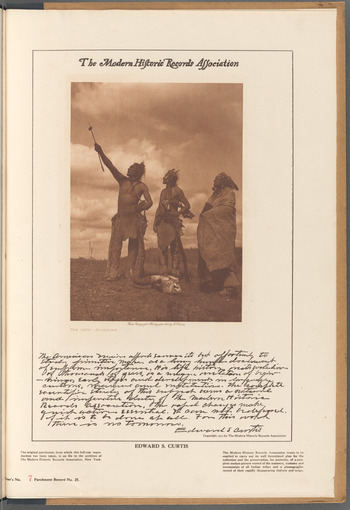
Curtis ultimately settled on a photogravure depicting three members of the Apsáalooke (or Crow Nation), one of whom is taking what the title announces as “an oath” (Figure 1). He had taken the photograph on a research expedition to the Crow reservation in southern Montana during or before 1908, and had published it the following year as the frontispiece to his fourth volume, which focussed on this tribe (and the closely related Hidatsa). According to the description in that volume, a Crow warrior consecrates his oath by “thrusting an arrow through a piece of meat, placing it upon a red-painted buffalo-skull, and then raising it toward the sun” and “touch[ing] the meat to his mouth.”Footnote 1 The photograph represents the intermediate, climactic moment of that series of actions: the appeal to nature as guarantor of truth. The warrior grips the arrow shaft in his outstretched right hand, while two witnesses look on. Their gaze leads the viewer's eye toward the tip of the arrow, tracing an arc that is echoed by the buffalo horn in the foreground. This leftward inclination is counterbalanced by the chevrons of bent elbows.
Edward S. Curtis, “The Oath – Apsaroke” (copyrighted 1908), full-size facsimile of original parchment, which Curtis printed and inscribed on 29 April 1913, and included in “Message of the Records” (MHRA, n.d. [1913–15]), Manuscripts Division, MssCol 2025, New York Public Library. Curtis's inscription reads, “The American Indian affords [science?] its best opportunity to study primitive man, as a living human document of supreme importance. His life history, in its evolution of thousands of years, is a unique revelation of beginnings, early stages, and developments in languages, customs, manners and institutions. The complete scientific study of this subject seems a natural and imperative duty of the Modern Historic Records Association. The rapid changes make quick action essential. It can not be deferred, if it is to be done at all. For this work there is no tomorrow. Edward S. Curtis.”

Curtis's contribution to the MHRA provides a case study through which to reexamine historical assumptions about the broader endeavor now known as salvage (or urgent) ethnography. Beginning in the nineteenth century and continuing into the twentieth, numerous projects were undertaken across the globe to “rescue” and preserve the extant practices, languages, beliefs, artifacts, and appearance of “primitive” tribes before they were erased by the spread of Western modernity.Footnote 2 Recovered by amateur and professional ethnologists, often with the blessing or under the guidance of European or American governments, those rescued fragments filled the collections of learned societies, public and university museums, and other institutions. These efforts pre-dated photography; as early as 1821 Superintendent of Indian Affairs Thomas McKenney began collecting artifacts and portraits (painted by Charles Bird King) of Indian tribal leaders who visited Washington, resulting in a three-volume publication that was praised for “presenting to the world authentic memorials of this race, in a form to give them perpetuity, while the race itself is fast dwindling away.”Footnote 3 But practitioners and critics championed the camera (and later the phonograph) as the ideal tool for preserving the indigenous, on the grounds of its objectivity and indexicality. Early photographic salvage projects include Maxine du Camp's expeditions to the Middle East in 1849–51; the archaeological and ethnographic surveys of colonial India undertaken under the auspices of the British colonial administration from the 1860s onwards; and the Smithsonian's ongoing collection of portraits of Indians, catalogued by A. Zeno Shindler in 1867 and by William Henry Jackson in 1877.Footnote 4
A generation of scholars has critiqued the ethnocentric assumptions behind such cultural and artifactual expropriation – in particular, the assumption that those indigenous peoples were doomed to extinction.Footnote 5 By the 1980s, such critiques were applied to Curtis's work, which had been rescued from obscurity the previous decade and celebrated as a rare instance of an authentic portrait of Indian life, the product of a sympathetic and sensitive photographer (a view that persists among connoisseurs, collectors, and devotees to this day).Footnote 6 Christopher Lyman's The Vanishing Race and Other Illusions (1982) characterized Curtis as animated by a racist impulse to depict Indians as primitive types that led him to choreograph scenes, supply his own authentic-looking (yet often inappropriate) props and clothing, and crop or touch out any signs of acculturation to Western modernity, along with any trace of his own presence.Footnote 7 Taking a more contextual approach, Mick Gidley's Edward S. Curtis and the North American Indian, Incorporated mapped Curtis's connections with other salvaging photographers and ethnologists, and with politicians, financiers, and others, to show how his project reinscribed the prejudices of its period. In cajoling and bribing Indians to pose, appropriating their art objects, turning a blind eye to their current conditions, and, above all, disseminating the notion of Indians as a vanishing race, Curtis was a product of his culture.Footnote 8
These critiques of the salvage paradigm have come under challenge, however, for downplaying indigenous agency. Recent scholars question whether ethnographic photographers necessarily duped their subjects into posing. In Curtis's case, Martha Sandweiss demonstrates how some tribes were aware of his project – and of the camera's power to memorialize – and invited him to their reservations.Footnote 9 In those photographic sessions, Alan Trachtenberg suggests, they must have exerted an “influence in shaping [their] roles, choosing their costumes, their gestures, the scenes they performed.”Footnote 10 Expanding on these claims, Shamoon Zamir considers the possibility that Indians shared Curtis's “sense of the inevitability of significant and rapid cultural loss” and wished to leave a record for their own assimilated posterity.Footnote 11 The photographs thus bear traces of what Zamir calls a “face-to-face encounter” between Curtis and his subjects, or what Trachtenberg calls “a transaction across a divide, a cross-cultural dialogical event.” These and other scholars reimagine the ethno-photographic session as a scene of cultural exchange and negotiation.Footnote 12
Also under dispute is the assumption that photographs produced in the salvage mode are fully determined by their ethnocentric biases and are therefore pernicious – or at best useless – to contemporary indigenous communities. There is a growing recognition of how subsequent viewers (including the subjects’ descendants) bring their own meanings to such photographs. Gidley himself hinted at this new direction in the final paragraph of his book on Curtis. “Looked at ‘against the grain,’” he suggested, “the project does also constitute a resource for Native Americans and others, a set of texts to be appreciated, studied, exploited, played with, and, perhaps … played against.”Footnote 13 Several indigenous artists have, indeed, found ways to reclaim Curtis's photographs, from Dugan Aguilar's mimicking of his stylistic conventions to Wendy Red Star's reduction of his portraits to ghostly silhouettes.Footnote 14 According to Zamir, it is Curtis's aesthetic choices – his long exposures, shallow depth of field, soft focus, and erasure of potentially distracting artifacts – that allow his photographs (especially the portraits) to reach out across time and confront viewers in the present.Footnote 15
This article will detect further tensions between ethnographic photography and the ideological constructs of salvage and vanishing races, but not by focussing on the agency of the sitters or on acts of reclamation by recent viewers. Instead, it will explore the complex temporality of photographs produced or earmarked specifically for future viewers. The ethnographer's claim to be selflessly serving posterity was a common justification for blatant acts of expropriation. Curtis himself deployed this strategy in the general introduction to his North American Indian, claiming that his gathering of information about disappearing traditions was intended “for the benefit of future generations.”Footnote 16 Again, such rhetoric was not specific to photographic salvage; the painter George Catlin had prefaced his engraved Illustrations of the Manners, Customs, and Condition of the North American Indians by describing himself as gallantly “snatching from a hasty oblivion what could be saved for the benefit of posterity, and perpetuating it, as a fair and just monument, to the memory of a truly lofty and noble race.”Footnote 17 But photography, with its apparent capacity to convey light and presence through time, was identified as having a particular affinity with the future viewer.Footnote 18
This rhetoric of posterity clearly worked to mask the ways in which such surveys catered to contemporaneous interests, such as the justification (or obscuration) of colonial policies, the legitimation of evolutionary science, or the commercial profit to be made from providing vicarious tourism or erotic fantasies of the other. Yet it also endowed the ethnographic image with a sense of temporal doubleness. Even as they consigned “primitive” people to the past, ethnographic images simultaneously projected them into the future. Even as they lamented the oblivion of indigenous ways, they affirmed the possibility of preserving them in perpetuity. Curtis's collaboration with the MHRA offers an ideal instance for exploring this temporal ambiguity. Whereas published surveys invoked posterity only vaguely or rhetorically, the MHRA promised literally to seal away his photograph, and other ethnographic records, for historians in the distant future. The MHRA's time-capsule project also reminds us that the salvage paradigm was animated not only by dreams of exhaustive surveys and all-encompassing archives, but also by a logic of selectivity: the notion of a representative sample, the discrete photograph that would stand for a larger whole. Even a project as vast as The North American Indian represented a selection from a larger collection of negatives – and thus an exclusion of those that potentially undermined its agenda.
Lastly, Curtis's brief involvement with the MHRA allows us to track the meanings of a single photograph. Scholars who treat Curtis's twenty-volume opus magnum as a totality – even as an internally differentiated one, as Gidley does – have obscured how individual images could break free from that context and resonate unpredictably across multiple domains.Footnote 19 The photograph Curtis contributed to the MHRA, moreover, is one that has escaped critical analysis. While scholars focus on certain canonical images such as “Cañon de Chelly” (1904), “An Oasis in the Bad Lands” (1905), or “Vanishing Race – Navaho” (1904), or repeatedly unmask the photographic deceptions of “In a Piegan Lodge” (1910), they have neglected many others. The neglect of “The Oath – Apsaroke” is particularly surprising, given its prominence in the fourth volume and its subsequent reprinting in a New York Times profile of Curtis in 1911 and on the frontispiece of the Photographic Times in 1912. In the latter magazine, he described it as one of three photographs that most satisfied visitors to his Fifth Avenue studio.Footnote 20 Without implying that the photograph is emblematic of Curtis's entire oeuvre, this article will explore how its meanings become knotty and complex when viewed as a submission to the MHRA. While the first half will acknowledge how the photograph appears to reinscribe hegemonic assumptions governing the Euro-American depiction of the indigenous, the second half will emphasize how it undercuts those assumptions.
“Thousands of years hence,” the Times speculated in December 1911,
when the explorer may delve in the ruins of New York, then perhaps buried under the accumulations of time, he will come across strange-appearing cylinders of terra cotta and concrete, and in them, in thick [g]lass encasements, he will find the records of our period … the singers of the present age will sing, our actors talk their lines, and our great men speak again.
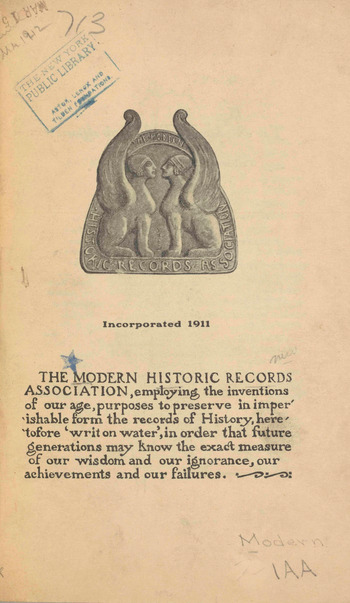
The Times was reporting the inaugural meeting of the MHRA, held at the National Arts Club in Gramercy Square the previous evening (Figure 2). After a series of talks by its founding members, an architect and a sculptor demonstrated an unusual device. They filled a glass jar with various items and deposited it in a terra-cotta pipe, pouring concrete into the intervening space and capping it with a copper disc bearing an inscription and a list of the contents. According to the Times, this elaborate ceremony “was followed with great interest by those present.”Footnote 21
Cover of an untitled pamphlet detailing MHRA's aims (New York: MHRA, 1912). Miscellaneous Personal Name Files, Box 73, miscellaneous file, Manuscripts and Archives Division, New York Public Library.

That makeshift cylinder was one of several receptacles improvised during the Progressive Era to communicate across time. Although the term “time capsule” was coined to describe the torpedo-shaped vessel that Westinghouse Electric Company buried at the New York World's Fair of 1939, the practice of sealing messages and materials for a fixed date in the future can be traced back to Philadelphia's Centennial Exposition of 1876.Footnote 22 But whereas most proto-time capsules were one-off affairs, the MHRA had grander ambitions. Founded by the Hungarian immigrant and wealthy Wall Street banker Alexander Konta, sponsored in part by J. P. Morgan, and with a governing board boasting such luminaries as President William Howard Taft and arctic explorer Robert Peary, the organization developed a range of archival initiatives to ensure that when future historians came to write the history of the twentieth century, they would have sufficient sources at their disposal. In addition to launching two further time capsules, it served as a pressure group lobbying newspapers to print special library editions on rag rather than wood-pulp paper, state governors to improve record-keeping practices, Congress to establish a National Archives building in Washington, DC, and the Permanent Court of Arbitration in the Hague to pass an international law to protect “repositories of art and learning” from military bombardment.Footnote 23
But the MHRA's main task, one that no association (it claimed) had ever undertaken, was the “gathering and preservation of contemporary records for posterity.”Footnote 24 Against the dominant conception of the archive as a passive repository for records produced by other institutions, the MHRA intended to actively produce them itself. To do so, it conscripted photographic, phonographic, and cinematographic technologies (including Thomas Edison's new sound-film apparatus, the Kinetophone), which it believed would preserve the present more objectively and vividly. Initial projects included a film of Mayor William Gaynor of New York explaining the workings of city government to posterity and a plan to record the upcoming Democratic and Republican conventions.Footnote 25 Another venture consisted of sending a blank parchment to various public figures, “earnestly request[ing]” them to inscribe their ideas or achievements and return it to the MHRA, for preservation in its proposed headquarters in Washington, DC.Footnote 26 The resulting portfolio, “Message of the Records,” temporarily entrusted to the New York Public Library for safekeeping, contained documents ranging from an eyewitness account by the captain of the RMS Carpathia of his rescue of Titanic survivors twelve days earlier, to a defense of Progressivism by Theodore Roosevelt, an explanation by George Bernard Shaw of his approach to dramaturgy, and a bar of music handwritten by Richard Strauss.Footnote 27 It was to this distinguished portfolio that Curtis was invited to contribute a photograph in 1913.
Although Konta, as treasurer of the National Arts Club, may have been seeking to showcase an American contribution to the arts – and Curtis was indeed a leading practitioner of pictorialist photography and had been a member of that club since 1903 – the invitation more likely arose from his desire to expand what would count as history.Footnote 28 Not content with memorializing “great men” or recording political conventions, the MHRA broke with the mainstream of the historical profession and affiliated itself with the emerging practitioners of the “New History” such as Frederick Jackson Turner and James Harvey Robinson. This “modern” school of history, Konta explained, “attaches more importance to the evolution of the daily life of the common people, the development of their civilization and culture, their economic and social status, than to the doings of their leaders in peace and war, to what has been so aptly described as ‘past politics.’”Footnote 29
Yet whereas the New Historians were exclusively interested in the social and cultural history of white Euro-Americans, Konta's definition of “common people” extended to indigenous Americans.Footnote 30 He announced his plan to construct “a systematic living record of [the American Indian] in all the phases of his life,” through films and phonographs as well as “books, drawings, and photographs.”Footnote 31 Already, the MHRA's board of incorporators included journalist and amateur anthropologist Charles Fletcher Lummis, who was among the first to use Edison's recording phonograph as an ethnomusicological tool, gathering nine hundred “perishing songs” from American Indian and Mexican American communities between 1904 and 1912, and founding the Southwest Museum to house them and the accompanying photographs.Footnote 32 The MHRA would extend this work across an even broader terrain. “When speaking of the American Indian,” Konta explained to the Talking Machine World, “we in this country are apt to overlook the Indians of Canada, and, still more, those of Central and South America.” Through collaboration with similar associations in other countries, the MHRA would encompass the entire hemisphere, from the Inuit of the Arctic to the Tehuelche of Patagonia.Footnote 33
Curtis's acceptance of Konta's invitation may have stemmed from a sense of the affinities between their projects. He would have recognized their shared impulse to encompass all aspects of Indian existence: their “history, life and manners, ceremony, legends and mythology,” as he put it in the outline of his own project.Footnote 34 He also shared Konta's transnational vision, having resolved from the outset to include Canadian tribes in The North American Indian. The multimedia approach, too, would have appealed to Curtis, who had recently won acclaim for his incorporation of motion pictures, lantern slides, and music into an “Indian Picture Opera,” and was currently at work on his pioneering film, In the Land of the Headhunters.Footnote 35 At the same time, Curtis – like Konta – was dedicated to older media. He employed luxurious materials and expensive processes for The North American Indian: handmade Japanese vellum, high-quality ink, Morocco leather binding, and photogravures and platinum prints – all clearly designed to attract an elite clientele.
But above all Curtis and Konta appeared to share the linked convictions that the “Indian race” was vanishing; that it was their duty as white men to salvage and preserve its surviving remnants; and that its rate of disappearance rendered the task especially urgent. That Konta subscribed to these related ideas is evident from his warnings that
the American Indian is approaching, if indeed he has not already reached, the last stage of his native existence. Either he is gradually disappearing or he is adopting the white man's civilization and adapting himself to it. In both cases the records of his own civilization will be lost unless something is done and done speedily.Footnote 36
Curtis's inscription beneath “The Oath” echoes those sentiments. “The complete scientific study of [the American Indian] seems a natural and imperative duty of the Modern Historic Records Association. The rapid changes make quick action essential. It can not be deferred, if it is to be done at all. For this work there is no tomorrow.”
Curtis's inscription also invoked another assumption that underlay the Vanishing Indian myth, namely that by studying indigenous Americans (especially those untouched by European influences), white anthropologists can glimpse the hazy origins of their own race. He describes the Indian as a “living human document,” whose “life history, in its evolution of thousands of years, is a unique revelation of beginnings, early stages, and development in languages, customs, manners and institutions.”Footnote 37 In conceiving the Indian as a kind of time capsule that perfectly preserved the story of civilization's emergence, Curtis in effect offered a rationale for the inclusion of the “primitive” in an archive of “Modern Historic Documents.” Such reasoning was also used to justify the explorer (and MHRA vice president) Robert Peary's acquisition of six Inuits as “living specimens” for the American Museum of Natural History in 1897.Footnote 38 As a record deposited in the MHRA, “The Oath” also operated under this logic of the Indian as document. Although two of the Apsáalooke men have since been identified as Goes Ahead (in the middle) and Pretty Tail (on the left), and although the former was honored with a portrait and biographical sketch in The North American Indian, they remain unnamed in the MHRA parchment. Stripped of their individuality, they are reduced to mere samples of “Indianness.”Footnote 39
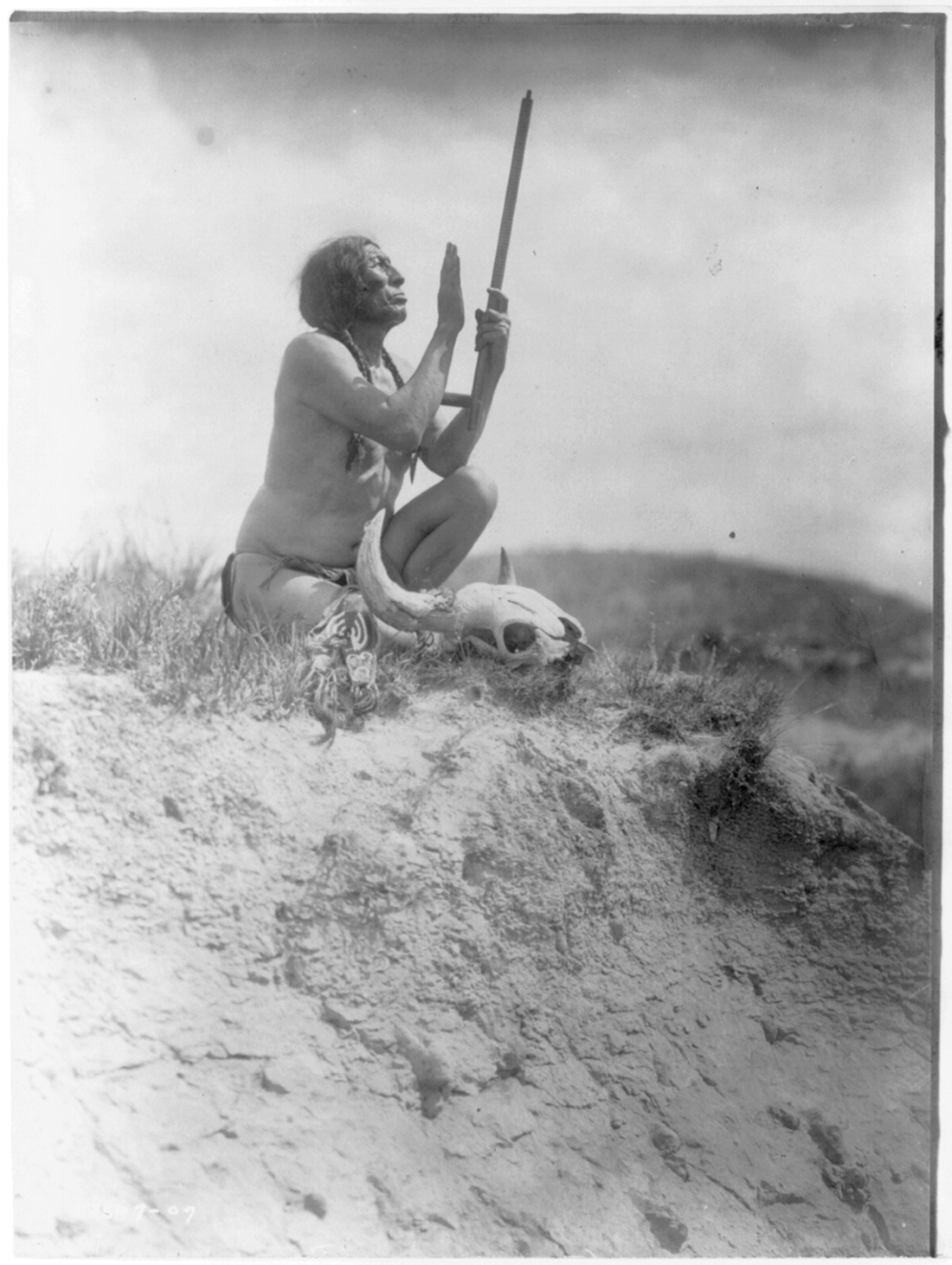
Curtis's contribution to the MHRA was also emblematic of the tendency to associate the Vanishing Indian with a spirituality and connectedness to nature that the white race had supposedly lost through the process of civilization. If we were to divide his photographs into various categories – portraits, hunting scenes, domestic scenes, etc., – “The Oath” would belong to one that might be called spiritual ceremonies. Like the upward-looking or upward-pointing figures in “Offering the Buffalo Skull – Mandan” (1908), “Crying to the Spirits” (1908), “Prayer to the Mystery” (1907), and “Prayer to the Great Mystery (Slow Bull)” (1907) (Figure 3), the oath-taker appeals to a transcendental authority. The buffalo skull – “symbolic,” according to Curtis, “of the spirit of the animal upon which the Indians were so dependent” – appears in many of these photographs, often at the Indian's feet.Footnote 40 Curtis himself may have placed that skull in the foreground of “The Oath” – and indeed may have conceived and directed the entire scene. Gidley has described his depictions of spiritual supplication as having a staged, tableau vivant quality – calculated to “remove the subject from the passage of time.”Footnote 41 In choosing “The Oath” as his representative photograph, Curtis thus affirmed a common (and still prevalent) trope of the Indian as a spiritual and naturalist being.
Edward S. Curtis, “Prayer to the Great Mystery (Slow Bull)” (copyrighted 1907). Prints and Photographs Division, New York Public Library.

The Vanishing Indian was also routinely described in the singular rather than the plural. Curtis was often, to be sure, at pains to challenge his contemporaries’ tendency to generalize about “the Indian,” as though observations about one tribe could be extrapolated to encompass all. He was particularly critical of how “the average person” viewed Plains Indians as “the typical American Indian, the Indian of our school-day books – powerful of physique, statuesque, gorgeous in dress, with the bravery of the firm believer in predestination.”Footnote 42 Yet, although his book project encompassed more than eighty tribes and examined them separately, the MHRA's terms – permitting just one parchment page – forced him to present a single tribe as representative. Curtis's submission of “The Oath” thus reinscribed popular perceptions of the Apsáalooke people as the quintessential Indians, eliding the diversity of indigenous tribes occupying North America.
A further defining feature of the myth of the Vanishing Indian was its implication that the decimation of Indian life was an inevitable and natural process, the result of fixed Darwinian laws rather than of specific historical injustices committed against them. Curtis did acknowledge in the general introduction to The North American Indian that the “treatment” of the Indians was “in many cases … worse than criminal,” even as he disclaimed that his purpose was the “rehearsal of these wrongs.”Footnote 43 In the volume on the Apsáalooke, he (or his principal writer, William E. Myers) described how they had been decimated not only by smallpox outbreaks and wars against neighboring tribes, but also by the incursions of white settlers and the slaughter of the buffalo, and most recently by the “cession” of thousands of acres of their reservation.Footnote 44 Yet none of this is included in the photograph Curtis deposited with the MHRA. By eliding the problems faced by the Apsáalooke, “The Oath” conveys to the future historian the impression that these last Indians of 1913 were still living a pristine and untroubled existence, practicing their traditional customs without interference from the government or, for that matter, ethnologists and photographers.
Nor did Konta seem interested in documenting crimes against Indians. Among the vice presidents he appointed for the MHRA were Frederick Grant (son of Ulysses) and David Brainard, both of whom had been commanders in the Indian Wars.Footnote 45 For such veterans, a photograph of Apsáalooke warriors would have had special appeal, as their tribe fought alongside the US Army in those wars against their traditional enemies, the Sioux and Cheyenne. Indeed, Goes Ahead (the middle figure in “The Oath”) was one of six Apsáalooke scouts assigned to George Armstrong Custer and thus witness to the Battle of the Little Bighorn in 1876. Curtis visited the battlefield in 1907 to collect testimony from him and other surviving scouts for a debunking book he intended to write about that event, and may have shot “The Oath” on that very site. Even though he was critical of the cult of Custer, his photographs of Goes Ahead and others catered to the growing white nostalgia for his “Last Stand.” As in the work of contemporaries such as the Wanamaker-sponsored Joseph Kossuth Dixon, who also photographed Goes Ahead, Apsáalooke warriors were presented as the last surviving links to that mythical event.Footnote 46
Yet the affinity between Curtis and the MHRA centered, above all, on their relation to the future. The notion that preserving a record of dying cultures was a service or even obligation to posterity was central both to salvage ethnography and to the larger myth of the Vanishing Race. Curtis conveyed that notion not only verbally – in his general introduction and in articles and public addresses – but also through the physical materials he deployed for his volumes. Critics clearly bought into the conceit. His search for such “time-defying” materials, commented the Hampton Magazine in 1912, “would alone form a splendid chapter in the record of persistent and forethinking effort.” In phrases similar to those used at ceremonies for the sealing of time capsules, the magazine suggested that the value of Curtis's work could not be “properly appraise[d]” by his contemporaries: “we can but guess at it; the men of generations yet to come will be much better able to estimate truly its worth.”Footnote 47 Photographic Times, in the issue featuring “The Oath,” suggested that Curtis's photographs would enable future viewers to enter into vivid contact with that lost race. Artists in “years to come” could depict Indians without resorting to white models “painted in bronze and dressed in buckskin and feathers, borrowed from a museum.”Footnote 48 This emphasis on the edification of future artists and researchers allowed Curtis and his supporters to distinguish his work from the popular images that the pictorial press produced for contemporaneous consumption. And if the persistence of living Indians interfered with white nostalgia for precontact Indian culture, Curtis and others could imagine a purer form of nostalgia that would be possible when their vanishing was complete. Konta took such ideas a step further, establishing an archival framework for the literal stockpiling of images and records of native folkways for later scholars. The parchment on which Curtis submitted his photograph of “The Oath” to the MHRA thus lent substance to his claim to be endowing posterity with a noble gift.
New visual and audio technologies were crucial to the articulation of this bond with posterity. Konta and his MHRA associates celebrated photography, phonography, and cinematography as guaranteeing the survival of their records. With such durable media at our disposal, wrote one of them (conveniently ignoring their tendency to degrade or combust), “there will be no lost history in the future … There will be complete pictured and phonographed records of everything worth keeping.”Footnote 49 Media technologies were not simply innocent tools with which to preserve Indian culture for posterity, but were considered proof of the very evolutionary process that was apparently condemning it to extinction. As American studies scholar Brian Hochman has recently shown, American ethnologists had long attributed the disappearance of indigenous languages to Indians’ alleged failure to develop an alphabet. Indigenous arts and institutions, too, were “dissolving” because of this fixed state of orality, the late nineteenth-century ethnologist John Wesley Powell implied. Conversely, the capacity to store sophisticated ideas as written (and, subsequently, printed) words was considered key to the evolution of the dominant races. The camera and phonograph were simply the culmination of that logic of inscription.Footnote 50 Stories of Indian resistance to such technologies served to reinforce this idea. “The tribes of the Southwest,” declared the mineralogist George F. Kunz at the MHRA's inaugural meeting, retained a “superstition” towards the phonograph that “was almost impregnable” – yet which, Charles Lummis, through “long, intimate and wide acquaintance” with them, has been able to “overcom[e].”Footnote 51 Konta's and Curtis's faith in the preservative powers of modern media thus had a subtle racial subtext.
The very idea of a time capsule, too, was believed to confirm that higher stage of cultural development. According to the architect of the Century Chest, a capsule deposited for a hundred years in Colorado Springs in 1901, such an invention demonstrated a regard for future generations that is “indicative of a new virtue which is faintly rising in the race,” its forward-looking orientation signaling an advance over the ancestor “worship” emphasized by man “in former ages.”Footnote 52 Indians, by contrast, were often characterized as indifferent to the future, in accordance with the myth of the happy savage. For the archaeologist and ethnologist Alice Palmer Henderson, the tribes of the Yukon “have very little idea of the future, and, to tell the truth, very little interest in it. They follow the instruction of the poet: ‘Worry not over the future, present is all thou hast, / For the future will soon be present, and the present will soon be past.’”Footnote 53 The self-styled expert on Plains Indians Colonel Richard Irving Dodge had attributed this disinterest in the “possibilities of the future” to their supposed lack of a proper calendar or of any “word synonymous with our word year.”Footnote 54 Preserving photographs and phonographs of Indian life for posterity, in other words, was assumed to be a task only whites could undertake. The Colorado Springs time capsule thus memorialized the neighboring Ute tribe through materials donated on their behalf by a US Indian agent's widow.Footnote 55 This assumption effectively discounted the efforts that many tribes were already making to document their own culture for future gnerations, through autobiographies such as that of the Apsáalooke warrior Two Leggings and through the photographic work of the Cree Indian but adopted Apsáalooke Richard Throssel, who preserved their ancient ceremonies as well as their current living conditions in more than a thousand photographs between 1904 and 1911.Footnote 56
As a submission to the MHRA, “The Oath” thus appears to deny a future for the Apsáalooke by construing posterity in racially exclusive terms. Unlike messages written by MHRA members (or by other time-vessel contributors) to their own lineal descendants, this photograph does not reinforce an ethnic bond across time. Its assumed recipients are not Indians but whites, for whom the former will have become the stuff of legend, their rituals and practices obscured by the mists of time. Already, wrote Curtis, the Apsáalooke's numbers are dwindling, from a population of “approximately nine thousand” in 1825 to “less than eighteen hundred” by 1908.Footnote 57 Yet photographs such as this would serve, in his words, as “transcriptions for future generations that they might behold the Indian as nearly lifelike as possible.”Footnote 58 The sacrificial bison meat raised to the heavens here echoes his own offering to posterity in the form of this photograph – and, by extension, all his photo-ethnographic labors, for which he claimed that year to have “made about every sacrifice a human being can.” And, given that twelve volumes remained, the oath also evokes his pledge to complete those labors.Footnote 59
Closer examination of the MHRA and of Curtis's “The Oath,” however, complicates this picture. Konta's archive was not simply a distillation of the dominant racial views of the period. The “Message of the Records” portfolio also included more critical testimony. H. G. Wells used his parchment to denounce the racial ideologies of his time, in particular the way that “the politically ascendant peoples of the present phase are understood to be the superior races,” while those who are “not at present prospering … are represented as the inferior races, unfit to associate with the former on terms of equality, unfit to intermarry with them on any terms, unfit for any decisive voice in human affairs.”Footnote 60 Lummis also criticized prevailing views on race, even if (like Wells) he ultimately reinscribed assumptions of white supremacy. His sojourn with Pueblo Indians in New Mexico in 1888 had led him to reject salvage ethnography and the Vanishing Indian myth and to maintain that indigenous cultures could adapt and endure without losing their cultural traditions. He was also a fierce critic of the US Bureau of Indian Affairs and its post-Dawes policy of forced assimilation. In 1899, he had launched a campaign against the removal of Indian children to boarding schools and against an educational program designed to turn them into a “class of constitutional peons,” and in 1902 he had organized a league to protect the land and educational rights of Indians in California, thus becoming the “forerunner by half a generation” of the American Indian Defense Association of 1923, in the words of its founder, John Collier.Footnote 61
We also need to consider the possibility that Curtis's endorsement of the MHRA was merely strategic. Given the expense of his fieldwork and high-quality volumes, Curtis was always on the lookout for patrons and promotional opportunities. This need was especially acute at the time of the MHRA offering because J. P. Morgan, who had financed all the fieldwork since 1906, had died less than a month earlier without having clarified whether his estate would continue that funding. With the MHRA offering its paying members free facsimiles of all the celebrity contributions to its “Message of the Records,” Curtis presumably spotted a chance to circulate one of his photographs and thereby lure subscribers to his own venture. He could capitalize on the MHRA's efforts to conscript those members as archival partners, charged with preserving these facsimiles, “should the originals … be lost or destroyed.”Footnote 62
Moreover, had Curtis wished to affirm his belief in the notion of the Vanishing Indian, a more obvious choice of photograph to submit to the MHRA would have been one that portrayed Indians receding from the viewer or with their backs turned to the camera. His celebrated “Vanishing Race,” the frontispiece to his first volume, is still viewed as an encapsulation of his entire project, with its mournful depiction of Indians riding off into a blurry sunset.Footnote 63 A similar strategy, employed in “The Three Chiefs – Piegan” (1900) and “The Valley of the Rosebud” (1905), was to place an obstacle such as a river between camera and subject, thus evoking the temporal chasm that separates the Indian from any present or future. Curtis might also have chosen one of his photographs that employed a title to drive home the idea of a vanishing people, such as “The Spirit of the Past – Apsaroke” (1908), which a caption further describes as “a group of old-time warriors,” harking back to the “early days of the chase and the war-path.”Footnote 64 By contrast, “The Oath,” which never had a descriptive caption, presents its Indian subjects in a more defiant posture, their bodies turned partially or fully toward the viewer, even as they looked off to the side. Engaged in the more assertive act of an oath, their bodies affirm a sense of persistence and endurance in the face of white incursions.
Their possession of two rifles, furthermore, appears to contradict the essential rule of salvage ethnography, that of presenting the Indians as if in some pure, prehistoric (or precontact) state.Footnote 65 The rifles’ inclusion in “The Oath” may have been on the insistence of Goes Ahead and Pretty Tail – and, if so, would exemplify that process of cultural negotiation that recent scholars emphasize. Although white settlers and soldiers used rifles as “instruments of dispossession,” Indians were able to appropriate them as “instruments of resistance, resilience, survival, and self-definition,” in the words of American Indian studies scholar Amanda Cobb. As ethnologist John Ewers showed, Plains Indians incorporated them into their culture, etiquette, medicinal practice, and religion, and counted them as a status symbol and as a war honor (or coup) when captured in battle.Footnote 66 Not surprisingly, Indian tribal leaders frequently posed with their rifles in photographic portraits by other studios. If Lyman is correct about Curtis's preference to exclude such modern, postcontact artifacts, why did the latter not erase the rifles through subsequent retouching? And if, as Gidley argues, such signs of cultural exchange were “exceptions” seemingly included “to prove the rule” – indeed, no other rifles are to be found in that fourth volume and very few in the other volumes – then why did Curtis offer the MHRA a photograph that was unrepresentative in its foregrounding of evidence of cultural hybridity?Footnote 67 Does it not hint at some ambivalence on his part about the discourse of the Vanishing Indian, with its willful blindness to the ongoing realities of cultural adaptation, exchange, and survival?
The strongest indications of ambivalence towards prevailing discourses, however, revolve around the ritual depicted in the photograph. His decision to offer a picture purporting to represent an oath – the only one, it seems, in all of the North American Indian – may not have been arbitrary.Footnote 68 Curtis appears to be refuting the long-standing assumption that Indians could not conceivably have developed such a practice. Use of oaths to settle a dispute, according to James Endell Tyler's influential treatise Oaths: Their Origin, Nature, and History (1835), was characteristic of “nations somewhat advanced in civilization,” such as the Jews, Greeks, Romans, and Germanic peoples.Footnote 69 Its presumed absence from American Indian cultures was generally attributed to a supposed lack of certain moral or religious preconditions. “Although a believer in the immortality of the soul,” declared a contributor to the American Law Review in 1901, the American Indian “never employed oaths, because of his belief that his conduct in this life in nowise affected the life to come.”Footnote 70 Even the antiracist anthropologist Franz Boas downplayed evidence of Indian oaths. “Examples of the oath in America,” he wrote in The Mind of Primitive Man (1911), are “remarkably few … compared to … [those] collected … from the Old World.” To acknowledge their significance would have been to undermine his theory of how cultural forms spread through spatial expansion and contact. Adhering as rigidly to diffusionism as his opponents did to evolutionism, Boas overlooked the possibility of Indians developing oaths through independent invention.Footnote 71
Indians’ perceived lack of an oath tradition was invoked as justification for their continued subjugation. During the nineteenth century, state codes adduced it to prohibit them from testifying as witnesses, particularly in cases against whites. Even after those codes were revised, Indian testimony could still be disallowed. In 1880, the Nebraska Supreme Court found that a particular Indian witness was incompetent because he failed to “show his capacity to understand the obligations of an oath.”Footnote 72 Those opposing the full admission of Indians into the US Army made similar arguments. General Philip Sheridan wrote to the Secretary of War in 1884 to advise against establishing a military academy to prepare Indians for enlistment, on the grounds not only that they lack “stability or tenacity of purpose” and resist “discipline,” but also that “they cannot appreciate … the sacredness of an oath.”Footnote 73
By 1913, however, the anthropological “discovery” of oath ceremonies among Indian (and African) tribes had complicated such ethnocentric claims. Curtis appears in fact to have been only the second ethnologist to report the Apsáalooke oath, the first being S. C. Simms.Footnote 74 Curtis may have viewed his apparent codiscovery of the oath as part of his larger effort to repudiate popular stereotypes of the backward, barbaric, and unassimilable savage. “The average conception of the Indian,” he declared in 1911, “is as a cruel, blood-reeking warrior, a vigorous huntsman, a magnificent, paint and feather bedecked specimen of primitive man. Of such we have no end of mental pictures.”Footnote 75 Documentation of how the Apsáalooke observed a complex juridical process such as an oath would thus serve as corrective. Certainly, Simms viewed it as comparable to modern, Western oaths. Using legal terminology, he described how, once the tribal councilors consent to “hearing” the “claims” of certain contestants, the head-chief announces the “cause of the trial” and administers the oath, which involves the sacred objects of the buffalo skull, arrow, and meat, just as Western oaths are solemnized by a Bible or stone. As “many were afraid to touch the arrow,” the oath fulfilled the same function as those in courts of law, namely to deter “perjury.”Footnote 76 Curtis's photograph suggests a further echo of European oaths (and famous European paintings of oaths) by depicting the oathtaker as standing erect with his right arm raised.
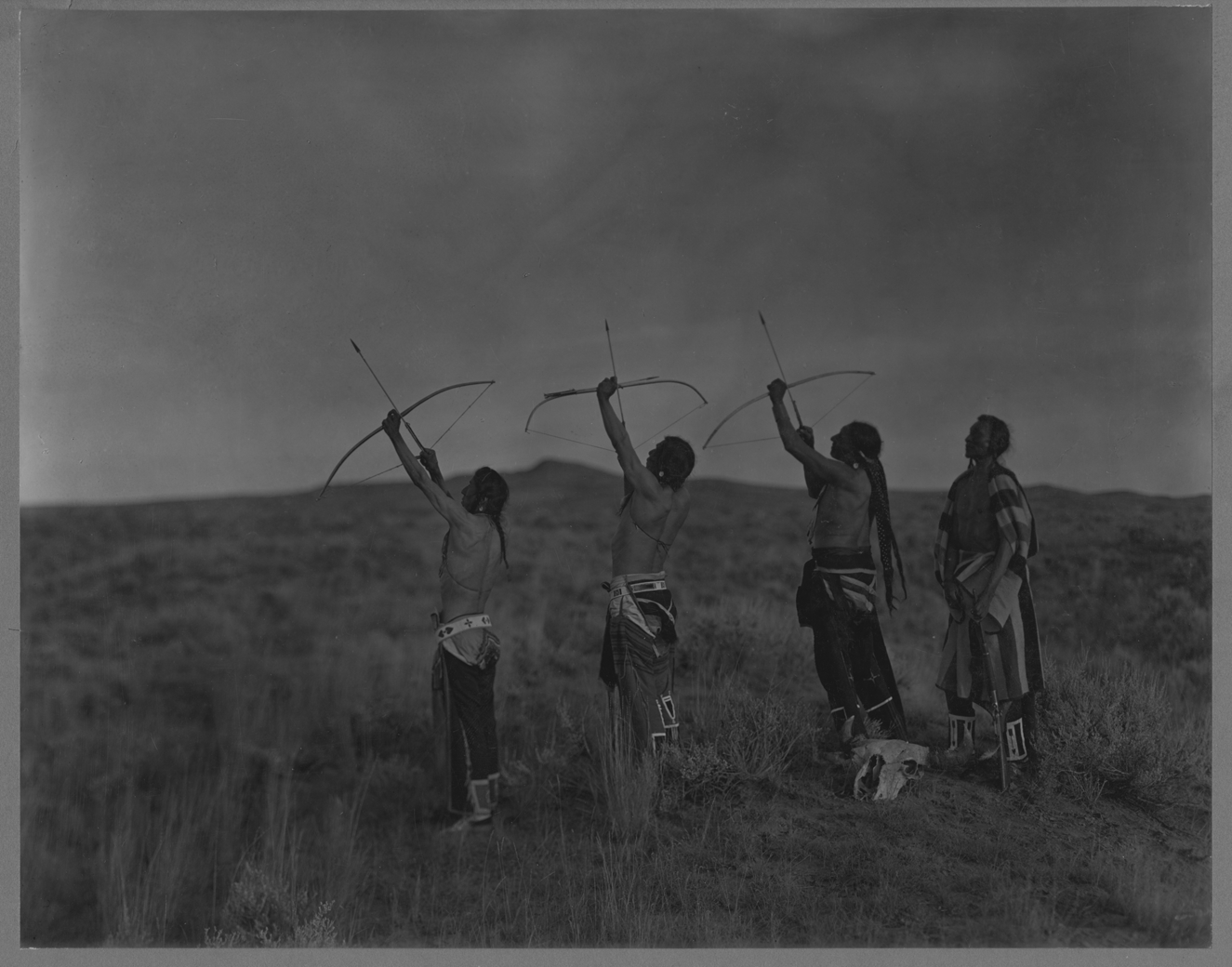
Of course, this impulse to celebrate Indian oaths remained highly problematic on a number of levels. First, it played into evolutionary assumptions. As philosopher Giorgio Agamben has shown, the human sciences began in the late nineteenth century to explain a practice or institution by “tracing it back to an origin or context that is sacred or magico-religious.”Footnote 77 They did so either to legitimize the institution or to advocate reform to eradicate such atavism, as in the growing movement to abolish oaths around 1900.Footnote 78 Oliver Wendell Holmes Jr.’s Common Law (1881) thus characterized the adoption of promissory oaths in premodern times as a primitive stage in the gradual evolution of contract.Footnote 79 Another legal historian, contributing to the landmark American collection The Evolution of Law (1915), saw the oath as itself evolving out of the earlier “ordeal” – the subjection of the accused to physical danger to determine whether the gods considered them guilty or innocent.Footnote 80 Within this evolutionary framework, Indian oaths functioned as crude antecedents. Indeed, a 1912 discussion of the Apsáalooke oath, by ethnologist Robert Lowie, ranked it as closer to the primitive ordeal than to modern oaths, insofar as it still served as means of proof; an oath taker's claim was rendered false not by cross-examination or counterevidence, but if “some misfortune” subsequently “befell” him.Footnote 81
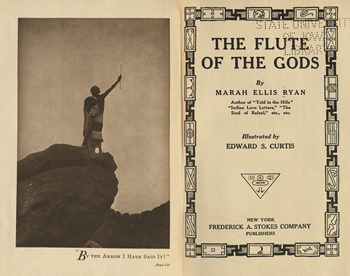
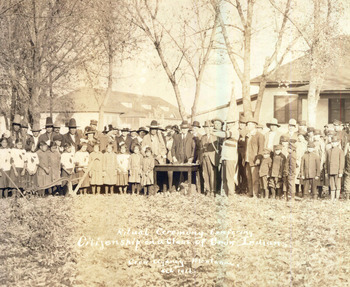
A second negative implication of Curtis's celebration of the oath was its exposure of a sacred ritual. Ripped from its indigenous context, it became an aesthetic object or a kind of theatrical performance to be consumed by non-Indian eyes. It also abetted cultural appropriation; by the 1910s, masonic organizations, college fraternities, and the Boy Scout movement were injecting various pseudo-Indian oaths into their rites of initiation and secrecy. (The scout's hand gesture, claimed Boy's Own, was apparently identical to that made by an Indian scout-to-be after a “solemn pow-wow and a prayerful smoking of the ceremonial pipe.”)Footnote 82 Curtis catered to this cult of the Indian oath, issuing the stand-alone photogravure “By the Arrow I Have Said It!” in 1909 – an image that served as inspiration and illustration for the oath scene in Marah Ellis Ryan's ethnologically informed novel of that year, The Flute of the Gods (Figure 4).Footnote 83 Other photographers emulated Curtis in purveying oath imagery, most notably Dixon, who featured three Apsáalooke men consecrating an oath with bows and arrows pointed skyward, in the presence of a tribal elder and a buffalo skull (Figure 5).Footnote 84 Such representations, moreover, fed back into Indian policy. As Indians who gained US citizenship through receipt of an allotment of reservation land (rather than through naturalization) were not required to take an oath of allegiance, Secretary of the Interior Franklin Lane devised a fraternal-style ceremony in 1916 that consisted of a pseudo-Indian oath involving, among other things, the symbolic discharging of an arrow (Figure 6) – a theme that Dixon's book Vanishing Race (1913) had sentimentalized through images of Indians discharging their arrows into the sunset or firing their “Last Arrow.”Footnote 85 This invented ritual inflicted a metaphorical death – less heroic than the death in combat depicted in earlier sculptures, such as Randolph Rogers's 1879 bronze The Last Arrow – from which the Indian would be reborn as American citizen. In a private letter a year earlier, Curtis had advised Secretary Lane about Indian initiation rites and even offered to bring to Washington further examples from his books.Footnote 86 He thus contributed not only to the simulation of Indian rituals but also to the imposition of such simulations on Indians.
Edward S. Curtis, “By the Arrow I Have Said It!”, frontispiece for Marah Ellis Ryan, The Flute of the Gods, illustrated by Edward S. Curtis (New York: Frederick A. Stokes, 1909). Special Collections, University of Iowa Libraries.

Joseph Kossuth Dixon, “The Oath” (1908 or 1909). Rodman Wanamaker Collection, National Anthropological Archives, Smithsonian Institution, NAA INV 02512000.

Richard Throssel, “Ritual Ceremony Confering [sic] Citizenship on a Class of Crow Indians, Crow Agency Montana, October 1916” (detail). National Archives, Still Pictures Branch, Photograph no. RG75-PA-7-46. Note the oathtaker drawing the bow in the center.

Third, in calling this ritual an “oath,” Curtis was projecting an Anglo-Saxon word and concept onto what appears to have been part of a larger ceremonial complex. Although Curtis's book alluded to the oath's role in adjudicating disputes between Apsáalooke warriors over who could claim the honor – or “count” the “coup” – of an act of bravery in battle, he elided that discussion from the parchment he submitted to the MHRA, thereby reducing it to a generic ritual.Footnote 87 This reduction further illustrates the dangers of excising his photographs from his book, where they operated inextricably with the text, and allowing them to circulate by themselves. Curtis also elided Euro-Americans’ subversion of this so-called oath. When relocating the Apsáalooke to a reservation in the early 1880s, the US government prohibited them from engaging in intertribal warfare, thus rendering such war-related rituals for counting coups meaningless – or, in philosopher Jonathan Lear's word, “unintelligible.”Footnote 88 The Office of Indian Affairs, aided by Christian missionary societies, subsequently sought to discourage or eradicate such “primitive” rituals, in particular through the Religious Crimes Code of 1883, which authorized penalties such as imprisonment or withholding of rations for those who did not comply.Footnote 89 Meanwhile, the decimation of the buffalo would have made it difficult to procure that sacrificial meat for the arrow. All this is absent from Curtis's MHRA parchment.
Yet, for all these problems, “The Oath” may still have served a purpose for Curtis's Apsáalooke subjects, namely that of preserving one of their cultural practices for their descendants, perhaps in the hope that they would revive it. Although the photograph had limitations as an aide-mémoire – as a single image it could only capture one moment of a complex ceremony and as a monochrome one it failed to register that both arrow and skull were painted red to symbolize blood – it could nevertheless be situated alongside the Apsáalooke's other efforts to record their own culture verbally and visually, such as Two Leggings's autobiography or Throssel's photographs (although, interestingly, neither included their oath). If the Apsáalooke themselves had proposed the oath scene to Curtis, the photograph would stand as evidence of their resistance to efforts to extinguish Indian traditions. The omission of any explanatory caption, on this reading, ironically preserves the ritual's aura of mystery and sanctity.
Such oath rituals, moreover, were not static but highly adaptive resources for negotiating with whites throughout the nineteenth century and into the twentieth. Numerous tribes had employed oaths to consecrate treaties, with the Apsáalooke chief Arra-tu-resash apparently invoking the “The Sun, Moon, and Earth” as witnesses to his fidelity to the Treaty of Fort Laramie in 1851.Footnote 90 They were also employed as indigenous variants of the oath of enlistment. When twenty-three Apsáalooke warriors enlisted in 1876 as scouts for Colonel John Gibbon's Montana Column against their traditional enemies, the Sioux and Cheyenne, they performed one of their oath ceremonies of touching a fingertip to a knifepoint. They construed that oath, moreover, as a mutual one – a kind of covenant – by insisting that Gibbon and his commander of scouts Lt. James H. Bradley pledge, on their part, “to believe all [the Indians] should tell [them] and do as [the Indians] wanted [them] to do.” After some hesitation, Bradley agreed to swear on the knife that they would receive “the same pay, rations, and allowances as were received by white soldiers.”Footnote 91 Goes Ahead, the figure apparently standing in the center of “The Oath,” was among those twenty-three scouts (one of six who were subsequently reassigned to Custer) and would thus have participated in that oath.
Oaths also played a part in the formalizing of tribal systems of governance. Legal historian David E. Wilkins and political scientist Sheryl Lightfoot have recently gathered numerous instances from the nineteenth and early twentieth centuries of tribal constitutions (such as that of the Sisseton Wahpeton Nation in 1884 or the Rosebud Sioux in 1916) that incorporated some kind of oath of investiture. While some were “colonial impositions” by white superintendents and Indian agents or were the result of Christian influences, others were “adaptations of traditional social and governmental institutions to the mores and modes of Western constitutionalism.” Indeed, the tradition of using oaths to anoint new leaders pre-dated contact; the Great Law of Peace of the Iroquois Confederacy required leaders to undergo an induction ceremony involving a pledge upon “four strings of shells (or wampum).”Footnote 92
It is symptomatic of this process of inventive adaptation that, by 1903, the ethnologist Simms – and perhaps Curtis himself – witnessed the Apsáalooke oath-by-arrow not in its original context but in a Court of Indian Offenses. A “tin arrow,” he noted, is used “in administering oaths to plaintiffs and defendants appearing before [its] three Indian judges.”Footnote 93 Devised by Chester Arthur's Secretary of the Interior Henry Teller in 1882 and established on numerous reservations in subsequent years, the Courts of Indian Offenses (like the Indian boarding schools) were a product of the assimilationist policy that followed the Indian Wars. They were to be presided over by “progressive” Indians and were to target, in Teller's words, “heathenish rites and customs” – especially those designed to “stimulate the warlike passions of the young warriors of the tribe,” such as feasts and dances where “the warrior recounts his deeds of daring.”Footnote 94 It is not clear whether the Office of Indian Affairs introduced the oath-by-arrow in order to legitimize the court in the eyes of the older Apsáalooke, or whether the latter demanded it; according to one recent scholar, the Indian judges did find “innovative ways to incorporate Indian customary ways into the court's proceedings and decisions.”Footnote 95 At any rate, its use contradicted Teller's anti-ritual agenda and corroborates claims that the courts may have been sites of contestation rather than simply coercion.Footnote 96 Curtis's photograph might thus have taken an ongoing, creatively adapted ritual and simply restaged it in a timeless, landscape setting.
Lastly, in depositing that photograph with the MHRA, Curtis was not necessarily catering to future white viewers’ nostalgia for some lost race. It might just as conceivably function as an indictment of their white ancestors, a reminder of the civilization they had destroyed. To include such documents of Indian culture in an archive of “Modern Historic Records” was also to negate the prevailing assumption that they belonged in natural-history museums or ethnological collections. Furthermore, the photograph may not even have been intended for future Americans. Although Konta sealed two of his time capsules for one hundred years (a standard timespan for those of the period), he envisioned the archive itself as a longer-term bequest, designed to outlive Western civilization. The project was originally inspired by a visit to a museum of Egyptian antiquities, which had sparked an epiphany about how “this advanced civilization of ours” would bequeath an equally inadequate archaeological record, unless active measures were taken. His philosophy of history was that “civilizations reach a certain point, then decline, and even disappear, leaving the human race to start anew at the bottom.”Footnote 97 It was this desire to communicate across deep historical chasms that prompted the MHRA to devise a method for mechanically imprinting messages on clay tablets and to espouse reinforced concrete – a material that “theoretically … will last forever” – for its proposed headquarters.Footnote 98 Thus, if Curtis's photographs promoted a belief in the impending extinction of the Indian, Konta's scheme enabled the same Anglo-American audience to confront the specter of its own ultimate extinction and supersession. The skull, reminiscent of those that served as memento mori in baroque vanitas portraits and still lifes, functions here as reminder of the transience of civilization itself.
As it turned out, it was Konta's own organization that proved transient. The “Message of the Records” and the cylindrical time capsule turned out to be among its last undertakings. America's entry into the Great War diverted funds and interests away from cultural projects while also prompting questions about the loyalties of Austro-Hungarian-born citizens; in 1918, Konta was called before the Senate to respond to allegations that he had colluded with German propagandists – that he had effectively broken his own oath of citizenship.Footnote 99 With the failure to realize its headquarters in Washington, the MHRA's collection of autographed testimony was condemned to permanent limbo in the vaults of the New York Public Library. The time capsule, although listed in the library's catalogue, is now apparently lost. Only a few documents, including the autographed print of “The Oath,” remain in its manuscript division.Footnote 100
Curtis, too, suffered a decline of fortune. While eleven volumes appeared in the nine years up to 1916, there were none in the subsequent six. By the time the final volume appeared in 1930, the public had lost interest in the photographer and his project. Twenty-two years later, he died bankrupt and largely forgotten.Footnote 101 Curtis's photographic offering to the MHRA thus marks the high point of his own career, a moment when he moved in elite circles and when his work was widely exhibited, reproduced, and imitated.
Yet, more than that, Curtis's “The Oath” stands as a reminder of instabilities and ambivalences within his work – and within the larger mission of salvage ethnography. Viewed within the context of the MHRA records, rather than that of the fourth volume of The North American Indian, “The Oath” appears both to confirm and to contradict the governing myth of the Vanishing Indian. As a contribution to a future-oriented archive, it seemingly reinscribes various assumptions underpinning the preservation of the cultural practices of American Indians, namely that they were incapable of documenting themselves in lasting form, were indifferent to conceptions of posterity, and were living documents of humanity's origins. And yet these assumptions are undercut by Curtis's unlikely choice of photograph to represent his project. Instead of one of his romantic, “disappearing Indian” photographs, he chose one that depicted his subjects in an assertive pose and that insisted on the preexistence of juridical procedures among Indians. The ambiguity of Curtis's photographic offering derives also from its removal from a multivolume book, where its meanings had been constrained and explicated by an organized framework of images and text, and its bestowal on the MHRA, where it commingled with other, quite distinct agendas, such as those of Lummis or Wells. But, above all, the future orientation of that archive – so different from those archives created for specific, governmental uses in the present – exposed its documents to the unknowable (and possibly harsh) judgments of historians to come. Curtis's autographed photograph in the New York Public Library thus calls attention to the indeterminacy that salvage ethnographers invited when they addressed – rhetorically or literally – their future viewers.