



1. Introduction
In this review article, we aim to provide an international readership access to the most recent research on foreign language teaching and learning published in local, high-impact journals in China. Following up on Gao et al. (Reference Gao, Liao and Li2014), this synthesis covers 71 publications selected from 13 Chinese Social Science Citation Index (CSSCI)-indexed journals of applied linguistics over the past ten years (2012–2021).
Since the time of the previous review (Gao et al., Reference Gao, Liao and Li2014), a few significant national policies concerning foreign language teaching and learning have been implemented nationwide. The launch of the Belt and Road initiative in 2013, which was driven by emerging social, political, and economic needs, triggered the Chinese government's reinvigorated investment in developing degree programs in languages other than English (LOTE) education (Gao & Zheng, Reference Gao and Zheng2019; Han et al., Reference Han, Gao and Xia2019). Additionally, the past decade or so witnessed the continuing rise of teaching and learning of Chinese as a second or foreign language (CSL/CFL) both inside and outside China. In response to that, the Chinese government has made concerted efforts to support Confucius Institutes around the globe as a way to extend China's soft power on the one hand, and to promote quality research on critical issues concerning CSL/CFL teaching and learning on the other hand (Gong et al., Reference Gong, Gao and Lyu2018, Reference Gong, Gao and Lyu2020). In June 2021, the education industry in China experienced an abrupt regulatory clampdown on after-school tutoring businesses related to school syllabi at elementary to senior high levels, in which English is one of the core courses. It is predicted that this crackdown will further influence the status of English language education in China. Although these policies seem to indicate the suppression of English as the most important foreign language at the national level, it is unlikely that these shifts will directly challenge the dominance of English language education, at least in the short term. In a word, if the previous review (2008–2011; Gao et al., Reference Gao, Liao and Li2014) is situated within a context that can be characterized as an ongoing enthusiasm for learning English in the post-Olympic era, this new phase (2012–2021) is contextualized within the rise and possible decline (at least significant shifts) of foreign language education in China.Footnote 1
Apart from that, compared with foreign language learning and teaching in China in previous years (e.g., see Gil (Reference Gil and Kirkpatrick2016) for an overview of English language education in China), the last decade is characterized by growing political, economic, and social needs for learning foreign languages, more advanced technological development such as Artificial Intelligence, Big Data, and Cloud, and an increasing number of professionals studying abroad and returning home to be language teachers. While all these have a mostly positive impact on the learning and teaching of foreign languages, some difficulties and challenges still remain. For instance, although many learners may know a lot about English, the number of people who can use English to communicate effectively in a real-life situation is low (Gil, Reference Gil and Kirkpatrick2016). A major reason may be that the traditional grammar-translation approach to foreign language pedagogy remains to be widely used in Chinese public schools despite its criticisms of producing so-called ‘deaf-and-dumb’ learners, whereas other more communicative methods fail to receive widespread popularity (Liu et al., Reference Liu, Lin and Wiley2016). Additionally, there still exists an uneven distribution of language teaching and learning resources in particular qualified teachers among the eastern coastal districts and less affluent areas (Ruan & Leung, Reference Ruan and Leung2012).
To address these difficulties and challenges, the Chinese Ministry of Education has implemented a series of initiatives for nationwide foreign language curriculum reform in the last decade or so. The publication of English Curriculum Standards for Compulsory Education in 2011 called for student-centred, task-based, and communicative instruction from elementary to senior high schools (Liu et al., Reference Liu, Lin and Wiley2016). At the tertiary level, an education development initiative, namely the Double First Class University Plan, was conceived in 2015 and launched in 2017, aiming at sponsoring and developing elite universities and disciplines including linguistics and applied linguistics. In addition, the National Criteria of Teaching Quality for Undergraduate English Majors and Other Foreign Languages Majors was issued in 2018, with the purpose of promoting undergraduates’ basic language skills, humanistic quality, international vision, intercultural communication competence, and critical thinking (Xu & Feng, Reference Xu and Feng2019). However, we have to recognize that the actual implementation of these national foreign language policies and curriculum standards is challenging owing to the wide diversity of foreign language learners and learning circumstances in China (Wang & Gao, Reference Wang and Gao2008).
Accompanying the tremendous national support for foreign language curriculum reform and discipline development, research published in local journals in China focuses on topics related to the learning and use of languages under various learning contexts, innovative approaches to teach foreign languages to learners at various levels, individual differences pertinent to language learners and teachers, to name just a few. Much research is interested in testing the feasibility of theories initiated by international scholars in Chinese learners and learning contexts. Apart from that, the past decade has also witnessed the proposal and development of Chinese scholars’ innovative instructional approaches such as the production-oriented approach (Wen, Reference Wen2015) and the reading-writing integrated continuation approach (Wang, Reference Wang2012). Thus, this synthesis, serving as a follow-up study of Gao et al. (Reference Gao, Liao and Li2014), aims to make some selected, high-impact publications in China's local journals accessible to a wider international readership, with a focus on foreign language teaching and learning. It is hoped that a review on the experience of Chinese practitioners and researchers’ efforts to promote foreign language education may inform and contribute to language teaching research and development in a wider context (Wang & Gao, Reference Wang and Gao2008).
2. Methodology
A bibliometric approach was employed to help us objectively select the research themes and articles to be reviewed. In this section, a brief description on our methods is introduced.
First, following Gao et al. (Reference Gao, Liao and Li2014), we aim to review publications in the 13 high-impact local journals in the area of foreign language teaching and learning (Appendix 1). We downloaded the bibliometric information of all articles published from 2012 to 2021 from China National Knowledge Infrastructure (CNKI). We chose 2012 as the starting year since the present review is a follow-up of Gao et al. (Reference Gao, Liao and Li2014), whose review covered 2008 to 2011. In addition, we downloaded the data from CNKI since it includes the bibliometric information of all the journal articles that we need for the analyses, such as author names, article titles and abstracts, and journal titles. At this step, the bibliometric data of a total of 11,927 articles were downloaded.
Second, since most of the target journals publish articles in multi-disciplinary areas such as linguistics, applied linguistics, translation and interpreting studies, and literary studies, the researchers and a Ph.D. student in applied linguistics, based on the titles and abstracts of the articles, collaboratively excluded those that were not pertinent to language teaching and learning. A total of 9,585 articles were excluded, and the abstracts of the remaining 2,342 articles were extracted and used for the analysis. Note that all the articles, including the abstracts, were written in Chinese. Hence, we performed the following procedures on the Chinese abstracts.
Third, we tokenized and part-of-speech tagged the abstracts with the tool package spaCy (Honnibal & Montani, Reference Honnibal and Montani2018) based on home-made Python scripts. Following Justeson and Katz's (Reference Justeson and Katz1995) rule-based algorithms, we extracted a total of 22,150 noun phrases from the part-of-speech tagged abstracts. We extracted noun phrases for the reason that most topical terms are noun phrases (Justeson & Katz, Reference Justeson and Katz1995). It should be noted that we did not use the author-provided ‘keywords’ for two reasons. First, the method of extracting research topics from the abstracts is one that has been widely accepted and commonly used in previously bibliometric studies (e.g., Lei & Liu, Reference Lei and Liu2019a, Reference Lei and Liu2019b). Second, the author-provided ‘keywords’ are very limited in size while the abstracts are much larger in size, which may provide much more information and hence a much larger number of possible candidate topics.
Fourth, two empirical criteria were used to filter in candidate topics from the noun phrases, that is, high frequency and wide range. The reasons that we included such criteria is that the topics extracted should occur frequently across a wide range of texts (Lei & Liu, Reference Lei and Liu2019a, Reference Lei and Liu2019b). After several rounds of experiments, we decided that a noun phrase is a candidate topic if it occurs at least 20 times across at least 20 texts. We obtained 416 candidate topics at this step.
Last, we decided on the important topics with the following steps. We first individually judged if the candidate topics were important ones, and topics such as research, this article, and results were excluded since they might not serve as research topics. Then, we discussed our judgements, and obtained 41 important topics after full agreements were reached. The topics were grouped into four categories, that is, language learning and use, language pedagogy, language learners and teachers, and Teaching English as a Foreign Language (TEFL) approaches/theories, and a number of sub-categories. The topics, categories, and sub-categories are summarized in Appendix 2, the first two columns of which also serve as the overall structure for the rest of the present review. Based on the topics, we removed articles that were irrelevant, were deficient in theoretical soundness, or lacked methodological rigour. Finally, a total of 71 articles were included in the following in-depth qualitative review, based on a careful consideration of factors such as representativeness, quality, diversity, and impact of the articles.
3. Language learning and use
The topics concerning language learning and use are probably the most extensively examined ones in the area of foreign language teaching and learning. Before we review the selected studies, we would like to offer several observations.
1. The research concerning language learning and use covers the four language skills, that is, listening, speaking, reading, and writing, from the perspective of a fairly comprehensive set of pertinent topics such as complexity (e.g., H. Zhang, Reference Zhang2020), accuracy (e.g., Li & Sui, Reference Li and Sui2017), and fluency (e.g., Bai & Ye, Reference Bai and Ye2018).
2. Researchers paid much attention to the trajectory of learners’ language development in the past decade, examining and explaining the development of skills such as speaking (e.g., Yu & Dai, Reference Yu and Dai2019) and writing (e.g., Jiang & Wang, Reference Jiang and Wang2015) largely within the framework of the Complexity Theory (Larsen-Freeman, Reference Larsen-Freeman2009).
3. The past decade witnessed the birth of China’ national framework of English language proficiency standards named China's Standards of English (CSE), which has become a new topic of heated discussion. Researchers were particularly interested in relevant topics such as the development and validity of the CSE framework and its utility in English teaching and learning (e.g., Min et al., Reference Min, He and Luo2018; Zhang & Zhao, Reference Zhang and Zhao2017).
4. Topics such as pragmatic competence began to attract more attention and many studies have been conducted to investigate the development of pragmatic competence (e.g., Liu & Huang, Reference Liu and Huang2012; Liu, Reference Liu2015) and pragmatic transfer (e.g., Dai & Zhang, Reference Dai and Zhang2018; Zhu, Reference Zhu2019). The increasing interest in pragmatic competence reveals that Chinese researchers have begun to realize the integrated role of pragmatic competence in the learner's development of linguistic competence, which was evidenced by findings such as the non-linear relationship between linguistic proficiency and pragmatic competence (e.g., Liu & Huang, Reference Liu and Huang2012) and that between pragmatic competence and pragmatic transfer (e.g., Dai & Zhang, Reference Dai and Zhang2018; Zhu, Reference Zhu2019).
3.1 Lexical learning and language transfer
3.1.1 Incidental acquisition of vocabulary
One of the most examined topics in lexical development in China is incidental acquisition of vocabulary, largely in the framework of Laufer and Hulstijn's (Reference Laufer and Hulstijn2001) Involvement Load Hypothesis. Meng and Chen (Reference Meng and Chen2015), for example, investigated the effect of glossing on Chinese learners’ incidental acquisition of vocabulary in timed reading. Five types of new word glossing were controlled in their experiment, that is, no glossing, Chinese side-noting, English side-noting, Chinese end-noting, and English end-noting. Results showed that all types of glossing rendered significantly better achievement in incidental acquisition of vocabulary in the instant after-reading vocabulary test than no glossing did, and both Chinese side-noting and Chinese end-noting were significantly more effective in the delayed test than no glossing, English side-noting, and English end-noting. Different from Meng and Chen (Reference Meng and Chen2015), Li and Wang (Reference Li and Wang2020) examined incidental vocabulary acquisition via movie input. They controlled two variables in their experiment, that is, task difficulty and interestingness. Their findings indicated that the factor of task difficulty affected incidental vocabulary acquisition. To be specific, movie inputs with bilingual subtitles facilitated learners’ vocabulary learning to a larger extent than those with no subtitles. When the factor of task difficulty was controlled, the variable of interestingness was responsible for the effect of incidental vocabulary acquisition, with more interesting inputs producing better effect than less interesting ones. In addition to the reading tasks, a few researchers explored the effect of incidental vocabulary acquisition via writing tasks. For example, Ren and Liu (Reference Ren and Liu2020) asked their participants to first read a passage, and then either (1) write a sentence with the target words, (2) write a passage with the target words, or (3) translate the target words into Chinese. They found that the participants benefited most from the writing-passage task and least from the translation task. To summarize, the aforementioned three studies all partially confirmed the Involvement Load Hypothesis (Laufer & Hulstijn, Reference Laufer and Hulstijn2001). However, it should be noted that research in this area framed the explanations of their empirical findings based on the Involvement Load Hypothesis (Laufer & Hulstijn, Reference Laufer and Hulstijn2001). Future research may need to refer to more recent advances of research in the area such as the Involvement Load Hypothesis Plus (Yanagisawa & Webb, Reference Yanagisawa and Webb2021) and extend research to the incidental acquisition at other linguistic levels such as collocations (Dang et al., Reference Dang, Lu and Webb2021).
3.1.2 Language attrition
Besides the learning of vocabulary, some researchers are also interested in language attrition, or non-pathological loss of language (Tomiyama, Reference Tomiyama2000), particularly in terms of vocabulary. Ni's (Reference Ni2013) research is probably the most influential in this area of inquiry. As a follow-up study of Ni (Reference Ni2010), which focused on the role of external factors such as instrumental and integrative motivation in language attribution, Ni (Reference Ni2013) focused on the dynamic process of lexical attribution. In Ni (Reference Ni2013), he asked the participants who had graduated from college for one to seven or more years to complete a vocabulary assessment test and then compared the vocabulary attrition rate of those graduates with that of a group of undergraduates. Based on the results, Ni (Reference Ni2013) observed a three-stage model of vocabulary attrition for Chinese graduates, that is, the two-year-after-graduation stage of rapid attrition (with a retention of 3,100 words), the six-year-after-graduation stage of stability (2,900 words), and the six-year-onwards stage of rapid attrition (1,500 words). Fu (Reference Fu2019) extended Ni (Reference Ni2013) and explored both the internal and external factors that caused Chinese EFL learners’ attrition of vocabulary. He found that external factors such as the duration of non-learning were a function of attrition, with five years of non-learning being a critical point for attrition. In addition, internal factors of word frequency were also found to be significantly correlated with attrition, and low-frequency words were more prone to attrition than high-frequency words.
3.1.3 Language transfer
Researchers also examined vocabulary learning from the perspective of language transfer. Zhang and Liu (Reference Zhang and Liu2013) searched preposition-related collocations and colligations in an interlanguage corpus of writings by Chinese undergraduates and analysed conceptual transfers at both lexical and grammatical levels. The research found the existence of both positive and negative conceptual transfers, particularly negative ones such as frequently occurring errors possibly caused by conceptual transfers from the writers’ mother language (e.g., *on the sky at the lexical level and *after hear my words at the grammatical level). Zhang and Liu (Reference Zhang and Liu2013) argued that their findings in part supported the Conceptual Transfer Hypothesis (Jarvis, Reference Jarvis2011). Cai and Xu (Reference Cai and Xu2018) tracked the dynamic change pattern of EFL transfer in a two-year longitudinal study in terms of adjective + noun collocations in five consecutive narratives orally produced by 32 Chinese undergraduate learners. The study found an overall higher frequency of positive transfer from Chinese to English than that of negative transfer in the collocations. One finding of interest in the study is that positive transfer was found to have changed with a significant general upward trajectory in terms of Chinese–English congruent or incongruent collocations (collocations that have lexical components common to first language (L1) and second language (L2) or not), while negative transfer was not found to have significantly changed in congruent or incongruent collocations. In this line of study, researchers also attempted to develop theoretical frameworks to explain language transfer of Chinese EFL learners. For example, Cai and Li (Reference Cai and Li2016), based on the review of previous research, proposed the Multidimensional Dynamic Framework of Language Transfer. The framework hypothesizes a three-phase model of language transfer. At the initial phase when learners’ L2 proficiency is at a relatively lower level, the transfer at the formal, semantic, and conceptual levels occurs only from the first language L1 to L2. At the changing phase when L2 proficiency improves, language transfer still largely occurs from L1 to L2 since the representation of L1 still affects that of L2. However, at this phase reverse transfer begins to occur, which means that concepts at the lexical, syntactic, or contextual levels start to transfer from L2 to L1. Then, at the relatively stable phase when learners’ L2 proficiency is very close to that of native speakers, transfer becomes bidirectional and relatively stable: Transfer occurs both from L1 to L2 and reversely from L2 to L1, and more importantly, the state of bidirectional transfer becomes relatively stable.
3.2 Teaching and learning of listening and speaking
3.2.1 Pronunciation and phonological awareness
Previous research indicated that phonological awareness plays an important role in young learner's reading and literacy development (Deacon & Kirby, Reference Deacon and Kirby2004; Saiegh-Haddad, Reference Saiegh-Haddad2019), and most studies in this line of research have been conducted to explore the role of phonological awareness in Chinese children's EFL development. For example, Wei (Reference Wei2017) examined the relations between English phonological awareness, prosodic sensitivity, and English word spelling of Chinese EFL children at an average age of 10 years. The study found that the children's prosodic sensitivity significantly explained the variance of their phonological awareness, and more importantly, indirectly predicted their word spelling via phonological awareness. Wei (Reference Wei2017) argued that his findings in part supported Ziegler and Goswami's (Reference Ziegler and Goswami2005) Psycholinguistic Grain Size Theory. In addition, Wei (Reference Wei2018) followed up his exploration concerning the effect of a third or additional language (i.e., English) on L2 (i.e., Mandarin) in the development of reading/literacy and phonological awareness with a group of Uyghur-Mandarin bilingual children (aged 10.58 years). He found that children who were more proficient in their third language (English) reading performed much better in their phoneme and tone awareness in L2 (Mandarin), which indicated that the learning of an additional/third language would promote the development of bilingual children's phonological awareness in their L2. Besides the studies on the phonological awareness of young learners, a few studies also examined the phonological awareness of Chinese adults, but mostly from the perspective of Mandarin–English bilinguals. For example, Hu (Reference Hu2013) investigated the development of Chinese undergraduates’ English phonological awareness. A series of six tasks were designed to test the participants’ English and Mandarin phonological awareness. The results showed that the four types of English phonological awareness – that is, the awareness of syllable, phoneme, onset, and rhyme – were not found to be significantly different, which showed a balanced development of the learners’ phonological awareness. Another finding of interest in this study is that the participants’ phonological awareness of their mother language (i.e., Mandarin) affected not only the overall phonological awareness of their L2 (i.e., English), but also the aforementioned four types of phonological awareness in English. This finding partially supported Cummins's (Reference Cummins1980) Linguistic Interdependence Hypothesis, that is, an individual's phonological awareness can transfer across languages despite their different phonological systems.
3.2.2 Complexity, fluency, and accuracy (CAF)
The factors of CAF, considered as major variables in the research of second language acquisition (Housen & Kuiken, Reference Housen and Kuiken2009), have been extensively examined in the speeches produced by Chinese learners. For example, Li and Sui (Reference Li and Sui2017) reported on a one-year longitudinal study on the CAF development in the speeches produced by six Chinese undergraduates from the perspective of the Complexity Theory (Larsen-Freeman, Reference Larsen-Freeman2009). A total of 16 indices at tonal, phonological, lexical, and syntactic levels were used to measure the learners’ CAF in their speech production. Findings showed that indices concerning complexity and accuracy, such as syntactic complexity, lexical richness, grammatical accuracy, and accuracy in pronunciation and tone, increased across the examined time span. Most participants opted for a fluent speech at the sacrifice of accuracy and complexity at the beginning of the experiment. However, it is of interest to find that, along with the increase of complexity and accuracy in the oral production, their fluency experienced a general decrease across the year in terms of indices such as the number of syllables produced per minute. This finding showed a complex and dynamic feature of CAF developmental trajectory in the learners’ oral production. A similar study yet with a relatively shorter span is Yu and Dai (Reference Yu and Dai2019), which examined the development of complexity and accuracy in English speaking based on a 12-week experiment with ten Chinese undergraduates. A general linear increase in both complexity and accuracy was tracked over the examined time span in the study. Interestingly, there existed a complex relation between the development of complexity and accuracy, changing from a competitive relation during the first few weeks to a supportive one at the second half of the examined period. The findings again provided support for the tenets proposed in the Complexity Theory (Larsen-Freeman, Reference Larsen-Freeman2009). Different from Li and Sui's (Reference Li and Sui2017) and Yu and Dai's (Reference Yu and Dai2019) longitudinal paradigm of CAF development in speaking, other researchers also investigated the factors that may affect the CAF in speaking. For example, Han (Reference Han2015) explored the relationship between working memory and Chinese learners’ CAF in a speaking task. The working memory capacity of 30 undergraduates and the CAF in their oral production were measured. Results indicated that the participants’ working memory capacity was significantly correlated with accuracy and some indices of fluency, but not with complexity in their speeches.
3.2.3 Listening from the perspective of CSE
With reference to the Common European Framework of Reference for Languages (Council of Europe, 2001), researchers in China designed and developed CSE, a national framework of English language proficiency standards, in preparation for a more ambitious follow-up project known as China's National English Testing System (NETS, Liu & Peng, Reference Liu and Peng2017; Jiang & He, Reference Jiang and He2019). Many studies have been conducted on the CSE since then, amongst which some have examined the requirements of the CSE concerning listening skills. For example, Zhang and Zhao (Reference Zhang and Zhao2017) investigated undergraduates’ feedback on the listening ability descriptors in the CSE via a series of questionnaire surveys and interviews. The results showed that the students could relatively accurately self-evaluate their English listening ability based on the descriptors. However, they also recognized limitations of the descriptors in terms of their logic, clarity, and difficulty. In contrast, Min et al. (Reference Min, He and Luo2018) validated the descriptors with the polytomous Item Response Theory models that scaled the self-assessment data of more than 1,300 undergraduates. It was found that the descriptors of the listening ability in the CSE could significantly discriminate the learners in terms of their listening ability. In addition, the difficulty estimates of the descriptors of the listening ability in the CSE were stable across participant samples, IRT models, and calibration methods. To summarize, the validity of the descriptors was verified.
3.3 Writing and development
3.3.1 Lexical and syntactic complexity
As important dimensions of CAF (Housen & Kuiken, Reference Housen and Kuiken2009), lexical and syntactic complexity have been extensively examined in the writing of Chinese EFL learners and its development. H. Zhang (Reference Zhang2020) examined the lexical richness in the writings composed by Chinse Grades 1–3 junior high school students using four lexical variables, that is, lexical complexity (in terms of the ratio of low-frequency words), lexical variation (type-token ratio), lexical density (ratio of content words), and the ratio of spelling mistakes. It was found that factors such as lexical complexity, lexical variation, and lexical density increased and the ratio of spelling mistakes decreased across the students’ writings of the three grades. Zhang argued that the results found in this study in part confirmed the Language Exposure Hypothesis (Ortega, Reference Ortega2014). Different from H. Zhang's (Reference Zhang2020) examination of the lexical richness in the writings of younger learners, Lei (Reference Lei2017) explored the syntactic complexity in the writings of Chinese M.A. and Ph.D. candidates’ dissertations. Ten of Lu's (Reference Lu2010) indices were investigated. The results showed that some of the complexity indices (such as the mean length of sentences and T-units, the ratio of dependent clauses, and the number of dependent clauses per T-unit) in the writings by Chinese authors were significantly different from those of their native English-speaking counterparts. More interestingly, Lei (Reference Lei2017) found that some measures might not serve as good indices of written genres or might be negatively correlated with the quality of writing, particularly those related to complex nominals such as complex nominals per clause and complex nominals per T-unit (Deng et al., Reference Deng, Lei and Liu2021). Similar to H. Zhang (Reference Zhang2020), Lei (Reference Lei2017) also argued that syntactic complexity measures were more sensitive to the amount of writing experience than to the learner writers’ language proficiency. Another example is X. Wu (Reference Wu2017), who examined the role of instructor's corrective feedback in the development of lexical and syntactic complexity in undergraduate learners’ writings. After a one-semester experiment, the researcher found that neither direct nor indirect feedback affected learners’ development of lexical complexity. However, the instructor's feedback promoted the development of syntactic complexity in the learner's writings. Specifically, direct feedback helped their development in indices such as length of T-units and length of clauses, and indirect feedback facilitated that of the ratio of clauses.
Besides the studies that focused on the CAF development in Chinese learner's speaking as reviewed in Section ‘Teaching and learning of listening and speaking’, researchers also investigated the CAF development in learner's writing from the perspective of the Complexity Theory (Larsen-Freeman, Reference Larsen-Freeman2009). Jiang and Wang (Reference Jiang and Wang2015) reported a case study that tracked the developmental trajectory of syntactic complexity in the writings composed by two undergraduates across one year. Indices such as the ratio of clauses, the mean length of clauses, the mean length of phrases, and the number of non-finite clauses and passive voices were used in the study. The results found non-linear development of the examined indices in the learner's writings. In fact, some of the indices (e.g., the length of clauses and phrases) showed increase in the earlier examined time span and then stability in the later period, while others (e.g., the ratio of clauses) first increased and then decreased in the examined time. Interestingly, the study also found interactional relationships in the development of some indices. For example, indices concerning clauses and phrases showed not only competitive but also supportive interactions in the developmental trajectory, which provided evidence for the hypotheses in Larsen-Freeman's (Reference Larsen-Freeman2009) Complexity Theory. Similarly, Bai and Ye (Reference Bai and Ye2018) examined the developmental trajectory in the writings composed by 12 Chinese undergraduates across one semester in terms of CAF. Similar findings were obtained in this study: CAF indices showed non-linear features of development across the examined period. More importantly, the indices showed both competitive and supportive relationship in the process of development, although the findings showed an overall upward trend of the indices. One distinctive feature of Bai and Ye (Reference Bai and Ye2018) in terms of methodology is its use of the keystroke logging technique. When the learners were asked to type in their writings in the language laboratory, the technique recorded information such as the number of characters typed in and the time elapsed. Then, factors such as the time and the number of characters were considered in the calculation of fluency.
3.3.2 Collocations
Another research topic of interest is the use of collocations in the writings of Chinese learners. Sun (Reference Sun2017) investigated the development features of collostruction knowledge (interaction between collocations and structures, Stefanowitsch & Gries, Reference Stefanowitsch and Gries2003) in the writings of Chinese learners. Collocations of four shell nouns (e.g., reason, fact, problem, and difference) in four structures (i.e., noun + preposition, noun + to-infinitive, noun + that-clause, and preposition + noun) were examined based on the writings by three levels of students (i.e., senior-high students, Grades 1–2, and Grades 3–4 undergraduates). The results showed a general upward trend of the learners’ collostruction knowledge across the three levels of student writers. However, the study also found underuse or misuse of certain collostructions, which was explained in terms of learners’ inadequate command of certain shell nouns and negative conceptual transfer from their mother tongue. In addition, Wang and Li (Reference Wang and Li2018) investigated the use of verb-noun collocations in the argumentative essays written by Ph.D. students. The results showed that the students frequently used light verbs (e.g., have, do, and make) for verb-noun collocations. The study also found that approximately one-third of the verb-noun collocations were misused owing to reasons such as misuse of synonyms, overuse of delexicalized verbs, and omission of plural nouns.
3.4 Development of pragmatic competence
A less extensively explored area in language learning and use is Chinese students’ development of pragmatic competence. Liu and Huang (Reference Liu and Huang2012) examined the relation between learners’ English proficiency and pragmatic competence based on a test of pragmatic competence and a questionnaire survey. The results of the test showed that Chinese learners with different English proficiency demonstrated different pragmatic competence, which were reflected in their use of routines and speech acts but not in that of conversational implicature. The results of the questionnaire survey indicated that the development of the learners’ pragmatic competence was largely defined by the teaching content and instruction of their English instructors. Liu (Reference Liu2015) focused on the interaction between the development of learner's pragmatic-linguistic competence and that of their socio-pragmatic competence. To be specific, she examined whether the development of the pragmatic-linguistic competence preceded that of the socio-pragmatic competence or vice versa. Four groups of participants (i.e., junior high, senior high, college first-graders, and college fourth-graders) were asked to complete a discourse-completion test (Beebe et al., Reference Beebe, Takahashi, Uliss-Weltz, Scarcella, Anderson and Krashen1990). The test included items that examined the learners’ pragmatic competence in terms of speech act of refusals such as direct refusals, indirect refusals, and adjuncts to refusals. The findings showed non-sequential features in the development of Chinese EFL learners’ pragmatic-linguistic competence and socio-pragmatic competence. The two types of competence developed dynamically along with the development of the learners’ English proficiency. Another line of research focused on the role of pragmatic transfer in the development of learner's pragmatic competence. For example, Dai and Zhang (Reference Dai and Zhang2018) investigated the relationship between Chinese learners’ pragmatic competence and pragmatic transfer in spoken English. A total of 120 undergraduates at three levels of pragmatic competence (in terms of their spoken English proficiency) were invited to complete a spoken discourse-completion test (Rose, Reference Rose2009) and the semantic formulas used in their spoken discourse were analysed. Four types of pragmatic transfer were found in the spoken discourse: apparent pragmatic transfer, unapparent pragmatic transfer, pragmatic over-transfer, and pragmatic under-transfer. In addition, an inverted U-shaped relationship was found between pragmatic competence and pragmatic transfer. That is, when the learners’ pragmatic competence grew from low to intermediate level, pragmatic transfer increased. However, when their pragmatic competence improved from intermediate to advanced level, pragmatic transfer decreased. A more interesting study is Zhu (Reference Zhu2019) that, different from Dai and Zhang (Reference Dai and Zhang2018), found pragmatic transfer from learner's L1 and L2 to their third language (L3). To be specific, Zhu (Reference Zhu2019) reported on a study that examined whether L1 Uyghur and L2 Chinese transfer affected L3 English request strategies among Uyghur trilingual college students. Concerning the L1 and L2 proficiency, they have achieved a near-native proficiency in Mandarin Chinese and the proficiency of their English is comparable to that of their peers of Han ethnic group. The data were collected via an e-mail writing task and a retrospective interview. The findings showed that Uyghur and Chinese transfer occurred in the use of mood derivable, want statement, and query preparatory, Mandarin Chinese being the seemingly major source of transfer.
To summarize, the researchers have extensively investigated important topics related to language learning and use. However, several issues are to be addressed for future research:
1. One topic of interest is language attrition, which has been investigated largely in terms of lexical attrition. Future research may need to examine attrition more from the perspective of other dimensions such as phonological and grammatical attrition. Also, since the participants of the existent studies are mostly graduates in Chinese colleges, it may be of more interest to study this issue with learners who return to China after studying or living abroad.
2. Another topic is the learning of collocations. Most research investigated the topic with a focus on verb + noun collocations, while research concerning other types of collocations such as adjective + noun and adverb + adjective/verb collocations is scarce. Also, most studies deal with the issue in learners’ writings, whereas little is known about the use of collocations in learners’ speech production.
3. A recently emerging topic concerning language learning/teaching in China is the CSE. Although research has begun to investigate its use in English teaching and learning, much effort is needed on its role in high-stake tests in China such as the National College Entrance Test of English and the College English Test and its impact on English language teaching.
4. A vast majority of the studies in this area investigated the learning and use of English, while only a few included Chinese learners of other foreign languages such as German and Japanese. More importantly, it may be of significance to investigate language learning and use from the perspective of bi/multilingualism and examine the interaction of the mother tongue and L2/L3.
4. Foreign language pedagogy
In response to the call for enhancing the overall quality of nationwide foreign language education, concerted efforts have been made to explore novel approaches to foreign language teaching and testing at varying educational levels. Studies in this category are keen to report a range of curriculum reforms, new initiatives in pedagogical practices, and reforms in language assessment. Three broad patterns are worthy of attention:
1. Curriculum reforms at the program level often tackle problems that are particular to Chinese instructional contexts such as large-size classes, drip-feed distribution of instructional time, a diversity of student needs, a lack of bilingual environment, and so on (e.g., Chang et al., Reference Chang, Huang, Liu, Qin, Xia, Zhao and Zhu2021). Their findings cannot necessarily be generalized beyond the pedagogical contexts in China.
2. New initiatives in pedagogical practices are mostly driven by advancement of technology (e.g., J. Liu et al., Reference Liu, Zeng and Liu2020) and development of innovative instructional methods in the West such as the content-based instruction (Cao, Reference Cao2012). Reforms in English tests, however, are largely products reflective of Chinese language learning and teaching contexts (e.g., Jin & Jie, Reference Jin and Jie2020).
3. While the vast majority of studies address pedagogical issues at the tertiary level, few probe into primary and secondary education. Even fewer look at after-school English tutoring courses from elementary to senior high schools, which have been a decade-long phenomenon until the Chinese government's abrupt clampdown in June 2021.
4.1 Curriculum reform
4.1.1 Curriculum for college English
Since the issue of College English Curriculum Requirements by the Ministry of Education in 2007, an accumulation of curriculum reforms have been popularized nationwide. Many reforms focus only on the how-to aspect of pedagogical practices. For instance, Zhang and Deng (Reference Zhang and Deng2021) recommended emergent flipped learning, which features learner autonomy, social learning environment, and teacher scaffolding, and applied it to a college English course integrating language teaching with Chinese culture. Another course-level English curriculum reform was reported by Liu (Reference Liu2012), who introduced ‘modules + electives’ pattern for a non-English postgraduate program for professional degrees (in contrast to academic degrees). He elaborated on the curriculum innovation in terms of its theoretical foundations, guiding philosophy, course structure, management support, and its feasibility in pedagogical practices. In contrast, fewer studies are concerned with other aspects of curriculum reform such as curriculum standard, curriculum design, and course assessment. Zhou and Zhu (Reference Zhou and Zhu2016) proposed a standards-driven reform, an innovative paradigm in which teachers take part in the draw-up or in-depth discussion of curriculum standards, followed by formulation of teaching objectives and development/selection of pedagogical materials. This is fundamentally different from the traditional curriculum which starts with selection of teaching materials. However, it seems that none of the proposals of reform has inspired extensive discussion or led to large-scale pedagogical practices. The actual implementation of these reforms, although claimed to be effective (Zhang & Deng, Reference Zhang and Deng2021; Zhou & Zhu, Reference Zhou and Zhu2016), is confined to one institution or even one single course.
4.1.2 Curriculum for English for specific purpose (ESP)
Another area of curriculum reform pertains to ESP, which can be categorized into English for Academic Purpose (EAP) and English for Occupational Purpose (EOP). Liao (Reference Liao2019) enquired about the design and implementation of EAP courses in Chinese colleges and universities through an online questionnaire. Respondents from 83 institutions suggested that EAP courses were largely marginalized, and a large proportion of the so-called EAP courses, which were supposed to prepare learners for effective academic learning and research, were in fact variants of traditional English reading, writing, and listening-speaking courses. As if to address the issue suggested by Liao (Reference Liao2019), Feng (Reference Feng2017) discussed in detail a bottom-up curriculum reform based on the multiliteracies pedagogy (New London Group, 1996), taking the Systemic Functional Linguistics course as an instance. The study showed that the multiliteracies pedagogy provided an effective solution to some long-existing problems in linguistics courses (e.g., some students may argue that linguistics is boring and some theories in linguistics are not related to real life) by cultivating students’ abilities to conduct academic research in linguistics and to apply linguistics knowledge to addressing real life problems. Regrettably, there was no report of the actual efficacy of this curriculum reform. Yu (Reference Yu2014) investigated the perception of 210 graduates of business English major on the practicability of EOP courses before and after field practices. Their original need for improvement in language skills transformed to a demand for EOP and interdisciplinary knowledge after practices, indicating that field practices were essential in promoting learning motivation and highlighting curricular values. Reflecting on the three studies, we expect more elaborated explanation on how to redesign EAP courses or to reconstruct EOP courses, and more importantly, how effective those courses may be on learner development.
4.1.3 Curriculum at pre-tertiary levels
Very few publications target English curriculum in primary and secondary education. In a discussion on key problems in nationwide English curriculum systems at all institutional levels, Chang et al. (Reference Chang, Huang, Liu, Qin, Xia, Zhao and Zhu2021) suggested that English courses in primary education suffered from excessive reliance on textbooks and inadequate class hours and those in secondary education were unreasonably test-oriented. They also reported uneven distribution of teachers, instructional resources, and teaching facilities across different regions of China, as well as problematic transitions from primary to lower secondary and from lower to upper secondary. It is hoped that this study could initiate more concerns with English curriculum reform at pre-tertiary levels, moving the current test-oriented education to quality-oriented education.
4.2 Innovative teaching practices
4.2.1 Technology-mediated pedagogy
Over the past decade or so, researchers have had an increasing passion for incorporating into classroom teaching a variety of information technologies, including micro courses, social media (such as WeChat, a popular Facebook-like social media in China), podcasts, blogs, and so on. J. Liu et al. (Reference Liu, Zeng and Liu2020) reported an innovative English audio-visual-speaking course, in which Chinese instructors collaborated with their American counterparts to deliver blended classes to learners in both countries using Adobe Connect, a real-time communication platform. Chinese EFL learners benefited enormously from the unique and rich learning affordances, resulting in increased self-efficacy and enhanced understanding of the target culture. The authors also listed a number of problems encountered in the trial sessions, and more importantly, ways to solve those problems, providing useful references for future implementation of cross-cultural blended teaching. Zhang and Chou (Reference Zhang and Chou2021) introduced an immersive interpreting teaching platform, a scenario-based, interactive training scheme based on virtual reality, artificial intelligence, and automatic speech and semantic recognition. This platform was able to not only create virtual scenarios and contexts through a full-scale simulation of real interpreting events, but also automatically evaluate students’ interpretations in terms of accuracy, fluency, reaction time, and completeness. It is hoped that both endeavours could give impetus to a profound integration between education and technology, moving the seemingly current static and stationary pedagogy forward to a more dynamic and individualized one.
4.2.2 Data-driven learning (DDL)
DDL is an approach to foreign language learning in which language is treated as data and students as researchers undertaking guided tasks on those data (Johns, Reference Johns, Johns and King1991). H. Zhang (Reference Zhang2020) examined the efficacy of applying DDL to teaching academic writing in English, in which students were instructed to compare abstract writings by English native speakers and EFL learners with a focus on key words and their collocations. Tests showed that the DDL approach was effective in promoting students’ academic writing. Questionnaire and interview surveys reported their positive perception of the approach despite its novelty and unfamiliarity. DDL is also successfully applied to vocabulary instruction in ESP courses, as evidenced by P. Liu et al.'s (Reference Liu, Wang and Wei2020) study on 61 doctoral students majoring in agricultural science, who demonstrated not only improved recognition, but also enhanced mastery of the form, usage, and meaning of the target vocabulary after being exposed to the DDL approach. While acknowledging the values of the DDL approach, we need to keep in mind its high requirements on learner capabilities and learning affordances. For instance, the doctoral students in P. Liu et al.'s (Reference Liu, Wang and Wei2020) study were highly motivated and proficient in autonomous and explorative learning and their learning was greatly facilitated by technical trainings and support.
4.2.3 Project-based learning
Grounded in principles underlying project-based learning and research-oriented learning as well as six-year pedagogical practices at Nankai University, W. Zhang (Reference Zhang2015) proposed a localized innovation-oriented project-based learning termed iPBL. The iPBL stands out from project-based learning in the general sense (Polman, Reference Polman2004; Stoller, Reference Stoller, Beckett and Miller2006) in terms of (1) its objectives of promoting critical thinking and innovative abilities; (2) emphasis on learning and using languages through research-oriented projects; and (3) promotion of teacher roles as advisors, directors, and organizers. According to W. Zhang, classroom implementation of the iPBL consisted of six stages, namely pre-project promotion, project preparation and launch, project design, project implementation, project presentation, and post-project assessment. While this localized iPBL approach is expected to promote learners’ critical thinking and innovative abilities, its limitations are also conspicuous, such as a lack of systematic instruction, a prerequisite of high L2 proficiency, and so on.
4.2.4 Content-based instruction (CBI)
Another innovative teaching method that has drawn researchers’ attention is CBI, a pedagogical approach that commits to addressing both language- and content-learning objectives. Cao (Reference Cao2012) conducted an experimental study comparing a CBI theme-based teaching with a traditional grammar-translation approach on 100 second-year collegiate learners over one semester. CBI was found to be effective in cultivating learners’ enthusiasm towards language learning, enriching their comprehensive learning skills, and improving their ability to synthesize knowledge across courses. Regrettably, many other issues related to the CBI approach in terms of course system construction, curriculum design, textbook compilation, and teacher training remain to be solved.
4.3 Reforms in assessment Footnote 2
4.3.1 CSE and NETS
The newly launched CSE, a common scale to which various tests of English can be aligned, aims at guiding or even regulating the teaching, learning, and assessment of English language for all educational stages in China (Min et al., Reference Min, He and Zhang2020). It has drawn sustained interest from test developers and researchers since 2018 when it took effect. For instance, Jin and Jie (Reference Jin and Jie2020) developed a guiding framework for conducting systematic studies on the impact of the CSE speaking subscale, taking into full consideration involved parties from both educational and social sectors. With the CSE as a reference, the NETS in China was initiated, with an aim of providing a full-skill testing system of English language proficiency whose results would be used to inform high-stake decisions in education and employment. Jiang and He (Reference Jiang and He2019) reflected that the design of the NETS should be both needs-oriented and theory-centred. That is, it is grounded in full-scale surveys of actual needs of students, teachers, and other parties involved on the one hand, and well-established theories on communicative language ability and test validity on the other hand. Additionally, the NETS should aim at cultivating learners’ communicative language abilities and affording full-scale, multi-dimensional assessment of their abilities. It is of no doubt that development of the CSE and NETS is vital to English language teaching and testing, and we expect more future research that concretizes and verifies the proposed framework and reflections.
4.3.2 High-stakes tests
The Senior High School Entrance Exam (also known as zhongkao) and the National College Entrance Exam (known as gaokao) are two high-stakes tests in China. Han and Lian (Reference Han and Lian2021) and Xu and Liu (Reference Xu and Liu2021) reflected on reforms in these two tests. Using Bachman and Palmer's (Reference Bachman and Palmer1996) model of test usefulness, Han and Lian (Reference Han and Lian2021) analysed the structural features of test papers in zhongkao and gaokao English, identifying several problems related to construct validity, authenticity, interactiveness, washback impact, and practicality. It is a pity that, although Han and Lian tried to offer some suggestions in terms of development and use of language tests, those suggestions are rather general and cannot be directly applied to assessment reforms of zhongkao and gaokao. Focusing specifically on reading tests in gaokao English, Xu and Liu (Reference Xu and Liu2021) reflected on assessment reforms in comparison with their international counterparts and in correspondence to the New English Curriculum Standards for Senior High Schools. These two studies, while affording much-needed suggestions on how reforms of high-stakes gaokao and zhongkao may be directed, are descriptive in nature, lacking empirical evidence on which suggestions may be based.
In summary, researchers have made great efforts to dig into a number of innovative approaches to foreign language teaching and testing. Before closing this section, we would like to make some further comments and recommendations:
1. A large number of practitioners are keen on reflecting on their teaching experiences, proposing curriculum design and instructional methods of various types. Regrettably, many of those reflections and proposals are descriptive in nature and lack an empirical component (e.g., Zhang & Chou, Reference Zhang and Chou2021). Those that include an empirical component are based on small-scale pedagogical practices in one institution or related to one course (e.g., Cao, Reference Cao2012), making it difficult for them to generalize their experiences/proposals/methods to a broader population of foreign language instructors and learners.
2. The few studies delving into language teaching and testing at pre-tertiary levels (Chang et al., Reference Chang, Huang, Liu, Qin, Xia, Zhao and Zhu2021; Han & Lian, Reference Han and Lian2021; Xu & Liu, Reference Xu and Liu2021) are written by researchers and college teachers who lack first-hand experiences teaching in primary or high schools. There exists a disconnection between language practitioners and reflections on their teaching and testing practices. Thus, it is highly recommended that future research incorporates intensive cooperation between researchers and practitioners at elementary and secondary levels.
3. Curriculum and assessment reforms that target other populations such as rural left-behind children, handicapped students, ethnic minority students, and other ‘non-traditional’ students would help extend the parameter of this body of research. Additionally, classroom pedagogical practices may take into consideration learners’ demographic/sociocultural, cognitive, conative, and affective variation (Li et al., Reference Li, Hiver, Papi, Li, Hiver and Papi2022), although it may not be feasible to deliver instructions attuned to individual learners.
5. Language learners and teachers
Researchers have made unremitting efforts to examine the relationships between the characteristics of language learners and teachers and a number of factors related to the learning, teaching, and use of a foreign language. Before more in-depth discussion of selected studies, we would like to make three general observations first:
1. Research on language learners has witnessed the deployment of a diversity of methods, including longitudinal study (Zhen & Yao, Reference Zhen and Yao2019) versus cross-sectional comparison (Xu, Reference Xu2016), quantitative (Cai, Reference Cai2021) versus qualitative (Chang, Reference Chang2018) methods, meta-analyses (Zhao & Luo, Reference Zhao and Luo2020), structural equation modelling (Guo, Reference Guo2018), and so on.
2. In contrast to a plethora of studies that examine a variety of learner characteristics, research on language teachers is fewer in number. Such research is largely qualitative in nature, with unstructured interview, case study, classroom observation, and diary keeping as the most commonly used data collection methods.
3. Echoing the observation of Gao et al. (Reference Gao, Liao and Li2014), studies on language learners and teachers are mostly conducted in tertiary settings in more developed Southeast China. Only a very few studies target participants from underdeveloped areas or ethnic minority groups (Shan, Reference Shan2015; Zhen & Yao, Reference Zhen and Yao2019) or at non-tertiary learning stages (Xu, Reference Xu2016; Yang & Li, Reference Yang and Li2020).
5.1 Language learners
5.1.1 Motivation
Of a variety of learner characteristics, motivation attracts the most attention from Chinese researchers. Within the framework of L2 motivational self system, Wang and Dai (Reference Wang and Dai2015) conducted a 14-week research on the effectiveness of motivational strategies received by 111 first-year collegiate learners. Although the learners perceived those strategies as effective as reflected in the remarkable enhancement of their ideal L2 self, their motivational state did not improve as expected. The authors concluded that in order to enhance learners’ L2 motivation, their ought-to L2 self and motivational strategies aiming to maintain appropriate gap between actual self and possible self need to be emphasized. Another way of researching motivation is demonstrated by Chang's (Reference Chang2018) case study of four college freshmen's motivational trajectories across two semesters. Using trajectory equifinality modelling, he found that despite the learners’ various initial conditions, all of their trajectories exhibited fluctuations at moments of tests of different types, that is, the attractor states in the motivational system. Moreover, their motivational trajectories were affected by both learner-internal factors such as interests and anxiety, and learner-external factors related to the society, the school, and the classroom context. As if to expand on Chang's (Reference Chang2018) observation of learner-external factors, Shan (Reference Shan2015) reported negative motivation of 80 English teachers in underdeveloped, ethnic minority areas in Hainan. Questionnaire and interview results showed that factors concerning students, pedagogical environments, and administrative management resulted in their negative motivation. Apart from the reviewed studies, future research on L2 motivation could be enlightened by new approaches proposed in the international academia, such as the person-focused, critical social orientation (Ushioda, Reference Ushioda2020, Reference Ushioda2021).
5.1.2 Working memory
Working memory, another key learner-internal factor, has been gaining popularity among Chinese researchers. In a meta-analysis of 37 published journal articles and M.A. and Ph.D. dissertations in China from 1993 to 2019, Zhao and Luo (Reference Zhao and Luo2020) examined the relationship between working memory capacity and L2 proficiency. It was found that working memory capacity had medium-size influence on EFL learners’ L2 proficiency and impact of various degrees on their skills and knowledge in L2. Such relationships were also reported to be mediated by the content, the languages used, and the complexity of the tasks used in measuring working memory capacity. These findings largely resonate with those of meta-analyses published in international journals (Daneman & Merikle, Reference Daneman and Merikle1996; Linck et al., Reference Linck, Osthus, Koeth and Bunting2014; Peng et al., Reference Peng, Barnes, Wang, Wang, Li, Swanson and Tao2018). Another study worth reviewing is Xu's (Reference Xu2016) cross-sectional comparison of the reading/auditory working memory spans of 5,124 Chinese–English bilinguals at different learning stages from junior high school to graduate studies. Results showed that the development of their Chinese-specific working memory mainly occurred in middle school, while the third year at university was a critical period for their development of English-specific working memory. In addition, the development of bilingual working memory was facilitated by engagement in intensive language learning programs, echoing previous findings which supported bilinguals’ cognitive advantages in terms of working memory span (Gass & Lee, Reference Gass, Lee, Schmid and Lowie2011; Keijzer, Reference Keijzer2013).
5.1.3 Learning strategy and style
Apart from motivation and working memory, some studies focus on learning strategy and learning style. Cai (Reference Cai2021) studied the effects of input modality and perceptual learning style on 120 freshmen's listening comprehension when they performed more and less complex listening tasks. Results demonstrated interactive effects between input modality and perceptual learning style in more complex listening tasks. That is, the visual-style learners performed better than the auditory-style learners in the listening comprehension test only under the bi-modal input condition, whereas no difference occurred when the input was mono-modal. Contextualized in web-based learning, Xiong and Zhang (Reference Xiong and Zhang2014) reported factors that might influence 232 college students’ use of a diversity of learning strategies. Their L2 proficiency, interests, and confidence were found to be positively correlated with the use of learning strategies, but gender and personality had few effects.
5.1.4 Affect and emotion
Learners’ foreign language anxiety has been most researched of all affective variables. In an interventional case study, Meng and Chen (Reference Meng and Chen2014) reported a college student's considerably reduced anxiety in English learning and test preparation after a cognitive-behavioural therapy, which included psychological diagnosis, self-belief promotion, behaviour modification, and cognition restructuring. In a quantitative study, Guo (Reference Guo2018) employed exploratory factor analysis and structural equation modelling in a full-scale examination of the components of affective engagement with EFL learning and its effect on academic achievement. He found that internal affective engagement, consisting of EFL learning confidence, interest, and value, had a direct effect on academic achievement. It also mediated the relationship between external affective engagement, which involved satisfaction with school, belonging to school, and identification with teachers, and academic achievement. More studies like the two are needed to further investigate the role of affective and emotional factors in foreign language learning.
5.1.5 Self-efficacy
Among language learners’ cognitive, conative, motivational, and personality characteristics, their self-efficacy has received only modest attention from Chinese researchers. In a longitudinal case study, Zhen and Yao (Reference Zhen and Yao2019) observed the developmental trajectories of self-efficacy of three EFL learners of Yi, Buyi, and Tibetan minority groups during undergraduate thesis writing. Thanks to their advisors’ supervision covering lectures, readings, regular reports, learning community, and emotional intervention, the minority undergraduates’ self-efficacy exhibited remarkable progress over two-year thesis writing, resulting in more stabilized emotional states and well-planned and sustainable academic behaviour. It is suggested that future research look more in-depth into how different aspects of advisor supervision impact on learners’ self-efficacy.
5.2 Language teachers
5.2.1 Teacher knowledge
Much research on teacher knowledge is framed within the conceptualization of Pedagogical Content KnowledgeFootnote 3 (PCK, Park & Oliver, Reference Park and Oliver2008; Shulman, Reference Shulman1987). Guo and Chen (Reference Guo and Chen2019) conducted a mixed-method study on knowledge structure of 198 English teacher educators from universities of different types and tiers. Statistical results and PCK structure charts suggested that those teacher educators had different patterns of PCK, especially in terms of knowledge of disciplinary content, knowledge of instructional approaches, and knowledge of computer-assisted pedagogy, but all suffered from a lack of balance in overall knowledge structure. In a similar vein, Xia et al. (Reference Xia, Zhao and Deng2012) reported that 32 EFL teachers involved in a curriculum reform had inadequate conceptual knowledge on how to implement the content-based instruction and their sources of acquiring content and instructional knowledge lacked diversity. The curriculum reform also impacted their psychological states: while the majority claimed high self-efficacy, some teachers questioned their own identities as pedagogical practitioners and suffered from certain degrees of stress, anxiety, and a sense of incompetence. Interestingly, a significant positive correlation existed between teachers’ self-reported PCK and their psychological states. Aiming at teachers of English for business-related purposes, Jiang and Wang (Reference Jiang and Wang2020) developed an instrument for assessing their PCK based on learners’ perceptions. Five dimensions were identified in the instrument: knowledge of teaching objectives and context, knowledge of disciplinary content, knowledge of instructional approaches and content representation, knowledge of teaching subjects, and knowledge of curriculum. In general, future research on teacher knowledge could involve a greater variety of educational practitioners in all kinds of instructional contexts.
5.2.2 Teaching ability
Another aspect of language teachers, much related to their content knowledge, is teaching ability. Si (Reference Si2016) investigated 210 collegiate EFL teachers’ autonomous teaching abilities in the information era. Based on findings from questionnaire surveys, she reported a series of challenges language teachers were facing: (1) knowledge structure, in particular the integration of pedagogical content, instructional approaches, and specialized knowledge; (2) technical know-how, namely the processing, integration, and reconstruction of web resources; and (3) professional development, in terms of adopting new teaching ideas and novel class organizational patterns such as the flipped class model. This study draws our attention to a worldwide transition in foreign language teaching from the traditional to an information-based pedagogy, in which language teachers are required knowledge and capabilities of acquiring, analysing, processing, and utilizing information.
5.2.3 Teacher training and development
Enhancement in teacher knowledge and teaching ability cannot be separated from professional training teachers receive. Two studies interested in promoting teachers' professional development proposed self-reflective classroom instruction (Chen, Reference Chen2012) and Professional Learning Community (Guo & Xu, Reference Guo and Xu2016) respectively. Chen (Reference Chen2012) analysed in depth how two EFL teachers learned from the preview, instruction, and reflection phases of classroom instruction. Such learning was also found to be influenced by contextual factors including students, curriculum, and educational policy. In Guo and Xu's (Reference Guo and Xu2016) study, a group of collegiate teachers reported enhanced teaching abilities after one-semester engagement in the Professional Learning Community, which comprises of collective lesson preparation, teaching and researching cooperation, reflective communication, experience sharing, and class audits. However, it should be noted that both studies are qualitative in nature and the findings are based on teachers’ self-reported data rather than learners’ actual learning results. Future research on teacher training and development needs to incorporate objective, systematic assessment of instructional practices and learning effects.
5.2.4 Teacher identity and belief
A limited amount of research is concerned with language teachers’ identities and beliefs in pedagogical instruction. One instance is Lan and Han's (Reference Lan and Han2013) conversation analyses of two episodes of teacher-student classroom interaction, based on which teachers’ identities were constructed. The authoritarian identity was associated with teacher's complete control of turn-taking, speaker selection, interruption, and negative feedback, while the authoritative identity related to teacher's partial control of turns-taking, supportive feedback, and students’ self-selection of speakers. This study echoes the call for a transition in teacher identity research from the macro narrative inquiry and critical conversation analysis to the micro analysis of classroom interaction (e.g., Johnson, Reference Johnson, De Fina, Schiffrin and Bamberg2006). In a case study on two high school EFL teachers’ beliefs and practices in writing instruction over an academic year, Yang and Li (Reference Yang and Li2020) reported their adopting a genre approach in which writing was integrated into other English teaching activities, despite the macro test-oriented background. The two teachers’ early English learning experiences profoundly influenced their faith in writing instruction, namely writing is a process of reflection and discovery that cannot be separated from listening, speaking, and reading, which in turn impacted on their instructional practices. While this study sheds light on the relationship between teachers’ beliefs and their teaching practices, how their beliefs take shape as a result of the complex interaction between personal experience and social-cultural influence awaits to be explored.
5.2.5 Classroom discourse and discipline
Research into language teachers also pays attention to their classroom discourse and discipline patterns. An interesting study by Guo and Lu (Reference Guo and Lu2020) contrasted the use of classroom meta-discourse by teachers of native speakers of Chinese (NSC) and of native speakers of English (NSE) using a corpus-based discourse analysis. They found that NSC teachers used more interactive meta-discourse than NSE teachers, indicating their concern with the readability and understandability of classroom discourse. In contrast, NSE teachers tended to utilize interactional meta-discourse more often because they valued learners’ involvement in classroom discourse. A question that follows is the impact of teachers’ verbal and nonverbal behaviours on language learners. This is addressed by T. Wu (Reference Wu2016) who found that teachers’ classroom disciplineFootnote 4 as a whole explained 38% of learners’ willingness to communicate in English classes. Teacher behaviours aiming at encouraging students’ involvement in classroom management (Involvement) and creating positive learning atmosphere (Recognition) helped them cultivate active learning and communication habits. Future research could delve more into the relationships between teachers’ classroom discourse and discipline and learners’ cognitive, conative, and affective states.
To sum up, this body of research has facilitated our understanding of how characteristics of learners and teachers mediate the learning, teaching, and use of foreign languages. However, several issues remain to be systematically investigated:
1. Many studies on language learners and teachers touch upon only one or two individual variables, lacking a holistic view that incorporates multiple factors and their correlations or interdisciplinary analyses involving the social, political, psychological, and pedagogical domains. Future research could be enlightened by an integrated, transdisciplinary framework which takes into full consideration society-wide ideological structures at the macro level, sociocultural institutions and communities at the meso level, as well as social activities at the micro level (Douglas Fir Group, 2016).
2. Compared with studies on language learners, those on teachers are fewer in number and conducted in largely homogeneous learning contexts. Future research could delve more into the characteristics of a variety of educational practitioners in all kinds of instructional contexts. Moreover, current research on language teachers, which relies on one-time interview, observation, and case study, awaits full-scale surveys and methodological triangulation in order to elicit more generalizable outcomes.
3. Apart from the above-reviewed individual variables, some novel ones could be added to this realm of research. One suggestion is learner and teacher creativity, a concept originating from the field of psychology and gradually recognized as a significant variable related to L2 activities (Albert & Kormos, Reference Albert and Kormos2004; McDonough et al., Reference McDonough, Crawford and Mackey2015). Research on emotion could also take in topics from positive psychology such as happiness, optimism, hope, well-being, empathy, and resilience (e.g., MacIntyre et al., Reference MacIntyre, Gregersen and Mercer2019).
6. TEFL approaches/theories
The approaches or theories that Chinese researchers initiated or developed and have recently attracted much attention in China include the reading-writing integrated continuation approach (C. Wang, Reference Wang2012; Wang & Wang, Reference Wang and Wang2014, Reference Wang and Wang2015) and the production-oriented approach (Wen, Reference Wen2015). In this section, we first briefly introduce the two approaches and then review selected studies that applied the approaches in teaching practices. At the end of this section, we discuss issues that pertain to the approaches.
6.1 The reading-writing integrated continuation approach
The reading-writing integrated continuation approach was proposed based on a teaching or learning activity named the continuation task, which asks learners first to read a snippet of a text (i.e., the first half of a story in teaching practice) and then to continue writing the text with their own words (C. Wang, Reference Wang2012; Wang & Wang, Reference Wang and Wang2014). In completing the writing task, the learners are required not only to comprehend the input text, but also more importantly to align their writing or output to the input text. The theoretical foundation of the continuation approach is the crucial role of alignment and priming in language use and its relevant models in psycholinguistics such as the Interactive Alignment Account (Pickering & Garrod, Reference Pickering and Garrod2004), which considers alignment as a socio-cognitive process of dynamic adaptation in interpersonal interactions. Recently, the role of alignment has also attracted the attention of researchers in second language acquisition (e.g., Costa et al., Reference Costa, Pickering and Sorace2008). They argue that alignment, when mediating learner's comprehension and production, may strengthen the representations of learner's second language at various levels such as phonology, lexis, and syntax, and hence trigger or facilitate the acquisition of their L2 (Wang & Wang, Reference Wang and Wang2015; Zhang et al., Reference Zhang, Du and Zhu2022). Concerning the alignment in the continuation task, it may not only include the learners’ repetition or imitation of the language in the input text at the superficial formal levels, but also involve a complex process that engages the learners in ‘coordinated interaction with the input text’ (Peng et al., Reference Peng, Wang and Lu2020, p. 366) in terms of meaning. It is hoped that the approach should motivate and facilitate the participants’ language learning (C. Wang, Reference Wang2012; Wang & Wang, Reference Wang and Wang2014, Reference Wang and Wang2015).
The reading-writing integrated continuation approach has been applied to teaching experiments with the effect of alignment examined at various linguistic levels. An early experiment on the effect of alignment was reported on in Wang and Wang (Reference Wang and Wang2014). In their study, the researchers asked the Chinese learners of English to first read the first half of English stories of approximately 950 words as well as the second half of the stories either in the original English version (Condition 1) or in their Chinese translations (Condition 2). They then asked the learners in both conditions to write the second half of the stories in English. Results found that although the length of the written production was not significantly different in the two experimental conditions, the learners in Condition 1 borrowed more key words and four-word chunks from the original English texts and made less grammatical errors in terms of subject-predicate agreement, articles, auxiliary verbs, infinitives, and tense than those in Condition 2. Following up on Wang and Wang (Reference Wang and Wang2014), one of the preliminary empirical studies that confirmed the effect of alignment in the reading-writing integrated continuation activities, the effects of alignment were further explored. For example, Xin (Reference Xin2017) investigated the effect of alignment in the learning of subjunctive mood. He asked Grade 2 students at senior high schools who had not learned subjunctive mood to first read the first half of a children's story in English and then complete the story with their own words. Different from Wang and Wang's (Reference Wang and Wang2014) design, Xin (Reference Xin2017) asked one group of the participants to read the original version of the story (the ordinary group) and the other a modified version in which all sentences with subjunctive mood were underlined (the enhanced group). The experiment found a significant learning effect in the enhanced group, particularly in the use of subjunctive moods in complex forms. Xin (Reference Xin2017) argued that the alignment in the enhanced continuation tasks successfully attracted more noticing on the target structures from the learners than that in the ordinary tasks. Therefore, the effect of alignment was increased and the learning of the target structures was facilitated. Wang and Cao (Reference Wang and Cao2020) extended Xin's (Reference Xin2017) research to passive voice. They asked one group of learners to read the first half of an English story where all sentences had been rewritten with active voice (the active group) while the other group read that of the same story where all sentences had been adapted into passive voice (the passive group). The learners in the passive group were found to have produced more sentences with passive voice, which indicated a significant effect of alignment and structure priming. A more recent study examined the effect of continuation tasks on Chinese learners’ writing anxiety (Zhang & Qin, Reference Zhang and Qin2020). It was found that, after an experiment of eight reading-and-writing continuation tasks in a semester of 18 weeks, the writing anxiety of the participants decreased, particularly in terms of avoidance behaviours and the anxiety towards writing planning.
6.2 The production-oriented approach
While the reading-writing integrated continuation approach focuses on the facilitation of language learning from an integrated practice of reading and writing, the production-oriented approach seems to be a more ambitious and comprehensive approach. Wen (Reference Wen2018) argued that the production-oriented approach is based on or combines theories in second language acquisition such as the Input Hypothesis (Krashen, Reference Krashen1985), the Interaction Hypothesis (Long, Reference Long, Ritchie and Bhatia1996), and the Output Hypothesis (Swain, Reference Swain, Gass and Madden1985). While it stresses the role of input and interaction in language learning, the approach places output before input and interaction and considers output as ‘a driving force for L2 learning’ (Wen, Reference Wen2018, p. 531), hence named ‘the production-oriented approach.’ To be specific, the approach includes a set of principles, hypotheses, and guidelines for language teaching (Wen, Reference Wen2015). Its principles emphasize learning-centred teaching, the integration of learning at the input end (e.g., listening and reading) and using at the output end (e.g., speaking, writing, and translation/interpreting), and whole-person education. It hypothesizes that output-driven learning, compared to input-driven learning, may be more effective since it helps get the learners more motivated and hence improve their achievement in language learning (i.e., the output-driven hypothesis). Additionally, the output-driven achievement should be scaffolded by appropriate inputs (the input-enabled hypothesis), particularly those carefully selected ones (the selective learning hypothesis). In the process of teaching, the production-oriented approach highlights the role of teachers as mediators who should consistently ‘motivate’ the learners, help ‘enable’ the learning with output tasks, and ‘assess’ the learners’ achievements both during and after the process of learning (Wen, Reference Wen2015).
The production-oriented approach has been employed and tested in many classroom teaching experiments. W. Zhang (Reference Zhang2016) is one of the earliest reported and most highly cited experiments. At the end of a three-week college English teaching experiment with the approach, W. Zhang (Reference Zhang2016) collected the learners’ feedback on the approach using an open-ended questionnaire survey and their reflection diaries. The results showed the learners’ very positive attitudes towards the teaching approach. In particular, the majority of the participants expressed satisfaction on their achievements obtained from the approach. Of course, the learners also had to face challenges such as limited time investment in the learning tasks and difficulties in team collaboration. W. Zhang (Reference Zhang2017) followed up with a two-week experiment of the production-oriented approach in Chinese learners’ writing. Two groups of students were recruited in the experiment, with the experiment group involved in activities such as warming-up background exercises including discussion on the target topics, linguistic devices, and contextual structures concerning the target writing. The results indicated that the students in the experimental group outperformed their peers in the control group in the ‘language’ dimension in their writing, though no difference was found in the ‘content’ and ‘discoursal structure’ dimensions. Zhang (Reference Zhang2017) reported on a 12-week experiment in her college English class using the production-oriented approach. The findings showed that the output-related skills such as listening and writing of the students in her experimental group were significantly improved after the experiment. In addition, similar to W. Zhang (Reference Zhang2016), L. Zhang (Reference Zhang2017) found that the participants in her experiment were very positive towards the teaching approach and their motivation in English learning significantly increased. Last, many researchers have investigated the possibility of using adapted teaching materials and textbooks in their teaching practices based on the principles and hypotheses proposed by the production-oriented approach. For example, Zhan (Reference Zhan2019) adapted teaching materials and designed learning/teaching activities in her Comprehensive German class, integrating the learning/teaching of grammar and vocabulary into a series of listening, reading, writing, and translation practices.
To sum up, Chinese researchers have attempted to integrate their theoretical considerations with pedagogical practices and the aforementioned approaches are two of the recent, most influential achievements in such attempts. Although the approaches have been tested in many studies, several issues are open to consideration:
1. Most studies on the reading-writing integrated continuation approach dealt with the alignment effect based on specific linguistic items such as words, chunks, subjunctive mood, and subjective voice. The effect of continuation tasks on other more complex dimensions such as the lexical and syntactic complexity, and the overall development of learners’ writing is still open. Another issue concerning the reading-writing integrated continuation approach is the possibility of alignment effect in the teaching and learning of spoken production. Since the reading-writing integrated continuation approach is based on Pickering and Garrod's (Reference Pickering and Garrod2004) Interactive Alignment Account, which was preliminarily designed to explain the alignment in dialogues/speeches, we hypothesize that the proposed effects in the approach may also exist in listening and speaking. If it is the case, the ‘reading-writing’ integrated approach may be extended to the teaching and learning of spoken English or other foreign languages, or the ‘listening-speaking’ integrated approach. A still bolder hypothesis is that the alignment effect may be cross-modal in nature. For example, when the input is in the mode of either reading or listening, the alignment will occur in speaking or writing. If so, the approach should be extended to a cross-modal one.
2. Instructors and learners may need to address challenges that they face with the production-oriented approach. Since the approach is a fairly complex framework, an immediate challenge for the instructors is how to gain familiarity with the principles, hypotheses, and teaching guidelines proposed in the approach, and more importantly, as Wen (Reference Wen2015) claimed, to learn how to carry them out in the teaching practice and help ‘enable’ the learning. The learners, particularly those of lower proficiency, may also need to address issues such as time limit and team collaboration with the approach (W. Zhang, Reference Zhang2016, Reference Zhang2017).
3. Still another issue with both the continuation approach and the production-oriented approach is that most existent studies are based on short-term experiments (except Wang and Cao (Reference Wang and Cao2020) whose experiment lasted for a semester of 18 weeks). Future research may need to experiment with a longer period of time or conduct case studies in a longitudinal paradigm with an aim for more careful observations concerning the effect of the approaches.
4. Last, the two reviewed approaches/theories, particularly the continuation one, have attracted increasing attention, and a number of studies that applied the approaches have been published in international journals (e.g., Bui & Luo, Reference Bui and Luo2021; Zhang & Zhang, Reference Zhang and Zhang2021). However, experiments in such studies were still conducted with Chinese EFL learners. One possible action point for international researchers is to experiment on the approaches in other contexts, particularly with participants of other L1 backgrounds than Chinese (e.g., German native learners of Greek).
7. Conclusions
During the last decade, more than 2,000 articles that were published in high-impact journals in China attempted to address topics related to foreign language teaching and learning, suggesting the local scholars’ endeavours to cope with issues concerning language learning and use, language pedagogy, individual differences among learners and teachers, and TEFL approaches. Seventy-one studies corresponding to these issues were reviewed extensively, from which some general patterns have been observed. In the concluding section, we would like to compare the new emerging features of foreign language education research in China with those displayed in the previous review (Gao et al., Reference Gao, Liao and Li2014, pp. 58–59), while at the same time propose suggestions for future research.
First of all, concerning research methodology, Gao et al. (Reference Gao, Liao and Li2014) observed a trend towards moving away from ‘positivism’, which adheres to the view that only factual knowledge gained through observation, including measurement, is trustworthy, whereas the influence of methodological positivism was still strong. We noticed similar patterns in this review as this methodological feature has not changed much during the last decade. Specifically, while the studies reviewed here demonstrate skilful use of various sophisticated quantitative methods such as meta-analyses (e.g., Zhao & Luo, Reference Zhao and Luo2020) and structural equation modelling (e.g., Guo, Reference Guo2018), the qualitative research is largely confined to observation, diary, case study, questionnaire, and interview. Such research could be made stronger, for instance, by incorporating methodological innovations relating to narrative analysis (e.g., De Fina & Georgakopoulou, Reference De Fina and Georgakopoulou2019), a point also observed in Min et al.'s (Reference Min, He and Zhang2020) review of recent empirical research on language assessment in China. In addition, there is a lack of studies that truly adhere to the principles of mixed-methods research, although many claim that they do. A proportion of the so-called empirical studies are either based on personal experiences and reflections or questionable in terms of methodological rigour, lacking detailed description of methods in particular contexts, participant selection, instrument, data collection, data analysis, and so on.
Second, echoing Gao et al.'s (Reference Gao, Liao and Li2014) observation that the majority of empirical studies investigated issues pertinent to teaching and learning English in tertiary settings among Han students, the dominant ethnic group in China, this synthesis also found very few studies that examined foreign language education in primary or secondary schools (82) or among ethnic minority students (15). Apart from that, despite the Chinese government's renewed promotion of LOTE education programs, English remains the predominant target language in the scholarly community, with only 89 studies delving into other languages such as Japanese (46), German (14), or Russian (11) as a foreign language. It seems that this lack of diversity in participants and educational settings still permeates in the academic community in China. In future research, it would be best if the current educational settings could be extended to include the learning and teaching of English and other foreign languages in primary and secondary education, an area of research that needs close collaboration between researchers, educational practitioners, and decision-makers. In addition, valuable insights could be gained through investigations of ethnic minority students, who are an integrated part of Chinese learners and whose results will add diversity to the present research.
Third, different from Gao et al.'s (Reference Gao, Liao and Li2014) observation of a strong engagement with research concepts and theories originating elsewhere, a proportion of studies now turn to address local needs, problems, and interests in foreign language education in China. Although a great number of researchers remain interested in testing, modifying, or contextualizing well-established theories generated by western counterparts (e.g., Lei, Reference Lei2017), the past decade has also witnessed the growing and prospering of research groups that probe into indigenous theoretical and practical issues in China's foreign language teaching and learning. For instance, the production-oriented approach and the reading-writing integrated continuation approach have each attracted a number of followers and stimulated a large quantity of studies published in CSSCI-indexed journals. Such a remarkable shift in research directions may be, on the one hand, owing to Chinese researchers’ motivation to develop novel approaches and theories in order to address the language teaching/learning issues in the Chinese context, and on the other hand, in response to the call to promote China's visibility/reputation in the international academia of applied linguistics (e.g., Wen, Reference Wen2021).
It is hoped that this review not only depicts the Chinese practitioners’ and researchers’ efforts to promote the teaching and learning of foreign languages in China, but also contributes to language learning research and pedagogical development in a wider international context. To begin with, the results present many of Chinese researchers’ modification and localization of theories generated by western counterparts, which may in turn enlighten understanding of foreign language education in a broader setting. For instance, W. Zhang's (Reference Zhang2015) iPBL approach – a localized project-based learning aiming at promoting learners’ critical thinking and innovative abilities – acts as an important supplement to the well-established project-based learning and research-oriented learning in the international community. Moreover, the reading-writing integrated continuation approach and the production-oriented approach, as an exploration of the learning mechanisms underlying second language acquisition and an effective approach to teaching foreign languages to non-majors respectively, can make meaningful contributions to the scholarly community concerned with language teaching and learning, although further research is still needed to substantiate these conceptualizations. However, the potential contribution of either theoretical localization or innovative theoretical frameworks should not be overstated, considering that many studies are in response to local needs and problems, and thus their findings cannot necessarily be generalized beyond foreign language teaching and learning in China (Gong et al., Reference Gong, Gao and Lyu2020).
Acknowledgements
The authors would like to express their sincere gratitude to the Editor Dr. Graeme Porte and the reviewers for their insightful comments and suggestions, which have very much helped improve this review. The authors also thank Ms. Yaqian Shi and Ms. Yingxian Zhang for their help in the preparation and preliminary analyses of the data. Very special thanks go to Dr. Lourdes Ortega, who has inspired us with ideas of drafting such a review and encouraged us throughout the writing. The study is partly funded by the Social Science Planning Fund of Guangzhou, China (Grant No.: 2021GZGJ190).
Appendix 1. List of journals reviewed
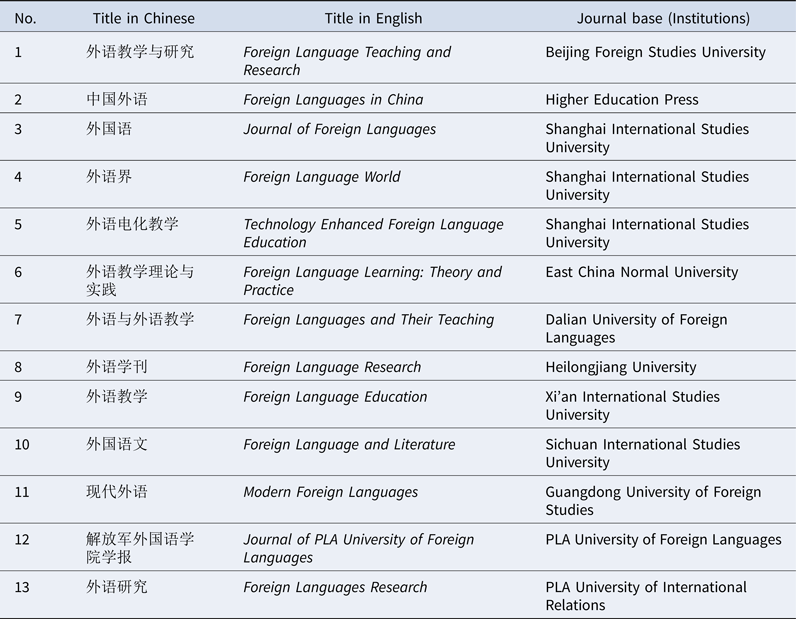
Appendix 2. Categories of topics
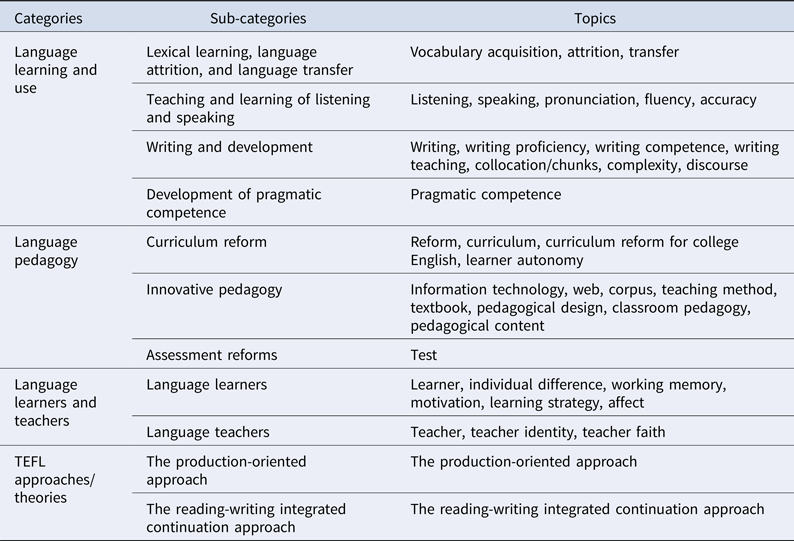
Lei Lei is Professor of Applied Linguistics at the Institute of Corpus Studies and Applications, Shanghai International Studies University. His research interests include second language acquisition, academic English and corpus linguistics. He has published extensively, and his articles have appeared in international journals such as Applied Linguistics, Journal of English for Academic Purposes, International Journal of Corpus Linguistics, Lingua, and System.
Jie Qin is Assistant Professor of Applied Linguistics at the School of Foreign Languages Studies, South China Agricultural University. Her main research interests are in instructed second language acquisition, especially task-based language teaching and cognitive linguistics-inspired instruction. She has published articles in Language Teaching Research, International Review of Applied Linguistics in Language Teaching (IRAL), and System.


