Introduction
The clinostomids comprise a diverse group of digenean, yet their true diversity remains largely unexplored. In their mature stage, clinostomids act as parasites within the upper respiratory tract and esophagus of piscivorous birds, reptiles (Kanev et al. Reference Kanev, Radev, Fried, Gibson, Jones and Bray2002), and mammals including humans (Kifune et al., Reference Kifune, Ogata and Miyahara2000; Park et al., Reference Park, Kim, Joo and Kim2009; Hara et al., Reference Hara, Miyauchi, Tahara, Yamashita and Nagoya2014; Lee et al., Reference Lee, Park, Kim, Seo, You, Chung, Moon and Hong2017; Kim et al., Reference Kim, Cho, Oh and Byeon2019). DNA investigations have yielded valuable insights into clinostomid taxonomy and distribution. These studies have unveiled a dichotomy between the “New World” and “Old World” clinostomids forms (Locke et al., Reference Locke, Caffara, Marcogliese and Fioravanti2015). Within the Americas, clinostomids exhibit several genetic lineages. Noteworthy contributions have significantly enriched the catalog of identified clinostomid lineages within Argentina (Montes et al., Reference Montes, Plaul, Croci, Waldbillig, Ferrari, Topa and Martorelli2020; Reference Montes, Barneche, Pagano, Ferrari, Martorelli and Pérez Ponce de León2021). In Argentina there have been documented four species, namely Clinostomum detruncatum Braun, 1899, Clinostomum heluans, Braun, 1899 Clinostomum marginatum (Rudolphi 1819) Braun 1901 sensu stricto, and Clinostomum fergalliarii Montes, Barneche, Pagano, Ferrari, Martorelli, & Pérez Ponce de León, 2021. Additionally, four distinct metacercariae lineages parasitize various fish species: Clinostomum sp. CVI and Clinostomum sp. GBA in Cichlidae from Esteros del Iberá, Corrientes province, Clinostomum sp. CRA in Crenuchidae from Ayui River, Entre Rios province, Clinostomum sp. PAU in Lebiasinidae from Timboy River, Corrientes province, and the metacercariae of C. heluans in Cichlidae from La Plata, Buenos Aires province (Montes et al., Reference Montes, Plaul, Croci, Waldbillig, Ferrari, Topa and Martorelli2020, Reference Montes, Barneche, Pagano, Ferrari, Martorelli and Pérez Ponce de León2021). In addition to these lineages, Clinostomum sp. metacercariae lacking genetic data have been reported, infecting fish species like Trigonectes aplocheiloides Huber, Hoplosternun littorale Hancock both from Salta province (Davies et al., Reference Davies, Ostrowski de Nuñez, Ramallo and Nieva2016), Neofundulus paraguayensis Eiganmann and Kennedy from Formosa province (Szidat, Reference Szidat1969); and Hypostomus plecostomus (Weyenbergh) from Cordoba province although this host species is not present in Argentina according to Mirande & Koerber (Reference Mirande and Koerber2020). Furthermore, juvenile clinostomids have been reported parasitizing Tigrisoma lineatum (Boddaert) from Formosa by Lunaschi & Drago (Reference Lunaschi and Drago2009).
In the present study, we have identified Clinostomum sp. metacercariae in diverse fish hosts and an adult parasitizing Ardea cocoi Linnaeus across several Argentine localities. The principal aim of this study is to present new reports of clinostomids using molecular data, and to discuss the diversity of clinostomids within Argentina.
Material and Methods
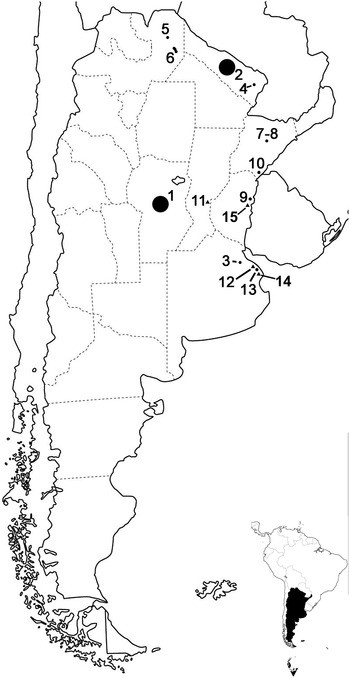
Specimens used in this study were collected between of 2019 to 2021 from three locations in Argentina (Fig. 1). Freshwater fish species Australoheros scitulus Říčan & Kullander (ASC), Cichlasoma dimerus (Heckel) (CDIM), and Pimelodella laticeps (Eigenmann) (PLA) were obtained through seining procedures conducted at El Palmar National Park, (31°53´39´´S and 58°14´05´´W, Entre Rios province), Juan Blanco River (35°08´30´´S, 57° 26´27´´W Buenos Aires province), and Espinillo River (35° 08´ 08´´S, 57° 42 ´37´´W Buenos Aires province) (Fig 1). Encysted metacercariae of Clinostomum sp. were recovered from both the dorsal and ventral fins of C. dimerus and A. scitulus, as well as from the axial musculature of P. laticeps. These digeneans were subsequently extracted from their cysts, rinsed in 0.65% saline solution, and then preserved in 95% ethanol for later morphological and molecular assessments. Notably, an additional Clinostomum sp. specimen was obtained from the esophagus of a deceased heron (A. cocoi) found in Santo Tome, Santa Fe Province (31° 41’ 58” S, 60° 45’ 27”W, Fig. 1) in September 2017. This specific specimen was used for genetic analysis.
Map of Argentina showing the sampling localities and previous reports of Clinostomum spp. (1) Province of Cordoba (Weyenbergh, Reference Weyenbergh1878), (2) Province of Formosa (Szidat, Reference Szidat1969), (3) Uribelarrea city (Boero & Led, Reference Boero and Led1971), (4) Pirané city, Formosa province (Lunaschi & Drago, Reference Lunaschi and Drago2009), (5) Hickman locality, Salta province (Davies et al., Reference Davies, Ostrowski de Nuñez, Ramallo and Nieva2016). (6) Quinquincho Wetland, Salta province (Davies et al., Reference Davies, Ostrowski de Nuñez, Ramallo and Nieva2016). (7, 8) Ibera Lagoon, Corrientes province (Montes et al., Reference Montes, Plaul, Croci, Waldbillig, Ferrari, Topa and Martorelli2020). (9) Concordia city, Entre Ríos Province (Montes et al., Reference Montes, Plaul, Croci, Waldbillig, Ferrari, Topa and Martorelli2020). (10) Montecaseros, Corrientes province (Montes et al., Reference Montes, Barneche, Pagano, Ferrari, Martorelli and Pérez Ponce de León2021). (11) Santo Tome, Santa Fe Province (this study). (12) Juan Blanco stream, Buenos Aires Province (this study). (13) La Balandra, Buenos Aires Province (Sutton & Damborenea, Reference Sutton and Damborenea2000). (14) Espinillo stream, Buenos Aires Province (this study). (15) El Palmar National Park, Corrientes Province (this study).
Small circles = previous reports, big circles = diffuse locality, only province, triangle = present study

Metacercariae were stained with chlorohydric carmine. These samples underwent dehydration through a series of ethanol solutions, followed by cleared and mounting in Canada balsam according to the protocol established by Pritchard & Kruse (Reference Pritchard and Kruse1982). Subsequently, each specimen was photographed using an AmScope MU 1000 MP digital camera attached to the Olympus BX51 microscope. Measurements of the specimens were conducted using ImageJ software (Schneider et al., Reference Schneider, Rasband and Eliceiri2012), and drawings were created using a drawing tube coupled with a light microscope.
Molecular analysis involved DNA extraction from entire specimens of metacercariae belonging to C. dimerus, A. scitulus, P. laticeps, and A. cocoi. PURO-Genomic DNA (Productos Bio-Lógicos) was employed for DNA extraction, following the manufacturer’s protocol. The partial COI-mtDNA gene fragment was amplified through Polymerase Chain Reaction (PCR) using an Eppendorf Mastercycler thermal cycler. The forward primer DICE 1F (5’–ATTAACCCTCACTAAATWC NTTRGATCATAAG-3’) and the reverse primer DICE 14R (5’–TAATACGACTCAC TATACCHACMRTAAACATATGATG-3’) as designed by Van Steenkiste et al. (Reference Van Steenkiste, Locke, Castelin, Marcogliese and Abbott2015) were employed for amplification. The 50-μl reaction mixture consisted of 25 μl of PB-L master mix (Productos Bio-Lógicos, Argentina), 0.4 μM of each forward and reverse primer, and 4 μL of the template DNA, followed the manufacturer’s protocol. Thermocycling conditions were based on those described by Montes et al. (Reference Montes, Barneche, Pagano, Ferrari, Martorelli and Pérez Ponce de León2021). Sequencing of the PCR products was performed by Macrogen Inc. The assembled sequences were then examined for the presence of pseudogenes using the Geneious 5.1.7 program. Alignments of clinostomid species/lineage sequences were carried out using MAFFT 7 (Katoh & Standley, Reference Katoh and Standley2013). Outgroups consisted of sequences of Euclinostomum heterostomum (Rudolphi 1809), Ithyoclinostomum yamagutii Rosser, Woodyard, Mychajlonka, King, Griffin, Gunn & López-Porras, Reference Rosser, Woodyard, Mychajlonka, King, Griffin, Gunn and López-Porras2020 and Odhneriotrema incomodum (Leidy, 1850). Optimal partitioning schemes and substitution models for each DNA partition were determined using the Bayesian Information Criterion (BIC) with the “greedy” search strategy in Partition Finder v. 1.1.1 (Lanfear et al., Reference Lanfear, Calcott, Ho and Guindon2012). The dataset encompassing barcode fragments was partitioned based on first-, second-, and third-codon positions, each employing the appropriate nucleotide substitution model. The first codon position employed the Tamura-Nei model with estimates of invariant sites and gamma-distributed among-site variation (TrN+I+G), the second codon position utilized the Kimura 1981 model with unequal base frequencies (K81uf), and the third codon position was characterized by the general time-reversible model with gamma-distributed among-site variation (GTR + G). For the Bayesian Inference analyses, the implemented model was GTR for the three positions because the less complex TrN+I+G and K81uf are not implemented in Mr.Bayes. The first with invariant sites and gamma-distributed among-site variation (GTR+I+G) and the second with equal-distributed among-site variation (GTR).
Phylogenetic reconstruction was conducted through Bayesian Inference (BI) using Mr.Bayes 3.2.3 (Ronquist et al., Reference Ronquist, Teslenkovan, van der Mark, Ayres, Darling, Höhna, Larget, Liu, Suchard and Huelsenbeck2012). The construction of phylogenetic trees involved two parallel Metropolis-Coupled Markov Chain Monte Carlo (MCMC) analyses, each spanning 20 million generations. The purpose of these analyses was to estimate the posterior probability (PP) distribution. Topology sampling occurred at intervals of 1,000 generations, with the average standard deviation of split frequencies remaining below 0.01 by the end of the run, following the recommendations of Ronquist et al. (Reference Ronquist, Teslenkovan, van der Mark, Ayres, Darling, Höhna, Larget, Liu, Suchard and Huelsenbeck2012). Bayesian posterior probability (PP) was employed to assess clade robustness, with PP values exceeding 0.90 signifying strong support. After discarding the initial 25% of trees as “burn-in,” a majority consensus tree with branch lengths was reconstructed for each run.
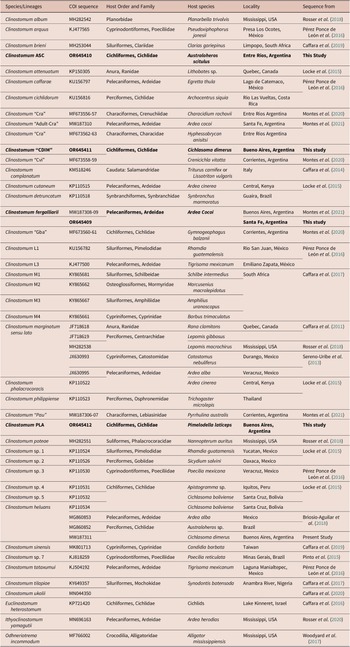
Additionally, the uncorrected p-distance was computed using MEGA X (Kumar et al., Reference Kumar, Stecher, Li, Knyaz and Tamura2018), and newly generated sequences were submitted to GenBank (Table 1). Specimens that underwent staining were deposited in the Invertebrate Collection of the Museo de La Plata, La Plata, Argentina.
Information on clinostomids species/lineages used to construct the cytochrome c oxidase subunit I (COI) phylogenetic tree showed in Fig 1. New sequences in bold

Results
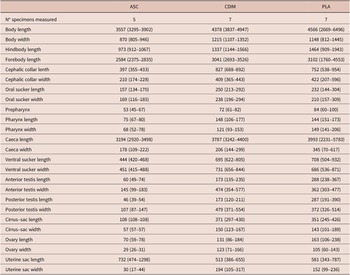
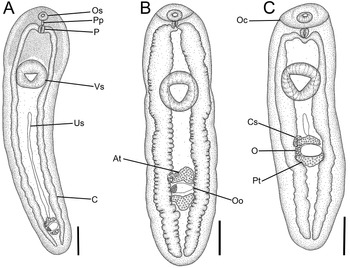
The measurements (Table 2) of Clinostomum ASC (FIG 2A), Clinostomum PLA (FIG 2B) and Clinostomum CDIM (Fig. 2C) were made using 5, 7 and 7 specimens, respectively.
Comparative measurements of Clinostomum metacercararie reported in the present manuscript. Measurements are shown in μm with the mean followed by the range (when available). Abreviation: ASC = Australoheros scitulus, CDIM = Cichlasoma dimerus, PLA= Pimelodella laticeps

Clinostomid metacercaria infecting (A) Australoheros scitulus; (B) Pimelodella laticeps; (C) Cichlasoma dimerus. Abbreviations: At = Anterior testis; C = caecum; Cs = cirrus sac; O = ovary; Oc = oral collar; Oo = ootype; Os = oral sucker; P = pharynx; Pp = Prepharynx; Pt = posterior testis; Vs = ventral sucker; Us = uterus. Scale bars = 500 μm.

Morphological description
Clinostomidae Lühe, 1901
Clinostomum (ASC) Leidy, 1856
Body elongated spines absent, flattened anterior end with underdeveloped oral collar end. Posterior body end slender. Oral sucker subterminal, rounded, smaller than ventral sucker. Prepharynx short. Intestinal caeca slightly diverticulated, lateral to ventral sucker and genital primordium extending to posterior end of body. Ventral sucker 2–3 times larger than oral sucker, with almost triangular opening. Primordium of genital complex in posterior end of body. Anterior testis slightly triangular. Posterior testis transversely elongated. Cirrus sac, kidney-shaped in right margin of anterior testis. Ovary small, oval, intertesticular and dextral. Uterine sac tubular, long, between genital complex and almost reaching ventral sucker.
Clinostomum (CDIM) Leidy, 1856
Body elongated spines absent, flattened anterior end with oral collar. Oral sucker subterminal, rounded, smaller than ventral sucker. Prepharynx short. Intestinal caeca slightly diverticulated lateral to ventral sucker and genital primordium extending to posterior end of body. Ventral sucker 2–3 times larger than oral sucker, with almost triangular opening. Primordium of genital complex postequatorial. Anterior testis transversally elongated with irregular margins. Posterior testis triangular, base transversely elongated, apex rounded, irregular margin. Cirrus sac, kidney-shaped, elongated, in right margin of anterior testis. Ovary small, oval, intertesticular and dextral. Uterine sac tubular, short between genital complex and almost reaching ventral sucker.
Clinostomum (PLA) Leidy, 1856
Body elongated spines absent, flattened anterior end with oral collar. Oral sucker subterminal, rounded, smaller than ventral sucker. Prepharynx short. Intestinal caeca deeply diverticulate lateral to ventral sucker and genital primordium extending to posterior end of body. Ventral sucker 2–3 times larger than oral sucker, with almost triangular opening. Primordium of genital complex in posterior third of body. Anterior testis slightly triangular. Posterior testis slightly triangular-shaped and almost irregular margin. Cirrus sac, kidney-shaped, elongated, in right margin of anterior testis. Ovary small, oval, intertesticular and dextral. Uterine sac tubular, not observed.
Molecular analysis
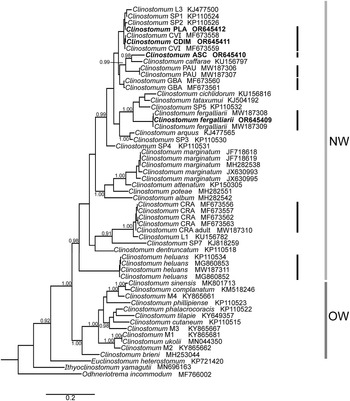
Partial COI mtDNA sequences were obtained for one specimen of Clinostomum sp. ASC, Clinostomum PLA, Clinostomum CDIM, and an adult of C. fergalliarii collected from a heron. The final COI alignment was 603 bp long and consisted of 56 terminals including isolates of the newly sequenced specimens of Clinostomum and three sequences of other clinostomids used as outgroups (Fig. 3) downloaded from GenBank. The new sequences nested within the New World clade in the phylogenetic tree.
Phylogenetic tree of species/lineages of clinostomids through the cytochrome c oxidase subunit I (COI) gene inferred using Bayesian Inference. Numbers in the nodes represent posterior probability (<90% are not shown). Clinostomum species sequenced in this study are in bold and the black bars indicate species reported from Argentina.

The metacercaria of Clinostomum ASC represents a potential candidate of a new species. This lineage was recovered as the sister species of Clinostomum caffarae Sereno-Uribe, García-Varela, Pinacho-Pinacho & Pérez Ponce de León, Reference Sereno-Uribe, Garcia-Varela, Pinacho-Pinacho and Pérez Ponce de León2018 (Fig. 3) with high posterior probability support value (PP=0.98). The genetic distance between Clinostomum ASC and the other closely related Clinostomum specie/lineages such as C. caffarae, Clinostomum L3, Clinostomum sp. 1, Clinostomum PLA and Clinostomum GBA was 10% (Supplementary table S1).
Clinostomum PLA was clustered in a clade with Clinostomum L3, and Clinostomum sp1 and sp2, albeit with low posterior probability support value (Fig. 3). The genetic distance between Clinostomum PLA and the other lineages included in the same clade (Clinostomum L3, sp1, sp2, CVI and CDIM) varied between 1–2%. The metacercariae of Clinostomum CDIM was yielded in a node with Clinostomum L3, sp1, sp2, PLA, and CVI with low support value (Fig. 3, Supplementary table S1). The distance between those metacercariae varied from 0–2%. The newly generated sequence of an adult of Clinostomum was nested within the clade of C. fergalliarii and sequences were identical, showing conspecificity.
Discussion
As a part of a comprehensive study aimed at describing the freshwater fish parasite fauna from the Northeast and Middle regions of Argentina, we have found and reported new clinostomid metacercariae. DNA analysis revealed unexpected findings, including the identification of a new lineage recognized as Clinostomum ASC. A feature that distinguishes these metacercariae from others found in freshwater fishes in Argentina is their body shape, which is widest anteriorly and becoming slender posteriorly. Similar metacercariae have been found by Murrieta-Morey et al. (Reference Murrieta-Morey, Tuesta Rojas, Echevarria-Matos and Chuquipiondo-Guardia2022) in Apistogramma sp., Cichlasoma amazonarum (Kullander) and Pterophyllum scalare (Schultze) from Peru. These host species (such as A. scitulus reported here) belong to the Cichlidae family. Furthermore, the site of infection, i.e., the fins, is consistent across all the infected fishes. In addition to Clinostomum ASC, other species reported in Argentina from cichlids include Clinostomum CVI (see below), Clinostomum CDIM (see below), Clinostomum GBA, and C. heluans (Montes et al., Reference Montes, Plaul, Croci, Waldbillig, Ferrari, Topa and Martorelli2020; Reference Montes, Barneche, Pagano, Ferrari, Martorelli and Pérez Ponce de León2021). The presence of C. fergalliarii in A. cocoi from Santa Fe (Fig. 1) represents a new locality record, thereby expanding the distribution of this species 500 km to the north.
The Clinostomum CDIM found in cichlid fish shows a low genetic difference compared to the metacercariae Clinostomum PLA (reported here in a siluriform fish), Clinostomum CVI, Clinostomum L3, Clinostomum sp. 1 and Clinostomum sp. 2. According to Pérez Ponce de León et al. (Reference Pérez Ponce de León, García-Varela, Pinacho-Pinacho, Sereno-Uribe and Poulin2016), Clinostomum L3 exhibits a low divergence value compared to Clinostomum sp. 1 and Clinostomum sp. 2 indicating that they may be congeners.
In a previous study, Montes et al. (Reference Montes, Plaul, Croci, Waldbillig, Ferrari, Topa and Martorelli2020) compared the morphology of Clinostomum CVI with Clinostomum L3 of Sereno-Uribe et al. (Reference Sereno-Uribe, Garcia-Varela, Pinacho-Pinacho and Pérez Ponce de León2018) and concluded that the only difference observed was the diverticulate margins of caeca; the genetic difference was 4%. This value does not represent a threshold for considering them as either a different entity or the same lineage found by Pérez Ponce de Leon et al. (2016). Based on our findings of Clinostomum PLA and Clinostomum CDIM, in the context of the new phylogenetic analysis, we consider them conspecific with Clinostomum sp1, Clinostomum Sp2, Clinostomum L3 and Clinostomum CVI reported by Locke et al. (Reference Locke, Caffara, Marcogliese and Fioravanti2015), Pérez Ponce de Leon et al. (2016), Sereno-Uribe et al. (Reference Sereno-Uribe, Garcia-Varela, Pinacho-Pinacho and Pérez Ponce de León2018) and Montes et al. (Reference Montes, Plaul, Croci, Waldbillig, Ferrari, Topa and Martorelli2020), respectively. Interestingly, the morphology of these metacercariae shows some variation depending on the infected host or the development stage of the larvae. This lineage, herein named Clinostomum L3 (the name used when morphologically described), exhibits a wide distribution range in the Neotropical biogeographical region since it has been reported from Mexico, Costa Rica, and Argentina. Although this species infects a siluriform fish (Heptapteridae) in Mexico and Argentina, it has been reported in Gobiiformes (Eleotridae) in Costa Rica, and now in Cichliformes (Cichlidae) in Argentina. Other fish may host this digenean in other regions of South America independently of the order or family of their host. The wide distribution of these parasites is the result of their low specificity as metacercariae towards the second intermediate hosts and even their definitive host. The use of several hosts allowed Clinostomum L3 to present a wide geographical range that extends between Mexico and Argentina.
Additionally, this digenean does not show specificity for the site of infection. For example, they have been found in the mesentery and fascia of the muscle tissue in Crenicichla vittata Heckel (Montes et al., 2019), in the muscle of P. laticeps (Clinostomum PLA), and in the fins of C. dimerus (Clinostomum CDIM). The final host species as reported by Sereno-Uribe et al. (Reference Sereno-Uribe, Garcia-Varela, Pinacho-Pinacho and Pérez Ponce de León2018) are the great blue heron, Ardea herodias L., and the bare-throated tiger heron, Tigrisoma mexicanum Swainson, both members of the family Ardeidae. These authors were only able to sequence the digenean and did not have enough samples to formally describe the species. Other Ardeidae species within Argentina could be infected with that clinostomid. The large distribution of this digenean across the Americas is not unexpected, as this distribution range has been reported for other digenean such Austrodiplostomum compactum (Lutz, 1928) Dubois, 1970 (Ostrowski de Núñez, 2017
The accumulation of information on clinostomids, including the new sequences reported in this study corroborates the presence of two nodes evolving in the New and the Old World. However, we must continue to monitor the wildlife vertebrates, as there is a possibility of Clinostomum sp. from Old World being present in the Americas. This is supported by the potential for natural migration of birds from Africa/Europe as documented in the past for Bulbucus ibis (L.) (Cosby, Reference Cosby1972
Similar long-distance natural migrations have been reported in other continents, for example, another heron species, Egretta garzetta (L.) was captured in Trinidad by Downs (Reference Downs1959) after being banded six months earlier in Spain 4000 miles across the Atlantic.
Considering the large number of freshwater fish species reported in Argentina [over 500 according to Mirande & Koerber (Reference Mirande and Koerber2020)], we suspect that there may be more species of clinostomids awaiting discovery either in freshwater fish or fish-eating birds. Furthermore, conducting new studies on bird parasites could lead to the discovery of adult forms that are necessary for the description of new species. Based on our current knowledge, at least five lineages are awaiting formal description in Argentina. Overall, this paper contributes to the knowledge of clinostomid diversity, highlighting the importance of molecular information for accurate identification, and showing the implications of these findings for the understanding of parasite-host interactions in the region.
Supplementary material
The supplementary material for this article can be found at http://doi.org/10.1017/S0022149X23000706.
Acknowledgements
We are grateful to Marcia Montes for the line drawings, Consejo Nacional de Investigaciones Científicas y Técnicas (CONICET) and to CEPAVE for the provision of facilities and equipment.
Financial support
This work was partially supported by the Consejo Nacional de Investigaciones Científicas y Técnicas (CONICET PIP 1713), Agencia Nacional de Promoción Científica y Técnica (PICT 2020 SERIE A-01531) and Universidad Nacional de La Plata (PPID N902 to S.R.M).
Competing interest
On behalf of all authors, the corresponding author states that there is no conflict of interest.
Ethical standard
The authors assert that all procedures contributing to this work comply with the ethical standards of the relevant national and institutional guides on the care and use of laboratory animals.