


Introduction
Patients that present with co-morbidity of anxiety and depression in routine practice present the cognitive behavioural therapist with a treatment selection dilemma (Barlow et al., Reference Barlow, Allen and Choates2004). One possible approach is to use a disorder-specific cognitive behavioural therapy (CBT) treatment protocol, whilst monitoring concurrent improvements across other co-morbidities. Another approach is to deliver one protocol, evaluate outcome, and then begin another protocol. Criticism of the staged approach is that it is time consuming, creates potential confusion for the patient and requires the therapist to be ‘pan-protocol competent’ (see McManus et al. (Reference McManus, Shafran and Cooper2010) for a review). An alternative approach is to take a more parsimonious approach and deliver a transdiagnostic treatment protocol (Wilamowska et al., Reference Wilamowska, Thompson-Hollands, Fairholme, Ellard, Farchione and Barlow2010). Indeed, two meta-analyses have demonstrated the efficacy of transdiagnostic CBT in treating anxiety and depression (Andersen et al., Reference Andersen, Toner, Bland and McMillan2016; McEvoy et al., Reference McEvoy, Nathan and Norton2009).
The unified protocol (UP; Barlow et al., Reference Barlow, Farchione, Fairholme, Ellard, Boisseau, Allen and Ehrenreich-May2010) is a transdiagnostic and manualised form of CBT developed for the treatment of co-morbid anxiety and mood disorders. The UP targets the shared mechanisms of depression and anxiety (Hirschfeld, Reference Hirschfeld2001) using a short-term, focused, structured and manualised treatment approach. Farchione et al. (Reference Farchione, Fairholme, Ellard, Boisseau, Thompson-Hollands, Carl, Gallagher and Barlow2012) compared 18 sessions of the UP with a waitlist control to show that the UP facilitated significant differential improvement in severity, affect and symptom interference. Barlow et al. (Reference Barlow, Farchione, Bullis, Gallagher, Murray-Latin, Sauer-Zavala, Bentley, Thompson-Hollands, Conklin, Boswell, Ametaj, Carl, Boettcher and Classiello-Robbins2017) found that 16 sessions of the UP was as effective as single-disorder protocols, but had lower rates of treatment attrition. Both of these clinical trials, however, had very limited representation of health anxiety as either the principal or co-morbid disorder. This lack of evidence for the effectiveness of the UP in treating health anxiety as a primary concern has been attributed to overlap of health anxiety symptomology with obsessive compulsive disorder (OCD) and panic disorder, leading to potential misclassification (Olatunji et al., Reference Olatunji, Kauffman, Meltzer, Davis, Smits and Powers2014). One pilot randomised control trial (RCT) set in Iran (Mohammadpour et al., Reference Mohammadpour, Sadeghi, Foroughi, Amiri, Parvizifard and Khoramniya2018) has also investigated the effectiveness of pharmacotherapy with and without the addition of 12 sessions of the UP for patients with a primary diagnosis of generalised anxiety disorder (GAD). Patients showed a significant reduction in a variety of outcomes, including health anxiety.
Collectively, these findings provide limited support for the UP in treating health anxiety where it is the principal or co-morbid disorder. Strong support has been shown for single-disorder CBT protocol in the treatment of health anxiety (see Olatunji et al. (Reference Olatunji, Kauffman, Meltzer, Davis, Smits and Powers2014) for a meta-analysis). So, initial practice-based evidence is required to determine if the UP is effective for patients presenting with health anxiety as a primary concern to support the rationale for any future RCTs of the UP for health anxiety. An efficient way of generating such practice-based effectiveness evidence is via single case methods. The single case experimental design (SCED) method is based on the establishment of a baseline, and thereafter treatment is introduced and/or removed (sometimes randomly) according to the specified methodology (Morley, Reference Morley2017). A wide range of SCED methodologies are possible to evaluate the effectiveness of CBT in routine practice, including alternating treatment designs (e.g. Kellett et al., Reference Kellett, Oxborough and Gaskell2020) and multiple-baseline designs (e.g. Sauer-Zavala et al., Reference Sauer-Zavala, Cassiello-Robbins, Conklin, Bullis, Thompson-Hollands and Kennedy2017).
Where only a basic biphasic A/B single case design is implemented, then this is not a SCED but rather an empirical case study, as no aspect or component of the intervention is experimentally controlled (Shadish and Sullivan, Reference Shadish and Sullivan2011). A biphasic design is still nevertheless advantageous in the accrual of initial practice-based evidence because such designs are easy to implement, create few ethical dilemmas and usefully integrate idiographic and nomothetic outcome measurement (McMillan and Morley, Reference McMillan, Morley, Barkham, Hardy and Mellor-Clark2010). Arco (Reference Arco2015) for example used an empirical case study design to assess the effectiveness of CBT and pharmacotherapy for OCD and co-morbid depression. More recently, a number of empirical case studies and SCEDs evaluating UP effectiveness have been completed (Boswell et al., Reference Boswell, Anderson and Barlow2014; Hague et al., Reference Hague, Scott and Kellett2015; Sauer-Zavala et al., Reference Sauer-Zavala, Cassiello-Robbins, Conklin, Bullis, Thompson-Hollands and Kennedy2017). Hague et al. (Reference Hague, Scott and Kellett2015) for example used an A/B biphasic design to evaluate the effectiveness of eight sessions of the UP with an older adult experiencing co-morbid anxiety and depression.
This study used an A/B empirical case study to evaluate the clinical effectiveness of the UP in a case of health anxiety and co-morbid depression in a working age adult. The study had three aims. Firstly, to understand the feasibility of delivering brief UP in routine practice in terms of treatment engagement and attendance. Secondly, to test whether the UP was effective in treating target idiographic measures (i.e. reduce the cumulative time spent health checking, reduce number of health checking episodes, create a more stable sleep pattern, and greater satisfaction with food intake). Thirdly, to assess reliable and clinically significant change on the nomothetic measures of checking behaviour, depression and general psychological distress.
Method
Participant and setting
Consent was sought from the patient to complete and report the study. The UP was delivered by a trainee clinical psychologist working under the close supervision of a BABCP accredited principle clinical psychologist. The male patient (‘James’; name changed to protect anonymity) was 27 years old. He was referred to a community team in a secondary care mental health service from his General Practitioner (GP). Throughout the study, the patient was prescribed Fluoxetine for depression and Buspirone for anxiety. The patient had a long history of anxiety and depression, including a hospital admission for attempted suicide (9 years previously) and regular periods of crisis contact with mental health services. Since leaving school, due to his poor mental health, he had only been able to sustain brief periods of employment. James would rarely leave the house (i.e. due to low mood/motivation and fear of embarrassment about people judging his checking behaviours). Onset of health checking occurred when he was 13 years of age. The most frequent form of checking was for potential throat cancer, which deterred eating, and also created a poor sleep cycle through health checking at night. James stated that his mood was typically depressed, and that the onset of his depression was 15 years of age. His primary concern was being chronically fearful about his physical health status as he frequently believed that he had some form of undiagnosed serious illness, typically cancer. His uncle had died of cancer when he was an adolescent, triggering for James a psychological focus on his health. James reported occasional health-related panic attacks and frequent reassurance seeking behaviour towards his mum and GP. He had previously received formal diagnoses of OCD, depression, panic disorder, health anxiety and dependent personality traits. James had 16 sessions of CBT 2 years previously for GAD in the Improving Access to Psychological Therapies (IAPT) service using the Dugas treatment protocol for GAD (Dugas et al., Reference Dugas, Gagnon, Ladouceur and Freeston1998) which had been unsuccessful.
Idiographic measures: description, timing and analysis
Four idiographic measures were co-developed with James: cumulative time spent health checking (recorded as time elapsed in minutes), number of daily health checking episodes (count of checking episodes lasting longer than 30 seconds), sleep duration the previous night (recoded in hours and minutes) and food intake satisfaction (5-point Likert scale from ‘most satisfied’ to ‘least satisfied’). James was encouraged to record checking behaviour live during the day and following each checking episode. Eating satisfaction was recorded at the end of each day and sleep duration was recorded the following morning.
Baseline phases were assessed for stability through visual analysis (time-series plots with ordinary least squares regression lines) and statistical analysis (Kendall’s τ). Should any idiographic measure demonstrate statistically significant baseline trend then adjustments would be made using τU (Parker et al., Reference Parker, Vannest and Davis2011). Three tests of non-overlap were employed to assess intervention effectiveness. Percentage of data exceeding the median (PEM) refers to the percentage of intervention phase data that exceeds the median of the baseline phase. Non-overlap of all pairs (NAP; Parker and Vannest, Reference Parker and Vannest2009) makes use of all data, comparing every baseline point to every intervention point. Percentage of all non-overlapping data (PAND) is the smallest percentage of data points that would need to be removed to ensure no overlap between phases. The Scruggs and Mastropiere (Reference Scruggs and Mastropiere1998) criteria for categorising non-overlap effect sizes were used (50–69% = ‘questionable effectiveness’, 70–89% = ‘moderate effectiveness’, 90%+ = ‘highly effective’). To assess variability of idiographic measures, visual analysis of scatterplots and changes in the standard deviation (SD) between phases were considered. Differences in phase level was assessed using τA-B for which the p-value equates to that produced by a Mann–Whitney test (Parker et al., Reference Parker, Vannest and Davis2011).
Nomothetic measures: description, timing and analysis
Nomothetic measures were collected at four time points; (1) baseline start, (2) intervention start, (2) mid-intervention and (4) intervention end. The two valid and reliable nomothetic measures used were the CORE-10 (Barkham et al., Reference Barkham, Bewick, Mullin, Gilbody, Connell, Cahill, Mello-Clark, Richards, Unsworth and Evans2013) and the Yale-Brown Obsessive-Compulsive Scale (Y-BOCS; Goodman et al., Reference Goodman, Price, Rasmussen, Mazure, Fleischmann, Hill, Heninger and Charney1989). The CORE-10 is a 10-item measure of global psychological distress selected because of the need to evaluate the impact of the CBT on the general psychological well-being of the patient. The Y-BOCS is a 10-item measure of checking behaviour and intrusions. The Y-BOCS was selected because the patient experienced anxiety-provoking intrusions about his health and engaged in health checking compulsive behaviours. To assess change on these measures, reliable and clinically significant change indices (RCSI) were used (Jacobson and Truax, Reference Jacobson and Truax1991). To achieve RCSI there would be reductions in Y-BOCS and CORE-10 scores (from intervention-start to intervention-end) that both (a) meet the reliable change index (RCI) and (b) shift into the non-clinical range. The CORE-10 has a RCI of 6 and clinical cut-offs of 13 for depression and 11 for general psychological distress. The Y-BOCS has a clinical cut-off of 13 and an RCI of 5.
Design
An A/B design consisted of a 21-day baseline phase and 42-day intervention phase. The idiographic measures were therefore collected on a daily basis across the two phases, totalling an N=63-day study timeline.
Baseline procedure
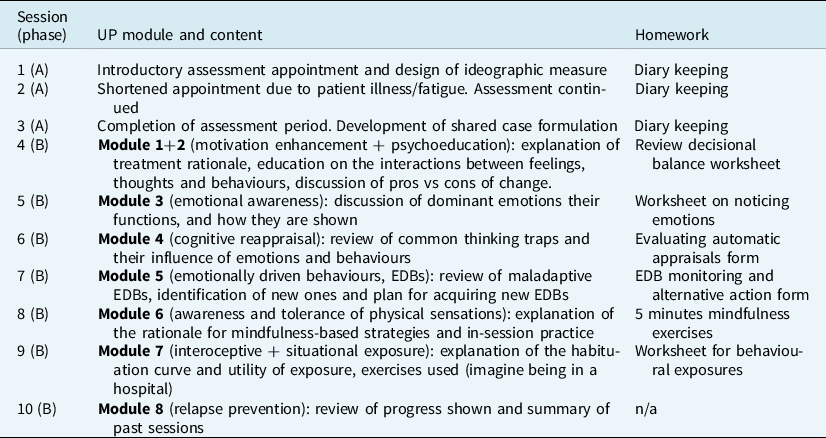
Table 1 details the content of the assessment and treatment sessions. The baseline phase contained three assessment sessions (sessions 1–3). The initial assessment appointment allowed for setting up of the diary (idiographic measures). Idiographic measures were collaboratively designed to reflect the main concerns of the patient and which he brought to each session for review. The UP formulation was built collaboratively towards the end of the third and final assessment appointment. Intervention strategies were not employed until the first treatment session (session 4). The formulation included the main schematic features of the UP (Barlow et al., Reference Barlow, Farchione, Bullis, Gallagher, Murray-Latin, Sauer-Zavala, Bentley, Thompson-Hollands, Conklin, Boswell, Ametaj, Carl, Boettcher and Classiello-Robbins2017). In response to arising symptoms of health anxiety and co-morbid depression, James would employ a range of emotionally driven behaviours (i.e. persistent checking, reassurance seeking, withdrawal and rumination). These behaviours would frequently lead to undesired consequences (i.e. reduced energy, poor sleep cycle, isolation and dependency), thus perpetuating distress. The aim of the UP was to provide James with alternative, flexible and more adaptive means of responding to his emotional distress.
Treatment content and UP adherence information

Intervention procedure
The UP was employed across seven treatment sessions (i.e. sessions 4–10) with the eight modules being covered sequentially in the treatment phase. The first two modules were combined during the first treatment session, whilst remaining modules received one session each. The contract of therapist input was 10 sessions (including assessment) due to the time limits of the clinical placement. The rationale for delivering the UP protocol was because the patient’s treatment in IAPT (i.e. using a disorder-specific approach) had been unsuccessful. Therefore, an alternative, transdiagnostic approach was selected. A cognitive behavioural approach was still considered appropriate, based on the concerns of the patient and also awareness of the UP evidence base. Sessions lasted for 50 minutes and were delivered in an out-patient community clinic. Homework was agreed at the termination of each session and reviewed at the subsequent session.
Results
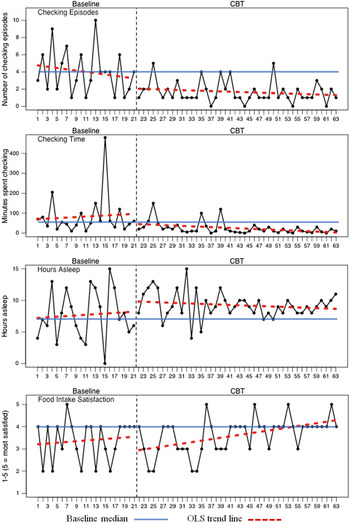
All sessions were attended and homework was consistently completed, demonstrating treatment acceptability. Figure 1 contains time-series plots for the four idiographic measures with fitted baseline median and ordinary least squares trend lines. There was limited baseline trend shown visually through OLS trend lines. This was confirmed by statistical analysis (Kendall’s τ; Table 2) as there was no significant baseline trend for any of the idiographic measure baseline phases. Baseline trend adjustment was therefore not indicated for other analyses.
Time series plots for idiographic measures; x-axis observations are equal to days.

Ideographic outcomes

* Significance at p=<0.001. Non-overlap indices: PND, percentage of non-overlapping data; PEM, percentage of data exceeding the median; PAND, percentage of all non-overlapping data; NAP, non-overlap of all pairs. τ indices: τ, Kendall’s tau; τ(A-B), Kendall’s tau difference (baseline-intervention); τU, Kendall’s τ(A-B)with adjustment for baseline trend.
For checking episodes, a highly variable baseline was shown (mean=4.00, SD=2.59). During the treatment phase there was a reduction shown in both level (mean=1.67) and variability (SD=1.24). Similar findings were shown for the checking time measure. That is, there was a highly variable baseline phase [mean=83.10, SD=102.65 (minutes)] followed by reductions in level (mean=24.24) and variability (SD=31.70). For both of these measures, significant differences between phases were shown using τA-B. Practically, a significant reduction was shown in the number of minutes spent health checking each day (i.e. 59 minute reduction). There was also a significant reduction in the number of checking episodes per day (i.e. four during baseline, two during treatment). The non-overlap effect sizes (Table 2) for checking measures showed a moderate to highly effective intervention.
For sleep, there was a highly variable baseline phase (mean=7.71, SD=3.98). An increase in level (mean=9.24) was shown during the intervention phase, but this was not significant. Non-overlap results indicated questionable to moderate effect sizes for increases in sleep duration due to intervention. Changes in sleep stability showed marked improvement (SD=2.09). For food intake satisfaction, there was a minor increase from the baseline phase mean (mean=3.38) to the intervention phase (mean=3.62), although this was not significant.
Table 3 reports the nomothetic outcomes. The CORE-10 shifted from ‘moderate distress’ to ‘low distress’ and met RCSI for depression and general psychological distress. The Y-BOCS had a 9-point reduction from ‘severe’ to ‘mild’ but remained two points above the clinical cut-off at end of treatment.
Nomothetic outcomes

Change score 1 is the movement in scores from baseline-end to mid-therapy; change score 2 is the movement in scores from baseline to therapy end; reliable change threshold indicates the amount of score change needed to meet reliable change; clinical change threshold indicates the clinical cut-off for caseness. ‡Score represents clinical caseness at that point in time; *reliable change has been met/exceeded. Norms obtained from Connell and Barkham, Reference Connell and Barkham2007 (UK norms); Frost et al., Reference Frost, Steketee, Krause and Trepanier1995 (US population norms); Deacon and Abramowitz, Reference Deacon and Abramowitz2005 (US community norms).
Discussion
This study reported the first single case investigation of the effectiveness of the UP in the treatment of co-morbid health anxiety and depression in a working age adult. Improvements were shown for time spent checking per day and number of daily checking episodes. Such improvements are noticeable given the limited time in treatment (i.e. seven treatment sessions). Improvements were less evident for satisfaction with food intake, although this may have been hindered by the relatively less severe baseline phase. Sleep was more stable according to changes in standard deviations; however, there was not a significant increase in sleep duration. Reliable and clinically significant change was shown for general psychological distress and depression. Improvement was also shown for checking symptoms (Y-BOCS), but this only constituted reliable change. With regard to how the effects of the intervention were generalised, the patient reported engaging in more regular social activity with his friends and family and that he had started to investigate attending University courses. The idiographic, nomothetic and soft outcomes combined support the partial effectiveness of briefly delivered UP when treating health anxiety and depression. A strength of this study was the utilisation of the non-parametric statistics to supplement visual analysis (Chen et al., Reference Chen, Hyppa-Martin, Reichle and Symons2016) and the absence of a statistically significant trend in the baseline period.
All sessions were attended, and homework completion was consistent. This provides additional support to the emerging evidence base for the acceptability of individualised transdiagnostic approaches (Sauer-Zavala et al., Reference Sauer-Zavala, Bentley and Wilner2016; Sauer-Zavala et al., Reference Sauer-Zavala, Cassiello-Robbins, Conklin, Bullis, Thompson-Hollands and Kennedy2017). The module selection and ordering in this study was not personalised to the patient or presenting problem. Modules were delivered in relatively equal amounts. Future SCEDs should attempt to test the effectiveness of tailoring of module ordering and dosage. This is because support has previously been shown for individualising UP module ordering (Sauer-Zavala et al., Reference Sauer-Zavala, Cassiello-Robbins, Conklin, Bullis, Thompson-Hollands and Kennedy2017). For example, in the current case, more time being devoted to the mechanisms thought to underpin health anxiety (e.g. the role of interoceptive conditioning) may have led to greater improvements. Future investigation of dose–response relationship in the UP for health anxiety is also required. This is because disorder-specific CBT protocols recommend longer treatment phases (e.g. Salkovskis and Kirk, Reference Salkovskis, Kirk, Hawton, Salkovskis, Kirk and Clark1989) and also in light of the apparent dose–response relationship for CBT and health anxiety improvements (Olatunji et al., Reference Olatunji, Kauffman, Meltzer, Davis, Smits and Powers2014).
The justification for just 10 sessions of input was purely based on the time limitations of the clinical placement and so it is acknowledged that this treatment was shorter than required for full UP treatment (16 sessions; Barlow et al., Reference Barlow, Farchione, Bullis, Gallagher, Murray-Latin, Sauer-Zavala, Bentley, Thompson-Hollands, Conklin, Boswell, Ametaj, Carl, Boettcher and Classiello-Robbins2017). This shorter course of treatment may have curtailed the effectiveness of the intervention. Despite the limited number of sessions, gains were made, particularly with regard to reduced health checking. Checking behaviour as measured with the Y-BOCS showed reliable but not clinically significant change. This might have occurred with an extended intervention phase and/or emphasising and concentrating on the modules suspected as most relevant to checking behaviour (e.g. interoceptive exposure). A further consideration is whether the choice to conceptualise the primary presenting problem as health anxiety was the most appropriate. Given the patient’s co-morbidity (i.e. with depression) and overlapping symptomology (i.e. checking is also a feature of OCD), it is reasonable to consider that a different clinician may have provided an alternative clinical formulation or treatment, and this may have been more effective.
Critics could question whether the UP was delivered at all or in sufficient depth due to the limited number of sessions. An issue with this study is also that therapist input occurred during the baseline phase. The UP was not a focus in these early baseline sessions; however, the UP formulation was developed towards the end of the final assessment session. Receiving this formulation may have led to a level of improvement between the final assessment session and the first treatment session. Despite this, the visual trends of improvement within baseline periods (for three of the idiographic measures) were not statistically significant. Other methodological limitations were the lack of diagnostic certainty, lack of a genuine experimental design, lack of idiographic measures of health obsessions, mood or reassurance-seeking, lack of any formal treatment adherence checks, lack of clinical competency checks, the lack of a nomothetic measure specific to health anxiety, lack of nomothetic generalisability measures and lack of any follow-up.
These acknowledged limitations allow the following recommendations for future single-case investigations using the UP: (a) use of adherence, fidelity and competency checks, (b) ensuring spread of idiographic measures across anxiety and depression, (c) inclusion of control idiographic measures, (d) inclusion of generalisation nomothetic measures, (d) inclusion of a cross-over treatment comparison phase, or a withdrawal phase, (e) inclusions of a follow-up phase, (f) gathering of informant idiographic outcomes to assess changes in reassurance-seeking and (g) the employment of diagnostic procedures (e.g. Anxiety Disorder Interview Schedule; ADIS-IV-L; Di Nardo et al., Reference Di Nardo, Brown and Barlow1994).
In conclusion, this is the first empirical case study to investigate the effectiveness of abbreviated UP in treating health anxiety and co-morbid depression in a working age adult. Encouraging results have been found for the relatively brief intervention used. This research should act as a stimulus for therapists in routine practice to use the UP and evaluate outcomes using single case quasi-experimental and ethically appropriate true-experimental methods. This research showed improvements in behaviourally based idiographic measures and so exploring cognitive outcomes would be a useful next avenue. As the UP acts on the shared mechanisms of depression and anxiety and because co-morbidity is so frequent in primary care settings, then the UP appears a valuable tool for IAPT CBT therapists. A pilot trial of the UP versus any single-disorder protocol is now indicated in IAPT settings and IAPT CBT therapists are also encouraged to produce genuine SCEDs of the UP.
Acknowledgements
None.
Financial support
None.
Conflicts of interests
None.
Ethics statement
This research was conducted in line with Health Research Authority guidelines on single case research so that signed consent from the participant was achieved to share the results in a form that patient anonymity was protected.
Data availability statement
The time series data are available upon reasonable request from the authors.





Comments
No Comments have been published for this article.