Introduction
Understanding the antecedents of youth suicidal thoughts and attempts is important because these behaviors indicate severe distress that may persist for years, sometimes leading to mental illness well into adulthood (Fergusson et al. Reference Fergusson, Horwood, Ridder and Beautrais2005; Reinherz et al. Reference Reinherz, Tanner, Berger, Beardslee and Fitzmaurice2006). Suicidal behaviors also represent the most potent risk factor for subsequent completed suicides (Gould et al. Reference Gould, Greenberg, Velting and Shaffer2003; Spirito & Overholser, Reference Spirito and Overholser2003; Bridge et al. Reference Bridge, Goldstein and Brent2006). In addition to these severe consequences for youth, repercussions of suicide and associated behaviors are colossal for significant others, including of course parents and siblings (Pfeffer et al. Reference Pfeffer, Jiang, Kakuma, Hwang and Metsch2002; Murphy et al. Reference Murphy, Johnson, Wu, Fan and Lohan2003), but also treating clinicians (Hendin et al. Reference Hendin, Haas, Maltsberger, Szanto and Rabinowicz2004). Despite the significance of suicide and associated behaviors, our understanding of these behaviors remains limited (Joiner et al. Reference Joiner, Brown and Wingate2005). Comprehensive models including a broad range of risk factors, from the biological to the social, are thought to represent the best avenue for improving our understanding of these behaviors (Joiner et al. Reference Joiner, Brown and Wingate2005; Spirito & Esposito-Smythers, Reference Spirito and Esposito-Smythers2006). Neighborhood disadvantage is a potentially important social risk factor for youth suicide that has received little research attention. The aim of the present study was to examine the association between neighborhood poverty and suicidal thoughts and attempts among older adolescents, a group particularly at risk for these outcomes (Kessler et al. Reference Kessler, Borges and Walters1999).
Indirect evidence suggests that neighborhood disadvantage could improve explanatory models of youth suicide. First, epidemiological studies show that adult suicide deaths tend to concentrate in disadvantaged neighborhoods (Rehkopf & Buka, Reference Rehkopf and Buka2005; Middleton et al. Reference Middleton, Sterne and Gunnell2006), perhaps especially so among younger residents (Middleton et al. Reference Middleton, Whitley, Frankel, Dorling, Sterne and Gunnell2004; Miller et al. Reference Miller, Piper, Ahern, Tracy, Tardiff, Vlahov and Galea2005; Exeter & Boyle, Reference Exeter and Boyle2007). Second, results from a study that included both individual and community data revealed that neighborhood disadvantage was independently associated with adult suicide deaths even after taking into account individual socio-economic characteristics (Cubbin et al. Reference Cubbin, LeClere and Smith2000). Third, although neighborhood effects on adolescent suicidal behaviors have yet to be demonstrated, neighborhood disadvantage is associated with an array of major risk factors for youth suicide. Importantly, youth living in disadvantaged neighborhoods exhibit higher rates of internalizing symptoms such as depression and hopelessness (Perez-Smith et al. Reference Perez-Smith, Spirito and Boergers2002; Xue et al. Reference Xue, Leventhal, Brooks-Gunn and Earls2005). They also present more externalizing problems, such as delinquency and substance abuse (Leventhal & Brooks-Gunn, Reference Leventhal and Brooks-Gunn2000; Duncan et al. Reference Duncan, Duncan and Strycker2002), which are also associated with youth suicide (Gould et al. Reference Gould, Greenberg, Velting and Shaffer2003; Bridge et al. Reference Bridge, Goldstein and Brent2006; Spirito & Esposito-Smythers, Reference Spirito and Esposito-Smythers2006). Thus, neighborhood disadvantage could increase youth suicidal behaviors through its impact on more proximal risk factors in the internalizing and externalizing spheres.
Why is neighborhood disadvantage associated with these major risk factors for youth suicide? Its association with internalizing symptoms is thought to be rooted in exposure to stressful events in the community, in the form of social and physical disorder (Aneshensel & Sucoff, Reference Aneshensel and Sucoff1996; Ross, Reference Ross2000; Wheaton & Clarke, Reference Wheaton and Clarke2003; Hill et al. Reference Hill, Ross and Angel2005). Examples of social disorder prevalent in disadvantaged communities that could be perceived as threatening and affect youths' mental health include exposure to violence and intimidation, substance abuse and conspicuous illegal activities. In an effort to avoid such stressful situations, youth and their parents often choose to avoid public spaces in disadvantaged neighborhoods (Jarrett, Reference Jarrett1999; Molnar et al. Reference Molnar, Gortmaker, Bull and Buka2004), resulting in increased isolation and reduced social support. Physical disorder, such as dilapidated housing or poorly kept infra-structures, including schools and parks, might be interpreted as additional evidence of a lack of investment in building a safe environment that provides positive opportunities for youth (Molnar et al. Reference Molnar, Gortmaker, Bull and Buka2004). It is easy to envisage how repeated exposure to stressors and reduced access to support in disadvantaged communities might induce feelings of hopelessness and depression. For these reasons, stressful life events, reduced social support and depression are considered in this study as potential risk factors linking neighborhood disadvantage and youth suicidal behaviors.
Neighborhood disadvantage not only increases exposure to social disorder but also increases the likelihood that youth engage in problematic behaviors themselves, including delinquent activities and substance abuse (Leventhal & Brooks-Gunn, Reference Leventhal and Brooks-Gunn2000; Duncan et al. Reference Duncan, Duncan and Strycker2002). Youth living in disadvantaged neighborhood are thought to be more likely to be involved in delinquency because of the difficulty residents experience exerting effective collective control over youth groups within this environment (Sampson et al. Reference Sampson, Raudenbush and Earls1997; Leventhal & Brooks-Gunn, Reference Leventhal and Brooks-Gunn2000). Residents living in disadvantaged areas often withdraw from a community perceived as dangerous, thus impeding the development of social cohesion and mutual trust, two collective resources considered essential for efficient supervision of youth groups (Sampson et al. Reference Sampson, Raudenbush and Earls1997). Drugs are also more accessible in poor than non-poor neighborhoods because drug markets are more prolific when social cohesion is low (Saxe et al. Reference Saxe, Kadushin, Beveridge, Livert, Tighe, Rindskopf, Ford and Brodsky2001). In this study, involvement in delinquent activities and substance abuse, two problem behaviors associated with both neighborhood disadvantage and youth suicidal behaviors, were examined as potential explanatory mechanisms.
Exposure to suicide is another aspect that could increase suicide risk in disadvantaged neighborhoods. As mentioned earlier, epidemiological studies show that adult suicide tends to concentrate in disadvantaged areas (e.g. Rehkopf & Buka, Reference Rehkopf and Buka2005). As such, adolescents raised in disadvantaged neighborhoods could be more likely to have known people who have committed suicide. Exposure to suicide is a documented environmental risk factor for youth suicide, possibly because of contagion or imitation effects (Gould et al. Reference Gould, Greenberg, Velting and Shaffer2003; Spirito & Esposito-Smythers, Reference Spirito and Esposito-Smythers2006). Thus, it was also explored as a potential explanatory mechanism.
So far, it has been argued that neighborhood disadvantage could increase suicidal thoughts and attempts by facilitating the emergence of important individual risk factors for suicide. However, neighborhood disadvantage could not only be associated with a higher level of these risks but also amplify their impact. Recent results indicate that neighborhood disadvantage, perhaps because it limits access to support and coping resources, could indeed modify the impact of other risk factors. For example, one study found that negative life events (NLEs) were more likely to lead to depression among adult residents of disadvantaged neighborhoods, as compared to those of better-off neighborhoods (Cutrona et al. Reference Cutrona, Russell, Brown, Clark, Hessling and Gardner2005). Among adolescents, neighborhood disadvantage has been shown to amplify the impact of individual vulnerabilities on youth externalizing outcomes (Lynam et al. Reference Lynam, Caspi, Moffitt, Wikström, Loeber and Novak2000; Obeidallah et al. Reference Obeidallah, Brennan, Brooks-Gunn and Earls2004; Dupéré et al. Reference Dupéré, Lacourse, Willms, Leventhal and Tremblay2008). In keeping with these results, the moderating impact of neighborhood disadvantage on other risk factors was explored.
The primary objective of this study was to examine whether youth living in poor neighborhoods are at an increased risk for suicidal thoughts and attempts in late adolescence, after controlling for pre-existing vulnerabilities. Introducing control variables is necessary in neighborhood research to reduce potential selection biases, given that otherwise disadvantaged families are more likely to live in poor areas (Leventhal & Brooks-Gunn, Reference Leventhal and Brooks-Gunn2000). Family socio-economic status (SES), family disruption and maternal depression, and also late-childhood internalizing symptoms and hyperactivity/impulsivity problems, were included as controls. Including individual-level controls in addition to family socio-economic characteristics allows a more thorough control of potentially confounding factors (Xue et al. Reference Xue, Leventhal, Brooks-Gunn and Earls2005). A second aim was to examine whether neighborhood effects could be explained by increased levels, in late adolescence, of important risk factors for youth suicide and associated behaviors, including depression, NLEs, low social support, substance abuse, delinquent activities, and exposure to suicide. Finally, the potential moderating role of neighborhood poverty on other risk factors was investigated.
Method
Sample
The National Longitudinal Survey of Children and Youth (NLSCY) is a nationally representative, prospective study of Canadian children and adolescents launched in 1994–1995, with ongoing follow-ups conducted biennially (Statistics Canada and Human Resources Development Canada, 1995; Statistics Canada, 2007). The NLSCY is based on a clustered probability sample of private households within the 10 Canadian provinces, excluding children living in remote areas, institutional settings, and on First Nations reserves. Initially, 13 439 households out of 15 579 identified as having at least one dependent child newborn to age 12 years agreed to participate. In each of the survey households, the ‘person most knowledgeable’ about the child was interviewed. In almost all cases, this person was the mother, and is referred to hereafter as such. From 10 years old on, children were also asked to complete self-reported questionnaires. Within each household, up to a maximum of four children were randomly selected, resulting in an initial total of 22 831, of whom 16 903 were selected to be followed biennially.
In this study, we selected participants who had reached 18–19 years old by cycle 6, the last currently available cycle of data collection. That is, we selected those who were at least 8 years old in cycle 1 (n=4951). Of that number, we selected those who still participated in the survey when they reached 18–19 years old (n=3088). Thus, the retention rate after a decade was >60%. Following previous NLSCY neighborhood studies (Kohen et al. Reference Kohen, Brooks-Gunn, Leventhal and Hertzman2002; Dupéré et al. Reference Dupéré, Lacourse, Willms, Leventhal and Tremblay2008), one child per household was selected at random to avoid within-family clustering, resulting in a final sample size of 2776. This sample was approximately evenly distributed across two cohorts: for the older cohort, aged 10–11 years in cycle 1, we used data collected from cycle 1 to cycle 5 (1994–1995 to 2002–2003); for the younger cohort, aged 10–11 years in cycle 2, we used data collected from cycle 2 to cycle 6 (1996–1997 to 2004–2005).
To take into account attrition as well as the sampling design, all analyses were conducted using normalized longitudinal survey weights. The use of longitudinal weights helps to preserve the representativeness of the sample despite survey drop-out, but it does not eliminate potential bias associated with partial non-response. Partial non-response arises when participants omit answering some of the survey questions. In this study, the rate of partial non-response varied between 0% and 4% for mother-reported variables, and between 6% and 9% for self-reported variables. Partial non-response on the predictors was treated through multiple imputation (Allison, Reference Allison2001; von Hippel, Reference von Hippel2007), using the SAS procedures mi and mianalyze (SAS Institute Inc., Cary, NC, USA). It is noteworthy that had simple list-wise deletion been used to manage non-response, the main conclusions of the present study would remain unchanged.
Measures
Suicidal behaviors and risk factors were self-reported in late adolescence (18–19 years old). Neighborhood poverty was assessed at two time-points during adolescence (12–13 and 14–15 years old), using the 2001 Canadian census. Family and individual controls were measured through parent-report in late childhood (10–11 years old).
Suicidal behavior (18–19 years old)
Suicidal thoughts were assessed by asking participants: ‘During the past 12 months, did you seriously consider attempting suicide?’ For those who answered ‘yes’ (7.7%), suicide attempts were measured by asking: ‘During the past 12 months, how many times did you attempt suicide?’ For this sample, 3.2% reported having attempted suicide at least once. Similar items have been used to measure suicidal behavior in other studies using community-based and national samples (Kessler et al. Reference Kessler, Borges and Walters1999; Johnson et al. Reference Johnson, Cohen, Gould, Kasen, Brown and Brook2002). The pattern of prevalence of suicide ideations and attempts is consistent with those reported in other Canadian (Weissman et al. Reference Weissman, Bland, Canino, Greenwald, Hwu, Joyce, Karam, Lee, Lellouch, Lepine, Newman, Rubio-Stipec, Wells, Wickramaratne, Wittchen and Yeh1999; Langlois & Morrison, Reference Langlois and Morrison2002; Fotti et al. Reference Fotti, Katz, Afifi and Cox2006) and American (Kessler et al. Reference Kessler, Borges and Walters1999; Johnson et al. Reference Johnson, Cohen, Gould, Kasen, Brown and Brook2002) samples.
Late-adolescence risk factors (18–19 years old)
Current depression was assessed with a 12-item shortened version of the Center for Epidemiological Studies Depression Scale (CES-D; Radloff, Reference Radloff1977). The items tapped the presence of depressive symptoms in the past 7 days, including depressed mood, hopelessness, poor appetite, trouble concentrating and restless sleep (mean=6.9, s.d.=6.6). Answers were coded on a four-point scale, ranging from score 0 (rarely; <1 day) to 3 (most or all of the time; 5–7 days). The shortened scale showed good psychometric properties in the NLSCY as well as in other Canadian samples (Statistics Canada and Human Resources Development Canada, 1995; Poulin et al. Reference Poulin, Hand and Boudreau2005). Social support (mean=19.76, s.d.=3.55) was measured by eight items (e.g. there are people I can count on in an emergency; if something went wrong, no one would help me) derived from the Social Provision Scale (Cutrona, Reference Cutrona1984). The response scale included four choices (0=strongly disagree; to 3=strongly agree). Five items assessed the occurrence of NLEs (mean=1.18, s.d.=1.13) during the past 2 years (i.e. painful break-up with boyfriend/girlfriend, serious problem at school or at work, death of someone close, divorce or separation of parents and other difficult events). The major domains in which NLEs may occur for adolescents were tapped through these items (Williamson et al. Reference Williamson, Birmaher, Frank, Anderson, Matty and Kupfer1998).
Substance abuse was measured through two self-reported items asking about the frequency of alcohol abuse (frequency of being drunk or having five drinks or more on one occasion in the past 12 months) and marijuana consumption (frequency of marijuana/hashish/cannabis use in the past 12 months). Those who abused alcohol (17%) or used marijuana (17%) more than once a week were considered at risk. Involvement in delinquent activities was assessed through one question asking participants if they were part, in the past 12 months, of a gang that broke the law by stealing, hurting people or damaging property (4%). Because of item inconsistencies between cohorts, we had to rely on a single item to define this variable. However, it is important to note that the relationship between involvement in delinquent groups and delinquency is strong (Lacourse et al. Reference Lacourse, Nagin, Tremblay, Vitaro and Claes2003) and that similar single-item measures have shown adequate validity (Thornberry et al. Reference Thornberry, Krohn, Lizotte, Smith and Tobin2003; Lacourse et al. Reference Lacourse, Nagin, Vitaro, Côté, Arseneault and Tremblay2006). Finally, participants were asked if someone they had known personally had committed suicide as a measure of exposure to suicide. About a quarter reported that they did.
Early and middle adolescence neighborhood poverty (12–13 and 14–15 years old)
Neighborhood poverty was assessed at two time-points, in early (12–13 years old) and middle (14–15 years old) adolescence, using the 2001 Canadian Census. The dissemination area (DA) was the geographic unit used to approximate the neighborhood environment (Puderer, Reference Puderer2001). The DA has a population range of 400 to 700 individuals and represents a convenient geographical unit that has been used in other NLSCY neighborhood studies (Kohen et al. Reference Kohen, Brooks-Gunn, Leventhal and Hertzman2002; Dupéré et al. Reference Dupéré, Lacourse, Willms, Leventhal and Tremblay2008). All DAs with 20% or more residents under Statistics Canada's Low-Income Cut-off qualified as poor neighborhoods. In early adolescence, middle adolescence, or both, 28% of the sample resided in a poor neighborhood.
Late-childhood family and individual controls (10–11 years old)
Family SES was measured through an index computed by Statistics Canada (Willms & Shields, Reference Willms and Shields1996). Five standardized variables were combined in this index, including mothers' and fathers' educational attainment, mothers' and fathers' occupational prestige, and household income (mean=0.0, s.d.=0.8). Non-intact family status represented those (29%) who did not live with two biological or adoptive parents. Maternal depression was assessed with the 12-item shortened version of the CES-D described above (mean=4.8, s.d.=6.0). Two parent-reported scales measuring internalizing problems and hyperactivity/impulsivity were used to measure individual control variables. The items included in the scales were previously validated in other Canadian samples (Boyle et al. Reference Boyle, Offord, Hofmann, Catlin, Byles and Cadman1987; Tremblay et al. Reference Tremblay, Pihl, Vitaro and Dobkin1994). Both scales showed good psychometric properties (Statistics Canada and Human Resources Development Canada, 1995). Response scales with three categories were used (0=never to 2=often). Internalizing problems (mean=2.9, s.d.=2.8) were assessed with eight items (e.g. seems unhappy, sad or depressed; is nervous, high-strung or tense). Hyperactivity/impulsivity (mean=4.2, s.d.= 3.6) was measured with eight items (e.g. is restless or hyperactive; is impulsive, acts without thinking).
Results
Attrition
Measures obtained at 10–11 years of age were used to assess differential attrition. Males [χ2 (1, n=4951)=7.3, p=0.007], non-Whites [χ2 (1, n=4484)=4.9, p=0.027] and participants from lower-SES families [F(1, 4674)=32.4, p<0.001] were more likely to have dropped out by late adolescence than girls, Whites and higher SES families respectively. However, no significant differences in attrition were found by cohort, age, family status, parental depression, hyperactivity, internalizing symptoms and neighborhood poverty.
Descriptives statistics
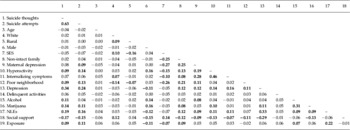
Table 1 presents the intercorrelations among suicidal thoughts and attempts and individual and family predictors. The results indicate that suicidal thoughts and attempts are significantly (p<0.001) associated with most late-childhood controls and late-adolescence risks. The associations tended to be stronger for variables measured in late adolescence, as compared with demographics and controls measured in late childhood. Not surprisingly, late-adolescence depression showed the strongest correlation with both suicidal thoughts and attempts. Other risk factors strongly associated with suicidal thoughts or attempts (p<0.001) included maternal depression, hyperactivity, neighborhood poverty, alcohol and marijuana use, NLEs, lack of social support and exposure to suicide.
Intercorrelations of suicide thoughts and attempts and predictor variables

SES, Socio-economic status; NLE, negative life event.
Boldface indicates coefficient significant at p<0.001.
As hypothesized, living in a poor neighborhood was associated with both suicidal thoughts (6.1% in non-poor neighborhoods; 11.6% in poor neighborhoods) and suicide attempts (1.8% in non-poor neighborhoods; 6.6% in poor neighborhoods). Based on the results of univariate logistic regressions, the odds of reporting suicidal thoughts were about two times higher among those who lived in poor neighborhoods during adolescence as compared to those who did not [odds ratio (OR) 2.0, 95% confidence interval (CI) 1.5–2.7], whereas the odds of attempting suicide were about four times higher (OR 4.0, 95% CI 2.5–6.3). Table 1 also shows that growing up in a poor neighborhood was negatively associated, at p<0.001, with White race/ethnicity, residence in a rural area, family SES and social support and positively associated with non-intact family status and maternal and youth depression. At p<0.05, neighborhood poverty was also positively associated with hyperactivity and NLEs.
Multivariate models
Hierarchical logistic regressions were used to predict suicidal thoughts and attempts. The first model included demographics and late-childhood family and individual controls, as well as neighborhood poverty, while also adjusting for cohort and region of residence. This model tested whether there was an independent association between neighborhood poverty and suicidal thoughts and attempts. The second model examined potential mediation mechanisms of neighborhood effects, by incorporating late-adolescence risk factors, including depression, low social support, NLEs, alcohol and marijuana abuse, delinquent activities and exposure to suicide into the previous model. The last model assessed potential moderating effects by incorporating interactions found between neighborhood poverty and family and individual controls and risk factors measured in early childhood and late adolescence. Only significant interactions were incorporated.
Suicidal thoughts (Table 2)
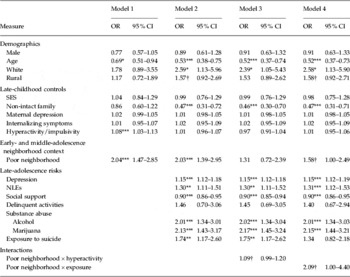
Model 1 (Table 2) demonstrates that when demographics and late-childhood controls were included simultaneously along with neighborhood poverty, neighborhood poverty had a significant independent effect on youth suicidal thoughts. The effect of neighborhood poverty was essentially unchanged when compared with univariate results. This pattern of findings suggests that its association with suicidal thoughts is probably not attributable to individual and family vulnerabilities.
Logistic regressions predicting young adults' suicidal thoughtsFootnote a

SES, Socio-economic status; NLE, negative life event; OR, odds ratio; CI, confidence interval.
a All models control for cohort and region of residence.
* p<0.05, ** p<0.01, *** p<0.001, p<0.10.
Model 2 shows that the effect of neighborhood poverty again remained essentially unchanged when late-adolescence risks (depression, low social support, NLEs, delinquent activities, substance abuse and exposure to suicide) were incorporated. Thus, a mediation hypothesis was not supported.
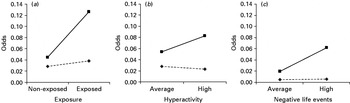
Two interaction effects, between neighborhood poverty and hyperactivity (p=0.06) and exposure to suicide (p=0.05), emerged as marginally significant over and above the effect of other family and individual risk factors. These interaction effects were incorporated into Models 3 and 4 respectively. In these models, the main effects of neighborhood poverty was appreciably reduced, suggesting that youth living in poor neighborhoods could be partly more at risk through the amplified effect of other risk factors. Fig. 1(a, b) illustrates these findings.
Predicted odds of (a, b) suicidal thoughts and (c) suicidal attempts as a function of exposure to suicide (non-exposed versus exposed), hyperactivity (average level of hyperactivity versus 2 s.d. above the mean), and negative life events (NLEs) (average level of NLEs versus 2 s.d. above the mean), by neighborhood poverty status (other risk factors were held constant at their average level). ◆- - -◆, Non-poor neighborhood; ■—■, poor neighborhood.

Suicide attempts (Table 3)
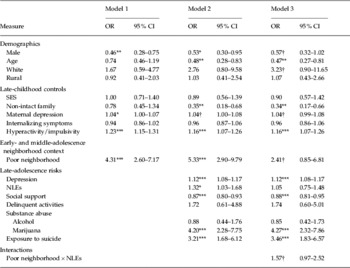
In general, the results for suicide attempts followed a similar pattern to those for suicidal thoughts (Table 3). Neighborhood poverty had an independent effect over and above demographics and late-childhood controls (see Model 1), and the size of the neighborhood poverty effect was not reduced when late-adolescence risks were added to the model (see Model 2).
Logistic regressions predicting young adults' suicidal attemptsFootnote a

SES, Socio-economic status; NLE, negative life event; OR, odds ratio; CI, confidence interval.
a All models control for cohort and region of residence.
* p<0.05, ** p<0.01, *** p<0.001, p<0.10.
For suicide attempts, only one interaction effect, between neighborhood poverty and NLEs, emerged as marginally significant (p=0.06). The main effects of neighborhood poverty and NLEs were appreciably reduced when the interaction effect was included, suggesting that NLEs had a pronounced association with youths' risk of suicide attempts in poor neighborhoods, and that living in a poor neighborhood was especially problematic vis-à-vis suicidal behaviors for those experiencing NLEs (see Model 3). Fig. 1c illustrates this finding.
Discussion
The aim of this study was to examine the association between neighborhood poverty and suicidal thoughts and attempts among older adolescents. Even though neighborhood disadvantage is associated with an array of risk factors for youth suicide (e.g. Leventhal & Brooks-Gunn, Reference Leventhal and Brooks-Gunn2000), its independent role as a social risk factor for adolescent suicidal behaviors has not been examined in previous studies. As hypothesized, the results showed that neighborhood poverty was independently associated with suicidal thoughts and attempts, after controlling for pre-existing family and individual vulnerabilities, including family SES, family disruption, maternal depression, internalizing symptoms and hyperactivity/impulsivity problems. These results represent an important addition to the literature, given that previous epidemiological studies looking at the link between neighborhood characteristics and suicidal behaviors did not focus on youth, a group particularly at risk for suicide attempts, and did not include family- or individual-level controls, except for one study conducted among adults that controlled for individual socio-economic characteristics (Cubbin et al. Reference Cubbin, LeClere and Smith2000).
At the descriptive level, the odds of suicidal ideations were about two times higher in poor than non-poor neighborhoods, and the odds of attempting suicide were about four times higher in disadvantaged neighborhoods. This increased vulnerability is comparable to that of other groups considered at high risk for suicide, such as Native youth or gay, lesbian and bisexual adolescents, for whom the rates of suicide have been found to be two to six times higher than in the general population (Spirito & Esposito-Smythers, Reference Spirito and Esposito-Smythers2006; Kirmayer et al. Reference Kirmayer, Brass, Holton, Paul, Simpson and Tait2007). Even if the processes underlying vulnerability are likely to vary among these groups, the results of this study suggest that youth living in poor neighborhoods are also highly vulnerable and should be a target of youth suicide prevention and intervention efforts.
Another unique contribution of this study is the examination of potential mechanisms for explaining neighborhood effects on suicide. Contrary to expectations, psychosocial risks, including depression, low social support, NLEs, delinquent activities, substance abuse and exposure to suicide, did not explain neighborhood effects. In other words, although adolescents raised in poor neighborhoods tended, as expected, to exhibit higher levels of depression, experience more NLEs and perceive lower levels of social support in late adolescence, these factors did not explain their higher rates of suicidal thoughts and attempts. Other potential mechanisms proposed in the neighborhood literature, such as exposure to violence and abuse, lack of social cohesion in the neighborhood, lower quality relationships with family members or peers, parental criminality, low-quality institutional resources such as school or lack of positive opportunities, need to be examined in future research (Leventhal & Brooks-Gunn, Reference Leventhal and Brooks-Gunn2000). In addition, considering differential biological responses as a function of neighborhood characteristics could also enhance our understanding of ‘neighborhood effects’ on youth behavior (Hill et al. Reference Hill, Ross and Angel2005; Manuck et al. Reference Manuck, Bleil, Petersen, Flory, Mann, Ferrell and Muldoon2005).
The results hint at an alternative pathway that might place adolescents raised in poor neighborhood at risk. Marginally significant interaction effects suggested that known risk factors for suicide, namely hyperactivity, exposure to suicide and NLEs, could exert stronger effects among youth living in disadvantaged neighborhoods. Youth who are otherwise at risk for suicide could be more likely to exhibit suicidal thoughts and to attempt suicide when they are exposed daily to a stressful environment that is less likely to provide strong emotional, social and institutional resources in the face of a crisis (Cutrona et al. Reference Cutrona, Russell, Brown, Clark, Hessling and Gardner2005). Thus, a combination of known risk factors for suicide, along with exposure to a challenging environment, might compound the risk of considering suicide as a solution when confronted with a difficult situation. These effects parallel those reported in an emerging literature looking at youth externalizing problems, illustrating that the effects of important individual risk factors are magnified in disadvantaged neighborhoods (Lynam et al. Reference Lynam, Caspi, Moffitt, Wikström, Loeber and Novak2000; Obeidallah et al. Reference Obeidallah, Brennan, Brooks-Gunn and Earls2004; Dupéré et al. Reference Dupéré, Lacourse, Willms, Leventhal and Tremblay2008). The results suggest that similar amplifying effects might also apply to internalizing problems, although this finding needs replication and should be regarded with caution given the marginal levels of significance of the interactions and the risks inherent in examining person×environment interaction effects with a dichotomous outcome (Eaves, Reference Eaves2006).
Other study limitations should be mentioned. First, non-experimental neighborhood studies are subject to selection bias. Indeed, even if major potential confounders are controlled, there is always a possibility that apparent neighborhood effects are attributable to unmeasured characteristics associated with both neighborhood disadvantage and the outcome (Leventhal & Brooks-Gunn, Reference Leventhal and Brooks-Gunn2000). Some limitations also arise from the use of a large-scale national data set. Large-scale data sets provide statistical power and representativeness but, perhaps inevitably, broadness is often obtained at the cost of depth. For instance, only two questions focused on suicidal thoughts and attempts, so that the specific timing and circumstances surrounding these events were unknown. Furthermore, because of the unequivalent time-frames (e.g. depressive symptoms were assessed in reference to the past week whereas suicide outcomes were assessed with regard to the past 12 months), temporal precedence and directionality are uncertain. In addition, because the NLSCY was not primarily designed to assess neighborhood effects, hierarchical multi-level modeling strategies could not be used because of insufficient within-neighborhood clustering of participants. For the same reason, potential mechanisms underlying youth suicide attempts were limited to individual-level factors and did not include any potentially relevant neighborhood-level mechanisms, such as exposure to community violence.
Despite these limitations, this study makes a valuable contribution to the literature by examining the link between neighborhood poverty and suicide attempts among youths. The results have potentially important implications for prevention and treatment of vulnerable youth. They suggest that it could prove highly beneficial to implement prevention programs designed to reduce adolescents' suicidal behaviors in disadvantaged communities with high rates of youth suicide. Educational programs for general practitioners working in disadvantaged areas represent one promising avenue (Szanto et al. Reference Szanto, Kalmar, Hendin, Rihmer and Mann2007). Another strategy that could reduce the gap between adolescents in poor and non-poor neighborhoods is to improve access to school-based health services. Indeed, high schools located in lower SES communities are less likely to offer school-based health services (Billy et al. Reference Billy, Grady, Wenzlow, Brener, Collins and Kann2000), even though the presence of such services are beneficial for youth in high-risk communities (Borowsky et al. Reference Borowsky, Resnick, Ireland and Blum1999). School-based prevention programs tested among high-risk groups, such as life skill-training programs, could also prove effective. These programs have been demonstrated to enhance problem-solving strategies and to foster a sense of personal ability to cope with life difficulties (Thompson et al. Reference Thompson, Eggert, Randell and Pike2001). In short, the prevention and intervention literature suggests many avenues that could significantly reduce the likelihood that adolescents in poor neighborhoods select suicidal behavior as a coping strategy in the face of important life difficulties.
Acknowledgments
V.D. was supported by fellowships from the Canadian Institutes of Health Research (CIHR) and the Social Sciences and Humanities Research Council of Canada (SSHRC).
The research and analysis in this paper are based on data from Statistics Canada, and the opinions expressed do not represent the views of Statistics Canada.
Declaration of Interest
None.