Scholars routinely cite E.E. Schattschneider's remark that “modern democracy is unthinkable save in terms of parties.” But what is a party?
Contemporary scholarship views a party as a team of politicians whose paramount goal is to win electoral office. These teams make promises about what they will do if elected, standing for re-election based on their records of implementing their programs.
It is easy to see how such parties might serve democracy. Voters can give more effective direction to government by supporting a team's program rather than an individual's. By holding entire parties rather than individual politicians accountable for what government does, voters create an incentive for responsible governance that might not otherwise exist.
We contest the view of party that supports this rosy assessment. We argue that parties in the United States are best understood as coalitions of interest groups and activists seeking to capture and use government for their particular goals, which range from material self-interest to high-minded idealism. The coalition of policy-demanding groups develops an agenda of mutually acceptable policies, insists on the nomination of candidates with a demonstrated commitment to its program, and works to elect these candidates to office. In this group-centric view of parties, candidates will, if the coalition has selected them well, have as their paramount goal the advancement of the party program.
Most studies of parties assume that voters can judge which party offers more of what they want, implying that parties must construct programs with a keen eye to voter satisfaction. We regard this assumption as unrealistic. In its place we theorize an “electoral blind spot” within which voters are unable to reliably ascertain policy positions or evaluate party performance. Recognizing the limits of voter acuity, our group-centric parties exploit the complexities of politics to disguise the actions they take on behalf of party agendas.
In our account, parties are no great friends of popular sovereignty. Electoral competition does constrain group-centric parties to be somewhat responsive to citizen preferences, but they cede as little policy to voters as possible. Parties mainly push their own agendas and aim to get voters to go along.
Despite basic differences between our theory and the standard view of parties, critical tests are hard to identify. Some telling evidence exists, but party nominations, central to our theory, are hard to study and poorly documented. Measuring party responsiveness to groups or to voters is difficult. Hence, we content ourselves here with developing our theory and demonstrating its plausibility.
Our argument begins with a survey of party literature. We next develop our alternative theory, first as an extended hypothetical story, then with more precision. We next describe relevant empirical evidence. We conclude with an argument for more attention to the role of interest groups and activists in parties, and the role of parties in policy-making and representation.
Legislative-Centered Theories of Party
Textbooks on political parties in the mid-twentieth century assigned a central role to interest groups, then considered the “raw material of politics.”Footnote 1 Five decades later, the view is radically different. The discipline's most developed theories of party feature office holders, especially legislators, as the dominant actors.
This legislative focus emerged as studies of party outside the legislature reported weakening and decline. Party identification in the electorate began to decrease in the 1960s and remained below historical levels through the 1980s. The decline of traditional urban machines and other developments brought loss of party control over legislative nominations.Footnote 2 The McGovern-Fraser reforms of the 1970s opened presidential nominations to mass participation in state primaries and caucuses; as party leaders lost their official role, many scholars concluded that parties had little impact on nominations.Footnote 3
During roughly this same time period, observers of Congress began to note increasing influence of majority party leadership, and much stronger evidence of partisan voting than had previously been recognized.Footnote 4 Scholars seeking to understand how party mattered in Congress quite naturally—given the consensus about the weakness of parties in other domains—focused on forces internal to Congress itself.
The theoretical view of parties in Congress is best introduced in the account of a mythical legislature first offered by Thomas Schwartz, then extended by John Aldrich.Footnote 5 This logic underlies most current theorizing about legislative politics and also deeply influenced our alternative, group-centered view.
The legislature of the Schwartz-Aldrich myth has three members (A, B, C.) Each member sponsors a bill (X, Y, Z) that provides benefits to her own district and imposes costs on the others. Pay-offs (from AldrichFootnote 6) for each bill and each district are:

If each legislator votes based on how her own district is affected, all three bills fail and pay-offs are zero. All three legislators would be better off, however, if all the bills passed; each player would get a pay-off of 1. But A and B could do better still by forming a “long coalition,” by both voting in favor of X and Y, and against Z. Without the long coalition, the decisive majority is different for each bill (the coalition of B and C defeats X, the coalition of A and C defeats Y, etc.) By forming a majority coalition that stays together across votes, A and B increase their pay-offs to 2. The gains from keeping a stable majority together form Schwartz's and Aldrich's answer to the question “Why Parties?”
The question then becomes, how does a party keep its long coalition together? According to Gary Cox and Mathew McCubbins, party leaders control the legislative agenda, suppressing proposals that might split the party and promoting the party program. The policies thus enacted create a “brand name,” valuable for winning elections.Footnote 7
The “brand name” concept begins to connect legislative theories with forces outside Congress. John Aldrich goes further, arguing that parties, while emerging from legislative politics, solve many problems legislators face as they attempt to win re-election and build stable careers.Footnote 8 Legislative-centered theories of party have thus grown to incorporate broader aspects of political and social life, including the preferences of voters and groups. But these broader forces impact parties only via the narrow conduit of politicians' electoral incentives. The desire of incumbent office-holders for re-election animates parties, and forms the basis of theories that measure their impact.
This view is plausible, but, in our view, limited. Yes, long coalitions are valuable to legislators pork-barreling for their districts. But they are also valuable for policy demanders nominating candidates. The logic of long coalitions transcends the legislative context, and we shall use it below in our account of parties as coalitions of interest groups and activists.
Recent empirical scholarship has documented anomalies for politician-centered theories. The reputations created by legislative parties have been shown to hurt rather than help the re-election chances of members of Congress.Footnote 9 A study of presidential nominations has argued that party insiders have managed to reassert much of their lost influence.Footnote 10 Evidence from California has demonstrated that in the absence of activist oversight of nominations, legislators do not form legislative long coalitions, but take the simpler path of selling policy piecemeal to private bidders.Footnote 11 Finally, several studies have found that reorganization of party coalitions on racial issues in the 1940s and 50s sprang from demands of interest groups and activists within the party coalitions.Footnote 12
Our theory of party has developed out of several of these recent studies, which we will review in more detail. We first turn to our own myth of party origin. Our myth encompasses both political and societal forces, making it more complex than the Schwartz-Aldrich myth. The purpose is the same, however: our stylized before-and-after narrative aims to convey a logic for why parties form and how they matter.
An Alternative Theory
Imagine a society in which no parties yet exist, about to elect its first president. The president governs by fiat, with re-election possible but not guaranteed.
Within this society, four groups of intense “policy demanders” have organized to promote policies that benefit group members but impose costs on society as a whole. The shepherds, for example, want a tariff on wool imports to increase the price they can charge for their homegrown wool. While many voters bemoan the high price of clothing, they know little about tariff policy or the arcane policy goals of other intense minorities.
As the election approaches, the shepherds work together to elect one of their own, who naturally favors a high tariff on wool imports. The shepherds are not rich or numerous, but in an otherwise unstructured electoral environment, with most voters uninterested, their chance of winning is high.
But then another group, teachers, notices what the shepherds are up to. The teachers calculate they could easily outspend the shepherds to elect a teacher, whose top priority would be school construction. Or, they reason, they could join forces with the shepherds. The latter option seems preferable: a candidate supported by multiple groups is even more likely to win. Leaders of the teachers union understand that the wool tariff increases the price everyone pays for wool, but this consideration is small compared to their desire for better school facilities. As they begin to pay more attention, two other groups, clergy and coffee growers, make similar calculations. The four groups decide they can do better by cooperating in electoral politics than by competing against each other.
The coalition encounters problems, however. The coffee growers want a new four-lane highway to increase market access for their remote region, but the other groups are dubious. The requisite tax increase would likely draw the attention of normally inattentive voters. The other groups would themselves also be burdened with the tax. Several such concerns arise, but the groups bargain them out. Everyone agrees, for example, that a two-lane highway will suffice for the coffee growers. The clergy's plans to ban the sale of alcohol, the teachers' school improvements program, and the wool tariff are similarly scaled back from what their backers originally envisioned.
The coalition drafts a candidate who demonstrates sufficient appreciation of the importance of education, sobriety, transportation, and the need to protect consumers from inferior imported wool. The groups and their candidate recognize that these issues might be perceived as special interest boondoggles, so they do not emphasize them. Instead, the campaign centers on growing the economy and providing for the common defense. The coalition's candidate wins easily, and society takes pride in a government that is above petty politicking. The shepherds get their tariff, ground is broken for a state-of-the-art highway in the coffee-growing region, new schools with majestic teachers' lounges are built, and the sale of alcohol on Sunday is forbidden. Several elections follow this pattern: candidates are vetted by the loose coalition of policy demanders, elections are low key, policy demands are implemented, and voters remain quiescent.
The Sunday alcohol ban, however, generates some controversy. The saloon keepers are dismayed to lose their Sunday evening revenue and fear stronger restrictions unless something is done to stop the clergy. Formerly uninterested in politics, the saloon keepers consider running their own candidate in the next election, but realize that their odds would be poor against the dominant coalition. Meanwhile, teachers become upset about religious interference in the school curricula, and coffee growers suffer retaliatory protectionism in the export markets. Sensing the possibility of gaining allies, saloon keeper leaders approach the teachers and growers about circulating pamphlets to protest the government's “interference in a free society.” Out of this activity the Freedom Party is formed. The party recruits a candidate to challenge the incumbent President on a reform platform emphasizing free markets, secular humanism, and an individual's right to choose what to drink on Sundays. Correctly anticipating a contentious election, the Freedom Party carefully selects a good-looking candidate with outstanding communication skills.
The incumbent President retains the support of the clergy and the shepherds. When the incumbent was first recruited, the coalition's primary concern was finding a candidate committed to its policy demands. Now running under the mantle of the “Heritage Party,” the incumbent proves to be an uninspired campaigner. The Freedom Party's reform candidate is elected and the era of consensual politics comes to an end.
The Freedom Party President is a savvy politician. He likes being President, wants to keep the job, and knows that any perception that he is in service to special interests will hurt his reelection odds. He repeals the Sunday drinking prohibition (a popular move) but otherwise pays little attention to the interests that sponsored him. He spends most of the national budget on fireworks for the popular Independence Day celebration, leaving school construction and the coffee highway to languish. This enrages the teachers and coffee growers, who withdraw their support at the next election. The popular incumbent continues to claim the mantle of the Freedom Party and wins re-election anyway. Learning a lesson, the Freedom Party takes much more care in future years to select nominees with proven loyalty.
As the Freedom and Heritage Parties compete over many elections, political discourse is dominated by conflict between them. The party programs become accepted as natural manifestations of competing worldviews: a “conservative” one that seeks to protect and restore the traditions of a religious society of herders, and a “liberal” one oriented toward cultivating human capital and infrastructure to compete in the global economy. Some voters who care nothing about the interests of the various groups are nonetheless attracted to their parties because of the “values,” such as social order or equality, that they perceive in their programs. The conservative and liberal ideologies help the groups define the terms of their cooperation; they also promote the useful fiction that everyone in the coalition wants the same things.Footnote 13
Yet the mobilization of new groups and values also makes the party coalitions more heterogeneous, more difficult to manage. Close observers note that the main economic dimension is crosscut by a secular/religious cleavage, as depicted in figure 1. For example, religious coffee growers sometimes vote Heritage because of the party's temperance plank. Even the saloonkeepers, despite continuing conflicts with the clergy over business hours, sometimes defect to Heritage in protest of the humanistic ideas teachers push on their children.
Groups, parties, and the ideological space

The parties respond to these internal tensions with sharper rhetorical appeals to Freedom and Heritage, saying less about specific programs, and continuing to nominate candidates committed to the party's entire agenda. Some voters buy the vague appeals, but others are confused and end up voting on the basis of the performance of the economy. The groups are happy enough with this outcome. Each coalition controls government about half the time, an outcome much better than the numerically small policy-demanders could achieve without parties.
The point of this extended myth has been to highlight our key claims. Organized policy demanders strive to recruit and elect candidates sympathetic to their goals, goals typically not shared by most ordinary voters. Bargaining among policy demanders constructs not only the party system, but also the ideological space. The resulting coalitions encompass diverse concerns, some narrowly material and some broadly idealistic. Inevitably, the party programs are less than perfect matches for the concerns of most voters, who respond with varying degrees of trust, adaptation, and confusion. The importance of nominations and the nature of voter responses to parties are particularly important points; we next elaborate on each.
Why Nominations?
Groups of organized policy demanders are the basic units of our theory of parties. Consider a group that wants the support of an independent office holder with its policy demand. Alone or with a coalition, it can lobby the office-holder to take up its cause, providing facts and talking points. This strategy is unlikely to succeed, however, unless the demand either can be framed as uncontroversially beneficial for a large number of voters, or lines up with the office-holder's existing goals. Lobbying works reliably only for policy demands that officials already favor.Footnote 14
Of course, a group can try to win over the elected official with campaign contributions, but a principal-agent problem inevitably looms. The official can tell whether the group is contributing or not; it is much harder for the group to know whether the official is really advancing its agenda. Easily observed activities (bill sponsorship, roll call votes) are less consequential than the behind-the-scenes coalition-building efforts needed to shepherd policy changes through the legislative process.Footnote 15 Office holders always have an information advantage over policy demanders. They know more about their own actions and the policy-making environment.
The rise of interest group newsletters in the 1970s and, more recently, blogs, have made it easier for interest groups and activists to monitor office holders on matters of moderate importance, such as amendment votes. But the principal-agent relationship between a policy demander and an incumbent persists. Policy demanders can (and do) try to strike deals with incumbents who do not already share their goals, but they can never be sure they are getting what they bargain for.
Another tack is to get a genuine friend nominated and elected to office. In seeking to control a nomination, interest groups and activists are in a stronger position. Multiple aspiring office-seekers, none secure in the office they covet, compete for contributions and other campaign resources. At minimum, interest and activist groups can require promises of policy support. Often they can hold out for candidates who have actually demonstrated their commitment through prior service. In the small worlds of local politics, leading individuals are well known to each other; by selecting nominees out of such pools, policy-demanding groups can be fairly confident of getting the politicianFootnote 16 they want.
Notice that this nomination process can, if the groups work it well, produce a different kind of politician than envisioned in standard theories of party—a politician committed more strongly to a particular agenda than to office-holding per se. This is not to say that such politicians would take quixotic positions leading to pointless electoral defeats. This would do no good for them or the party. But they would take risks for policy that candidates in a politician-dominated party would not.
The advantageous position of groups at the nomination stage is bolstered by lack of voter interest. Most citizens pay little attention to general elections and less to nominations. The few who vote in primaries lack the anchoring cue of candidate partisanship, rendering them open to persuasion. Media coverage of primaries is generally less heavy than in general elections, thereby increasing the impact of small amounts of paid advertising. The voters who pay closest attention in primaries often have ties to local interest groups and activists, further contributing to the capacity of policy demanders to control the outcome. Thus, the costs of providing selected politicians with what they need to win a primary election are often small.
For many reasons, then, nominations are a natural focus of interest groups and activists. But how do multiple groups, each with different policy demands, choose a sympathetic candidate? Our answer is by cooperating with other groups as a long coalition. The long coalition strives to nominate a candidate whom each group trusts to represent its interests in a manner acceptable to the coalition as a whole. As in legislative long coalitions, each group is expected to support the party's position in most nomination contests and to oppose it in few.
There are important differences between legislative and nominating coalitions, however. In the legislature, “supporting” the party means voting for its bills. In the electoral context, “supporting” means contributing resources (money, manpower, or expertise) to its candidates. In legislative long coalitions, each legislator makes an identical contribution to success (a single vote) up until the 50-percent-plus-1 threshold is reached. In electoral long coalitions, contributions vary in size and nature.
More significantly, in electoral long coalitions, there is no equivalent of the 50-percent-plus-1 threshold. If a majority of legislators vote for a bill, then it passes. No uncertainty here. But if a majority of the groups involved in a campaign support Candidate X, there is no guarantee that X will win. Even if the groups controlling a majority of the resources in a campaign support X, there is still no guarantee. The election depends on voters.
Despite this uncertainty, the benefit to policy demanders of coalition membership is tremendous. Acting alone, a policy demanding group has little hope of electing a majority of its friends to the legislature. To secure new policy, it must build support for its measures bill-by-bill in the legislature. But acting as a member of a party coalition, it can nominate and elect a large number of legislators—possibly even a majority—committed in advance to a program that incorporates the group's goals.
It is, however, easier to see why policy-demanding groups might wish to join party coalitions than to understand how, in practice, they might form one. It is one thing for representatives to a national legislature, gathered under one roof, to create national party coalitions, as in the Schwartz-Aldrich model. It is quite another for diverse interest groups and activists to build national coalitions outside the legislature, such that politicians nominated by a party coalition in any part of the country have roughly the same political commitments.
Yet, as we describe later, policy demanders have successfully formed major parties dedicated to a common agenda. And on more occasions, groups of policy demanders have tried—sometimes successfully, sometimes not—to capture an existing party and turn it to their purposes.
What about Voters?
One might question whether policy demanders have anything to gain from nominating a friendly candidate. According to the Median Voter Theorem,Footnote 17 electoral competition should force parties to choose candidates who advocate policies close to those of centrist voters, far from what policy-demanding groups prefer.
This argument, however, depends on the assumption that voters can judge the policy and ideological positions of candidates. Is this assumption tenable?
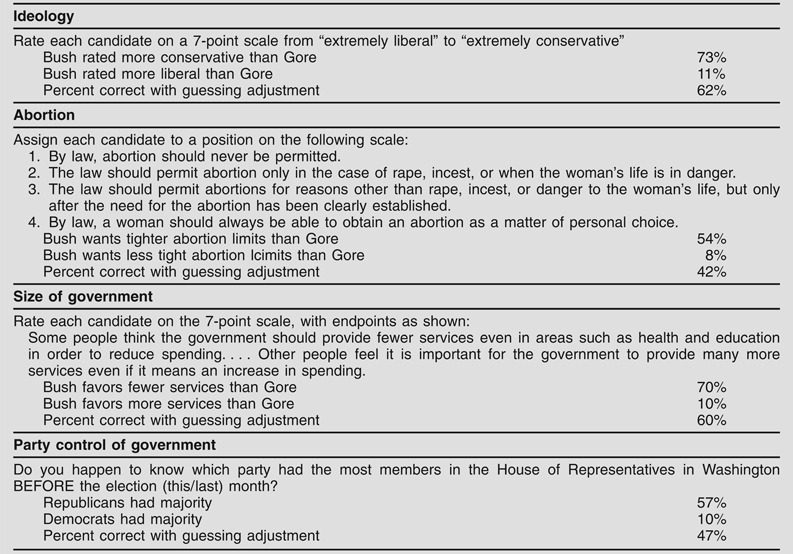
Table 1 presents relevant evidence. About 38 percent of voters in the 2000 election did not know that George W. Bush was more conservative than Al Gore. Voter awareness is even lower for two concrete policy items at the heart of the current partisan divide—limits on abortion, and cuts in government spending. Only 47 percent knew which party controlled the House of Representatives.
Voter information about politics and government

Source: 2000 National Election Studies, face-to-face mode, voters only
How much should a party be expected to moderate its positions in deference to an electorate in which half the voters do not even know whether it or its opposition controls the government? Some, perhaps, but probably not very much.
While ideological positioning seems to have relatively little effect on presidential elections, uncontrollable events can have large effects. Christopher Achen and Larry Bartels showed that bad weather (droughts, hurricanes) in the election year leads to substantial vote loss by the incumbent president's party. Weather, they estimate, cost Gore one million votes in the 2000 election.Footnote 18 Unsuccessful wars also hurt the incumbent party.Footnote 19 The largest and best-documented effect on presidential elections is the performance of the national economy, which is only marginally more amenable to political control than the weather. If voters held presidents accountable for economic performance over their full term in office, economic voting might be defensible as a criterion of choice. But voters actually seem to be influenced mainly by economic conditions over the last six months before Election Day.Footnote 20 Again, one must ask how much attention should parties be expected to pay to voter preferences when a roll of the dice six months before Election Day will be the biggest factor in the election.Footnote 21
To be sure, parties must tread carefully. As Key famously argued, voters are not fools.Footnote 22 Poorly informed voters can find cues and heuristics that allow them to make sense of politics and respond with a degree of rationality.Footnote 23 A candidate with a reputation for extremism will fare poorly with voters who, though lacking a coherent ideology, still know they don't like extremism. Candidates who attack very popular programs like social security, or promote unpopular ones like busing to achieve racial integration may likewise arouse the ire of voters not usually attentive to politics.
So, on the one hand voters can recognize and react against some kinds of extremism. On the other hand, many voters, especially swing voters, know dramatically little about politics.Footnote 24 In the competitive world of elections, voter ignorance gives parties the opportunity to win with candidates more extreme than swing voters would like if they knew better. We call the policy region over which aggregate electorates do not enforce their preferences the “electoral blind spot.”
Figure 2 illustrates the electoral blind spot, using the ideological space constructed by the coalitions of policy demanders in our myth. As in figure 1, the ideal points for the Heritage Party (HP) and the Freedom Party (FP) reflect negotiated agreements among each party's constituent policy demanders.
The electoral blind spot and nomination trade-offs

The typical voter's ideal point is at the origin. The policies marketed as “Freedom” or “Heritage” (or even “competitiveness” or “protectionism”) are crafted to bestow benefits on the organized few; any benefits experienced by the unorganized masses are happy accidents. Fully informed voters would thus vote for the candidate closer to the origin, creating pressure for both parties to scale back the policy demands they were created to promote. But uninformed voters may not be able to tell which platform they prefer.
Consider first an extreme case, in which voters pay no attention at all, completely unable to distinguish between candidates' positions, no matter how outrageous. In this case, parties can nominate candidates whose positions reflect only the negotiated position of their policy demanders. Contra Key, voters would behave like fools, choosing candidates on the basis of weather, charisma, or some other irrelevancy. Parties would abet voters' foolishness by competing on these irrelevancies rather than on policy.
Now consider the opposite extreme: voters are fully informed and react to every nuance of the candidates' positions. This is the assumption normally made in spatial voting models, usually (we hasten to note) for purposes of simplicity, not veracity. Under the assumption of fully informed voters, with a majority of voter ideal points at the origin, the party with most moderate nominee will win.
More realistic than either extreme is the assumption that voters notice and react to differences in positions only when they are sufficiently large. In figure 2, the dark, smaller circle in the center represents the electoral blind spot, the set of positions that a voter will treat as essentially equivalent.Footnote 25 To our inattentive voter, all the positions in the electoral blind spot (which includes her ideal point) sound pretty reasonable; she would not quibble with any of them. Most important, the voter chooses among candidates located within the electoral blind spot on the basis of something other than policy position (charisma, the economy, etc.).
The lighter-shaded donut-shaped area represents another equivalence class of positions; the voter regards all positions in this area as equivalent to each other, but worse than any position in the blind spot. That is, the voter recognizes that both policies fp′ and hp′ are somewhat more extreme than she would like. She does not, however, recognize that point fp′ (too much Freedom) is actually closer to her ideal point than point hp′ (too much Heritage.)
If low information creates wide bands of equivalence for voters, each party has an incentive to nominate a candidate whose position is just on the edge of the electoral blind spot—that is, to a point like fp″ or hp″. Nominating a more extreme candidate will lead to defeat. That is, if Freedom's candidate scales back the party's demands for highways, schools and beverages to fp″, but if Heritage's candidate promotes tariff and religion to the level of hp′, Heritage is certain to lose. There is no need for either party, however, to scale back beyond the point where voters notice any difference. As long as parties stay within the electoral blind spot, they are effectively free to nominate any candidate they want. They have nothing to gain from further compromise, nothing to lose from sticking to their guns. The more voters are blind to extremism—and the more election outcomes are affected by non-policy factors like economic voting and charisma—the more leeway parties have to nominate extremists.
Voters can be blind to the meaning of positions taken by parties in government as well as in election campaigns. They may, for example, believe that the governing party's health reform proposal is little different from that of the opposition party, even when the consequences differ significantly. Such lack of acuity increases the freedom of majority party office holders to take positions as extreme as they please—or as their core interest groups and activists wish them to do.
In practice, the blind spot is neither clearly demarcated nor fixed for all time. Parties must trade off the appeal of candidates more clearly committed to its policy demands against the risks of losing the election by straying outside the blind spot. Within each coalition, groups may evaluate this trade-off differently. Much intra-party conflict over nominations boils down to disagreement about the size of the blind spot, e.g., how much must commitment to party ideals be sacrificed to appeal to centrist voters?
Other scholars have observed that parties may be uncertain about what exactly voters want, and that this uncertainty can lead them to adopt non-centrist positions.Footnote 26 Our theoretical claim is different. Lack of voter attentiveness creates license for parties to take non-centrist positions, regardless of what voters may actually want. It is possible that both theories help to explain why parties polarize, but we offer specific evidence for the blind spot argument: Exogenous changes in the amount of information available to voters about their representatives increases the risk that extremist legislators will be recognized as such and voted out of office.
Competing Views of Party
Edmund Burke's definition of a political party as “a body of men united … upon some particular principle” is the foil of nearly every scholar who cites it. The modern view, first articulated by Joseph Schumpeter in Capitalism, Socialism, and Democracy, is that “a party is a group whose members propose to act in concert in the competitive struggle for power.” Schumpeter's view emphasizes the extent to which electoral competition drives the actions of politicians and therefore parties. “What businessmen do not understand,” he quotes a politician as saying, “is that exactly as they are dealing in oil so I am dealing in votes.”Footnote 27 As evidence against Burke's position, Schumpeter goes on to note that different parties may adopt identical platforms. Anthony Downs subsequently connected these points, arguing that platform convergence was a logical consequence of the pressures of electoral competition on office-seeking parties.Footnote 28
Leading contemporary studies of political parties continue in this intellectual tradition. Parties, and the politicians who lead them, are about one overwhelmingly important thing: gaining office. Policy commitments are, in most theories of party, secondary or non-existent.
Contemporary scholars do, of course, recognize that parties fail to converge to the position of the median voter. Various special explanations, such as imperfect political competition or uncertainty about what voters want, are invoked to cover these cases. In particular, scholars recognize the existence of “party-linked” groups and activists who attempt to pull parties away from the position of the median voter, but they regard the groups either as separate from the party itself or as secondary influences within the party. Marjorie Randon Hershey's comments in the fifteenth edition of Party Politics in America typifies this perspective:
In addition to competition within each party, parties also compete on the electoral stage with other political organizations. Groups such as single-issue organizations, labor unions, religious lobbies, insurance companies, and other corporations involve themselves in campaigns in order to achieve their political goals. Some of these groups work very aggressively to help candidates get nominated, raise money, influence public opinion, and win elections.Footnote 29
Activists working with these outside groups are usually treated separately from true party activists, who join campaigns or volunteer for explicitly partisan efforts. But true party activists can also be motivated by ideological or issue-specific goals. Hershey writes that such amateurs activists are “essential to a party's success” because of their volunteer efforts, but they can be harder for party leaders to control. Hershey characterizes this potentially rogue labor force as a challenge to “pragmatic parties, dedicated to the party's success above all else.”Footnote 30
John Aldrich takes a position even closer to ours. In the 2011 edition of Why Parties? he writes that “the major political party is the creature of the politicians, the partisan activist, and the ambitious office seeker and officeholder.”Footnote 31 He continues, remarking that “those who seek and hold political office … are the central actors in the party”.Footnote 32 Commenting on the activists, who are more extreme than most voters and pressure the politicians to adopt extreme views as well, Aldrich writes that “the political role of this part of the party is to attempt to constrain the actual leaders of the party, its ambitious office seekers as they try to … [appeal] to the electorate.”Footnote 33 But even in Aldrich's nuanced view, politicians are at the center of the party, leading it as best they can to offer what voters want.Footnote 34
Our view, in contrast, places policy demanders at the center. These interest groups and activists form coalitions to nominate and elect politicians committed to their common program. In our view, party nominees are not so much “constrained” by policy demanders to deviate from what voters want, as genuinely committed to what the policy demanders want regardless of the wishes of the median voter. This view of parties and politicians is as antithetical to Burke's idea of parties as it is to Schumpeter's. What makes plausible the survival of our kind of party, despite fierce electoral competition, is the limited attention voters pay to politics, and especially to policy positions and outcomes.
So the question now becomes what empirical evidence bears on the contrasting views of party?
Evidence
We begin by examining our most basic claim, that interest groups and activists, acting outside the legislature, form coalitions to nominate candidates committed to their program. We describe three occasions on which this has occurred. One involves the formation of a new party and two the reshaping of existing party coalitions. Building on this evidence, we move to nominations and legislative politics in the contemporary period. We close with a brief consideration of political machines, which constitute a type of party organization that is often inconsistent with our theoretical argument, and with a discussion of political parties in other advanced democracies.
Formation of National Party Coalitions
James Madison argued famously in Federalist No. 10 that political parties would be unlikely to form in an “extended republic” like the United States because factional leaders would be too scattered “to discover their own strength, and to act in unison with each other.” Consistent with this argument, we conceded earlier the difficulty of forming a Schwartz-Aldrich “long coalition” outside a legislature. Yet, notwithstanding Madison's claim and our own reservations, a national party coalition, the Democratic-Republicans, did form almost immediately. How did this happen?
An important first point is that Madison' argument about extended republics was questionable even at the time he penned Federalist No. 10. The Federalist Party already existed as a national coalition of southern planters and northern mercantilists. The motive of these groups resonates strongly with our theoretical analysis. Frustrated by the difficulty of gaining support for their measures one at a time in 13 different legislatures, they wanted a more efficient procedure and organized the selection of delegates to the 1787 Philadelphia convention to bring it about. This shows that formation of an effective national coalition outside the legislature is not prohibitively difficult.
The first glimmerings of a second national party coalition appeared in the Democratic Clubs of the early 1790s, which began as political discussion groups but were soon challenging Federalist congressmen for re-election. “Wherever there was a Democratic Society, the [electoral] fight was a hard one for the federalists. For the first time they faced an organization, disciplined, practical, aflame with enthusiasm.”Footnote 35 At a time when there were 65 congressional districts in the US, there were 40 to 50 Democratic clubs.
In the late 1790s, discussion clubs were overtaken by “party committees,” groups of self-starting citizens who nominated slates of Democratic-Republican candidates for all offices, including the critical role of Elector in the Electoral College. These nominations successfully channeled anti-Federalist votes to approved candidates,Footnote 36 invariably men who favored popular sovereignty, equal rights for white males, states' rights, and limited national government. This ideology, which had evolved in the intense newspaper culture of the day,Footnote 37 unified disparate policy demanders—southern planters, the growing middle class of the north, and western settlers—in a national coalition.
We have sought evidence that ambitious office holders in Congress or elsewhere led formation of the Democratic-Republican party and found little. Even Jefferson, the first presidential nominee of the party, played little role in its organization.Footnote 38
The key elements in this account—the rise of citizen discussion clubs which challenged Federalist candidates, their replacement by citizen committees to nominate slates committed to a party program, and use of ideology to mobilize diverse interests behind a national program—are standard history for this period. What is novel here is fitting these pieces into a theory of political parties that applies to the contemporary era as well.
Change in Party Coalitions
Party coalitions have changed greatly in the course of American history. In this section, we sketch two of these changes—the incorporation of civil rights for African Americans into the Democratic Party agenda, and incorporation of an anti-abortion position into the Republican Party agenda. We shall argue that policy demanders rather than office-holders initiated these important changes.
In a study that frames much research on changes in party coalitions, Edward Carmines and James Stimson propose a general model in which party leaders try different issues in an effort to lure voters to their side.Footnote 39 The leaders aim to be strategic, but Carmines and Stimson, following a biological model of evolution, posit that successful adaptation is largely a matter of luck. When an issue catches on, leaders communicate their success to party activists, who recruit candidates advocating the new position to the party, who then complete the realignment by attracting new voters. The two scholars apply their model to racial realignment, explaining how the 1958 congressional election, which was not at all focused on racial issues, led to strategic decisions by Lyndon Johnson and Barry Goldwater in 1964 to adopt new party positions on race, from which the new racial realignment followed.
Carmines and Stimson thus take a decidedly office-holder centered view of party position change. This view has come under attack in recent research. David Karol finds that on many issues members of Congress and presidential candidates changed positions in order to represent groups that had become more prominent in their party's coalitions or had new demands. He reports evidence that Republican members of Congress began turning racially conservative in the 1940s—not in order to attract new voters, but to satisfy business concerns that anti-discrimination legislation would bring unwelcome federal interference in the marketplace.Footnote 40 Republican House Speaker Joe Martin, who had some personal sympathy for a Fair Employment Practices Commission (FEPC), explained the party's position in 1947 as follows:
I'll be frank with you: we are not going to pass a FEPC bill, but it has nothing to do with the Negro vote. We are supported by New England and Middle Western industrialists who would stop their contributions if we passed a law that would compel them to stop religious as well as racial discrimination in employment.Footnote 41
The Republican Party remained opposed to lynching and other manifestations of Jim Crow. But when civil rights conflicted with the interests of a core policy demander, the party stood with the policy demander.
The situation in the Democratic Party was less straightforward. The migration of African Americans to the North and their incorporation into urban machines gave northern office holders a growing interest in representing them. The enthusiasm of black voters for Franklin Roosevelt heightened this interest and led to civil rights initiatives by urban Democrats. But support for civil rights among northern Democrats during the New Deal was modest and a dominant block in the Democratic Party—the white South—was adamantly opposed.
The earliest indication of reliable left-wing support for civil rights appeared not in the Democratic Party, but among political intellectuals and pundits associated with progressive causes. As late as 1910, leftist political intellectuals were no more likely to sympathize with African Americans than were conservatives, but by 1930 the left was systematically more favorable.Footnote 42 “Progressive ideology,” soon to be re-christened as “liberalism,” had realigned to favor it.
At about the same time as this ideological shift, liberal activists and union leaders in the Democratic Party began pressuring their party to stand up for civil rights. Explaining this turn among northern Democratic members of Congress in the 1940s, Eric Schickler, Kathryn Pearson, and Brian Feinstein write:
The Democratic Party's core coalition partners were instrumental in transforming the party to embrace civil rights. These coalition partners included not only civil rights organizations, but also labor unions, religious- and ethnic-affiliated groups … and broad-based progressive policy groups, such as Americans for Democratic Action (ADA). These organizations, which were drawn into the Democratic Party during the New Deal for reasons having little or nothing to do with race, became among the most vocal proponents of civil rights measures, pulling the party towards their position.Footnote 43
Schickler, Pearson, and Feinstein found that the Democratic legislators who most supported civil rights in the 1940s did not come from districts with high concentrations of African Americans, but from districts with high concentrations of union members (see their Figures 6a and 6b).
In another study, Feinstein and Schickler found that mid-level party officials and “amateur activists” at state Democratic conventions began in the 1940s to take pro-civil rights stances. These same forces, augmented by labor, pressed for a strong civil rights plank at the 1948 national party convention, causing southern segregationists to bolt to a new party. When it appeared that they might bolt again in 1952, the president of the United Auto Workers, a key player in the Democratic Party, said he doubted they would, “but if [the South] so chooses, let this happen; let the realignment of the parties proceed.”Footnote 44 As this and other evidence suggests, a coalition of unions and ADA liberals was purposefully seeking control of the Democratic Party for their purposes.Footnote 45
Meanwhile, Republican Party platforms continued to favor civil rights through 1960. However, American conservatism had by 1950 adopted a new states' rights stance toward civil rightsFootnote 46 and the conservative wing of the Republican Party was in virtual revolt against the party's moderation on just about everything, including civil rights. One party operative, F. Clifton White, convened a meeting of militant conservatives in 1961, claiming in his opening statement that “we're going to take over the Republican Party … and make it the conservative instrument of American politics.”Footnote 47 An organizing genius, White brought a flood of new conservative activists into the Republican Party, many from the South, who became the backbone of Barry Goldwater's successful campaign for the GOP presidential nomination in 1964.
These developments make it implausible to explain the racial realignment of the parties along the candidate-centered time line of Carmines and Stimson. Of course we cannot rule out the possibility of other activity by politicians prior to the policy demander activity Feinstein and Schickler observed. But it is clear that in both parties, traditional interest groups and realigned ideological groups had been pressing for change for at least 20 years before the 1964 election confirmed a new alignment. As Feinstein and Schickler say, “Johnson and Goldwater's respective embrace of civil rights liberalism and conservatism in 1964 are better understood as responses to deeply rooted forces within their parties than as free and independent decisions by the first movers in a sequence.”Footnote 48
Another issue where party positions have changed significantly is abortion. Over the last several decades, Republicans have emerged as pro-life and Democrats as pro-choice. Studying this development, Geoffrey Layman, Thomas Carsey, John Green, Richard Herrera, and Rosalyn Cooperman argue that the change occurred when abortion activists (pro- and anti-) entered the presidential nomination process, offering their support to candidates who took their preferred position.Footnote 49 Ambitious office seekers, looking for advantage, were forced to accommodate, even when it meant changing long-held positions.Footnote 50 Layman et al. argue that abortion fits other cases in which parties have “extended” conflict to new issues and offer this general model: “Once multiple groups of activists, each with noncentrist views on different issues, come into a party, office seekers have incentives to take ideologically extreme positions on all of those issues in order to appeal to them.”Footnote 51
Realignment of the Republican congressional party was likewise a response to new policy demanders in the nomination process. In three case studies, Marty Cohen found that pro-life Republican were elected to Congress in the early 1990s because morally conservative activists challenged economically conservative “country club Republicans” in congressional primaries and won. In a systematic study of about 100 districts, Cohen further found that an important part of Republican gains in Congress in the 1990s was due to the replacement of office seekers who were non-committal on abortion with candidates who took pro-life positions.Footnote 52
Although our account of party formation and change has emphasized the often-overlooked role of organized policy demanders, we do not claim that politicians play no role. But we see their role as managerial—facilitating efforts by policy demanding groups, often groups the politician already represents. For example, Martin Van Buren, when he was a Senator from New York, played a key role in the foundation of the Democratic Party in 1828; most importantly, the New Yorker persuaded southern slave-holders that an alliance with his state would have the effect of suppressing slavery as a national issue.Footnote 53 Similarly, leading politicians in existing parties may seek to draw new groups to the party, just as new groups may seek entry to the party by advancing the interests of politicians who favor them. FDR's close relationship with organized labor in the 1930s, and Ronald Reagan's with moral conservatives and the National Rifle Association are examples of this.Footnote 54 But, in our view, the dominant forces in coalition formation are policy-demanding interest groups and activists. Once a policy-demanding group, such as civil rights or anti-abortion activists, becomes part of a party, the normal operation of nomination processes produces candidates committed to the group's cause. Any “good Democrat” or “good Republican” can be counted on, even at real risk to their own careers. In the next section we shall see what taking risks for policy looks like.
Excess Polarization
One leading theory of office-holder parties holds that legislators organize parties in order to control the agenda on behalf of an electorally valuable “brand name.”Footnote 55 In recent decades, the Democratic brand is associated with ideological liberalism and the Republican brand with conservatism.
Figure 3 gives an overview of liberal and conservative brands in the House of Representatives in the period 1974 to 2004. In each panel, the horizontal axis shows the vote for the Republican presidential candidate in the nation's 435 congressional districts, and the vertical axis shows the roll call liberalism/conservatism of the Representative from that district. The measure of roll call voting is the standard NOMINATE score.Footnote 56
Patterns of political representation at four time points

The data show, as would be expected, that Representatives from Republican districts vote more conservatively on House roll calls than do those from Democratic districts. Note, however, that the parties become more polarized over time. The pattern for 2004 is especially striking: Even though many districts are about 50–50 in voting for president, very few are represented in Congress by a centrist. Nearly all Representatives have voting records that are either well to the right of center or well to the left. Are such extreme “brand names” really electorally valuable?
They are not. Although some brand differentiation may be electorally useful, parties routinely go too far. Legislators who vote with the polarized positions of their parties are more likely to suffer defeat.Footnote 57 The more extreme the voting record, the greater the electoral penalty. Stephen Ansolabehere, Charles Stewart, and James Snyder show that this tendency of parties toward politically damaging polarization goes back to the nineteenth century.Footnote 58 More generally, journalist E.J. Dionne has argued that excess polarization is a reason Why Americans Hate Politics.Footnote 59 This evidence is at least mildly inconsistent with the idea that party brands serve electoral interests.Footnote 60
Informed Electorates and Polarized Representation
Yet, notwithstanding the defeats of a handful of extreme legislators, 95 percent of incumbents in the highly polarized House of Representatives win re-election, most by large margins. This could be taken as vindication of party brands, evidence that voters generally accept, perhaps even like, the brands.
In contrast, we view the polarized votes of legislators as pursuit of policies demanded by interest groups and activists. The fact that voters only infrequently penalize this behavior reflects not approval, but rather the limited capacity of voters to discern extreme policy agendas for what they are.
How to adjudicate between these competing views? First, note that most voters cannot recall the names of both congressional candidates. Many do not know which party controls Congress. This suggests lax monitoring, but we concede lax monitoring might indicate well-earned trust. Thus, the critical question is how would voters evaluate their Representatives if they were able to monitor them more easily. If re-election rates remained uniformly high, it would suggest that voters are, after all, happy with the polarized party brands. But if easier monitoring leads voters to reject extremist legislators more often, it would suggest that normal levels of congressional polarization are tolerated only when beneath voters' normal radar.
Marty Cohen, Hans Noel, and John Zaller measured an exogenous determinant of monitoring and showed its effect on voter tolerance of extremist legislators.Footnote 61 The key variable is the degree of overlap between congressional districts and television markets (which generally reflect newspaper markets as well.) When congruence is high—the media market exactly overlaps the congressional district—everyone in the market is represented by the same legislator. Journalists have an incentive to cover the legislator and competing candidates find it economical to buy advertising against one another. Thus, for reasons having nothing to do with the legislator's behavior, voters in congruent districts end up relatively better informed. When, however, congruence is low—when, for example, a district is one of 10 or 20 within a large metropolitan market—stories or advertising about one legislator to viewers who are mainly represented by others, reducing the efficiency and hence the amount of such communication.
Cohen, Noel, and Zaller calculate congruence as the number of media markets into which a district falls, divided by the total number of districts covered by those markets. The measure varies from about 0.03 to 1 and can be calculated for nearly all districts from 1972 to 2010.Footnote 62 Mean congruence is rather low, 0.17, and only two percent of districts have congruence scores above 0.50. Thus, most voters live in districts in which mass communication about their Representative is likely to be sparse.
Figure 4 shows the effect of these congruence scores on probabilities of general election defeat for incumbent members of Congress who vary in ideological location. The panel at left shows results for a modal midterm election; the panel at right shows defeat rates for Democratic members of Congress in the 1994 midterm, an unusually exciting election with an unusually high number of losses by Democratic incumbents. All results are derived from a model of elections from 1972 to 2010 in which an incumbent sought re-election.
Media markets, MC ideology, and probability of general election defeat
Note: Curves show probability of general election defeat for three kinds of MC at different levels of congruence between congressional district and media market. Extremist MC is defined by NOMINATE score of |.75|; partisan MC is defined by score of |.50|; centrist is defined by score of 0. Results in left panel are for a modal midterm year; results in right panel are for Democratic MCs in 1994 midterms. Estimates are derived from model of all general congressional elections from 1972 to 2010. The models contain controls for race, urban location, and district vote for president, all of which have large effects. From Cohen, Noel and Zaller (Reference Cohen, Noel and Zaller2011).

Results on the left show that in typical elections, when political excitement runs low, members of Congress can take extreme positions with little risk of defeat. But when excitement is high, and when congruence between markets and districts helps voters to learn about their congressional candidates, voters show a preference for centrists.Footnote 63 Thus, in the Republican landslide of 1994, depicted on the right, extremist Democrats ran a high risk of defeat in congruent districts. Results for other politically volatile election years are similar.
These findings make it hard to argue that polarized party brands attract voters. One might still contend that the party brands have indirect electoral value because they please core policy demanders who then exert themselves for the re-election of legislators. But we would counter that parties that aim to achieve electoral success by first pleasing policy-demanding groups, forgoing the more straightforward path of centrism to do so, are best described as group-centered.
The preference of voters for moderates over partisan extremists is so strong that one may wonder why Congress has so few moderates (see figure 3). One reason is that overall congruence between media markets and congressional districts is, as noted above, quite low—high enough to make clear that better-informed electorates favor centrists, but not high enough to elect a large number of them. Another reason, as we discuss below, is that moderates find it hard to win nomination—and may be de-nominated if they stray from party orthodoxy after taking office.
The intermittency of electoral cataclysms like 1994 may also help to explain why Congress has more extremists than moderates. Since World War II, episodes of heavy seat loss in Congress have occurred about once per decade, often in response to events like war and recession that might cause big losses even for moderate parties. In quiet times, extremists (and everyone else) face only a small risk of defeat. Politicians selected at nomination time to value policy over office would be foolish to legislate cautiously in lengthy periods of political quiet—and might not be permitted by interest groups and activists to do so.
Growing the Blind Spot through Legislative Process and Policy Design
In every session, Congress passes scores of important laws with hundreds of important provisions. Ordinary voters cannot possibly keep tabs on this enormous work, but legislators nonetheless do their best to make monitoring as difficult as possible. R. Douglas Arnold has laid out the logic of their efforts:
Citizens punish legislators for undesirable effects only if there are both identifiable government actions and visible individual contributions …. It follows, then, that coalition leaders who seek to impose large, perceptible costs should either eliminate all identifiable governmental actions that produce those costs or make legislators' individual contributions as nearly invisible as possible.Footnote 64
The means by which Congress limits (in Arnold's term) the “traceability” of its actions are myriad. Unrelated policies are bundled in omnibus legislation;Footnote 65 major provisions are added or subtracted from bills in conference reports, which are subject to up or down votes with little debate. Unpopular measures are delegated to bureaucrats using procedures rigged to produce the desired outcome, while creating “political daylight” between legislators and policy consequences.Footnote 66
The brightness of this political daylight widens voters' blind spot. Few voters, for example, can follow the complex procedures that the majority party in the House of Representatives uses to enact its brand name legislation. The key vote on many bills is often the vote to adopt the “rule” specifying what amendments can be offered, the order in which they are voted, and the substitution of new elements as debate proceeds. Scholars have noted that legislators with overall moderate records vote for rules that assure passage of more extreme legislation than they nominally favor.Footnote 67 In contrast, Rob Van Houweling has shown that the bills legislators publically associate themselves with are systematically more moderate than overall voting records would imply.Footnote 68
This misleading behavior is possible because procedural votes are too obscure for citizens back home to understand. Compounding the deception, rules often allow recorded votes on amendments that are popular with ordinary voters but that, as the sequence of votes is structured, have no chance of becoming part of the final law. Rules are also routinely used to prevent votes on amendments that are popular with voters but are not consistent with majority party goals.
Gary Cox and Mathew McCubbins, whose Setting the Agenda offers an incisive analysis of this phenomenon, argue that complex rules are necessary for parties to enact brand name legislation. We agree, but suggest that much of the complexity stems from the fact that party agendas are not popular. Rather than pushing for policies that voters would like better, the majority party engages in bamboozlement. Groups get their desired policy outcome and voters can't figure out what is going on. The result is described by Suzanne Mettler as a “submerged state” in her recent book with that title. Mettler conceptualizes the submerged state as a complex of policy decisions indecipherable to all but expert insiders, insulated from voter scrutiny.
Nominations for Legislative Office
Seth Masket opens his study of polarized politics in California with an account of a closed-door meeting of Republicans in the legislature in 2003. The Democratic governor needed a handful of Republican votes to pass his budget and was negotiating private deals to get them. But the Republican Senate leader vowed that he would personally make sure that any Republican voting for the governor's budget would face a stiff challenge in the next primary. The Republican legislative leader had no direct power over primaries, but he did have the ties to local activists and donors to make good on his threat. His colleagues knew this. In the previous budget cycle, four Republicans had made private deals to support the Democratic budget and all were forced from politics, weeded out by various means at the nomination stage. So Republican party discipline held in 2003; bipartisan compromise, even if lubricated by benefits targeted to the districts of the compromisers, was a path too dangerous to tread.Footnote 69
This incident highlights the importance of nominations in our theory of political parties. If initial nomination fails to select office holders faithful to party agenda, then fear of de-nomination can finish the job.
Systematic evidence that party control of nominations has this effect is, however, lacking. Indeed, the textbook view is that parties have little control over legislative nominations. They may sometimes recruit candidates to run in the other party's bastions, or to head off nomination of an extremist in a moderate district, but in the large majority of races, parties play little role. When they do intervene, it is typically to bolster incumbents or to back the most electable candidate, rather than to find someone more supportive of the party's legislative agenda. As Paul Herrnson writes, “Candidates, not parties, are the major focus of congressional campaigns…. The need to win a party nomination forces congressional candidates to assemble their own campaign organizations, formulate their own electoral strategies, and conduct their own campaigns.”Footnote 70 Or, as Gary Jacobson puts it, a nomination “is not something to be awarded by the party but rather a prize to be fought over … by freebooting political entrepreneurs.”Footnote 71
But freebooting entrepreneurs do not fight with bare knuckles. They need money, door knockers, pollsters, ad makers, and much else. Where do they get these resources? Usually from the coalition of interest groups and activists associated with a party in a particular community. With only minor local variation, these policy-demanding groups espouse the positions for which their national party stands, and require that candidates do too.Footnote 72 Hence, even if party primaries are free-for-alls, any candidate who relies on local activists for support is likely to be a credible representative of the national party standard.Footnote 73 Most party nominees are, in fact, excellent representatives of their party agendas.Footnote 74 This is a point easily missed in standard accounts of party weakness in nominations.
But, while primary free-for-alls are likely to produce good party candidates, some primaries are surprisingly orderly affairs in which interest groups and activists do handpick the winners. In a study of four communities in California, Masket found that each had an active political organization that was deeply involved in primary elections for local, state, and congressional offices. None of the local parties looked like a traditional party machine. Rather, they consisted of networks of office holders, interest group leaders, activists, consultants, and assorted others.Footnote 75
In two urban communities, Masket found that successful party nominees worked up the ladder of an informal Democratic organization dominated by orthodox liberals. In consequence the nominees were liberals too, especially on race issues, a matter of intense local concern. In one congressional district, however, an 18-year incumbent drifted toward moderation, voting in favor of fast-track trade negotiating authority, and was beaten in his primary by a challenger with strong activist and union backing.
In a third community, the preferences of a conservative Republican organization, the Lincoln Club, dominated nominations. The club collected dues to use as campaign donations, formed committees to decide which candidates to support, and wound up on the winning side of almost all Republican nominations in its area. These candidates were invariably conservative.
Local party control of nominations is thus alive and well in at least some communities. How many exactly is impossible to say without more investigation. But one point is worth underscoring: If Masket had limited his research to formal party organizations, he would have found much less evidence of party influence.
What is the role of local parties in the larger universe? Do they simply feed ambitious office holders into the legislature, where the real work of party organization then occurs? Or are local nominating coalitions the primary driver of party organization in legislatures?
Further evidence from California addresses this question. In the 1910s, California Progressives enacted an unusually effective set of anti-party reforms. Foremost among them was cross-filing, which allowed state legislative candidates to run in both primaries:
For example, a Republican Assembly member could run in the Democratic primary, as well as her own, without her party affiliation being visible to voters. If she won both primaries (as the vast majority of incumbents did during this era), hers would be the only name appearing on the general election ballot, accompanied by a “Rep-Dem” hybrid label. Most incumbents won reelection at the primary stage through such means.Footnote 76
Cross-filing, combined with the absence of party endorsements in primaries, severed the link between local party organization and party nominations. In these circumstances, partisan organization ceased to play any real role in the state legislature. Voting for the Speaker became non-partisan and stable voting coalitions largely disappeared. When a Democratic speaker in the 1930s tried to enforce party discipline in service of a New Deal-style agenda, the legislature revolted and he was replaced.
Policy-oriented groups—especially unions, but also the fledgling California Republican Assembly—agitated to end cross-filing. Legislators resisted, but liberal activists were able to end it via a ballot initiative. Almost immediately, interest groups, working through a newly partisan Speaker, became active in party primaries. The subsequently elected Democratic majority voted as a stable coalition, passing a raft of important liberal legislation. Masket shows that the abolition of cross-filing—that is, the removal of the barrier to control of nominations by local activists—was the turning point.
Masket's findings are hard to reconcile with the view that legislators create strong parties. In mid-century California, legislators not only didn't try to create strong parties, they resisted measures intended to bring them about.
Nominations for President
From 1828 through 1968, America's two major parties chose their presidential nominees in national conventions of delegates from the nation's state parties. Many political scientists still think of these national conventions, with their colorful demonstrations and smoke-filled rooms, as the national parties. The fact that conventions occurred regularly and conducted their business in brief quadrennial meetings made the study of national parties straightforward and convenient to study.
It was convenient for candidates as well. Convention delegates were typically long-time party workers and often voted as instructed by state and local party leaders. Presidential aspirants knew where the power lay and how to compete for the party's favor. Early in the twentieth century primaries became part of the process, but most delegates were still chosen in less open, party-dominated caucuses and committee meetings. Candidates' goal in running in primaries—which they did very selectively—was to impress the party leaders who would make the final choice at the convention.
All this ended in 1972 when the Democratic Party adopted the McGovern-Fraser reforms in the wake of protests at its 1968 convention. The most important reform was limiting national conventions to delegates chosen by voters in open contests in the year of the election. The candidate who won the most pledged delegates in primaries and caucuses was the de facto nominee. Delegates continued to gather in national conventions, but their task, like that of the Electoral College, has been to ratify rather than to choose.
Most political scientists concluded that the reforms, which also affected the GOP because many states created primaries for both parties in response to the reform mandate, killed the national parties. If the national party is understood as state party delegates assembling to choose a nominee, this verdict is correct. But in a precursor to our paper's theory of party, Marty Cohen, David Karol, Hans Noel, and John Zaller argued that the national party is better understood as a coalition of policy demanders trying to elect loyalists to office.Footnote 77 Working with this broader view, we found that many of the same policy demanders who had been active in the pre-reform system adapted to, and remained important in, the new system. The adaptation was to reach a consensus ahead of the state primaries and caucuses on a candidate acceptable to all of them, and then to work together to promote that candidate through the new system of delegate selection.
The key evidence for this thesis consists of public endorsements of candidates made by party leaders and activists prior to the Iowa caucuses, as shown in updated form in figure 5. In nine of 12 nominations from 1980 to 2008, the candidate with the most endorsements won nomination; in only one of the 12 cases did a candidate lacking early commitments from insiders win. Changes in endorsement rates preceded rather than followed gains in fund-raising and poll standing. On this evidence, we concluded that party groups and activists continue to play a big role in the nomination process and often to dominate it. Rank-and-file voters possess the formal power to nominate, but they normally follow the insider consensus.
Insider endorsements in presidential nominations

The evidence for this view is not definitive. Most strikingly, the role of insiders seems (in figure 5) diminished in the most recent cycles, 2008 in particular. With just over 10 percent of pre-Iowa endorsements, Obama nonetheless won a months-long struggle with endorsement leader Hillary Clinton. Yet, while one cannot say that Obama was the insider choice, he had much more early support than shows in figure 5. In spring, 2006 Senate Minority Leader Harry Reid summoned the freshman senator to his office and urged, to Obama's amazement, that he run for president. It later surfaced that the entire Senate Democratic leadership, along with several other senators, were early Obama backers. None, however, made an early public commitment, partly because of fear of retribution by Clinton, and partly because they needed evidence that the neophyte politician could win outside of his base in Chicago.Footnote 78 Yet, from the start Obama had strong backing among regular Democratic fundraisers, who kept him even with the Clinton money machine.Footnote 79 In Iowa, the site of the first public contest, he had more insider endorsements than Clinton or Edwards, and trounced both of them. And, after winning Iowa, Obama received a flood of traditional party endorsements from organized labor and top politicians. Thus Obama was certainly not, as figure 5 might suggest, an outsider crashing the party. He was a widely favored but untested politician who needed to prove himself before top leaders would openly embrace him. We believe the Republican nomination of Mitt Romney, while too recent to be included in the quantitative analysis above, is also broadly consistent with our thesis.
In studying an institution as deeply strategic as a party, one must notice what does not happen as much as what does. In this vein, we note the large number of major figures who test the waters of presidential politics but then simply drop out. Examples include Gerald Ford in 1980, Donald Rumsfeld in 1988, Dan Quayle and Dick Cheney in 1996, Dick Gephardt in 2000, Al Gore in 2004, John Kerry in 2008 and Haley Barbour in 2012. Most races attract 10 to 15 interested politicians, but fewer than half actually place their name on a ballot. In the testing phase, office-seekers meet with groups, leaders, activists, fund-raisers, and top office holders, who grill them on their strategy to become president and the agenda they would pursue in office. From the candidates' side, the question is whether they can get the backing needed to mount a serious campaign. For a few, the answer is a clear yes; they easily and quickly put together juggernauts that suck resources from other candidates and sweep to victory in the state contests. Al Gore and George W. Bush were in this category in 2000. For some others, the answer is equivocal, encouraging the politician to run but guaranteeing nothing. Obama and Clinton were in this category in 2008. And sometimes the answer is so discouraging that the candidate, even a major figure like Gore in 2004, simply drops out. This screening process, though lacking formal structure and difficult for political scientists to observe, explains how a party, conceived as a coalition of interest groups and activists, can often get the candidates it wants out of the nomination process despite the demise of the traditional nominating convention.
We do not claim that the pattern of insider influence in Figure 4 decisively supports our group-centered account. The recent weaknesses are too important to overlook. The pre-Iowa endorsement data do, however, lend plausibility to our account, and they raise an important question for candidate-centered views.Footnote 80 With so many candidates trying to build campaigns and so few making it even to first base, the stable set of groups supplying campaign resources are not marginal characters.
Political Machines
Anyone with passing knowledge of American history knows about political machines, typified by the Cook County machine of Chicago Mayor Richard J. Daley, the last boss to firmly control it. These organizations are characterized by bosses, patronage workers, and disciplined control of nominations. David Mayhew estimated that, at their peak in the late nineteenth century, these traditional party organizations governed about 55 percent of the population. By the middle of the twentieth century, they were near extinction.Footnote 81
Many political machines, including Daley's, conspicuously fail to fit our notion of group-centric parties. Politicians, usually non-elected bosses, dominated the local scene, keeping private interests and political activists (also known as “reformers”) at bay. Colorful examples, such the Daley machine in Chicago, the Pendergast machine in Kansas City, and Tammany Hall in New York, make clear that there is no inevitability to domination of parties by interest groups and policy-oriented activists.
Yet it is equally clear that some political machines were dominated by private groups rather than politicians. For example, in his study of New England State Politics, Duane Lockard offers the following account of a machine in New Hampshire in the late 1800s:
Railroad interests along with timber barons and a few others had control over the party organizations, and local party barons held their fiefs at the grace of the leadership. Both top and bottom elements of the party performed mutual services in the best feudal tradition—votes from the bottom up and payoffs and patronage from the top down—but there was no doubt that the dominant power rested with leadership. Venality was common as rising economic interests maneuvered to protect and expand their investments. Frequently governors were mere pawns in the hands of party leaders and railroad magnates.Footnote 82
The greater part of the United States has never been under domination of a political machine. We know much less about how these areas were governed in the nineteenth and early twentieth century. Because historians as well as political scientists do not have well-developed alternatives, the more numerous non-machine cases attract less scholarly attention. It is clear, however, that citizen activists were important forces in the Whig and Jacksonian Democratic parties,Footnote 83 the foundation of the Republican Party,Footnote 84 the populist eruptions of the 1890s,Footnote 85 and the Progressive reforms of the turn of the twentieth century.Footnote 86
Group-Centered Parties Outside the US
If our notion of group-centric parties applied only to the United States, it would be worth taking seriously. But the incentive of policy-demanders to monopolize recruitment of candidates, and the inability of voters to reign in the extremism of their party politicians are not particular to the United States. We have offered evidence that our theory aptly characterizes many party organizations in American history. We now briefly consider how it might travel to other advanced democracies.
Our claim that parties are dominated by policy-oriented groups might seem ho-hum in many European countries. Speaking about the role of organized interests in countries with proportional electoral systems, Eric Chang, Mark Kayser, Drew Linzer, and Ron Rogowski observe, “So strong do these organizations sometimes become that major political parties are often mere coalitions of interest groups.”Footnote 87 One implication of our theory might simply be that, despite institutions that seem to favor office-holders over interest groups, parties in the US are not so different from those in other countries. On the other hard, however, Richard Katz and Peter Mair's cartel party model bears some resemblance to the politician-oriented view that dominates the study of US parties.Footnote 88 The question of whether parties are best thought of as motivated by policy, office, or a mix is an open one in the study of advanced democracies;Footnote 89 our theory offers a mechanism for how policy-motivated parties might arise.
Moreover, our prediction of excess polarization illuminates an existing puzzle in comparative politics. Excess polarization is not limited to the United States. Survey data from Western Europe shows that most voters place themselves at the center of a right-left scale.Footnote 90 Parties do not locate here, however, leaving most party systems with an “empty center.”Footnote 91 Scholars have reacted to the empty center phenomenon mainly by positing reasons why moderate voters might prefer extreme parties. Perhaps voters view extreme positions as indications that the party is principled and resolute?Footnote 92 Perhaps voters support extreme parties in order to pull a coalition government in the desired direction?Footnote 93 Perhaps more extreme positions motivate turnout?
James Adams, Samuel Merrill, and Bernard Grofman developed a “unified” model of party competition incorporating a variety of these reasons why voters might want to support parties whose positions were more extreme. Their model even includes habitual voting on the basis of party ID, a practice that could be construed as blind spot behavior. Using survey data from Norway, France, the UK, and the US, Adams, Merrill and Grofman estimate the party positions that would maximize vote share and compare them to parties' actual positions.Footnote 94 In each of the four countries, actual party positions are systematically more extreme than those that would maximize vote share. The excess extremism that Adams, Merrill, and Grofman consistently find is precisely what our theory predicts. Parties do not take positions in order to win as many votes as possible. Rather, they take positions that voters regard as extreme, moderating only to the extent that they absolutely need to.
Clearly some parts of our theory don't easily generalize to other democracies, especially those that elect their legislature in ways other than first-past-the-post. When elections are proportional, parties can win seats and participate in government by appealing to small niches in the electorate, with little pretense of centrism. Electoral blind spots may be helpful for attracting the votes of inattentive swing voters, but these votes are less critical when elections are not winner-take-all. When politicians are elected via party list, they have little opportunity to cultivate a personal vote, little incentive or ability to push back against the party policy line. Nominations are less critical for policy demanders seeking to keep politicians in line. Our theory offers a way, however, to think about how cross-national institutional differences might impact the representation of organized interests versus ordinary voters.
Broader Implications of a Group Theory of Parties
Parties and Political Science
The following loose syllogism lurks behind most contemporary studies of American parties: To win election, politicians must do what voters want. Politicians want above all to win elections. Politicians create parties to help win elections. Parties are good for democracy.
We have challenged this syllogism at two points: First, voters do not pay so much attention to politics that politicians must faithfully execute their wishes to win election; within fairly broad limits, obfuscation and phony credit claiming work quite well. Second, interest groups and activists are the dominant players in political parties, insisting on the nomination of candidates who will exploit the limitations of voter monitoring to advance party programs.
The evidence for these challenges is obviously not definitive, but we believe it is strong enough to raise serious doubts about the reigning conception of parties and to establish the plausibility of our own. Our empirical claims are as follows:
• Policy demanders outside of government form new party coalitions and force change in established ones. In this way, policy demanders rather than office holders determine the broad agendas of political conflict.
• Centrist members of Congress are more likely to win re-election than extremists, but the former are rare and the latter common in the House. The unnecessary risk borne by most office holders is consistent with our basic notion that policy-demanding groups rather than politicians are the dominant players in parties.
• When congressional districts and media markets align to conduce more informed electorates, extreme House members are at much greater risk for defeat. This finding suggests that the extremity of most members of Congress is not due to voter preferences, but to limitations in the ability of most voters to hold representatives accountable.
• In some cases, interest groups or activists can be shown to determine the particular individuals nominated for office. But more often, ideological conformity is imposed on party nominees through routine operation of the nomination process.
We have not claimed here that policy-demanding groups always succeed in controlling parties by controlling nominations. But they always have the incentive to try, and evidence shows they often succeed. Forming coalitions to control nominations is an effective way for policy-demanders to get what they want out of government.
Political science needs a conception of political parties capturing these contentions. Consider a recent study by Joseph Bafumi and Michael Herron, which finds that most Senators and House members are more extreme than most voters of their own parties in their state or district.Footnote 95 When, moreover, one of them is defeated, he or she is likely to be replaced by someone equally extreme, except from the opposite side of the spectrum. Bafumi and Herron call this pattern “leapfrog representation.” They discuss several possible explanations, but do not consider, even in passing, party influence over nominations. This omission, though glaring, is quite understandable, given that prevailing theories of party provide no basis for explaining this striking failure of representation. But political science should not content itself with theories of party so little capable of explaining such a fundamental outcome. Our motivation is to offer an alternative.
If scholars accept our conception of party, research paradigms would change in at least five subfields of the discipline:
Parties and elections
Political choice in US national elections is, in practice, limited to the Democratic and Republican parties, each with a distinct program. Realistically, however, voters' choice is even more limited. The majority of legislative seats in the United States are safe for the candidates of one party. Presidential elections are more competitive, but strongly affected by the business cycle.
In this situation, students of parties and elections ought to put tremendous energy into understanding the construction of party programs. They do not. The study of American of parties and elections is centrally concerned with the rules, techniques, resources, and individual psychology of electioneering. If our view of political parties were accepted, this field would be recast as the study of organized policy demands, with electioneering an important but secondary concern. The study of party nominations, now beneath the radar of most political scientists, would become a focal concern.
Congress
In studying the strategic construction of legislative institutions, scholars would give serious consideration to individual motivations beyond the desire to please the median voter in one's district. The agendas of policy demanders external to the institution would be examined in the context of legislative party leaders' decisions and actions. Rob Van Houweling's study of how procedures provide cover for legislators whose preferences are too extreme for their districts is an important step in this direction.Footnote 96
Complex legislative and bureaucratic procedures would be systematically studied as factors affecting the information levels of voters, the ambitiousness of policy demands, and the extremism of candidates. The obfuscation implied by efforts to limit traceability (documented effectively by R. Douglas Arnold, Kent Weaver and, more recently, Suzanne Mettler) would be studied in the context of party decisions.Footnote 97
Political ideology
The dominant strain of public-opinion research views ideology as a pattern of beliefs and preferences that recurs in the minds of many individuals, often as the product of value-based reasoning. It has little connection either to interest-group agendas or political institutions. In our account, ideology reflects a coalitional bargain among diverse policy demanders, to which some voters may also subscribe. It helps parties to create bonds among groups with diverse interests, to screen candidates for nomination, and to monitor incumbents. Ideology is often part of the process that creates and changes party coalitions, and is itself shaped by some of the same strategic considerations. As with parties, our theory implies that ideology and public discourse in general will be dominated by voices that many voters consider too extreme. This conjecture resonates with the findings of Morris Fiorina and others that ideological polarization of elites is not widely shared by ordinary voters.Footnote 98 Thinking about ideology in this way draws our attention to the strategic construction of ideology as an important area of research.
Law and Politics
Parties' structure and nomination processes are highly regulated in the US. Most of the debate about the proper extent of such regulation take place in law reviews, focusing on the First Amendment issues such as whether parties are state actors or private entities enjoying attendant freedoms.Footnote 99 Many practical and important questions are considered, e.g., may party organizations opt for closed primaries? How should states determine ballot access? Should public finance laws aim to strengthen parties or undermine them? A better-grounded understanding of the essential character of parties should inform these debates. While some legal scholarship has incorporated the mainstream “parties in service” view,Footnote 100 more recently scholars such as Michael Kang have begun to build our group-centered model into reform proposals.Footnote 101
Normative political theory
Theorists of democracy have written prodigiously about political representation as a relationship between office holders and constituents, but have paid much less attention to political parties. This stance could be reasonable if a party were merely an electioneering device. But if a party is a coalition of interest groups and activists that limits voter choice to candidates whom it finds acceptable, parties should be given central roles in theories of democracy. Political theorists such as Lisa Disch, Jane Mansbridge, and especially Nancy Rosenblum, have gone some distance toward incorporating ideas from the dominant view of parties into normative analysis.Footnote 102 Our alternative view would clearly offer different normative implications which we hope theorists will explore in depth.
Parties and Democracy
In Winner-Take-All Politics, Jacob Hacker and Paul Pierson note that the “dominant view of American politics” in public discourse presents electoral politics as simply a “spectacle.” Characterizing the dominant view (from which they, like us, dissent), they write
In the audience sits a fairly inchoate mass of voters. In the ring are politicians, individual showmen who seek their favor. They succeed or fail in wooing a fickle electorate, partly based on events—Vietnam, riots, an assassination, an economic downturn—and partly on their skill in managing the related challenges. This view of politics is … reassuring: If politicians are doing something, it must be because voters want them to. There's just one problem: It misses the essence of American politics. In particular, this near-universal perspective leaves out two critical things: public policy and organized interest groups.Footnote 103
Contrary to this popular image, Hacker and Pierson develop the view of “politics as organized combat.” Contestants in the battle are skilled and resourceful interest groups, especially business, which run roughshod over the unorganized.
We agree with Hacker and Pierson on their central point. To posit that American politics is mainly organized by election-minded politicians, as the textbook view of American politics does, is to miss its essence. Organized combat among groups that aim to control policy-making is closer to the heart of the matter.
We would assert as well that many organized groups—rights advocates, environmentalists, labor, pro-life and pro-choice groups, to name a few of the more prominent—often have outsized impacts on government, especially when their preferred party is in power. What definition of “organized” would not imply disproportionate influence? But this seemingly obvious point is obscured by theories of party that leave organized policy demanders on the periphery. Our theory offers a way to think about how organized interests might get more, what circumstances magnify their advantages.
A critical question, from our perspective, is whether political parties redress the inequalities in resources that Hacker and Pierson describe. One observer who thought they did was Schattschneider. A central argument in his later work, Toward a More Responsible Two-Party System Footnote 104 and Semisovereign People Footnote 105 was that parties could organize conflict such that more numerous groups, and not merely wealthier ones, would win out. Another political scientist of the mid-twentieth century, V.O. Key, Jr., took a similar view, writing in Southern Politics that
Over the long run the have-nots lose in a disorganized politics. They have no mechanism through which to act and their wishes find expression in fitful rebellions led by transient demagogues who gain their confidence but often have neither the technical competence nor the necessary stable base of political power to effectuate a program.Footnote 106
From a distance of half a century, it is not clear that Schattschneider and Key were right. The contemporary party system cleaves on issues of economics, and it is highly competitive, but the “have-nots” do not seem to be coming out on top. A likely reason is that, as Hacker and Pierson say, conflict in the US is conflict between organized groups, prominently including conflict within the party system. Since most “have-nots” remain unorganized, they remain underserved by the parties.
These observations, though speculative, amount to another reason for taking a reserved attitude toward the value of parties to democracy. We do not assert, however, that democratic accountability is worse with parties than without. Perhaps in a society in which politics is complicated and most citizens are too busy with their lives to pay much attention, group-centric parties are the best that can be realistically hoped for. Perhaps then giving society's most intense policy demanders a semi-institutionalized position at the heart of government is a better way of insuring that all points of view are heard than relying on the insipid discourse of mass politics for this purpose. Not everyone is represented, but many are. Perhaps the solution to the problem of parties and democracy would be more group involvement rather than less, so that all segments of society have representation in the system. We are not sure. We are, however, sure that the answers to these questions will not come from continuing to underplay the role of interest groups and activists in the party system.