Introduction
First published in December 1946, nine months before Indian independence, and founded by author Mulk Raj Anand (1905–2004), the quarterly art review MARG (an acronym for the Modern Architectural Research Group and a word meaning ‘pathway’ in Sanskrit) rapidly became the leading art review of the late 1940s and 1950s in India. Funded by the Tata Group, it combined a strong editorial line committed to humanist values and to the role of art in society with vibrant debates on the defining questions of the history of Indian art. The English-language publication included contributions by leading architects, photographers, curators, and art historians and, though dedicated to the arts of India, it clearly placed them within an international framework. During its formative years (1946–1963), the review carried side-by-side articles on Rajput and Mughal miniature painting, the photographs of Henri Cartier-Bresson, the built legacy of Delhi and Jaipur, and the architecture of Le Corbusier, introduced by editorials on ‘Education through art’, ‘Design and patronage’, and ‘Renaissance or revival’. The journal is famous, among other achievements, for presenting the project of Greater Bombay, meant to lessen demographic pressures on the metropolis; for its commitment to Indian folk culture; and for having reintroduced an erotic reading of the sculptural programme of the Hindu temples of Khajuraho, highlighted by striking full-page photographs by Raymond Burnier.Footnote 1 Its pages were infused with the socialist fervour of the Nehruvian period, but also disseminated ideas that are less familiar today such as that of Greater India.Footnote 2 Throughout those years, it showed a predilection for the documentary format, both in photography and film, and included contributions by the now mostly forgotten but then leading documentary filmmaker in India, the German Paul Zils.Footnote 3
The key feature of MARG was its juxtaposition of past and present. A constant back and forth between pre-colonial and present-day India was established in its pages. In doing so it countered the common disconnection between art history and art criticism by presenting the past as an example for contemporary artistic production. ‘We believe,’ it stated, ‘that the aims of a journal of art today should be to help new shoots of creative activity to grow at the same time as it disseminates information about the great masterpieces of the old tradition.’Footnote 4 Past—that is, pre-colonial—achievements were to serve as examples, while colonial artistic and architectural creations were conspicuously absent. Yet its editorials and articles followed a clearly anti-revivalist line. The journal favoured a return to the spirit of India's prestigious artistic past, but not to its form. In the early years after Indian independence the most important model for this was the Mughal period and its celebrated ‘synthesis’ of foreign and indigenous styles.Footnote 5 Construed since Ananda Kentish Coomaraswamy's Rajput Painting (1916) as a quintessentially courtly and secular idiom, the Mughal period played a determinant role in the 1940s and 1950s in the debate that opposed a so-called Indian style to a modern, international one.Footnote 6
MARG's contributors prompted artists and architects to emulate the Mughal spirit of tolerance and innovation. The use of the Mughal past was, of course, particularly handy. As India's most visible and frequently praised pre-colonial artistic legacy, it had always been one of the better-known chapters of Indian art history, one whose glory and symbolism the British had used to root their power in an indigenous visual language. In the formative years of the review, an overall positive, exemplary reading of the Mughal period was one of the pillars of a wider ‘idea of India’Footnote 7 prevalent at the time and supported in the pages of the journal. Though the Mughal period was the subject of radically dissimilar readings from the beginning of Indian mass mobilization in the 1920s to the 1960s, a dominant, very positive interpretation saw it as the principal pre-colonial exponent of Indian greatness, good governance, and religious tolerance, while retaining its less positive traits. This conception cut across vast segments of the Indian cultural and political landscape and significantly impacted on Indian art criticism. Forged and disseminated by nationalist political and cultural elites and centred on Nehru, the model value of the Mughal period gained momentum after independence—though it was already there before this, amid plural and competing ideas of India and of its past. In the 1940s and 1950s, MARG's contributors participated significantly in this wider movement of ideas. But how did the review's anti-revivalist agenda make sense of a past that was so obviously central to India's history of art and use it as an example, while rejecting any literal recourse to it?
Studies on Indian art historiography are remarkably few and have not given sufficient attention to the writing of the history of Mughal art.Footnote 8 Though references have been made to the influence of the Mughal period in the twentieth century, there is no holistic treatment of its modern reception and representation, whether in the arts or elsewhere. The existing scholarship has looked at the role of the past in Indian modernity, but the general focus has been on the use of the ‘Hindu past’ and on the recourse in the visual arts to the village trope.Footnote 9 This is partly explained by the fact that although Mughal themes and imagery were widely used in cinema and other popular art forms in India throughout the twentieth century, leading artists, with the notable exception of Abdur Rahman Chughtai, did not refer as much to Mughal styles and techniques after the 1920s as the previous generation—and especially Abanindranath Tagore—had done.Footnote 10 In MARG a small number of articles still evoked the Gupta period as a golden age and the village as the primary unit of Indian life, but this approach was dwarfed by a prevalent, exemplary reading of the Mughal period.Footnote 11 Though marginal in the visual recycling of past styles by Indian artists, the Mughal period remained crucial to the vibrant artistic debates of the time. In contemporary art criticism and discussions on art and architectural history, it remained throughout a central reference point.
An analysis of the use of the Mughal period in MARG is valuable from a number of perspectives, such as understanding the impact of modernist reviews on Indian art and architecture, the role of cultural elites in post-colonial nation building, and the deployment of the past for present-day purposes. Questions regarding the downplaying or celebration of specific legacies and the role played by individual critics in the writing of the history of Indian art are indispensable not only for its reinterpretation but, in many cases, its foundational writing. Paying greater attention to journals, bulletins, and art periodicals, where matters of style and influences were avidly discussed, brings out the different ways in which modern India has engaged with its past—and especially the pervasive influence of the Mughal legacy.
The review
Circulated in Indian cultural circles, MARG was the major art publication of the early post-independence period.Footnote 12 For three years, its cover simply bore the capitalized title of the review and its subtitle: ‘A Magazine of Architecture & Art’ and, below, the word ‘MARG’ written in devnagari script. The background colour changed from issue to issue, but the design remained unaltered. Its initial price—four rupees and eight annas—was considerably higher than that of generalist illustrated magazines such as The Times of India Annual and the Illustrated Weekly of India, which sold for eight annas in 1947. Besides its focus on art and architecture, what distinguished it from mainstream reviews was the number, quality, and variety of its reproductions, whether architectural photographs and sketches, reproductions of paintings or documentary photographs. Designed from 1955 by Dolly Sahiar, the elegant layout made for a clear reading that differed from other cluttered publications, through principles of variations between paper textures, typefaces, and font sizes, and its numerous and often full-page colour and black-and-white reproductions that could take up to half of an issue. The modernist review was aimed at a small, elite Indian audience, but also at an international readership. With its third issue MARG started to publish reviews of exhibitions held in the major urban centres of Bombay, Delhi, Calcutta, and Madras, and from its second year of publication it included summaries of some of its articles in French.
Born to a Punjabi family from the coppersmith community, Mulk Raj Anand, the editor, became part of the educated Westernized elite that had formed ‘the core of the politically conscious intelligentsia of pre-independence India’.Footnote 13 He founded the review in 1946 after his return from England, where he had spent most of the previous two decades, and rapidly became a central figure of the relatively small, yet growing, Indian art circle. A close reading of MARG therefore brings out the sociability network of the Indian art world, centred on cosmopolitan Bombay. As Yashodaria Dalmia puts it, ‘looming over this crowd was the writer and art patron Mulk Raj Anand, whose at-home soirées became meeting places for artists, writers, and actors’.Footnote 14 By the time he founded the review, Anand had published most of his literary output. A socially engaged intellectual, he was known for his pugnacious novels Untouchable (1935) and Coolie (1936). Although his Marxism may have been overplayed,Footnote 15 Suresht Bald explains that ‘Marxism also gave Mulk Raj [Anand] a viable way of coping with the distasteful and appealing West: he could accept scientific and technological achievements yet reject capitalism. He could take from Marxism the values of corporatism, brotherhood, and paternalism which were ostensibly modern and scientific but actually proto-feudal.’Footnote 16 In his writing for MARG a seemingly paradoxical articulation of socialism and humanism was at work.
The aim of the review was to ‘[stimulate] a popular interest in and appreciation of architecture in India, and to help improve its standard in general’.Footnote 17 Far from limiting itself to the field of architecture, the magazine would cover ‘everything in fact that has any relation to Architecture and Art’.Footnote 18 Anand later referred to the first article of MARG as a form of manifesto.Footnote 19 It took the shape of a didactic mix of text and image: along with the main text—an opinionated take on the development of Indian architecture and its present state—ran quotes by Le Corbusier, Ernest Binfield Havell, and others, with illustrations ranging from sketches of ancient Greek cities to photographs of the Ellora caves and of the Buland darwaza at Fatehpur Sikri. The text exhorted readers to move beyond the state of present architecture: ‘Are we so bankrupt in imagination and inspiration that we are unable to create our own art forms giving expression to our modern way of life with that freedom which is still before us —the freedom which a wise use of the machine as a new and wondrous tool can bestow on us?’ and to shed any latent form of parochial nationalism: ‘it is meaningless for us,’ it declared, ‘to think in terms of an “Indian Style of Architecture” or of “Indian Traditional Architecture”’.Footnote 20 It concluded that ‘modern science and the machine speak a common language, which in breaking down the old regional and social barriers, gives an expression of life common to all the peoples of the world’.Footnote 21 This egalitarian worldview and the belief in the power of industrialization to improve the quality of life of the masses would be reflected in the topics covered in MARG, from urbanism and town planning to relatively niche issues such as air conditioning (to which a full editorial was dedicated), but also, as we will see, in its treatment of past chapters of Indian art history.Footnote 22
Art criticism in the English language developed in India from the beginning of the century. Periodicals such as the Bengali nationalist Modern Review and its sister publication Prabasi, as well as Chatterjee's Picture Album, all published by Ramananda Chatterjee, were crucial for the dissemination of Bengal school paintings through the new half-tone block technique and the creation of an audience.Footnote 23 To this list must be added Orhendra Coomar Gangoly's Rupam, the Journal of the Indian Society of Oriental Art and Roopa-Lekha, the magazine of the All-India Fine Arts and Crafts Society, as well as the Anglo-Indian The Times of India Annual and The Illustrated Weekly of India to which Anand and his collaborators also contributed.Footnote 24 However, many artists covered in The Illustrated Weekly's ‘Painters of the Present’ series are now absent from art history survey books, unlike those supported in MARG. In the early 1960s the creation of Lalit Kala Contemporary would launch a new generation of critics. The gradual multiplication of art periodicals emerged in the context of the low status from which Indian art had long suffered.Footnote 25 In different ways, fighting this stereotype was the major aim of all nationalist art reviews of the first part of the century and was still present in MARG. The review of the commemorative catalogue of the ‘Exhibition of Art chiefly from the dominions of India and Pakistan, 2400 B.C. to 1947 A.D.’ (1950) held in London at Burlington House in the winter of 1947–48, a grandiose showcase of South Asian art that was duly praised in MARG, for example, regretted the survival of old prejudices.Footnote 26 In its second editorial ‘On the study of Indian art’, MARG quoted the historian Vincent Smith who once declared that ‘after 300 A.D. Indian sculpture properly so called hardly deserves to be reckoned as art’, a vilification, it argued, that continued until the early twentieth century.Footnote 27 The new generation of critics had to go beyond historians such as Smith and George Birdwood, who thought of Indians as ‘singularly indifferent to aesthetic merit and little qualified to distinguish between good and bad art’, but also beyond Coomaraswamy's ‘exaltation merely of metaphysical spirituality and iconography’.Footnote 28 This middle ground found supporters among historians, architects, critics, and art historians, who shared a desire to move away from past factions.Footnote 29 For MARG, this meant setting itself the difficult task of fighting old stereotypes in a way that differed from past, pre-independence, and, therefore, mostly anti-foreign objectives.
The 1940s to 1960s was a transitional period in the Indian art world that saw the creation of a wider cultural infrastructure and national policy. Major developments included the establishment of the National Gallery of Modern Art and of the Lalit Kala Akademi in Delhi (both in 1954) and the confirmation of Bombay as the dominant city in terms of private art initiatives. Bombay was the home of the Progressive Artists’ Group; of important critics and collectors such as the nuclear physicist Homi Bhabha, whose Tata Institute of Fundamental Research acquired key works by the Progressives; and of the Tata Group, which funded MARG and organized regular contemporary art exhibitions at its Taj Art Gallery. Since the nineteenth century artists had been trained at the J. J. School of Art, but until the 1940s there were only a handful of exhibition spaces available. This would change in the 1950s and early 1960s with the opening of the new Jehangir Art Gallery, Gallery 1959 (Bombay's first commercial art gallery housed in the Bhulabhai Desai Institute), Pundole Art Gallery, and Chemould Gallery, whose founder Kekoo Gandhy described MARG as the ‘voice of this community’. Footnote 30
In a country where museums and travelling exhibitions of significant foreign artworks were scarce, art from India and abroad was first encountered in magazine illustrations.Footnote 31 Even the foreign art exhibitions mainly consisted of reproductions, such as print exhibitions organized by UNESCO, New York's Museum of Modern Art, and the Alliance Française.Footnote 32 To redress this lack of context was one of MARG's pressing concerns. From the start, it aimed at creating a form of musée imaginaire, by reproducing Indian artworks held in foreign collections or scattered throughout the country, international artworks never seen in India, and examples of modernist architecture, and to propose a policy for the creation of museums of Indian art abroad and of Western art in India. Footnote 33
‘Mulk Raj Anand developed these positions in dialogue with many of his peers, such as Jawaharlal Nehru, Le Corbusier, Anil and Minette de Silva, Pupul Jayakar and others, all of whom inspired or collaborated with him.’Footnote 34MARG was a collective enterprise. Assisting Anand were Anil de Silva, founding member of the Indian People Theatre's Association, who served as assistant editor of the journal, and Karl Khandalavala, its art advisor. Khandalavala was a barrister by training and the co-editor with Moti Chandra from 1955 of the biannual Lalit Kala: A Journal of Oriental Art, Chiefly Indian. He served in several capacities in the Indian art establishment, including as chairman of the Lalit Kala Akademi and chairman of the board of trustees of the Prince of Wales Museum. Regular contributors included Rudolph von Leyden, the principal art critic of The Times of India; art historian Hermann Goetz; the architect and sister of Anil, Minnette de Silva; the painter George Keyt; and architects Minoo Mistri and Durga Bajpai, who designed the new Jehangir Art Gallery opened in 1952. International contributors included articles and reprints of texts by Herbert Read, Le Corbusier, and Patrick Geddes.
The network of contributors partly relied on connections established during Anand's stay in England where he had been one of the founders of the Progressive Writers’ Association, but it also built on the international scene of 1940s and 1950s Bombay, when European émigrés, particularly those from German-speaking countries, were overrepresented in the Indian art world. These included Leyden, Goetz, the collector Emmanuel Schlesinger, and Walter Langhammer, the first arts editor of The Times of India. It is difficult to overestimate the role these men played in the promotion of new talents at a time of national effervescence. ‘Remember that in those days,’ writes Kekoo Gandhy, ‘Indian artists had no means of going abroad or of following trends in Europe. Of course, there were magazines, but the unexpected arrival of all these Europeans—most of them Jews fleeing from Austria—really started the Progressive movement off.’Footnote 35
Some of the most opinionated and regular articles and editorials, along with Anand's, were signed by Goetz (1898–1976). A specialist in Mughal art, he had obtained his PhD in Munich in the early 1920s with a thesis on court dresses of the Mughal empire and had moved to India in 1936.Footnote 36 Goetz was the director of the Baroda Museum and Picture Gallery from 1940 and the founding editor of its Bulletin. In the early 1950s he became the first director of the National Museum of Modern Art in Delhi but soon after returned to Germany for health reasons. He had long decried the lack of knowledge about Mughal and Rajput miniature painting and used his research on Mughal costume to bridge the many chronological gaps in the study of Mughal art.Footnote 37 Examples of this history of Mughal and Rajput art in the making are found in the back-and-forth exchanges in MARG on matters of attribution and dates between Goetz and Khandalavala.Footnote 38 In addition to his own prolific output, Goetz had previously translated into German Coomaraswamy's influential History of Indian and Indonesian Art. Later, however, he distanced himself from Coomaraswamy's emphasis on the spiritual aspect of Indian art and aimed, instead, at building an objective knowledge of Mughal and Rajput miniature painting. As Anand explained, ‘Dr Goetz was, with me, a rebel against the bias shown in Coomaraswamy, who had excluded Mughal architecture and painting from his History of Indian and Indonesian Art, and merely used it as a counterpoint to the folk lyricism of Rajput painting.’Footnote 39
Anti-revivalism
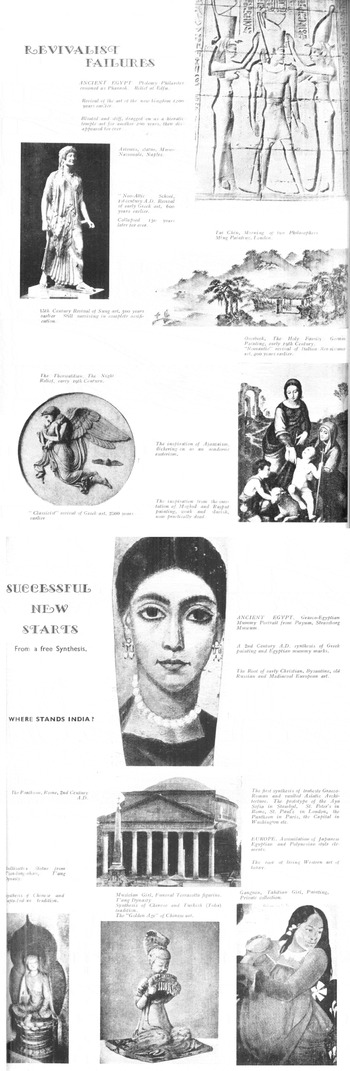
The first decades of MARG were marked by opinionated editorials, expressed in vehement, sometimes repetitive, prose that left no aspect of Indian art untouched. This had the virtue of making its message unequivocal. ‘A resurgence of nationalism is in evidence all over the East to-day (. . .) culturally it tends to be revivalist and decadent, more especially in the realm of the arts’; ‘it is obvious, for instance, that we cannot revive the past in the changed conditions of the present (. . .) we cannot and do not want to built a neo-Magadha or a neo-Mughal architecture’.Footnote 40 During the formative years, from 1946 to the early 1960s, the journal's dominant agenda was anti-revivalism in the arts. Examples of anti-revivalist statements are numerous and evenly spread throughout the period under discussion. One of the most effective examples is a chart inserted in Goetz's ‘Art: Whither Indian Art?’ which compares ‘revivalist failures’ with ‘successful new starts’ (see Figure 1): on the one hand, Ptolemy Philaretes crowned as Pharaoh, a relief at Edfu, a ‘revival of the art of the new kingdom 1200 years earlier’; Morning of two philosophers, a Ming painting by Tai Chin, described as a ‘15th century revival of Sunga art, 500 years earlier, still surviving in complete ossification’; ‘the inspiration of Ajantaism, flickering on as an academic esoterism’ and ‘the inspiration from the imitation of Moghul and Rajput painting, weak and slavish, now practically dead’.Footnote 41
(Above) ‘Revivalist Failures’; (Next page) ‘Successful New Starts’. Source: Reproduced in Goetz, H. (1947). ‘Art: Whither Indian Art?’, MARG, 2:1, pp. 64–65.

On the other hand, the opposite page featured ‘Successful new starts: from a free synthesis’: Graeco-Egyptian mummy portrait painting from Fayum, ‘a 2nd century A.D. synthesis of Greek painting and Egyptian mummy marks the root of early Christian, Byzantine, old Russian and mediaeval European art’; the Pantheon in Rome, defined as ‘the first synthesis of trabeste Graeco-Roman and vaulted Asiatic architecture, the prototype of the Aya Sofia in Istanbul, St Peter's in Rome, St Paul's in London, the Pantheon in Paris, the Capitol in Washington etc.’; a Bodhisattva statue from T'ien-lung-shan, Tang dynasty, called a ‘synthesis of Chinese and Gupta-Indian tradition’; and Paul Gauguin's Tahitian Girl.
Revivalism had framed numerous debates in the previous decades, from the discussion on the appropriate architecture for the building of New Delhi, after it became the capital of India in 1911, to the influence of Ajanta paintings on Bengal school artists.Footnote 42 ‘The Bengal Renaissance in the sense of cultural regeneration required its golden age in order to assuage a feeling of inadequacy,’ writes Partha Mitter. ‘Nothing boosted budding nationalism more than an appeal to the past.’Footnote 43 By the 1940s, though, Ajanta's influence in the visual arts had stultified. Already in the 1920s, when the artists of the Bengal school came to dominate the Indian art world, one of its most important exponents, Abanindranath Tagore, ‘suggested that revivalism became an unnatural obsession, so as to lose touch with reality, tolerating only a nostalgia for the past’.Footnote 44 By the 1940s leading artists, including those of the Progressive Artists’ Group, set themselves against Bengal school revivalism.
In architecture, the debate focused on the opposition between an Indian revivalist style and a modern international one. With independence, revivalist architecture initially seemed to impose itself.Footnote 45 Although modernist architects were already active in India, and especially in Bombay, where Art Deco architecture had flourished since the 1930s, it is really Le Corbusier's work in the 1950s, especially his design for Chandigarh, that opened a way for modernist architects, against the revivalist current.Footnote 46 From the start, however, MARG rejected the need to choose between seemingly antithetical modern and Indian architectures. It decried both a contrived modernism and revivalism: it mocked bad modernist buildings for their ‘streamlined structures’, ‘as though they were vehicles designed for moving at high speed—with odd shapes and curious curves and other extraneous features plagiarized from foreign architectural magazines’.Footnote 47 While revivalist examples were caricatured as ‘soulless piles of brick and stone where so-called “classical” features of Indian architecture have been indiscrimately [sic] plastered on the main elevation whilst the rear is a mass of sanitary pipes and services’.Footnote 48 The magazine put forward what it described as examples of successful architecture in articles on Frank Lloyd Wright and Le Corbusier, as well as on the Mughal period, to which it established a direct connection, as explained in the following section of this paper.
MARG championed a modern synthesis, which went hand in hand with the need to transcend anti-colonial nationalism, a bias deemed harmful for current artistic production. ‘With swaraj there has been a marked tendency to revive everything “Indian” and to exclude everything “foreign”, irrespective of the merits and demerits of the case’; ‘for by imposing their own nationalism on our country they created in us, through action and reaction, a kind of nationalism, which, however genuine in the political sphere has often led to a very unhealthy chauvinism in art matters’.Footnote 49 Here again examples of anti-parochialism abound, supported by European émigrés such as Leyden and Goetz, among others.Footnote 50 Indian independence was a turning point for Indian art: an obvious change in self-perception, it imposed on critics a new way of looking at the past.Footnote 51 It also changed the character of Indian print culture which, during the nationalist struggle, had called into being a variety of competing public spheres.Footnote 52 In this context, the journal's cosmopolitanism affirmed itself against what it described as a now-defunct, parochial nationalism. In the cosmopolitan context of 1940s and 1950s Bombay, it affirmed the necessity of measuring Indian art and architecture against that of other countries and vice-versa, instead of treating them in their own terms, whatever those might be. In its pages, MARG created a virtual international framework for the evaluation of Indian past and present art.
Self-criticism and self-improvement were advocated in the pages of the review. It set out to understand what it conceived of as the blatant absence (with individual exceptions such as Jamini Roy or Amrita Sher-Gil) of significant art movements in India since the Bengal school.Footnote 53 Colonialism was to blame, but whereas past generations had used nationalist rhetoric to counter the colonial grip on the writing of the history of Indian art and on its categorization, MARG deliberately sought to transcend it. It aimed at a true renaissance, fostered by radical innovations, an impulse that could only stem from positive developments, not from a reaction against past influences.Footnote 54 To this end a critical framework was set up in its pages ‘to create some values, critical tests or considerations, through which it may be possible to sift the really important artworks from the bad ones’.Footnote 55 This implied an opinionated art criticism that believed in the model value of past, brilliant chapters of Indian art history and in the faculty of contemporary artists and architects to match those: ‘And this, too, is certain, that once the inner direction has found its way and its implications have come to the surface, the result will be no mere Asiatic modification of Western modernism, but some great, new and original thing of the first import to the future of human civilization.’Footnote 56
Though the link between the Mughal period and contemporary art and architecture is not always explicit in the review, there is a surprising overlap between the language used to discuss the Mughal period and the values that are put forward in its contemporary art criticism: between the ‘synthesis’ of foreign and local styles achieved by the artists and architects of the Mughal period and the ‘synthesis’ of Indian and Western styles sought in contemporary production.Footnote 57MARG was not created from within an art movement and in fact decried most of the current artistic production. However, it did praise a small number of artists who were invited to design for the magazine, included in its contemporary art portfolios, and whose exhibitions were supportively reviewed. The members of the Progressives Artists’ Group, ‘bound to one another by the spirit of the medieval guilds’, were the artists MARG felt closest to.Footnote 58 Founded by Francis Newton Souza in 1947, the group included Syed Haider Raza, Krishnaji Howlaji Ara, Maqbool Fida Husain, Sadanand Bakre, and Hari Ambadas Gade. Its first exhibition was held in February 1949 in Baroda. In July it travelled to the Bombay Art Society and was inaugurated by Mulk Raj Anand. In the catalogue, Souza shunned ‘chauvinist ideas and leftist fanaticism which we had incorporated in our manifesto at the inception of the Group’. ‘We have no pretension of making any vapid revivals of any schools or movement in art,’ he continued. ‘We have studied the various schools of painting and sculpture to arrive at a vigorous synthesis.’Footnote 59 The group, which eventually dissolved in 1954 after several of its members left India, came closest to what MARG considered to be a true synthesis ‘between Indian feeling and the lessons of Western technique’.Footnote 60
Many art critics, and particularly those who had championed the Bengal school at the beginning of the century, did not, however, share this enthusiasm for the Progressive Artists’ Group. The art historian Orhendra Coomar Gangoly (1881–1974), who had defended the Bengal school artists, criticized several artists of the group in his review of the 1956 Venice Biennale.Footnote 61 What he attacked was the perceived un-Indianness of several paintings presented in the exhibition. On the contrary, for Goetz it was Souza, the rebellious leftist Christian Goan artist, who had spent time in prison and studied revolutionary Mexican art, who embodied the third way between European and ancient Indian art, which he evoked in ‘Art: Whither Indian Art?’.Footnote 62 A sign of Goetz's early support was that the Baroda Museum was the first institution to acquire the painter's work.Footnote 63 Judging from his appreciation of Mughal art and of the Progressive Artists’ Group, it is possible to set Goetz against Gangoly. While Goetz promoted a select number of ‘progressive’ contemporary artists and adopted an inclusive take on past artistic achievements (whether Rajput or Mughal), Gangoly, a critic of the older generation, was sympathetic toward the Bengal school and the Hindu revival, and reticent when it came to non-Bengali post-1947 art.Footnote 64 However, the writing of both Goetz and Gangoly was premised on a profound sense of inadequacy between past standards and present production, including that of the Progressive Artists’ Group.
The Mughal synthesis
The best examples of the synthesis advocated in MARG still belonged to the Indian past, and to the Mughal past in particular.Footnote 65 The Mughal legacy, especially that of the first Mughal rulers, was inspiring for the ideas that shaped its artistic innovations: a synthesis of cultures and styles (Hindu and Muslim, indigenous and foreign) which presented an example for the present generation. Implicit in this seemingly simplistic generalization is the concept of secularism. Key to Nehru's idea of the state and of state-society relations, it can be thought of in the Indian context as religious pluralism, combined with a rejection of obscurantism and superstition.Footnote 66 A debated concept in Indian political thought, it has been attached to the artistic output of the Mughal period by art historians and critics from the beginning of the twentieth century onwards with remarkable ease and consistency, despite its obvious anachronism. This has been so because of the sophisticated, urban cultural output of the Mughals, of Akbar's tolerant policies towards non-Muslims, and of his much discussed philosophical experiments (commonly known as din-i ilahi). In addition, after Partition, the validating presence for secular India of a large Muslim community seemed to reinforce this reading.
The Mughal synthesis can be linked to the more cogent notion of syncretism that held sway in the Nehruvian period. The rewriting of a syncretic past as a precursor to India's securalism was rooted in a powerful political rhetoric. In October 1955 Nehru delivered a speech on ‘Emotional integration’ in Bangalore in which he reminded his audience that ‘India is a strange land whose peculiar quality is absorption, synthesis. When this capacity for synthesis became less, then India became weak. India was weak for several hundred years because it had become a closed country which did not look outside.’Footnote 67 Another segment of the speech would serve as an epigraph to the 1962 Report of the Committee on Emotional Integration: ‘we should not become parochial, narrow-minded, provincial, communal and caste-minded, because we have a great mission to perform. (. . .) Political integration has already taken place to some extent, but what I am after is something much deeper than that—the emotional integration of the Indian people so that we might be welded into one, and made into one strong national unit, maintaining at the same time all our wonderful diversity.’ Footnote 68 This vision was embraced by Anand and MARG's regular contributors. For instance, in a letter to the editor of the Times of India Anand upheld the idea that a Ministry of Culture should be created that would ‘promote the spiritual and emotional integration of our country into the kind of nation state (. . .) that had been envisaged throughout the liberation struggle’. The ‘crisis in our culture,’ he continued, would be resolved by ‘encouraging a free flow of exchange between the various linguistic and cultural regions.’Footnote 69
The perception of a ‘composite culture’ nurtured, among others, by Mughal kingship was strongly relayed in MARG.Footnote 70 According to the review, the Mughals, under Akbar in particular, not only blended Hindu and Muslim influences, but never ‘[lost] the characteristics of their own style’ and therefore created an art that was genuinely Indian—a reading that contrasted with Orientalist interpretations of Mughal art that stressed its foreign character.Footnote 71 The model value of the Mughal period did not stand for a literal imitation of the Mughals, but for an understanding of the precedent they set, of their exemplary potential and, therefore, of the need to participate in the writing of the history of Mughal art. In one of its pivotal editorials, MARG affirmed that ‘what is required is a scientific outlook in our line of approach and our study of the glories of the past’.Footnote 72 This may first seem antithetical to the model value of the Mughal period, but only if it is conceived of as a formulaic restoration of Mughal style.
Tensions in Indian art, underpinning the will to articulate an Indian cultural identity with a purported universal and homogenizing modernity, have been attributed to India's ambiguous relation with modernity at large.Footnote 73 However, overplaying the apparent paradox between being Indian and being modern risks neglecting the very pragmatic and confident responses of artists, architects, and art critics of the 1940s and 1950s in their attempt to bridge these seemingly antagonistic options. ‘The relationship between “modernity” and “tradition” is not one of linear antagonism but of accommodation, suggestion and creation’ writes Humeira Iqtidar on the relationship between colonial secularism and Islamism.Footnote 74 In the context of Indian art criticism, the recourse to the Mughal exemplar can be understood as an instance of this adaptive process.
The Mughal empire was one of the most significant early modern states and a cornerstone of Indian history. Between 1526 and 1707 it dominated large parts of present-day India, Pakistan, Afghanistan, and Bangladesh. It brought stability to the subcontinent, co-opted local aristocrats, created an elaborate taxation system, designed magnificent cities and palaces, and established a complex network of artistic patronage. After the death of Emperor Aurangzeb in 1707 the Mughal empire entered a long period of decline which eventually ended in 1858 when the British crown took over from the East India Company. The reasons for this decline, long attributed to Aurangzeb's zealous religious policies, including the real and alleged destruction of Hindu temples, are the subject of ongoing historical debates with substantial political consequences for Indian society.Footnote 75
As a vast repertoire of themes, artistic styles, and techniques, the influence of the Mughal period remained a source of inspiration up to the twentieth century. ‘The memory of the Great [Mughal] Emperors,’ writes Christopher Bayly, ‘hung over north India in the eighteenth and nineteenth centuries as the name and institutions of Imperial Rome dominated Christendom in the European Middle Ages.’Footnote 76 Its courtly culture was recuperated, diluted, and transformed by rival and peripheral kingdoms and by the British who used Persian as their administrative language up to 1835, paid allegiance to the Mughal emperor, recycled Mughal architectural elements, and organized grandiose, Mughal-inspired displays of power.Footnote 77
The Mughal period has been the subject of highly politicized reinterpretations of its merits and flaws. Problematically rigidified into a Muslim period in the writing of Indian history, its continuing relevance in the twentieth century stems from the widespread use of the Mughal past to make sense of contemporary India, exaggerate or manipulate Hindu-Muslim divides, and, after Partition, an increased tendency to read back into history present-day divisions.Footnote 78 Reactions to the rich and malleable Mughal legacy have verged from hagiography to demonization, with many gradations of ambivalence in-between. At the heart of these debates were competing views on what the nation should be. Positive readings of the Mughal period were always in competition with other—sometimes sectarian—evaluations, ranging from the Muslim League's hostility towards Emperor Akbar, perceived as a heretic, to the Hindu nationalists’ fixation on the foreign origins of the Mughal emperors and on Aurangzeb.Footnote 79
The model value of the Mughal period circulated in MARG went beyond artistic concerns. It built on a good image of the Mughal past championed by the dominant set of Indian politicians and cultural protagonists of the period and can be read as a symptom of a wider sense of purpose of the Nehruvian generation. The 1942 celebration of the four hundredth anniversary of Emperor Akbar's birth was a testimony to the power of his myth. In this context, historian Jadunath Sarkar, like many others, explicitly referred to the model set by Akbar for present-day communal unity.Footnote 80 For Nehru as well, Akbar was the chief exponent of the synthesis of Hindu and Muslim cultures that had united India and shaped its architecture and language. ‘In a sense,’ he wrote, ‘he might be considered to be the father of Indian nationalism. At a time when there was little of nationality in the country and religion was a dividing factor, Akbar deliberately placed the ideal of a common Indian nationhood above the claims of separatist religion.’Footnote 81 In MARG too Akbar was set above all other rulers, Mughal or otherwise.Footnote 82
One category of articles that evoked the Mughal past concerned films. The Mughal historical film, epitomized by the grandiose Mughal-e-Azam (1960), was one of the dominant genres of the time. Yet it is the ‘documentary fiction’, a didactic genre that enabled the free juxtaposition of past and present, that received most attention in MARG. In Phani Majumdar's Andolan (1951), a film that traced the history of India from 1857—the year of the Indian mutiny, often read back as the beginning of Indian nationalism when the sepoys rallied around the last Mughal emperor—to 1947, ‘a dance montage had to be devised which could trace the time the Moghul ruled supreme’. ‘After all,’ the article explained, ‘the unified concept of India [was] broken with the cunning of the British, it was with the coming of the Congress that the idea was revived and the concept of the nation born.’Footnote 83 Another example is MARG's coverage of Zils’ Our India, a film based on the bestseller by Minocher Rustom Masani and starring Prithviraj Kapur and Durga Khote, illustrated by film shots of actors playing Akbar and his historian and counsellor Abu'l Fazl. The film also fused past and present by following the trajectory of the Indian peasant across centuries. ‘It appeared to me very important,’ wrote Zils, ‘to go back hundreds, rather thousands of years, to the dim dawn of civilization and underline the incidents of the past that had foreshadowed the present.’Footnote 84 As in Mughal historical films, Mughal rule was presented as an example of good governance, conceived of as a provider of equity and balance between people.Footnote 85 Generally, however, the exemplary reading of the Mughal period in MARG built on more historically rigorous endeavours of art historians who believed both in the model value of the Mughal period and in the importance of developing authoritative historical knowledge of it.
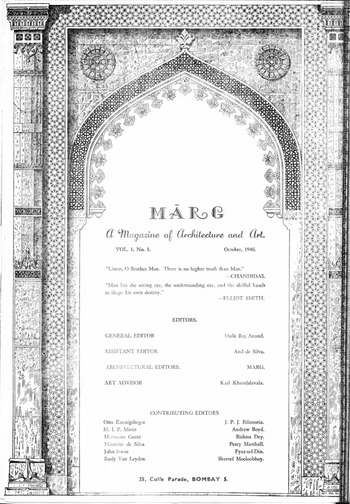
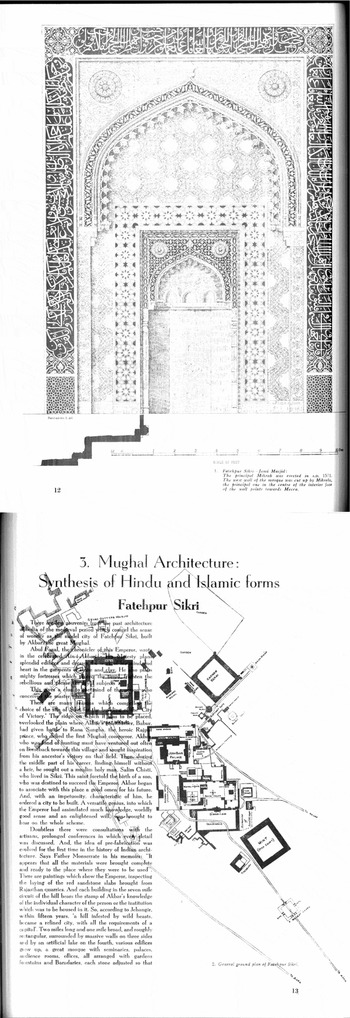
The first article to deal with the Mughal past was ‘Old Delhi’, published in the second issue of MARG, which presented the various incarnations of the city up to Shahjahanabad.Footnote 86 Many longer in-depth treatments would follow, including several special issues. The articles were written by a vast range of international experts: from John Irwin, assistant keeper of the India section of the Victoria and Albert Museum; Kenneth de Burgh Codrington, professor of Indian archaeology at the London School of Oriental and African Studies and former keeper of the India section at the Victoria and Albert Museum; and Basil Gray, keeper of the Department of Oriental Antiquities at the British Museum, to Charles Fabri, a Delhi-based Hungarian-born scholar and critic for The Statesman; Karl Khandalavala, Hermann Goetz, Percy Brown, and Mulk Raj Anand. Symbolic of the influence cast on MARG's contributors by the Mughal past was the presentation (until its fourth year of publishing) of its list of contributors under a detailed drawing of the entrance from the aisle to the southern chapel of Fatehpur Sikri's Jami Masjid, lifted from Edmund W. Smith's 1897 Portfolio of Indian Architectural Drawings (see Figures 2 and 3).
A list of MARG's editors and contributing editors. Source: Reproduced in MARG, 1:1 (1946).

The mihrab of Fatehpur Sikri's Jami Masjid, also from Edmund Smith's Portfolio. Source: Reproduced in ‘Mughal Architecture: Synthesis of Hindu and Islamic Forms, Fatehpur Sikri’, MARG, 11:3 (1958), pp. 12–13.

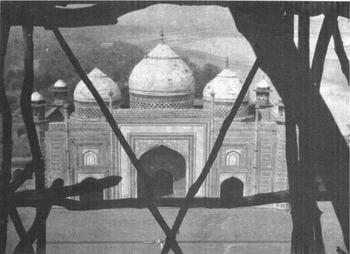
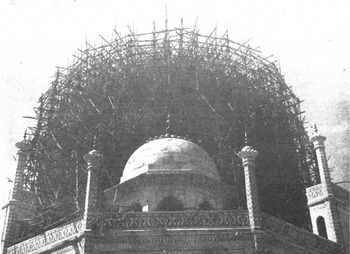
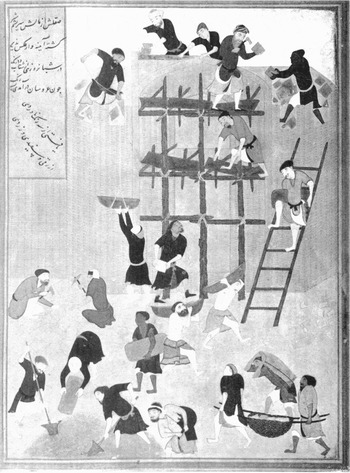
Nevertheless, however exalting the rhetoric surrounding the Mughal period may have been, in its formative years MARG refused to romanticize its legacy. This comes across most forcefully in a series of black-and-white photographs that accompany a text on the Taj Mahal by Aldous Huxley (see Figures 4 and 5).Footnote 87 Set against Huxley's critical appreciation of the building—an excerpt taken from Jesting Pilate (1926)—are anonymous, narrowly cropped photographs of workmen suspended on bamboo-pole scaffoldings, toiling away at the building. The undated photographs were most probably taken during the Second World War when the dome of the Taj Mahal was protected by scaffolding. Instead of majestic, frontal views of the Taj Mahal, the mausoleum and its adjacent buildings are framed through the intricate bamboo poles—only one conventional photograph is reproduced at the end of the article. The series thus forms a modern equivalent to miniature paintings of builders reproduced in MARG (see Figure 6).
‘The mosque attached to the Taj Mahal seen through the scaffolding’. Source: Reproduced in Huxley, A. (1950). ‘Aldous Huxley on the Taj Mahal’, MARG, 4:2, p. 16.

‘The scaffolded dome of the Taj Mahal’. Source: Reproduced in Huxley, A. (1950). ‘Aldous Huxley on the Taj Mahal’, MARG, 4:2, p. 17.

‘The building of a mosque (from a manuscript of Nizami by Bihzad, AD 1494)’. Source: Reproduced in the special issue ‘Early Mughal Art’, MARG, 11:3 (1958), p. 35.

The extensive foreword gives away MARG's intentions: to exhort readers to embrace modern architecture, its material, steel, and concrete, and the substantial building programmes undertaken in those years. Anand's later correspondence with R. Nath in preparation for his contribution to MARG's special issue on the Taj Mahal further explains his misgivings regarding the building, or rather its romantic glorification.Footnote 88 The attention he paid to the Mughal built legacy lay elsewhere: in the radical innovation it represented for its time and in the political will and manpower necessary for such achievements.
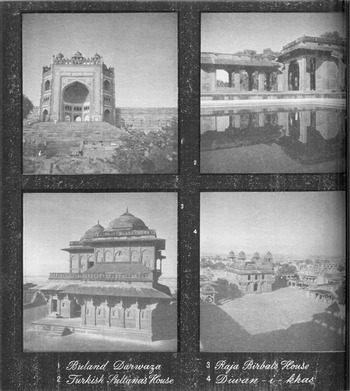
In its second year MARG published a two-part article on Fatehpur Sikri.Footnote 89 The first part, a historical note, was illustrated with colour and black-and-white photographs by Sunil Janah (see Figure 7). The second part presented Fatehpur Sikri as the epitome of Mughal synthesis. Fatehpur Sikri, the planned city built by Akbar, which served as the Mughal capital in the 1570s and early 1580s, with its characteristic blend of Hindu and Muslim architectural elements, was the place where the emperor, in a time of relative peace, had experimented with religious and philosophical ideas and where artistic patronage had flourished.Footnote 90 It thus came to embody Akbar's enlightened policies. In MARG Fatehpur Sikri was consistently presented as the direct precedent for Chandigarh, India's most ambitious post-independence architectural project.Footnote 91 To this pair was added Jaipur, India's second major planned city. Illustrated with photographs by Cartier-Bresson and Hunnar, Durga Bajpai's article (published the following year) presented Jaipur as a model city built by Maharaja Jai Singh, a man interested in science, technology, and the arts, and a Rajput equivalent to Akbar. In the orbit of Mughal power for the past two centuries, and highly influenced by its court culture, modern Jaipur was established in 1728 after the death of Aurangzeb. Articles on the Indian planned cities fitted a larger programme: to learn from India's past but also, in doing so, to realign India's ‘Renaissance’ with a set of references and a genealogy of Indian kingship that had been bypassed by the Hindu revival started in Bengal.Footnote 92 For MARG perceived Indian culture as a hybrid: a ‘composite culture’ that relied on a ‘mix of influences’, a reality that ‘tends to upset the narrow, chauvinist sense of nationalism of our leadership at a moment when they are genuinely seeking to knit together India into a nation’.Footnote 93 In line with this reading, the Mughal period was also believed to be the only pre-modern period to have produced a secular artistic output, which made it a natural precursor to post-1947 art.Footnote 94
Photographs of Fatehpur Sikri by Sunil Janah. Source: Reproduced in ‘Fatehpur Sikri, Introductory; Historical Note’, MARG, 2:3 (1948), p. 16. © Sunil Janah, 2011.

In MARG Mughal art and architecture was read as a perfect expression of the society of its time.Footnote 95 This was used to underline the discrepancy between India's present—mainly disappointing—artistic achievements, and its current, decisive political stage. Later diffusions and imitations of the Mughal architectural style were described as ‘the work of epigones’, in line with MARG's anti-revivalist agenda. But, ‘even those two last centuries following the moment when the zenith of Mughal art was reached in the Taj Mahal, have not simply been a period of decadence as their art had always been the true and appropriate expression of the contemporary society and ideals’.Footnote 96 Therefore it was the Mughal legacy as a whole that was salvaged as a true reflection of its time. It was not only Akbar's legacy that was deemed valuable, even Aurangzeb's controversial policies towards Hindus were integrated within a broader narrative of decline.Footnote 97 While MARG could not completely do away with the idea of decadence, the decay of Indian art was attributed to multiple causes—including an overplay of decorative motifs started under Shah Jahan; the dilution of the Mughal style in peripheral kingdoms, from the end of Jehangir's rule and especially in the eighteenth century; and the later imitation of Western art practices—rather than exclusively to Aurangzeb's attitude.Footnote 98 An article by Goetz in MARG's special issue on later Mughal art even praised Aurangzeb's son's often-decried Bibi ka Rauza, a mausoleum built in homage to his mother during Aurangzeb's reign and a pale copy of the Taj Mahal. It further stated that ‘though people may disagree, the second half of the 17th century, no doubt, represents the zenith of the political and cultural development initiated a century earlier by the great Akbar’.Footnote 99
To link the evolution of art with that of its society was an art history commonplace. In the past Havell had sought to turn away from the literal application of Western classical criteria and present ‘Indian’ (i.e. Hindu) art as the visual embodiment of Indian philosophy.Footnote 100MARG, by contrast rejected the overly spiritual interpretation of Indian art, but it retained the term ‘Indian’, retrospectively projected on the Mughal cultural synthesis. Future art and architecture had to be inclusive, but ‘Indian’ above all. As in the case of Havell, what this meant in positive terms was not clear, as shown by the frequent use of the vague term ‘synthesis’, to which it was often adjoined. Specifically, it was never fleshed out what sort of judicious mix of external influences and self-styled Indianness would bring out a worthy contemporary art practice.
Conclusion
In an editorial published in December 1963, Anand decried the fact that MARG's programme had not materialized into a sustained artistic output and criticized the narrow-mindedness of the Indian intelligentsia:
The cliche used by the people, who understand neither the Manasara, nor Leonardo nor Frank Lloyd Wright, is that we in India are not Indians anymore but prefer the ‘international’ style. Perhaps, there is an element of truth in this vague charge. Certainly, however, we are not wasting money on domes, (which look more and more like sola hats), Pathan turrets and Mughal cupolas a la Sir Edward Lutyens the builder of the pompous British Imperial style. We are frankly, self-consciously, modernist who follow Tagore when he said: ‘I strongly urge our artists vehemently to deny their obligation carefully to produce something that can be labelled as Indian art according to some old world mannerism. Let them proudly refuse to be herded into a pen like branded beasts, that are treated as cattle and not as cows.’ Footnote 101
The editorial did cite architects who had followed the ‘synthesis’ so strongly advocated in the review, but the continued imbalance between present production and past glory marked the end of the optimistic period. From the mid-1950s MARG gradually opted for a thematic approach, and by the 1960s it dedicated each issue and its editorial to a more narrowly focused topic and stopped publishing regular exhibition reviews and portfolios of contemporary artists. Specific media, styles, and periods would now be treated independently. Its writers never lost touch with the art world of the time: Anand served as chairman of the Lalit Kala Akademi from 1965 to 1970 and MARG's list of contributors remained authoritative. However, by the mid-1960s European critics who had held prominent positions in the Indian art world had left India and the Progressive Artists’ Group had dissolved. As we have seen, the journal's Mughal-inspired synthesis was never defined in empirical terms. The distinction between the historical catalyst and straightforward imitation would lead to still-unresolved tensions.Footnote 102
With the death of Nehru in 1964 and the rise of a very different set of politicians, the character of Indian politics changed. In a context of increased communal politics, party feuds, and inter-religious quarrels, a vast array of cultural and historical symbols, some Mughal but many not, were deployed in a piecemeal, expedient way to invoke and legitimize power, or sap that of the other. The synthetic rhetoric stuck to the Mughal artistic legacy even after it lost its grip on the Indian political imagination. For this reason, it was also less suited for communal or religious mobilization.
It is telling that the emblematic story of the Mughal past would end in the 1960s, a decade that marked a turning point in Indian art. From the late 1960s, the idea that Indian art should bridge a Western-born modernism with concerns specific to the Indian context was deemed irrelevant. Many Indian artists who had gone abroad to study in Paris, London or New York returned to India, but this experience was often used as a negative counterpoint. In the Cold War context, a new generation of artists and critics from the Maharaja Sayajirao University of Baroda defined themselves against the modernism of the Progressive Artists’ Group. They claimed that a truly Indian painting could only be figurative, in contrast to Western abstract painting, and sought to align themselves with cultural movements of other non-aligned countries.Footnote 103 At the same time, in Tamil Nadu, artist Jagdish Swaminathan tried to reconcile Indian folk and contemporary art. These opinions were expressed in magazines addressed to a small circle of artists, such as Contra 66 and Vrishchik. The influence of Mughal miniatures in artistic creation was still felt, for example in the rejection of single-point perspective, but the idea of a ‘synthesis’ of foreign and indigenous styles and ideas was dismissed by leading theorists.
In 1968 the first Triennale India, organized by the Lalit Kala Akademi and its chairman Mulk Raj Anand, brought together the artistic creation of Third World countries with that of Western and socialist ones.Footnote 104 Modelled on the São Paulo, Paris, and Venice biennials, the exhibition featured several hundred artworks from over 30 countries. Its international artists included Jackson Pollock, Howard Hodgkin, Donald Judd, and Robert Morris. Despite the high standard of works, the exhibition was criticized for its internationalism, as well as for the selection criteria of its India section. Though in practice, opposition to the Triennales and the Lalit Kala Akademi was far less systematic than it may seem, the reception of the first Triennales brings out a theoretical apparatus that developed in the late 1960s against Western modernism as formulated by critics such as Clement Greenberg.Footnote 105 Reinforced by post-colonial theory, this oppositional outlook still inflects the analysis of Indian modern and contemporary art and misapprehends the strategic positioning of much of the late 1960s–1970s Indian art world by neglecting its global ramifications. It has also undermined the key function of foreign art historians in the history of twentieth-century Indian art, the often-international careers of Indian artists, and the role played by India—albeit the exoticized idea of India—in the development of foreign artistic imaginations and practices.Footnote 106 New perspectives on the much-discussed issue of Indian artistic modernity may lie in placing its output within its current and historical international contexts, their specific political and cultural dynamics, and in interrogating its relations to the foundational myths of India.