Introduction
There is a consistent body of research showing that exposure to combat is associated with an increased risk of post-deployment psychiatric injury (Kulka et al. Reference Kulka, Schlenger, Fairbank, Hough, Jordan, Marmar and Weiss1990; Lee et al. Reference Lee, Vaillant, Torrey and Elder1995). After the recent conflict in Iraq, high rates of post-traumatic stress disorder (PTSD) have been reported in US combat troops (Hoge et al. Reference Hoge, Auchterlonie and Milliken2006). UK personnel returning from Iraq have a lower prevalence of PTSD than their US counterparts but there is a clear association between combat role and increased risk of PTSD (Hotopf et al. Reference Hotopf, Hull, Fear, Browne, Horn, Iversen, Jones, Murphy, Bland, Earnshaw, Greenberg, Hacker Hughes, Tate, Dandeker, Rona and Wessely2006). PTSD is a major concern to the military because of the considerable disability and co-morbidity associated with the disorder (Zatzick et al. Reference Zatzick, Marmar, Weiss, Browner, Metzler, Golding, Stewart, Schlenger and Wells1997; Kessler, Reference Kessler2000), which have implications for the individual affected, for the employer, and for society in general. More research is needed to understand modifiable factors in the military environment that reduce the risk of PTSD.
The introduction of the diagnostic category of PTSD in 1980 stated that war trauma alone was a sufficient cause of long-term disorder (APA, 1980). Like its predecessors, that view was too absolute, and since 1980 there has been a gradual re-exploration of the importance of individual factors associated with PTSD. Meta-analyses have identified several risk factors for PTSD in both the military and the general population.
In terms of pre-trauma vulnerability factors, Brewin et al. (Reference Brewin, Andrews and Valentine2000) have identified factors such as previous psychiatric history, early childhood adversity and a family history of mental illness as independent risk factors for PTSD. Other individual factors such as low education, previous trauma, female gender, ethnic minority status and younger age have also been shown to be associated with PTSD in both the military (Riddle et al. Reference Riddle, Smith, Smith, Corbeil, Engel, Wells, Hoge, Adkins, Zamorski and Blazer2007) and the general population (Brewin et al. Reference Brewin, Andrews and Valentine2000; Ozer et al. Reference Ozer, Best, Lipsey and Weiss2003). Several authors report that degree of exposure to potentially traumatic events and severity of trauma are associated with risk of PTSD (Brewin et al. Reference Brewin, Andrews and Valentine2000; Hoge et al. Reference Hoge, Castro, Messer, McGurk, Cotting and Koffman2004). Objective degree of trauma exposure may, however, be less predictive of PTSD than the individuals' appraisals of the trauma and its aftermath (Ehlers & Clark, Reference Ehlers and Clark2000). Such appraisals have been shown to predict PTSD over and above objective trauma severity (Halligan et al. Reference Halligan, Michael, Clark and Ehlers2003) and perceived threat to life during trauma is among the best established predictors of PTSD (Ozer et al. Reference Ozer, Best, Lipsey and Weiss2003). There is also evidence to suggest that an individual's sense of unpredictability and uncontrollability during a traumatic situation increases the risk of PTSD (Basoglu et al. Reference Basoglu, Livanou, Crnobaric, Franciskovic, Suljic, Duric and Vranesic2005, Reference Basoglu, Livanou and Crnobaric2007). Conversely, a sense of preparedness in political torture victims is related to less perceived distress during torture and less severe psychological sequelae afterwards (Basoglu et al. Reference Basoglu, Mineka, Paker, Aker, Livanou and Gok1997).
The recovery environment after trauma exposure may act as a protective factor. Social support is associated with lower PTSD risk in the general population (Brewin et al. Reference Brewin, Andrews and Valentine2000; Ozer et al. Reference Ozer, Best, Lipsey and Weiss2003) and military settings (Green & Berlin, Reference Green and Berlin1987; Solomon et al. Reference Solomon, Mikulincer and Avitzur1988; Green et al. Reference Green, Grace, Lindy, Gleser and Leonard1990; Solomon et al. Reference Solomon, Mikulincer and Habershaim1990, Reference Solomon, Margalit, Waysman and Bleich1991; Sutker et al. Reference Sutker, Davis, Uddo and Ditta1995; King et al. Reference King, King, Fairbank, Keane and Adams1998; Neria et al. Reference Neria, Solomon and Dekel1998), as well as in non-military occupational settings such as the police (Carlier et al. Reference Carlier, Lamberts and Gersons1997).
In this study we used a large, randomly selected, military cohort to examine systematically the factors that are associated with PTSD in the UK Armed Forces. We investigated the relationship between PTSD and pre-trauma vulnerability factors (such as childhood adversity), objective deployment variables (such as number of potentially traumatic events to self and others) and their subjective appraisals (such as perceived threat to life), and home-coming experiences. We were especially interested in the role of organizational factors specific to the military, including what impact group-cohesiveness and morale within the unit, the receipt of a home-coming brief and the practice of ‘decompression’ (time spent in base location before discharge) have on the risk of PTSD.
Method
Study design and sample
The method has been described in a previous paper (Hotopf et al. Reference Hotopf, Hull, Fear, Browne, Horn, Iversen, Jones, Murphy, Bland, Earnshaw, Greenberg, Hacker Hughes, Tate, Dandeker, Rona and Wessely2006). In brief, the study is the first wave of a retrospective cohort study comparing UK military personnel who were deployed on the first phase of the Iraq War between 18 January and 28 April 2003 with personnel serving in the Armed Forces on 31 March 2003 but not deployed at this time (the ‘Era’ cohort). Sampling was stratified by Service (Naval Services, Army and Royal Air Force) and enlistment status (regulars and reservists), with reservists being oversampled by a ratio of 2:1. Because we have previously shown an interaction between reservist status and deployment (Hotopf et al. Reference Hotopf, Hull, Fear, Browne, Horn, Iversen, Jones, Murphy, Bland, Earnshaw, Greenberg, Hacker Hughes, Tate, Dandeker, Rona and Wessely2006), explored in greater depth in a subsequent paper (Browne et al. Reference Browne, Hull, Horn, Murphy, Fear, Greenberg, French, Rona, Wessely and Hotopf2006), we limited the present analyses to regular personnel. Furthermore, as deployment to Iraq was the focus of interest for the present paper, we have excluded those from the ‘Era’ cohort who did not deploy to Iraq on any of the subsequent roulements since 28 April 2003.
Data collection and follow-up
Participants were approached, irrespective of whether or not they had left the Armed Forces, either by a postal questionnaire or, where feasible, with visits to over 80 military bases. A range of approaches including three mailings and multiple base visits were used to follow up non-participants (see Hotopf et al. Reference Hotopf, Hull, Fear, Browne, Horn, Iversen, Jones, Murphy, Bland, Earnshaw, Greenberg, Hacker Hughes, Tate, Dandeker, Rona and Wessely2006 for full details). The final participation rate was 61%, with younger, lower rank and male Service personnel being least likely to respond.
Variables
Participants were sent a detailed 26-page questionnaire booklet. This included information that participation in the survey was voluntary, and that the research was being conducted independently of the UK Ministry of Defence. For the ‘Era’ cohort, the participant was asked to complete the questionnaire for their most recent deployment, thus it was possible to gain information on deployment experiences for individuals who had served on later Iraq deployments.
For the purposes of the present paper, we focus mainly on variables collected that cover experiences on deployment; experiences following deployment, information on current health; and background information, including past medical history and adversity in childhood. Questions about experiences on deployment included information on the individual's main duty in theatre, which is classified as combat (e.g. armour, infantry and artillery), combat support (e.g. signals, engineering) and combat service support (e.g. medical, administrative and logistic). Participants were asked how long they had served in a ‘forward’ area in close contact with the enemy. They were then asked about a series of potentially traumatic experiences; for example, discharging their weapon in direct combat, handling bodies, aiding the wounded and seeing personnel wounded or killed, experiencing landmine attacks, coming under mortar or artillery fire, or experiencing hostility from civilians. Two questions aimed at assessing appraisals that may increase the risk of PTSD were included: ‘thinking that I might be killed’ (perceived threat to life) and ‘work in theatre matched my trade and experiences’ (perceived preparedness). We classified the trauma variables into three groups of experience: (1) high risk to self events (e.g. coming under small arm fire); (2) trauma to others events (e.g. aiding wounded, or handling bodies) and (3) appraisal of deployment experiences (perceived preparedness and perceived threat to life).
Participants were also asked a series of questions about morale and the level of support and sense of comradeship they experienced within their unit. These were adapted from the US Deployment Experiences Survey (2002) and included statements such as ‘I felt a sense of comradeship (or closeness) between myself and other people in my unit’, which were endorsed on a Likert scale. Relevant items post-deployment included whether the individual spent time in barracks after returning from deployment before going home (known as decompression), whether they received a home-coming brief, and a number of questions related to the end of deployment, including feeling proud of the contribution made while deployed.
Finally, a series of questions was included about experiences in childhood. These have been described in depth in another paper (Iversen et al. Reference Iversen, Fear, Hull, Greenberg, Jones, Browne, Murphy, Hotopf, Rona and Wessely2007) but consist of 16 questions with the stem: ‘when I was growing up … ’. Participants were given a choice of answering true or false to each item. Care was taken to include both protective and adverse experiences in childhood, with examples including: coming from a close family, playing truant from school, or being hit by parents or caregivers regularly. For the purposes of this study we used a composite score of adverse childhood events with higher scores indicating greater adversity (items were reverse scored as appropriate).
Symptoms of PTSD were measured using the 17-item National Center for PTSD Checklist (PCL; Blanchard et al. Reference Blanchard, Jones, Buckley and Forneros1996). We defined cases on the PCL as scoring positive if the total score was ⩾50 (Weathers et al. Reference Weathers, Litz, Herman, Huska and Keane1993). This cut-off was chosen because it is the standard cut-off for this scale, and also because we have used a cut-off of 50 in our previous large-scale UK military studies, allowing direct comparison with data from previous conflicts. For brevity's sake, we refer in the remainder of this article to those who score above this threshold as having PTSD, while acknowledging that a proportion of such cases would not have met criteria for the diagnosis in a semi-structured clinical interview. We used a slightly different definition of PCL ‘caseness’ compared to that used in the main previous US study of Iraq veterans (Hoge et al. Reference Hoge, Castro, Messer, McGurk, Cotting and Koffman2004), which required a score of >50, that the participant scored moderate or above on one of the re-experiencing symptoms, three avoidance symptoms, and two hyperarousal symptoms. We have analysed the main findings of our cohort study using both our own UK definition of PCL ‘caseness’ and the US version of PCL ‘caseness’ described above, and there were no significant differences in our results between these two approaches (Hotopf et al. Reference Hotopf, Hull, Fear, Browne, Horn, Iversen, Jones, Murphy, Bland, Earnshaw, Greenberg, Hacker Hughes, Tate, Dandeker, Rona and Wessely2006).
Statistical analyses
Analyses were performed in Stata 9 (Stata Corporation, College Station, TX, USA). The analysis presented compares individuals who score above the threshold of 50 on the PCL with individuals who score below the threshold (controls). The relative distribution of independent variables (sociodemographic, trauma, morale and childhood) between PCL cases and controls are expressed as percentages and odds ratios with 95% confidence intervals, derived from logistic regression analysis. Multivariate models controlled for known confounders and other exposures. Model adequacy was tested using a specification test (linktest command in Stata) and a goodness of fit using the Hosmer–Lemeshow test. Where these indicated that the logistic model did not provide an adequate description of the data, we performed further analyses, including quadratic and cubic terms for continuous variables in the models. As there were a large number of potential exposure variables, we simplified some by using principal components analysis and deriving factor loadings.
Results
The final sample consisted of the 4762 individuals who responded to our survey, were regulars, and had served in any Iraq War deployment.
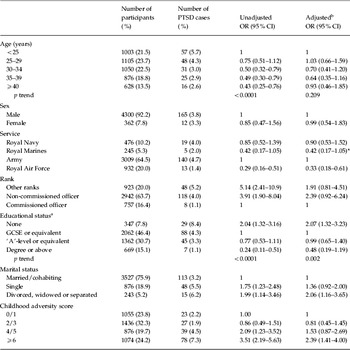
Sociodemographic characteristics and pre-enlistment vulnerability are described in Table 1. This shows strong associations between PTSD and younger age, low rank, low educational attainment, and not being in a relationship. There is also an association between PTSD and Service, with those in the Royal Navy and Army experiencing greater symptoms than those in the Royal Air Force. The Royal Marine Commandos (elite Naval Service combat troops) had a relatively low prevalence of PTSD. There was no gender difference in the distribution of PTSD. There is a strong association between total adverse childhood experiences and PTSD. In the multivariable model there remained relatively powerful effects of Service, educational status, marital status, and childhood adversity.
Pre-deployment: distribution of participants and PTSD cases by sociodemographic variables and childhood adversity

PTSD, Post-traumatic stress disorder; OR, odds ratio; CI, confidence interval.
a GCSEs are examinations usually taken at age 16. A-levels are usually taken at age 18 and are required for entry to university.
b Model adjusts for all variables in table simultaneously except for childhood adversity. Childhood adversity is adjusted for age (continuous), sex, rank, educational status, Service, and marital status.
* p=0.063.
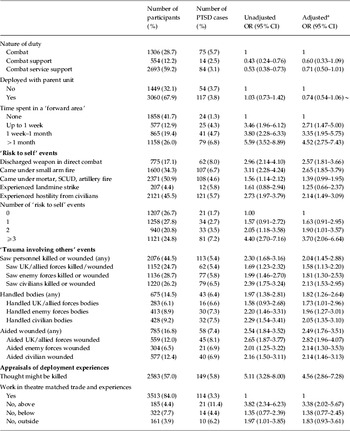
Table 2 describes deployment experiences in Iraq, potentially traumatic events, and appraisal of events. Deploying in a combat role was associated with PTSD, as was deploying to a forward area in contact with the enemy. Potentially traumatic experiences that involved threat to the self or others were related to PTSD, with odds ratios ranging from 1.6 to 3.1 and all but four being statistically significant. There was little discernable difference in the strength of ‘risk to self’ as opposed to ‘trauma to others’ events. There was a dose–response effect with ‘increased time in a forward area’ and increased ‘risk to self’ events being associ-ated with higher odds of PTSD. The multivariable analysis made little difference to these associations. Perceived threat to life and ill-preparedness for the experiences during deployment were strongly related to PTSD, with odds ratios of 5.1 and 3.8.
During deployment: experiences during deployment and their association with PTSD

PTSD, Post-traumatic stress disorder; OR, odds ratio; CI, confidence interval.
a Adjusted for age (continuous), sex, rank, educational status, Service, marital status.
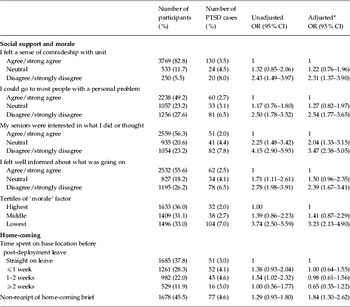
Table 3 describes the associations between variables relating to perceived social support and morale during deployment, home-coming experiences and PTSD. For each morale variable, there is a relatively strong association with PTSD, and the single factor generated from principal components analysis showed a strong dose–response relationship with PTSD, which was not greatly altered by controlling for demographic variables. There was an association between non-receipt of a home-coming brief and PTSD, with those who did not receive it having more PTSD symptoms. There was no association between PTSD and spending time at a military base before being granted leave, so-called ‘decompression’. Individuals who reported going home to their families directly after deployment were found to have the same prevalence of PTSD as those who stayed on bases.
Post-deployment: social support and morale on deployment, home-coming experiences and their association with PTSD

PTSD, Post-traumatic stress disorder; OR, odds ratio; CI, confidence interval.
a Adjusted for age (continuous), sex, rank, educational status, Service, marital status.
We derived an interaction term to determine whether any specific groups would be at increased risk from being in a forward area for a prolonged period of time. Because of the risk of type 1 error from testing multiple interactions we limited the analyses to three interaction terms (rank, morale and childhood adversity by time in forward area). No statistically significant interaction was detected for morale and childhood adversity, but a statistically significant interaction was found between rank and duration of time in a forward area, those from lower ranks having a greater risk of PTSD if in a forward area for a prolonged time compared with commissioned officers (χ2=11.9, 2 df, p=0.003).
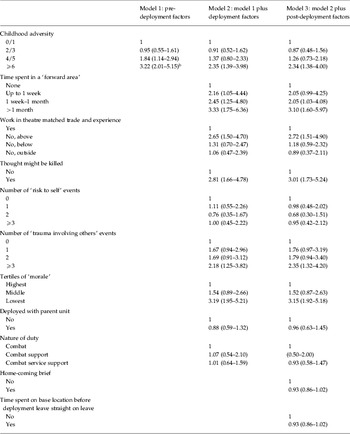
Table 4 shows a series of models involving pre-deployment, deployment and post-deployment variables. A single hierarchical regression analysis involving three models is presented. Pre-deployment variables were entered in model 1, deployment variables in model 2, and post-trauma variables (home-coming experiences) in model 3. Because of the presence of a statistically significant interaction with rank and time spent in a forward area, we present the results of this analysis excluding officers. The full model shows that the following variables are independently associated with PTSD symptoms: spending longer in a forward area; perceiving one's work to be above one's trade and experience; perceiving that one might be killed; witnessing trauma to others; experiencing low morale on deployment; and having more adverse experiences in childhood. It is noteworthy that the effect of experiencing specific events that placed the individual at risk was no longer associated in the full model. This variable was strongly correlated with time in a forward area (p<0.001); however, there was no effect for self-risk events even when time in a forward area was omitted from the model (data not shown).
Full modelFootnote a: Sequential multiple regression including pre-deployment variables (model 1), deployment variables (model 2) and post-deployment variables (model 3)

Values are given as odds ratios (95% confidence intervals).
Model 1 is adjusted for age, sex, rank, service arm, education, and marital status.
Model 2 is adjusted for model 1 plus all variables in model 2.
Model 3 is adjusted for model 1, model 2, and all variables in model 3.
a Officers were excluded because of the presence of statistically significant interaction.
b These estimates are different from those presented in Table 1 because officers were excluded from the analysis.
Discussion
The principal findings are as follows. PTSD is more frequent in those of lower rank, who are single or separated/divorced, have lower educational attainment and a history of childhood adversity. An individual's appraisal of their deployment experiences, both in terms of perceived threat to life (might have been killed) and in terms of not being prepared for the work in theatre (work above trade and experience), showed particularly strong associations, with odds ratios of 4.56 and 3.38 respectively. In terms of post-deployment experiences, low morale, perceived disinterest by superiors and non-receipt of a home-coming brief were all associated with PTSD. When all variables were considered together in one model, childhood adversity, time spent in forward area, low perceived preparedness for work in theatre, perceived threat to life, number of traumas involving others, and low morale remained significant predictors.
The demographic associations reported here are consistent with previous research in the general population. Brewin et al. (Reference Brewin, Andrews and Valentine2000) have previously shown that lower educational attainment is associated with PTSD. In the military, a recent large epidemiological study in the USA has indicated that a range of mental health problems including PTSD are more common in female, younger, less educated, single, white, short-term service, lower rank, Army personnel (Riddle et al. Reference Riddle, Smith, Smith, Corbeil, Engel, Wells, Hoge, Adkins, Zamorski and Blazer2007). In keeping with our previous studies we found no additional risk of PTSD in females in the Armed Forces (Rona et al. Reference Rona, Fear, Hull and Wessely2007), in contrast to the US military studies (Adler et al. Reference Adler, Huffman, Bliese and Castro2005; Riddle et al. Reference Riddle, Smith, Smith, Corbeil, Engel, Wells, Hoge, Adkins, Zamorski and Blazer2007). This may be because females in the US military are more likely to be engaged in front-line duties than their UK counterparts.
The association of childhood adversity with PTSD has been reported in both of the large meta-analyses of PTSD (Brewin et al. Reference Brewin, Andrews and Valentine2000; Ozer et al. Reference Ozer, Best, Lipsey and Weiss2003), and is also described in both the UK (Iversen et al. Reference Iversen, Fear, Hull, Greenberg, Jones, Browne, Murphy, Hotopf, Rona and Wessely2007) and the US military population (Bremner et al. Reference Bremner, Southwick, Johnson, Yehuda and Charney1993; Cabrera et al. Reference Cabrera, Hoge, Bliese, Castro and Messer2007). This may be explained by psychosocial (Koenen et al. Reference Koenen, Moffitt, Poulton, Martin and Caspi2007), genetic (Koenen et al. Reference Koenen, Lyons, Goldberg, Simpson, Williams, Toomey, Eisen, True, Cloitre, Wolfe and Tsuang2003) and neurobiological mechanisms (De Bellis et al. Reference De Bellis, Baum, Birmaher, Keshavan, Eccard, Boring, Jenkins and Ryan1999). New traumatic experiences may also reactivate earlier memories of childhood trauma. Previous work suggests that early adversity may predispose an individual to PTSD by a ‘double-hit’; not only are they more likely to get PTSD with any given traumatic exposure but they are also more likely to be exposed to trauma in a combat situation (King et al. Reference King, King, Foy and Gudanowski1996).
In common with published meta-analyses (Brewin et al. Reference Brewin, Andrews and Valentine2000; Ozer et al. Reference Ozer, Best, Lipsey and Weiss2003), in the full model, peri-trauma variables emerge as more important than the individual pre-trauma variables discussed above. Time spent in a forward area has an important association with PTSD in our study; more important than having a combat role. It may be that being in a forward area increases the risk of PTSD by biological (e.g. exhaustion, sleep deprivation) and psychological (e.g. high states of vigilance) mechanisms. The effect of time spent in a forward area is more marked for lower ranks than for officers. We have reported previously that elite forces (paratroopers) have low rates of PTSD (Hacker Hughes et al. Reference Hacker Hughes, Cameron, Eldridge, Devon, Wessely and Greenberg2005). This is probably because both officers and members of elite forces are in general more experienced combatants with higher levels of group cohesion, fitness and general motivation. There may also be a differential selection process: officers who are having difficulty coping are taken away from the front line more promptly than other ranks. It is important to note that we use a self-report of ‘time in forward area’ without further qualifying our definition of what that meant. It may be that what we are measuring here is appraisal of risk in a combat situation.
As in the meta-analysis of Ozer et al. (Reference Ozer, Best, Lipsey and Weiss2003), perceived threat to life emerged as one of the most important predictors of PTSD. When perceived threat to life and number of risk to self events were considered together in the full model, only threat to life remained significant. This is in line with earlier research suggesting that subjective appraisals of threat are more important for the development and maintenance of PTSD than objective trauma severity (Dunmore et al. Reference Dunmore, Clark and Ehlers1999; Ehlers & Clark, Reference Ehlers and Clark2000; Halligan et al. Reference Halligan, Michael, Clark and Ehlers2003); and with findings from other studies of war, torture, and natural disaster survivors (Basoglu et al. Reference Basoglu, Mineka, Paker, Aker, Livanou and Gok1997, Reference Basoglu, Livanou, Crnobaric, Franciskovic, Suljic, Duric and Vranesic2005, Reference Basoglu, Livanou and Crnobaric2007). A further important psychological dimension appears to be perceived loss of control during the trauma and in its aftermath. Low perceived preparedness, as indicated by the perception that work in the theatre was above one's experience, was associated with greater risk of PTSD. This may be because feeling unprepared in this way is associated with a sense of loss of control or a perceived threat to one's autonomy at the time of trauma. Both responses are associated with higher rates of PTSD (Baum et al. Reference Baum, Cohen and Hall1993; Ehlers et al. Reference Ehlers, Maercker and Boos2000). The importance of loss of control as a central concept in PTSD is also supported by findings that post-trauma loss of control, and associated perceived continued threat to safety, was the most significant predictor of PTSD in war survivors, including combat veterans (Basoglu et al. Reference Basoglu, Salcioglu and Livanou2002, Reference Basoglu, Kilic, Salcioglu and Livanou2004, Reference Basoglu, Livanou, Crnobaric, Franciskovic, Suljic, Duric and Vranesic2005; Livanou et al. Reference Livanou, Basoglu, Marks, De Silva, Noshirvani, Lovell and Thrasher2002; Salcioglu et al. Reference Salcioglu, Basoglu and Livanou2007).
The finding that social support, feeling well informed and part of a group and good leadership were associated with PTSD has practical implications because they are potentially modifiable factors within the occupational environment. Social support is likely to help individuals cope with potentially traumatic experiences because positive and close-knit social environments provide confirmation of social identity, instrumental aid, and readily available sources of advice and feedback to group members (Cobb, Reference Cobb1976; Cohen & Willis, Reference Cohen and Willis1985). Effective leadership within a unit increases role clarity, self-efficacy and job engagement, and thus mitigates the effects of potential stressors (Britt et al. Reference Britt, Davison, Bliese and Castro2004). Work on contextual factors in the US Army has shown that ‘collective efficacy’ within a unit was significantly related to reduced levels of psychological strain, job satisfaction and commitment (Jex et al. Reference Jex, Bliese, Buzzell and Primeau2001). Some of our morale and social support variables may have been tapping into other concepts. ‘A sense of comradeship’ might also reflect commitment to a group and the value system shared by the group, and this may in turn increase psychological preparedness at times of trauma. Similarly, ‘feeling well informed about what was going on’ may result in an enhanced sense of control during trauma, which reduces the risk of PTSD. The knowledge that one could ‘go to most people with a personal problem’ may exert its impact through enhancing one's sense of personal efficacy. This is consistent with the additional evidence that this study provides regarding the role of preparedness and sense of control in PTSD. However, it is important to note that the association of PTSD with poorer perceived social support may also be because those who were unwell were more likely to perceive their levels of support as less helpful than those who did not develop problems. The cross-sectional nature of the data means that we are unable to discern the direction of causation.
In terms of other occupational policies, decompression (time spent in base location before discharge) appeared to make little difference to prevalence of PTSD. A period of decompression after deployment is currently standard procedure in both the UK and US military, despite little evidence for its efficacy in reducing post-deployment distress or ill-health. Our own qualitative work in UK personnel has shown that it is often perceived negatively by returnees, who typically described it as ‘a waste of time’ (French & Dandeker, Reference French and Dandeker2005) and reported frustration and boredom. Further work is needed to ascertain whether there are any useful aspects of decompression and whether the timing of decompression makes any difference to its effectiveness.
A home-coming brief is a series of talks given to returnees that covers various aspects of post-deployment functioning including health and readjustment to life with family and friends. The talks typically last around 2 hours and are delivered either by the Chain of Command or by Community Mental Health Nurses, Padres, or Consultant Psychiatrists/Psychologists. They cover a broad range of topics including home-coming, how to reintegrate with family, common symptoms of stress, and where to seek help. They are compulsory but in exceptional circumstances an individual may be too unwell to attend. This is not the same as debriefing, which encourages specific and individual exploration/reliving of any traumatic experiences. In this observational study, receipt of a home-coming brief is associated with lower prevalence of PTSD, although this association disappears in the full model. Ehlers & Clark (Reference Ehlers and Clark2000) have highlighted that catastrophic cognitions about common symptoms after trauma predispose to PTSD (e.g. ‘I am going mad’, ‘My brain must be damaged’). It may be that psycho-education at an early stage works by normalizing symptoms and experiences. It is important to note that the association of PTSD with lack of a home-coming brief may also be because those who were unwell were less likely to attend such an event. The cross-sectional nature of the data means that we are unable to discern the direction of causation.
Strength and limitations
This study is the first systematic examination of the risk factors associated with PTSD in UK Armed Forces personnel. The sample was large, random and representative of all three Services.
Our response rate of 60% is comparable to that achieved by other population-based studies, especially those of urban populations dominated by young men (Eaker et al. Reference Eaker, Bergstron, Bergstrom, Adami and Nyren1998). Furthermore, we have already presented data suggesting that reduced response rates in military cohorts are largely due to practical difficulties in finding people or participant inertia (Iversen et al. Reference Iversen, Liddell, Fear, Hotopf and Wessely2006). A detailed analysis of non-response (Tate et al. Reference Tate, Jones, Hull, Fear, Rona, Wessely and Hotopf2007) has demonstrated no difference between responders and non-responders in terms of medical downgrading (whether an individual is fit for duty or not) in the 2 years following the start of the Iraq War, and similarly a limited intensive follow-up study showed that persistent non-responders did not have different health outcomes when compared with responders (Hotopf et al. Reference Hotopf, Hull, Fear, Browne, Horn, Iversen, Jones, Murphy, Bland, Earnshaw, Greenberg, Hacker Hughes, Tate, Dandeker, Rona and Wessely2006).
As these data are derived from cross-sectional analysis, a major limitation of this study is that is not possible to comment on the direction of causation. Future longitudinal data from the cohort will address this.
There is potential recall bias. We have previously shown that test–retest reliability of recall of deployment-related hazards is poor (Wessely et al. Reference Wessely, Unwin, Hotopf, Hull, Ismail, Nicolaou and David2003) and that changes in recall are non-random, being affected by changes in health status. However, some of the most important variables identified here are inherently subjective ones (perceived morale, perceived risk, etc.) rather than specific exposures/hazards. The PCL has a sensitivity of 0.82 and a specificity of 0.83 (Weathers et al. Reference Weathers, Litz, Herman, Huska and Keane1993). Despite this, there are limitations to the validity of any questionnaire-based instrument for PTSD, and we intend to validate the PCL in this population in a subsequent clinical study using the gold standard for PTSD diagnosis, the Clinician Administered PTSD Scale (CAPS).
Implications
Three factors reported here emerge as potential areas for intervention. The first is the increased risk of PTSD for individuals who are deployed in a role above their perceived trade and experience. More careful matching of personnel's expertise to role in theatre, and ensuring that all troops undergo sufficiently robust training prior to deployment, may help to reduce rates of PTSD. Second, personal perceptions of threat to life during trauma appear to be robustly related to PTSD in this and earlier studies (Ozer et al. Reference Ozer, Best, Lipsey and Weiss2003). This is in line with the emphasis on threat to life in the DSM-IV definition of trauma. It remains to be tested whether there are interventions that lessen the impact of life threat. In line with the work on preparedness, it could be argued that systematic preparation for such extreme situations may lessen their psychological impact. Third, this study suggests that good leadership, fostering a sense of individual and group efficacy, and general social support within the unit may be associated with a decreased risk of PTSD.
Acknowledgements
This study was funded by the UK Ministry of Defence (MOD). We are grateful to the MOD for their cooperation in the execution of this study; in particular we thank the Defence Medical Services Department, the Defence Analytical Services Agency, the single services, AFPAA and the Veteran's Policy Unit. Although the MOD has facilitated data collection, it has had no input in the hypotheses under study, design, analysis, interpretation and publication of this study.
Declaration of Interest
M. Earnshaw is a member of the Defence Medical Services currently seconded to King's College London. N. Greenberg is a full-time active service medical officer who has been seconded to King's College Centre for Military Health Research as a liaison officer; although paid from Ministry of Defence funds, he was not directed in any way by the Ministry in relation to this publication. J. Hacker Hughes is a member of the Defence Medical Services currently seconded to King's College London. S. Wessely is Honorary Civilian Consultant Advisor on Psychiatry to the British Army.