


The quality of democratic institutions as a tool of political representation depends on interest articulation: the opportunity and willingness of voters to communicate their needs and preferences to their representatives in government. What politicians think, how they vote, and what they prioritize depends in part on what they hear from constituents. But in many low-income countries, voters often have limited channels of communication with their representatives. Communication is often unidirectional and clustered around election periods. Moreover, there can be inequality in who can access politicians: men are often more likely to have access than women, wealthier constituents are more likely to have access than poor constituents and so on.
We examine how the availability and cost of a new system of communication with politicians—one which is based on innovations in information communication technologies (ICTs)—affects who gets to be heard and what gets communicated. Generally assessing the effects of technological innovations on political communication is rendered difficult because the existence and costs of new ICT platforms are likely to be correlated with features of a political system that may independently determine political participation. Though past research has demonstrated a positive correlation between an individual’s access to ICTs and levels of political engagement (Boulianne Reference Boulianne2009), the causal arrow has been left undetermined. To overcome these identification problems we implement an experiment in two senses.
First we introduce a novel ICT system based on short message services (SMS) that provides an avenue for voters to communicate directly with their elected representatives. Second, to assess how the representativeness of interest articulation depends on the cost of communication, we experimentally vary the price for using the ICT system. The experiment is implemented with voters in all parliamentary constituencies in Uganda, making this, to our knowledge, one of the first nationwide experiments on the role of information technology on political communication. Moreover, in structure, the experiment mimics actual innovations introduced by the Parliament of Uganda (the uSpeak system) and, more recently, by the Parliament of Botswana (Botswana Speaks), which enhances the relevance of our analysis.Footnote 1
Our findings support the widely held view that populations often classified as politically marginalized, such as the poor and women, are less likely to use existing forms of political engagement and have more limited access to their political representatives. Encouragingly, our results also suggest that opening a new ICT channel has a potential for flattening political access, with marginalized populations relatively more likely to take advantage of a low-cost, impersonal, alternative technology to contact representatives. We do not, however, find evidence that the priority issues for ICT users are closer to those of the general population than are those of groups exhibiting high levels of political engagement via traditional communication channels.
Turning to the effect of price on uptake, we find that prices matter, even when the differences in the cost of political communication are quite small. Providing a subsidy increases uptake considerably, though in our data this effect depends on full subsidization (i.e., offering access to the system for free) and not on partial subsidization. Strikingly, however—and contrary to our prior expectation—we do not find that applying a subsidy to communication has a significantly stronger effect on uptake by more marginalized citizens. In other words, making access to the technology free does increase engagement by marginalized groups, but it does not increase the relative uptake of these constituents. One explanation for this is that marginalized populations enjoy fewer alternative channels of access and are therefore less price sensitive than populations that can substitute between new and traditional forms of political access.
We also examine a set of simple strategic hypotheses that draws on ways that citizens might condition their behavior on the likely behavior of politicians or of other citizens. We find that these strategic considerations provide little purchase in assessing patterns of communication. In particular, voter engagement is not related in expected ways to likely correlates of politician responsiveness nor are the types of communications sent related to the price of messaging in ways suggested by simple strategic logics.
Overall our results suggest modest but encouraging effects of ICTs on broadening political access. Concerns that setting up new ICT channels privilege the already privileged are not borne out. Marginalized populations use ICTs at higher rates than less marginalized populations even when they have to pay to do so. New technologies expand political access in particular to poorer populations, to more remote populations, and to women. Flattening of interest articulation, however, is more a function of technology availability than of cost. Nonetheless, cost is not inconsequential: although full price messaging increases the relative share of marginalized populations among ICT users, this benefit is achieved at the cost of reducing overall uptake.
The hypotheses, measurement of key variables, and estimation strategies of this article were all developed after data were collected but prior to any analysis, and were made publicly available in the form of a pre-analysis plan. We provide a description of consistency with, and deviations from, the pre-analysis plan in the Online Appendix. Moreover, data and replication files were made available to referees with first submission of this article. As such this article joins calls made by Lupia and Elman (Reference Lupia and Elman2014) and Miguel et al. (Reference Miguel, Camerer, Casey, Cohen, Esterling, Gerber, Glennerster, Green, Humphreys, Imbens, Laitin, Madon, Nelson, Nosek, Petersen, Sedlmayr, Simmons, Simonsohn and Van der Laan2014), and others, to increase transparency of data analysis as a means to increase the reliability of published results in the social sciences.
In the next section, we situate our study within the broader literature on ICT and politics and consider arguments drawn from decision and strategic theory regarding how technologies and the costs of political access are likely to affect who gets to communicate and what gets communicated to politicians.
ICT AND POLITICAL COMMUNICATION
In recent years there has been a growing interest in the effects of information technology on political outcomes as these tools become increasingly prevalent across the developed and developing world. Generally, past work has focused on the political effects of exposure to ICTs, usually operationalized as Internet usage, or the availability of technological innovations that allow citizens to communicate among themselves, such as SMS (Pierskalla and Hollenback Reference Pierskalla and Hollenback2013), Facebook, and Twitter (Aday et al. Reference Aday, Henry, Marc, John and Freelon2012). One set of studies focuses on the implications of exposure to mass media, another focuses on the political effect of peer-to-peer communication platforms.
Studies that examine the relationship between usage of ICTs and political activism generally find that ICTs are positively related to traditional forms of political participation at the individual level. This correlation has been recently confirmed using meta-analysis of 38 such studies (Boulianne Reference Boulianne2009). Though informative, a challenge for many of these studies has been the risk of bias due to reverse causality (politically active citizens likely are more disposed to consume ICTs) and spurious correlation (e.g., the existence of an omitted factor causing some citizens to be more active both online and politically).Footnote 2
At the national level, usage of ICTs has been associated with countries’ levels of democracy (Shirazi, Ngwenyama, and Morawczynski Reference Shirazi, Ngwenyama and Morawczynski2010) with a suggestion that ICTs can strengthen democratic processes by facilitating group interaction, information dissemination, and debate (Oates Reference Oates2003). Here too, the availability and exposure to ICTs is plausibly correlated with features of a political system that may independently determine a country's level of democracy. Indeed, as one author notes, in this area “it is particularly challenging to disentangle political, social and technology factors” (Diamond Reference Diamond2010).
A more nascent literature focuses on the relationship between peer-to-peer ICTs and collective action. On one hand, peer-to-peer ICTs have been associated with lowering levels of corruption in Namibia (Bailard Reference Bailard2009), increased voter turnout in Spain (Suárez Reference Suárez2006), and supporting the organization of protests in Tunisia (Breuer, Landmann, and Farquhar Reference Breuer, Landmann and Farquhar2012). These studies all point to politically relevant features of peer-to-peer technological innovations; they provide access to information, lower transaction costs, and a tool for coordination. On the other hand, several recent studies question the causal interpretation ascribed to such technological innovations. For example, Aday et al. (Reference Aday, Henry, Marc, John and Freelon2012) find no evidence that social media played a significant role in collective action during the Arab spring. Similarly Miard (Reference Miard2009) finds that mobile penetration has no significant effect on antigovernment demonstrations, using a large-n research design. These findings corroborate the arguments put forwards by Shirky (Reference Shirky2011), cautioning against a tendency among academics and policy makers to uncritically adopt “technological optimism.”Footnote 3
We depart from these studies in two ways. First, while past studies focus on uncovering a relationship between ICT and political activism, this study focuses instead on how ICTs are used to articulate interests that may substitute or supplement traditional forms of political communication. Second, many past studies focus on public ICT platforms in which citizens are on the receiving side of communication. By contrast, we study the implications of a private ICT system linking citizens to politicians, in which citizens are the senders and initiators of political content provided privately to politicians. As such, citizens’ usage of the private ICT system to articulate interests is the political action of interest.
We also situate our study within the literature on political accountability. Though democratic forms of governance are now common in many low-income countries, the quality of elected governments, as measured by corruption levels and quality of public services, remains low. One leading explanation—together with the dominance of clientelism and the weakness of electoral institutions (Wantchekon Reference Wantchekon2003)—is the effect of information deficits. Whereas studies of the determinants of political accountability overwhelmingly focus on the lack of information in the hands of citizens (Pande Reference Pande2011), a motivation for this study is the idea that a lack of information in the hands of politicians may be just as important.
With limited information on the preferences of citizens, politicians have little ability to serve as representatives, and parties have fewer incentives to differentiate themselves based on policy positions (Bleck and van de Walle Reference Bleck and van de Walle2013). Moreover, politicians may have little incentive to act in a representative manner when they know that their constituents know that they have such poor information (Ashworth Reference Ashworth2012). Instead, politicians who are unable to assess public opinion may be more likely to respond to the demands of powerful interest groups (Bartels Reference Bartels2008) or serve as rubber stamps for the executive branch. This logic provides one explanation for the weakness of African parliaments vis-à-vis the executive (Barkan et al. Reference Barkan, Mattes, Mozaffar and Smiddy2010). These possibly-adverse effects of limited information in the hands of politicians also provide a basis for our expectation that citizens would take advantage of new channels of political communication to articulate their needs, preferences, and priorities.
Finally, our analysis speaks to an older but still important literature on political power and decision-making. In a well-known exchange Bachrach and Baratz (Reference Bachrach and Baratz1962) responded to the work of Dahl (Reference Dahl1958) and others, by arguing that political power operates, at least in part, through what issues are placed on the political agenda; not simply through the exclusion of issues by elites, but through the noninitiation of demands by interested parties because they anticipate “that they would provoke strenuous opposition and perhaps sanctions.” In a subsequent response, Lukes (Reference Lukes1974) highlighted the possibility that power can operate through the ways that subjects conceptualize their interests. Power may be most effective when the weak and marginalized are unaware of their conflicts of interest with the strong. Under this reading, an operation of the third face of power could result in weak interest articulation because of a lack of awareness of those interests.Footnote 4 For later developments in this discussion see Digeser (Reference Digeser1992). In our study we assess responses to an invitation to articulate interests. Since the availability of the ICT platform was made independent from citizens’ social position, our experiment provides leverage for distinguishing between these accounts, a point we return to in the Conclusion.
Technology Induced Flattening
Our survey data establishes that in Uganda, as in rich industrialized countries, there is inequality in who voices their interests. Particularly there is variation in access—the extent to which channels exist to communicate with politicians if need or want arise and in engagement—the extent to which individuals use existing paths to participate in political processes. In Uganda, as elsewhere, there exist large and significant differences between the poor and nonpoor, and male and female citizens with respect to both political access and political engagement. These measures of access and engagement also correlate with each other, suggesting that communication depends not just on the desire to communicate but also on the opportunity. In this context, we seek to assess how technologies for political communication might alter preexisting patterns of interest articulation. Specifically, we are interested in whether the introduction of a private ICT platform flattens political access or exacerbates existing inequalities.
On one hand, there is a concern that the groups that have the weakest access to political processes are also the least likely to access and use ICTs. According to some, “ICT has the power to create new inequities, as well as exacerbate existing ones” (Thompson Reference Thompson2008, 822). And existing evidence suggests, as expected, that marginalized populations have weaker access to ICTs. For example, Hafkin and Huyer (Reference Hafkin and Huyer2007) find that women in low-income countries are significantly less likely than men to use ICTs. Such a gender divide applies to both access and to the frequency of usage (Park Reference Park2009).
On the other hand, usage of technology does not necessarily follow access in a deterministic way. In fact, there are reasons to assume that marginalized groups would adopt a bottom-up ICT system to communicate with elected politicians at higher rates compared to nonmarginalized groups. In many low-income countries existing channels of communication with representatives are highly personal, and thus commonly require traveling to meet one’s representative or his/her staff in person. Thus, existing channels of political interest articulation likely entail significant investments in time and money. For this reason, women who are less likely to travel outside their village for both cultural and cost reasons, may value the ability to contact representatives through mobile technologies, which eliminate the need to travel.Footnote 5 In addition, marginalized populations, such as poor constituents, may even find the impersonal aspect of ICT system appealing.Footnote 6
This discussion suggests that there is a need to critically assess the case for “technological optimism” in the area of politics and governance.Footnote 7 We seek to assess whether ICT innovations increase or decrease interest articulation of marginal populations by focusing first on a core hypothesis regarding the representativeness of user demographics.
-
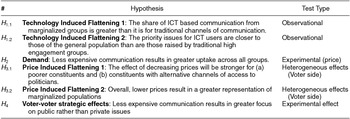
H 1.1 ICT Availability Induced Flattening 1: The share of ICT users from marginalized groups is greater than it is for traditional channels of political communication.
If all citizens had similar preferences then the identity of those constituents articulating interests to politicians might be less consequential. However, there are good reasons to believe that policy preferences are also a function of class (Meltzer and Richard Reference Meltzer and Richard1981) and gender (Chattopadhyay and Duflo Reference Chattopadhyay and Duflo2004). If this is the case, then the identity of those using the new ICT platform might also affect what types of preferences get to be voiced. This motivates our second question: Does the introduction of a new ICT system result in more representative articulation of constituency needs and preferences?
-
H 1.2 ICT Availability Induced Flattening 2: The priority issues for ICT users are closer to those of the general population than are those of groups exhibiting high levels of political engagement via traditional communication channels.
Note that our hypothesis focuses on the representativeness, in terms of their preferences, of those engaging in political communication, rather than on the representativeness of interests articulated.
Price Induced Flattening
All political communication is costly. This cost can have significant implications for the level of communication, for who communicates, and for what gets communicated. Decision theoretic considerations suggest that political access satisfies the law of demand (we consider strategic logics below). We state this simple expectation as our next hypothesis:
-
H 2 Demand: Less expensive communication results in greater levels of communication.
Beyond its effect on the quantity of communication, price is likely to affect whose voice gets to be heard. Specifically, marginalized populations may be more reluctant to raise their voice when the cost of political communication is high. Data gathered by the National Democratic Institute (NDI) suggests that such patterns are likely to hold in Uganda. In 2010, NDI conducted a small pilot study in Uganda to examine the willingness of survey respondents to send a text message to their Members of Parliament (MPs) as a function of hypothetical prices. NDI found that poorer constituents reported greater sensitivity to the price of political communication (see Online Appendix, Section 2.1).
Although the patterns NDI reports suggest that higher prices likely generate relatively more messaging of wealthier constituents, its not clear that actual behavior is consistent with the sort of hypothetical behavior claimed by citizens.Footnote 8 Access to alternative channels of communication plays a similar, though perhaps more counterintuitive, role to wealth. More advantaged individuals may be more sensitive to prices if they enjoy the option to substitute to more traditional channels of political communication. We assess these questions in terms of heterogeneous demand effects:
-
H 3.1 Price Induced Flattening 1: The subsidy effect (difference in uptake between higher and lower prices) will be stronger for (a) poorer constituents and (b) constituents with alternative channels of access to politicians.
These heterogeneous effects push in different directions for marginalized population. Formally, however, we are interested in whether the net effects of price subsidization is increased flattening:
-
H 3.2 Price Induced Flattening 2: Lower prices result in a greater representation of marginalized populations among message senders.
Strategic Logics
The discussion so far is based on a conceptualization of voters as facing a simple decision theoretic problem, to engage or not. But the decision to engage in politics is plausibly a strategic decision, and the value of participation may depend on expectations of the actions of other voters and of politicians. Treating the participation problem as a collective action problem suggests two possible patterns.Footnote 9
First, strategic considerations can provide a rationale for why subsidization may reduce political participation. This might arise, for example, if the messages for public goods act as strategic substitutes. We describe this logic more formally in the Online Appendix (Section 2.2). If this strategic consideration dominates then we should witness the opposite effect to that stated in Hypothesis H 2.
Strategic considerations also have implications for the content of communication (conditional on who communicates). Under one logic, citizens may be relatively more likely to send messages with public goods content (rather than with demands for private goods) when prices are low. The core insight is that when there is no cost, one can expect many others to contact their representative. In this case, the marginal benefits from seeking private goods may decline relative to the marginal gains from seeking public goods. When the cost of sending messages is high, senders may assume that competition over the resources the politician controls is relatively small, and hence it is relatively more prudent to request private, or clientelistic, goods. We illustrate the core logic in the Online Appendix (Section 2.3).
This logic suggests that when the cost of contacting representatives decreases (through a subsidy), citizens will be more likely to send requests for actions that are more public in nature.
-
H 4 Voter-voter Strategic Effects: Less expensive communication results in greater focus on public goods issues rather than private issues.
Beyond between-voter strategic considerations, simple political economy logics suggest that the engagement of citizens will depend on the incentives politicians have to react to the information provided. In addition to the core hypotheses listed above we also briefly assess the role of constituency and MP characteristics that are likely associated with greater responsiveness, examining specifically whether price effects are weaker for more competitive areas, for younger politicians, and for MPs from the ruling party.
Table 1 summarizes the hypotheses under examination; the next section describes how we seek to test them.
Hypotheses Summary

Note: Summary of hypotheses on the effects of the introduction of ICT based access to politicians.
RESEARCH DESIGN
To assess the effects of ICT on political communication, we implemented a field experiment in Uganda in which we made an ICT platform available to a random sample of constituents at randomly determined prices.
The experiment took place several months after the February 2011 Parliamentary elections. Winning MPs were elected in one of two ways; through constituency level majoritarian races where candidates of both sexes can participate and district level majoritarian races in which only women candidates can compete. Universal adult suffrage applies in both types of races. Currently there are 238 constituency representatives and 112 District woman MPs—the title of this piece is taken from a message from one constituent for one such women MP, or WMP.Footnote 10
There are some good reasons to choose Uganda as our research site. First, claims to external validity are strengthened by the fact that Uganda shares characteristics with many low-income countries on some critical dimensions. It is ranked 162 in the latest HDI ranking (low human development countries are ranked between 143 and 188) and in the midrange of the World Bank’s Lower-middle-income economies in terms of GDP per capita. In addition, Uganda has middling scores in terms of ICT ownership, use and access among African countries (see Online Appendix, Section 5.1). In terms of inequality, as measured by the GINI index, Uganda is ranked 46 out of 136 countries.Footnote 11 It has a weak democracy (a centrist score of − 1 in polity IV scale) with a strong executive branch and a relatively weak parliament, a characteristic common to many developing countries in Africa and beyond.Footnote 12
Second, some features of Uganda’s political landscape make it a theoretically interesting place to examine whether there exists a latent demand for citizens to communicate their preferences to their representatives in parliament when democratic institutions are weak. On one hand, a single party, the ruling NRM, which won 70% of the seats in the last election, dominates the Ugandan parliament. In addition, competitiveness (defined as the percentage point difference between the winner and the runner up) is relatively low: on average 0.22 for constituency races and 0.26 for district races.
On the other hand, Uganda is not simply nominally democratic (the last elections, with a turnout of 59%, were considered relatively free and fair according to domestic and international observers), it is also in some ways functionally democratic (Grossman and Lewis Reference Grossman and Lewis2014). For example, there is high turnover, and even top performers have only 50% re-election rates (Humphreys and Weinstein Reference Humphreys and Weinstein2012). Interviews by the PIs with MPs reveal that MPs themselves interpret the loss of races by prominent incumbents in the most recent election as evidence of the costs for Ugandan MPs of being unresponsive to constituents.Footnote 13 Closely related, there is evidence suggesting that the current parliament has been reluctant to serve a rubber stamp of the executive, as evidenced, for example, in the debates surrounding the passage of the Petroleum (Exploration, Development and Production) Act in December 2012.Footnote 14
In addition, Ugandan politicians have limited information on the preferences of voters. For example, over a third of Uganda’s MPs admitted that when they vote on a bill or a motion, most of the time they do not feel that they have sufficient information on the way their constituents would like them to vote.Footnote 15 Citizens in Uganda report that MPs do not frequently elicit voter opinions, despite voters overwhelmingly claiming that this is an important component of their job as a representative. According to a survey we implemented, 81% of subjects said it was very important for their MP to regularly visit their constituency and 74% said it was very important they maintain an office in their constituency. Yet, less than 50% of constituents surveyed for this project knew of any opportunities to meet their constituency or district MP over the past year. Together these data suggest weaknesses in existing channels of communication between constituents and their representatives in parliament.
Marginalized Populations and Political Empowerment in Uganda
Beginning in late April 2011, the research team worked with a group of Ugandan enumerators to conduct interviews with randomly sampled respondents in each of Uganda’s 238 electoral constituencies. Cluster randomized sampling was used to select 4 villages in distinct subcounties within each constituency. Within each village we conducted interviews with 8 villagers, for a total of 7,582 survey respondents.
Using these data we construct two indicators of political empowerment: a measure of access—the extent to which channels exist to communicate with politicians if need or want arises, and a measure of engagement—the extent to which individuals participate in political processes. We operationalize both access and engagement by grouping a number of related measures into a summary index, following Anderson (Reference Anderson2008).Footnote 16 We relate these measures of access and engagement to commonly used indicators of marginalization in African polities: poverty, gender (female and cogender with MP), and ethnicity (being a non coethnic of one’s MP) and remoteness; these last measures are also aggregated into a continuous marginalization index. For some analyses we divide the population into groups by dichotomizing the summary indices.
We operationalize access using variables that capture existing technologies that individuals could use to contact politicians: (1) an indicator of respondent’s phone access; (2) a continuous measure capturing the frequency of SMS usage; and (3) an indicator of respondent’s access to a computer. In addition, we have two measures of physical barriers to connecting with politicians: (4) an indicator of whether the respondent travels ten kilometers or more from the place where he or she lives now, at least a few times a month; and (5) a continuous variable measuring the geodetic distances from the respondent’s home to the district capital.Footnote 17 We emphasize that our index captures existing access technologies available to voters and does not capture social channels such as family or ethnic ties; we would also add that the access and the marginalization index are not independent since they both include data on physical remoteness.
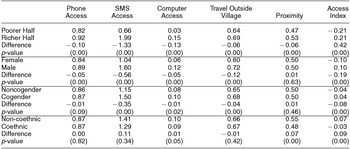
In Table 2 we illustrate our operationalization of the access index and how it, and each of its constituent variables, relates to traditional indicators of marginalization in African politics—wealth, gender, and being of the same gender or ethnicity as one’s MP. The binary wealth index is constructed using a “subjective” measure of wealth (coded as 1 if a respondent described themselves as having a “much higher” economic situation to those of other Ugandans) and an “objective” measure formed from a set of items provided in Table 9 (Online Appendix). All items were grouped into a summary index as in Anderson (Reference Anderson2008). To create a binary measure of poorer and richer respondents we use the median of the continuous wealth index as a cutoff point.
Access to Existing Communication Channels
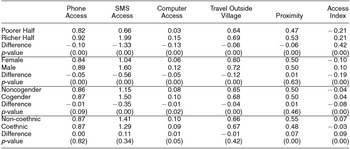
Notes: The access index is standardized (mean equals 0 and standard deviation equals 1). Number of observations: 7,582.
Two important relations stand out. First, on all measures except coethnicity, marginalized voters are significantly less able to access their representative through existing channels of communication. Second, our data confirm the potential of mobile technology to connect citizens with their representatives in parliament. Whereas only 8% of survey respondents have ever used a computer, and a third rarely travel outside their village, 65% report that they use a mobile phone regularly and 86% report that they would personally be able to access a phone if they had to make an important call (even though only 48% of respondents report personally owning a mobile phone).
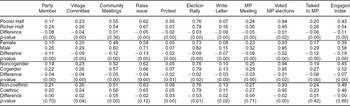
We operationalize engagement using ten indicator variables. These measures, which appear in Table 3, include: (1) active membership in any political party; (2) membership in the village governance committee; (3) attending a community meeting several times in the past year; (4) raising political issue with others at least once in the past year; (5) attending demonstrations and protest marches at least once in the past year; (6) attending elections rallies at least once in the past year; (7) writing letters to a newspaper or calling a radio show at least once in the past year; (8) voting in the recent parliamentary elections; (9) attending at least one MP organized meeting in the past year; and (10) personally talking to one’s MP in the past year. We then use these variables to construct a summary index of political engagement, which appears in the last column.
Politically Engaged

Notes: Number of observations: 7,582.
As with access, there exist large and significant differences between the poor and nonpoor, and male and female respondents with respect to political engagement. The difference between noncogender and cogender respondents is somewhat smaller yet significant at the 95% level. However, and in contrast to classic accounts of the political economy of African development, our data do not suggest that political engagement (Table 3), like access (Table 2), is structured around ethnic lines.
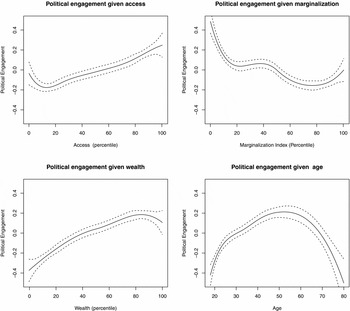
Figure 1 shows how the measure of political engagement relates to access, marginalization, wealth, and age. As expected, engagement rises with political access and wealth and declines with marginalization, strengthening our confidence in the reliability of our measures. Variation in marginalization accounts for about 10% of the variation in engagement, with a one standard deviation increase in marginalization associated with a 0.1 standard deviation decline in engagement (
 $t\text{-stat}=-8.68$
). Engagement is highest for voters in middle age ranges and declines for the youth and the elderly.
Correlates of Traditional Political Engagement

Treatment Assignment: Price Variation
To test the study’s hypotheses, in each village in the study area 4 respondents were offered the opportunity to SMS their MP at a price level which was randomly preassigned. In total, 3,790 subjects participated in our experiment. Random assignment was used to assign subjects across the three treatment price groups within each constituency in equal numbers: (a) Full price (100 shillings), (b) Partial subsidy (50 shillings), and (c) Full subsidy (free).Footnote 18 We provide data on covariate balance in the Online Appendix, Figure 6.Footnote 19 The service was introduced with the following script:
We would like to offer you an opportunity to send your new (constituency/ district) MP a message using SMS. It is a chance to tell your incoming MP about issues that are important to you, or things you feel he/she should work on. This service is not associated with any political party or government agency. The service is (free/50sh/100sh).
In addition, experimental subjects were given a flyer that provided additional instructions on how to access the ICT system and send a text message to one’s MP. Examples of such flyers are provided in the Online Appendix.
Estimation Strategy
Estimation strategies for testing the study’s hypotheses were developed in advance in a detailed plan that we posted on the Experiments in Governance and Politics (EGAP’s) Design Registration web page, prior to analysis. The plan specified the measures of variables and econometric specifications that we would use for testing the study’s hypotheses. The specifications include no controls; analysis of experimental effects is generally done using design based inference, with core tests implemented using randomization inference. In the Online Appendix we describe both fidelity and deviations from the preanalysis plan and our rationale for the change in each case, where relevant.
RESULTS
In total we received 243 messages, out of which 41 were dropped since participants failed to enter their identifying code and 29 messages dropped since they were the second, third, or fourth message sent by the same participant.Footnote 20 Since 4 messages were blank, we are left with 173 identified message senders and 169 valid messages. Note that invalid messages do not constitute missing data in our analysis; they are simply not considered valid messages.
This set of messages corresponds to a 4.5 percent uptake. This rate is not low relative to other types of political participation outside of election periods. The rate is similar to the share of respondents reporting having taken part in a protest and is marginally smaller than the share reporting having written a letter (in the previous 12 months, in an election year). It is a quarter as large as the share of people reporting having spoken to their MP, although this measure is taken specifically with respect to the two months leading up to the February election. It is only slightly lower than the share of voters participating in party primaries in the United States (Gans Reference Gans2010), and similar to the number of attendees in relatively large scale public deliberations over oil revenues in São Tomé e Príncipe (Humphreys, Masters, and Sandbu Reference Humphreys, Masters and Sandbu2006) and to the number of citizens joining online discussions during Iceland’s deliberative process over a new constitution (Magnusson Reference Magnusson2013). Five percent also matters in parliamentary politics in Uganda: if an additional 5% of voters in the 2010 Ugandan election chose to cast a vote for the candidate who was an eventual runner up in their constituency, the outcome of 17% of constituency MP and 10% of women district MP races would have been changed. At scale, this rate would correspond to approximately one million messages sent to Uganda MPs. As we discuss in the Conclusion, this rate is also considerably higher than the rate achieved in the closely related uSpeak intervention implemented by the Parliament of Uganda.Footnote 21
The uptake recorded in this study thus suggests that a sizable number of citizens value the opportunity for interest articulation provided by the introduction of the SMS channel to MPs. In the remainder of this section we examine who is responsible for this uptake, and in particular the relationship between system availability and both user demographics and preferences.
Technology Effects
We saw above (Tables 2 and 3) that marginalized groups are significantly less engaged in political life across a broad range of political participation indicators. Can an opening of a new ICT channel, based on mobile technology, flatten access to national assembly representatives?
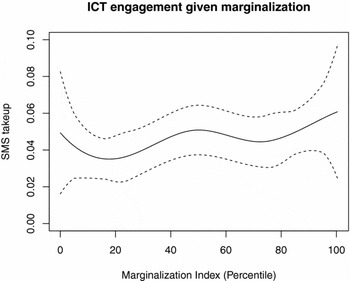
Our data suggest it could. Figure 2 illustrates the observed flattening. The figure shows the analogous relationship between marginalization and the propensity to send an SMS message to that shown in the top right panel of Figure 1; broadly this relationship is flatter and the broad relation is weakly positive rather than negative, indicating that more marginalized subjects are more likely than nonmarginalized subjects to message.
Flattening

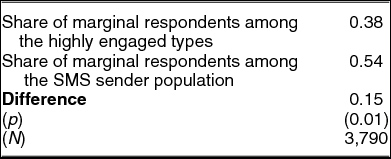
To test hypothesis H 1.1 more formally, we compare the share of marginal respondents among the SMS sender population to the share of marginal respondents among politically engaged types (those who report using traditional strategies of engagement). For this analysis and the next we define the “highly engaged” as those with scores in the top 4.5% of the engagement index.Footnote 22 This ensures that the engaged pool is set to be approximately the same size as the pool of SMS senders. To compare these shares we employ seemingly unrelated linear regressions; results from this analysis, reported in Table 4, suggests that the share of marginal respondents is indeed higher among the SMS sending group than among a comparably sized group of the most traditionally engaged subjects.
Flattening Participation: Test of Hypothesis 1
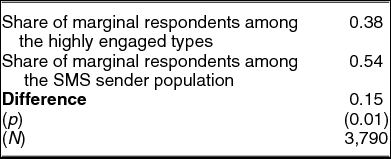
Note: p value estimated using χ2 test from seemingly unrelated regressions.
We deepen this analysis in three ways. First, we assess the extent to which this relationship holds for different subcomponents of the marginalization index. These results are provided in the Online Appendix. They suggest that opening a direct channel between citizens and their MPs using text messaging is especially beneficial to poorer villagers, to women, and to citizens living in remote areas. As discussed above, this may be because those populations are less likely to travel to the district capital to meet their representative or his/her parliamentary assistant in person.
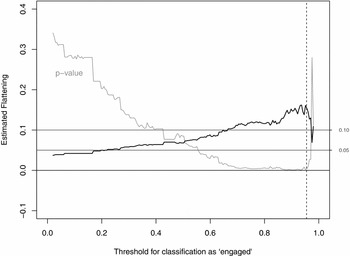
Second, we examine the sensitivity of our findings to the definition of “highly engaged.” We do so by repeating the same analysis each time with a different threshold on the engagement index, calculating p values in each iteration. The results of this sensitivity analysis are shown in Figure 3. We see here that the test of Hypothesis 1 is not sensitive to large changes in the definition of “highly engaged” away from the 4.5% cutoff. Qualitatively a flattening effect holds throughout the range (reflecting the fact that marginalized populations message more than nonmarginalized populations in absolute terms). Quantitatively, however, this effect weakens as the definition of engaged becomes less demanding and significance at conventional levels is lost at around the midpoint. At the midpoint—the threshold we specified in our preanalysis plan—the flattening effect is significant only at the 5% level in a one-tailed test and only at the 10% level in a two-tailed test.
Sensitivity of H 1 Results

Finally, we assess whether there is evidence specifically for greater uptake within the middle class. In classic accounts the middle class has served as a catalyst for democratization processes. Figure 2 shows a slight rise in SMS uptake among constituents with middling marginalization index scores. This pattern can be seen more strongly in the relation between wealth and uptake. Formal analysis suggests however that the nonmonotonicity is weak and only on the border of statistical significance.Footnote 23
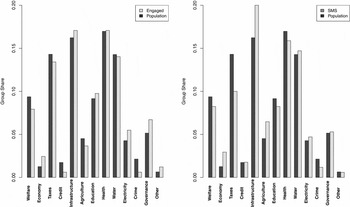
We have found evidence that the share of politically marginalized respondents among SMS users is larger than their share among the engaged types. This fact, however, does not alone tell us whether the priority issues for ICT users are closer to those of the general population than are those raised by traditional high engagement groups (H 1.2). To address this question, Figure 4 provides information on the top priorities of all respondents against the priorities of two groups of interest: (a) experimental subjects choosing to use the SMS system to contact their MP, and (b) subjects that are located at the top 4.5% of the politically engagement summary index. Figure 4 shows that there exists little difference in the distribution of top priorities of the more politically engaged subjects and those of the general population (the complete sample of experimental subjects), and a slightly larger discrepancy between the preferences of SMS users and the general population. For example, compared to the general population, SMS users are more likely to prioritize infrastructure and less likely to prioritize taxes. These differences may reflect the fact that poorer constituents are over-represented in the SMS users group.
Patterns of Representativeness of Messaging (H 1.2)

To test H 1.2 more formally, we construct a measure of the nonrepresentativeness of preferences of engaged constituents relative to preferences of the population and a measure of the nonrepresentativeness of SMS senders relative to preferences of the population and compare these two quantities. Our “nonrepresentativeness statistic” (NRS) measures the distance between the distribution of responses from subpopulation A and (possibly overlapping) subpopulation B as
 $$
NRS(A,B)= \frac{1}{2}\sum _{k=1}^m(\alpha _{k}^A - \alpha _{k}^B)^2,
$$
where α j k denotes the share of members of group j selecting option k. The NR statistic is calculated then as half the sum of squared deviations of shares in each of m categories. The maximum deviation is 1, which would arise if the population A all valued one area while population B valued another.
To estimate the significance of differences in nonrepresentativeness across the engaged and SMS-users groups we estimate a multinomial logit model of sector choice as a function of group membership and, using the estimated distribution of parameters, simulate a distribution of NR statistics relative to the reference distribution (population B) as well as a distribution of differences in NRS’s relative to the reference distribution both for non-SMS (and nonengaged) populations (population A) and nonengaged (but SMS sending) populations (population A′).Footnote 24 This analysis suggests that although the NRS statistic is higher for the SMS group (0.0022) than the Engaged group (0.0007), the difference between these deviations is small and the probability of such a difference arising by chance if the two distributions were equally representative of the population is close to 1 (see Online Appendix for results and code).
We conclude that though opening a new ICT channel can increase the voice of marginalized populations relative to existing communication channels (H 1.1), we do not find, contra to our expectations (H 1.2), greater inclusion of a pool of citizens with priorities closer to those of the general population.
Price Effects
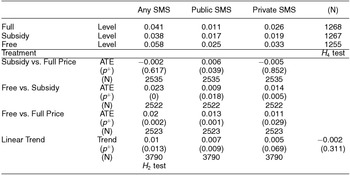
New technologies can expand access, but how much does this depend on the price of these technologies? The key patterns can be seen in the top panel of Table 5, column 1, which shows unconditional uptake by price category. Table 5 suggests that uptake decreases in price, and that the shift from free to some positive price is more consequential than the shift from a partial subsidy to a full price. This nonlinear demand curve induced by zero price is consistent with findings reported by Cohen and Dupas (Reference Cohen and Dupas2010) in the case of bed nets and by Kremer and Miguel (Reference Kremer and Miguel2007) in the case of deworming pills in Kenya.
Price Effects

Notes: ATEs estimated using linear regression, p values estimated using randomization inference (taking into account blocked assignment). N simulations: 5,000. Throughout the article p denotes two-sided test; p + and p − denote one-sided tests for hypothesized positive and negative effects, respectively.
To test hypotheses H 2 more formally, we estimate price effects on SMS uptake.Footnote 25 Average Treatment Effects (ATEs) are calculated as mean differences, whereby coefficients and p values are estimated using randomization inference, while taking account of the structure of blocking in the randomization scheme by using the experimental subjects village as strata. To generate a summary measure of effects, we report, in addition, the linear trend in which the dependent variables are regressed on a three-category treatment variable and a linear model where we use MPs as blocks when including fixed effects. Key results are presented in the bottom panel of Table 5. Our findings provide support for H 2: less expensive communication results in greater uptake. Specifically, moving from a partial subsidy to a free price or from a full price to a free price results in an increase in uptake of about 2 percentage points, or an approximately 50 percent increase.
How Prices Affect Who Gets Heard
To assess heterogeneous effects of price on uptake, we focus on the subsidy effects and the differences in subsidy effects for more and less marginalized citizens and specifically at differential effects for wealthier and poorer constituents and for those with greater or weaker access. Recall that we expect that the difference in uptake when moving from higher to lower prices (subsidy effect) will be larger for poorer constituents than richer constituents. Similarly we expect that a subsidy will result in increased use of the system by individuals with greater alternative channels of access.Footnote 26
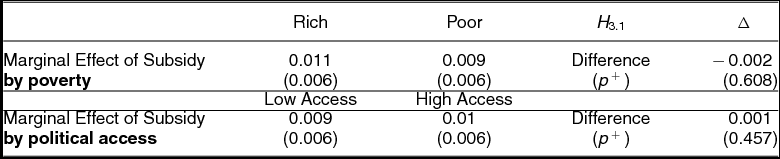
As shown in Table 6, we find, contrary to our expectations, that the subsidy effect on the uptake of poorer constituents (0.009)—defined as subjects who are located at the bottom half of the standardized wealth index—is smaller (though not significantly so) than the subsidy effect on the uptake of richer constituents (0.011). This suggests that poorer constituents are no more price sensitive than richer constituencies when interest articulation is at stake. Turning to political access, as hypothesized, we find that the conditional difference in uptake as a function of price between high and low access constituents is positive. However, the subsidy effect difference is relatively small and again not significantly different than zero (p value 0.457).
Price Induced Flattening (1) – Test of (H 3.1)

Notes: Estimated marginal effect of a price subsidy. Marginal effect of subsidy by poverty level controlling for access (top), and marginal effect of subsidy by access controlling for poverty. p values, which take into account the blocking design, are estimated using OLS. See also Online Appendix (Section 7) for a sensitivity test of these results in which we use randomization inference.
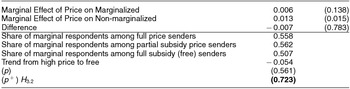
In order to assess the overall effect of price subsidization on flattening of political access, we report in Table 7 first the marginal effect of price for more marginalized and less marginalized subjects (using the same measure of marginalization employed to test H 1, Table 4), as well as the difference between these (upper panel). We find that for the nonmarginalized there is a strong and significant price effect (substantively this effect implies nearly a doubling in message sending rates from 3.7% uptake for the marginalized in the full price condition to the 6.3% in the free condition). For the marginalized, however, the effect is much weaker, contrary to our hypothesis.
Price Induced Flattening (2) — Test of H 3.2

Notes: p values for the marginal effect of the subsidy are estimated using regression. p values for the trend in the share of marginal respondents from high price to free are estimated using randomization inference that takes into account the use of villages as blocks. The number of SMS users in the full-price treatment condition is 52, there are 48 in the partial subsidy price treatment condition, and 73 in the free condition.
The result is that the share of the population of SMS users that is marginalized is slightly higher under the high price condition—contrary to our expectations—at 56% compared to 51% (Table 7, bottom panel). This difference is not significant however at conventional levels: the associated p value for this difference is 0.561 given our original one-sided test of the hypothesis of greater flattening from subsidization (p +), and 0.723 on a two-sided test (p). The 51% share of marginalized in the low price condition, though lower than that in the high price condition, is however still higher than the share marginalized among the most engaged group (see Table 4).
All in all, while system availability flattens access, we find no evidence for additional flattening stemming from applying a subsidization scheme and indeed the results (weakly) point in the opposite direction.
How Prices Affect What Gets Heard
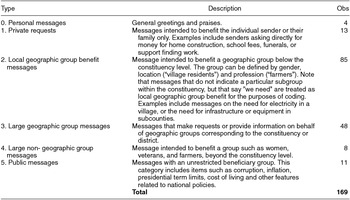
We have found that the cost of political communication alters the propensity of marginalized constituents to articulate their interests. Strategic logics, described above, suggest however that price may affect not just the quantity of communication but also the type of message sent (H 4). In the last piece of analysis we turn to examine whether price subsidy results in greater focus on public rather than private issues. Our estimand here is therefore the propensity to send messages of a given type (“private” or “public”). An initial classification of each of the 169 valid messages into five categories is presented in Table 8.
Types of Messages

After this initial classification, we further collapsed the more detailed categorization into a binary measure of public messaging, such that 1 and 2 were coded as more private messages and categories 3, 4, 5 were coded as public messages. The rationale for choosing this cutoff is based on Lindberg (Reference Lindberg2010) that distinguishes between core duties of MPs—such as legislation, executive oversight, and constituency representation—that have an inherent public good component, and constituency services in the form of personal favors and community development that have a private or club good component. Our cutoff point is also consistent with the work of Cammett and Issar (Reference Cammett and Issar2010) and Smith, LaGatta, and Bueno de Mesquita (Reference Smith, LaGatta and Bueno de Mesquita2013) that view investments in community-level services, such as health and education, through a clientelistic framework. Note also that our choice of cutoff point has the additional benefit of maximizing the variance of the measure.
We note that a large number of messages are requests for local public good, especially water and electricity supply, health services, roads, and education. While this might in part reflect responsiveness to a prime in our encouragement, it is consistent with findings from recent studies (e.g., Lindberg (Reference Lindberg2010)), that show that voters in many African countries view the lobbying for provision of community-level (club) goods as one of the key areas of responsibility of their representatives in parliament. MPs are increasingly expected to represent their constituents by lobbying for them in parliamentary committees, line ministries, and local government council meetings. The fact that most SMS messages address what voters view as a core MP activity is consistent with the view that ICT, as a platform for interest articulation, can alter the nature of substance of political demands and serve as a vehicle to increasing the accountability of MPs in low-income countries, such as Uganda.
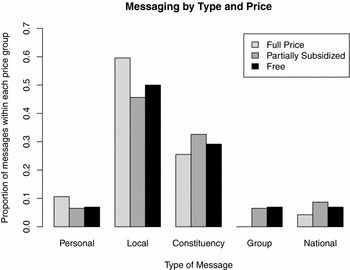
Figure 5 provides descriptive information on the full distribution of message types by price levels, suggesting a rather weak relationship between price and message type, with marginally greater share of messages of a local nature, and fewer of a constituency nature, sent in the full price condition.Footnote 27
Message Content and Pricing

Moving to a formal analysis of price effects, we find that, using a binary variable to measure message type, the difference in the subsidy effect on the increase in public messages relative to private messages is small and statistically indistinguishable from zero (Table 5, columns 2–4). Importantly, as reported in the Online Appendix, our findings are the same for other plausible classifications, such as treating category 4 as “private.” We conclude that there is no robust evidence suggesting that citizens are using information on the price of messaging strategically to tailor the content of their messages to expectations regarding uptake by others. In sum, an increase in price excludes potential users who opt out of contacting their MP, but without a significant change in the types of messages that get communicated.
These results thus provide little support for the strategic rationales described above. We find similar negative results for other hypotheses arising from strategic considerations. As reported in the Online Appendix (Table 6), we do not find that voter sensitivity to price is related to measures that we expect to predict the responsiveness of MPs.
CONCLUSION
To assess how information technologies affect political interest articulation, we provided a representative sample of constituents with access to a communication platform akin to those being developed by national parliaments and nongovernmental organizations in a growing number of developing countries. In order to asses how cost affects interest articulation, we introduced random variations in the prices faced by constituents.
The experiment allows us to assess two concerns raised by many. Our results establish that there is underlying constituent demand to use ICTs to articulate interests and preferences to MPs, including among marginalized populations. As discussed above, the uptake recorded in this study (about 5%), though perhaps modest as a share of survey respondents, is reasonably large when compared to nonelectoral participation in Uganda and elsewhere.
The second common concern we address is that new technologies will only exacerbate existing inequalities in access to politics. Our results suggest that this concern may be misplaced. We find that opening a new low cost ICT channel can flatten interest articulation, as uptake among marginalized populations outpaces that by nonmarginalized groups. In our study, marginalized citizens send costly SMSs at higher rates than the less marginalized, and they are relatively more likely to text message their MP than they are to participate in various traditional forms of political engagement. Since we exogenously introduced the communication platform within a nationally representative sample—i.e., made the ICT system available independent of citizens’ wealth, location, or other characteristics—our measurement of levels (uptake) is free from selection biases that limited past work on technology exposure and political behavior.
The experiment also allows us to assess the effect of cost on interest articulation. Simple theoretical models suggest that lower prices could affect both the quantity and the type of messaging. We assessed whether a subsidy would lead to an increase in the participation of poorer constituents, an increased focus on issues of concern to them, and a general shift towards communication relating to the provision of public rather than private goods. We find that providing a full subsidy for messaging increases uptake by 42% compared to uptake under market prices. However, subsidization does not lead to greater flattening. Contrary to our expectations, more marginalized voters are no more price sensitive than more politically connected voters. In other words, making access to the communication technology free increases uptake across all populations of interest, but it does not necessarily encourage the participation of populations with a different set of priorities, compared to existing communication channels.
Our finding that poorer constituents are not more price sensitive than richer constituents when interest articulation is at stake contrasts with results generated from survey data. NDI found that voters’ self-reported intention to contact their MP using SMS messaging has significant heterogeneous hypothetical price effects by voters’ income level.Footnote 28 Our findings reaffirm the importance of measuring costly behavior rather than simply relying on survey responses, which are more likely to be affected by various biases.
We find little evidence that price affects the type of messages that get communicated by constituents. Though we find some evidence that information received when prices are low is of a more public nature, this result is weak. In sum, our findings suggest that subsidizing the price of using ICT systems result in politicians facing more demands and in more marginalized constituents making their voice heard (though not relatively more), but the nature of these demands may not fundamentally change. These combined findings have important policy implications as more governments are contemplating the introduction of ICT innovations.
We close with a discussion on external validity. In our case we delivered a technology directly to a nationally representative sample of voters. We therefore have grounds to expect that the sample treatment effects identified here extend to the Ugandan population. However, like all results derived from single case studies, we need to be cautious regarding the implications for other sites and for other technologies. Ultimately confidence in the generality of the findings will depend upon replication elsewhere. We note however that our analysis of heterogeneous effects suggested that the patterns that we found did not depend sharply on features such as the competitiveness of constituencies or attributes of politicians; nor did price effects depend strongly on the wealth of voters or their existing channels of political access. Given the high level of inequality and the dominance of the ruling party, an experiment conducted in this environment is a particularly hard test of income and political effects. The lack of variation in effects by income or MP characteristics suggest that our results may not be very sensitive to features of the case at hand.
External validity depends, however, not just on the case but also on various design elements of the intervention studied. Our experiment was closely modeled on designs for a national system to be introduced by the Uganda parliament, and is also similar to one used in Botswana and elsewhere. This strengthens the relevance of our findings to other real world interventions. However, data emanating from the Ugandan parliament SMS system suggests that uptake in the national system is lower than what we find in our experiment. According to reports from NDI, the uSpeak system generated approximately 2,000 messages following a national radio dissemination campaign—a figure, while larger than ours in number, suggests a much lower uptake rate.Footnote 29
What should we make of these differences? First, differences—or more broadly, the generalizability of our results—may depend on core features of our design. Three stand out, emanating from the fact that the service we studied was introduced to voters individually, and in a private one-on-one interaction. One implication of this is that, absent a dynamic structure, voters could not base participation decisions on learning about the views and behavior of politicians. Second, for marginalized voters, the personal invitation may provide an incentive to engage politically that is not typical of mass media campaigns. Third, the private delivery mechanism may not induce the common knowledge conditions or the opportunities for coordination that may be needed for strategic logics to take effect, whether these be logics of complementarity or substitution. Thus while we have a clear possibility result, whether technology can flatten interest articulation in the absence of an invitation to participate is still an open question.
Second, and more positively, much is learned from the very fact of a difference between participation levels in controlled and field settings. An interpretation of low uptake by marginalized populations in the field setting, one that that is informed by considerations of the second and third faces of power, would suggest that low participation can be explained by the possibility that populations are unconscious of demands (or feel they have no rights to make any) or that they feel that initiating requests will be ineffective in the face of systemic biases. However, the results from our experiment suggest that while low participation rates—particularly among marginalized populations—may be due to the second consideration, they cannot be simply attributed to the first.
Supplementary materials
To view supplementary material for this article, please visit http://dx.doi.org/10.1017/S0003055414000331







Comments
No Comments have been published for this article.