Introduction
Cigarette smoking is associated with an increased risk of depression, other mental illnesses and suicide (Davey Smith et al. Reference Davey Smith, Phillips and Neaton1992; Lasser et al. Reference Lasser, Boyd, Woolhandler, Himmelstein, McCormick and Bor2000; Hughes, Reference Hughes2008; Diaz et al. Reference Diaz, James, Botts, Maw, Susce and De Leon2009), and smokers with a mental illness seem to smoke more than other smokers (Farrell et al. Reference Farrell, Howes, Bebbington, Brugha, Jenkins, Lewis, Marsden, Taylor and Meltzer2001). However, the direction of the association is not clear, and it is not known if smoking causes mental illness or if mental illness leads to smoking. It is also possible that the association of smoking with mental illness is confounded by genetic, lifestyle or socio-economic factors (Davey Smith et al. Reference Davey Smith, Phillips and Neaton1992; Kendler et al. Reference Kendler, Neale, MacLean, Heath, Eaves and Kessler1993; Munafò & Araya, Reference Munafò and Araya2010).
Smoking may serve as a form of self-medication among people with mental illness (Salín-Pascual et al. Reference Salín-Pascual, Rosas, Jimenez-Genchi and Rivera-Meza1996), and smoking may also be a shared social activity. In this respect, mental illness may cause people to smoke. By contrast, it has been hypothesized that smoking may cause depression (Klungsøyr et al. Reference Klungsøyr, Nygård, Sørensen and Sandanger2006; Pasco et al. Reference Pasco, Williams, Jacka, Ng, Henry, Nicholson, Kotowicz and Berk2008; Boden et al. Reference Boden, Fergusson and Horwood2010), possibly through an influence on neurotransmitter pathways that are linked to mental health (Williams & Ziedonis, Reference Williams and Ziedonis2004). Smoking may also cause mental illness through its association with physical diseases that may have secondary effects on mental health. These explanations are not mutually exclusive and the association of smoking with mental illness may be bidirectional (Munafò et al. Reference Munafò, Hitsman, Rende, Metcalfe and Niaura2008). It is also possible that the association is confounded by factors such as low socio-economic position and alcohol misuse, which are associated with both mental illness and smoking status, although such factors have been controlled for in prospective investigations of this issue (Klungsøyr et al. Reference Klungsøyr, Nygård, Sørensen and Sandanger2006; Munafò et al. Reference Munafò, Hitsman, Rende, Metcalfe and Niaura2008; Pasco et al. Reference Pasco, Williams, Jacka, Ng, Henry, Nicholson, Kotowicz and Berk2008; Boden et al. Reference Boden, Fergusson and Horwood2010).
The use of instrumental variables may be helpful in determining the causal nature of epidemiological associations (Greenland, Reference Greenland2000) and, under certain assumptions, genetic variants with known functional associations may be particularly useful in the assessment of causality (Davey Smith & Ebrahim, Reference Davey Smith and Ebrahim2003; Munafò & Araya, Reference Munafò and Araya2010). Thus, the random assortment of genetic variants leads them to be independent of possible confounding factors (Davey Smith et al. Reference Davey Smith, Lawlor, Harbord, Timpson, Day and Ebrahim2007). In addition, as germline genetic variation is fixed at conception, associations of genetic variants with outcomes cannot be attributed to reverse causation, which is a common reason for distortion of effects in observational studies (Davey Smith & Ebrahim, Reference Davey Smith and Ebrahim2004). Genetic variants with robust biological or behavioural associations can be used in a Mendelian randomization analysis. For example, polymorphisms of the FTO gene have been used as instrumental variables for obesity (Timpson et al. Reference Timpson, Harbord, Davey Smith, Zacho, Tybjaerg-Hansen and Nordestgaard2009) and genetic variants of the alcohol dehydrogenase 2 (ALDH2) gene have been used as an instrumental variable for alcohol consumption (Chen et al. Reference Chen, Davey Smith, Harbord and Lewis2008).
Genetic variation in the nicotine acetylcholine receptor gene cluster (CHRNA5–CHRNA3–CHRNB4) at the long arm of chromosome 15 (15q25) has recently been found to be related to smoking behaviours among smokers rather than smoking initiation (Berrettini et al. Reference Berrettini, Yuan, Tozzi, Song, Francks, Chilcoat, Waterworth, Muglia and Mooser2008; Thorgeirsson et al. Reference Thorgeirsson, Geller, Sulem, Rafnar, Wiste, Magnusson, Manolescu, Thorleifsson, Stefansson, Ingason, Stacey, Bergthorsson, Thorlacius, Gudmundsson, Jonsson, Jakobsdottir, Saemundsdottir, Olafsdottir, Gudmundsson, Bjornsdottir, Kristjansson, Skuladottir, Isaksson, Gudbjartsson, Jones, Mueller, Gottsater, Flex, Aben, de Vegt, Mulders, Isla, Vidal, Asin, Saez, Murillo, Blondal, Kolbeinsson, Stefansson, Hansdottir, Runarsdottir, Pola, Lindblad, van Rij, Dieplinger, Haltmayer, Mayordomo, Kiemeney, Matthiasson, Oskarsson, Tyrfingsson, Gudbjartsson, Gulcher, Jonsson, Thorsteinsdottir, Kong and Stefansson2008; Caporaso et al. Reference Caporaso, Gu, Chatterjee, Sheng-Chih, Yu, Yeager, Chen, Jacobs, Wheeler, Landi, Ziegler, Hunter, Chanock, Hankinson, Kraft and Bergen2009; Thorgeirsson et al. Reference Thorgeirsson, Gudbjartsson, Surakka, Vink, Amin, Geller, Sulem, Rafnar, Esko, Walter, Gieger, Rawal, Mangino, Prokopenko, Magi, Keskitalo, Gudjonsdottir, Gretarsdottir, Stefansson, Thompson, Aulchenko, Nelis, Aben, den Heijer, Dirksen, Ashraf, Soranzo, Valdes, Steves, Uitterlinden, Hofman, Tonjes, Kovacs, Hottenga, Willemsen, Vogelzangs, Doring, Dahmen, Nitz, Pergadia, Saez, De Diego, Lezcano, Garcia-Prats, Ripatti, Perola, Kettunen, Hartikainen, Pouta, Laitinen, Isohanni, Huei-Yi, Allen, Krestyaninova, Hall, Jones, van Rij, Mueller, Dieplinger, Haltmayer, Jonsson, Matthiasson, Oskarsson, Tyrfingsson, Kiemeney, Mayordomo, Lindholt, Pedersen, Franklin, Wolf, Montgomery, Heath, Martin, Madden, Giegling, Rujescu, Jarvelin, Salomaa, Stumvoll, Spector, Wichmann, Metspalu, Samani, Penninx, Oostra, Boomsma, Tiemeier, van Duijn, Kaprio, Gulcher, McCarthy, Peltonen, Thorsteinsdottir and Stefansson2010; Freathy et al. Reference Freathy, Kazeem, Morris, Johnson, Paternoster, Ebrahim, Hattersley, Hill, Hingorani, Holst, Jefferis, Kring, Mooser, Padmanabhan, Preisig, Ring, Sattar, Upton, Vollenweider, Waeber, Sørensen, Frayling, Watt, Lawlor, Whincup, Tozzi, Davey Smith and Munafò2011). Thus, each additional T allele at the rs1051730 single nucleotide polymorphism (SNP) may be associated with an increase in the number of cigarettes smoked per day and increased cotinine levels among smokers (Munafò et al. Reference Munafò, Timofeeva, Morris, Prieto-Merino, Sattar, Brennan, Johnstone, Relton, Johnsen, Walther, Whincup, Casas, Uhl, Vineis, Padmanabhan, Jefferis, Amuzu, Riboli, Upton, Aveyard, Ebrahim, Hingorani, Watt, Palmer, Timpson and Davey Smith2012). Therefore, this genetic variant may be useful as an instrumental variable for smoking behaviour (Caporaso et al. Reference Caporaso, Gu, Chatterjee, Sheng-Chih, Yu, Yeager, Chen, Jacobs, Wheeler, Landi, Ziegler, Hunter, Chanock, Hankinson, Kraft and Bergen2009; Freathy et al. Reference Freathy, Ring, Shields, Galobardes, Knight, Weedon, Davey Smith, Frayling and Hattersley2009; Thorgeirsson et al. Reference Thorgeirsson, Gudbjartsson, Surakka, Vink, Amin, Geller, Sulem, Rafnar, Esko, Walter, Gieger, Rawal, Mangino, Prokopenko, Magi, Keskitalo, Gudjonsdottir, Gretarsdottir, Stefansson, Thompson, Aulchenko, Nelis, Aben, den Heijer, Dirksen, Ashraf, Soranzo, Valdes, Steves, Uitterlinden, Hofman, Tonjes, Kovacs, Hottenga, Willemsen, Vogelzangs, Doring, Dahmen, Nitz, Pergadia, Saez, De Diego, Lezcano, Garcia-Prats, Ripatti, Perola, Kettunen, Hartikainen, Pouta, Laitinen, Isohanni, Huei-Yi, Allen, Krestyaninova, Hall, Jones, van Rij, Mueller, Dieplinger, Haltmayer, Jonsson, Matthiasson, Oskarsson, Tyrfingsson, Kiemeney, Mayordomo, Lindholt, Pedersen, Franklin, Wolf, Montgomery, Heath, Martin, Madden, Giegling, Rujescu, Jarvelin, Salomaa, Stumvoll, Spector, Wichmann, Metspalu, Samani, Penninx, Oostra, Boomsma, Tiemeier, van Duijn, Kaprio, Gulcher, McCarthy, Peltonen, Thorsteinsdottir and Stefansson2010), and this is supported by the association of this SNP with smoking-related diseases (Amos et al. Reference Amos, Wu, Broderick, Gorlov, Gu, Eisen, Dong, Zhang, Gu, Vijayakrishnan, Sullivan, Matakidou, Wang, Mills, Doheny, Tsai, Chen, Shete, Spitz and Houlston2008; Spitz et al. Reference Spitz, Amos, Dong, Lin and Wu2008; Munafò et al. Reference Munafò, Timofeeva, Morris, Prieto-Merino, Sattar, Brennan, Johnstone, Relton, Johnsen, Walther, Whincup, Casas, Uhl, Vineis, Padmanabhan, Jefferis, Amuzu, Riboli, Upton, Aveyard, Ebrahim, Hingorani, Watt, Palmer, Timpson and Davey Smith2012).
In a collaborative European study, the T allele of rs1051730 was associated with lower body mass index (BMI) among ever smokers but not among never smokers, suggesting that smoking reduces BMI (Freathy et al. Reference Freathy, Kazeem, Morris, Johnson, Paternoster, Ebrahim, Hattersley, Hill, Hingorani, Holst, Jefferis, Kring, Mooser, Padmanabhan, Preisig, Ring, Sattar, Upton, Vollenweider, Waeber, Sørensen, Frayling, Watt, Lawlor, Whincup, Tozzi, Davey Smith and Munafò2011) as the gene acts as a marker for the number of cigarettes smoked per day in smokers. With regard to mental illness, the number of T alleles of the rs1051730 polymorphism has been associated with a reduced tendency for depressed mood in pregnancy among women who were smokers prior to pregnancy, but not among non-smokers, and this finding may be consistent with the self-medication hypothesis (Lewis et al. Reference Lewis, Araya, Davey Smith, Freathy, Gunnell, Palmer and Munafò2011).
We assessed the causal association of smoking with anxiety and depression in a large population study, using the rs1051730 SNP variant as an instrumental variable for smoking in a Mendelian randomization analysis. If smoking causes anxiety and depression, we would expect to find an association with the T allele of the rs1051730 polymorphism among smokers (indicating a dose–response effect) but not among non-smokers.
Method
Participants
The data for this study were derived from the second wave of the HUNT Study in Norway. All adults aged ⩾20 years in Nord-Trøndelag County were invited to participate in the study in 1995–1997, and among approximately 92 000 inhabitants, 65 215 (71%) accepted the invitation and gave written informed consent to use the data for medical research. The data collection included questionnaires, clinical measurements and blood samples, and has been described in detail elsewhere (Holmen et al. Reference Holmen, Midthjell, Krüger, Langhammer, Lingaas Holmen, Bratberg, Vatten and Lund-Larsen2003). In total, 56 664 participants were genotyped for the rs1051730 SNP variant and, of these participants, 53 601 (82%) had provided information on smoking habits and completed a brief mental health questionnaire, the 14-item Hospital Anxiety and Depression Scale (HADS). One feature of the participants of the HUNT Study is the low ethnic diversity (Holmen et al. Reference Holmen, Midthjell, Krüger, Langhammer, Lingaas Holmen, Bratberg, Vatten and Lund-Larsen2003). The present study was approved by the Regional Committee for Medical Research Ethics.
Genetic variants
DNA has been extracted from blood samples for all participants of the HUNT 2 study and is stored at the HUNT biobank. The rs1051730 polymorphism was genotyped at the HUNT biobank using TaqMan genotyping assays (Applied Biosystems, USA) and performed on an Applied Biosystems 7900HT Fast Real-Time PCR System using 10 ng of genomic DNA. The call rate cut-off was set to 90% and the genotype frequencies were in agreement with HapMap data. The genotype was coded according to the number of the minor T allele, assuming an additive genetic model (0 = no T allele, 1 = heterozygote for the T allele and 2 = homozygote for the T allele).
Anxiety and depression
The HADS, a well-validated screen for depression and anxiety in general population samples (Bjelland et al. Reference Bjelland, Dahl, Haug and Neckelmann2002), was included in the questionnaire. The HADS comprises 14 questions with four response categories (scored 0–3); the scale can be subdivided into seven items measuring symptoms of depression and seven measuring anxiety. A cut-off value ⩾8 was set to define clinical caseness of both anxiety and depression (Bjelland et al. Reference Bjelland, Dahl, Haug and Neckelmann2002).
Smoking
Smoking status was measured as a categorical variable and the participants were classified as never smokers, former smokers or current smokers. Current smokers were asked how many cigarettes they smoked per day.
Statistical analysis
To assess the association of current smoking frequency (range from 0 to 70 cigarettes/day) with anxiety and depression (indicated by the HADS), we used cubic splines to prevent restrictions that may be dependent on the particular choice of categorization of smoking frequency. Multinomial logistic regression was used to estimate the association between genotype and smoking status. Binomial logistic regression analyses were used to estimate associations of genotype with the presence of anxiety or depression as indicated by a HADS score ⩾8. Ordinal logistic regression analyses were used to study associations of genotype with the single HADS items (0–3).
Potential departure from the Hardy–Weinberg equilibrium was evaluated using a χ2 test. Data were analysed using Stata 11.0 for Windows (Stata Corporation, USA).
Results
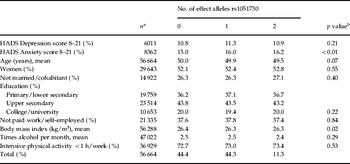
The characteristics of study participants are presented in Table 1. We found that with increasing number of 1051730 T alleles, the participants tended to be slightly younger and to have a lower BMI. Other characteristics did not vary across variants of the rs1051730 SNP, and there was no evidence for departure from the Hardy–Weinberg equilibrium (p value = 0.24).
Characteristics of study participants by number of rs1051730 SNP variants

SNP, Single nucleotide polymorphism; HADS, Hospital Anxiety and Depression Scale.
a Total n varies from 47 022 to 56 664 due to missing data.
b χ2 for categorical variables and t test for linear associations according to number of effect alleles.
Association of anxiety and depression and smoking frequency
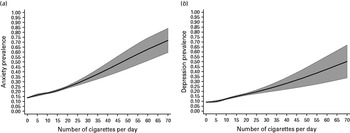
Both anxiety and depression were strongly and positively associated with smoking frequency (Fig. 1). The age- and sex-adjusted prevalence of anxiety and depression was <15% among non-smokers and in participants who smoked a few cigarettes per day, and increasing to >40% among those who smoked >60 cigarettes/day. With an increasing number of cigarettes, there was a nearly linear increase in the prevalence of both anxiety and depression.
Age- and sex-adjusted anxiety and depression prevalence and 95% confidence intervals (grey) according to number of cigarettes smoked per day. Based on the results from a logistic regression analysis.

Association between the rs1051730 SNP variant and smoking status
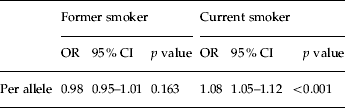
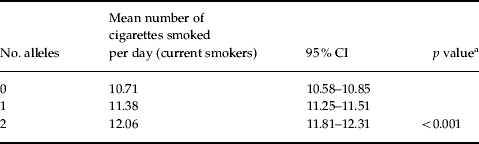
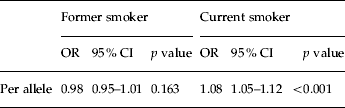
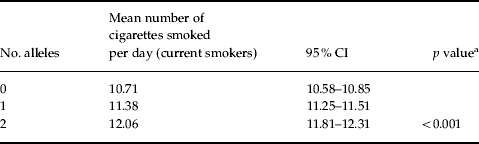
Supplementary Table S1 (available online) gives the prevalence of never smokers, former smokers and current smokers according to the number of T alleles. Table 2 shows the results from a multinomial regression model with the rs1051730 SNP as the exposure variable and three categories of smoking status (never, former, current) as the outcome variable. The genetic variant was associated with current smoking [odds ratio (OR) 1.08, 95% confidence interval (CI) 1.05–1.12] relative to never smoking but there was no clear association with former smoking (OR 0.98, 95% CI 0.95–1.01) relative to never smoking. In current smokers (Table 3), we also found that each additional rs1051730 T allele was associated with an increase in the number of cigarettes smoked per day. In another analysis, we used a binomial logistic regression model with the rs1051730 SNP as the exposure variable and two categories of smoking status (never versus former or current) as the outcome variable. In keeping with the OR pattern in Table 2, the genetic variant was modestly associated with ever smoking (OR 1.04, 95% CI 1.01–1.06).
Association between the rs1051730 SNP variant and smoking status. Multinomial logistic regression analysis
SNP, Single nucleotide polymorphism; OR, odds ratio; CI, confidence interval.
Daily number of cigarettes in current smokers according to rs1051730 SNP variant
SNP, Single nucleotide polymorphism; CI, confidence interval.
a T test for linear associations according to number of effect alleles.
Association between the rs1051730 SNP variant and anxiety and depression
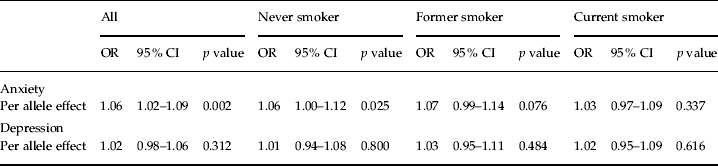
Table 4 shows the association of the rs1051730 genotype with prevalent anxiety and depression. Overall, for each additional T allele there was a 6% higher odds of anxiety (OR 1.06, 95% CI 1.02–1.09, p = 0.002). In contrast to the a priori hypothesis, however, the association was weaker in current smokers (OR 1.03, 95% CI 0.97–1.09, p = 0.34) than in never smokers (OR 1.06, 95% CI 1.00–1.12, p = 0.03) and former smokers (OR 1.07, 95% CI 0.99–1.14, p = 0.08). Conditioning on ever smokers (former and current smokers), the number of T alleles was positively associated with the prevalence of anxiety (OR 1.05, 95% CI 1.01–1.10, p = 0.03) (data not shown).
Association between the rs1051730 SNP variant and caseness of anxiety and depression. Logistic regression analysis of all study participants and stratified on smoking status
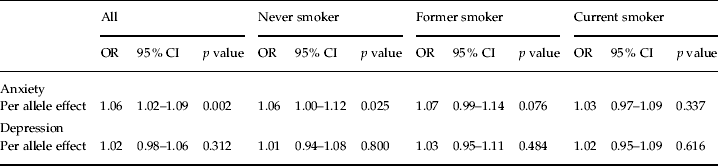
SNP, Single nucleotide polymorphism; OR, odds ratio; CI, confidence interval.
With regard to the prevalence of depression, we found no association with the rs1051730 genotype, both overall and stratified by smoking status. There was no support for statistical interactions between the polymorphism and smoking on anxiety (p = 0.67) or on depression (p = 0.93). We also analysed anxiety and depression as indicated by the HADS score (as continuous variables), but the results were not substantially different (Supplementary Table S2).
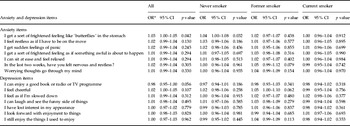
Table 5 summarizes the associations of the effect alleles with each of the 14 items in the HADS questionnaire. Overall and stratified by smoking status, the weak associations with anxiety items were generally stronger than for the depression items. Among current smokers, however, there was no clear association of the rs1051730 polymorphism with any of the individual items in the HADS questionnaire.
Association between the rs1051730 SNP variant and each item of the anxiety and depression scale. Ordered logistic regression analysis of all study participants and stratified on smoking status

SNP, Single nucleotide polymorphism; OR, odds ratio; CI, confidence interval.
a Odds ratio of increasing one step on the 0–3 scale per effect allele.
Discussion
In this large population study, smoking was strongly and positively associated with the prevalence of both anxiety and depression. Similarly, the genetic instrument for smoking was strongly related to whether or not an individual smoked and the number of cigarettes smoked per day. If smoking caused anxiety or depression we would expect an association of the polymorphism only among smokers because the genetic variant cannot influence the amount of tobacco exposure in never smokers; however, we found no such association. Although there was a weak positive association of the genetic instrument with anxiety, the finding was limited to never and former smokers. With regard to depression, the genetic instrument showed no association, suggesting that smoking causes neither anxiety nor depression. Thus, the alternative hypothesis, suggesting that people with anxiety or depression may use smoking as a form of self-medication, seems more plausible.
There is evidence that the smoking-related rs1051730 polymorphism is associated with heavier smoking among smokers and those with a reduced ability to quit smoking (Berrettini et al. Reference Berrettini, Yuan, Tozzi, Song, Francks, Chilcoat, Waterworth, Muglia and Mooser2008; Thorgeirsson et al. Reference Thorgeirsson, Geller, Sulem, Rafnar, Wiste, Magnusson, Manolescu, Thorleifsson, Stefansson, Ingason, Stacey, Bergthorsson, Thorlacius, Gudmundsson, Jonsson, Jakobsdottir, Saemundsdottir, Olafsdottir, Gudmundsson, Bjornsdottir, Kristjansson, Skuladottir, Isaksson, Gudbjartsson, Jones, Mueller, Gottsater, Flex, Aben, de Vegt, Mulders, Isla, Vidal, Asin, Saez, Murillo, Blondal, Kolbeinsson, Stefansson, Hansdottir, Runarsdottir, Pola, Lindblad, van Rij, Dieplinger, Haltmayer, Mayordomo, Kiemeney, Matthiasson, Oskarsson, Tyrfingsson, Gudbjartsson, Gulcher, Jonsson, Thorsteinsdottir, Kong and Stefansson2008, Reference Thorgeirsson, Gudbjartsson, Surakka, Vink, Amin, Geller, Sulem, Rafnar, Esko, Walter, Gieger, Rawal, Mangino, Prokopenko, Magi, Keskitalo, Gudjonsdottir, Gretarsdottir, Stefansson, Thompson, Aulchenko, Nelis, Aben, den Heijer, Dirksen, Ashraf, Soranzo, Valdes, Steves, Uitterlinden, Hofman, Tonjes, Kovacs, Hottenga, Willemsen, Vogelzangs, Doring, Dahmen, Nitz, Pergadia, Saez, De Diego, Lezcano, Garcia-Prats, Ripatti, Perola, Kettunen, Hartikainen, Pouta, Laitinen, Isohanni, Huei-Yi, Allen, Krestyaninova, Hall, Jones, van Rij, Mueller, Dieplinger, Haltmayer, Jonsson, Matthiasson, Oskarsson, Tyrfingsson, Kiemeney, Mayordomo, Lindholt, Pedersen, Franklin, Wolf, Montgomery, Heath, Martin, Madden, Giegling, Rujescu, Jarvelin, Salomaa, Stumvoll, Spector, Wichmann, Metspalu, Samani, Penninx, Oostra, Boomsma, Tiemeier, van Duijn, Kaprio, Gulcher, McCarthy, Peltonen, Thorsteinsdottir and Stefansson2010; Caporaso et al. Reference Caporaso, Gu, Chatterjee, Sheng-Chih, Yu, Yeager, Chen, Jacobs, Wheeler, Landi, Ziegler, Hunter, Chanock, Hankinson, Kraft and Bergen2009; Freathy et al. Reference Freathy, Kazeem, Morris, Johnson, Paternoster, Ebrahim, Hattersley, Hill, Hingorani, Holst, Jefferis, Kring, Mooser, Padmanabhan, Preisig, Ring, Sattar, Upton, Vollenweider, Waeber, Sørensen, Frayling, Watt, Lawlor, Whincup, Tozzi, Davey Smith and Munafò2011; Lewis et al. Reference Lewis, Araya, Davey Smith, Freathy, Gunnell, Palmer and Munafò2011), and our results are in line with this. In addition, we found that the rs1051730 T allele was associated with ever smoking, which may suggest that the genetic variant could be associated with smoking initiation. However, as the finding was restricted to current smokers, it seems more likely that the finding suggests that quitting smoking is more difficult for those carrying this genetic variant.
The results of previous prospective studies have suggested that smokers may be at increased risk of depression (Klungsøyr et al. Reference Klungsøyr, Nygård, Sørensen and Sandanger2006; Munafò et al. Reference Munafò, Hitsman, Rende, Metcalfe and Niaura2008; Pasco et al. Reference Pasco, Williams, Jacka, Ng, Henry, Nicholson, Kotowicz and Berk2008; Boden et al. Reference Boden, Fergusson and Horwood2010), but only one previous study has investigated the effect of the smoking-related rs1051730 polymorphism on mental health outcomes (Lewis et al. Reference Lewis, Araya, Davey Smith, Freathy, Gunnell, Palmer and Munafò2011). In that study, the rs1051730 T allele was associated with a reduced tendency to depressed mood in pregnancy, but the finding was limited to women who were smokers prior to pregnancy and there was no association in women who reported smoking during pregnancy. We found that the prevalence of anxiety was positively associated with the number of T alleles among non-smokers. This finding may indicate an independent association of this genotype or the biological pathways that the genotype influences in the aetiology of anxiety.
It is a fundamental assumption in a Mendelian randomization analysis that the genotype should influence the outcome only through the exposure of interest (Davey Smith & Ebrahim, Reference Davey Smith and Ebrahim2004). We cannot exclude the possibility that the genetic variant that we used may have other, pleiotropic effects, or that the variant is in linkage with other variants that may influence the outcome. Thus, the moderate positive association with anxiety that we observed among non-smokers may suggest that the polymorphism has effects other than reflecting smoking dependency or smoking style. Therefore, our findings require replication in other population studies.
Strengths and limitations
Our study was based on genotyping of nearly 54 000 people and included assessments of anxiety and depression using a validated questionnaire (Bjelland et al. Reference Bjelland, Dahl, Haug and Neckelmann2002). Longitudinal assessments using a structured psychiatric diagnostic interview would have given more reliable diagnostic information than that obtained from the 14-item HADS questionnaire, but such an approach would not be feasible in a study of this size. There is also a considerable overlap between symptoms of anxiety and depression, and separate effects of smoking should therefore be interpreted with caution (Shorter & Tyrer, Reference Shorter and Tyrer2003). The information on smoking was self-reported and not biochemically verified, but showed a clear linear association with the prevalence of both anxiety and depression in our data.
In line with the random assortment of genetic variants at conception, sex, marital status, education, working status, alcohol use and physical activity did not vary across variants of the rs1051730 SNP. However, with increasing number of the 1051730 T alleles, the participants tended to be slightly younger and to have a lower BMI. Lower BMI among those with the genetic variant is expected as smoking is inversely associated with BMI (Freathy et al. Reference Freathy, Kazeem, Morris, Johnson, Paternoster, Ebrahim, Hattersley, Hill, Hingorani, Holst, Jefferis, Kring, Mooser, Padmanabhan, Preisig, Ring, Sattar, Upton, Vollenweider, Waeber, Sørensen, Frayling, Watt, Lawlor, Whincup, Tozzi, Davey Smith and Munafò2011), and the younger age may be a consequence of the higher mortality among smokers.
Conclusions
The results of this study do not support the hypothesis that smoking is a cause of anxiety and depression. Instead, the positive association of smoking with anxiety and depression that has been reported in many studies, and confirmed by us, may be a consequence of anxiety and depression rather than being a cause of these conditions.
Although our findings may suggest that smoking could serve as a form of self-medication among people with mental symptoms, the contribution of smoking to poor physical health also applies to people with anxiety or depression, and smoking cessation is equally important for people with mental problems as it is for others.
Supplementary material
For supplementary material accompanying this paper visit http://dx.doi.org/10.1017/S0033291712001274.
Acknowledgements
The Nord-Trøndelag Health Study (the HUNT Study) is a collaboration between the HUNT Research Centre (Faculty of Medicine, Norwegian University of Science and Technology NTNU), Nord-Trøndelag County Council and the Norwegian Institute of Public Health. J. H. Bjørngaard is financed by the Research Council of Norway and the Liaison Committee between the Central Norway Regional Health Authority and the Norwegian University of Science and Technology. D. Gunnell is a National Institute for Health Research (NIHR) Senior Investigator. M. B. Elvestad is financed by the Norwegian University of Science and Technology. G. Davey Smith is supported by the Medical Research Council (MRC: G0600705).
Declaration of Interest
None.