Introduction
The taxon currently known as Begonia wollnyi Herzog was originally described as Begonia williamsii Rusby & Nash, based on material from La Paz Department, Bolivia (Nash, Reference Nash1906). Because the name Begonia williamsii had already been assigned in 1882 by Williams (Williams, Reference Williams1882), the accepted name for the taxon became B. wollnyi Herzog, following the synonymisation of that species with B. williamsii Rusby & Nash by Golding in 1999 (Golding, Reference Golding1999). This merger followed an earlier tentative suggestion that these two taxa were synonymous (Smith & Schubert, Reference Smith and Schubert1944). Smith and Schubert (Reference Smith and Schubert1955) had also earlier synonymised Begonia acrensis Irmsch. with B. williamsii Rusby & Nash, and Golding (Reference Golding1999) also recognised this taxon as a synonym of B. wollnyi Herzog. With the merger of these species and further work on them, the distribution range of this taxon was enlarged to include Santa Cruz Department, Bolivia; Acre, Brazil; and Portuguesa and Cojedes States, Venezuela (Golding, Reference Golding1999). Since then, additional collections of this species have been recorded from a total of five Bolivian departments (Chuquisaca, Cochabamba, La Paz, Santa Cruz and Tarija) (Jørgensen et al., Reference Jørgensen, Nee and Beck2014, Reference Jørgensen, Nee and Beck2015), as well as from three Venezuelan states (Cojedes, Lara and Portuguesa) (Hokche et al., Reference Hokche, Berry and Huber2008) and four Brazilian states (Acre, Amazonas, Pará and Roraima) (Kollmann, Reference Kollmann2016), with the Amazonas record being in error (Kollmann, unpublished).
Begonia wollnyi as currently recognised has one of the largest distributions of any species in the megadiverse pantropical genus Begonia, and one that, very unusually for the genus, spans multiple ecoregions as defined by Olson et al. (Reference Olson, Dinerstein, Wikramanayake, Burgess, Powell, Underwood, D'Amico, Itoua, Strand, Morrison, Loucks, Allnutt, Ricketts, Kura, Lamoreux, Wettengel, Hedao and Kassem2001). The vast majority of other species in this genus are narrow endemics that are often restricted to precise microhabitats (Tebbitt, Reference Tebbitt2005; Hughes et al., Reference Hughes, Moonlight, Jara, Tebbitt, Wilson and Pullan2015–). These intriguing anomalies prompted us to conduct a detailed taxonomic study of Begonia wollnyi and its closest relatives. The study aimed to determine if Begonia wollnyi, as currently recognised, represents a single, widespread species or if it requires recircumscription into smaller units, each with a more limited geographical and ecological range.
A detailed examination of the herbarium material available from 29 herbaria (see Acknowledgements), in combination with fieldwork in Ecuador, Peru, Bolivia, Argentina and Brazil, found that not only does Begonia wollnyi represent a coherent morphological species as currently circumscribed, and which has populations in Venezuela, Bolivia and Brazil, but that it additionally occurs in Peru (Cuzco Region) and northern Argentina (Salta Province). The study also found that the northern Andean populations (Venezuela, Peru and La Paz Department, Bolivia) usually differ from the Brazilian and southern Andean populations (southern Bolivia and Argentina) in having peltate rather than cordate leaf bases. Fitting this pattern, the types of Begonia wollnyi (Herzog 86: Santa Cruz Department, Bolivia) and B. acrensis (Ule 9649: Acre State, Brazil) both have cordate leaf bases, whereas the type of B. williamsii Rusby & Nash (Williams 600: La Paz Department, Bolivia) has peltate leaf bases. We refrain, however, from assigning infraspecific names to these two variants, given that individual plants occasionally produce both peltate and cordate leaves (Golding, Reference Golding1999).
The herbarium material from Argentina that we assign here to Begonia wollnyi was in part previously recognised as a distinct species, Begonia parodiana L.B.Sm. & B.G.Schub., which we newly synonymise with B. wollnyi. Smith and Schubert (Reference Smith, Schubert and Macbride1941) described Begonia parodiana based on fertile material that lacks mature leaves. They stated that this species could be distinguished from its relatives by virtue of its erect, succulent stem and its few-flowered terminal inflorescence that matures before the leaves appear. Smith and Schubert (Reference Smith, Schubert and Macbride1941) did not, however, state what species they considered closely related to Begonia parodiana. All the features that they cite as distinct for this species occur in Begonia wollnyi, and examination of the isotype specimen of B. parodiana at Kew found that this sheet had young developing leaves and that these had the deeply lobed margins characteristic of B. wollnyi. The only other Andean Begonia species with leaves that are similar enough to be confused with those of B. wollnyi is B. acerifolia Kunth. This species is, however, readily distinguished from Begonia wollnyi, and molecular phylogenetic analyses indicate that although the two species are closely related, they are not sister taxa (Moonlight et al., Reference Moonlight, Ardi, Arroyo Padilla, Chung, Fuller, Girmansyah, Hollands, Jara-Muñoz, Kiew, Mahardika, Marasinghe, Leong, LIU, O'Connor, Peng, Pérez, Phutthai, Pullan, Rajbhandary, Reynel, Rubite, Sang, Scherberich, Shui, Tebbitt, Thomas, Wilson, Zaini and Hughesin press). Characters that distinguish Begonia wollnyi and B. acerifolia are presented in the key provided here. In addition to this material of Begonia wollnyi that lacks mature leaves, a number of specimens of this species from Argentina with fully developed leaves, as well as flowers and fruit (e.g. Vervoorst & Cuezze 7735 C (LIL)), were also seen. This material further confirms the presence of Begonia wollnyi in Argentina.
Molecular data (Moonlight et al., Reference Moonlight, Ardi, Arroyo Padilla, Chung, Fuller, Girmansyah, Hollands, Jara-Muñoz, Kiew, Mahardika, Marasinghe, Leong, LIU, O'Connor, Peng, Pérez, Phutthai, Pullan, Rajbhandary, Reynel, Rubite, Sang, Scherberich, Shui, Tebbitt, Thomas, Wilson, Zaini and Hughesin press) indicates that the sister species of Begonia wollnyi is B. arrogans Irmsch. Begonia arrogans is a narrow endemic that was described from the Junín Region of Peru (Irmscher, Reference Irmscher1949) and which is morphologically similar to B. wollnyi, differing most noticeably in its leaf shape and tepal colour. Recent fieldwork has expanded the known range of Begonia arrogans to include the Ucayali and Pasco Regions of Peru. This additional material allows us to present here a more comprehensive description of this species than Irmscher (Reference Irmscher1949) was able to provide.
The distribution of Begonia wollnyi is of considerable interest because among Begonia it is unusually large, disjunct, and atypical in that the species occurs both in the Andes and in the Amazon Basin of Brazil. Molecular phylogenetic analyses (Moonlight et al., Reference Moonlight, Ardi, Arroyo Padilla, Chung, Fuller, Girmansyah, Hollands, Jara-Muñoz, Kiew, Mahardika, Marasinghe, Leong, LIU, O'Connor, Peng, Pérez, Phutthai, Pullan, Rajbhandary, Reynel, Rubite, Sang, Scherberich, Shui, Tebbitt, Thomas, Wilson, Zaini and Hughesin press) indicate that Begonia wollnyi is nested within a large clade otherwise consisting of species that are restricted to the Andean region. This suggests that Begonia wollyni probably originated in the Andean region and then colonised eastern Brazil via long-distance dispersal. Begonia wollnyi, by virtue of its thick, drought-tolerant stems and deciduous leaves, is adapted to grow in environments with alternating wet and dry seasons, such as occur throughout the species’ range both in the Andes and in Brazil. These features would have preadapted the species to the conditions found in the parts of Brazil that the species has colonised. Interestingly, this distribution pattern is similar to that of Begonia ulmifolia Willd., which was recently found in seasonally dry environments in central Peru (Moonlight, unpublished data) but is most commonly found in similar environments in the Guiana Shield region (Funk et al., Reference Funk, Berry, Kelloff and Alexander2007; Hokche et al., Reference Hokche, Berry and Huber2008) and on Trinidad (Baksh-Comeau et al., Reference Baksh-Comeau, Maharaj, Adams, Harris, Filer and Hawthorne2016), with a further disjunction to south-eastern Brazil (Brazilian Flora, Reference Brazilian2020 under construction). Molecular phylogenetic analyses (Moonlight et al., Reference Moonlight, Ardi, Arroyo Padilla, Chung, Fuller, Girmansyah, Hollands, Jara-Muñoz, Kiew, Mahardika, Marasinghe, Leong, LIU, O'Connor, Peng, Pérez, Phutthai, Pullan, Rajbhandary, Reynel, Rubite, Sang, Scherberich, Shui, Tebbitt, Thomas, Wilson, Zaini and Hughesin press) indicate Begonia ulmifolia colonised south-eastern Brazil and central Peru from the Guiana Shield region and thus has migrated in the opposite direction to B. wollnyi.
Many questions regarding the distribution patterns of Begonia wollnyi and B. ulmifolia, however, remain unanswered. For example, why did these species expand their ranges while other similar drought-adapted Andean Begonia species did not? And were the isolated populations of Begonia wollnyi and B. ulmifolia once part of larger populations that occurred continuously throughout the Andes and around the Amazon, or are these disjunctions the result of long-distance dispersal? Similarly, how have Begonia wollnyi and B. ulmifolia managed to largely maintain their integrity despite having a large, disjunct distribution, whereas other Begonia species have apparently fragmented into numerous infraspecific taxa or even segregate species (Hughes & Hollingsworth, Reference Hughes and Hollingsworth2008)? Perhaps these species’ large, disjunct distributions are of relatively recent origin? If so, what led to their recent expansion? We suggest that it would be worth the effort of future researchers to expand both the ecological and the molecular data sets available for both Begonia wollnyi and B. ulmifolia to better understand the biogeography of these unusual Begonia species. Such a study could shed light on not only the biogeography of these species but also on how Begonia as a whole has managed to colonise such a large portion of the tropics, especially because drought-tolerant species such as these probably played a key role in the process.
Key to Begonia wollnyi and its Relatives
1a. Margin of leaf blade with irregular ± triangular lobes or lobes lacking, lobes when present up to one-third length of blade, crenate; stamens 30–40_________________________________ 2. B. arrogans
1b. Margin of leaf blade usually deeply 5- to 8-lobed, lobes usually about half length of blade, rarely with 6–8 shallow angular lobes, lobes lanceolate to lanceolate-triangular or narrowly triangular, serrulate to serrate; stamens 50–100___________________________________________2
2a. Rhizome present; ovary and fruit with one long wing and two rib-like wings, longest wing ligulate, ligulate-triangular or triangular__________B. acerifolia
2b. Rhizome absent but stem base often swollen; ovary and fruit with 3 subequal wings, wings rounded triangular, front edge ± truncate, rear edge gently convex curved______________________________1. B. wollnyi
Taxonomic Treatment
1. Begonia wollnyi Herzog § Knesebeckia, Repert. Spec. Nov. Regni Veg. 7: 63 (Reference Herzog1909). – Type: Bolivia, Im Bergwald der Quebrada de Cuñucú (Cordillera de Sta. Cruz), c.800 m, x 1907, T. C. J. Herzog 86 (holo Z!). Fig. 1.
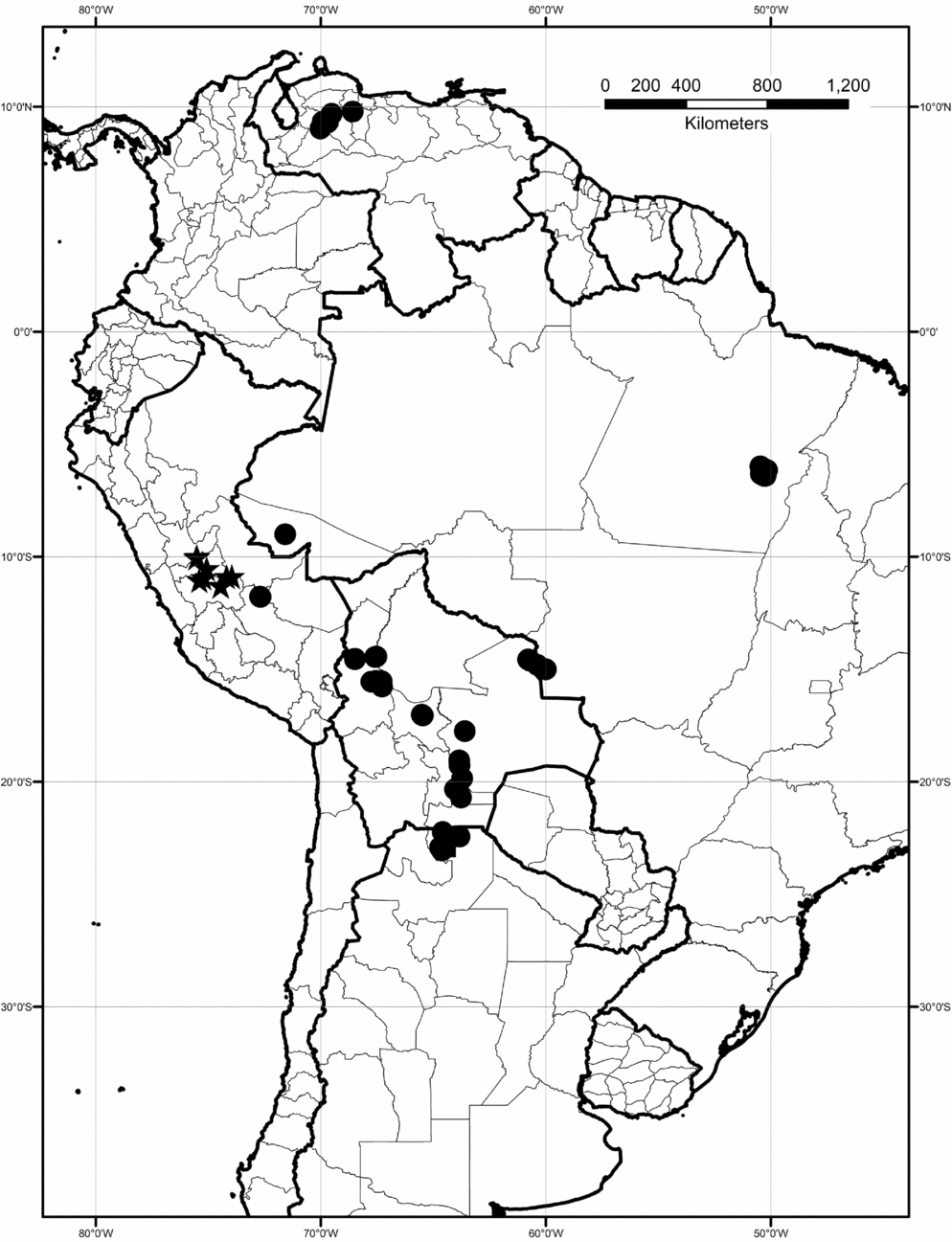
Distribution of Begonia wollnyi (circles) and Begonia arrogans (stars).

Begonia williamsii Rusby & Nash, Torreya 6: 47 (Reference Nash1906), non B. williamsii B.S.Williams (Reference Williams1882). – Type: Bolivia, San Buena Ventura, 14°27′29′′S, 67°35′12′W, 420 m, 14 xi 1901, R. S. Williams 600 (lecto NY! [barcode 00118714], here designated; isolecto BM!, K!, US!).
Begonia acrensis Irmsch., Bot. Jahrb. Syst. 74: 605 (Reference Irmscher1949). – Type: Brazil, Acre State, Rio Acre, Seringal S. Francisco, 9°0′37′′S, 71°35′42′′W, vi 1911, E. H. G. Ule 9649 (lecto US! [barcode US00115231], here designated; isolecto B, G!, K!, U!, US!).
Begonia parodiana L.B.Sm. & B.G.Schub., Darwiniana 5: 88 (1941) – Type: Argentina, Prov. Salta, Dep. Oran, Cerros de Río Ytau, 54 km oeste de Manuela Pedraza, 800 m, 29 x 1938, W. J. Eyerdam & A. A. Beetle 22726 (holo GH!; iso G!, K!, US!), syn. nov.
Caulescent herb, often with a swollen stem base but usually lacking a tuber or rhizome, very rarely a tuber present. Stem erect, becoming somewhat woody at maturity, 0.1–2 m tall, 1–3 cm diameter at base, gradually tapering from base to apex, unbranched or few-branched, internodes (0.3–)2–5 cm long, glabrous. Stipules persistent, oblong or ovate-oblong to triangular, 0.8–2.1 × 0.3–0.8 cm, apex acute, setose, margin entire. Leaves 3–8, alternate, basifixed or peltate with umbo 2.5–6 mm from the margin; petiole joining blade at an angle, 5–16 cm long, glabrous; blade asymmetric, broadly ovate to suborbicular in outline, 8–20 × 8–26 cm, base obliquely cordate, basal lobes spreading, sinus 2–3.5 cm deep, margin with (4–)5–7 lanceolate to lanceolate-triangular lobes, lobes usually about half length of blade, apex of lobes acute or acuminate and often curved, margin serrate toothed, teeth 0.25–2 mm long, ciliate, upper surface green or green with silver white splotches between veins, with a sparse cover of short white hairs, lower surface green or green with a purple tinge, glabrous or with a sparse cover of short white hairs, veins palmate, 5–7. Inflorescences 1–4, axillary, arising from close to apex of stem, ± erect, symmetric 2- to 6-branched dichasial cyme, often produced just before the emergence of the new leaves or shortly after the new leaves have emerged, male flowers usually developing ahead of females but both sexes open concurrently; peduncle 8.5–19 cm long, glabrous or minutely glandular-pubescent; pedicels of male flowers 1.2–1.4 cm long, glabrous or minutely glandular-pubescent; pedicels of female flowers 0.6–1.5 cm long, glabrous or minutely glandular-pubescent; bracts caducous, elliptic, sublanceolate, or oblong, 4.8–8.5 × 1.5–4.8 cm, apex acute, margin and outer surface with minute glandular hairs. Male flowers: tepals (2–)4, spreading, pellucid, green, outer pair ± orbicular, ovate, or obovate, subequal, 0.5–1.25 × 0.7–1 cm, apex rounded, margin entire, outer surface glabrous or with minute glandular hairs, inner pair elliptic, 5–7 × 2–3 mm, apex rounded, margin entire, glabrous; stamens 75–100, golden-yellow to orange, attached to a rounded receptacle, filaments 1.25–2 mm long, those near the centre of the androecium longer than those on the margin, anthers basifixed, obovoid, 0.5–0.75 mm long, dehiscing via unilateral slits, connectives not extended. Female flowers: bracteoles present or absent, when present 2, c.3 mm long, deciduous; tepals usually persisting in fruit, occasionally tardily deciduous, 5, spreading, pellucid, green, ovate to broadly ovate, subequal, 5–9 × 2–6 mm, apex acute, margin entire, glabrous; ovary body ellipsoid, 0.4–1 × 0.3–0.7 cm, green with a pinkish tinge, glandular-pubescent, 3-winged, wings equal to subequal, rounded triangular, front edge ± truncate, rear edge gently convex curved, apex subacute to obtuse, longest wing 0.2–0.9 cm tall, 0.8–1.2 cm wide, shorter two wings 0.1–0.7 mm tall, 0.8–1.2 cm wide, apex obtuse; 3-locular, placentas bifid, bearing ovules on both surfaces; styles 3, free or shortly fused at base, 3–3.5 mm long, bifid from about half their height, branches erect, stigmatic papillae in a once or twice spirally twisted band. Fruiting peduncle 8.5–19.5 cm long; fruiting pedicel elongating as fruit matures, becoming up to 3 cm long. Fruit ± erect, body ovoid or ellipsoid, to 1.1 × 0.8 cm, glabrous, longest wing to 1.5 cm tall, 1.8 cm wide, apex obtuse to acute, shorter two wings to 1.2 cm tall, 1.8 cm wide, apex obtuse to acute.
Phenology
Flowering year-round throughout its range.
Distribution and habitat
A scattered and locally common species of Venezuela (Lara, Portuguesa and Cojedes), Peru (Cuzco), Brazil (Acre, Mato Grosso, Pará and probably Roraima; Kollmann, unpublished), Bolivia (La Paz, Cochabamba, Santa Cruz, Chuquisaca and Tarija) and Argentina (Salta). Occurring on shady, steep rocky banks in humid primary and disturbed forest, from 200 to 1320 m.
IUCN conservation category
Begonia wollnyi is a widespread and often locally common species that occurs in the Andes from Venezuela to Argentina and in Brazil. An IUCN category of Least Concern (LC) is assigned, according to IUCN criteria (IUCN, 2015).
Additional specimens examined. Venezuela. Lara: Distr. Jiménez, Paso de Angostura, sitio de represa de Yacambú, en la confluencia de la Quebrada Honda con el Rio Yacambu, 33 km Sureste de Sanare, 9°41′N, 69°31′W, 500 m, 28–31 vii 1973, J. A. Steyermark & V. Carreño Espinoza 107599 (NY, US), 27–28 xii 1973, 108742 (F, MO, NY, US [2]). Portuguesa: En riberas del Río Guanare, km 4 antes de Biscucuy, entrando a Quanare, 9°20′N, 69°55′W, 500 m, 22 i 1982, E. Rutkis 420 (US); faldas pedre-gosas arriba del puent sobre er Río María, NE de Boca de Monte, 28–32 kms al NNE de Guanare, 9°18–19′N, 69°42–43′W, 400–500 m, 2 xi 1982, J. A. Steyermark, R. Liesner & G. Aymard 127054 (MO [2], US, VEN); Selva en valle de la Quebrada Algarrobo, afluente del Rio Morador, 7 kms al NE de Boca de Monte, 22 kms al NE del vado del Rio Suruguapo, 45 kms al NE por la autopista Guanare-Ospino, en el sitio Las Marias al este de guanare, 9°19′N, 69°41′30′′W, 400 m, 3 xi 1982, J. A. Steyermark, R. Liesner & G. Aymard C. 127239 (MO); 30 km west of Guanare by air, along Río Tucupido, 9°2′N, 70°1′W, 200–300 m, 13 iii 1982, R. Liesner, A. González & B. Stergios 12648 (MO, US); Municipio Guanare, Río Las Narías camino hacia San José de Montaña, 350–1200 m, 27 ix 1981, B. Stergíos & F. Ortega 2949 (US). Cojedes: Dept. San Carlos, Cigarron, orillas del rio San Carlos, 9°47′46′′N, 68°35′22′′W, 230 m, 28 xi 1986, F. Delascio Chitty & R. Lopez 12940 (MO).
Peru. Cuzco: Prov. Cuzco, Distr. Camisea, Campamento San Martin-C, Camisea Production unit, west of camp, 11°47′08′′S, 72°41′57′′W, 467 m, 13 i 1997, P. Acevedo-Rdgz 8682 (CUZ, MO, NY, US, USM); Prov. La Convencion, Distr. Echarati San Martin, 3 well site, 11°46′89′′S, 72°42′10′′W, 400 m, 15 ii 1997, P. Nuñez, S. Baldeon, A. Alonso, J. Santisteban, G. Valencia, K. Anderson, J. Luton, J. Pacaya V. & F. Ramos R. 19107 (USM).
Brazil. Mato Grosso: Serra Ricardo Franco, 15°S, 60°W, 600–700 m, 19 vii 1977, Windisch 1368 (RB). Pará: Serra dos Carajás, “Azul”, near camp at Serra Norte (22 km NW, then 10–15 km SW), 5°59′S, 50°28′W, 500–550 m, 8–12 xii 1981, D. C. Daly, R. Callejas, M. G. da Silva, E. L. Taylor, C. Rosario & M. R. dos Santos 1861 (MG, NY, US); Serra dos Carajás, AMZA camp AZUL, an abandoned manganese exploration camp, 6°06′S, 50°17′W, 500–550 m, 31 v 1982, C. R. Sperling, R. S. Secco, M. Condon & A. L. Mesquita 5903 (K, MG, MO, NY [2], US); Canaã dos Carajás, S11-D, 6°23′31.3′′S, 50°19′9.06′′W, 22 vii 2012, A. J. Arruda, L. F. A. Paula, L. V. Costa & L. J. Batitucci 1217 (BHCB); S11-D, 6°23′31′′S, 50°19′9′′W, 23 v 2012, A. J. Arruda, A. Salino. & L. J. Arruda 1176 (BHCB, MG); S11-D, 6°23′29′′S, 50°19′04′′W, 26 i 2012, L. F. A. Paula, L. V. Costa, M. O. Pivari, L. J. Batitucci & A. J. Arruda 450 (BHCB); Serra Sul, S11-D, 6°24′00′′S, 50°18′56′′W, 12 vi 2014, R. S. Santos, P. G. C. Lima, L. C. B. Lobato & M. R. Coelho-Ferreira 184 (MG); rise of the waterfall, 6°24′29.6′′S, 50°14′52.35′′W, 27 iv 2010, F. D. Gontijo, T. E. Almeida & M. E. Megale 159 (BHCB); Serra Sul, Corpo A, 6°18′33′′S, 50°27′19′′W, 29 vi 2010, T. F. Almeida, F. Marino, M. Megl & A. J. Arruda 2427 (BHCB); Serra Sul, Corpo B, 6°21′18′′S, 50°23′16′′W, 6 x 2009, V. T. Giorni, F. Marino & P. Viana 363 (BHCB); Serra Sul, S/SW do Corpo A, 6°19′43.14′′S, 50°27′17.68′′W, 15 ii 2010, F. D. Gontijo 82 (BHCB, MG); Parauapebas, N7, 6°09′10′′S, 50°10′42′′W, 24 vi 2012, L. V. C. Silva, T. B. Jorge, F. M. G. Santos & R. A. Pereira 1319 (BHCB, MG).
Bolivia. La Paz: Prov. Abel Iturralde, Madidi, Cerranias de los alrededores de San Buenaventura, 14°26′20′′S, 67°32′11′′W, 250 m, 3 xii 2004, A. Araujo-Murakami, P. Gismondi & N. Flores 1381 (MO); Prov. Franz Tamayo, Area Natural de Manejo Integrado Madidi; Unapa, 21 km en linea recta al N de Apolo, 14°32′26′′S, 068°29′46′′W, 1022 m, 1 ix 2004, A. F. Fuentes & C. Aldana 6376 (LPB, MO, NOLS); Prov. Franz Tamayo, Area Natural de Manejo Integrado Madidi, 3 km al norte de Unapa, 14°32′35′′S, 68°29′38′′W, 969 m, 3 ix 2004, L. Cayola, A. Antezana, F. Miranda, C. Quevas & D. Quevas 861 (USZ); Prov. Franz Tamayo, Chaquimayo-Tuichi trail, c.20 km NW of Apolo, just above Rio Machariapo, 1100 m, 7 viii 2000, D. C. Wasshausen & J. R. I. Wood 2279 (US); Prov. Larecaja, along road between Caranavi and guanay, 27.8 km N of Caranavi, 15°33′S, 67°45′W, 865 m, 28 xi 1980, T. B. Croat 51640 (MO); Prov. Nor Yungas, Caranavi c.15 kms hacia Puerto Linares, subiendo por el rio Yara, 850 m, 15 ix 1981, S. G. Beck 31982 (NY), 4822 (US); Prov. Sud Yungas, Alto Beni, arriba de Sapecho, [15°32′S, 67°18′W], 550 m, 29 xi 1993, R. Seidel 7478 (US); Prov. South Yungas, Basin of Rio Bopi, San Bartolome (near Calisaya), 750–900 m, 1–22 vii 1939, B. A. Krukoff 10493 (F, NY). Cochabamba: Prov. Chapare, Avispas-Rio Putintiri, zona muy proxima a Villa Tunari, a 152 km de la ciudad de Cochabamba, 17°1′9′′S, 65°31′25′′W, 16 ix 2007, J. A. Terán, D. O. Soux Pol & E. Rodríguez 974 (MO); Prov. Chaparé, Parque Nacional Carrasco, La Cueva de Guacheros, near road from Villa Tunari to Comunidad El Palmer, small stream near administration building (behind parking lot), 17°3′51.6′′S, 65°28′34.3′′W, 460 m, 4 viii 2002, J. L. Clark 6806 (US [2]); Prov. Carrasco, localidad Guacharos, 17°4′14′′S, 65°27′48′′W, 550 m, 10 ix 2003, S. Altamirano, M. Alem, E. Zurita & C. Orosco 1548 (MO); Santa Cruz: Prov. Jose Miguel de Velasco, Parque Nacional Noel Kempff M., Campamento Las Gamas, Campo Rupestre, 14°48′14′′S, 60°23′59′′W, 850 m, 13 vi 1994, L. P. Arroyo, J. Wellens & E. Gutierrez 815 (MO); Prov. Velasco, Parque Noel Kempff Mercado, Serrania de Huanchaca, trail between Los Fierros and base of Meseta de Caparusch., 300 m, 31 vii 2000, D. C. Wasshausen & J. R. I. Wood 2246 (US); Prov. Velasco, Serrania de Huanchaca Farallon Sur Oeste, senda a Catarata El Encanto, desde el camino del Estación Los Fierros, Parque Nacional Noell Kempff M., 14°37′S, 60°42′W, 200–300 m, 4 xi 1991, R. Foster 13659 (USZ); Prov. Velasco, Parque Noel Kempff Mercado, vicinity of catarata El Encanto, 450 m, 1 viii 2000, D. C. Wasshausen & J. R. I. Wood 2251 (US); Prov. Velasco, Parque Nacional Noel Kempff Mercado, 14°39′38′′S, 60°42′43′′W, 300 m, 19 viii 1996, P. F. Foster, C. Sims & R. Roca 778 (MO); Prov. Ichilo, Parque Nacional Amboró, SE side of gorge of Rio Macuñucú, 17°45′S, 63°36′W, 900 m, 6 xii 1991, M. Nee 41976 (NY); Prov. Sara, Buena Vista, Campos región, 17°36′0′′S, 63°45′0′′W, 450 m, 9 v 1925, J. Steinbach 7218a (BM, F, G, K, MO); Prov. Florida, Bella Vista, circuito ecoturístico el “Chorro del Fraile”, 18°19′26′′S, 63°40′28.7′′W, 1249 m, 13 ix 2007, M. Vargas, Y. Inturias & M. Mendizabal 448 (MO). Tarija: Prov. Aniceto Arce Ruíz, 108 kms de Tarija hacia Bermejo, 5 iii 1988, R. Ehrich 447 (B, LPB); Prov. Aniceto Arce, Bermejo, 109 kms hacia Tarija, 1000 m, 20 x 1983 S. G. Beck & M. Liberman 9607 (US). Chuquisaca: Prov. Hernando Siles, Huacareta Municipality, Serrania Los Milagros. Trayecto Canon – Largo, 20°20′16′′S, 64°2′42′′W, 1575 m, 23 xii 2005, M. Serrano, J. Villalobos, A. Lliully, J. A. Peñaranda & R. Lozano 6875 (MO); Prov. Hernando Siles, Municipio Huacareta, Canton, Rosario del Ingre, comunidad Villa Hermosa, al borde de la quebrada, 20°30′43.6′′S, 63°51′27.4′′W, 973 m, 1 i 2008, A. Flores & M. Jimenez 29 (HSB, MO, US); [Prov. Luis Calvo], Bridge over Rio Asero, 19°3′28′′S, 63°51′48′′W, 1210 m, 29 ix 1949, W. M. A. Brooke 5707 (BM); Prov. Luis Calvo, Villa Vaca Guzman Municipality, PN y Área de Manejo Integrado “Serrania del Inao” Comunidad de Monte Grande, Serrania Nawnaca, 19°16′20′′S, 63°50′33′′W, 1126 m, 24 x 2008, J. L. Villalobos, H. Panique, E. Portales & L. Portales 1680 (MO); Prov. Hernando Siles, Municipio de Monteagudo, parque nacional y área de Manejo integrado de la Serranía del Iñao, 19°43′49′′S, 63°54′56′′W, 1275 m, 10 xii 2008, A. Lliully, J. Peñaranda, E. Mamani, E. Coa & M. Barrientos 1420 (MO); Prov. Luis Calvo, Villa Vaca Guzman Municipality, Serrania del Incahuasi, 19°51′13′′S, 63°43′38′′W, 1318 m, 19 x 2005, A. Lliully, R. León, F. Ortega & J. Vedia 436 (MO); Prov. Luis Calvo, Municipio Villa Vaca Guzman, Canton Iguembe, 20°42′06.2′′S, 63°46′49.7′′W, 1090 m, 16 x 2007, M. Jiménez, C. Ortíz & A. Flores 442 (HSB, MO, US).
Argentina. Salta: Yariguarenda, 3 vii 1944, Schulz-Varela 5178 (LIL); Orán Department, Balapuca [Bala Puca], 20 iii 1972, T. Meyer & A. A. Vaca 23511 (LIL); Orán Department, Pintoscayo, 7 iv 1947, S. A. Pierotti 6576 (LIL); Orán Department, San José, Río Iruya, 858 m, 29 viii 1944, B. Willink 328 (LIL); Orán Department, Río Cañas, 870 m, 25 viii 1944, B. Willink 356 (LIL); Orán Department, Cornisa Río Bermejo, camino a la Quebra. El Arasayal, km 7–8 de Aguas Blancas, 600 m, 26 x 1970, F. Vervoorst & A. R. Cuezze 7735 C (LIL [2]); Orán Department, a 3 km del Puente Intern. Agua Blanca, camino a la Quebra. El Arasayal, P. R. Legname & A. R. Cuezze 7226 C (LIL); Sierras de Ramos, 502 m, 19 iii 1944, s.c. 5463 (LIL); Orán Department, Tartagal River, 14 km W of Manuela Pedraza, 23°3′22′′S, 64°37′18′′W, 900 m, 26 x 1938, W. J. Eyerdam & A. A. Beetle 22635 (GH, K, UC).
Cultivated. New York Botanical Garden, 16 i 1906, G. V. Nash 2795 (NY); New York Botanical Garden, 22 i 1906, G. V. Nash 2795 (NY).
Begonia williamsii Rusby & Nash is herein lectotypified. The original herbarium collection of Begonia williamsii Rusby & Nash (Williams 600, NY barcode 00118714) was collected by R. S. Williams in Bolivia on 14 November 1901, bearing fruit but no flowers (Nash, Reference Nash1906). Seed from this herbarium collection was sown at the New York Botanical Garden, and from the resulting living plants male flowers were collected on 16 January 1906 and female flowers on 22 January 1906. These living collections were used to describe the floral parts of Begonia williamsii Rusby & Nash, and a voucher was deposited at the New York Botanical Garden herbarium (Nash 2795, NY barcode 00118715). According to the International Code of Botanical Nomenclature (Article 9.4; McNeill et al., Reference McNeill, Barrie, Buck, Demoulin, Greuter, Hawksworth, Herendeen, Knapp, Marhold, Prado, Prud'homme van reine, Smith, Wiersema and Turland2012), there are three syntypes: Williams 600, the original collection from Bolivia, and Nash 2795, from New York Botanical Garden, which comprises two syntypes because the male and female flowers were collected on different dates. The first material collected by Williams (Williams 600) we designate as the lectotype, according to Article 9.12, and the remaining two collections represent syntypes.
Begonia acrensis Irmsch. is herein lectotypified. Irmscher (Reference Irmscher1949) cites two syntypes of Begonia acrensis in the protologue for his new taxon, one in Berlin herbarium (B) and one in the United States National Herbarium (US). We designate the specimen at US as the lectotype, because we were unable to locate the Berlin specimen and suspect that it may have been destroyed.
In the protologue for Begonia parodiana Smith and Schubert (Reference Smith, Schubert and Macbride1941) cite the holotype as being located at G, by which they mean Harvard University's Gray Herbarium rather than Geneva.
The specimen Pierotti 6576 (LIL) represents a mixed collection. The sheet consists of the top portion of a stem of Begonia wollnyi bearing three leaves and also two detached infructescences of that species, along with three detached leaves and a single fruit of Begonia micranthera Griseb. The specimen Vargas et al. 448 (MO) represents a mixed collection with a stem and two detached inflorescences of Begonia wollnyi with a leaf of an unknown plant (not Begonia).
2. Begonia arrogans Irmsch. § Knesebeckia, Bot. Jahrb. Syst. 74: 606 (1949). – Type: Peru, Dept. Junín, Pichis trail between Azupizu and Santa Rosa, 650 m, 28 vi–8vii 1929, E. P. Killip & A. C. Smith 26137 (lecto US! [barcode US00115245], here designated; isolecto F!, NY!). Fig. 1.
Caulescent herb, lacking a tuber or rhizome. Stem erect, becoming somewhat woody at maturity, 0.75–1 m tall, 5–8 mm diameter, few-branched, internodes 0.5–5.5 cm long, glabrous. Stipules tardily deciduous, oblong-ovate, 1.1–2.2 × 0.4–0.9 cm, apex acute, setose, margin entire. Leaves few, alternate, basifixed; petiole joining blade at an angle, 10–17 cm long, glabrous; blade asymmetric, ovate to oblong-ovate, 13–42 × 5.5–21 cm, apex acute or acuminate, base obliquely cordate, basal lobes spreading, sinus 0.8–5.5 cm deep, margin with up to irregular ± triangular lobes, lengthening towards the apex of the leaf, or lobes lacking, lobes when present up to one-third length of blade, lobes to 16 cm deep, apex of lobes acute and often slightly curved towards the apex of the leaf, margin crenate toothed, teeth 0.2–2.5 mm long, ciliate, upper surface green with silver white splotches between veins in immature plants, green in mature plants, glabrous, lower surface wine red in immature plants or pale green in mature plants, glabrous, veins palmate-pinnate, 6–8. Inflorescences few, axillary, arising from close to apex of stem, ± erect, ± symmetric, 3- to 6-branched dichasial cyme, male flowers usually developing ahead of females but both sexes open concurrently; peduncle 11–14 cm long, glabrous; pedicels of male flowers 6–8 mm long, glabrous; pedicels of female flowers 0.6–1.8 cm long, glabrous; bracts deciduous, ovate or oblong, 0.6–1 × 0.25–0.42 cm, apex acute, margin entire, glabrous. Male flowers: tepals 4, spreading, white with a pinkish flush on outer surfaces, outer pair subcordate, 6–7 × 6–7 mm, apex subacute, margin entire, glabrous, inner pair elliptic, c.4 × 1.8 mm, apex shape, margin entire, glabrous; stamens 30–40, yellow, attached to a flat receptacle, filaments 0.5–2 mm long, anthers symmetrically basifixed, obovoid, c.0.5 mm long, dehiscing via unilateral slits, connectives shortly extended. Female flowers: bracteoles absent; tepals persisting in fruit, 5, spreading, white with a pinkish flush on outer surfaces, outer two ovate, 5–12 × 2.8–6 mm, inner three elliptic, 5–7 × 2–3 mm, apex of all tepals acute, margin entire, glabrous; ovary body ovoid to ellipsoid, 8–12 × 5–7 mm, pinkish white, glabrous, 3-winged, one wing slightly longer than the other two, longest wing, semicircular, front edge gently curved to ± truncate, apex obtuse, 12–15 mm long, 6–8 mm wide, two shorter wings semicircular, 11–14 mm long, 4–6 mm wide, front edge gently curved, apex rounded; 3-locular, placentas bifid, bearing ovules on both surfaces; styles 3, shortly fused at base, 1.8–3.5 mm long, bifid from about half their height, branches erect, stigmatic papillae in a once to twice spirally twisted band. Fruiting peduncle c.14 cm long; fruiting pedicel to 1.8 cm long. Fruit almost erect to nutant, body ovoid to ellipsoid, to 1.4 × 0.8 cm, glabrous, longest wing to 2 cm long, 1.3 cm wide, apex obtuse, shorter two wings to 1.8 cm long, 0.9 cm wide, apex rounded.
Phenology
Collected in flower in February and in June to September.
Distribution and habitat
A narrow endemic of central Andean Peru (Ucayali, Pasco, and Junín). Occurring on shaded, rocky slopes in dense forest, from 550 to 1040 m.
IUCN conservation category
Begonia arrogans is common within its range and has been collected in disturbed areas, including regularly cut roadside banks. Although the species has not been collected within any protected areas, it has tentatively been identified from photographs taken within Parque Nacional Yanachaga-Chemillén (Moonlight, unpublished). The population of the species appears stable, therefore we assess the species as Least Concern (LC) under IUCN criteria despite its relatively small extent of occurrence of c.13,000 km2.
Additional specimens examined. Peru. Ucayali: Prov. Atalaya, road from Puerto Ocolpa to Atalaya, c. km 105, 10°53′23′′S, 73°57′1′′W, 553 m, 15 ii 2016, P. W. Moonlight & A. Daza 250 (E); Prov. Atalaya, km 53 of road from Puerto Ocalpa to Atalaya, 10°53′50′′S, 74°11′’39 ′′W, 835 m, 14 ii 2016, P. W. Moonlight & A. Daza 242 (E). Pasco: Prov. Oxapampa, route from Pozuzo to Cado de Pozuzo, 10°0′22′′S, 75°30′31′′W, 655 m, 20 ii 2016, P. W. Moonlight & A. Daza 285 (E); Prov. Oxapampa, Camino to mirador from Pozuzo, 10°3′59′′S, 75°32′57′′W, 792 m, 20 ii 2016, P. W. Moonlight & A. Daza 277 (E); Prov. Oxapampa, along road Chatarra–Cacazu, disturbed forest, 10°32′S, 75°4′W, 700 m, 13 viii 2003, H. van der Werff 18425 (MO). Junín: Prov. Chanchamayo, c.9.5 km NW of San Ramon on dirt road along E side of Rio Oxabamba valley, 11°3′22′′S, 75°24′30′′W, 1042 m, 22 vi 2014, P. W. Moonlight & A. Daza 27 (E); Road Mazamari–Puerto Ocopa, path to waterfall, 11°17’8′′S, 74°27′45′′W, 610 m, 30 ix 2007, R. T. Pennington & A. Daza 1982 (E); Prov. Satipo, Route from Mazamari to Puerto Ocapa. Path to catarata Arco Ibis, c.25 m on to trail, 11°18′1′′S, 74°27′26′′W, 562 m, 14 ii 2016, P. W. Moonlight & A. Daza 239 (E).
Irmscher (Reference Irmscher1949) in his protologue of Begonia arrogans cites two syntypes, one in US and one in F. We designate here the specimen in US as the lectotype, because it includes the best-preserved floral material of the two specimens.
Colour photographs of the collections Moonlight & Daza 27, 239, 242 and 250 and of Pennington & Daza 1982 growing in situ are available on Hughes et al. (Reference Hughes, Moonlight, Jara, Tebbitt, Wilson and Pullan2015–).
Acknowledgements
We thank the curators of B, BHCB, BM, COL, CPUN, CUZ, E, F, G, GH, HSB, HUT, K, LIL, MG, MO, MOL, NOLS, NY, P, QCA, QCNE, QPLS, RB, UC, US, USM, USZ and Z for allowing us to work in their herbaria or for making material available to study. The American Begonia Society, Fundación Miguel Lillo, University of Edinburgh Davis Expedition Fund, and James and Eve Bennett Trust are gratefully acknowledged for funding the fieldwork. Alexander Parada (USZ), Aniceto Daza Yomona (MOL), Eva Bulacio (LIL) and Hugo Ayarde (LIL) are gratefully acknowledged for their help in the field. LJCK thanks the Instituto Nacional da Mata Atlântica, from the Ministério da Ciência, Tecnologia, Inovação e Comunicação, Programa de Capacitação Institucional (CNPq – 312488/2016-5).