

Introduction
Advances in psychology and behavioral economics have credibly identified numerous decision-making biases leading people to make choices they would not have made if better informed about the long-term consequences of their actions. This has led to calls for coercive government involvement in correcting these biased choices and revived the case for government paternalism in areas such as obesity and financial decision-making. Governments across the world have been experimenting with such regulation. Both the Obama administration in the US and the Cameron administration in the UK explicitly tried to harness behavioral economics in nudging or lightly coercing individuals to choose differently than they would have done on their own, by changing framings, default options or broader choice architectures. More direct measures have also been proposed, implemented – and abandoned. The former mayor of New York City, Michael Bloomberg, famously advocated a limit on the size of soda cups, the Danish government implemented and later, citing administrative difficulties, rescinded a so-called fat tax (Bødker et al., Reference Bødker, Pisinger, Toft and Jørgensen2015), and the UK has introduced auto-enrollment pension schemes (Clark & Knox-Hayes, Reference Clark and Knox-Hayes2009). Such policies are controversial, not least because they expand state powers, and they do it into domains often considered to be within people's private realm.
In this article, we investigate theoretically and empirically the role and understanding of self-interest in the formation of attitudes toward a broad class of policies aimed at correcting individual decision-making failures by influencing or overruling voluntary individual decisions. We follow Le Grand and New (Reference Le Grand and New2015) and denote a government intervention toward an individual as paternalistic if it is intended to address a failure of judgment by that individual and it is intended to further the individual's own good. We look at cases where the government intervention is intended to – but ultimately may fail to – help the individual achieve one of his or her ultimate objectives, such as obtaining better health, rather than intended to change the emphasis an individual places on one ultimate objective vs another. In the language of Bernheim (Reference Bernheim2016), this means that we are focusing on failures of indirect judgments rather than failures of direct judgments. This definition of paternalism does not exclude policies that also include considerations on costs borne by taxpayers, so-called fiscal externalities (discussed below).
Classical liberalism has forcefully argued against interference with individual decision-making, insisting that individuals themselves are in the best position to make choices concerning their own welfare. Consequently, in cases not involving the possibility of harming others, it is argued that the state should refrain from overriding individual choice (Mill, Reference Mill1869). This argument finds support from the view that governments lack the benevolence or knowledge to improve people's well-being through paternalism, that paternalism may infringe upon individuals’ rights and that paternalism may be a slippery slope for further interference with individual behavior and rights. It also finds support in neoclassical economics, where rational decision-makers would trade off costs and benefits in ways that are individually optimal, and the state (or other outside actors) would be unable to improve upon these choices. However, research in psychology and behavioral economics demonstrates that individuals may suffer from decision-making biases, including, for the purposes of this article, cases where short-term benefits may be incorrectly weighted against future costs. That said, it is also possible to construct an argument against interference with individual decision-making from the perspective of behavioral economics (see Sugden (Reference Sugden2018) for an argument to that end).
In our analysis, we consider attitudes toward legislation intended to affect smoking, consumption of unhealthy food, pension savings and the take-up of risky mortgages. These choice domains are all characterized by potentially conflicting short-term and long-term goals within individuals (Thaler & Shefrin, Reference Thaler and Shefrin1981). Outcomes may be attractive in the short term – e.g., spending rather than saving for pension (Weiss, Reference Weiss1991; Thaler & Benartzi, Reference Thaler and Benartzi2004) or the consumption of comforting, but unhealthy food (O'Donoghue & Rabin, Reference O'Donoghue and Rabin2006) – but influence long-term welfare negatively. Decisions that do not adequately account for long-term consequences due to the existence of choice biases are said to have internalities (Herrnstein et al., Reference Herrnstein, Prelec, Loewenstein, Elster, Loewenstein and Elster1992; Rabin, Reference Rabin2013), and it is these internalities that are the subject of interest for policy-makers and regulators.
Our investigation of attitudes toward paternalism is based on two large-scale data sets. The primary data set combines a survey carried out in Denmark in 2014 with third-party individual-level administrative data. We use anonymized personal identifiers to merge the two data sources. In the survey, we elicit attitudes toward paternalism across four policy domains, political attitudes, and self-reported behavior and outcomes, including smoking habits and body mass index. We combine this with administrative data on economic choices and outcomes, including pension payments, type of mortgage and borrowing behavior in the credit market. Methodologically, the presence of third-party reported data is important as social desirability bias and self-deception may introduce measurement error into self-reported behavior on sensitive issues (Hariri & Lassen, Reference Hariri and Lassen2017), including health and financial circumstances. The second data set is a cross-country survey from 2017, where we elicit attitudes using the same survey instruments to examine the validity of the findings from the detailed study beyond Denmark. This is important, both because individual views on the role of the state – and the relationship between individual characteristics and such views – may differ across countries and since extant evidence has shown Denmark to be an outlier in attitudes toward the closely related concept of nudging (Reisch & Sunstein, Reference Reisch and Sunstein2016), which we consider separately below.
We show, across all policies in both the health and financial domains and both in Denmark and in the cross-country setting, that targets of paternalism – “paternalees” (Lusk et al., Reference Lusk, Marette and Bailey Norwood2014) – are more opposed to paternalistic policies than those whose behavior would not be affected by such policies. This holds true even for individuals with self-reported self-control problems. Paternalists – people who support implementing paternalist policies – are motivated by altruism, meaning that they are trying to make paternalees better off. Support for paternalism is strongly increasing in years of education and is more pronounced among left-wing voters and people who trust government. Concerns about the costs borne by taxpayers, fiscal externalities, are important for support for paternalism in the health domain. Comparisons of attitudes toward questions that are trying to capture hard paternalism and questions on nudges suggest that paternalee resistance is largely coming from concerns over relinquishing the freedom to choose.
While there is, as far as we know, no work on attitudes toward paternalism across domains that use third-party reported data on individual decisions, a number of papers have considered public opinion toward policies aimed at addressing smoking with a self-interest perspective (Green & Gerken, Reference Green and Gerken1989; Hersch, Reference Hersch2005), and, more recently, obesity (Oliver & Lee, Reference Oliver and Lee2005; Lund et al., Reference Lund, Sandøe and Lassen2011; Gollust et al., Reference Gollust, Barry and Niederdeppe2014) separately. Diepeveen et al. (Reference Diepeveen, Ling, Suhrcke, Roland and Marteau2013), Pedersen et al. (Reference Pedersen, Koch and Nafziger2014) and Gyrd-Hansen and Kjær (Reference Gyrd-Hansen and Kjær2015) consider attitudes toward smoking and obesity jointly, but do not consider decision-making in the economic domain, nor broader motivations for attitudes toward paternalism. Recently, there has also been a number of studies considering attitudes toward nudges across domains (Felsen et al., Reference Felsen, Castelo and Reiner2013; Loewenstein et al., Reference Loewenstein, Bryce, Hagmann and Rajpal2015; Reisch & Sunstein, Reference Reisch and Sunstein2016; Sunstein, Reference Sunstein2016; Tannenbaum et al., Reference Tannenbaum, Fox and Rogers2017; Arad & Rubinstein, Reference Arad and Rubinstein2018).
Conceptual framework
In this section, we use theories from neoclassical economics, behavioral economics, psychology and political science to outline how attitudes to paternalism may be shaped. In the subsequent section, we attempt to operationalize these theories using our data at hand, and in the remaining part of the article, we attempt to test their validity.
Paternalistic policies seek to override individual choice with the specific aim of protecting people from the consequences of their own choices, that is, to save people from themselves. This means that the concept of self-interest is more complex than when individual choice is synonymous with self-interest, as in the neoclassical idea of revealed preference, where choices are made precisely because they are optimal for the individual and, as a consequence, reveal individual preferences.
What do behavioral shortcomings mean for how we conceptualize and understand self-interest in attitude formation? We distinguish between three types of self-interest: The “classical” self-interest, behavioral self-interest and procedural or expressive self-interest.
Under classical self-interest, everyone who sees their choices constrained by paternalistic policies will disapprove of the policy, as they were already choosing optimally. Classical self-interest can also be invoked if individual behavior has external effects. Examples include when tax payers or co-insurees pay for health costs associated with other people's unhealthy life-styles, or when the lack of pension savings on part of the population leads government to pay out pensions instead, at the cost of tax payers (Le Grand & New, Reference Le Grand and New2015). These effects, called fiscal externalities, may cause people without self-control problems, and those who are not cognizant of having such problems, to support paternalistic policies. Since such support could also arise in domains with fiscal externalities but no self-control problems, the support only becomes related to paternalism if it is grounded in thinking that others’ irrationality is costly for them. Non-paternalistic policies often exist to address fiscal externality concerns, such as policies that align insurance premiums better with individual risk assessments. People in favor of paternalism for reasons of fiscal externalities alone may prefer such policies to the policies asked about here.
Behavioral self-interest allows for the possibility that an individual's choices may not be the best available decision or consistent with long-term welfare. For example, Thaler and Shefrin (Reference Thaler and Shefrin1981) contrast short-term goals of individuals as “myopic doers” with long-term goals of individuals as “farsighted planners.” In our case, myopic doers may consume unhealthy food for short-term benefit without trading such consumption off against long-term health consequences. For people with self-control problems, it may be in their self-interest to save for pensions, even if they do not save at present. Respondents with self-control problems could favor paternalism, as it could be consistent with their own objectives. This crucially depends on whether individuals are aware of their self-control problems or not – whether they are “sophisticated” or “naïve.” Hersch (Reference Hersch2005) and Gyrd-Hansen and Kjær (Reference Gyrd-Hansen and Kjær2015) find in the health domain that respondents with self-reported self-control problems are indeed more supportive of paternalism than respondents who do not report self-control problems. This is not a given, as such respondents may prefer to self-paternalize, such as entering contracts with themselves or close friends to set incentives for reaching long-term goals rather than being influenced by government policies. The attitudes of individuals not subject to behavioral biases will depend on actual policy design. For example, if paternalistic policies aimed at helping individuals with self-control problems also affect the consumption of rational consumers, ceteris paribus, they will be more opposed to such policies.
Procedural or expressive self-interest can be a factor that influences attitudes toward policy (Saint-Paul, Reference Saint-Paul2011). If people value making their own decisions separately from the outcome of these decisions, as suggested by experimental evidence (Bartling et al., Reference Bartling, Fehr and Herz2014; Owens et al., Reference Owens, Grossman and Fackler2014), then individuals with behavioral biases may have to trade off the gain arising from paternalistic policies yielding better outcomes against the intrinsic value of autonomy and influence on one's own life. Even paternalees with known self-control problems may in this case be against paternalism. Autonomy could also matter instrumentally if individuals believe that they through trial and error learn how to make better decisions, which paternalistic policies may impede upon (Wright & Ginsburg, Reference Wright and Ginsburg2012). Additionally, some people may value influencing others as a separate goal, getting benefits from being moralizing (Petersen, Reference Petersen2013) and being “meddlesome” (Blau, Reference Blau1975). This could lead non-targets of paternalism to favor paternalism.
Beyond self-interest
In addition to self-interest, we consider four factors that can affect attitudes toward paternalism: altruism, political values, trust and attributions of responsibility for individual behavior and outcomes.
Some non-targets of paternalism may be concerned with the welfare of others and believe that the paternalees are engaging in irrational behavior that make them worse off by their own standards. In this case, non-targets may favor paternalism on altruistic grounds, separate from concerns of fiscal externalities. Jacobsson et al. (Reference Jacobsson, Johannesson and Borgquist2007) find that most individuals who wish to improve the health of smokers with diabetes do so in a paternalistic manner.
Political values can matter as some individuals may not have well-established preferences over the appropriateness of paternalistic policies and hence employ representative heuristics, relying on attitudes toward related policy questions to form an attitude, such as their views on redistribution.
Individuals’ general level of trust in politicians can matter for attitudes toward paternalism in many ways. Due to asymmetric information, citizens may not trust that politicians are capable of knowing what is in the best interest of the paternalees; indeed, knowing what is good for individuals becomes increasingly hard in a behavioral world, in particular since they may not know, or realize it, themselves. Furthermore, they may consider paternalistic policies a “slippery slope” for granting more authority to politicians. Even if they favor specific paternalistic policies in isolation, they may express negative attitudes toward them because they do not trust politicians would use this expanded authority optimally (Camerer et al., Reference Camerer, Issacharoff, Loewenstein, O'Donoghue and Rabin2003; Wright & Ginsburg, Reference Wright and Ginsburg2012).
Finally, individuals who hold others responsible for their choices may be more likely to oppose paternalism (Oliver & Lee, Reference Oliver and Lee2005). For example, if individuals think obesity is a result of lack of self-control, they may be less likely to support paternalistic policies than if they think obesity is a result of socioeconomic upbringings beyond individual control. Relatedly, if they think decisions in a specific domain are more complex, they might not hold individuals accountable for their outcomes, which could make the case for paternalism is stronger (Conly, Reference Conly2012; Bhargava & Loewenstein, Reference Bhargava and Loewenstein2015). Yet complexity also makes policy intervention more difficult, which could lower the support for paternalism.
Data and empirical specification
To gauge which of these various channels matter for attitudes toward paternalism, we carried out a telephone survey on savings, consumption behavior and political attitudes in 2014.Footnote 1 6009 people selected randomly from the Danish population among those who held any employment between 1998 and 2004 were interviewed. The response rate was 49.1%. The data were collected by a professional survey firm and linked to administrative data at Statistics Denmark after approval by the Danish Data Protection Agency. Pseudonymized data are analyzed at secure servers. We remove respondents with missing values in our key dependent variables leaving us with a total sample of 5411 respondents.
Dependent variables
We asked four questions on regulation of individual choices:
In recent years, the extent to which the state should decide over people's actions has been discussed. Do you agree or disagree that the state should legislate in order to affect, among other things:
• How much people smoke?
• Whether people eat unhealthy food?
• Whether people save for pensions?
• Whether people can take out interest-only mortgages?
The answer categories were as follows: (1) Strongly disagree, (2) Partly disagree, (3) Neither agree nor disagree, (4) Partly agree, (5) Strongly agree (and (6) Don't know, which was not read aloud). The order of the four questions was randomized.
The four questions can all represent cases of government paternalism according to a long list of paternalistic policies surveyed in Le Grand and New (Reference Le Grand and New2015). In line with the chapter division in Thaler and Sunstein (Reference Thaler and Sunstein2008), they cover the two major domains of paternalistic policies, health and financial decisions. To be paternalistic, one of the motivations for such policies should be to address a failure of judgment by the individual for the individual's own good. Naturally, these policies may have other motivations as well, such as combating negative externalities and equity concerns.
The answers to the questions depend on the specific framing that we used. We deliberately sought to assess opinions toward coercive paternalism by using the word “decide,” rather than, say, “influence” in the phrase on whether “the state should decide over people's actions.” Whereas nudges rarely with certainty will decide which of several options an individual will choose, coercive paternalistic policies – such as mandatory retirement savings and bans on smoking – will, at least in isolated contexts, decide over people's actions. That said, we cannot exclude that some of the survey respondents nonetheless thought about soft paternalism when answering our questions. We also deliberately asked the questions at a very high and abstract level rather than referring to specific policy suggestions, such as banning smoking at bars or levying fat taxes. We did so since such specific policies have been heavily discussed both in Denmark and in the countries in our cross-country sample, and we expect our respondents have quite specific attitudes toward these policies that may not map unto their attitudes toward paternalism in general. In particular, attitudes toward policies that already have been discussed or implemented may be strongly correlated with attitudes toward the political parties that advocated for these policies (Tannenbaum et al., Reference Tannenbaum, Fox and Rogers2017).
Paternalee indicators
We match each question on attitudes to paternalism with one or more variables indicating whether the respondent would be a likely target of the policies in the particular domain. For the question on smoking, we elicit smoking behavior with the question: We would like to know if you (1) are a smoker; (2) are a smoker, but have tried to quit; (3) have been a smoker, but have quit; (4) never have been a smoker. For the question on unhealthy food, we calculate respondents’ BMI based on answers to questions on height and weight. We measure pension savings behavior by the total pension contributions relative to disposable income, including both mandatory payments, as part of collective labor market agreements, and private pension savings declared as such in order to enjoy privileged tax treatment, both from administrative data. We use data from the 13 years we have information on their pension savings to smooth out potential annual fluctuations. This will serve as a proxy for the degree to which individuals forego current consumption in order to increase pensions. Mortgage type for homeowners is measured in the administrative data. We look at whether respondents have variable or fixed interest rate mortgages and whether they have interest-only or interest and repayment mortgages. In addition, we compute the marginal borrowing rate faced by the respondent (Kreiner et al., Reference Kreiner, Lassen and Leth-Petersen2019). We use the administrative data for socio-demographic information on the respondents; their gender, age, family status, income, education and immigrant status.
Variables for hypothesis testing
The survey contains specific questions that allow us to test which of the hypothesized theories that have empirical support. Most of our survey variables are gauged by standard survey questions adapted from the GSS and European Social Survey. We measure political preferences by a question on attitudes toward redistribution on a scale from 1 to 5. Trust in politicians is elicited by combining answers to a question on whether the respondents trust the government and whether they trust the main opposition party. We do so to assure that the trust variable does not capture political preferences for the current government.
Individuals with different time and risk preferences will have different behaviors under rational self-interest (Frederick et al., Reference Frederick, Loewenstein and O'Donoghue2002). We attempt to control for this by eliciting respondents’ time and risk preferences: Time preferences are self-reported on a scale from 0 to 10 (10 being very patient) and risk preferences on a similar scale (10 being very risk averse). Non-incentivized self-reported risk and time preferences may obviously fail to fully capture individuals’ true degree of risk aversion and patience, and results should be interpreted with this in mind.
In the smoking domain, we define people with self-control problems as individuals who have tried to quit smoking but still smoke. One interpretation is that these smokers are sophisticated behavioral, i.e., cognizant of their self-control problems, but feeling unable to quit smoking. Obviously, some of these individuals may no longer wish to quit and others may have failed for reasons not related to lack of self-control, such as suffering from severe physical symptoms from attempting to quit. Conversely, others may have self-control problems as well, but may not recognize it or may try to justify their actions in order to reduce cognitive dissonance. In the financial domain, we identify individuals as having self-control problems if they answer positively to a question on whether it is difficult for them to control their expenses (Rick et al., Reference Rick, Cryder and Loewenstein2007). Some individuals may have a hard time controlling their expenses unrelated to self-control problems but because they live under a tight budget. We will control for individuals’ annual gross income, measured through administrative data. Again, others may have self-control problems as well but may misreport their answers or fail to acknowledge their shortcomings.
We measure attributions of responsibility by a question on whether individuals believe that success requires more luck than hard work. Presumably, individuals who think success requires mostly hard work on average hold individuals more responsible for their choices, also when it comes to health and financial decisions. Everything else equal, this would on average make them less inclined to support paternalistic interventions. Some respondents may answer the question based on whether they believe societal institutions are fair rather than based on individual-level health or financial choices. This means that the question is a noisy predictor of what we are trying to capture, which may attenuate the coefficient we estimate from this question.
We elicit concerns about fiscal externalities by asking people whether they think that smokers should pay for smoking-related hospital bills. If individuals answer yes to this question, they are presumably concerned about costs to society. Since we will be controlling for preferences for redistribution, the coefficient on the hospital bills question should not be driven by political preferences. For the channel from fiscal externalities to have support, individuals who think smokers should pay for smoking-related bills should be more in favor of paternalism. Yet even if this is the case, the support may not be grounded in paternalism per se, but rather in favor of a policy that reduces externalities (regardless of whether the externalities occur due to lack of self-control of smokers or not). While focused on smoking, we also tentatively investigate this measure across domains. This is problematic if smoking generally is perceived to be worse than some of the behaviors elicited in other domains, in which case we may classify some individuals as being concerned about fiscal externalities in domains where they are not. This would tend to attenuate the coefficient we estimate on this variable in other domains.
To examine the role of altruism, we distinguish people by their views on a very heavy-handed policy intervention: banning smoking. While radical, smoking bans have been implemented in Denmark in the past decade: outside schools, in public workplaces and, somewhat controversially, on railway stations. We ask respondents: “Do you think that a general smoking ban will benefit smokers?” This question, if indirectly, gets at the cause of supporting paternalism. If individuals in favor of paternalism answer yes to this question, then altruism could be a motivating factor. That said, we cannot distinguish individuals by whether they answer yes to the question because they think it will make smokers better off by the smokers’ own standards or because they think it will make smokers better off when imposing their own standards on the smokers. As for fiscal externalities, the internal validity is strongest when considering paternalism over smoking as the dependent variable, but we tentatively assume that answers to this item are informative about preferences in other domains too. Like with fiscal externalities, if smoking is perceived differently than the behaviors elicited in other domains, we may classify some individuals as being motivated by altruism in domains where they are not. This would tend to downward bias the coefficient we estimate on this variable in other domains.
We classify individuals’ as being moralizing or meddlesome based on their answers to a question asked as part of the Big-Five inventory (Gosling et al., Reference Gosling, Rentfrow and Swann2003). The particular question we use asks respondents whether they have a tendency to focus on other people's flaws. Finally, we address whether values relating to freedom and personal autonomy matter for attitudes by comparing attitudes to our main questions, which we, as argued, think mostly capture attitudes to coercive paternalism, with attitudes toward nudging.
We normalize all the hypothesis variables to lie in the interval between zero and one to foster comparisons in later regressions. Summary statistics of all the variables are shown in Supplementary Appendix Table A.1.
Empirical specification
We model attitudes toward paternalistic policies for an individual i in domain d as

Here, ${\rm behavior}_i^d$ refers to the revealed behavior of an individual in a given domain, hypothesisi refers to a number of alternative or complementary hypotheses listed above and sociodemographicsi to socio-demographic control variables. The dependent variables are measured using a Likert scale and, as such, could be analyzed using an ordered discrete choice model. However, for ease of interpretation, we use OLS with robust standard errors. Throughout, results are qualitatively similar in terms of sign and degree of statistical significance when applying ordered logit models (see Supplementary Appendix Table A.2). A concern, both with ordered logit models and OLS, is that results could be driven by, say, differences between those who disagree strongly and those who disagree (where most of the mass of answer distributions is located). For robustness, we constructed a binary variable equal to one if a respondent agrees or strongly agrees, and zero in case of disagreement or no strong opinion. This, too, yields results that are qualitatively similar to the OLS results (see Supplementary Appendix Table A.3).
Main results
In this section, we first describe the distributions of attitudes toward paternalistic policies in different domains and how individuals’ attitudes covary across domains. Subsequently, we test our key hypotheses in a standard, multivariate regression framework and explore how different explanations for approval of or resistance to paternalism are supported in the data.
Descriptive results
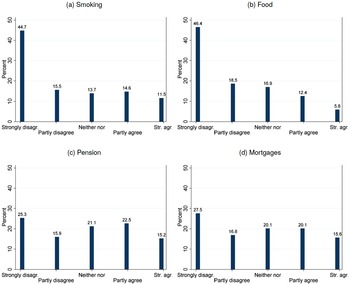
Figure 1 shows the distribution of answers to the key questions on paternalism. In general, respondents are skeptical of government paternalism in the form of legislation and regulation. About 60% disagree with the statement that the government should legislate to regulate smoking, and 65% disagree with legislation to influence consumption of unhealthy food. Respondents are more favorable toward government legislation in the economic domain, with only about 40–45% disagreeing that the state should affect whether people save for pension or take out risky, interest-only mortgages. Interestingly, this is reverse from Gold et al. (Reference Gold, Lin, Ashcroft and Osmanforthcoming) who consider nudges and find greater support for health-related behavioral interventions than for financial behavioral interventions.
Attitudes toward paternalistic polices.
Note: Histograms over dependent variables, n = 5411.

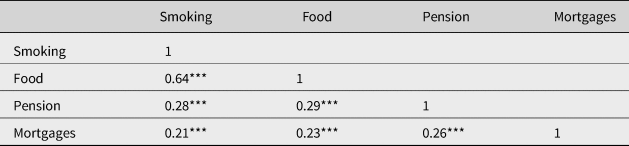
Table 1 shows the Spearman's rank correlation matrix for the answers. Attitudes to all categories of paternalistic policies are significantly positively correlated. Attitudes to legislation toward smoking and unhealthy food are considerably stronger correlated.
Spearman's rank correlation of attitudes toward paternalism

Note: *p < 0.10, **p < 0.05, ***p < 0.01.
The theories outlined in the previous section may help explain why we find a greater support for paternalistic policies in the economic domain than in the health domain. In recent years, Danish politicians have discussed and implemented various laws with regards to smoking and unhealthy products. Some of these policies, such as sugar and fat taxes, were so unpopular that the government had to repeal them (Bødker et al., Reference Bødker, Pisinger, Toft and Jørgensen2015). Due to individuals’ likely exposure to these debates, they may be more aware of the loss of autonomy these policies entail, and consequently display a stronger reactance to furthering paternalism in this domain. Paternalism in the economic realm, on the other hand, has been less discussed. This could lead individuals to be unaware of their choice-diminishing content and hence to support these policies to a greater extent.
Another possibility is that individuals possess (or believe they possess) more knowledge about food consumption decisions than they do about financial decisions. As a result, they can have more established preferences in this area and see less of a need for the government to intervene. In contrast, in the economic domain, the complexity of financial products may lead people to acknowledge that they do not fully understand the financial world and accept government interference. Hence, it is possible that individuals hold others responsible for poor food and cigarette choices but not for poor financial choices. Indeed, evidence suggests that even credit-savvy individuals tend to make inferior choices when selecting credit cards (Hilchey et al., Reference Hilchey, Osborne and Somanforthcoming).
The divergence in attitudes may also be explained by behavioral self-interest if there is a larger share of individuals with cognizant self-control problems in the economic realm than in the food and smoking realm. Finally, this pattern could be explained by respondents estimating the costs of fiscal externalities from inoptimal financial decisions, say, in the form of a financial crisis, to be greater than costs associated with health choices.
Paternalees vs paternalists
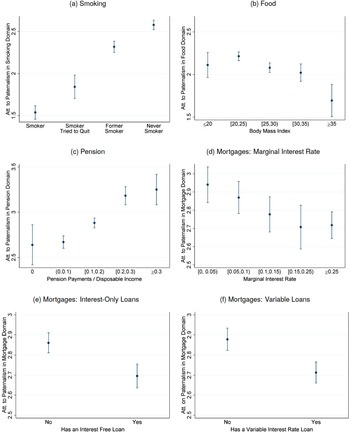
Next, we assess the bivariate relationships between paternalee indicators in each of the four policy domains and attitudes toward paternalism in these domains. Figure 2 shows the mean attitude to paternalism categorized by whether the respondent is a likely paternalee or not.
Paternalees’ attitude toward paternalism.
Note: Attitudes toward paternalistic policies categorized by individuals who are likely targets of these policies and individuals who are unlikely targets of these policies. The y-axis reports the mean answer on a scale from 1 to 5 where 5 indicators support for paternalism while 1 indicates opposition. Bars indicate 95% confidence interval. In all cases, Wilcoxon–Mann–Whitney tests or Kruskal–Wallis tests reject identical distributions at the 1% level, n = 5411.

The figure reveals a consistent pattern. In all cases, the likely targets – and intended beneficiaries – of paternalism are significantly more opposed to paternalism than the non-targets. Smokers are much less supportive of paternalistic policies aimed at reducing smoking. Respondents with a high BMI are less supportive of paternalistic policies targeted unhealthy eating. Respondents with smaller pension payments relative to disposable income, i.e., those more reluctant to trade current consumption for larger savings for old-age, are strongly against paternalism with regards to pension savings despite likely being the ones who under-save. Individuals who have the most risky and shortsighted mortgage loans in the form of variable interest rates and interest-only loans, or who face high marginal interest rates, are the least supportive of regulating the availability of interest-free loans. In all cases, Wilcoxon–Mann–Whitney tests or Kruskal–Wallis tests reject identical distributions at the 1% level. These findings are consistent with what Gyrd-Hansen and Kjær (Reference Gyrd-Hansen and Kjær2015) report in the smoking and health domain. The patterns could be explained by revealed preference on behalf of potential paternalees: If they believe they are already choosing optimally, they see no need for government intervention. However, they could also be explained by choice-biased individuals being naïve, i.e., not aware of their own biases. We return to this below.
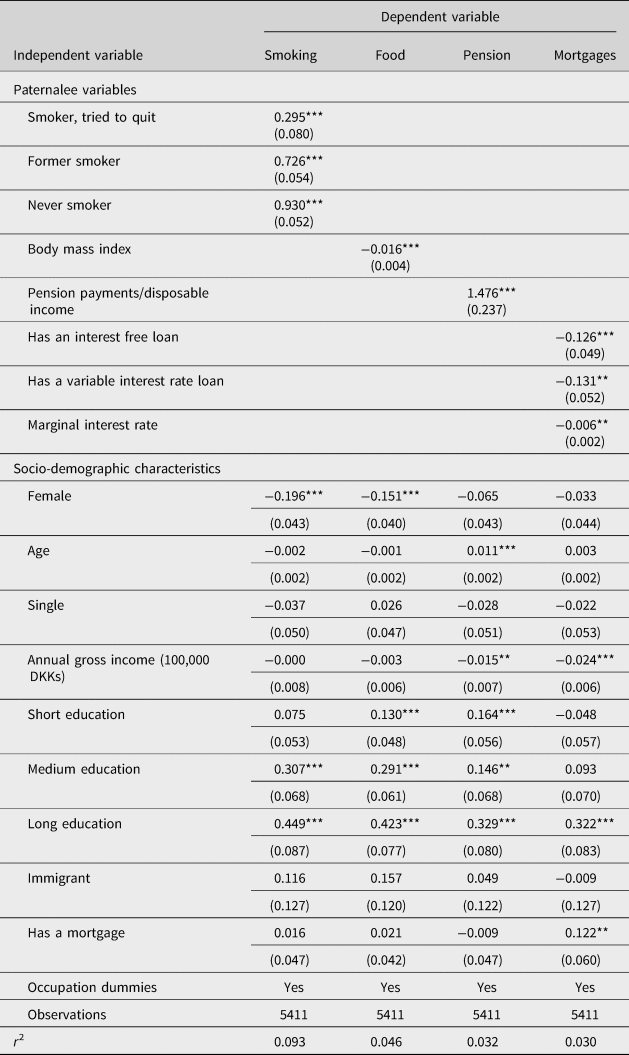
Table 2 shows that the links between behavior in one domain and attitudes toward paternalism in the same domain are clearly present in a multivariate OLS regression where we control for socio-demographic characteristics generally thought to be important for political attitudes. Across the board, paternalees are less likely to support paternalistic policies in their domain. Regarding the socio-demographic variables, we observe patterns that are interesting in themselves. In particular, women are more skeptical of paternalistic legislation in the health domain, suggesting that state regulation of behavior is viewed by respondents as being distinct from views of government on a left-right scale, where women are typically found to be more left-wing and more in favor of redistribution, something which is also true in the present data. Age does not have large effects except in the pension question, where older individuals are more in favor of paternalism toward retirement savings, presumably due to a higher salience of pension savings for older generations. Support for paternalistic policies increases strongly in education across domains. Our data shows that the highly educated are less likely to be paternalees in all dimensions but the mortgage domain, where education plays a smaller role. Neither being single nor an immigrant is predictive of attitudes.
Attitudes toward paternalistic policies

Note: *p < 0.10, **p < 0.05, ***p < 0.01. OLS regressions with robust standard errors. The dependent variables range from 1 to 5 with 5 indicating great support for paternalism. The reference level of education is basic education while the reference level for the smoking variable is smoker.
Most of these results are consistent with the findings from prior studies. Gollust et al. (Reference Gollust, Barry and Niederdeppe2014), for example, also find age to play a very limited role, and the higher educated to be more supportive of paternalism. On the other hand, Gollust et al. (Reference Gollust, Barry and Niederdeppe2014) and Pedersen et al. (Reference Pedersen, Koch and Nafziger2014) find women to be marginally more supportive of paternalistic health policies. This difference may be caused by the set of control variables we include relative to these other studies.
Overall, there is little support for the proposition that those exercising potentially harmful, impatient or risky behavior desire to be subjected to paternalistic policies. These results give rise to two questions: Why are paternalees, some of whom presumably would benefit from paternalism, against these policies? And, why are non-targets, whose welfare to a smaller extent depends on the paternalistic policies, relatively supportive of them? With regards to the former question, the results are consistent with the notion that targets are less patient than non-targets and with the proposition that individuals care about autonomy. With regards to the latter finding, it is consistent with non-targets being driven by concerns about fiscal externalities, moral prescriptive behavior or altruistic paternalism.
Beyond narrow self-interest?
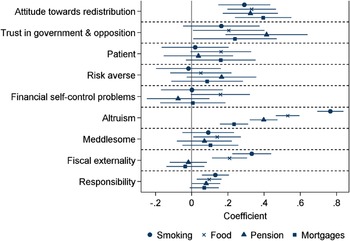
In this section, we briefly assess the hypotheses outlined earlier to see if they alter our main result, and if they provide additional perspectives on understanding preferences toward paternalism. For the theoretical interpretations of the results, we refer readers back to the conceptual framework section. All theory variables are standardized to be between 0 and 1 to foster comparisons of the coefficients. Regression results are plotted in Figure 3 and reported fully in Supplementary Appendix Table A.4.
Hypothesis testing
Note: Coefficients from OLS regressions with robust standard errors. Bars indicate 95% confidence interval. The regressions control for paternalee indicators, socio-demographic characteristics and occupation dummies. The dependent variables range from 1 to 5 with 5 indicating great support for paternalism. All variables for hypothesis testing are scaled to be in the interval between 0 and 1 to foster comparisons. Attitude toward redistribution = 1 indicates support for redistribution. Trust in government & opposition = 1 indicates high trust. Patient/Risk averse = 1 indicates being very patient/risk averse. Financial self-control problems = 1 for respondents who find it difficult to control their expenses. Altruism = 1 for respondents who think smoking bans will benefit smokers. Meddlesome = 1 for respondents who tend to find faults with others. Fiscal externality = 1 for respondents who think smokers should pay their own hospital bills. Responsibility = 1 for respondents who believe success requires luck.

Attitudes toward paternalistic policies are strongly associated with political preferences. People who are in favor of redistribution are also more likely to be in favor of paternalistic interventions across domains. This is consistent with Pedersen et al. (Reference Pedersen, Koch and Nafziger2014) who find that people who see a bigger role for the state are more supportive of paternalism. Trust in politicians is less important, but it does seem to matter in the economic domain, where individuals with greater levels of trust are more supportive of paternalism. This could imply that some individuals find paternalistic policies welfare improving but have no trust in the government executing these policies appropriately or fear that it might lead to a slippery slope of interventionist policies. This is consistent with evidence from Sunstein (Reference Sunstein2016) who finds that support for nudges drop when people are suspicious of the motivations of those who are designing the nudging. In contrast, we find no support for individual time and risk preferences explaining attitudes toward paternalism in any domain. Keep in mind, though, that we elicit time and risk preferences through self-reported non-incentivized questions, which may be the reason behind this null effect.
Altruistic reasons for engaging in paternalism has the most explanatory power; respondents who think banning smoking would make smokers better off are more supportive of paternalism. The effect is largest in the smoking domain, but significant and positive in the three other domains as well, despite the question itself being about smoking, which as noted above may bias the coefficient downwards in the other domains. This is consistent with Jacobsson et al. (Reference Jacobsson, Johannesson and Borgquist2007) who find that individuals who wish to improve the health of smokers with diabetes mostly do so in a paternalistic manner. As noted earlier, it is not possible for us to distinguish whether this effect stems from paternalists trying to make paternalees better off according to the paternalees’ own standards or from paternalists trying to impose their standards on the paternalees.
At the same time, we observe small, but significant, support for attribution of responsibility: respondents who think success is a result of luck rather than hard work are more supportive of paternalism. This is consistent with evidence from Lund et al. (Reference Lund, Sandøe and Lassen2011) who find that respondents who think obese people are responsible for their weight are less likely to support publicly funded obesity treatment, but contrary to Pedersen et al. (Reference Pedersen, Koch and Nafziger2014) who find that respondents who think overweight people are responsible for their weight are more supportive of paternalism. There is only little support for individuals’ being supportive of paternalism since they like to moralize or be meddlesome.
Respondents who think smokers should pay their own hospital bills are more in favor of paternalism. We take this to be support for the notion that fiscal externalities matter; individuals who answer yes to this question are likely guided by the societal costs of smoking. The fact that they are more supportive of paternalism suggests that they find it unfair that they should cover the expenses of people with behavioral biases. This holds also in the food domain, but not for the economic domains. One likely reason for this is that the survey instrument is clearly focused on the health domain and that external effects in the economic domain are less clear to respondents. For future research, it would be interesting to see how much of this support would vanish if respondents were also given policy options that are not paternalistic but still address the fiscal externality concern.
Individuals with self-reported financial self-control problems are not much more in favor of paternalism. This may be because only very few acknowledge that they have self-control problems. In contrast, smokers who tried to quit (not shown in figure) are significantly more favorable toward paternalistic policies for smoking than other smokers, a finding consistent with Hersch (Reference Hersch2005) and Green & Gerken (Reference Green and Gerken1989). Nevertheless, respondents that tried to quit are less supportive of paternalism than non-targets. Given that the gap remains after we have controlled for the various hypotheses, this may imply that the difference cannot fully be accounted for by the theories we have tested so far. We also note that including standard personality measures (Gosling et al., Reference Gosling, Rentfrow and Swann2003) do not change these results, even if one facet of the Big Five inventory, neuroticism, is correlated with preferences for paternalism (Supplementary Appendix Figure A.2 and Table A.6). The only theory which we have not been able to test here is that individuals value their autonomy and freedom. Since freedom is only at stake for the paternalees, it is possible that this can explain why paternalees who are cognizant of their self-control problems remain more against paternalism than non-targets. We return to this when comparing paternalism and nudges below.
Cross-country results
In existing cross-country evidence, Danes have been shown to be more hostile toward nudging than like-minded European countries (Reisch & Sunstein, Reference Reisch and Sunstein2016). Although it is uncertain that this also applies to attitudes to the more coercive type of paternalism we tried to elicit here, in order to provide some assurance that our results are not particular to the case of Denmark, we utilize another survey we conducted in 2017 in Denmark and eight other advanced capitalist democracies: the US, Canada, England, Spain, France, Germany, Netherlands and Sweden. Each survey is representative of the adult population of the country in question and contains 2000 respondents, except for the US sample, which contains 5000 respondents (see Jensen & Wiedemann (Reference Jensen and Wiedemann2022) for another use of this survey without focus on paternalism). We ask the respondents our main questions on attitudes toward paternalism in the smoking domain and in the unhealthy food domain, as well as about their smoking behavior, height and weight. This allows us to recreate the figures relating attitudes toward paternalism to indicators on whether the respondent is a likely paternalee. We omit the figures of the two economic dimensions since we do not have access to administrative economic data in the eight other countries but shown in Supplementary Appendix Table A.5 that survey questions capturing savings and borrowing behavior yield results qualitatively similar to those reported for the economic domains above.
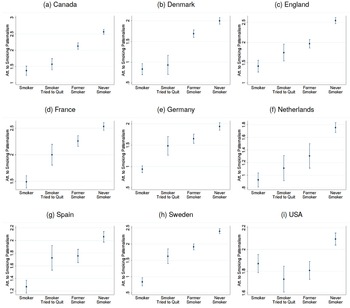
Figure 4 reports the attitudes toward smoking paternalism broken down by the respondents’ smoking status. In all nine countries but the US, point estimates suggest that smokers are the most opposed to paternalism in the smoking domain. They are followed by smokers that have tried to quit, former smokers and never smokers. A similar, but slightly less pronounced, picture emerges if we compare attitudes toward food paternalism broken down by BMI (Supplementary Appendix Figure A.1). Whenever statistical differences appear between BMI groups, higher BMI numbers are associated with greater resistance to paternalism. Noticeable exceptions include France, where attitudes toward food paternalism seem unrelated to BMI.
Cross-country attitudes toward paternalism in smoking domain.
Note: Attitudes toward paternalism in the smoking domain for nine different countries. The y-axis reports the mean answer on a range from 1 to 5, where 5 indicates in favor of paternalism in the smoking domain while 1 indicates being against paternalism. Bars indicate 95% confidence interval.

The broad picture is the same as in our main Danish sample and remains the same if we control for socio-demographic variables (see Supplementary Appendix Table A.5). As noted above, this remains true also in the economic domain, when we proxy administrative economic data with survey measures: current pension savings are proxied by current savings measured as the respondents’ assessment of the number of weeks they can get by if hit by an economic shock; administrative data on borrowing are proxied by self-reported marginal interest rates. Those with more savings support paternalism more than those with less savings; those with high interest rates support paternalism less than those facing low interest rates. Regarding the socio-demographic characteristics, the cross-country regressions show the same pattern across all four domains as we observed in the Danish case: women are more critical of paternalism, while respondents with tertiary education are more supportive of paternalistic policies.
Perspectives on the value of freedom and autonomy: Nudging vs hard paternalism
One indirect way to assess whether the gap between the attitudes of paternalees and non-targets is driven by the value of freedom and autonomy is to look at nudges. Though some nudges can limit freedom and autonomy through social pressure, manipulation and more, many nudges do not limit individuals’ freedom and autonomy to the same degree as more coercive forms of paternalism. If the difference in attitudes between paternalees and paternalists partly is due to the intrinsic value of freedom, we should find much smaller differences when looking at transparent and non-manipulative nudges. The respondents were asked two questions about such nudges:
In recent years, it has been discussed whether the state should try to affect people's behavior by using psychologists’ knowledge about how we make decisions.
• Do you agree or disagree that fruit and vegetables should have a more prominent position in the supermarket and that unhealthy products at the same time should be hidden a bit?
• Do you agree or disagree that we should try to solve the problem about unhealthy lifestyles by requiring that fat and sugar content is stated with big letters on the packaging?
The answer categories were, like our other main dependent variables, on a scale from 1 to 5 with 5 indicating strongly agree. We test whether paternalees are more opposed to nudges than non-targets by running regressions similar to our baseline regression but with these two new dependent variables. Supplementary Appendix Table A.7 displays the results. The coefficient on BMI is insignificant in the two nudge questions but significant at the 1% level in our baseline regulation question. Conditional on our main question in fact eliciting attitudes to coercive paternalism, this is consistent with the idea that the value of freedom and choice is an important factor in attitudes toward coercive paternalism. It is also consistent with evidence from Michaelsen et al. (Reference Michaelsen, Johansson and Hedesströmforthcoming) who find that certain nudges are less autonomy-reducing than sometimes feared and Tully (Reference Tully2019) who argues that choice architecture can at times enhance individual autonomy.
In general, we also see a different pattern in the determinants of nudges relative to paternalism. Other things equal, women, older people and respondents with little or no education are more in favor of nudges relative to coercive paternalism. These patterns also replicate in a cross-country setting. Supplementary Appendix Table A.8 shows that BMI is insignificant in explaining attitudes toward the nudging questions. The cross-country results also confirm the finding from the Danish data that women are more supportive of nudges than men. By looking at the country fixed effects estimates, the finding from Reisch and Sunstein (Reference Reisch and Sunstein2016) that Danes are generally more skeptical of nudges than other European countries, also carries through. In sum, while the level of support for nudging is lower in Denmark, the associations between both domain behaviors and socio-demographics are similar across countries.
Conclusion
Paternalistic policies are increasingly used by Western governments, yet very little is known about the demand side for paternalism. In this article, we sought to get a better understanding of the determinants of support for paternalistic policies, the individuals supportive of paternalism, and the extent to which this popular support, and the lack thereof, can be explained by self-interest.
We studied attitudes toward paternalism across four domains: smoking, unhealthy food, pension savings and interest free loans. We found that targets of paternalistic policies are less favorable of these policies than non-targets. That is, the people these policies are designed to help, for the most part, do not want them in place. This goes against the predictions one would derive from a setting where individuals suffer from acknowledged self-control problems. It is consistent with a traditional economic discourse, where individuals engaged in short-sighted behavior simply have different time preferences; yet, no evidence could be found in support of this. On the other hand, targets of paternalism were found to be as supportive of nudges as non-targets. Since nudges are less intrusive than the coercive type of paternalism we tried to elicit attitudes toward in our main questions, this suggests that the opposition to coercive paternalism of the individuals that are likely to benefit from them may be driven by the value they place on freedom. We find suggestive evidence in favor of non-targets supporting paternalism for altruistic reasons; they are supportive because they believe that these policies will benefit the lives of the people engaging in myopic behavior.
Overall, our findings document that attitudes toward paternalism are often fundamentally different from attitudes toward other forms of government intervention and that looking at the direct health and financial outcomes alone gives too narrow a picture. Policy makers interested in engaging with problems that can be addressed through coercive paternalism could benefit from these findings. In order to fully understand who supports paternalistic policies and why, one cannot always rely on findings from other policy domains. Rather, complex notions of self-interest that go beyond the observable outcomes need to be taken into account.
Supplementary material
To view supplementary material for this article, please visit https://doi.org/10.1017/bpp.2022.39.
Acknowledgments
We thank Felix Sebastian Døssing, Erik Øiolf Sørensen, two referees and seminar and workshop participants at University of Copenhagen, APSA, and Dublin for comments and suggestions. Views are ours and cannot be attributed to the World Bank.
Funding statement
Financial support from the Danish Council for Independent Research – Sapere Aude and the European Research Council through ERC Starting Grant no. 313673 is gratefully acknowledged.
Competing interest
The authors declare none.