The Centers for Disease Control and Prevention (CDC) recommend placement of patients with a history of MRSA in contact precautions to decrease nosocomial spread from potentially persistent carriers.Reference Siegel, Rhinehart, Jackson and Chiarello 1 However, no guidelines specify how and when contact precautions can be discontinued. The negative effects of isolation precautions on patient experience and patient safety have been well described.Reference Abad, Fearday and Safdar 2
In a national survey of infection control professionals, institutions varied markedly in the requirements for the number of cultures and sites as well as and the time between cultures needed prior to discontinuing contact precautions.Reference Shenoy, Hsu, Noubary, Hooper and Walensky 3 Most respondents did not actively screen for persistent carriage, and the impracticality of obtaining several cultures over time leaves most patients indefinitely labelled as MRSA positive.
We studied outpatients with past MRSA infections in a large integrated health system to assess the prevalence of persistent MRSA carriage and to determine whether a more streamlined process (ie, a single nares PCR test for MRSA) could adequately rule out persistent MRSA carriage. A very sensitive gold standard was chosen to assure a high likelihood of finding any patient with persistent MRSA. A patient was defined as a persistent carrier if they had any positive result from a nares culture, axilla or groin skin culture, wound culture, or a nares PCR, at either of 2 visits separated by ≥7 days. A convenience sample of ambulatory patients was chosen to facilitate the 2-visit gold standard.
METHODS
Participants
After obtaining appropriate IRB approval, we queried our electronic medical record database for a list of all patients flagged with past infection or colonization with MRSA. The inclusion criteria for the study were as follows: patients aged 18 years or older, patients residing within 80 miles of the study center, patients free from long-term antibiotics or able to stop their antibiotics for subsequent encounters, and patients for whom at least 3 months had passed since their last positive culture for MRSA. All eligible patients were invited to participate in the study by letter; a second letter was sent to who did not respond to the first letter. Enrollment was conducted on a continuing basis from June through December of 2013.
Interventions and Specimen Collection
Patients who agreed to participate signed informed consent forms, then demographic and health status data were collected. Patients had both nares swabbed with a single-specimen dual-swab culturette using the BD BBL Liquid Stuart Medium CultureSwab collection device (Becton Dickenson, Sparks, MD). The skin areas in both the axilla and groin were swabbed similarly. Any wounds present were cultured as well.
Patients testing positive on any test at the first visit were considered persistently positive and were not asked to return for a second visit. If all first-encounter tests were negative, patients returned at least 7 days later (range, 7–77 days; mean 17 days, standard deviation, 13), and the same specimens were collected and tested a second time. Patients on an antibiotic at study entry were tested both while on the antibiotic and twice after at least 48 hours or more off the antibiotic.
Laboratory Methods
Culture. MRSA was identified in standard fashion using a selective chromogenic medium, chromID MRSA agar (bioMerieux, France) according to the manufacturer’s recommendations.
Polymerase Chain Reaction (PCR). Real-time PCR was performed on the second swab using the BD MAX MRSA assay (Becton Dickenson, Sparks, MD, Cat. No 442953) according to the manufacturer’s recommendations.
Outcomes
The primary outcomes were the percentage of patients who could have their contact precautions flag removed by testing negative for all tests at all visits, and the negative predictive value (NPV) of a single nares PCR compared with the standard of swab cultures and PCR tests at 2 separate visits. We also assessed demographic and clinical risk factors for predicting persistent carriage of MRSA.
Statistics
Two-sample, independent t tests were used to compare continuous characteristics of the MRSA-positive and MRSA-negative populations. Comparisons using Fisher’s exact tests were implemented for binary and categorical outcomes. Exact confidence intervals for sensitivity and NPV were calculated using the binomial distribution. Specificity and positive predictive value were not reported because we considered any positive test to be a true positive; therefore, by definition, a single nasal PCR test would have 100% specificity and positive predictive value.
RESULTS
A total of 1,032 patients met the eligibility criteria and were invited to participate. Of these, 144 patients consented to participate in the study and presented for the initial visit. Only 4 patients dropped out after the initial visit, and 140 patients completed all aspects of the study.
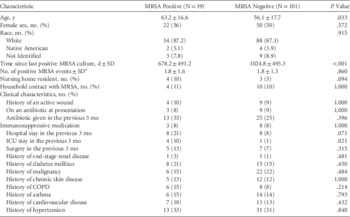
Demographic data and clinical characteristics of the patients who tested positive versus negative for persistent MRSA were compared (Table 1). Patients with persistent MRSA were more likely to be of older age, to have a more recent history of MRSA, or to have had an intensive care unit stay within the prior 3 months.
Baseline Demographics and Clinical Characteristics of Patients

NOTE. MRSA, methicillin-resistant Staphylococcus aureus; SD, standard deviation; COPD, chronic obstructive pulmonary disease.
a No. of separate episodes of positive MRSA culture.
A total of 101 (72.1%) patients were negative for all tests at all encounters and were able to have their MRSA flags removed from the EMR. Of the 39 patients who were positive for MRSA, 10 were identified by a PCR test only, 3 were identified by a skin culture only, and 6 were identified at the second visit only (Figure 1). The performance of a single nasal PCR for MRSA at the first encounter as a screening test for MRSA compared to any positive test from either the first or second encounter had a 76.9% sensitivity (95% confidence interval [CI], 60.7–88.9), and a negative predictive value of 91.8% (95% CI, 85.0–96.2).
Results of cultures and PCR testing in subjects positive for MRSA.

DISCUSSION
Despite the use of a very sensitive gold standard, the majority of our screened patients were negative for MRSA colonization. The MRSA prevalence and NPV results for a single nasal PCR in our study were remarkably similar to the results reported by Shenoy et alReference Shenoy, Kim and Rosenberg 4 in a similar study with inpatients. Additionally, both studies also detected no significant effect of a patient being on an antibiotic.
Some studies using a culture-based screening process only have suggested that cultures from multiple body sites and over several visits are necessary to rule out persistent carriage of MRSA.Reference Vikram, Dumigan, Kohan, Havill, Tauman and Boyce 5 However, other studies have suggested that a single nasal PCR has similar NPV to culturing multiple body sites.Reference Wassenberg, Kluytmans and Bosboom 6 – Reference Hombach, Pfyffer, Roos and Lucke 8
Our study found that older age, recent ICU stay, and less time from prior positive cultures were all significantly associated with MRSA persistence. The most consistent predictors across studies have been the presence of active wounds and less time from the last positive MRSA culture.Reference Vikram, Dumigan, Kohan, Havill, Tauman and Boyce 5 , Reference Scanvic, Denic, Gaillon, Giry, Andremont and Lucet 9 , Reference MacKinnon and Allen 10 It is probable that when developing a screening strategy for removing patients with past MRSA from contact precautions, excluding patients at highest risk for persistent MRSA carriage could lower the disease prevalence and thereby increase the NPV of any testing strategy.
The limitations of our study include the possibility of selection bias because <15% of eligible subjects agreed to participate. This low participation rate could potentially have skewed disease prevalence in the sample, which would also affect the NPV of the single nasal PCR test strategy. Also, the applicability of our findings in a sample of outpatients to other patient populations is uncertain.
In summary, a single nasal PCR test may reasonably identify the large number of patients with past MRSA who need not remain under contact precautions. This finding could have significant implications for cost savings to health systems and improved patient experience.
Acknowledgments
Financial support: Partial funding was provided by an internal grant from Sanford Health, Sioux Falls, South Dakota.
Potential conflicts of interest: No authors reported conflicts of interest.