




No CrossRef data available.
Article contents
Lack of scientific evidence and precautionary principle in massive release of rodenticides threatens biodiversity: old lessons need new reflections
Published online by Cambridge University Press: 25 February 2009
Summary
Pesticides are widely used throughout the world to control agricultural pests. Owing to their well identified side-effects on wildlife, the release of high quantities of pesticides to the environment should always require responsible use of both science-based information and the precautionary principle, however decision making in wildlife management and conservation is not systematically supported by scientific evidence. This is particularly worrying when decision making involves release of toxic substances to the environment, as often occurs in rodent plague control. Poorly-informed management decisions to control a rodent plague can adversely affect wildlife, especially when chemical-based treatments are generically designed and applied on a broad scale, with high economic cost. Evidence-based and environmentally sustainable management should be used to control rodent plagues in Spain.
Information
- Type
- Comment
- Information
- Copyright
- Copyright © Foundation for Environmental Conservation 2009
References
Berny, P. (2007) Pesticides and the intoxication of wild animals. Journal of Veterinary Pharmacology Therapy 30: 93–100.CrossRefGoogle ScholarPubMed
Bonal, R. & Viñuela, J. (1998) Las plagas de topillos en España: enigmas, floklore y problemas de conservación. Quercus 146: 35–39.Google Scholar
Brakes, C.R. & Smith, R.H. (2005) Exposure of non-target small mammals to rodenticides: short-term, recovery and implications for secondary poisoning. Journal of Applied Ecology 42: 118–128.CrossRefGoogle Scholar
Chitty, D. (1996) Do Lemmings Commit Suicide? Beautiful Hypotheses and Ugly Facts. New York, USA: Oxford University Press.CrossRefGoogle Scholar
Diario de León (2008) La Junta decide llevar veneno contra los ratones a otras 375.000 hectáreas [www document]. URL http://www.diariodeleon.es/noticias/noticia.asp?pkid=355530Google Scholar
Elton, C. (1942) Voles, Mices and Lemmings. Problems in Population Dynamics. Oxford, UK: Clarendon Press.Google Scholar
Gannon, W.L., Sikes, R.S. & The Animal Care and Use Committee of the American Society of Mammalogists (2007) Guidelines of the American Society of Mammalogists for the use of wild mammals in research. Journal of Mammalogy 88: 809–823.CrossRefGoogle Scholar
JCYL (2008) La cosecha de cereales en Castilla y León alcanzaría la mayor producción de los últimos años con 8.577.000 toneladas [www document]. URL http://www.jcyl.es/scsiau/Satellite/up/es/AgriculturaGanaderia/Page/PlantillaDetalleContenido/1141143048675/Comunicacion/1213708951343/_?asm=jcylGoogle Scholar
Lambin, X., Bretagnolle, V. & Yoccoz, N.G. (2006) Vole population cycles in northern and southern Europe: is there a need for different explanations for single pattern? Journal of Animal Ecology 75: 340–349.CrossRefGoogle Scholar
La Opinión de Zamora (2008) La Federación regional de caza estudia presentar una denuncia contra la Junta por las liebres envenenadas [www document]. URL http://www.laopiniondezamora.es/secciones/noticia.jsp?pRef=2127_4_248678Google Scholar
Ministerio de Agricultura, Pesca y Alimentación (1989–1996) Informes de las reuniones de trabajo de los grupos de trabajo fitosanitarios. Ministerio de Agricultura, Pesca y Alimentación, Madrid, Spain.Google Scholar
Mason, G. & Littin, K.E. (2003) The humaneness of rodent pest control. Animal Welfare 12: 1–37.CrossRefGoogle Scholar
Newton, I., Shore, R.F., Wyllie, I. & Birks, J.D.S. (2000) Empirical evidence of side-effects of rodenticides on some predatory birds and mammals. In: Advances in Vertebrate Pest Management, ed. Cowan, D.P. & Feare, C.J., pp. 347–367. Furth, Germany: Filander Verlag.Google Scholar
Norte de Castilla (2008) Los cazadores achacan al veneno contra los topillos la escasez de liebres y conejos [www document]. URL http://www.nortecastilla.es/20081028/valladolid/cazadores-achacan-veneno-contra-20081028.htmlGoogle Scholar
Pullin, A.S. & Knight, T.M. (2005) Assessing conservation management's evidence base: a survey of management-plan compilers in the United Kingdom and Australia. Conservation Biology 19: 1989–1996.CrossRefGoogle Scholar
Sarabia, J., Sánchez-Barbudo, I., Siqueira, W., Mateo, R., Rollán, E. & Pizarro, M. (2008) Lesions associated with the plexus venosus subcutaneus collaris of pigeons with chlorophacinone toxicosis. Avian Diseases 52: 540–543.CrossRefGoogle ScholarPubMed
Singleton, G.R., Hinds, L.A., Leirs, H. & Zhang, Z. (1999) Ecologically-Based Management of Rodent Pests. Canberra, Australia: Australian Centre for International Agricultural Research.Google Scholar
Singleton, G.R., Brown, P.R., Jacob, J., Aplin, K.P. & Sudarmaji, (2007) Unwanted and unintended effects of culling: a case for ecologically-based rodent management. Integrative Zoology 2: 247–259.CrossRefGoogle Scholar
Worldwide Fund for Nature/Adena (2006) El veneno en España (1990–2005). Análisis del problema, incidencia y causas. Propuestas de WWF/Adena. Madrid, España: WWF/Adena [www document]. URL http://assets.wwfes.panda.org/downloads/informe_venenos_2006_3.pdfGoogle Scholar
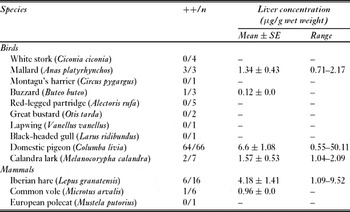
Table 1 Animals (n = 116) found dead in the field in Castillay León between February and August 2007 were analysed for the presence of chlorophacinone residues in liver. Haemorrhages were observed in all the animals with detectable chlorophacinone levels (n = 76.65 % of corpses). ++ = number of individuals with chlorophacinone residues; n = number of individuals analysed.
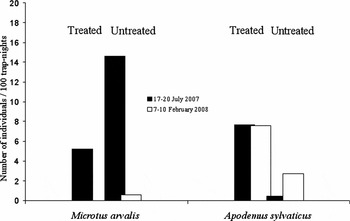
Figure 1 Abundance of individuals (number of individuals /100 trap-nights) captured by Shermann® traps for each species in two periods (July 2007 and February 2008) in León (north-western Spain). In treated fields there were 248 trap-nights per survey in July 2007 and 251 trap-nights per survey in February 2008. In untreated fields there were 651 trap-nights per survey in July 2007 and 665 trap-nights per survey in February 2008. The decrease in number of individuals of M. arvalis captured between July and February was not significantly different between treated and untreated fields (Fisher exact test: p = 1), but the population changes for A. sylvaticus in untreated versus treated fields was significant (χ2 with Yates correction = 5.93, df = 1, p = 0.015). Note that the number of individuals of M. arvalis in treated areas in February 2008 was 0.

Olea supplementary material
Summary.doc

File
24.6 KB
 You have
Access
- 62
- Cited by
Pesticides are widely used throughout the world to control agricultural pests (Berny Reference Berny2007). Owing to their well identified side-effects on wildlife (see for example Newton et al. Reference Newton, Shore, Wyllie, Birks, Cowan and Feare2000; Brakes & Smith Reference Brakes and Smith2005), the release of high quantities of pesticides to the environment should always require responsible use of both science-based information and the precautionary principle (Mason & Littin Reference Mason and Littin2003). However, decision making in wildlife management and conservation is not systematically supported by scientific evidence (Pullin & Knight Reference Pullin and Knight2005). This is particularly worrying when decision making involves release of toxic substances to the environment, as often occurs in rodent plague control. Here we describe how poorly-informed management decisions to control a rodent plague can adversely affect wildlife, especially when chemical-based treatments are generically designed and applied on a broad scale, and discuss the high economic cost of such campaigns. We urge the implementation of a more cost-effective evidence-based and environmentally sustainable management to control rodent plagues in Spain. Cases similar to those reported here occurred in the UK a century ago, and throughout Europe in the 1950s (Elton Reference Elton1942; Chitty Reference Chitty1996). Although abundant scientific information has since been generated about vole cyclic population dynamics and rodent plague control techniques in the world, lessons have apparently not been learned.
Between 2006 and 2007, an outbreak of common voles Microtus arvalis occurred in agricultural areas of north-western Spain, which also took place simultaneously at least in parts of France and Germany (U. Mammen & V. Bretagnolle, personal communication 2007). By February 2007, densities approaching 1000 voles ha−1 were estimated in the area where the plague apparently started in Spain (J.J. Luque-Larena et al., unpublished data 2007). By that date, farmers' associations claimed that voles were causing severe damage to cereal fields, and started a campaign to promote their case in the media. Under this pressure, the regional government (Junta de Castilla y León, JCYL hereafter) officially declared the vole outbreak as an agricultural plague in 19 February 2007 (AYG/556/2007 order, Official Gazette of Castilla y León, Spain) and financed three extensive campaigns of vole poisoning. However, to our knowledge, there had not been any serious study of vole damage to crops in Spain, even although there have been at least four plagues in this area since the 1980s (Bonal & Viñuela Reference Bonal and Viñuela1998). The first poisoning campaign started in March 2007 and entailed disseminating cereal grain surface-treated with an anticoagulant rodenticide (clorofacinone) at the maximum authorized doses, over an area of c. 20 000 ha. This campaign was stopped due to a regional court submission by protectionist groups, which also presented a complaint to the European Commission; this is still under scrutiny [D(2007)ENV.A.2/AGP/17332]. That treatment, however, resulted in tonnes of toxic grain remaining accessible to non-target species over a huge area causing massive mortality of some species such as pigeons, human consumption of which had to be temporarily banned (Sarabia et al. Reference Sarabia, Sánchez-Barbudo, Siqueira, Mateo, Rollán and Pizarro2008). By summer 2007, the vole plague had spread over almost 500 000 ha and, from 20 July 2007, clorofacinone was used again, this time combined with stubble burning and roadside cleaning, affecting 37 000 km of roads and at least 100 000 ha of agricultural land (JCYL personal communication 2007). For this second campaign, the bait was placed inside plastic tubes, in an attempt to preclude access to poison by non-target animals. However, this measure proved to be ineffective, because the grain often fell out of the tubes (widely documented on press releases; our own personal observations), again causing mortality of non-target species (see below, Table 1). Animals found dead in the field by Environmental Protection guards, field naturalists and hunters between February and August 2007 were analysed for the presence of chlorophacinone residues in liver at the Wildlife Toxicology laboratory of IREC (Instituto de Investigaciones Cinegéticas, Ciudad Real, Spain). Chlorophacinone residues were determined by high-performance liquid chromatography (HPLC) with ultraviolet detection at 281 nm (as described in Sarabia et al. Reference Sarabia, Sánchez-Barbudo, Siqueira, Mateo, Rollán and Pizarro2008). In response to further complaints from farmers, a third poisoning campaign was implemented and, from February to April 2008, 169 technical teams of JCYL released tonnes of bromadiolone, a highly toxic rodenticide, introducing poisoned baits (pellets) inside vole burrows over 375 000 ha in 830 municipalities (Diario de León 2008). Tens of tonnes of this compound have also been freely distributed in the form of bagged granules to farmers, who generally applied the baits mainly on field surface (our own personal observations), leaving it thus accessible to non-target species.
Animals (n = 116) found dead in the field in Castillay León between February and August 2007 were analysed for the presence of chlorophacinone residues in liver. Haemorrhages were observed in all the animals with detectable chlorophacinone levels (n = 76.65 % of corpses). ++ = number of individuals with chlorophacinone residues; n = number of individuals analysed.
Decision making by JCYL on release of rodenticides has not been explicitly evidence-based. First, an ad hoc scientific commission was formed in September 2007, after the first two poisoning campaigns were implemented. Additionally, great discrepancies emerged between data and methods used by regional administration and scientists working in the area. While methods to estimate vole densities used by scientists were based on live-trapping (Fig. 1) following scientific experience (Gannon et al. Reference Gannon and Sikes2007), those used by technical personnel in the Administration were based on an indirect abundance index not previously used in this area (J.J. Luque-Larena, personal communication 2008). Live trapping sessions occurred just before chemical treatments were applied in the area (chlorofacinone applied August 2007 and bromadiolone applied second fortnight in February 2008. Traps were set on three consecutive nights and in the same position in both periods (summer and winter) on 22 crop fields and field margins where chlorofacinone was applied (Treated, six fields) or not (Untreated, 16 fields) over and are of 750 km2. Contrary to information used by JCYL, empirical evidence showed that most vole populations had already collapsed before the third poisoning campaign started, and this occurred equally in treated and untreated areas (Fig. 1; J.J. Luque-Larena & J.J. Fargallo, personal communication 2008). Importantly, this population collapse in both chemically treated and untreated areas had already been previously documented in past vole plagues in the area (Ministerio de Agricultura, Pesca y Alimentación 1989–1996) and it is widely known that natural decline usually occurs within a timeframe similar to that of treatment (Elton Reference Elton1942; Chitty Reference Chitty1996; Singleton et al. Reference Singleton, Brown, Jacob, Aplin and Sudarmaji2007). Secondly, anticoagulant rodenticides invariably cause secondary poisoning of non-target species, and bromadiolone particularly is known to affect predators and scavengers (see Berny Reference Berny2007). Thirdly, high percentages of individuals killed by rodenticides were found in the study area for some species, particularly pigeons (96% mortality) and hares (38%) (see Table 1). Additionally several threatened species were also affected by rodenticides (for example the calandra lark Melanocorypha calandra and great bustard Otis tarda; Table 1, and reports from several toxicological labs in Spain and summarized in the complaint to the European Union; La Opinión de Zamora 2008). These control campaigns could also have a negative impact on populations of some non-target species, at least in field mouse Apodemus sylvaticus populations, which showed markedly different dynamics in treated and untreated areas (Fig. 1); hares have also disappeared over wide treated areas (for example see Norte de Castilla 2008; our own unpublished data).
Abundance of individuals (number of individuals /100 trap-nights) captured by Shermann® traps for each species in two periods (July 2007 and February 2008) in León (north-western Spain). In treated fields there were 248 trap-nights per survey in July 2007 and 251 trap-nights per survey in February 2008. In untreated fields there were 651 trap-nights per survey in July 2007 and 665 trap-nights per survey in February 2008. The decrease in number of individuals of M. arvalis captured between July and February was not significantly different between treated and untreated fields (Fisher exact test: p = 1), but the population changes for A. sylvaticus in untreated versus treated fields was significant (χ 2 with Yates correction = 5.93, df = 1, p = 0.015). Note that the number of individuals of M. arvalis in treated areas in February 2008 was 0.
The application of rodenticides was based on economic reasoning not well grounded in evidence. First, there is little or no evidence that the rodent plague adversely affected agricultural production. Indeed, in 2007 (the year of the plague) in this area, production of crops claimed to be damaged by voles, such as cereal, potatoes and vineyards, was the highest recorded over the last 10 years (JCYL 2008), even although the second and third vole control campaigns started after harvesting. Second, the cost of the control campaign (c. € 24 million; € 1 = US$ 1.41, December 2008) has been higher than the compensatory payments for crop damages (c. € 5.5 million, JCYL unpublished data 2008). These chemical treatments negatively affecting biodiversity conservation can hardly be integrated within the new payment schemes of the European Union Common Agricultural Policy (CAP), which demands the fulfilment of eco-conditionality measures for the payment of subsidies.
A precautionary principle criterion should have prevailed over the pressure exerted by farmers in decision-making since: (1) the area treated with rodenticides included five Natura 2000 Bird Special Protection Areas (SPAs); (2) non-target small mammal species were expected to have reduced abundance after poisoning further reducing prey availability for predators (Fig. 1); and (3) high uncertainty remained on the potential direct and indirect effects of massive use of anticoagulants in this agrarian ecosystem (Table 1). Accordingly, managers should have determined the appropriate level of precaution to apply based on the evidence, and implemented a programme to investigate the collateral effects of vole treatment on wildlife.
These chemical-based environmentally-aggressive management campaigns in Castilla y León may be taking a backward step of decades in terms of public awareness of the collateral effects of poisoning programmes, an issue now considered as one of the main conservation problems for predators in Spain (Worldwide Fund for Nature/Adena 2006). Moreover, society is exerting growing pressure for more humane rodent culling programmes (Singleton Reference Singleton, Brown, Jacob, Aplin and Sudarmaji2007). Neglect of scientific evidence by decision-makers is often not deliberate (Pullin & Knight Reference Pullin and Knight2005), and identification of the best management practices requires an in-depth understanding of the pest-species ecology and ecosystems, as well as the social, economic and technical contexts in which rodents are pests (Singleton et al. Reference Singleton, Hinds, Leirs and Zhang1999). The necessary strong links between managers, farmers and scientists can hopefully be attained with the recently released Vole Plague Control National Programme developed by the Spanish national government (409/2008RD, 28 March 2008, Official Gazette of the Spanish government). The next voles population explosion could be expected as soon as 2010 (Lambin et al. Reference Lambin, Bretagnolle and Yoccoz2006), and the National Programme should urge integrated plague management based on scientific evidence and ecological control (Singleton et al. Reference Singleton, Hinds, Leirs and Zhang1999, Reference Singleton, Brown, Jacob, Aplin and Sudarmaji2007), a well-informed benefit/cost (risk) balance, including the sanitary risk of contact with rodents by rural people, and the cooperation/supervision of international and local authorities when, as has been the case, enormous quantities of poison are released in the environment. These measures should lead to better-informed management decisions that control the pest species while minimizing impacts of unwanted ecological side-effects.
Acknowledgements
We thank Enrique Osorio and Eduardo García for field assistance work and Pablo Camarero for laboratory analytical help. Part of this research was supported by Junta de Castilla y León (SEK02B06) and Ministerio de Educación y Ciencia (CGL2006-05047/BOS). Peter Brown, Xavier Lambin and two anonymous referees provided useful comments on a previous draft of this paper.