The population of Ireland having been created by the potato, … without the potato it cannot exist … A large portion of that population … will be destroyed by famine and disease if they are not provided with means to emigrate.
William Monsell, Irish landlord, 23 June 1847Footnote 1Nothing can effectually and immediately save the country without an extensive emigration. And I have not met in Town, or in Country, a reflecting man who does not entertain more or less the same opinion.
Ulick de Burgh, Earl of Clanricarde, 8 January 1847Footnote 2Today famines and their accompanying horrors are at most a faint memory in rich countries and, thanks to economic growth and the globalization of relief, a rarity even in the poorest.Footnote 3 But famines are still worth studying, not least because when they struck, they inflicted enormous suffering on whole communities and led to actions unimaginable in normal times. A second reason for studying famines is that it highlights the difference between famine, hunger, and malnutrition. Non-governmental organizations and popular opinion conflate the three, but they require very different solutions. Coping with famines nowadays should be straightforward, whereas reducing malnutrition is not. Third, studying famines in detail also argues against fatalism and inaction, on the one hand, and against ignoring constraints on economic growth, on the other. Most famines historically were the products of poverty, but two of the greatest famines of the twentieth century were triggered by totalitarian regimes in backward economies rejecting the downside risks implicit in Alfred Marshall’s epigraph, natura non facit saltus: nature does not do leaps (Wheatcroft Reference Wheatcroft, Matthias and Felix2010; Wemheuer Reference Wemheuer2014).
This article’s main focus is on the Great Irish Famine of the 1840s. In the global history of famines that famine was a bit of an outlier. Whereas most famines last a year or two at most, it lasted four or five years. And while the impact of most famines on population was temporary, the Irish Famine marked a demographic tipping point between almost two centuries of rapid population growth and a century or more of sustained population decline or stagnation. Generalizations are therefore potentially problematic. Yet close study of the Irish Famine has lessons for the study of famines more generally, though, its special status in the history of famines must not be forgotten.
In the remote parish of Partry in the west of Ireland, the famine lasted a long time. In early 1847, just as it was entering a critical phase that was attracting global attention, parish priest Peter Ward wrote an open plea for help to the editor of a local newspaper, stating that five of his parishioners had died of hunger “in the past six days.” For added impact, he revealed their names. More than a year later, in April 1848, we find Ward writing to Archbishop Murray of Dublin, pleading on behalf of destitutes who had been “banished from a crowded poor-house, to die on the roads and buried without coffins everywhere as the living are not able to carry their remains to the Grave Yard.”Footnote 4 In May 1849, nearly two years after 321 the authorities in London had in effect declared the famine over, Ward was still begging Murray for help for his parishioners, of whom “already 1,900 have died in this mountainous area; and more than 700 families wander about, without food, clothing or shelter.”Footnote 5 His plea was rewarded with a donation of £1, which he acknowledged with the news that the meal had run out in Partry, that “the nettles and watercress ha[d] all been picked” and that “death awaits many” (Purcell Reference Purcell2000, p. 108). Ward was not crying wolf. Three months later he reported:
In the village of Drimcaggy [recte Drumcoggy] four were dead together in a poor hut—brother, two sisters, and daughter. The flesh was pulled off the daughter’s arm and mangled in the mouth of her poor dead mother—her name was Mary Kennedy. William Walsh, of Mount Partree, and his son were dead together, their flesh was torn off their dead bodies by rats, and by each other; flesh was found in their mouths. His wife and child died the week before of hunger… These are true facts.Footnote 6
This is part of what happened in a remote corner of the United Kingdom in the late 1840s. Census data on Drumcoggy Mountain corroborate: its population plummeted by almost two-thirds during the famine and the number of houses there, mainly one-roomed mud cabins, fell in tandem. Famine is hell.
In what follows, I first address the views of two of the founding fathers of economics on famines generally and their implications for Ireland. Next, I discuss the role of human agency and institutions in mitigating or otherwise the shock of the failure of the potato. Arguing that the policies pursued offered no solution to what was an ecological disaster, I focus on the role of migration as a mode of famine relief. I focus in particular on two small publicly assisted migration schemes. I conclude with some speculations on the broader implications of those schemes.
SMITH AND MALTHUS
Although Adam Smith and Robert Malthus seriously underestimated the incidence of famines in early modern Europe, their conflicting perspectives on what caused famines offer a useful introduction to the literature on the Irish Famine. Smith convinced himself that “[w]hoever examines, with attention, the history of the dearths and famines which have afflicted any part of Europe, during the course of the present or that of the previous two centuries”—that is, since c. 1500AD—”… will find that a famine has never arisen from any other cause but the violence of government attempting, by improper means, to remedy the inconveniencies of a dearth” (Smith Reference Smith, Campbell and Skinner1776 [1976], p. 526, emphasis added). Malthus claimed that, thanks to the preventive check, although “[i]n every state in Europe, since we have first had accounts of it, millions and millions of human existences have been repressed from [want of food] … perhaps in some of these states an absolute famine has never been known” (1798, p. 139; emphasis added). Both assertions displayed a cavalier disregard of the recent past because, in reality, famine was commonplace in much of Europe well into the eighteenth century. Just a few decades before Smith’s birth a famine had robbed Scotland of up to 5 percent of its people; and when he was in his late teens Ireland was struck by a catastrophic famine, that of 1740–1741 (Alfani and Ó Gráda Reference Alfani and Cormac2017; Dickson Reference Dickson1997; Wootton Reference Wootton2018).
Smith blamed meddlesome governments for famines and held that smoothly functioning markets were a panacea for even major crop failures. His advice, extremely influential but not so original, was anticipated by French Enlightenment commentators such as Claude-Jacques Herbert and Jacques Turgot in the 1750s and 1760s and, seven thousand miles away, by the Qianlong emperor in Beijing, in 1742 (Persson Reference Persson2000, pp. 3–10; Dunstan Reference Dunstan1996, p. 272; as cited in He (2012, p. 13)) who wrote:
Given the vastness of the Empire and the distinctiveness of its component territories, if the harvest is poor in one place, it may be good in another. The whole reliance is on intercourse between want and possession, and aid alike to all in times of crisis. If merchants converge like spokes into a wheel on regions where the harvest has been good, once they have much grain assembled, the price will naturally come down, and it will be easy for the needy masses to acquire food.
Unlike Smith, the emperor—and Turgot, as well (Persson Reference Persson2000, p. 6 fn15; Wootton Reference Wootton2018)—supported maintaining entitlements through famine relief. Indeed, Smith’s great friend David Hume, whose conviction that “the rules of equity and justice depend entirely on the particular state and condition in which men are placed” tempered his faith in free markets during famines.Footnote 7 The empirical evidence—and this also holds for Ireland in the 1840s—supports Smith to the extent that it finds that markets often functioned more or less normally during famines. But that does not mean that they did much to alleviate famines (Ó Gráda Reference Ó Gráda1993, pp. 101–16, 2009, pp. 129–58, 2015, pp. 92–129; Ó Gráda and Chevet Reference Ó Gráda and Jean-Michel2002).
By contrast, Malthus and his followers invoked the principle of population to argue that famines were the natural if regrettable products of excessive pressure on the land. Moral hazard therefore constrained the efficacy of famine relief or, worse, fatally compromised it.Footnote 8 Yet Malthus, uncharacteristically, did occasionally allow institutions a positive role, conceding in the wake of a threatened famine in England (and an actual famine in Ireland) in 1799–1800 that the “system of the poor laws, in general, I certainly do most heartily condemn, … but I am inclined to think that their operation in the present scarcity has been advantageous to the country” and that it was thanks to them that “a much greater number of [the poor] has not been starved” (Malthus Reference Malthus1800). Malthus would never again have a good word to say about the Old Poor Law, although he did concede two other ways in which institutions mattered in reducing population growth and thereby, ultimately the risk of famine. First, in a little-read review essay on Irish population published in 1808, he argued that legislation granting Irish Catholics full civil rights would lead to “the introduction of more prudential habits” and “the retardation of the population” (Malthus Reference Malthus1808, p. 49–50). And second, towards the end of his life he would, albeit grudgingly, allow state-funded emigration a role in relieving population pressure. We will return to this topic later.
Smith and Malthus represent two contrasting, though arguably complementary, views of famine: one highlighting the role of human agency and institutions, and the other that of endowments and population pressure. In the historiography of famine, the former dwells on institutional factors such as poor governance and attendant corruption and on cultural factors such as the role of social capital in fostering philanthropy and, perhaps, preventing crime. The latter discounts agency at the expense of economic factors such as living standards before the crisis and the extent of the harvest shortfall during it. These approaches, in turn, are reflected in alternative ways of writing famine history.
MALTHUS IN IRELAND
The Malthusian system is described by two equations. One models income as a function of population; the other, population growth as a function of income (Lee Reference Lee1973; Mokyr Reference Mokyr1985, pp. 42–3). The available statistical evidence for medieval and early modern Europe does indeed suggest that high population pressure on resources was the most common remote cause of a famine occurring, with crop-damaging weather being the trigger. It also suggests that high grain prices led to increased mortality in the short run. But after c. 1630 these Malthusian links between population and grain prices, on the one hand, and excess mortality and famine, on the other, no longer held in England. Malthus-minded economic historians might argue that it was no coincidence that sustained growth in English GDP per capita dates from exactly this time (Alfani and Ó Gráda 2018; Kelly and Ó Gráda Reference Kelly and Cormac2014; Broadberry et al. Reference Broadberry, Bruce and Alexander2015, pp. 237–9).
So far, so Malthusian. But the link between population and the occurrence of famine was sundered in France and Italy from the early eighteenth century on, before the onset of sustained growth in GDP per capita. And even in medieval and early modern Europe, famines were never all about Malthus: between c. 1250 and c. 1800 about one famine in every three was exacerbated, if not caused, by a war that had nothing to do with population pressure (Alfani and Ó Gráda 2018).
Malthus framed his principle of population in a time-series framework—”population, when unchecked, increase[s] in a geometrical ratio, and subsistence for man in an arithmetical ratio”—and the previous discussion reflects this. But the link between land, population, and vulnerability to famine also holds in cross-section, as data produced by the United Nations’ Food and Agriculture Organization’s Early Warning System show for the present. The Food and Agriculture Organization (FAO) lists include 13 countries suffering since 2009 from either an “extensive shortfall in food production/supplies” or “widespread lack of access to food” in more than every second year. These vulnerable countries, mostly in sub-Saharan Africa, include six of the seven at the very bottom of the Human Development Index league table in 2013.Footnote 9 Remarkably, almost never in these years did an “extensive” shortfall lead to a full-blown famine.
From this perspective, the severity of the Great Irish Famine may seem somewhat of an anomaly, since in the mid-1840s GDP per head in the United Kingdom (including Ireland) was nearly three times that of Finland in 1867–1868, and more than three times that of China in 1958 and Ethiopia in 1985 (Bolt et al. Reference Bolt, Robert and Herman2018). Nor was there a war on. What is missing in such comparisons is a sense of the size and persistence of the ecological shock that was the proximate cause of the Irish Famine (Solar Reference Solar and Margaret Crawford1989; O’Rourke Reference O’Rourke1991).
Our focus here is the presumed Malthusian link between pre-famine Irish poverty and population which Joel Mokyr (Reference Mokyr1980, Reference Mokyr1985) was the first to test for rigorously. His strategy of exploiting cross-section county rather than (much scarcer) time-series data has been replicated in research on Ireland and elsewhere.Footnote 10 Alan Fernihough and Cormac Ó Gráda (Reference Fernihough2018), in the same tradition, also rely on data derived mainly from the Irish population censuses of 1841 and 1851. The quality and ambition of those censuses should be noted: in a tribute to the chief architect of the 1841 census (BPP 1843a), Thomas Larcom, his renowned English counterpart William Farr described “the last census of Ireland… one of the best in Europe.”Footnote 11
Fernihough and Ó Gráda (Reference Fernihough2018) exploit the data at civil parish rather than at the county level (so n=2,387 instead of 32) to estimate the impact of population pressure on poverty. Our results, described in detail elsewhere with the appropriate caveats, support the claim that poverty on the eve of the famine was highly correlated with pressure on the land as measured by population per quality-adjusted acre. But the size of the effect is modest. This outcome is perhaps too predictable to be very interesting. The more interesting question is that why on the eve of the Great Famine so many poor people lived on the worst land. So we allow for the role of potential determinants of population density at the parish level in 1841.
First, we argue a role for remoteness, proxied by longitude and by distance to the nearest town. Remoteness was linked, not just to poor access to markets and the slow spread of new techniques and ideas (compare Redding and Venables (Reference Redding and Anthony2004); Redding and Sturm (Reference Redding and Daniel2008); Asher, Nagpal, and Novosad (Reference Asher, Karan and Paul2018)), but also to landlord absenteeism and lack of control over subdivision (Dorian Reference Dorian, Breandán and David2000, pp. 236–7). Second, 326 we invoke the presence of individuals with “vested means” in a parish— another detail reported in the 1841 census—as a measure of human and social capital and the provision of public goods. Such people mattered because they could have provided employment, sponsored schools and charities, or invested in local infrastructure and new technologies, and so on (compare Lampe and Sharp (Reference Lampe and Paul2018)). Or, as landed proprietors or their agents present in a parish, they could have aided emigration and perhaps controlled the subdivision of farms. Third, in acknowledging that the landed elite may have spurred overpopulation by failing to prevent subdivision or failing to grant those civil rights alluded to by Malthus which might have led to “the retardation of the population,”Footnote 12 we use the rate of population change between 1821 and 1841—and this, in practice, means population change in rural areas—as a measure of landlords’ failure or inability to prevent subdivision, early marriage, and overpopulation. Finally, we include a measure of pre-famine emigration to America at the parish level (discussed in more detail later) and, as expected, this variable is linked to higher-living standards.
The inclusion of these and other control variables adds to the explanatory power of the model but does not change much the coefficients on the population pressure variable. To get a sense of the importance of that variable we conduct a back-of-the-envelope calculation comparing our estimates against a “no 19th century population growth” benchmark. This suggests that had population remained at the 5 million level reached c. 1800 (instead of the 8.2 million recorded in 1841) (Dickson, Daultrey, and Ó Gráda Reference Dickson, Stuart and Cormac1982), illiteracy would have risen by about 3 percent of its 1841 level. An equivalent exercise for housing suggests a counterfactual rate of 34.8 percent living in the lowest quality dwellings against an actual average of 36 percent. While confirming that population pressure reduced pre-famine living standards, such calculations square with Mokyr’s conclusion that economic historians should look beyond simple Malthusian models to understand Ireland’s pre-famine economy.
Cross-section data on mortality are lacking, but in accounting for cross-parish variation in fertility, we used the number of children under the age of five per family as a proxy for fertility in 1841. This fertility measure was subject to significant regional variation, being 20 percent higher in the counties Antrim and Down in the northeast than in the counties Waterford and Kilkenny in the southeast. Moreover, we found that fertility was reduced by population pressure and poor housing, but there were important roles also for the size of the agricultural sector, for the lack of education (as captured by illiteracy), and for religion. So Malthus was right, but he was only half-right.
HUMAN AGENCY AND INSTITUTIONS
Whereas the Malthusian approach to famine is simple and straightforward, the roles of human agency and institutions are more complex and more difficult to test. The claim that fiscal constraints “made Britain feel unable to borrow to finance relief efforts” (Read Reference Read2017, p. 3, emphasis added) in Ireland from early 1847 on is ultimately an argument about human agency. But how many lives did that “feeling” cost? Its legislative consequences are clear, but not its impact on mortality. Crucially, it led to legislation in June 1847 that placed the entire burden of relieving poverty on Irish ratepayers—and disproportionately on those in the most devastated areas—from late summer 1847 on.Footnote 13
Famine relief plays only a minor role in the historiography of some well-known famines such as the Soviet famines of the 1930s and China’s Great Leap Famine.Footnote 14 In the Irish literature it looms large, and issues raised have resonances for modern analyses of famine relief. Before the decision to put an end to public funding was taken, the Treasury had spent about £8 million (nearly 2 percent of U.K. GDP) in Ireland, most of it, admittedly, intended as loans to be repaid by Irish taxpayers. Historians— and many contemporaries—were critical of how that money was spent. For example, food for work schemes tend to score well in the literature (compare Ravallion (Reference Ravallion1991); Drèze and Sen (Reference Drèze and Amartya1989, pp. 113–8); Devereux (Reference Devereux2016)) and were effective in Ireland in 1822 and 1831, but as the authorities’ first response to distress during the winter of 1846 and spring of 1847, they paid too little, spread disease, weakened the healthy, and failed to reach the most vulnerable. Early in 1847, a public works official in a neighbourhood that was losing people “with railway speed” pleaded with prime minister Lord John Russell that it would be “better far to keep [the poor] in their wretched hovels, and pay them for staying there, than ask them to expose themselves during the day on the side of a mountain.”Footnote 15
An added problem was that as a result of the harsh weather the typical laborer was employed only part-time. Yet so desperate were people for relief that “in many instances” the dead were left unburied for days on deserted potato plots so that males employed on the works could attend their funerals on a Sunday without the loss of a day’s wages (Irish Examiner, 27 September 1847; Kerry Examiner, 23 March 1847).
As the limitations of food for work became increasingly clear from early 1847 on, the authorities switched to the temporary provision of food aid through local relief committees. Nearly two thousand such committees were formed in all but three affluent poor law unions in the northeast, and it was these committees that bought, cooked, and doled out rations. The system as it operated during the summer of 1847 was far from flawless, but it coincided with a drastic reduction in the incidence of starvation and associated diseases. The commissioners in charge of relieving daily nearly three million people, more than one-third of the population, at the scheme’s height claimed the credit “for arresting for the present so general a calamity with more complete effect than was probably ever before attempted” (BPP 1847d, p. 3). While the hyperbole ignores the role of seasonality in reducing mortality, the scope of the achievement is undeniable, and there was a widespread sense at the time that the system worked well. The prospect of a bountiful harvest and fears of moral hazard—the “demoralization that would follow… large and almost indiscriminate support”—led to the termination of the scheme, other than in a few devastated areas, in mid-August 1847. The closure of the food kitchens meant reliance on one of the 130 workhouses responsible for relief under the Irish Poor Law of 1838.Footnote 16
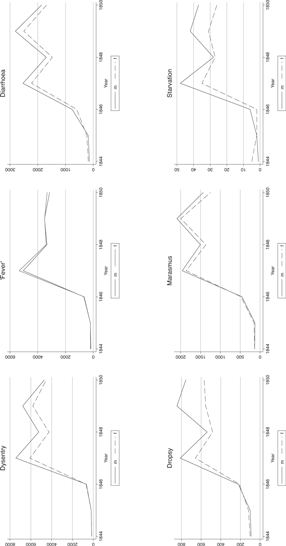
The legislation mentioned earlier allowed for locally financed outdoor relief where workhouses were overcrowded, but only to occupiers of less than one-quarter of an acre of land. The famine persisted. Almost as many people died in Irish workhouses of clearly defined famine-related causes—hunger, but most especially disease—in 1849–1850 as in 1847–1848 (Figure 1). In early August 1849, nearly 0.9 million people were still dependent on a combination of indoor (203,199) and outdoor (666,224) poor relief. It is no accident that most of the admittedly few cases of cannibalism identified so far post-date the decision to place the burden of relief entirely on local taxpayers.Footnote 17
MALE [M] AND FEMALE [F] FAMINE DEATHS IN WORKHOUSES 1844–1850
Source: BPP (1856).

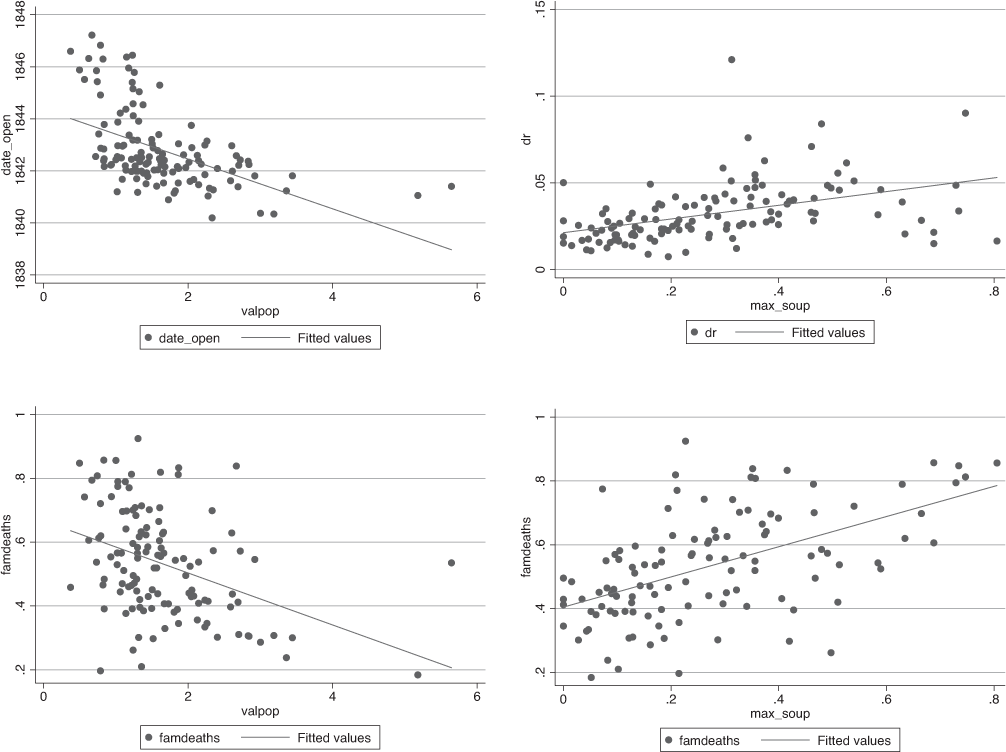
Andrés Eiríksson (Reference Eiríksson2018) links the timing of deaths in Parsonstown workhouse in the Irish midlands during the famine to the refusal of its board of guardians to countenance outdoor relief. He claims that the resultant overcrowding, compounded by inadequate clothing, heating, and sanitation, led to many unnecessary deaths. And it is hard to argue with Eiríksson’s close reading of the evidence. Other studies critical of workhouse management could be cited but a limitation of such case studies is their lack of comparative focus.Footnote 18 In Figure 2 the y-axis measures workhouse management using three yardsticks, while the x-axis measures the challenge faced by it. As indicated, workhouses in poorer areas (as proxied by land value per capita (valpop) and dependence on soup rations at the height of the famine (max soup)) tended to find it more difficult to operate (as measured by the date on which they opened their doors (date open)),Footnote 19 to prevent deaths (as measured by, e.g., workhouse deaths per head of population (dr) or the proportion of workhouse deaths due to famine-related causes (famdeaths)), and to collect the necessary local taxes.
BASELINE POVERTY AND WORKHOUSE PERFORMANCE
Source: BPP (1856, pp. 82–120).

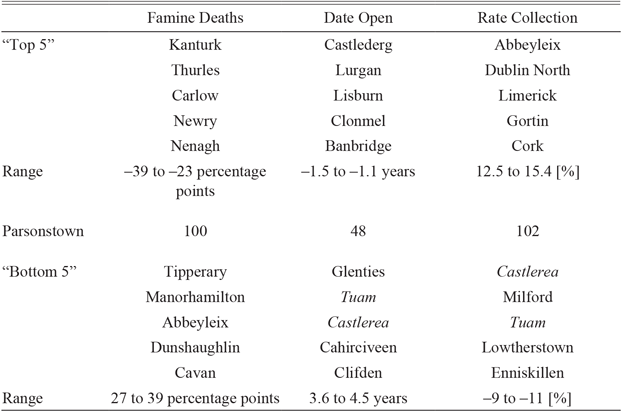
How did Parsonstown rank compared to other similarly challenged workhouses? Table 1 offers a rough indication of relative workhouse performance on the basis of the yardsticks mentioned. The rankings reflect the residuals from regressing each yardstick on valpop and max soup. Much depends on the yardstick chosen; famdeaths is the perhaps most important, since it measures an outcome. The residuals imply that deaths from famine-related causes in the bottom five workhouses were 27 to 39 percentage points higher than predicted by the regression model. This offers a rough measure of the impact of local decision making. Interestingly, Parsonstown performed poorly by two criteria out of three.
WORKHOUSE MANAGEMENT DURING THE IRISH FAMINE

Note: “Famine deaths” are percentage of all deaths due to famine-related causes; “Rate collection” refers to rates collected to 31/12/1846 as a proportion of the poor law valuation.
Source: BPP (1847b, p. 16, cols. 3 and 5).
Assessments of the mechanisms just outlined—public works, soup kitchens, and the workhouse—feature prominently in Irish famine historiography. However, none was fit for purpose, because none addressed the cold reality that the Irish Famine destroyed both an agricultural system and a whole way of life dependent on it. On the eve of the famine about one-third of the entire population of 8.5 million relied almost exclusively on potatoes, and the majority of the agricultural labor force of more than a million was paid essentially in potatoes. The second near-total crop failure in 1846 meant that the “Farmers of Ireland [were left with] no Means of replacing the Potato Currency, so to speak, with any other,”Footnote 20 a loud signal that there could be no return to the status quo ante. This was widely recognized at the time, but the only form of famine relief to take it on board would have been state-assisted emigration. Unhappily, state funding towards “the equalisation of capital and labor in the country”Footnote 21 was very limited.
MIGRATION AS FAMINE RELIEF
Migration is an important, if neglected, part of famine demography (Maharatna Reference Maharatna2014). Migrants have nearly always been among the first victims of famine, but migration in search of food or work is also an age-old coping mechanism.Footnote 22 Such migration is usually internal—often from rural to urban areas—and temporary. In theory, long-distance migration could be a more effective option, either because it reduces the immediate pressure on the affected area in the event of a crisis or, if it precedes a crisis, because it generates emigrant remittances and facilitates crisis migration (Maharatna Reference Maharatna2014; Lucas and Stark Reference Lucas1985; Sirkeci, Cohen, and Ratha Reference Sirkeci, Jeffrey and Dilip2012).Footnote 23
That option was open to emigrants from Europe in the mid-nineteenth century. Insofar as mass migration over long distances is concerned the Great Famine happened at a unique moment in world history, ushering in an era that would allow more than 50 million Europeans to seek their fortune on the other side of the Atlantic (Hatton and Williamson Reference Hatton and Jeffrey1998). A limitation of such migration, however, is that the most destitute are more likely to lack the resources to move.Footnote 24 During the Great Irish Famine, as the parish priest of Kenmare noted in 1849, “the better classes of farmers and labourers [were] flying to America as if they were running from a plague,” leaving behind “miserable beings… with scarcely a hovel to shelter them, insufficiently provided for by the law.”Footnote 25
Occasionally, as during the Somali Famine of 2011–2012, an extensive diaspora connected through strong clan networks played an important role in providing relief through remittances. In Somalia even distant relatives in the United States or in Europe were a distinct advantage. But the outcome was a reversal of the Irish pattern: those with kin abroad could remain in their villages or close to their land while others, less fortunate and more marginal, were forced into the age-old coping strategy of taking to the road, in this instance often to refugee camps in neighboring Kenya and Ethiopia (Majid et al. Reference Majid, Guhad and Khalif2016, pp. 17, 18, 19, 36; Maxwell and Majid Reference Majid, Guhad and Khalif2016, pp. 83–4; Robinson, Zimmerman, and Checchi Reference Robinson, Linnea and Francesco2014).
In their classic work on Scottish demographic history Michael Flinn et al. (Reference Flinn1977, p. 36) argued:
It is likely that the Highlands came very close indeed to the margin that would have produced an Irish-type catastrophe: one estimate put the numbers who might have died in 1836–7 without external relief at 80,000, and it would have been even higher in the 1840s. Had there been more people - had there been no clearances or earlier outmigration - could the situation have been saved?
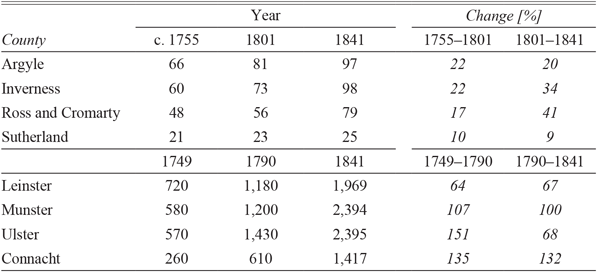
Flinn et al. did not answer their own question directly and, indeed, other factors intervened to ensure that “the Highlands did not starve” in the 1840s. The challenge was on a smaller scale than in Ireland, the Scottish economy was wealthier and more resilient, dependence on the potato was lower, and landlords were less likely to be burdened with debt (Devine Reference Devine, Sean, Robert and Robert1995). Scotland’s poorest were better positioned to leave of their own volition than Ireland’s—and they did so. Be that as it may, the stricter controls on subdivision and early marriage and the Highland Clearances, which involved the forced removal of thousands of marginal smallholders, mainly to the Lowlands of Scotland and to Canada in intermittent waves between the mid-eighteenth and mid-nineteenth centuries, were among the reasons for the modest population growth in the Highlands relative to Ireland before the 1840s [Table 2].Footnote 26 A sinister aspect of pre-famine Irish demography is that population growth in the pre-famine decades was highest where living standards were lowest. The correlation between population growth and wage levels across Irish counties was –0.41. In early nineteenth-century Scotland, by contrast, it was +0.42.Footnote 27
POPULATION IN HIGHLAND COUNTIES AND IN IRISH PROVINCES, C. 1750–1841 (1,000S)

Source: Derived from Kyd (Reference Kyd1952), Mitchell and Deane (Reference Mitchell and Phyllis1971), and Dickson, Daultrey, and Ó Gráda (Reference Dickson, Stuart and Cormac1982).
Patterns of population growth reflected contrasting land tenure regimes. In Ireland, landlord indebtedness constrained improvement and landlord-assisted emigration. In pre-famine Scotland the market for financially embarrassed estates was much more activeFootnote 28 than in Ireland, where the inability of creditors to foreclose on insolvent landlords led to a constipated land market. The extent of Irish landlord indebtedness cannot be established with precision. A lower-bound estimate can be inferred from data on rents due on estates managed by the Courts of Chancery and Exchequer which imply, very roughly, that on the eve of the famine 1 owner in 12 and 1 acre in 20 were chronically insolvent. Those estates represented the extremes of ruinous indebtedness; they do not include heavily indebted properties still under the control of their owners (Donnelly Reference Donnelly1975, pp. 68–72; Eiríksson and Ó Gráda 2006, p. 51; Gray Reference Gray1999, pp. 83–4). One such encumbered Irish grandee claimed in the House of Lords in January 1847 that his class owed at least eight years’ rental—or about £100 million—in “judgments, mortgages, and other bond debts,” and that the interest on this sum and other charges was costing them nearly £10.5 million annually, leaving only a few million at their disposal. In vain, he pleaded for a stay on the foreclosure of mortgages for three years.Footnote 29
According to the Irish economist William Neilson Hancock (1850– 51, p. 14) such indebtedness led to a premium of 1 percent charged on loans to Irish proprietors as compensation for the “trouble and insurance against loss arising from the risk of delay and ultimate failure.” A study published in the immediate wake of the famine buttressed its statistical critique of how the land system penalized creditors with an extreme example “where the proceedings ha[d] been pending since 1786” and the encumbrancer was “a pauper inmate of the North Dublin Workhouse” (Hancock Reference Hancock1849–51, pp. 4–6).
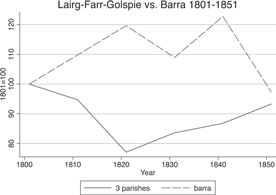
In Scotland, the trade-off between evictions before and during the 1840s is highlighted by comparing demographic trends in three of the worst-affected Sutherland parishes and on the island of Barra (Figure 3). The owners of the Sutherland estate, notorious for large-scale clearances in the 1810s, still faced considerable distress among their tenants in the 1840s. They responded by concentrating on relief, spending £18,000, exclusive of wages and unpaid rent (Flinn et al. Reference Flinn1977, p. 434). By contrast, in the late 1840s Barra, where there had been no clearances beforehand, was the scene of brutal and violent clearances, accompanied by great hardship and even excess mortality.Footnote 30
POPULATION CHANGE 1801–1851 IN BARRA AND IN LAIRG-FARR-GOLSPIE
Source: Derived from Scottish population censuses, 1801 and 1851.

In Ireland one of the institutional by-products of the famine was establishment in 1849 of the Incumbered Estates Court, which facilitated foreclosures on bankrupt landlords. The lands transferred through the Court were not so much casualties of the famine as the properties of insolvent landlords that a properly functioning land market would have disposed of years or decades earlier (Eiríksson and Ó Gráda Reference Eiríksson, Cormac and Cormac2006). Such transfers from an old-style Castle Rackrent gentry to new more profit-conscious owners reduced the cost of borrowing on the security of land, but half a century too late. What if the Incumbered Estates Court had been established in 1800 rather than in 1849? What if more Irish landlords, like their Scottish counterparts, had helped (or even forced) more people from the most marginal areas to emigrate before the 1840s? The what-ifs about Irish emigration pre-date the famine.
THE NEXT WORLD OR THE NEW WORLD
Most famine migration is internal migration. Ireland’s low urbanization rate constrained migration within the island before the Great Famine, limiting its effectiveness as a form of famine relief. In 1841 only 5 percent of the population (405,365) lived in counties other than those in which they were born, and most of those lived in counties next to where they were born. For example, in 1841 only 2.5 percent of Mayo-born Irish residents lived elsewhere in Ireland, and more than two-thirds of those lived in the three contiguous counties of Galway, Roscommon, and Sligo. In 1841, in England and Scotland the proportions of inhabitants born in counties other than those in which they were born were more than three times those in Ireland (BPP 1843b, pp. 14–7; compare Withers (Reference Withers1988)).
During the famine there was a perception that Dublin resembled “a gigantic refugee camp,” and the famine’s first casualties in the city were rural immigrants. But as just noted, internal migration was quite limited and not of the kind that would have much alleviated conditions in the worst-affected areas (Ó Gráda 1999, p. 173; Kelly et al. Reference Kelly, Aidan and Jason2013). In 1851, the aggregate number of people living in counties other than their birth counties rose to 8.8 percent of the total (578,158), but distance remained a deterrent to migration to the metropolis, with richer counties sending proportionately more migrants to Dublin than the poorer. For example, the number of Mayo-born living elsewhere in Ireland rose by only 1,550 between 1841 and 1851 and those living in Dublin by only 422. Urban Ireland offered no safety-valve for famine refugees in the 1840s.
In this period, Irish migration to Britain was also, technically, internal migration. There were no border walls. A majority of those who crossed during the famine did so en route to North America, but Britain also provided a respite for more than 0.3 million Irish immigrants, mostly famine refugees, between 1841 and 1851. Had it not done so, the crisis in Ireland would have been far worse. Given the huge and probably increasing gap between wages in the two islands and their proximity, the wonder is why more had not moved. It would seem that the Irish were welcome in England as seasonal workers, but not as year-round agricultural laborers (Solar and Smith Reference Solar and Malcolm2009).Footnote 31 The famine migrants, who settled mainly in the slums of industrializing towns and cities, were among the poorest who could afford to leave; this was negative selection with a vengeance (Neal Reference Neal and Donald2000; MacRaild Reference MacRaild2000, Reference MacRaild2006).Footnote 32
One constraint on further migration to Britain was that poor relief there was locally financed and its benefits, except in cases of illness, restricted to locals. Local authorities relieved the Irish sick and limited the spread of disease, but they responded with alacrity when legislation in June 1847 made it easier for them to return paupers without a settlement (i.e., an entitlement to relief) to Ireland.Footnote 33 How much the fear of removal back to Ireland deterred others from travelling or seeking relief remains moot. A humane solution would have been to relax the settlement laws and spread the burden by making the charge on ratepayers a national, as opposed to a local, one (Neal Reference Neal1998, pp. 122–76, 222, 243–62, 280–1; Ó Gráda 1999, pp. 111–3). Desperate times call for desperate remedies: had the rest of Britain, controlling for relative size, accommodated half as many Irish as Scotland did in the late 1840s, Ireland would have had 0.2 million fewer paupers to worry about. The constraints on further movements across the Irish Sea were political and institutional, not Malthusian.
Overseas migration reduced the pressure on resources at home and supplemented the incomes of those who remained (Ó Gráda and O’Rourke Reference Ó Gráda and Kevin1997). Between 1840 and 1850 the number of Irish-born in the United States quadrupled to nearly a million, while the number in Canada rose from 122,000 to 227,000 (Commission on Emigration 1956, p. 126). But a shortcoming of trans-oceanic emigration as relief was that it required capital, or else the assistance of a local landlord: the passage to America would have cost an agricultural laborer more than a half a year’s wages. Those without access to such capital were left at the mercy of the grossly inadequate relief regime described earlier. For emigration to be a more effective means of disaster relief public funding was needed, but not forthcoming.
ASSISTING MIGRATION
The case for assisted migration as a remedy for population pressure in pre-famine Ireland was not new. It had been an issue in the 1820s when Robert Wilmot Horton, a keen supporter, was colonial undersecretary. In 1823–1825 he was behind two schemes to move 2,000 smallholders and their families from an epicentre of agrarian unrest in northern Cork County to Upper Canada. Those schemes attracted great interest in Ireland (Ó Gráda 1994, pp. 336–7). In their wake, Wilmot Horton prevailed on Malthus to concede before a parliamentary select committee on emigration in 1827 that “while there was always a natural tendency towards the filling up of a vacuum,” resolute action on the part of landlords might prevent that outcome. But opinion in parliament was resolutely opposed to state-assisted migration. The very high cost of the Upper Canada experiment (about £20 per emigrant) deterred pragmatists like Sir Robert Peel, while hard-line Malthusians asserted that any remedy would prove merely temporary anyway, and anti-Malthusians argued for land reclamation instead. In 1830 a frustrated Wilmot Horton conceded that the topic was “not agreeable to the House.”Footnote 34
Inevitably, the issue of publicly subsidized migration as means of relieving victims came to the forefront again during the Great Famine. The “plan of colonization for Ireland” proposed by a group of Irish landlords and politicians to Lord John Russell in March 1847 may have been self-serving and impractical in its details, but it cogently posed the choice facing ministers:
Unless the people of England are prepared to say that they will, for many years, support the Irish people with imported food at an immense expense or suffer them to starve by millions, they must turn to the second alternative with a deep and earnest desire… for securing its immediate and extensive application. It is to diminish the redundant numbers of Ireland by means of well-regulated emigration.Footnote 35
While the plan was opposed by senior Catholic clergy and nationalist leaders, there is ample evidence that the poor themselves were eager to leave. In London, the scheme yielded a parliamentary inquiry, but no concrete action. Other pleas and petitions from various quarters were given short shrift by government on the grounds that assisted migration would crowd out support from private sources;Footnote 36 that it would increase the cost of the passage; that the migration of workhouse inmates would entice people into the workhouses in order to qualify; that it would constitute the state assuming the responsibility of landlords; or that it would attract the “most infirm” and the “least industrious” and, thus, place a burden on receiving areas.Footnote 37 Supporters of assisted emigration pointed to the trans-Atlantic flow of remittances as proof that the Irish were far from being the “worst emigrants.” But the cost of significant emigration was the main constraining factor, with Charles Wood, Whig Chancellor during most of the famine, adamantly refusing to lend supportFootnote 38 (Black Reference Black1960, pp. 226–35; Gray Reference Gray1999; Moran Reference Moran2004, pp. 36, 70–90; also Schrier Reference Schrier1959).
By the time the government’s stance on assisted migration mellowed in 1849, it was too late. Article 26 of the Poor Relief (Ireland) Act of that year, drawing on a suggestion by an Irish Whig M.P., entitled poor law guardians to borrow from the Exchequer Bill Loan Commissioners, subject to Treasury consent, to assist the emigration of workhouse paupers. The immediate results were rather meager. By March 1851 the unions had assisted 2,592 men, women, and children at a cost of £11,151 (Moran Reference Moran2004, pp. 89, 136). Given that unions in the neediest areas were already financially stretched, most of those assisted tended not to come from the worst-affected western seaboard counties.
FROM SOUTH KERRY TO SOUTH MANHATTAN
In this and the following section, I describe two very different assisted migration schemes, one mainly landlord funded, the other publicly funded.Footnote 39 Both refer to highly disadvantaged migrants and offer glimpses of what more assisted migration might have achieved. The Emigrant Industrial Savings Bank (EISB), one of such several savings banks set up in New York in the antebellum decade, was founded in 1850 to help Irish immigrants to save and to remit money home. By 1858 more than 15,000 prospective savers had opened accounts in the EISB, most of them immigrants, and most of those Irish famine migrants (Wegge, Anbinder, and Ó Gráda Reference Wegge, Tyler and Cormac2017). The EISB archive records the date of arrival in the city of thousands of Irish immigrants who became account holders, and the parish they left behind. The striking persistence in spatial emigration patterns during the famine suggests that those who went before paved the way for those who followed. Parishes with a record of pre-famine emigration sent three times as many post-1845 account holders as those with no pre-famine account holders.Footnote 40 It can be shown that having an account in a savings bank in New York in the 1850s was very common and that the Irish were overrepresented among savings bank depositors (Anbinder, Ó Gráda, and Wegge Reference Anbinder, Cormac and Simone2019). Therefore, even if only the most economically successful famine Irish opened accounts, they were the most successful half or two-thirds, not the most successful 1 percent.
Among those who opened accounts in the EISB were 234 migrants from the contiguous civil parishes of Kenmare, Tuosist, and Kilkaskan in Ireland’s southwest.Footnote 41 They had arrived in New York either as paupers assisted under the provisions of the 1849 legislation or, much more likely, as emigrants whose passage was financed by the local absentee landlord and prominent Whig grandee, the third Marquess of Lansdowne (Wright Reference Wright2009). Most of the latter were “absolute and entire paupers, and on the very verge of entering the Union house when they left” (Lyne Reference Lyne2001, p. 41). Lansdowne’s agent, William Steuart Trench, was the driving force behind the assisted emigration scheme, one of the most ambitious of all Irish landlord-funded emigrations.Footnote 42 But landlords like Lansdowne were few where needed most, and “no landlord in Donegal, Mayo or Connemara had any extensive involvement in the assisted emigration schemes during the famine because they felt they were too expensive” (Moran Reference Moran2004, p. 36).Footnote 43 What follows focuses on the broader policy lessons to be drawn from the Lansdowne experiment.
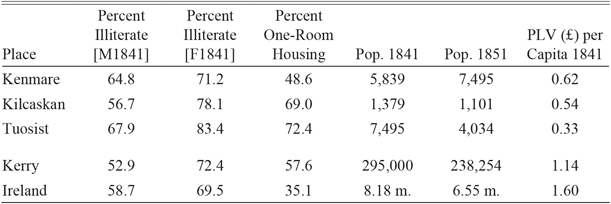
Table 3, which gives data on population, housing conditions, literacy, and poor law valuation in the three Lansdowne parishes, in Kerry County as a whole, and in Ireland, highlights the economic backwardness of the three-parish area.Footnote 44 The only town of any size was Kenmare (population 1,339 in 1841), and most of the emigrating tenants would have lived within a ten mile radius of that town. The hardships and horrors endured by the smallholders of this area have been described in some detail elsewhere (Ó Gráda, Anbinder, and Wegge Reference Ó Gráda, Tyler, Simon and Bric2019). Hard data on famine mortality are lacking, but there are indications that it was very high. Local parish registers lack information on burials, but the course and severity of the famine can be captured from the trends in baptisms.Footnote 45 Trends in the neighbouring parishes of Kenmare and Tuosist tally very well.
CONDITIONS IN KENMARE ESTATE PARISHES

Sources: Censuses of 1841 and 1851. M1841=Males in 1841; F1841=Females in 1851.
Given the area’s narrow tax base and its heavy reliance on the potato, it was inevitable that the workhouse in Kenmare, the main vehicle of relief, would prove disastrously inadequate. At first, the local guardians sought to cap total admissions at 500, the capacity of the workhouse; but by December 1848, they were accommodating more than 2,000 inmates, many of them in rented buildings in the town and hinterland. The number relieved through the workhouse continued to mount; by April 1851 it still exceeded 3,300.
Many of the Lansdowne migrants either landed in or ended up in New York. Most were penniless on arrival and illiterate; many spoke only Irish. More than four in five of the immigrants, most of whom landed in 1851 and 1852, settled in Lower Manhattan’s run-down and heavily Irish Sixth Ward, as compared to two in five of all Kerry account holders and less than one in five of all Irish account holders.Footnote 46 The Lansdowners, who included significant proportions of children and older people, formed a ghetto within the ghetto.
We have occupational data on 143 male and 43 female EISB account holders from the Kenmare area. The men included 91 “laborers,” seven waiters or barmen, four shoemakers, and—this being New York—one “who sets up pins in a bowling alley” and an “attendant at a shooting gallery”; of the rest, only one claimed a white-collar occupation (“clerk”), while four or five might qualify as small-scale dealers. Among the women, there were 17 domestics, 11 washerwomen, 4 seamstresses, and 3 laborers. The Lansdowners were thus overwhelmingly unskilled laborers. And although there is evidence that the people of Kerry as a whole were eager for schooling and literacy (Ó Gráda Reference Kelly, Aidan and Jason2013), fewer than two in five of Lansdowne males and only one in four of females on whom there is information—proportionately far fewer than in Ireland as a whole—could sign their name when opening an account.
Still, the Lansdowners were keen to join the EISB. On Baxter Street just north of the Five Point intersection, where they dominated, three-fifths of the Lansdowne families had Emigrant Bank savings accounts (Anbinder 2002, p. 382): an impressive statistic, given that the Lansdowners would have had no familiarity with banks or savings banks beforehand.Footnote 47 Still, the bank’s records, which list nearly every transaction made until 1869 for accounts opened from 1850 to 1858, paint a picture of resilience and modest achievement. Though the Lansdowners were poorer on arrival and less likely to be literate, the median gap between their arrival and opening an account was shorter than that of Irish-born account holders in general, and their median opening deposit of $99 (equivalent to about three months’ wages) was higher than that of the Irish as a whole ($60). Perhaps because they lived closer to the bank, the Lansdowners were more likely to visit it. And like other Irish account holders, the majority of them used the bank to accumulate in the sense that the median gap between closing and opening account balances was positive.
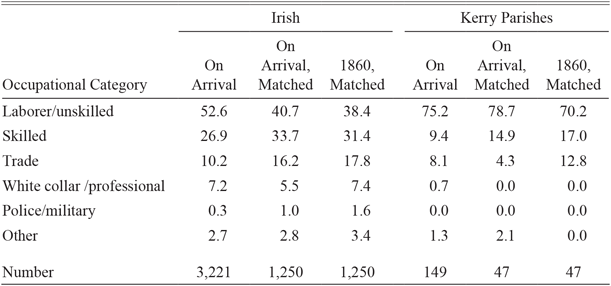
Table 4 describes a preliminary attempt at linking the Lansdowners and Irish account holders generally to the 1860 U.S. census. Our focus on is male arrivals in the 1850s. Columns 1 and 4 highlight the disadvantage of the Lansdowners relative to other Irish immigrants in the 1850s. Whereas slightly more than half of Irish could be described as laborers on arrival, more than three-quarters on the Lansdowners could be so described. The other columns compare the occupational status of account holders whose occupations are recorded both when they opened their bank account and in 1860. The numbers are small but the outcome nevertheless interesting. While Irish account holders as a whole registered modest progress by becoming more white collar, the improvement in the Lansdowners’ status is reflected in the increasing importance of trading occupations such as peddling, selling junk, and operating fruit stalls. Not only were the Lansdowners much more likely to live in slum housing, as represented by the Sixth Ward, than the Irish as a whole, they were also less likely to leave it. Thus, 88 percent of the Lansdowners with an address in the Sixth Ward when they opened their account still lived there in 1860, whereas this was true of only 67 percent of other Irish who arrived in the same years. The Lansdowners may not have struck it rich in the United States, but they coped.Footnote 48
OCCUPATIONAL ADJUSTMENTS, 1850–1860 [MALES ONLY]

Source: EISB database.
THE EARL GREY SCHEME
Virtually the only assisted migration scheme to receive official backing at the height of the Irish Famine was named after its instigator, colonial secretary Henry George Grey, the third Earl Grey (1802–1894).Footnote 49 Under this scheme more than 4,000 female orphans were shipped from Irish workhouses to Australia between October 1848 and July 1850.Footnote 50 The plan was to relieve pressure on the workhouses while responding to the demand for domestic servants and for women of marriageable age in a colony where in 1846 males aged 21–45 years outnumbered females of the same age by almost two to one.Footnote 51 Conveyed to Melbourne, Adelaide, and Sydney in 20 separate consignments, the young women, most aged between 16 and 19, began life there as indentured servants, most with no pre-existing networks of friends and relations.
The orphans were selected by inspectors from among those proposed by the workhouses. There was selection within selection. Despite their background of destitution, the orphans were somewhat more likely to be literate than other young women in the counties they left.Footnote 52 That makes sense: The authorities would not have selected girls, for example, who could not speak English. Those chosen from the workhouse in Oldcastle, County Meath included 12 selected “for superior merit and good conduct during a residence of more than 2 years in the workhouse”; while nearly all of a group from “the Cavan, Boyle, Loughrea, and other unions” who sailed from Dublin to Plymouth in December 1848 could read and write, “some of them very superiorly, both as to style and penmanship.”Footnote 53 Only in one case (Belfast) was there clear evidence of workhouse administrators using the scheme to dispose of their more boisterous inmates.
The orphans seem to have adapted to settler society with relative ease. Most for whom the details have been traced—nearly one-third of the total so far—married within a few years of arrival, when they were still in their teens,Footnote 54 and displayed remarkable procreative power (Figure 4). The average number of births per woman still married in her 40s exceeded nine. Moreover, the women lived relatively long lives, with an average age at death of 62.6 years.Footnote 55 Unlike Irishwomen who settled in the United States and Britain at that time, most of the orphans married men who were not Irish and/or belonged to a different religion, often ex-convicts, and they assimilated quickly. This applied to Catholic and Protestant orphans alike. How representative were those for whom we have information remains moot. Catholic orphans were a little less likely to be traced and those from Ulster more so, and clearly those with no children are less likely to be represented; but at least we can be confident that the data contain relatively few “false positive” matches.
THE EARL GREY ORPHANS: MARRIAGE, FERTILITY, AND DEATH
Source: Derived from Australian Irish Famine Memorial database http://www.irishfaminememorial.org/orphans/database/.

As a policy measure the Earl Grey scheme failed in the sense that objections from colonists brought it to an end in 1850. It attracted hostility because the colonists rather than the Treasury bore the cost of the scheme; because public opinion in the colonies conflated convict and assisted immigration; because a minority of the women misbehaved; and because of anti-Catholic prejudice. There were complaints about the orphans’ truculence and lack of appropriate skills, and some were undoubtedly justified, although adverse publicity surrounding a minority overshadowed the efficiency with which most were settled.Footnote 56 And the size of the inflow cannot have counted for much, as the population of Australia grew from 340,000 in 1847 to 405,000 in 1850 and 1,145,000 in 1860.Footnote 57 In sum, this scheme offers a hint of what might have been achieved by a less restrictive scheme of assisted migration to Australia.
IMPLICATIONS
The Great Irish Famine was the product of an ecological disaster that made the vast population, previously dependent on the potato and the land-intensive agriculture that it sustained, redundant. Only a much lower population could sustain the wage obtaining before the shock, and that required either excess mortality or permanent migration. The challenge posed was unprecedented. For those who could afford it, emigration was an option, which a million or so availed of during the famine and its immediate wake. Although neither the numbers involved nor the trade-off between death (the next world) and migration (the new world) will ever be precisely known, what is certain is that in the absence of this safety valve, excess mortality in Ireland and in the United Kingdom as a whole would have been much higher (Ó Gráda and O’Rourke Reference Ó Gráda and Kevin1997). However, a serious limitation of this form of disaster relief was that the most vulnerable lacked the means to leave and local elites in the worst-hit areas were unable or unwilling to support them.
Publicly funded migration was a viable option, much discussed at the time. Diverting, say, even half of the £4.5 million spent on wasteful public works in 1846–1847 to assisting emigration to the New World and to Australia would have financed the emigration of 0.2 million people and significantly reduced the pressure on local relief. The bureaucratic challenges posed by such a desperate measure would certainly have been considerable—but hardly greater than those posed by organizing, in a short space of time, the public works and the soup kitchens in a country afflicted by hunger and disease.
There would have been other challenges, not least nativist resentment in receiving countries. An increase of about one-fifth in aggregate long-distance migration from Ireland in 1847–1849 would have added to the pressure on labor markets and public health and exacerbated anti-Irish sentiment. Such feeling was strong in any case, and would fuel the rapid growth of the Know-Nothing Party in the United States in the mid-1850s. In Massachusetts, in particular, there was strong support for excluding paupers who would become a public charge; less so in New York, where the local Irish community was more powerful. Still, in the late 1840s, not even the most rabid nativists argued for a ban on entry: the surge in support for the Know-Nothings came later. Thus, while an added influx of Irish would not have been welcome, they would have been admitted.Footnote 58
Exporting such numbers during the famine would also have stretched available shipping capacity, but here the record suggests that supply of potential carriers was elastic.Footnote 59 Immigration from the United Kingdom as a whole to the United States more than doubled between 1847 and 1851 (from 129,000 to 273,000) without any rise in steerage fares westwards: Indeed, the modal spot fare from Liverpool fell marginally from £4.1 in 1845–1847 to £3.9 in 1848–1850 (Killick Reference Killick2014, p. 191). In other words, shippers found many more (and bigger) ships over these years in order to accommodate quite a large increase in traffic. It seems doubtful that space could not have been found for, say, another 0.2 million steerage passengers over a two- or three-year period.
It is impossible to say how many lives such an emigration might have saved. In a somewhat different context two decades earlier, Malthus had remarked that “a removal of a small part of the whole laboring population might effect a very beneficial change in the condition of the remainder.”Footnote 60 Surely the same could be said of the assisted migration of, say, 200,000 of those most at risk at the height of the Great Famine?
The micro-histories of the Earl Grey orphans in Australia and the Lansdowne emigrants in New York attest to the ability of even the most wretched to acculturate and adapt in their different ways. The latter clung to the ghetto and were slow to integrate, whereas the former were more likely to leave the cities behind, and far less likely to marry their own kind. In terms of material progress, the orphans probably had the edge. Both groups, however, support Irish historian Oliver MacDonagh’s conjecture that had migration been supported out of the public purse during the famine “many thousands more might have been given an opportunity to begin life with hope.”Footnote 61 The constraint on this happening was ideological, not budgetary. They make a broader point about the role of migration as a means of relieving poverty and destitution. Famines in peacetime may be a thing of the past, at least for the time being, but their history has plenty resonances for the present.