During the first half of the 20th Century, a pair of complementary papers was published on the ontogeny of two species of trilobites from the Tremadocian of the Shineton Shales, in Shropshire, England. These admirable and very detailed works were to have a significant influence on future studies of trilobite ontogeny and were soon to become classics. These papers were Frank Raw's (Reference Raw1925) work on the ontogeny of Leptoplastides salteri (Callaway, Reference Callaway1877) and Sir James Stubblefield's (Reference Stubblefield1926) elucidation of the development of Shumardia (Conophrys) salopiensis (Callaway, Reference Callaway1877). In Raw's paper, the terms protaspid, meraspid, and holaspid were defined and introduced for the first time. Stubblefield's work, with reconstructions of all successive growth stages by Oliver Bulman, demonstrated unequivocally what had been foreshadowed in previous studies (e.g., Barrande Reference Barrande1852) – that the thoracic segments were formed in a generative zone in the anterior part of the pygidium and then released forwards successively when mature. The macropleural spine on the fourth segment in L. salteri could be clearly seen throughout development and acted as a marker. The importance of these two papers cannot be underestimated, the work that they encapsulate was undertaken well before the advent of palaeontological techniques in common use today. These include the latex replication of external moulds, epoxy resin casting, whitening with ammonium chloride or magnesium oxide, high-powered light microscopy, the use of the camera-lucida microscope, and scanning electron microscopy (SEM). Whereas details of developing spinosity, the eyes, and the hypostome were noted and illustrated by Raw, and although they were present in many of his specimens, their precise morphology is only clearly visible with modern equipment. Moreover, details of the smaller developmental stages were hard to distinguish in Raw's time, and in some cases his interpretations required revision and new drawings needed to be made. By today's standards, the papers by Raw and Stubblefield are under-illustrated, and although Bulman reconstructed each developmental stage for Stubblefield's paper, Raw had reconstructions only of meraspid degrees 3 and 5, though in 1927 he added further drawings, later reproduced by Whittington (Reference Whittington and Moore1959) for the Treatise on Invertebrate Palaeontology. Fortey & Owens (Reference Fortey and Owens1991) have already revised the ontogeny of S. (C.) salopiensis, and have made additional comments on some of the early stages in the growth of L. salteri; they also presented new photographs and a new lateral reconstruction of the adult.
As part of an extended programme of research on the ontogeny, evolution, and ecology of olenid trilobites (including Clarkson Reference Clarkson1973; Clarkson & Taylor Reference Clarkson and Taylor1995; Clarkson et al. Reference Clarkson, Taylor and Ahlberg1997, Reference Clarkson, Ahlgren and Taylor2003, Reference Clarkson, Ahlgren and Taylor2004; Månsson Reference Månsson1998; Clarkson & Ahlberg Reference Clarkson and Ahlberg2002; Bird & Clarkson Reference Bird and Clarkson2003; Tortello & Clarkson Reference Tortello and Clarkson2003, Reference Tortello and Clarkson2008; Ahlberg et al. Reference Ahlberg, Szaniawski, Clarkson and Bengtson2005, Reference Ahlberg, Månsson, Clarkson and Taylor2006; Månsson & Clarkson Reference Månsson and Clarkson2012, Reference Månsson and Clarkson2016; Schoenemann & Clarkson Reference Schoenemann and Clarkson2015), it became clear in the early stages of this research that much more was to be learned about the ontogeny of this species, despite what was already known. In particular, we sought to ensure adequate illustration of the successive stages in ontogenetic development, but in the process we discovered a number of aspects of developmental morphology and population biology that were previously unknown. In addition, we discovered new details of the development of the hypostome, which changes from being conterminant to natant during ontogeny, and also that the early meraspid stages provide evidence for more remarkable spinosity than had previously been recognised.
1. The Tremadocian Shineton Shales
The Tremadocian Shineton Shales of S Shropshire form a 2-km-thick pile of argillaceous and arenaceous sediments belonging to the lowest (and now internationally accepted) series of the Ordovician (Smith & Rushton Reference Smith and Rushton1993). First noted by Charles Callaway (Reference Callaway1877), these were extensively researched by Stubblefield & Bulman (Reference Stubblefield and Bulman1927) and are divided into the Rhabdinopora flabelliforme, Adelograptus tenellus, and Shumardia (Conophrys) salopiensis biozones. Of these, the highest biozone, that of Shumardia (Conophrys) salopiensis, is dominated by yellowish-green fine-grained shales and yields a rich, diverse, and often very well-preserved fauna. Trilobites are abundant; the rocks also yield the cystoid Macrocystella and inarticulated brachiopods. The common trilobites include Leptoplastides salteri, S. (C.) salopiensis, and Asaphellus homfrayi Salter, Reference Salter1866, but several rarer species belonging to other genera were described by Callaway and, more recently, by Fortey & Owens (Reference Fortey and Owens1991). Juvenile stages of the three common genera are frequently encountered at various levels within the sequence. Those of L. salteri have been described in the classic papers by Raw (Reference Raw1908, Reference Raw1925, Reference Raw1927) and Stubblefield (Reference Stubblefield1926), the latter having been revised on the basis of new material (and with the use of SEM) by Fortey & Owens (Reference Fortey and Owens1991).
Very similar faunas are present in the Tremadocian of NW Argentina, Scandinavia, and China, with many of the same genera, as described and summarised by Balseiro et al. (Reference Balseiro, Waisfeld and Buatois2011) and Tortello & Esteban (Reference Tortello and Esteban2016).
1.1. Raw's original work
Frank Raw (1875–1961), encouraged by Charles Lapworth, embarked upon a detailed study of the ontogeny of Leptoplastides salteri. Although a preliminary note had been published in 1908, it was not until 1925 that the main work appeared, with subsequent comments in a more general paper in 1927. It is still intensively cited. Raw's extensively developed views on the interrelationships of the various trilobites, based on the form of the facial sutures and the larval cephalic spines, were criticised as being too speculative, though his careful documentation of the morphological changes during ontogeny was highly praised (H. H. Swinnerton, V. C. Illing, following discussion of Raw 1925 paper). ENKC corresponded with Raw before the latter's death in 1961. Raw noted that his own work on L. salteri had been limited by the quality of the microscopic and photographic equipment available to him at the time of his research. He hoped that some younger persons would take it up again and would revise and update it. The present paper is a somewhat belated response to his suggestion.
1.2. New directions in research
We visited Shineton Brook and also the new section at Coundmoor Brook, Cressage, Shropshire (Fortey & Owens Reference Fortey and Owens1991) with Peter Sheldon (Open University) in 2005. Despite an intensive search we found very little at either locality, due to extreme over-collection in the past. Fortunately, there are extensive collections in several geological museums; most of the material examined was borrowed from the Sedgwick Museum, Cambridge (CAMSM), which included slabs covered with specimens in all stages of growth, but mainly adults, probably resulting from mass mortality events. Other valuable material came from Lapworth Museum, Birmingham University (BU), the Natural History Museum, London, and the British Geological Survey, Keyworth, Nottingham.
1.3. Material and methods
Fifteen slabs of various sizes were selected from the collections in the Sedgwick Museum and light micrographs were made of the surfaces showing great numbers of specimens crowded together (e.g., Fig. 5d). A search was then made of the surface of each slab, for specimens of various sizes suitable for SEM study. Latex casts of external moulds were mounted on SEM stubs for investigation. Other good specimens, dorsal side up, were likewise coated with latex, and from these concave moulds convex epoxy resin replicas were made for SEM micrography (Månsson Reference Månsson1998), so as not to destroy the borrowed material. Preservation was generally good, although some surfaces, evidently having been collected from different levels in the sequence, produced less good moulds. In a few cases, there was a reaction between the shale surfaces and the latex, resulting in some blistering. These slabs, from one or possibly more than one stratigraphical level, were not used again. Though the preservation of the trilobites was generally good, most specimens had undergone some crushing; thus, most of the preserved compound eyes had at least one crack, and their original convexity could not be readily determined. Raw's earliest determinable stage is represented by an imperfectly preserved degree 1 meraspid specimen (Raw Reference Raw1925, pl. 16, fig. 1), here tentatively redrawn from Raw's photograph (Fig. 2a), together with a second degree 1 merasid specimen (Raw Reference Raw1925, pl. 16, fig. 2); we found no others of this degree. As a result of the generally good preservation, however, all stages from the degree 2 meraspid onwards could be fully described. Reconstructions, to scale, were made for meraspid degrees 2, 3, 4, 5, 7, 8, 9, and the holaspid, with 12 thoracic segments.
2. Descriptive section
Repositories. Illustrated, described, and cited specimens are deposited at CAMSM and Lapworth Museum, BU.
Class Trilobita Walch, Reference Walch, Knorr and Walch1771
Subclass Libristomata Fortey, Reference Fortey1990
Order Olenida Adrain, Reference Adrain and Zhang2011
Family Olenidae Burmeister, Reference Burmeister1843
Subfamily Pelturinae Hawle & Corda, Reference Hawle and Corda1847
Genus Leptoplastides Raw, Reference Raw1908
Type species. Conocoryphe Salteri Callaway, Reference Callaway1877, by original designation.
Leptoplastides salteri (Callaway, Reference Callaway1877)
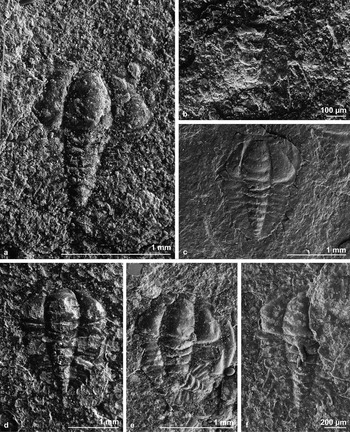
Leptoplastides salteri (Callaway, Reference Callaway1877). (a) Degree 2 meraspid, imperfect preservation, CAMSM.X.50302.1 (see also Fig. 2d). (b) Degree 1 meraspid, spiny transitory pygidium, imperfectly preserved, CAMSM.X.50302.2 (see also Fig. 2b, c). (c) Degree 3 meraspid, complete, CAMSM.X.50302.3 (see also Fig. 2e, f). (d) Degree 4 meraspid, intact apart from librigenae, upper surface somewhat abraded, CAMSM.X.50302.4 (see also Fig. 4e). (e) Degree 4 meraspid pygidium detached and abraded, CAMSM.X.50302.5. (f) Degree 4 meraspid with axial and pleural spines, CAMSM.X.50302.6.

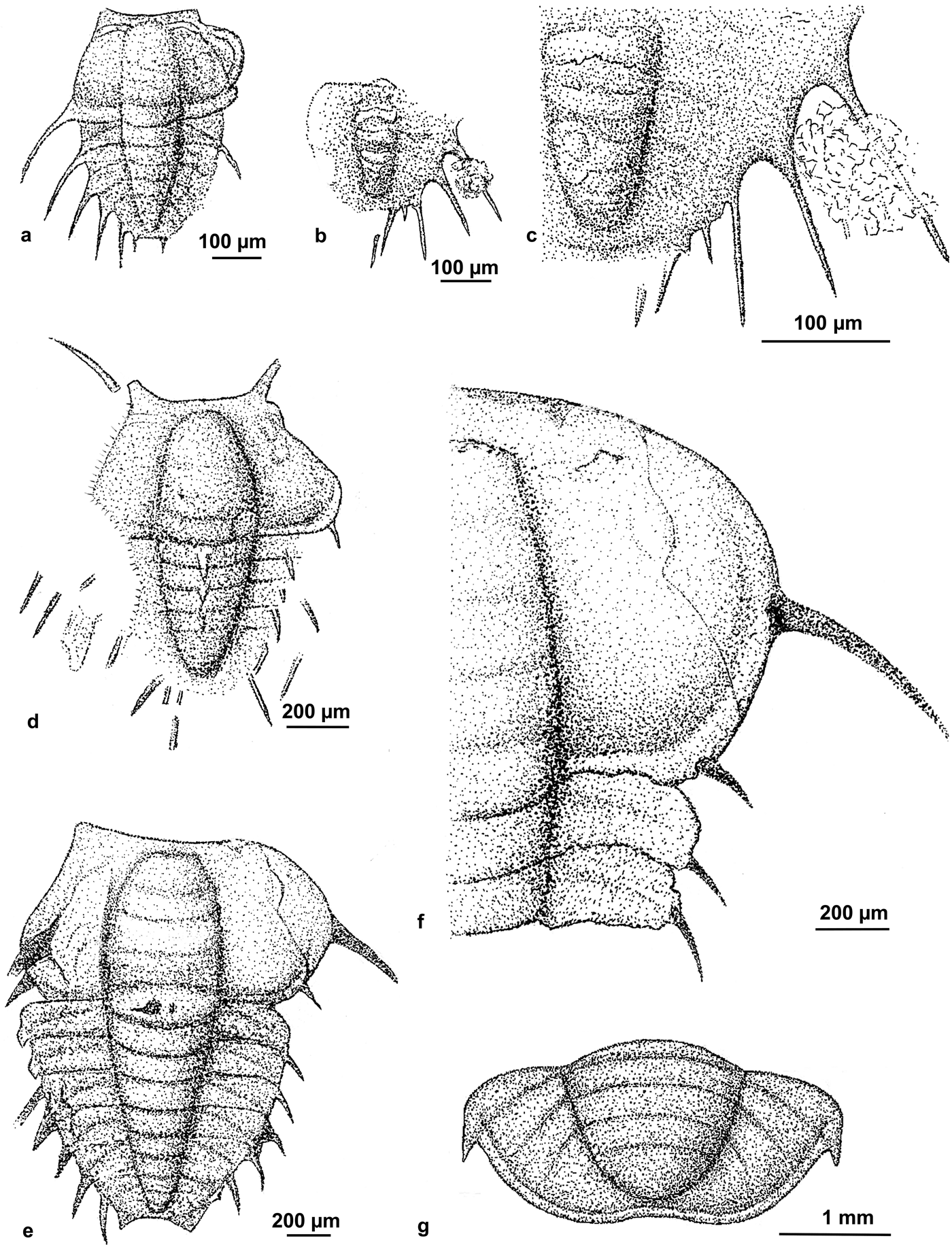
Leptoplastides salteri (Callaway, Reference Callaway1877). (a) Drawing of a poorly preserved degree 1 meraspid, made from a photograph in Raw (Reference Raw1925, pl. 16, fig. 1). (b, c) Partial spiny degree 1 pygidium (see also Fig. 1b). (c) Enlargement of (b). (d) Almost complete degree 2 meraspid, showing procranidial spines and broken, thin thoracic spines (see also Fig. 1a). (e, f) Degree 3 meraspid, largely complete and well-preserved (see also Fig. 1c). (f) Enlargement of (e). (g) Holaspid pygidium, reconstructed from a photograph in Raw (Reference Raw1925, pl. 18, fig. 24).

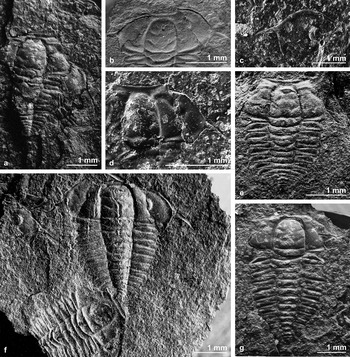
Leptoplastides salteri (Callaway, Reference Callaway1877). (a, b) Degree 3 meraspid, left-hand side crushed, with well-preserved procranidial, genal, and pleural spines, CAMSM.X.50302.7 (see also Fig. 4a, b). (b) Enlargement of right-hand side of (a). (c) Degree 3 meraspid with displaced left librigena, CAMSM 781a (also figured by Raw Reference Raw1925, pl. 16, fig. 7; see also Fig. 4c). (d) Paired librigenae of middle to late meraspid, probably exuviae, CAMSM.X.50302.9. (e) Degree 5 meraspid, lacking librigenae, CAMSM.X.50302.10 (see also Fig. 7a).

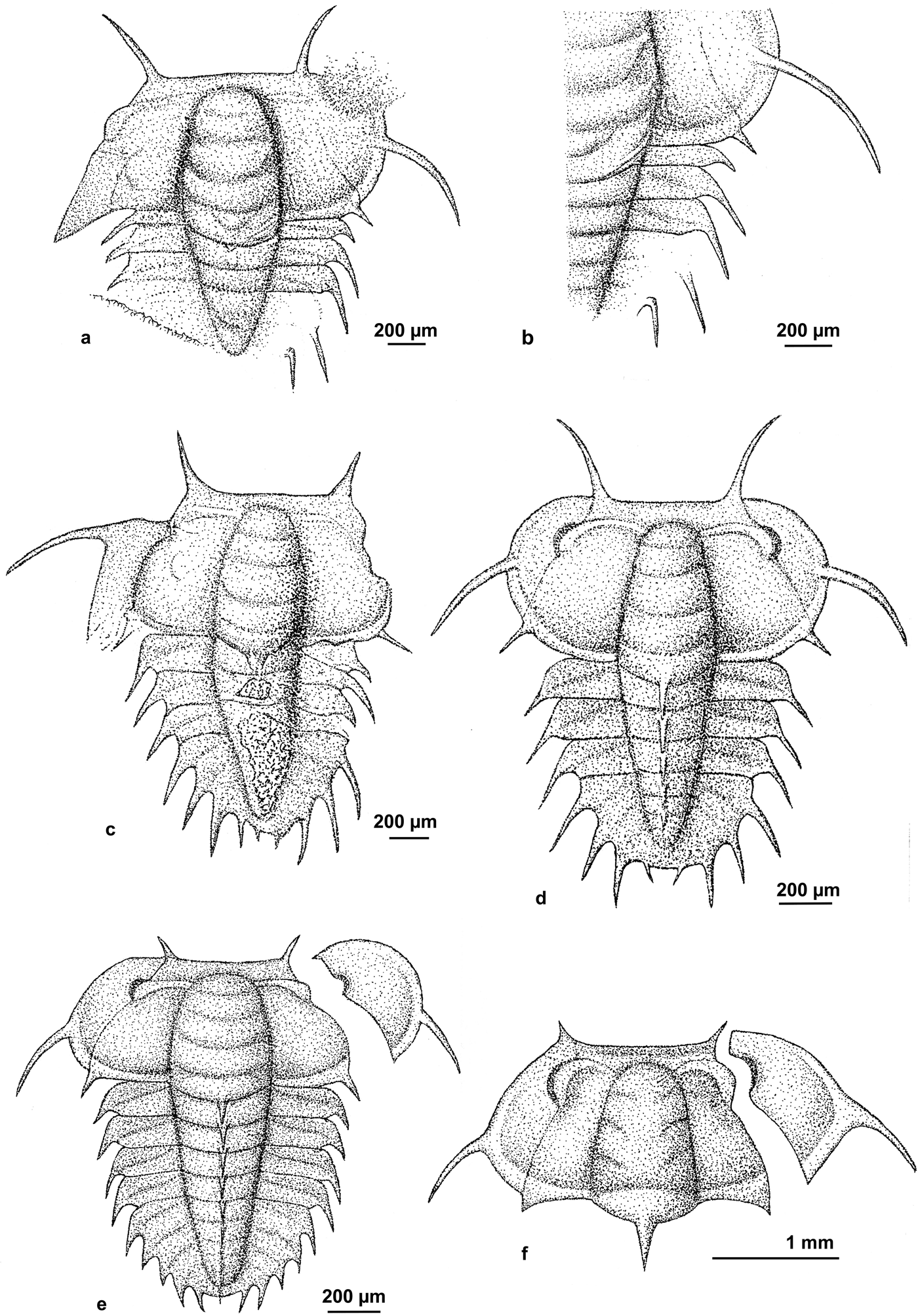
Leptoplastides salteri (Callaway, Reference Callaway1877). (a, b) Degree 3 meraspid (see also Fig. 3a). (b) Enlargement of (a) (see also Fig. 3b). (c) Degree 3 meraspid (see also Fig. 3c). (d) Reconstruction of a degree 3 meraspid. (e) Reconstruction of a degree 4 meraspid. (f) Reconstruction of a degree 6 meraspid cranidium and librigena.

Leptoplastides salteri (Callaway, Reference Callaway1877). (a) Degree 5 or 6 meraspid, CAMSM.X.50302.11. (b) Degree 6 meraspid, CAMSM.X.50302.12. (c) Degree 6 meraspid, CAMSM.X.50302.13. (d) Surface of a probable death assemblage, CAMSM A 557.

Leptoplastides salteri (Callaway, Reference Callaway1877). (a) Degree 7 or 8 meraspid, with displaced librigena on right-hand side, CAMSM.X.50302.14. (b) Cephalon of a degree 7 meraspid, CAMSM.X.50302.15. (c) Detached librigena of degree 7 meraspid, CAMSM.X.50302.16. (d) Degree 7 meraspid cranidium, with a displaced librigena on the right-hand side, CAMSM.X.50302.17. (e) Degree 7 meraspid, CAMSM.X.50302.18 (see Fig. 7b). (f) Degree 8 meraspid, virtually intact, CAMSM.X.50302.19. (g) Degree 8 meraspid, lacking librigenae, CAMSM.X.50302.20 (see also Fig. 7c).

Leptoplastides salteri (Callaway, Reference Callaway1877). (a) Reconstruction of degree 5 meraspid. (b) Reconstruction of a degree 7 meraspid lacking librigenae. (c) Reconstruction of a degree 8 meraspid. (d) Reconstruction of a degree 9 meraspid.

Leptoplastides salteri (Callaway, Reference Callaway1877). (a) Degree 9 meraspid lacking librigenae, CAMSM.X.50302.21. (b, c) Degree 8 meraspid lacking librigenae, CAMSM.X.50302.22. (c) Pleural spines, enlarged. (d) Degree 10 meraspid lacking librigenae, CAMSM.X.50302.23. (e) Fully grown holaspid with 12 thoracic segments, lacking librigenae, CAMSM.X.50302.24. (f) Late meraspid eye, CAMSM.X.50302.25 (see also Fig. 11e). (g) Holaspid eye, crushed, CAMSM.X.50302.26 (see also Fig. 11f).

Leptoplastides salteri (Callaway, Reference Callaway1877). Reconstruction of a holaspid with 12 thoracic segments, dorsal and lateral view.

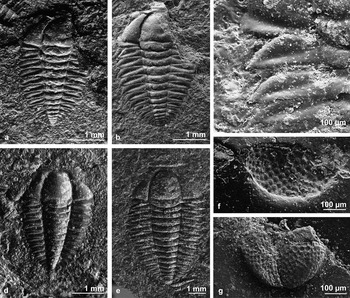
Leptoplastides salteri (Callaway, Reference Callaway1877). (a) Early meraspid impendent hypostome, CAMSM.X.50302.27 (see also Fig. 11a). (b) Middle meraspid, impendent hypostome, CAMSM.X.50302.28 (see also Fig. 11b). (c) Later meraspid, natant hypostome, rotated, CAMSM.X.50302.29. (d, e) Degree 10 meraspid with right librigena remaining with natant hypostome, CAMSM.X.50302.30. (d) Enlargement of the hypostome. (f, g) Holaspid with natant hypostome in situ, CAMSM.X.50302.31 (see also Fig. 11d). (f) Enlargement of the hypostome, showing the anterior hypostomal border fitting directly within the anterior border of the glabella. (h) Axial spines of holaspid, CAMSM.X.50302.32.

Leptoplastides salteri (Callaway, Reference Callaway1877). (a, b) Impendent hypostomes (see also Fig. 10a, b). (c) Natant hypostomes (see also Fig. 10c). (d) Holaspid, natant hypostome in situ (see also Fig. 10f, g). (e) Part of a holaspid eye (see also Fig. 8f). (f) Late meraspid crushed eye (see also Fig. 8g).

1874 Conocoryphe Salteri: Callaway, p. 196.
1877 Olenus Salteri Call: Callaway, p. 666, figure 5.
1900 Olenus Mitchinsoni, sp. nov.: Thomas, p. 619, plate 35, figures 5, 6.
1908 Leptoplastides Salteri Call: Raw, p. 513.
1919 Leptoplastus salteri (Callaway): Lake, pp. 90–93, plate 11, figures 2–5.
1925 Leptoplastus salteri (Callaway): Raw, pp. 227–257, plate 15, figure 1; plate 16, figures 1–7; plate 12, figures 8–17; plate 13, figures 18–24.
1927 Leptoplastides salteri (Callaway): Raw, p. 25, text figures 1, 6–11.
1932 Beltella spinifera sp. nov.: Lake, p. 149, plate 18, figures 9, 10.
1942 Leptoplastides salteri (Callaway): Størmer, p. 89, plate 1, figure 31.
1946 Leptoplastides salteri (Callaway): Lake, p. 342.
1957 Leptoplastides salteri (Callaway): Henningsmoen, p. 264.
1973 Leptoplastides salteri (Callaway): Rushton In Bulman & Rushton, plate 6, figure 10.
1988 Leptoplastides salteri (Callaway Reference Callaway1877): Morris, p. 126.
1991 Leptoplastides salteri (Callaway Reference Callaway1877): Fortey & Owens, pp. 449–451, figures 8c–j, 9.
Lectotype. An external mould of a dorsal shield of a young holaspid, somewhat disarticulated, BU 691, from the Shineton Shale Formation, Shineton Brook, England (figured in Callaway Reference Callaway1877, pl. 24, fig. 5; Fortey & Owens Reference Fortey and Owens1991, fig. 8h; Raw Reference Raw1925, pl. 18, fig. 21).
Earliest developmental stages. Protaspides are absent in the material from Shineton, as noted by Raw. He wrote, ‘just as Walcott had to leave the protaspid to be found by Beecher, so I have to leave the discovery of the protaspid to another'. Unfortunately, we have not found one and there are none in the newer collections from Cressage (Fortey & Owens Reference Fortey and Owens1991). This is undoubtedly the result of non-preservation.
Development of the meraspid period
Degree 1. (Figs 1b, 2a–c). The two, rather poorly preserved, degree 1 meraspides have deteriorated since Raw's time, and the figure given here (Fig. 2a), which is based on his (Raw Reference Raw1925, pl. 16, fig. 1) photograph of the best preserved of the two, has only been included for completeness of the series. Using Raw's measurements, the specimen's dimensions are: length exclusive of spines = 0.9 mm; maximum width = 0.7 mm. The cranidium is 0.3 mm long and 0.2 mm wide; the glabella is about a third of the total width. Ocular ridges are present. A long, thin, slightly curved spine is present on the left-hand side; this, we believe, is the librigenal spine pushed under the cranidium. The single thoracic segment is clearly discernible, and it is likewise provided with a similar pleural spine. Together with at least four spines from the pygidium, which become shorter posteriorly, the spine array is seen to form a fan, though details of the pygidium are otherwise poorly preserved. It is likely that the newly identified specimen (Figs 1b, 2b, c) also belongs to this meraspid degree. This is a partial pygidium, with an imperfectly preserved axis, but clearly showing a radial fan of very thin spines, decreasing posteriorly in size, on the right-hand side.
Degree 2. (Figs 1a, 2d). Raw (1925, pl. 16, fig. 2) illustrated a meraspid degree 2 individual, similar in size and appearance to that shown here, though less complete and well-preserved. Originally, it would have been c.1.1 mm long and 1.0 mm at its widest. Raw's specimen was surrounded by a fringe of long, thin spines, very distinct on the left-hand side. The pair of anterior cephalic horns, referred to by Raw, and here, as procranidial spines, is distinct. In Fig. 1a, though imperfect, the cranidium is about as long as the posteriorly tapering thoracopygidial axis, and the glabella occupies about the central third of the cranidial width. The outwardly curving procranidial spines are broken, but long. There is a fringe of very long, needle-like spines (intergenal, pleural, and pygidial), now broken and lying subparallel, surrounding the body. By this stage, the axial spines are already evident. Faint ocular ridges are present.
Degree 3. (Figs 1c, 2e, f, 3a–c, 4a–d). Specimens representing this degree are more abundant and better preserved than those of earlier developmental stages. Of these, three have been selected here for description and illustration; they each show different aspects of the overall morphology of this critical developmental phase.
Figures 3c and 4c show the best preserved and most complete specimen, which is damaged only along the axis and librigenae. It is c.1.2 mm long (as noted by Raw), and the maximum cranidial width is c.0.8 mm. The cranidium is trapezoidal in shape, widest posteriorly, with rounded margins and distinct borders. The glabella occupies the central third of the cranidial width; it tapers forwards and is rounded anteriorly. Three similar glabellar furrows and an occipital furrow are distinct though not deeply incised. The occipital ring shows the base of a stout, broken-off occipital spine. The procranidial spines have now shortened somewhat and are less curved, and the intergenal spines are quite short. On the left-hand side there is a detached, relatively narrow, slightly displaced librigena. Though the anterior edge is obscured, the genal spine is clearly seen, lying well anteriorly of the genal angle. There are three thoracic segments, and the axis tapers posteriorly, uniformly with the pygidium. The length of the thoracic region is comparable with that of the pygidium. Each thoracic segment has a stout, sharp, postero-laterally directed pleural spine, much shorter, relatively, than those of degrees 1 and 2. The pygidial spines are similar to those of degrees 1 and 2, though they are somewhat longer; the thoracic and most of the pygidial spines are essentially parallel, though the posterior ones are more parallel with the axis. The axial region is damaged and it is not possible to discern whether axial spines are present. There seems to be some malformation on the right-hand side of the thorax; the margins of the right thoracic segment are irregular and twisted, and this is not a result of crushing, but more likely caused by some kind of injury. Raw (1925, pl. 16, fig. 7) assigned this specimen to degree 4 meraspid, but we regard it as a degree 3, since the relevant anteriormost segment of the pygidium has not yet been released.
The specimen illustrated in Figures 3a, b, 4a, b is relatively complete, with the axial and glabellar furrows made more distinct by crushing. Most notable are the still very long and curved procranidial spines, the rounded genal angle, the posteriorly preserved facial suture, and the posteriorly curving genal spine on the right-hand side, emerging from the midpoint laterally. The form of the pleural spines, with stout bases and thin, almost straight, terminations, is distinctive.
The specimen in Figures 1c, 2e, f preserves a more or less intact outline of the whole body, though it is damaged anteriorly and on the left-hand side. Here, again, the course of the facial suture and the form of the narrow librigena is clear, and the right genal and intergenal spines are distinct. At this stage, however, none of the specimens show any trace of lenses.
From these three specimens, and with reference to others, it has been possible to produce a new reconstruction of a degree 3 meraspid (Fig. 4d). This differs from that of Raw (1925, pl. 15, fig. 1) chiefly in the conformation of the genal region, and particularly the point of origin of the genal spine, which, in our reconstruction, is set much further forward. Moreover, the ocular ridges are club-shaped, with the palpebral lobe being somewhat swollen.
Degree 4. (Figs 1d–f, 4e). The almost intact individual illustrated here (Figs 1d, 4e), despite some superficial damage, is otherwise well preserved. It is 2.2 mm long and 1.7 mm wide, exclusive of spines. Notable differences from the degree 3 specimens, in addition to the larger size and extra thoracic segment, is that the procranidial spines, though still present, are shorter, and the pleural spines are likewise shorter, and of similar length to each other, almost attaining adult proportions. The axial spines are rather stout and longer, though are broken off so that their true length cannot be established. There are still three glabellar furrows and the glabella is rather more parallel-sided and of more adult form.
Degree 5. (Figs 3e, 5a?, 7a). The almost intact individual (Fig. 3e) has part of the thorax and pygidium on the right-hand side obscured by an overlying librigena (reconstructed here, Fig. 7a). It is 2.3 mm long and 1.8 mm wide and differs from a degree 4 only in the conformation of the pleural spines which are stout-based but with narrow thin tips. The procranidial spines are still present, robust, though small. The intergenal spines are less distinct and almost gone in some specimens. An intramarginal suture runs along the entire cephalic border.
Degree 6. (Figs 4f, 5a?, b, c). We have only reconstructed the cephalon representative of this degree. Other general characteristics and sizes are intermediate between degrees 5 and 7. The complete trilobite is about 3.0 mm long, and the cranidial width is 2.0 mm. Raw (1925) gave a length of 2.4 mm.
Degree 7. (Figs 6a?, b–e, 7b). Several specimens pertaining to this degree all show consistent structure, and they are c.3 mm long and 2 mm wide (Raw registered similar dimensions). The anterior border has become broader and is gently curved concave forwards, extending laterally into a pair of tiny horns, which is all that remains of the procranidial spines. The ocular ridges are prominent and somewhat curved, retaining the slightly swollen palpebral region. In most of the specimens belonging to this degree, the glabella is now parallel-sided and of largely adult form. F1 is effaced medially and represented only by an oblique lateral depression; F2 is continuous, and deeper close to the axial furrows; F3 is present, though very faint, and continuous. In degree 7, the first thoracic segments have rather blunt pleural tips, whereas those of the succeeding segments have short, recurved spines. The pygidial spines are very short, absent posteriorly. A detached cranidium with a displaced librigena on the right-hand side belonging to this degree (Fig. 6d) shows a notably trapezoidal outline, a forwardly narrowing, anteriorly rounded glabella, an extremely narrow genal field, distinct ocular ridges, and procranidial spines are still present as is a strong occipital spine. Intergenal spines are no longer present.
Degree 8. (Figs 6a?, f, g, 7c, 8b, c). Raw (1925, p. 238) noted that he had not found specimens representing this degree and suggested that two thoracic segments may have been liberated during a single moult. This would seem to be perfectly possible and is matched by equivalents in other trilobites (Whittington Reference Whittington and Moore1959, p. O135). We did, however, find a few specimens representing this degree, individuals of which are very similar, morphologically, to those of degree 7, though larger, and procranidial spines are no longer present.
Degree 9–11. (Figs 7d, 8a, d, 10e). Raw (1925, p. 238) noted: ‘These degrees do not differ much from one another, many of the characters of the adult having now been acquired'. He recorded that the procranidial spines have almost disappeared, but ‘two sharp eminences remain in degree 9 and perhaps in degree 10'. We agree with most of Raw's general descriptions for these degrees; however, procranidial spines are last seen in degree 7, and we have not found any later degrees with traces of them. Of specimens representing degree 9, those measured here are c.3.25 mm long and 2.1 mm wide, those of degree 10 (Fig. 8d) are around 5.0 mm long, and those of degree 11 lie in the range of 5.8–6.2 mm long, as measured from specimens in the assemblage illustrated in Fig. 5d.
Holaspid morphology. (Figs 8e, 9, 10g) This is well known from the work of Callaway (Reference Callaway1877), Raw (1925), Lake (Reference Lake1919, Reference Lake1932, Reference Lake1946), and Fortey & Owens (Reference Fortey and Owens1991). Other than recording the dimensions (up to 7.5 mm long, in agreement with Raw's measurements), and presenting a photograph (Fig. 8e) and reconstruction of the adult (Fig. 9), no further description is deemed necessary. The disposition of the axial spines is based upon new SEM photographs (Fig. 10g), which shows them to be very long and lying more or less parallel. Our lateral reconstruction is relatively equivalent to that of Fortey & Owens Reference Fortey and Owens1991, the differences being only that we have a somewhat less concave cephalon, a higher anterior arch, a shorter preglabellar field, and a horizontal genal spine.
Development of the hypostome. (Figs 10a–g, 11a–d). Raw (1925, pl. 18, fig. 26) figured a detached adult hypostome. During our investigation further hypostomes were discovered. These indicate that whereas the later meraspides and holaspides possessed a natant hypostome (sensu Fortey Reference Fortey1990) fitting directly under the glabella, those of the earlier stages were impendent, and attached to the doublure, from which they were later freed. This is much the same as the sequence of events in Parabolina spinulosa (Wahlenberg, Reference Wahlenberg1818) (see Clarkson et al. Reference Clarkson, Taylor and Ahlberg1997, figs 11c, 13a), where the anterior border of the hypostome becomes curved but remains attached until the hypostome becomes natant. The smallest, impendent, hypostome of Leptoplastides salteri (Figs 10a, 11a) is 0.3 mm long and 0.3 mm wide at its maximum, appearing relatively short lengthwise. The middle body is about two thirds of the total hypostomal length, tapers posteriorly from its transverse attachment to the doublure, and has a rounded termination. The somewhat larger hypostomes (Figs 10b, 11b), believed to be of mid-meraspid stages, are likewise impendent, but relatively longer than that of the previous developmental stages. They are 0.4 mm long and 0.35 mm wide, and the middle body is now some three-quarters of the total hypostomal length. Apart from this increase in length, the hyostomal form is relatively similar to that of the earliest known stage. A larger hypostome (Fig. 10c) lies obliquely, detached from the doublure, and is clearly, by this stage, natant. It is 0.7 mm long and 0.6 mm wide, and the anterior margin has become outwardly curved rather than straight. The hypostome in Figure 10d, e is of similar dimensions and appearance to that in Figure 11c. The largest of the natant hypostomes preserved (Figs 10f, g, 11d) belongs to a mature, intact holaspis, 7.0 mm long, which we presume to be a carcase rather than a moult. This hypostome is 1.1 mm long and 1.0 mm wide. It lies directly below the glabella, in life position, and the curving anterior margin fits exactly with the anterior glabellar border. In this respect, it resembles some hypostomes described by Fortey (Reference Fortey1990).
Remarks on the eyes. An internal mould of an intact right eye (probably of a holaspid) attached to its librigena was figured by Raw (1925, pl. 18, fig. 25). Despite its small size, it clearly shows the lenses, which are arranged in a somewhat irregular hexagonal close packing system. A larger eye (Figs 8f, 11f) is c.0.6 mm long and though crushed and cracked, it shows the disposition of the lenses, of which there were originally about 150. Raw (1925, p. 240) commented that in a large individual 8.7 mm long there were about 300 lenses, each of about 0.25 mm in diameter. In all the eyes available for study, the lenses are arranged in a semi-regular pattern, and their diameter varies somewhat in different parts of the eye; to what extent this results from, or is accentuated by, distortion is uncertain. Although other adult olenid trilobite eyes are normally of standard holochroal kind, there is at least an impression of separation between the lenses here in a slightly smaller partial specimen (Figs 8g, 11e), though the quality of preservation does not permit further analysis. Paired librigenae with eyes are sometimes found together (Fig. 3d), in a likely moulting configuration.
The eye of Leptoplastides salteri is large for an olenid (in comparison to, e.g., Parabolina and Peltura), but is appreciably smaller than that of the olenid Jujuyaspis keideli Kobayashi, Reference Kobayashi1936, described in detail by Acenolaza et al. (Reference Acenolaza, Tortello and Rábano2001). This widespread and probably pelagic species (Tortello & Clarkson Reference Tortello and Clarkson2003) is a pelturine, as Leptoplastides is now considered to be, and possesses the largest eyes of any olenid trilobite, with up to 1200 small, separate lenses.
Remarks on the spinosity. A remarkable feature of the early stages in development of Leptoplastides salteri is the extreme spinosity. The strong development of the procranidial spines, as distinct curving cephalic horns, is a prominent feature of the early meraspides. Thereafter, they become relatively smaller, and have vanished by degree 8. Similar, though smaller, procranidial spines are rare in trilobites, and amongst olenids known only in protaspides and early meraspides of Triarthrus latissimus (Månsson Reference Månsson1998). Clearly, they were obsolete by the later stages of meraspid ontogeny. These spines became relatively diminished in size later and thicker proximally, taking up the recurved, sharply pointed form of the thoracic spines typical of most olenids. The genal spines are quite stout and posteriorly curved in the meraspides, at least from degree 3 onwards, but are not especially long, and subsequently become relatively shorter. The axial thoracic and pygidial spines, an unusual feature of olenids, generally are very long and quite sharp, as Fortey & Owens (Reference Fortey and Owens1991) pointed out, and they lie more or less parallel to each other. They are quite delicate and they broke off easily (Fig. 10h). Developmental changes in spinosity appear to be more distinct in L. salteri than in any other olenid known so far.
3. Ecological aspects of Leptoplastides salteri
Olenid trilobites are widespread in the dysoxic facies of the Furongian (late Cambrian) across the northern hemisphere, which contains almost exclusively olenids, with some agnostoids and with a few ‘exotics' (Żylińska Reference Żylińska2001; Żylińska et al. Reference Żylińska, Weidner, Ahlgren and Ahlberg2015). In the later Tremadocian times, however, olenids became part of a much more diverse fauna, though as a subordinate rather than a dominant component. The Shineton Shales contains a diverse fauna, but it is dominated by Leptoplastides. This is remarkably equivalent to coeval faunas in other regions. In particular, during the early Ordovician, olenids were more abundant in the Central Andean Basin (from Peru to NW Argentina) than anywhere else in the world (Balseiro et al. Reference Balseiro, Waisfeld and Buatois2011). Moreover, several depositional environments are represented, each with its own olenid fauna. These lived in a wide variety of depositional environments, which have been intensely investigated sedimentologically. Accordingly, the situation in the Argentinian Cordillera Oriental (Furongian to Tremadocian) is of particular interest for olenid palaeoecology, and that of Leptoplastides in particular. Leptoplastides is always found in high abundance in the Tremadocian Central Andean Basin (Waisfeld & Balseiro Reference Waisfeld and Balseiro2016). In samples from across the environmental gradient, from oxygenated high-energy environments of the lower shoreface to the deepest anoxic settings, Leptoplastides are found in high abundance and dominate the trilobite fauna.
In the earliest middle Tremadocian, rocks in the Central Andean Basin from five biofacies have been recently statistically defined in great detail (Balseiro et al. Reference Balseiro, Waisfeld and Buatois2011), representing, in general terms, a gradient of successively deeper environments. The lower shoreface to upper offshore environments contained a Leptoplastides–Asaphellus fauna, rather like that of Shineton. A third olenid fauna, in what has been called the Olenid-rich 1 biofacies, occurs in lower-offshore sediments, and is dominated by Leptoplastides, Bienvillia, Parabolinella, Peltocare, and Plicatolina. Asaphellus and Pseudokainella are also present.
The Andean Leptoplastides seems to have been a generalist, able to live in a broader range of environments than other Tremadocian olenids (Balseiro & Marengo Reference Balseiro, Waisfeld and Buatois2008). There is an evident correspondence between the Leptoplastides–Asaphellus fauna of the Andean lower shoreface to upper-offshore biofacies and the occurrence of Leptoplastides in the Shineton Shales, which may suggest equivalent environmental preferences, though depositional sequences, the key to facies analysis, are not well known from Shineton.
Leptoplastides salteri is unusual, for if it is correctly interpreted as a pelturine, it is exceptionally spiny, both as a juvenile and an adult. The procranidial spines likely acted as stabilisers in juvenile trilobite, particularly if these small trilobites had been active swimmers (B. Schoenemann, University of Cologne, pers. comm. 2017). We also note that in the early stages thoracic and pygidial spines are remarkably long and thin, and they would have acted as a prickly deterrent or protection for young stages. But what were the dorsal spines for in the adults? Were they purely protective? We shall never know.
Leptoplastides salteri sometimes occurs in swarms at Shineton, covering bedding planes (Fig. 5d). These possible mass mortality horizons are suggestive of periodic influxes of toxic or deoxygenated water. However, since our knowledge is necessarily based on museum material, and there is now very limited access to productive sampling levels, there is much that still remains unknown.
4. Acknowledgements
We thank Matt Riley (CAMSM) for the loan of material, and Michael Howe (British Geological Survey, Nottingham) and Claire Mellish (Natural History Museum, London) for access to other specimens. Nicola Cayzer (School of Geosciences, University of Edinburgh) gave great assistance with SEM at Edinburgh, and Peter Sheldon (Open University) accompanied us in the field. Brigitte Schoenemann (University of Cologne) read the manuscript and offered useful discussions for its amendment. Alan Owen (Glasgow University) and Derek Siveter (Oxford University) made many helpful suggestions for the improvement of the manuscript.