Introduction
The egg cell of angiosperms is deeply embedded in maternal somatic tissue, and during fertilization pollen tubes needs to penetrate the stigma and style of the pistil through tip growth to reach the embryo sac. The stigma and style of a pistil screen select compatible pollen to keep the species purity, and are also the main barriers for distant hybridization during breeding. In vitro fertilization, in which both egg and sperm cells are isolated and induced to fuse, overcomes the somatic barrier of the pistil to produce a zygote. Kranz et al. (Reference Kranz, Bautor and Lörz1991) first fused the egg and sperm cell of maize, producing artificial zygotes and cultured these to a multicellular development stage. The artificial zygotes were then raised to fertile plants (Kranz & Lörz Reference Kranz and Lörz1993). Kovács et al. (Reference Kovács, Barnabás and Kranz1995) fused wheat egg and sperm cells, and these artificial zygotes developed into multicellular structures. Khalequzzaman and Haq (Reference Khalequzzaman and Haq2005) conducted rice in vitro fertilization and, 2 years later, Uchiumi et al. (Reference Uchiumi, Uemura and Okamoto2007) reported obtaining fertile plants produced through in vitro fertilization. In vitro fertilization cannot only be used to explore the fertilization mechanisms of higher plants, but also has great potential for crop improvement by fusing egg cells and sperm from different species to perform in vitro distant hybridization (Dumas & Faure, Reference Dumas and Faure1995).
Wheat is the most important crop worldwide. Green bristlegrass (Setaria viridis) is a common malignant weed in wheat fields and has strong viability. If this trait in S. viridis was transferred to wheat, it could enhance its competitive ability against weeds, and improve wheat production. The S. viridis stem, although very slender, produces a relatively large spike, suggesting that it provides strong support, this trait could be very useful for wheat with an anti-lodging feature. Unfortunately, S. viridis could not be crossed with wheat using classical methods, therefore in this study wheat egg cells were fused with wheat sperm and S. viridis sperm using electro-fusion.
Materials and methods
Wheat
The wheat used in the study was Jimai 20 winter wheat, which was sown in October. The wheat flowered in March of the following year at the Botanical Gardens at Xiamen University, China.
Egg cell isolation from wheat
The wheat ovule was peeled out from the ovary of flowers at anthesis and incubated in an enzyme solution containing 0–1% (w/v) cellulase (RS) (Yakult Pharma Ceuticalind. Co. Ltd, Higashi Shinbashi Minato-Ku, Tokyo, Japan), 0–0.3% (w/v) pectolyase Y-23 (Kikkoman Corporation, Koamicho Nihobashi Chuo-ku Tokyo, Japan), 0.05% (w/v) CaCl2·2H2O, 1% (w/v) bovine serum albumin (BSA) and 6–12% (w/v) mannitol at pH 6.5 for 20 min with gentle shaking at 25–27°C. The ovules were then washed twice with the above-mentioned solution but without enzymes, and dissected under an inverted microscope. An ovule was transversely cut into two halves. After gently pushing the micropyle end of the ovule, cells in the egg apparatus were released from the cut end. Isolated egg cells were collected using a micromanipulator and transferred to an electro-fusion trough in preparation for fusion with sperm of wheat and S. viridis.
Sperm isolation of wheat and S. viridis
Mature pollen of wheat and S. viridis is tricellular and consists of two sperm cells and a vegetative cell at anthesis. Sperm isolation was performed by breaking open mature pollen in mannitol solutions (6–12%) to release the pollen cytoplasm, including the two sperm. The released sperm were collected and transferred to an electro-fusion trough using a micromanipulator (Leica DC-180) in preparation for their fusion with an egg cell. Because the isolation of wheat sperm was reported in a prior study (Kovács et al., Reference Kovács, Barnabás and Kranz1995), here we mainly describe the isolation of S. viridis sperm.
The fusion of wheat egg cells with wheat and S. viridis sperm
The electro-fusion method was used to induce wheat egg cell fusion with wheat sperm and S. viridis sperm. A BTX EMC 2001 fusion apparatus (BTX Harvard Apparatus, Holliston, MA, USA) was used to facilitate cell fusion using two processes. The fusion solution contained 7–10% (w/v) mannitol, 0.1% (w/v) cellulase RS, 0.1% (w/v) BSA and 0−0.05% (w/v) CaCl2·2H2O, at pH 6.5. The electro-fusion instrument was set to alternating current (AC), which caused the egg and sperm cells to adhere to each other and become arranged in a line according to the polarity of the electron field. Then a direct-current (DC) electric field (300–500 V) set to one or two 45 µs pulses was applied. This process perforated the plasma membranes of the egg and sperm cells, causing them to fuse.
Results
The isolation of wheat egg cells
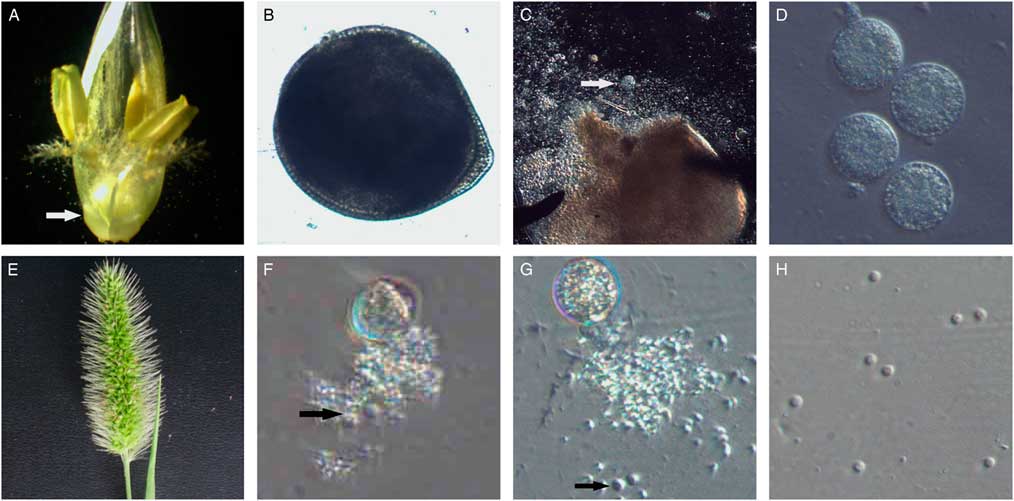
Wheat flowers at anthesis were used to isolate mature egg cells. First, the inner and outer glumes were peeled off the flower (Fig. 1A ). The ovary wall was removed (Fig. 1B ) and the collected ovules were immersed in a 5 ml enzyme solution at 25°C to digest for 20 min. The outline of the embryo sac in the ovule was visible, and provided a visible transverse line along which the ovule was cut into two parts using a dissecting needle. The micropylar half of the ovule was then fixed into position using a dissecting needle, and the micropylar end was pushed gently using another needle. The cells of the egg apparatus were released from the cut end (Fig. 1C ). The released embryo sac cells were easily distinguishable in the solution because of their distinct cytology and larger size than the nucellar cells. The egg cell was collected using a micromanipulator. The wheat egg cell could be specifically isolated into groups of egg cells (Fig. 1D ), which could be used in molecular biological assays for egg development research.
Isolation of wheat sperm and egg cells, and S. viridis sperm cells. (A) Wheat pistil and stamen (arrow indicates ovary). (B) An ovule after the ovary wall was stripped. (C) An egg cell (arrow) was released from dissected ovule. (D) Four isolated egg cells. (E) A spike of S. viridis. (F) A pollen grain broken open releasing its content, including two sperm (arrow). (G) The released two sperms (arrow) moving away from pollen cytoplasm. (H) A collected population of sperm of S. viridis.

The isolation of wheat and S. viridis sperm
Osmotic shock was used to break open S. viridis pollen grains and release the sperm. S. viridis sperm were released directly because of the tricellular pollen (Fig. 1E−G ). Mannitol was used as the osmotic medium. The mannitol concentration in the solution affected pollen breakage and the viability of the released sperm. The higher the concentration of mannitol, the lower the breakage rate of pollen grains. In 6–12% mannitol solution, the rate of pollen breakage was from 33.8 to 19.5%, with a tendency for breakage to decrease when the osmolality was increased. However, in solutions with a lower mannitol concentration, the released sperm became swollen and ruptured quickly. In 6% mannitol solution, the released sperm became round and were intact for ~170 s only. In 12% mannitol solution, the rate of broken pollen decreased to 19.5%, but released sperm increased to 7.7% and their viability increased to 200 s. Therefore, the optimal concentration of mannitol for pollen breakage was 10%, in which 29.7% of pollen grains broke open, releasing 20 pairs of sperm. The released sperm displayed viable fluorescence for 220 s (Table 1). Sperm of S. viridis could also be collected into clusters of sperm (Fig. 1H ), which can be used in molecular assays to research S. viridis sperm development.
The effect of mannitol concentration on pollen breakage and sperm viability of S. viridis

Wheat pollen is similar with that of S. viridis and the same operation was used to isolate wheat sperm.
Fusion of wheat egg cells with wheat sperm
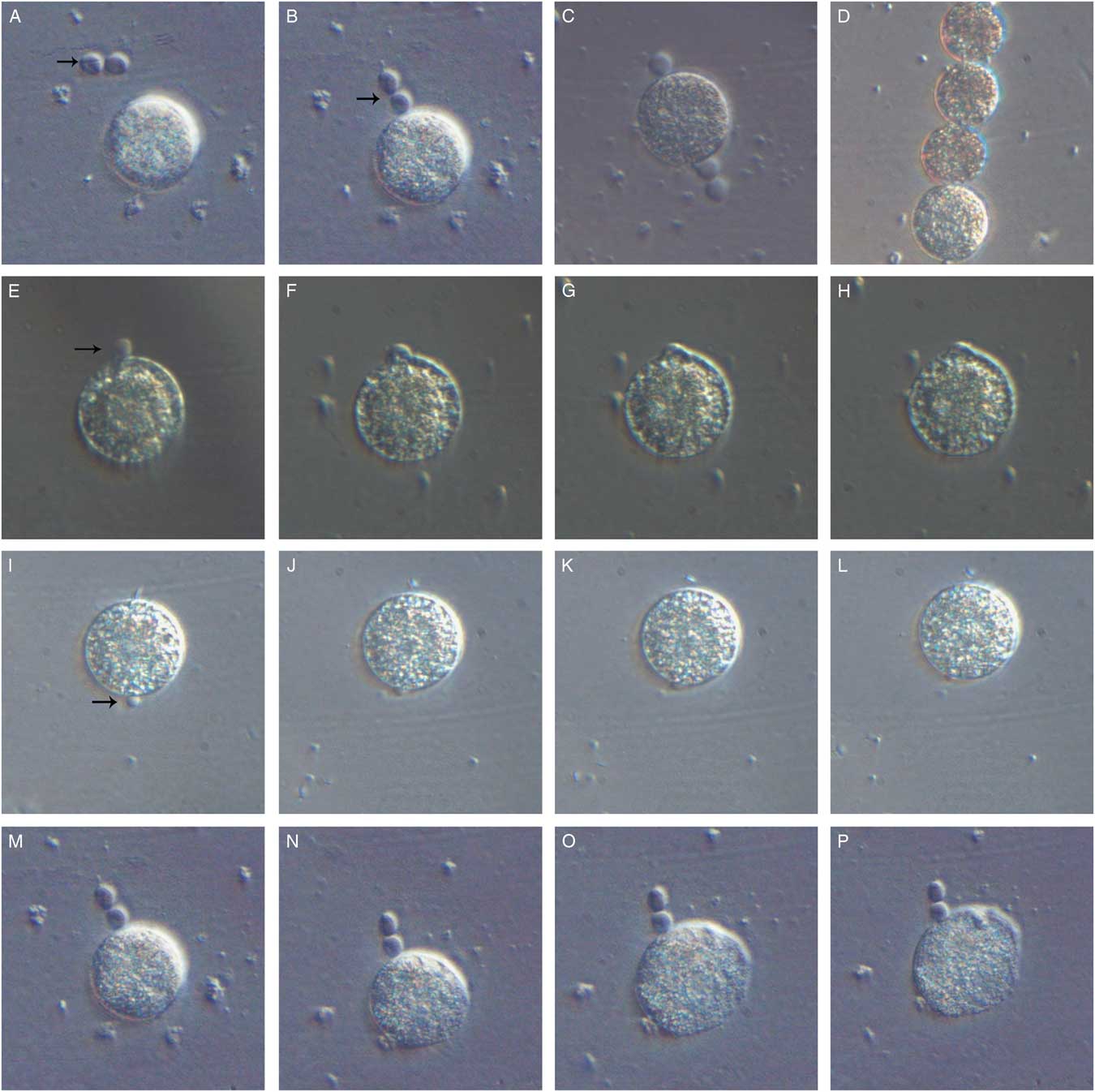
Fusion of egg and sperm cells occurs in two steps: egg and sperm cells adhere to each other and become arranged in a line, and then they fuse. Each process requires optimal conditions to ensure fusion success. When wheat egg and sperm cells were transferred into the electro-fusion trough and arranged in close proximity to each other using a dissecting needle (Fig. 2A ), they adhered to each other and become arranged in a line (Fig. 2B ) according to the direction of the electrodes after an alternating-current (AC) field was applied. Generally, one egg cell and several sperm cells were transferred into the electro-fusion trough to guarantee fusion success. These cells would become arranged linearly (Fig. 2C ). If more than one egg cell was transferred into the fusion trough, the cells were more easily arranged in a line because of their large size (Fig. 2D ). Then, after the DC was applied, the egg cells and sperm began to change form, becoming oblong in alignment with the direction of the two electrodes; the sperm cell membrane fused with the egg cell membrane and then the sperm nucleus was observed to enter the egg cell within 5 s (Fig. 2E–H and Video S1 in Supporting Information). Using a fusion solution containing 10% mannitol and 0.001% CaCl2·2H2O, the fusion of a wheat egg cell with sperm was conducted 191 times, of which 122 combinations (64%) were induced to fuse successfully.
Fusion of a wheat egg with sperm cells, and with S. viridis sperm cells. (A) Two sperm (arrow) and an egg cells before an alternating-current (AC) field was applied. (B) Two sperm (arrow) and an egg cell arranged in a line after an AC field was applied. (C) Three sperm and an egg cell arranged in a line. (D) Four egg cells arranged in a line. (E–H) Wheat egg cell fused with sperm (arrow). (I–L) Wheat egg cell fused with S. viridis sperm (arrow). (M–P) Egg cell breaking during fusion with a current of over 550 volts.

The fusion of wheat egg cells with S. viridis sperm
Fusion of a wheat egg and S. viridis sperm cells was also induced using the above-mentioned process. however the sperm of S. viridis are about one-third smaller (Fig. 2I ) than those of wheat (Fig. 2E ). The manipulation of S. viridis sperm, therefore, is more difficult after transfer to the electro-fusion trough. To increase the ability of the cells to adhere to each other and therefore improve fusion success, sperm and egg cells had to be placed in close proximity using a dissecting needle. If the distance between two cells was too great, adherence and fusion could not occur. Fusion assays of wheat egg cells with S. viridis sperm were conducted 83 times, of which six were successful (Fig. 2I–L ). The rate of fusion was 7.2%.
Screening for optimal fusion conditions
The concentration of calcium in the fusion solution is an important factor during fusion. In fusion solutions without calcium, the egg cell was easily broken when a DC electric field was applied. Fusion assays were conducted 57 times, but only one (1.75%) was successful. This rate suggests that calcium has a critically important role for cell fusion, therefore the optimum calcium concentration in the fusion solution needed to be determined. A fusion solution containing 0.05% calcium became hot immediately and quickly evaporated after the current field was applied. When the CaCl2·2H2O concentration was decreased to 0.001%, heat emission did not occur.
Before fusion, two voltage parameters had to be set on the fusion instrument (BTX EMC 2001): an AC field, which makes cells adhere to each other and become arranged in a line, and a DC field, which perforates the cell membranes and enables fusion. When the AC voltage was below 20 V, the egg and sperm cells did not adhere to each other and did not become arranged in a line. However, when the AC voltage was over 40 V, cells were easily broken. We therefore concluded that a 30–35 V (15 s) AC voltage field was the most suitable for this use. In DC field screening, when the voltage was lower than 300 V the cells did not fuse, whereas when a current more than 550 V was applied the cells were easily broken (Fig. 2M–P ). The DC fusion voltage, therefore, that was most suitable was 350–500 V for 45 µs.
The state of egg cell viability also requires different AC and DC voltages. Newly isolated egg cells had high viability and therefore could endure a higher voltage. If the egg cells were isolated for a longer time, the fusion voltage had to be set lower (<350 V).
Discussion
Superiority and use of in vitro distant fertilization
The technique of somatic hybridization can successfully fuse living cells of any two plant species, but somatic hybridization is not frequently researched because hybrid cells are difficult to culture. In somatic hybridization, both parents are diploid and there is only a small difference in the cytoplasmic volume of the two cells. After fusion of two somatic cells, the cytoplasm of the hybrid cell may be physiologically incompatible. One phenomenon often observed in hybrid cells is that the chromosomes of one parent are eliminated (Clarke et al., Reference Clarke, Chevre, Landgren and Glimelius1999; Evans et al., Reference Evans, Sharp and Flick2011). There are many other observed problems associated with somatic hybridization such as hybrid cells not dividing, non-differentiation of the hybrid callus, and instability and a high level of sterility in hybrid plants resulting from somatic hybridization (Skirvin et al., Reference Skirvin, McPheeters and Norton1989; Liu et al., Reference Liu, Liu, Zhou and He2013). These difficult problems have interfered with successful somatic hybridization of higher plants.
In vitro distant fertilization differs from somatic hybridization because of the numerous cytological differences between the sperm and egg cells. First, sperm cells contain little cytoplasm, and therefore most of the cytoplasm in the zygote is contributed by the egg cell, the maternal parent. Second, the early development of the zygote is largely regulated by resources stored in the egg cytoplasm (Dresselhaus et al., Reference Dresselhaus, Cords and Lörz1999). In addition, sperm cells genes are activated only after the zygote undergoes several divisions to form a proembryo of 32–46 cells, suggesting that egg cell genes regulate early development of the zygote (Vielle-Calzada et al., Reference Vielle-Calzada, Baskar and Grossniklaus2000). Although the zygote is a product of the fusion of male and female gametes, the zygote’s early development may be controlled mainly by maternal cytoplasm (Wang et al., Reference Wang, Kuang, Russell and Tian2006). Third, the sperm and egg cells are haploid, and both cells are induced to fuse to form a diploid hybrid, which avoids ploidy problems during somatic fusion. In polyploid breeding, the double chromosomes of same species will induce many changes.
Kranz et al. (Reference Kranz, Wiegen and Lörz1995) induced the fusion of maize egg cells and sperm cells of genetically remote species, such as Coix, Sorghum, Hordeum, and Triticum. The hybrid zygotes divided at a ratio of 78% (21/27), 50% (17/34), 43% (13/30) and 24% (9/38), respectively, to form microcalli (Kranz et al., Reference Kranz, Wiegen and Lörz1995). The high frequency of hybrid zygotes that divides to form microcalli makes the fusion of egg cells with sperm of different species or genera a potential method for distant hybridization between different genera of angiosperms. In our assay, the fusion frequency of wheat egg cells with sperm reached 64% (122/191), whereas the fusion frequency of wheat egg cells with S. viridis sperm was only 7% (6/83). Although this was much lower than wheat, this was a breakthrough for conducting instant hybridization between wheat and S. viridis. Wheat sperm are about triple the size of S. viridis sperm. The smaller size of S. viridis sperm made it more difficult to bring them into close proximity to wheat egg cells. This factor reduces cell adherence before fusion and therefore the successful fusion of wheat egg cells with S. viridis sperm. The large size of the two sperm cells of wheat makes it easier for them to adhere to each other, which is a precondition for fusion.
Screening calcium concentration in the fusion solution
Calcium has an important role during cell fusion. The role is especially evident for maize egg and sperm cell fusion. In medium containing 5 mM CaCl2, 79.7% of maize sperm and egg cells adhere for several minutes and fuse within 10 s. In this medium, fusion was restricted to sperm and egg pairs, but no fusion occurred between mesophyll protoplasts (Faure et al., Reference Faure, Digonnet and Dumas1994). In another assay, fused maize egg cells with sperm cells divided in a mannitol solution containing 50 mM CaCl2 at pH 11.0 (Kranz & Lörz, Reference Kranz and Lörz1994). However, in the in vitro fertilization of maize (Kranz et al., Reference Kranz, Bautor and Lörz1991), wheat (Kovács et al., Reference Kovács, Barnabás and Kranz1995), and rice (Uchiumi et al., Reference Uchiumi, Uemura and Okamoto2007), fusions of egg and sperm cells were induced by an electro-fusion apparatus, in which a pair of platinum electrodes (diameter 50 µm) were used. In these assays, the egg cell effectively fused with a sperm in a mannitol solution without calcium. However, in the in vitro fertilization of Torenia fournieri, which also used an electro-fusion apparatus but with an electro-fusion trough to induce egg and sperm fusion, calcium was demonstrated to have an important role in the fusion process. In the fusion solution containing 6% mannitol without calcium, fusion between egg cells was 14.5% (10/69), and the fusion of egg and sperm cells was tried 56 times without success. When 0.04% CaCl2·2H2O was added to the fusion solution, however, the fusion between egg and sperm cells increased to 69% (11/16), and between egg and sperm cells to 30% (3/10) (Yu et al., Reference Yu, Chen and Tian2012). In the present assay, calcium also had an important role in the fusion of wheat egg cells with sperm. In the fusion solution without calcium, the fusion frequency of wheat egg and sperm cells was 1.78% (1/57). When 0.001% CaCl2·2H2O was added to the fusion solution, 64% (122/191) of egg cells successfully fused with sperm cells. Using the same solution, fusion assays of wheat egg cells with S. viridis sperm were conducted 83 times, and six were successful; the rate of fusion was 7.2%. This result indicated that calcium is necessary for fusion of egg cells with sperm. However, when calcium in the fusion solution was increased to 0.05%, the solution became hot and quickly evaporated after the current field was connected.
Acknowledgements
We thank Sarah Jose PhD, from Liwen Bianji, Edanz Editing China (www.liwenbianji.cn/ac), for editing the English text of a draft of this manuscript.
Financial support
This study was funded by the National Natural Science Foundation of China (author Ru ZG charge, No. 31100225), and the Special Project of Science and Technology of Henan (author Li DX charge, 172102110025), and (author Hu HY charge, 142102110041).
Conflicts of interest
None
Ethical standards
Not applicable.
Supporting Information
Video S1.