INTRODUCTION
Historically most indicator work has focused on the macrobenthic infauna (defined as organisms retained on a 500 mm sieve (Warwick, Reference Warwick1986)). Until recently the importance of small zoobenthic organisms within the marine environment has been underestimated. Although their biomass may be insignificant compared to larger invertebrates they have been shown to contribute disproportionately to benthic production (Platt & Warwick, Reference Platt, Warwick, Price, Irvine and Farnham1980; Kuipers et al., Reference Kuipers, de Wilde and Creutzberg1981; Raffaelli & Hawkins, Reference Raffaelli and Hawkins1996). This complex ‘Small Food Web’, consisting of bacteria, microfauna, meiofauna, temporary meiofauna and small macrofauna is characterized by the small size of individuals (<500 mm), a high turnover rate, and relatively short life spans. Kuipers et al. (Reference Kuipers, de Wilde and Creutzberg1981) showed that, in intertidal environments, these groups contribute to the production of food for juvenile stages of commercially viable carnivores such as shrimp, crab and fish.
Benthic nematode and macrofaunal communities are regularly utilized in impact studies. However, very few studies are carried out utilizing both communities (Warwick et al., Reference Warwick, Platt, Clarke, Agard and Gobin1990; Somerfield et al., Reference Somerfield, Cochrane, Dahle and Pearson2006). A literature search using the search engine Scopus (www.Scopus.com) covering the last twenty years, using the key words ‘Macrofauna’ and ‘Disturbance’ then ‘Meiofauna’ and ‘Disturbance’ and finally ‘Macrofauna and Meiofauna’ and ‘Disturbance’, gave 210, 115 and 36 hits respectively. The topics covered were very similar and included physical disturbance, organic enrichment, effects of fishing gear (dredges and trawls), mariculture, and the assessment and monitoring of anthropogenic activities.
Nematode and macrofauna communities may behave differently under the same disturbance regime, increasing their utility as disturbance indicators when used together. The short life cycle, fast recolonization rates and all year round reproduction of nematodes is thought to affect their response to disturbance events (Warwick & Buchanan, Reference Warwick and Buchanan1971; Schwinghammer et al., Reference Schwinghammer, Hargrave, Peer and Hawkins1986; Alves et al., Reference Alves, Chicharo, Nogueira and Regala2003; Lampadariou et al., Reference Lampadariou, Hatziyanni and Tselepides2005), hence meiofaunal communities might be expected to show higher resilience in the face of disturbance than macrofaunal communities. For example, Bolam et al. (Reference Bolam, Schratzberger and Whomersley2006) found that when benthic communities were buried during the beneficial recharge of a mudflat the disturbed nematode communities recovered rapidly and univariate community metrics were comparable to those of reference communities with respect to spatial and temporal patterns. In contrast, macrofauna community indices were found to be significantly lower when compared with reference sites. Sherman & Coull (Reference Sherman and Coull1980) found that after sediment was disturbed, creating anoxic conditions, meiofauna communities recovered within one tidal cycle, much faster than any reported results from macrofaunal studies. However, other studies investigating disturbance events using meiofauna communities have shown that responses can be similar to those displayed by some macrofauna (Coull & Chandler, Reference Coull and Chandler1992; Austen & Widdicombe, Reference Austen and Widdicombe2006). Observed effects of various types and intensities of disturbance on nematode communities have included increased evenness, initial increases in abundance, reduced species richness and changes in community assemblage (Moore et al., Reference Moore, Murison, Mohd Long and Mills1987; Sandulli & Giudici, Reference Sandulli and Giudici1989; Schratzberger et al., Reference Schratzberger, Dinmore and Jennings2002a, Reference Schratzberger, Wall, Reynolds, Reed and Waldock2002b; Lampadariou et al., Reference Lampadariou, Hatziyanni and Tselepides2005; Dye, Reference Dye2006). Nematode species-specific responses to burial have also been documented (Schratzberger et al., Reference Schratzberger, Gee, Rees, Boyd and Wall2000). These have been attributed primarily to the variable ability of nematode species to migrate upwards through the deposited material.
Meio- and macrofaunal assemblages do not exist in isolation and therefore are part of an interacting system (Zobrist & Coull, Reference Zobrist and Coull1992, Tita et al., Reference Tita, Desrosiers, Vinx and Nozias2000). Our understanding of benthic systems and how they behave in response to disturbance events may therefore be improved if a more holistic ecosystem approach to disturbance impact studies was taken, considering more than a single faunal group (Warwick et al., Reference Warwick, Dashfield and Somerfield2006).
This study aims to compare and contrast the effects that two intensities of in situ burial have on the meiofaunal nematode and macrofaunal communities of an intertidal mudflat.
The following null hypotheses were addressed:
(1) meiofaunal nematode and macrofaunal communities show the same pattern of response to disturbance by in situ burial; and
(2) there are no differences in the effects of different intensities of in situ burial on meiofaunal nematode and macrofaunal communities.
MATERIALS AND METHODS
Study site
The Crouch Estuary is a sea inlet which is dominated by tidal ebb and flow of high-salinity waters. A field manipulation experiment was carried out on mud flats mid-way along the estuary (51°38.20 N 00°42.80E) that are sheltered from the main prevailing wind and tide. The sediments are fine (90% silt/clay) with 12% organic content (loss on ignition). The macroinfaunal community is dominated by tubificid oligochaetes, polychaetes from the family Cirratulidae and the gastropod mollusc Hydrobia ulvae (Bolam et al., Reference Bolam, Whomersley and Schratzberger2004). Dominant meiofaunal nematode species include the chromadorids Sabatieria punctata, Molgalaimus demani, Pytocholaimellus ponticus, Metachromadora viviparum and Metachromadora remanei, Chromadora macrolaima, Cyatholaimus gracilis and the monhysterids Terschellingia longicaudata and Terschellingia communis.
Experimental design
To assess the differential response of meio- and macrofauna to in situ burial a field experiment was carried out over a 9-month period on an intertidal mud flat. The experiment involved a replicated random block design that was initiated in October 2003. Samples were taken at one, three, six and nine months post set-up; the experiment was then terminated after ten months, two months earlier than planned, due to unusually high densities of seasonal algal growth. Non-sampled control, control, high intensity and low intensity burial treatments were randomly allocated to twenty-four 1 m2 plots, divided between three blocks, with two replicates of each treatment per block. Control plots were sampled at the same time as the treatment plots, whilst non-sampled controls were only sampled at the end of the experiment, to allow for the detection of any effects of sampling per se on community structure. Due to time constraints only one replicate from each of the blocks (two burial intensities and two control treatments) were processed.
Disturbance
In situ burial was achieved by spreading 4 cm of anoxic mud on top of each treatment plot. The mud was taken from areas adjacent to the plots, and was obtained by scraping off the surface oxic layer and digging down approximately 20 cm into the underlying anoxic mud. This was done to avoid transferring additional macrofauna and nematodes on to the experimental treatment plots. The high intensity treatments were applied every two weeks and the low intensity treatment every four weeks throughout the nine month period.
Sampling and processing of samples
MACROFAUNA
Sampling took place at one, three, six and nine months after the beginning of the experiment (first disturbance event) and before any fresh disturbance was applied to the treatment plots. Samples were collected using an 8 cm diameter core inserted to a depth of 10 cm. The samples were preserved in 4% buffered formaldehyde solution. Samples were washed over a 500 µm mesh sieve and all retained organisms identified, where possible, to species level.
MEIOFAUNA
Samples were collected one, three, six and nine months after the beginning of the experiment (first disturbance event) and before any fresh disturbance was applied to the treatment plots. Samples were collected using a 5 cm diameter core inserted to a depth of 5 cm. The samples were preserved in 4% buffered formaldehyde solution. Samples were washed over a 63 µm mesh sieve and extracted using Ludox (McIntyre & Warwick, Reference McIntyre, Warwick, Holme and McIntyre1984; Somerfield & Warwick, Reference Somerfield and Warwick1996). As nematode abundances were high, 5% sub-samples were taken. The sub-samples were then evaporated slowly in anhydrous glycerol and mounted on semi-permanent slides for identification and counting.
Data processing
UNIVARIATE
Number of individuals (N), species number (S), species richness (Margalef, d) and species diversity (Shannon–Weiner, H′) were calculated for each nematode and macrofauna sample. All data were checked for heteroscedasticity and normality and transformed where necessary. Differences in the response of the two faunal communities over time were assessed using repeated measures general linear models with within-subject factor of time (1, 3, 6 and 9 months) and between-subject factor faunal type. Separate analyses were performed for each treatment (high burial, low burial and control) in order to test for significant interactions between meiofaunal nematodes and macrofauna. Due to multiple testing and therefore an increased risk of false positive results, an adjusted alpha value (Bonferroni correction) of P = 0.0042 was used. Where significant interactions were found these were supplemented with one-way analysis of variance (ANOVA) within times.
MULTIVARIATE
Bray–Curtis similarity matrices were calculated for both faunal types using square-root transformed data, and from these, multidimensional scaling (MDS) ordinations were created to enable the visualization of any community differences between treatments over time. R-values (treatment versus control) generated by one-way analysis of similarity (ANOSIM) were used to rank the treatments in order of effect (distance from control).
Supplementing the illustration of fauna-specific temporal patterns in MDS ordination plots, the RELATE permutations test was applied to determine the temporal inter-relationships between faunal matrices based on univariate indices of meiofaunal nematode and macrofauna communities. This test compares the relationships between independently derived similarity matrices (based on Bray–Curtis similarity) from matched sample data, therefore allowing the significance of the relationship of temporal patterns in the two types of community to be assessed. A Spearman rank-correlation of ρ = 1 implies a perfect match between assemblages whereas a Spearman rank-correlation of ρ = 0 implies no match (Clarke et al., Reference Clarke, Somerfield, Chapman and Gee2006). The similarity percentages (SIMPER) routine was carried out to assess the contribution of individual species to the dissimilarity between treatments and controls (Clarke & Warwick, Reference Clarke and Warwick1994; Clarke & Gorley, Reference Clarke and Gorley2006).
RESULTS
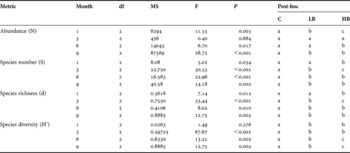
Forty-six meiofaunal nematode and twenty-six macrofaunal species were identified during this study. At the end of the experiment at Creeksea, no significant differences (<0.05) in abundance, species number, richness and diversity between control and non-sampled controls were observed (Table 1); hence sampling per se had no impact on the communities.
Results from one-way ANOVA comparing control with non-sampled control treatments at the conclusion of the experiment (significance P < 0.05).

Univariate analyses
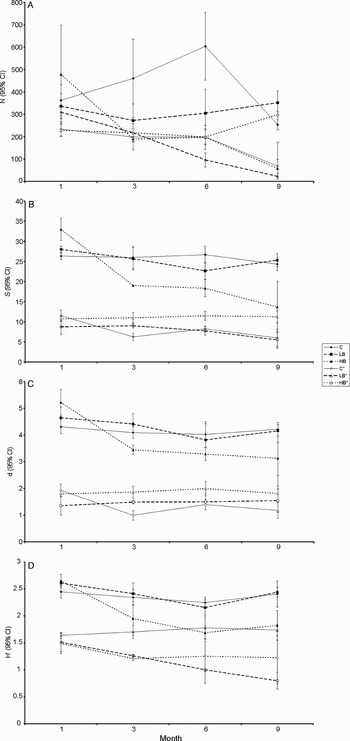
Figure 1 a–d illustrates observed spatio-temporal patterns in the univariate measures for meiofaunal nematode and macrofaunal communities. Clear differences in community behaviour over time and in response to disturbance treatments were observed. Increases in nematode species number, richness and diversity in response to disturbance were revealed in month one of the experiment. This was not apparent in results from the macrofaunal data, where there was a reduction in S, d and H′. In the case of species richness and diversity, the low intensity burial appeared to have a greater effect over time on the macrofaunal community than high intensity burial. This was not observed in the meiofaunal data. In month six, nematode abundance increased significantly in the control only and this was primarily attributed to seasonal fluctuations in Chromadora macrolaima and Molgalaimus demani densities.
(a–d) Mean (±95% CI) meiofauna and macrofauna* community indices over time. Shaded symbols, meiofaunal nematodes; open symbols, macrofauna; C, control; HB, high burial; LB, low burial.

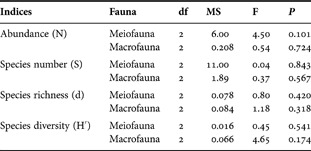
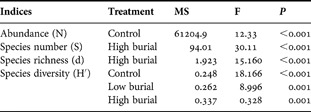
All assumptions of sphericity (equality of the variances of the differences between levels of the repeated measures factor) were passed for all repeated measures general linear model analyses. Repeated measures analyses with within-subject factors of time (1, 3, 6 and 9 months) and the between-subject factor of faunal type (meiofaunal nematodes and macrofauna) revealed several significant interactions (Table 2). Interestingly these interactions included control treatments. Assessing differences between treatments within faunal type, results from repeated measures ANOVA revealed significant interactions between time and treatment for all univariate measures for both macrofauna and meiofauna.
Significant interactions between meiofaunal nematodes and macrofauna (P = 0.0042) results from the repeated measures general linear model.

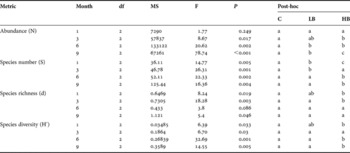
Results from additional one-way ANOVAs (Tables 3 & 4) indicated when community responses differed during the experiment. In month one, the high intensity burial treatment caused significant increases in nematode species number, richness and diversity. These values then declined as the experiment progressed. Due to a smaller number of individuals and number of species recorded per sample, only subtle changes in the macrofauna community were apparent. At different stages during the experiment all indices identified significant differences between both treatments. However, at the end of the experiment after nine months, only nematode abundance and macrofauna species diversity were sensitive enough to discriminate between the three experimental treatments. Analysis of the macrofaunal data revealed differences between the control and the two burial treatments. The magnitude of these differences changed during the experiment with the greatest differences occurring in month three.
Results from one-way ANOVAs carried out to assess significant differences between treatments over time within the meiofaunal nematode community. Lower case letters a, b & c denote significant differences between treatments.

C, control; HB, high burial; LB, low burial.
Results from one-way ANOVAs carried out to assess significant differences between treatments over time within the macrofaunal community. Lower case letters a, b & c denote significant differences between treatments.

C, control; HB, high burial; LB, low burial.
Multivariate analyses
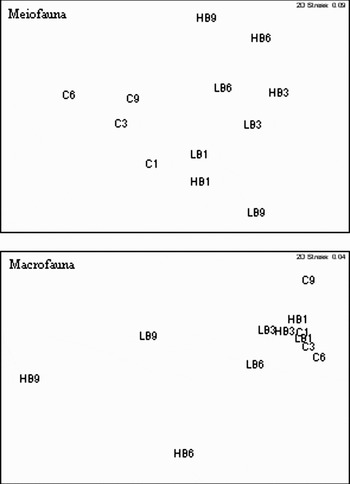
Non-metric multidimensional scaling (MDS) ordinations (Figure 2) revealed different spatial trajectories for the two faunal types. In both ordinations, the two burial treatments behaved differently when compared to the control. In the ordination of meiofaunal nematode communities, samples within treatments are more variable than those of macrofauna. In both ordinations, the high intensity burial treatment caused greatest community variation.
Multidimensional scaling ordinations of averaged community data at 1, 3, 6 and 9 months. C, control; HB, high burial; LB, low burial.

In order to quantify the magnitude of treatment effects, treatments at 9 months were ranked using the R statistic generated from the one-way ANOSIM test; the higher the R-value (0–1) the greater the differences between treatment and control. For both faunal types high burial was ranked highest with R-values of 1. Both the low burial treatments were also found to differ greatly from the control values with R-values of 0.963 (meiofaunal nematodes) and 0.990 (macrofauna). Nematode species primarily responsible for the dissimilarity between treatments and controls included Sabatieria punctata, Molgalaimus demani, Ptycholaimellus ponticus, Chromadora macrolaima, Spilophorella paradoxa, Calyoptronema maxweberi, Cobbia trefusiaefomis and Dichromadora cephalata. For macrofauna, discriminating species were Tubificoides benedii, Hydrobia ulvae, Streblospio benedicti and Aphelochaeta ‘A’.
To assess temporal inter-relationships between faunal matrices based on univariate indices of meiofaunal nematode and macrofauna communities the RELATE procedure was carried out. Non-significant test statistics of ρ = 0.011, 0.084, 0.078 and 0.019 for N, S, d and H′ respectively showed there were no common temporal patterns. Results from a comparison of similarity matrices created from community data also showed there were no common temporal patterns (ρ = 0.376). This confirms the observation made from the MDS ordinations in Figure 2.
DISCUSSION
Meiofaunal nematode and macrofaunal communities responded differently over a period of nine months when exposed to high and low frequencies of in situ burial. Within one month following disturbance, burial treatments had caused significant increases in the species number, richness and diversity of the meiofaunal nematode community, whilst values for macrofauna were significantly reduced. Only abundance of macrofauna responded positively, as a result of a temporary increase in the numbers of opportunists such as Tubificoides benedii and Aphelochaeta ‘A’. The initial increase in nematode species richness is congruent with the intermediate disturbance hypothesis which describes a predictable unimodal relationship between the intensity and frequency of disturbance and the species richness of a perturbed community (Grime, Reference Grime1973; Connell, Reference Connell1978). Although such a response has been reported from a wide range of communities (Mackey & Currie, Reference Mackey and Currie2001), it is not the usual pattern for inter-tidal macrofauna (Huxham et al., Reference Huxham, Roberts and Bremner2000). Hence this difference implies that macro- and meiofaunal nematode communities may have fundamentally different constraints and drivers (Warwick et al., Reference Warwick, Platt, Clarke, Agard and Gobin1990; Dial & Roughgarden, Reference Dial and Roughgarden1998; Austen & Widdicombe, Reference Austen and Widdicombe2006); in particular competition (Svensson et al., Reference Svensson, Lindegarth, Siccha, Lenz, Molis, Wahl and Pavia2007) may be a more important structuring force for meiofauna.
Macrofauna species richness and diversity were more affected by low than high burial frequencies. This is in contrast to the meiofaunal nematode communities where the high burial treatments consistently had the greatest effects. It is possible that the macrobenthic community benefited from high frequency burial due to increased stability of the sediments and a greater surface area as a result of the three-dimensional shape of the mounds of sediment which formed. For example, at the end of the experiment, extensive crab burrows (Carcinus maenas) were found in the sides of the mounds and increased numbers of Hydrobia ulvae were observed on the upper surfaces.
Overall macrofauna were found to be more sensitive to disturbance than meiofaunal nematodes. This was apparent from the number of significant contrasts between control and burial treatments and also between the two treatment intensities for nematodes (22) and for macrofauna (35). Significant interactions between the two control communities were also observed. These interactions appeared to be driven by the seasonal pulses of nematode individuals entering the community. However, the fact that a single meiofaunal taxon (nematodes) has been compared to several macrofaunal taxa (polychaetes, oligochaetes, mollusca and crustacea) must be considered. It is possible that had more meiofauna taxa (e.g. Copepoda) been included in the analysis, sensitivity of meiofauna may have been increased (Moore & Bett, Reference Moore and Bett1989).
The magnitude of effects caused by burial on the meiofaunal nematode and macrofaunal communities changed throughout the experiment. Within the macrofaunal community, the number of individuals (month one) and species number (month three) showed significant differences among all treatments (both burial treatments and the control). However, at the end of the experiment, only species diversity was sensitive enough to distinguish between the two disturbance types and the control community. After one month significant differences in species number, species richness and species diversity were observed between the nematode communities disturbed by burial and those in the control. However, after nine months only number of individuals was significantly different between all three treatments. These observations are important when deciding which fraction of the infauna and univariate measure to use and at what frequency sampling should take place to ensure that no changes in community structure are missed and then masked by natural variability in the community attributes being monitored.
Generally, small body size enables meiofauna to utilize a greater variety of niches and thus achieve considerable diversity at both the species and the functional group level compared to macrofauna (Warwick, Reference Warwick, Jones and Wolff1981). Meiofaunal generation times are much shorter than those of macrofauna (Somerfield et al., Reference Somerfield, Rees and Warwick1995; Bongers & Ferris, Reference Bongers and Ferris1999; Schratzberger et al., Reference Schratzberger, Gee, Rees, Boyd and Wall2000). Meiofaunal nematode species also exhibit continuous reproduction and direct development within the sediment rather than seasonal reproduction and pelagic larval stages exhibited by many macrofaunal species (Warwick, Reference Warwick, Jones and Wolff1981; Gunter, Reference Gunter1992). Continuous reproduction results in the constant presence of individuals, facilitating the recovery of disturbed areas. This renders meiofauna less vulnerable than macrofauna to disturbance events during the recruitment period, which could destroy the population until the next recruitment. This means that potentially, and as demonstrated here, meiofaunal nematodes are more responsive than macrofauna to the early stages of disturbance. The fact that macrofauna were found to be generally more sensitive to burial than meiofaunal nematodes (Austen et al., Reference Austen, Warwick and Rosado1989; Warwick et al., Reference Warwick, Platt, Clarke, Agard and Gobin1990; Gee et al., Reference Gee, Austen, De Smet, Ferraro, McEvoy, Moore, Van Gausbeki, Vincx and Warwick1992; Austen & Widdicombe, Reference Austen and Widdicombe2006; Somerfield et al., Reference Somerfield, Cochrane, Dahle and Pearson2006) may also be explained by the different life history characteristics of nematodes. In previous studies these characteristics have been shown capable of dampening the longer-term effects of disturbance events (Warwick & Buchanan, Reference Warwick and Buchanan1971; Schwinghammer et al., Reference Schwinghammer, Hargrave, Peer and Hawkins1986; Alves et al., Reference Alves, Chicharo, Nogueira and Regala2003; Lampadariou et al., Reference Lampadariou, Hatziyanni and Tselepides2005).
Species variability was greater in the meiofaunal nematode community. Changes in the species composition of the macrofaunal community involved a ‘set’ number of species, with no new species entering the community. At the end of the experiment the dominant macrofaunal species were still present, although reduced in number. The dominant meiofaunal species (S. punctata, M. demani and P. ponticus) were also still present in all treatments although their abundances were also reduced and the order of dominance changed when compared with the control treatments. In contrast to the macrofauna, new species entered the nematode communities disturbed by burial. Species not observed in the control treatments included S. paradoxa and C. maxweberi in the low burial and C. trefusiaefomis in the high burial treatment. Dichromadora cephalata was found to be present in all the control samples but by the end of the experiment had disappeared from both burial treatments. These species were also shown to contribute highly to the dissimilarity between control and disturbance treatments. Therefore, in this case, their presence or absence could be used as an indication of a disturbed nematode community.
Results from RELATE analyses (combined with the significant interactions in the repeated measures analyses) showed that meiofaunal nematode and macrofaunal community attributes (abundance, species number, richness and diversity) did not follow the same trajectory. The current work is congruent with previous studies, suggesting that meiofaunal nematodes and macrofauna respond differently to the same type and frequency of disturbance. Several studies (Warwick et al., Reference Warwick, Platt, Clarke, Agard and Gobin1990; Pranovi et al., Reference Pranovi, Da Ponte, Raicevich and Giovanardi2004; Austen & Widdicombe Reference Austen and Widdicombe2006; Bolam et al., Reference Bolam, Schratzberger and Whomersley2006) found that macrofauna communities revealed clear signs of disturbance while nematode communities were apparently undisturbed by physical perturbation. This may be due to either meiofaunal communities being structured by other environmental factors, shorter adaptation times to changes in the physical environment or because they are simply more resilient to this form of disturbance.
The mechanisms of diversity maintenance are thought to be different for meiofauna and macrofauna. Diversity in nematodes is thought to be maintained through specialized feeding behaviour and food partitioning while macrofauna diversity is thought to be controlled by the spatial partitioning of the habitat as demonstrated by the increased utilisation of the high burial treatment mounds by the macrofaunal species C. maenus and H. ulvae (Whitlach, Reference Whitlach1980; Warwick, Reference Warwick, Jones and Wolff1981). The different mechanisms of diversity maintenance and possible interactions between meiofauna and macrofaunal communities (Zobrist & Coull, Reference Zobrist and Coull1992; Tita et al., Reference Tita, Desrosiers, Vinx and Nozias2000; Olafsson, Reference Olafsson2003) may further explain why different responses to the same disturbance were observed.
Whilst attributes of meiofaunal nematode communities were more sensitive to the initial impacts of disturbance, indices derived from macrofaunal data were more responsive to burial throughout the whole duration of the experiment. The shorter generation time and all year round reproduction of most nematode species may provide an early indication of disturbance (Schratzberger et al., Reference Schratzberger, Gee, Rees, Boyd and Wall2000). Conversely the longevity of some macrofaunal species may result in changes in community structure taking longer to appear (Somerfield et al., Reference Somerfield, Cochrane, Dahle and Pearson2006). Community-specific responses and sensitivities of meiofauna and macrofauna to the physical disturbance associated with in situ burial highlights the importance of using both faunal types in the assessment of the effects of seabed disturbance in the marine environment (Heip, Reference Heip1992; Somerfield et al., Reference Somerfield, Rees and Warwick1995, Reference Somerfield, Cochrane, Dahle and Pearson2006).
ACKNOWLEDGEMENTS
We would like to thank all our colleagues at CEFAS who helped with the set-up and sampling of this experiment, especially Helen Bates, Tracy Maxwell, Matt Curtis and Sue Ware. We would particularly like to thank Hubert Rees for all his support throughout this study. This work was funded by the Department for Environment and Rural Affairs (Defra; contracts BA004, ME4118 and AG001).