Introduction
During the last 30 yr, the frequency of autumn-sown crops in Denmark has increased almost 70% at the expense of annual spring crops and grass leys (Andreasen and Streibig Reference Andreasen and Streibig2011; Anonymous 1971, 2005). A shift from summer to winter annual crops favors winter annual weed species such as blackgrass (Alopecurus myosuroides Huds.) and silky windgrass [Apera spica-venti (L.) P. Beauv.], which are now among the most common weeds across large areas of Europe (Aamisepp and Avholm Reference Aamisepp and Avholm1970; Andreasen and Stryhn Reference Andreasen and Stryhn2008; Melander et al. Reference Melander, Holst, Jensen, Hansen and Olsen2008; Naylor Reference Naylor1972). Both species are highly competitive weeds that can cause substantial yield reduction in winter wheat (Triticum aestivum L.) crops (Vizantinopoulos and Katranis Reference Vizantinopoulos and Katranis1998). In England, the economic threshold level for A. myosuroides was found to be only 12 plants m−2 (Moss Reference Moss2013), while a density of 10 plants m−2 of A. spica-venti can lower grain yield in winter wheat by 17% in Denmark (Melander Reference Melander1995). Apera spica-venti is one of the most abundant grass weeds in arable lands of Central and Eastern Europe (Massa and Gerhards Reference Massa and Gerhards2011). Naylor (Reference Naylor1972) reported that autumn-germinating A. myosuroides produced up to 8,000 seeds plant−1, while Holzner (Reference Holzner1981) recorded 50 to 6,000 seeds plant−1. Seeds of A. spica-venti are tiny (1.6 by 0.4 by 0.5 mm) (Holm-Nielsen Reference Holm-Nielsen1998) and are produced in large numbers per plant depending on the growing conditions (Warwick et al. Reference Warwick, Black and Zilkey1985). Seed shed has been reported 1 to 2 wk before winter wheat harvest at the end of July in Germany (Kampe Reference Kampe1975; Koch Reference Koch1968). Apera spica-venti has been reported to produce up to 2,000 to 16,000 seeds plant−1 (Holzner et al. Reference Holzner, Hayashi, Glauninger, Holzner and Numata1982; Melander Reference Melander1993). It has been reported that a density of 10 plants m−2 of A. spica-venti can lower grain yield in winter wheat by 17% in Denmark, and control of heavy A. myosuroides infestations in winter cereal fields can increase crop yield up to 30% (Melander Reference Melander1995; Naylor Reference Naylor1972).
The control of A. myosuroides and A. spica-venti has mainly relied on spraying with acetyl CoA carboxylase (ACCase) inhibitors and acetolactate synthase (ALS) inhibitors. Both species have been reported resistant to ACCase inhibitors and ALS inhibitors and are among the most widespread herbicide-resistant weeds in Europe (Keshtkar et al. Reference Keshtkar, Mathiassen, Moss and Kudsk2015). Consequently, there is a need for an integrated weed management strategy that includes nonchemical weed control. Moreover, political initiatives to reduce unwanted side effects of pesticide use in Europe can result in further restrictions in chemical weed control (Anonymous 2009). Integrated weed control that combines multiple strategies will be a necessity to find a compromise between crop production, crop protection, and agricultural biodiversity in the future (Andreasen and Streibig Reference Andreasen and Streibig2011; Anonymous 2018).
Alopecurus myosuroides and A. spica-venti are solely propagated by seeds, and their long-term control is dependent upon minimizing seed production (Moss Reference Moss1983; Szekeres Reference Szekeres1991). A major factor in weed seedbank replenishment is the dispersal of weed seeds by grain harvesters (Walsh et al. Reference Walsh, Newman and Powles2013). During grain harvesting, separation of harvested material takes place directly on the grain harvester. Grains are separated and often collected in a grain tank. Straw is separated and chopped or placed in a row behind the grain harvester, and the chaff fraction, which consists of the remaining harvested material, is spread across the field (Glasner et al. Reference Glasner, Andreasen, Vieregge, Dikiy, Fenselau, Bitarafan and Shumilina2018). Weed seeds also enter the front of the grain harvester at harvest, exit the machine in the chaff fraction, get redistributed evenly across the field, and contribute to weed problems in subsequent crops (Broster et al. Reference Broster, Walsh and Chambers2016; Glasner et al. Reference Glasner, Andreasen, Vieregge, Dikiy, Fenselau, Bitarafan and Shumilina2018). Therefore, grain harvest provides an opportunity to collect and destroy weed seeds by targeting the weed seed–bearing chaff fraction. In Australia, several approaches to managing this chaff material have been developed in harvest weed seed control (HWSC) systems. These include collection in chaff carts for livestock feed or burning, confinement with straw in narrow windrows (50 to 60 cm) that are burnt, direct baling with straw during harvest, placement in a narrow (20 to 30 cm) row or rows on dedicated wheel tracks, or processing by chaff-processing impact mills attached to the harvester (Walsh et al. 2013; Reference Walsh, Broster, Schwartz-Lazaro, Norsworthy, Davis, Tidemann, Beckie, Lyon, Soni, Neve and Bagavathiannan2018b). At the moment, a new system using the heat source from the exhaust gas of the combine harvester to kill weed seeds is under consideration (Jakobsen et al. Reference Jakobsen, Jensen, Bitarafan and Andreasen2019). The intention is to bring the chaff fraction and contained weed seeds into contact with hot exhaust gases to kill the weed seeds before returning this material to the field (Andreasen et al. Reference Andreasen, Bitarafan, Fenselau and Glasner2018; Glasner et al. Reference Glasner, Andreasen, Vieregge, Dikiy, Fenselau, Bitarafan and Shumilina2018; Jakobsen et al. Reference Jakobsen, Jensen, Bitarafan and Andreasen2019). The critical question is how much of the total weed seed production in a growing season is retained on the weed plants at crop harvest. If a large fraction of the total seed production could be collected and removed from the field or destroyed at crop harvest, this could contribute significantly to reduce the soil seedbank and hence the weed infestation of these two aggressive weed species. In this study, we recorded the seed-shattering pattern of A. myosuroides and A. spica-venti and estimated how much of the total seed production the plants retained at wheat harvest to get an indication of the potential for HWSC. Our hypothesis is that a large fraction of the seeds is retained on the weed plants at crop harvest, and consequently there is potential to collect or destroy the seeds with a combine harvester to reduce weed infestation in the following years.
Materials and Methods
Methods
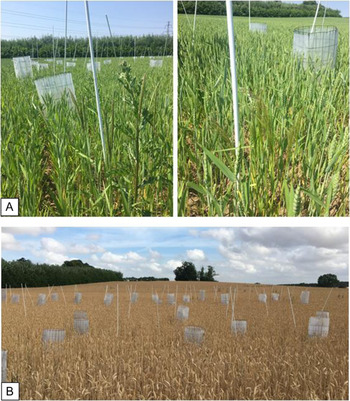
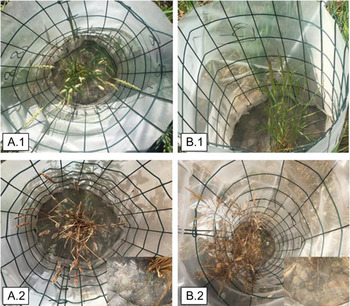
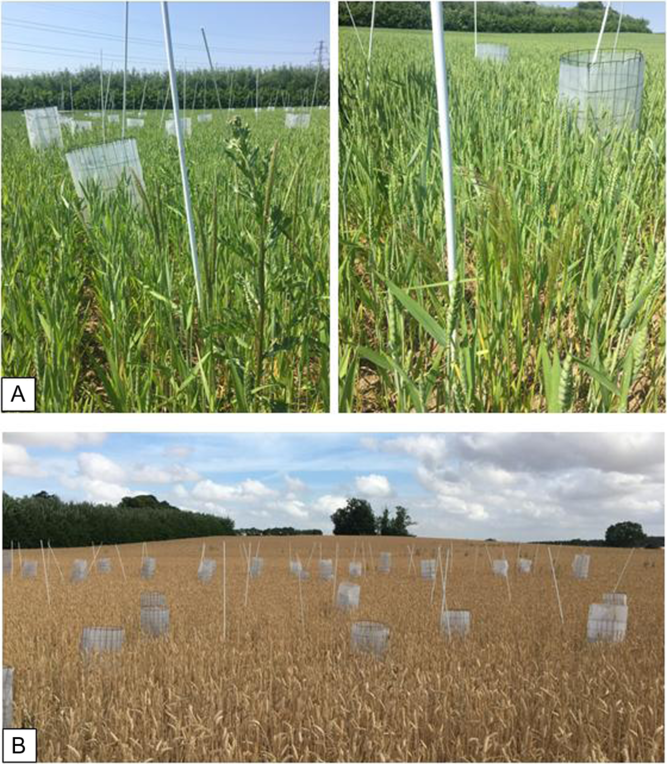
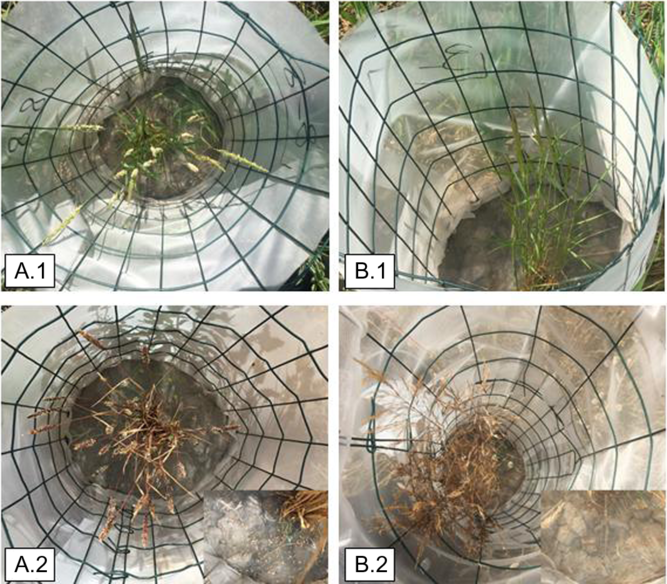
We recorded the seed production and seed shed of A. myosuroides and A. spica-venti during two growing seasons in two winter wheat fields located in Taastrup (55.63°N, 12.28°E), Denmark. One field was sown on September 27, 2016, with the cultivar ‘Elixer’ at a seeding rate of 210 kg ha−1 and harvested on August 15, 2017. The field was fertilized with 150 kg ha−1 of NPKS (22-3-8-3) on September 27, 2016, 500 kg ha−1 of NPKS (22-3-10-2) on March 16, 2017, and 250 kg ha−1 NPKS (33-3-10-2) on April 25, 2017. The other field was unfertilized and sown on October 18, 2017, with the cultivar ‘KWS Cleveland’ at a seeding rate of 180 kg ha−1 and harvested on July 31, 2018. Both fields were clay soils, and crops were grown without pesticides. Before the weeds started to flourish, 20 plants of each species were selected randomly and surrounded by a seed trap comprising a porous net (precision-woven open-mesh fabrics SEFAR NITEX 06-475/56, Sefar, Germany; mesh opening: 475 μm; opening area: 56%) (Figures 1 and 2) covering an area of approximate 710 cm2. The nets surrounded the plant at the soil surface to make it possible to collect the seeds. If there were other plants inside the net, they were removed. Twenty other plants of each species without seed nets were followed during the growing season to compare the development of plants inside and outside the nets. All selected plants survived until harvest. Nets were checked each week to record the start time of seed shattering. Thereafter, seeds were collected by a portable vacuum cleaner every 6 to 8 d depending on the weather conditions and stored in paper bags. Seeds were collected and counted until wheat harvest (Figures 1 and 2). At harvest time, weed plants were cut 15 cm above the soil surface, as no plants set seeds below this height; also, a height of 15 cm reflects practical harvest height for the growers. The number of seeds remaining on the weed plants before crop harvest was counted. For both species, the number of seeds retained on the plants at wheat harvest and the number of seeds shed before the wheat harvest were determined. The last weed seed collection took place at the first opportunity for wheat harvest. At crop harvest, the weed plants were cut at the soil surface, dried in a drying cabinet at 80 C for 24 h, and weighed.
Seed nets in a wheat field in (A) late May and (B) mid July (2018).
Maturing plants of Alopecurus myosuroides in nets in late May (A.1) and mid July (B.1). Maturing plants of Apera spica-venti in nets in late May (A.2) and mid July (B.2).
Weather Conditions
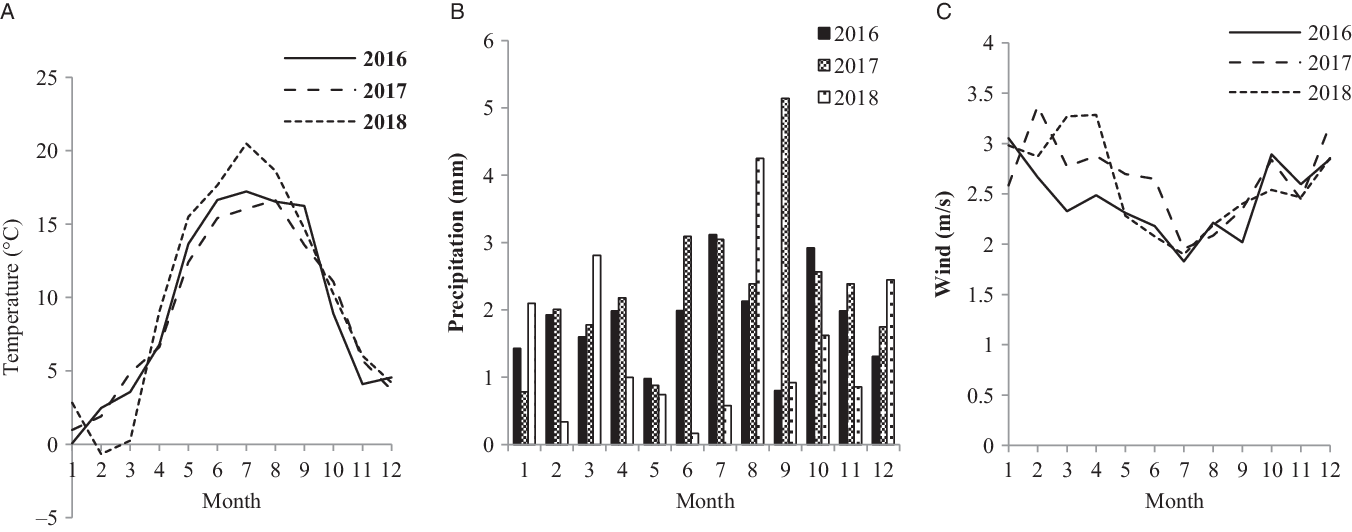
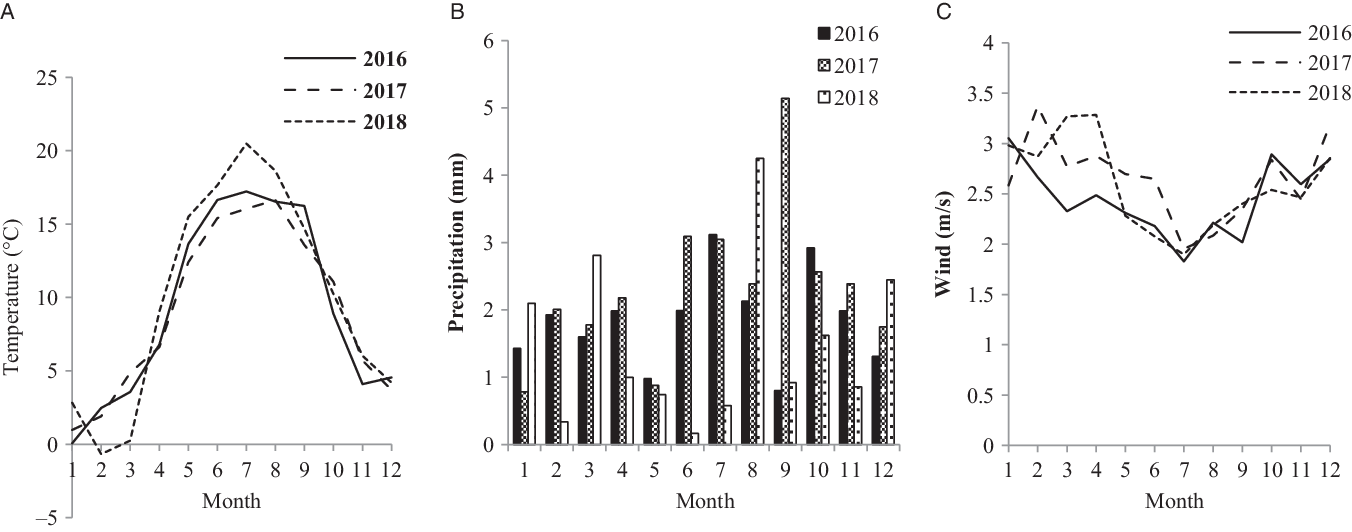
Weather data came from a weather station in the area (55.67°N, 12.30°E) (Figure 3). Daily rainfall, wind speed, and the daily maximum and minimum temperature were collected. The mean daily temperature was calculated as a mean of the daily maximum and minimum temperature, which was used to calculate the growing degree days (GDD) for the growing seasons (Equation 1).
 $${\rm{GDD}} = \mathop \sum \limits_{{S_1}}^{{S_2}} \left( {{T_m} - {b_0}} \right)$$
where T m represents the mean daily temperature, b 0 represents the base temperature (0 C), S 1 is the sowing date, and S 2 is the harvest date.
Weather data for 2016, 2017, and 2018. (A) monthly average air temperature, (B) precipitation, and (C) wind speed. Temperature, precipitation, and wind speed were measured at 2, 1.5, and 2 m above ground level, respectively.
Data Analysis
The difference in weekly seed shed of weed species during the growing season of wheat was evaluated using a method for repeated measurement in R v. 3.6.1 (R Foundation for Statistical Computing, Vienna, Austria, http://R-project.org). The analyses were done using the extension packages lme4 (Bates et al. Reference Bates, Maechler, Bolker and Walker2015) and multcomp (Hothorn et al. Reference Hothorn, Bretz and Westfall2008). Each weed species was analyzed separately. The difference in plant dry weight at harvest in the two seasons was also evaluated using ANOVA.
Results and Discussion
Seed production depends on many factors such as soil fertility and weather conditions as well as competition from other plants (Raymond Reference Raymond2011). Very different weather conditions characterized the two growing seasons. In 2017, the summer in Denmark was cold, wet, and cloudy with no days with temperatures >30 C. In contrast, the weather in 2018 was unusually dry, warm, and sunny with many days with temperatures >30 C. It was the warmest summer since 1874 (Figure 3) (Danmarks Meteorologiske Institut 2018). Consequently, the weather resulted in a substantial difference between the 2 yr in terms of seed production and seed-shattering patterns of the two weed species. However, the wind speed, which also affects seed shattering, did not differ much between the summers.
Seed Shedding during the Wheat Growing Season
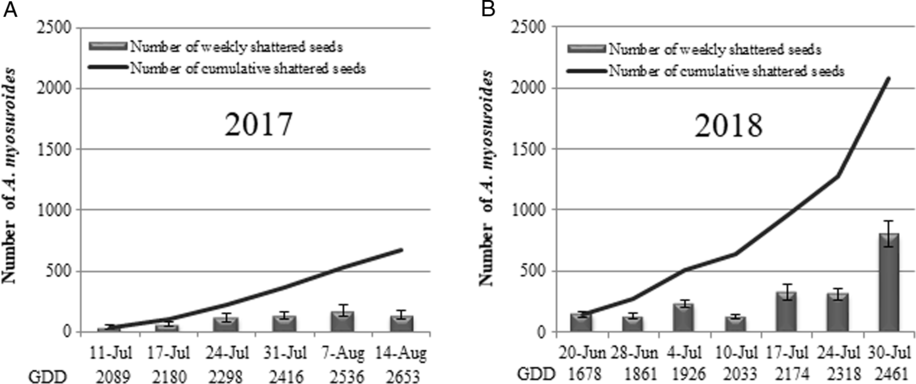
In 2017, the mature seeds of A. myosuroides started shattering between July 4 and 11, corresponding to 1,978 and 2,089 GDD, respectively (Figure 4A). There was a significant difference between the weekly numbers of seeds shed during the 6 wk before wheat harvest (P ≤ 0.001). The greatest number of seeds dropped between July 31 and August 7, corresponding to 2,416 and 2,536 GDD, respectively, and the least between July 4 and 11 (Figure 4A).
Average number of seeds shed from Alopecurus myosuroides each week and the cumulative number of seeds shattered during the growing season of winter wheat in (A) 2017 and (B) 2018. Growing degree days (GDD) = sum of daily mean temperatures above 0 C from the date the wheat was sown.
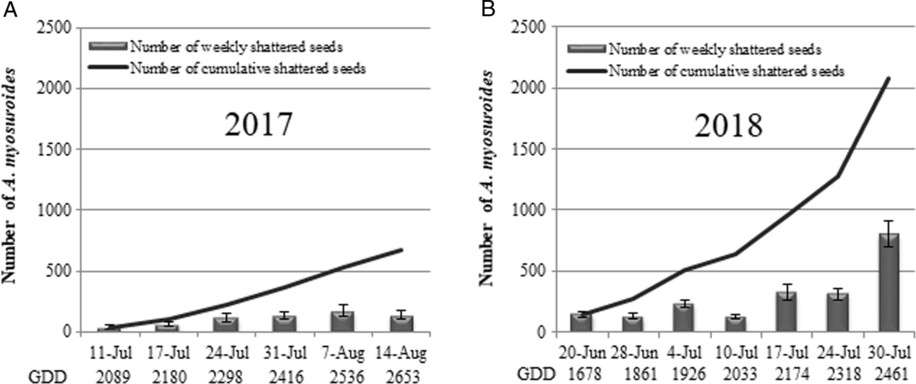
In 2018, seed shattering started between June 13 and 20 (corresponding to 1,561 and 1,678 GDD) (Figure 4B). There was a significant difference between the weekly numbers of shattered seeds during the 7 wk before wheat harvest (P ≤ 0.001). The highest and lowest number of seeds shed happened between July 24 and 30 (corresponding to 2,318 and 2,461 GDD) and between July 4 and 10 (corresponding to 1,926 and 2,033 GDD), respectively (Figure 4B). The average plant dry weight at crop harvest varied significantly between the 2 yr (1.98 g in 2017; 6.17 g in 2018; P ≤ 0.001), as the wheat suffered from drought in 2018.
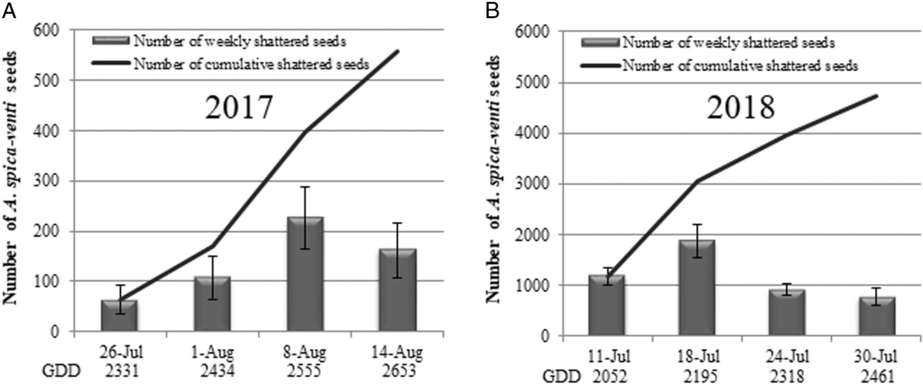
In 2017, mature seeds of A. spica-venti started shattering between July 19 and 26 (corresponding to 2,212 and 2,331 GDD) (Figure 5A). There was a significant difference between the weekly numbers of seed shed during the 4 wk before the wheat harvest (P ≤ 0.001). The greatest number of shattered seeds occurred between August 1 and 8 (corresponding to 2,434 and 2,555 GDD), and the least number was shed between July 19 and 26 (Figure 5A).
Average number of seeds shed of Apera spica-venti each week and the cumulative number of seeds shattered during the growing season of winter wheat in (A) 2017 and (B) 2018. Growing degree days (GDD) = sum of daily mean temperatures above 0 from the date the wheat was sown.
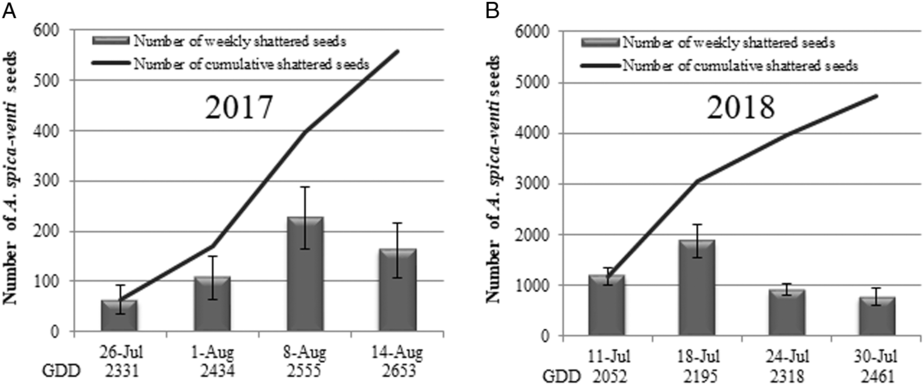
In 2018, seed shattering started between July 4 and 11 (corresponding to 1,926 and 2,052 GDD) (Figure 5B). There was a significant difference between the weekly numbers of seed shed during the 4 wk before wheat harvest (P ≤ 0.001). The greatest amount of seed shattering took place between July 11 and 18 (corresponding to 2,052 and 2,195 GDD), and the least between July 24 and 30, respectively (corresponding to 2,318 and 2,461 GDD) (Figure 5B). The average plant dry weight varied significantly between the 2 yr (0.69 g in 2017; 4.59 g in 2018; P ≤ 0.001).
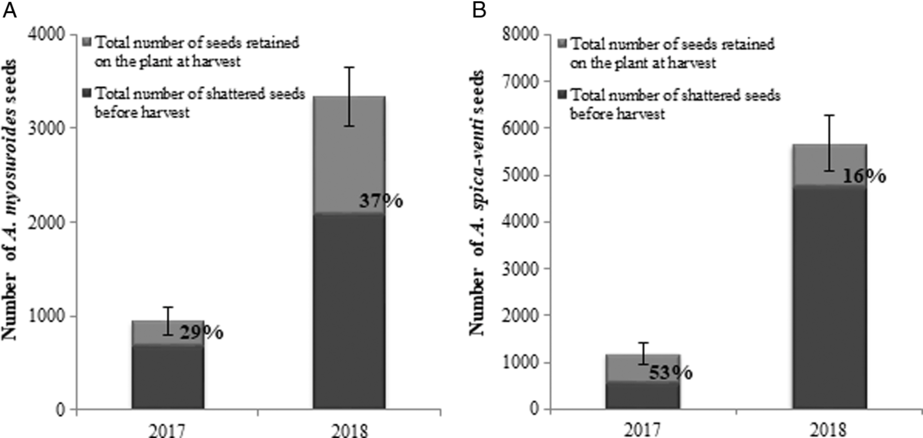
The seed-shattering pattern of the two grass species varied between the 2 yr (Figures 4 and 5). In the dry and warm weather in 2018, weeds and crop plants matured much earlier than in the cold and wet year of 2017, resulting in an earlier crop harvest. Walsh et al. (Reference Walsh, Broster, Aves and Powles2018a) reported that early seed shedding reduced the proportion of seeds retained above the harvest height at crop maturity. The same was found for A. spica-venti but not for A. myosuroides. Apera spica-venti shed 46.8% of the total number of produced seeds before harvest in 2017 but 83.3 % in 2018 (Figure 6A and B). Alopecurus myosuroides shattered 70.7% of the total number of seeds before harvest in 2017 and 63% in 2018. Moss (Reference Moss1983) reported that A. myosuroides seeds were shed during a period from about late June to late August in the south Midlands of England. As winter wheat in this part of England is usually harvested after mid-August, most seeds are likely to be shed before harvest. Secondary heads are sometimes formed in late July or August from stem nodes, but they are not normally important in the production of seeds (Moss Reference Moss1983). Secondary heads were also observed in some of the plants in the second year but not in the first year. It was observed that early-shed seeds tend to be derived from seeds near the apex of the heads and late-shed seeds from the base of the heads.
The total number of seeds produced in the season illustrated as the sum of retained seeds on the plants at wheat harvest and the seeds shed before wheat harvest for (A) Alopecurus myosuroides and (B) Apera spica-venti during the growing season of winter wheat. Standard error bars of the total seed productions are shown.

The Percentages of Weed Seeds Retained at Wheat Harvest
In 2017, A. myosuroides retained 29.3% of the seeds produced in the season at harvest, and 38.9% in 2018 (Figure 6A). For A. spica-venti, the corresponding numbers were 53.2% (2017) and 16.7% (2018) (Figure 6B).
Shirtliffe et al. (Reference Shirtliffe, Entz and Van Acker2000) and Taghizadeh et al. (Reference Taghizadeh, Nicolas and Cousens2012) also found that weed seed retention varied according to climatic conditions, and it would most likely also vary across different agro-ecosystems (Walsh and Powles Reference Walsh and Powles2007). The rainy conditions in 2017 favored the competitive ability of the wheat, resulting in large growth and a dense wheat stand. In 2018, the wheat plants became drought stressed, resulting in less growth and a thinner wheat stand to create more space and light for the weeds, resulting in a higher weed seed production. Zerner et al. (Reference Zerner, Gill and Vandeleur2008) found a similar relationship between wheat and weed biomass production. Weeds in annual cropping systems are generally not very shade tolerant, and the growth and development of A. myosuroides and A. spica-venti are restricted under low light conditions (Gommers et al. Reference Gommers, Visser, Onge, Voesenek and Pierik2013; Yasin et al. Reference Yasin, Rosenqvist and Andreasen2017). A typical response to crop-canopy shading by shade-intolerant species is a more erect growth habit (Vandenbussche et al. Reference Vandenbussche, Pierik, Millenaar, Voesenek and Van Der Straeten2005; Yasin et al. Reference Yasin, Rosenqvist and Andreasen2017). Therefore, the weed seed heads will be produced higher in the crop canopy and are easier to collect during crop harvesting (Walsh et al. Reference Walsh, Broster, Aves and Powles2018a). However, in our experiments, all seed heads were above 15 cm in both years, which may make it possible for a grain harvester to collect the seeds, but it is likely that some seeds may be spread and fall to the soil surface during the harvesting process. The number of GDD to seed shattering varied between the 2 yr, showing that other factors like drought influence the physiological maturation of the plants (Figures 4 and 5).
The fraction of the total seed production retained on A. myosuroides and A. spica-venti was 29.3% and 53.2% in 2017 and 37.9% and 16.7% in 2018, respectively. For rigid ryegrass (Lolium rigidum Gaudin), 80% and 96% seed retention at wheat harvest have been reported in Australia (Walsh and Powles Reference Walsh and Powles2007) and Spain (Blanco-Moreno et al. Reference Blanco-Moreno, Chamorro, Masalles, Recasens and Sans2004), respectively. The level of wild oat (Avena fatua L.) seed retention has been reported to be between 20% and 50% in Canada (Feldman and Reed Reference Feldman and Reed1974; Shirtliffe et al. Reference Shirtliffe, Entz and Van Acker2000) and about 20% in the United Kingdom (Barroso et al. Reference Barroso, Navarrete, Sanchez Del Arco, Fernandez-Quintanilla, Lutman, Perry and Hull1994). The level of seed retention for ripgut brome (Bromus diandrus Roth) and wild radish (Raphanus raphanistrum L.) was reported to be 40% to 50% in the United Kingdom (Howard et al. Reference Howard, Mortimer, Gould, Putwain, Cousens and Cussens1991) and Italy (Balsari et al. Reference Balsari, Finassi and Airoldi1994). In 2014, the seed retention in more than 100 fields in the United Kingdom infested with A. myosuroides was studied during 4 wk before crop harvest. The study indicated that about 80% to 90% of the seeds were shed by the commencement of the harvest of winter wheat, while seed retention was approximately 40% to 50% at the usual harvest time for winter barley (Hordeum vulgare L.) and canola (Brassica napus L.) in late July (Walsh et al. Reference Walsh, Broster, Schwartz-Lazaro, Norsworthy, Davis, Tidemann, Beckie, Lyon, Soni, Neve and Bagavathiannan2018b). The seed-shedding pattern of A. myosuroides indicates that HWSC systems will potentially have a greater impact during canola and barley crop harvest than winter wheat harvest. Naylor (Reference Naylor1972) and Budd and Shildrick (Reference Budd and Shildrick1968) found that the growth and seed production of A. myosuroides were reduced more by the presence of wheat plants than by the same number of A. myosuroides plants. We observed less biomass and seed production of A. myosuroides and A. spica-venti in 2017 than in 2018, indicating the positive effect of lower wheat crop competition in 2018. Walsh et al. (Reference Walsh, Broster, Aves and Powles2018a) also found that seed production of L. rigidum was reduced when it grew in competition with a higher biomass–yielding wheat crop. Increased crop competition will both increase HWSC efficiency and reduce weed seed production, because weed plants surviving the increased competition from the crop usually become taller, and therefore their seeds will be easier to harvest (Yasin et al. Reference Yasin, Rosenqvist and Andreasen2017). Zimdahl (Reference Zimdahl2004) also reported that weed growth and weed seed production were positively affected by dry conditions and reduced competition from moisture-stressed crops. Alopecurus myosuroides and A. spica-venti produced 3.5 and 4.7 times more seeds, respectively, in the dry season compared with the rainy season in our experiment.
The plants of A. myosuroides and A. spica-venti produced seeds on upright shoots, making it possible to collect most of the seeds retained on the plants at harvest with a grain harvester. The average number of seeds per plant produced in the growing season was 2,145 and 3,435 for A. myosuroides and A. spica-venti, respectively. The average percentage of seeds retained on the plant was 33.6% and 34.9%, respectively. If a grain harvester removed or killed approximately 30% of the total seed production of these two aggressive grass weeds, it could contribute to reducing seed input to the soil seedbank. However, such methods cannot stand alone and need to be combined with other weed control methods to reduce weed pressure. A long-term investigation of the impact of collecting the seeds on weed infestation is required to assess the effect of the HWSC technique for these grass species. Such research would enlighten us as to whether the seed shed before harvest would still produce a high infestation level in the fields in the long term.
Acknowledgments
This work was a part of the project 105 SWEEDHART—Separation of Weeds during Harvesting and Hygienisation to Enhance Crop Productivity in the Long Term. The activity was conducted under the Joint European Research Projects in the Field of Sustainable and Resilient Agriculture under ERA-NET Cofund FACCE SURPLUS 2015. We thank Innovation Fund Denmark for financial support. No conflicts of interest have been declared.