INTRODUCTION
To solve a political conflict, power can be shared and rights granted; to solve a conflict over economic resources, the spoils can be shared or distributed more equally. Ethnic conflicts are different. Due mainly to the indivisibility of the issues involved, they are often characterized as particularly intractable (Horowitz Reference Horowitz1985; Licklider Reference Licklider1995; Kaufmann Reference Kaufmann1996; Sambanis Reference Sambanis2001). Two aspects of such armed conflicts set them apart: First, the involved groups tend to be secessionist, seeking to carve out an independent state of their own. Second, in these identity conflicts, irrespective of the ultimate goal that may range from secession to obtaining some form of autonomy or extracting concessions, fighters tend to be mobilized along ethnic or religious lines.
In this article, we examine the subset of civil wars that include ethnic or religious groups engaged in armed conflict against their government. Our sample includes, for example, the case of Sudan, where predominantly black African Christian and Animist Southerners fought against a government dominated by Muslim Arabs; Muslim Chechens in Russia versus a government dominated by Orthodox Christians; and Muslim Acehnese in Indonesia who fought a long war against a government dominated by Muslim Javanese. Notwithstanding difficulties involved in defining ethnicity and ethnic armed conflicts, we attempt to examine the role religion plays in creating conditions for and sustaining the peace after such identity conflicts come to a close. The main question that we examine empirically is: Can sharing the same religion serve as a peacemaker despite differences in ethnic identities? Moreover, do leaders use shared religious values to foster reconciliation and peace, or do calls for reconciliation between two groups of the same religion remain rhetoric?
Religion's salience to ethnic identity and conflict varies (Fox Reference Fox1997, 6). While religion can be a key factor in some identity conflicts (e.g., Palestinians vs. Israel 1987–1997), it can play a minor role in others as the case of Bengalis vs. Pakistan (1971) demonstrates. Many ethnic minorities share the same religion as the majority group. One study finds that of 268 politically active ethnic minorities worldwide for the 1990–1995 period, 163 (61%) are not religiously distinct from the dominant group (Fox Reference Fox1997). An analysis of the two datasets used in this study confirms this conclusion. In about half of the ethnic civil wars that started and ended between 1950 and 2006, ethnic rebels shared the same religion as the governing ethnic group.Footnote 1
This raises important questions. Can religion, as some scholars and policymakers have argued, lay the groundwork for peace between the protagonists? How does a common faith influence the prospects for sustaining peace after an ethnic conflict ends? In this study, we address these questions and examine whether ethnic conflicts in which the warring parties share one religion are easier to resolve in the long run than conflicts in which they belong to different religions. We develop three competing hypotheses: Co-religiosity can be used to resolve conflicts, co-religiosity has no influence on the duration of post-war peace, and co-religiosity makes it harder to keep the peace. To test the hypotheses, we build a multi-variate model with co-religiosity of the warring parties as our main explanatory variable of interest.
Results from a series of survival models show that the effect of religion, particularly of co-religiosity, as a peacemaker is overstated. Two of our four models show no statistically signification link, indicating that warring parties in ethnic civil wars are not more likely to reconcile if they share one religion than if they belong to different faiths. To the contrary, the other two models show that co-religiosity between the warring factions may even make it more difficult to keep the peace after a civil war, but this result is not robust.
Below we first provide a summary of the literature that examines how religion affects war dynamics, followed by a discussion of religion and peace-building in the aftermath of ethnic civil wars. In the Research Design section, we present data sources and specify key explanatory and outcome variables. Following the presentation of the results from a series of survival models, we conclude with a discussion of policy implications.
RELIGION, ETHNIC CONFLICT, AND PEACE DURATION
Research into the specific influence of religious factors on conflicts has produced inconclusive findings. Here, we list findings on the influence of ethnic and religious factors on the risk of civil war onset, intensity, duration, and recurrence.
One group of scholars argues that the effect of ethnic and religious diversity on the onset of civil war is not discernible (e.g., Fearon and Laitin Reference Fearon and Laitin2003). Others point out a strong association between regional ethnic diversity and ethnic warfare (e.g., Melander Reference Melander2009). Eck (Reference Eck2009) finds that ethnic low-intensity conflicts are more likely to escalate to civil war than non-ethnic conflicts. Gubler and Selway (Reference Gubler and Sawat Selway2012) find that ethnicity substantially increases the probability of civil war onset when it is reinforced by other salient social cleavages such as religion and socioeconomic class.
Similarly, scholars disagree over the impact of religion on the intensity of war. Lindberg (Reference Lindberg2008) finds that religious conflicts are deadlier than other conflicts. Pearce (Reference Pearce2005), however, does not find conclusive results showing that religious conflicts are more intense than other types of conflict when the level of relevance that religion plays in each conflict is taken into account. In a second part of her analysis, Pearce shows that the impact of religion on conflict duration is ambiguous. Religious conflicts are more likely to end early but once they have endured two-and-a-half years or longer, they are less likely to end than non-religious conflicts.
Yet, another group of studies argue that an overlap between religious identities and ethnic boundaries increases the risk of war onset (Basedau et al. Reference Basedau, Struver, Vullers and Wegenast2011), prolongs the conflict, results in more casualties (Toft Reference Toft2007), and undermines prospects to end conflicts through peaceful solutions (Svensson Reference Svensson2007). In situations where ethnic and religious identities coincide, religion can become a readily available instrument for political entrepreneurs who want to exploit it for their ambitions to gain more power and resources, or for ideological objectives.
The evidence for the impact of ethnic and religious differences on the duration of civil war and the duration of post-war peace, however, is mixed. Mattes and Savun (Reference Mattes and Savun2010) find that civil wars with an ethnic (including but not limited to religious) component are more likely to restart. They seem to attribute this to information failures between ethnic groups. Walter (Reference Walter1997), on the contrary, does not find ethnic wars to be more difficult to resolve than other conflicts, and finds only weak support for religious conflicts being more intractable than other conflicts. Collier, Hoeffler, and Söderbom (Reference Collier, Hoeffler and Söderbom2008, 471) report that they “investigated a range of variables that describe the ethnic composition of the society” and did not find any to be statistically significant, with the duration of post-war peace as their dependent variable.
Evidence from cases where ethnic and religious identities coincide illustrates how this overlap exacerbates underlying tensions, making such cases particularly difficult to resolve and to keep the peace after war has ended. The armed conflicts in Sudan, in 1955–1972 and 1983–2005, between the government of Sudan, dominated by Arab Muslim northerners, and the Southerners, predominantly black African Christians and adherents to traditional African religions, only subsided when the country partitioned after more than three decades of war, two million dead, and nearly 4.5 million displaced (Toft Reference Toft2007, 117). Similarly, the conflict in Sri Lanka between the majority Sinhala, who are mainly Buddhist, and the minority Sri Lankan Tamils, mainly Hindu, was one of the most intractable conflicts (Svensson Reference Svensson2007). Although, the rebel group, the Liberation Tigers of Tamil Eelam, was not religiously motivated, the emphasis on the Buddhist character of the Sri Lankan state has added a new wrinkle to the war and the prospects for peace. While the evidence is far from conclusive, this discussion suggests that ethnic and religious differences may contribute to increasing the risk of civil war. Ethnic civil wars in which religion and ethnic identities coincide may also be particularly difficult to resolve and to prevent from recurring. Thus we offer the following hypothesis.
Hypothesis 1:
Religious differences between the warring groups in an ethnic civil war correlate with a shorter duration of post-war peace and increase the risk of war to recur.
The evidence from the two cases mentioned above leads to the question of whether religion can serve as peacemaker, particularly for ethnic conflicts in which combatants belong to the same faith. Below we discuss several possible causal mechanisms that may link co-religiosity to war recurrence, including shared values, security dilemmas, communication, trust and negative perceptions, and negotiation styles.
Several scholars have drawn attention to “the seeds of tolerance, justice, compassion, and peace” in religious traditions and argued that religion can help bring about peace and democracy (Johansen Reference Johansen1997, 53; see also Appleby Reference Appleby2000; Driessen Reference Driessen2010; Reference Driessen2014). Religion, as Philpott (Reference Philpott2007, 505) states, “devastates not only New York skyscrapers but also authoritarian regimes; it constructs not only bellicose communal identities but also democratic civil society.” Thus, religion can also be used in conflict resolution and peace-building processes (Johnston and Sampson Reference Johnston and Sampson1994; Abu-Nimer Reference Abu-Nimer2001; Alger Reference Alger2002).
Reflective of this line of argument, a number of politicians have made references to religion playing the role of a peacemaker, particularly among different ethnic groups that share the same faith. In Indonesia where the Acehnese fought a long armed conflict for independence between 1976 and 2005 against a government dominated by Muslim Javanese, the Indonesian political elite commonly made references to Islam as the glue that binds Aceh to the rest of the country (Aspinall Reference Aspinall2009). Similarly, the governing Justice and Development Party (AKP) in Turkey has tried to use “Islam as a primary form of identification and common ground” toward a rapprochement with the Kurdish minority that has been waging an armed conflict for greater rights on and off since 1984 (Mitchell Reference Mitchell2012). Reminiscent of what Abraham Lincoln said in his second inaugural address about the American Civil War that “both sides read the same bible, and pray to the same God” (Miller Reference Miller2007), Turkish president Tayyip Erdogan, in an effort to put an end to the decades-longs armed conflict, has repeatedly stressed that both Kurds and Turks believe in the same God, read the same Qur'an, and face the same Mecca when they pray. Erdogan has stated that “when someone inquires about your identity, you should simply reply: ‘Thank God I am a Muslim! That is enough’” (Yavuz Reference Yavuz2009, 131). While neither the American Civil War nor the conflict between Turkey and the Kurds were settled by agreement, this points to a first possible causal mechanism linking co-religiosity and conflict resolution: Shared religious values may make it easier for warring parties to agree to sit down to negotiate and agree to end the conflict in a durable way.
A second key mechanism involved in the challenge to put an end to ethnic armed conflicts is the notion of security dilemma. This dilemma refers to the possibility of defection in times of conflict characterized by distrust and fear, which in turn prevents belligerents from credibly committing to peace (Posen Reference Posen1993). At this juncture, religious leaders can play a constructive role in keeping lines of communication open, reducing suspicion, distrust, and negative perceptions that accompany deteriorating relations in times of war (Sampson Reference Sampson, Johnston and Sampson1994, 95). Religious groups can mediate between the protagonists, provide or withdraw moral legitimacy for a government during and after a conflict, and thus bridge seemingly intractable conflict issues (Appleby Reference Appleby2000; Toft, Philpott, and Shah Reference Toft, Philpott and Samuel Shah2011).
Such a peacemaking potential of religion should be of particular interest in cases where belligerents belong to the same religious tradition. Belonging to the same religion can help address the mistrust and fear of being cheated, and hence contribute to sustaining the peace after the end of ethnic civil war. In other words, if sustainable peace-building requires the extension of dignity and esteem to the “other” through understanding, trust, and respect (Gibson Reference Gibson2004), or the promotion of empathy because social and familial networks were damaged or destroyed during the war (Halpern and Weinstein Reference Halpern and Weinstein2004), an emphasis on shared religious identity could help maintain the peace in the aftermath of the civil war.
We are not aware of empirical studies that have directly addressed this question, whether co-religiosity between the belligerent parties can help maintain the peace after a civil war. However, research on mediation of international conflicts may yield additional insight into the link and possible causal mechanisms. Bercovitch and Elgström (Reference Bercovitch and Elgström2001) find that cultural differences, including whether belligerents share the same religion, are associated with unsuccessful mediation outcomes. They suggest that religious and other cultural differences can lead to misperceptions that lead to communication and negotiation failure, and can influence negotiation strategies. Similarly, Leng and Regan (Reference Leng and Regan2003) find that international mediation is less likely to succeed when the conflict parties do not share the same religion. Sharing the same religion facilitates communication, the capacity to appreciate the other side's interests, and to agree on the rules of the mediation effort and negotiating or bargaining styles. Inman et al. (Reference Inman, Kishi, Wilkenfeld, Gelfand and Salmon2014) do not find cultural differences to influence the effectiveness of mediation. Yet they add a possible causal explanation: cultural, including religious, differences between belligerents may lead to distrust of the mediator. If the findings of these three studies can be applied to civil wars, we should expect co-religiosity between the conflict parties to make it easier to negotiate an end to the war. While the three studies examined short-term mediation success, the same factors — communication, perceptions, trust, negotiation styles — may also work in the long-term and help prevent war from recurring.
Along these lines, examining the peacemaking role of religion in ending the conflict between the Sandinistas and East Coast Indians of Nicaragua, Nichols (Reference Nichols, Johnston and Sampson1994) draws attention to religious leaders’ role in developing a common language of conciliation and infusing Christian values into the negotiating process. Adhering to the same faith, he argues, provided a common ground for the members of the negotiating commission and helped create a positive negotiating atmosphere. Just as political entrepreneurs may appeal to religion to mobilize groups against each other in violent conflict, particularly in cases where warring parties belong to different faiths, political and religious leaders may appeal to shared religious values to end the conflict and build peace. This discussion leads to our second hypothesis.
Hypothesis 2:
Co-religiosity between the warring groups in an ethnic civil war correlates with a longer duration of post-war peace and a lower risk of war to recur.
The argument that a common faith can serve as peacemaker despite ethnic differences assigns a central role to religion in forging a common identity that transcends other identities. This approach overlooks the importance of other components of identity such as customs, language, and ethnicity. Identity formation is complex, fluid, and context-dependent (Fearon and Laitin Reference Fearon and Laitin2000; Brubaker Reference Brubaker2009). As Aspinall (Reference Aspinall2009, 195) argues in his analysis of the Acehnese rebellion in Indonesia, 1976–2005, identity construction in Aceh focused on differentiating Acehnese national identity from Indonesian national identity, dominated by the Javanese. This process of differentiating Aceh's identity from that of Indonesia accelerated when the Indonesian state adopted a religious posture to weaken the separatist movement. As the state appealed to co-religiosity — Islam as glue that binds Muslim Acehnese to the rest of Indonesia — Acehnese began to see Muslim, Indonesian, and Acehnese identities as distinct fields with boundaries that do not necessarily coincide.
Similarly, ethnic Kurds, who have engaged in an armed conflict on and off since 1984, often accuse the AKP government of exploiting Islam to weaken the legitimate Kurdish grievances. Even devout Kurdish Muslims, those who distance themselves from the PKK (Kurdistan Workers’ Party) due to its secular ideology and who are overall receptive to the “Islamic brotherhood” discourse, describe the AKP's emphasis on “Islam as the glue” as another tactic to undermine the Kurdish struggle for equal rights (Gurses Reference Gurses2015b). The Islamist movement in Turkey, as Houston (Reference Houston2001, 141–142; see also Somer and Glupker-Kesebir Reference Somer and Glupker-Kesebir2016) summarizes, “bears the fingerprints of nationalistic discourse,” which renders it “unable to find a position properly sensitive of Kurdish suffering.”
Thus, the politicization of religion could render its peacemaking potential ineffective. As Haynes (Reference Haynes2009, 72) concludes, such peacemaking ability is contingent on whether religious leaders and authorities “are seen as reflective of a high moral standing … to the extent that they can be regarded by all parties as apolitical or neutral in conflict situations.” Examining whether religion helps or hinders the formation of political coalitions, Wilcox (Reference Wilcox2016, 242) points to religion's potential to create “a shared language and a set of core values that enables trust to form.” At the same time, Wilcox continues, when political considerations take precedence, religious identity might have little or no impact on the formation of political coalitions, regardless of shared religious identity. Devoid of legitimacy, religion is then likely to be constrained and shaped by politics. As religion turns into another instrument of legitimation and mobilization in the hands of political actors it loses its power as a peacemaker. Thus, we offer our third hypothesis.
Hypothesis 3:
Co-religiosity between the warring groups in an ethnic civil war will have no effect on post-war peace duration.
RESEARCH DESIGN
To test our hypotheses, we constructed a sample of all ethno-nationalist civil wars for the period from 1950 to 2006. We use Gurses’ and Rost's (Reference Gurses and Rost2013) list of ethnic civil wars, which builds upon Sambanis’ (Reference Sambanis2000; Reference Sambanis2004) and Chapman's and Roeder's (Reference Chapman and Roeder2007) lists. We focus on the dyadic relationship between an ethnic group and the state. Thus, our sample includes cases that involve a civil war between the government and an ethnic group's members of which engage in armed conflict. Our sample includes wars in which rebels aspired to change the regime rather than carve out a state of their own (e.g., Lebanon, Iraq, Rwanda, and South Africa) and secessionist wars (e.g., Sudan, Chechnya), but excludes cases where the rebels and group in power are from the same ethnic group (e.g., Iran 1979, Algeria 1992–1997) since our research question asks whether religion can serve as a peacemaker between a group and the government it challenges given their ethnic differences.
Dependent Variable
The dependent variable is the duration of peace after the end of an ethnic civil war in years. Our unit of analysis therefore is the post-civil war country year. The peace duration for the 72 cases that we identified ranges from 1 year to 57 years with a mean of 12 and a standard deviation of 10.6 years.
Independent Variables
Our primary independent variable is whether or not warring parties share a common religion. As a proxy, we use the data on measures of distinctiveness provided by the Minorities at Risk (MAR) project (2009). Specifically, we use the data on “belief” which takes a value of “0” if a group that was involved in an armed conflict (e.g., the Acehnese in Indonesia) has the same religion as the plurality group in the country, “1” when the group belongs to the same religion but a different sect or denomination as the largest religious group (e.g., Catholic Irish in Northern Ireland), and “2” when the group to which rebels are linked and the dominant group belong to distinct religions (Chittagong Hill Tribes in Bangladesh).Footnote 2 Of the total of 72 cases, in 36 cases the ethnic group that was involved in a conflict against the government had the same religion as the majority group, in 11 cases it had the same religion but belonged to a different sect, and in 25 cases it had a distinct religion. As the cases of Catholic Irish in Northern Ireland or Shiites in Iraq demonstrate “different sect” often translates into a significant religious difference. Thus, we generated a binary measure better to capture the effect of a common faith on the outcome variable. This “co-religiosity” variable is coded “1” for cases where rebels and government share a common faith and “0” when they belong to different religions or denominations.
Control Variables
We use a list of control variables accounting for the characteristics of the war, country, ethnic group, and post-war environment that scholars have found to influence the risk of war recurrence. Starting with characteristics of the war, the war outcome has been found to have an impact on post-war peace duration in several studies (Licklider Reference Licklider1995; Mason, Weingarten, and Fett Reference Mason, Weingarten and Fett1999; Hartzell, Hoddie, and Rothchild Reference Hartzell, Hoddie and Rothchild2001; Fortna Reference Fortna2003; Quinn, Mason, and Gurses Reference Quinn, David Mason and Gurses2007; Fuhrmann and Tir Reference Fuhrmann and Tir2009; Toft Reference Toft2010). A negotiated settlement may leave the warring parties with their arms and organizational structures intact, which could increase the risk of war recurrence. A government victory may result in a dismantling of the rebel group but it may also leave grievances in place. Similarly, a rebel victory may result in the creation of a new state or replacing the ruling elite. Using data from Gurses and Rost (Reference Gurses and Rost2013), who extend data from Doyle and Sambanis (Reference Doyle and Sambanis2000), and Sambanis (Reference Sambanis2004), we distinguish between civil wars that end in a government victory, a rebel victory, or a negotiated settlement (the reference category).
Similarly, long wars can lead to war weariness thereby helping to sustain the peace (Mason and Fett Reference Mason and Fett1996; Walter Reference Walter2004). On the contrary, long wars may destabilize the country to such a degree that the risk of war recurrence is high. This could particularly be the case with ethnic wars. We measure war duration in years, and include it as a control variable in the model.
We include a variable to account for regime type as it is shown to be a predictor of civil war, with highly democratic and highly autocratic regimes being less susceptible to civil war (Hegre et al. Reference Hegre, Ellingsen, Gates and Petter Gleditsch2001). Furthermore, regime type can also serve as a proxy for state strength (Gurses and Mason Reference Gurses and Mason2010), making it an important factor in sustaining the peace. Using the Polity scale (Marshall and Jaggers Reference Marshall and Jaggers2009), we distinguish those regimes with some democratic elements, but that are not full democracies (i.e., anocracies; those that fall between -6 and +6 on the Polity scale).
Asal and Phillips (Reference Asal and Phillips2015) find that government repression is an important predictor of the likelihood of a group using violence. Gurses and Rost (Reference Gurses and Rost2013) point to post-war ethnic discrimination against the ethnic group that was involved in the war on the opposition side as a key determinant of whether the peace will fail. To control for this we used a measure of discrimination from the MAR project that combines indicators for economic and political discrimination. The measure ranges from “0” to “4,” with higher numbers indicating high levels of political and economic discrimination.
Larger and more geographically concentrated ethnic groups face a lower threshold to organize an insurgency (Walter Reference Walter2006; Cederman, Wimmer, and Min Reference Cederman, Wimmer and Min2010). We use data from the MAR project to measure group size, i.e., the share of ethnic group of the country's population, and the degree of geographical concentration, ranging from “0” to “3,” with higher numbers indicating higher levels of concentration. The descriptive statistics are presented in Table 1.
Summary statistics for the independent variables

Due to the nature of the outcome variable, peace duration in years, we estimate a series of survival models to test our hypotheses. These models assess the risk or hazard rate of the peace failing (i.e., war recurring) in a given year. Since there is no strong theoretical justification for the shape of the baseline hazard, we employ a Cox regression to model the post-war peace duration.Footnote 3 These models assess the risk or hazard rate of the peace failing (that is, civil war resuming) in a given year. The results are presented as hazard ratios; a coefficient less (greater) than “1” indicates that the variable lowers (increases) the risk of the peace failing, prolonging (shortening) the duration of the peace (Box-Steffensmeier and Jones Reference Box-Steffensmeier and Jones2004).
EMPIRICAL RESULTS
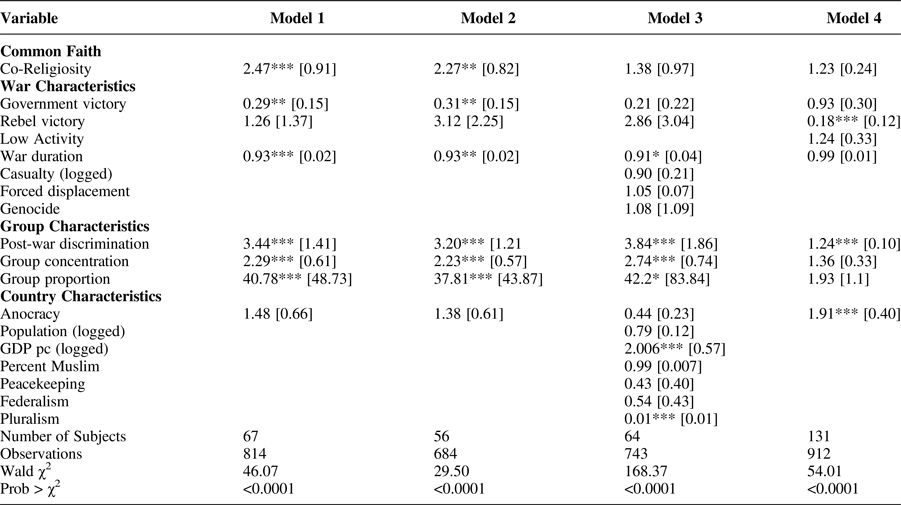
We first present results from our basic model that shows the effect of co-religiosity on the outcome while controlling for some key variables that have been found to be significant predictors of peace duration. In summary, we find no evidence that co-religiosity between the warring groups helps keep the peace after an ethnic war. To the contrary, in two of our models, one with a minimal number of variables and one which includes wars that ended in partition, co-religiosity is linked with an increased risk of war recurrence. In the other two models, one with additional control variables and one with a list of ethnic wars based on a different data source, there are no statistically significant results that would allow us to reject the null-hypothesis of no relationship between the two variables.
Cox regression analysis for the duration of peace after ethnic civil war

Note: Hazard ratios are reported. Robust standard errors clustered on country in parentheses.
***significant at 0.01 level; **significant at 0.05 level; *significant at 0.10 level (two-tail).
The estimates were obtained using Stata 13.1.
As shown in Model 1, and contrary to Hypothesis 2, the results indicate that co-religiosity does not help to maintain peace after an ethnic civil war. In other words, it seems to be more difficult to achieve a lasting peace after an ethnic conflict, the closer the religious ties between a rebel group and the government. Post-war peace is the most fragile if the opposing groups belong to the same religion.
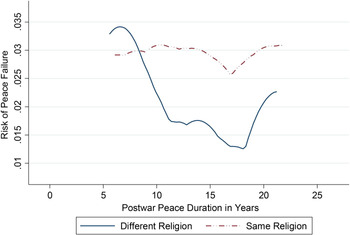
Just as common faith failed to prevent Muslim Kurds, Acehnese, or Bengalis to rebel against governments dominated by their co-religionists, it does not offer a cure to ethno-nationalist demands and grievances. Quite the contrary, despite its peacemaking potential, religion is shaped and constrained by politics to such a degree that it ceases to serve as a solution to ethnic armed conflicts. Thus, our findings suggest that references to common faith as the glue that binds rebellious ethnic minority and ruling group together is not empirically substantiated. The coefficient of 2.47 on the “co-religiosity” variable in Model 1 indicates that common faith increases the risk of peace failure by 147%. As illustrated in Figure 1, the risk of peace failing is relatively stable and overall greater when warring ethnic groups share the same religion.
The estimated effect of shared religion on peace duration.

By the same token, the results also suggest that post-war peace is more likely to last if the warring parties belong to different religions.Footnote 4 Belge's and Karakoç’s (Reference Belge and Karakoç2015) study of minorities in the Middle East offers an explanation for this finding. They argue that some religious minorities, primarily due to different historical trajectories, have been granted some collective rights and achieved a certain level of economic prosperity in modern Middle Eastern states. Egypt's Coptic Christians largely peaceful relationship with the Egyptian Republic, for example, has been primarily shaped by the Islamic legacy of granting communal rights to non-Muslims under the Ottoman Empire. The same legacy, however, resulted in forced and often aggressive assimilationist policies towards Muslim Kurds in Turkey and Berbers in Morocco because these groups were treated as a part of the Muslim community, not as distinct groups. Such a “non-recognition” continued in modern Turkey and Morocco, dominated by ethnic Turks and Arabs, respectively, and generated grievances among ethnic minorities. Moreover, as Birnir and Satana (Reference Birnir and Satana2013) note, contrary to the belief that religious differences create obstacles to power-sharing and peaceful coexistence, majority politicians might in fact seek a coalition with ethnic minorities who belong to different religious families to demonstrate their willingness for building bridges and to claim credit for reaching out to religious minorities.
ROBUSTNESS ANALYSIS
We conducted several robustness checks. First, an analysis of a sub-sample of ethno-nationalist wars, excluding those cases that resulted in partitioning of the country and thereby separating the warring groups, yielded similar results (Model 2).
Second, we controlled for several other variables that may affect the outcome. Intense wars, i.e., those that cause a lot of human suffering, may lead to war weariness and thus a long post-war peace. Or they may lead to instability and grievances, which could increase the risk of war recurrence. We use Doyle's and Sambanis’ (Reference Doyle and Sambanis2000) and Sambanis’ (Reference Sambanis2004) coding notes, as well as the Uppsala Conflict Data ProjectFootnote 5 to collect data on total deaths, of which we include the log. We include a variable measuring forced displacement as the logged total number of refugees and internally displaced persons, with the data coming from Moore and Shellman (Reference Moore and Shellman2004), and Doyle and Sambanis (Reference Doyle and Sambanis2000), and updated data for the most recent years from Gurses and Rost (Reference Gurses and Rost2013). We include a binary variable to measure whether genocide occurred during the civil war, based on data from the Political Instability Task Force.Footnote 6
Civil war is more likely to occur in countries with a large population and a low level of economic development (Fearon and Laitin Reference Fearon and Laitin2003; Hegre and Sambanis Reference Hegre and Sambanis2006). We include variables for the population size (logged) and gross domestic product per capita (logged) in the model, with the data taken from the Penn World Tables.
Huntington (Reference Huntington1996) argues that Islam is more prone to conflict than other religions. Toft (Reference Toft2007) finds that incumbent governments and rebels who identified with Islam were involved in 81% of religious wars (34 out of 42 wars) from 1940 to 2000. We include a variable measuring the percentage of Muslims in a country, with data from Fearon and Laitin (Reference Fearon and Laitin2003).
Walter points to the crucial role an outside enforcer can play in convincing civil war adversaries of the merits of the peace and cooperation (Walter Reference Walter1997; Reference Walter2002). Others have extended this argument and found that United Nations peace operations can help end the violence, build peace, and foster democracy (Doyle and Sambanis Reference Doyle and Sambanis2000; Fortna Reference Fortna2004; Joshi Reference Joshi2013). Relying on Mullenbach's (Reference Mullenbach2005) dataset, we include a dichotomous variable, coded ‘1’ for years during which a peacekeeping mission was present.
Cammett and Malesky (Reference Cammett and Malesky2012) find that the type of election system can have an impact on the duration of post-war peace. In particular, closed-list proportional representation electoral systems are linked with a longer duration of post-war peace.Footnote 7 Similarly, some have maintained that power-sharing and conciliatory institutions are likely to appease the fears and grievances of ethnic minorities (Horowitz Reference Horowitz2008; Hoddie and Hartzell Reference Hoddie and Hartzell2005; Cederman et al. Reference Cederman, Hug, Schadel and Wucherpfenning2015) To control for this, we add two measures of political power sharing. Both federal systems and pluralistic voting systems allow for some degree of power sharing and prevent situations in which the winner takes all.
As shown in Model 3, our measure of common faith loses its statistical significance once additional variables are controlled for, supporting the notion that there is no clear link between co-religiosity and post-war peace. As a further robustness analysis, we checked for multi-collinearity between some of our variables, cut the number of predictors to a smaller set of variables, and dropped outliers with very long peace durations and where war never recurred for the period under analysis (e.g., Nigeria 1967–1970). These alternative model specifications produced substantially the same results.
Third, to account for the possibility of our findings being driven by our sample selection, we used an alternative list of ethnic civil wars. Gurses’ (Reference Gurses2015a) dataset includes all ethnic wars that began and ended between 1950 and 2006, building on the UCDP/PRIO Armed Conflict Dataset v.4-2010 (Gleditsch et al. Reference Gleditsch, Wallensteen, Eriksson, Sollenberg and Strand2002; Harbom and Wallensteen Reference Harbom and Wallensteen2010). The UCDP/PRIO Dataset uses a threshold of at least 25 battle-related deaths, resulting in a much larger sample as well as different beginning and end dates for each peace spell. We were able to include 131 cases in our analysis.
We ran Model 1 using this alternative list of ethnic armed conflicts. As shown in Model 4,Footnote 8 the results are in line with those reported earlier. More specifically, as in Model 3, the results do not support the argument advanced by some politicians that common faith could serve as a peacemaker. Confirming Hypothesis 3, the insignificant coefficient on the co-religiosity variable, the central explanatory variable, indicates that ethnic wars in which rebels and the government share a common faith are no more or less likely to sustain the peace than those with different religions.
Of the control variables, most do not seem significantly and robustly to affect the post-war peace duration. The measures of the intensity of the conflict, peacekeeping mission, and the size of the population do not play much of a role in influencing the risk of war recurrence in our models. Contrary to the studies that have pointed to the violent nature of Islam, the insignificant finding on the “percentage of Muslims” variable shows that Muslim societies are no less likely to sustain the peace after the end of ethnic civil wars.
There is some evidence that war outcome and duration have a noticeable impact on peace duration. Compared to a negotiated settlement, wars that ended in a military victory (Model 2 and 4) seem to produce a longer peace, though these effects do not appear to be robust across the models. The coefficient of 0.18 on the “rebel victory” variable in Model 4 indicates that rebel victories lower the risk of peace failure by 82%. This finding, however, should be interpreted keeping in mind that our sample includes many secessionist ethnic wars. In line with studies that have argued for partition as a better solution to ethnic conflicts (Kaufmann Reference Kaufmann1996; Chapman and Roeder Reference Chapman and Roeder2007), warring ethnic minorities who successfully seceded are less likely to engage in another round of conflict with the country they seceded from. This effect, however, is not noticeable in Models 1–3. Similarly, longer wars appear to be followed by a longer peace. This effect, however, is confirmed only in Models 1 and 2.
The variables that matter the most in our models are all directly linked to the ethnic group that is involved in a fight against the government. The larger this group and the more geographically concentrated it is, the shorter the average duration of post-war peace and the higher the risk of war recurrence. This is likely because larger, more concentrated ethnic groups have a better capacity of taking up arms again if they are not satisfied with the outcomes after the end of a conflict. This seems particularly to be the case when the government continues to engage in political and economic discrimination against an ethnic group. If this is the case, war is much more likely to recur. Every unit increase in the post-war level of discrimination that an ethnic group faces increases the risk for peace failure by more than 200% in Models 1 and 2, and 351% in Model 3. The use of an alternative dataset produces a similar finding: It increases the risk of war resumption by 24% (Model 4).
Finally, as shown in Model 3, there is some evidence that power-sharing may reduce the risk of ethnic war recurring, though this effect is substantively small. While the link between federal systems and post-civil war peace duration is not statistically significant, countries with a pluralistic voting system, which better allows for the representation of minority groups and easier power-sharing, on average seem to have a slightly lower risk of ethnic war recurring.
To sum up, co-religiosity alone fails to address deep-seated ethnic grievances and does not lead to a durable peace. Common faith is unlikely to serve as a cure for ethnically based grievances, just as it failed to prevent Muslim Bengalis from engaging in a bloody civil war to secede from their Muslim Pakistani brethren in the 1970s or dissuade Iraq's Saddam Hussein to commit genocidal killings against his co-religious Kurds in the 1980s. Taken together, our results in line with Hypothesis 3 suggest no evidence for the view that that a common faith may serve as a peacemaker between warring ethnic groups.
CONCLUSION
We used data from two different sources to test three main predictions about the effect of religion on post war peace duration. The statistical tests fail to provide support for claims that common faith helps ensure a durable peace. Consistent with some earlier works that have pointed out problems with the idea of co-religiosity as a solution to ethnic conflicts in Indonesia (Aspinall Reference Aspinall2007; Reference Aspinall2009) and Turkey (Sarigil Reference Sarigil2008; Sarigil and Fazlioglu Reference Sarigil and Fazlioglu2013; Gurses Reference Gurses2015b), it seems that appeals for shared religious values to help reconcile warring groups are more rhetoric than reality. On the contrary, there is some evidence for co-religiosity diminishing chances for peace. As shown in Models 1 and 2, co-religiosity increases the risk of war recurrence. The mean duration of peace for the cases in which warring groups belong to a different religion is significantly higher than the mean duration for those cases in which rebels and governing group share the same religion (13.4 years vs. 9.8 years in Sample #1 and 11.4 years vs. 7.6 years in Sample #2, both significant at 0.01 level). However, this result is not robust across all models, especially if additional control variables are included.
Of the mechanisms outlined above it appears that the politicization of religion better explains the link between religion and peacemaking. Instead of religious leaders using co-religiosity to foster peace, political entrepreneurs exploit religion to pursue their ambitions. A key finding that can be drawn from this study is that co-religiosity fails to contribute to building peace and, in most cases, “the political, economic, and security dimensions of most social confrontations usually outweigh” that of the religious as the realities of realpolitik kick in (Johnston Reference Johnston, Johnston and Sampson1994, 263).
Thus, notwithstanding a full range of constructive roles religious institutions can play in a post-war reconciliation, this effect appears to be contingent and is likely to be constrained by politics. Drawing attention to the potential for religious actors playing a constructive and transformative role in peacebuilding, Appleby (Reference Appleby2000, 238) argues that religious leaders can gradually “saturate” the society by transforming the conflict environment and issues, condemn violence, and thus foster cross-communal cooperation. As Appleby also warns, however, such an outcome requires special situations characterized by a strong civil society and democratic tradition as well as assistance from the international community, conditions that are rarely present in many war-torn countries that make up our sample.
If a common faith was a unifying, peacemaking factor, war between two groups that share the same religion should not have broken out in the first place. When the trust between two ethnic groups has broken down and they understand their relations to each other in terms of a security dilemma, the simple fact that they belong to the same religion, denomination, or sect will, in most cases, not be enough to rebuild the trust and resolve the conflict. Once armed conflict has started, static factors such as religion are likely to play a lesser role. Similarly, after a civil war has ended, the government's actions are likely to play a key role in maintaining the peace. If the government respects the political rights and economic interests of the ethnic group that was involved in the previous conflict, peace is likely to endure.