The English-language learner (ELL) population in the United States has grown dramatically in the last quarter century. The number of students for whom English is not a first language increased from 6% in 1979 to 14% in 1999 (National Center for Education Statistics, 2004, p. 7). Spanish speakers are by far the largest group of language minority speakers, comprising 72% of all ELLs in 1999 (National Center for Education Statistics, 2004, p. 10). Such rapid change in student demographics has presented instructional challenges, as measures of attainment in English literacy have consistently shown large gaps between the performance of ELLs and that of English-only (EO) children. Low reading and writing proficiency in English has serious implications for ELLs, including a high dropout rate and diminished economic opportunity.
In response to the urgency of this challenge, in 2002, the U.S. Department of Education created the National Literacy Panel on Language Minority Children and Youth, whose charge was to synthesize research on the development of literacy in language-minority students. An important finding of the National Literacy Panel (NLP) report (August & Shanahan, Reference August and Shanahan2006) is that while ELLs often attain levels of performance comparable to native English speakers on word-level skills, such as word recognition, decoding, and spelling, they lag behind their English-speaking peers on text-level skills, such as reading comprehension. The research attributes this disparity to lower levels of English oral language proficiency, including vocabulary knowledge and metalinguistic awareness, which are strong predictors of reading comprehension and writing proficiency. The Panel thus recommends that for ELLs, vocabulary should be targeted intensively throughout the entire instructional sequence.
A second major finding of the NLP report indicates that for Spanish-speaking ELLs, oral proficiency and literacy in the first language can be used to facilitate literacy development in English. In the current paper, we report on a study grounded in these twin principles, i.e., that English academic vocabulary development can be enhanced by first language knowledge, in the case of relatively closely related languages like Spanish and English. Specifically, our study explores the ways in which Spanish-speaking ELLs use their knowledge of Spanish in inferring meaning for unknown English vocabulary words that are Spanish–English cognates (i.e., words in English and Spanish that have common etymological roots and similar forms and meanings).
Spanish–English cognate relationships
The number of cognates Spanish and English have been estimated to share is between 10,000 and 15,000. Further, cognates comprise over one-third of the words appearing in academic texts (Nash, Reference Nash1997). Because Latinate words in English are associated with academic English vocabulary, and because such terms are frequently everyday words for speakers of Romance languages, it has been hypothesized that the meanings of English words that are rare in spoken language but necessary for higher levels of reading comprehension may be accessible to Spanish speakers through their first language (Hancin-Bhatt & Nagy, Reference Hancin-Bhatt and Nagy1994). Accordingly, several studies have examined cognate knowledge in Spanish-speaking English-language learners.
In one such study, Jiménez, García and Pearson (Reference Jiménez, García and Pearson1996) used think-aloud protocols to examine the first- and second-language strategic reading processes of Latino sixth- and seventh-graders who had been identified as successful English readers, and to compare these processes with those of Latino students who were less successful readers, as well as with monolingual English-speaking successful readers. The authors found that the major obstacle to comprehension for both groups of Latino readers, but not the EO readers, was unknown vocabulary. More importantly, the successful Latino readers explicitly accessed cognate vocabulary, especially in Spanish, their less dominant language. The less successful readers, on the other hand, did not “know how to use their knowledge of Spanish to enhance their comprehension of English text and vice versa” (Jiménez et al., Reference Jiménez, García and Pearson1996, p. 106).
García (Reference García1991) also found that bilingual readers frequently showed no awareness of cognates, even cognate pairs that have obvious structural parallels in their Spanish and English forms, and so could not exploit this source of information.
García (Reference García1998) investigated the cross-language transfer of reading strategies by four fourth-grade students, all Spanish–English bilinguals who were also literate in both languages. She reported that none of the students accessed cognates while reading the expository texts, and only a few with the narrative texts. She suggested that the ability to use cognates may be subject to developmental constraints and/or that explicit instruction in cognate identification is required.
Cognate awareness and its relationship to reading comprehension was the focus of an important study by Nagy, García, Durgunoglu and Hancin-Bhatt (Reference Nagy, García, Durgunoglu and Hancin-Bhatt1993). Within a sample of 74 Spanish–English bilingual, biliterate fourth-, fifth-, and sixth-graders, the authors found that students’ performance on an English comprehension assessment containing cognates was mediated by their first language vocabulary knowledge and their ability to recognize cognates.
The review of the literature thus far suggests that Spanish words that are cognates to academic English words may provide information directly useful in English literacy acquisition, to those ELLs who both know the Spanish words and recognize the existence of cognates. In addition to lexical cross-language relationships, there are systematic relationships between Spanish and English affixes that might be a source of reading facilitation. For example, the English suffixes -ity, -ing, and -ly are equivalent to the Spanish suffixes -idad, -a/endo and -mente, respectively. Hancin-Bhatt & Nagy (Reference Hancin-Bhatt and Nagy1994) investigated Spanish–English bilinguals’ use of morphological knowledge in cognate recognition. Specifically, they studied the extent to which students in grades 4–8 recognized systematic relationships between suffixes in English and Spanish. The authors found that students more easily recognized cognate stems in suffixed words (e.g., amicably) than non-cognate stems in suffixed words (e.g., shortly), suggesting that cross-language transfer may play a role in the learning of English derivational morphology rules.
The diversity of cognate types
Another area of cognate research has focused on properties of cognates themselves that may facilitate recognition, including (i) the linguistic features of cognate pairs, such as the degree of structural overlap between them, and (ii) the frequency of occurrence of the Spanish form of the cognate in Spanish. Holmes & Ramos (1995), for example, have demonstrated that the degree to which cognates are recognized by language learners depends on their orthographic and semantic similarity. In an investigation of the cognate awareness of a sample of native Spanish- and Portuguese-speaking university students who were learning English, Holmes (Reference Holmes1986) found that students differed in what they considered to be a cognate. He identified a “cline of cognate-ness”, ranging from pairs most students classed as cognates, such as progresso – progress (which share extensive orthographic and complete semantic overlap) to words which few subjects considered cognates, such as mito – myth (little orthographic but complete semantic overlap), to pairs which no students considered cognates such as Portuguese atual (meaning “at the moment”) – actual (little semantic, but extensive orthographic overlap).
The importance of orthography in cognate recognition is further underscored by Nagy et al. (Reference Nagy, García, Durgunoglu and Hancin-Bhatt1993), who found greater orthographic congruence in cognate pairs to be associated with higher recognition.
An additional property of cognates thought to influence students’ ability to relate them to each other is the frequency of the word in written Spanish and English. This dimension of cognate relatedness was the central focus of a study by Bravo, Hiebert and Pearson (Reference Bravo, Hiebert, Pearson, Wagner, Muse and Tannenbaum2007) that aimed to identify Spanish–English cognate pairs within a particular science curriculum, and to determine whether the number of cognates was sufficient to warrant systematic teaching of this strategy. Bravo and colleagues hypothesized that the cognate strategy depends on the existence of a substantial number of words that appear infrequently in English but frequently in Spanish. When this “imbalance” exists, the ELL has become familiar with the term in Spanish because of its high frequency of use, and can then transfer an understanding of the Spanish word to its low-frequency English cognate, most likely encountered in academic text. In subsequent work, Lubliner and Hiebert (Reference Lubliner and Hiebert2008) determined that nearly 70% of the words on a corpus of general academic vocabulary, the Academic Word List (AWL) (Coxhead, Reference Coxhead2000), are Spanish–English cognates, and further that 50% of these cognates are either highly or moderately frequent in Spanish.
The findings reviewed here suggest that both learner variables and attributes of cognate pairs play a role in cognate recognition. Specifically, cognate recognition has been demonstrated to occur in learners with higher levels of reading proficiency and metalinguistic awareness. Features of cognate pairs thought to influence recognition include the frequency of the word in Spanish, and the extent to which pairs share semantic and orthographic overlap.
Research perspective and framework
This study is part of a vocabulary intervention that included a cognate awareness component, the Vocabulary Improvement Project (VIP) (Carlo et al., Reference Carlo, August, McLaughlin, Snow, Dressler, Lippman, Lively and White2004).
The VIP was a federally funded, three-year project designed to enhance the vocabulary development of fourth- and fifth-grade students. During academic year 1998–9, the VIP implemented a fifteen-week vocabulary intervention among fifth-graders at three sites. Approximately half of the children at each site were ELLs. In addition to teaching the meanings of 168 English target words to these children, the intervention explicitly modeled strategies for inferring the meanings of unknown words, including using context clues, word part analysis and cognate awareness.
The cognate strategy was the strategy of focus for three of the fifteen weeks. Taught cognates were a subset of the selected academic target words that appeared in the trade books and newspaper articles used as texts in the intervention. Students completed activities in heterogeneous language groups, in which English-only students received help from their Spanish-speaking peers. Appendix A presents samples of the passages in both Spanish and English.
Quantitative analyses of data collected in the large-scale VIP study have shown intervention effects in several domains of word knowledge. Additionally, a cognate assessment which tested subjects’ knowledge of untaught cognates, matched in frequency with untaught non-cognates (Malabonga et al., Reference Malabonga, Kenyon, Carlo, August and Louguit2008), revealed that ELLs significantly outperformed EOs on cognate items, and that intervention ELLs significantly outperformed comparison ELLs on cognates. Within the context of a successful intervention, then, the present qualitative study was designed to elucidate the processes students engaged in when inferring the meaning of unknown words that have Spanish cognates, and to explore properties of cognate pairs that may affect recognition. Our intention here is not to further demonstrate the effectiveness of the instructional techniques used in the VIP intervention study, nor to provide a normative account of the cognate recognition process and factors associated with it. Rather, our focus in this research note is on understanding the ways in which 12 readers, sampled from each of the four conditions that were part of the design of the larger study (EO/ELL, treatment/comparison) approach a cognate inferencing task.
The following questions guided our research:
1. How do Spanish-speaking ELLs use cognate knowledge in assigning meaning to English words that are cognates?
2. When is the use of the cognate strategy effective in this sample? When is it less effective?
3. Are there different ways that the cognate strategy is applied? For example, does its application differ according to cognate type?
4. How are metacognitive and metalinguistic skills exhibited by children in the process of inferring meaning for cognates?
Method
Participants
Twelve fifth-grade students from Santa Cruz, California, participated. Because the VIP focused on the vocabulary development of ELLs, eight subjects were Spanish–English bilinguals, receiving instruction in bilingual classrooms. Four monolingual English-speaking students were included for comparative purposes. Half of the students in each language group received the VIP intervention. Gender was as balanced as much as possible within the constraints imposed by the selection criteria: five girls and seven boys.
Table 1 summarizes students’ linguistic background. Background questionnaires were completed by participants’ parents and provided information about students’ linguistic experiences. This information, combined with teachers’ evaluations of students as ELLs, allowed us to determine that they were sufficiently proficient in Spanish for the purposes of this study. To ensure adequate English proficiency, we administered the L form of the Peabody Picture Vocabulary Test Revised (PPVT-R). Because the think aloud technique we employed requires students to introspect and articulate reading behaviors, and thus makes higher language demands on participants than pencil and paper tests do, we selected students from the middle to high end of the distributions for each language group.
Student linguistic background information.

Materials
Reading passages
Data was gathered through a think-aloud protocol. Students were presented with six short passages containing six words for which meaning had to be resolved (see Appendix B).Footnote 1 The target cognates – “amicable”, “amorous”, “converse”, “obscurity”, “fragility”, and “tranquil” – had been found in a pilot study to be words that fifth-grade children generally did not know. The passages/target words were culled from a variety of sources. The passages containing the cognates “amicable”, “amorous”, “converse”, and “obscurity” were adapted from Hancin-Bhatt and Nagy (Reference Hancin-Bhatt and Nagy1994). These cognates occurred in especially lean contexts, so as to maximize the use of the cognate strategy relative to other possible inferencing strategies. Two additional cognates, fragility and tranquil (adapted from Dulin, Reference Dulin1970), appeared in rich contexts, which allowed us to observe students’ preferred strategies when presented with passages that offered more than one clue to a word's meaning. All Spanish–English cognate pairs were semantically related, but had varying degrees of orthographic and phonological overlap. Additionally, there was variability in the frequency of the word in Spanish (although this was not a dimension we varied in a systematic fashion).
Interview protocol
The interview was designed to gather information about how a student infers meaning for unknown words. It consisted of 6 questions, including general reading questions and questions about word- inferencing strategies (see Appendix C for the complete protocol).
Procedure
Data collection
The subjects met individually with one of the researchers in an empty school classroom. They were told that the purpose of the exercise was to find out what fifth-grade students do when they “come across words they do not know”. Then the students were interviewed (see section “Materials” above) in order to put them at ease and to give them an opportunity to reflect upon strategies they use to infer the meanings of unknown words. After the interview, directions were read aloud to the students (see Appendix D).
Data analysis
Tape recordings of students’ think-aloud protocols were transcribed. In initial coding, students’ responses were coded as being accurate, partially accurate or inaccurate. Accurate responses include those for which the student provided a reasonable definition of the target word as it was used in the passage. It was decided to include the category “partially accurate” because it is recognized that vocabulary knowledge is not acquired in an all-or-nothing fashion, but proceeds in increments (Nagy & Scott, Reference Nagy, Scott, Kamil, Mosenthal, Pearson and Barr2000). Using three categories allowed us to discriminate among levels of understanding of the target words.
Once the accuracy of the inferences was determined, the strategies students used in inferring meaning for each target word were coded. Most often students who used cognate knowledge drew clear and explicit parallels between English and Spanish, but in a few rare instances they simply stated the correct definition of the English word. If an ELL who otherwise did exhibit cognate awareness offered a correct definition for a cognate, used no other clues to define that cognate, and if the target cognate was one that other students in the sample were unable to define based on other available clues (contextual and morphological), we thought it reasonable to conclude that the student was drawing on cognate knowledge in an implicit manner. At the same time, we recognize that the students in question may simply have been guessing.
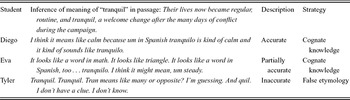
Table 2 shows examples of an accurate, partially accurate and inaccurate inference for the target word “tranquil”. “Tranquil” is defined by the Encarta Dictionary (Stelter, Reference Stelter2005) as “adj. free from any disturbance or commotion; free from or showing no signs of anxiety or agitation”. Synonyms include: “calm”, “serene”, “peaceful”, “still”, “relaxing” and “quiet”. The accurate response in Table 2 clearly expresses the core meaning of this word: “calm”. The subject, Diego, draws on his knowledge of the Spanish word tranquilo and so is coded as using cognate knowledge. The partially accurate response offered by Eva captures an aspect of the meaning of “tranquil”; “steady” is in the right direction, in that some things that are described as “tranquil” might also be called “steady”, but the two words are not synonymous. To assign meaning to this word, the student used cognate knowledge. The third response by Tyler shows that he clearly does not know the meaning of “tranquil”, and it is thus coded as inaccurate. Tyler unsuccessfully looks for clues in the word parts tran- and -quil.
Examples of an accurate, partially accurate, and inaccurate inference of the meaning of target word tranquil with accompanying strategy use.

Reliability for the scoring system was assessed by having a second judge score 50% of the data. Codings for scores were plotted on a confusion matrix (Bakeman & Gottman, Reference Bakeman and Gottman1997), with observer agreement determined through percentage of agreement, and corrected for chance using Cohen's Kappa (Cohen, Reference Cohen1960). Kappa for the scoring system was .85.
To answer questions 1–3 above, further analyses were conducted to identify the type and frequency of strategy use for accurate, partially accurate and inaccurate responses for each passage/target word and for groups (ELLs/EOs, intervention/comparison). Of special interest were strategies that led to accurate inferences of unknown vocabulary words, and whether or not students employed the cognate strategy.
Frequencies of the Spanish words were established using the online Corpus del Español (Davies, Reference Davies2001). This corpus comprises 100 million words and draws from both spoken and written Spanish. Bravo et al. (Reference Bravo, Hiebert, Pearson, Wagner, Muse and Tannenbaum2007) have established frequency in the following manner: high-frequency words are those that appear 10 or more times per million written words and low-frequency words are those that appear fewer than 10 times per million in written form. In recognition that the primary source of Spanish knowledge of our subjects is oral Spanish, we have modified these criteria slightly: frequent words are those that occur 10 or more times across both written and spoken forms of Spanish; infrequent words are those that occur fewer than 10 times in the combined forms.
Finally, to determine whether students exhibited metalinguistic knowledge in the process of deriving meaning for an unknown word (question 4 above), data from the interview were combined with data from the inferencing task, and analyzed within an information processing framework (i.e., a model of reading that focuses on the simultaneous application of skills and strategies by readers at various levels of text – word, sentence, etc. in the process of making meaning) (Paris, Lipson & Wixson, Reference Paris, Lipson and Wixson1983). The goal was to assess students’ declarative knowledge of linguistic structure and strategy use, and its relation to their procedural knowledge, as assessed through the think aloud protocol.
Discussion
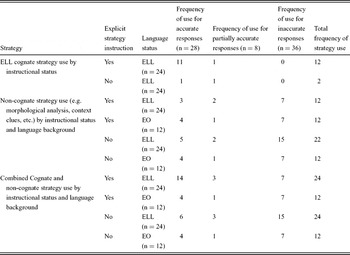
Table 3 shows the numbers of correct, partially correct and incorrect responses produced through the use of the cognate strategy (CS) only, strategies other than CS, and CS and other strategies combined, by language status and instructional condition. The results show that for the ELLs, use of the CS was associated with correct inferences for Spanish–English cognates, as it was used in 43% (12 of 28) of the accurate responses. Further, Spanish-speaking students were much more likely to use the CS if it had been taught to them as it had been in the VIP, as 11 of the 12 accurate responses using the CS were produced by ELLs who had received explicit instruction, as compared to 1 in the comparison group. The CS was also used in 2 of the 8 partially accurate inferences offered by ELLs, one each by a Spanish-speaking instructed and comparison student. Finally, as Table 3 also shows, none of the inaccurate responses involved the use of the CS.
Frequency of strategy use for responses to the inferencing of 6 target cognates (n = 72).

Notes: (i) In cases where multiple strategies were used, the text-initiated strategy was considered primary, and is the one reflected in these figures.
(ii) In this table n refers to the number of responses in a given category or group.
The usefulness of the CS for ELLs becomes clearer when we compare the responses of ELLs and EOs by instructional condition, also shown in Table 3. If we consider the number of accurate responses by intervention ELLs obtained through strategies other than the CS, we see that these ELLs were successful only half as often as intervention EOs. Specifically, using other strategies, intervention ELLs were correct 12% of the time (3/24), compared with 33% (4/12) for intervention EOs. When partially correct responses were included, the ELLs’ accuracy rate was 20% (5/24) as compared to 40% (5/12) for intervention EOs. However, when frequencies for the CS use were combined with those of other strategies, the success rate of intervention ELLs increased from 12% to 60% correct (3/24 to 14/24), or from 20% to 70% at least partially correct (5/24 to 17/24), considerably exceeding EO accuracy.
In contrast, no striking differences appeared between the ELL and EO comparison groups as a result of CS use. Comparison ELLs inferred meaning correctly 21% of the time (5/24), and at least partially correctly 29% of the time (7/24), as compared to 29% accuracy (4/12), and 41% partial accuracy (5/12) for EOs. When the one (possibly two) instances of CS are added, the ELLs had an accuracy rate of 25% (6/24), and 33% (8/24). Thus, with or without the CS, ELLs who had received no strategy instruction were somewhat less successful than their EO counterparts in inferring meaning for target cognates.
How do ELLs use cognate knowledge?
The excerpts from the protocols presented in this section illustrate how ELLs using cognate knowledge responded differently from EO students to passages containing the target cognates “tranquil” and “amorous”. “Tranquil” and “amorous” are the two target words which elicited the greatest use of the CS (an asterisk here and in subsequent examples marks the target word).
Their lives became regular, routine, and *tranquil, a welcome change after the many days of conflict during the campaign.
Laura (comparison EO)
Laura: It means . . .I guess it's like these words that “it became regular” and stuff and that's. . .
Interviewer: What are those two words?
Laura: “Regular” and “routine”. Yeah and like it means like how their lives became after the “conflict during the campaign”.
Interviewer: It means the same as these words. So do you want to take a guess at what tranquil means by giving me another word for it?
Laura: Um . . . good?
Edward (intervention ELL)
Edward: I think it means. . . because in Spanish? There's like a word that means tranquilo and it sort of has the same roots? And I think in Spanish tranquil, it means like to be calm?
Interviewer: Uh-huh.
Edward: And I think it sort of means calm.
“Tranquil” is defined by the Oxford American Dictionary (Ehrlich et al., Reference Ehrlich1979) as “adj. calm and undisturbed, not agitated”. In the first verbalization, Laura makes good use of the two sets of context clues provided in this passage, the synonyms “regular” and “routine”, and the contrast clues “after the conflict” to arrive at a general sense of what “tranquil” must mean. Her final response, “good”, however, is not an accurate definition of “tranquil”. Through his knowledge of the Spanish word tranquilo, Edward is able to offer a precise synonym for “tranquil”, “calm”. It is interesting that Edward did not discuss any of the salient context clues at all; his knowledge of the word tranquilo alone made him confident that his inference of “tranquil” was correct.
She began to feel *amorous towards him.
Joseph (comparison EO)
Joseph: I'm not sure if it's bad or good ‘cause they don't give you any really good clues here. She began to feel amorous about. . . toward him. I think it's like attracted or maybe liking him.
Interviewer: Liking him. And why do you think that?
Joseph: Um I don't know. Because it says she began to feel amorous toward him. I'm not sure if it's like annoyed or like liking him. I'm not sure. . .
Interviewer: And what do you think helped you settle on liking him?
Joseph: I don't know. – just like “toward him” maybe?
Dolfo (comparison ELL)
Dolfo: Um maybe it means she was feeling mad at him or (unintelligible). . .
Interviewer: Mad at him and then you said something else. . .
Dolfo: Like in love with him or something?. . .One of those two.
Interviewer: Oh, one of those two. . .I see. Okay, what makes you think it's one of those two?
Dolfo: Because it said that she began feeling amorous. . .amorous towards him.
Interviewer: Okay so what makes you think that it means either being mad or being in love?
Dolfo: Because she was feeling it towards him.
Interviewer: Is there anything else that helps you figure out the meaning?
Dolfo: No.
Interviewer: Do you want to make a choice between the two?
Dolfo: Love. . .cause um she was feeling amorous and it sounds like [student laughs].
Interviewer: It sounds like what?
Dolfo: Love.
Unlike the passage containing the word “tranquil”, the passage with target word “amorous” provided no context clues as to the meaning of the word. “Towards” was overwhelmingly interpreted by the students as a positive word, so that many students arrived at a meaning for “amorous” that approximated the definition of the word through this erroneous assumption, as in this example: . . .because, I don't know. Cause “towards” him. It wouldn't be away from him because that would mean she was turning that way. . .so it means she has something for this guy”. Both Joseph and Dolfo above initially suggest two contrasting meanings for “amorous”: annoyed/attracted to and mad at/in love with. Whereas the EO Joseph concluded his verbalization with some level of uncertainty about which of the two meanings was correct, having only the clue “towards” to guide him, Dolfo eventually arrived at a definition he felt sure of through his recognition that ‘amorous” has the Spanish word amor in it. By concealing the -ous suffix in “amorous”, Dolfo isolated the English stem, which corresponds to the written Spanish word amor. Interestingly, the four other students who used cognate knowledge for this word also extracted the word amor, and referred to the letters a-m-o-r in the word amorous, suggesting that they recognized the written Spanish word. Unlike Dolfo, however, who had not been taught the cognate awareness strategy and seems to have been reluctant (and possibly embarrassed) to state the meaning of the root amor, the intervention students quickly and confidently arrived at a meaning for “amorous” through the use of cognate knowledge, as in this example:
Eva (intervention ELL)
I know what that means. Like him. Look: Amor. [Student covers up -ous in the word “amorous”.] Love. Love towards him because I sort of went in the word and it sort of sounded exactly like love when I read it.
As with “amorous”, students who used cognate recognition to infer meaning for the word “fragility” in the passage below made the connection by extracting the English stem from the derived form, and relating it to the Spanish cognate:
The boys were worried about the raft's *fragility. They therefore decided to reinforce it with the strongest, heaviest materials possible.
Edward (intervention ELL)
And I think? Fragility? It means that it's like fragile because it has the word fragile? And “-ity?” It's like a suffix? And the clues it gave me that it was fragile? Because it says the boys were worried? They therefore. . . they decided to reinforce it with the strongest, heaviest materials that they could, to like not make it be fragile anymore. . .In Spanish it means frágil, and it means the same.
In a very thorough approach to word inferencing, Edward utilizes morphological analysis (extracting “fragile” from “fragility”) to arrive at an accurate meaning for fragility. He then confirms his inference through the use of context clues, and finally connects the English stem “fragile” to Spanish frágil.
Are there different ways the CS is applied?
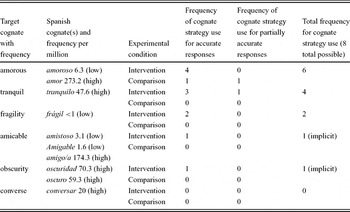
While cognate knowledge is the strategy most associated with the accurate inferencing of cognates, it was not applied evenly across the target cognates. Table 4 shows the frequency of cognate strategy use associated with accurate and partially accurate responses for each of the target cognates.
Cognate strategy use by intervention and comparison English Language Learners for each of the target cognates (No use for inaccurate responses).

This strategy was used most often with the cognates “amorous” and “tranquil”, less frequently with “fragility”, only once with “obscurity” and “amicable”, and not at all with “converse”. Further, in the case of “obscurity” and “amicable”, cognate use was coded as implicit. We recognize that these students may not have drawn on their knowledge of Spanish in arriving at an accurate definition of the words, and may have been guessing. Whether they were guessing or drawing from Spanish in an unconscious fashion, it can be informative to compare the ELLs’ verbalizations with those of EO students who did not have access to Spanish as a source of knowledge about the words “obscurity” and “amicable”.
The *obscurity frightened us.
Emma (intervention EO)
Okay. Obscurity means. . . I have no idea what it means. That's why I don't like short sentences. Mostly they don't tell you what it means so you need like more than one sentence to figure out what the meaning is. Insecurity. . . like they aren't secure with themselves and they're always sitting and looking really, really cautious.
Diego (intervention ELL)
Um I think it means like probably the darkness because. . . Um well lots of people are scared of the dark and I thought it just might like kind of mean it. I'm not quite sure but lots of people are sort of scared of the dark.
The Encarta Dictionary provides the following synonyms for “obscure”: “darkness”, “dimness”, “shadows”, “gloom”, and “murkiness”. In constructing meaning for this word, the EO student makes an interesting comment about her frustration with the lack of contextual aids in this passage, and she attempts to extract clues from the sound of the target word itself. The strategy Emma used was termed false etymology. Emma's strategy was the most common approach to figuring out the meaning of this word across intervention and comparison students: Well, it kind of made me think of the word security.
In contrast to Emma, Diego suggests that “obscurity” means “darkness”, though he does not explicitly state that he is drawing from his knowledge of the Spanish cognates to “obscure”, oscuridad and oscuro.
The new girl at the school seemed *amicable.
Laura (comparison EO)
Laura: I guess it looks like a smart word or something.
Interviewer: Oh, it looks like a smart word.
Laura: Because I don't know if she's dumb, or ugly, or smart. I guess smart.
Interviewer: Is there anything in the sentence to help you figure it out?
Laura: No.
Kara (intervention ELL)
Kara: Okay this one is very hard. No clue, nothing. Okay. “The new girl at the school seemed amicable (pronounced ami-cayble)”. Very outgoing.
Interviewer: Very outgoing.
Kara: Because because “amicable” . . . Cable is like. . . like wires. They stay. . . the way they stick together, stick together so it could mean she makes lots of friends.
Interviewer: She makes lots of friends.
Kara: Yeah.
In these verbalizations, both Laura (EO) and Kara (ELL) express frustration with the lack of context clues in the passage. Laura suggests that amicable could just as easily mean “smart”, “dumb” or “ugly” – and that there was nothing in the text to help her select among these possibilities. Other students in the sample offered additional meanings for this word, including “different”, “capable”, and “shy”.
Like Laura, Kara states that there was, “No clue, nothing” to help her figure out the meaning of “amicable”, but she then proceeds without hesitation to offer only one definition of the word, an accurate definition. Kara and Diego may or may not have been drawing from Spanish in inferring meaning for the target cognates. Somehow, however, they correctly derived the meanings of these words with very little to go on. If they were in fact using cognate knowledge, the contrasting EO/ELL verbalizations illustrate the power of this knowledge source in arriving at a meaning for infrequent English words of Latin origin.
Finally, no student used cognate knowledge for the cognate “converse”. The variability among cognates in their elicitation of the cognate strategy can be examined in terms of constructs introduced earlier: the degree of phonological similarity and orthographic overlap between the Spanish cognate and the English target word, and the frequency of the word in Spanish.Footnote 2 The cognates “amorous” and “tranquil” are related to the Spanish words amoroso and tranquilo, respectively. In both cases, the root morphemes are transparent in the written English words. In addition to sharing considerable orthographic overlap, the connection between the English and Spanish versions of these words is relatively easily recognizable from a phonological perspective.
The verbalizations reveal that, in fact, students relied both on sound and print. With respect to sound, several of the ELLs showed Spanish influence in their pronunciations of “amorous” and “tranquil”, placing the stress on the second syllable of “amorous” instead of the first, and in pronouncing “tranquil” as “trankeel”. In addition, some students explained that the sound connection helped them recognize the cognate relationship (“it sounds like love”; “it kind of sounds like tranquilo”). Several students also explicitly drew attention to print in spelling the Spanish word amor, and in using the verb “look”: “It looks like a word in Spanish”.
With respect to the frequency of occurrence of these words in written and spoken Spanish, amoroso occurs infrequently, but amor occurs frequently, and as the student verbalizations showed, students extracted Spanish amor from “amorous” and were not connecting it to amoroso. Tranquilo is also a high frequency word in Spanish. The “amorous” – amor and “tranquil” – tranquilo cognate pairs thus satisfy both the transparency and frequency criteria, which may contribute to the relatively high number of students who used cognate knowledge with these words. In contrast, the target word frágil, which also elicited the cognate strategy, is infrequent in Spanish (see Table 4), suggesting high Spanish proficiency on the part of students who had this word in their vocabulary.
The cognates “amicable” and “obscurity” fall on the more opaque end of the phonological/orthographic transparency continua. “Amicable” is cognate to amistoso and amigable, infrequent forms in Spanish. It is therefore not surprising that this target word rarely elicited the cognate strategy. “Obscurity” is related to the Spanish oscuridad and oscuro. There seems to be little phonological overlap between English “obscurity” and Spanish oscuro, but some orthographic overlap between the two forms. Both oscuridad and oscuro are frequent, so that the Spanish-speaking students were probably familiar with this word, yet only one student made the Spanish–English connection, and his use of the strategy was unclear.
The target cognate, “converse”, is cognate to Spanish conversar. “Converse” and conversar are transparent cognate pairs with considerable orthographic and phonological overlap. Additionally, conversar occurs frequently in Spanish, yet no student made the inter-language connection. Rather, the preferred strategy for determining the meaning of “converse” was morphological analysis (a strategy also taught in the VIP intervention). The relationship between “converse” and the derived English form “conversation” is transparent. This, combined with the high frequency of “conversation” in English may account for the relatively large number of students (four) who related “converse” to “conversation”.
It is possible that when more than one inferencing strategy presents itself, as in the possibility of analyzing “converse” either as a cognate to Spanish conversar or as the root of a frequent English word, “conversation”, students’ Spanish and English proficiency plays a role in strategy use: a student who is very proficient in English might readily associate “converse” with “conversation”, while one whose Spanish proficiency is relatively higher might have the form conversar in his or her vocabulary and make a cognate connection.
In sum, cognate knowledge gave ELLs to whom the strategy had been taught a distinct advantage in inferring meanings for the group of target cognates. At the same time, there was variability in the application of this knowledge source among cognates. It appears from these data that familiarity with the Spanish word in a cognate pair is not a sufficient condition for the cognate strategy to be used. Rather, a degree of orthographic/phonological overlap between cognates might be required for students to access cognate knowledge. When these structural conditions are present, even infrequent Spanish words may be related to their English cognates by students with high Spanish proficiency.
How are metacognitive and metalinguistic skills exhibited by children in the process of inferring meaning for cognates?
The metacognitive knowledge displayed by the students can be analyzed as either declarative or procedural knowledge (Paris et al., Reference Paris, Lipson and Wixson1983). Declarative knowledge is “knowing that . . .” and includes knowledge of facts, rules, theories, passages, etc. Procedural knowledge, on the other hand, is “knowing how”, and is demonstrated during the performance of a task. Students’ declarative knowledge can be gleaned from responses to interview questions as well as from verbalizations that accompanied the process of word inferencing. Procedural knowledge was assessed during the coding phase of analysis, when it was determined what strategies students were using. In this section, we combine information from both sources to create profiles of students in the intervention and comparison groups. In any given case the student profiled may not be entirely typical of his/her group, but will have exhibited a behavior or offered a verbalization that helps explain phenomena across the group as a whole.
In response to the interview question,
Have you ever thought about whether knowing both Spanish and English could help someone to be a better reader? Could it? Why?
all four comparison students said that knowledge of both languages could help them to be better readers. When asked to explain how, one comparison student said he did not know why, two explained the usefulness of being bilingual as capacity to translate for people in need (family members), and one offered the following intriguing response:
Lucinda (comparison ELL)
Lucinda: Yeah, cause sometimes the words are almost the same. . .Like when you say “excuse me”. . .and like you're trying to pass by? Well, sometimes it kind of tells you in Spanish.
Interviewer: Because. . .could you say a little more about that?
Lucinda: I don't know. . .it's kind of hard to explain. . .because it's spelled the same and stuff?
Lucinda noticed similarities between Spanish and English, but this awareness had not yet acquired the status of a strategy that she could articulate in a declarative way. Indeed, Lucinda did not use the cognate strategy at all, though her intuitive, “below the surface” awareness of cognate relationships was evident in one of her responses to a cognate passage:
She began to feel *amorous towards him.
Lucinda (comparison ELL; pronounced the word as [amóris])
Kind of exciting or something? I don't know; it doesn't give me any clues. So I don't know why.
All four intervention ELLs also responded affirmatively when asked whether knowledge of both English and Spanish could be helpful in reading, but most offered different reasons from students in the comparison group. One discussed its utility in translating for people, and three noted the usefulness of similarities between the two languages at the lexical level. Two of these used the term “cognate”.
The following is an example of a response to this question by an intervention student:
Diego (intervention ELL)
Yes, I think it does because, well first of all, it gives a big advantage on cognates and say like you read a book, an English book and a Spanish book, and you're a Spanish reader, you just look in Spanish and then read it in English too – if you come to a word that you don't know but you know in Spanish, you can just go right through and know what it means.
The declarative, metalinguistic knowledge evident in this response matched the student's procedural knowledge. Diego used cognate knowledge in successfully inferring meaning for three of the six target cognates. Further, he did so in an explicit manner, consciously drawing a parallel between the English form in the passage and its Spanish cognate, as in the following passage:
She began to feel *amorous towards him.
Diego (intervention ELL)
Oh I think it means, like, love because in Spanish “amor” means love, and she said she began to feel. . .Like some people feel like they love somebody else.
While Diego exhibits a high degree of cognate awareness, Lucinda, who did not benefit from the explicit strategy instruction the children in the intervention group received, shows just the beginning of an understanding of how her knowledge of Spanish might be useful to her in ascertaining word meaning in English. For children in the intervention as well as in the comparison group, then, declarative and procedural knowledge proved to be closely linked. Further, metalinguistic knowledge and an ability to articulate a strategy were associated with higher levels of inferencing accuracy.
Summary
Evidence from this study suggests that the cognate strategy may be effective in resolving meaning for challenging English vocabulary items that are Spanish–English cognates. Indeed, when ELLs used other strategies, their success rate was somewhat less than that of EOs, but when the CS was included, their accuracy surpassed EOs. The use of the CS was not spontaneous among ELLs: those who used it had been explicitly taught the strategy. Finally, ELLs who experienced the intervention exhibited higher levels of metalinguistic awareness.
Analyses of students’ verbalizations also shed light on the roles of phonology, morphology, and orthography in cognate recognition. Students who used cognate recognition often referred to the sound similarities in cognate pairs and pronounced the English word as they would its Spanish cognate, which indicates that sound is a source of information they use in making the cognate connection. For many students, cognate recognition occurred through cognate stems (for example, in the words “amorous” and “fragility”), corroborating previous findings that cognate recognition may provide a vehicle for learning the rules of English derivational morphology. Importantly, students often discerned the written Spanish word within the written English cognate, suggesting that the ability to read in Spanish may facilitate the application of this strategy. Finally, students’ Spanish and English oral language proficiency may have influenced students’ preferences for interlingual (cognate) strategy (e.g., relating “converse” to conversar) versus an intralingual strategy (e.g., relating “converse” to “conversation”).
Cognate pairs varied in the extent to which they elicited the strategy; students used it more readily with cognate pairs that shared phonological and orthographic features, and in which the Spanish term was frequent.
These findings are consistent with those of the National Literacy Panel as they demonstrate a clear example of how first language development can contribute to the growth of academic English vocabulary.
Implications
The findings from this qualitative analysis confirm the value of the CS both as a strategy for unlocking the meanings of unknown English words that have Spanish cognates, and as a means of expanding students’ metalinguistic insight. However, the mechanism governing cognate transfer must be further specified.
Until now, researchers and educators alike have emphasized orthography as the primary source of information for learners making this interlinguistic connection, while the role of phonology in cognate transfer has been largely ignored. While our data confirm the relevance of orthography in the process of making cognate connections, they also suggest that students who use the CS rely on sound similarities as well. We therefore recommend that future studies explicitly test this hypothesis, and further that they attempt to disentangle orthographic from phonological influences in the transfer process.
Secondly, the observation that CS use may be mediated by oral Spanish proficiency raises the question of how bilingual students need to be in order to take advantage of it. We urge studies that investigate cognate strategy use in ELLs with varying degrees of oral Spanish proficiency, as well as varying levels of Spanish literacy. This research would contribute to the design of instruction in the first language that would maximize the development of vocabulary in a second language.
Finally, student verbalizations indicate that those who use the CS perform morphological analyses in extracting cognate roots. Given the critical importance of morphological awareness in English vocabulary development, additional attention (research and instructional) should be paid to the overlap between Spanish–English cognates and English derivational morphology.
Appendix A. Samples of passages containing cognates
María vive en un rancho con su familia. Hay muchos animales y plantas en el rancho. Jessica ayuda a su papá a cuidar las flores y el jardín. María ayuda a su mamá a cuidar los animales.
In newer tenements, running water came from a convenient faucet above the kitchen sink. This sink was used to wash dishes, clothes, and kids. Water had to be heated on the kitchen stove. Since bathing was difficult at home, most immigrants went regularly to public bathhouses. Tenement apartments had no refrigeration and supermarkets had not yet been invented.
Appendix B. Word inferencing passages
1. The new girl at the school seemed *amicable.
2. She began to feel *amorous towards him.
3. The students liked to *converse.
4. The *obscurity frightened us.
5. The boys were worried about the raft's *fragility. They therefore decided to reinforce it with the strongest, heaviest materials possible.
6. Their lives now became regular, routine, and *tranquil, a welcome change after the many days of conflict during the campaign.
Appendix C. Student interview
1. What sorts of things do you like to read?
2. What are you reading now in school?
3. Have you ever learned how to do something to better understand your reading? What?
4. What do you do when you are reading, and you come across a word you don't know?
5. Are there clues that you use to help figure the meaning of a word you don't know? Which ones?
6. Have you ever thought about whether knowing both Spanish and English could help someone to be a better reader? Could it? Why?
Appendix D. Directions read aloud to the student (adapted from McKeown, Reference McKeown1983)
Interviewer:
In this activity, I'm going to ask you to read a few short passages with me. In each passage, you will see a word with a star in front of it. After you finish the passage, I would like you to go back to the starred word, and tell me what you think it means, and most importantly, whyyou think it means that. I'd like for you to tell me as much as you can about what you're thinking when you try to figure out what each starred word means, and why you gave the answer you did. The answers you give aren't as important as what you are thinking along the way to your answer.
Five additional questions were included to guide more reticent students who did not independently volunteer information about their processing behavior:
1. Have you seen this word before?
2. Do you know what it means? What does it mean?
3. What do you think it means?
4. What makes you think that?