Introduction
During the process of assisted reproductive technology (ART), controlled ovarian stimulation is the first important step towards in vitro fertilization (IVF) success. Multiple follicles are stimulated using different gonadotrophins and protocols in a single cycle for the collection of multiple oocytes (Macklon et al., Reference Macklon, Stouffer, Giudice and Fauser2006; Vermey et al., Reference Vermey, Chua, Zafarmand, Wang, Longobardi, Cottell, Beckers, Mol, Venetis and D’Hooghe2019). The general aim of this collection was to obtain as many oocytes as possible to increase the chance of good quality embryos. A high number of good quality embryos increases the chances of having more than one transfer, as many of the embryos can be vitrified for upcoming cycles. However, there is considerable heterogeneity in the published studies on the effect of the number of retrieved oocytes on IVF outcomes (Timeva et al., Reference Timeva, Milachich, Antonova, Arabaji, Shterev and Omar2006; Cai et al., Reference Cai, Wan, Huang and Zhang2013). While some studies showed that an optimum number increases the live birth rates (Ji et al., Reference Ji, Liu, Tong, Luo, Ma and Chen2013), others found that clinical pregnancies and live birth rate (LBR) do not decrease with a high number of oocytes (Briggs et al., Reference Briggs, Kovacs, MacLachlan, Motteram and Baker2015).
Also, it has been shown that poor ovarian reserve does not necessarily means poor pregnancy rates, as there are other factors that are involved such as female age (Klinkert et al., Reference Klinkert, Broekmans, Looman and Te Velde2004; Hendriks et al., Reference Hendriks, Te Velde, Looman, Bancsi and Broekmans2008; Yin et al., Reference Yin, Jiang, He, Wang, Zhu and Cao2019). However, reports on poor responders with lower pregnancy rates have also been published (Biljan et al., Reference Biljan, Buckett, Dean, Phillips and Tan2000; De Sutter and Dhont, Reference De Sutter and Dhont2003; Timeva et al., Reference Timeva, Milachich, Antonova, Arabaji, Shterev and Omar2006; Zhen et al., Reference Zhen, Qiao, Li, Wang and Liu2008). Before the phases of implantation and live birth, there are many key stages that can be affected by oocyte competence. Oocyte maturation, fertilization competence, cleavage quality and blastulation are known to be the first in vitro indicators of chances of implantation and live birth during IVF cycles. The aim of this study was to elucidate the association between the number of oocytes after retrieval and the following results of each step of the IVF process.
Materials and methods
Patients
This retrospective study was approved by the IRIFIV Fertility Centre, Casablanca (Morocco) informing the selected patients with consent. The study includes 1987 women, aged between 24 and 40 years old, who were eligible for oocyte retrieval, with primary and secondary infertility, and who underwent an intracytoplasmic sperm injection (ICSI) cycle between January 2015 and January 2020.
For the purpose of this study, cycles involving oocyte cryopreservation and frozen oocyte thawing were excluded from the analysis. Patients were divided into three groups according to the number of oocytes retrieved from each patient. Group 1: ≤5 oocytes, group 2: 6–15 oocytes, group 3 ≥15 oocytes. These categories were defined according to previous research (please refer to the Discussion).
Ovarian stimulation
Women underwent controlled ovarian stimulation with the flexible gonadotrophin-releasing hormone (GnRH) antagonist protocol. A daily subcutaneous injection of recombinant follicle-stimulating hormone (rFSH; Gonal-F, Merck-Serono) was used alone or in combination with human menopausal gonadotrophin (HMG; Menopur; Ferring). The follicle-stimulating hormone (FSH) dose was based on the woman’s age, anti-müllerian hormone (AMH) concentration, in addition to prior history of ovarian stimulation and was adjusted according to the usual parameters of follicle growth, determined using serum estradiol (E2) concentration and ultrasound monitoring.
A daily dose of GnRH antagonist (Cetrotide, Merck-Serono or Orgalutran, MSD) was injected subcutaneously, starting from day 6 of FSH administration. The ovulation trigger was performed with 10,000 IU of human chorionic gonadotrophin (rHCG, Ovitrelle; Merck-Serono) and gonadotrophin-releasing hormone (Decapeptyl, Ferring), after obtaining follicles that reached dimensions of 17 mm or greater in diameter and adequate serum E2 levels. Oocytes were retrieved 34–36 h after hCG administration.
Oocyte and sperm preparation
The retrieved cumulus–oocyte complexes were isolated from follicular fluid, rinsed and cultured in culture medium (SAGE 1-Step, Origio). At 2–3 h after retrieval, the oocyte–corona–cumulus complexes were placed in a HEPES-buffered medium (Ferticult Flushing medium, Fertipro) containing hyaluronidase (Hyaluronidases in Ferticult Flushing medium, Fertipro) and were mechanically denudated using a 20–200-µl micropipette. The nuclear maturation grades were classified as metaphase II, metaphase I and germinal vesicle.
Sperm samples were collected in a sterile container from the male partner by masturbation, after 3–4 days of abstinence, and washed by centrifugation. All metaphase II oocytes underwent ICSI after denudation.
The temperature inside the incubators (IVF-Cube AD3100, ASTEC; Thermo Scientific HeraCell 150) was controlled using a certified thermometer and remained at 37 ± 0.2°C. Oxygen levels inside the incubators were at 5% and the cultivation medium was pH 7.3 ± 0.02 with CO2 ∼5.6%.
Assessment of the rate of maturation, fertilization, embryo quality and implantation
The rate of fertilization was calculated by the number of 2PN embryos on day 1 divided by the total number of metaphase II (MII) oocytes. The rate of 8-cell embryos on day 3 was calculated by the number of 8-cell embryos divided by the total number of embryos. The blastulation rate was calculated by the number of blastocysts obtained on day 5 divided by the total number of embryos of extended culture. On day 2, embryos were not taken out of the incubator for evaluation.
The embryo transfer policy was double embryo transfer (DET) on day 3. The implantation rate was calculated as the number of implanted embryos divided by the number of embryos transferred per group of patients.
Statistical analysis
The results are expressed as the mean ± standard deviation or percentage of the total. Data were obtained using Student’s t-test and Statistical Package for the Social Sciences (SPSS) software. Statistical significance was defined as a P-value < 0.05. Correlation coefficient values were used to determine the significance of the correlations found in all data. In this analysis, the relationship was assessed for each possible confounding factor.
Results
Relationship between the number of retrieved oocytes and their maturation rate
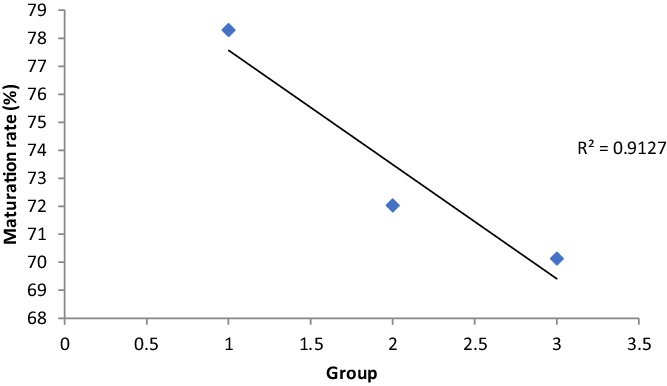
Our data showed a significant negative correlation between the maturation rate and the number of retrieved oocytes (r = −0.95; P = 4.79 × 10⁹) (Figure 1). The highest maturation rate (78.2%) was observed in group 1 (≤5 oocytes) and the lowest maturation rate was observed in group 3 (≥16 oocytes) (Table 1).
Association between the number of retrieved oocytes and the maturation rate.
Group 1: (≤5 oocytes); Group 2: (6–15 oocytes); Group 3: (≥16 oocytes).

Comparison of maturation rates, fertilization and 8-cell embryos on day 3 according to the number of retrieved oocytes

Values are reported as the mean ± standard deviation (SD).
Relationship between the number of retrieved oocytes and embryo quality
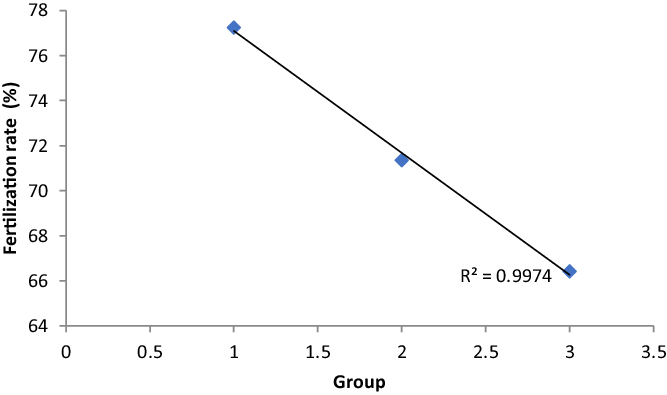
As shown in Table 1, we found a significant negative correlation (r = −0.99; P = 1.03 × 10⁶) between fertilization rate and the number of retrieved oocytes. The rate of fertilization significantly decreased from group 1 to group 3 (Figure 2).
Association between the number of oocytes and the fertilization rate. Group 1: (≤5 oocytes); Group 2: (6–15 oocytes); Group 3: (≥16 oocytes).

Regarding the rate of 8-cell embryos on day 3, no correlation but a significant difference (P = 1147 × 10–13) was found between the groups. The group with the highest rate was group 2 (6–15 oocytes), followed by group 3 (≥ 16 oocytes) and finally group 1 (≤ 5 oocytes).
A significant positive correlation (r = 1; P = 0.03) was found between blastulation rates and the number of retrieved oocytes (Table 1). As seen in Table 1, there were no extended cultures on day 5 in group 1, which was due to the low numbers of oocytes and day 3 embryos in that group.
Relationship between the number of retrieved oocytes and implantation rate after fresh day 3 embryo transfer
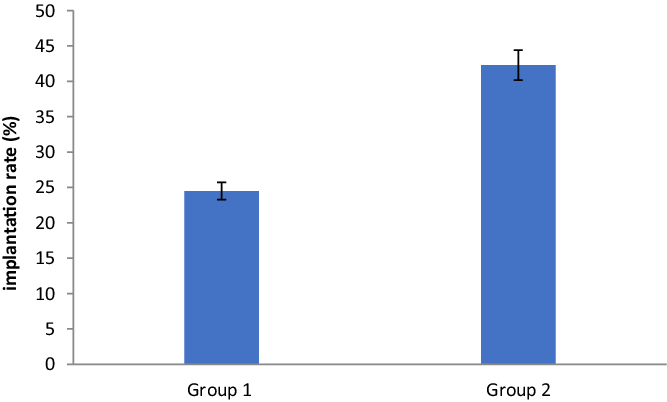
The implantation rates after fresh embryo transfer were 24.9% and 42.3% in groups 1 and 2, respectively (Figure 3). No implantation rate was included in group 3, all embryos were frozen. This group included a high cancelled cycle transfer rate due to ovarian hyperstimulation syndrome (OHSS).
Association between the number of oocytes and the implantation rate. Group1: (≤5 oocytes); Group 2: (6–15 oocytes); Group 3: (≥16 oocytes).

Discussion
Ovarian stimulation is the important first step during IVF cycles and plays an important role in IVF outcomes. Many studies have been interested in the effect of the number of retrieved oocytes on implantation success, however many conflicting results have been found. In fact, some studies have suggested that the optimum number of oocytes to generate positive IVF outcomes can be ∼6–10 oocytes (Sunkara et al., Reference Sunkara, Rittenberg, Raine-Fenning, Bhattacharya, Zamora and Coomarasamy2011; Ji et al., Reference Ji, Liu, Tong, Luo, Ma and Chen2013; Steward et al., Reference Steward, Lan, Shah, Yeh, Price, Goldfarb and Muasher2014; Thaker et al., Reference Thaker, Mishra, Gor, Agarwal, Sheth, Kapadia and Kumar2020). Other researchers have shared that a higher number of retrieved oocytes increases the LBR (Zhou et al., Reference Zhou, Wang, Hu and Sun2017), while other studies found that oocyte number did not significantly affect IVF outcomes (Briggs et al., Reference Briggs, Kovacs, MacLachlan, Motteram and Baker2015). To date, only a few studies have analyzed the relationship between maturation, fertilization, as well as embryo quality and oocyte number (Sigala et al., Reference Sigala, Sifer, Dewailly, Robin, Bruyneel, Ramdane, Lefebvre-Khalil, Mitchell and Decanter2015; Decanter, Reference Decanter and Palomba2018; Lin et al., Reference Lin, Vitale, Chen, Wen, Tsai, Chern and Tsui2018; Agrawal et al., Reference Agrawal, Panchal and Nagori2020; Nikbakht et al., Reference Nikbakht, Mohammadjafari, Rajabalipour and Moghadam2021). Our data have shown a significant association between retrieved oocytes per patient and IVF success, from oocyte maturation to implantation.
Initially, our results showed a significant negative correlation between the number of retrieved oocytes and the rate of maturation and fertilization. In line with our findings, many studies have found a lower fertilization rate and lower oocyte quality in patients with high oocyte numbers. As most of these patients were known to have polycystic ovary syndrome (PCOS) with high AMH levels, the alteration in oocyte quality can be explained by an increased expression of reactive oxygen species (ROS) levels by granulosa cells (GCs) and follicular fluid (Arya et al., Reference Arya, Haq and Chaudhury2012; Yilmaz et al., Reference Yilmaz, Inal, Gorkem, Sargin Oruc, Yilmaz and Turkkani2016; Lai et al., Reference Lai, Xiang, Li, Zhang, Li, Zhu, Xiong and Jin2018; Sun et al., Reference Sun, Ma, Li, Hu, Wang, Zhang, Dai and Sun2021). The high oocyte number resulting from excessive follicle number is associated with folliculogenesis disturbance that is known to be a consequence of PCOS (Jonard and Dewailly, Reference Jonard and Dewailly2004; Homburg, Reference Homburg2009).
The metabolic activity of GCs is related to oocyte competence and development from maturity to implantation (Uyar et al., Reference Uyar, Torrealday and Seli2013; Huang et al., Reference Huang, Qian, Li, Yue, Yang, Zhu and Zhang2015; Lai et al., Reference Lai, Xiang, Li, Zhang, Li, Zhu, Xiong and Jin2018) through the cross-talk between oocyte and GCs (Rienzi et al., Reference Rienzi, Balaban, Ebner and Mandelbaum2012; Decanter, Reference Decanter and Palomba2018). Intact GCs already produce a considerable amount of ROS by electron transport, which is maintained by enzyme antioxidants (Behl and Pandey, Reference Behl and Pandey2002; Migdal and Serres, Reference Migdal and Serres2011). In PCOS patients, the percentage of ROS in GCs has been shown to increase by 20-fold compared with the normal rate (Das et al., Reference Das, Djahanbakhch, Hacihanefioglu, Saridogan, Ikram, Ghali, Raveendran and Storey2008; Lai et al., Reference Lai, Xiang, Li, Zhang, Li, Zhu, Xiong and Jin2018), which can alter DNA and mitochondrial metabolism prior to the inadequate dialogue between GCs, cumulus cells (CC) and oocytes (Kenigsberg et al., Reference Kenigsberg, Bentov, Chalifa-Caspi, Potashnik, Ofir and Birk2009; Kwon et al., Reference Kwon, Choi, Bae, Kim and Kim2010). All this cellular disturbance can lead to high rates of immature oocytes, as well as a significantly low rate of fertilization and embryonic development (Plachot et al., Reference Plachot, Belaisch-Allart, Mayenga, Chouraqui, Tesquier, Serkine, Boujenah and Abirached2003; Dumesic and Abbott, Reference Dumesic and Abbott2008; Homburg, Reference Homburg2009; Qiao and Feng, Reference Qiao and Feng2011; Zhang et al., Reference Zhang, Liu, Yin, Yang and Xiong2017; Lai et al., Reference Lai, Xiang, Li, Zhang, Li, Zhu, Xiong and Jin2018; Jamil et al., Reference Jamil, Debbarh, Aboulmaouahib, Aniq Filali, Mounaji, Zarqaoui, Saadani, Louanjli and Cadi2020). In accordance with these studies, our highest fertilization and maturation rates were observed in group 1 (1–5 oocytes). Moreover, some studies have shown that poorer ovarian responses can be due to altered mitochondrial RNA (mit-RNA) expression in CC and can also lead to negative oocyte and embryo quality (Karakaya et al., Reference Karakaya, Guzeloglu-Kayisli, Uyar, Kallen, Babayev, Bozkurt, Unsal, Karabacak and Seli2015; Yin et al., Reference Yin, Jiang, He, Wang, Zhu and Cao2019). However, the poor ovarian response usually includes some oocytes that are less than or equal to two oocytes. In our study, in the group including 1–5 oocytes, not all patients had abnormally low AMH levels, and therefore had a better chance of higher quality oocyte competence (Cohen et al., Reference Cohen, Tannus, Alzawawi, Son, Dahan and Buckett2018).
Although in our data, fertilization and maturation rates were the highest in group 1 (≤ 5 oocytes), the rate of 8-cell embryos on day 3 was the highest in group 2 (6–15 oocytes).
This interesting result can be explained by the reduced embryo quality resulting from mit-RNA deletions in CC. According to Gross et al. (Reference Gross, Kropp and Khatib2017), the role of maternal miRNA in embryo development is still unclear, but they might play a role in producing ‘robust’ embryos.
In addition, Thaker and colleagues showed that lipid peroxidation was at an optimum level in the 6–10 oocyte group, compared with lower and higher retrieved oocyte number, which can confirm the importance of maintaining a balance during ovarian stimulations. Even though the physiological basis for the association between AMH levels and embryo quality is still not well understood (Melado Vidales et al., Reference Melado Vidales, Fernández-Nistal, Martínez Fernández, Verdú Merino, Bruna Catalán and Bajo Arenas2017; Shrikhande et al., Reference Shrikhande, Shrikhande and Shrikhande2020), it is worth mentioning that an optimum AMH level results in an optimum oocyte number that can result in a higher quality embryo with lower OHSS risk.
In group 3 (≥16 oocytes), although the rate of 8-cell embryos on day 3 embryos was not the highest, it appeared to be higher compared with group 1. This can be explained by the higher number of oocytes that were prone to produce 8-cell embryos. In fact, when comparing embryo quality between PCOS patients and the control group, Fernández-González and colleagues (Reference Fernández-González, Laguna, Ramos-Ibeas, Pericuesta, Alcalde-Lopez, Perez-Cerezales and Gutierrez-Adan2019) found no significant difference between the two groups. However, the number of retrieved oocytes in the PCOS group was higher.
A high rate of 8-cell embryos on day 3 is considered a more promising result compared with lower rates, with the exception of aneuploidy, in which morphological characteristics are not a significant predictor of conception (Dolgushina et al., Reference Dolgushina, Syrkasheva, Makarova, Kovalskaya, Kalinina and Sukhikh2015; Minasi et al., Reference Minasi, Colasante, Riccio, Ruberti, Casciani, Scarselli, Spinella, Fiorentino, Varricchio and Greco2016; Lee et al., Reference Lee, Chen, Huang, Cheng, Chen, Ho, Lin, Lee and Lee2019; Munné et al., Reference Munné, Kaplan, Frattarelli, Child, Nakhuda, Shamma, Silverberg, Kalista, Handyside, Katz-Jaffe, Wells, Gordon, Stock-Myer, Willman and Study Group2019). Moreover, it has been shown that embryo morphology can help to increase the percentage of chromosomally normal embryos (Ziebe et al., Reference Ziebe, Lundin, Janssens, Helmgaard and Arce2007). According to our data, as well as all the previous studies mentioned, we can confirm that, for a higher quality embryo competence, in terms of development and kinetics, an optimum number of retrieved oocytes can be adequate. The rate of fertilization and maturation is a very important factor in IVF success, however embryo kinetics and the subsequent cleavage quality in time are more impactful for quality embryo transfers and also cryopreservation.
For blastulation, we could not establish a rate for group 1 due to the low rate of prolonged culture to day 5 for such a low number of oocytes. Nevertheless, the blastulation rate of group 3 was significantly higher when compared with group 2. Cycle characteristics alone may not be an accurate predictor for the rate of blastulation, as there have been many conflicting results reported in previous literature (Jones et al., Reference Jones, Acharya, Acharya, Raburn and Muasher2020). It has been shown that better quality blastocysts are mostly generated by oocytes originating from a follicular volume of between 13 and 23 mm (Agrawal et al., Reference Agrawal, Panchal and Nagori2020). However, smaller follicles still have the capacity to produce blastocysts, which increases their number for higher chances of implantation. Most importantly, 8-cell embryos on day 3 can increase the rate of blastocyst formation, however embryos with a greater cell number on day 3 are not always predictive of a greater likelihood of blastocysts. In fact, 6–7-cell embryos may also result in blastulation, as Langley et al. (Reference Langley, Marek, Gardner, Doody and Doody2001) have previously shown that 54% of 6-cell embryos formed blastocysts on day 5. Simply put, a large number of embryos in extended culture can increase the chances of obtaining blastocysts on day 5, irrespective of whether the corresponding day 3 embryos are of better quality (seven or eight cells) or lower quality (six cells) (Graham et al., Reference Graham, Han, Porter, Levy, Stillman and Tucker2000; Langley et al., Reference Langley, Marek, Gardner, Doody and Doody2001). This might explain the higher rate of blastulation in group 3 compared with group 2, regardless of the higher quality of day 3 embryos in group 2.
Regarding the most important indicator of IVF success, in our data, we noted that the implantation rate after the fresh transfer of day 3 embryos doubled from group 1 to group 2 (24–42%). Group 3 was not included in the implantation rates due to a lack of fresh embryo transfers in this group, as all transfers from OHSS are postponed to other cycles. The same trends in the results were observed with a higher LBR in oocyte retrievals of 10–14 oocytes (Zhou et al., Reference Zhou, Wang, Hu and Sun2017). The higher rate of implantation in group 2 can be explained by the concordance with the highest rate of 8-cell embryos on day 3 in the same group. During our DET policy, the chances of transferring two 8-cell embryos on day 3 were higher in cultures that had a higher number of 8-cell embryos. In group 1 (≤ 5 oocytes), the rate of 8-cell embryos on day 3 was quite acceptable, nevertheless DET may involve two 8-cell embryos or it may also involve only one 8-cell embryo paired with another embryo with a lesser number of cells. As there are more good quality embryos available in group 2 compared with group 1, we can speculate that it might be one of a variety of factors that could affect the chances of implantation. A high number of retrieved oocytes may not necessarily mean a higher chance of implantation, however a high number of good quality embryos can increase the chances of implantation (Bosch et al., Reference Bosch, Labarta, Kolibianakis, Rosen and Meldrum2016; Lin et al., Reference Lin, Vitale, Chen, Wen, Tsai, Chern and Tsui2018; Polyzos et al., Reference Polyzos, Drakopoulos, Parra, Pellicer, Santos-Ribeiro, Tournaye, Bosch and Garcia-Velasco2018).
To conclude, our results showed that the quality of embryo cleavage plays an important role in IVF outcomes, as the quality of retrieved oocytes can be more impactful than their number. Also, some oocytes between 6 and 15 oocytes can result in the highest chances of positive IVF outcomes in terms of embryo quality and fresh embryo transfers with lower risks of ovarian hyperstimulation.
Conflict of interest
The authors declare that they have no conflict of interest.
Financial support
This research received no specific grant from any funding agency, commercial or not-for-profit sectors.