The Khazak hen is one of the native chicken species in the Sistan region of Iran and is small in size with short legs (Khash, Reference Khash2006). Native hens are the most important genetic resource in every country because of their resistance to unsuitable environmental conditions. The genetic reservoir of native hens establishes the basis for the breeding of birds in many developing countries and there is additional evidence to support the productive and reproductive capacities and characteristics in native hens (Hoofman, Reference Hoofman2005). The breeding of native hens for economic traits such as growth rate and level of egg production will result in an increase in the productivity levels of hens and will encourage traditional producers to choose native hens. The estimation of genetic parameters will help to determine the current position of native hen flocks and will help specialists to devise strategies for the future. Body weight during 8 and 12 weeks, age and weight at sexual maturity, the rate and weight of eggs produced based on the economic value are known as the most important economic traits in native hens (Kianimanesh, Reference Kianimanesh2000). The evaluation of genetic parameters of economic traits is essential for the breeding of hens (Sapp et al., Reference Sapp, Rekaya, Misztal and Wing2004) and different studies have been conducted in order to find the genetic parameters and the process of changes for some traits such as growth, number and weight of eggs produced, age of sexual maturity in native hens in Mazandaran (Kianimanesh, Reference Kianimanesh2000), West Azerbaijan (Jilani et al., Reference Jilani, Singh, Sharma and Brijesh2007), Isfahan (Nejati Javaremi, Kianimanesh and Kamali, Reference Nejati Javaremi, Kianimanesh and Kamali2002) and Fars (Kamali et al., Reference Kamali, Ghorbani, Moradi Shahrbabak and Zamiri2007). But no comprehensive work on genetic and phenotypic parameters estimation and correlation between these traits in Khazak native hens has been published. The purpose of this study is to evaluate the level of genetic parameters and estimate the genetic and phenotypic processes in economic traits in Khazak native hens in the Sistan region.
Material and methods
The data used in this study were collected from the research station in the centre of Zahak, a town having a geographical length of 61°32′0E and geographical width of 31°12′0N and being around 30 km in distance from Zabol. A total of 80 hens and 8 roosters were used to analyse some of the important economic traits. Some traits such as the number of eggs produced, egg weight, fertility, hatchability, age of sexual maturity and broodiness and also the heritability of each trait and the genetic correlation between sexual maturity age and the number of eggs produced and between sexual maturity age and the egg weight have been evaluated in this study. The eggs were pulled from a special pasteboard and immediately transferred to the laboratory where they were cleaned, weighed and measured using a digital scale with accuracy of about ±0.01. The data were then transferred to the computer and the statistical files were established which were then used during this study. The data set consisted of the hen number, sire number, dam number, cage number, age of hen, hatchability, fertility, the level of egg production, weight of eggs produced and additional information on the quality traits of the eggs. The variance (covariance) components were evaluated using the REML and multiple trait animal models. Variances were evaluated using the DMU software (Madsen and Jensen, Reference Madsen and Jensen2007) and the genetic parameters were estimated using the following bivariate model:
 $$\; Y_i = X_i b_i + Z_i \alpha _i + e_i $$
where Y i is the observation vector for the i th trait, b i is the fixed effect vector for the i th trait and is connected to the X i matrix (including the effect of egg numbers, the age of hen and rooster, broodiness, sexual maturity age, cage number and the weight of bird). α i is the random effect vector for i th traits and is connected to Z i , and e is the residual effect vector. X i and Z i are the incidence matrixes for the i th trait.
Discussion and results
The rate of egg production, fertility and hatchability
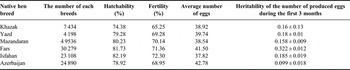
The heritability and average number of eggs produced by Khazak hens during the first 3 months were compared with other native breeds and are shown in Table 1. The average number of eggs produced per year by Khazak native hens is 120; whereas for other native breeds such as Marandi, Zardeh Kerk, Naked neck, it was 80, 65, 35, 130, 102 and 108 (Etemad Zadeh, Reference Etemazd Zadeh1988). The quantity for Rhode Island Red, White Leghorn and Barred Plymouth Rock breeds was equal to 234, 277 and 215 (Kiyani and Sanei, Reference Kiyani and Sanei2001). In general, the Khazak native hen had a higher rate of egg production per year compared with the other native breeds, but it was lower than industrial hens. The rate of egg production can be increased by conducting selected breeding programmes and as the fertility of Khazak is lower than other Iranian native hens there is a need to improve fertility using selected breeding programmes.
The hatchability, fertility rate, average and heritability of the number of produced eggs during the first 3 months in Iranian native hens.

(P < 0.01).
The average fertility for Khazak hens was about 65.25 percent and this is shown in Table 2. Some researchers reported that the average fertility was about 76.24 percent for dominant roosters and Fulani-ecotype chicken (Fayeye, Adeshiyan and Olugbami, Reference Fayeye, Adeshiyan and Olugbami2005), whereas it was about 85 percent for Indian hens (Kamble et al., Reference Kamble, Singh, Jori and Sharma1996). The fertility of hens increased along with an increase in the age of the hen, but fertility decreased when they reach 28 months. Increasing the weight of hens can lead to an increase in the rate of fertility, but this increase has included a fluctuation. The results also show that fertility can also be increased in brooding-hens too, but increasing the level of broodiness in hens more than once will cause a decrease to overall fertility (Hunt, Voisey and Thompson, Reference Hunt, Voisey and Thompson1977). The hatchability of Khazak hens where compared with other native Iranian hens and the results are shown in Table 1. The rate of hatchability in Khazak hens is lower than other breeds, with the average hatchability at about 74.83 percent for Khazak hens, while the rate of hatchability reported for industrial breeds about 86–93 percent and the range for Leghorn and for other breeds such as Cornish near to 93 and 86 percent, respectively (Kiyani and Sanei, Reference Kiyani and Sanei2001). The results of a similar study showed that the hatchability rate for Fulani-ecotype chickens in Nigeria was 48 percent (Fayeye, Adeshiyan and Olugbami, Reference Fayeye, Adeshiyan and Olugbami2005). The level of hatchability in Khazak hens is as low as other native breeds, but this parameter will increase by selecting hens with higher levels of hatchability and by improving the nutrition and management status.
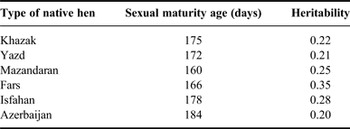
Heritability of sexual maturity age in Iranian native hen.

The results of analysis of variance indicated that the age of hens, broodiness (P < 0.01) and the weight of the hen (P < 0.05) had a significant effect on the hatchability rate. The hatchability increased along with the increase in the age of the hen. The weight of hen also had a distinctive influence on hatchability so that increasing the weight of the hens led to increase in hatchability, while increasing the level of broodiness led to a decrease in hatchability.
Sexual maturity age, broodiness and weight of eggs
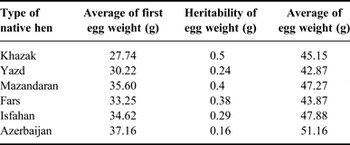
The average age of sexual maturity for native hens in Khorasan, Yazd, Mazandaran, Fars, Isfahan and Azerbaijan basis on reports was about 5.63, 5.76, 5.36, 5.5, 5.96 and 6.616 months, respectively. The average age of sexual maturity of Khazak hens was 5.54 months with the average number of broodiness for Khazak hens at 1.90. The occurrence of broodiness is not an unnatural phenomenon and occurrences of more than one instance of broodiness for some breeds have been reported in other studies. The frequency of broodiness in native hens is more than industrial breeds as industrial breeds have been selected for least amount of broodiness and are reared in artificial environments with controls on the length of daylight. Selection against broodiness is more important in Khazak hens. The average weight of eggs in Khazak hens were 45.15 g, with the weight of an egg less in native hens. For example, during the study on Kedaknat native hens in India, the weight of the eggs was about 42.67 g in the Jobat region, while the weight of eggs in Meganegr was 41.99 and 41 g for the eggs produced from Acil hens (Singh et al., Reference Singh, Cheng and Silversides2009). The mean weight of eggs produced by native hens was reported at about 42.87, 47.27, 43.87, 47.88 and 51.16 g in Yazd, Mazandaran, Fars, Isfahan and West Azerbaijan (Ghazikhani Shad, Nejati Javaremi and Mehrabani Yeganeh, Reference Ghazikhani Shad, Nejati Javaremi and Mehrabani Yeganeh2007). The results of a study on three layers suggested that the weight of the egg was about 66.86, 64.44 and 52.45 for commercial strains with white shell, strains with brown shell and brown native Leghorn (Silversids, Korver and Budgell, Reference Silversids, Korver and Budgell2006) and the weight of eggs for dwarf hens with brown shells about 53.85 g (Zhang et al., Reference Zhang, Ning, Xu, Hou and Yang2005). The egg weight was reported about 33.04 g for cross-breed hens (dominant rooster, Fulani hen) (Fayeye, Adeshiyan and Olugbami, Reference Fayeye, Adeshiyan and Olugbami2005). The average egg weight in Khazak hens was better than other native hens, but the egg weight can be affected by additional factors such as the age of the hen, sexual maturity age, weight of the hen, broodiness and the number of cages. The results of analysis of variance showed that increasing the weight of a hen will cause an increase in the weight of eggs. The age of sexual maturity also had a significant effect on the egg weight (P < 0.01), by increasing the sexual maturity age to a certain level resulted in a decrease in the weight of eggs, but the weight of eggs increased as the hen reached puberty at 6 months. The weight of eggs increased along with the increasing weight of the hen, but a large increase in the weight of the hen led to a decrease in the weight of eggs. The weight of eggs decreased first and then increased along with an increase in the frequency of broodiness. The number of cages also had a significant effect on the weight of eggs due to the slight differences in nutrients in the diets. The Khazak hens had the higher heritability for egg weight compared with other Iranian native hens and the weight of eggs produced by them remained normal (Table 3).
Heritability of weight of egg in Iranian native hen.

Evaluating the genetic and phenotypic parameters
The bivariate models were used for evaluating the genetic and phenotypic parameters. The evaluated heritability for sexual maturity weight was about 0.35 using the animal model. Evaluating of heritability using different models for sexual maturity weight, coordination of body weight in the 12th week was similar to the estimated heritability using sib animal model. The coefficient of heritability for body weight during the 12th week was higher than the maturity weight. These differences can be attributed to maternal genetic and environmental factors or both. The estimated heritability for the number of produced eggs was relatively low and it was calculated at about 0.19 using the animal model. This estimated value was consistent with different studies which showed that values were low with a range between 0.33 and 0.67. The evaluated heritability for this trait was similar to the heritability of eggs produced using the hen–nest method (0.14) which was reported by other researchers using the animal model (Johnson, Reference Johnson1956). The estimated heritability using the sib animal model was more similar to the evaluated quantity, found using an animal model. The effect of maturity age and sexual maturity weight as connected variants on quantity of eggs produced shows that by increasing the sexual maturity age caused a decrease in egg production and increasing the sexual age weight will cause an increase in egg production. The total average for egg production was about 54.29.
Evaluating the correlation between traits
The correlation between traits showed that a change in one trait would have an influence on the results of other traits. The genetic correlation between sexual maturity age and number of eggs produced and between sexual maturity age and the weight of eggs was about −0.95 ± 0.02 and 0.29 ± 0.07, while the averages showed the negative genetic correlation between these traits (in the range between 0.5 and 0.11) (Schwartz et al., Reference Schwartz, Raux, Schacter, Stephenson and Shoffner1980). Genetic correlations between the body weight in the 12th week and the weight of eggs during the 28th and 32nd weeks were positive and the range of these correlations was from medium to small, with the quantities for them about 0.241, 0.229 and 0.289. The greatest genetic correlation has been seen between the body weight in the 12th week and the weight of eggs produced during the 32nd week. Positive and middle genetic correlations between the pre-mature body weight and the weight of eggs produced have been shown by other studies (Siegle, Van Middelkoop and Reddy, Reference Siegle, Van Middelkoop and Reddy1978). The quantity of evaluation of these traits was about 0.26 and is the same as the quantity of evaluation of these traits for native hens in Fars province. The genetic, phenotypic and environmental correlations are negative and high and the quantity of them was about −0.625, 0.555 and 0.543. The genetic correlation between sexual maturity age and the number of eggs produced was negative in most of the studies (Siegle, Van Middelkoop and Reddy, Reference Siegle, Van Middelkoop and Reddy1978). There was a negative and a medium genetic correlation between the number of eggs produced and the weight of eggs from 28th to 30th weeks and 32nd weeks, which was found in the range of −0.20 to 0.44 (Silversids, Korver and Budgell, Reference Silversids, Korver and Budgell2006).
The quantity of some heritability traits such as egg weight, shell weight, shell index, colour of shell, egg width, egg length, the weight of yolk, albumen weight, albumen height, the colour of the yolk, yolk ratio, HU and albumen ratio were estimated at about 0.5, 0.54, 0.30, 0.15, 0.49, 0.36, 0.32, 0.61, 0.42, 0.19, 0.66, 0.46, 0.65, respectively, using bivariate models. The phenotypic and genetic correlations were evaluated among these traits, with the highest phenotypic and genetic correlations seen between the egg width and weight of egg among the external traits which were evaluated at about 0.91 and 0.96. The greatest phenotypic and genetic correlation has been determined between the HU and albumen height, which was calculated at about 0.97 and 0.99.