1 Introduction
Both pitch accents and boundary tones contribute to the tonal structure of the intonation of West Germanic languages. Pitch accents are associated with ‘accented’ syllables: it is the presence of the pitch accent that makes the syllable accented. Boundary tones may appear at the beginning and end of an intonational phrase (IP). In the terminology of earlier descriptions of British English, the final pitch accent in an IP is called a ‘nuclear’ pitch accent and the melody described by it and any final boundary tone a ‘nuclear tune’, henceforth a ‘nuclear intonation contour’. Other pitch accents are ‘prenuclear’. These terms thus refer to positions in the structure, not to specific tone configurations. In (1), an example with two English IPs from Wells (Reference Wells2006: 224) is reproduced, given with the autosegmental notation used in Gussenhoven (Reference Gussenhoven2004: ch. 15). In this notation, one of the tones in a pitch accent typically has the least variable time alignment relative to the accented syllable. It is indicated by an asterisk, as is customary, even when it is the only tone in the pitch accent. A subscripted tone denotes a boundary tone, with the subscript referring to the prosodic constituent (‘i’ for IP).
(1)


Both IPs begin with the IP-initial boundary tone Li. The first has a single accented syllable, with a nuclear pitch accent H* and no closing boundary tone, and the second has two accents, a prenuclear H* and a somewhat raised nuclear H*L, followed by a final Li, which describes the fully low final pitch. Stretches of speech in between pitch accents and boundary tones are filled from the left (stretches of level pitch are described as the two-edge alignment of the tone in Gussenhoven Reference Gussenhoven and Horne2000). A tone with alignment on both the right and left edges is pronounced twice, once to the right and once to the left of the toneless stretch, which itself forms the interpolation between the two targets. Targets of tones are given as black circles. Following van der Ven & Gussenhoven (Reference Ven and Gussenhoven2011), the right-hand target of a tone is represented as a white circle. Alternative choices of pitch accents and boundary tones are available for all the locations in (1). Initially, Hi may appear instead of Li; finally, Li may appear instead of Hi, thus creating a three-way contrast with Ø.Footnote 1
In addition to pitch accents and boundary tones, Central Franconian dialects have lexical tones. These dialects are spoken in an area covering the Dutch and Belgian provinces of Limburg, Luxembourg and parts of North-Rhine Westphalia and Rhineland Palatinate in Germany (Schmidt Reference Schmidt1986, Newton Reference Newton and Russ1990). The dialects spoken in the Netherlands, Belgium and nearby areas of Germany are known as ‘Limburgish’ or ‘Limburgian’. Recent analyses of Franconian assume a privative lexical tone or tone complex for words with ‘Accent 2’ (Gussenhoven & Bruce Reference Bruce, Hermans and Hulst1999, Gussenhoven & van der Vliet 1999, Gussenhoven Reference Gussenhoven and Horne2000, Heijmans Reference Heijmans, Fikkert and Jacobs2003, Gussenhoven & van den Beuken 2012 for East Limburgish dialects; Peters Reference Peters, Riad and Gussenhoven2007a, Reference Peters, Trouvain and Barryb, Reference Peters2008 for West Limburgish dialects; Gussenhoven & Peters Reference Gussenhoven and Peters2004, Peters Reference Peters2006 for the dialect of Cologne). That is, Central Franconian sentences containing only words with Accent 1 have tonal structures that are comparable to (1), with only pitch accents and boundary tones, and it is therefore only when a word with Accent 2 occurs that a third tone type is added to the representation.Footnote 2 In general, it is located in the syllable with main word stress. The dialects vary in two respects. First, while the dialect of Cologne and the East Limburgish dialects use the sonorant mora of the stressed syllable as the tone-bearing unit (TBU), West Limburgish dialects use the syllable itself (Peters Reference Peters2008). Second, where East Limburgish dialects sequence the tone or tones of the pitch accent to the left of the lexical tone, West Limburgish dialects and the dialect of Cologne sequence it to the right. In IP-medial syllables, where no boundary tone occurs, three out of the four possible tonal configurations in the stressed syllable are thus attested in the abovementioned dialects, as illustrated in (2a–c). The pitch accent is indicated by T*(T) and the lexical tone by T. The tonal representations are those for declarative intonation.
(2)
There are two implications of these representational differences. First, in dialects with (2a, b), the tone contrast is absent in words whose stressed syllable contains a single sonorant mora, while in (2c) the contrast is present regardless of syllable structure. Specifically, the restriction of the tone contrast in East Limburgish and the dialect of Cologne can be understood as a consequence of the absence of a designated TBU for the lexical tone, while, conversely, the general occurrence of the tone contrast in all word types can similarly be seen as resulting from the availability of a TBU, a syllable with word stress, in all words. The structure in (2d) represents the fourth possibility for these two variables. This will be argued to be appropriate for the dialect of Maastricht, in the Netherlands.
The second implication concerns the opportunity that the pitch accent has to associate with a TBU. The presence of a lexical tone on a TBU renders it unavailable for association with the tone of a pitch accent, given a maximum of one associated tone per TBU. In East Limburgish, the left-aligned T* will always be able to associate to the first or only mora, regardless of the presence of a lexical tone on any second mora (3a). In Cologne, the left-aligned pitch accent associates its T* to the second mora in syllables with Accent 2, while in syllables with Accent 1, both tones of its bitonal pitch accent will associate, as shown in (3b). In West Limburgish, the pitch accent can only associate in words with Accent 1. The same is true for (3d).
(3)
This article presents the data for tone and intonation in nuclear contours in the dialect of Maastricht, and provides an analysis. §2 shows that the dialect has two pitch accents, L*H and H*L, and that, like English, it has three right-hand boundary conditions for the IP: Li, Hi and Ø. Of the six nuclear contours that result from combining pitch accents and boundary tones, two (L*H Hi and H*L Li) are excluded by the OCP, which the dialect obeys without exception. The four nuclear intonation contours found are thus L*H Li, H*L Hi, L*H Ø and H*L Ø. Semantically, Li signals ‘declarative’, while Hi and Ø indicate either ‘non-finality’ or ‘interrogativity’. The pitch accents indicate ‘focus’, as in English. There appears to be no semantic difference between L*H and H*L, and L*H Ø seems to be exchangeable with H*L Ø without much effect.
This inventory is compromised by two features. One is that the dialect contrasts lexically toneless words (‘Accent 1’) with words that have a H tone associated with the stressed syllable (‘Accent 2’). The other is that maximally two tones are allowed per surface syllable. This constraint, Three.is.a-Crowd (Clements & Keyser Reference Clements and Keyser1983), is given as #TTT in (12) below. The OCP and #TTT dictate that in some contexts fewer than four nuclear contours are found. §3 deals with IP-medial nuclear contours on nuclear syllables with Accent 2, and argues that #TTT tolerates at most one tone of a pitch accent in a syllable with Accent 2, since such syllables already have a tone, H. With three boundary conditions, this means that maximally three nuclear intonation contours are available if the pitch accent lands on a word with Accent 2. §4 focuses on IP-final nuclear syllables and argues that when these have Accent 2, the same three contours are available as in IP-medial position. This is thanks to Realise.orph (Kurisu Reference Kurisu2001), which prevents #TTT from deleting any of the three tones contributed by the lexical tone, the boundary tone and the pitch accent. By the same token, the nuclear contours for final syllables with Accent 1 are reduced to HL and LH, since there are at most two morphemes (a pitch accent and a boundary tone) and thus at most two tones. This means that only two contours are available in this position, H* Li and L* Hi. The analysis suggests that identical phonological tone strings which have identical associations but whose tones come from different morphemes do not contrast. Specifically, no contrast exists between monosyllabic H* Li and H*L Ø or between monosyllabic L* Hi and L*H Ø. Both §3 and §4 end with subsections in which perception data are presented from three experiments that support the analysis (§3.4, §4.3.1 and §4.3.2). These reports can be skipped without impairment to the exposition by readers who are interested only in the details of the analysis. In the final section, the analysis is summarised, and two topics are identified which represent opportunities for further research.
2 Pitch contours in IP-medial nuclear syllables
The full set of four nuclear pitch contours occurs on IP-medial nuclear syllables, as outlined in §2.1. §2.2 briefly evaluates the representations in the light of possible alternatives.Footnote 3
2.1 The ‘rise–fall’ (L*H Li)
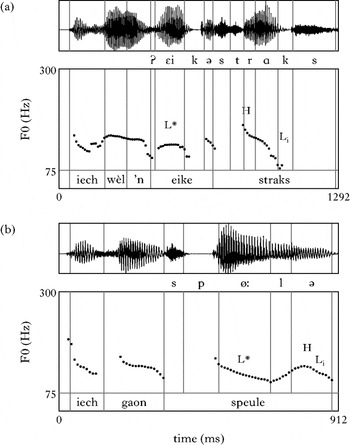
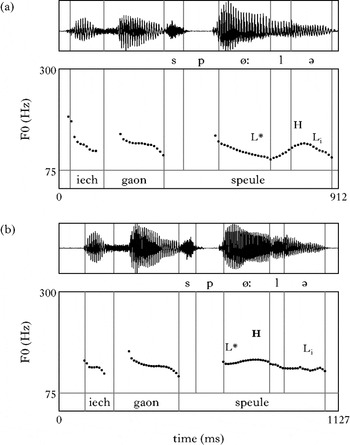
The pitch contour for the ‘rise–fall’ rises from the accented syllable and falls in the final syllable to the IP-boundary. Figure 1 shows the contour, starting from an antepenultimate nuclear syllable in (a). In (b), where it starts from the penultimate syllable, the fall is located in the final schwa. The nuclear syllable here has weakly falling pitch instead of the expected low pitch. I will return to this in §4. The proposed tonal representation is that of a L*H pitch accent followed by declarative Li, as illustrated in (4) for the contour on the penultimate nuclear syllable in (a). (The tone class of relevant syllables is indicated by a superscript after the syllable.)
(4)
The L*H pitch accent (a) on an IP-medial syllable [ɛi] with Accent 1 followed by Li in Iech wèl 'n eike straks ‘I would like a little egg in a minute’ and (b) on a penultimate nuclear syllable [spøː] with Accent 1 in Iech gaon speule ‘I'm going to rinse’. Here, as in all figures giving speech waveforms and pitch tracks, target words and any additional IP-final words are segmented, with phonetic symbols between the panels for the pitch track and the waveform. The annotation tier for the pitch track shows orthographic words, while tone symbols are shown at the approximate locations of their targets in the pitch track.

2.2 The ‘fall’ (H*L Ø)
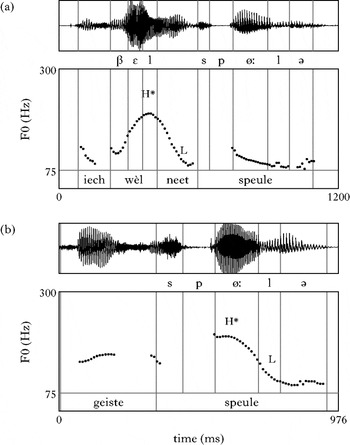
The ‘fall’ is used in questions and in non-final IPs. The example in Fig. 2a has the pitch accent on /ßɛl1/ ‘want-1sg’ in Iech wèl neet speule ‘I don't want to rinse’ in an IP which is followed by the IP meh iech wèl wel aofwasse ‘but I do want to do the dishes’. The representation is given in (5). The contour in (b) is that of an utterance-final question with a penultimate nuclear syllable /spøː1/.
(5)
The H*L pitch accent (a) on an antepenultimate nuclear syllable [ßɛl] with Accent 1 in a non-final IP Iech wèl neet speule (meh iech wèl wel aofwasse) ‘I don't want to rinse (but I do want to do the dishes)’ and (b) on a penultimate nuclear syllable [spøː] with Accent 1 in Geiste speule? ‘Are you going to rinse?’. The raised F0 after [sp] in the contour in (a) is a perturbation due to the voiceless consonants.

2.3 The ‘rise’ (L*H Ø)
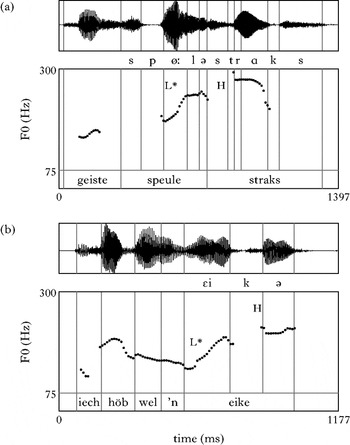
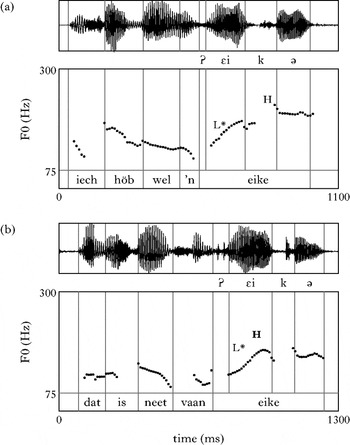
The pitch contours in Fig. 3 are described as L*H Ø. The contour in (a) is a question, with the nuclear syllable /spøː1/ in antepenultimate position, while that in (b) is a non-final IP in which the pitch accent occurs on the penultimate syllable /ɛi1/. Thus, like H*L Ø, the ‘rise’ is used for questions as well as non-final IPs. (6b) shows a prenuclear H*L on /hœp/, realised as a slow fall (cf. e.g. Gussenhoven Reference Gussenhoven2005).
(6)
An observation that will become relevant in §4 is that the pitch of the postnuclear stretch is fractionally higher than that of the end of the nuclear syllable. This is particularly clear in the contour in (a), where /lə/ is some 40 Hz higher than the end of the rise in /spøː1/.
The L*H pitch accent without following boundary tone (a) on an antepenultimate nuclear syllable [spøː] with Accent 1 in Geiste speule straks? ‘Are you going to rinse in a minute?’ and (b) on a penultimate nuclear syllable [ɛi] with Accent 1 in Iech höb wel 'n eike (meh iech höb gein zaajt) ‘I do have a little egg (but I have nosalt)’.

2.4 The ‘fall–rise’ (H*L Hi)
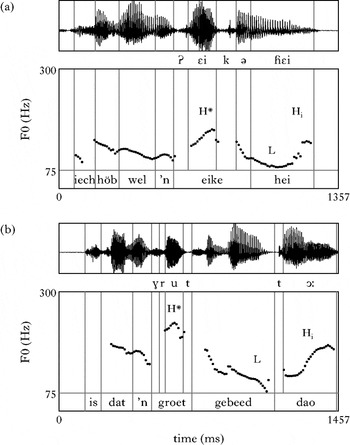
The pitch contour in Fig. 4a occurs in a non-final IP, that in (b) in a final IP. The nuclear syllables are /ɛi1/ of eike ‘little egg’ and /ɣrut/ ‘large’ respectively. In both cases, the F0 peak is in the accented syllable and the rise appears on the last syllable. In (7), the phonological representation of this non-declarative contour is given for the example in (b).
(7)
There are no attestations of the ‘fall–rise’ on penultimate nuclear syllables. I return to this point in §4.
The H*L pitch accent followed by Hi (a) on a antepenultimate syllable [ɛi] with Accent 1 in Iech höb wel 'n eike hei (meh iech höb gein zaajt) ‘I may have a little egg here (but I have no salt)’ and (b) on an early nuclear syllable [ɣrut] in Is dat 'n groet gebeed dao? ‘Is that a large territory there?’.

2.5 The analysis of contours on IP-medial nuclear syllables with Accent 1
There are a number of possible analyses of the above four nuclear contours. The first choice is between a single tone pitch accent T* plus a bitonal boundary tone TiTi on the one hand and a bitonal pitch accent T*T and a single boundary tone Ti on the other. For instance, the ‘rise–fall’ would be L* HiLi in the first analysis and L*H Li in the second. An analysis with a bitonal boundary tone would need to explain why the falling pitch movement occurs close to the nuclear syllable in the contours in Fig. 2 and why the rising movements occur inside the nuclear syllable in the contours in Fig. 3, rather than being interpolated to the edge of the phrase, or executed on the last syllable. The bitonal pitch accent is therefore the more realistic analysis. A second decision concerns the optional status of the boundary tone. With T*T plus an obligatory Ti, two pitch accents, H*L and L*H, could combine with two boundary tones, Hi and Li, to give H*L Li, L*H Hi, L*H Li and H*L Hi. With optionality of the boundary tone, the analysis proposed here, H*L and L*H combine with three boundary conditions, Hi, Li and Ø, and appeal to the OCP reduces the inventory to four nuclear contours, as shown in (8).
(8)
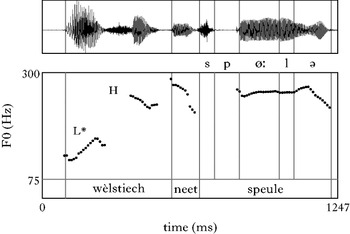
There are three arguments for adopting the OCP (9a). First, the Maastricht dialect has no contours with upstep of Hi after a H tone, as occurs frequently in Dutch and German, where the last syllable after a rising or mid-level tone has raised pitch, as in a ‘low rise’ (L*H Hi) or ‘high rise’ (H* Hi). At first blush, the contour in Fig. 3b may resemble the contours analysed as H* H% by Gussenhoven (Reference Gussenhoven2005) for Dutch and as L+H* H- H% by Grice et al. (Reference Grice, Baumann and Benzmüller2005) for German. However, the pitch in the final syllable is high level, not high rising. As will be explained in §4, the raised pitch on the final syllable in this contour serves as a cue to Accent 1. To illustrate the absence of rising pitch accents followed by mid level pitch with a rise on the last syllable, the typical realisations of the West Germanic ‘high rise’ (H* Hi) and ‘low rise’ (L*H Hi) contours, consider the contour in Fig. 5. The contour was elicited as a ‘surprised question’ for Wèlstiech neet speule? ‘Don't you want to rinse?’ The contour remains level after the accented syllable. The second and third arguments follow from the analysis adopted here. First, as discussed more fully in §4 and §5, undominated OCP, together with #TTT, explains the reduction of the four-way nuclear intonation system to the three-way system that exists for words with Accent 2 and to the two-way system that exists for IP-final syllables with Accent 1. Second, the OCP is required to account for an inserted L-tone in the ‘fall–rise’ on a nuclear syllable with Accent 2, as explained in §5.
The L*H pitch accent without a following boundary tone on an early nuclear syllable [ßɛl] in Wèlstiech neet speule? ‘Don't you want to rinse?’.

The tableau in (10) shows how H*L Li is merged with L*H Li by ranking OCP, Max(T), given in (9b), and Ident(Ti) above Ident(T*T). (A generic Ident(T) is given in (9c).)
(9)
No ranking can as yet be motivated among the first three constraints.
(10)
3 Pitch contours on IP-medial nuclear syllables with Accent 2
§2 dealt with IP-medial contours for Accent 1. This section parallels §2 for Accent 2. Each of the three Accent 2 contours will be discussed in comparison with the corresponding contour with Accent 1. It will be argued on the basis of these data that the lexical tone is H, which is associated to the stressed syllable, as shown in (11b). It contrasts with the toneless Accent 1 in (11a).
(11)
3.1 The ‘fall–rise’ with Accent 2 (L*H Li)
The pitch contour in Fig. 6b is a declarative Accent 2 on a penultimate nuclear syllable. The pitch rises in that syllable, while the IP-final unstressed syllable falls to mid pitch. It resembles the declarative contour with Accent 1 in (a) in its rising–falling shape, suggesting that there may be a LHL tonal sequence in both contours. The Accent 2 contour of (b) differs from that in (a) in having the F0 peak inside the accented syllables rather than after it. The late peak in the Accent 1 contour is explained by the association of L* of the pitch accent L*H to the accented syllable, leaving the trailing H to be realised late. On the assumption that the lexical tone comes associated to the stressed syllable of the Accent 2 word, it must be H. This suggests that an unassociated L* occurs before it and the declarative Li after it. Given that that there is only a single low target before H, there is evidently no bitonal H*L pitch accent before it. This suggests that the constraint #TTT, given in (12), is active in the dialect. Because it allows two tones on a syllable, it is a lenient member of the constraint family banning tonal complexity, like No.ontour (Yip Reference Yip2002: 109, Zhang Reference Zhang2004).
(a) Accent 1 (L*H) on a penultimate nuclear syllable [spøː] before Li in Iech gaon speule ‘I'm going to rinse’; (b) Accent 2 (L*H) on penultimate nuclear syllable [spøː] before Li in Iech gaon speule ‘I'm going to play’.

(12)
The representation of the contour in Fig. 6b is thus as in (13b), which can be compared with (13a), the contour for Accent 1. Crucially in this analysis, the syllable, not the mora, is the TBU. In that way, a difference in association parallel to that given for Stockholm Swedish can be postulated for Maastricht Limburgish. In Stockholm Swedish, the L of H+L is associated with a stressed syllable with Accent 1 and the H with one with Accent 2 (Bruce Reference Bruce1977).
(13)
In agreement with the representation of the declarative contour for Accent 1 and the lexical tone for Accent 2, the declarative contour for Accent 2 must be L*HH Li underlyingly. Its surface form L*HLi is derived by virtue of the OCP and #TTT, as shown in (14). The notation σσ) in the input indicates an IP-medial nuclear syllable; violations refer to the nuclear syllable.Footnote 4 The low ranking of the faithfulness constraints for the pitch accent ensures that the correct representation is selected.
(14)
There is one further observation to be made about the pitch contour in Fig. 6b. The realisation of Li is mid rather than fully low. This systematic feature is taken care of by the phonetic implementation rule of Post-H Narrowing, given in (15), which raises L tones to mid pitch after the last H. As we will see in the next subsection, the rule is more general; dots are included in the context to accommodate an optional Hi.
(15)
3.2 The non-declarative ‘rise’ with Accent 2 (L*H Ø)
A penultimate nuclear syllable with the ‘rise’ nuclear contour for Accent 2 is given Fig. 7b, where it can be compared with its Accent 1 counterpart in (a). The distinguishing cue resides in the pitch after the accented syllable. The F0 of final /-kə/ in the Accent 2 contour in panel (b) remains below that of the end of the rise in the accented syllable. That for Accent 1 rises above it. This feature for the Accent 1 ‘rise’ can also be observed in the postnuclear syllables /strɑks/ and /-kə/ in Figs 3a and 3b respectively. It is also shown in Fig. 5, where the post-focal part /tix neːt1 spøː1lə/ is pronounced at a higher pitch than the end of the rise in /ßɛl1/. This difference matches the difference in representation of the Accent 1 and the Accent 2 contours, shown in (16). Again, the phonetic timing of the peak of the contour is the phonetic cue to the lexical contrast. To the best of my knowledge, this particular cue is reported here for the first time.
(16)
The selection of the correct output candidate for the ‘rise’ proceeds as shown in (18). Leaving the bitonal pitch accent intact (candidates (b) and (c)) will lead to rejections due to #TTT violations, in addition to the rejection by the OCP of candidate (b). A new role is introduced for Dep(T), shown in (17), which prevents the gratuitous insertion of a boundary tone, as in candidate (d).
(17)
(18)
(a) Accent 1 with a L*H pitch accent before Ø on a penultimate nuclear syllable [ɛi] in Iech höb wel 'n eike (meh iech höb gein zaajt) ‘I may have a little egg (but I have no salt)’; (b) Accent 2 (L*H) before Ø on a penultimate nuclear syllable [ɛi] in Dat is neet vaan eike (meh dat is vaan beuke) ‘That isn't oak, but beech’.

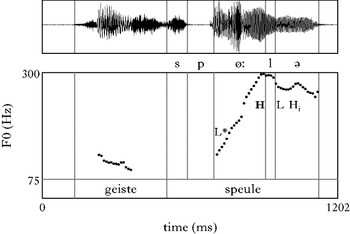
3.3 The non-declarative ‘fall–rise’ with Accent 2 (L*H L Hi)
Figure 8 shows the ‘fall–rise’ starting from a penultimate nuclear syllable with Accent 2. The accented syllable has the usual rising contour, while unaccented [lə] has a high-range falling–rising contour. (The F0 drop at the very end has no appreciable perceptual effect.) This is a crucial pitch contour in the dataset. At first sight, it represents a contour, a rise–fall–rise, which is unavailable in our grammar. If the pitch accent is L*, the lexical tone must be H, and if there is at most one boundary tone, where does the required final LH come from? In fact, given that the boundary tone in the ‘fall–rise’ is Hi, and given that the OCP is high-ranked, the grammar predicts that an L tone is inserted in the winning candidate (a), as in (19).
(19)
In (19), the resistance of the lexical tone to a change in its value, as in candidate (d), is made explicit by high-ranking Ident(T). In order to allow tone insertion, Dep(T) must be ranked below OCP and #TTT. Candidates (b) and (c) violate the OCP, and (c) additionally has three tones in a single syllable, in violation of #TTT. Max(T), like Ident(T*T), must thus be ranked below #TTT. The representation of the contour in Fig. 8 is given in (20).
(20)
The absence of an Accent 1 counterpart of the penultimate nuclear contour in (20) calls for an explanation, since a disyllabic H*L.Hi is a legitimate representation. It readily appears on nuclear syllables that are further away from the end of the IP, as shown in Figs 4a and 4b. There have been a number of reports of avoidance of grammatically legitimate intonation contours in IP-final position. Some of these have been motivated on the basis of the phonetic complexity of the pitch movement: L*HL H% in American English (Leben Reference Leben1976), H*L H% in German (Féry Reference Féry1993: 91, Ladd Reference Ladd2008: 184) and L* H- L% in Romanian (Grice et al. Reference Grice, Ladd and Arvaniti2000). Others have been motivated on the basis of the resemblance between the avoided form and other forms. Endangerment of a phonological contrast was advanced as the reason for the avoidance of the Accent 1 contour H* LιHυ in the dialect of Venlo (Gussenhoven & van der Vliet Reference Gussenhoven and van der Vliet1999).Footnote 5 In this case, the phonetic cue to the lexical tone contrast would be a longer duration for the syllable rhyme with Accent 2, but since the raison d'être of the longer duration could either be a cue to Accent 2 or be due to the complexity of the falling–rising pitch movement per se, one of the two forms is abandoned in favour of the one in which these two interpretations are not contradictory. It is proposed that the absence of the Maastricht disyllabic H*L.Hi has a similar perceptual motivation. The realisation of L in the H*L.Hi contour on a penultimate nuclear syllable is likely to be undershot, due to time pressure. Because such undershooting may resemble the effect of Post-H Narrowing in the Accent 2 form, the main phonetic difference would lie in the timing of the pitch peak in the accented syllable. Such a timing difference is achieved in the ‘rise–fall’ declarative, where it is enhanced by placing the peak of the Accent 1 L*H Li contour robustly in the final syllable (see Fig. 1b). Given the phonological difference between H* of Accent 1 H*L Hi and H of Accent 2 L*H L Hi, a timing difference would presumably have to be achieved by an earlier peak for Accent 1. Since in both cases, the peak would occur inside the accented syllable, the perceptual effect would be low, as suggested by the graphic representations of a hypothetical Accent 1 in (21a) and the attested Accent 2 contour in (21b), where the boxes indicate the nuclear rhymes. Also, any timing difference is likely to be masked perceptually by the falling–rising pitch movement after the peak.
(21)
Accent 2 (L*H) on a non-final nuclear syllable [spøː] before L Hi in Geiste speule? ‘Are you going to play?’.

3.4 Experiment 1: on the three-way contrast for penultimate Accent 2
The three-way contrast for Accent 2 on penultimate nuclear syllables outlined in §§3.1–3.3 may appear subtle. Since the pitch on the nuclear syllables themselves doesn't vary, with L*H appearing in all contours, the final weak syllable is the locus of the contrasts (Figs 6b, 7b and 8). Post-H Narrowing causes the valley of the ‘fall–rise’ to reach mid pitch only; the same implementation rule also causes the ‘rise–fall’ to end in mid pitch. The contours thus resemble each other, and both resemble the level pitch of the ‘rise’, which typically occurs just below the end of the rise in the nuclear syllable. The question to be addressed in this section concerns the extent to which these three contours are perceptually distinct for the native speaker.
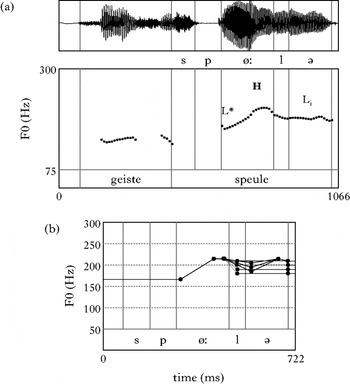
One of the interrogative utterances Geiste speule? ‘Are you going to play?’, as spoken with declarative L*H Li, was selected as the source utterance. The part of the waveform corresponding to Geiste was removed, leaving the speech fragment speule (see Fig. 9a). Using the PSOLA manipulation function in Praat (Boersma & Weenink Reference Boersma and Weenink2010), seven artificial F0 contours were produced for this speech fragment, which together covered the phonetic space within which the three-way contrast is realised (see Fig. 9b). The F0 was varied over the final 240 ms of the utterance, approximately the stretch corresponding to [lə]. The fall from the peak of 215 Hz to the level pitch at 210 Hz occurs 25 ms before the onset of [l]; the three lower levels are 200, 190 and 180 Hz. These level steps will be referred to as L1 to L4. The edges of the three valleys of the falling–rising contours have the same value as the peak (225 Hz), while the values for the bottom of the valley are 205, 195 and 185 Hz. The valley slopes are 100 ms long. These are stimuli V1, V2 and V3.
(a) Source utterance [spøː2lə] excised from Geiste speule? ‘Are you going to play?’ with a L*H Li (‘rise–fall’) intonation on a question; (b) seven stimuli with manipulated F0 (see text).

The seven artificial contours were exhaustively paired with each other, giving 7×7=49 stimulus pairs.Footnote 6 These were randomised and provided with two filler items at the beginning. The 51 stimulus pairs were presented to a group of fifteen native speakers of the dialect, seven men and eight women, whose ages ranged from 29 to 70. All of them were Maastricht Limburgish–Standard Dutch bilinguals. They were seated round two large tables in a conference room, where the stimuli were played to them over loudspeakers. Before the test, the experimenter read out instructions which explained that a given sentence could be spoken in two audibly different ways, yet have the same intonation, but that the same sentence could also be spoken with two different intonations, as happens when a sentence with statement intonation is repeated with question intonation. They were subsequently asked to indicate in each case whether the two contours in each pair had the same intonation or different intonations.
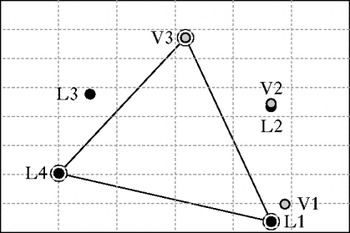
The scores for the 49 experimental pairs were subjected to a Principal Component Analysis, so as to reduce the seven-dimensional space to a two-dimensional one. The two components account for 90% of the variance. Figure 10 shows a plot of the seven contours in the two-dimensional space, with a triangle connecting the most extreme positions. These correspond to the canonical stimuli representing the three phonological contours L*H Li (L4), L*H Ø (L1) and L*H LHi (V3). Strikingly, the four levels L1 to L4 do not lie along a single dimension, despite the constant difference of 10 Hz between them. V1 is attracted to L1, as its dip is not deep enough to make it resemble V3, while stimuli V2 and L2 cluster together, as forms that are intermediate between L*H LHi (V3) and L*H Li (L1). These data suggest that the ‘rise–fall’, the ‘rise’ and ‘fall–rise’ are perceptually equidistant, and that the analysis proposed here is correct.
Two-dimensional solution from a Principal Component Analysis of the difference scores for seven artificial contours differing in the F0 after the peak of 215 Hz occurring 240 ms from the end of [spøː2lə]. L1=210 Hz, L2=200 Hz, L3=190 Hz, L4=180 Hz, V1=valley 205 Hz, V2=valley 195 Hz, V3=valley 185 Hz.

4 Pitch contours on IP-final syllables
Five pitch contours are attested on IP-final syllables, two for Accent 1 and three for Accent 2. This section presents the data and argues that our grammar predicts the facts, if one further constraint is activated. It protects tones which represent the morphological structure of the expression from being deleted on account of #TTT. The constraint Realise.orph (Kurisu Reference Kurisu2001), introduced in §1, is formulated in (22). As will be clear, it is violated whenever a pitch accent, a lexical tone or a boundary tone in the input is not realised in the output by at least one tone. By ranking Realise.orph above #TTT, three tones can be preserved on a syllable, provided they represent different morphemes.
(22)
4.1 IP-final contours with Accent 1
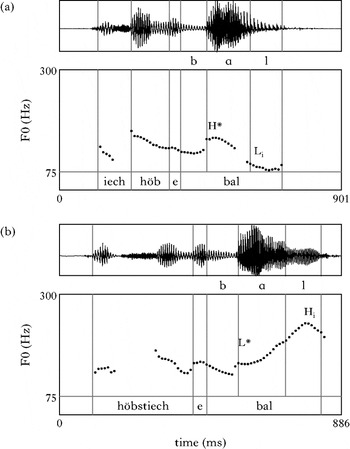
One of the remarkable features of the dialect is that a pitch fall signals a non-declarative on IP-medial nuclear syllables (§2.2), but a declarative when it is IP-final. An IP-final contour is shown in Fig. 11a. For non-declaratives, a single contour is available, the rising contour, as exemplified in (b).
(a) The declarative fall on an IP-final syllable with Accent 1 [bɑl] in Iech höb e bal ‘I have a ball (party)’; (b) the interrogative rise on the otherwise equivalent syllable in Höbstiech e bal? ‘Do you have a ball (party)?’.

On the basis of its phonetic form, the falling contour in (a) could have either of two surface representations: H*L Ø or H*Li. Adoption of the first representation would pose an insurmountable problem, if we adhere to what Ladd (Reference Ladd2008: 41) has referred to as the ‘Linguist's Theory of Intonational Meaning’. Specifically, it cannot be assumed that H*L Ø is an interrogative on IP-medial nuclear syllables but a declarative on IP-final ones, because a morpheme's meaning (though not its interpretation) is in principle independent of context (cf. also Gussenhoven Reference Gussenhoven1984: ch. 6). In contrast, the other option, H* Li, is in line with our grammar, which will convert declarative L*H Li to surface H* Li. The tableau in (23) shows how the deletion of the trailing tone of the underlying L*H pitch accent is due to #TTT.
(23)
By the same token, the representation of the monosyllabic rise could be either L*H Ø or L* Hi. If it is assumed that Hi is a non-declarative morpheme, parallel to declarative Li, either L*H Hi or H*L Hi could be input. In either case, we end up with L* Hi, as shown in (24).
(24)
While in this case there is no semantic argument for rejecting L*H Ø, the parallel with declarative L* Hi argues for L* Hi.
Representations of the contours in Fig. 11 are given in (25). The prenuclear peak on [hœb] is assumed to be due to an H*L pitch accent.
(25)
4.2 IP-final contours with Accent 2
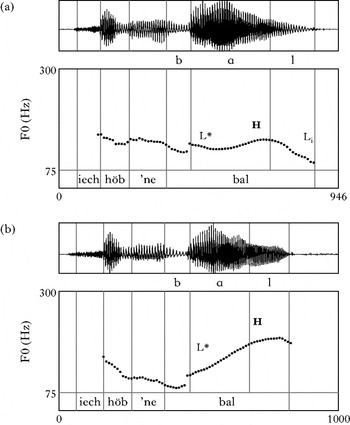
Three pitch contours are found for nuclear contours on IP-final syllables with Accent 2. They are presented in Fig. 12, where the declarative ‘rise–fall’ is shown in (a), the ‘rise’ in (b) and the ‘fall–rise’ in (c). The ‘rise–fall’ appears as a late peak in a lengthened syllable, the ‘rise’ as a straight rise that flattens out somewhat towards the end, and the ‘fall–rise’ appears as a rise followed by a fall to mid.
Accent 2 (L*H) on a IP-final nuclear syllable [bɑl] (a) before Li in Iech höb 'ne bal ‘I have a ball (toy)’ (the ‘rise–fall’), (b) before Ø in Iech höb 'ne bal (meh iech wèl neet speule) ‘I have a ball (toy) (but I don't want to play)’ (the ‘rise’) and (c) before L Hi in Is dat 'ne bal? ‘Is that a ball (toy)?’ (the ‘fall–rise’).

The representations of these three pitch contours are the same as those of the IP-medial ones presented in §4, except that L*H now combines with the three boundary conditions, Li, Hi and Ø, in a single syllable. As before, constraint #TTT is responsible for reducing the bitonal pitch accents to a single tone, L*, always in combination with H. However, if this constraint were left to do its work in IP-final nuclear syllables, it would reduce the number of tones to two, with the specifics of these bitonal representations depending on the ranking of the Max constraints for T*, H and Ti. As it is, Realise.orph prevents this from happening, as shown in (26) for the declarative. While the bitonal candidate (b) satisfies #TTT, it fatally leaves out the declarative boundary tone, thereby violating Realise.orph. Changing the boundary tone to Hi serves no useful purpose. And even if candidate (d), H*L Hi, avoids a violation of Realise.orph, it loses to the winning candidate, L*H Li, because of the violations of the identity constraints for the lexical tone and the boundary tone.
(26)
Monosyllabic L*H Ø is unproblematic, as any tritonal representation will founder on #TTT, as shown in (27).
(27)
The IP-final realisation of the ‘fall–rise’ is a rise followed by a fall to mid. Our grammar suggests that the winning representation is L*H LHi, as illustrated in (28). The derivation of the contour differs from the IP-medial case in that there is one more violation of #TTT by the winning candidate, which, given the higher ranking of Realise.orph, is irrelevant. This case illustrates the categorical ranking of OT constraints. That is, forms may acquire tones if higher-ranking constraints are to be satisfied, quite against the functional nature of #TTT.
(28)
The representations of the three contours in Fig. 12 are given in (29). Their phonetic realisation is characterised by increased lengthening relative to the Accent 1 contours (Gussenhoven & Aarts Reference Gussenhoven and Aarts1999). This feature is the sole distinguishing cue in the case of the ‘rise’, and will carry some of the distinguishing burden in the case of the ‘rise–fall’, alongside the difference in peak alignment within the syllable, which is earlier for Accent 1. The most striking case is the ‘fall–rise’, which lacks a phonetically short version with Accent 1, but forms a remarkable contrast with the ‘rise–fall’. In (29a), in which a prenuclear H*L is assumed on [hœb], a similar late peak occurs on the last syllable, but it is executed in a lower pitch range than the peak in (29c). The ‘rise’ in (29b) has a similar rising part, but lacks a perceivable downward curve at the end. The realisation of LHi is taken to be a single mid target.
(29)
4.3 Evidence from perception data
The five monosyllabic contours of the Maastricht dialect raise a number of questions. The first concerns the two contours for Accent 1. On the basis of its ‘declarative’ meaning, the falling pitch contour was argued in §3.2 to be the surface form H* Li, from underlying L*H Li, rather than the realisation of H*L Ø. Yet it is conceivable that a monosyllabic representation H*L Ø might exist alongside H* Li. This would mean that there are two phonologically distinct monosyllabic falls, one with a declarative meaning and the other with an interrogative meaning. Arguably, the interrogative fall might be later or higher than the declarative, features that are typical of question intonation (e.g. Gussenhoven Reference Gussenhoven2004: 91).
A second question concerns the surface contrast between the declarative contour for Accent 2, the ‘rise–fall’ (Fig. 12a), and the interrogative ‘fall–rise’ for Accent 2 (Fig. 12c). The general shapes of the two pitch peaks are similar, but they differ in peak height. Intonational peak height contrasts have been reported for European intonation systems as downstepped vs. non-downstepped realisations of H* (e.g. Pierrehumbert Reference Pierrehumbert1980 for English, van den Berg et al. Reference Berg, Gussenhoven, Rietveld, Docherty and Ladd1992 for Dutch, Post Reference Post2000 for French and Grabe Reference Grabe1998 and Grice et al. Reference Grice, Baumann and Jagdfeld2009 for German). In all these cases, an H* is downstepped relative to a preceding non-downstepped H target. However, the lowered peak of the Maastricht ‘rise–fall’ is preceded by Li alone, and the height difference is therefore is a contextless and unique phonetic cue to the intonational contrast. The question here is whether the Maastricht case is really contrastive. Experiment 2 addresses these two issues.
4.3.1 Experiment 2: IP-final (rise-)falls as declaratives and interrogatives
If – unlike what the analysis here has assumed – there are two phonological falls for IP-final Accent 1, a declarative H* Li and an interrogative H*L Ø, we would expect one end of a continuum of falling contours to be interpreted as a clear statement and the other as a clear question. An additional prediction is that the same F0 peak may be judged as more prominent if it is interpreted as a statement, on the assumption that listeners expect questions to have higher or later peaks if they are equally prominent as statements. The phonetic continuum should yield either a flat perceived prominence function, or else one that rises but has a dip somewhere halfway, depending on where and how the perceptual switch between a statement and a question is represented in the phonetic continuum. By contrast, if the continuum represents a single phonological contour, later peaks and the higher peaks will be assigned higher scores in a prominence judgement task (e.g. Rietveld & Gussenhoven Reference Rietveld and Gussenhoven1985, Ladd & Morton Reference Ladd and Morton1996). The prominence judgements by Dutch listeners, who have a single representation of an IP-final early peak ('t Hart et al. Reference Hart, Collier and Cohen1990, Gussenhoven Reference Gussenhoven2005), should show a steadily rising perceived prominence function. If our one-contour analysis is correct, the same will be true for the Maastricht listeners.
Turning to the two phonetic rising–falling contours for Accent 2, the analysis assumes that the lower-peaked rising–falling contour differs categorically from the higher-peaked rising–falling contour. We therefore expect a phonetic continuum between them to be firmly interpreted as a statement at the low end, and as a question at the high end. We also expect the prominence function to be flatter that than for the Accent 1 continuum. And thirdly, we expect Dutch listeners, who have a single representation of an IP-final late peak ('t Hart et al. Reference Hart, Collier and Cohen1990, 9 Reference Gussenhoven2005), to differ from Maastricht listeners in their assignment of question judgements and prominence.
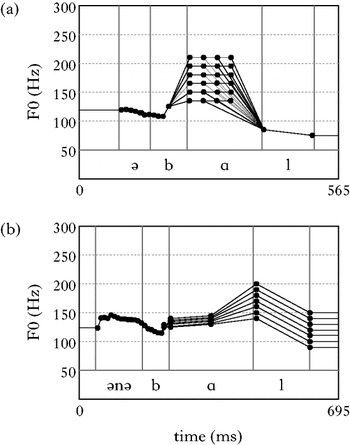
Materials. With the help of the PSOLA manipulation function in Praat, eighteen artificial F0 falls were created on two Accent 1 source utterances of e bal [ə bɑl1] ‘a ball (dance)’ that were spliced off from the declarative and interrogative utterances shown in Fig. 11. The alignment of the beginning of the fall varied in three 30 ms steps from 30 ms to 90 ms after the beginning of the vowel. The height of the peak varied in six 15 Hz steps from 135 to 210 Hz, as shown in Fig. 13a. The beginning and end of each continuum were modelled on the values of the declarative and interrogative source utterances. There were thus 3×6×2 (source utterances), i.e. 36 stimuli, for Accent 1. Similarly, two Accent 2 source utterances of 'ne bal [ənə bɑl2] ‘a ball (toy)’ were obtained by splicing these speech portions off from the utterances shown in Figs 12a and 12c. As shown in Fig. 13b, seven stimuli were produced from each of these with peaks and final low targets that were 10 Hz apart, starting at 140 Hz and 90 Hz respectively. The starting points of the rising movements were 5 Hz apart, the lowest value being 135 Hz. This yielded a further 14 stimuli, making up a total of 50.
Artificial F0 contours superimposed on (a) declarative and interrogative source utterances of e bal [ə bɑl1] ‘a ball (party)’ and (b) declarative and interrogative source utterances of 'ne bal [ənə bɑl2] ‘a ball (toy)’.

Procedure. The 50 stimuli were randomised, together with eight Accent 2 stimuli used for a different experiment (see §4.3.2), with two fillers at the beginning and two at the end. They were presented twice, in opposite orders, to the fifteen judges who also took part in Experiment 1, under the same test conditions. Stimuli were preceded by a warning signal, repeated once after a 800 ms interval and followed by a five-second pause during which subjects could record their judgements on a printed score sheet. Each stimulus presentation corresponded to a picture on their score sheet of either a football or of a dancing couple, in order to leave no doubt about the identity of the word that was presented. Instructions were given in standard Dutch. Subjects were asked to tick one of two boxes, one marked vraag (‘question’) and the other marked mededeling (‘statement’). For each trial, subjects were also asked to tick one of five boxes on a scale marked nadruk (‘emphasis’), which ran from a small amount of emphasis on the left to a large amount on the right. They were told that it might on occasion be difficult to judge whether the words they were going to hear were questions or statements, and that there was no implication that the number of questions was equal to the number of statements. Five non-dialectal speakers of standard Dutch served as the control group. They were tested individually on the basis of a single presentation of one of the two test versions, and heard the test via headphones. In the instructions, they were asked to judge the stimuli as if they were Dutch; they were told that the number of questions and the number of statements were unlikely to be equal. Their score sheets did not include the word-identifying pictures, but were otherwise identical to those of the Maastricht listeners.
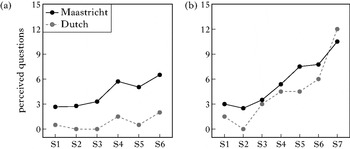
Results. An analysis of variance was performed on the Maastricht question scores of the Accent 1 stimuli with Source (two levels), Alignment (three levels) and F0-Step (henceforth Step; six levels) as factors. Main effects were found for Source (F(1, 15)=8·498, p=0·01) and Step (F(3·135, 15)=8·632, p<0·001). There was a significant interaction between Source and Step, which appeared to be due to an unexpectedly high score for the Step 4 stimulus produced from the interrogative source utterance. A post hoc auditory inspection revealed that during the creaky part of the vowel a falsetto-like pitch was to be heard, due to an interaction between the PSOLA resynthesis and the original signal. The effect of step size is given in Fig. 14a, where the y-axis gives the mean number of question scores, pooled over the three alignment steps and the orders of presentation, with the theoretical maximum being given by the number of subjects, 15. The results for the Dutch listeners on the same stimuli are also given in (a). The relatively high score for Step 4 from the interrogative source utterance is also detectable in this graph. The significant effect of Source is due to the slightly higher scores from the interrogative source utterance: 3·33 against 3·27 for the declarative source utterance. An analysis of variance (repeated measures) was also performed on the question scores for the Accent 2 stimuli, with Source (two levels) and Step (seven levels) as factors. A main effect was found for Step only (F(3·445, 15)=11,849, p<0·001). The pooled results, with the Dutch scores, are shown in Fig. 14b.
Question judgements by 15 Maastricht listeners and five Dutch listeners for the height continuum shown in Fig. 13 for (a) declarative and interrogative source utterances of e bal [ə bɑl1] ‘a ball (party)’ and (b) declarative and interrogative source utterances of 'ne bal [ənə bɑl2] ‘a ball (toy)’. The y-axis gives the mean number of stimuli perceived as questions.

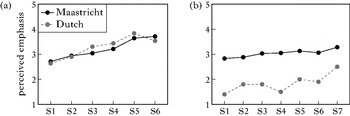
The emphasis scores for the Maastricht judges for the stimuli with Accent 1 were likewise subjected to an analysis of variance with Source (two levels), Alignment (three levels) and Step (six levels) as factors. Both Alignment and Step (F(1·906, 15)=17·030, p<0·001) gave significant effects. The Step effect is shown in Fig. 15a, together with the results for the Dutch listeners on the same stimuli. The effect size of Alignment was very small. An analysis of variance on the prominence scores for Accent 2 just failed to reach a significant level for Step, after a Huyhn-Feldt correction because of non-sphericity (F(3·128, 15)=2·369, p=0·07). They are shown, with the Dutch scores, in Fig. 15b.
Emphasis judgements by 15 Maastricht listeners and five Dutch listeners for the height continuum shown in Fig. 13 for (a) declarative and interrogative source utterances of e bal [ə bɑl1] ‘a ball (party)’ and (b) declarative and interrogative source utterances of 'ne bal [ənə bɑl2] ‘a ball (toy)’. The y-axis gives the emphasis scores.

Discussion. The results for the Accent 1 continuum do not suggest that IP-final monosyllabic falls represent two phonologically different contours. First, the alignment of the fall did not move responses in the direction of interrogativity, even though the phonetic manipulation was perceived by subjects, as shown by the significant prominence scores. A 35 ms difference in the alignment of a fall was shown to give a 50% switch from statement to question in Neapolitan Italian (D'Imperio & House Reference D'Imperio and House1997, D'Imperio Reference D'Imperio2000), with a 70 ms difference leading to a virtually complete switch. Our maximum alignment interval was 60 ms, which was completely inert.Footnote 7 Second, the peak continuum of 75 Hz had a small effect when compared with that obtained for the continuum with Accent 2 stimuli, which covered a pitch range of only 60 Hz (see Fig. 13). Third, the perceived prominence on the Accent 1 stimuli linearly increased with peak height and moreover was no different from that of the Dutch listeners, as shown in Fig. 15a. As already noted, a flat function might have been expected if the Maastricht listeners had interpreted peak height primarily as marking interrogativity and only secondarily as signalling prominence. The only aspect of the results that might indicate that Maastricht listeners perceived falls differently from the Dutch listeners lies in the fact that their question scores were some 20% higher overall than the scores given by the Dutch listeners. The dashed line in Fig. 14a gives the mean number of pooled question scores by the Dutch subjects, multiplied by three (since the number of subjects was five). The overall greater preparedness on the part of the Maastricht listeners to perceive interrogativity may have a number of causes. For the Dutch listeners, all stimuli in this experiment sounded like different pronunciations of Dutch bal ‘ball (toy)’ or ‘ball (party)’. The Accent 1 contours sound like standard declarative contours, whereas the Accent 2 stimuli sound like marked versions of declarative falls, suggesting perhaps a non-assertive request. As a result, they will have tended to restrict their interrogativity scores to the stimuli from the Accent 2 source utterances. What is important here is that the general profile of the Accent 1 scores is similar in the two groups.
By contrast, the results for the Accent 2 continuum suggest that there are two phonological contours that are realised with rising–falling pitch. The continuum is biased towards the declarative contour, and higher scores would no doubt have been obtained with stimuli containing higher peaks. Among the question contours in the corpus, considerably higher peak values occur. The contrast with the responses to the continuum for Accent 1 is all the more striking. While the lowest stimuli in the two continua attract a score of 3, the highest for Accent 1 has a score of 6·5, against 12 for Accent 2, despite the lower peak. In addition, the fact that there is no effect on perceived prominence suggests that the continuum does not represent a single phonological category. As noted, if questions and statements are in principle equally prominent, the raised peaks in the Accent 2 continuum should be primarily interpreted as signalling interrogativity, not prominence. The perception of prominence in linguistic stimuli is generally dependent on the phonological structure (Hume & Johnson Reference Hume, Johnson, Hume and Johnson2001, Shinya Reference Shinya2009). This is seen in the Maastricht data by the comparable prominence scores for Accents 1 and 2 (compare the solid lines in Figs 15a and b), despite the lower peaks in the Accent 2 continuum. That is, the low-peak realisation of the IP-final Accent 2 declarative is a canonical part of the language. By comparison, scores for the five Dutch subjects are consistently lower, by more than one scale point (see Fig. 15b), which more directly reflects phonetic peak height.
4.3.2 Experiment 3: on the phonetic implementation of IP-final L*H LHi
The third and final issue concerns the realisation of LHi of the Accent-2 ‘fall–rise’ as mid pitch rather than as rising pitch. Does the phonetic implementation create a single mid target for these two tones, similar to the mid pronunciation of H-L% in Pierrehumbert's (Reference Pierrehumbert1980) analysis of English, or does it create two, one lower and one higher, such that the higher target, and thus the final rise, is truncated, similar to the non-realisation of final Li in the Hungarian interrogative L* HiLi on IP-final syllables (Ladd Reference Ladd2008: 182)? The prediction made by the assumption of a truncated pronunciation is arguably that less truncated versions might appear alongside more truncated ones as a function of speech style. By contrast, an implementation as a mid target might not be variable in that sense. The experiment reported below addresses this question.
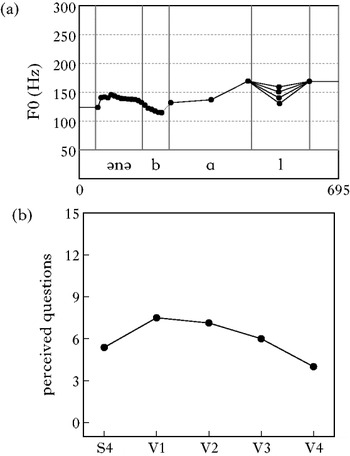
Four artificial pitch contours were created which were identical to step 4 of the continuum shown in Fig. 14b without the final fall, which was replaced by a fall–rise movement that started from the peak of 170 Hz and went down in four 10 Hz steps to a valley, creating a continuum from 160 (V1) to 130 Hz (V4) (see Fig. 16a). These artificial contours were superimposed on the declarative as well as on the interrogative source utterances of 'ne bal [ənə bɑl2] ‘a ball (toy)’, to give eight stimuli. The same 15 judges who took part in Experiments 1 and 2 were asked to identify these stimuli as either a question or a statement. They were interspersed between the stimuli of Experiment 2.
(a) Four stimuli (V1 to V4) with manipulated F0 for the valley during [l] on the declarative and interrogative source utterances of 'ne bal [ənə bɑl2] ‘a ball (toy)’; (b) question judgements by 15 Maastricht listeners for these stimuli and the midway stimulus S4 of the continuum shown in Fig. 13b.

The interrogativity scores were subjected to an analysis of variance with Source and Step as factors. Step was significant (F(2·227, 15)=4·061, p<0·05), the effect being due to decreasing perceived interrogativity as the valley of the fall–rise was deeper. This is shown in Fig. 16b.
Stimulus V1, with its near-level ending, has higher perceived interrogativity than stimulus S4, with its final fall, and must have been interpreted as an instance of L*H Ø (see Fig. 16b). As the mini-valley during [l] is deeper, however, the interpretation as a question is impaired, so much so that V4 has less perceived interrogativity than S4. The fact that a deeper valley does not lead to more interrogativity judgements is a clear indication that the contour L*H LHi is pronounced as a raised-peak rising–falling contour in IP-final monosyllables, without an additional final rise, and that LHi has a single mid target.
5 Summary and remaining issues
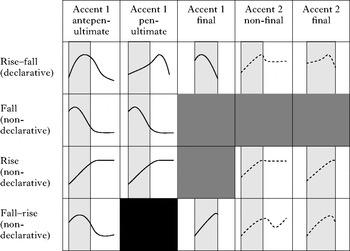
Underlyingly, the dialect of Maastricht has four nuclear contours. However, there are systematic gaps, depending on the lexical tone class of the nuclear word and on the proximity of the nuclear syllable to the IP-end. The first three columns of Fig. 17 give the pitch contours for IP-antepenultimate, IP-penultimate and IP-final nuclear syllables with Accent 1, while the last two columns give the pitch contours for IP-non-final and IP-final nuclear syllables with Accent 2. The shaded areas give an impression of the duration of the nuclear syllable. The grey cells indicate gaps that are explained by the tonal grammar proposed here. The black cell indicates the absence of a contour whose presence is predicted by the grammar, but which has not been attested and which could not be elicited.
Stylised declarative and non-declarative intonation contours on IP-antepenultimate, penultimate and final nuclear syllables for Accent 1 (solid contour shapes) and on IP-non-final and IP-final nuclear syllables with Accent 2 (interrupted contour shapes). The light grey areas represent the nuclear syllables.

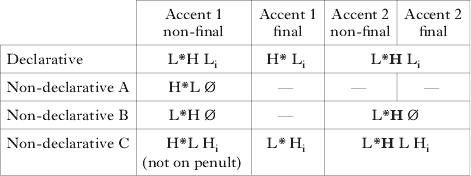
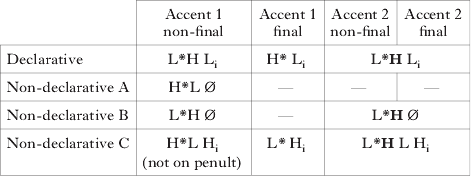
The core of the grammar is formed by OCP, Realise.orph≫#TTT. It prevents more than two tones from appearing in a syllable, unless there are three tones that represent different morphemes. The three morphemes are the focus-marking pitch accent, a privative lexical H that marks Accent 2 words and an optional boundary tone which signals discourse meaning. Faithfulness to tones is strictly adhered to for the lexical tone and the boundary tones, but not for the focus-marking pitch accent. Given bitonal pitch accents, the grammar explains (a) that there are four nuclear contours, L*H Li, H*L Ø, L*H Ø and H*L Hi, (b) that a nuclear syllable with the lexical tone always has L*H, there being no other legitimate representation that respects the identity of H, and (c) there are only three nuclear contours starting on nuclear syllables with H, L*H Li, L*H Ø and L*H L Hi, where the third contour arises from an OCP-enforced repair of the minimal representation satisfying Realise.orph.Footnote 8 Similarly, the two gaps for the IP-final Accent 1 syllables follow from this grammar, which predicts that at most two tones can appear on a syllable without the lexical tone, HL and LH. Each of these bitonal sequences has two potential morphemic sources. They could represent the bitonal pitch accents without a final boundary tone, i.e. H*L Ø and L*H Ø, or a single tone in a pitch accent followed by a boundary tone, i.e. H* Li and L* Hi. It was argued on semantic grounds that the second option is correct, a conclusion that was supported by the results of a perception experiment with native speakers. The existence of the three contours with Accent 2 was also confirmed for penultimate nuclear syllables, from perception scores obtained from native speakers. Table I gives all the representations. It is not unusual for the number of possible word-based tonal configurations to vary with the number of tone-bearing units that the word makes available (e.g. Uwano Reference Uwano and Kaji1999, Ding Reference Ding2001). The closest intonational case of an asymmetry that I am aware of is the neutralisation of narrow-focus and broad-focus interrogatives in Bengali, which arises from an OCP-induced deletion of a H tone (Hayes & Lahiri Reference Hayes and Lahiri1991).
Representations of the contours for Accent 1 and Accent 2 in final and non-final nuclear syllables. It follows the structure of Fig. 17, except that the two IP-medial columns for Accent 1 have been collapsed.
5.1 Two issues for further research
This article has focused on the tonal structure of the nuclear contours that contrast for lexical tone. It does not, however, exhaustively describe the melodic structures of the dialect. There are two issues that have not been dealt with. These are, first, the lexical tone contrast in post-focal positions, and second, the shapes of the intonation contours on nuclear syllables in which there is no lexical tone contrast. These issues are briefly outlined here.
5.1.1 The tone contrast in post-focal position
The assumption that the OCP is observed in nuclear contours and the lexical tone is H predicts that post-focal (unaccented) stressed syllables with Accent 1 do not affect the pitch contour, since they contribute no tone to the representation, while Accent 2 syllables are predicted to show a peak, due to the lexical H which such syllables have in their lexical representation. The contours in Fig. 18 suggest that these predictions are correct. In (a), the final syllable [bɛi1] ‘bee’ is realised at the low end of the falling part of a declarative ‘rise–fall’. By contrast, [bɛi2] ‘at, near’ has a rising–falling pitch contour in an otherwise identical intonational structure. This post-focal peak, which equally appears on IP-medial post-focal syllables with Accent 2, is due to an inserted L-tone between the H of Accent 2 on [stɛit2] and the H of the last syllable, which in turn is followed by Li. A full demonstration of this point and the way in which a focal syllable is distinguished from a post-focal one like [bɛi2] in (30b) must await more systematic data.
(30)
(a) An early L*H pitch accent followed by Li on an IP-final syllable [bɛi] with Accent 1 in Zie is bang veur die bij ‘She is afraid of that bee’; (b) an early L*H contour followed by L, H and Li on an IP-final syllable [bɛi] in Dat steit miech neet bij ‘That doesn't ring a bell’.

5.1.2 Segmentally defined neutralisations of the lexical tone contrast
Rhymes containing a high short or long monophthong (/i y u iː yː uː/) or a mid-open long monophthong (/ɛː œː oː/), and those with a semivowel (/ß j/) in the coda, do not have the tone contrast. Neither do rhymes containing a short (lax) vowel followed by an obstruent. The reasons for these segmentally motivated gaps all concern the maintenance of contrast, but the details vary (Gussenhoven & Aarts Reference Gussenhoven and Aarts1999). First, the quantity contrast for high vowels is maintained at the expense of the tone contrast. The quantity contrast for high vowels apparently excludes a tone contrast that would rely on a durational enhancement of Accent 2 (Gussenhoven Reference Gussenhoven, Botma and Noske2012). Second, the reason for the absence of the tone contrast on mid-open vowels and in rhymes closed by glides lies in an enhancement strategy whereby the mid vowels /eː øː oː/ and the diphthongs /ɛi œy ∅u/ have diphthongal pronunciations ending in a high [j Lɥ w] positions, while their pronunciations with Accent 2 are purely monophthongal [eː øː oː] and gradiently monophthongised [ɛːe œːʸ ∅ːo] respectively. Clearly, adding the tone contrast to rhymes ending in /ß j/ or to the open-mid monophthongs would interfere with this strategy.
The third restriction, the absence of the tone contrast on syllables with one sonorant mora, is a common feature of Franconian dialects. By itself, this fact might be an argument for a moraic association of the tones of Maastricht Limburgish. However, the configuration in which the contrast is absent differs from the East Limburgish and Cologne cases in that Maastricht only disallows it in monosyllables rhymes with a short vowel closed by a (surface voiceless) obstruent, like [bYs] ‘bus’. Specifically, like the dialects spoken in Belgium (Peters Reference Peters, Riad and Gussenhoven2007a, Reference Peters2008), it allows it in V.N sequences, where N is a nasal or liquid opening the next syllable, as in /ˈhY2mə/ ‘singlet’ (Gussenhoven & Aarts Reference Gussenhoven and Aarts1999). Older sources mention other Accent 2 words with this structure (Houben Reference Houben1905, Brounts et al. Reference Brounts, Chambille, Kurris, Minis, Paulissen and Simais2004). Thus, unlike the case in the more northerly dialects, Accent 2 is grammatical in syllables with a short vowel in which the postvocalic sonorant consonant forms the onset of the next syllable.Footnote 9 While the absence of the tone contrast on syllables like [bYs] is evidently due to lack of phonetic space, in the Maastricht case the restriction is not directly explained by the moraic representation. Further research is needed to allow a systematic treatment of the intonation contours used in nuclear syllables with vowels in which the tone contrast is absent.