Since its initial description, the extracardiac conduit has been extensively used for completion of the Fontan operation in children with univentricular hearts.Reference Marcelletti, Corno, Giannico and Marino 1 It has the advantage of avoiding surgical suture lines in the atrium and therefore potentially reducing future arrhythmia risk, of optimised fluid dynamics, and the operation is technically easy to perform.Reference Lardo, Webber, Friehs, del Nido and Cape 2 – Reference Kim, Kim, Lim and Lee 4 Follow-up studies have demonstrated a mild reduction in the internal diameter of the conduit within the first few months after surgery, with no significant late stenosis at up to 15 years after Fontan completion.Reference Giannico, Hammad and Amodeo 5 , Reference Lee, Lee and Hwang 6 We describe the cases of three young patients with evidence of acute or chronic conduit obstruction, which was successfully relieved by percutaneous stent implantation.
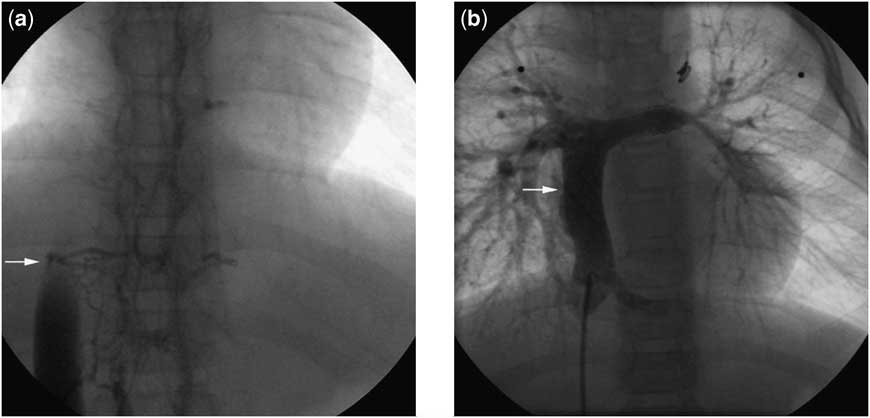
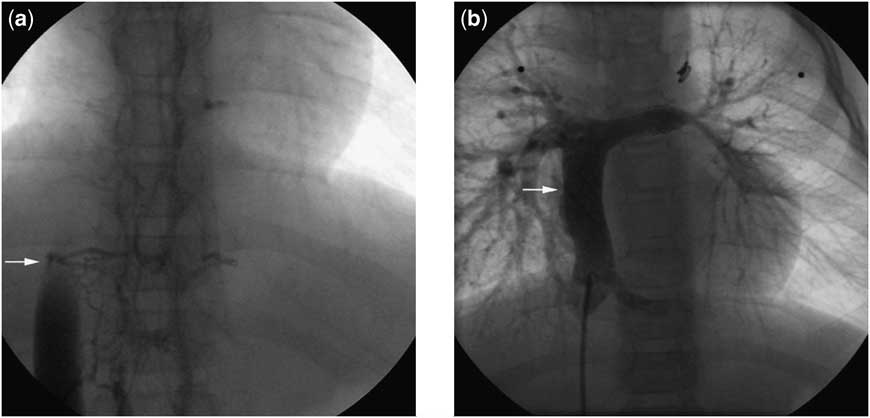
Patient 1 was a 5-year-old girl who presented with acute abdominal pain 3 months after Fontan completion for tricuspid atresia, using a 16-mm diameter Gore-Tex conduit (Distributor W.L. Gore & Associates BV, Tilburg, The Netherlands). Angiography demonstrated thrombotic occlusion of the conduit (Fig 1). The occluded segment could be crossed with a 0.035-inch guidewire and catheter combination via a femoral venous access. Recanalisation of the conduit was successfully achieved by implantation of a Palmaz stent (Cordis Corporation, Miami Lakes, Florida, United States of America), which was dilated up to 15 mm.Reference Kammeraad and Sreeram 7 Following subsequent thrombolytic therapy, the patient recovered uneventfully. There was no evidence for a coagulopathy. Over a follow-up of over 5 years, she has had no further complaints.
( a ) Hand injection of contrast in the femoral vein shows complete occlusion of the extracardiac conduit (arrow, reprinted with permission). ( b ) Contrast injection following stent implantation (arrow), confirming free flow through the conduit (reprinted with permission).
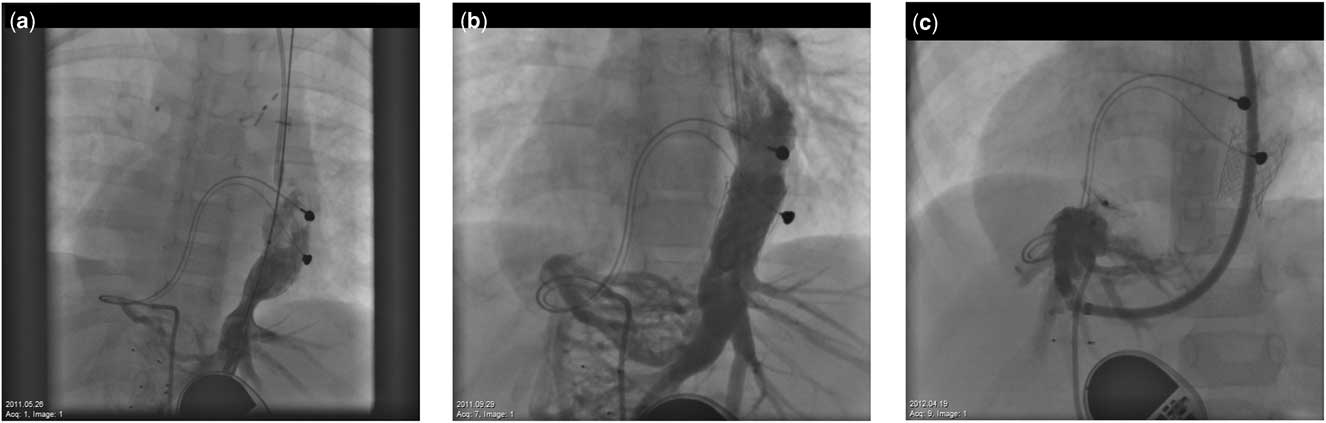
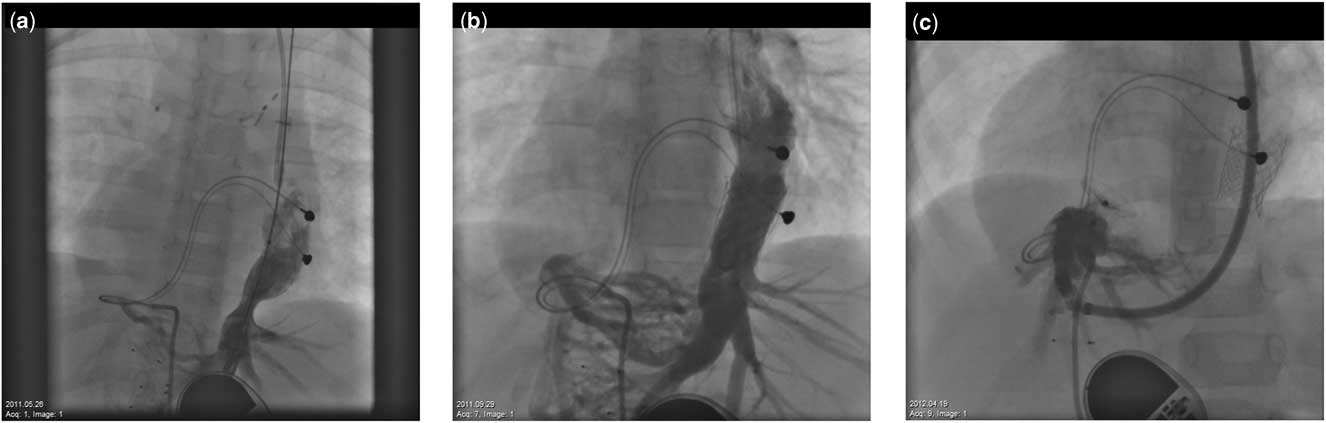
Patient 2 was a 3-year-old girl who developed progressively worsening cyanosis within 3 months after Fontan completion, using an 18-mm conduit, for visceral heterotaxy syndrome and complex univentricular heart. She had had epicardial pacemaker implantation during Fontan completion, for treatment of sinus node disease. Angiography via the femoral and jugular veins demonstrated a localised stenosis at the junction between the conduit and inferior caval vein. This was successfully treated with implantation of a Palmaz stent, which was dilated to 18-mm in diameter using a high-pressure balloon (Atlas, Bard Peripheral Vascular Incorporation, United States of America) dilated up to 15 atmospheres (Fig 2). Multiple collateral vessels to the pulmonary venous atrium were also occluded successfully, resulting in an improvement in the transcutaneous oxygen saturation from 78% to 94% at discharge from hospital (Fig 2).
( a ) Contrast injection in the extracardiac conduit confirming a stenosis at the junction with the inferior caval vein in patient 2. ( b ). The result after stent implantation in patient 2. ( c ) The extensive collateral network to the pulmonary venous atrium in patient 2 has been occluded with a 10 mm Amplatzer muscular ventricular septal defect occluder.
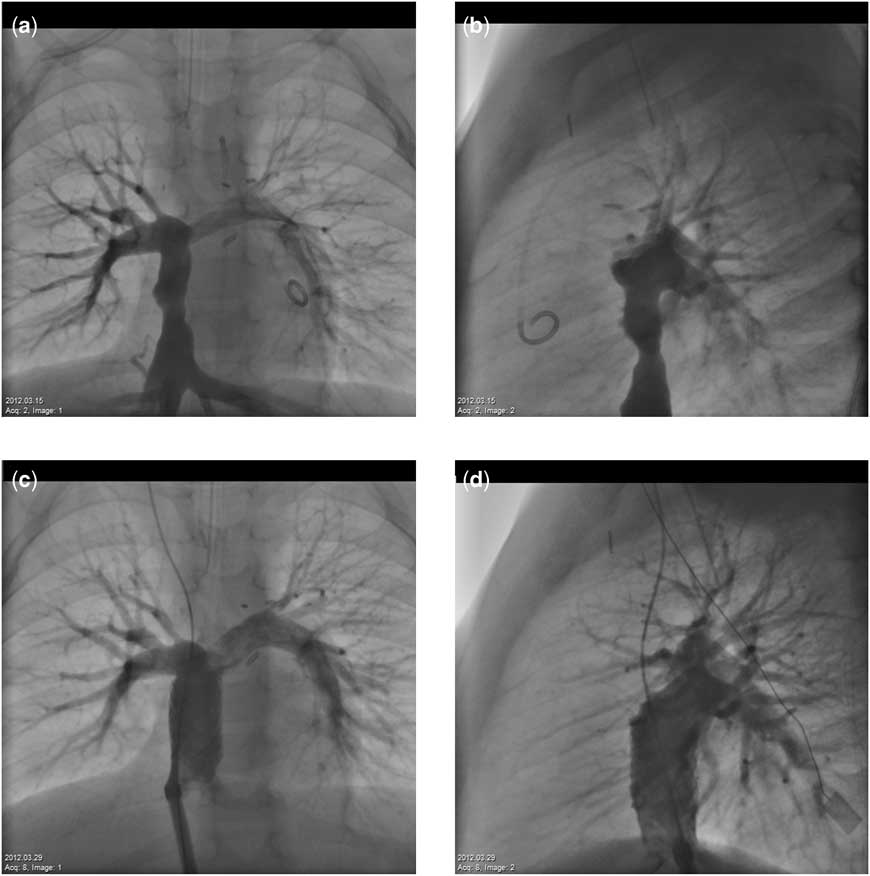
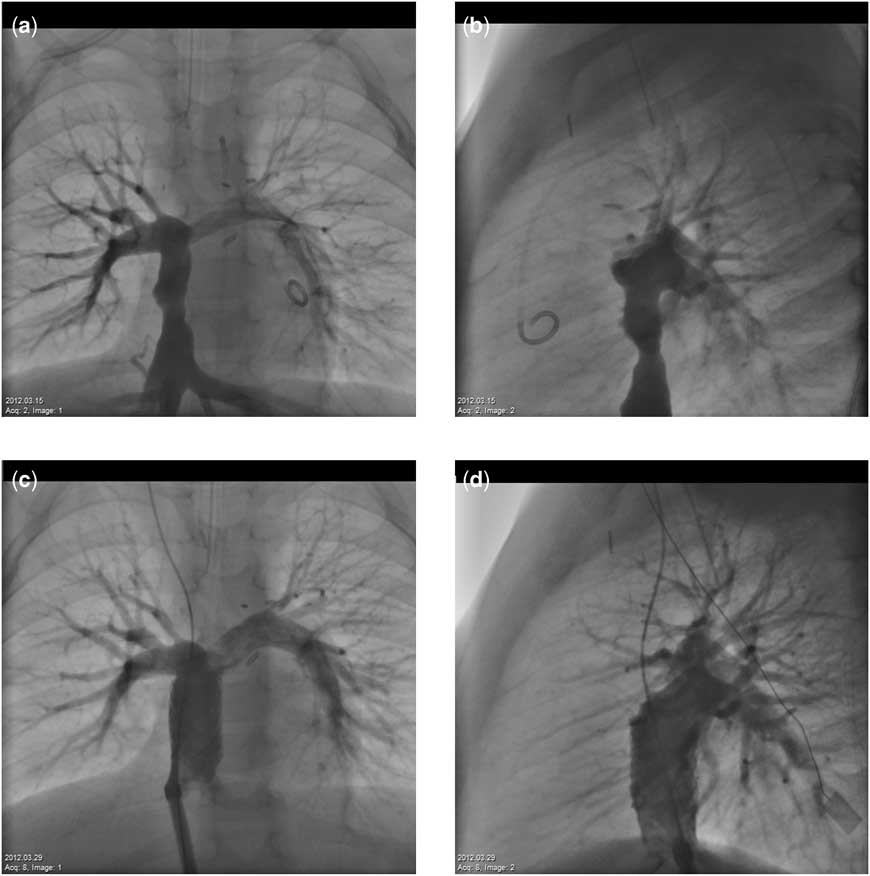
Patient 3 was a 2.5-year-old boy with complex univentricular heart, who presented with protein-losing enteropathy, confirmed by stool alpha-1 antitrypsin clearance studies, 5 months after Fontan completion with an 18-mm conduit. Angiography via the femoral vein demonstrated a mid-conduit stenosis, without any measurable pressure gradient (Fig 3). This was treated by stent implantation (Palmaz), with dilation of the stent to 18 mm in diameter using a high-pressure balloon (Atlas). The procedure was uneventful. Within 6 weeks after the procedure, the patient had normal serum albumin levels and normal stool alpha-1 antitrypsin levels.
( a and b ) Antero-posterior and lateral angiographic projections in patient 3, demonstrating mid-conduit stenosis. ( c and d ) Antero-posterior and lateral projections following stent implantation in patient 3.
Comment
The extracardiac Fontan operation is associated with excellent long-term survival, and a small reported incidence of conduit-related problems.Reference Lardo, Webber, Friehs, del Nido and Cape 2 – Reference Lee, Lee and Hwang 6 Optimal size of the conduit and the optimal age for Fontan completion are still debated, as it is likely that patients who have not realised their growth potential may require conduit replacement in later life owing to the absence of growth in the diameter of the conduit. The conduit sizes in the patients described here – 16 mm versus 18 mm – were chosen by the surgeon on the basis of the diameter of the inferior caval vein at the lower anastomotic site. There are few reports of stent therapy for conduit failure, and protein-losing enteropathy may not be reversible in some patients despite successful therapy of conduit stenosis.Reference Mertens, Hagler, Sauer, Somerville and Gewillig 8 , Reference Meadows and Jenkins 9 Early onset of new symptoms should, however, prompt aggressive investigation for potentially treatable causes of failure of the Fontan circulation. Our current institutional policy is to maintain anticoagulation using coumadin in all patients who have undergone Fontan completion – with or without stent implantation in the Fontan circuit – to maintain the international normalised ratio at between 2.5 and 3.0.
Acknowledgements
Figures 1a and b have been reprinted with the permission of the BMJ Publishing Group Ltd. Licence number 2895930302136.