

Introduction
Ceramics from the period between the seventh and ninth centuries AD in the Iberian Peninsula are broadly characterized by the coexistence of diverse manufacturing techniques, the gradual disappearance of standardized productions, regionalization of production centres, and the incorporation of new forms and techniques such as glaze or the simplification of the typological registry. This latter means that one object was used for different functions. These characteristics present a widely diverse scenario, due in particular to the regionalization of ceramic productions (Alba Calzado and Gutiérrez Lloret Reference Alba Calzado, Gutiérrez Lloret, Bernal Casasola and Ribera i Lacomba2008, 585). This landscape resulted from the transformation of socioeconomic patterns that took place between the political and administrative restructuring process, which started before the end of the Roman Empire, and the later parallel creation of feudal and Islamic societies.
The diversity found in the early Medieval peninsular assemblages increases with the different traditions of study used for the analysis of ceramics from these periods. The collections of late Roman tradition include standardized pieces that can be studied according to the shape of the objects,Footnote 1 and help with the development of typologies that synthesize the temporal evolution of their morphology. Production of service and transport artefacts coexisted in the Mediterranean with cooking ware of coarser granulometry, mostly manufactured by hand or using a slow wheel. Features of these rough pieces and their lack of standardization complicate their recognition from a formal point of view, which is why a technological approach has been adopted for their study, based on an archaeometric analysis of the ceramics.Footnote 2 This type of study analyses the technical features of ceramics in detail, but it also supports the identification of production centres and analysis of distribution networks at different levels. Regarding typologies and classifications of Medieval ceramics, mostly developed according to Spanish, French and Italian traditions, functionality of the object is the key element. This has led to the creation of a specific and unique nomenclature for the Islamic period, different to the system used for productions of Roman tradition,Footnote 3 although cases of typologies structured according to formal series exist, for example Gutiérrez Lloret (Reference Gutiérrez Lloret1996a) for the south-eastern area and Retuerce Velasco (Reference Retuerce Velasco1998) for the central area of the Iberian Peninsula.
The various elements that shape the early Medieval ceramic collections, the regionalization of the productive processes and the different traditions of study leave us with a complex scenario. Furthermore, our degree of knowledge about early Medieval productions is not at the same level as the standardized Roman ceramics. We are still in an early phase of this research. All these elements create a complex situation that is accentuated in the seventh and eighth centuries, a period filled with ceramic forms that fluctuate between the late Roman and the Classic Islamic worlds, but not fitting completely into either of them. This is a period where the methodologies for studying late Antique or Classic Islamic ceramics do not apply, since they do not adapt to the necessities of productions halfway between both worlds. Therefore, the articulation of a methodology that combines different and wider perspectives is necessary.
The study of early Medieval ceramics from the current perspective
One of the most common adjectives used when referring to the early Medieval period is ‘dark ages’ – a title that can be extended to its material culture, which was used to portray a complex material reality and the lack of knowledge about it. However, recently several studies on ceramic collections in the Iberian Peninsula have used new approaches and perspectives of analysis, creating a landscape of knowledge different from that seen a decade ago. Much progress has been achieved regarding the understanding of early Medieval ceramic groups since La cerámica altomedieval en el sur de al-Andalus (Malpica Cuello Reference Malpica Cuello1993) was published in 1993, since the congress of Merida in 2001 on Cerámicas tardorromanas y altomedievales en la Península Ibérica: Ruptura y continuidad (Caballero Zoreda et al. Reference Caballero Zoreda, Mateos Cruz and Retuerce Velasco2003), the congress in Granada in 2005 (Malpica Cuello and Carvajal López Reference Malpica Cuello and Carvajal López2007) and the first sharing of knowledge about paleo-Andalusian ceramics in the Iberian Peninsula (Alba Calzado and Gutiérrez Lloret Reference Alba Calzado, Gutiérrez Lloret, Bernal Casasola and Ribera i Lacomba2008).Footnote 4
Over the last few years, early Medieval ceramics have become a key focus for the socioeconomic and cultural analysis of societies and their study is no longer viewed as a simple descriptive catalogue of the discoveries from an excavation. This new approach is reflected in some monographs dedicated to little-known geographical areas of the Peninsula.Footnote 5 All these studies have in common the recognition of archaeometry as a fundamental elementFootnote 6 and stress the need to contextualize ceramics, not only according to their stratigraphic position, but also according to the other materials, bioarchaeological and architectural remains that are part of the deposits, transcending the mere typological analysis of the works from the late twentieth century.Footnote 7
Contextual analyses have turned into a powerful tool for the study of archaeological material from any period, but they become essential for the analysis of transition periods such as the one we study. The peculiarities of the early Medieval ceramic materials require a different and more versatile perspective than that currently dominating projects on ceramics. The traditional approach is a classical study of ceramics based on the quantification and typological description of standardized shapes and is treated as a chronological model in itself, separate from the stratigraphic analysis. At present, studies on early Medieval ceramics assume that chronological distortion of these productions is risked without a starting point from the contextual stratigraphic analysis. It is, therefore, necessary to consider this carefully when analysing the ceramic collections. We need to keep in mind that the production and distribution date of objects does not necessarily coincide with its lifetime or its amortization period, which is what we usually document in an archaeological excavation. In these periods, characterized by residuality and permanence, the cataloguing of archaeological material only has a meaning within a contextual and chronostratigraphic analysis of the sequence where they were found. In order to do this, we need to understand the nature of the deposit, its formation and the inner chronological indicators, going beyond the theoretical chronology attributed to each separate piece.
These problems are well illustrated with two examples taken from our own research in the south-eastern part of the Iberian Peninsula. The first one comes from El Tolmo de Minateda (Hellín, Albacete), a Roman village dating from the age of Augustus, partially uninhabited between the third and fifth centuries, but intensely occupied during the seventh and eighth centuries. During the latter peak, it accommodated a Visigothic episcopal see (Eio) and turned into an Islamic city (Madīnat Iyyuh) mentioned in the famous surrender treaty of 713 between the dux Theodemir and the Arab conquerors (Abad et al. Reference Abad Casal, Gutiérrez Lloret, Gamo Parras and Cánovas Guillén2012; Gutiérrez Lloret Reference Gutiérrez Lloret and Marin1998, Reference Gutiérrez Lloret2014). In a domestic context located above the early Medieval fortification, stratigraphically dated between the end of the seventh and the beginning of the eighth century, a group of materials from a small kitchen in a courtyard of houses attached to the wall was documented (Amorós Ruiz Reference Amorós Ruiz2018, 78–83; Gutiérrez Lloret et al. Reference Gutiérrez Lloret, Gamo Parras, Amorós Ruiz, Caballero Zoreda, Mateos Cruz and Retuerce Velasco2003, 125–26), including the base of an amphora Keay 61/62 that had been reused as a domestic container. There is a discrepancy between the production and circulation date of this African container and the chronology of the stratigraphic contexts where it appears as a recycled material still in use. This has resulted in some researchers suggesting that the context may have been inaccurately dated, because the proposed chronology does not correspond with the typological dating attributed to this standardized production (Reynolds Reference Richarté, Gutiérrez Lloret, Gragueb Chatti, Tréglia, Capelli, Cressier and Gayraud2016, 142 and 145, notes 56 and 79). There is no such error, since it is not the base of the amphora Keay 61/62 that dates the context, but the stratigraphic sequence, the features of the deposit and the contextual analysis of all of its materials, not just the ceramic ones. These criteria date the recycled amphora in a late third phase of the site, corresponding to the uses associated with the Late Visigothic or Early Islamic periodFootnote 8 (Amorós Ruiz Reference Amorós Ruiz2018, 76). In fact, if we only took into account the production and distribution dates of certain standardized elements that were imported, the houses would have been dated to the beginning of the seventh century: ‘ … that need not date later than the early seventh century (+), in my opinion’ (Reynolds Reference Richarté, Gutiérrez Lloret, Gragueb Chatti, Tréglia, Capelli, Cressier and Gayraud2016, 142, footnote 56). This would once again obscure the eighth century with typologies that do not belong to it.
A contrasting example is provided by a recent excavation in the sector of the north-eastern domus in Ilici-La Alcudia (Elche, Alicante),Footnote 9 a site in the Colonia Iulia Ilici Augusta, a Visigothic episcopal see and one of the other cities mentioned in the Treaty of Theudimer. This site has been known since the sixteenth century and has been regularly excavated since at least the mid nineteenth century. Within its long occupational sequence, the later phases have not been easily recognized and have been interpreted as marginal and isolated occupations. In contexts characterized by extremely high residuality and large removals or spills, the dating of the stratigraphic units cannot exclusively depend on a percentage estimate of its recognizable and datable materials. This strategy magnifies the visibility of Roman and late Antique productions, while at the same time dilutes the early Medieval phases. The latter are represented by scarce materials that, once noticed, help with the recognition of the contexts of the eighth century or even fully Medieval contexts, although sometimes with more than 95% of older materials. This contextual and non-selective analysis of the later occupations has been key to distinguishing the noise of the overwhelming quantity of Imperial Roman material and also to recognizing the real diagnostic material for documentation of Visigothic urbanistic facies and even artefacts from the first Islamic period (Tendero Porras et al. Reference Tendero Porras, Ronda Femenia, Gutiérrez Lloret, Sarabia-Bautista, Amorós Ruiz, Doménech-Belda and Gutiérrez Lloret2020).
In truth, it is this methodological perspective that has enabled recognition of ceramic productions of the eighth century in certain sites and areas of study. Without it, it is impossible to record a productive evolution, the transformation of the shapes and, of course, give visibility to a century such as the eighth, which would otherwise still be diluted in the different interpretative approaches. Therefore, the apparent invisibility of the eighth century stems, in many cases, from the methodology used in the study of ceramics. The same methodology is used as that of the standardized productions from the Roman and late Roman periods, which is inappropriate for the early Medieval economic and productive context. We will only be able to move forwards when the ceramic groups are analysed with chronostratigraphic and contextual parameters, the only way that has proved valid for describing productions from the eighth century.Footnote 10
The methods of producing ceramics in early al-Andalus
Until recently, it was assumed that productions from the seventh and eighth centuries were mostly ceramics modelled by hand or using a slow turntable, made of coarse fabrics and rough-looking, the result of a simplification of the productive processes and the dismantling of markets. The productive landscape at the dawn of al-Andalus showed, from this perspective, a complex, unequal and contrasting material reality, which could be defined as the antithesis of the Antique world (Alba Calzado and Gutiérrez Lloret Reference Alba Calzado, Gutiérrez Lloret, Bernal Casasola and Ribera i Lacomba2008, 585). Only the arrival of the Islamic world would transform this technological perspective thanks to specialized artisans and their new ceramics made with a potter's wheel, distributed through the budding commercial routes of the peninsula. However, the data collected within the last decade from various projects and areas of study seem to draw a diverse and more complex landscape, where different production types and economic resources coexist in the Visigothic period and the beginning of the Islamic world. Although technological data are still very partial, we can sense general patterns that need to be analysed with their contexts and particularities. Broadly speaking, there seems to be a technological and productive difference between urban and rural areas.Footnote 11 However, this apparent city–hinterland dichotomy is not valid for all the Iberian Peninsula and does not present itself in the same way in the different territories.
There are some urban examples such as the one in Merida, where the ceramics made by hand on a slow wheel, or turntable, are usual until the arrival of the Islamic world (Alba Calzado and Feijoó Martinez Reference Alba Calzado, Feijoo Martínez, Caballero Zoreda, Mateos Cruz and Retuerce Velasco2003, 493–94). Something similar has been detected in the north-eastern area (Vigil-Escalera Guirado and Quirós Castillo Reference Vokaer, Kralidis and Gkoutzioukostas2016, 33), the Ebro river valley (Hernández Vera and Bienes Calvo Reference Hernández Vera, Bienes Calvo, Caballero Zoreda, Mateos Cruz and Retuerce Velasco2003, 310), in Alto Guadalquivir (Castillo Armenteros Reference Castillo Armenteros1998; Pérez Alvarado Reference Pérez Alvarado2003), in Vega de Granada (Carvajal López and Day Reference Carvajal López, Day and Jiménez Puertas2014, 138) and in the north-eastern area of the Peninsula. In these latter regions, the production with a turntable is predominant in rural areas (Cau Ontiveros et al. Reference Cau Ontiveros, Macias i Solé, Tuset, Lacuesta Contreras and Gonzálex Moreno-Navarro1997; Folch Iglesias Reference Folch Iglesias2005), while in other urban spaces local productions made with a potter's wheel or a turntable coexist with Mediterranean imports (Folch Iglesias Reference Folch Iglesias2005; Macias i Solé Reference Macias i Solé, Caballero Zoreda, Mateos Cruz and Retuerce Velasco2003); in Tarragona this is the case until the beginning of the eighth century (Rodríguez Martorell and Macias Solé Reference Rosselló Bordoy2018). Castellón y Valencia seems to have this same duality (Negre Pérez Reference Negre pérez2014; Pascual Pacheco et al. Reference Pascual Pacheco, Ribera i Lacomba, Rosselló Mesquida, Caballero Zoreda, Mateos Cruz and Retuerce Velasco2003). Córdoba appears to follow this trend, though possibly less pronounced. Therefore, in the site of Cercadilla, Visigothic productions are also divided between those made with a turntable and those with a potter's wheel, though productions from the latter seem predominant (Fuertes Santos Reference Fuertes Santos2010). In contexts from the second half of the eighth century discovered in Saqunda, a neighbourhood in Cordoba, 90% of the pieces were made with a potter's wheel (Casal et al. Reference Casal, Castro, López and Salinas2005, 193).
In the central part of the Peninsula, the urban areas of Recópolis (Olmo Enciso and Castro Priego Reference Olmo Enciso, Castro Priego and Olmo Enciso2008) and Vega Baja (Aranda González Reference Aranda González2013; De Juan Ares and Cáceres Gutiérrez Reference De Juan Ares, Cáceres Gutiérrez and García2010; De Juan Ares et al. Reference De Juan Ares, Gallego García, García González and Gallego García2009; Gómez Laguna et al. Reference Gómez Laguna, Rojas Rodríguez-Malo, Zozaya, Retuerce and Villalba Hervás2009) contain productions created mostly with a potter's wheel from Visigothic times. In contrast, in many of the rural areas of this part of the Peninsula, ceramics made with a turntable are the most documented from the fifth century until the end of the eighth or even the ninth century (Grassi and Vigil-Escalera Guirado Reference Grassi and Vigil-Escalera Guirado2017; Serrano Herrero et al. Reference Sodini, Villeneuve, Canivet and Rey-Coquais2016; Vigil-Escalera Guirado Reference Vigil-Escalera Guirado, Martín Viso, Fuentes Melgar, Sastre Blanco and Catalán Ramos2003, 385). However, we can also find rural enclaves where the productions were made with a potter's wheel during all of the early Medieval sequences. Such is the case of Carranque, a late Roman villa that was inhabited until the Islamic period, where the ceramic sets were mostly made using a potter's wheel both in late Antique (García Entero et al. Reference García Entero, Peña Cervantes, Zarco Martínez and Aranda González2017a) and in Andalusian contexts from the period of the Emirate (García Entero et al. Reference García Entero, Peña Cervantes, Zarco Martínez and Aranda González2017b). Likewise, in some rural sites in the Duero basin, in León, Valladolid, Segovia and Salamanca, late Visigothic ceramic sets mostly made with a potter's wheel have been documented (García Entero et al. Reference García Entero, Peña Cervantes, Zarco Martínez and Aranda González2017a, 156).
In the south-eastern area, the region known as Tudmīr in Arab sources, although there are no precise data for most of the settlements, a general perspective (Gutiérrez Lloret Reference Gutiérrez Lloret1996a) indicates a production made mostly with a turntable or by hand in the rural settlements during the Visigothic period, though this trend changed with the arrival of the Islamic world. In the middle of the eighth and beginning of the ninth century, we find some rural settlements, such as Cabezo Pardo, where production with a potter's wheel increases while shapes are also modelled by hand or with a turntable (Ximénez de Embún Sánchez Reference Zozaya Stabel-Hansen, Larrén Izquierdo, Gutiérrez González, Miguel Hernández and Gelichi2016). In contrast, urban areas differ from this model. Like in the cities in the central part of the Peninsula, production with a potter's wheel is predominant at the site of El Tolmo de Minateda throughout the whole early Medieval sequence (Amorós Ruiz Reference Amorós Ruiz2018, 289–315), in Cartagena during the Byzantine period (Murcia Muñoz and Guillermo Martínez Reference Murcia Muñoz, Guillermo Martínez, Caballero Zoreda, Mateos Cruz and Retuerce Velasco2003) and in Murcia during the ninth century (Jiménez Castillo and Pérez Asensio Reference Jiménez Castillo and Pérez Asensio2018).
Moreover, for the southern and south-eastern areas, we need to consider another argument regarding the ceramics made by hand. There seems to be a cultural link with other areas in the Western Mediterranean, where there was a tradition of cookware ceramics being modelled by hand since the late Roman period (Gutiérrez Lloret Reference Gutiérrez Lloret, Cressier and Fentress2011a; Reference Gutiérrez Lloret, Gelichi and Hodges2015, 76–80), acknowledged in studies such as Late Roman Cooking Ware – LRCW.Footnote 12 This tradition is represented in cookware that, although rough-looking, was part of the cargo comprising amphorae, tableware and other luxury elements, sometimes of high value, such as glass or metal, between the fourth and sixth centuries. In addition, these products, which should have had a certain prestige (Cau Ontiveros Reference Cau Ontiveros, Malpica Cuello and Carvajal López2007, 268) and were very functional from a technological point of view, had a great impact on the ceramic typologies of the Mediterranean coast of the Iberian Peninsula. Therefore, when the Mediterranean trade networks began to fade, these ceramics were copied in local workshops to substitute household items (Gutiérrez Lloret Reference Gutiérrez Lloret1996a, 328–29; Reference Gutiérrez Lloret and Valerian2011b, Reference Gutiérrez Lloret, Baquedano, García Moreno and Vigil-Escalera2011c; Reynolds Reference Reynolds1985, Reference Reynolds, Stevens and Conant2007, 42–47). Thanks to this, in some areas such as the southern and south-eastern parts of the Peninsula, a productive tradition was maintained for certain kitchen items, a tradition that is only documented in these latitudes and is unknown in the rest of the Iberian Peninsula during the Visigothic period.
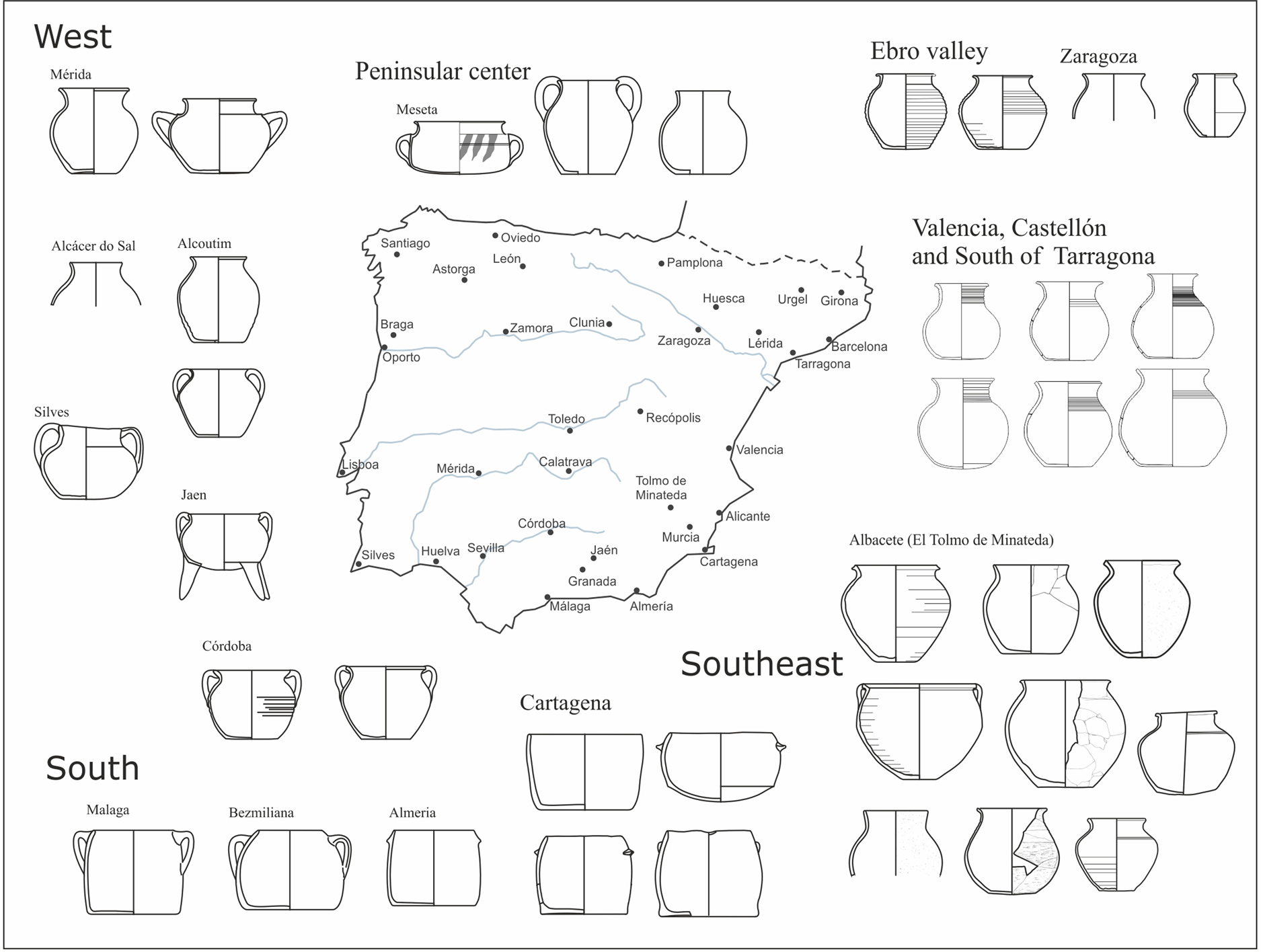
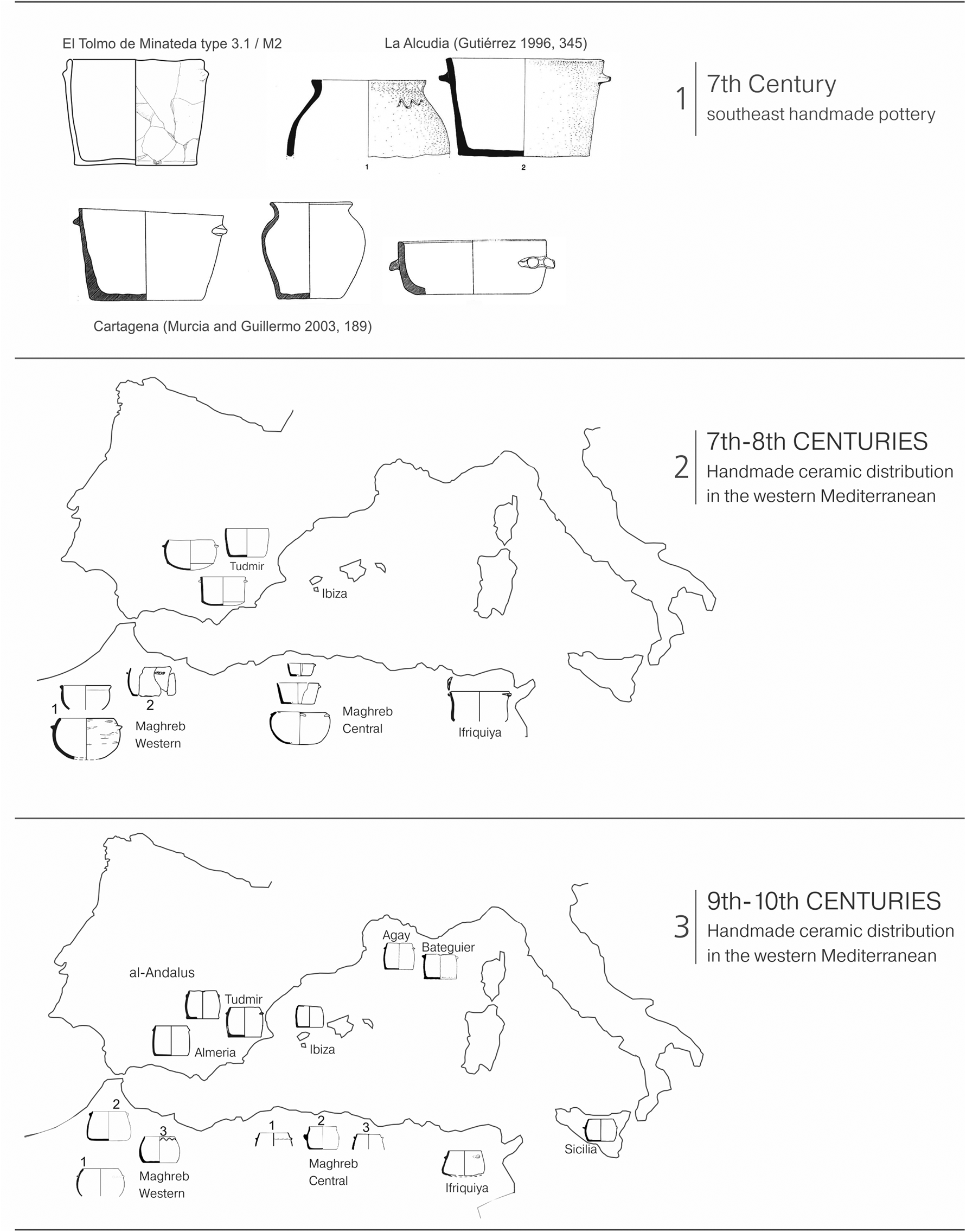
The cultural heritage of these productions is reflected in the forms we refer to in the bibliography as pots and marmites, which are traditionally associated with the domestic Visigothic world in the south-eastern area. They then became part of the household items in the Emiral period and evolved during the Islamic world into more specific shapes. The wide distribution of the marmites in the Visigothic rural areas from the south-east and the fact that they can easily be detected in diachronic ceramic sets have led to them being catalogued as a predominant element in the Visigothic and Emiral sets from the region (Alba Calzado and Gutiérrez Lloret Reference Alba Calzado, Gutiérrez Lloret, Bernal Casasola and Ribera i Lacomba2008, 586; Gutiérrez Lloret Reference Gutiérrez Lloret, Gelichi and Hodges2015, 77). Nevertheless, when these sets are analysed in detail in urban areas, there are various ceramic shapes present in high quantities relative to others. In these cases, the hand-modelled marmites coexist with pots with an S-shaped profile and other spherical or egg-shaped items, made both with a potter's wheel and a turntable. These are the inheritance of another late Roman tradition, extensive over all the Iberian Peninsula (Alba and Gutiérrez Reference Alba Calzado, Gutiérrez Lloret, Bernal Casasola and Ribera i Lacomba2008, 586) and remaining during the Islamic period (Figs. 1 and 2).
Examples of the geographical distribution of pots and marmites (eighth–ninth centuries). (Based on Alba and Gutiérrez Reference Alba Calzado, Gutiérrez Lloret, Bernal Casasola and Ribera i Lacomba2008, 587, fig. 1.)

1. Examples of hand cooking forms from the Visigothic period in the southeast: El Tolmo de Minateda (Amorós Ruiz Reference Amorós Ruiz2018, 141–42), la Alcudia (Gutiérrez Lloret Reference Gutiérrez Lloret1996a, 345), Cartagena (Murcia and Guillermo Reference Murcia Muñoz, Guillermo Martínez, Caballero Zoreda, Mateos Cruz and Retuerce Velasco2003, 189). 2. Distribution of marmites in the Western Mediterranean in the seventh and eighth centuries. (Based on Gutiérrez Lloret Reference Gutiérrez Lloret, Gelichi and Hodges2015, 79, fig. 10): Tudmir (Alba Calzado and Gitiérrez Lloret Reference Alba Calzado, Gutiérrez Lloret, Bernal Casasola and Ribera i Lacomba2008, 587, fig. 1), Western Magreb: 1. Volubilis (Amorós Ruiz and Fili Reference Amorós Ruiz, Fili, Cressier and Fentress2011, 30, fig. 5), 2. Ceuta (Gutiérrez Lloret Reference Gutiérrez Lloret, Cressier and Fentress2011a). Central Magreb: Sétif (Fentress Reference Fentress and Mohamedi1991); Ifriquiya (Bonifay Reference Bonifay2004, 310, fig. 174). 3. Distribution of marmites in the Western Mediterranean in the ninth and tenth centuries. (Based on Gutiérrez Lloret Reference Gutiérrez Lloret, Gelichi and Hodges2015, 79, fig. 10.2): Tudmir and Almeria (Alba Calzado and Gutiérrez Lloret Reference Alba Calzado, Gutiérrez Lloret, Bernal Casasola and Ribera i Lacomba2008, 587, fig. 1); Agay and Batiguer (Richarté et al. Reference Rodriguez Martorell, Macias Solé, Martin Viso, Iñaki, Fuentes Melgar, Sastre Blanco and Catalán Ramos2015); Ibiza (Kirchner Reference Kirchner, Malpica Cuello and Carvajal López2007, 425, fig. 5); Sicilia and Monte Iato (Gutiérrez Lloret Reference Gutiérrez Lloret, Cressier and Fentress2011a; 362, fig. 2); Western Magreb: 1. Volubilis (Amorós Ruiz and Fili Reference Amorós Ruiz, Fili, Cressier and Fentress2011, 33, fig. 9), 2. Melilla (Salado Escaño et al. Reference Salinas Pleguezuelo2011, 63–85, fig. 5), 3. Nakūr (Acién Almansa et al. Reference Acién Almansa, Cressier, Erbati and Picon1999: 45–69, lam. VII); Central Magreb: 1. Tahert; 2. Sétif; 3. Asĭr-ouest (Djellid Reference Djellid, Cressier and Fentress2011, 147–58). Ifriquiya: Althiburos (Kallala et al. Reference Kallala, Sanmartí and Belarte2017, 260, fig. 5.11).

In the Maghreb, on the other hand, this type of ceramic can easily be found in contexts from the seventh and eighth centuries (Amorós Ruiz and Fili Reference Amorós Ruiz, Fili, Fentress and Limane2018). Therefore, we can sense an imitation process similar to that in the Peninsular Mediterranean coast (Cressier Reference Cressier, Anderson, Fenwick and Rosser-Owen2018, 510), especially if we take into account that the southern and south-eastern areas of the Iberian Peninsula create a cultural area together with the western coast of the African continent, which transcends the Islamic world (Gutiérrez Lloret Reference Gutiérrez Lloret, Cressier and Fentress2011a; Reference Gutiérrez Lloret, Gelichi and Hodges2015, 76–80). In fact, similar productions, with their own morphology and fabrics, can be found in many areas of the Western Mediterranean between the seventh and tenth centuries (Gutiérrez Lloret Reference Gutiérrez Lloret, Gelichi and Hodges2015, 76). They are part of the maritime trade of the first half of the tenth century between the south-eastern area of the Iberian Peninsula and southern France (Richarté et al. Reference Rodriguez Martorell, Macias Solé, Martin Viso, Iñaki, Fuentes Melgar, Sastre Blanco and Catalán Ramos2015) and are also integrated into the Sicilian repertories of the tenth and eleventh centuries (Gutiérrez Lloret Reference Gutiérrez Lloret, Gelichi and Hodges2015, 76) (Fig. 2).
Although the data vary and come from very diverse methodologies (Vigil-Escalera Guirado Reference Vigil-Escalera Guirado and Quirós Castillo2018, 30), there is enough evidence to sense not just a city–hinterland duality in some Peninsular areas, but also mixed models in other areas, where the disarticulation of rural and urban areas is diluted (Amorós Ruiz, Reference Amorós Ruizforthcoming). New data regarding production models and ceramic distribution, together with comparison with other economic indicators such as glass, coins, or the use of metal objects, enable the formulation of models that are more complex than those used up to now.
From this perspective, we cannot restrict the use of handmade ceramics to the framework of domestic productions and simplified economic systems. In the Basque Country, in Gorliz (Bizkaia), for example, some production and distribution of handmade ceramics have been detected in specialized productive systems, where the same artisan could make the same ceramic form with a potter's wheel or by hand, depending on demand (Azkarate Garai-Olaun and Solaun Bustinza Reference Azkarate Garai-Olaun, Solaun Bustinza, Guirado and Quirós Castillo2016, 223). Furthermore, by the end of the ninth century in the south-eastern part of the Iberian Peninsula, handmade ceramics were integrated into more specialized and complex productive models, together with ceramics made with a potter's wheel, and they are part of joint production strategies in regional workshops, or by itinerant specialized artisans. In this case, the ceramic modelled by hand/turntable reflects a socioeconomic complexity that exceeds the traditional interpretation based on the simplification of productive models (Amorós Ruiz, Reference Amorós Ruizforthcoming).
Ceramic transformation in the Islamic period
The Islamic conquest of the Iberian Peninsula took part in a productive context common to the rest of the Western Mediterranean by the end of the Antique world in an environment dominated by the regionalization and the crisis of Mediterranean trade. But the joint vision of urban and rural contexts leads us to reconsider the analysis of productive structures, especially if it strengthens the self-sufficiency and the simplification of productive processes in the early Medieval ceramic sets. From the current data, it seems that each region adopted productive strategies according to their resources and needs. In these adaptative systems, handmade ceramics coexist with those made with a potter's wheel and the simplification degree and standardization of the shapes depends on the socioeconomic context of production.
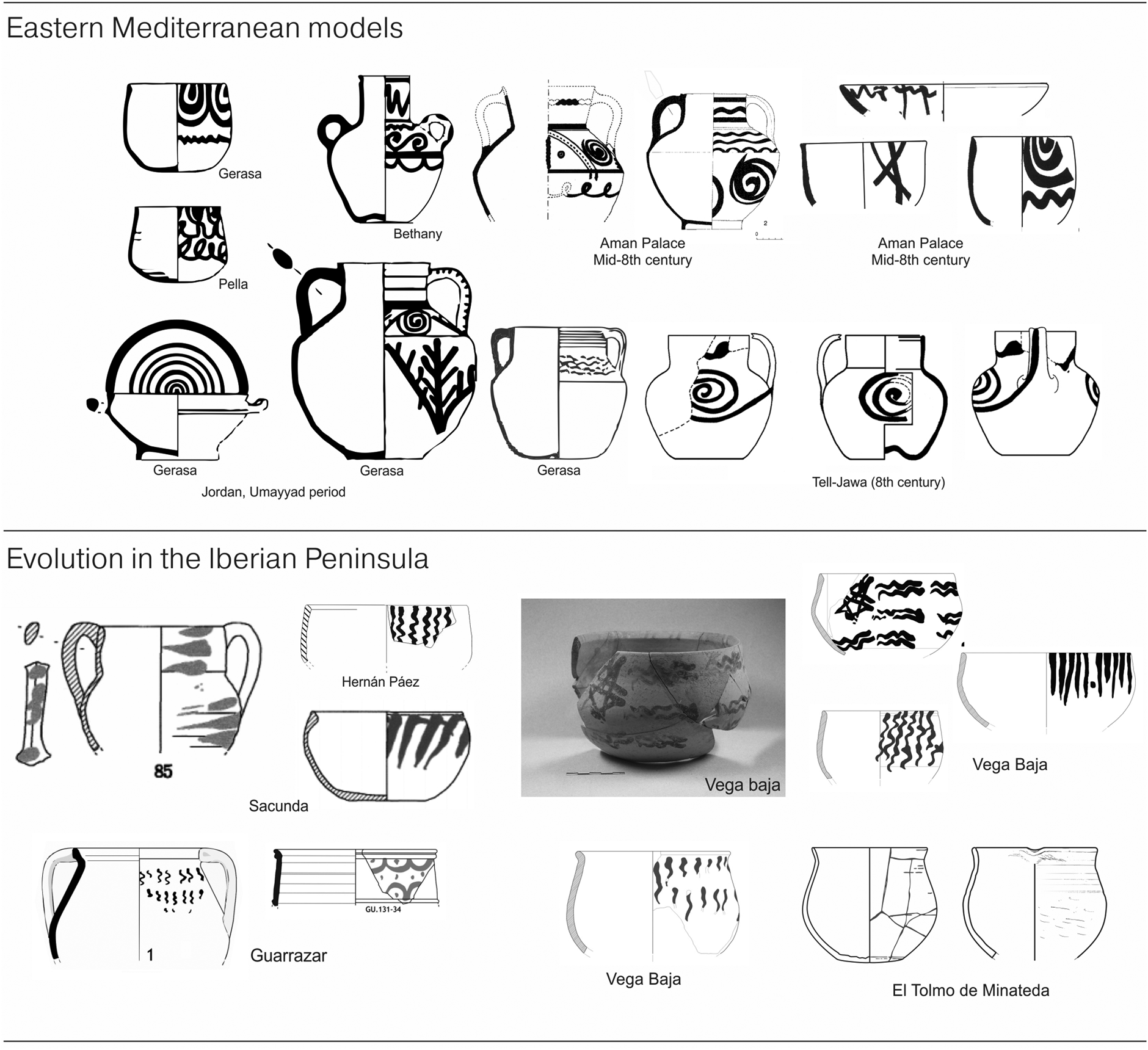
In any case, one characteristic seems to be common for all the Iberian Peninsula. This is the continuity of production and consumption patterns of ceramics made in the seventh century into the first half of the eighth century. The shapes of cooking pots and pans, the carinated bowls of Visigothic tradition, the S-shaped jugs and the bottles with two handles are retained. Together with the shapes of Visigothic tradition, new elements are introduced and gradually integrated into old traditions. One of the first changes detected is the appearance of painted decoration,Footnote 13 very rare in Visigothic repertoires, although common in Umayyad trousseaus at the end of the seventh and beginning of the eighth century. This new decoration can be found both in new shapes and in ceramics of Visigothic tradition from a very early period (Fig. 3).
Examples of eighth-century painted pottery. (Based on Amorós Ruiz Reference Amorós Ruiz2018, 369, fig. 302): Eastern Mediterranean models: Jordania (Uscatescu Reference Vigil-Escalera Guirado, Caballero Zoreda, Mateos Cruz and Retuerce Velasco2003, 555); Aman (Almagro Gorbea et al.. Reference Almagro Gorbea, Jiménez and Navarro Palazón2000, 174); Tell Jawa (Davidau Reference Davidau2010, 256). Evolution in the Iberian Peninsula: Hernán Páez (Vicente and Rojas Reference Vicente Navarro and Rojas Rodriguez-Malo2009, 309); Guarrazar (Serrano Herrero et al. Reference Sodini, Villeneuve, Canivet and Rey-Coquais2016, 295); Sacunda (Casal et al. Reference Casal, Castro, López and Salinas2005, 220 and 224); Vega Baja (Gómez Laguna and Rojas Rodríguez-Malo Reference Gómez Laguna, Rojas Rodríguez-Malo, Zozaya, Retuerce and Villalba Hervás2009, 790); El Tolmo de Minateda (Amorós Ruiz Reference Amorós Ruiz2018, 201–202).

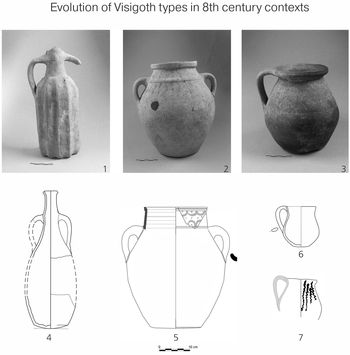
From the middle of the eighth century and as the century moves forward, new elements are detected that indicate innovations in the sets. This means, on the one hand, transformations in the already known shapes and, on the other hand, the introduction of new elements. The shapes of the seventh century begin to evolve; thus, for example, the bottles start shortening the neck and widening the body towards more spherical shapes, or they increase in size, as has been documented in the central area of the Iberian Peninsula (Serrano Herrero et al. Reference Sodini, Villeneuve, Canivet and Rey-Coquais2016, 300). Jugs undergo a double evolution: we find jugs with just one handle, with long and narrow necks and bodies, which are increasingly spherical. At the same time, in most areas of the Peninsula, jugs with a cylindrical neck and wide mouth become widespread, inspired by eastern prototypes that acquire their own singularity in al-Andalus. In fact, the older ones, like that from Šaqunda, may have two handles like some oriental examples. However, the shape that becomes standardized is a container with a wide mouth and cylindrical neck, with just one handle (jarro), which during the second half of the eighth century turns into one of the elements that best illustrates the Islamization of domestic sets (Gutiérrez Lloret Reference Gutiérrez Lloret, Gelichi and Hodges2015, 80–81). The repertoire of bowls increases and together with the Roman-Visigothic tradition, bitruncate cone-shaped bowls are documented in the eighth and ninth centuries in the Islamic Mediterranean (Amorós Ruiz Reference Amorós Ruiz2018, 368) (Fig. 5). Furthermore, as the century goes by, new shapes appear, such as the tannūr, which is an oven for baking bread of oriental tradition (Gutiérrez Lloret Reference Gutiérrez Lloret1991, Reference Gutiérrez Lloret1996b), the waterwheel bucket (qādūs/arcaduz) (Gutiérrez Lloret Reference Gutiérrez Lloret1996c; Reference Gutiérrez Lloret and Sénac2012, 264–69; García Blánquez Reference García Blánquez2014) and the Islamic oil lamp (candil). These objects represent different cultural traditions and, more importantly, are proof of the introduction of new types of food and agricultural practices with irrigation (Gutiérrez Lloret Reference Gutiérrez Lloret, Gelichi and Hodges2015, 80), corroborated in an early period in the region of Tudmīr, in the south-eastern area of al-Andalus (Gutiérrez Reference Gutiérrez Lloret2019). (Figs. 3–6)
Evolution of Visigoth ceramics into eighth-century contexts: 1–3 Vega Baja (Gómez Laguna and Rojas Rodríguez-Malo Reference Gómez Laguna, Rojas Rodríguez-Malo, Zozaya, Retuerce and Villalba Hervás2009, 795, lam. 4); 4. El Tolmo de Minateda (Amorós Ruiz Reference Amorós Ruiz2018, 187, fig. 157a); 5. Guarrazar (Serrano et al. Reference Serrano Herrero, Torra Pérez, Catalán Ramos, Vigil-Escalera Guirado, Vigil-Escalera Guirado and Quirós Castillo2016, 303, fig. 10.15); 6. El Tolmo de Minateda (Amorós Ruiz Reference Amorós Ruiz2018, 200, fig. 165g); 7. Vega Baja (Gómez Laguna and Rojas Rodríguez-Malo Reference Gómez Laguna, Rojas Rodríguez-Malo, Zozaya, Retuerce and Villalba Hervás2009, 792, lam. 3).

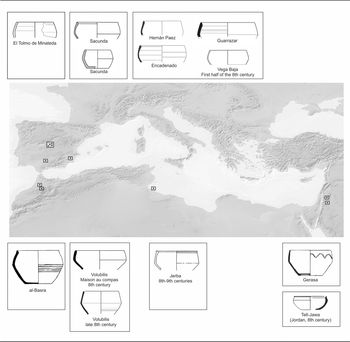
Bitruncate cone-shaped bowls documented in the Mediterranean in the eighth and ninth centuries. (Based on Amorós Ruiz Reference Amorós Ruiz2018, 368, fig. 301): El Tolmo de Minateda (Amorós Ruiz Reference Amorós Ruiz2018, 233 Type 8.4.2:), Hernán Páez (Vicente and Rojas Reference Vicente Navarro and Rojas Rodriguez-Malo2009, 309); El Encadenedo (Serrano Herrero et al. Reference Sodini, Villeneuve, Canivet and Rey-Coquais2016, 289); Vega Baja (Peña and García Reference Peña Cervantes, García-Entero and Gómez Rojo2009, 172); Guarrazar (Serrano Herrero et al. Reference Sodini, Villeneuve, Canivet and Rey-Coquais2016, 295); Sacunda (Casal et al. Reference Casal, Castro, López and Salinas2005, 224); al-Basra (Benco Reference Benco1987, 41); Volubilis Maison au compas (Atki Reference Atki, Cressier and Fentress2011, 17); Volubilis (Amorós Ruiz and Fili Reference Amorós Ruiz, Fili, Cressier and Fentress2011); Jerba (Holod and Cirelli 2010: 172); Gerasa (Uscatescu Reference Vigil-Escalera Guirado, Caballero Zoreda, Mateos Cruz and Retuerce Velasco2003, 552); Tell Jawa (Davidau Reference Davidau2010: 181).

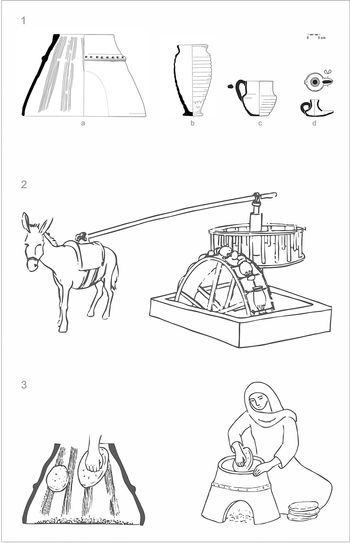
New Islamic forms. (Based on Gutiérrez Lloret Reference Gutiérrez Lloret, Gelichi and Hodges2015, 82, fig. 11): 1a/b/c. Jars; 1d. Islamic oil lamp (candíl); 2. Water-wheel jug (arcaduz); 3. portable oven (tannur) and portable oven use.

If the eighth century represents the mix and evolution of two cultural traditions, the ninth century is, on the other hand, the moment for cultural homogenization. In this century, the shapes of Visigothic tradition dissolve and integrate in sets that are increasingly Islamized from a social point of view; this is the period when glazing is introduced, which is the final element of the process of change of the productive system (Amorós Ruiz Reference Amorós Ruiz2018, 371–73; Gutiérrez Lloret Reference Gutiérrez Lloret, Gelichi and Hodges2015, 84; Salinas Plaguezuelo and Montilla Torres Reference Salinas Plaguezuelo and Pradell2018, 433; Serrano Herrero et al. Reference Sodini, Villeneuve, Canivet and Rey-Coquais2016, 309). The case of El Tolmo de Minateda is a paradigmatic example (Amorós Ruiz Reference Amorós Ruiz2018). The contextual analysis of the chronostratigraphic sequence detects a change in the ceramic productions of the second half of the seventh century, with the transformation of such conservative elements as the cooking pots (the most abundant containers in the ceramic repertoire). Their design evolves to more egg-shaped forms with more marked inflections, turning away from the S-shapes and spherical bodies so common in the previous period. There are also other subtle changes (such as the increased production of narrow-necked bottles, the appearance of S-shaped jugs, cups and glasses added to tableware, etc.) that define a productive landscape that will remain until the second half of the eighth century, when new shapes connected to the Islamization of the society are documented. However, it is in the ninth century when a complete transformation of domestic household items takes place and the productive models that prevailed since the second half of the seventh century are broken. In the assemblages of the ninth century of El Tolmo, the number of shapes documented increases exponentially, exchanges with eastern Andalusia, Granada, Málaga Murcia and the central area of the Iberian Peninsula are detected and glazed products already manufactured in Peninsular workshops begin to appear, which by the end of the century are completely integrated in the domestic household items (Amorós Ruiz and Gutiérrez Lloret, Reference Amorós Ruiz, Gutiérrez Lloret, Coll and Salinasforthcoming).
Social Islamization read through ceramic household items
The same process detected in the Iberian Peninsula has its equivalent in the ceramic sets from the oriental part of the Mediterranean, where the Islamic conquest did not imply a radical transformation of the uses and ways of producing ceramics (Gayraud and Vallauri Reference Gayraud and Vallauri2017, 3–5; Reynolds Reference Reynolds, Malpica Cuello and Carvajal López2003, Reference Reynolds2010, 132; Reference Richarté, Gutiérrez Lloret, Gragueb Chatti, Tréglia, Capelli, Cressier and Gayraud2016, 146; Sodini and Villeneuve Reference Solaun Bustinza1992; Uscatescu Reference Vigil-Escalera Guirado, Caballero Zoreda, Mateos Cruz and Retuerce Velasco2003, 546 and following; Vokaer Reference Waksman, Bouquillon, Cantin, Katona and Waksman2013, 499–500; Walmsley Reference Walmsley, Marchetti and Theuesen2007, 57; Reference Walmsley, Villeneuven and Watson2000, 329). The significant change in production of ceramics in the Middle East is first documented in the second half of the eigth century. However, it is especially clear in the ninth century, when the Roman/Byzantine production patterns in force up to that time are radically transformed (Uscatescu Reference Vigil-Escalera Guirado, Caballero Zoreda, Mateos Cruz and Retuerce Velasco2003, 543 and following; Vokaer Reference Waksman, Bouquillon, Cantin, Katona and Waksman2013, 484; Walmsley Reference Walmsley, Villeneuven and Watson2000, 329; Reference Walmsley, Marchetti and Theuesen2007, 57). The same process is also documented at a site in the Persian Gulf, Kush (Ras al-Khaimah), where the first centuries of Islamization show a gradual evolution of the late Sassanid sets. However, no transformation can be seen in the ceramic productions until the ninth century, when possibly the most significant change is the increase of southern Asia ceramics in the early Islamic sets (Kennet Reference Kennet2004, 108).
In the second half of the eighth century, the cultural, technological and economic focus of the Islamic world moves to the east. The transfer of the capital to Baghdad lets the Abbasid world focus its power in Asia, thus beginning a cultural transformation that is also reflected in the ceramic productions of the Eastern Mediterranean (Walmsley Reference Walmsley, Villeneuven and Watson2000, 329 and following; Reference Walmsley2001; Reference Watson2008, 149). From this perspective, the second half of the eighth century and especially all the ninth century was a period of change for the whole Islamic world.
The transformation process detected in the ceramic household items from the Middle East in the aforementioned period raises the question of whether we have accurately interpreted the Islamization process of household items and the introduction of new elements in the ceramic sets of the Iberian Peninsula in early al-Andalus.
The weight of the pre-Islamic tradition in the Umayyad collections is the framework that explains the continuity or reappearance of traditionally Mediterranean shapes (at least since the Roman world) in the repertoires from the early Islamic period. Examples are the plate for baking bread or ṭābaq (Gutiérrez Lloret Reference Gutiérrez Lloret1991; Reynolds Reference Richarté, Gutiérrez Lloret, Gragueb Chatti, Tréglia, Capelli, Cressier and Gayraud2016, 158–67), which can be also found in Visigothic contexts from the central part of the Peninsula (Serrano Herrero et al. Reference Sodini, Villeneuve, Canivet and Rey-Coquais2016, 307) and in the Byzantine Cartagena (Laiz Reverte and Ruiz Valderas Reference Laiz Reverte and Ruiz Valderas1988). This perspective in part explains why we find shapes and decorations in the eighth century similar to the Umayyad ceramics from the Eastern Mediterranean, such as painted decorations and jugs with wide mouths, in different parts of the Iberian Peninsula, such as the Duero valley (Zozaya Stabel-Hansen et al. Reference Zozaya Stabel-Hansen, Larrén Izquierdo, Gutiérrez González, Miguel Hernández and Gelichi2012), the central part of the Peninsula (Serrano Herrero et al. Reference Sodini, Villeneuve, Canivet and Rey-Coquais2016) or Córdoba (Casal et al. Reference Casal, Castro, López and Salinas2005). The perspective may also contribute to these elements being established as early indicators of social and cultural Islamization (Gutiérrez Lloret Reference Gutiérrez Lloret and Valerian2011b, Reference Gutiérrez Lloret, Baquedano, García Moreno and Vigil-Escalera2011c, Reference Gutiérrez Lloret and Sénac2012, Reference Gutiérrez Lloret, Gelichi and Hodges2015).
During the second half of the eighth century, but especially in the ninth century, new influences arrive in al-Andalus regarding the shapes and modes of producing ceramics, which reflect the deep cultural changes that the Abbasid Mediterranean was undergoing. The orientalization of the Umayyad world takes place here with some specific features, marked by a peripheral geographic location in the most western part of the Islamic territory, the deep regionalization of the ceramic sets, the tradition and location of the Umayyad from Cordoba and a close link to the Berber world (Amorós Ruiz, Reference Amorós Ruizforthcoming).
The Berber problem and research in the Maghreb
The large role that the Berber population played in the conquest and formation of al-Andalus is undeniable, especially thanks to a fluid transfer of population between the north of Africa and al-Andalus, which has been archaeologically witnessed from a very early period (De Miguel Reference De Miguel Ibáñez2016). This link between populations and the location of the Iberian Peninsula and the Maghreb in the most western end of the Dār al-Islam created a specific political, economic and cultural atmosphere different to other parts of the Islamic territory. However, the direct relationship between the southern and south-eastern areas of the Iberian Peninsula and the central part of the Maghreb transcends the Islamic period and must be understood as a cultural area (Gutiérrez Lloret Reference Gutiérrez Lloret, Cressier and Fentress2011a; Reference Gutiérrez Lloret, Gelichi and Hodges2015), connected by an easy maritime communication that increases during the Islamic period (Azuar Ruiz Reference Azuar Ruiz2016; Cressier Reference Cressier, Anderson, Fenwick and Rosser-Owen2018).
However, an archaeological analysis of the Berber world is more complicated than an analysis using textual history. The central and western Maghreb (from Algeria to Morocco) has had very few systematic excavations, long-lasting projects or recent publications that may provide contrast data on which to construct serious discussions about the Berber societies between the seventh and ninth centuries. We also lack information about these settlements in the period immediately prior to the expansion of Islam, between the fall of the Roman Empire and the arrival of the eastern army. This lack of knowledge hinders calibration of the real impact of Islamization in this North African region and how it affected the local population. This ignorance has favoured the appearance of hypotheses built from presentism paradigms arisen from colonial anthropological patterns that emphasize the unity, if not the immutability, of ‘the Berber’ (Brett and Fentress Reference Brett and Fentress1996, 7). This perspective ignores that the Berber world comprised different cultural groups, far from being homogeneous, and that the societies studied by colonial anthropology in the first half of the twentieth century do not necessarily correspond with those which took part and settled in the territories of the Iberian Peninsula, which from that moment created al-Andalus. Moreover, those societies had been conquered just a few decades earlier and their linguistic Arabization, religious and especially social Islamization was still incipient. In fact, there are few data regarding Berber material culture and its Islamization process between the seventh and ninth centuries (Cressier and Fentress Reference Cressier and Fentress2011).
The importance of the Berber component in the development of al-Andalus was established according to the theory of the Hispanist, Pierre Guichard, formulated in the 1960s (Guichard Reference Guichard1976; Reference Guichard1990). This hypothesis, which still has crucial historiographic importance, was built on textual data, with the help of toponymy and a budding Medieval archaeology,Footnote 14 but it lacked a previous knowledge of the material culture of these early Berber societies, which have not yet been archaeologically characterized. By way of example, an ongoing debate arises over the hypothetical Berber origin of a type of culinary container, a cooking pot with a globular body and narrow corrugated neck, typical of the Sharq al-Andalus area, which now corresponds to the north of the Valencian Community (Castellón and Valencia) and the bordering regions (Tarragona, Albacete and Cuenca) (Bazzana Reference Bazzana and Stabel-Hansen1986; Bazzana and Guichard Reference Bazzana and Guichard1980). The discovery of these kitchen productions in territories where there was an important and early Berber settlement, according to the theory of Guichard himself, prompted some researchers to consider them as from Berber populations that settled in the area, rather than from other productions thought to have an indigenous or even Arab tradition. While the indigenous affiliation has received new archaeological support, there is no archaeological argument that supports the supposed ‘Berber heritage’ of some Andalusian ceramics.Footnote 15 On the contrary, in the few excavations with sequences between the eighth and ninth centuries, published on the current Morocco and Algeria, there is no evidence of this type of cooking pot; the most common shape is an open type of pan (Amorós Ruiz and Fili Reference Amorós Ruiz, Fili, Fentress and Limane2018; Cressier and Fentress Reference Cressier and Fentress2011).
Another of the ethnographic arguments raised by archaeological research is based on painted decoration. Over several decades, archaeological research has explored the identification of certain decorative motives, especially the reticulated triangles, with the supposed Berber ‘facies’ of some Andalusian ceramics. This technique, quite common in current ceramics of Berber tradition, is not documented in the few stratigraphic contexts of the eighth century, nor in most of the sites of the ninth century in the Maghreb.Footnote 16 Information about these areas, however, is partial and rare, and could change in the future. Further, the current data do not support the concept that geometric painted decoration is an inherent component of ceramics from the eighth and ninth centuries in these areas of Algeria and Morocco, or that it could be a feature, many centuries old, of the ‘Berber ceramics’, that is, a timeless category. It seems rather to be an element that was introduced later, influenced by other groups in the tenth century or later. This theory is also suggested in the case of Nakūr (Acién Almansa et al. Reference Acién Almansa, Cressier, Erbati and Picon1999, 47–58), where the comparison of Medieval types (tenth and eleventh centuries) with the traditional Berber ceramics, which are well defined in this area thanks to ethnographic observations, show clearly the non-existent connection among both (Cressier Reference Cressier, Anderson, Fenwick and Rosser-Owen2018, 510).
According to the data we currently have, the ceramic sets of the eighth and ninth centuries in the north of Morocco were mostly made using a potter's wheel,Footnote 17 with differences between settlements of Arab origin such as al-Basra (where the percentage of ceramics made with a potter's wheel is higher than 90%) and pre-Islamic sites such as Volubilis and Nakūr (which both have 30% handmade and 70% made with a potter's wheel) or Melilla (which has 45% handmade and 55% made with a potter's wheel). Moreover, in the settlements with a pre-Islamic tradition, an association between technology and functionality has been detected; cookware and some larger containers were handmade, while the ceramics for smaller tableware, storage and transport were mostly made using a potter's wheel (Amorós Ruiz and Fili Reference Amorós Ruiz, Fili, Fentress and Limane2018, 282–85).
From the current point of view, we know that in the oldest contexts, such as the one in Volubilis (Amorós Ruiz and Fili Reference Amorós Ruiz, Fili, Cressier and Fentress2011, Reference Amorós Ruiz, Fili, Fentress and Limane2018; Atki Reference Atki, Cressier and Fentress2011), ceramic cookware mostly comprises handmade wide-mouthed pans and marmites, heirs of the late Roman models (Cressier Reference Cressier, Anderson, Fenwick and Rosser-Owen2018, 510). However, other late Roman cookware was made with a potter's wheel, in the style of a cooking pot, with a globular body and sometimes used as small containers, although few exist. There is also a large formal repertoire in the eighth and ninth centuries of productions made with a potter's wheel, such as a great variety of medium and large jars and jugs with narrow necks and mouths, and a wide range of bowls, which are much more common than in Andalusian collections. From the ninth century onwards, elements such as wide-mouthed jugs with cylindrical necks, similar to the Andalusian ones, and oil lamps (candil) are occasionally detected. These pieces become more common in the tenth century onwards. The same happens with glazing, which seems to appear later than in al-Andalus and is associated with the important urban areas such as Fez (El Baljani et al. Reference El Baljani, Ettahiri, Fili, Anderson, Fenwick and Rosser-Owen2018). The information we have nowadays shows that the Maghreb was isolated during the first centuries of Islamic presence (El Baljani et al. Reference El Baljani, Ettahiri, Fili, Anderson, Fenwick and Rosser-Owen2018, 426), indicating that this area had its own Islamization process and a parallel development to that of the Berber populations in the Iberian Peninsula (Fig. 7).
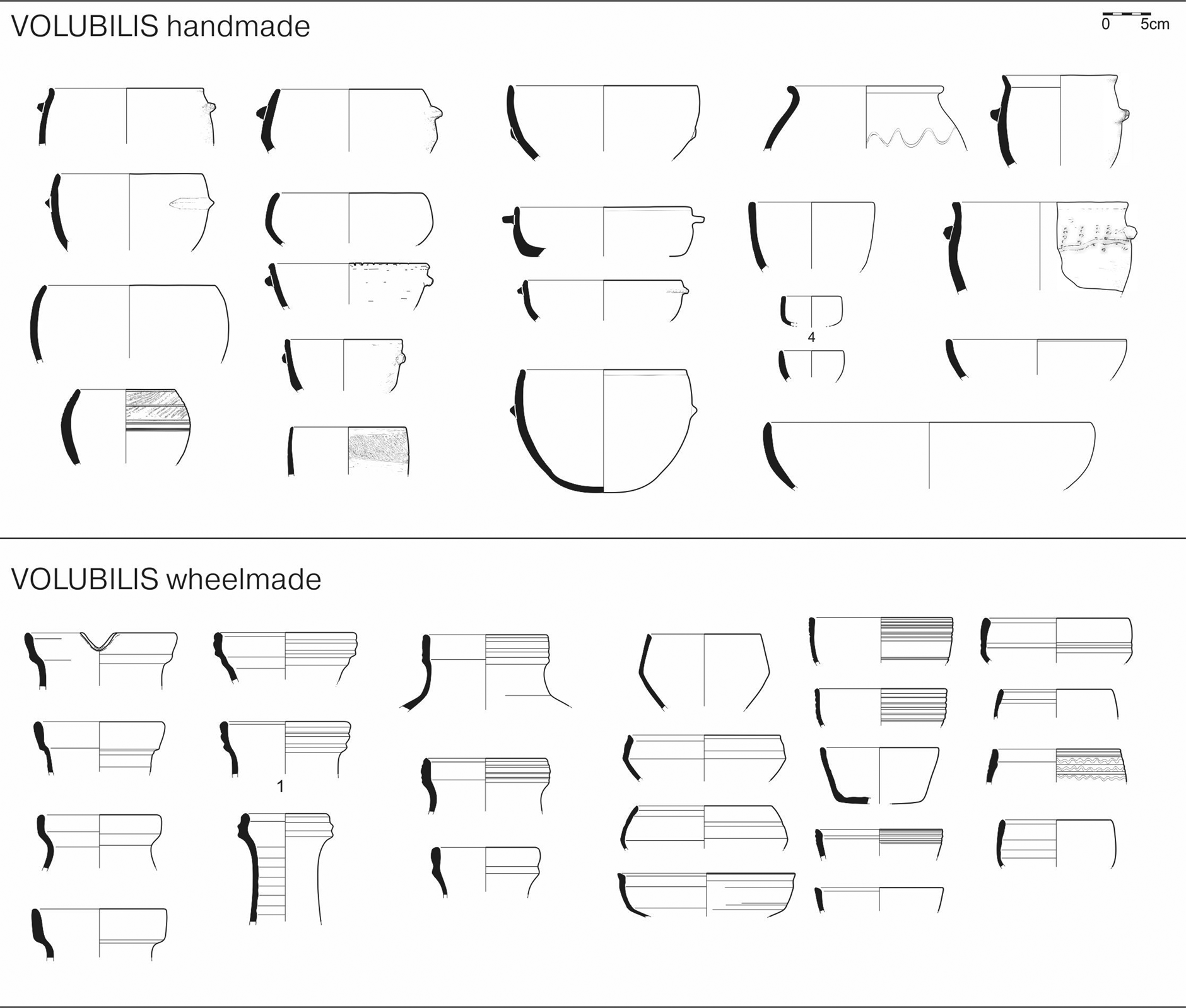
Volubilis: selection of ceramics from Phase 2 of building 4 (second half of eighth century) (Based on Amorós Ruiz y Fili Reference Amorós Ruiz, Fili, Cressier and Fentress2011.)

The introduction of glazing in the Western Mediterranean
The great transformation of ceramic production systems in the Islamic world is the introduction of glazed products in household items. Glazing technique is recognized from the first millennium before our era. Glazed productions exist in Imperial Roman times and they are also well documented in late Roman and early Medieval periods in southern France and Italy (Cacciaguerra Reference Cacciaguerra2009; Paroli Reference Paroli1992). However, all of them are limited luxury productions whose result is far from that of Islamic household items. The technological leap of the Islamic world transformed a luxury item available to very few people into a high-quality glazed product, aesthetically appealing and part of a production system that made it available to a large part of the population.
The Classic hypothesis accepted that the introduction of glazing in the Islamic world happened after the conquest of Mesopotamia, but research in the last decade has confirmed that the first glazing associated with the Islamic world was documented in Egypt and Syria from the end of the seventh and in the eighth century (Moujan et al. Reference Moujan, Tite and Watson2018; Salinas Plaguezuelo et al. Reference Salvatierra Cuenca and Castillo Armenteros2019; Tite et al. Reference Uscatescu, Bonifay and Bakirtzis2015; Watson Reference Ximénez de Embún Sánchez, Gonçalves and Gómez-Martínez2014). Investigation of these first glazed productions from the Middle East has proved that green transparent and honey-coloured lead glazes coexisted with the first tin-opaque yellow and white glazes in Egypt of the eighth century (Moujan et al. Reference Moujan, Tite and Watson2018, 60; Tite et al. Reference Uscatescu, Bonifay and Bakirtzis2015, 90).
The technology applied to those first lead glazes could have been developed thanks to a knowledge transfer process: ‘This use of lead stannate can be explained in terms of technological transfer from contemporary Egyptian and Syrian glassmakers who had continued the Byzantine tradition of glassmaking whilst working under Islamic rule’ (Tite et al. Reference Uscatescu, Bonifay and Bakirtzis2015, 90). These Middle Eastern artisans could have known the Byzantine technology, with which the artisans of Constantinople from the seventh and eighth centuries produced glazed ceramics by directly applying a lead compound to high-quality tableware productions (Waksman et al. Reference Walmsley, Hansen and Wickham2007). The interaction between Byzantine and Islamic technology continued in the following centuries (Armstrong Reference Armstrong2020).
The change of the capital from Damascus, Syria, to Baghdad, Iraq, in AD 762, after the Abbasids’ rise to power (AD 750), was how Mesopotamia accessed a technology that already existed in Egypt and the Middle East (Moujan et al. Reference Moujan, Tite and Watson2018, 57; Salinas Plaguezuelo et al. Reference Salvatierra Cuenca and Castillo Armenteros2019, 11). The ninth century in Mesopotamia sees the blossoming ‘of white glazes, the technique became widely used as base white glazes for Samarra-type pottery, produced essentially in response to imported Chinese stoneware and porcelain’ (Moujan et al. Reference Moujan, Tite and Watson2018, 57–59; Watson Reference Ximénez de Embún Sánchez, Gonçalves and Gómez-Martínez2014).
Regarding the Iberian Peninsula, it is accepted that the arrival of this type of technology is directly related to the appearance of Peninsular production centres, such as Córdoba or Pechina, in the second half of the ninth century. The absence of glazed ceramics during the first half of this century is clear in Šaqunda, a suburb of Córdoba that was built in AD 750 and destroyed in AD 818. No fragment of glazed ceramics has been documented there (Casal et al. Reference Casal, Castro, López and Salinas2005, 193; Salinas Pleguezuelo Reference Salinas Plaguezuelo, Montilla Torres, Anderson, Fenwick and Rosser-Owen2013, 76). Nevertheless, there are contexts with glazed ceramics from the first half and middle of the ninth century in some sites such as El Tolmo de Minateda (Amorós Ruiz Reference Amorós Ruiz2018, 279–85; Amorós Ruiz and Gutiérrez Lloret, Reference Amorós Ruiz, Gutiérrez Lloret, Coll and Salinasforthcoming). Therefore, it is be possible that glazed ceramics from the Islamic Mediterranean could have been introduced, prior to the appearance workshops in the Peninsula (Amorós Ruiz Reference Amorós Ruiz2018, 284).
This hypothesis is shared by researchers from the site of Marroquies Bajos (Jaén). The discovery of glazed ceramics in the levels of use and destruction of the house I, in the early phase of the second half of the ninth century, leads researchers to suggest that the introduction of glazed ceramics in the Peninsula is related to changes introduced by the government during the rule of ‘Abd al-Raḥmān II (AD 822–52) (Navarro Pérez et al. Reference Navarro Pérez, Montilla Torres, Salvatierra Cuenca, Doménech Belda and Gutiérrez Lloret2020). The goal was to reproduce Baghdad's splendour in Córdoba, a city that was the scientific and cultural centre of the time. Many eastern wise men travelled there to teach and bring Islamic practices and regulations to the court of Córdoba (Manzano Moreno Reference Manzano Moreno2006, 371). This intense relationship between the Emirate of Córdoba and the Abbasid Caliphate is made clear in the works of Salinas and Pradell about the introduction of glazing technology and its productive process in al-Andalus (Salinas Plaguezuelo and Pradell Reference Salinas Plaguezuelo, Pradell, Grasi and Castillo2018a; Reference Salinas Plaguezuelo, Pradell, Moujan and Tite2018b). They prove that, from a technical point of view, the first lead and tin glazed ceramics in the Iberian Peninsula are similar to those of the Middle East (Salinas Plaguezuelo and Pradell Reference Salinas Plaguezuelo, Pradell, Grasi and Castillo2018a, 10) and they rule out the Aghlabid area as the main conveyer of this knowledge, as had been proposed in the Peninsular bibliography until recently (Acién Almansa Reference Acién Almansa and Malpica Cuello1993; Acién Almansa and Martínez Madrid Reference Acién Almansa and Martínez Madrid1989; Castillo Galdeano and Martínez Madrid Reference Castillo Galdeano, Mártinez Madrid and Malpica Cuello1993). By analysing the composition of glazes from different production centres in al-Andalus, they conclude that the production of glazed ceramics in the Iberian Peninsula begins in the middle of the ninth century, significantly later than in other regions of the Islamic world. Consequently, the changes in glazing technology were quicker than in other areas, and the decorative techniques introduced were less varied. Even though the glazing technology arrived later to al-Andalus, once its production started, its consumption extended quickly (Salinas Plaguezuelo and Pradell Reference Salinas Plaguezuelo, Pradell, Grasi and Castillo2018a, 10).
The appearance of these productive centres had a social impact that can be seen in the increase in glazed objects inside domestic environments from the second half of the ninth century, but especially by the end of that century. This increase shows that there was a commercial structure in al-Andalus, thanks to which glazed ceramics lost their luxury nature and became accessible household items (Amorós Ruiz and Gutiérrez Lloret, Reference Amorós Ruiz, Gutiérrez Lloret, Coll and Salinasforthcoming) (Fig. 8).
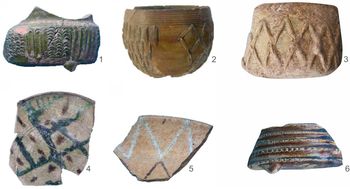
Glazed pottery from Córdoba (second half of ninth century). 1-2, 4-5 (Salinas Plaguezuelo and Pradell Reference Salinas Plaguezuelo, Pradell, Grasi and Castillo2018a), 3 and 6 (Photos Elena Salinas Plaguezuelo).

Epilogue: the case of al-Andalus
It is known that the Arab-Berber conquest of Hispania in the year AD 711 and its incorporation into the Dār al-Islam resulted in the creation of an Islamic society in the Western Mediterranean.
Beyond specific historical and political events, the birth of al-Andalus had a transitional nature that spans over more than three centuries. As we recently pointed out, ‘Objects, spaces, landscapes, common practices and social meanings did change deeply over those three centuries. The 10th century shows us a homogeneous society with an intense Islamization in al-Andalus, which has little to do with the Hispania that the Arab-Berber conquerors found at the beginning of the 8th century. A dialectical process transformed the society which predated 711, integrating both native people and Berbers inside the new Arab and Islamic guidelines for Andalusian society’ (Gutiérrez Lloret Reference Gutiérrez Lloret, Gelichi and Hodges2015, 44).
The Islamization process represented by that transition goes beyond the obvious religious transformation and linguistic Arabization of the people and affects all spheres of the social, political and economic structure. Within the last few years, archaeology in general and ceramology studies in particular have become a powerful tool for analysing social change by studying with precision the material evidence of those processes.
The example of al-Andalus is especially revealing because in just four decades of Iberian research developed both in Spain and Portugal, an important tradition of monumental Islamic studies has emerged (architecture, epigraphy, numismatics, sumptuary arts, etc.), influenced by Arabism and Medievalism. Thanks to these studies, a new perspective has emerged – more archaeological than anything else – which has focused on the settlements, the landscape and the material culture, with particular attention to the study of the ceramics from the first centuries of al-Andalus. The study of ceramics has explained that the changes in the production, distribution and consumption of wares were not homogeneous. The previous substrate and the distinct decommercialization, features of the end of the Antique world, condition a multifaceted and regionalized seventh century that is not recognizable from a material perspective.
Our experience has revealed that the understanding of this phenomenon requires overcoming the watertight compartmentalization that marks the different traditions of study typical of Roman and late Antique ceramics on the one hand and Medieval on the other. The different strategies and research agendas usually strengthen the productive, morphologic and technological differences previously recognized, creating a hiatus that does not really exist. This hiatus arises solely from the inability to acknowledge anything but the fully formed material universe: on the one hand, late Roman, Byzantine or Visigothic ceramics from the sixth and the first half of the seventh centuries, and on the other hand, the Islamic ceramics that can be recognized as such from the end of the ninth century. If we want to understand the real transformation that the creation of an Islamic society through its material culture represents, we need to start with the previous reality, since the same ways of producing and consuming ceramics remain within the early development steps of the Islamic culture and afterwards transform to the rhythm of what is defined as social Islamization.
Research on early Islamic ceramics in the Western Mediterranean has demonstrated the need to have complex stratigraphic sequences, both urban and rural, that cover the period between the seventh and ninth centuries and the need to study it from a contextual perspective that takes into account the sequence and nature of the deposit instead of the theoretical chronology attributed to the pieces themselves. Without verified stratigraphic sequences, the early years of the eighth century cannot be identified from a material point of view (Gutiérrez Lloret Reference Gutiérrez Lloret, Gelichi and Hodges2015, 83). Lacking stratified contexts, the typological recognition of early Medieval repertoires is overly complex, since identification depends exclusively on the percentual representativeness of the different types. Their decontextualized cataloguing can lead to artificial separation of repertoires, thus contributing to obscuring a transitional period: some repertoires are characterized by the permanence of late Antique shapes of Roman-Byzantine tradition that cannot be associated with the parameters of the Islamic material culture, while others already suggest the gradual incorporation of a socially Islamized context (Gutiérrez Lloret Reference Gutiérrez Lloret, Cressier and Fentress2011a, 257).
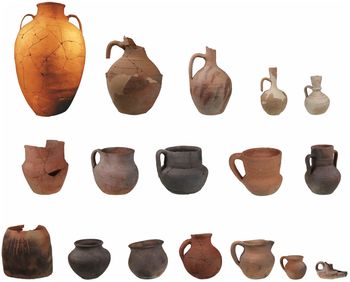
Almost a decade ago, in the framework of the aforementioned comparative reflection regarding early Medieval ceramics in al-Andalus and the Maghreb, we stated that, although increasingly precise indicators had been gathered for the period of hiatus between the disappearance of African imports and the appearance of Caliphal productions in the Andalusian shore of the Western Mediterranean, the parallel knowledge of the early Medieval registries in the Maghreb was crucial for understanding pottery production in the early Islamic period. The Andalusian experience can be used as reference for research in the Maghreb, while at the same time this research can broaden and enrich our knowledge of early Islamic pottery in the Western Mediterranean (Fig. 9).
Example of a fully Islamized domestic set from the end of the ninth century (El Tolmo de Minateda). Photos: El Tolmo de Minateda project. (References to the pottery see Amorós Ruiz Reference Amorós Ruiz2018.)