INTRODUCTION
The difficulties in conducting palliative care research have been widely acknowledged and include small sample sizes, ethical considerations such as concerns about patient abilities to consent, lack of funding, high attrition rates, limited numbers of funded research positions, public and professional misunderstanding of palliative care, and a lack of time and resources for clinician researchers (Grande & Todd, Reference Grande and Todd2000; Penrod & Morrison, Reference Penrod and Morrison2004; Kaasa et al., Reference Kaasa, Hjermstad and Loge2006). In order to generate the evidence needed to underpin palliative care, collaborative research is considered essential (Abernethy et al. Reference Abernethy, Hanson and Main2007; Kaasa, Reference Kaasa2008; Kaasa & Radbruch, Reference Kaasa and Radbruch2008). Accordingly, there has been an increasing international trend toward the establishment of formal research collaborations (Fainsinger, Reference Fainsinger2008).
In the United Kingdom, for example, the National Cancer Research Institute funded the establishment of interdisciplinary supportive and palliative care research collaborations to enhance the value, quality, and productivity of research in this area. These included the Cancer Experiences Research Collaborative and the Complex Assessment Trials and Implementation of Services collaboration (Bailey et al., Reference Bailey, Wilson and Addington-Hall2006; Payne et al., Reference Payne, Addington-Hall and Richardson2007). Similarly, in the United States, the Palliative Care Research Cooperative (PCRC) has been established, which aims to generate high-quality evidence on prioritized clinically relevant topics in palliative care (Abernethy et al., Reference Abernethy, Aziz and Basch2010).
In Australia, the national government funded the Palliative Care Clinical Studies Collaborative, which focuses on clinical drug trials (Shelby-James et al., Reference Shelby-James, Hardy and Agar2012); however, a formal research collaboration exploring broad areas of palliative care and a variety of research topics did not exist. A preliminary study was conducted to underpin the development of palliative care research collaboration for the state of Victoria. The project incorporated the following objectives: (1) exploring whether a collaboration was desirable; (2) determining the enablers and barriers to establishing a collaboration; (3) developing the research agenda; and (4) establishing the structure and resources required to support the network.
METHODS
For the purposes of our work, we defined “palliative care research collaboration” as follows:
A formal collaboration of individuals from several institutions that focuses on a strategic approach to conducting research and advancing empirical enquiry in palliative care.
The development of the collaboration was based upon three data-collection strategies, including a questionnaire, interviews, and stakeholder workshops. An advisory group of key experts was established to oversee the project. Given this was considered a “quality improvement” initiative, a formal ethical panel review was not requested. Nonetheless, all participants were fully informed and advised of the conventional confidentiality requirements, and the project was conducted in accordance with standard ethical guidelines. In addition, the project was conducted in partnership with the Department of Health, Victoria. Data were collected over a 12-month period from July of 2008 to June of 2009.
1. Questionnaire
To assist with meeting objectives 1–4, a questionnaire was developed by the investigative team and an advisory group of key experts in the field of palliative care research. The 22 questions were predominantly multiple choice with an open-ended “other” category. The questionnaire covered current involvement in palliative care research; research gaps and priorities; enablers and barriers to conducting research; and establishing and maintaining research collaborations, including the perceptions of the benefits or otherwise of forming a Victorian palliative care research collaboration.
The web-based questionnaire was distributed across Victoria to the managers of all palliative care services (in patient and home care) and to all palliative care academics within the state. The questionnaire invitation email was sent to 280 individuals and organizations in Victoria, encompassing: known palliative care researchers; palliative care consortia (eight regional groups consisting of the funded palliative care services based on the Victorian Government Department of Human Services regions); palliative care physicians; palliative care rural and metro service providers; and community health services. In an attempt to ensure that no one was excluded from participating in the questionnaire, the invitation email encouraged interested parties to forward the email on to other colleagues. Invitations to participate in the questionnaire were sent by email with a link to the online questionnaire. A reminder was sent closer to the closing date, with a follow-up two weeks later.
2. Interviews
Semistructured interviews were conducted with 21 key informants to obtain their views regarding the benefits, enablers, and barriers of collaboration, and on the ideal components required for success, encompassing the complexities of multiple sites and disciplines. A purposive sample was selected for interviews and comprised several participants (local, national, and international) who had significant contributions and involvement in palliative care research or other related areas of research and had successfully built research collaborations. The interviews were conducted face to face, by a research fellow where possible, or via telephone. The interviews requested participants to reflect on current research collaboratives in healthcare research, enablers and barriers to collaborative research, and key ingredients for successful research collaboration.
3. Stakeholder Workshops
A framework for a palliative care research collaboration was developed based on the results of the questionnaire and interviews. This framework was presented for discussion and consideration at two workshops facilitated by external strategic planning consultants. The framework incorporated indicative vision, mission, principles, outcomes, actions, timeframes, structure, and costs. Invitees included the project's steering committee and other key experts in the field of palliative care research. The aim was to debate and refine the various elements of a draft framework through guided discussion.
RESULTS
Questionnaire
Description of Sample
Some 61 participants completed the online questionnaire—a response rate of approximately 20% (the exact number of people to which the survey went is unknown since a snowballing technique was employed). Respondents were primarily from metropolitan hospitals (n = 17, 28%) or universities (n = 12, 20%), with community health services (n = 9, 15%), metropolitan community palliative care providers (n = 6, 10%), regional/rural community palliative care providers (n = 6, 10%), and regional/rural health services (all n = 6, 10%) also represented. Almost two thirds of respondents (n = 39, 64%) were currently involved in palliative care research, and participants reported being involved because they had a personal interest in the field (55%).
Current Research Priorities
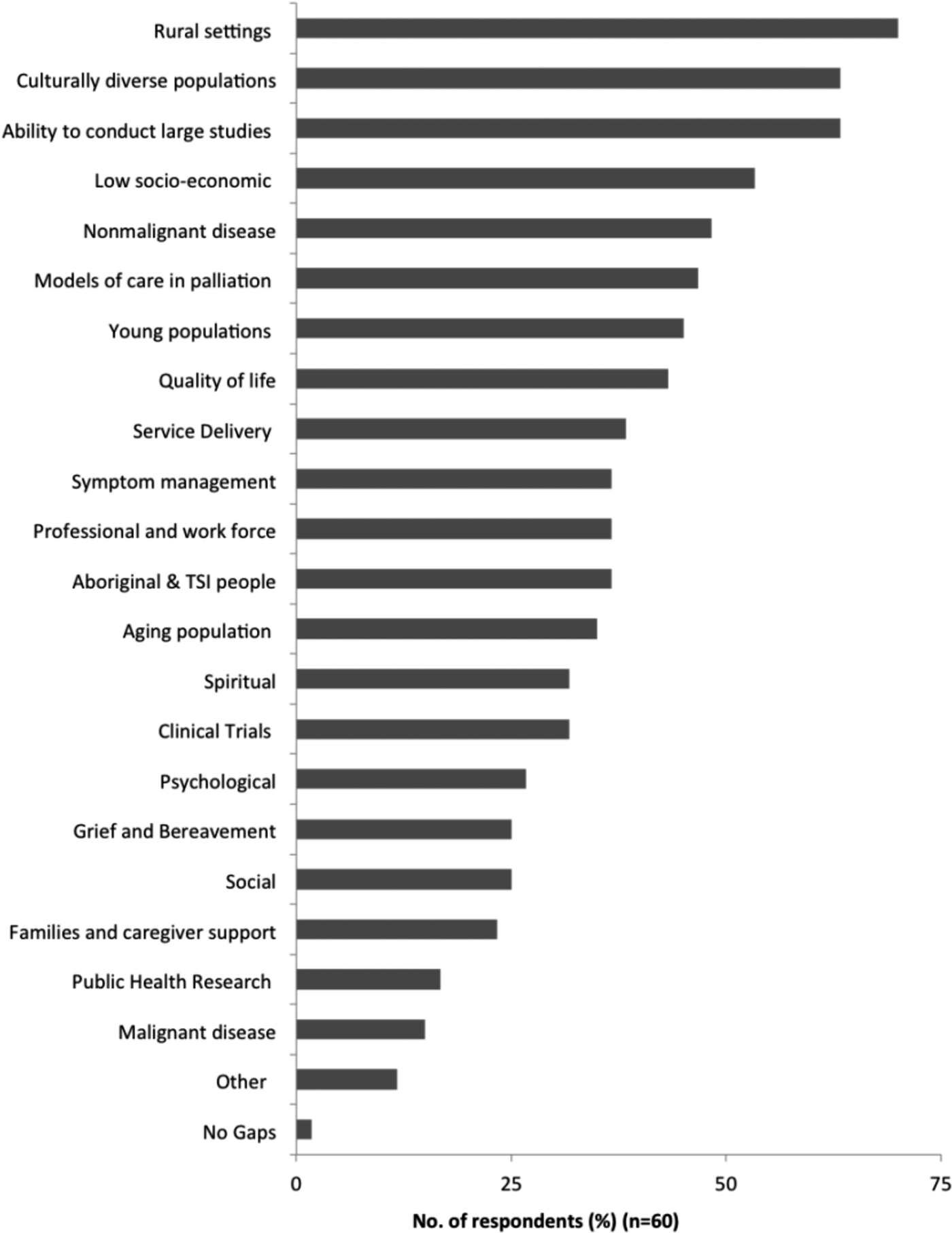
A total of 60 participants responded to current gaps from a comprehensive list of areas in palliative care research. Figure 1 depicts the highest-rated research gaps.
Gaps in palliative care research.

Barriers and Enablers to Research
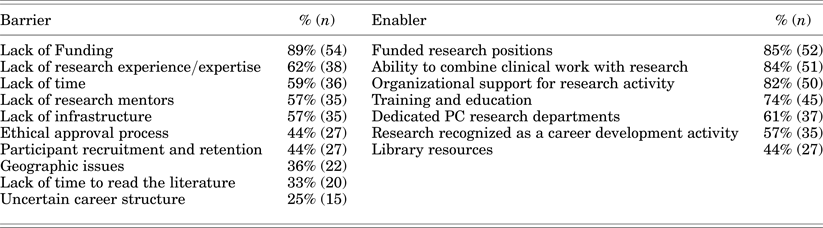
Table 1 reports the identified barriers and enablers to conducting palliative care research. The highest-rated barrier was a lack of funding, whereas the enablers were funded research positions, the ability to combine clinical work with research, and organizational support for research activities.
Barriers to and enablers of conducting palliative care research
Research Dissemination and Translation
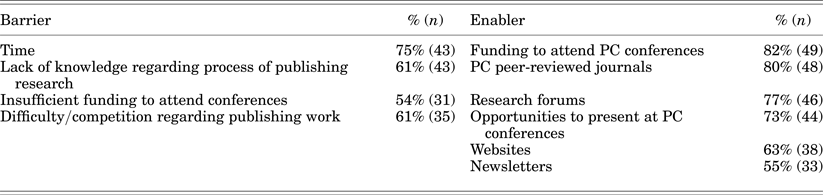
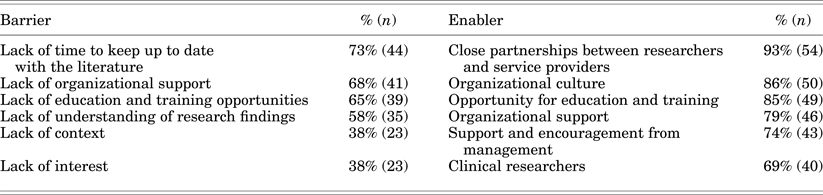
The greatest barrier for both research dissemination and translation of findings to clinical care was a lack of time (Tables 2 and 3). Lack of knowledge surrounding the process of publishing was also noted as a barrier to dissemination, while a lack of understanding of research findings was a barrier to translation of findings to clinical care.
Barriers to and enablers of dissemination of research
Barriers to and enablers of translation of research findings to clinical care
Views on the Establishment of a Formal Research Collaborative
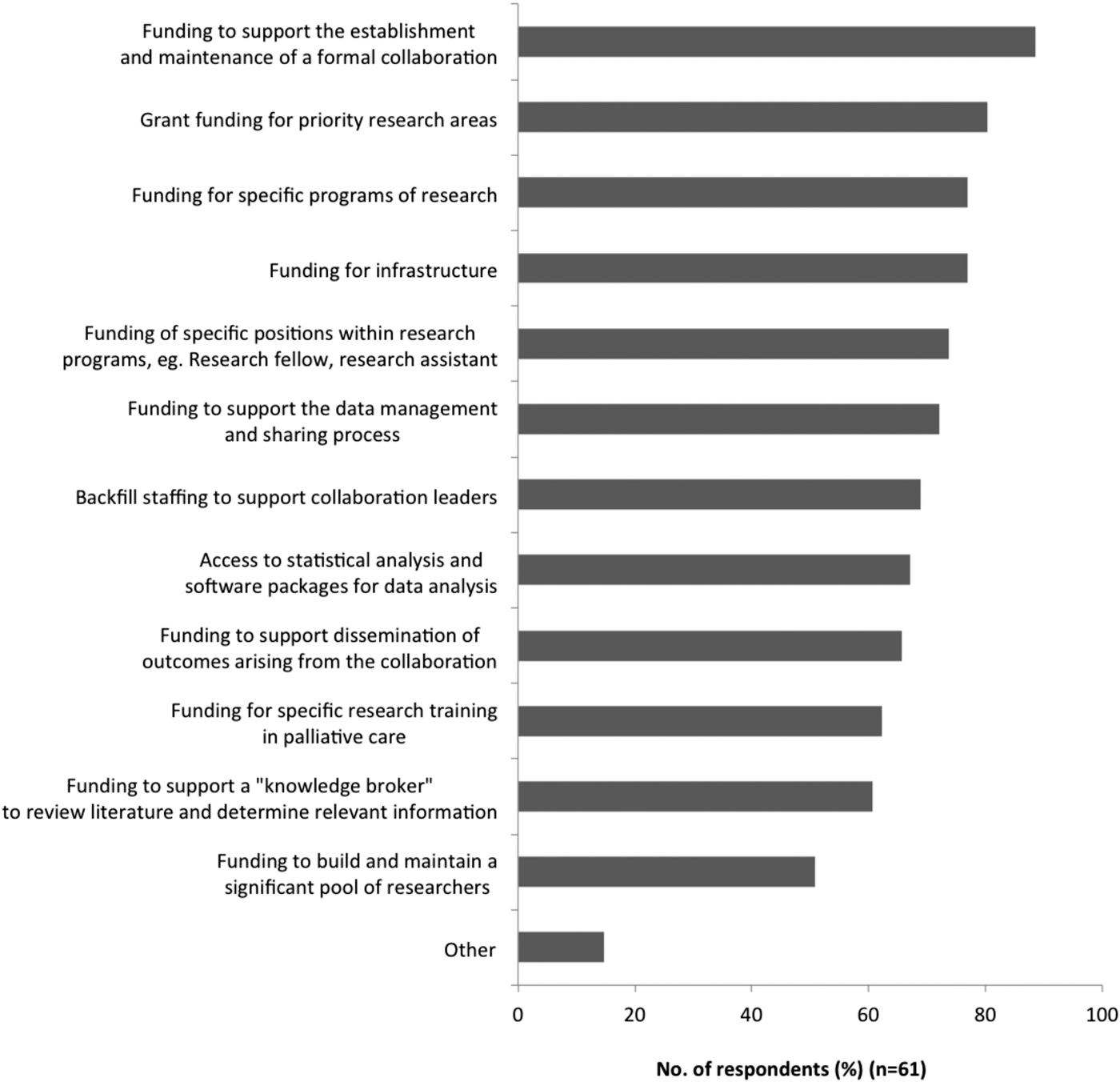
When asked about views on forming a collaborative group, almost all participants (n=58, 95%) indicated that they would like to see the formation of a collaborative group for Victoria. Figure 2 depicts the essential ingredients for successful palliative care research collaboration.
Essential ingredients for successful statewide palliative care research collaboration.
Interviews
Some 21 semistructured interviews were conducted with key informants, including: the CEO/director or deputy director of a research centre (or similar relevant agency) (n = 11); a vice chancellor (n = 1); the head of school within a university (n = 2); a professor within a university (n = 3); an associate professor within a university (n = 1); and the head of medical department (n = 3).
Focus of the Collaborative
All participants stressed that research collaborations were valuable for research outcomes. Many highlighted that collaboration would be beneficial because palliative care research is a small developing field and noted the many known difficulties associated with conducting palliative care research. Nevertheless, all key informants stressed difficulties associated with creating a successful multisite, multidisciplinary research collaborative.
Some key informants discussed whether the focus of the collaboration should be palliative care research exclusively or whether it should include such other related areas as supportive care, grief and bereavement, or pain research. The key informants held mixed views: some preferred the wider research focus, as several of the research areas overlapped. However, others suggested that the collaboration should be confined to palliative care research; otherwise, the collaboration might lose focus and become too large to manage.
Potential Benefits, Enablers, and Barriers
The key informants highlighted the many potential benefits of a successful research collaboration, which included: increased research capacity; the ability to create a critical mass; improved research quality; prevention of duplication in research; and improved ability to compete for large grants. They stressed that a successful collaboration would require a clear vision and governance structure with appropriate leadership. Maintenance and sustainability would depend on the ability to attract and retain high-quality staff and prudent business planning. The individuals involved in the collaboration would play a key role in ensuring success.
However, several potential issues and barriers associated with the creation and maintenance of research collaborations were highlighted, including: lack of resources; lack of time; interpersonal issues; research considered to be of low priority in some contexts; the difficulties associated with conducting palliative care research; governance and administration issues; and geography.
Stakeholder Workshops
Some 29 participants attended one or both workshops. The participants included: directors and CEOs (n=7); professors and heads of university departments (n=7); clinical or medical directors (n=6); researchers and project officers (n=6); managers of government departments (n=2); and one full-time clinician.
All participants favored the formation of a palliative care research collaborative and assisted in developing the mission and vision statements for the initiative. Participants agreed that the focus should be palliative care, but relationships might be formed with other fields as opportunity and need allowed. It was recommended that the collaborative be built around strong partnerships with a clear agenda, mission, and values. Participants considered that capacity building was a key area to be addressed for the future of palliative care research and that collaboration should build upon existing capacity. Participants regarded the governance and structure of the collaboration as very important.
Formation of the Network
Based on these data, three years of funding was granted to develop a Victorian research collaboration in palliative care (2009–2012). The Palliative Care Research Network of Victoria opened to members in 2013.
DISCUSSION
Justification for Establishing the PCRNV
Our data support the findings of others when confirming the reasons for developing a research network (Health Canada, 2007; Abernethy et al., Reference Abernethy, Aziz and Basch2010; Payne et al., Reference Payne, Seymour and Grande2012). Respondents reported the potential advantages of a formal palliative care research collaboration, including: more evidence to underpin practice; increased sample size; consolidation of a small and fragmented workforce; maximizing clinician support and engagement; greater capacity of translation of knowledge into practice; and research capacity building.
Both the interview and the questionnaire data demonstrated significant interest and support for a palliative care research network in Australia. Research funding was a significant theme in the qualitative and quantitative results. Funding, or the lack thereof, was the highest-ranked enabler of and barrier to palliative care research. The Canadian Palliative and End-of-Life Care Initiative, which engaged multiple partners to support the development of collaboration for palliative research, emphasized the importance of ongoing funding (Health Canada, 2007). Abernethy and colleagues (2007) also reinforced the importance of core funding in order to develop and sustain research networks. Funding issues were outlined in a review which found that 25% of palliative medicine research was published without acknowledged funding; the conclusion was that research funding for palliative medicine was inadequate (Gelfman & Morrison, Reference Gelfman and Morrison2008). The lack of research funding has been previously identified in Australia, with a survey identifying “lack of funds” as the second highest barrier to palliative care research, behind “lack of time” (Hardy et al., Reference Hardy, Maresco-Pennisi and Gilshenan2008).
The interviews identified that there are numerous advantages to collaboration. These are consistent with those previously noted in the literature (Abernethy et al., Reference Abernethy, Aziz and Basch2010). However, collaboration needs to be balanced and managed by a clear governance structure and appropriate leadership. The data from our present study also demonstrated the importance of working closely with clinical services in order to improve dissemination.
A limitation associated with our study was the inability to calculate an accurate response rate to the survey, due to the electronic dissemination method. The low response rate is also a limitation in that it is possible that the sample is biased toward those who have a greater interest in collaboration. It was also possible that the project team failed to identify all Victorian individuals involved in or interested in palliative care research, and therefore their opinions were not represented.
Preliminary Outcomes of the PCRNV
Although the PCRNV has only recently been formally established, several key achievements can be noted. These include: a formal governance structure; a clear vision to improve palliative care outcomes for patients and families, being informed by high-quality research; strategic direction and a business plan; completion of a collaborative research project that employed two postdoctoral researchers; established links with a number of key groups locally, nationally, and internationally; 10 peer-reviewed research proposals endorsed by PCRNV and submitted for competitive grants (three of which were successful); and presentations at state and national fora.
FUTURE RESEARCH AND STRATEGIES
Consistent with the literature, while there have been valuable preliminary achievements from the PCRNV, it has not been without several challenges. Future research should explore strategies to overcome some of these barriers. Payne and colleagues (2012), for example, acknowledged several difficulties, including: maintaining strong links between academicians and clinicians; management of funds and resources; variations in research expertise; coordination of multiple projects, and dealing with different agendas (individual and institutional).
Other important questions arose from the inception of the PCRNV initiative and have included: (1) how should clinician expectations of a research network be managed, and what role should clinicians play? (2) should researchers have less of a governance role in order to concentrate on grants and publications? (3) what is the true cost of establishing and sustaining a research collaboration? (4) what are the optimal means of determining research priorities? (5) what criteria determine the success of a research collaboration? (6) how can the infrastructure and funding base be maintained? (6) how do research collaborations work across different settings and cultures? We aim to address these questions as the PCRNV unfolds, and this can also be the focus of future research.
The recent report on the establishment and outcomes from the National Cancer Research Institute Supportive and Palliative Care Initiative in the United Kingdom (NCRI, 2013) provides useful insights to guide the development of research collaborations. Recommendations and outcomes arising from other palliative care research networks are encouraged; without these, some of the significant costs and benefits of formal research collaborations will remain poorly understood.
CONCLUSION
Although there are challenges to overcome, the recognition of a need to collaborate in order to enhance palliative care research outcomes is unequivocal (Abernethy et al., 2008). Investment in formal research collaboration is likely to have much greater impact than small-scale individual studies (Payne et al., Reference Payne, Seymour and Grande2012). The research and efforts to establish the PCRNV are encouraging to date and provide optimism for the evolution of palliative care research in Australia, and potentially more broadly. Importantly, the direct outcomes of this palliative care research collaboration and others throughout the world need to be published; otherwise, the true merit and feasibility of these initiatives will remain unclear.
ACKNOWLEDGEMENTS
The project was funded by the Victorian Cancer Agency. The authors thank the project's steering committee members for their support and contribution to the project: Sheila Payne; David Brumley, Jackie Kearney, Donna Milne, Sophie Gravel, Tracey Mander, and Mark Cockayne. The authors would like to thank the key informants: Richard Fox, Linda Kristjanson, James Best, Phyllis Butow, Patsy Yates, Sally Redman, David Currow, Rob Sanson-Fisher, Warwick Anderson, David Castle, Michael Ashby, John Zalcberg, Samar Aoun; Michael Jefford, Lynn Oldham, Harshal Nandurkah, Mike Salzberg; Drs. Mark Boughey, Tina Thomas, Melanie Price, Katherine Clark, Meinir Krishnasamy, Peter Martin, Jeremy Couper, Melanie Benson, and Jennifer Tieman, Rebecca James, Christopher Hall, and Jane Hanson. The authors would like to thank Bruce Rumbold, Peter Martin, and Anne Harbison for their support and contribution to the project. The secretarial assistance provided by Emilia Agalianos is also appreciated.