

A concise history of atomism in Greek natural philosophy comprises the formulation of atomism by the “founders” Leucippus and Democritus, the detailed critique and refutation of atomism by Aristotle, and the subsequent formulation of a post-Aristotelian atomism by Epicurus, in response to Aristotle's critique and refutation.Footnote 1
In the parallel concise account of atomism in Islamic natural philosophy, the “founders” of atomism are the early mutakallimūn and the critique and refutation of atomism is by Ibn Sīnā, in particular his detailed discussion in Book Three of the Physics of the Shifāʾ. To carry the parallel further, we may ask whether there is a post-Avicennan reformulation of kalām atomism analogous to the Epicurean reformulation in Greek atomism. The answer to this question requires conducting a research project to examine post-Avicennan kalām discussions of atomism by Ashʿarīs, Mātūridīs, Zaydīs and Twelver Shīʿīs. This article engages one aspect of such a project, through examining post-Avicennan atomism among some Ashʿarī mutakallimūn, in particular al-Juwaynī, al-Ghazālī, al-Shahrastānī,Footnote 2 and Fakhr al-Dīn al-Rāzī.
In The Physical Theory of Kalām, I characterized kalām physical theory as consisting of an atomistic theory of matter, corresponding theories of discrete space, time and motion, and the affirmation of void space. The present discussion does not examine all these aspects of physical theory. Rather, it is limited to the foundational question of the atomistic theory of matter. I begin with an overview of Ibn Sīnā's refutation of the atomistic theory of matter expounded in Book Three of the Physics of the Shifāʾ and then examine the responses of these Ashʿarī mutakallimūn.
IBN SĪNĀ'S DISCUSSION OF ATOMISM IN THE PHYSICS OF THE SHIFĀʾ
Aristotle had commenced his refutation of Democritean atomism in Physics 5.3 through the analysis of key terms for discussing physical continuity, such as “together”, “apart”, “in contact”, “between”, “in succession”, “continuous”, and “contiguous.”Footnote 3 Ibn Sīnā similarly commences his critique of atomism in 3.2 of the Physics of the Shifāʾ with an analysis of the terms “succession”, “contiguity”, “interpenetration”, “cohesion”, “continuity”, “intermediate limit”, “being together”, and “being separate.”Footnote 4 Not surprisingly, Ibn Sīnā analysis of these terms is premised on the notion of magnitude as continuous and divisible rather than as discrete and indivisible. Aristotle's and Ibn Sīnā's strategy of beginning the analysis of atomism through a discussion of these terms emphasizes their central concern – what is the nature of the relationship between the observed continuity of sensible bodies, their divisibility into parts, and their constitution from such parts?
In his discussion, Ibn Sīnā lists three positions on the constitution of sensible bodies (al-ajsām al-maḥsūsa):
ISa) bodies are composite (taʾlīfan), constituted from finite (mutanāhiya) indivisible parts (ajzāʾ alladhī lā yatajazzaʾ);
ISb) bodies are constituted from infinite parts (ajzāʾ lā nihāya lahā);
ISc) bodies are constituted either from finite actual parts, or do not have any actual parts.Footnote 5
Ibn Sīnā identifies proponents of the first view – “those who say that bodies terminate at atoms”Footnote 6 – as Ancients (al-qudamāʾ), consisting of Democritus, Proclus, and Epicurus,Footnote 7 and Moderns (al-muḥdathūn), whom he does not list.Footnote 8 However, it is clear from the arguments and proofs he attributes to the Moderns that they are the atomist mutakallimūn, some of whom were his contemporaries.Footnote 9 He lists their “proofs” (ḥujaj) as:
ISA1. body results from the composition (taʾlīf) of indivisible parts. When composition is removed, the body ceases to exist leaving behind its constituent indivisible parts;Footnote 10
ISA2. the half-distances argument illustrated by the traversal of an ant over a sandal (the Ancients had used the example of Achilles and the tortoise). For this distance to be traversed, half of it must first be traversed, and before this can commence, half of this half be traversed, and so on. Hence either traversal can never commence or division must reach a limit. Since motion exists, there must be an end to division and therefore indivisibles exist;Footnote 11
ISA3. if division is unlimited, the parts of a mustard seed would completely cover the earth;Footnote 12
ISA4. if division is unlimited, the parts of the mustard seed would equal to the parts of an enormous mountain;Footnote 13
ISA5. a self-subsisting point, which is indivisible, is equivalent to the atom;Footnote 14
ISA6. according to Euclid there is a minimal indivisible angle;Footnote 15
ISA7. a sphere rolling on a smooth surface forms a line constituted of successive points.Footnote 16
Turning to the second position on the constitution of body – that it is constituted out of an actual number of infinite parts – Ibn Sīnā identifies its proponents as advocates of the theory of the “leap” (ṭafra). As is well-known, this theory was held by the mutakallim al-Nāẓẓām and his followers.Footnote 17 Ibn Sīnā mentions the controversy between proponents of the first position and proponents of the second position regarding variations in the rotational speed of circles on a millstone (rāhy). The atomists hold that these variations in speed derive from interspersed periods of rest and motion during rotation while proponents of the leap claim that variations derive from differences in the number of leaps in the motion of the two circles. Ibn Sīnā further describes how proponents of the leap forced the atomists to admit that their theory of interspersed rests and motions entails the fragmentation (tafakkuk) of the millstone during its rotation.Footnote 18
Ibn Sīnā's next chapter, 3.4 of the Physics of the Shifāʾ – “Establishing the true opinion and refuting the false” – is devoted to refuting “those who constitute bodies from [indivisible] nonbodies” (madhhab al-muʾallifīn li-al-ajsām min ghayr al-ajsām). By this formulation, Ibn Sīnā highlights the atomist contention that atoms are not bodies, and are thereby indivisible. He presents the following arguments against atomism:
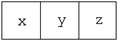
ISB1. The constitution of such bodies out of parts must be through the manners of “mere succession, contiguity, interpenetration, or continuity.” But the constitution of bodies out of parts which are not bodies in any of these manners cannot produce a continuous body. As an example, take three atoms (x, y, z) in a row. How can one explain the manner in which the middle atom y hinders contact between the two atoms x and z at the two ends? It must be because each of these two atoms x and z “has conferred on the contact” with the middle atom y “something of itself that the other has not, this is self-evident, and therefore
 the atom in the middle is conceptually divided.” In other words, each of the atoms x or z is in contact with a different “part”, “side”, or “edge” of the atom y, so that “what is in the middle” is conceptually divided.Footnote 19
ISB2. A sheet of a single layer of atoms illuminated on one side by the sun, must also be simultaneously illuminated on the other side because, if atoms are indivisible, one cannot distinguish this side from that side. This is absurd.Footnote 20
ISB3. Atomism entails geometrical difficulties that necessitate denying geometrical objects like circle, right triangle, and other figures. The hypotenuse of a right isosceles triangle with sides of ten units is impossible. The atomists, Ibn Sīnā reports, respond by claiming that “vision errs with respect to the circle and right triangle, and that these figures are serrated” (ashkāl muḍarassa).Footnote 21 But, Ibn
Sīnā argues, this leads to further difficulties regarding diagonals and other lines that are neither horizontal nor vertical.Footnote 22 This is clear in the figure in which the triangle ABC is depicted in the discrete cellular space of kalām atomists. AB, which is “horizontal”, and AC, which is “vertical”, are “straight” lines, but the hypotenuse BC, is serrated.ISB4. Atom a on top of two atoms b and c is either on top of both b and c, or on top of one of them (b or c).
Thus if atom a touches both b and c, it is conceptually divided by the boundary between the atoms b and c, so that a part is above b and a part is above c.Footnote 23
ISB5. A gnomon illuminated by the sun produces a shadow on the ground. When the sun's position in the sky moves the distance of an atom the size of shadow must change; but this change must be fractional and less than an atom. This entails the division of the atom.Footnote 24 Similarly when the hypotenuse of a right triangle with two unequal sides is yanked so that its longer side is stretched by one atom, the shorter side must decrease by less than an atom.Footnote 25
ISB6. The absurd consequence of the fragmentation of a rotating millstone entailed by the atomist position.Footnote 26
ISB7. The atomist conundrum regarding variation in speed, that is, slowness or fastness derives from a lesser or greater number of interspersed rests. Can we account for the variations in speed of the sun, a flying arrow, or a galloping horse with this view? Compared to the motion of the sun, motions of the arrow and the horse would need thousands of rests!Footnote 27
ISB8. Two objects moving in opposing directions across adjacent paths can pass each other without ever being opposite each other during their course of motion.Footnote 28 Consider two rows of atoms (a, b, c, d and e, f, g, h) moving in opposite directions, atoms a and e, b and f, c and g, and d and h are opposite each other at the beginning of the motion.
At the next instant, both rows shift over by one unit:
Hence atoms b and e, c and f, and d and g can never be opposite each other during the motion.
ISB9. Consider a row of three atoms a, b, c with two atoms x, z on top of a and c, in such a manner that x and z are separated by empty space y the size of an atom.
 the atom in the middle is conceptually divided.” In other words, each of the atoms x or z is in contact with a different “part”, “side”, or “edge” of the atom y, so that “what is in the middle” is conceptually divided.
 Sīnā argues, this leads to further difficulties regarding diagonals and other lines that are neither horizontal nor vertical.

When atoms x and z are pushed towards each other to occupy the empty space y, our “estimative faculty” (wahm) suggests they will move without obstruction and meet in the middle of y such that half of x, and half of z are now on top of b. This entails atoms are conceptually divisible.Footnote 29
IBN SĪNĀ'S CRITIQUE OF KALĀM ATOMISM AND IBN MATTAWAYH'S TREATISE ON ATOMS AND ACCIDENTS
Ibn Sīnā's critique of atomism in the Physics of the Shifāʾ and in other works shows an intimate understanding of kalām discussions of atomism. Ibn Mattawayh, a younger contemporary of Ibn Sīnā, is the author of one of our most detailed kalām sources for atomism. In his Treatise on the Properties of Atoms and Accidents (al-Tadhkira fī aḥkām al-jawāhir wa-al-aʿrāḍ) Ibn Mattawayh discusses not only kalām arguments for atomism, but also the “difficulties” (shubah) atomism raises, subdividing them into conceptual (ʿaqliyāt) difficulties, difficulties regarding geometrical figures (ashkāl), and difficulties raised by the theory of the leap.Footnote 30 Despite differences in style, approach, and technical vocabulary, there is a great deal of overlap between the discussions of Ibn Mattawayh and Ibn Sīnā. Is there any possibility of influence or response here? I don't think so. Ibn Mattawayh's discussion represents the teaching of his teacher ʿAbd al-Jabbār that was probably elaborated in detail in two inextant works: the early volumes of the Mughnī and the commentary on Abū al-Qāsim al-Balkhī's Maqālāt. There are strong reasons to believe that Ibn Sīnā may have been acquainted with the latter work.Footnote 31 If this was indeed the case, then the similarities between the accounts of Ibn Sīnā and Ibn Mattawayh suggest reliance on a common source. It is very likely that Ibn Sīnā's detailed discussion of kalām atomism derives from access to kalām texts that preserve the arguments and counter-arguments of proponents and opponents of kalām atomism.
DID IBN SĪNĀ INFLUENCE AL-JUWAYNĪ'S DISCUSSION OF ATOMISM?
The Ashʿarī mutakallim al-Juwaynī (d. 478/1085) was another younger near contemporary of Ibn Sīnā. Robert Wisnovsky has shown Ibn Sīnā's “influence” on al-Juwaynī through the latter's adoption of the Avicennan formulation of wājib al-wujūd.Footnote 32 Al-Juwaynī's most extensive extant discussion of kalām atomism is found in his al-Shāmil fī uṣūl al-dīn where an Ashʿarī perspective of atomism is found. Regarding falsafa views on the division of body, al-Juwaynī states:
The followers of Islam (islamiyyūn) agree that bodies (ajsām), with respect to their division, reach a limit resulting in individual [parts] (afrād). Each part is indivisible having neither side (ṭarf) nor edge (ḥadd). [Each] part is homogenous having no distinctiveness. Those who have immersed themselves deeply in geometry incline to this view. However, they designate the “atom” (juzʾ) by [the term] “point” (nuqṭa). They were categorical about the indivisibility of the point. The majority of the falāsifa inclined to the view that there is no limit to division of bodies (ajrām). Al-Naẓẓām, who is among those who are associated with the falāsifa, [also] inclined to this view. We will first clarify the ways to refute the falāsifa, then we will turn to al-Naẓẓām and we will clarify to him that his doctrine leads to the destruction of the principles of religion.Footnote 33
Al-Juwaynī present three arguments affirming atomism: the argument that a finite interval is traversable only because it is constituted from a finite number of indivisible parts (this entails responding to al-Naẓẓām's counter-argument that his hypothesis of the leap allows traversing an interval constituted from infinite parts); the argument that differences in sizes of objects are due to the numbers of atoms that constitute them; and the argument that if one were to replace the accidents of composition in a body by their contraries, namely accidents of separation, the result would be individual separated atoms.Footnote 34 Ibn Sīnā lists these arguments in the Physics of the Shifāʾ. But there is no evidence to indicate that al-Juwaynī was responding to Ibn Sīnā's critique of atomism. He does not take up Ibn Sīnā's anti-atomistic arguments. Rather, al-Juwaynī's discussion is consistent with the pre-Avicennan Ashʿarī discourse on atomism.
AL-GHAZĀLĪ'S ATTITUDE TOWARDS KALĀM ATOMISM
Many contemporary scholars classify al-Ghazālī as an “Ashʿarite theologian.” While he would not dispute the foundational principles of Ashʿarism, it is doubtful whether al-Ghazālī would have characterized himself as a mutakallim. Indeed, even though he held a progression of views through his life, he held kalām and its practitioners in very low esteem for most of his intellectual life.Footnote 35
The evidence for whether al-Ghazālī ascribed to atomism is scanty. In his Maqāṣid al-falāsifa, which is summary of Ibn Sīnā's system written between 484/1092 and 486/1094, al-Ghazālī states, “there is nothing in the premises of geometry and arithmetic which is contrary to reason (ʿaql)”, a statement he then repeats in the Tahāfut al-falāsifa.Footnote 36 This statement suggests al-Ghazālī probably rejected the discrete cellular space of kalām atomism and its associated geometrical puzzles. In his discussion of different views on body in the Metaphysics of the Maqāṣid, al-Ghazālī discusses the view that body is constituted from atoms. He presents six arguments against atomism, most of them deriving from Ibn Sīnā's the Najāt. One of these arguments, that is missing in the Najāt is al-Naẓẓām's argument of the millstone, which, as discussed above, is found in the Physics of the Shifāʾ.Footnote 37 Al-Ghazālī does not defend atomism by rejecting of any these arguments. It may be argued that this is because the Maqāṣid was written to explicate the views of the falāsifa, and is thereby not written as a critique.Footnote 38 Rather, al-Ghazālī's critique of the falāsifa is reserved for the Tahāfut.
In the Tahāfut, atomism emerges in a minor way in two places in which it is raised through the literary device of a fictional interlocutor. The first occurs in the context of an objection against the falsafa position that intellectual cognitions (al-ʿulūm al-ʿaqliyya) inhere in the human soul. The interlocutor asks:
With what [argument] would you deny someone who claims that the substrate (maḥall) for knowledge is the indivisible space-occupying atom (jawhar fard mutaḥayyiz lā yanqasim)? It is well known that this is one of the positions of the mutakallimūn.Footnote 39
Asserting his authorial voice, al-Ghazālī dismisses the fictional interlocutor:
We do not prefer to pursue this position (maqām) because the discussion regarding the atom (al-juzʾ alladhī lā yatajazzaʾ) is lengthy and they (i.e. the falāsifa) have geometrical arguments regarding this that would take too long to elaborate. One of these is their statement, “[Consider] an atom (jawhar) in the middle of two other atoms […]” But the solution of this problem (shubha) will take too long and there is no need for us to plunge into it. So let us turn to another position.Footnote 40
The argument al-Ghazālī is referring to is Ibn Sīnā's ISB4. Despite the evasion here, al-Ghazālī lets his fictional interlocutor interrupt again at the end of this first discussion:
If someone says: Why don't you refute these demonstrations by [arguing] that knowledge inheres in the body in the space-occupying indivisible jawhar which is the atom (lit. individual part, al-juzʾ al-fard)?
We say: Because discussion of the atom is linked with geometrical matters whose solution will lengthen the discussion. Moreover, there is nothing in this [argument] that will refute the difficulty for it entails that power (qudra) and will (irāda) also inhere in the atom.Footnote 41
By his use of a fictional interlocutor and his evasive responses, al-Ghazālī would seem to at most have a lukewarm commitment to kalām atomism. Moreover, he explicitly acknowledges the challenges posed by geometrical arguments. It is possible that al-Ghazālī had the specific geometrical arguments listed by Ibn Sīnā in the Najāt, which he himself had described in the Maqāṣid, in mind. In my view, we are on firm grounds to conclude that al-Ghazālī's response to Ibn Sīnā's critique of kalām atomism was to abandon atomism. Moreover, al-Ghazālī's less than enthusiastic endorsement of kalām itself suggests that Ibn Sīnā's refutation of atomism was perhaps not as important to his outlook as was his broader skepticism of normative Ashʿarī kalām.
IS AL-SHAHRASTĀNĪ'S VIEW ON THE CONSTITUTION OF BODY A RESPONSE TO IBN SĪNĀ'S REFUTATION OF KALĀM ATOMISM?
A refutation of kalām atomism is also found in Ibn Sīnā's Physics of the Ishārāt. In his commentary on these passages, Fakhr al-Dīn al-Rāzī states:
Body is, without doubt, capable of [repeated] division. All of these divisions are either possible (mumkina), actually realizable, or they are impossible. In both cases, they are either finite or infinite. Hence there are four possibilities:
1. Body is constituted from a finite number (mutanāhiya) of indivisible atoms (ajzāʾ lā tatajazzaʾ). This is the position held by a group among the Ancients, and most of the mutakallimūn among the Moderns.
2. Body is constituted from an infinite (ghayr mutanāhiya) number of indivisible atoms. This is the position some Ancients were forced into holding as was al-Naẓẓām of the Muʿtazilī mutakallimūn.
3. Body is not constituted from actual parts, but is capable of finite division. Muḥammad al-Shahrastānī preferred this position in his book al-Manāhij wa-al-bayyānāt.Footnote 42
4. Body is not constituted from actual parts, but is capable of infinite division. This is the position held by majority of the ḥukamāʾ, and is the position the Shaykh [i.e. Ibn Sīnā] wants to establish.Footnote 43
The first, second, and fourth positions have been discussed above. The third position, which Fakhr al-Dīn al-Rāzī attributes to al-Shahrastānī is new. Is this position a response to the Avicennan critique of kalām atomism?
Al-Shahrastānī's intellectual career was unusual. His early career, from his appointment to teach at the Niẓāmiyya in Baghdad to his authorship of kalām heresiographical texts, including Nihāyat al-aqdām, and al-Milal wa-al-nihal, illustrates his commitment to the Shāfiʿī madhhab and to Ashʿarī kalām. Late in life, he embraced Ismāʿīlī views (the teaching of the old “Bāṭiniyya”) and composed al-Muṣāraʿa al-falāsifa, which is a critique of Ibn Sīnā's metaphysics:
There is unanimity that the foremost in the sciences of wisdom and the most learned of all time in falsafa is Abū ʿAlī al-Ḥusayn ibn ʿAbd Allāh ibn Sīnā […] I desired to challenge him to a wrestling match […] I chose the best and firmest amongst what he says in the Metaphysics of the Shifāʾ, the Najāt, the Ishārāt, and the Taʿlīqāt. […]Footnote 44
Al-Shahrastānī's familiarity with Ibn Sīnā's œuvre is evident here (he also mentions Ibn Sīnā by name in his kalām heresiographical worksFootnote 45). The Muṣāraʿa is perhaps to be compared with al-Ghazālī's better known Tahāfut al-falāsifa. Al-Shahrastānī was also deeply familiar with kalām atomism as is evident in the Muṣāraʿa and his kalām works. For example, in the first question of the Muṣāraʿa, he mentions the kalām classification of existents noting that “by jawhar they mean the space-occupying object which prevents its like from occupying the place it is in.”Footnote 46
The al-Manāhij wa-al-bayyānāt, which Fakhr al-Dīn al-Rāzī mentions in his comments on the Ishārāt discussion of atomism, as containing al-Shahrastānī's unique position on atomism, is unfortunately inextant.Footnote 47 We cannot therefore ascertain whether al-Shahrastānī's distinctive view on the constitution of bodies, described by Fakhr al-Dīn al-Rāzī, was formulated as a response to Ibn Sīnā's critique of atomism.
Another work on atomism, that has been attributed to al-Shahrastānī, is extant. This text bears the title “A question regarding establishing the existence of the atom” (masāʾil fī ithbāt al-jawhar al-fard). Guillaume, the editor of the Nihāyat al-aqdām has published it as an appendix to his edition. He had found it appended to the Bodleian manuscript of the Nihāya. Carmela Baffioni, who utilizes this text in her study on Islamic atomism – Atomismo e Antiatomismo nel Pensiero Islamico – remarks that she also found this text appended to the Berlin manuscript of the Nihāya. However, she notes that it is not found in the best and earliest manuscript of the Nihāya in the Bibliothèque Nationale.Footnote 48 Several arguments against kalām atomism are found in this text. However, there is no evidence in it supportive of the view on the constitution of bodies which Fakhr al-Dīn al-Rāzī attributes to al-Shahrastānī. This raises more doubts on al-Shahrastānī's alleged authorship of this text, and even Baffioni concedes that it is “perhaps spurious.”Footnote 49 We cannot, therefore, evaluate al-Shahrastānī's response to Ibn Sīnā's critique of kalām atomism.
FAKHR AL-DĪN AL-RĀZĪ'S RESPONSE TO IBN SĪNĀ'S CRITIQUE OF KALĀM ATOMISM
Fakhr al-Dīn al-Rāzī was perhaps more familiar with Ibn Sīnā's œuvre than either al-Ghazālī or al-Shahrastānī. Muḥammad al-Zarkān, the author of an intellectual biography of al-Rāzī, lists commentaries on the ʿUyūn al-ḥikma, Ishārāt, Qānūn, Shifāʾ, and Najāt which are attributed to al-Rāzī.Footnote 50 Al-Rāzī discusses kalām atomism in many extant works, but unfortunately his monograph on atomism – al-Jawhar al-fard – is inextant.Footnote 51
In her study, Carmela Baffioni characterizes al-Rāzī as a critic and opponent of atomism.Footnote 52 On the other hand, Muḥammad al-Zarkān and, following him, Adi Setia consider al-Rāzī to be a proponent of atomism.Footnote 53 These diametrically opposed conclusions derive from the different texts examined by these authors as well as differences in their assessment of which of these texts reflect al-Rāzī's “actual” view.
In his intellectual biography, al-Zarkān categorizes al-Rāzī's works as belonging to various disciplines comprising kalām, falsafa, a synthesis of these two, and others.Footnote 54 For al-Zarkān the seemingly contradictory positions found in al-Rāzī's œuvre, that is for example, affirming atomism in the earliest phase of his intellectual career, then rejecting atomism, then adopting an ambivalent stance towards atomism or its rejection, and finally reverting back to affirming atomism, are to be explained within a developmental perspective. As an illustration of al-Rāzī's early affirmation of atomism, al-Zarkān points to al-Rāzī's al-Ishāra fī ʿilm al-kalām, which he believes was written “at the beginning of his intellectual life” since in it, al-Rāzī adheres to the views of al-Ashʿarī. This is evident in his statement, “The correct position is the one held by our shaykh Abū al-Ḥasan [al-Ashʿarī], may God be pleased with him.”Footnote 55 For the next phase, denial of atomism, al-Zarkān points to al-Rāzī’s al-Mabāḥith al-mashriqiyya and his commentary on Ibn Sīnā's Ishārāt. Al-Zarkān classifies both of these as al-Rāzī's falsafa works, written before 582/1186 AH, that is before al-Rāzī turned forty.Footnote 56 But, al-Zarkān asserts, “We cannot claim that what is found in these two works is al-Rāzī's actual view.”Footnote 57 He claims that the anti-atomistic arguments found in these works illustrates al-Rāzī's deep engagement with Aristotelianism and Avicennanism during this stage of his intellectual career. Al-Zarkān holds that in the al-Mulakhkhaṣ fī al-ḥikma wa-al-manṭiq, which he categorizes as a falsafa work, and in the Niḥāyat al-ʿuqūl, which he categorizes as a kalām work, we find the next phase of al-Rāzī's intellectual career which is an ambivalent stance, neither affirming nor denying atomism. Al-Rāzī lists arguments for both positions without committing himself to either of them. Al-Rāzī defends this ambivalence claiming that he is not the first to be ambivalent but that he had been preceded in this by al-Juwaynī and the Muʿtazilī Abū al-Ḥusayn al-Baṣrī.Footnote 58 Al-Zarkān considers al-Rāzī's final position on atomism to be expressed in one of his last major works, al-Maṭālib al-ʿāliyya. In this work, which according to al-Zarkān, is a synthesis between kalām and falsafa, al-Rāzī reverts to his early affirmation of atomism.Footnote 59
In his 2005 doctoral dissertation and publications arising from it, Adi Setia, accepts al-Zarkān's developmental thesis, chronology, and conclusion. Setia focuses on al-Rāzī's “final” theory which, in his view, affirms atomism.Footnote 60
On the other hand, Carmela Baffioni, who considers al-Rāzī to be a critic of atomism, also speaks of development. She considers al-Mabāḥith al-mashriqiyya to be a work composed “during (his) youth”, whose arguments al-Rāzī “would later abbreviate in other theological works.”Footnote 61 Baffioni therefore devotes considerable space to the Mabāḥith arguments against atomism. Baffioni also discusses “one of his mature works”, namely, al-Arbaʿīn fī uṣūl al-dīn, where arguments affirming atomism are followed by arguments against atomism.Footnote 62 Baffioni did not consult al-Maṭālib al-ʿāliyya for good reason – the text of the Maṭālib had not been published when she wrote her work.Footnote 63
These modern studies of Fakhr al-Dīn al-Rāzī's atomism provide the context for the texts that are discussed here. For the purposes of illustrating Fakhr al-Rāzī's engagement with Ibn Sīnā's refutation of atomism, I will examine the Mabāḥith arguments against atomism. I will then examine the discussion of atomism in the Maṭālib. Finally, I will briefly evaluate the discussion in the Arbaʿīn.
In the Mabāḥith, al-Rāzī discusses atomism in the section on substance (jawhar). Al-Rāzī begins by discussing definitions of “body” (jism), different positions on the divisibility of bodies, and then, in the third “chapter” (faṣl) turns to “proofs against atomism” (al-adilla ʿalā buṭlān al-juzʾ alladhī lā yatajazzaʾ). We may note that al-Rāzī does not discuss any arguments affirming atomism in the Mabāḥith. The twenty “demonstrative proofs” (barāhin) arguments against atomism are:
RMb1. This argument corresponds to ISB1, Ibn Sīnā's first argument in the Physics of the Shifāʾ, based on the analysis of the constitution of continuous bodies out of indivisibles through succession, contiguity, interpenetration, or continuity. Al-Rāzī's discussion is more detailed, raising three objections (shukūk), and responses to them. In his evaluation, this is not a strong argument (laysa fī ghāyat al-mātana).Footnote 64
RMb2. This argument corresponds to ISB9 depicting a row of three atoms on top of which two atoms are placed at the extreme ends and which then move to occupy the empty middle space.Footnote 65
RMb3. This argument corresponds to ISB8 in which two adjacent objects pass by each other without ever being opposite to each other.Footnote 66
RMb4. This argument corresponds to ISB7, the refutation of the atomist explanation that variations in speed derive from differences of interspersed motions and rests. Al-Rāzī argues:
If slowness of motion is not the result of interspersed rests then atomism is false. Since the antecedent is true in accordance with what has been discussed in the chapter on motion the consequent must be true. The support for the conditional proposition is: If the atom exists, and we traverse an interval at a fast speed, we would traverse through all the atoms of this interval. If traversal of one atom at fast speed takes some duration, then traversal at a slower speed for the same duration entails traversing less than the atom. Hence the atom has been divided!Footnote 67
RMb5. An atom a moving from atom b to another c is either moving when in contact with b at the beginning of the motion, which is absurd or is moving when in contact with c at the end of the motion, which is also absurd.
Hence it must be moving when it is between atoms b and c entailing the division of the atom!Footnote 68 There is no corresponding argument in Ibn Sīnā's Physics of the Shifāʾ.
RMb6. This argument corresponds to ISB2 regarding the illumination of a single sheet of atoms on one side by the sun.Footnote 69
RMb7. This argument claims that the atom is finite and that every finite object has a shape, and that every shape is bounded by an edge. If then, the atom is bounded by an edge, this edge can only be that of a sphere. But when spheres are combined together, their combination does not produce a solid body but contains gaps whose size is smaller than an atom.Footnote 70 There is no corresponding argument in the Physics of the Shifāʾ.
RMb8. This argument corresponds to ISB5 on the shadow of a gnomon inserted in the earth.
RMb9. This argument corresponds to of the absurdity of the fragmenting millstone in ISB6. However, instead of a millstone, al-Rāzī uses a top (duwwama).Footnote 71
RMb10. When one of the outer legs of a three-legged compass (firjār) is reduced by an atom, the middle leg must be reduced by less than an atom.Footnote 72 There is no corresponding argument in the Physics of the Shifā'.
RMb11. RMb11-RMb17. These arguments correspond to ISB3 on the geometrical difficulties regarding circles, right angles, diagonals etc.Footnote 73
RMb18. An atom z is placed on top of an atom a of a row of three atoms j, b, a.
The row of atoms moves one space to the right so that a moves to a new space, b now is in the space a was formerly in, and j is in the place b was in. At the same time the atom z also moves away from a in the same direction. After its motion, z is either above a, but this is not possible because z would not then have moved away from a and this is what we had supposed, or z is in a place next to the place above the new space of a. However, this entails z would have moved faster than a, because it would have covered two [atomic] spaces in the time a had covered one space, and this further entails that when z has traversed one atom, a would have traversed half an atom.Footnote 74 This poorly formulated argument is not found in the Physics of the Shifāʾ.
RMb19. This is al-Naẓẓām's argument of the well and the bucket reported by Ibn Mattawayh.Footnote 75 A well, one hundred units deep, has a wooden beam at its middle, that is, at the depth of fifty units. One end of the rope (RA), fifty units in length, is attached to the beam. It then passes through a ring and its other end is attached to a bucket. Another rope (RB), also fifty units in length, is attached to the ring. When rope RB is pulled up a length of fifty units, the bucket, which was initially at the bottom of the well, reaches the top of the well.
RMb20. This argument, while set within the frame of the argument of the shadow of gnomon, is based on the problem associated with dividing a length with an odd number of atoms.Footnote 77 There is no corresponding argument in the Physics of the Shifāʾ.
We can see that all but six of al-Rāzī's twenty arguments against atomism in the Mabāḥith derive from Ibn Sīnā's arguments in the Physics of the Shifāʾ (ISB1, ISB2, ISB3, ISB5, ISB6, ISB7, ISB8, ISB9).
Let us now turn to the later part of his intellectual career. Fakhr al-Dīn al-Rāzī characterizes his al-Maṭālib al-ʿāliyya as “our book on metaphysics (al-ʿilm al-ilāhī) which in the Greek language is called theology (uthūlūjiya).”Footnote 78 The framework of this work is primarily theological (God, attributes, prophecy, free-will, etc). However of its nine parts, the fifth part is devoted to time (al-zamān) and space (al-makān) while the sixth part is devoted to matter (hayūla). The extensive discussion of atomism in the sixth part occupies one hundred and forty-eight pages of the Beirut edition and is therefore al-Rāzī's most extensive discussion of this topic.Footnote 79
Al-Rāzī categorizes the arguments (adilla) in support of atomism into arguments based on motion and time, on the principles of geometry, on the finitude of the magnitude of bodies, and other arguments.
The category of arguments based on motion and time are prefaced with the remark that time, motion, and space/distance (masāfa) are interrelated (umūr thalāta mutaṭābiqa). Hence, if any is constituted from indivisibles, then all must be so constituted. Similarly, if any is continually divisible, then all must be continually divisible – which is the position of the falāsifa.Footnote 80 Thus al-Rāzī aims to show that motion or time are constituted from indivisibles, and thereby space/distance (and matter!!) must also be constituted from indivisibles.
Al-Rāzī presents six arguments affirming atomism based on motion which he defines as successive presence in spaces that blend into each other (ḥuṣūlāt mutaʿāqiba fī aḥyāz mutalāsiqa). Let us review the first argument (ḥujja). Al-Rāzī asserts that if a body is to move at all, it must be moving in the present instant (al-ḥāl al-ḥāḍir). Moreover, motion in the present instant must be indivisible, for if it were divisible one part of it would precede another. But this is impossible, because the first part of the motion would then also be divisible having a preceding part, and so on ad infinitum. Therefore, if motion at the present instant were divisible it could never exist as a whole (bi-tammāmih) at this instant. Thus motion at the present instant, which exists as a whole, must be indivisible. When this indivisible motion at the present instant ceases to be, the next one comes to be, and this too is indivisible, and when it ceases to be, the next one comes to be and so on, one indivisible motion succeeding another.Footnote 81
After these arguments for atomism based on motion, al-Rāzī turns to four arguments based on time. He aims to show that time (al-zamān) is constituted out of successive nows (al-ānāt al-mutatāliyya), each of them indivisible. Let us examine the third argument. Al-Rāzī asserts that time is either “like a continuous entity” (kamā mutaṣṣil) or “like a discontinuous entity” (kamā munfaṣil). The former is false because the past and the future do not exist. Al-Rāzī dismisses the falsafa claim that the now is not part of time because it is the end of the past and the beginning of the future. This is false, he argues, because it implies the continuity of a non-existent past with a non-existent future. It follows therefore that time must be discrete; and that it must be constitute from successive units, that is, successive nows.Footnote 82 Time is therefore constituted from indivisible parts and this entails indivisible parts of matter, space, and motion.
Al-Rāzī's second category of arguments is based on principles of geometry. Here, his aim is to show the existence of indivisibles (as when a sphere is in contact with a level surface) that entail affirming the atom.Footnote 83 In the third of four “demonstrative proofs” (burhān), al-Rāzī states:
The point is an indivisible entity having position (al-nuqṭa shayʾ dhū waḍʿ lā yanqasim). Since this is the case, the doctrine of affirming the atom follows necessarily.Footnote 84
Al-Rāzī's third category of arguments is based on the finitude of the magnitude of bodies. These arguments are grounded on the premise that if a body of finite magnitude were capable of infinite division, it must be actually composed of infinite parts. Al-Rāzī asserts that since the consequent is false, the antecedent must also be false.Footnote 85 He notes the falsafa objection, that by “capable of infinite division”, they mean potential division, namely, that after every division a further division is always possible. That is to say, asserting capability for infinite division does not entail the realization of infinite division. But, al-Rāzī argues, every one of the infinite divisions is realizable since there is no impediment to their division. Therefore, the converse, namely the combination of these infinite divisions to constitute the body must also be realizable, that is to say, the possibility of the constitution of a body from actually infinite parts.Footnote 86
Al-Rāzī's novel contribution to discussion of atomism in the Islamic milieu lies in his formulation of the category of arguments affirming atomism based on motion and time. This category embraces Aristotle's assertion of the interrelation of matter, space, time, and motion. Key to the Aristotelian, and then Avicennan critique of atomism is the rejection of the construction of continuous magnitudes from indivisible parts. Al-Rāzī directly takes up the challenge by his formulation that indivisible parts of time and motion form continuous magnitudes by “blending” into each other. The falāsifa may question whether al-Rāzī's notion of continuity of motion as successively blended indivisible motions, or continuity of time as successively blended instants, and whether his use of terms “like a continuous entity” or “like a discontinuous entity” is rigorous and withstands Aristotle's and then Avicenna's critique. However, the same question can be asked of the Epicurean reformulation of atomism following the critique of Aristotle. The conflict between the cosmologies of discrete atomism and Aristotelian/Avicennan continuity is precisely over different paradigms of continuity.
In addition to constructing these new arguments and reformulating previous arguments affirming atomism, al-Rāzī also responded directly to Ibn Sīnā's critique. First, he evaluated and categorized kalām arguments for affirming atomism which Ibn Sīnā had discussed in the Physics of the Shifāʾ and second, he responded to Ibn Sīnā's arguments against atomism. Regarding the former, the following is a summary of al-Rāzī's analysis of the arguments in support of atomism which Ibn Sīnā had discussed in the Physics of the Shifāʾ:
ISA1. This argument asserts that if all the compositions in a body were removed the result would be atoms. Al-Rāzī lists it as “the second proof (ḥujja) of the mutakallimūn” and places it in the category of other arguments for affirming the atom.Footnote 87
ISA2. This is the half-distances argument. Al-Rāzī lists it as “the first proof” in the category of arguments based on the finitude of the magnitude of bodies. He attributes this argument to Abū al-Hudhayl and lists two objections: the first is al-Naẓẓām's objection that led to the formulation of his theory of the leap. Al-Rāzī asserts that the falseness of this theory is self-evident (maʿlūm al-fasād bi-al-badīha). The second objection argues that just as body is infinitely divisible, so too is time, and therefore there is no difficulty for motion to commence.Footnote 88 This objection had been raised by Ibn Sīnā in his refutation of this argument.Footnote 89
Al-Rāzī responds by arguing that if the infinite parts of temporal duration were realized, motion could never end because the final temporal instant is unreachable. Hence, al-Rāzī concludes, division of the interval and of time must be limited.Footnote 90
ISA3. This is the argument of the infinite parts of a mustard seed covering the world. Al-Rāzī lists it as “the first proof” in the category of other arguments for affirming the atom.Footnote 91 In his remarks, al-Rāzī states:
Ibn Sīnā has said, “The necessity [that this is far-fetched – and thereby the anti-atomist position is false –] is also faced by those affirm the atom. This is because, given their position that body is composed from atoms, it is not far-fetched to suppose that in a mustard seed there can be surfaces [of atoms] which could cover the surface of the sky and the two earths. Since this necessity falls upon all of them (i.e. atomists and anti-atomists) then it is no longer far-fetched [for only the anti-atomist position].”Footnote 92
But al-Rāzī argues that “by affirming the atom we know that this is necessarily false.”
ISA4. This is the argument that if division is unlimited the infinite parts of a mustard seed would equal to those of a mountain. Al-Rāzī lists it as “the third proof” in the category of arguments based on the finitude of the magnitude of bodies.Footnote 93 Al-Rāzī defends this argument asserting that the parts of the mountain must be greater than the parts of the mustard seed, and this entails that the number of parts of both must be finite else comparison would be impossible. Hence there must be a limit to division.
ISA5. This is the argument that a self-subsisting point is the same as an atom. Al-Rāzī places it in the category of arguments based on geometry.
ISA6. This is the “indivisible” horn-angle argument. It is not mentioned by al-Rāzī.
ISA7. This is the argument that a line is constituted from the indivisible points traced by the motion of a sphere on a smooth surface. Al-Rāzī lists it as the first “proof” in the category of arguments based on geometry. Ibn Sīnā raises the objection that we cannot know whether such a situation of a sphere on a smooth surface is actually realizable or whether the resulting line is presumed by the estimative faculty (al-tawahhum).Footnote 94 Al-Rāzī counters, “we do not accept the possibility of a sphere and a surface being such as you have described” because there is no impediment “according to the principles of falsafa (ghayr mustaqīm ʿalā uṣūl al-falsafa)” which preventing the realization of this arrangement of a sphere on a smooth surface.Footnote 95
Al-Rāzī's comments on these anti-atomist arguments and his responses to Ibn Sīnā's objections demonstrate that the Maṭālib discussion of atomism is a direct response to Ibn Sīnā's refutation of atomism. This is made this explicit (without identifying Ibn Sīnā directly) in al-Rāzī's conclusion of arguments affirming atomism:
We have explained in many categorical and indisputable ways (al-wujūh al-qāṭiʿa al-yaqīniyya) that if bodies were capable of infinite division they would need to be constituted from infinite parts. We have mentioned these arguments to show that it is impossible for bodies to be actually composed from infinite parts. Hence the antecedent, that they are capable of infinite division must be false. In this way, these arguments serve to refute the doctrines of the falāsifa.Footnote 96
Having discussed arguments affirming atomism, al-Rāzī turns to arguments that refute atomism. He categorizes these arguments into those based on contact (mumāssa), on variations of speed, on the doctrine of the leap (ṭafra), on motion, and those linked to the “essence” (dhāt) of body and its spatial occupation. Most of these arguments correspond with the arguments he had made earlier in the Mabāḥith, which, as we have seen, originate from Ibn Sīnā. However, unlike the discussion of the Mabāḥith, the Maṭālib elaborates at length on the premises of the anti-atomist arguments, sometimes raising objections, and sometimes refuting the arguments. For example, in the argument corresponding to RMb2 and ISB9 (a row of three atoms on top of which two atoms are placed at the extreme ends which then move simultaneously to occupy the empty middle space),Footnote 97 al-Rāzī raises the objection that the simultaneous movement of two atoms is contingent upon the condition (sharṭ) of the possibility of splitting the middle space which is the length of an atom. But since it is impossible for this condition to be fulfilled “the condition of the possibility [of simultaneous movement] of the two atoms situated at the ends disappears (fāʾitan), and when this condition disappears, then what had been entailed by the condition (i.e. movement into the middle space) becomes impossible.”Footnote 98 In another place, al-Rāzī judges the arguments against atomism to be erroneous and untrue (ḥujja mughālaṭiyya wa-laysa ḥujja ḥaqīqiyya) and their results to be false (natīja bāṭila) because if they were true “bodies would be constituted out of actually infinite parts.”Footnote 99 Clearly al-Rāzī's stance in the Maṭālib is not one of ambivalence despite his discussion of both arguments affirming and refuting atomism. Therefore, I agree with the claim of al-Zarkān and Setia that al-Rāzī affirmed atomism at the end of his life in the Maṭālib. Moreover, it is evident that al-Rāzī arguments for affirming atomism directly respond to Ibn Sīnā's refutation of kalām atomism in the Physics of the Shifā' and in other works.
An examination of al-Arbaʿīn fī uṣūl al-dīn, which Baffioni considers to be “one of his mature works”, shows that its arguments affirming atomism are the same as those of the Maṭālib, albeit in an abbreviated form.Footnote 100 Like the Maṭālib, the Arbaʿīn is primarily a theological text but contains chapters affirming atomism and the void. The chapter on atomism contains arguments of both proponents and opponents of atomism. Anti-atomist arguments are introduced by the remark, “the falāsifa claimed that division by the estimative faculty (al-qisma al-wahmiyya) is unlimited. They proved it by the following arguments (lit. ways – wujūh).” After listing ten arguments against a limit to divisionFootnote 101 al-Rāzī concludes:
Let us limit the arguments for denying atomism to these ten. We have written a book devoted solely to this topic. Whoever wishes to probe deeply can consult this book. [Here] we will respond to all of these doubts (shubuh) with just one response, and we will leave specific responses for this book.
We then say – All of these arguments have a common premise (shayʾ), which is, each of the two sides of the atom must be characterized by a specific property that is absent in the other side. But this is something (maʿnā) required when infinite division is actually realized. The falāsifa do not believe this is possible nor do they accept the consequences of the doubts they have raised. They only believe in potentially divisibility, not the consequences of these arguments. Therefore the fact that all of these arguments are null and void has been established.Footnote 102
Clearly, when he wrote the Arbaʿīn, al-Rāzī was no longer ambivalent about atomism.Footnote 103
To conclude, al-Rāzī was thoroughly familiar with Ibn Sīnā's critique of kalām atomism in the Physics of the Shifāʾ and in other works. Arguably, he found this critique to be convincing during the early stage of his intellectual career. But later, and certainly at the end of his life, he affirmed his commitment to atomism, and defended it by formulating arguments and objections that responded directly to Ibn Sīnā's critique.
Epicurus, for classical Greek natural philosophy, and Fakhr al-Dīn al-Rāzī for Islamic natural philosophy, both reformulated the atomism of their predecessors, the former in response to Aristotle and the later in response to Ibn Sīnā. Epicurus' reformulation was extremely influential among subsequent generations of natural philosophers. Can the same be said of al-Rāzī's reformulation of atomism? Is it analogous to Epicurus? The short answer is that al-Rāzī's reformulated and novel arguments affirming atomism were well known and discussed by later generations of scholars. They are found, for example, in al-Ījī's influential al-Mawāqif fī ʿilm al-kalām which, for centuries was the school text for the study of kalām. However, a detailed and nuanced answer to this question requires a thorough examination of discussions of atomism in texts written after the fourteenth century. This task must await another occasion.


