Introduction
The population growth of older adults brings many challenges to all sectors of healthcare (Knickman and Snell, Reference Knickman and Snell2002; Australian Institute of Health and Welfare, 2014). Older adults are more likely to have multiple co-morbidities, cognitive impairment, varying degrees of functional dependence, and complex psychosocial problems (Rockwood and Hubbard, Reference Rockwood and Hubbard2004; Nobili et al., Reference Nobili, Garattini and Mannucci2011). When the healthcare needs of older patients do not match the service provision, crisis occurs such as overcrowding of hospitals leading to access block (Travers et al., Reference Travers2008).
One consequence of this pressure is the “boarding” or out-lying of patients out of their home ward (McKnight and Espie, Reference McKnight and Espie2012; McMurdo and Witham, Reference McMurdo and Witham2013). Frail older adults are most at risk of being subjected to repeated bed moves within and between wards (McMurdo and Witham, Reference McMurdo and Witham2013). Emerging evidence shows that boarding increases length of stay and readmission rates (Xu et al., Reference Xu, Whitaker and Hubbard2011; Stowell et al., Reference Stowell2013), as well as inpatient mortality (Perimal-Lewis et al., Reference Perimal-Lewis, Li, Hakendorf, Ben-Tovim, Qin and Thompson2013). Environmental factors, such as room changes, increase the risk of delirium (McCusker et al., Reference McCusker, Cole, Abrahamowicz, Han, Podoba and Ramman-Haddad2001; Goldberg et al., Reference Goldberg, Straus, Hamid and Wong2015), falls (Trueland, Reference Trueland2013), and hospital-acquired infection (McMurdo and Witham, Reference McMurdo and Witham2013), leading to prolonged hospitalization, increased dependence, institutionalization, and death (McCusker et al., Reference McCusker, Cole, Abrahamowicz, Han, Podoba and Ramman-Haddad2001; Lafont et al., Reference Lafont, Gerard, Voisin, Pahor and Vellas2011).
A systematic review has shown that dedicated ward-based Comprehensive Geriatric Assessment (CGA) and multidisciplinary intervention can improve the health outcomes of older people admitted to hospital (Ellis et al., Reference Ellis, Whitehead, Robinson, O'Neill and Langhorne2011). In spite of having a strong evidence base, dedicated ward-based acute Geriatric Medicine Units are still not a universal practice (Kafetz, Reference Kafetz2010).
A geriatrician-led multidisciplinary team for Older Person Evaluation Review and Assessment (OPERA) was established in our hospital in 2009. OPERA admits directly from the emergency department and on referral from other inpatient units. There were no strict admission criteria for OPERA and the decision to admit under OPERA was made by the geriatric registrar in consultation with the geriatrician. At the time of the study, the team did not have a designated ward area and patients were admitted to general medicine wards with many patients out-lied to other wards such as rehabilitation, palliative care, general surgical, urology, orthopaedic, and maternity wards, depending on bed availability.
The objectives of our study were as follows:
-
1. to compare the number of ward moves that OPERA and age- and sex-matched General Medicine patients undergo during a single admission;
-
2. to explore the reasons for multiple bed moves;
-
3. to explore whether multiple bed moves were associated with negative outcomes.
Methods
Study setting and participants
From a database of 1,014 Geriatric Medicine (OPERA) admissions, 300 were randomly selected and matched on age and sex with 300 General Medicine patients (from a database of 3,320 patients aged 65 years and over) admitted to hospital between July 2012 and June 2013. Matching on age was to within one year. Patients who were transferred to OPERA and General Medicine teams after 48 hours of admission were excluded from the study.
Data collection
A retrospective observational study was undertaken using the Hospital Electronic Patient Data Base to record the number of bed moves, patient locations, and discharge destination. The database tracks all bed changes throughout a patient's admission, including changes between or within a given ward. The number of bed moves, both between and within wards, was calculated for each patient. For those with three or more moves, a medical chart review was conducted to collect data related to patient characteristics, reasons for bed movements, and outcomes.
Measurements and definitions
Data regarding patients’ place of residence, living arrangements, community support services, level of dependence (Activities of Daily Living (ADL)) (Katz, Reference Katz1983), frailty (Clinical Frailty Scale) (Rockwood, Reference Rockwood2005), pre-morbid medical conditions (Charlson Comorbidity Index) (Charlson et al., Reference Charlson, Szatrowski, Peterson and Gold1994), and history of dementia and delirium (medical entries by the treating doctors) were gathered from the medical chart review. The clinical records were reviewed to collect the following data; the documented and apparent reasons for bed moves, the incidence of delirium, falls and related injuries, hospital-acquired infection, increased dependence in ADL, discharge destination, readmission within 28 days of discharge, and death.
Statistical analysis
Statistical analysis was conducted using SPSS IBM version 22 (Armonk, NY: IBM Corp. 2013). Frequency distributions were used to describe the characteristics of the population. Depending on the distribution of data, t-tests or Mann–Whitney U tests compared mean or median differences between OPERA and General Medicine patients. For comparison of proportions, χ 2-tests or Fishers Exact (for small cell numbers) were used. The level of significance was set at p < 0.05. Missing data were excluded from the analysis (two cases in the General Medicine group).
Ethical considerations
Approval to conduct the study was obtained from Hospital Human Research Ethics Committee.
Results
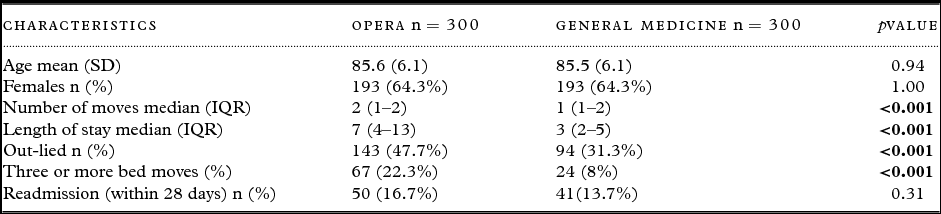
Three hundred OPERA admissions and 300 age- and sex-matched General Medicine admissions during the study period were reviewed. Both groups had mean age of 85.6 years (SD 6.1) and 193 (64.3%) patients were females. OPERA patients had a median length of stay of seven days (IQR 4–13) and General Medicine patients had a median length of stay of three days (IQR 2–5) (p < 0.001). Median number of moves for OPERA patients was 2 compared with 1 for General Medicine patients (p < 0.001). Out-lying in non-medical wards occurred in 143 (47.7%) OPERA patients and 94 (31.3%) General Medicine patients (p < 0.001). There was no significant difference between groups for readmissions, with 50 (16.7%) OPERA patients and 41(13.7%) General Medicine patients readmitted within 28 days (p = 0.31). Three or more bed moves during a single admission to hospital were recorded for 67 (22.3%) OPERA and 24 (8%) General Medicine patients. Characteristics of the study population are shown in Table 1.
Characteristics of study population

Notes: IQR = Interquartile Range; t-tests or Mann–Whitney U tests were used for comparison of means or medians, respectively; χ 2 or Fishers Exact (for small cell numbers) tests were used for comparison of proportions.
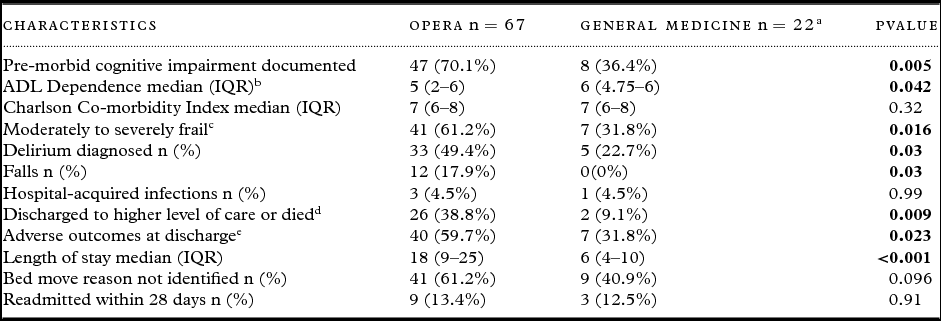
Medical records of all 67 OPERA patients and 22 out of 24 General Medicine patients who had multiple bed moves were reviewed. Two medical records from the General Medicine group were not available. The results are presented as a percentage of available data. Characteristics of the patients who had three or more bed moves are shown in Table 2.
Characteristics of the study population with three or more moves

Notes: IQR = Interquartile Range;
a Charts of two patients (females aged 91 and 98) were not available for review;
b Katz score range 0 to 6. Higher scores indicate greater independence;
c Clinical Frailty Scale ≥6;
d Newly admitted to residential aged care or other supported accommodation;
s e Increased dependence, discharge to higher level of care or death; t-tests or Mann–Whitney U tests were used for comparison of means or medians, respectively; χ 2 or Fishers Exact tests were used for comparison of proportions.
OPERA patients were more dependent and frailer compared to age- and sex-matched General Medicine patients (p = 0.042 and p = 0.016, respectively). According to the available data, 47 (70.1%) OPERA and 8 (36.4%) General Medicine patients had documented pre-morbid cognitive impairment, indicating that OPERA patients were likely to have higher prevalence of pre-morbid cognitive impairment and dementia (p = 0.005). Both OPERA and General Medicine patients had a similar burden of pre-morbid medical conditions with a median Charlson co-morbidity index of 7 (p = 0.32). OPERA patients with multiple moves had a longer length of stay with a median stay of 18 days (IQR 9–25) compared with a median stay of six days (IQR 4–10) for General Medicine patients (p < 0.001).
Delirium during the hospital episode was diagnosed in 33 (49.4%) OPERA patients and 5 (22.7%) General Medicine patients (p = 0.03). While 12 (17.9%) OPERA patients recorded having a fall, no falls were documented in the General Medicine patients (p = 0.03). Discharge to a higher level of care (defined as newly admitted to residential aged care or supported accommodation) or death during the hospital admission was documented for 26 (38.8%) OPERA patients and two (9.1%) General Medicine patients (p = 0.009). Only three (4.5%) OPERA patients and one (4.5%) General Medicine patient had hospital-acquired infections (p = 0.99). At least one adverse outcome, defined as increased dependence, entry into residential care or death, was recorded for 40 (59.7%) OPERA patients and seven (31.8%) General Medicine patients (p = 0.023).
The reason for the bed move was not identified in 41 (61.2%) OPERA patients and nine (40.9%) General Medicine patients (p = 0.096). For OPERA patients, reasons for bed moves included having delirium (n = 6), need for isolation for infection control (n = 8), and admission to specialist unit such as intensive care, palliative care, or high dependency respiratory care (n = 4) or to access telemetry (cardiac monitoring) (n = 8). For General Medicine patients, reason for bed move was for infection control (n = 3) and to access telemetry (n = 10).
Discussion
This study showed that OPERA patients were subjected to boarding more frequently than an age- and sex-matched General Medicine control group. Previous studies have shown that hospital out-lying due to lack of beds is associated with negative patient outcomes (McCusker et al., Reference McCusker, Cole, Abrahamowicz, Han, Podoba and Ramman-Haddad2001; Xu et al., Reference Xu, Whitaker and Hubbard2011; Stowell et al., Reference Stowell2013; Trueland, Reference Trueland2013), which highlights the importance of having a designated ward area with dedicated geriatric nursing and medical care.
The median number of bed moves for OPERA patients was higher compared to General Medicine patients. The longer length of stay could have contributed to higher number of bed moves in OPERA patients. It is known that frail older patients stay longer in the hospital after an admission (Singh et al., Reference Singh, Gallacher, Davis, Johansen, Eeles and Hubbard2012; Rose et al., Reference Rose, Pan, Levinson and Staples2014). There are many reasons for this, including delayed functional recovery after an acute illness, the delay in access to post-acute care or community services, and/or a prolonged wait for a residential care facility vacancy (Australian Institute of Health and Welfare et al., 2007). A high proportion of OPERA patients were moved without a valid clinical reason. Not having a designated ward area and relative longer length of stay may have been the reasons for these unfavorable decisions.
OPERA patients were more dependent, frailer, and cognitively impaired compared to the age- and sex-matched General Medicine patient group and previous studies have shown that patients with such characteristics are more vulnerable to the negative effects of hospitalization, boarding, and multiple bed moves such as delirium (McCusker et al., Reference McCusker, Cole, Abrahamowicz, Han, Podoba and Ramman-Haddad2001; Lafont et al., Reference Lafont, Gerard, Voisin, Pahor and Vellas2011). Delirium management guidelines therefore recommend that patients with delirium or who are at risk, be nursed in specially designated units and that repetitive room and staff changes be avoided (Tropea et al., Reference Tropea, Slee, Brand, Gray and Snell2008; National Institute for Health and Care Excellence, 2010).
Because the OPERA patients were a select group with a higher degree of pre-morbid cognitive impairment, dependence, and frailty compared to the General Medicine group it is difficult to attribute reported increased incidence of delirium, falls, and other negative outcomes as a direct effect of boarding and repetitive bed moves. A further study exploring the outcomes of OPERA patients who were subjected to out-lying and repetitive moves compared with those who were not could answer this question.
Strengths and limitations of the study
The large sample size and selection of matched controls to account for age and gender confounders as a source of bias are the strengths of this study. Medical chart review was conducted only for patients with three or more moves and hence actual comparison was made only in a smaller sub group, which limited the opportunity for multivariate analysis. As this was a retrospective audit, the findings were reported based on the chart entries. Some entries were suboptimal and pre-morbid cognitive impairment was not documented in a significant number of patients.
In contrast to the General Medicine patients, the majority of the OPERA patients had a routine Occupational Therapy review with formal functional assessments, including pre-morbid cognitive assessment, which could have skewed the results. The delirium detection rate could be potentially higher in OPERA group as Geriatricians are more alert to the diagnosis, which also may have resulted in higher detection and documentation of delirium. Other differences in care management between the two groups which may have influenced outcomes (both positive and negative) were beyond the scope of this study.
In summary, a significantly higher percentage of OPERA patients underwent multiple bed moves and were out-lied to a non-medical ward compared to the General Medicine patients. A higher proportion of OPERA patients had negative outcomes such as delirium, falls, increased dependence, institutionalization, and death. Out-lying to non-medical wards and multiple bed moves may have contributed to poorer outcomes.
Conflicts of interest
The authors declare there are no conflicts of interest.
Authors’ contributions
Champa Ranasinghe: Study concept and design, data collection, analysis and interpretation of the data, draft of manuscript. Aisling Fleury: Study concept and design, interpretation of the data, editing of manuscript. Nancye Peel: Study concept and design, analysis and interpretation of the data, drafting and editing of manuscript. Ruth Hubbard: Study concept and design, interpretation of the data, editing of manuscript.
Acknowledgments
The authors would like to thank the administrative staff of the Geriatric Medicine Department and the staff of the hospital medical records for their support in retrieving the medical records.