




No CrossRef data available.
ANCIENT MAYA ROYAL STRATEGIES: Creating power and identity through art
Published online by Cambridge University Press: 28 March 2006
Abstract
Ancient Maya monumental art was designed to enact the physical, social, and ritual hierarchy. Physically, sculpture created barriers and access patterns that altered movement through sites. Monumental architecture separated ritual participants in buildings from audiences in the plazas below. Access to monuments and portrayals on monuments in part defined social and power hierarchies. Motifs were altered to communicate various forms of power appropriate to each context and audience. Complex supernatural themes and ritual roles demonstrated hierarchical differences among the ruler and other nobles, while more simplistic representations of a powerful ruler demonstrated the separation of the ruler from commoners.
Information
- Type
- Research Article
- Information
- Copyright
- © 2005 Cambridge University Press
Ancient Maya monuments have been viewed as representations of power, ideological beliefs, and social systems. Monuments include structures and large sculpture such as stelae that were carved with information about cosmologies and hierarchies of power. This study builds on previous research by taking the opposite and complementary view: where George Andrews (1975:24) discussed the influence of political, administrative, social, and economic life on the arrangement of space, this study views physical space as an active part of the creation of political, administrative, social, and economic life. The ancient Maya used space, architecture, and art not as mere reflections of power, but to create and maintain power. Economic interaction and wealth are traditionally used by archaeologists to identify hierarchies, yet monumental art was crucial in the development of hierarchies, as well. Structures create various settings for imagery, dividing spaces and creating different levels of access. In this sense, monumental art was active in society, determining how space, and therefore activity and interaction, were divided. To the ancient Maya, art was a living part of society and, as such, was used to communicate and to create social relationships.
Previous studies have examined structures, site layouts, and art as clues to interpreting ideology and social organization (Andrews 1975, 1995; Ashmore 1989; Hendon 1992; Hohmann and Vogrin 1982; Miller 1986:78–80; Proskouriakoff 1960). Zelia Nuttall (1900:282–283) described Mesoamerican temples as representations of mountains, an idea expanded later by Andrews (1975:12–13, 70), who claimed that temples allowed priests to ascend high above public spaces to come closer to the supernatural world, and by Linda Schele and David Freidel (1990), who included rulers as well as priests. Other studies have used imagery and texts, the content of the monuments, to interpret ideology (Miller 1986a, 1986b; Schele and Freidel 1990; Schele and Miller 1986; Stuart 1987). Some have framed the discussion in terms of public and private art, where public art is meant for large groups of people and private art is meant for the few nobles allowed to enter structures (Miller 1986:78–80; Schele and Miller 1986:34–35).
Building on previous interpretations, this study combined approaches from several fields into a systematic, multidisciplinary approach (for a full discussion of methods, see Sanchez 1997). The goal is to examine how monuments are used to create and maintain power and social relationships. The relationship between content and context of monuments provides the basis for interpretation, where content is the information communicated through images, text, and other aspects of form and style, and context provides the setting for the content and its intended audience. Stelae in plazas have a different audience from that of lintels inside a temple. The content of the monuments provides a view of society (usually created by the ruler who commissions the monuments; Marcus 1992:8–16; Schele and Miller 1986:33), while the context influences who receives the message. This paper examines how rulers use monuments to create different contexts, then vary the content of monuments to create power and define social roles.
For this study, five sites were chosen that had a large sample of monuments with contextual data: Copan, Palenque, Quirigua, Tikal, and Yaxchilan. The analysis is qualitative rather than quantitative. Even at large sites, the number of monuments (as few as 3 to as many as 43) does not allow statistically significant comparisons between sites, types of monuments, time periods, or themes. Each of the five sites has a substantial history of archaeological research and art-history interpretation to provide a foundation for further interpretation and comparison. To identify patterns in the content of monuments, methods from the ethnography of communication were applied (Hymes 1986; for archaeological applications, see Love 1983 and Whitley 1994). Context was examined using access analysis, which measures the relative degree of access to areas within a site by the ease with which one may move between areas (Fairclough 1992; Foster 1989; for an archaeological application, see Moore 1992).
MONUMENTS AND ACCESS
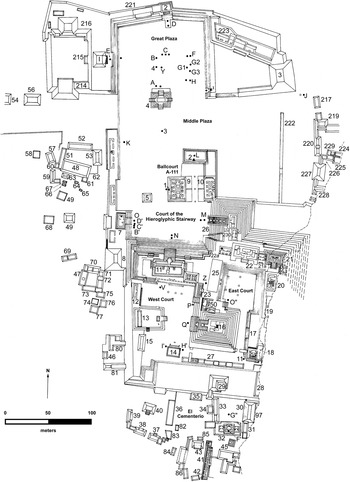
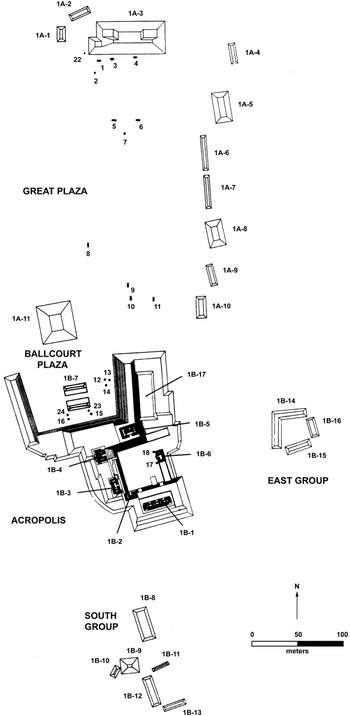
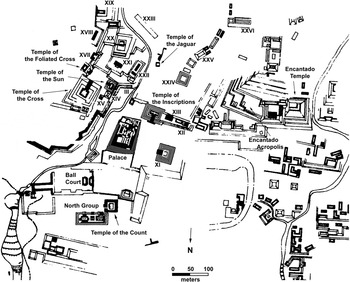
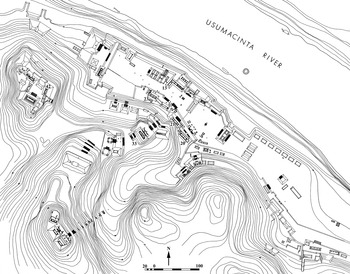
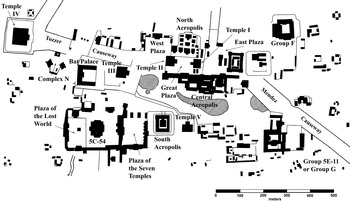
Each of the five sites is arranged with open plaza areas and relatively more restricted areas labeled acropoleis or palaces (Figures 1, 2, 3, 4, and 5). Plazas were the location for public rituals, oriented toward a broad audience. All five sites had multiple public plazas with open access, although the plazas may be defined as separate spaces. Palenque's Cross Group and the Twin Pyramid Groups at Tikal may be exceptions, being plazas to which access was restricted. Their construction indicates public access, although perhaps not as extensive as in the main plazas at both sites.

Map of Copan (adapted by Anthony Graesch from Fash 1991:Figure 8).

Map of Quirigua (adapted by Anthony Graesch from Sharer 1990:Figure 1).

Map of Tikal (adapted by Anthony Graesch from Coe 1967:20).

Map of Yaxchilan (adapted by Anthony Graesch from Graham and von Euw 1977:6–7). Scale in meters.

Map of Palenque (adapted by Anthony Graesch from Schele and Freidel 1990:Figure 6:5).
Structures on the edges of plazas had restricted access. Relatively few could enter these structures, and those who ascended the steps of the structure were demonstrating their ability to interact with the monument. Structure 10L-26 at Copan, Structure 1A-3 at Quirigua, Temples I and II at Tikal, the Temple of Inscriptions at Palenque, and Structure 20 at Yaxchilan all face public plaza areas. The plaza is a setting for public ritual, but it is also a place for an audience to witness those few who were allowed to enter the structures above. The audience in the plaza below acknowledged the higher status of those ascending the steps. The interiors of structures were the context for relatively private ritual, while the exteriors of structures were stages on which rituals were performed for the audience in the plaza below.
An acropolis is composed of groups of structures on raised platforms that served as locations for more restricted, private ritual. Platforms and some structures create physical barriers between the surrounding plazas and the acropolis itself. Entrance to an acropolis may be relatively simple such as climbing the steps on the north side of Quirigua's Acropolis, or complex such as at Tikal's labyrinthine Central Acropolis. Even a staircase restricted access to the acropolis to a few who, by entering the acropolis, demonstrated their higher status. Once in the acropolis, further divisions mimicked those on the main plazas, as some people would be restricted to plazas or courtyards in the acropolis while others were allowed to enter the structures. At Copan, Structures 10L-16 and 10L-22 and other structures were relatively more restricted than the East and West Courts below. Within an acropolis, society was further subdivided as some acted out their higher social status and ability to enter structures, interacting with the monuments and the ruler more closely. Monumental art, which was created by the ruler, depicts the ruler as the top of the hierarchy and as allowed unrestricted access to everything.
CREATING ROYAL POWER
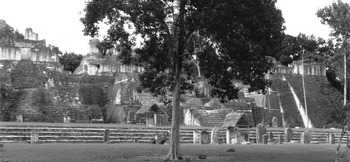
In addition to physical access to monuments, variations in the monuments themselves created different contexts and communicated information about power and society. A modified dominant ideology theory suggests that each class or group in society may be unified by its own ideology (Abercrombie and Turner 1982; Abercrombie et al. 1982). The dominant or ruling ideology may not be accepted by other groups in society. While not all aspects of this model fit the Classic Maya, the ruling ideology of the Maya was not directed in the same way at each group in society. At all of the sites, images differed according to their context. Public monuments defined the ruler's power, and architectural sculpture created a supernatural setting for ritual (Andrews 1975:12–13; Schele and Freidel 1990). Sculpture located at lower elevations in relatively more public areas emphasized the image of the ruler. Other imagery or people might be included, but the ruler's image dominates the scene by size or position. As the one who commissioned the monuments, the ruler could use them to communicate his/her view of society. In the ruler's view, the ruler was the dominant living member of society, whose image was placed on stelae in plazas to communicate this identity to all of Maya society. In the central area of each site is a large public plaza with a gallery of ruler portraits (Figure 6). Plazas were used in a variety of ways: as the setting for public ritual, for processions, and for markets and other daily activities (Andrews 1975:10–13, 37), so the images of the ruler in plazas were visible to the largest, broadest audience. People interacted with the portraits daily, walking past them, and continually acknowledging the ruler's position.

Tikal, Great Plaza showing the gallery of ruler portraits on rows of stelae.
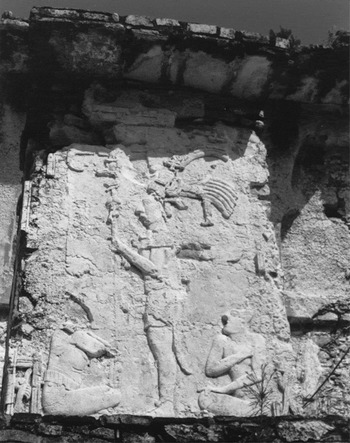
An exception is Palenque, where ruler portraits are placed on the piers of structures above the plaza rather than on stelae (Figure 7). The portraits are similar in placement to those at other sites because they are located below the supernatural architectural sculpture, which is on the facades and roof combs. The portraits differ from those at other sites in that, although they are visible to a general audience, the audience is not allowed to interact directly with them. Only those allowed to ascend the steps of the structures were able to interact with the ruler. This placement appears to distinguish the rulers from the general audience at Palenque more than at other sites.

Palenque Palace, House A, Column B. The ruler portraits at Palenque are placed on building piers, such as this one, rather than on stelae.
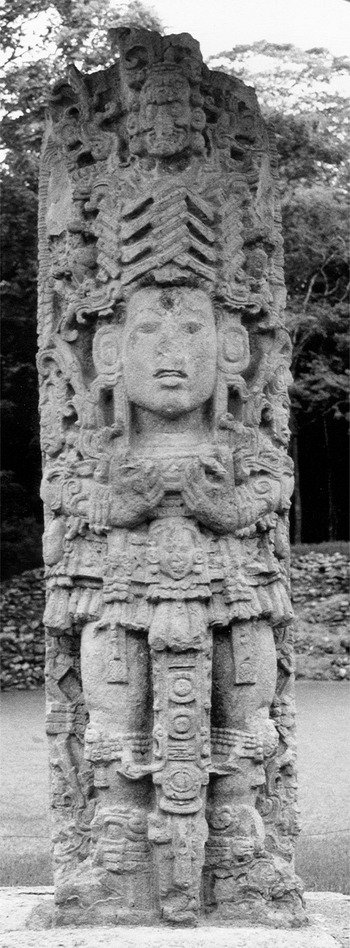
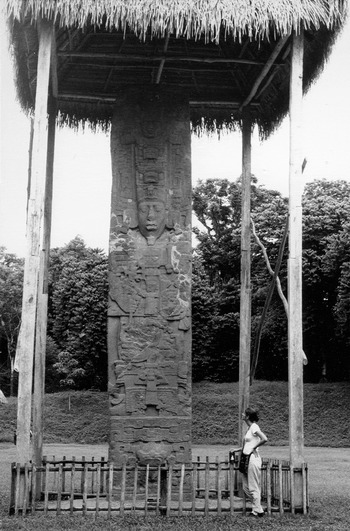
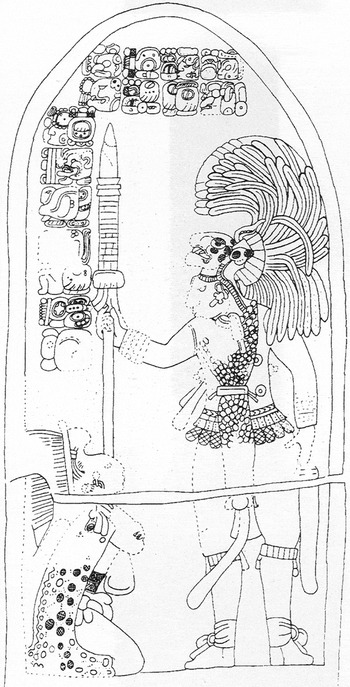
Although the ruler's image is dominant, other motifs on the stelae conveyed sources of the ruler's power. Ideological power came from the ability to commune with the supernatural, so public monuments showed the ruler with deities and ancestors to create a unique relationship (for complete discussions of ancient Maya connections to ancestors through art and architecture, see McAnany 1995, 1998). At Copan, Quirigua, and Tikal, stelae portray the ruler in ritual costume, with cosmological figures around (Figures 8–9). Even with cosmological imagery, the ruler's image dominates the scene. At Palenque and Yaxchilan, the images are more dynamic, showing the ruler performing rituals (Figures 7, 10). Stelae at Yaxchilan have deity masks below and ancestor cartouches and deities above, showing the ruler in the middle world of the tripartite Maya universe. At Palenque, the ruler portraits are conflated with architectural imagery, showing the ruler performing rituals on the piers, with supernatural imagery above, suggesting that the rituals were performed within a mythological context.

Copan Stela A, east side, showing the ruler in costume holding a serpent bar.

Quirigua Stela E, south side, showing the ruler in costume holding a shield.

Yaxchilan Stela 20 showing the ruler in military costume standing over a captive. Drawing by Carolyn E. Tate.
Images were altered to adapt to current sociopolitical situations. K'ak' Tiliw Chan Yoaat of Quirigua (also known as Butz' Tiliw or Cauac Sky) included warrior imagery and ritual imagery on his stelae (Figure 9). He achieved his status through the military defeat of Waxaklajuun Ub'aah K'awiil of Copan (also known as 18 Rabbit), so he continually re-created his military power on an almost equal level with his ideological power. Tikal and Yaxchilan also erected portraits of rulers in military costume during times of conflict (Figure 10). Yaxchilan devoted much of the imagery facing the river, facing visitors entering the site, to the ruler's military achievements.
Unlike monuments in plazas, on architecture the supernatural imagery dominates. The exteriors of structures were designed to be visible from the plaza below, setting a stage for ritual. When participants ascended the steps of a structure, they entered a space where they were physically dominated by cosmic imagery as they metaphorically entered the supernatural world (Andrews 1975:10–13; Schele and Miller 1986:66). One moved from the terrestrial world of the plaza with images of the ruler to the supernatural world with cosmological imagery. The images of deities or supernatural motifs such as water bands and sky bands separated the participants in the plaza from those in the structure above by placing them in different worlds. Stephen Houston (1998) describes cosmological associations of architectural features in detail. Moving up a stairway carved with dynastic histories, such as Copan's Structure 10L-26, the Hieroglyphic Stairway, moves one farther back along the ancestral line of rulers, into the dynastic past as well as the supernatural realm (Houston 1998:356–357).
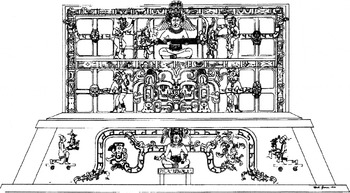
On some structures, the ruler was depicted with the supernatural imagery; at Yaxchilan, Palenque, Tikal, and perhaps parts of the Acropolis at Copan, figures were shown seated on thrones on the roof combs (Figure 11). The thrones and costumes indicate that the rulers were human rather than deities. The ruler was shown within a cosmic setting, demonstrating ideological power through communion with the supernatural. Palenque's structures are slightly different, depicting the ruler on piers rather than on stelae, but as at all sites, ruler portraits were dominant below while mythological imagery was dominant above. The structure conflated the public images of rulers with the supernatural imagery but still kept them separate.

Palenque Temple of the Sun, roof comb. Drawing by Merle Greene Robertson (after Griffin 1978:Figure 19).
Structure 33 at Yaxchilan is the dominant structure above the Main Plaza, but it is also the least visible. Because the structure is set back from the staircase that leads to it, only the roof comb and upper facade are visible from the plaza and from the river. The visible portion shows the ruler seated on a throne, surrounded by mythological imagery (Tate 1992:131). Although the rituals conducted within the structure were not visible, the structure itself was a constant reminder of the ruler's place within the supernatural and unique ideological power.
The interiors of structures above the plazas were the setting for private rituals where the ruler interacted with deities and ancestors, creating power through ritual. Inside structures, imagery continued to emphasize the ruler's place within the supernatural, creating a context for ritual. Relatively few elite entered structures, and they did so when participating in private ritual. The imagery created a supernatural context and conveyed specific messages to the elite audience. The elite had power, and their powerful position may have been threatening to the ruler, so the ruler was distinguished from others through action, costume, and the surrounding monuments. Inside structures, the ruler was portrayed participating in ritual, communing with the supernatural, performing acts that the other members of the elite could not. At Copan, the inner doorway of Structure 10L-22 is a representation of the cosmos (Fash 1991:Figure 77; Schele and Miller 1986:302). When the ruler stood in the doorway, he was shown as the center of the universe, a blatant message to those entering the structure of his central position not only in ritual, but also for the preservation of the cosmos. These images demonstrated the distinct ideological power of the ruler from other ritual participants. By standing within and among such monuments, the elite audience acknowledged and accepted the ruler's position.
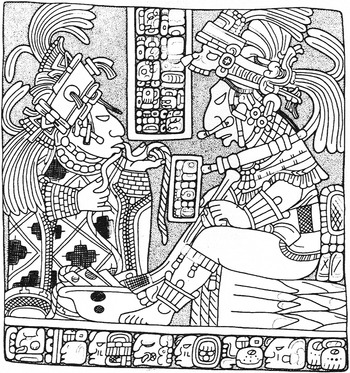
Ritual acts were depicted differently in public and private spaces, with private scenes including more details of the actions and objects involved. Palenque's exterior building piers had various simple scenes, while the interiors of structures in the Cross Group had more elaborate images with more detailed depictions of ritual implements and sacred objects. Yaxchilan stelae depicted relatively simple, graphic portraits of the ruler with blood dripping from his hands, while the more private lintels presented the bloodletting ritual itself, not just the result. On the lintels in Structures 21 and 23, the ruler and others were shown in the process of auto-sacrifice with ritual implements such as bloodletters, associated bowls, paper, and Vision Serpents (Figure 12; see also Graham and von Euw 1977:39, 41, 43, 53, 55–56). The act of letting blood and these ritual objects were shown in these private contexts, while they were never shown in the public contexts. It may have been inappropriate for ritual implements or the ritual process to be displayed outside the ritual context.

Yaxchilan Lintel 17 showing the ruler's wife and the ruler performing a bloodletting ritual (from Graham and von Euw 1977:Figure 43; reprinted with permission).
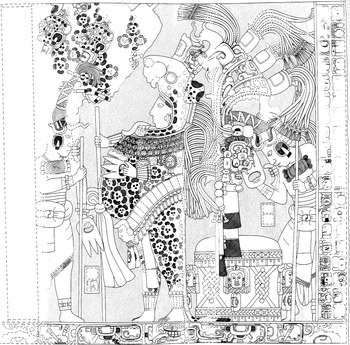
Other rituals are depicted in structures that may have been the settings for the rituals. Tikal Temple III, Lintel 2, shows the ruler performing a ceremony with two other individuals in which all three hold staves and tri-bladed knives (Figure 13; Jones and Satterthwaite 1982:Figure 72). The ruler is clearly the dominant figure, wearing an elaborate jaguar costume. The Cross Group of Palenque shows K'inich Kan B'alam II (also known as Chan Bahlum II) in various ritual acts associated with his heir designation, accession, and the dedication of the temples, all crucial events (Schele and Freidel 1990:Figures 6:11–6:13). The Cross Group panels demonstrated to others entering the structures that Kan B'alam II was named as the successor of Pakal (also known as Pacal); that he became ruler; and that he alone could dedicate structures to the gods and commune with them. The objects held by Kan B'alam II were held only by rulers and create an intimate connection to the gods. At Yaxchilan, the ruler was depicted in bloodletting rituals, such as those described earlier, in solstice celebrations and in numerous other ceremonies of which the details are unknown.

Tikal Temple III, Lintel 2, showing the ruler in a jaguar costume flanked by two other participants (from Jones and Satterthwaite 1982:Figure 72; reprinted with permission).
DEFINING SOCIAL ROLES
Rulers also defined the social roles of others in Maya society through the images on monuments. The ruler chose to show other participants in particular contexts. Such images provide information about some social interaction, such as which members of society participated in various rituals. Since these images were commissioned by the ruler, they depict what the ruler wanted to convey. The monuments show individuals whose prestige and support was important to the ruler. Monuments depict activities that were significant in creating social and power distinctions between groups. The strategy of each ruler, the participants and activities depicted, provide information about the unique circumstances in the sociopolitical environment. Examining the participants and activities depicted and comparing them to their context and audience reveals more about social roles and interaction than mere names and dates; the monuments reveal who participated in what activities and how they were important to the social and power structure.
Rulers as Dominant
Maya rulers are frequently the dominant human figure in scenes from monumental art. The rulers may be represented alone or with other individuals, but the size, posture, and placement of the ruler usually indicates that the ruler is the central figure. The ruler may be slightly larger than other individuals in the scene, placed in the center of the composition, and may be standing above other figures, or other individuals in the scene may be facing the ruler.
At Copan and Quirigua, the dominance of rulers is taken to the extreme of excluding other figures entirely. Copan and Quirigua have fewer representations of non-rulers than other sites. At Quirigua, no living person other than the ruler was depicted on monuments. On stelae, the ruler was shown holding military or ritual objects. On zoomorphs, the ruler was seated within the mouths of supernatural beings. Only the ruler was recorded performing rituals and taking captives, although the texts mentioned powerful allies, parents, and captives. By excluding images of non-rulers, and by focusing on the actions of the ruler in texts, the monuments of Quirigua emphasized the individual power of the ruler. Others were mentioned only to enhance that power, defining political relationships, genealogical rights to rulership, and successful military endeavors.
In the early stages of political development at all sites, only rulers are mentioned on monuments. When first establishing a ruling dynasty, rulers had to create individual power that was separate from that of everyone else in society. Most rulers emphasized ideological power and control of ritual. Quirigua, the smallest site included in the study, had a relatively short history of rulers that erected monuments. Monumental texts primarily refer to K'ak' Tiliw Chan Yoaat and his two successors (Looper 1995, 1999). K'ak' Tiliw Chan Yoaat was a provincial lord of the Copan polity who ruled Quirigua (Looper 1999:268). His power increased, and his rule became independent after his extraordinary defeat of Waxaklajuun Ub'aah K'awiil of Copan (Looper 1995:90–124, 1999:268–274; Marcus 1976:134–140; Proskouriakoff 1973:168). After his victory, K'ak' Tiliw Chan Yoaat had to establish an office of rulership that differentiated him from other lineage heads. Power was usurped from Waxaklajuun Ub'aah K'awiil through monumental art; K'ak' Tiliw Chan Yoaat copied and re-created Waxaklajuun Ub'aah K'awiil's monuments (Looper 1995) combining ideological and military themes.
At Copan, most monuments also excluded non-rulers. Stelae depicted only contemporary rulers. Altar Q and the Structure 10L-11 step depicted the ruler seated with all predecessors in the dynasty (Schele and Freidel 1990:Figure 8:3; Schele and Miller 1986:Plate 36). Architectural sculpture focused on supernatural imagery, with occasional portraits of the ruler, such as Yax Pasaj Chan Yoaat (also known as Yax Pac), on the doorjambs of Structure 10L-18 (Grube and Schele 1990:3). Non-rulers were not depicted, except on the Hieroglyphic Stairway. On the treads of seven steps, seen only by the few allowed to climb them, were captives. The stairway was built after the defeat of Waxaklajuun Ub'aah K'awiil and was an attempt to reassert the military prowess of Copan's rulers. By stepping on the captives, the military victories of the rulers were reenacted. Captive imagery was not seen previously at Copan because military power was less significant than ritual power in ensuring rule.
Another aspect of artistic style at Copan and Quirigua was the lack of active scenes; only static portraits are present. When non-rulers were shown at other sites, they were participating actively with the ruler. The ruler was depicted as dominant by his size, costume, and actions. Copan and Quirigua limited their monuments to portraits of the ruler. Although rituals and captures were not represented in images at Copan and Quirigua, they are recorded in texts. Similar events occurred, but had different meanings than at other sites. At Copan and Quirigua, military power was less influential than at sites such as Tikal and Yaxchilan; Copan and Quirigua only used captive and warfare imagery during and after their conflicts with each other. When Copan was defeated by Quirigua, Copan's rulers used images of captives on Structure 10L-26, the Hieroglyphic Stairway, to regain authority at Copan. Since Tikal and Yaxchilan were involved in frequent conflict, the military prowess of the ruler was more significant.
Sharing the Stage
Although rare at Copan and Quirigua, non-ruler participants are included in images at other sites. Depicting other individuals was a deliberate effort to show interaction in a manner that was beneficial to the ruler. Ancestors created a link to the past and demonstrated the inheritance of power; captives show military strength; and other ritual participants add to active scenes and enhance the prestige of the participants as well as the rulers.
At all sites, genealogical information was presented in texts, and at all sites except Quirigua, genealogies were represented visually with images of ancestral rulers and sometimes other parents. Because rulership and power were inherited, the ruler had to create a genealogical right to rule. At Copan and Tikal, parental portraits focused on ancestral rulers to create continuity in the ruling dynasty. Ancestral rulers were apotheosized after death and thus were powerful supernatural allies. At several sites, rulers built on places tied to ancestors. Copan's Structures 10L-16 and 10L-26 were traditionally associated with the founder and the sources of dynastic power, and subsequent rulers continued to build on those locations, often making references in iconography and texts to the earlier rulers (Agurcia 1996; Fash 1991:22, 26, 74, 78–81, 100, 135, 139–151, 168–170; Fash et al. 1992; Sharer, Fash, Sedat, Traxler, and Williamson 1999; Sharer, Traxler, Sedat, Bell, Canuto, and Powell 1999).
In Tikal's North Acropolis, monuments depicted dynastic histories that showed apparently unbroken links in the inheritance of power. At Copan, Altar Q and the step of Structure 10L-11 recorded portraits of the entire dynasty witnessing the accession of a ruler (Schele and Freidel 1990:Figure 8:3; Schele and Miller 1986:Plate 36). The Hieroglyphic Stairway at Copan seems to have been more selective, focusing on more recent ancestors and military exploits. At Palenque, the Cross Group panels and the Temple of Inscriptions linked the ruler to the dynasty and even connected the ruling dynasty to gods (Schele and Freidel 1990:Figures 6:14–6:16). The connections to deities enhanced supernatural ties and ideological power. Tikal and Yaxchilan used imagery more often than dynastic histories. A few stelae at Tikal include portraits of the ruler's father and predecessor on the sides, lending his support. Yaxchilan stelae often included ancestor cartouches above the ruler. At Yaxchilan, mothers were included in genealogical statements more often than at other sites. Yaxchilan may have enhanced the status of its rulers by mentioning the powerful status of their wives and mothers (Marcus 1976; Robin 2001).
Genealogical rights to rulership were mentioned more frequently or emphasized in times of crisis. Moon Jaguar of Copan was the son of Waterlily Jaguar, but two others (possibly brothers of Moon Jaguar) ruled between this father and son (Fash 1991:96; Schele and Stuart 1986:3). Moon Jaguar had to re-create his genealogical ties to his father, so he created spatial ties to his father's sacred space by building additions onto Waterlily Jaguar's structures (Morales et al. 1990:1; Schele and Morales 1990:1). Pakal of Palenque and Bird Jaguar IV of Yaxchilan both inherited the right to rule through their mothers (Schele and Freidel 1990:221; Tate 1992:123–125), and their genealogical statements were more prominent and included their mothers. On the Oval Palace Tablet, Pakal receives a headdress from his mother on the date of his accession (Schele and Freidel 1990:227, Figure 6:7). She was a prominent part of the ceremony, and the father was not pictured, because it is only through the mother that Pakal inherited the right to rule. Bird Jaguar IV dedicated Structure 21 and Stela 35 inside of it to his mother (Graham and von Euw 1977:Figures 39, 41, 43; Tate 1992:125, 129–130). The images of mothers at Palenque and Yaxchilan were often in private contexts, where they would be seen by elite participants in ritual. The role of the women was not unknown to the general population, and women were presented in public contexts, but the genealogical relationship was emphasized to an elite audience to create an inheritance of power.
Images also may have been a visual representation of genealogical information to a less literate audience. Relatively few in Maya society attended schools and could read hieroglyphic writing (Houston 1994). Although genealogical ties were more significant to an elite audience, the ruler demonstrated lineage ties to large, broad audiences, as well. Tikal and Yaxchilan stelae included information about parents and inheritance. In the case of Palenque, no monuments were in the plaza to convey genealogical information, so images on building piers presented the information where it could be seen from below.
In addition to genealogical representations, non-rulers were also presented in dynamic images at Tikal, Palenque, and Yaxchilan depicting particular rituals: dances, bloodletting ceremonies, captures, and other rituals. At all three sites, the images occurred relatively late in the monumental history of the site at times when the rulers were struggling to maintain power. As populations grew and competition between nobles increased, the rulers had to maintain support to remain in power. Rulers needed to share power with other nobles while maintaining a superior position, so they created scenes in which other nobles participated in ritual. The nobles shown achieved a powerful position by sharing some of the ideological and military power of the ruler. Such images gave power to nobles who supported the ruler and showed that the ruler was supported by influential people. Although other nobles participated in rituals, they did not have the supernatural power that the ruler had, allowing the ruler to maintain dominance by retaining some exclusive ritual rights and activities.
Lintel 2 of Temple III at Tikal showed the ruler and two men involved in a ritual (Figure 13). Lintel 2 was placed inside a structure where it would be seen only by a limited elite audience. It demonstrated the support of other nobles yet still emphasized the ruler's dominance. Tikal Altar 5, inside the stela enclosure in Complex N, showed the ruler and another man standing over a pile of bone (Jones and Satterthwaite 1982:125). Because the two figures are shown on the top of the altar, one had to enter the enclosure to see the image, a restricted context. On Tikal Temple II, Lintel 2, a ruler's wife was depicted by herself, giving her high enough status to be shown alone on a monument (Jones and Satterthwaite 1982:100). The only non-rulers depicted on public monuments at Tikal showed captives, demonstrating the ruler's military power. Such monuments were created only in times of military conflict, when the ruler needed to emphasize military power in addition to ritual power. Joyce Marcus (1974) suggested that such images were attempts to create the appearance of military power when it may not exist or be secure. On public monuments, captives created a dominant position for their captor (Johnston 2001).
At Palenque and Yaxchilan, the ruler was often shown with parents, wives, and other people in public and private contexts. At Palenque, the images depicted ritual activities, often dancing. The Palace piers depicted the ruler dancing while ritual assistants sit to the sides (Figure 7). The identities of these other figures are unknown. They may have been members of the ruling family or other nobles participating in the ceremony, ritual assistants of lower status, or perhaps captives. Since there is little evidence to suggest that the figures are captives, and assistants of lower status would not be depicted so prominently, they are likely noble participants in the ceremony. As discussed earlier, the presence of allies at such an occasion would have demonstrated their support to the ruler. By displaying their presence and support, the ruler's prestige was enhanced, and the prestige of the nobles likely was enhanced, as well.
At Yaxchilan, participants were shown as captives, military allies, and ritual participants. The ruler was shown more often with other figures than alone, and the other figures included were parents, wives, and members of other lineages. Stelae at Yaxchilan show military images on the sides facing the plazas and scatterings on the sides facing the structures. In military images, the ruler was usually shown alone or with a captive cowering underfoot. The image conveyed the ruler's military strength and success in battle. In ritual scenes on stelae, the ruler was shown as often with ritual participants as alone. The participants include kneeling men, who are assistants of lower status, and woman who stand facing the ruler. Some of the assistants may actually be captives; their poses are similar to those of kneeling captives in military scenes.
On private monuments at Yaxchilan, the non-ruling participants have more prominent roles. In capture scenes, the ruler subdued captives in more dynamic poses than on stelae. Military allies were shown standing nearby (Lintel 12; Graham and von Euw 1977:33) or actively taking captives of their own (Lintel 8; Graham 1979:27). Both images occurred late in the site's history, about a.d. 750. The ruler, faced with competitive nobles, had to portray the military support of other nobles. Rituals were more prominent contexts for elite interaction on monuments. On the lintels of Structures 21 and 23, women performed bloodlettings with the ruler. On the lintels of Structures 1, 2, 13, 20, 33, and 42, the ruler was shown standing with a man or a woman who held ritual implements (Graham 1979:Figures 21, 23, 25, 27, 73, 75, 91, 93, 95, 109; Graham and von Euw 1977:Figures 13, 15, 17, 29, 33, 35, 37). In Structures 1, 2, and 33, the non-ruling males held objects similar to those held by the ruler, participating on a level almost equal to the ruler. As it was at other sites, the support of other noble lineages was critical to the ruler—and perhaps even more so at Yaxchilan than at other sites. Participation of other nobles in ritual appears to have been more common, with the non-ruling participants taking on greater roles while the ruler gained strength through their support.
DECENTRALIZATION OF POWER
As each site declined, there was an increase in the imagery produced by and depicting individuals other than the ruler. At Copan, sculpture in the elite residential area Las Sepulturas became more abundant and more elaborate. At Tikal, sculpture found in other groups also increased. Tikal Temple III, Lintel 2. included non-rulers participating in ritual. At Palenque, the Tablet of the Slaves commemorated the war exploits of a sahal, a noble under the authority of the ruler (Fash 1991:136; Schele and Freidel 1990:469). At Yaxchilan, the Southeast Group monuments increased and may have depicted figures who were not of the ruling family. These images represented both attempts by the ruler to maintain power and the loss of control over the production of monuments. As populations increased, more people were competing for the same amount of power. Nobles competed for positions of prestige. Rulers, wanting to maintain the support of the nobles, attempted to divide power and create new positions. Nobles of high status who supported the ruler were depicted on monuments or allowed to erect their own. Nobles who participated in rituals on monuments were seen as higher in status, being physically and symbolically elevated above others. Another means of gaining support was to allow nobles to erect their own monuments. The rulers may actually have had little choice in the matter. Preventing the use of monuments may have led to open conflict with the nobles—exactly what the ruler wanted to avoid. Allowing the production of monuments by other groups was the only choice.
CONCLUSIONS
Art communicated different messages in different contexts and for different audiences. The way in which the content of monuments was altered according to audience provides information about the relationship between social groups that can be compared with other archaeological and ethnohistoric data. The context of the monument determined the audience, and the goals for each monument differed according to the audience. Rulers had to present themselves as leaders to everyone, and specifically as ritual leaders to elite.
The activities conducted in each context also determined appropriate imagery. Relatively private rituals in structures required a supernatural setting. The participants on the monuments also show categories of social relationships. At Yaxchilan and Palenque, support of other nobles was prominently displayed, and genealogical relationships were represented visually. Copan, Quirigua, and Tikal used more static representations that focused on the primary power of the ruler. The participants on monuments also showed beliefs about gender roles. The participants displayed in certain activities showed different roles for men and women. Although this discussion is brief, these patterns show the benefits of a systematic study of multiple variables compared between monuments and between sites that focus on art within a social context.
RESUMEN
El arte monumental maya precolombino está examinado como una parte activa de su contexto social usando un acercamiento que combina métodos y teorías de la antropología, la historia del arte y la lingüística. El arte en la sociedad maya fue diseñado para representar la jerarquía física, social y ritual. Más bien que imágenes estáticas, el arte era parte de la interacción cotidiana, influyendo la manera en que la gente transitaba por sus sitios y la manera en que los grupos interactuaban. El acceso a ciertas áreas y, por lo tanto el arte que esas áreas contenían, estaba restringido. Cuando se paraban encima de las plataformas, las élites mostraban físicamente la jerarquía social. Rango social y posición física estaban relacionados a los papeles rituales. Los motivos iconográficos y jeroglíficos en los monumentos creaban distinciones en contextos para distintas ocasiones, permitiendo al gobernante comunicar varias formas de poder apropiadas a cada contexto y a cada público. Las esculturas públicas que eran accesibles a los grupos grandes de gente, enfatizaban al gobernante como un soberano poderoso. Las esculturas arquitectónicas creaban un contexto metafórico sobrenatural en el cual se realizaban los rituales, mostrando el poder ideológico único del gobernante a los demás participantes. Durante tiempos de crisis militar, el gobernante usaba atuendo de guerrero, armas y cautivos para ostentar su poder militar. En situaciones cuando se necesitaba apoyo adicional, se representaba al gobernante participando en rituales con otros nobles, estos como aliados poderosos. Las representaciones de actividades de la gente común mostraban sus relaciones a los gobernantes y sus papeles en la sociedad. Por medio de una consideración del arte como fenómeno activo y una examinación de cómo fue cambiando en varios contextos sociales, se puede identificar el papel del arte en la definición de las relaciones sociales y de poder.
ACKNOWLEDGMENTS
This project was guided and influenced by several people, including Jeanne Arnold, Wendy Ashmore, Jim Hill, Cecelia Klein, Paul Kroskrity, Richard Leventhal, Joyce Marcus, and Karl Taube. Wendy Ashmore, Virginia Fields, Rex Koontz, and two anonymous reviewers graciously provided comments. The project was funded by the National Science Foundation, the Friends of Archaeology, and the University of California, Los Angeles. I thank those who allowed the use of their maps and drawings. The ideas presented and any possible errors are the responsibility of the author.
References
REFERENCES
Abercrombie, Nicholas, and
Bryan S. Turner
1982
The Dominant Ideology Thesis. In
Classes, Power, and Conflict: Classical and Contemporary
Debates, edited by
Anthony Giddens and
David Held, pp.
396–416.
University of California Press,
Berkeley.CrossRefGoogle Scholar
Abercrombie, Nicholas,
Stephen Hill, and
Bryan S. Turner
1982
The Dominant Ideology Thesis.
George Allen and Unwin,
Boston.CrossRefGoogle Scholar
Agurcia Fasquelle, Ricardo
1996
Rosalila, el corazón de la Acrópolis: El Templo del
Rey-Sol.
Yaxkin
14:5–18.Google Scholar
Andrews, George F.
1975
Maya Cities: Placemaking and Urbanization.
University of Oklahoma Press,
Norman.Google Scholar
Andrews, George F.
1995
Pyramids and Palaces, Monsters and Masks: The Golden Age of Maya
Architecture.
Labyrithos,
Lancaster, CA.Google Scholar
Ashmore, Wendy
1989
Construction and Cosmology: Politics and Ideology in Lowland Maya
Settlement Patterns. In
Word and Image in Maya Culture: Explorations in Language, Writing,
and Representation, edited by
William F. Hanks and
Don S. Rice, pp.
272–286.
University of Utah Press,
Salt Lake City.Google Scholar
Fairclough, Graham.
1992
Meaningful Constructions—Spatial and Functional Analysis of
Medieval Buildings.
Antiquity
66:348–366.CrossRefGoogle Scholar
Fash, William L.
1991
Scribes, Warriors and Kings: The City of Copán and the
Ancient Maya.
Thames and Hudson,
New York.Google Scholar
Fash, William L.,
Richard V. Williamson,
Carlos Rudy Larios, and
Joel Palka
1992
The Hieroglyphic Stairway and Its Ancestors: Investigations of Copan
Structure 10L-26.
Ancient Mesoamerica
3:105–115.CrossRefGoogle Scholar
Foster, Sally M.
1989
Analysis of Spatial Patterns in Buildings (Access Analysis) as an
Insight into Social Structure: Examples from the Scottish Atlantic Iron
Age.
Antiquity
63:40–50.CrossRefGoogle Scholar
Graham, Ian
1979
Corpus of Maya Hieroglyphic Inscriptions, Vol. 3, Part 2,
Yaxchilan.
Peabody Museum of Archaeology and Ethnology, Harvard
University,
Cambridge, MA.Google Scholar
Graham, Ian, and
Eric Von Euw
1977
Corpus of Maya Hieroglyphic Inscriptions, Vol. 3, Part 1,
Yaxchilan.
Peabody Museum of Archaeology and Ethnology, Harvard
University,
Cambridge, MA.Google Scholar
Griffin, Gillett G.
1978
Cresterias of Palenque. In
Tercera Mesa Redonda de Palenque, edited by
Merle Greene Robertson and
Donnan Call Jeffers, pp.
139–146.
Pre-Columbian Art Research,
Monterey, CA.Google Scholar
Grube, Nikoai, and
Linda Schele
1990
A New Interpretation of the Temple 18 Jambs.
Copán Mosaics Project, Copán Note 85.
Austin,
TX.Google Scholar
Hendon, Julia A.
1992
Architectural Symbols of the Maya Social Order: Residential
Construction and Decoration in the Copan Valley, Honduras. In
Ancient Images, Ancient Thought: The Archaeology of Ideology,
Proceedings of the 23rd Annual Chacmool Conference,
edited by
A. Sean Goldsmith,
Sandra Garvie,
David Selin, and
Jeannette Smith, pp.
481–495.
Chacmool,
Archaeological Association of the University of Calgary.Google Scholar
Hohmann, Hasso, and
Annegrete Vogrin
1982
Die Architektur von Copan (Honduras).
Akademische Druck- und Verlagsanstalt,
Graz, Austria.Google Scholar
Houston, Stephen D.
1994
Literacy among the Pre-Columbian Maya: A Comparative
Perspective. In
Writing without Words: Alternative Literacies in Mesoamerica and the
Andes, edited by
Elizabeth Hill Boone and
Walter D. Mignolo, pp.
27–49.
Duke University Press,
Durham, NC.Google Scholar
Houston, Stephen D.
1998
Classic Maya Depictions of the Built Environment. In
Function and Meaning in Classic Maya Architecture, edited by
Stephen D. Houston, pp.
333–372.
Dumbarton Oaks,
Washington, DC.Google Scholar
Hymes, Dell
1986
Models of the Interaction of Language and Social Life. In
Directions in Sociolinguistics: The Ethnography of
Communication, edited by
John J. Gumperz and
Dell Hymes, pp.
35–71.
Basil Blackwell,
Oxford.Google Scholar
Johnston, Kevin J.
2001
Broken Fingers: Classic Maya Scribe Capture and Polity
Consolidation.
Antiquity
75(288):373–381.CrossRefGoogle Scholar
Jones, Christopher, and
Linton Satterthwaite
1982
The Monuments and Inscriptions of Tikal: The Carved Monuments. Tikal
Report No. 33, Part A. University Museum, University of Pennsylvania,
Philadelphia.CrossRefGoogle Scholar
Looper, Matthew G.
1995
The Sculpture Programs of Butz'-Tiliw, An Eighth Century Maya
King of Quiriguá, Guatemala.
Ph.D. dissertation,
Art History, University of Texas,
Austin.Google Scholar
Looper, Matthew G.
1999
New Perspectives on the Late Classic Political History of Quirigua,
Guatemala.
Ancient Mesoamerica
10:263–280.CrossRefGoogle Scholar
Love, Bruce
1983
Mayan Epigraphy and the Ethnography of Writing. Unpublished
manuscript.Google Scholar
Marcus, Joyce
1974
The Iconography of Power among the Classic Maya.
World Archaeology
6(1):83–94.CrossRefGoogle Scholar
Marcus, Joyce
1976
Emblem and State in the Classic Maya Lowlands: An Epigraphic
Approach to Territorial Organization.
Dumbarton Oaks,
Washington, DC.Google Scholar
Marcus, Joyce
1992
Mesoamerican Writing Systems: Propaganda, Myth, and History in Four
Ancient Civilizations.
Princeton University Press,
Princeton, NJ.Google Scholar
McAnany, Patricia A.
1995
Living with the Ancestors: Kinship and Kingship in Ancient Maya
Society.
University of Texas Press,
Austin.Google Scholar
McAnany, Patricia A.
1998
Ancestors and the Classic Maya Built Environment. In
Function and Meaning in Classic Maya Architecture, edited by
Stephen D. Houston, pp.
271–298.
Dumbarton Oaks,
Washington, DC.Google Scholar
Miller, Arthur G.
1986
Maya Rulers of Time: A Study of Architectural Sculpture at Tikal,
Guatemala.
University Museum,
University of Pennsylvania, Philadelphia.Google Scholar
Miller, Mary Ellen
1986a
Copan, Honduras: Conference with a Perished City. In
City-States of the Maya: Art and Architecture, edited by
Elizabeth P. Benson, pp.
72–109.
Rocky Mountain Institute for Pre-Columbian Studies,
Denver.Google Scholar
Miller, Mary Ellen
1986b
The Murals of Bonampak.
Princeton University Press,
Princeton, NJ.Google Scholar
Moore, Jerry D.
1992
Pattern and Meaning in Prehistoric Peruvian Architecture: The
Architecture of Social Control in the Chimu State.
Latin American Antiquity
3(2):95–113.CrossRefGoogle Scholar
Morales, Alfonso,
Julie Miller, and
Linda Schele
1990
The Dedication Stair of “Ante” Temple. Copán
Mosaics Project, Copán Note 76.
Austin,
Texas.Google Scholar
Nuttall, Zelia
1900
The Fundamental Principles of Old and New World Civilizations: A
Comparative Research Based on a Study of the Ancient Mexican Religious,
Sociological and Calendrical Systems. Papers of the Peabody Museum of
Archaeology and Ethnology.
Harvard University,
Cambridge, MA.Google Scholar
Proskouriakoff, Tatiana
1960
Historical Implications of a Pattern of Dates at Piedras Negras,
Guatemala.
American Antiquity
25(4):454–475.CrossRefGoogle Scholar
Proskouriakoff, Tatiana
1973
The Hand-Grasping Fish and Associated Glyphs on Classic Maya
Monuments. In
Mesoamerican Writing Systems, edited by
Elizabeth P. Benson, pp.
165–178.
Dumbarton Oaks,
Washington, DC.Google Scholar
Robin, Cynthia
2001
Kin and Gender in Classic Maya Society: A Case Study from
Yaxchilán, Mexico. In
New Directions in Anthropological Kinship, edited by
Linda Stone, pp.
204–228.
Rowman and Littlefield,
New York.Google Scholar
Sanchez, Julia L.J.
1997
Royal Strategies and Audience: An Analysis of Classic Maya
Monumental Art.
Ph.D. dissertation,
Anthropology, University of California,
Los Angeles.Google Scholar
Schele, Linda, and
Mary Ellen Miller
1986
The Blood of Kings.
Kimbell Art Museum,
Fort Worth, TX.Google Scholar
Schele, Linda, and
Alfonso Morales
1990
Some Thoughts on Two Jade Pendants from the Termination Cache of
“Ante” Structure at Copán. Copán Mosaics
Project, Copán Note 79.
Austin,
Texas.Google Scholar
Schele, Linda, and
David Stuart
1986
Moon-Jaguar, the 10th Successor of the Lineage of
Yax-K'uk'-Mo' of Copán. Copán Mosaics
Project, Copán Note 15.
Austin,
Texas.Google Scholar
Sharer, Robert J.,
William L. Fash,
David W. Sedat,
Loa P. Traxler, and
Richard Williamson
1999
Continuities and Contrasts in Early Classic Architecture of Central
Copan. In
Mesoamerican Architecture as a Cultural Symbol, edited by
Jeff Karl Kowalski, pp.
220–249.
Oxford University Press,
New York.Google Scholar
Sharer, Robert J.,
Loa P. Traxler,
David W. Sedat,
Ellen E. Bell,
Marcello A. Canuto, and
Christopher Powell
1999
Early Classic Architecture beneath the Copan Acropolis.
Ancient Mesoamerica
10:3–23.CrossRefGoogle Scholar
Stuart, David
1987
Ten Phonetic Syllables. Research Reports on Ancient Maya Writing
14.
Center for Maya Research,
Washington, DC.Google Scholar
Tate, Carolyn
1992
Yaxchilan, the Design of a Maya Ceremonial City.
University of Texas Press,
Austin.Google Scholar
Whitley, David S.
1994
Ethnography and Rock Art in the Far West: Some Archaeological
Implications. In
New Light on Old Art: Recent Advances in Hunter-Gatherer Rock Art
Research, edited by
David S. Whitley and
Lawrence L. Loendorf, pp.
81–93.
Institute of Archaeology, Monograph 36.
University of California,
Los Angeles.CrossRefGoogle Scholar
Map of Copan (adapted by Anthony Graesch from Fash 1991:Figure 8).
Map of Quirigua (adapted by Anthony Graesch from Sharer 1990:Figure 1).
Map of Tikal (adapted by Anthony Graesch from Coe 1967:20).
Map of Yaxchilan (adapted by Anthony Graesch from Graham and von Euw 1977:6–7). Scale in meters.
Map of Palenque (adapted by Anthony Graesch from Schele and Freidel 1990:Figure 6:5).
Tikal, Great Plaza showing the gallery of ruler portraits on rows of stelae.
Palenque Palace, House A, Column B. The ruler portraits at Palenque are placed on building piers, such as this one, rather than on stelae.
Copan Stela A, east side, showing the ruler in costume holding a serpent bar.
Quirigua Stela E, south side, showing the ruler in costume holding a shield.
Yaxchilan Stela 20 showing the ruler in military costume standing over a captive. Drawing by Carolyn E. Tate.
Palenque Temple of the Sun, roof comb. Drawing by Merle Greene Robertson (after Griffin 1978:Figure 19).
Yaxchilan Lintel 17 showing the ruler's wife and the ruler performing a bloodletting ritual (from Graham and von Euw 1977:Figure 43; reprinted with permission).
Tikal Temple III, Lintel 2, showing the ruler in a jaguar costume flanked by two other participants (from Jones and Satterthwaite 1982:Figure 72; reprinted with permission).
 You have
Access