Introduction
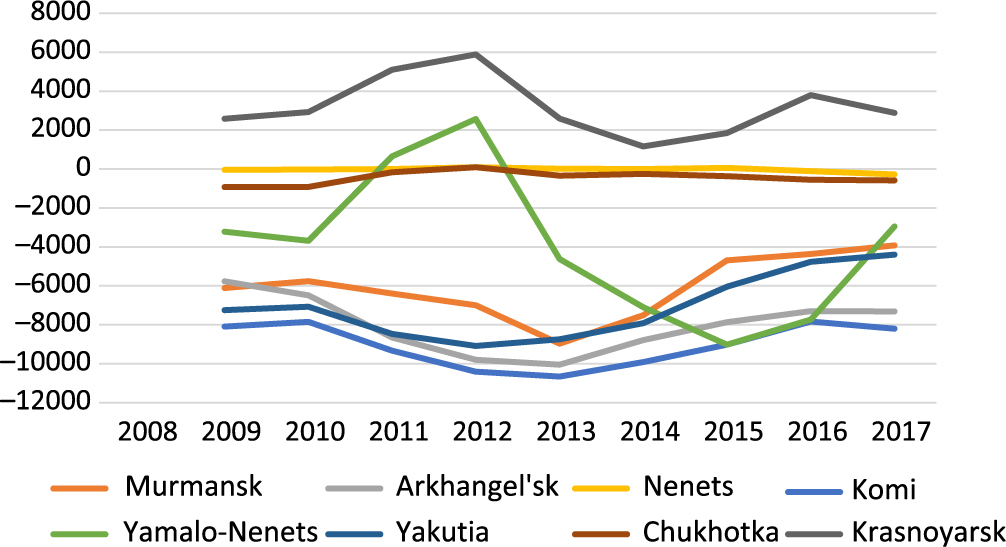
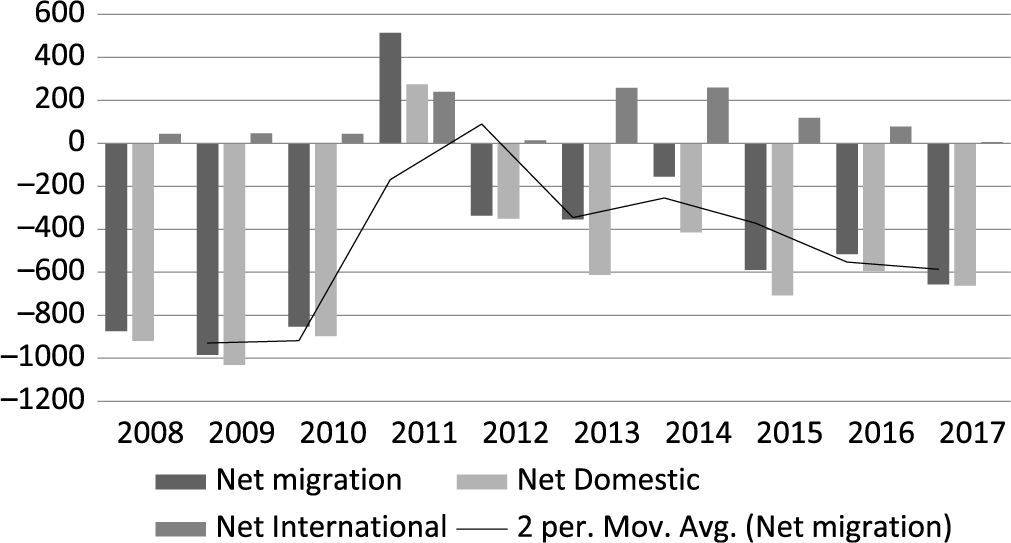
This paper identifies education, skills training and improved social infrastructure as key policy areas to address population decline, or steady out-migration, from the European regions of the Russian Arctic. During the 1990s, following its transition to a market economy, Russia’s Arctic experienced sharp and unexpectedly rapid population decline. Out-migration followed the withdrawal of extensive subsidies and the end of political support for expensive and remote production, and it reflected preferences by mobile residents to have a more habitable climate, to live with relatives in other regions, or to have a life closer to Moscow. By 2017, although out-migration had stabilised, a steady population decline continued in most regions (see Fig. 1). The trends in the European Russian Arctic portend lasting consequences: lower levels of education, a shrinking of all but the largest cities, and a relative ageing of the populace. This is in contrast to positive net migration, indicating some resilience, the ability to withstand recessionary shocks, as observed in Yamalo-Nenets Autonomous Okrug (AO) and Krasnoyarsk.
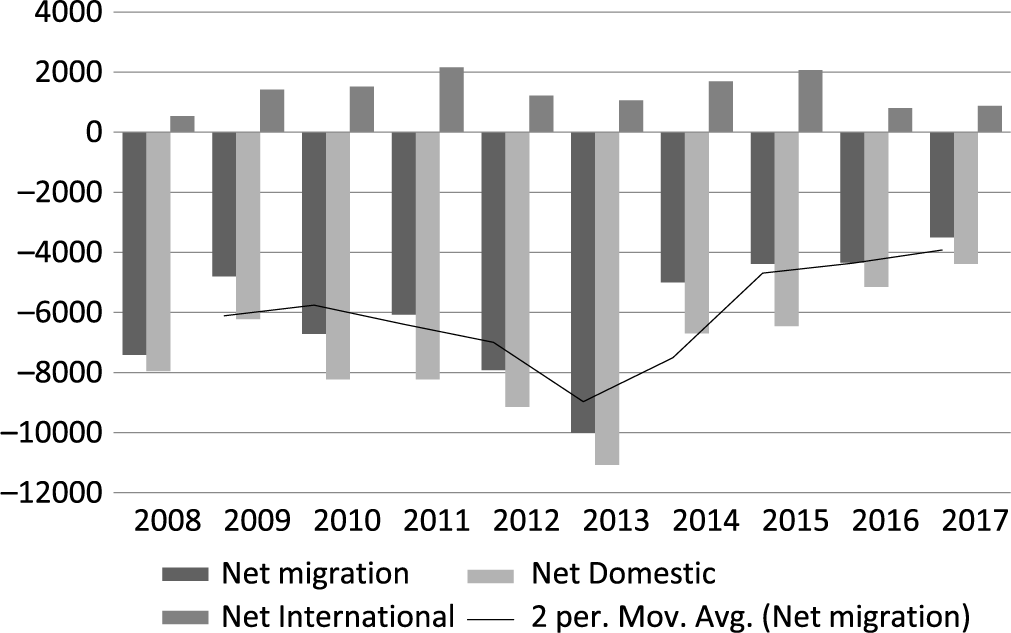
Net migration in regions of the Russian Arctic, 2008–2017 (2-year moving average). (Source: Federal Service of State Statistics: Migration (2015), Distribution of migrants).

The immediate population loss after price shocks in the Arctic regions during Russia’s transition to a market economy, and the ongoing population decline, are addressed in a growing literature. Emphasis tends to fall on the impact of these trends on manpower shortage and urban sustainability (Heleniak, Reference Heleniak, Bogoyavlensky, Larsen and Fondahl2015; Korovkin, Dolgova, Edinak, & Korolev, Reference Korovkin, Dolgova, Edinak and Korolev2015; Orttung, Reference Orttung2016; Reisser, Reference Reisser and Orttung2016; Round, Reference Round2005). The aim of this paper is to assess the drivers of migration trends, including initial conditions, which differ by region. In European Arctic Russia, for example, the initial loss particularly affected the sustainability of manufacturing. The main driver of current out-migration is general economic forces, including wages, the cost of transportation and the state of social infrastructure. This paper identifies the exceptional nature of some cities and regions, attractive to international and domestic migrants, with their vitality largely, but not entirely, due to employment demand in fast-growing energy-producing regions with transit accessibility (Laruelle, Reference Laruelle2015; Reisser, Reference Reisser and Orttung2016). Ecologically resilient in a broader sense, these cities and regions show not only population growth, even under conditions of volatile energy prices, but they also tend to attract a somewhat younger and better-educated populace, as discussed below.
The resilience of the two regions with regard to employment and replenishment of youth cohorts is not entirely a response to demand for labour and to profits in resource extraction. Resource exploitation is in fact common to most Arctic regions, even where migration trends show net decline, and most rely on resource production networks to and from European Russia for firm growth (Fauzer, Rozhkin, & Zagainova, Reference Fauzer, Rozhkin and Zagainova2001). Diversity thus requires modelling for out-migration to include some account of local competitive advantage, governance, and historical urban attraction, along with resource exploitation and Russia’s future commerce and military security in the North.
To summarise, this paper models the general trajectory of decline in net migration, noting moderate stabilisation and growth achieved in some regions in attracting domestic and foreign migrants. The research questions address comparative advantage, regional capacity to absorb government assistance and the likelihood of that assistance in the region. In this regard, the comparative context lies in other countries, as in northern Europe, where policy also focuses on efforts to retain the younger, better-educated and more productive work force (Huppert, Reference Huppert2016).
The paper is organised as follows. Part I below briefly traces regional population history through 2017, with a focus on the first research question, to emphasise comparative advantage and the diversity of the regions’ historical experiences and current population movement, and with comparison to other Arctic countries. It also discusses government amelioration efforts to increase in-migration with reference to the common northern European approach. Part II introduces the statistical and geographical data used here and examines region-by-region out-migration trends with an emphasis on attraction of skilled labour. Part III addresses theoretical understanding and current research on out-migration trends in Arctic areas in order to modify the current consensus for modelling of out-migration from Russia’s Arctic (Vakulenko, Reference Vakulenko2016). Part IV addresses the potential of differentiating comparative advantage by region and following regional capacity to absorb government assistance for effective policy resolution in all regions.
The Russian Arctic’s regional population history and policy
From the mid-1980s through first the decade of the post-transition era, beginning in 1991, the diverse regions of the Russian Arctic, stretching from European Russia to the Far East, seemed to closely resemble one another in regard to the population boom under Soviet communism (Heleniak, Reference Heleniak1999; Osherenko & Young, Reference Osherenko and Young2005; Slavin, Reference Slavin1972; Van Dijk et al., Reference Van Dijk, Folmer, Herzog and Schlottmann1989). Rapid expansion was part of “high latitude industrialization” (Bradshaw, Reference Bradshaw1995, p. 199, cited in Heleniak, Reference Heleniak1999, p. 155) for the extraction of mineral resources. The government first used Gulag labour, then replaced it in the 1950s with voluntary labour, which it attracted by “…a long list of ‘Northern’ benefits paid from the budget, including benefits for resettlement and supplements for living in the region, and relocation from the North after periods of employment were completed” (Heleniak, Reference Heleniak1999, p. 155). Wage increments, combined with regional wage coefficients and entitlements, including pensions and housing privileges, were paid through state firms. These broadly similar trends diverged in pace and timing, following the geographic expansion of resource development. The Arctic North areas covered here (Chukotka AO, Republic of Sakha (Yakutia), Krasnoyarsk Krai, Yamalo-Nenets AO, Nenets AO, Republic of Komi, Arkhangelsk oblast, Murmansk oblast) are classified as part of the Arctic Zone (Presidential decree of the Russian Federation, “About land territories of the Arctic zone of the Russian Federation”, 2 May 2014, No. 296).
The Komi Republic was developed from the late 1930s through the 1980s for its rich deposits of oil, gas, coal and woodlands located near Gulag camps where there were former exiles (Moran, Pallot, & Piacentini, Reference Moran, Pallot and Piacentini2011). From 1939 to 1959, its population increased from 320,300 to 815,800. By 1970, it had reached 946,800 and the urban population had multiplied by a factor of 16, with the population densest in the northeast; industrial labour continued to grow rapidly even through 1990. The Republic of Sakha also grew after World War II; it almost doubled in population in the 1960s and 1970s due to migration inflow. At that time, settlement efforts created numerous large cities in the far north, including Vorkuta and Norilsk, boosted by the relocation of supply centres for coal and nickel during World War II to Siberia. Krasnoyarsk Krai also increased in population by 75% during World War II (Shabad & Mote, Reference Shabad and Mote1977). Murmansk by contrast had a sustainable pool of labour only after the 1950s, after the end of labour force redistribution and the beginning of residential subsidies, and continued to build the population using these subsidies even as other areas in the European Russian Arctic declined after World War II through the 1960s and 1970s (Heer Reference Heer1977). Specifically, 53% of the total population growth in Murmansk occurred between 1959 and 1970, with steady growth through the 1980s (Popova, Reference Popova2011). The population of Yamalo-Nenets Autonomous Okrug similarly grew in the period from the 1970s through the 1990s as some of the largest gas fields in Russia opened up. The size of cities in these Arctic regions contrasts with global Arctic cities, which reach populations of some 10,000; in the Russian Arctic in 1991, 40% of the population lived in 16 urban areas, each with over 100,000 people (Heleniak, Reference Heleniak1999). By the 1970s, the (mainly non-indigenous) population in general in the Russian Arctic far exceeded that in Arctic regions of other northern European countries (Heleniak, Reference Heleniak2013).
In the 1990s, the price shocks and subsidy cuts in the transition to a market economy halted these advances in settlement, built up by industrialisation during the war, and afterward as resources were discovered. Transition financial collapse ended the budget-funded labour benefits (that is, wage increments, bonuses, vacations) to the North; these were no longer available at the federal level. They were devolved to regional authorities, which most often lacked the tax resources to pay for them, or to privatised firms, which mostly disinvested. As ‘northern’ benefits largely disappeared, the population inflow in most Republics and oblasts stopped (Heleniak, Reference Heleniak1999), and outflow increased, at first from cities, and later from rural regions. Heleniak (Reference Heleniak2010) adds that distance from the capital was another factor for population decline in the 1990s.
Population transition effects, essentially the initial conditions for the current Arctic developments in Russia, left some regions with particularly grave losses. Murmansk, an ice-free port with key bridging connections to northern trade hubs, for example, lost 150,000 residents between 1989 and 2002 (Reisser, Reference Reisser and Orttung2016). Between 1989 and 2002, in the Far East, Magadan and Chukotka lost some 50% of their populations, while European regions lost some 20–30%. Ten of the 16 Russian Arctic regions suffered depopulation by as much as 10% in the 1990s (Gurvich, Reference Gurvich2015; Heleniak, Reference Heleniak2009; Huskey & Southcott, Reference Huskey and Southcott2010; Popova, Reference Popova2011). Between 1989 and 2002, Chukhotka and Magadan lost more than 50% of their populations, Taimyr AO 30%, Nenets 25% and Murmansk 20% (Heleniak, Reference Heleniak2010; Laruelle, Reference Laruelle2015).
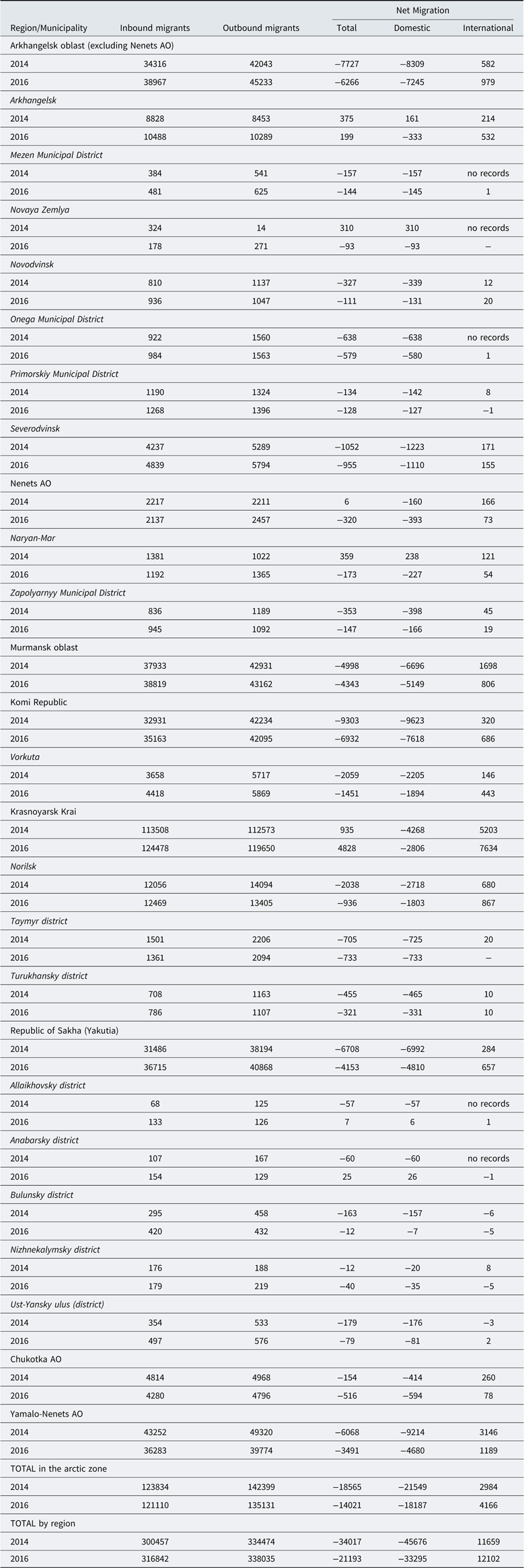
All regions were hit by the drop in their tax base, but some were affected more than others. Some regions became heavily dependent on federal revenues (Sakha, Chukhotka, and Murmansk; see Table 1). Where factories closed and investment dropped, as in Murmansk, there were critical concerns around the now failing social infrastructure (especially housing and communal services, including the supply of clean drinking water) and this compounded the effects of the initial conditions.
Urban migration, Russian Arctic territorial entities, 2014, 2016.

Trends in net out-migration lost some volatility by the 2000s, although the recession shocks in 2009 brought new sharp declines; overall, the challenge of population loss is still evident (see Fig. 1). In just three regions there were overall gains or minimal total losses of population. In this regard, the comparative context is Northern Europe. Globally, post-war development through the 1990s brought positive developments in Alaska, Iceland and the Canadian Arctic, all of which experienced positive net migration across the decades with investment in resource development and prospective trade and thanks to geopolitical and strategic interests. These regions benefit from high human fertility, which is still prevalent among some native populations who are at an earlier stage of the demographic transition than in Europe and Russia. Population increase is also driven by lower infant mortality due to health benefits and by the younger age structure (the impact of higher fertility, lower life-expectancy and out-migration mainly of males) (Heleniak & Bogoyavlensky, Reference Heleniak, Bogoyavlensky, Larsen and Fondahl2015; Larsen & Fondahl, Reference Larsen and Fondahl2015; Larsen et al., Reference Larsen, Fondahl and Schweitzer2010). This must be qualified, however, by noting that even where populations grow, as in Alaska, rural villages lose residents to larger towns due to scarcities in the environment left behind in small villages and even regional centres (Howe, Reference Howe2009). To summarise, in some countries, the Arctic population is growing – particularly in cities – and, by 2030, growth rates may reach 4% per annum.
Peripheral areas of Sweden and Finland, by contrast, like post-transition Russia, benefit neither from net immigration nor from the early-stage demographic transition, that is, high fertility. As in Russia, economic conditions result in higher infant mortality and lower life expectancy, and since there is outmigration of females, a higher male to female gender ratio. In general, across northern Europe, there is an out-migration of the young (Suorsa, Reference Suorsa2007; Beine et al., Reference Beine, Docquier and Rapoport2001; Ishkanian, Reference Ishkanian2002), that is, the loss of young professionals (i.e. potential experts, entrepreneurs and innovators), as they move away, explained mostly as a consequence of threatened loss of opportunity:
…their greatest challenges are their distant location from the core areas and the lack of key actors in innovation process and resources, e.g. high-tech enterprises, institutes of higher education and R&D institutes. These factors generally decrease the opportunities for providing education and establishing internationally competitive businesses in peripheral regions when compared to the core areas of the countries (Suorsa, Reference Suorsa2007, pp. 15–16).
In Russia, similar effects occurred as the relatively younger age structure from the Soviet era was affected by the economic transition (Heleniak & Bogoyavlensky, Reference Heleniak, Bogoyavlensky, Larsen and Fondahl2015). In 1989, before the transition, according to Heleniak (Reference Heleniak1999, p. 159), “This [younger] cohort comprises 32% of the population of Russia but 39% of the North’s population.” In 1999, the older cohort grew rapidly (Ibid., p. 184):
…effects of this age-specific out-migration can clearly be seen…One of the most discernible changes is the fact that there are far fewer young children below age 10 and young adults between the ages of 25 and 40 in the North in 1997 than in 1989. Correspondingly, there was a large increase in the share of those in the young retirement ages and a smaller increase in the older ages.
Again, the current situation differs significantly by republic, krai, okrug or oblast, with some preserving a younger age structure due to interregional and international immigration, as discussed below.
Population policies across the Arctic bring into focus common initiatives to mitigate the productivity consequences of out-migration and ageing. Russia has adopted general policies similar to those in the EU and the EEA for northern periphery regions. In Russia, these are often delivered by regional development investment corporations, which vary significantly in capacity from region to region. The governments of Finland, Sweden and Norway follow broad regional EU development strategies for coordinated national and regional assistance in the Arctic focused on connectivity business services, finance, IT and innovation, and diversification (Bachtler & Yuill, Reference Bachtler and Yuill2001; Hansen et al. Reference Hansen, Rasmussen, Olsen, Roto and Fredricsson2012; Suorsa, Reference Suorsa2007). Long-term policies address challenges of dependence: those arising in resource extraction and from changes in traditional industries (forestry, reindeer herding, fisheries), along with planning for climate adaptation. For example, in Russia long-term regional policy promotions covered by development corporations aim to encourage small business, shipbuilding and fishing to supplement the energy-intensive economy of the North.
Such general targets cannot, however, address the immediate issue of labour market shortages. These shortages arise, on one hand, from the rapid expansion of 16 very large cities in the last decades of the 20th century that placed great pressure on utilities and social services, and, on the other, from the ten years of transition out-migration, leaving tax revenues in most regions insufficient to cover services compounded by decades of stress on such services, for example, water supply. Dudarev et al. (Reference Dudarev, Dorofeyev, Dushkina, Alloyarov, Chupakhin, Sladkova and Evengard2013, p. 1) observe:
In 18 selected regions of the Russian Arctic, Siberia and Far East Category I and II water reservoirs, water sources (centralised, underground, surface; non-centralised) and drinking water are highly contaminated by chemical and biological agents. Full-scale reform of the Russian water industry and water security system is urgently needed, especially in selected regions.
Gaps in social infrastructure in Russia are numerous, including for the now ageing populace (Heleniak & Boboyavlensky, Reference Heleniak, Bogoyavlensky, Larsen and Fondahl2015).
In Russia, federal labour policy is therefore particularly important among development strategies: it assists firms to hire replacements from abroad and shift labour for new investment, and it repatriates Russians from neighbouring states in response to general population decline. The most recent of these population policies for the Arctic, for example, announced at the 4th International Arctic Forum (Arkhangelsk, 29–30 March 2017), will allocate a substantial investment (3.4 billion Euros, or 4% of GDP in 2017, over the next three years) to partially target labour retention – for example, improve local conditions and reduce out-migration. Private and state enterprises, also, will receive subsidies for temporary labour in the North to repair and expand infrastructure and transportation (Kozlov, Reference Kozlov2017).
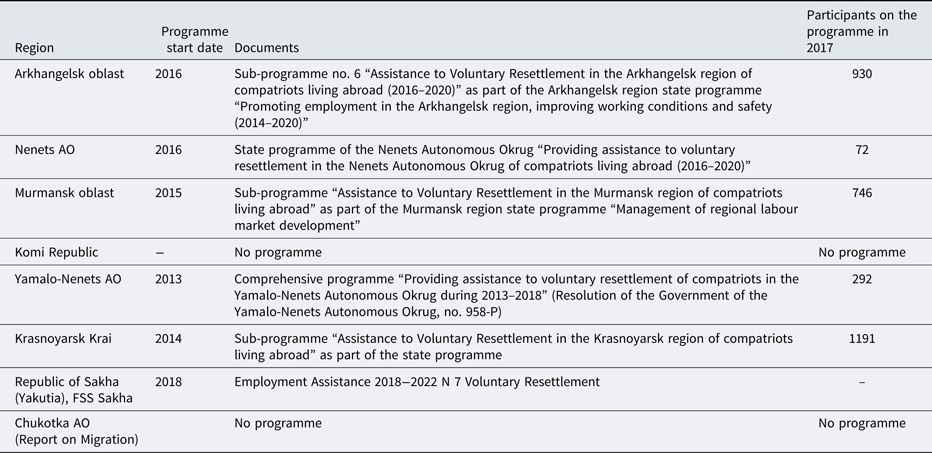
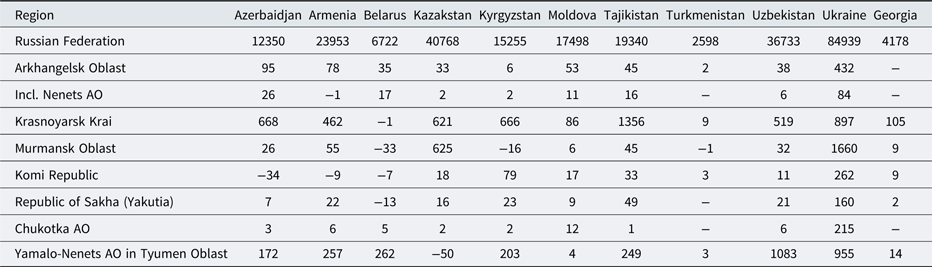
A key coordinated Russian labour policy initiative has attracted 745,000 former residents (of the USSR) from abroad since its launch on 31 December 2012. The Voluntary Resettlement (VR) programme has supported 745,000 former citizens (see Presidential RF decree, June 22, 2006 No. 637; Ministerstvo vnutrennykh del Rossii, Glavnoe upravlenie po voprosam migratsii, https://мвд.рф/mvd/structure1/Glavnie_upravlenija/guvm/compatriots/information-pack). With the objective of population growth and regional development of priority areas, VR has provided employment, vocational education and support for entrepreneurship, including for personal subsidiary farming, by covering moving costs and registration fees and by compensating for lost income from jobs abroad. Some subnational entities add supplementary targeted lump-sum payments. At present in 66 regions, VR started with 12 “pilot regions” with the following priorities: (1) strategically important border areas with population decline; (2) commercially important or resource-rich regions with large investment projects requiring labour inflows; and (3) environmentally sustainable regions where there is significant population loss, especially outflows over the last three or more years. Although VR does not specifically target migration to the Russian Arctic, it has given an especially large boost to resettlement there from Ukraine (RF Government Decree (2014)). Since 2014, Ukrainian former USSR residents have resettled in Arkhangelsk, Murmansk, Nenets and Yamalo-Nenets Autonomous Okrugs, and Krasnoyarsk (Table 2). Thus, although not specifically designated, the Arctic regions were included among priorities in the Action Plan for citizens’ mobility in the Russian Federation (2014) for 2014–2018 (Order of the Government of 24 April 2014, No. 663-p; Federal Law of 22 December 2014, No. 425-FZ) and included among the 15 target regions Arkhangelsk, Krasnoyarsk, Murmansk and Chukotka Autonomous Okrug. It is estimated that the programme may attract some 3,300 workers on 70 investment projects. The results of these programmes (Table 2) can be found in the FS Statistical Bulletin (http://www.gks.ru/bgd/regl/b18_107/Main.htm).
Implementation of regional programs to facilitate the voluntary resettlement of compatriots to the Russian Federation on the territory of the Arctic zone of the Russian Federation.

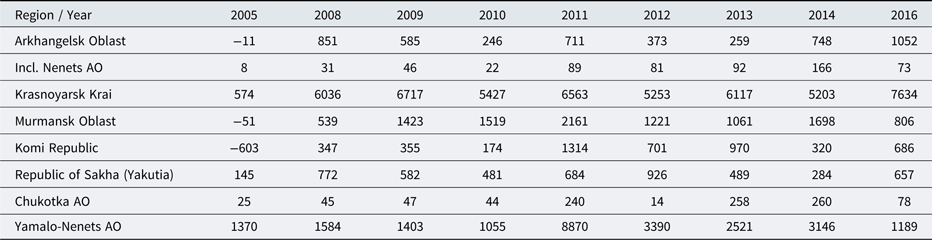
For the Arctic, wage support policies are now in place and have long been a central and successful policy in Russia (Giltman, Reference Giltman2016). Since these policies were put in place, preliminary outcomes have been reported for some of the regions (see Table 2. General international migration flows are reported in Tables 3 and 4. We note that in-migrants from the former Soviet republics (Ukraine, Azerbaijan, Belarus, Kazakhstan, Kyrgyzstan, Moldova, Tajikistan, and Uzbekistan) increased during 2005–2014 and boosted the particular regions that exhibit positive net migration.
Net international migration in the Russian Arctic Republics and oblasts, 2005–2016 (individuals).

Total international migration in the Russian Arctic Republics and oblasts, 2015.

Different regions received migrants from different countries: Arkhangelsk hosted migrants from Azerbaijan and Armenia, Krasnoyarsk from Tajikistan, Murmansk from Kazakhstan, the Komi Republic from Kyrgyzstan, the Sakha Republlc (Yakutia) from Tajikistan, Chukotka Autonomous Okrug from Moldova and the Yamalo-Nenets Autonomous Okrug from Uzbekistan. Inward flows to all regions came from Ukraine.
In brief, before 1991, with subsidised in-migration of labour, the Soviet government achieved a relatively dense settlement that met strategic goals and industrialisation policies. After the end of the Communist regime in 1991, massive out-migration from Russia’s Arctic reached a significant scale of population and infrastructure loss (Hamilton, Saito, Loring, Lammers, & Huntington, Reference Hamilton, Saito, Loring, Lammers and Huntington2016; Hamilton et al, Reference Hamilton, Colocousis and Johansen2004; Hamilton & Mitiguy, Reference Hamilton and Mitiguy2009; McLeman & Hunter, Reference McLeman and Hunter2010). In some ways this resembled “climagration” or a mass exit of populations at risk, embracing whole communities threated from erosion, flooding and other consequences of climate change. To this initial condition are added the many and complex causes of continued departure from the Arctic – as Timothy Heleniak shows – and repopulation of factories in part by foreign shift-workers, creating new issues and compounding the challenges left by transition effects (Heleniak, Reference Heleniak1999, Reference Heleniak2009, Reference Heleniak2013).
We also emphasise, in the discussion below, the exceptions in the comparative economic advantages of Yamalo-Nenets AO and Krasnoyarsk, the former is well-endowed with natural resources and the latter far less so, but both more fiscally independent and both attract considerable international in-migration and well-educated migrant cohorts (see Fig. 10). One region has considerable advantage from its gas fields, and the other from historical foundations as a Siberian capital, with significant population growth in the 1980s, expansive continuing investment in infrastructure (Krasnoyarsk and Yamalo-Nenets AO have the highest investment in the construction sector in the Arctic; Tynkkynen, Tabata, Gritsenko, & Goto, Reference Tynkkynen, Tabata, Gritsenko and Goto2018), minimal loss of population in the 1990s, and little dependency on federal subsidies in the 2000s.
Population trends in Russian Arctic regions: exploring diversity
Data
The Russian migration data used in this paper from online statistical indicators published by the Federal State Statistics Service of the Russian Federation (http://www.gks.ru/wps/wcm/connect/rosstat_main/rosstat) provided in accordance with the Presidential decrees “On Land Territories of the Arctic Zone of the Russian Federation” (May 23, 2014), and “The Strategy for the Development of the Arctic Zone of the Russian Federation and Ensuring National Security until 2020”; http://government.ru/en/docs/29164/). Government directives No. 2437-R of 3 December 2014 and No. 638-R of 9 April 2016 supplement the federal plan of statistical surveys, national security status and socioeconomic development, considering the Arctic zone as a separate region. Migration data show arrivals and departures registered by the Ministry of Internal Affairs of the Russian Federation and its territorial branches. Statistical indicators of economic conditions and the social sphere for municipalities (PMO) for the regions of the Arctic zone of Russia are developed in accord with Section 1.33 “Municipal Statistics” of the Federal Statistical Work Plan on municipalities, a database still in formation, and data for participants of the State Programme for Assistance to the Voluntary Resettlement to the Russian Federation of Compatriots Living Abroad are published (http://www.gks.ru/bgd/regl/b18_107/Main.htm) as results of federal statistical surveys. The source for data in this paper is Chislennost’ i migratsiia naseleniia Rossiiskoi Federatsii za 2009–2017 gody; (http://www.gks.ru/wps/wcm/connect/rosstat_main/rosstat/ru/statistics/publications/catalog/doc_1140096034906, accessed 29 October 2018). The data for Figure 10 are from the Main Directorate for Migration Affairs, Internal Affairs.
Russia’s Arctic regions: Arkhangelsk
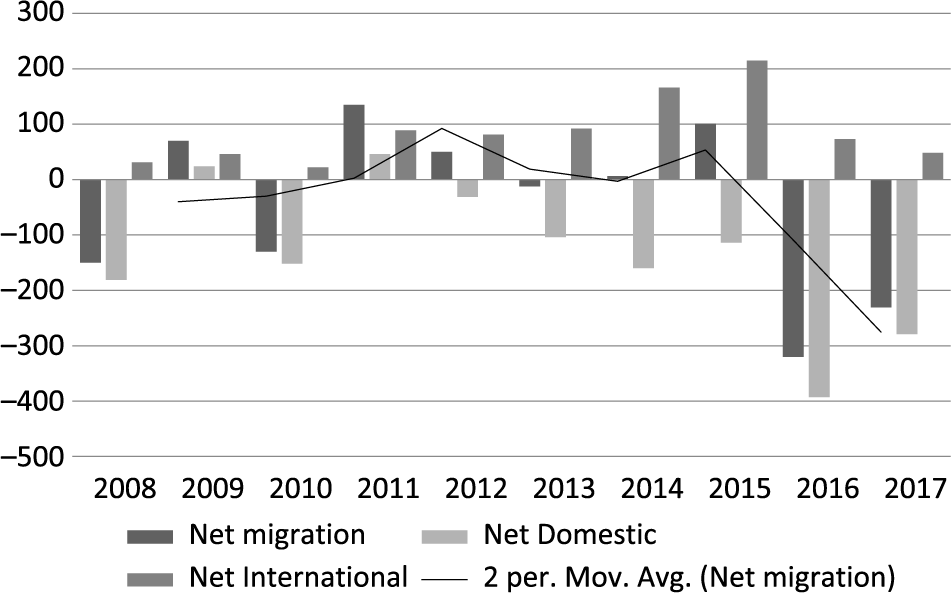
Population decline continues to be steady and marked in Arkhangelsk. Positive trends in migration were noted only in one of its sub-regions – Novaya Zemlya—and in Naryan-Mar of the Nenets Autonomous Okrug. During the last decade alone (2004–2014) the region lost more than 92,000 residents, comprising 24,000 from urban areas and 68,000 from rural areas (see Fig. 2).
Migration data, Arkhangelsk oblast’, 2008–2017 (see supplementary material for data tables).

Of foreign migrants to Arkhangelsk (from Ukraine, Azerbaijan, Uzbekistan, Tajikistan, Belarus and Armenia) most register to reside in the municipalities Arkhangelsk and Severodvinsk (FMS, Arkhangesk, 23.07.2015). From registration documents (2011, 2012) migrants came largely for “private” reasons (38.5% and 43.5%, in those years respectively); next was a “work objective” (19.4% and 38.8%, in those years respectively). However, in 2013 and 2014 migrants giving “work objective” as a reason increased (to 29.3% and 40.3%, respectively for 2013 and 2014) and the “private purpose” declined (to 19.6% and 29.4%, respectively for 2013 and 2014). In the entire 2011–2014 period, migrants chose “business” as their objective the least.
Between 2004 and 2016, Arkhangelsk experienced a steady decline in working age population (the figure for January 2015, 677,600, showed a fall from that of 2011 by a factor of 1.1). For this reason, among others, it became a priority target for supplementary labour resources (Order, 20 April 2015, no. 696-p). Indeed, the regional Ministry of Labour, Employment and Social Development initiated its own programme to support labour mobility (2015–2017): a federal-level sub-program, entitled “The Promotion of Employment in the Arkhangelsk region, improvement of working conditions and safety (2014–2020).” The aim is to attract labour from other Russian regions for large-scale investment projects. One example of such investments is the industrial and logistics complex to be used both by military and civilian sectors, planned to begin in 2020, announced by the region’s governor (TASS, 2018 Nazaraenko, Reference Nazarenko2012).
Russia’s Arctic regions: Nenets Autonomous Okrug
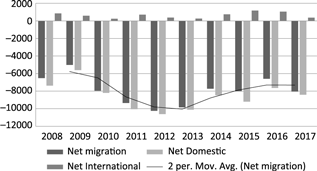
Initially not among the weaker regions of the Russian Arctic, the urban population of Nenets Autonomous Okrug grew at the expense of the rural population, but immigration began an overall decline in 2012 continuing through 2017. Since 2004, cities in Nenets mostly have a positive migration balance of not less than 200 per year, showing potential resilience (Fig. 3).
Migration data, Nenets Autonomous Okrug (Arkhangelsk Oblast’), 2008–2017 (see supplementary material for data tables).

Russia’s Arctic regions: Murmansk
Significant population losses due to out-migration have occurred in Murmansk, as in Arkhangelsk, with inflows since 2000 positive only for international immigration (Territorial Branch of Federal State Statistics, Murmansk oblast). Among those who have left, most are of working-age (76% in 2013), and the inflow of migrants in 2015 was only 80% of the outflow. Only from 2014–2016 did out-migration slow to 899. See Figure 4.
Migration data for Murmansk, 2008–2017 (see supplementary material for data tables).

Russia’s Arctic regions: Komi Republic
Migration loss in the Komi Republic has been severe. Over the period from 1996 to 2000, the Republic lost 108,700 residents. Migration turnover witnessed 1.6 million leaving home at one of the highest rates in the Russian Arctic. Although migration outflow has somewhat declined since 2012, urban areas are still running at a loss. For 2014–2016, the population of Syktyvkar municipality is an example (Fig. 5). Although there is some inflow to municipalities from rural areas within the region, there is greater outflow of urban residents to central and southern regions. The municipality with the worst indicators is Vorkuta, where migration loss amounted to 20.7% of the total loss of population in the Komi Republic in 2016 (see Territorial Branch of Federal State Statistics, Komi Republic).
Migration data for the Komi Republic, 2008–2017 (see supplementary material for data tables).

Russia’s Arctic regions: Yamalo Nenets Autonomous Okrug
Yamalo-Nenets is one of the few regions in the North where, from the early 1990s, migration growth maintained a positive value, at least until 1997, although the inflow was continuously declining Bykovskiy & Kobylkin (Reference Bykovskiy and Kobylkin2001). Over the past 10 years, the population of Yamalo-Nenets AO has generally increased (in large part due to natural fertility growth), although at present it shows negative net migration (except in 2011) (Fig. 6).
Migration data for Yamalo-Nenets Autonomous Okrug (Tiumen’ Oblast’), 2007–2017 (see supplementary material for data tables).

In this region the labour market differs for urban and rural areas, with increased demand for labour in cities and increased unemployment in rural areas. Also, shift work is now prevalent, constituting at least 15% of the working population. Demand for workers in 2015 was significant in construction, education, transport and communication, health and social services, and mining (http://rabota.yanao.ru/content, accessed 10.09.2016). Interactive portal of the employment services of the Yamalo-Nenets Autonomous Okrug. Interaktivnyy portal sluzhby zanyatosti naseleniya Yamalo-Nenetskogo avtonomnogo okruga.
Russia’s Arctic regions: Krasnoyarsk
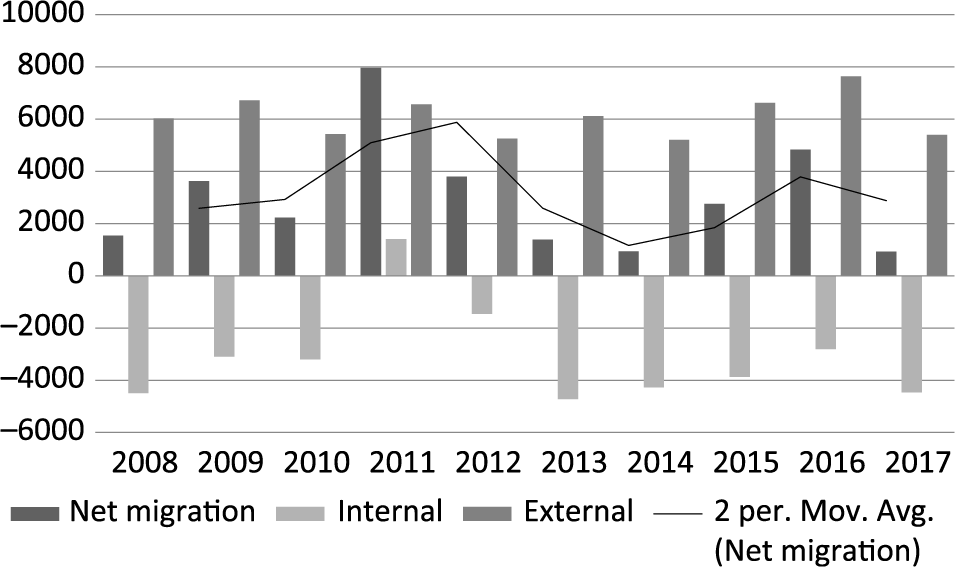
One of the most prosperous regions in the Russian Arctic, Krasnoyarsk nevertheless experienced a population decline in all municipalities (Norilsk, Taimyr and Turukhansky) due to migration outflow. The highest outflow was from the municipal districts of Krasnoyarsk, Sosnovoborsk and Berezovsky. The net migration for Krasnoyarsk was -2753 for 2015 (see Territorial Branch of Federal State Statistics Service in the Krasnoyarsk Krai, http://rabota.yanao.ru/content, accessed 10.09.2016). The following dynamics of migration growth show an increase in outflows during 2011–2013 but positive net migration in 2014–2015. This is due to some decrease in interregional outflow and a change in the number of foreign migrants (Fig. 7). The relative proximity to some of the former Soviet republics helps explain the rather positive population figures for this region (of 11,883 immigrants in 2017, 9,421 were from the former republics, with 2,462 from other countries, including 247 from China) (see Upravlenie Federal’noi sluzhby po gosudarstvennoi statistiki po krasnoyarskomu kraiu, Respublike Khakassia i Respublike Tyva; http://krasstat.gks.ru/wps/wcm/connect/rosstat_ts/krasstat/ru/publications/pubKras/news_issues/).
Migration data for Krasnoyarsk Krai, 2008–2017 (see supplementary material for data tables).

While this is positive, accompanying information on net migration shows an ongoing need in Krasnoyarsk for skilled labour, ranging from highly qualified specialists and managers to workers. New investment projects are steadily creating new demand.
Russia’s Arctic regions: Republic of Sakha (Yakutia)
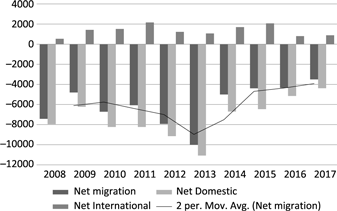
In the 1990s, the northern and northeastern districts of the Republic of Sakha experienced industrial collapse and significant outflow. Through 2014, with fluctuations, negative rates of migration continued. Loss of population was lowest in its Arctic regions for 2005 (-5084 people), but this figure subsequently increased to its highest number of out-migrants (-9809 people) in 2011, before it dropped back to -5387 in 2015 (Fig. 8).
Migration data for the Republic of Sakha (Yakutia), 2000–2016 (see supplementary material for data tables).

As elsewhere in the Russian Arctic, migration to the municipalities in Yakutia is important in the total inflows. However, in Ust-Yansky and Bulunsky out-migration from the municipalities was steady due to interregional migration within Russia. The municipality of Nizhnekalymsky grew somewhat with positive external (international) immigration (see Table 3). On the whole, it might be expected that the inflow from China and South Korea could be substantial; but it is relatively small. In all, among 40,724 immigrants in 2017, 1205 were from other countries, including both China and South Korea.
Russia’s Arctic regions: Chukotka Autonomous Okrug
Considerable out-migration from Chukotka Autonomous Okrug, as discussed by Heleniak (Reference Heleniak2010), began with transition shocks in the 1990s. The resident population in Chukotka fell by a factor of three between the censuses of 1989 and 2002. The mitigation measures undertaken by the regional government from 2001 dramatically slowed the outflow by 2015 (see Fig. 9) (Otchet o migratsii v Chukotskom avtonomnom okruge, 2015). Certainly, migration growth was still negative in 2015, but at its most positive rate since 2010. During this period, the Chukotka Autonomous Okrug lost mainly its rural population (Table 1). The result of mitigation, in other words, has been positive, but the district still suffers a shortage of qualified personnel and an unfavourable age structure, as do most Russian Arctic regions (Danilova et al., Reference Danilova, Golubeva and Emelyanova2011; Dudarev, Chupakhin, & Øyvind Odland, Reference Dudarev, Chupakhin and Øyvind Odland2013, Einarsson et al., Reference Einarsson, Larsen, Nilsson and Young2004).
Migration data for Chukotka, 2008–2017 (see supplementary material for data tables).

Russia’s Arctic regions: who migrates where?
For the last decade, the highest intensity of migration in the Russian Arctic was observed in Krasnoyarsk and Yamalo-Nenets Autonomous Okrug, between them taking in 71.6% of all arrivals. Even for these regions, capable of attracting in-migration, the trends are unpredictable. Positive immigration rates for 2011, for example were observed in Nenets and Yamalo-Nenets Autonomous Okrugs, Krasnoyarsk Krai and Chukotka Autonomous Okrug, followed in 2012 by decline in all regions. Then, during 2014–2015 there was a slight increase (see Fig. 1).
Krasnoyarsk Krai, the Republic of Sakha (Yakutia) and Yamalo-Nenets Autonomous Okrug, had the most intraregional migration, with Murmansk oblast and Chukotka Autonomous also showing intense intraregional population movement. Two areas with less intraregional migration were Arkhangelsk region and the Komi Republic, where external migration outweighed intraregional movement. Three regions experienced particularly high rural out-migration: Nenets Autonomous Okrug, Krasnoyarsk and Chukotka Autonomous Okrug, although there was some stable population outflow from rural areas in all regions.
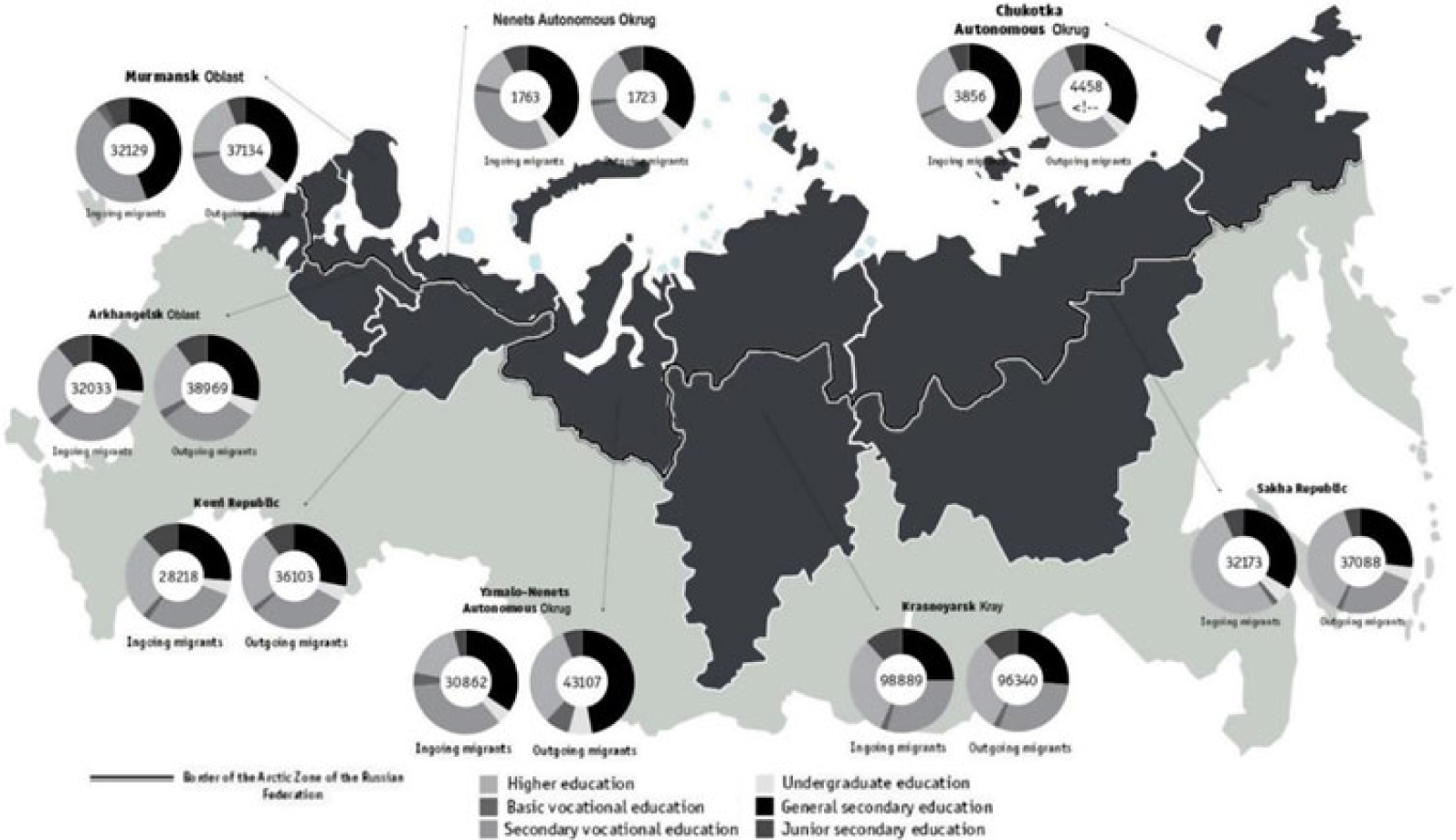
The capacity to attract workers with skills can be seen in migrants’ educational background for selected regions (see Fig. 10).
Distribution Interregional Migration in the Russian Arctic: Migrants aged 14 and over by education level, 2015. (Source: Federal Service of State Statistics: Migration (2015), Distribution of migrants).

The education level of in-migrants (2015) was highest for the Nenets Autonomous Okrug, Chukotka Autonomous Okrug and Murmansk oblast (30% and more of immigrant labour had attained a higher education degree). In that year, 22,300 migrants with higher education qualifications arrived in Krasnoyarsk Krai. To be sure, from these regions (Krasnoyarsk Krai, Yamalo-Nenets AO, and Krasnoyarsk), there were also large numbers of outgoing migrants with higher education qualifications. Migrants with secondary specialist and general secondary education also left. Yamalo-Nenets Autonomous Okrug lost migrants with specialist education (34.8% of all out-migrants). In-migrants with secondary vocational education mainly chose the Yamalo-Nenets Autonomous Okrug, Murmansk oblast and Nenets Autonomous Okrug, and a somewhat smaller share with secondary vocational education chose the Republic of Sakha (Yakutia) and Chukotka. The proportion of in-migrants with only basic vocational education was negligible in all Russian Arctic regions (1.5–4.6%), but, in general, less-skilled migrants were attracted to all regions, as can be seen in Figure 10.
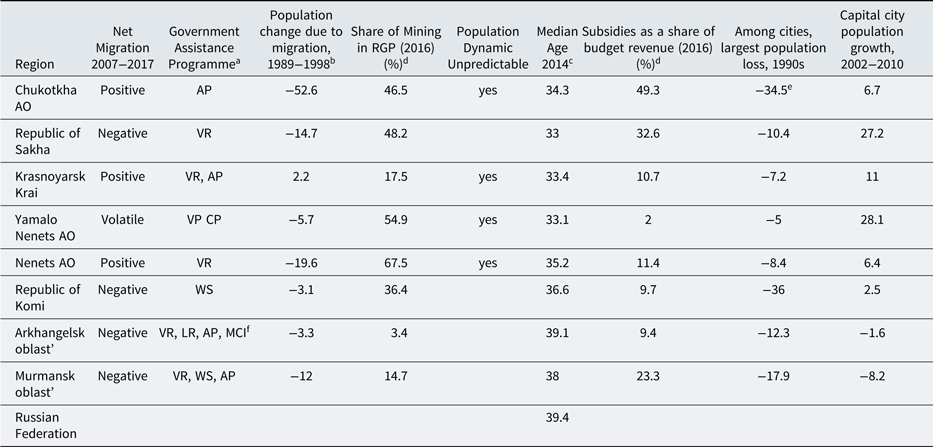
The capacity of Yamalo-Nenets AO and Krasnoyarsk to replenish their younger, possibly more educated, cohorts can also be seen in median age of the population of each region (see Table 5, in the next section). Both regions have (2014) a significantly younger median age than found in Arkhangelsk and Murmansk oblasts, which trend more toward averages found in the rapidly ageing northern European countries, where the median age reached 40 to 50 years in 2013. For comparison, the median age for 2014 in Alaska (34.5) shows its typically younger population. In developed countries for 2014 the median is 40, and in less developed, 27 (Emelyanova & Rautio, Reference Emelyanova and Rautio2012, Reference Emelyanova and Rautio2013).
Selected indicators, diversity of regions of the Russian Arctic.

a. CP = Comprehensive programme, LR = labour retention, WS = Wage Support, AP = Action Plan for Mobility, MCI = Military–Civilian Infrastructure Investment
b. Heleniak (Reference Heleniak1999) p. 172.
c. Sinitsa, “Demograficheskoe,” Reference Sinitsa2016, p. 25.
d. Tynkkynen et al. (Reference Tynkkynen, Tabata, Gritsenko and Goto2018), Tables 1.3, 1.4.
e. Litvinenko and Murota (Reference Litvinenko and Murota2008), p. 89.
f. TASS (2018).
Migrant workers by definition arrive for a limited period and choose regions of the Russian Arctic by their location for a job (with the exception of illegal migration). Evidence that retention policies are working do not show up in overall indicators. Indeed, among migrant and permanent residents, the outgoing population are still mostly of working age. Out-migrants tend to have a higher, secondary vocational and secondary general education: they tend to be migrants under contract – that is, shift workers – and younger residents who, after high-school graduation, choose to advance their education at institutions in other regions of Russia. It can be seen, in brief, that the number of outgoing migrants in these years exceeded the number of arrivals.
Developing a migration theory: Russia’s Arctic regions
The literature on reasons for out-migration of working-age populations from the Arctic has reached a consensus regarding the dominance of economic motivations (De Haas, Reference De Haas2010) including but not limited to employment and wages (Huskey, Berman, & Hill, Reference Huskey, Berman and Hill2004); economic factors combine with others, relating to work interest and political, social and cultural background (De Haas, Reference De Haas2010). Migration also tends to reflect individual characteristics, such as professional status, level of education and ethnicity, and statistically has interaction effects with location (exit and destination), and distance (Lee, Reference Lee1966).
These general factors are discussed as broad categories of push and pull forces (Heleniak, Reference Heleniak1999; Ravenstein, Reference Ravenstein1889). They reflect considerations of costs and benefits, with their economic foundation in rational expectations, as Heleniak (Reference Heleniak1999) observes. Gerber (Reference Gerber2005) also emphasises push and pull in migration during the period 1989–1991, as the Soviet Union was breaking up. At that time, the pull reflected the package of northern benefits, including retirement supplements, paid to individuals if they returned to their places of birth outside Russia, which had inherited payments from the Soviet Union. Significantly, the factors explaining Soviet era out-migration by “northern benefits” no longer apply to the Russian Arctic and new models have been developed. However, models are still based on economic foundations, and there is still some weight added to economic motivations by government policies in support of energy production and security.
The “push/pull” framework, bringing together the balance of staying and departing, has general limitations in regard to Arctic migration (De Haas, Reference De Haas2010). In particular, indicators of well-known push/pull factors are dynamic for the Arctic, given that conditions in polar regions are affected by climate change and the emergence of new technologies, which ease transportation and reduce infrastructure costs (Howe, Huskey, & Berman, Reference Howe, Huskey and Berman2013). Lee’s description of cyclical influences on mobility of manpower in the Arctic shows predictability which we do not find for this length of time; his theory shows a balancing of factors resulting in “migration efficiency”, or net redistribution of a population caused by opposing flows (Lee, Reference Lee1966). Inbound and outbound flows are high during periods of growth and low during depressions/recessions. Because of its dependence on energy sector revenues, Heleniak (Reference Heleniak2013) observes, however, the Russian Arctic population is particularly vulnerable to unpredictable boom and bust resource cycles due to oil price volatility, which affects investment and employment opportunities. Volatility is an Arctic-wide concern, since communities must adapt not only to boom and bust cycles of resource exploitation but also to substantial population flows in a labour-scarce environment.
Theories also take account for personal job-related factors, for example, how migrants may differ in their migration destination decision depending on their skills (Heleniak, Reference Heleniak2013). In particular, stepwise migration from small rural settlements has altered skills differentials in cities (Howe, Reference Howe2009; Korovkin et al., Reference Korovkin, Dolgova, Edinak and Korolev2015). Forecasted demand for manpower resources in the Arctic takes account of skills differentials, which affect economic performance and tax revenues (Huskey, Reference Huskey2009; Korovkin, Reference Korovkin2016). In this regard, modelling of regional migration is also important for estimates of economic performance and tax revenues.
Considerable current literature also focuses on the potential impact of extraordinary events. Political, social and cultural factors can be added to the refined and complex economic motivations of migration decisions in such circumstances (Huskey, Reference Huskey2009; Korovkin, Reference Korovkin2016). Russia’s experience with population loss in the 1990s was sudden and significant, affecting the current age structure, skills gap and dependency ratio, especially in cities, and this has consequences that exacerbate the hiring market. Many factors are involved in migration from the Arctic during such circumstances, including preferences affecting choice of “place” or “location,” pulling previous migrants, even those who had lived for decades in the North, back to their homes in other regions of the country (Heleniak, Reference Heleniak1999, p. 191), leaving behind different leading cohorts on average:
When the migration from the North began in large numbers in the early 1990s, it was the highly educated, young adults, living in urban areas who constituted the majority in the streams. Left behind were less educated and older people, as well as members of non-Slavic ethnic groups.
Included among push factors, along with wage decline and unemployment, are the state of local industry and the level of urbanisation, as well as distance and ease of migrating from village to city (Vakulenko, Mkrtchyan, & Furmanov, Reference Vakulenko, Mkrtchyan and Furmanov2011). Showing the relevance of the gravity model, they argue, under current conditions out-migration is mainly to nearby places. These factors have interaction effects, for example, as between location (exit and destination), and distance, and with personal factors (Lee, Reference Lee1966). Vakulenko (Reference Vakulenko2016) observes, however, that migration is affected most by demographic and economic factors (housing provision and per capita income, education and healthcare), and less by other factors.
In view of the scale of the northern cities in the Soviet era, the destruction of much of their industry during transition was a powerful economic factor with lasting effects in the transformation of employment, for example the bankruptcy of some factories in some cities. Prior industrial concentrations and other Soviet-era legacies, which can be seen in regional Russian economic development and historical events, have an impact on governance (Leonard, Nazarov, & Vakulenko, Reference Leonard, Nazarov and Vakulenko2016). We argue that in the Arctic, population movement experienced reasonably long effects of transition events and should remain part of forecasting future population trends.
Building a preliminary practical model of population movement, for this brief time period, we should take into account both the initial industrial and social conditions and the current economic and governance factors, particularly of forces affecting population movement in large cities. Table 1 (above) shows the large migration trends for 2014 and 2016, explaining the focus here on cities.
In Table 1 there are two totals provided. The first, “Total in the Arctic Zone” is for the municipalities in this zone; the second, “Total by region” is for all Arctic cities in all regions in the Russian Federation.
To advance a tentative model, Table 5 provides background descriptors beginning with a column simplifying net migration general trends after 2000. In column seven (“Median Age 2014”), diversity of ageing can be identified by median age in different regions. Column eight (“Subsidies as a share of budget revenue (2016)”) identifies those regions that are especially fiscally dependent on the federal government in part as a result of transition population movements, firm bankruptcies and abandoned mining operations, particularly in the coal sector. To summarise, Table 5 provides a rough comparison of regions by these indicators showing initial conditions, population and economic indicators, urban loss in the past and current stabilisation, and manpower and more broadly developmental programmes in place to assist some regions.
A preliminary focus here on regional resilience, or the ability of a region to withstand recessionary shocks, arguably even emerges from column six above, showing continued unpredictability in population dynamic. A large population movement to and from major cities is observed (Table 4) in some regions in recent years (2014, 2016). On one hand, where severe loss of urban population in the transition era occurred, current unpredictability combines with heavy dependence on the available budget, as in Chukhotka AO and Nenets AO, to make significant population outflows a plausible trajectory, and there is little evidence of capacity in Chukhotka to absorb government assistance. On the other hand, unpredictability combined with moderate growth of capital cities and less fiscal dependency along with the presence of government programmes provides a plausible resilience trajectory. Government assistance, it can be seen, is not the key; even with it, some regions are struggling. Also, even where there is evidence of resilience, as in Krasnoyarsk, Figure 10 shows that the outflow of younger educated migrants leaves crucial manpower shortages.
To provide greater detail for a more practical model, given a longer time frame, and following the economic orientation of Vakulenko (Reference Vakulenko2016), requires the tracking of diverse and changing actual aggregates in each of the northern regions to assess the performance of subsidies for education and social services, especially housing and communal services. Will shift workers have skills and training in the technical and engineering professions, a need that the local unemployed cannot meet? Korovkin et al. (Reference Korovkin, Dolgova, Edinak and Korolev2015) provides estimates of current and forecast dynamics of the amount and qualitative composition of the manpower resources of the Arctic regions. Large-scale resettlement programmes tend to attract those who have no claimed professions or professional education (see Fig. 10). This produces significant imbalance, in that ingoing migrants tend to supply mainly non-professional labour, while the demand for highly skilled, specialised labour remains high.
This review draws focus, overall, toward the emerging similar issues and conditions in northern Europe. Emelyanova and Rautio (Reference Emelyanova and Rautio2012) show similarities in regard to the ageing of the populace, as in Murmansk and Arkhangelsk. For such regions, without much evident capacity to absorb current levels of assistance or retain younger cohorts, it may be useful to focus on inter-regional, or rural/urban migrants. The literature shows that much migration is short-travel and stepwise (Vakulenko, Reference Vakulenko2016), and urban areas may benefit from centres for regional training and education to attract the highly mobile younger rural migrants.
Discussion and conclusions
To summarise, by contrast with those that seem to be resilient and recovering, the Russian Arctic’s sub-national regions in steady decline are of two types: (1) most are in the European Russian Arctic with long-term steady migration loss, having suffered dramatic decline of their large cities in the 1990s (Arkhangelsk, Murmansk, Nenets AO), and (2) some have the indicators of the legacy of high population loss in the 1990s and substantial government budget subsidies (see Table 5; the Republics of Komi, Chukotka and Sakha [Yakutia]). The highest migration loss occurred in the Komi Republic (-9.3 thousand people) and in Arkhangelsk (-7.7 thousand people). The resilient regions represent another type, characterised by a higher intensity of migration in general (Krasnoyarsk Krai and Yamalo-Nenets AO). Possibly also on course towards greater recovery is Nenets Autonomous Okrug, which has attracted more migrants with higher education qualifications and far fewer with only general secondary education, by contrast with the steadily declining Republic of Sakha (Yakutia), where in 2015, 38% of all in-migrants had only general secondary education.
Under present economic conditions, with government support and energy resource investment in two, perhaps three regions, resilience seems to be the trend; but even here, attracting skilled labour is important for improved productivity and regional performance; these regions too report a shortage of qualified personnel.
To attract skilled labour, a multi-functional federal-level Arctic assistance policy with long-term development objectives, coordinated with the regional level, could target locations most disadvantaged in terms of social infrastructure (especially housing and communal services, including the supply of safe drinking water). However, such regions may not have the capacity to absorb extensive government aid; Russian government assistance in the form of budget subsidies, in any case, is already evident in these regions. The Voluntary Resettlement (VR) programme assists former residents of Russia from, say, Ukraine, to resettle in the Russian Arctic (Arkhangelsk, Nenets Autonomous Okrug, Murmansk oblast, Yamalo-Nenets Autonomous Okrug and Krasnoyarsk), but these resettlements in resilient regions, with intensive re-urbanisation underway, far exceed VR accomplishments in declining regions. However, government support does result in attracting the younger, professional, entrepreneurial and innovative workers in those few regions.
Our research agenda for the Russian Arctic focuses on refining the economic stimulus model to emphasise diversity since its application, as in the periphery of northern Europe, is most effective in already resilient regions and is insufficient to stop decline in others. The peripheral northern European model is important, however not applicable to the entire Russian Arctic; federal policy work with regional authorities and communities is needed to develop local solutions to the dilemmas of decline. Some services renovation is ongoing and important; federal/state and private initiatives also support the crucial area of logistics improvement in regions, such as Archangel, where networks and transportation hubs link the entire Russian Arctic.
Supplementary material
To view supplementary material for this article, please visit https://doi.org/10.1017/S0032247419000019.
Author ORCIDs
Konstantin Zaikov 0000-0001-6479-416X
Acknowledgements
The authors gratefully acknowledge comments by an anonymous reviewer and reading by Irina Il’ina, Elena Vakulenko, and Zafar Nazarov.
Funding
This work was prepared within the framework of the project of the Ministry of Education and Science of the Russian Federation, state order No. 27.13547.2019 / 13.1 “Research and methodological support for the implementation of the state policy in the field of personnel training for the Arctic zone of the Russian Federation and international cooperation within the University of the Arctic”.