I. RULE-CONSEQUENTIALISM AND THE PROBLEM OF PARTIAL ACCEPTANCE
Rule-Consequentialism's modern ‘partial acceptance’ debate begins with Brad Hooker's articulation of Fixed Rate Rule-Consequentialism:
An act is wrong if and only if it is forbidden by the code of rules whose internalization by the overwhelming majority of everyone everywhere in each new generation has maximum expected value in terms of well-being . . . The calculation of a code's expected value includes all costs of getting the code internalized.Footnote 1
What exactly is the ‘overwhelming majority of everyone everywhere’? 90 per cent, answers Hooker.Footnote 2
This 90 per cent answer is a ‘Fixed Rate’ response to Rule-Consequentialism's ‘problem of partial acceptance’: How should the ideal code be selected given the possibility that its rules may not be universally accepted?Footnote 3
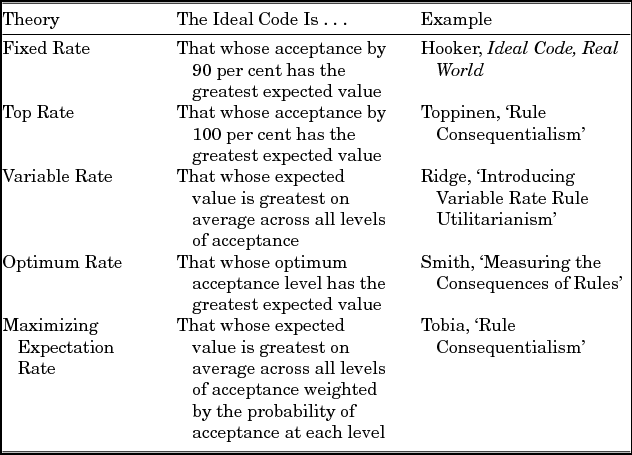
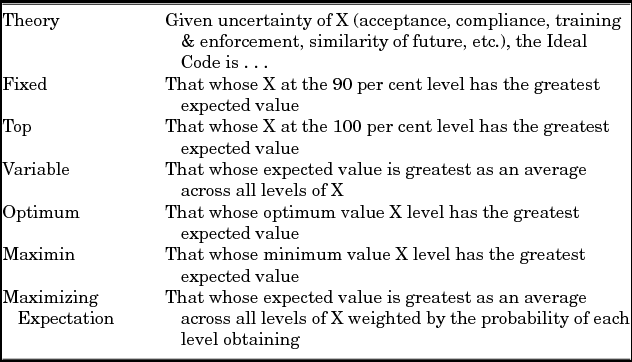
But a Fixed Rate response is not the only answer to the problem of partial acceptance. Michael Ridge offers a ‘Variable Rate’ response; we should select the code with the greatest expected value across all possible levels of acceptance.Footnote 4 Holly Smith defends an ‘Optimum Rate’ answer: we should select the code with the greatest expected value at some level of acceptance.Footnote 5 I have defended ‘Maximizing Expectation Rate’ theory: the ideal code is that whose expected value is greatest as an average across all possible acceptance levels, weighted by the probability of each level obtaining.Footnote 6 Teemu Toppinen argues for a ‘Top Rate’ response: choose the code whose acceptance by 100 per cent has greatest expected value.Footnote 7 For a summary of these views, see Table 1.
Five responses to Rule-Consequentialism's ‘Problem of Partial Acceptance’: how should the ideal code be selected given that its rules may not be universally accepted?

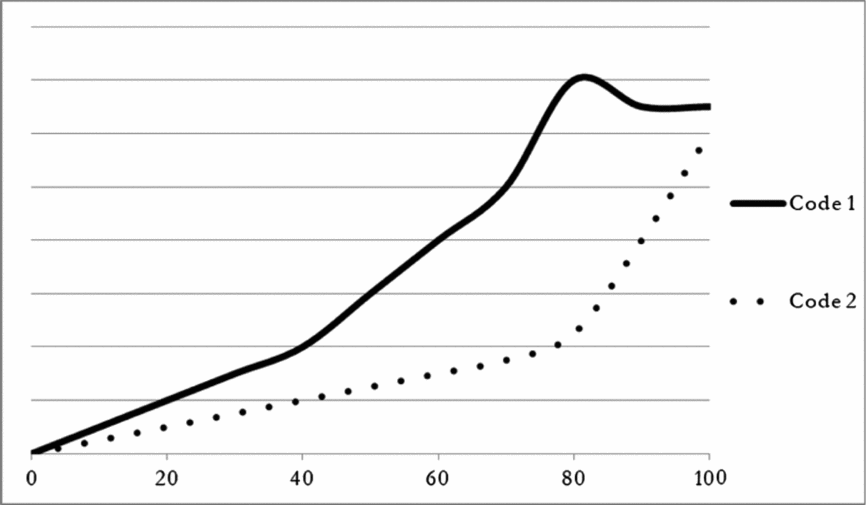
These theories recommend different possible codes as the ideal code. Which code each theory identifies depends on various facts about the world and what possible alternative codes exist. For instance, consider Figure 1 above. In this simple example, there are only two possible codes. The Y-axis depicts expected valueFootnote 8 and the X-axis depicts possible acceptance levels. On all five theories, Code 1 is identified as the ideal code. Compared to Code 2, Code 1 promises greater expected value at 90 per cent acceptance (Fixed Rate), at 100 per cent acceptance (Top Rate), on average across all acceptance levels (Variable Rate), at its optimum acceptance level of 80 per cent (Optimum Rate), and on any average weighted by the probability of acceptance at each level (Maximizing Expectation Rate).Footnote 9
Expected value of two codes across possible acceptance levels.

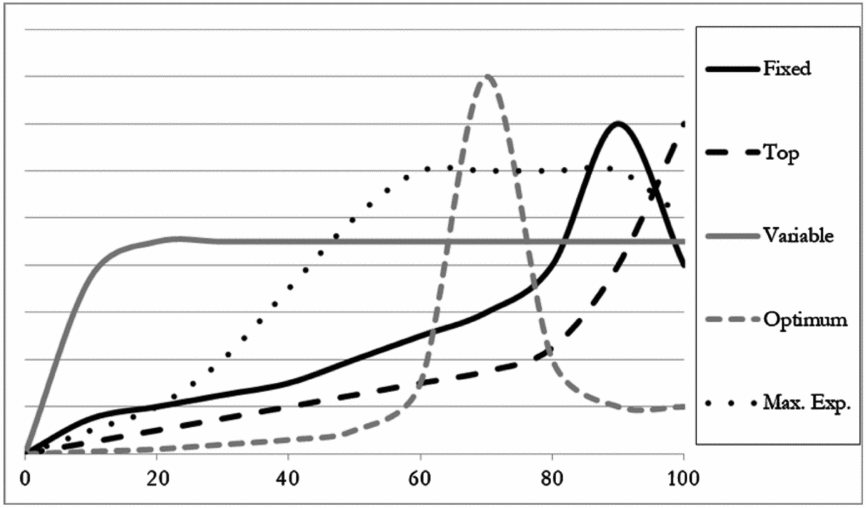
In the real world, there are more than two possible codes. And their expected value functions at various acceptance levels are more complex. For some codes, it is reasonable to expect great value at higher levels of acceptance and low value at lower levels; for other codes the inverse expectation is reasonable. For a more complex example, see Figure 2 below.
Expected value of five codes across possible acceptance levels. Each code is labelled by the theory under which it is the ideal code (assuming these five codes were exhaustive). And that the probability of an acceptance level obtaining is normally distributed over 75 per cent. This assumption is required to distinguish the Maximizing Expectation Rate code from the Variable Rate ideal code.

This figure depicts a world with five possible codes. In this example, intended to illustrate the competing theories’ differences, the codes are such that each of the five theories identifies a different code as the ideal one. Assume that acceptance levels are normally distributed around the 60 per cent acceptance level.Footnote 10 The Fixed Rate code is that with the greatest expected value at 90 per cent acceptance; the Top Rate code is that with the greatest expected value at 100 per cent acceptance; the Variable Rate code is that with the greatest expected value on average across all levels; the Optimum Rate code is that with the greatest expected value at its optimum (in this case, 70 per cent); and the Maximizing Expectation Rate code is that with the greatest expected value when averaging across all possible acceptance levels, weighted by their likelihood of obtaining. Figure 2 indicates the significant differences between these competing versions of Rule-Consequentialism.
Which of these formulations of Rule-Consequentialism is best? This is the subject of much debate. Each of these theories has been critiqued individually, and all have also been critiqued collectively.
Fixed Rate theory is maligned as arbitrary:Footnote 11 why focus on 90 per cent rather than 8 per cent or 95 per cent? Moreover, it focuses on just one acceptance level. This leads to implausible consequences when a code performs well at 90 per cent but poorly at many other levels.Footnote 12
Top Rate theory is the newest addition to the debate, but it is subject to many of the same critiques as is Fixed Rate theory. It is less arbitrary than (90 per cent) Fixed Rate theory, but by focusing on just one acceptance level (100 per cent), Top Rate theory still risks identifying ‘ideal codes’ that perform well at that single rate, but poorly at many others. This is particularly troublesome in so far as 100 per cent acceptance is unlikely to obtain.
Variable Rate theory is also arbitrary: why does it recommend taking the mean across acceptance levels and not the median or mode?Footnote 13 More importantly, it is prone to being skewed by anomaly.Footnote 14
Optimum Rate theory does not consider whether a given code is at all likely to achieve those optimal acceptance rates. A risky code with an improbable optimum is not obviously the ideal one.Footnote 15
Maximizing Expectation Rate theory has not been subjected to any individual critiques.Footnote 16 A tempting criticism is that its selection procedure is more complicated than that of other theories. This is not to say the theory is ad hoc or arbitrary; the maximization of expected value is a straightforward approach, and one that is less arbitrary than focusing on fixed rates. But the complexity might raise implementation problems.
These theories have also been critiqued collectively. For instance, Doug Portmore describes Maximizing Expectation Rate as the ‘best version . . . perhaps’, but he also levels critiques that apply to all versions.Footnote 17 Holly Smith argues that indeterminacy of acceptance and compliance presents a challenge to all theories.Footnote 18 I turn now to a most recent competitor to all of these views, one that claims to ‘solve’ the problem of partial acceptance.
II. CALCULATED RATES RULE-CONSEQUENTIALISM (CRCC)
Timothy Miller offers a new competitor theory to those discussed in the previous section.Footnote 19 This is ‘Calculated Rates’ Rule-Consequentialism (CRRC). Miller claims that CRRC ‘has considerable advantages over [all these other] formulations’ and ‘no disadvantages that those theories do not share’. Miller's view is that Rule-Consequentialism should simply solve for the appropriate acceptance levels, rather than treat acceptance rate as an uncertain variable.
CRCC holds that ‘[a]n ideal code is a code included in an expanded code whose value is at least as high as the value of any alternative expanded code’.Footnote 20 This definition includes Miller's original terminology. ‘Code’ refers to a complete set of moral rules, and ‘code + stipulated methods of teaching and enforcement’ is an ‘expanded code’.Footnote 21 In other words, for any given code we can consider various methods of teaching and enforcement. For each of these methods, we calculate the expected acceptance and compliance of various rules within the code.
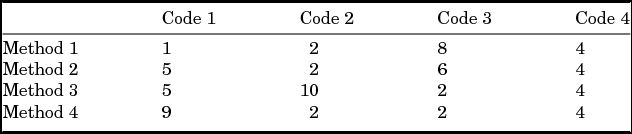
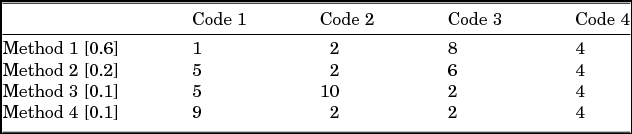
The fundamental problem with CRCC is that, although it seems to ‘solve’ the partial acceptance problem, it merely masks it. Imagine a world with four possible codes, each of which can be taught and enforced by four different methods. Table 2 depicts a matrix indicating the value of each of these Code × Method pairs.
Expected value matrix: methods of training and enforcement by code

CRRC endorses choosing the code ‘whose value is at least as high as the value of any alternative expanded code’. Now, which cell contains the code ‘whose value is at least as high’ as the value of any alternative? Seemingly Code 2 (and Method 3).
But a crucial question remains: how are these matrix values calculated? Answering this question returns us to familiar territory of the problem of partial acceptance. Should the ‘values’ that fill this table represent a Code × Method's Optimum at some level of acceptance, or the (Variable Rate) average across all possible levels of acceptance, or the reasoning of one of the alternative theories? In other words is ‘10’, the value of Method 2 and Code 3, an indication of what those methods will arrive at in the best case acceptance scenario (Optimum), if they achieve 100 per cent acceptance (Top) or 90 per cent acceptance (Fixed), on average (Variable) or on a likelihood weighted average (Maximizing Expectation)?
Miller's solution is to simply ‘solve’ for the acceptance rate that will obtain from a method. But a single method does not guarantee an acceptance rate, either for a specific code or across all codes. For example, ‘Method 3’ cannot be understood as purchasing, say, a 90 per cent acceptance rate across all different moral codes. Different codes have different inculcation costs. And within a single pair, say Method 3 and Code 2, we need to say more about how the acceptance rate is calculated.
I interpret Miller's suggestion as most plausibly endorsing Optimum or Maximizing Expectation reasoning to answer this question. In other words, teaching Code 2 with Method 3 will in the best case scenario (Optimum) achieve the level of acceptance providing 10 value, or the weighted average of acceptance levels (Maximizing Expectation) provides 10 value. But even such an interpretation requires a defence. Why, on Miller's view, do we prefer a certain method of ‘solving for’ acceptance?
More importantly, this reveals that CRCC is not a true competitor to these other theories. It is ultimately dependent on one of these other views, arguing that we should choose the Code × Method combination that offers the best value given an acceptance rate calculation – value ultimately calculated in terms of Variable or Optimum or Maximizing Expectation or some other theory.
This first objection concerns a problem in calculating acceptance levels given stipulated methods of training and enforcement. A second line of objection also problematizes CRCC. Is it really plausible that we can stipulate what methods of training and enforcement will obtain? In the real world, this is a question influenced by various political processes and complex social norm interactions. The far more plausible assumption is that we can estimate the likelihood of certain methods obtaining, given our intention for them to obtain.
Similar debates to the partial acceptance debates arise here: the various positions include endorsing the code that does best on average across various methods, the code that does the best at one possible method, or the code that does the best as a weighted average. Consider Table 3, which depicts a Code × Method expected value matrix. This figure also reflects the more realistic assumption that attempting to teach and enforce some method may lead to slightly different methods actually obtaining – a slight difference with significant consequences.
Expected value matrix: methods of training and enforcement by code

Note: Brackets indicate probability of the method actually obtaining
Let us set aside the first objection. Ignore the question of how these matrix values are calculated and take them as given. Consider just the second objection. The fact that the outcomes of methods of training and enforcement are at best probabilistic outcomes requires us to make hard choices in ideal code choice. Table 3 suggests different predictions of the same theoretical approaches to the problem of partial acceptance. For example, in Table 3’s matrix ‘variable methods theory’ would select Code 1; ‘optimum methods theory’ would select Code 2; ‘Maximum Expectation methods theory’ would select Code 3. When we cannot guarantee that an intended method will obtain, then ‘Calculated Rates’ theory by itself does not give a clear prediction about the ideal code.
It is worth reiterating that this problem does not require large differences among possible methods of training and enforcement. We might understand Table 3 as representing the probabilities obtaining from the intention or expected effort to implement some single method, say Method 1. We expect that intended implementation to actually result in one of four (perhaps subtly different) outcomes: Method 1, 2, 3 or 4. Those method outcomes interact differently with different codes, generating this second problem for Calculated Rates.
Together, these two critiques reveal that CRRC raises as many problems as it claims to solve. Attempting to ‘solve’ for acceptance rates by endorsing some particular methods still raises questions about what kind of acceptance value should be calculated and how to respond to the partial success of methods of training and enforcement.
III. RULE-CONSEQUENTIALISM'S BROADER PROBLEM
The previous section identifies two problems with the Calculated Rates suggestion. Calculated Rates simply relocates the problem of partial acceptance. The guidance to select the code in an expanded code of greatest value is indeterminate; we need to know how the values are calculated, and answering that implicates the core problem of the partial acceptance debate. Second, it assumes that we can stipulate precise levels of training and enforcement. In so far as there is any probabilistic variability in method outcome, we face similar problems to those raised by the problem of partial acceptance.
These critiques reveal the problem of partial acceptance as one instance of a broader problem for Rule-Consequentialism: rules are chosen given various assumptions. The partial acceptance debate has focused on questions about how many people will accept the ideal code, but we should also consider questions about the realizability of methods of training and enforcement. Other factors are also relevant. For instance, we should consider the similarity of our current context to future contexts; a code that realizes great value today may not be as valuable in a future sufficiently dissimilar to ours. Alongside the ‘problem of partial acceptance’, we have at least the ‘problem of training and enforcement’ and the ‘problem of uncertain futures’.
Rule-Consequentialism's broader problem is the problem of its factual stipulations or assumptions made under uncertainty. The core of Rule-Consequentialist analysis is evaluation of different codes’ outcomes. The value of those outcomes depends crucially on the relationship between a code's rules and various factors (e.g. partial acceptance, partial compliance, other background factors like training and enforcement, dis/similarity of the future).
Although the partial acceptance debate is somewhat narrow, the various approaches outlined by that debate are useful to these other questions. Those theories provide a basic taxonomy of useful approaches and a groundwork for developing the best formulation of Rule-Consequentialism. See Table 4 below for a summary of these approaches.
Theoretical approaches to the problem of Rule-Consequentialism's assumptions

Fixed theories offer a brightline rule. For example, the ideal code is the code that does best when accepted by 90 per cent, is complied with by the same, in 90 per cent effective conditions (e.g. training and enforcement) similar to our current one.
Top theories also offer a clear brightline rule, for ideal conditions. For example, the ideal code is that at 100 per cent acceptance, complied with by same, in conditions like ours.
Variable theories offer an averaged view. For example the ideal code is the code that does best on average over possible levels of acceptance and compliance, in various conditions.
Optimum theory selects the best possible code. For example, the ideal code is the code that does best for some acceptance and compliance rate, in some condition (perhaps not so similar to our current one).
A previously undefended option is a ‘Maximin theory’, selecting the code that avoids the worst possible consequences. For example, the ideal code is the code that does least badly across all various conditions.
Maximizing Expectation theory selects the ideal code as the code that does best in an expected value calculation, taking acceptance and compliance rates and background conditions as probability-weighted inputs. Further refinements are possible. For instance, ‘Plausible Expectation’ theory might select the code that maximizes expected value, only over plausible outcomes levels (i.e. excluding from analysis improbable values). ‘Anomaly Avoidance’ theory might first exclude all codes that have a probability of leading to unusually bad outcomes under certain conditions, and then apply Maximizing Expectation theory. There are countless other possibilities.
To see the relevance of these approaches across various Rule-Consequentialist debates, consider as an extended example the problem of uncertain futures. How should we identify the ideal code given that the conditions of the future might not mirror those of the present? One approach might be to only consider futures that are ‘close’ but not identical to ours, and choose the code that does best in those contexts. This is essentially a ‘Fixed’ style suggestion. Given the problematic variability in some parameter (e.g. partial acceptance, future similarity), we should just pick a clear and simple cut-off and choose the code that performs best at the value (e.g. 90 per cent acceptance, 90 per cent similarity).
But perhaps what we should really consider is the code whose acceptance leads to the greatest value in the future most similar to ours. This is a ‘Top’ style suggestion. Given the problematic variability in some parameter, we should just choose the code that performs best at the value of the parameter that would in itself seem ideal (e.g. 100 per cent acceptance, 100 per cent future similarity).
Or we could look to the code whose expected value is greatest as an average across all possible futures (Variable). Or we could choose the code whose optimum in any future has greatest expected value (Optimum). Here, as elsewhere, the Maximizing Expectation style solution is highly plausible: the ideal code is the one whose expected value is greatest as an average across all future possibilities, weighted by the probability of each level obtaining.
We might wonder how broad a problem this presents for Rule-Consequentialism. For one, some of these issues might be considered together. Perhaps problems of partial acceptance and partial compliance can be dealt with swiftly using the same general Rule-Consequentialist assumption and endorsing one of the theoretical approaches (e.g. fixed or top or variable).
While there might be some reason to adopt a similar approach about certain issues (e.g. adopting the same theoretical approach with respect to both acceptance and compliance), there may be reasons to favour different approaches to different questions. For instance, rather than adopting an Optimum theory across the board, one might endorse an Optimum stance towards the problem of partial acceptance and a Maximizing Expectation stance towards the problem of future similarity. More generally, it is not plausible that we should adopt the same stance to every question. For example, a Fixed approach has prima facie plausibility in the face of partial acceptance concerns, but perhaps less plausibility in the face of future similarity concerns. Why should we focus only on futures that are not exactly similar to ours, but also not very different? This is less compelling than the intuition that, in the face of partial acceptance concerns, we should consider how codes perform at around the 90 per cent rate.
The one view that does seem plausible across the board is a Maximizing Expectation style theory. This view has many benefits in the partial acceptance context, and it is also useful when considering questions from methods to future similarity. In the face of uncertainty, the Rule-Consequentialist should simply perform an expected value calculation that takes into account the relative probabilities of the uncertain parameter obtaining.
IV. IS RULE-CONSEQUENTIALISM IRREPARABLY ARBITRARY?
The previous argument suggests a commonality among debates about Rule-Consequentialism. This indicates new ways in which to define the Ideal Rules, with varying assumptions about various topics. However, the flip side to this commonality is that it also reveals the breadth of Rule-Consequentialism's potential problems. Does the range of Rule-Consequentialism's required assumptions imply a death by arbitrariness? If there is no principled way to choose among the resulting expanded list of definitions for the Ideal Rules, Rule-Consequentialism cannot provide a principled defence of any set of moral rules.Footnote 22
One way to explain the objection is to note that expanding the possible topics about what we need to make assumptions about for defining the Ideal Code expands the possibility for arbitrary assumptions. Does Rule-Consequentialism's initially plausible idea, that morality is to be understood as a value-maximizing set of rules, collapse under the weight of arbitrariness?
Although acknowledging the broader problem of Rule-Consequentialism's assumptions increases the required number of Rule-Consequentialism's theoretical commitments, we do not yet need to conclude that the theory collapses under the weight of arbitrariness. For one, it is not clear that a theory's increasing detail or sophistication – or decreasing simplicity – should count against it. In so far as theorists offer persuasive reasons and arguments for Rule-Consequentialism's assumptions, the theory does not collapse under arbitrariness.
Second, the problem of arbitrariness might be dismissed by appeal to reflective equilibriumFootnote 23 or some other methodology. Although refining Rule-Consequentialism might seem to involve arbitrary decisions, we can conduct that process through a robust philosophical method. In so far as the inquiry is conducted by reflective equilibrium, or another methodology, this provides another reason against concerns of arbitrariness.
More broadly, the arguments about how to refine Rule-Consequentialism do not involve arbitrary reasons. All plausible moral theories face choices. Take Consequentialism more broadly. Should we endorse act- or rule-consequentialism;Footnote 24 actual or expected consequentialism;Footnote 25 scalar or non-scalar versions;Footnote 26 or other vers- ions?Footnote 27 These are debates that advance reasons and arguments, not merely arbitrary preferences.
In light of all these considerations, I am most inclined to retain cautious optimism about Rule-Consequentialism's project. The mere existence of these questions – how should Rule-Consequentialism respond to various uncertainties – does not necessarily indicate Rule-Consequentialism's arbitrariness, never mind its failure. Of course, it might turn out that with respect to some of these questions there is no clear victor among the various versions of Rule-Consequentialism. That conclusion is far from settled, and given the numerous principled arguments in favour of these various approaches (e.g. in the partial acceptance debates), for now the burden of proof seems to rest with those who think Rule-Consequentialism is overburdened by arbitrariness.
V. CONCLUSION
The discussion about Rule-Consequentialism's ‘problem of partial acceptance’ initially appears narrow. It begins with a simple question – how should the ideal code be selected given the possibility that its rules may not be universally accepted? – and results in an array of complex theoretical responses: Fixed Rate, Top Rate, Variable Rate, Optimum Rate, Maximin, and Maximizing Expectation Rate Rule-Consequentialism.
That problem has no easy solution. The failure of ‘Calculated Rates’ Rule-Consequentialism demonstrates this difficulty. But it also illuminates the broader problem underlying the problem of partial acceptance. Formulating the best version of Rule-Consequentialism requires grappling with the theory's assumptions about various uncertainties.
This new problem – how should the ideal code be selected given the possibility that various assumptions will not be (fully) realized? – is broad. It implicates concerns about partial compliance, partial acceptance, ineffective training and enforcement, the dis/similarity of the future, and perhaps further considerations. Though seemingly narrow, the previous rich discussions about partial acceptance provide a taxonomy and groundwork for broader attempts to formulate the best version of Rule-Consequentialism.
This is not to say that these approaches solve all of Rule-Consequentialism's problems. Future work could delve into different details. For example, even in the partial acceptance debate, Fixed theory might have very different implications depending on which 90 per cent of the population accepts the rules. For at least some rules, a dense pocket of dissent plausibly has very different consequences from evenly distributed non-acceptance. Debates among these various theories (e.g. Fixed vs Optimum vs Maximizing Expectation) should come alongside debates within each theory.