Introduction
The arrival of a non-native species can lead to significant changes of the invaded ecosystem , such as local extinctions of native species or communities, variations in biodiversity composition, alteration of fire regimes, water quality and biochemical cycles (Baumgärtner & Gilioli, Reference Baumgärtner and Gilioli2008), with serious environmental, economic and social impacts (Lin et al., Reference Lin, Cheng and Xu2011). These effects are particularly feared in protected natural areas because of their major role in conserving biodiversity and sustaining local livelihoods (Naughton-Treves et al., Reference Naughton-Treves, Buck Holland and Brandon2005).
The consequences of a biological invasion are largely unpredictable, especially during the first phases when an alien population colonizes a new habitat, becomes established and influences the dynamics of indigenous organisms. Population dynamics are often understandable only when the invasive species is well established at numerically high levels: in the early stages of infestation, biological parameters are difficult to obtain due to the objective difficulty of sampling, and the subsequent evolution of the invaded ecosystems is uncertain in many respects (Leung & Delaney, Reference Leung and Delaney2006).
To deal with uncertainties, adaptive management enables managers to act in a flexible and adaptable manner in the face of uncertainty and lack of knowledge (Holling, Reference Holling1978; Baumgärtner et al., Reference Baumgärtner, Getachew, Melaku, Sciarretta, Shifa and Trematerra2004). According to the definition of Williams & Brown (Reference Williams and Brown2012) ‘an adaptive approach involves exploring alternative ways to meet management objectives, predicting the outcomes of alternatives based on the current state of knowledge, implementing one or more of these alternatives, monitoring to learn about the impacts of management actions, and then using the results to update knowledge and adjust management actions. Adaptive management focuses on learning and adapting, through partnerships of managers, scientists and other stakeholders who learn together how to create and maintain sustainable resource systems’.
Matsucoccus feytaudi Ducasse (Hemiptera Matsucoccidae) is a scale insect closely associated with maritime pine (Pinus pinaster Aiton) forests in Morocco, the Iberian Peninsula and Southwestern France. The species was introduced into Southeastern France in the mid-20th century (Kerdelhué et al., Reference Kerdelhué, Boivin and Burban2014) where, because of the high susceptibility of the eastern lineage of P. pinaster (Harfouche et al., Reference Harfouche, Baradat and Durel1995; Burban & Petit, Reference Burban and Petit2003), found optimal conditions to initiate an epidemic phase (Schvester et al., Reference Schvester, Carle and Riom1970; Schvester & Fabre, Reference Schvester and Fabre2001). Its gradual spread involved the Italian regions of Liguria in the late 1970s (Arzone & Vidano, Reference Arzone and Vidano1981) and Tuscany, where M. feytaudi was reported for the first time in 1999 (Binazzi et al., Reference Binazzi, Pennacchio and Francardi2002). By 2010, a large part of Tuscany was colonized, with infested pine forests in 200 municipalities, including coastal ones (Roversi et al., Reference Roversi, Sciarretta, Marziali, Marianelli and Bagnoli2013), which caused the decay and death of several thousands of hectares of P. pinaster stands.
Herein we present the results of a M. feytaudi adaptive management plan implemented in the coastal protected territory of the Migliarino, San Rossore, Massaciuccoli (MSM) Regional Natural Park in Tuscany, Italy. M. feytaudi arrived in the area in 2004 and caused a rapid decay of local P. pinaster stands. For example, at Tenuta di Tombolo, the first sector of the MSM Regional Natural Park to be invaded by M. feytaudi, an extensive phytosanitary clean-up of affected areas was initiated 4 years after the first detection of the scale insect because of the widespread die-off of P. pinaster trees (Roversi et al., Reference Roversi, Logli, Marziali, Marianelli, Squarcini, Juncker, Barbagallo, Roversi and Colombo2009).
In the framework of the adaptive management approach, the general goal of the programme was to manage the ecosystem in order to preserve the park as a whole from the destructive action exerted by M. feytaudi on P. pinaster stands, utilizing management practices that have the ability to be adjusted based on new spatial and temporal pattern of the pest populations.
Due to the lack of control tools effective in contrasting the insect damages, the plan pointed to the gradual conversion of the affected habitats, rather than just to the pest control in the area. In particular, the management of M. feytaudi population, by means of mass trapping, was aimed at slowing its establishment and growth into the park territory in order to: (1) retard the destruction of the P. pinaster coastal strip; (2) make possible a gradual start-up of silvicultural operations necessary in the short term to allow replacement of P. pinaster with other native tree species, like Quercus ilex L.; (3) in the medium term, to adapt the structure and floristic composition of these forests, favouring natural succession of more stable native woods.
Materials and methods
Study area
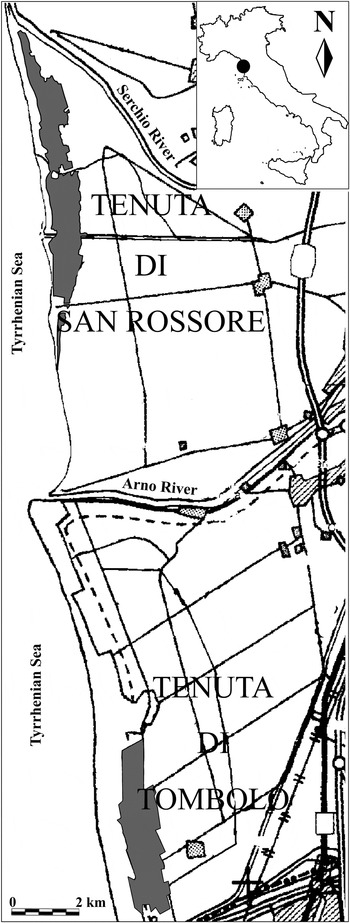
The MSM Regional Natural Park occupies about 23,114 ha, extending 30 km along the coast of Northwestern Tuscany and from 5 to 10 km inland. Typical alluvial environments dominate, in which large wetlands meet with the deciduous coastal wood and sclerophyllous Mediterranean scrub, with forest covering ca. 9000 ha, giving rise to a range of ecosystems such as plain hygrophilic wood, Alnus marsh forests and Q. ilex L. forests. Over the centuries, human intervention has made radical changes to the original structure of the forest, that currently, is occupied by large stands of Pinus pinea L. and P. pinaster, the second one occupying the first portion of the coast behind the dunes, with a total area of 813 ha (Pozzi, Reference Pozzi and Lucci2005) (fig. 1).
Geographical map of the Migliarino, San Rossore, Massaciuccoli Regional Natural Park (Italy). In grey are indicated Tenuta di San Rossore and Tenuta di Tombolo experimental areas.

In Tenuta di San Rossore, the core area of the park, the protective strip of P. pinaster is pure, coeval and dense, ensuring good protection of the more internal woodland from sea winds, whose effects are negligible starting 400–500 m from the coastline, the distance at which the P. pinea forest begins (Pozzi, Reference Pozzi and Lucci2005).
Tenuta di Tombolo occupies the coastal strip at the southern boundary of the park, at about 10 km from Tenuta di San Rossore. This area has been profoundly changed over time both by natural causes such as the advancement of the coastline and by human intervention. Due to the strong presence of urban settlements along the coast, plant communities typical of the dune are not found and pine stands are less extensive than in Tenuta di San Rossore. P. pinaster and P. pinea forests dominate an understory of Q. ilex and typical Mediterranean shrubs such as Erica arborea L., which form often a dense scrubland.
M. feytaudi monitoring (2005–2007)
In 2005, following the detection of M. feytaudi at the southern border of the MSM Regional Natural Park, a preliminary survey was conducted, positioning 44 pheromone sticky traps in the various sectors of the park, to verify the presence of M. feytaudi in the area. In the following 2 years, both Tenuta di San Rossore and Tenuta di Tombolo were intensively monitored by means of 1120 and 1379 traps in 2006 and 2007, respectively. In Tenuta di San Rossore the traps were placed in four parallel rows on either side of the main access routes to the park and in 2007 also throughout the P. pinaster stand. In Tenuta di Tombolo, most of the traps were placed along the main road.
M. feytaudi males were collected using sticky traps, consisting of a 30 × 30 cm2 polycarbonate panel covered with glue on one side and baited with a synthetic sex pheromone blend containing 0.4 mg of (8E, 10E)-3,7,9-trimethyl-8,10-dodecadien-6-one (Einhorn et al., Reference Einhorn, Manassieu, Malosse and Ducrot1990), provided by the Institut National de la Recherche Agronomique, Unité de Phytopharmacie et des Médiateurs chimiques (Versailles, France). Each year, traps were placed on the tree trunk at about 2 m above ground from January to April, for the whole duration of male flight. Pheromone dispensers were replaced monthly. Traps were positioned ca. 25 m apart.
At the end of the survey, the sticky traps were removed and checked in the laboratory under a stereoscopic microscope to assess the presence of M. feytaudi individuals. The identification of the specimens followed Foldi (Reference Foldi2004). The number of males was counted for each trap and year.
M. feytaudi mass trapping (2008–2012)
Mass trapping of emerging males was carried out in the Tenuta di San Rossore as part of the adaptive management strategy. Wrapping traps, consisting of a plastic film 1 m high covered with a Soveurode glue aerosol provided by Witasek PflanzenSchutz GmbH (Feldkirchen, Austria) and wrapped around the trunk at about 1.3 m above ground, were used (Binazzi et al., Reference Binazzi, Pennacchio and Francardi2002; Branco et al., Reference Branco, Jactel, Silva, Binazzi and Mendel2004).
Each year, traps were set up in January and maintained until April, for the whole duration of male flight. The same synthetic pheromone provided by Synchimia srl (Dipartimento di Chimica, Università degli Studi di Bari, Italy), was blended as above, and was replaced monthly. Universal Transverse Mercator (UTM) coordinates were recorded for each sampling point. The male counting was carried out as previously described.
In 2008, traps were positioned 50 m apart. In the following years, in order to increase the mass trapping activity, the grid was intensified inside hot spot areas, with traps 25 m apart. In 2012, the 25 m distance was used in all sectors of the study area. The total numbers of deployed traps were 1489 in 2008, 1961 in 2009, 1793 in 2010, 1869 in 2011 and 3027 in 2012.
A non-linear regression analysis of the yearly number of males per trap calculated from 2005 for Tenuta di San Rossore and Tenuta di Tombolo was carried out, to highlight the trend of captures in the two areas.
Visual inspection of P. pinaster trees
From September to October each year, a thorough visual inspection was carried out in all P. pinaster stands throughout the park to identify trees with obvious symptoms of M. feytaudi attack. P. pinaster were observed to detect chlorosis, reddening of the foliage, withered or standing dead trees or attacks by bark beetles or secondary pathogens, all symptoms that suggest outbreaks of M. feytaudi. The binocular was used to facilitate the observation in the tree canopy.
From 2007, UTM coordinates of each group or individual trees showing symptoms of M. feytaudi infestation were acquired and the trees were marked with paint or red tape.
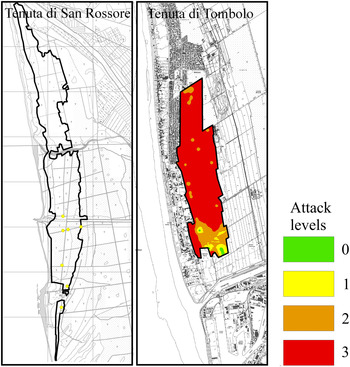
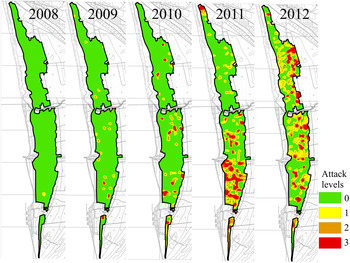
The degree of attack was estimated based on the number of infested trees recorded in an area of ca. 30 m radius, with four damage levels (level 0: no trees with symptoms; level 1: 1–3 trees with symptoms; level 2: 4–10 trees with symptoms; level 3: more than 10 trees with symptoms).
Spatial analysis
During the adaptive management programme (2008–2012), data collected from mass trapping and visual inspections were reported in ArcGis version 8 (ESRI, Redland, California) for mapping visualization. To characterize the spatial distribution of M. feytaudi adults, yearly total numbers of captures, transformed to log (x + 1) prior to analysis, and damage levels obtained by visual inspections, were examined by calculating omnidirectional semivariograms with a maximum distance of 1500 m, where x and y represent the UTM coordinates.
The variogram analysis was performed using GS + Version 7 (Gamma Design Software, Plainwell, Michigan, USA). Experimental variograms were fitted according to the model that gave the lowest residual sums of squares. Linear, spherical, exponential and Gaussian functions were tested by the software. Models were defined by the nugget (C0), the range (a) and the sill (C). The ratio C0/C, known as the k parameter, was used to evaluate the amount of randomness that exists in the data at distances smaller than the sampling distance. Values approaching to zero indicate that the distribution is more and more aggregated (Journel & Huijbregts, Reference Journel and Huijbregts1978). Models obtained from variogram analyses were used to interpolate data by means of the ordinary kriging algorithm.
The grid was graphically represented by a map showing the configuration of the surface by means of colours representing intervals of z-values. Areas of relatively high densities were referred to as hot spots. A base map showing the experimental area, with the same coordinate system, was placed on top of the contour map.
Adaptive management strategy
The Forest General Management Plan of the MSM Regional Natural Park drawn up in 2004 for the period 2005–2019 included a series of annual logging campaigns for regeneration of P. pinaster forests in order to preserve these forest formations over time. In particular, seeding after thinning of Holm oaks and other broad-leaved trees, regeneration cutting and cutting on pines to support the established Holm oak layer, were planned in predetermined positions for a total surface area of ca. 4.5 ha each year.
The adaptive management programme was developed to integrate year by year information on the M. feytaudi population dynamics and to make the various components of the Management Plan more flexible. Continuously updated knowledge of M. feytaudi spatial distribution patterns obtained from wrapping traps and visual inspections allowed the standard cuttings forecast by the Management Plan to be carried out not in the predetermined positions but rather on the basis of yearly maps showing the pest's distribution.
Furthermore, additional silvicultural interventions, hereafter called phytosanitary cuttings, were carried out in pine wood sectors where M. feytaudi damage hot spots were located. In these cases, clear cutting in gaps of all the trees falling within a diameter of 50 m from the outbreak was conducted as a standard measure; alternatively, we opted to fell certain trees alone when no more than 1–3 symptomatic trees were detected during the visual controls (level 1).
Interventions started in October, after the end of the visual controls, and continued until March, when activities were usually interrupted to minimize disturbance to wildlife.
All the woody material was reduced to wood chips, using machine harvesting (Spinelli et al., Reference Spinelli, Lombardini and Magagnotti2013), and sent to the user industry to prevent any reinfestation originating from cut logs.
Results
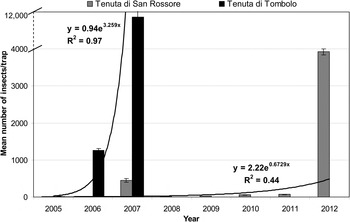
Monitoring traps set up in 2005 confirmed the presence of M. feytaudi inside the MSM Regional Natural Park. Figure 2 shows the M. feytaudi catches in managed (Tenuta di San Rossore) and unmanaged (Tenuta di Tombolo) areas starting from 2005, when the highest captures were detected in Tenuta di Tombolo, with 17.5 ± 10.89 (mean ± SE) individuals per trap per year, and 9.50 ± 2.79 individuals per trap per year recorded in Tenuta di San Rossore.
Yearly number of Matsucoccus feytaudi males per trap detected in Tenuta di Tombolo and Tenuta di San Rossore, with the adult male trends. Bars indicate standard errors. Regression analysis results are also reported for each curve.

In the following 2 years, intensive sampling gave a better picture of the M. feytaudi presence in the area. In 2006, 1260.35 ± 48.80 and 1.52 ± 0.12 individuals per trap per year were recorded in Tenuta di Tombolo and Tenuta di San Rossore, respectively. An increasing trend of M. feytaudi populations was observed in 2007, with 11,858.56 ± 528.20 and 444.26 ± 51.48 individuals per trap per year recorded in Tenuta di Tombolo and Tenuta di San Rossore, respectively.
For Tenuta di Tombolo we do not have data after 2007 because of the phytosanitary cuts in the area. In Tenuta di San Rossore there was a decrease in catches during 2008, when the mass trapping was implemented, although the spread of the pest in the area continued. In the following years the catches remained fairly stable until 2012, when there was a marked increase (3923 ± 80.61 individuals per trap). The fit of the exponential function, selected by the regression analysis, was very high for Tenuta di Tombolo (R 2 = 0.97) but lower for Tenuta di San Rossore (R 2 = 0.44) (fig. 2).
Due to the high number of attractive devices used for mass trapping in the period 2008–2012, M. feytaudi male distribution maps were obtained with a high level of accuracy.
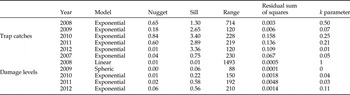
The semivariogram analysis highlighted in all cases exponential functions, with the range of 744 m for 2008 but lower in the following years, between 120 and 228 m; k parameter in all cases indicated an aggregated distribution (table 1).
Parameters obtained by fitting the semivariograms of the trap catches of M. feytaudi adult males and the damage levels.

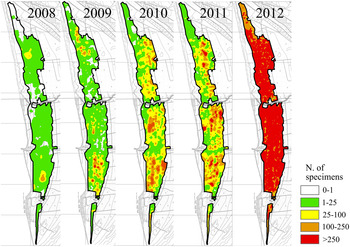
Figure 3 shows the distributional map of the yearly total catches of male scales during the 5-year adaptive management period (2008–2012). In 2008, M. feytaudi was already present in various sectors of the park but still at low densities; in subsequent years, and especially from 2010 onwards, there was a general spread of populations year by year throughout the territory. Three hot spot areas, i.e., patches with densities exceeding densities observed in the surrounding areas, were recognized as early as 2008 and 2009, representing a source of infestation for nearby areas in the following years. In 2012, levels of M. feytaudi males were very high in all sectors of Tenuta di San Rossore.
Spatial pattern of Matsucoccus feytaudi males in Tenuta di San Rossore during the period of the adaptive management programme (2008–2012), obtained by the interpolation procedures applied to the yearly number of captures in wrapping traps.

In 2007, visual controls highlighted widespread die-offs of P. pinaster in Tenuta di Tombolo, while mild attack symptoms on P. pinaster were recorded in a few points of Tenuta di San Rossore (fig. 4).
Map of Tenuta di San Rossore and Tenuta di Tombolo, showing the visual inspections of maritime pine trees with symptoms of Matsucoccus feytaudi attack carried out in 2007, before the period of the adaptive management programme (2008–2012). Level 0 corresponds to no trees with symptoms; level 1: 1–3 trees with symptoms; level 2: 4–10 trees with symptoms; level 3 to more than 10 trees with symptoms.

From 2008, spatial analysis was carried out yearly. In 2008, detections were still limited to a small portion of the southern part of the park (fig. 5). The variogram was linear with a range of 1493 m (table 1), indicating a weak spatial pattern. After only 1 year, detections spread as far as the northern point of Tenuta di San Rossore. Variogram analysis for years 2009–2012 selected asymptotic functions with range varying between 88 and 210 m, k parameter in all cases indicated an aggregated distribution (table 1). Highest levels of damage were found in the same areas of the adult hot spots of the previous years, while low levels occurred more diffusely through the territory (fig. 5).
Map of Tenuta di San Rossore showing the visual inspections of maritime pine trees with symptoms of Matsucoccus feytaudi attack during the period of the adaptive management programme (2008–2012). Level 0 corresponds to no trees with symptoms; level 1: 1–3 trees with symptoms; level 2: 4–10 trees with symptoms; level 3 to more than 10 trees with symptoms.

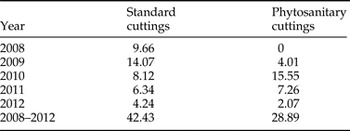
Silvicultural interventions changed during the adaptive management programme (fig. 6). In the beginning (2008–2009), standard cuttings were carried out according to the Park Management Plan and were not strictly related to the distribution of M. feytaudi. Starting from 2009, and more clearly from 2010, phytosanitary cuttings took precedence over the standard ones in order to intervene in areas affected by hot spots. In 2012, because of the widespread presence of M. feytaudi, it was decided to carry out selective cuttings in 80 ha of pine forest, removing only the symptomatic trees. Hence only limited standard and phytosanitary cuttings were conducted.
Map of Tenuta di San Rossore showing yearly silvicultural interventions during the period of the adaptive management programme (2008–2012). In each map, blue and red areas represent, respectively, standard and phytosanitary cuts carried out during the current year while grey areas represent all cuts carried out during the previous years.

From 2008 to 2012, 71.32 ha of P. pinaster were replaced by broad-leaved trees, especially Q. ilex. Details of the pine surface areas cut in each year are reported in table 2. Interestingly, there was a move from a ratio of 3.5:1 in favour of standard cuts in 2009 to a 2:1 ratio in favour of phytosanitary cuts in 2010, followed by a return to a 2:1 ratio in favour of standard cuts in 2012, when M. feytaudi was widely distributed throughout the area.
Maritime pine cuttings carried out during the adaptive management programme, expressed as hectares.

Discussion
Due to the ability of P. pinaster to tolerate the saltiness and desiccant action of sea winds, P. pinaster stands have played a strategic role in defence of the forests in vulnerable coastal strips, in particular the P. pinea forests of landscape, tourist and economic importance.
In these territories, the structural characteristics of P. pinaster stands, which are pure, coeval, dense, almost devoid of renewal and confined to areas closest to the sea, make them rather fragile from an ecological point of view, with trees often suffering from physiological stresses and a high risk of fire.
The arrival of M. feytaudi was a further severe stress for these forest formations. The pest weakens infested trees, favouring the establishment of a number of indigenous wood-eating insects, especially of the genera Tomicus, Orthomicus and Pissodes, which find favourable conditions for settlement on the infested trees. This combined action leads to a progressive decay of pine trees and causes their death within 3–5 years (Binazzi, Reference Binazzi and Lucci2005).
A study of Ligurian P. pinaster stands showed that M. feytaudi caused a significant regression of infested forests, reducing the arboreal composition and favouring sprouting of understorey species that benefited from the increased sunlight caused by crown reduction of the affected trees, with consequences for soil stability (Turcato et al., Reference Turcato, Paoli, Scopesi, Montagnani, Mariotti and Vassallo2015).
Another example of the impact of M. feytaudi on P. pinaster forests comes from the arrival of the bast scale in Tuscany in 1999 in the Monfalcone Natural Reserve (province of Pisa). The insect caused extensive mortality of P. pinaster trees, leading to a transformation of the canopy dominant trees, with the expansion of broadleaves. In addition, the accumulation of dead wood favoured the occurrence of fires and the subsequent expansion of trees with invasive behaviour, like Robinia pseudoacacia L., previously present in the reserve but severely restricted to a few marginal areas (Piussi, Reference Piussi and Pignatti2011).
None of the currently available control methods, including the use of pheromone traps for early detection of adults, mass trapping of emerging males or the employment of kairomones to attract natural enemies (Jactel et al., Reference Jactel, Menassieu, Ceria, Burban, Regad, Normand and Carcreff1998; Gaulier et al., Reference Gaulier, Menassieu, Hoguet and Jactel2001; Binazzi et al., Reference Binazzi, Pennacchio and Francardi2002, Reference Binazzi, Roversi, Pennacchio, Francardi, De Silva, Marziali and Marianelli2009; Branco et al., Reference Branco, Jactel, Silva, Binazzi and Mendel2004; Roversi et al., Reference Roversi, Marianelli, Marziali, Squarcini, Pennacchio, Binazzi and Francardi2007; Marziali et al., Reference Marziali, Marianelli, Bagnoli and Roversi2011), is able to definitely contrast the establishment and dispersal of M. feytaudi populations in a newly invaded environment. Given such a situation, both preventive and curative silvicultural practices, i.e., thinning designed to foster individuals with greater vigour, removal of attacked trees, early use of stands to facilitate renewal, replacement of P. pinaster with other tree species and removal of dry material to reduce fire hazard, are of particular importance.
When M. feytaudi arrived in the MSM Regional Natural Park, the rapid decay of the P. pinaster stands at the southern edge of the protected area in Tenuta di Tombolo made it clear to decision-makers and local stakeholders that there was a need for immediate action by means of all the techniques available, in order to stem the pest's destructive action through an integrated approach, involving direct pest control and silvicultural operations.
One of the main reasons for the choice of immediate action throughout Tenuta di San Rossore was that there was no time for preliminary tests to verify and select the most efficient control method. In the absence of any intervention, the forest would possibly have been completely compromised in the space of 3 years, as occurred previously in Tenuta di Tombolo. Furthermore, in the adopted programme the spatial component had an important role in allocating limited resources for pest control and applying a precision targeting strategy, as reported by Shea et al. (Reference Shea, Possingham, Murdoch and Roush2002), Sciarretta et al. (Reference Sciarretta, Melaku, Getachew, Lulseged, Shifa and Baumgärtner2005) and Sciarretta & Trematerra (Reference Sciarretta and Trematerra2014).
As the results showed, the broad use of mass trapping, with 16 traps ha−1 was ineffective in preventing the establishment of the pest in the environment, although it was instrumental in slowing the increase of M. feytaudi populations. The success of mass trapping is influenced by various key factors, such as attractant competitiveness with wild females, trap design and density, population density of the pest, isolation and immigration rates, biology and ecology of target species. These aspects require long-term studies to ensure the success of a mass trapping programme (El-Sayed et al., Reference El-Sayed, Suckling, Wearing and Byers2006). However, there are case studies concerning the use of mass trapping not aimed at eradicating the pest but rather as part of a slow-the-spread philosophy. This approach was applied in the national campaign against the gypsy moth Lymantria dispar conducted in the United States for many years (Sharov et al., Reference Sharov, Liebhold and Roberts1998). That campaign revealed the problem of the impossibility of having an untreated ‘control’ in mass trapping programmes, so that it cannot be stated that the mass trapping is the cause of a population decrease and/or disappearance (Dreistadt & Dahlsten, Reference Dreistadt and Dahlsten1989). Since the same problem was applied in our case, we compared the managed area with an adjacent unmanaged zone, while bearing in mind the limitations of such a comparison, e.g., the different time periods of the two data series.
The use of traps proved very useful for monitoring purposes, depicting the yearly distribution of M. feytaudi and identifying hot spots on maps. This information allowed us to apply the silvicultural measures in a targeted manner, directing phytosanitary cuttings to the hot spot areas identified on the maps and verified by visual inspections. Moreover, the standard cuttings foreseen by the Park Management Plan were carried out not in the predetermined positions but rather based on maps showing the pest's distribution. This scheme was repeated every year and the silvicultural activities were adapted to the situation observed in the field. The management strategy resulted from a compromise between the severity of the pest's attack and the limited availability of funds and workforce necessary to carry out the silvicultural activities over the entire surface of the park. The chosen adaptive approach made the management measures sustainable.
The standard Management Plan of the park provided measures to extend and stabilize the P. pinaster stands, such as thickening with sclerophyllous plants and regeneration cuts in strips. The impact of M. feytaudi on the MSM Regional Natural Park phytocoenosis has led to a forced change of its silvicultural intervention policies, suspending renewal cuttings and focusing on phytosanitary cuttings, which will involve all the remaining pine forest at the end of the management period. From the beginning of the Management Plan up to 2013, the P. pinaster stands declined from 320.60 to 249.27 ha, whereas areas in which the development of more stable native woods is expected, especially as Q. ilex forests or Mediterranean scrub (previously absent from these sectors), occupy 65 ha.
The activities have seen broad participation by all decision-makers, starting with the managing park authority and forest rangers and arriving at forestry and entomology researchers. Environmental organizations were also involved in the decision-making meetings and the general public was informed through public meetings.
Conclusions
Although the gradual reduction of the pine forest was expected, likely due to the establishment of broadleaves, the M. feytaudi invasion has greatly sped up the process. This has forced the MSM Regional Natural Park to cut pine trees not just to renew and maintain the stands but to transform them into another type of forest. The medium/long-term results of the planned interventions will be transformation of the pine forest formations into Q. ilex woods with Mediterranean shrubs in order to provide the same protection of the more internal forests and generally to maintain the habitat integrity in this portion of the park (Logli, Reference Logli2012). However, the P. pinaster is not expected to disappear entirely at the end of this conversion process: clusters of trees or pine blocks will survive and will, in the long term, produce new P. pinaster plots in a heterogeneous landscape. According to Rigot et al. (Reference Rigot, van Halder and Jactel2014), pines in these environments will benefit from a greater invisibility against the pest, with a lower risk of colonization.
Given the transformation caused by M. feytaudi in the MSM Regional Natural Park, we consider the case reported here an example of management of insect invasions in protected areas when eradication and/or containment cannot be achieved. Additional studies on M. feytaudi are necessary to improve the efficacy of its control. However, to properly tackle the problem it is necessary to shift from direct pest control to overall forest ecosystem management, understanding how habitats can be modified to adapt to the new situation and to reach equilibrium among various ecological components.
Acknowledgements
This work was supported under the project ‘Biocontrol – Biological control of the maritime pine bast scale Matsucoccus feytaudi (Ducasse)’, funded by the Migliarino, San Rossore, Massaciuccoli Regional Natural Park (Pisa, Italy). We are grateful to the many colleagues of the Research Centre for Agrobiology and Pedology in Florence who have collaborated on the Biocontrol project over the years.