Introduction
Cystic echinococcosis (CE) is a human zoonotic infection caused by the small tapeworm, Echinococcus granulosus, with a life cycle involving dogs and livestock animals as definitive and intermediate hosts, respectively. Human CE is a cosmopolitan infection found in different parts of the world, including Europe, Central Asia, China, Africa, America and the Middle East, including Iran. CE is endemic throughout Iran, causing significant medical and economic losses, and relatively high prevalence rates have been reported in dogs, livestock and humans (Lahmar et al., Reference Lahmar, Lahmar, Boufana, Bradshaw and Craig2007). The annual surgical incidence of CE is estimated at 0.8–1.73 per 100,000 in Iran (Harandi et al., Reference Harandi, Budke and Rostami2012), and 1% of admissions to surgical wards in the country are believed to be attributed to human CE (Rokni, Reference Rokni2008). Sheep, goats, cattle and camels are the major intermediate host species of the parasite in Iran and CE prevalence rates of 8–32% have been reported from different regions of the country (Harandi et al., Reference Harandi, Budke and Rostami2012).
Dogs have been considered to be key players in the epidemiology and transmission of CE. The dog population in Iran is estimated at 3.5–11.5 million, most of them being unowned/stray dogs (Harandi et al., Reference Harandi, Moazezi, Saba, Grimm, Kamyabi, Sheikhzadeh, Sharifi and Deplazes2011). A common source of infection for dogs is offal from infected livestock. Knowledge of the prevalence of echinococcosis in dogs is an important part of hydatid control programmes (Budke et al., Reference Budke, Carabin, Ndimubanzi, Nguyen, Rainwater, Dickey, Bhattarai, Zeziulin and Qian2013).
Various methods have been applied for the specific identification of E. granulosus in dogs. Among them, intestinal scraping, copro-ELISA (enzyme-linked immunosorbent assay) and copro-PCR (polymerase chain reaction) are the most reliable techniques. Various studies have used copro-PCR as a reliable method for specific identification of taeniid eggs recovered from faecal specimens and/or environmental samples (Abbasi et al., Reference Abbasi, Branzburg, Campos-Ponce, Hafez, Raoul, Craig and Hamburger2003; Lahmar et al., Reference Lahmar, Lahmar, Boufana, Bradshaw and Craig2007).
Several studies have demonstrated the prevalence of canine echinococcosis in Iran. Studies conducted in the north-eastern parts of the country showed high rates of E. granulosus infection in stray dogs using copro-PCR analysis (Beiromvand et al., Reference Beiromvand, Akhlaghi, Massom, Mobedi, Meamar, Oormazdi, Motevalian and Razmjou2011; Borji et al., Reference Borji, Naghibi and Jahangiri2013). In Kerman city the prevalence of E. granulosus infection in stray dogs was recorded as 7.4%; however, the study was conducted in the 1990s (Sharifi & Zia-Ali, Reference Sharifi and Zia-Ali1996) and no recent data are available for stray dogs in this region.
The purpose of the present study was to determine the prevalence of E. granulosus infection among canine definitive hosts, using copro-PCR, in Kerman, south-eastern Iran.
Materials and methods
Collection and examination of samples
Kerman, the largest province of Iran, is situated in south-eastern Iran, covering an area of 182,000 km2. The province lies between latitude 26°29′ and 31°58′N and longitude 54°20′ and 59°34′E. It is located in the arid and semi-arid zones, and the average annual rainfall is low and decreases towards the south-east. Kerman city is the capital of the province, with an estimated population of 722,000 in 2011 and an area of 185 km2 (Statistical Center of Iran, 2015).
From September 2013 to May 2014, a total of 307 faecal samples of stray dogs were collected from different parts of the city of Kerman and its suburbs. From each of ten regions in the Kerman metropolitan area 30 faecal samples were collected, namely Ekhtiarabad, Zangiabad, Kazemabad, Chatroud, Kouhpayeh, Sarasiab Farsangi, Joupar, Mahyabad, Mahan and the city of Kerman. The coordinates ranged from 30°03′24″ to 30°36′16″N and from 56°50′37″ to 57°17′12″E.
The faecal samples were collected mostly from places where high numbers of stray dogs were frequently observed. Samples from dogs were collected less than 24 h after defecation. Fresh dog faeces were identified by characteristics such as colour, shape, moisture and smell. To avoid duplicate faecal sampling of each individual dog, samples were taken 200 m apart.
The faecal specimens were transferred to the research laboratory of the Department of Parasitology, Kerman University of Medical Sciences. Each sample was stored separately in a plastic bag for at least 8–12 days at −80°C to inactivate Echinococcus eggs before processing further (Abbasi et al., Reference Abbasi, Branzburg, Campos-Ponce, Hafez, Raoul, Craig and Hamburger2003). The coprological examination was conducted using the formalin–ether concentration method. The microscopic examination was performed at ×400 magnification. All those samples found positive for taeniid-type eggs were selected for further molecular studies.
Molecular analysis
Microscopically positive specimens were subjected to DNA extraction. Faecal samples (weight 1 g) were freeze-thawed ten times in lysis buffer and DNA extraction was performed using Exgene Stool Mini Kit (GeneAll, South Korea), according to the manufacturer's instructions. The eluted DNA was stored at 4−8°C until used in PCR amplification. Two primers, JB3, 5′-TTTTTTGGGCATCCTGAGGTTTAT-3′ (forward), and JB4.5, 5′-TAAAGAAAGAACATAATGAAAATG-3′ (reverse), were used to amplify a taeniid-specific fragment of 444 bp of the cox1 gene (Bowles et al., Reference Bowles, Blair and McManus1992). The PCR was carried out in a volume of 25 μl in a FlexCycler (Analytik Jena, Jena, Germany). The thermal profile included and initial denaturation at 94°C for 5 min; followed by 35 cycles, each of 30 s at 94°C, 45 s at 50°C and 35 s at 72°C; and a final extension of 10 min at 72°C. The amplification products were subjected to electrophoresis on 2% agarose gel in TAE buffer (Tris–acetic acid–EDTA).
The primers Eg1121a, 5′-GAATGCAAGCAGCAGATG-3′ (forward) and Eg1122a, 5′-GAGATGAGTGAGAAGGAGTG-3′ (reverse) were used for specific identification of E. granulosus sensu lato. This primer pair amplifies a 133-bp segment from a repeat unit of the parasite genome (Abbasi et al., Reference Abbasi, Branzburg, Campos-Ponce, Hafez, Raoul, Craig and Hamburger2003). The thermal profile was as follows: 5 min at 94°C; followed by 35 cycles, each of 30 s at 94°C, 1 min at 55°C and 1 min at 72°C; and a final extension of 5 min at 72°C. Templates of DNA from previously sequenced taeniid species, i.e. E. granulosus sensu lato, Taenia multiceps, T. hydatigena, T. ovis and T. saginata (Rostami et al., Reference Rostami, Salavati, Beech, Sharbatkhori, Babaei, Saedi and Harandi2013a, Reference Rostami, Talebi, Babaei, Sharbatkhori, Ziaali, Rostami and Harandib, Reference Rostami, Salavati, Beech, Babaei, Sharbatkhori, Baneshi, Hajialilo, Shad and Harandi2015a, Reference Rostami, Salavati, Beech, Babaei, Sharbatkhori and Harandib), were used as controls to test species specificity of the primer. Seven microscopically negative specimens were randomly selected and subjected to PCR amplification using both taeniid-specific (JB3 and JB4.5) and E. granulosus-specific (Eg1121a and Eg1122a) primer pairs, to test the accuracy of microscopic examination.
Results
Of 307 faecal samples examined microscopically, Taenia-type eggs were found in 34 (11.1%) of stray dogs. All microscopically positive specimens were subjected to taeniid-specific PCR amplification and a 100% concordance with microscopy was obtained. Of the 34 taeniid isolates identified, 21 samples (6.8%) were shown to be E. granulosus sensu lato using a species-specific primer pair. The distribution of taeniid-positive faecal samples in different localities in Kerman and its suburbs showed that the western and eastern regions had the highest proportion of positive specimens (table 1).
The prevalence (%) of taeniid/Echinococcus granulosus eggs in faecal samples of stray dogs from different localities of Kerman and its suburbs.

*Based on the estimated sensitivity of copro-PCR by Ziadinov et al. (Reference Ziadinov, Mathis, Trachsel, Rysmukhambetova, Abdyjaparov, Kuttubaev, Deplazes and Torgerson2008).
Of the seven randomly selected microscopically negative specimens tested with both taeniid- and E. granulosus-specific primer pairs, none of them showed positive results, indicating the accuracy of microscopic examination. Furthermore, none of the Taenia isolates were amplified when applied as templates for PCR using E. granulosus-specific primers.
Discussion
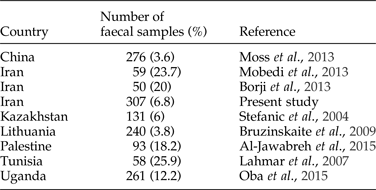
Understanding the epidemiology of canine echinococcosis is essential for the implementation of CE control programmes. The present epidemiological investigation revealed that E. granulosus infection is present in 6.8% of dog samples in Kerman. Table 2 summarizes the most recent data on the prevalence of canine echinococcosis around the world. The rate of dog infection ranges from 6% in Kazakhstan to 25.9% in Tunisia (Stefanic et al., Reference Stefanic, Shaikenov, Deplazes, Dinkel, Torgerson and Mathis2004; Lahmar et al., Reference Lahmar, Lahmar, Boufana, Bradshaw and Craig2007). In a recent study in Uganda, 12.2% of household dogs were found to be infected with E. granulosus (Oba et al., Reference Oba, Ejobi, Omadang, Chamai, Okwi, Othieno, Inangolet and Ocaido2015). In Sichuan province on the Tibetan plateau, 3.6 and 3.2% of dogs were found to be infected in Shiqu and Honglong regions, respectively, using copro-DNA PCR (Moss et al., Reference Moss, Chen, Li, Qiu, Wang, Giraudoux, Ito, Torgerson and Craig2013).
The prevalence (%) of canine echinococcosis in faecal samples of dogs from seven countries, using the copro-PCR method.
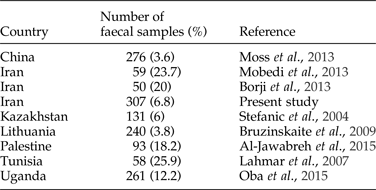
Canine echinococcosis is widespread in Iran and several copro-DNA studies have indicated that dogs are commonly infected with the parasite, especially in north-western and north-eastern parts of the country. In north-western Iran, 23.7% of stray dogs were found to be infected on the Moghan plain (Mobedi et al., Reference Mobedi, Zare Bidaki, Siavashi, Naddaf, Kia and Mahmoudi2013). A couple of studies in the north-eastern part of the country, using the copro-PCR technique, revealed that 20 and 16.9% of dogs were infected by E. granulosus (Beiromvand et al., Reference Beiromvand, Akhlaghi, Massom, Mobedi, Meamar, Oormazdi, Motevalian and Razmjou2011; Borji et al., Reference Borji, Naghibi and Jahangiri2013).
Kerman is situated in the south-eastern part of Iran, where the climate is arid and the humidity is very low at most times of the year. Kerman climatic conditions do not favour the survival of parasites in the environment. The annual precipitation in Kerman is 135 mm and the city is located on a semi-arid plateau, with sunny days at most times of the year. In a study in 1996 using necropsy, 7.4% Echinococcus infection was recorded in dogs of the Kerman area (Sharifi & Zia-Ali, Reference Sharifi and Zia-Ali1996). According to Mirzaei & Fooladi (Reference Mirzaei and Fooladi2012) 1.4% of owned dogs referred to a veterinary hospital were found to be infected with taeniid eggs. In the present study, Echinococcus-positive samples were most frequently found in western (14.3%) and eastern (9.5%) parts of the region (table 1). Fifteen per cent of the samples collected around the city abattoir were found to be infected. Dogs roaming around abattoirs have access to the offal and garbage of the abattoir, and this increases the chances of acquiring Echinococcus infection. No dog faeces were found to be infected in the central parts of the city, which are more urbanized and where access to livestock viscera for dogs is less probable.
Three Taenia species – T. hydatigena, T. ovis and T. pisiformis – were used as controls by Abbasi et al. (Reference Abbasi, Branzburg, Campos-Ponce, Hafez, Raoul, Craig and Hamburger2003) to test the species specificity of the primers. Another two species of Taenia (T. multiceps and T. saginata) were used in our study, and negative results confirmed that the primer pair is E. granulosus-specific and none of the major taeniid tapeworms of dogs could be amplified in copro-PCR analysis.
Using microscopy, the faecal examination of stray dogs would be expected to underestimate the actual parasitism rate when compared to other methods such as the copro-PCR test (Hartnack et al., Reference Hartnack, Budke, Craig, Jiamin, Boufana, Campos-Ponce and Torgerson2013). Ziadinov et al. (Reference Ziadinov, Mathis, Trachsel, Rysmukhambetova, Abdyjaparov, Kuttubaev, Deplazes and Torgerson2008) found that egg isolation followed by PCR for diagnosing E. granulosus in dogs had a sensitivity of 78%, because some of the parasites are in a prepatent phase and are not detectable by purgation and/or microscopy. In contrast, prepatent infections could be diagnosed accurately by DNA-based methods (Al-Sabi et al., Reference Al-Sabi, Kapel, Deplazes and Mathis2007; Lahmar et al., Reference Lahmar, Lahmar, Boufana, Bradshaw and Craig2007). Therefore molecular methods are more sensitive than conventional intestinal scraping or faecal microscopy. Using the 78% estimated sensitivity of copro-PCR obtained by Ziadinov et al. (Reference Ziadinov, Mathis, Trachsel, Rysmukhambetova, Abdyjaparov, Kuttubaev, Deplazes and Torgerson2008), a prevalence rate of 8.8% could be inferred by adjusting observed prevalence values in the present study (table 1).
Nevertheless, as the faecal examinations for taeniid eggs had been carried out prior to the PCR, we are unable to discuss any prepatent infection in dogs. In conclusion, the study showed that canine echinococcosis is widespread in south-eastern areas of the country and copro-DNA techniques can be used as reliable tools for field surveys and CE surveillance campaigns in endemic areas.
Acknowledgements
The authors would like to thank Mr Sadooghian for his kind cooperation in the collection of parasite materials.
Financial support
This study was supported financially by the Vice-Chancellor for Research and Technology, Kerman University of Medical Sciences, grant No. 93-233.
Conflict of interests
None.