1. INTRODUCTION
Analysis of existing products is at the heart of new product development in two ways, as inspiration from which the designers of the new products can learn and as a starting point for the development of a new design. With very few exceptions complex technical products are designed by modification from existing products, which are changed to meet new needs and requirements. Although these changes can be substantial and allow scope for radical innovation, many products carry components or solution principles across from their predecessor designs. It is therefore important for designers to understand how the old product works, what its strengths and weaknesses are, and what problems have occurred with it. This paper reports on an experiment, where 20 designers were asked to analyze a given product in terms of the functions that occur in the product, and provide a summary in the form of a classical function tree as a common format that allows a comparison of their understanding. The paper builds on Alink et al. (Reference Alink, Eckert, Ruckpaul, Albers and Gero2010) to include a detailed analysis of the steps taken by six subjects. The results show a huge range of functional breakdowns produced by the subjects and very little consensus among the subjects as to their understanding of functions and their approach to functional analysis.
Developing a degree of shared understanding of the problem and the product is important for an effective design process (see, e.g., Hacker, Reference Hacker1997; Hinds & Weisband, Reference Hinds, Weisband, Gibson and Cohen2003). This can be problematic when participants with different backgrounds and interests need to communicate across object worlds, that is, the differing sets of concepts and interpretations of terms that people gain from education and experience in particular fields (see Bucciarelli, Reference Bucciarelli1996). Shared understanding has mainly been studied from the perspective of computer support for distributed teams (e.g., Arias et al., Reference Arias, Eden, Fischer, Gorman and Scharff2000) or eliciting the degree of shared understanding in teams (e.g., Hill et al., Reference Hill, Song, Dong and Agogino2001).
Functions are a fundamental, albeit in practice elusive, part of many prescriptive design methodologies, such as the Pahl and Beitz methodology. Pahl and Beitz (Reference Pahl, Beitz, Wallace, Blessing and Bauert1996) define a function as the relation between an input and an output of a system. The Pahl and Beitz definition represents the class of transformative notions of functions. A related concept of functions as transformations has been introduced by Hubka (Reference Hubka1973) in the theory of technical systems. This view conceptualizes the operation of machines and larger systems as transformations of matter, energy, and information; machines (and components of machines) perform functions that are effects required to make the desired transformations happen. These effects are created in conjunction with the human operator of the machine. Building on this, Andreasen and Hein (Reference Andreasen and Hein1987) “define a (purpose) function as the ability of a machine to create an expedient effect” (see Buur, Reference Buur1990). Therefore, function is seen as the behavior exerted by the transformations of matter, energy, and information in the product. This is a sociotechnical notion of function, because it is based on the purpose intended by a human for the machine. It has a concept of secondary functions covering power functions, control functions, auxiliary functions, and support functions, which are intentionally incorporated into a product and which would suppress or prevent undesired behavior.
A concept of undesired function makes sense in the context of undesired affordances, that is, purposes a system can have that were not intended, or related to this misuse of a system, that is, a system is given a purpose outside what the original designers have intended. An undesired function is also a meaningful concept, if function is equated with an abstract view of behavior, where functions arise in response to undesired behavior that a potential embodiment could display. These incidental functions would not have been included in an abstract a priori functional breakdown of a product, as they arose from embodiment choices.
The function–behavior–structure (FBS) model of Gero and Kannengieser (Reference Gero, Kannengiesser and Gero2002) is closer to the everyday use of English words than flow or transformation notations of function. FBS sees design as the transformation of a set of functions into a set of descriptions of structure. The function of an object is defined as its teleology, that is, what the product is made for. They introduce the term “behavior” to describe what the system is expected to do (behavior expected) or what the system actually does when it is designed, that is, the behavior, derived from structure. Designing is defined as the transformation of those variables. With the FBS ontology Gero clearly distinguishes different terms for what, for example, the Pahl and Beitz (Reference Pahl, Beitz, Wallace, Blessing and Bauert1996) describe with a single term. Based on the work of Pahl and Beitz (Reference Pahl, Beitz, Wallace, Blessing and Bauert1996), the German Engineers Association Guidelines were created. The Verein Deutscher Ingenieure (VDI; VDI, 2004) Guidelines do not distinguish between function and behavior. However, the VDI Guidelines are the basis for the education of most engineering designers in Germany.
Umeda et al. (Reference Umeda, Takeda, Tomiyama, Yoshikawa and Gero1990) point out that functions are subjective descriptions of a product, while their behavior is objective. Crilly (Reference Crilly2010) states that the designers' notions about the term “function” depend on the situation they are faced with. Design researchers are still debating the concept of function (e.g., Kirschman & Fadel, Reference Kirschman and Fadel1998; Vermaas & Houkes, Reference Vermaas and Houkes2006; Crilly, Reference Crilly2010) because the concept of function is fundamental to understanding designing and to improving methods that build on this concept. Although many researchers have provided views of functions and their role in wider product development, which are in themselves coherent and consistent, these views are sufficiently different that they cannot be mixed with each other and have to be understood in the context of the theories they arise from. This context is often not explicit, making it difficult for somebody who only has had a brief exposure to the concepts to made use of the considerable insights generated in the research community. An additional factor adding to the challenge of bringing functional concepts together are the subtle differences in the meaning of the words used in different languages and therefore the difficulties in providing accurate translations.
This paper reports on an experiment, where 20 designers were asked to analyze a given product and express their understanding in a function tree. As explained in Section 2, the experiment has removed many of the factors that negatively affect teams by giving a very homogeneous group of people the same product and time to analyze its functions. Section 3 shows the range of outputs produced by the participants. The subjects had different notions of function using very varied vocabulary (Section 4). They produced functional breakdowns with different levels of detail and completeness (Section 5) and used very different approaches to doing so (Section 6). Section 7 draws conclusions and discusses further work.
2. RESEARCH DESIGN
The experiment presented in this paper was part of the evaluation of the contact and channel (C&C) approach (Albers, Alink, & Deigendesch, Reference Albers, Alink and Deigendesch2008) and was carried out through a combination of workshops, interviews, and in the end this experiment. The third author of this paper conducted six 1-day training sessions with a total of 30 experienced designers in industry and supervised nine students preparing their diploma theses in cooperation with industry using the C&C approach for solving design problems (Alink, Reference Alink2010). He worked on two industry projects himself (e.g., Albers, Alink, Thau, & Matthiesen, Reference Albers, Alink, Thau and Matthiesen2008) where the C&C approach was applied to overcome a particular problem. The C&C approach was also discussed critically with the users in five 1-day research workshops, which took place every 6 months. C&C is an approach that enables designers to connect abstract functions with concrete forms in products. It is a thinking tool for describing, analyzing, and designing products in terms of their functions. The core idea of the C&C approach is that function is only fulfilled if the product interacts with adjacent systems. The interactions are located on the form of the product and on its adjacent systems through working surface pairs (WSP). The WSP are connected through channel and support structures and are located in the structure of the system. C&C does not have a firmly defined concept of function, but usually conceptualizes functions as creating, enabling, or suppressing behavior. Therefore, C&C handles desired and undesired effects or functions in the product in the same way. C&C concentrates on the physical interactions, rather than the sociotechnical interaction.
As part of the research 11 experienced designers in industry were interviewed about their experiences with C&C and design methods in general. These interviews were recorded and transcribed. Fourteen of the subjects who took part in the experiment were interviewed about their experience with the C&C approach. Within this evaluation it became clear that designers were struggling with the concept of function. To investigate this in detail, it was decided to concentrate on the functional understanding of existing products. Design synthesis has the additional complication of needing to interpret needs and specifications into function and then apply them to a product. Therefore, the following hypothesis was investigated in the experiments: the way designers analyze a product is strongly influenced by their notion of function.
To test this hypothesis it was decided to set up an experiment where designers were given a product to analyze under controlled conditions. The subjects were selected from employees of the IPEK, partly for convenience, but also to make sure that the subjects had similar training and methodological background. The experiment was conducted by the first two authors.
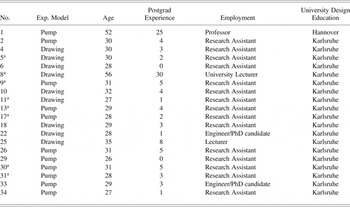
The subjects (18 male, 2 female) are all mechanical engineers and all had experience in applying the C&C approach. Sixteen of them graduated from Karlsruhe Institute of Technology in the last 8 years. Table 1 summarizes the subjects.
Overview of the experimental subjects

aSubjects are analyzed in detail in Section 6.
The task of the experiment was to analyze a hydraulic pump used in off-road vehicles for lifting or moving heavy parts, for example, the bucket of a hydraulic excavator. The product was selected as an example of a product that is highly optimized for robustness and durability and has sufficient complexity to reflect components that are designed by teams in industry. The product was deliberately selected as an example of a product that does not immediately interact with a user to eliminate variability in user behavior as a factor in the experiment.
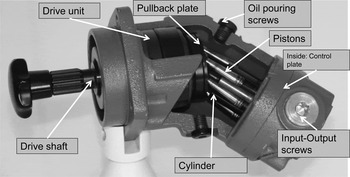
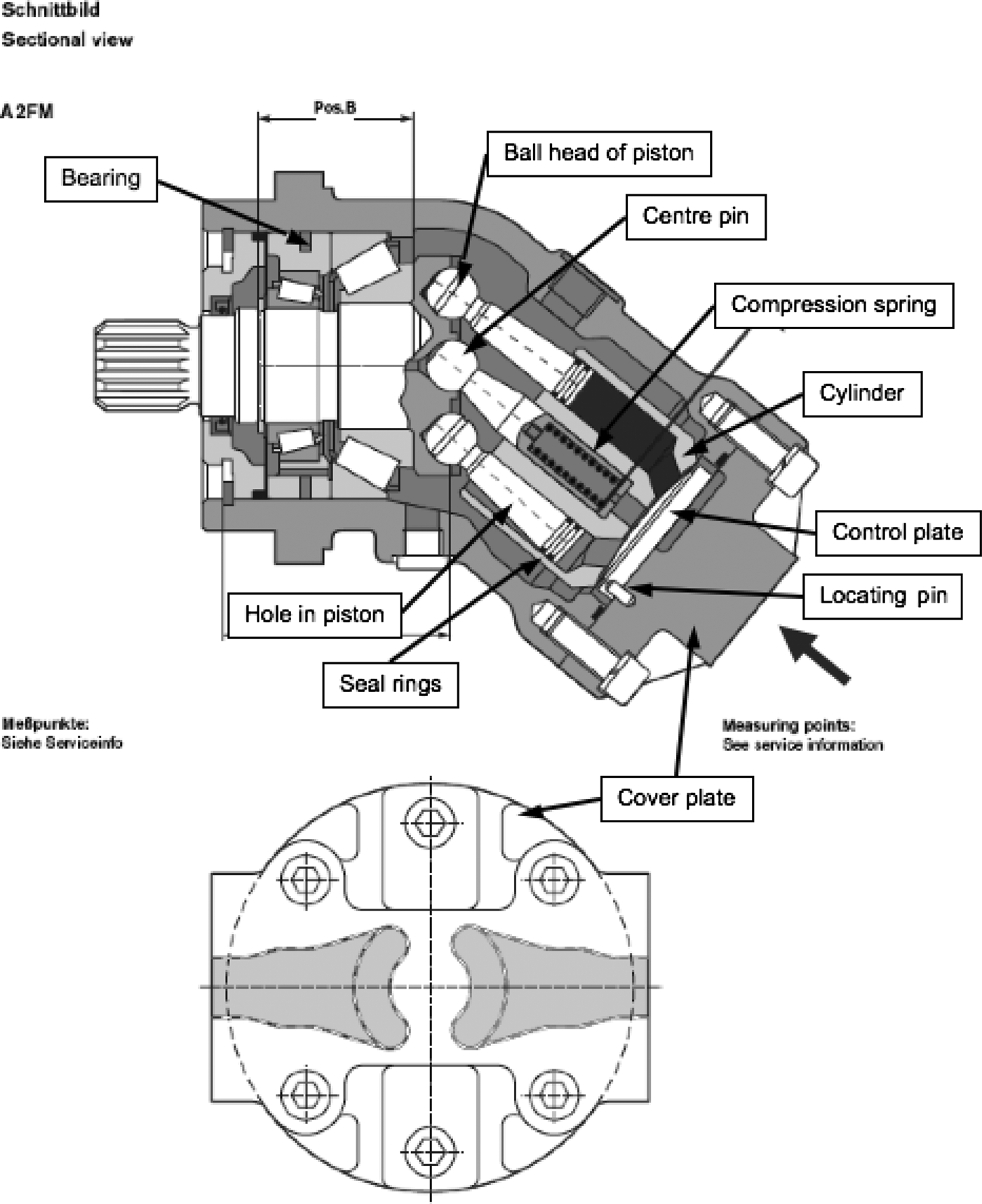
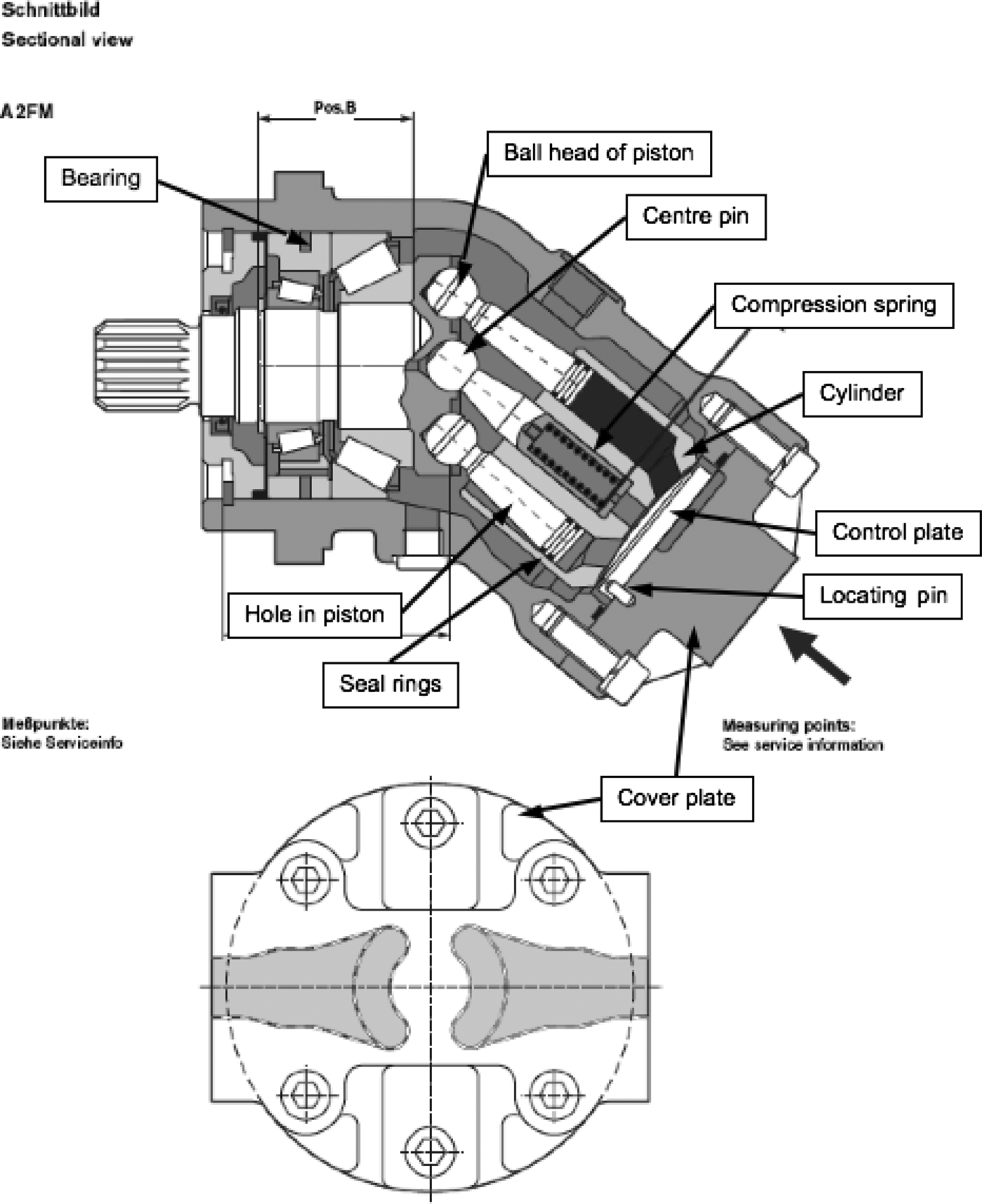
The experiments were carried out in two groups, who were placed in the groups according to when they were available for the experiment. The first 11 subjects were given a physical example of the pump, which had been prepared for teaching, as shown in Figure 1, by replacing a motor with a manual handle and cutting the top cover to expose the pumping mechanism. The subjects were allowed to manipulate the pump, but could not unscrew its components. Certain aspects of how the pump works were hard to see on the physical pump, it was therefore decided to give the second group a maintenance drawing (see Fig. 2), to see whether the representation had a significant impact on their ability to analyze the product. The second group of 9 subjects was provided with a two-dimensional maintenance drawing that was obtained from the publicly accessible product documentation. It is well recognized that the type of representation plays of crucial role in design activities (e.g., Goldschmidt & Porter, Reference Goldschmidt and Porter2004). The different representations were chosen partly to avoid biasing the results through the physicality of the pump, but also for convenience as the pump is very heavy. A detailed analysis of the effects of the different representation is beyond the scope of this paper, but the reporting of the results distinguishes between both representations.
The pump used in the experiment.

A maintenance drawing of the pump (Alink, Reference Alink2010).
All subjects were given identical briefing notes, which asked them to imagine that they were a new engineer at the pump developing company and needed to find ways to improve the pump. They were asked to analyze this pump to assess the potential for improvement and summarize their understanding in a function tree. The experiment was conducted in German. All functions and other results of the experiments had to be translated to English by the authors. All quotations are translated as literally as possible; thus, the inconsistent use of nouns and verbs (e.g., in expressions of functions) reflect the subject's German phrasing.
The duration of the experiment was limited to 1 h. However, many subjects declared that they had concluded the task earlier and were therefore released.
The experimenters discussed the outcomes after each experiment and provided feedback to the subjects at the end of the experimental period. The audio recordings were transcribed. All sketches were transformed into a standardized tree format. Based on a preliminary analysis of the analysis of the session and their output, it was decided to concentrate on the following issues:
• spoken functions: functions that were mentioned in the protocol, but not written down
• level of abstraction: abstract formulation with little information about design; concrete functions giving indication of the specific design
• level of detail: detailed functions contribute to the fulfillment of higher level functions; the subject's focus on the overall system, subsystem, subsubsystem, and single elements
The third author carried out a detailed analysis of the data as part of her diploma thesis. She has not observed the experiments herself. She read through the protocols, reviewed all sketches, and listened to the recordings to identify functions that were mentioned, but not written down in the function trees. These were added retrospectively to the function trees to produce a complete picture of the subject's analysis. The assignment to a location in the function tree sometimes had to be extrapolated from the context in which they were expressed. Eight subjects were selected for a detailed analysis of their analysis strategy. There are marked with an asterisk in Table 1.
3. OUTPUT OF THE EXPERIMENTS
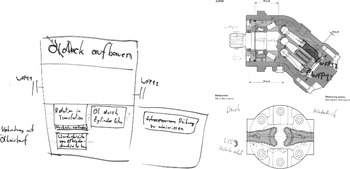
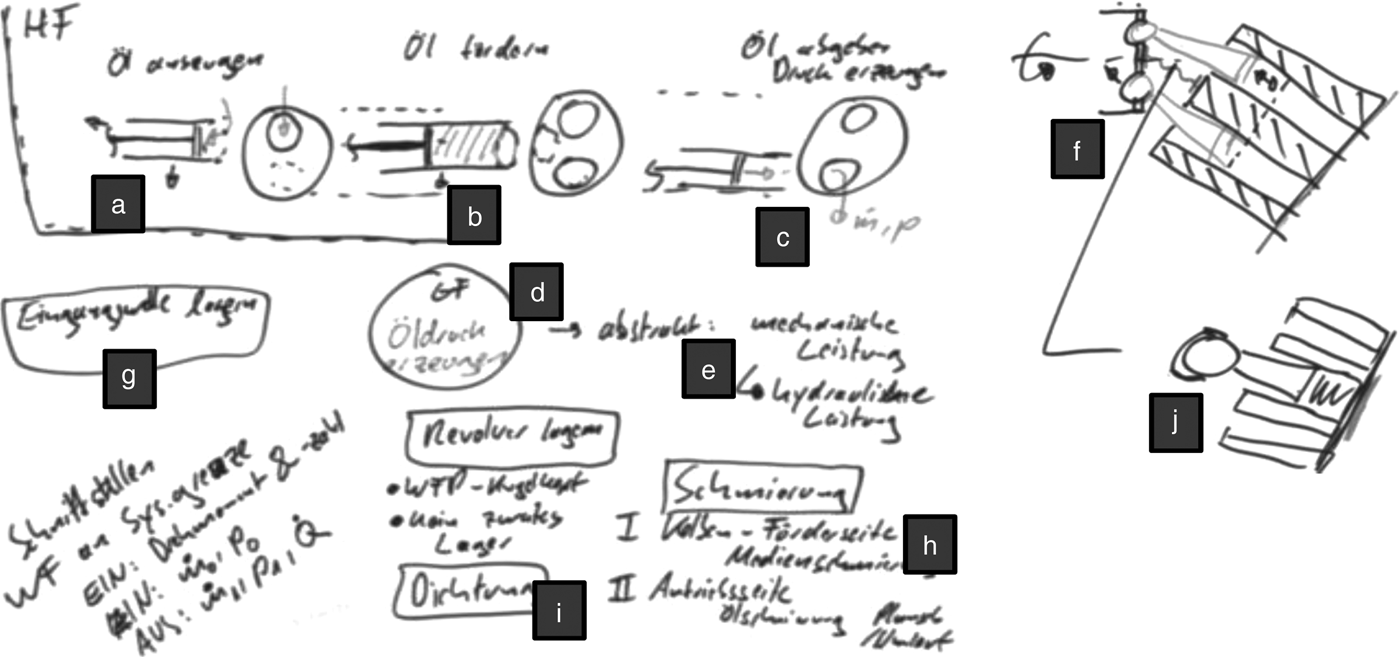
The transcriptions of the 20 experimental protocols consisted of between 3000 and 5000 words each. All but one subject wrote down at least one function. Ten out of 11 subjects who had the physical pump produced sketches. All 9 subjects who had the drawing sketched on the drawing. Figure 3 and Figure 4 show the representations created by 2 different subjects: 1 who was given the physical pump and 1 given had the maintenance drawing.
A typical representation of a maintenance drawing subject.

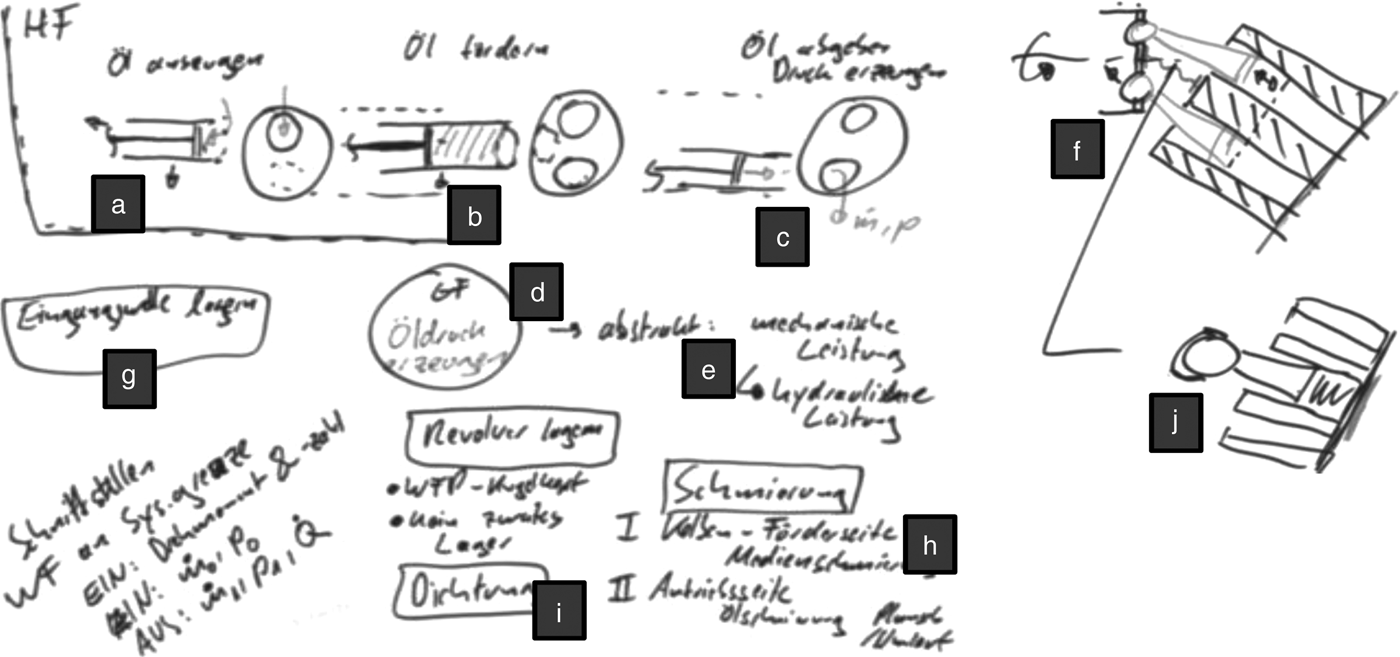
An example of an analysis by subject using the physical pump. draw in oil (a), convey oil, (b) dispense oil/create pressure (c), generate oil pressure (d), transform mechanical capacity into hydraulic capacity (e), the arrangement of the pistons that draw in oil and dispense oil (f), position drive unit (g), lubrication (h), lubrication (i), and support the revolver (j).
The brief only asked for the subjects to summarize their understanding in a function tree, but did not prescribe the form of representations. The subjects were provided with A1 paper and different colored pens of different thickness. One subject requested Post-it notes, so that he could rearrange the functions as his understanding grew. None of the subsequent subjects made use of the sticky notes. This section aims to provide a sense of the range of data produced, starting with two examples of typical representations, before discussing the ways functions were expressed and components are named. Although an indication of the range of formal and informal notions of the functions is provided, an in-depth analysis of how different notions of the functions affect the analysis of the product is outside the scope of this paper. The section will conclude with an overview of the approaches people took to analyzing the product.
3.1. Typical representation
The most obvious difference between the two groups was that the subjects who were given the two-dimensional schematic drawing did not sketch, whereas 10 out of 11 subjects in the other group drew sketches to understand or illustrate parts of the pump. Nineteen of the subjects drew traditional function trees; 1 subject did not draw any tree. Function trees arrange the functions in a hierarchical manner, where lower level functions contribute to the fulfillment of a higher level one. All but 2 subjects mentioned functions that they did not include in the function tree. The subjects using the maintenance drawing pointed out and marked the subsystems that carried out the functions they were speaking about.
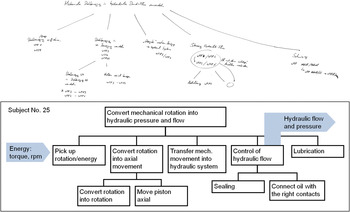
Figure 3 shows a typical output from an experiment where the subject was given the maintenance drawing. On the left side in the figure the function tree can be seen as a box representation. Subfunctions are arranged inside the box of the main function. The WSPs and channel and support structures are included in this function tree as part of a C&C approach analysis. The right side shows the annotations the same designer added to the maintenance drawing.
Figure 4 shows typical notes produced by one pump subject, who created additional drawings to clarify aspects of the pump. On the upper left side of the figure the main function of the system (Hauptfunktion, i.e., main function) is broken down into three subfunctions. These functions correspond to the sequence of the pumping operation: draw in oil (a), convey oil, (b) and dispense oil/create pressure (c). To understand the piston movement, he created a sketch of one piston in different positions (a, b, c). As soon as the sketch was created, he identified further functions at a lower level of detail, for which he did not produce more sketches, but wrote down the functions position drive unit (g) and lubrication (h). The arrangement of the pistons that draw in oil and dispense oil (f), two functions that occur sequentially, are shown, which makes him aware of the need to position the piston cylinder; the function of support the revolver (j) is shown, as well as lubrication (i), which is a function on a lower level in the function hierarchy, as it supports all other functions of the pump. The arrow from the upper drawing (see f to j in Fig. 4) indicates a detailing of the analysis.
3.2. A comprehensive model of the pump
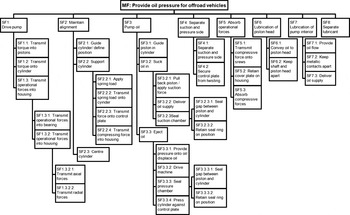
A detailed functional model of the pump was developed by the authors as a baseline for the analysis, using the C&C approach (Fig. 5). It employed all the functions mentioned by any of the subjects. Results of the subjects that could be regarded as clearly false were discarded and some functions were broken down further, although no subject had done so. They used both the pump and the maintenance description. Thus, they had a richer data set than the subjects. Although many subjects commented they had understood the product sufficiently, none reached this level of detail. This model gives an indication of the level of analysis that would have been possible on the pump and illustrated which functions the subjects have missed.
The detailed functional model.

4. RESULTS: NAMING FUNCTIONS AND PARTS OF THE PRODUCT
For many subjects describing how the pump worked turned out to be a difficult problem. Even though the subject overall had a very similar background and training, they had different notations of functions and different ways of expressing functions arising from different notations and conventions that they had been exposed to during their education both in terms of the syntax they used and the level of abstraction they aimed for.
4.1. Different notions and expressions of function
The interviews indicated that these were partly derived from everyday use of language and partly from the different methodological approaches to which they had been exposed. In consequence, the participants choose different formats to express functions and were also working on different levels of abstraction. None of the subjects drew an explicit distinction between function and behavior, as German language design methodologies do not make this distinction, in particular, the VDI Guidelines (VDI, 2004). As more detailed discussion of the notations of functions and their effects can be found in Eckert et al. (Reference Eckert, Alink, Ruckpaul and Albers2011); however, this section provides a flavor of the variability of the data.
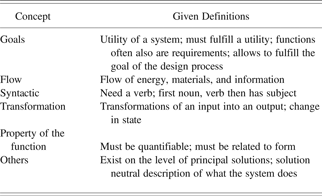
Some subjects had been asked what they understand by the term function and how they would define it during the initial interviews. The remaining subjects were asks after the trail to avoid biasing before the analysis. Table 2 gives an impression of the range of answers. The subjects were asked to elaborate on their definition, but were not challenged on it. The left column in Table 2 lists the key concepts and the right columns elaborate the flavor of the answer. The partial nature of the answer reflects the subjects' statements.
Variation in the notion of functions
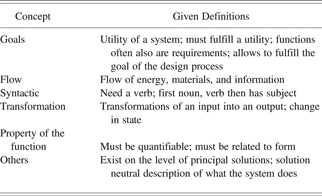
During their degrees the subjects had exposure to a variety of engineering methods, such as quality function deployment or failure mode and effects analysis methodology, which implicitly compose different conceptualizations of the term function. In the teaching of C&C approach functions were introduced through examples rather than a formal definition. The students learn to apply C&C approach in the context of practical engineering tasks.
Some subjects expressed functions in very concrete terms, whereas others used very abstract descriptions. However, often the same subject used different levels of abstraction for the same function or rephrased a function in more abstract or more concrete terms later. The subject in Figure 4 even wrote down two different expressions. He started by expressing the main functions very concretely as draw in oil, convey oil, and dispense oil/create pressure, which he summarized as the main function generate oil pressure (point d in Fig. 4).
He then rephrased this on a more abstract level as transform mechanical capacity into hydraulic capacity (point e in Fig. 4), when he thought explicitly about what would be an appropriate way to phrase the function. Other subjects expressed the functions without any reference to the specific pump or the components that carry out the function. For example, transform rotation into translation does not provide any impression of which subsystem carries out the function. Some subjects state explicitly that they are trying to write functions as a solution neutral description of what the system does. All subjects agreed that the main function of the pump was pumping the oil. Two subjects, in addition, mentioned that the pump could also be a motor that transforms the flow of oil into a rotation.
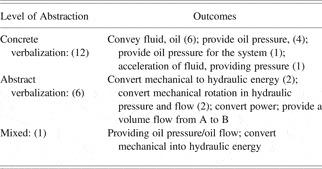
Table 3 illustrates the range of phrasing and the level of abstraction for the main function of the product they used.
Abstract and concrete phrasing of functions

4.2. Diverging terminology for parts
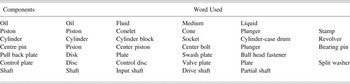
Subjects often pointed to components rather than naming them, or vaguely referred to generic terms like “thing” or “this part,” or names of very broad categories like “disk.” The oil was described on different levels of abstraction according to the designers' views on functional descriptions, as oil, hydraulic fluid, or medium. This appears to be related to the designer's notation of function. Several commented that they would call the oil fluid or medium to be as abstract as possible, because they felt functions needed to be described as abstract as possible.
A complete analysis of the terminology used by the subjects has not yet been carried out. However, Table 4 gives a flavor of the variation of component names in translation. The left column uses the terminology of the English maintenance instructions. Several subjects used the same word for different components with very different functions, for example, using disk for both the pullback plate and the control plate. Without a detailed analysis of the context when the words are mentioned three distinct naming strategies have emerged:
1. geometrical names, where the subject use the shape as a guide, for example, “plate” or “disk” for the pullback plate and “cone” for the pistons;
2. functional names, where an assumed functions provides the name, for example, “sealing ring” for the control disk;
3. analogical names, where they had encountered similar looking objects in a different context, such as “pistons” in engines.
Variations in terminology for components

Many words could be interpreted as a geometric or as a functional term, as the term Kolben, the German word for piston. However, without a detailed analysis of protocol, it is difficult to distinguish which meaning the subjects had in mind. Some commented on analogies when they were struggling to name the part.
4.3. Discussion
The subjects were presented with an object that they were nor familiar with and therefore had to draw on their general knowledge of engineering to name the part. Designers in a company specializing in pumps have established terminology that designers can draw on. However, needing to talk about engineered objects without being familiar with them is a fundamental part of engineering practice, which could lead to misunderstandings when different words are used for the same object.
5. RESULTS: DIFFERENT FUNCTIONAL BREAKDOWNS
This section concentrates on the function trees provided by the subjects and provides a quantitative overview. For each experiment we went through the transcripts and drew out the functions that were mentioned but not written down.
5.1. The function trees
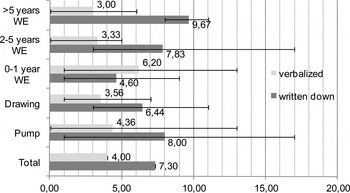
The basic statistics of the functions produced by subjects is summarized in Figure 6. On average, the subjects identified 11.3 functions (written plus verbalized). The largest number of functions written down was 17. This subject, who had nearly 4 years of experience, did not verbalize further functions. The other extreme was one subject, who wrote down only 1 function but verbalized a further 9 functions. He had just finished his degree and had a problem understanding the mechanism. This picture is characteristic for the groups. With experience the number of function written down increased. Subjects, who were confident about their analysis, were more willing to commit it to paper. People using the pump also generated more functions than those who used the maintenance drawing.
The average number of written down and verbalized functions with their statistical spread.

5.2. Written versus verbalized functions
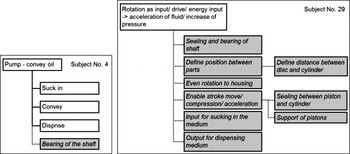
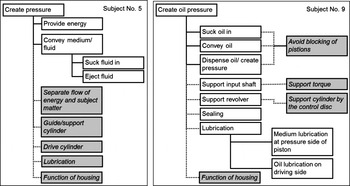
Figure 7 and Figure 8 show typical function trees. All function trees were first converted from the format they were written down, for example, the box notation in Figure 3, into a tree structure, and displayed in a standardized format to allow visual comparison. All subjects mentioned more functions than they wrote down. The written functions are shown in black, connected with continuous lines. Verbalized functions are added to the function tree at the most suitable point, are shown in gray and are connected with dashed lines. There was considerable variation in the number of functions that were only verbalized, both for very rich descriptions and for fairly coarse descriptions.
A function tree on two levels and a function tree with verbalized functions.

Two three-level function trees.

Figure 7 shows two coarse descriptions. In the right-hand example, only the main pumping operation was written. The subject really struggled. He was a fairly new staff member, and might have been lacking in confidence. He identified a key function using a mixture of abstract and concrete descriptions as Rotation as input/drive/energy input → acceleration of fluid/increase of oil pressure. He then mentioned what he thought the key components did, sometimes in detail, but did not aim to summarize them as a tree.
5.3. Levels of hierarchy
The level of detail in which the subjects analyzed the system can be divided into the number of levels of hierarchy and the number of functions on a hierarchy level.
Figure 8 shows two trees with three levels of hierarchy, but the left hand tree has fewer functions on the third level of hierarchy.
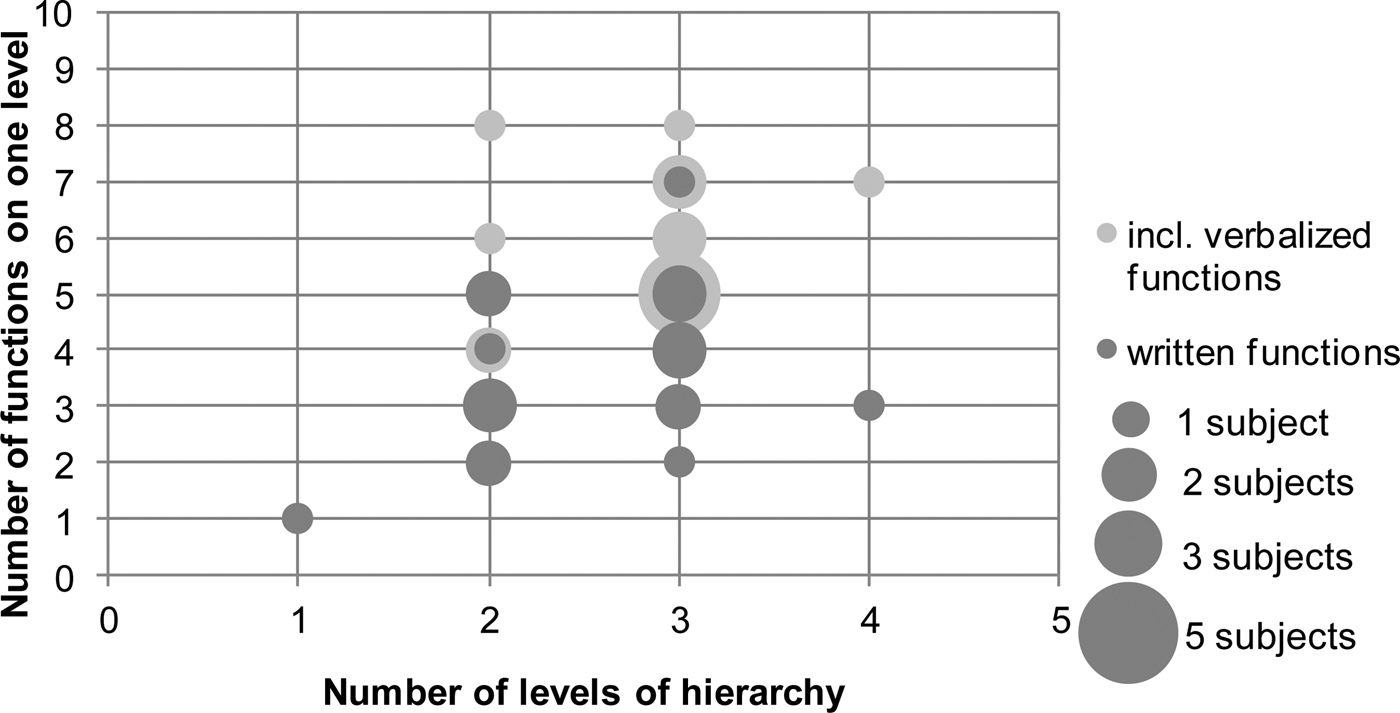
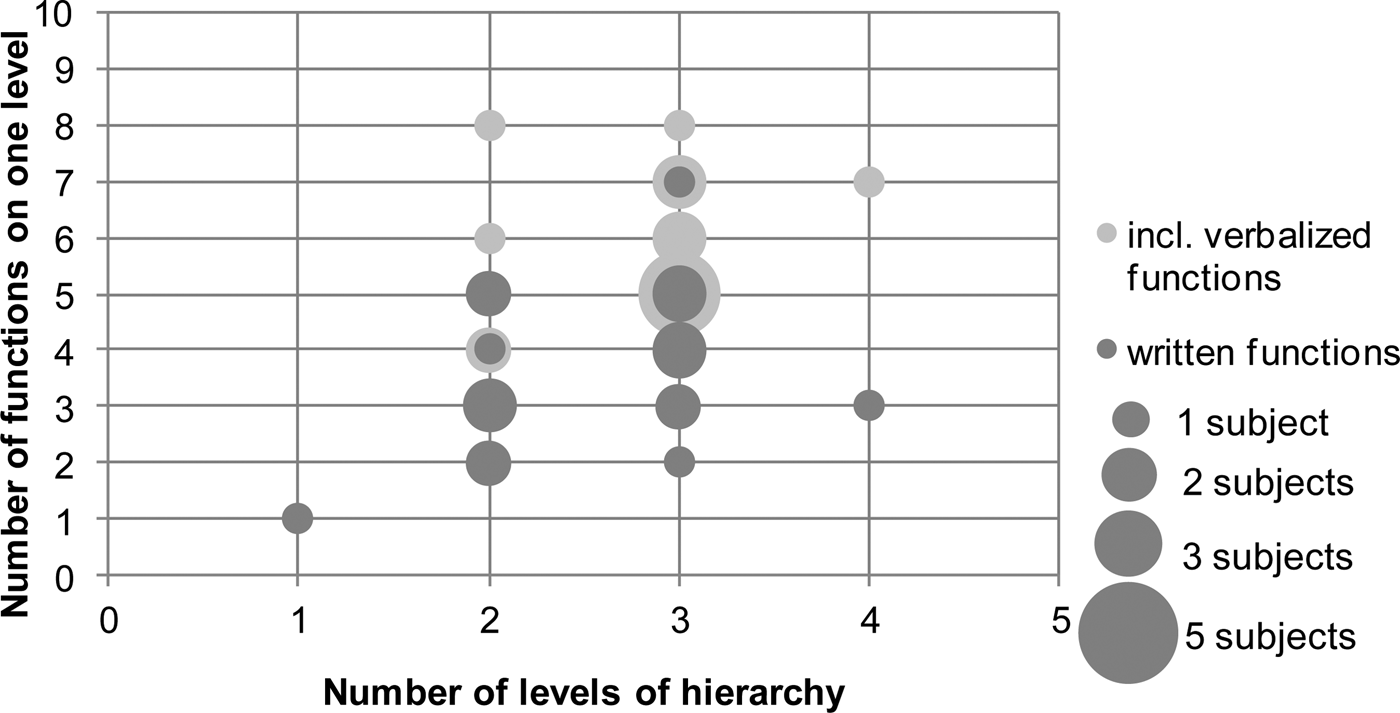
Figure 9 shows the relation of levels of hierarchy (depth) and the maximum number of functions on one level of hierarchy (breadth) of the function trees. Looking purely at the written functions (dark dots in Fig. 8), 10 subjects have structured the functions on three levels of hierarchy. Eight subjects elaborated the details on two levels of hierarchy. Only 1 subject chose a breakdown on four levels and only 1 subject wrote down only the main function. If the verbalized functions are also considered, 15 subjects break down the functions on three levels of hierarchy (bright dots in Fig. 9) of whom 8 have a maximum breadth of 5. Four subjects remain with two levels of hierarchy (bright dots in Fig. 9). The functions on the third and fourth levels of hierarchy are predominantly “auxiliary functions” like “Lubrication of part X,” “Pivoting of cylinder.” The variability of the maximum number of functions on each level of hierarchy is higher than the number of levels of hierarchy. Most functions are assigned to the second level of hierarchy. Further detail on the third level of hierarchy was only provided for one or two second-level functions (as in Fig. 8). The lack of completeness on the third level of detail can be ascribed to limited time in the experiment, subjects finding that they understood the system's function to their satisfaction, or subjects being unable to advance because they could not develop sufficient understanding of how the pump worked on a more abstract level to generate a function tree as the case in Figure 7 on the right. The generation of the authors' own model required several iterations and restructuring of assigned functions, which was not possible within the time given to the subjects. The author's model has 5 levels of hierarchy, with 8 second level, 18 third level, 13 fourth level, and 6 fifth level functions (see Fig. 5).
The depth to breadth of the function tree.
5.4. Discussion
There is no single right or complete functional model of a product. Like all models, functional models depend on the purpose of the model (see Frigg, Reference Frigg2003) and the emphasis placed by the person creating the model. It is possible that the subjects' models would have been more consistent in the level of detail they included, if they had been given a tighter brief for the analysis. For example, if the brief had included “leakage is occurring around the cylinder chamber” (the authors have no reason to assume that it does), all the subjects might have created a more detailed description of that part of the pump. The authors' model is not intended as the definitive model of the pump, but rather to show the levels of detail that could be described.
6. RESULTS: DIFFERENT APPROACHES FOR FUNCTIONAL DECOMPOSITION
The subjects also had very different approaches to analyzing the pump, both in terms of the overall strategy they employed and the relationship between gaining an understanding of the product and expressing the functions. This section provides an overview and then shows the detailed analysis of eight individual cases.
6.1. Overview
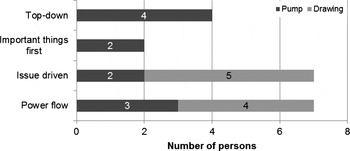
Subjects adopted different strategies to analyze the product (Fig. 10). The following classification is based on the analysis of the protocols and in some cases a discussion with the subjects. The following strategies have been identified so far:
• Top-down (TD, four subjects): Subjects analyzed the overall system and proceed to further levels of detail. The focus became more detailed step by step.
• Important things first (IF, two subjects): Subjects focused immediately on what they perceived as the main function of the most relevant subsystem. The criteria for the decision were not explicit. The focus was chosen arbitrarily or based on experience.
• Issue driven (ID, seven subjects): First the subjects created an overview and then detailed specific issues, which seemed important to understand or which they found problematic. They tended to write functions down as they went along.
• Power flow throughout the system (PF, seven subjects): Subjects followed the power flow from the source of the power to interfaces with other parts of the system. The flow starts where torque and rotational motion come into the system through the drive shaft. The rotation is then used to move the pistons in order to draw in and dispense the hydraulic oil.
Fig. 10.The numbers of subjects and strategies applied.


6.2. Function trees structured as power flow
Although only 7 subjects followed the power flow as a deliberate strategy, 11 subjects built a function tree that refers to the power flow through the system. In the example shown in Figure 11 the main stages of the power flow are drawn left to right. The functions of the drive shaft and the bearing unit (combined as “drive unit” in Fig. 1) are arranged on the left side. The flow of power then led the subjects to the right side, to the functions of the pump mechanism. Lubrication is added, because it seemed important.
The power flow reflected in the physical layout of a function tree. [A color version of this figure can be viewed online at http://journals.cambridge.org/aie]

Both the physical pump and the maintenance drawing had a natural orientation that might influence how the pump was analyzed and how function trees are drawn. The way the pump was prepared for teaching only affords a close look from one direction. The maintenance drawing has words and sentences on it, which determine the angle from which the drawing is normally seen.
Seven subjects defined lubrication and sealing as auxiliary functions on the first level of hierarchy. These functions are required to maintain other functions or to prevent unwanted functions like friction. The subjects positioned these functions at the right side (e.g., in Fig. 11) or the bottom of the function trees. One subject marked them as auxiliary functions. All the other subjects ignored lubrication and sealing in their function trees.
6.3. Detailed analysis of the strategy
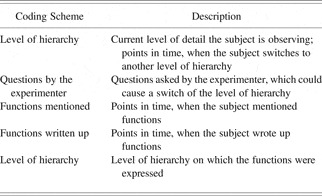
After all the protocols had been analyzed eight were selected for further analysis to how, when, and at what level of detail the subjects named functions. The detailed analysis followed the coding scheme shown in Table 5. In addition, the coder looked for when a C&C approach analysis was carried out; however, this is beyond the scope of this paper.
Coding scheme for detailed analysis

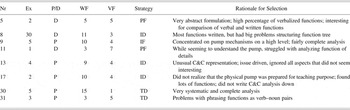
However, the interest in the C&C-A analysis influenced the selection of the subjects. The rationale for selecting the subjects is provided in Table 6, showing the years of experience, whether they had used the pump or the drawing, the number of written functions, the number of verbalized functions, and the strategy they employed, according to the classification in Section 6.1.
Subjects selected for detailed analysis

Note: Nr, number; Ex, years of experience; P/D, pump or drawing; WF, written Functions; VF, verbalized functions; PF, powerflow throughout the system; ID, issue driven; IF, important things first; PF, powerflow throughout the system; TD, top-down; C&C, contact and channel approach.
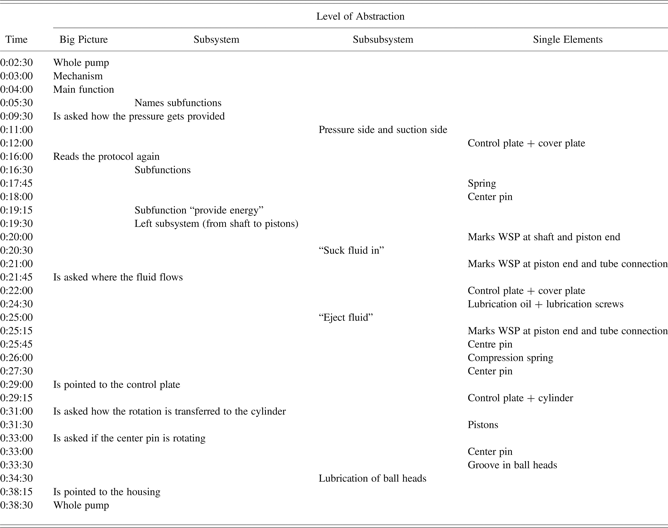
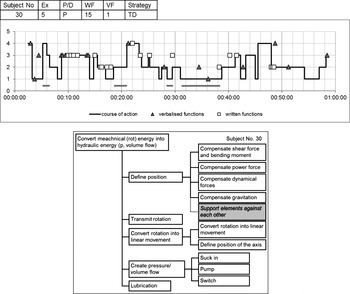
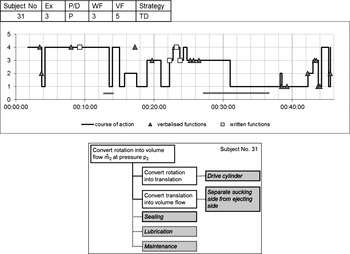
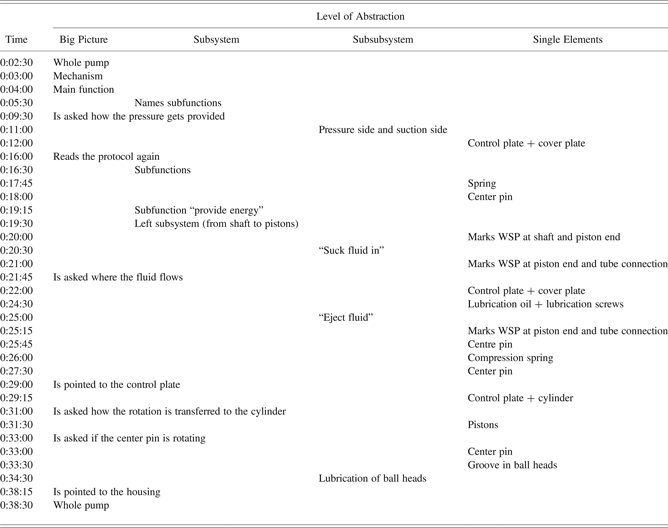
The detailed analysis assigned time stamps to when functions were mentioned or written down. The functions were assigned to four levels of hierarchy from the whole system to individual components. The interventions of the experimenter are shown. The experimenter typically intervened with a question when the subjects stalled, that is, did not speak or said that they did not know how to advance, or when they had been struggling with an obvious misconception for a considerable time. The phases where sketches were produced by the subject are indicated by the light gray background. An example is shown in Table 7.
Detailed analysis of the protocol of subject 5
Note: WSP, working surface pairs.
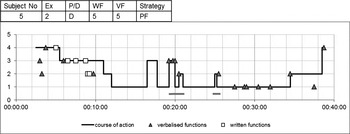
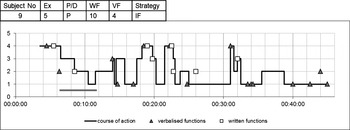
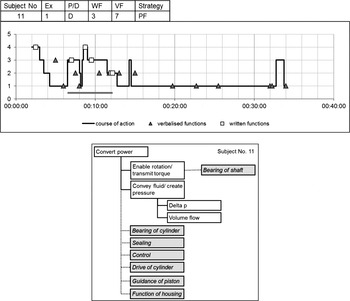
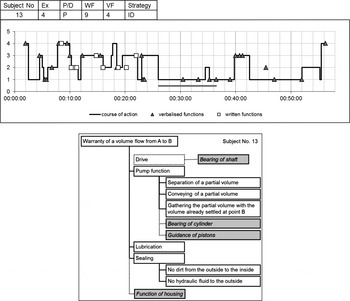
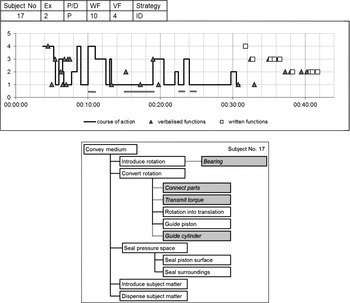
The data from this table are graphed in Figure 12, with the levels of detail numbered with the highest level, that is, the whole system is four, and the components level is one. The black line indicates the level of detail at which the subject was describing the pump. The line changes height when the subject moves to a different degree of detail. The triangles show verbalized functions and the squares written functions. This analysis shows whether functions are expressed at the same level of detail as the current description of the product. The gray lines below the course of action mark the periods when functions were assigned to elements of the pump.
The levels of abstraction of subject 5. The function tree can be seen in Figure 8 (left).

During periods with no written or verbalized functions the subjects mostly were asked questions by the experimenter which they tried to answer. Subjects who analyzed the physical pump often did not express any functions while they drew sketches. In Figure 12 between 0:10:00 and 0:16:00 subject 5 explained to the experimenter how the pressure in the fluid is built up. This protocol shows that the subject quickly understood the working principles of the pump and wrote them down as functions, but then struggled to understand how this particular pump actually worked. The frequent interventions of the experimenter indicate serious misunderstandings.
6.4. Detailed analysis graphs
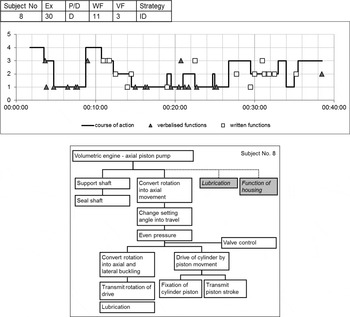
The graphs shown in Figure 13, Figure 14, Figure 15, Figure 16, Figure 17, Figure 18, and Figure 19 have been generated from the protocols of the other subjects. The number of subjects is not sufficient to draw significant conclusions from statistical analysis of quantities; therefore, this section will highlight some of the differences that were observed and illustrate problems that the subjects ran into with their chosen strategies.
The course of action and functions of subject 8.

The course of action and functions of subject 9. The function tree can be seen in Figure 8 (left).

The course of action and functions of subject 11.

The course of action and functions of subject 13.

The course of action and functions of subject 17.

The course of action and functions of subject 30.

The course of action and functions of subject 31.

6.4.1. Different levels of hierarchy
All profiles are different; however, some general trends can be observed. All subjects began at the highest level looking at the pump as a whole to understand the basic solution principle. In those first few minutes the participants recognized the pump as an example of a category of pump. They recognized the basic solution principle that is employed in the pump and that they knew from their training. Therefore, they could express the highest level function within the first few minutes. The latest was subject 19 at 4 min, whereas subject 16 expressed the top level function within a few seconds. All subjects revisited the top level function when they tried to phrase the function, some of them revised it. All subjects revisited the top function between two and five times and subject 9 rephrased it three times. It is interesting that subject 8 never expressed a top-level function. He looked at the whole pump and collected individual functions at lower levels of details, but struggled to group them, as he did not have a top-level function to group them under. He was also the only subject who wrote down a function on the component level as “Drive of cylinder by the movement of pistons.”
Most subjects quickly started looking at the component level as they tried to understand the basic mechanism. Only one subject (subject 8) wrote a function down at the component level; all other subjects tried to maintain an abstract phrasing of functions. Most functions that were only verbalized and never written down were functions at component level.
Subjects 13 and 30 focused on components within the first 30 s. Subjects 5, 9, and 11 worked their way gradually through different levels of detail, whereas the rest initially jumped between levels of detail. All the subjects spent about half of the time looking at the product at the component level, with considerable differences in the amount of time they spent at a medium level of detail. There was a tendency to look more at components toward the end of the experiment.
6.4.2. Timing of writing down functions
The times when the subjects wrote down functions varied considerably. Subjects 30, 9, and 8 wrote functions down throughout the experiment. This group of subjects wrote down a greater number of functions then those who wrote functions down at the beginning or the end. In particular, subject 30 worked his way systematically across the entire product. He was the only subject who used Post-it notes and reordered the functions. He wrote down a high percentage of functions (15 out of 16) and expressed all but the top level function at levels 2 and 3.
Subjects 31, 13, 11, and 5 wrote all their functions down in the first half of the experiment for slightly different reasons. Subject 13 had deliberately decided that he would write functions down first and then assign them to components. As he was doing that he found further functions, but did not write these down as they would not fit into his (very neat) function tree. Subject 11 had understood the basic solution principle of the pump and expressed the key functions, but then had difficulties to assign these functions unambiguously to parts to the pump, so that he did feel sufficiently confident to write detailed functions down. He only wrote down five functions, and was asked by the experimenter if he intended to write down more functions. He responded that he was not able to formulate functions on the level of single elements, as his notion of functions did not include functions that are related to concrete shapes. Subject 5 had confidently identified the main function at a fairly abstract level based on a abstract understanding of the mechanism and then looked at the pump to see how these functions had been implemented.
Subject 17 ran into problems early in his analysis, as he did not recognize the implications of the pump being prepared for teaching and misinterpreted the opening as the oil inlet. He therefore could not understand the oil flow and pinpoint the main functions.
6.4.3. Approaches to structuring functions
To arrange functions into a function tree the subjects employed two strategies, grouping by
• Function, where subfunctions were defined for high level functions and assigned later to components. Subject 13 stated this explicitly as his structure and only wrote down functions in the first half of the experiment. For subject 31 the subfunctions “Transfer rotation into translation” and “Transfer translation into volume flow” result from the main function “Transfer rotation into volume flow ṁ 2 with a pressure p 2.” He then looked for places in the product that carried out these functions. However, with this approach he ended up not assigning a function to pistons.
• Components and subsystems, where the whole pump was divided into a subsystem before assigning a function to them.
Subject 8 struggled to arrange the functions into a tree, when prompted by the experimenter at the end of the experiment. While analyzing the pump he continuously wrote down functions whenever a new function came to mind. Because of adopting an issue driven approach for the analysis, he wrote down the functions in an opportunistic way, too. He did not arrange them either according to function hierarchy or according to components, and ended up with an inconsistent function tree.
6.5. Discussion
The data set of 20 subjects, of whom 6 have been analyzed in detail, does not provide sufficient data to analyze whether there is a definite correlation between the strategies and the resulting function tree, or the notion of function and the resulting function trees. However, the detailed analysis indicates that the people who worked steadily at finding more function ended up with a higher number of functions than those who identified them upfront or at the end. The issue driven approach and important things first approach let to uneven analyses, as people looked in detail at particular aspects of the pump.
7. CONCLUSIONS AND IMPLICATIONS
Design is classically described as an iterative cycle of problem analysis, synthesis, and evaluation (Asimov, Reference Asimov1962). The emphasis of research in design cognition has been on synthesis, rather than analysis, which is required throughout the cycle, but predominantly during the problem analysis and the evaluation phases. Analysis of existing products is a very important part of many design processes and is not systematically taught at many universities. Although systematic methods for reverse engineering, that is, a systematic analysis of existing products do exist, such as Otto and Wood (Reference Otto and Wood1998) or Wood et al. (Reference Wood, Jensen, Bezdek and Otto2001), the emphasis of design education lies on new product design.
This experiment points to the variability of approaches and results in the analysis of products. The range of function trees and the differences in quality and level of detail have interesting implications for the shared understanding that a team might have. Most of the subjects left the experiment with the sense that they had understood the product to their satisfaction, but their understanding was very different. This could potentially cause problems in a joint design project, where each of them would bring their own divergent understanding without realizing that others might interpret the product in a different way. This is particularly critical as this group was far more homogeneous than many design teams, being graduates of the same university with very similar experiences. In particular, the detailed analysis shows that the subjects had very little idea how to go about a functional analysis and each had their own way of doing it. This would indicate the engineers would benefit from training in how to analyze products.
The paper also provides empirical evidence for the relevance of the ongoing debate on the nature of functions. All the subjects in the experiment struggled with defining functions, and each of them had a slightly divergent definition of functions. None of the academic definitions has been adopted universally. This also sheds light on the challenges of introducing methodologies into industry that require a coherent understanding of functions.
The goal of this paper is to alert the wider design community to some of the challenges designers face in the analysis of existing products and in using the concept of function. The paper provides an overview of the findings of the hydraulic pump experiment. Detailed analyses of the data are ongoing, and future work will look in detail at the processes by which products are analyzed, the challenges the designers encountered, and the help they require in the future.
The paper provides a summary of the findings and the rich set of data allows a far more detailed analyze of the data in the future. The authors are planning in particular to look at mistakes that the subjects made and how these were related to their understanding of function and to analyze the way the subjects described the product and the bias this description introduced into the analysis. To answer several of the questions that this paper raises conclusively, further experiments would be required potentially with a different design of the experiment. To understand correlations between notion of function and approaches to analyzing function and the level of detail, focus or quality of the functional analysis, a larger number of subjects would be required, but not the detailed protocols of analysis sessions. Alternatively for other issues, such as mistakes that people make or the effect of misconceptions of the product on approaches to functional analysis can be carried out by analyzing the existing protocols in more detail.
ACKNOWLEDGMENTS
The authors thank all of the people who participated as subjects in the experiment and the student research assistants who transcribed the records with great stamina.
Claudia Eckert is a Senior Lecturer in design at Open University, the British Distance Education University, where she also carried out her doctoral research on design processes in the knitwear industry, before spending nearly 10 years in the Engineering Design Centre in Cambridge. Her research interests are in understanding and supporting design processes, and in particular, engineering change and processes planning. She is also working on comparisons between design domains.
Anne Ruckpaul is a Research Assistant in the research group Appliance and Power Tool Design at the Institute of Product Engineering at Karlsruhe Institute of Technology (IPEK). Her research interests are related to the support of design engineers during the analysis and synthesis of technical product in the development process.
Thomas Alink received his PhD from the Karlsruhe Institute of Technology (KIT), where he worked as a Research Assistant in the field of design methods and design management until 2010. His research focuses on the meaning and notation of technical functions for solving design problems in the engineering design context.
Albert Albers is a Professor and Head of IPEK at KIT. After working as head of development of coupling systems and torsion vibration dampers at LuK GmbH & Co. OHG, he left there to take a position at IPEK in 1996. His research focuses on models for product development processes as well as the support of product development by methods for computer-aided engineering, innovation, and knowledge management in mechanical and automotive engineering.