Floods account for approximately 40% of all natural disasters worldwide. Most floods occur in developing countries and tropical regions where the impact on public health is substantial, the number of people displaced is often large, and the number of deaths is high.Reference Ohl and Tapsell 1 In 2011, 65 of 77 provinces in Thailand were declared disaster zones because of a severe flood that began on July 25, 2011, and persisted in some areas until January 16, 2012. Due to the monsoon season and the landfall of tropical storm Nock-Ten in North Vietnam, which borders Thailand to the north, the flood spread from the north through the northeast and central part of Thailand. The 2011 flood was described as the worst flood in Thailand in terms of the amount of water and the number of people affected, as well as the length of time of the disaster. The flood affected approximately 12.9 million people, caused 813 deaths,Reference Piyaphanee, Olanwijitwong and Kusolsuk 2 and affected the capital city of Bangkok. In the middle of November 2011, many facilities including hospitals, city offices, and Ministry offices were flooded and transportation had been disrupted.
According to Bich et al,Reference Bich, Quang and Thanh Ha 3 health consequences of floods can be described in relation to the progression of time. The recognized immediate health effects of flooding include injuries, acute asthma attacks, skin rashes and clusters, outbreaks of gastroenteritis, and respiratory infections.Reference Bich, Quang and Thanh Ha 3 After flooding, communicable diseases and traumas gradually decrease, while at the same time, mental health problems increase. The effect of floods on mental health is important to consider, because poor mental health may last longer than infectious diseases and injuries.Reference Ohl and Tapsell 1 Some researchers have investigated the impact of floods on mental healthReference Ahern, Kovats and Wilkinson 4 , Reference Mason, Andrews and Upton 5 ; however, most of these floods ebbed within 1 week. In contrast, the 2011 flood in Thailand exerted effects for as long as 1 to 6 months, which had not previously been experienced.
Given the importance of investigating mental health issues after floods, and the paucity of research on long-lasting floods, we evaluated the long-term psychological effects experienced by victims and unaffected residents from the same area during the 2011 flood. We also examined risk factors, and in particular, flood-related variables such as floodwater levels in the house, how long the flooding remained, disruption to essential services, and evacuation. The results of our research may be useful when planning future studies and to minimize the psychosocial impact associated with flooding.
METHODS
Study Site and Participants
Surveys were conducted in Salaya subdistrict (population: 15,845 people) and Nakhon Chaisri subdistrict (population: 4278 people), Nakhonpatom Province, from May to June 2012. This period was approximately 6 months after the heavy flood. Nakhonpatom Province is located on the west side of Bangkok Metropolitan area. These areas are suburbs of Bangkok, experienced long-term flooding, and were chosen because of the feasibility of carrying out the surveys.
In terms of sampling, with statistical power of 80%, 95% confidence interval, predictive standard deviation of 5.0, and detective difference of the mean of psychological measurement scores for flood victims and unaffected groups of 1.5, we calculated an ideal sample size of 351. Therefore, we collected a sample of about 400 to account for missing values. Households were selected by using systematic random sampling through the telephone book. The respondents in each household were either the household head or his or her spouse. When the household head or his or her spouse was not available, that particular household was excluded from the study and replaced with the closest available household. Interviewers were recruited from among public health researchers in universities around Bangkok and trained over a 2-day period on questionnaire administration.
Measurements
Sociodemographic Variables
We collected data on the age, gender, occupation, and annual income as well as present status of lifestyle-related disease such as hypertension and diabetes mellitus.
Exposure Variables
We recorded flooding levels (the presence of water in (1) the street or garden outside the house; (2) the basement or cellar of the property, or below the floor level in ground-floor rooms; (3) above the floor level in ground-floor rooms), and the term of flooding (flood water remained (1) 1 week or less, (2) 2 weeks or more).
Incident Management Variables
This questionnaire included items about disruption to essential services (such as electricity, tap water supply, and sewage) and evacuation (evacuated or not evacuated).
Outcome Measures
The main outcome measure in this study was nonspecific psychological distress, as measured by the Kessler 10 (K10)Reference Kessler, Andrews and Colpe 6 for serious mental illness (SMI). The K10 was selected because it is a well-established and validated measure that is used worldwide in population research. In addition, it is an appropriate screening instrument for identifying likely cases of SMI included for anxiety and depression in the population and provides a strong indication of possible mental health disorders. It contains 10 items rated on a 5-point Likert scale. Scores range from 10 to 50, with higher scores indicating higher levels of psychological distress. According to Sakurai et al,Reference Sakurai, Nishi and Kondo 7 who screened for mental disorders among a random sample of community residents in Japan, 19/20 is the optimal cutoff score. Therefore, we defined a K10 score of 20 or more as indicating probable SMI.
Statistical Analysis
We determined areas that had homes affected to varying degrees by the flood or not affected from the examinee’s answer. We first examined the univariate relationship between all exposure variables and mental health symptoms. Multivariable logistic regression was then used to describe the association between all exposure variables and mental health symptoms, adjusted for age group, gender, occupation, annual income, number of family members, and history of noncommunicable diseases. All data analyses were carried out by using JMP 10.0.0 (SAS Institute Inc, Cary, NC).
RESULTS
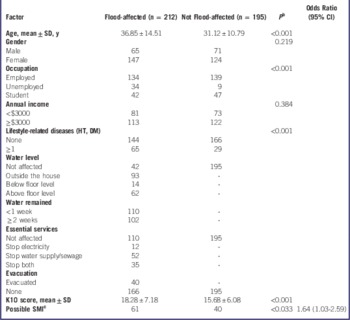
A total of 407 respondents participated in the survey. The mean age of the respondents was 34.1 years (SD: 13.1). The characteristics of both flood victims and unaffected people are shown in Table 1. Average age, occupation, and lifestyle-related disease status differed significantly between flood victims and unaffected respondents. Gender and annual income were not significantly different between the 2 groups. In the flood-affected area, approximately one-third (76/212) of respondents had damage inside their house. Approximately one-half (102/212) of flood victims reported that the water remained more than 2 weeks.
Demographic Characteristics of Each GroupFootnote a

a Abbreviations: DM, diabetes mellitus; HT, hypertension; K10, Kessler 10 screening instrument; SMI, serious mental illness.
b Chi-square test for categorical variables and t-test for continuous variables.
c Possible SMI means a K10 score of 20 or more.
The prevalence of possible SMI in flood victims was significantly higher than for unaffected respondents. The results of the univariate analysis showed that possible SMI was approximately 1.5 times higher in flood victims than in unaffected respondents; the odds ratio was 1.64.
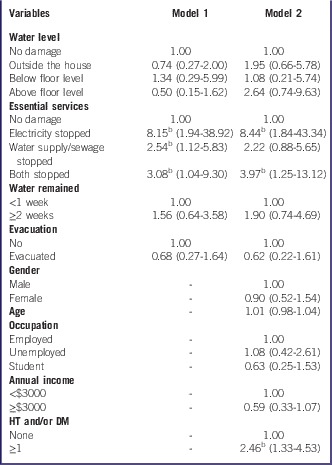
Table 2 shows the results of logistic regression analyses for flood-related variables and other sociodemographic variables in relation to SMI. After adjustment for potential confounding factors such as gender, age, occupation, annual income, and present status of lifestyle-related disease, there were significant associations with possible SMI for essential services (electricity stopped and both electricity and tap water/sewage stopped; odds ratio [OR]: 8.44, 95% confidence interval [CI]: 1.84-43.34; OR: 3.97, 95% CI: 1.25-13.12) and for hypertension or diabetes (OR: 2.46, 95% CI: 1.33-4.53). No significant association was found with SMI for age, gender, occupation, annual income, water level, period of floodwater remaining, or evacuation.
Adjusted Odds Ratios and 95% Confidence Intervals of Logistic Regression Analysis for Possible Serious Mental IllnessFootnote a

a Abbreviations: DM, diabetes mellitus; HT, hypertension; SMI, serious mental illness. Model 1 was adjusted for water level, essential services, period that water remained, and evacuation. Model 2 was adjusted for water level, essential services, period that water remained, evacuation, gender, age, occupation, annual income, and present status of lifestyle-related diseases.
b P<0.05.
DISCUSSION
The purposes of this article were to evaluate the long-term psychological effects of flooding and to clarify the risk factors for possible depression in flood-affected people. The key findings of the present study were as follows: (1) a lack of essential services such as electricity, tap water, and sewage and long-lasting floodwater (more than 2 weeks) were related to possible SMI and (2) individuals with preexisting lifestyle-related health problems were at a significantly greater risk for possible SMI due to flooding.
Loss of essential services was one of the most important risk factors for possible SMI (OR of 8.44 and 3.97) in the present study. This finding is consistent with a previous study in the United Kingdom showing that loss of essential services worsened mental health problems two- to three-fold.Reference Paranjothy, Gallacher and Amlot 8 Thus, we emphasize the need for planners to build greater reliability into essential services. In addition, such a long-lasting flood is unusual in the world. Therefore, little is known about the long-lasting effects on mental health, including potential anxiety among the flood victims about when the flood would end.
In the present study, previous lifestyle-related health problems such as hypertension and diabetes mellitus were more closely related to psychological distress among flood victims. According to a previous study about flood and health in Vietnam, people with hypertension in a severely affected commune worsened in terms of mental health problems compared with those in a less-affected commune in the urban district.Reference Bich, Quang and Thanh Ha 3 While this previous study did not clarify the relationship between hypertension and psychological distress, our study results suggest that aggravation of prior health problems may be associated with psychological distress.
In the present study, evacuation was not associated with psychological distress. Paranjothy et alReference Paranjothy, Gallacher and Amlot 8 also noted a nonsignificant correlation between evacuation and psychological distress among flood victims. Some studies have reported that females have a significantly higher prevalence of possible depression as a result of flooding than malesReference Mason, Andrews and Upton 5 ; however, our study did not find significant differences between genders. Although a previous report on the Thailand flood of 2000 noted that the experiences of poverty and loss of belongings were associated with stress and psychological problems,Reference Wisitwong and McMillan 9 our study results suggested no significant association between annual income, occupation, and psychological distress.
Some limitations of our study need to be considered. First, ours was a cross-sectional study, so causal relationships cannot be proven. In cross-sectional studies, it is not possible to ascertain the extent to which pre-flood mental health affected post-flood mental health. Thus, individuals with pre-flood depression may have reported greater increases of these symptoms after the flood.Reference Ginexi, Weihs and Simmens 10 Second, recall bias may have been present regarding respondents’ experiences of the flood. Third, because of the small sample size, it is difficult to generalize our findings. In particular, some of the 95% CIs were wide in the logistic regression analysis. Fourth, we did not mention post-traumatic stress disorder (PTSD), because we considered that SMI included PTSD. However, it may be better to add a PTSD questionnaire to learn more about psychological distress among flood victims. Fifth, we did not have data on social class and the former status of the respondents’ mental health, which are known risk factors for psychological distress; however, we were able to adjust for employment status.
CONCLUSION
Despite these limitations, this study provided useful information for a better understanding of psychological distress among flood victims. We conclude that disruption of essential services, length of flooding, water invasion in the house, and chronic illness may affect psychological distress among flood victims. Further work is required to confirm the risk factors associated with psychological distress in individuals and effective interventions to minimize mental health problems among flood victims. Public health agencies need to develop and evaluate strategies for improved risk communication and psychological support for families experiencing flooding.
Acknowledgments
We thank Orada Anotaipaiboon and Piyachatr Tragoolvongse for their assistance in the questionnaire research and Orawan Quansri for her friendly support. This research was supported by funding from the MIU memorial foundation grant number H23.
Conflict of Interest
All authors declare that they have no potential conflicts of interest or any financial or personal relationships with other people or organizations that could inappropriately bias the conduct and findings of this study.