Introduction
Interconnected problems: climate change and nitrogen pollution
Nitrogen (N) is one of the primary macro-nutrients of plants, playing a central role in plant metabolism (Marschner, Reference Marschner2011). Additional N from organic and inorganic sources is almost universally supplied to agricultural soils to support needs of crops. The ‘green revolution’ of the 20th century was depended critically on these additional nutrient sources, which largely contributed to doubling agricultural productivity of land (Erisman et al., Reference Erisman, Sutton, Galloway, Klimont and Winiwarter2008), and N continues to play a fundamental role in ensuring global food security through the 21st century (Sutton et al., Reference Sutton, Bleeker, Howard, Bekunda, Grizzetti, de Vries, van Grinsven, Abrol, Adhya, Billen, Davidson, Datta, Diaz, Erisman, Liu, Oenema, Palm, Raghuram, Reis, Scholz, Sims, Westhoek, Zhang, Ayyappan, Bouwman, Bustamante, Fowler, Galloway, Gavito, Garnier, Greenwood, Hellums, Holland, Hoysall, Jaramillo, Klimont, Ometto, Pathak, Plocq Fichelet, Powlson, Ramakrishna, Roy, Sanders, Sharma, Singh, Singh, Yan and Zhang2013).
However, globally nitrogen use efficiency (NUE) in agriculture is very low and has a decreasing trend. Between 1961 and 2008, globally, the N balance, estimated as the difference between all nitrogen inputs and outputs on agricultural land, has increased from 22.6 to 151.9 kg ha−1 (Lassaletta et al., Reference Lassaletta, Billen, Grizzetti, Anglade and Garnier2014). The surplus reflects the excess N in the agricultural field than the requirement and results in diffuse pollution. Along with that, globally, the NUE dropped from 68 to 47% (Lassaletta et al., Reference Lassaletta, Billen, Grizzetti, Anglade and Garnier2014). From the full food supply chain, over 80% of N is lost to the environment (Sutton et al., Reference Sutton, Bleeker, Howard, Bekunda, Grizzetti, de Vries, van Grinsven, Abrol, Adhya, Billen, Davidson, Datta, Diaz, Erisman, Liu, Oenema, Palm, Raghuram, Reis, Scholz, Sims, Westhoek, Zhang, Ayyappan, Bouwman, Bustamante, Fowler, Galloway, Gavito, Garnier, Greenwood, Hellums, Holland, Hoysall, Jaramillo, Klimont, Ometto, Pathak, Plocq Fichelet, Powlson, Ramakrishna, Roy, Sanders, Sharma, Singh, Singh, Yan and Zhang2013). Much of the lost N causes environmental pollution through emissions of nitrous oxide (N2O) and ammonia (NH3) to the atmosphere, along with losses of nitrate (NO3−) and organic N compounds to water. These emissions have harmful environmental effects, e.g., on a 100-year timescale, N2O has 298 times higher global warming potential than CO2 (IPCC, Reference Stocker, Qin, Plattner, Tignor, Allen, Boschung, Nauels, Xia, Bex and Midgley2013). Agricultural NH3 is one of the largest sources of atmospheric aerosol pollution (Bauer et al., Reference Bauer, Tsigaridis and Miller2016). Nitrogen compounds are also a major cause behind freshwater and marine water pollution, termed eutrophication (Sutton et al., Reference Sutton, Bleeker, Howard, Bekunda, Grizzetti, de Vries, van Grinsven, Abrol, Adhya, Billen, Davidson, Datta, Diaz, Erisman, Liu, Oenema, Palm, Raghuram, Reis, Scholz, Sims, Westhoek, Zhang, Ayyappan, Bouwman, Bustamante, Fowler, Galloway, Gavito, Garnier, Greenwood, Hellums, Holland, Hoysall, Jaramillo, Klimont, Ometto, Pathak, Plocq Fichelet, Powlson, Ramakrishna, Roy, Sanders, Sharma, Singh, Singh, Yan and Zhang2013).
Bangladesh is one of the countries with the highest quantity of excess N on agricultural land (West et al., Reference West, Gerber, Engstrom, Mueller, Brauman, Carlson, Cassidy, Johnston, MacDonald, Ray and Siebert2014). Agricultural N use increased to 1.3 M tons in 2018 from 0.02 M tons in 1961 in Bangladesh (FAOSTAT, 2020). Experimental results show that in the case of rice production in Bangladesh, the agronomic efficiency of N fertilizer is as low as 15–20 kg grain kg N−1, and NUE is only 35–40% (Ahmed et al., Reference Ahmed, Humphreys, Salim and Chauhan2016), which is certainly much lower in real-farm circumstances.
The issue of low NUE is specifically critical for a country like Bangladesh which is also predicted to be one of the most vulnerable countries to changing climate (Shahid and Behrawan, Reference Shahid and Behrawan2008; IPCC, Reference Pachauri and Meyer2014). The country's future rainfall pattern is predicted to become more variable and erratic, while the periods of consecutive dry days may increase (BanDuDeltAS, 2015). Simultaneously, there might be a 25–75% increase in upstream river discharges (Wijngaard et al., Reference Wijngaard, Lutz, Nepal, Khanal, Pradhananga, Shrestha and Immerzeel2017). All these factors will have a huge impact on agriculture, which is an important contributor to GDP and employment (MoF, 2018). In the next three decades, rice and wheat production is predicted to fall by 8 and 32%, respectively (Goosen et al., Reference Goosen, Hasan, Saha, Rezwana, Rahman, Assaduzzaman, Ashraful Kabir, Dubois and van Scheltinga2018). Alongside, the climatic hazards and anomalies such as flood, drought, salinity, cyclone and storm are predicted to increase substantially, consequently impacting the lives and livelihoods of those depending on agriculture (Goosen et al., Reference Goosen, Hasan, Saha, Rezwana, Rahman, Assaduzzaman, Ashraful Kabir, Dubois and van Scheltinga2018). The related threats are several times higher for small and marginal farmers, who constitute around 84% of the country's total farm households (BBS, 2019). These farmers are heavily dependent on agriculture for their livelihood and possess lower adaptive capacity (Wood et al., Reference Wood, Jina, Jain, Kristjanson and DeFries2014). Crucially, relying on climate-smart technologies is particularly important in reducing vulnerability.
Briquette urea (BU) deep placement as part of the solution
Solid urea, the most frequently used N fertilizer, is produced in two forms: prills and granules. Although both have the same chemical properties, their different physical and mechanical properties are distinguishable and make them suitable for different types of applications (Rahmanian et al., Reference Rahmanian, Naderi, Supuk, Abbas and Hassanpour2015). Prilled urea (PU) is around 1–2 mm in diameter (Rahmanian et al., Reference Rahmanian, Naderi, Supuk, Abbas and Hassanpour2015), which is commonly applied through broadcasting (CTC-N, 2021). As PU is smaller in size and applied on the soil surface, it is more volatile, prone to leaching and runoff, has low NUE and ultimately causes more greenhouse gas (GHG) emissions (Gaihre et al., Reference Gaihre, Singh, Islam, Huda, Islam, Satter, Sanabria, Islam and Shah2015). Alternatively, the granular urea is particularly prepared for deep placement in a larger size of 1–3 g and 2–8 mm in diameters (Rahmanian et al., Reference Rahmanian, Naderi, Supuk, Abbas and Hassanpour2015). This granular urea is called BU, which can be applied mechanically and manually (Chatterjee et al., Reference Chatterjee, Mohanty, Guru, Swain, Tripathi, Shahid, Kumar, Kumar, Bhattacharyya, Gautam, Lal, Kumar and Nayak2018) at 7–10 cm soil depth (CTC-N, 2021). The urea deep placement technique is promoted as a climate-smartFootnote 1 solution for rice systems (FAO, 2018). Deep placement of BU can increase NUE by around 40% compared to that of PU broadcasting (FAO, 2014; Ahmed et al., Reference Ahmed, Humphreys, Salim and Chauhan2016), particularly in the wet season and irrigated rice cropping systems (Bandaogo et al., Reference Bandaogo, Bidjokazo, Youl, Safo, Abaidoo and Andrews2015). Huda et al. (Reference Huda, Gaihre, Islam, Singh, Islam, Sanabria, Satter, Afroz, Halder and Jahiruddin2016) noted that NUE in experimental fields could be increased from 35% of PU to 63–67% by applying BU. BU application enhances NUE by reducing NH3 volatilization and reduces N2O emissions by 61–84% (Gaihre et al., Reference Gaihre, Singh, Islam, Huda, Islam, Satter, Sanabria, Islam and Shah2015) compared to PU broadcasting. Furthermore, BU deep placement resulted in an average ten times lower NH3 in floodwater than PU broadcast (Kapoor et al., Reference Kapoor, Singh, Patil, Magre, Shrivastava, Mishra, Das, Samadhiya, Sanabria and Diamond2008). Moreover, various experiments found that BU deep placement can increase rice yield by 20% or higher in comparison with PU broadcast (Gregory et al., Reference Gregory, Haefele, Buresh, Singh, Pandey, Byerlee, Dawe, Achim Dobermann, Mohanty, Rozelle and Bill Hardy2010; Gaihre et al., Reference Gaihre, Singh, Islam, Huda, Islam, Satter, Sanabria, Islam and Shah2015).
Motivated by the above benefits, many countries, including Bangladesh, have tried to promote BU technology as a climate-smart technology. BU was introduced in Bangladesh in the 1990s initially for research purposes. Wider scale promotion of the technology was started through the ‘Improved Livelihood for Sidr-Affected Rice Farmers’ project in 2009. As a result, BU was applied in half a million hectares of land (FAO, 2014). Department of Agricultural Extension (DAE) later took the lead role for upscaling BU and conducted massive training and organized demonstration plots showcasing the technology all over the country (FAO, 2014). Besides, there were mass media campaigning, and around 2500 briquette-making machines were delivered across the country (CTC-N, 2021). FAO (2014) reported that BU deep placement in 2008 helped the government save USD 22 million import costs and USD 14 million subsidies. Despite these efforts, upscaling was not at the desired level: the Bangladesh Integrated Household Survey (BIHS) recorded <3% of the rice farmers in the country applied BU through deep placement in 2015. The ‘Diffusion of Innovations’ theory argues for ‘failed diffusion’ which means adoption never reached or approached universal acceptance in its target population (Rogers, Reference Rogers2010). Considering Brown et al. (Reference Brown, Nidumolu, Kuehne, Llewellyn, Mungai, Brown and Ouzman2016), who reported adoption reaching 10–20% in the first 10 years for many technologies in developing countries, the BU adoption rate is extremely slow.
Adoption of a technology by a large group of heterogeneous actors, such as farmers, is a complex process, heavily influenced by their individual situation, the economic and institutional environment and the characteristics of the technology (Edwards-Jones, Reference Edwards-Jones2006; Dang et al., Reference Dang, Li, Nuberg and Bruwer2019; Prokopy et al., Reference Prokopy, Floress, Arbuckle, Church, Eanes, Gao, Gramig, Ranjan and Singh2019). Recently, adaptation to the changing climate became the focus of research and policy action. Though often studied in isolation, adaptation to climate change is still, however, embedded in the wider considerations that farmers make about their subsistence and commercial food production (Mertz et al., Reference Mertz, Reenberg, Genescio, Lambin, D'haen, Zorom, Rasmussen, Diallo, Barbier, Moussa, Diouf, Nielsen and Sandholt2011). In the process, farmers may prioritize yield and economic benefits instead of environmental consequences of technologies, and thus the adaptive capacity of sustainable practices becomes an important entry point for adoption (Martinez-Baron et al., Reference Martinez-Baron, Orjuela, Renzoni, Rodríguez and Prager2018; Tang et al., Reference Tang, Zhou, Bobojonov, Zhang and Glauben2018). The literature suggests farmers' perceptions about current and future climate and weather conditions to play a pivotal role in the adaptation process (Maas et al., Reference Maas, Wardropper, Roesch-McNally and Abatzoglou2020). Despite decades of effort across the globe, the uptake of most sustainable practices is low, with authors pointing to the need of expanding the social capital, improving institutions, knowledge exchange, providing incentives and removing perverse incentives from agricultural policies (Martinez-Baron et al., Reference Martinez-Baron, Orjuela, Renzoni, Rodríguez and Prager2018; Dang et al., Reference Dang, Li, Nuberg and Bruwer2019). Though the available literature provides important insights, none has explored the role of climatic factors in the adoption of fertilizer technology adoption.
The paper aims to fill two gaps. First, the paper seeks to improve our understanding of the slow adoption of BU deep placement technology and provide informed recommendations that can assist in increasing the efficiency of technology promotion efforts. Secondly, our goal is to examine how farmers' decision to adopt BU deep placement relates to the prevailing climatic conditions and the risks associated with a particular location. So far, these gaps have not been sufficiently addressed in the scientific literature.
Theoretical underpinning
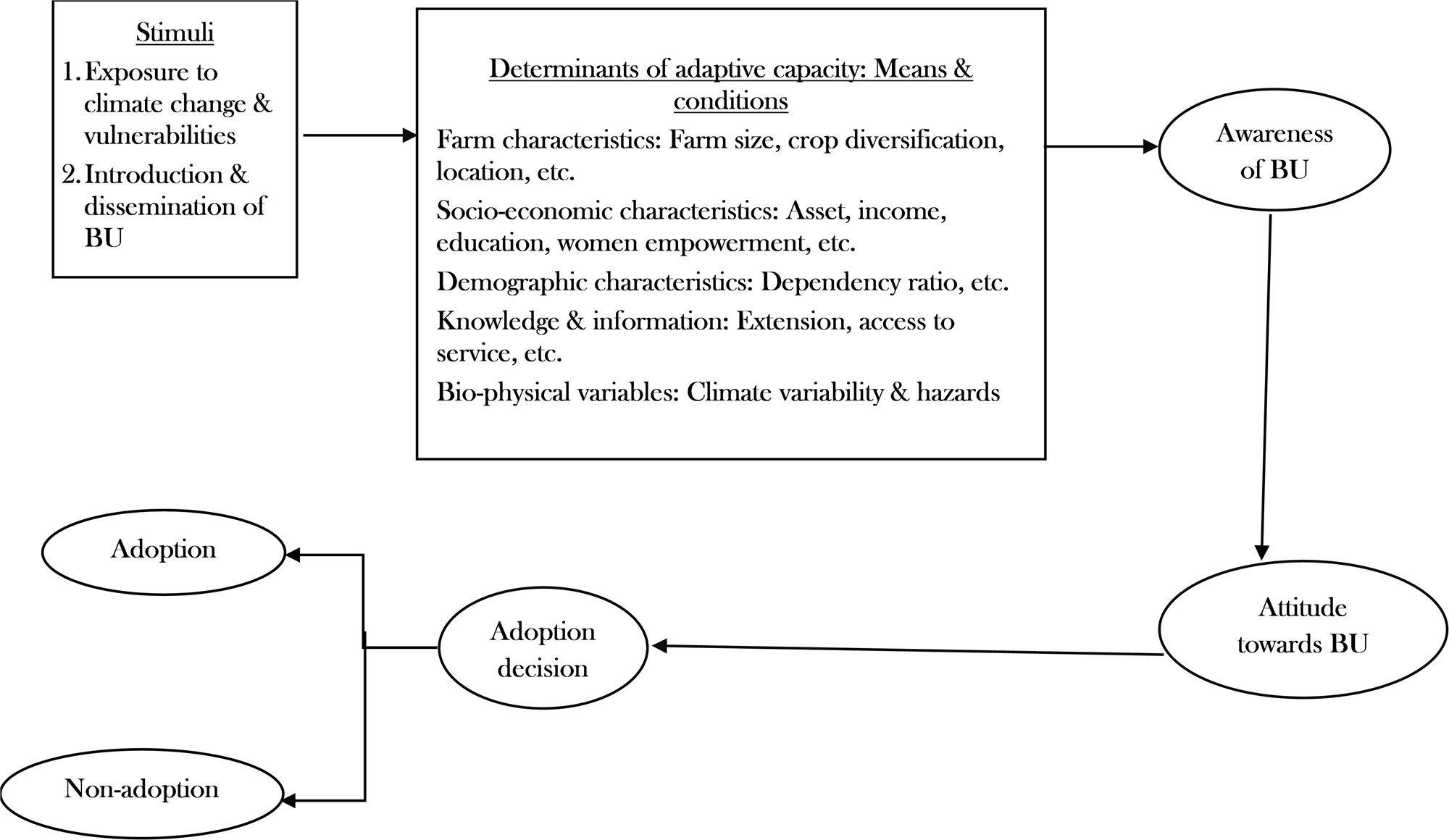
We apply an action-oriented approach, combining insights from the ‘action theory’ that Eisenack and Stecker (Reference Eisenack and Stecker2012) applied to climate change adaptation and pathways described by Neupane et al. (Reference Neupane, Sharma and Thapa2002) and Reid et al. (Reference Reid, Smit, Caldwell and Belliveau2007) (Fig. 1). In a green revolution-driven synthetic fertilizer-based farming system, farmers are gradually experiencing declining soil productivity (Sutton et al., Reference Sutton, Bleeker, Howard, Bekunda, Grizzetti, de Vries, van Grinsven, Abrol, Adhya, Billen, Davidson, Datta, Diaz, Erisman, Liu, Oenema, Palm, Raghuram, Reis, Scholz, Sims, Westhoek, Zhang, Ayyappan, Bouwman, Bustamante, Fowler, Galloway, Gavito, Garnier, Greenwood, Hellums, Holland, Hoysall, Jaramillo, Klimont, Ometto, Pathak, Plocq Fichelet, Powlson, Ramakrishna, Roy, Sanders, Sharma, Singh, Singh, Yan and Zhang2013) while still exposed to economic and livelihood considerations imposed by the household's needs. Meanwhile, the biophysical environment is also changing, strongly driven by climate change. Expanding on Eisenack and Stecker (Reference Eisenack and Stecker2012), we include the economic and social environment, which we refer to as ‘stimuli’. Stimuli are only relevant for adaptation when they influence an ‘exposure unit’, i.e., the farm and the related household. In our case, the adaptation action is direct, as it acts on the exposure unit and reflexive. The ‘operator’, who exercises the adaptation, is the same agent as the ‘receptor’, who experiences the effects of the action. Whether a farmer will adopt the technology depends on the availability of the necessary ‘means’ (e.g., information availability, financial and labor resources, knowledge or social network) and on ‘conditions’ (i.e., constraints and resources that are beyond the farmer's control, e.g., environmental and institutional factors). Furthermore, to what extent disseminating information will be effective also depend on the resources power of the institutions partly responsible for facilitating adoption (e.g., extension, research and other market institutions), which accumulates under the knowledge exchange condition of the farmer.
Schematic representation for understanding BU adoption behavior.
Source: Developed based on Neupane et al. (Reference Neupane, Sharma and Thapa2002), Reid et al. (Reference Reid, Smit, Caldwell and Belliveau2007) and Eisenack and Stecker (Reference Eisenack and Stecker2012).

There are a few alternative theoretical frameworks for explaining farmers' adoption behavior. The ‘Diffusion of Innovations’ theory is popular in the literature as it explains how, why and at what rate new ideas and technology spread (Rogers, Reference Rogers2010). The framework describes how a decision-making unit adopts or rejects an innovation in a five-stage process to minimize the uncertainty about an innovation. Potential adopters evaluate an innovation on its relative advantage over the current tools or procedures, compatibility with the pre-existing system, complexity and trialability (Rogers, Reference Rogers2010). However, though the framework is popular in the qualitative literature, particularly when analyzing the mass diffusion process, it overlooks the role of an individual's resources or social support in the adoption process. For instance, Shelomi (Reference Shelomi2015) and Chigona and Licker (Reference Chigona and Licker2008) explained the promotion of insects eating and communal computing facilities adoption through the framework. Alternatively, since our focus is on individual's adoption decision, we focus on the ‘action-theory’, which can quantitatively explain an individual's adoption.
Methodology
Data
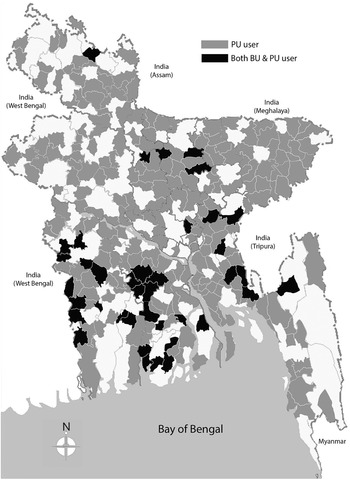
The data for this research come from the International Food Policy Research Institute's (IFPRI) BIHS conducted in 2015. It addressed a wider dimension of livelihood, including different aspects of agricultural production covering all the three crop growing seasons from December 1st, 2013–November 30th, 2014. The survey is nationally representative of rural Bangladesh, covering rural areas of all the seven administrative divisions of Bangladesh. A total of 6500 households from 325 primary sampling units or villages belonging to all the 64 districts of the seven administrative divisions of Bangladesh were interviewed.Footnote 2 From these, we selected the 3384 farm households who grew rice in any of the cropping seasons during the reference period, who may or may not cultivated other crops. Figure 2 presents the geographic distribution of the sample farmers. We focus on rice production for two reasons. First, rice is the main crop in Bangladesh. It occupies around 75% of the total cropped area and 80% of the irrigated area (BRRI, 2020). Secondly, as compared to rice, urea consumption in other crops is very low.
Map of Bangladesh showing geographic distribution of the sample farmers.

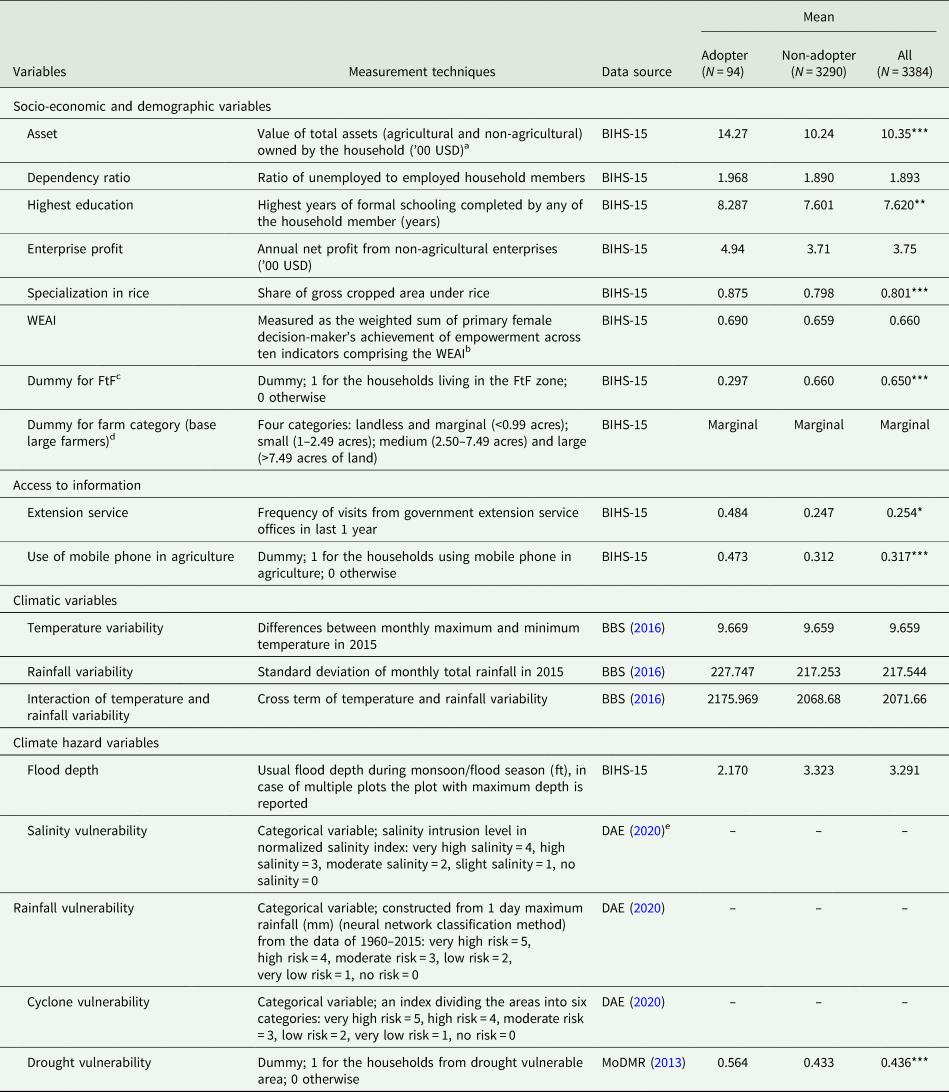
In addition, we obtained climate vulnerability and hazard data from the Statistical Yearbook of Bangladesh-2015 (BBS, 2016) and the vulnerability maps developed by the Bangladesh Agro-Meteorological Information Portal (DAE, 2020). A detailed description of all the variables is available in Table 1.
Measurement techniques and summary statistics of the explanatory variables used in the adoption model

a USD 1 = BDT 78, (Bangladesh Bank, 2021) (https://www.bb.org.bd/econdata/exchangerate.php).
b The WEAI is an aggregate index, calculated from individual-level data. The WEAI comprises two sub-indexes. (a) The first assesses the degree to which women are empowered in five domains of empowerment (5DE) in agriculture. These domains include (1) decisions about agricultural production, (2) access to and decision-making power about productive resources, (3) control of use of income, (4) leadership in the community and (5) time allocation. (b) The second sub-index is the Gender Parity Index (GPI). The GPI measures the percentage of women who are empowered or whose achievements are at least as high as the men in their households (Alkire et al., Reference Alkire, Meinzen-Dick, Peterman, Quisumbing, Seymour and Vaz2013).
c The FtF initiative covers the Southern Delta region in Bangladesh, with the aim of increasing on-farm productivity and improve nutrition via technology and training provision and facilitating private sector engagement. For detailed description of FtF zone, please refer to https://www.feedthefuture.gov/country/bangladesh/.
d For farm category, mode is reported.
e More information about climate vulnerability is available at https://www.bamis.gov.bd/risk-map/.
Note: ***, ** and * indicate the mean difference between adopter and non-adopters are significant at 1, 5 and 10% levels, respectively.
Econometric modeling for determinants of BU technology adoption
To understand farm-level BU adoption decisions, we use the probit model approach since each farmer's decision is binary in nature. The general form of the probit model used is as follows:

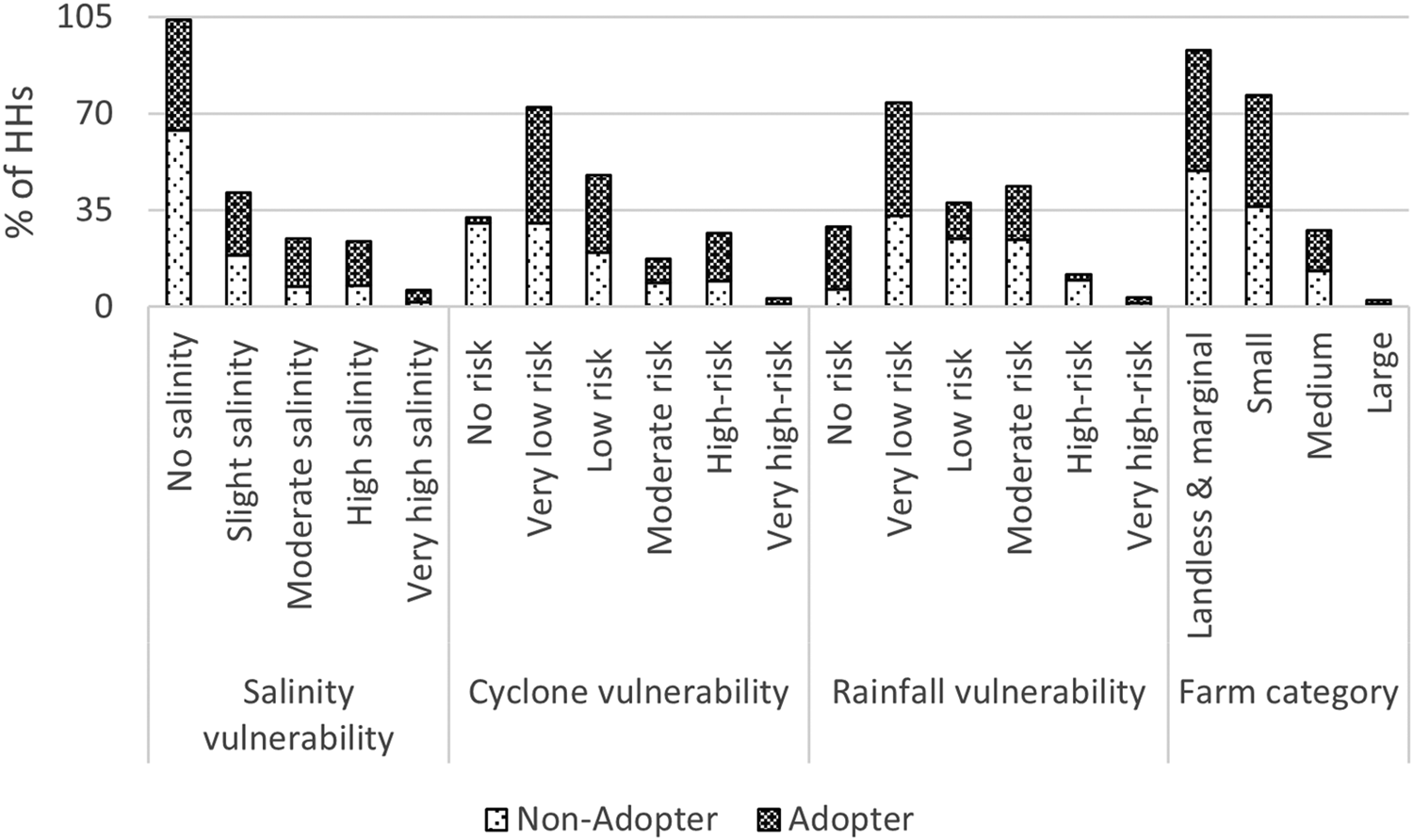
where $\Pr$ is the probability; y i is the ith household's adoption decision (e.g., 1 for the BU adopters, 0 otherwise); x is are different farm level socio-economic and biophysical factors that may influence adoption and βs are the parameters to be estimated. The detailed measurement techniques of the variables along with their sources and summary statistics are presented in Table 1 and Figure 3.
Distribution of the adopters and non-adopters according to climate vulnerability and farm category.

Descriptive analysis for cost and return in rice production
The BIHS-15 database contains crop-wise detailed information on organic manure, different chemical fertilizers, family and hired labor, the quantity of product and by-product produced. For fertilizer price, it collected the prices paid by farmers. The wage rate was recorded by different farming activities. For output, the database recorded sales quantity and price by different installments. Using these, we estimated usage quantity, cost and gross return from rice production.
Results and discussion
Econometric analysis for the determinants of BU technology adoption
Summary statistics of the explanatory variables used in adoption analysis
Table 1 and Figure 3 describe the summary statistics of all independent variables used in the probit model for identifying determinants of BU adoption. Table 1 shows that the difference between BU adopters and non-adopters are statistically significant for all the variables representing the household's socio-economic conditions except for dependency ratio, enterprise profit and women empowerment in agriculture. Compared to the non-adopters, the adopters are in better socio-economic condition. The adopters are more educated and possess a relatively higher value of assets. A relatively lower portion of adopters are landless and marginal farmers and live in the feed the future (FtF) zone. Besides, adopters have more frequent contact (almost double) with the government extension officers, and a relatively higher proportion of adopters use mobile phones for agricultural purposes. Compared to the non-adopters, the adopters devoted a significantly higher proportion of gross cropped area (GCA) to rice.
Compared to the adopters, non-adopters in a relatively higher proportion were from areas with moderate or lower than moderate levels of salinity and cyclone vulnerability. Nevertheless, BU users are more likely to live in areas with less extreme rainfall, represented by a lower rainfall vulnerability score (Fig. 3). In addition, adoption of BU was relatively more common among farmers in drought-prone areas (Table 1).
Determinants of BU adoption
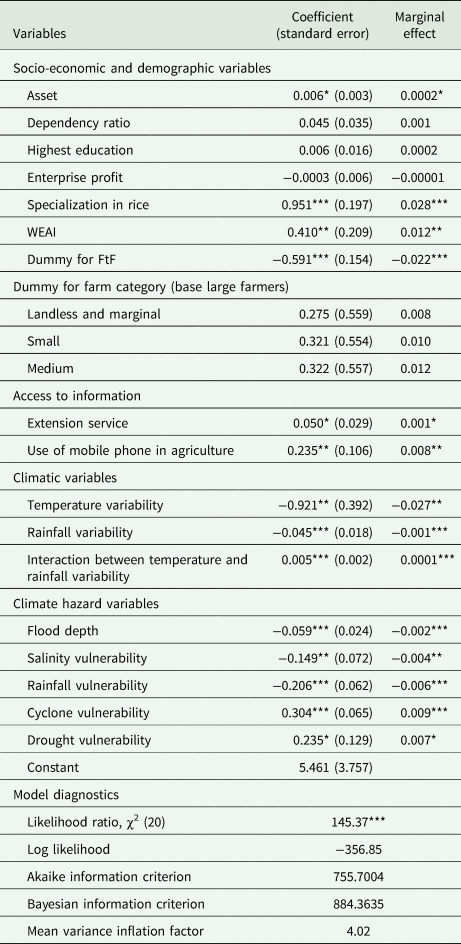
The marginal effects of the explanatory variables on BU adoption decisions are presented in Table 2. The BU adoption decision is positively influenced by asset, extension service, mobile phone use, specialization in rice production, women empowerment in agriculture, cyclone vulnerability and drought vulnerability. In contrast, the variables of FtF zone, temperature variability, rainfall variability, flood depth, salinity vulnerability and rainfall vulnerability have inverse impacts on adoption decisions.
Marginal effects of the variables used in explaining adoption

Note: ***, ** and * indicate significance at 1, 5 and 10% levels, respectively.
Farm-level socio-economic and demographic factors as determinants of BU adoption: BU application is laborious, and an adopter either needs an applicator or additional labor. Besides, the average price for PU and BU paid by the farmers is 0.23 and 0.27 USD kg−1, respectively. Both the high price and investment may discourage the relatively poor farmers from adopting BU, which is in line with the literature reporting that farmers having more assets are likely to invest in new farming practices with the support of their financial capital (Wood et al., Reference Wood, Jina, Jain, Kristjanson and DeFries2014). According to the probit model estimate, an increase in the value of a household's total asset increases the probability that BU will be adopted (Table 2). Also, the literature suggests that farmers having higher resources and income are less risk averse (Onyeneke et al., Reference Onyeneke, Igberi, Uwadoka and Aligbe2018), which stimulates the interest to adopt new farm technologies.
Farmers who are more specialized in rice production are more likely to adopt BU. This finding can result from a higher risk–higher return strategy, where they invest more in securing higher rice yields. In contrast, farmers who have a wider crop portfolio might invest less in maximizing the profit margin from each of their crops. This finding aligns with Kurgat et al. (Reference Kurgat, Lamanna, Kimaro, Namoi, Manda and Rosenstock2020) but contradicts Bittinger (Reference Bittinger2010), who observed that chemical fertilizer adoption and crop diversification in Ethiopia were inversely correlated.
The results also show that rice farmers in the FtF zone have a lower adoption probability than their counterparts living in zones outside the FtF (Table 2). The goal of the FtF program in Bangladesh is to support inclusive and sustainable agriculture-led growth and strengthen resilience in certain areas that are vulnerable to poverty, hunger and malnutrition (FtF, 2020). This intervention ascertained that the farmers of these areas are resource-poor and consequently less capable of adopting new farm technologies like BU.
Access to information and institutional factors: In line with previous studies, the probit model shows that the frequency of visits of government extension workers increases the likelihood of adopting BU (Table 2). Moreover, institutional affiliation and information sources can notably influence farming decisions (Aryal et al., Reference Aryal, Rahut, Maharjan and Erenstein2018; Hasan and Kumar, Reference Hasan and Kumar2020). Also, extension service can strengthen farmers' agricultural knowledge base (Haque et al., Reference Haque, Kabir and Nishi2016) since it is an important information source about improved agricultural production and management practices (Onyeneke et al., Reference Onyeneke, Igberi, Uwadoka and Aligbe2018), and particularly can help environmental-friendly technology adoption. A similar outcome is documented by Haque et al. (Reference Haque, Kabir and Nishi2016) for the Bangladeshi rice farmers. Contrarily, in some literature, limitations of extension services were identified as a barrier to adoption. For instance, when extension workers lack updated information and provide subjective opinions about the technology, farmers do not find the information useful and simply disregard it (Sheikh et al., Reference Sheikh, Rehman and Yates2003). But, our findings suggest that extension service in Bangladesh is succeeding in providing useful BU information to farmers.
Another essential medium of information is the mobile phone, which is positively correlated with BU adoption. Owning mobile phones allows harnessing the potential to access farming information, enables farmers to connect with a diverse range of agricultural information sources and assists them to receive targeted agricultural support. Access and use of mobile phones enhance the probability of being acquainted with new production technologies and may positively influence the adoption probability. This result is also consistent with Sharna et al. (Reference Sharna, Kamruzzaman and Anik2020), who find mobile usage has a positive correlation with the adoption level of improved crop variety in Bangladesh. The role of modern communication technology such as mobile phones becomes more important in the face of growing concern about inefficiency in public extension service (Karanasios, Reference Karanasios2011).
Role of women in adoption: The positive coefficient of the index for women empowerment in agriculture (WEAI) indicates a positive correlation between BU adoption and women empowerment (Table 2). Previous studies show that women are more likely to adopt technology and diversified production portfolios when they decide about farm inputs and have more control over marketing decisions (Kurgat et al., Reference Kurgat, Lamanna, Kimaro, Namoi, Manda and Rosenstock2020; Sharna et al., Reference Sharna, Kamruzzaman and Anik2020). Similarly, Onyeneke et al. (Reference Onyeneke, Iruo and Ogoko2012) reported that in Nigeria, women are more capable of adopting technology than men in the face of climate change. Empirical findings of this sort are useful in providing targeted support globally (FAO, 2011), and particularly in Bangladesh, where women contribute a higher proportion of the agricultural labor force than men (BBS, 2018). Overall, the Asian agriculture sector is heading toward feminization due to globalization and rising labor migration (Rola-Rubzen et al., Reference Rola-Rubzen, Paris, Hawkins and Sapkota2020). Since men are more likely to migrate, they leave the farm under female supervision who are more risk-averse than the former (Croson and Gneezy, Reference Croson and Gneezy2009). In several instances, the literature focusing on Bangladesh provided empirical evidence supporting the farm-level productivity and efficiency-enhancing role of women empowerment (Rahman, Reference Rahman2000; Anik and Rahman, Reference Anik and Rahman2021). Simultaneously, the literature reported that though there have been achievements in women empowerment and gender gap reduction in the country, significant inequality exists across and within households. Only in 40% of the farming household women are adequately empowered. It recommends assuring women empowerment by providing them with the legal rights on land and access to information and technology and creating an enabling environment within the society to surge adoption of modern technologies.
Climatic factors and adoption: The climatic factors considered in this paper as part of the theoretical model's biophysical variables significantly impact BU adoption decisions. Although biophysical conditions such as salinity, flood, rainfall, drought and cyclone are beyond a farmer's control, variability in these conditions may act as a stimulator and influence the adoption decision. For example, increasing temperature and rainfall variability reduce BU adoption probability. Adoption probability is lower in areas with a higher risk of salinity and rainfall vulnerability, whereas it is the opposite for drought and cyclone vulnerability. With increasing flood depth, BU adoption probability reduces (Table 2). The importance of appropriate adaptation strategies to address and ease climatic challenges on agriculture, livelihood and vulnerability is documented in the literature (Funk et al., Reference Funk, Dettinger, Michaelsen, Verdin, Brown, Barlow and Hoell2008; Lobell et al., Reference Lobell, Burke, Tebaldi, Mastrandrea, Falcon and Naylor2008). But adoption is context-specific, and depending on the nature of technology and type of climatic factors and vulnerabilities, the relationship between climatic factors and adoption may vary. Asfaw et al. (Reference Asfaw, Di Battista and Lipper2016) reported that weather variability strongly influences the type of technology adopted. For instance, greater rainfall and temperature variability enhance the likelihood of incorporating crop residue into soils, while the opposite happens for using modern inputs and organic fertilizer. Khanal et al. (Reference Khanal, Wilson, Lee and Hoang2018) found that a household's past experiences with climate vulnerability like flood and drought positively influence adoption strategies like increasing chemical fertilizer or farmyard manure use to counteract the effects of climate-induced stresses. Overall, all kinds of climate-driven risks do not encourage the adoption of environment-friendly innovations. Instead, farms' ecosystem responses to climate hazards discourage their adoption (Yoder et al., Reference Yoder, Houser, Bruce, Sullivan and Farmer2021).
The salinity intrusion index negatively correlates with BU adoption (Table 2). This finding aligns with Anik et al. (Reference Anik, Ranjan and Ranganathan2018), which reported that salinity weakens the ability of households to stick to their cropping-based livelihoods and limits overall economic opportunities in southwestern coastal regions of Bangladesh. Due to more crop failure in salinity vulnerable regions, farmers are unwilling to invest in new technologies to accelerate farm production growth. Notably, Bangladesh is facing more climatic hazards than ever before, which exacerbates farmers' adaptive capacity to transform agriculture (Rahman, Reference Rahman2016; Hossain et al., Reference Hossain, Ahmed, Ojea and Fernandes2018), while at the same time, it dampens the capability of rice producers to uptake improved agricultural technologies, such as BU.
Heavy rainfall and flooding increase the losses of agricultural chemicals through leaching from the land and reduce yield (Wang et al., Reference Wang, Ju, Wei, Li, Zhao and Hu2010). Besides, climate change and the associated variabilities may reduce agricultural investment by reducing capabilities and possible returns, but investors can also overestimate the uncertainty (Cooper et al., Reference Cooper, Dimes, Rao, Shapiro, Shiferaw and Twomlow2008). Thus, in areas where rainfall and flood frequently occur, farmers may choose multiple applications of PU in accordance with the climatic events and find an effective and visible effect of this practice on sustaining yield. Hence farmers exposed to rainfall and flood vulnerabilities might be less likely to invest in relatively expensive BU technology, which does not always provide immediate results. Houser and Stuart (Reference Houser and Stuart2020) also corroborated that the increase in frequency and intensity of heavy rain provokes nitrogen loss and introduces economic risks to farmers. Therefore, farmers respond by multiplying nitrogen application rates to stabilize production and cope with the climate vulnerability. The political-economic structure of society motivates farmers to respond to climate change in ways that accelerate the environmental contradictions of agriculture.
BU adoption probability falls with increasing temperature and rainfall variability (Table 2). Rahman (Reference Rahman2016) noted that different climatic factors, including their variabilities, significantly influence agricultural land use diversity and yield in Bangladesh. Variability in climatic factors, including rainfall and temperature variability, have a profound impact on farm production, and ultimately, the sustainability of the whole system is challenged (Aryal et al., Reference Aryal, Sapkota, Rahut and Jat2020). In addition, the variabilities contribute to uncertainty in the production process, which affects farm production and efficiency (Semenov and Porter, Reference Semenov and Porter1995). All these may discourage a farmer from adopting since the perceived benefit from adoption may not be higher than the cost of adoption.
In contrast to all other climatic variables, drought and cyclone vulnerability are associated with an increased BU adoption probability (Table 2). This is in line with the literature reporting farmers in the drought-prone areas of Bangladesh adopting different adaptation strategies (Alauddin and Sarker, Reference Alauddin and Sarker2014). Since drought is a gradual process and has a trend, a farmer in drought-prone areas may face less uncertainty and have reasons to be optimistic about sustaining production loss through adopting BU technology.
Farmers with past experiences of frequent and disastrous cyclones perceive decreasing farm productivity and are less willing to adopt new technologies (Hasan and Kumar, Reference Hasan and Kumar2020). This would suggest high cyclone vulnerability is associated with lower BU adoption. However, in Bangladesh, the southern-coastal part is more exposed to cyclone vulnerability (DAE, 2020), where the BU technology was first introduced (FAO, 2014). Hence, the farmers in the region are expected to be well informed and acquainted with the technology than other parts of the country.
Comparison of input use by the adopters and non-adopters
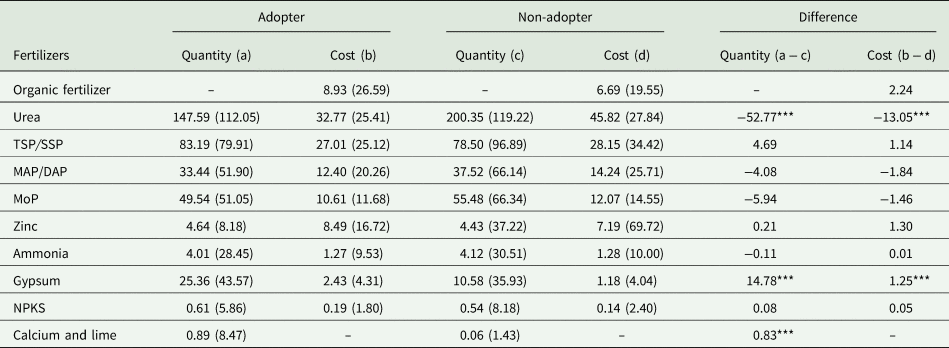
The quantity and cost of fertilizers and soil additives differ between adopters and non-adopters. However, the differences are statistically significant only for urea, gypsum, calcium and lime. Since BU application reduces N-losses and has the potential to improve NUE, the adopters applied around 36% less urea than the non-adopters, which enabled them to save around 13 USD ha−1 (Table 3). Although the average price of BU is around 17% higher than that of PU. But since unlike other fertilizers where broadcasting is the common method, BU must be point-placed 5–7 cm below the soil surface (Bandaogo et al., Reference Bandaogo, Bidjokazo, Youl, Safo, Abaidoo and Andrews2015). Furthermore, since it is a labor-intensive application process, the adopters of BU require more family and hired labor for fertilizer application. As such, the BU adopter's hired labor cost is about 10 USD ha−1 more than their counterparts (Table 4).
Average quantity (kg ha−1) and cost (USD ha−1) of different fertilizer application by the adopters and non-adopters

TSP, triple super phosphate; SSP, single super phosphate; MAP, monoammonium phosphate; DAP, diammonium phosphate; MoP, muriate of potash; NPKS, nitrogen, phosphorus, potassium and sulfur.
Figures in parentheses are standard deviations. *** indicates the mean difference between adopters and non-adopters is significant at the 1% level.
Organic fertilizer quantity and calcium and lime price is not available in the dataset.
Average quantity (man-days ha−1) and cost (USD ha−1) of labor used in fertilizer application by the adopters and non-adopters

Note: Figures in parentheses are standard deviations. *** indicates the mean difference between adopters and non-adopters is significant at the 1% level.
Production and return from using BU
BU reportedly increases rice yield compared to PU in agronomic experiments (Miah et al., Reference Miah, Gaihre, Hunter, Singh and Hossain2016; Chatterjee et al., Reference Chatterjee, Mohanty, Guru, Swain, Tripathi, Shahid, Kumar, Kumar, Bhattacharyya, Gautam, Lal, Kumar and Nayak2018). We found that although BU application resulted in a higher grain yield, the insignificant yield difference between the adopters and non-adopters can be the outcome of a farmer's low investment-low return strategy, particularly when the farmer is capital constrained. A BU adopter may decide for a relatively low N-fertilizer quantity, which is just enough to provide the same yield as was earlier obtained with PU. It is not necessary that higher NUE will always ensure a higher yield (Table 5).
Quantity of rice grain (ton ha−1) and straw (ton ha−1) produced and the associated return (USD/ha)

Note: Figures in parentheses are standard deviations. No significant difference between the adopters and non-adopters are observed.
Conclusions and policy implications
This paper aimed to explore the determinants of BU adoption through analyzing a database that is representative of rural Bangladesh. Since PU is the main source of N in Bangladesh and BU is a full agronomic alternative, the substitution could help the adopters raise NUE and positively contribute to environmental sustainability. But since the environment may not be the prime concern for all farmers, a farmer may not intentionally adopt BU unless adoption results in higher production and profit in the changing environment. Our results show that compared to the non-adopters, the BU adopters applied less urea and hence they had lower urea cost, though PU price was relatively low compared to BU. But since BU is applied through the deep-placement method and the applicator is unavailable locally, labor usage and cost increase significantly for the adopters. Though BU adopters have a high yield, the yield difference is not statistically significant.
We employed the ‘action theory’ and the probit model. The empirical results of the probit model provide insights into how rice farmers in Bangladesh decide about BU adoption based on differences in their socio-economic characteristics, information sources, level of women empowerment, climatic conditions and vulnerability under which the farm operates. Overall, the climate-related variables have a more comprehensive impact than other variables on adoption decisions. In general, the farm households with more assets, access to information, extension services, own mobile phones and located outside the FtF zone are more likely to adopt. Higher adoption probability for the households where women are more empowered is an encouraging result since compared to men, women have an increasing participation rate in agriculture. Besides, the rice farmers who also cultivate a wide range of crops are reluctant to use BU.
According to our results, climate change adaptation could become an entry point for increasing adoption where it relates to drought and cyclone vulnerability. However, farmers exposed to other types of climate vulnerability and variability are less likely to adopt, which can be a result of higher risk-averse characteristics and relatively poor economic status than their counterparts living in less vulnerable areas.
The policy recommendations from the study are as follows. First, the adoption program should concentrate on areas vulnerable to climate and hazards. Similarly, more focus is required for the farmers with relatively low assets and living in economically fragile areas (e.g., FtF) since they have a low adoption probability. Secondly, access to information through conventional extension and contemporary digital technology should be promoted. The latter becomes more important considering the immense workload the government extension agents have to bear.Footnote 3 Thirdly, since women are more involved in agriculture and are more likely to adopt BU, targeting women groups and associations in smallholder rural communities can have significant positive impacts on increasing the uptake of climate-smart technology. Fourthly, the BU applicator should be made available at the farm level. Finally, the cost that BU adopters saved through applying a low level of urea fertilizer is consumed by the relatively high BU price and more labor requirements. To make BU lucrative to the farmers, the price of BU must be made lower than conventional urea through allocating more subsidies, particularly from PU to BU production and import. While the exact mechanism here requires further research, issues like efficiency and transparency in the subsidy distribution system should be considered.
Author contributions
A.R.A. and M.M.R. designed the study. T.B. and V.E. contributed to the plan. A.R.A. and S.C.S. carried out data compilation and analysis. A.R.A., T.B. and S.C.S. wrote the initial draft of the manuscript. All authors contributed substantially to the writing of the manuscript.
Financial support
This paper results from research funded by UKRI GCRF South Asian Nitrogen Hub (SANH). The project team includes partners from across South Asia and the UK. Neither UKRI nor any of the partner institutions are responsible for the views advanced here.
Conflict of interest
We have no conflict of interest to declare.