INTRODUCTION
Host survivorship and reproductive success may be reduced through death directly from infection or indirectly due to debilitation, diminished reproductive performance or behavioural changes arising from parasitic manipulation to increase transmission. Reduced survivorship and reproduction can lead to large fluctuations in host population size (Kennedy et al. Reference Kennedy, Shears and Shears2001). Mortalities of large numbers of fish within short periods of time have been linked to infections by the pseudophyllidean cestodes, Ligula intestinalis and Schistocephalus solidus (see Pennycuick, Reference Pennycuick1971 a; Shields et al. Reference Shields, Groves, Rombaugh and Bellmore2002). In other instances, these two cestodes have been shown to reduce reproductive capacity of host fish (Arme and Owen, Reference Arme and Owen1968; McPhail and Peacock, Reference McPhail and Peacock1983; Tierney et al. Reference Tierney, Huntingford and Crompton1996; Carter et al. Reference Carter, Pierce, Dufour, Arme and Hoole2005; Heins and Baker, Reference Heins and Baker2008), sometimes severely and apparently by different mechanisms.
Reductions in host population size, resulting from the impact of parasitism, may result in significant changes in the metrics of parasite populations, including prevalence, intensity and parasite:host biomass ratios. In the roach-L. intestinalis host-parasite system, the interplay between host and parasite has been shown to result in repeated epizootics (Kennedy et al. Reference Kennedy, Shears and Shears2001). In the present study, we quantified the metrics of infections of adult threespine stickleback (Gasterosteus aculeatus) by S. solidus from Walby Lake, Alaska, over an 8-year period. We document the end of one epizootic and one cycle of a second epizootic. The first epizootic ended with a severe reduction in host population size not seen in the second epizootic. Epizootics, such as the first, suggest that parasitic infection of the three-spine stickleback in Walby Lake may strongly influence host population dynamics over time.
The life cycle of S. solidus includes an aquatic, free-living coracidium, a procercoid in a cyclopoid copepod, a plerocercoid in the stickleback, and an adult tapeworm in any of ~40 species of piscivorous birds (Smyth, Reference Smyth1962). Transmission of the parasite to each host occurs through predation. Small threespine stickleback are most likely to feed on copepods (Pennycuick, Reference Pennycuick1971 b; Christen and Miliniski, Reference Christen and Milinski2005). Thus, the stickleback is most likely to become infected as a small, young fish. In Alaska, threespine stickleback appear to become infected during their first summer following spring hatching, and infections also appear to occur in fish of 1 year of age (Heins and Baker, personal observations). Multiple infections often occur (McPhail and Peacock, Reference McPhail and Peacock1983; Tierney et al. Reference Tierney, Huntingford and Crompton1996; Heins et al. Reference Heins, Singer and Baker1999). Uninfected threespine stickleback typically live as long as 2 and sometimes 3 years, usually reaching sexual maturity at 2 years of age in Alaska, based on length-frequency analysis for age determination and ovarian examinations for an assessment of sexual maturity (Heins et al. Reference Heins, Singer and Baker1999; Baker et al. Reference Baker, Heins, Foster and King2008). Thus, S. solidus may live within its fish host ⩾2 years until the death of the host. Almost all of the parasite's growth occurs during the plerocercoid stage, which uses the threespine stickleback host as a resource for its growth. The mass of infection can be quite large relative to the host, sometimes equaling or exceeding host mass (Arme and Owen, Reference Arme and Owen1967), in part because of the longevity and accumulated infections of plerocercoids.
The combined impact of inhibited gamete development (McPhail and Peacock, Reference McPhail and Peacock1983; Tierney et al. Reference Tierney, Huntingford and Crompton1996; Heins et al. Reference Heins, Singer and Baker1999) and reduced survivorship (Threlfall, Reference Threlfall1968; Pennycuick, Reference Pennycuick1971 a) on host fish as a consequence of S. solidus infection should have an effect on population dynamics of the threespine stickleback. The effects of the parasite on host population size are likely to be most apparent during periods of greatly reduced host reproductive success and, particularly, at times when infections result in the demise of larger host fish. The mortality of hosts in this region is likely to be largely the result of reduced over-winter survivorship because of the long period during which ice covers the lakes. The older, larger fish carry large parasites capable of reproduction in the definitive host (Heins et al. Reference Heins, Baker and Martin2002), resulting in more infections of young of the year and especially fish of 1 year of age each spring-summer season. As a consequence, the deaths of heavily infected fish hosts should, in turn, affect the dynamics of the parasite population by bringing about reductions in the metrics of the parasite population.
In the threespine stickleback-S. solidus system in Alaska, an epizootic should involve a significant reduction in the larger host fish by their second year of age, which would be the beginning of the reproductive, adult phase. The demise of the larger fish should result in a reduction of the parasite population. Thus, we would expect a scenario involving a reduction of adult fish due to infectious mortality in 1 year, low levels of infection among adults in years immediately following the reduction in adult host fish, and increases in measures of infection in subsequent years as the population size of potential hosts increases with increased survivorship and reproductive success, accompanied by increased reproduction and transmission of S. solidus.
MATERIALS AND METHODS
Samples of adult threespine stickleback (⩾42 mm standard length) were collected annually during the reproductive season of the threespine stickleback in Alaska (Heins et al. Reference Heins, Singer and Baker1999). Collections were obtained from Walby Lake (61°37·230′N 149°12·798′W), Alaska, in the Matanuska-Susitna Valley, north of the Cook Inlet using wire mesh minnow traps set near the shore. Walby Lake is situated at an elevation of 119 m with a surface area of 22 ha and a mean depth of 1·6 m. Specimens were anaesthetized in tricaine methanesulfonate until quiescent prior to fixation and storage in 10% buffered formalin.
Lakes in the Matanuska-Susitna Valley usually are covered with ice from approximately October to May (Woods, Reference Woods1985). The average air temperature in July at 2 distant stations in the Mat-Su Valley was ~14–15°C (Woods, Reference Woods1985), and the average warmest summer temperatures throughout the area were ~18–20°C (Reger and Updike, Reference Reger, Updike, Pewe and Reger1983).
After measurements of the standard length of the fish were made, specimens were dissected to record the presence or absence of S. solidus and to remove any plerocercoids from the body cavities. Parasites were counted and weighed en masse to the nearest milligram after they were blotted. When the total mass of small parasites was less than 1 mg, their mass was estimated to be 0·1 mg. A combined parasite:host biomass ratio (parasite index, PI) was used as a measure of the severity of parasite infection. The PI was calculated using the formula PI=P/H, where P is the total weight of the parasites and H is the blotted mass of the eviscerated host (cf. Arme and Owen, Reference Arme and Owen1967). Catch-per-unit-effort (CPUE) for the threespine stickleback from each sample was calculated as the number of adult fish per trap per hour.
All statistics were calculated using SYSTAT. The analysis of variance (ANOVA) and Bonferroni post-hoc contrasts were used to compare mean intensity and PI among years. Values of PI were arcsine-transformed before ANOVA was performed. Confidence limits were calculated for prevalence, as described by Wilson (Reference Wilson1927) and Newcombe (Reference Newcombe1998) .
RESULTS
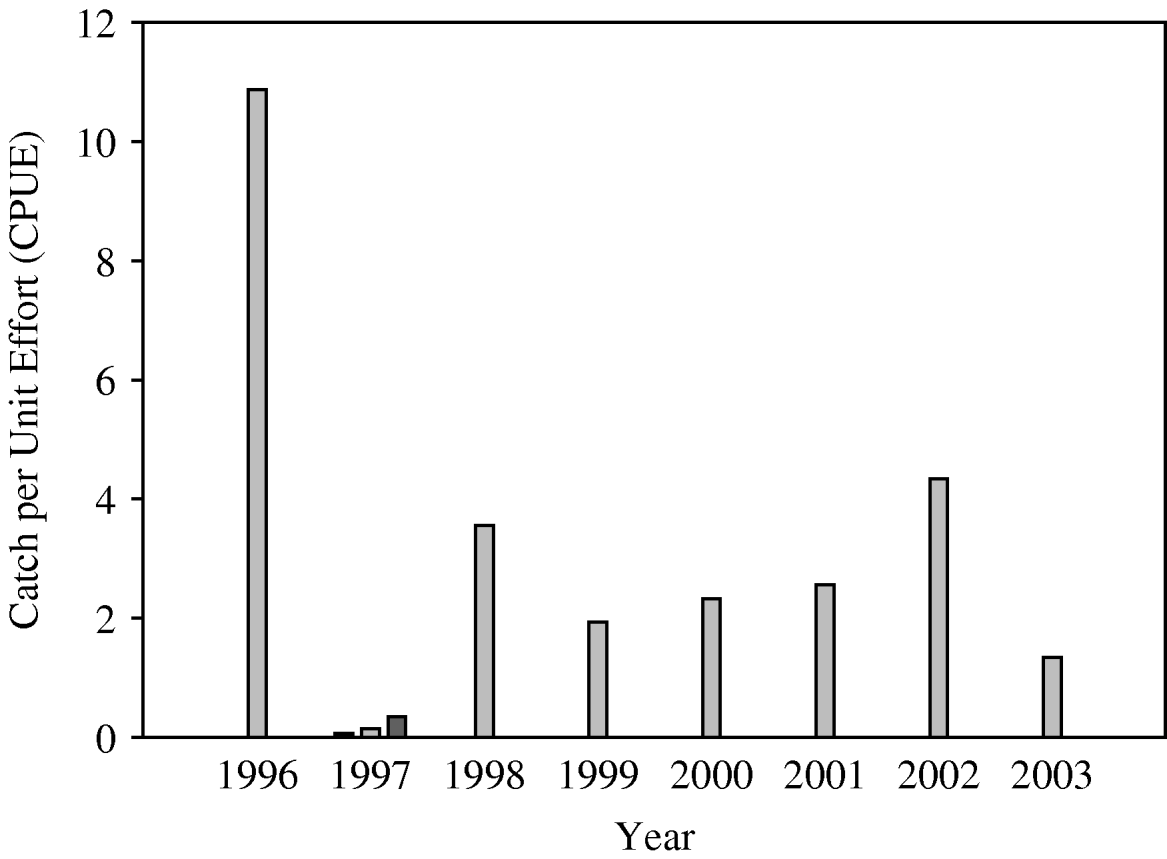
Threespine stickleback in Walby Lake are typically abundant (Heins and Baker, personal observations; Fig. 1). Population sizes of host fish were relatively high in 1996, but showed a dramatic reduction in 1997, at which time the population was the smallest recorded during this study. We were unable to calculate confidence intervals for the estimates of CPUE from the present data. Calculations of confidence intervals for other populations support the conclusion that the severe decrease in the CPUE observed between 1996 and 1997 indeed reflected a sharp decline in the population of threespine stickleback (Baker, personal observations). Moreover, we confirmed that our small catches in 1997 were not an anomaly peculiar to our sampling site by collecting at 2 other locations across the lake; these data are included in Fig. 1. In 1998 and thereafter, catches returned to more typical levels, all of which were greater than in 1997. Thus, the data appear to reflect a massive mortality of larger fish during winter, between 1996 and 1997, with smaller, juvenile fish surviving to become adults in 1998.
Relative population size of adult threespine stickleback (⩾42 mm standard length) in Walby Lake, Alaska, from 1996–2003, expressed as catch-per-unit-effort.

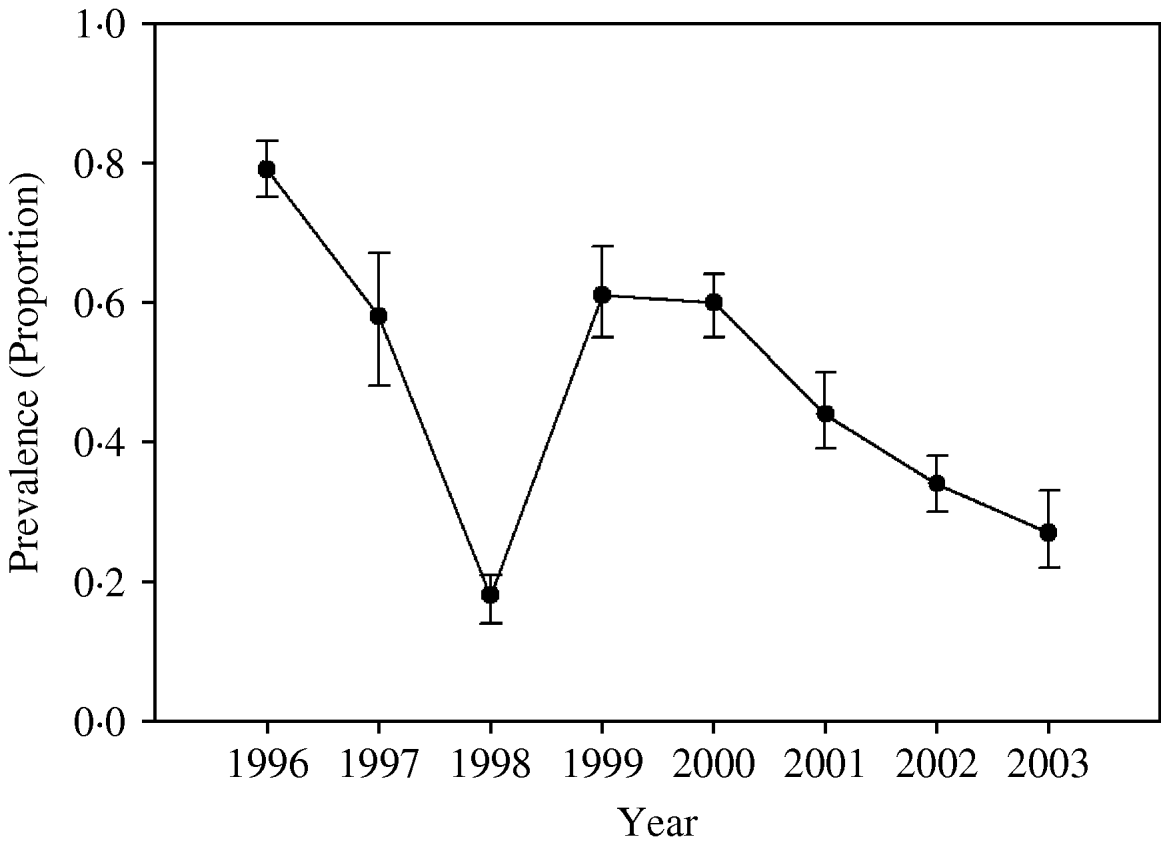
The prevalence of S. solidus infection in adult threespine stickleback decreased from 79% in 1996 to 18% in 1998 (Fig. 2). Subsequently, infections increased in prevalence from 1998 to much higher levels (60–61%) in 1999 and 2000, but did not reach the level seen in 1996. In the years that followed, the prevalence declined steadily from 60% in 2000 to 27% in 2003, which approached the low level seen in 1998.
Prevalence (±95% confidence interval) of Schistocephalus solidus infections in adult threespine stickleback (⩾42 mm standard length) from Walby Lake, Alaska, 1996–2003. Sample sizes are n=310, 1996; 62, 1997; 82, 1998; 132, 1999; 275, 2000; 163, 2001; 160, 2002; 77, 2003.

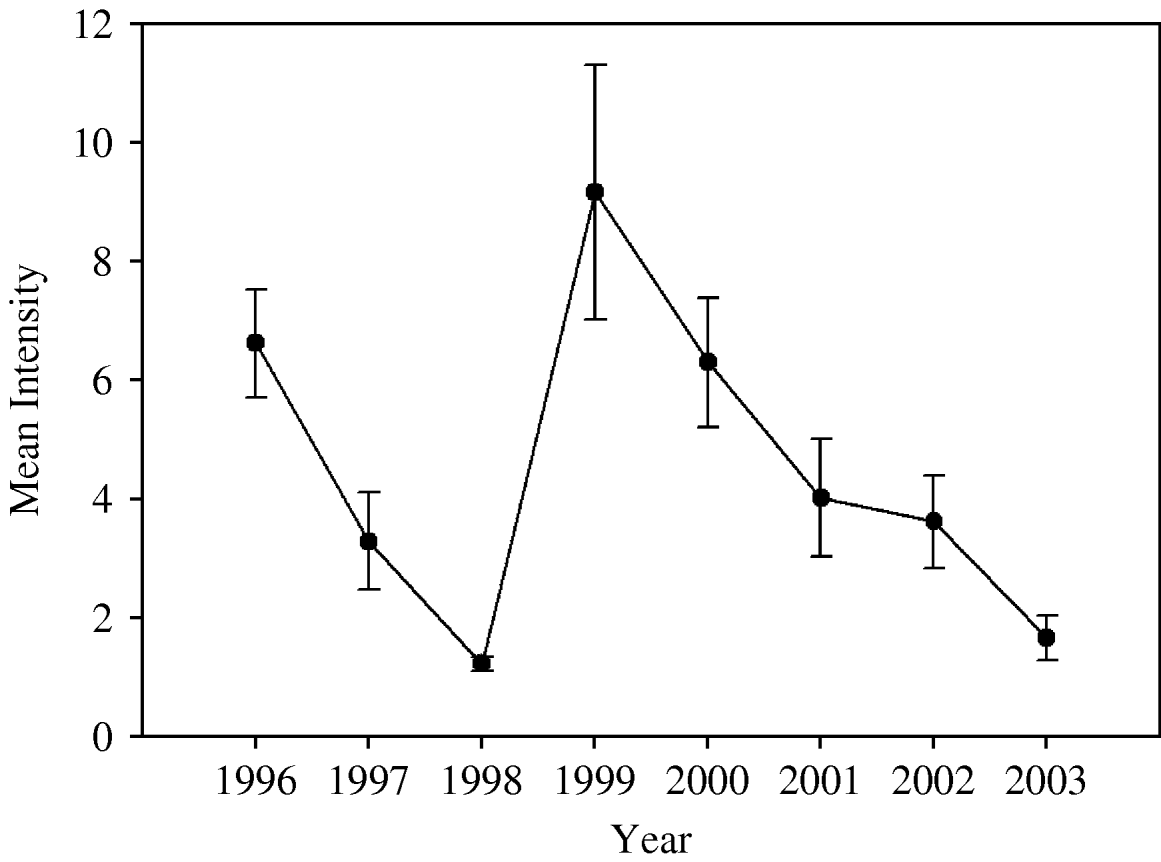
The mean intensity of S. solidus infection varied significantly among years (Fig. 3; ANOVA: F=14·680, d.f.=7, 1253, P<0·001). Bonferoni post-hoc tests revealed a significant decrease between 1996 and 1998 (P<0·001), before increasing significantly between 1998 and 1999 (P<0·001). In the subsequent years, there was a significant overall decrease in mean intensity between 1999 and 2003 (P<0·001).
Mean intensity (±95% confidence interval) of Schistocephalus solidus infections in adult threespine stickleback (⩾42 mm standard length) from Walby Lake, Alaska, 1996–2003. Sample sizes are as given in the caption to Fig. 2.

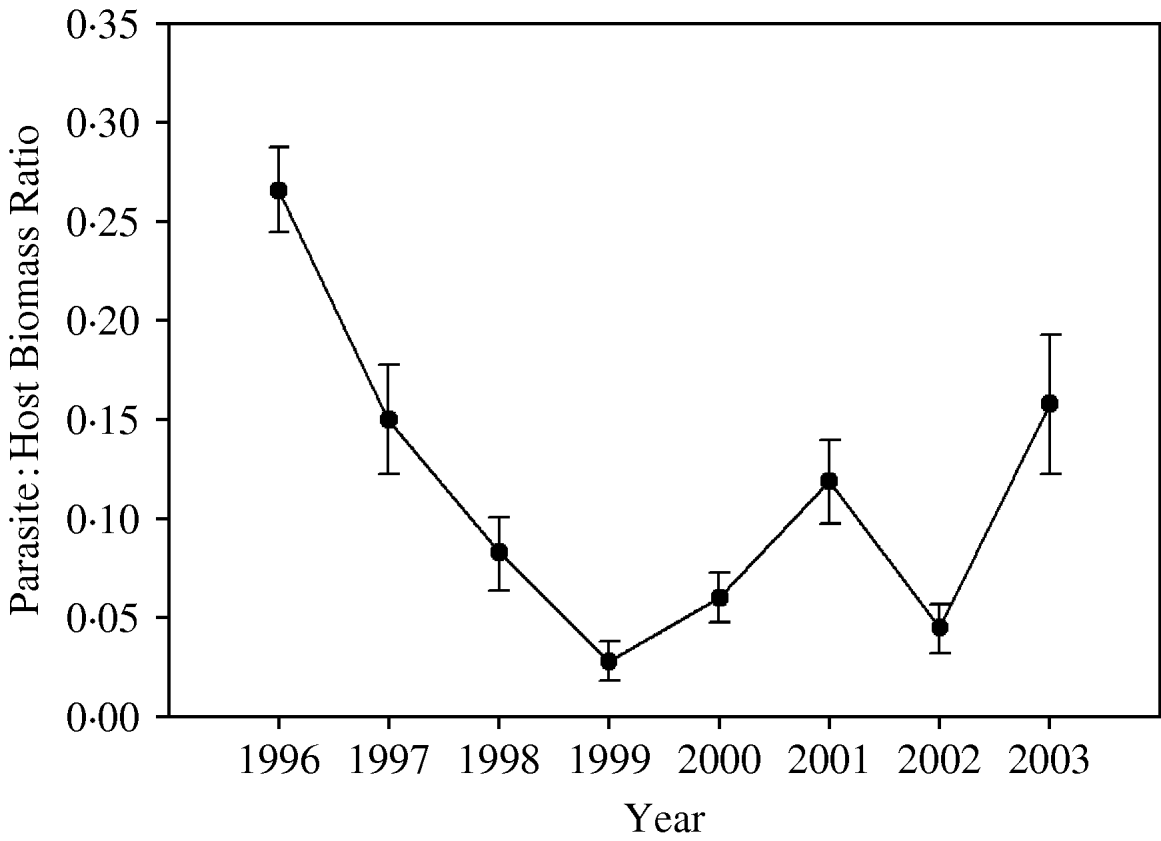
The parasite:host mass ratio of host fish also varied significantly among years (Fig. 4; ANOVA: F=80·279, d.f.=7, 1253, P<0·001). There was a significant decrease in mean PI from 0·266 in 1996 to 0·028 in 1999 (P<0·001, Bonferroni adjustment). The PI increased significantly (P<0·001, Bonferroni adjustment), between 1999 and 2001. Subsequently, it decreased significantly from 2001 to 2002 and increased significantly again between 2002 and 2003 (P<0·001, Bonferroni adjustments). The large increase seen among infected fish in 2003 appears to have resulted from a relatively large mean size of plerocercoids in smaller hosts that year (Heins et al. personal obervations).
Mean parasite:host biomass ratios (±95% confidence interval) for Schistocephalus solidus infections of adult threespine stickleback (⩾42 mm standard length) from Walby Lake, Alaska, 1996–2003. Sample sizes are as given in the caption to Fig. 2.

Pearson correlations of annual means (n=8) of the 3 metrics of parasite populations were: prevalence-intensity, 0·802; prevalence-PI, 0·383; and intensity-PI, −0·126. Only the correlation between prevalence and intensity was significant (Bonferroni probability, P=0·050).
DISCUSSION
The present data demonstrate a population crash of threespine stickleback and a subsequent decline in metrics of the S. solidus population in Walby Lake as an epizootic came to an end between 1996 and 1998. Data from a fyke net sample by the Alaska Department of Fish and Game in 1993 indicated that population levels of threespine stickleback and S. solidus were relatively high in that year (Heins and Baker, personal observations). Thus, the epizootic event may have built up over a number of years before coming to an abrupt end, commencing in 1996–1997. In subsequent years, the different measures of the S. solidus population varied somewhat inconsistently, but a second epizootic was characterized by increased prevalence and intensity alone. These results suggest that epizootics in S. solidus are unstable as they are for L. intestinalis (see Kennedy et al. Reference Kennedy, Shears and Shears2001).
The exact mechanisms that resulted in the end of the epizootic between 1996 and 1998 are not known. The main factor considered to be most likely was mortality of larger host fish over winter, resulting directly from the stress of infection. The impact of parasitism on host reproduction and host death through predation may also have played a significant role. In addition, a number of environmental factors which stressed the fish may have played a role and contributed to the process.
A variety of studies have shown conclusively that S. solidus imposes a significant energy drain on its host fish as it exploits the threespine stickleback's energy reserves to fuel its own growth from a microscopic larva to a large mass, allowing the parasite to be competent to infect the definitive host and to reproduce in that host (Walkey and Meakins, Reference Walkey and Meakins1970; Lester, Reference Lester1971). The metabolic drain imposed by the parasite might increase the risk of host death due to starvation (Pascoe and Mattey, Reference Pascoe and Mattey1977), particularly during the winter when food resources are limited. Moreover, large volumes of parasites can severely limit the stomach capacity of the threespine stickleback, decreasing the efficiency with which food items are processed (Miliniski, Reference Milinski1985; Cunningham et al. Reference Cunningham, Tierney and Huntingford1994). This impact on feeding efficiency should exacerbate the energy loss of the host to the parasite. As a consequence of these effects, body condition and energy reserves of host fish might be reduced (Bagamian et al. Reference Bagamian, Heins and Baker2004; Schultz et al. Reference Schultz, Topper and Heins2006). Thus, large parasite burdens may directly cause mortality in the fish host populations (Threlfall, Reference Threlfall1968; Pennycuick, Reference Pennycuick1971 a), although parasite-induced host mortality can be difficult to prove in field studies (Anderson and Gordon, Reference Anderson and Gordon1982).
The relatively low mean PI during the second epizootic, involving only increased prevalence and intensity, was unexpected. The present data, coupled to an understanding of this particular host-parasite system, suggest that during the first epizootic, a number of biotic and abiotic factors contributed to a ‘perfect storm’, which resulted in high values of metrics for the parasite population, coinciding with the relatively large host population. We observed that prevalence and intensity were significantly correlated among years, but that PI was not correlated with either prevalence or intensity. Various biotic and abiotic factors could affect the transmission of S. solidus at any stage of the life cycle and thus could affect the prevalence and intensity of infection. For example, unknown ecological factors could influence the survivorship of coracidia or the abundance of copepods in a given year. Similarly, the growth of plerocercoids within host fish may be influenced by factors both internal and external to the fish host. For example, there could be relatively minor mortality of fish incapable of sustaining infections at lower levels of infection over winter due to food limitation in autumn (before ‘ice-over’) or to a longer than usual winter (before ‘ice-out’). This means that the fish host must be able to sustain its energetic requirements and those of S. solidus throughout the winter when food and feeding activity are reduced. The length of time that hosts are capable of surviving the winter is likely to vary among years and may occasionally be exceeded because of a longer than usual winter.
Schistocephalus solidus also has well-documented deleterious effects on reproduction of host fish. In Scotland, Britain, and British Columbia, the effects can be severe (Pennycuick, Reference Pennycuick1971 a; McPhail and Peacock, Reference McPhail and Peacock1983; Tierney et al. Reference Tierney, Huntingford and Crompton1996). Although they are not as severe in Alaska, the parasite can reduce the reproductive success of its host (Heins et al. Reference Heins, Singer and Baker1999; Heins and Baker, Reference Heins and Baker2008). Behavioural modifications potentially leading to increased predation might include increased buoyancy (LoBue and Bell, Reference LoBue and Bell1993), decreased swimming speed and manœuverability (Giles, Reference Giles1983) and decreased responsiveness to predator attack (Giles, Reference Giles1983, Reference Giles1987; Milinski, Reference Milinski1984; Tierney et al. Reference Tierney, Huntingford and Crompton1993). In Alaska, the parasite also causes demelanization of the fish host (Ness and Foster, Reference Ness and Foster1999), which is expected to increase transmission by predation, but may also increase predation from predators that are not definitive hosts.
A plausible scenario of events in the first epizootic observed included mass over-winter deaths of larger hosts after the 1996 spawning season, resulting in small numbers of threespine stickleback of 2 and 3 years of age in the population during the reproductive season of 1997. This process also began the demise of the S. solidus population that reached its nadir in 1998. Apparently, some infected fish, probably those with less severe infection or in better condition in 1996–1997, survived the winter and remained in the population during the 1997 spawning season. Although we would expect a deleterious effect of infection on reproduction of hosts in 1996, the threespine stickleback population was large. Uninfected fish and some infected fish would be expected to produce large numbers of fry which were likely to have increased chances of survivorship and recruitment into the spawning population 2 years later, given the smaller overall population size of the threespine stickleback. Thus, these fish formed the cohort of fish, 2 years of age, which were reproducing in 1998, with lower metrics of infection, because there was less infection late in 1996 and 1997 when they fed on copepods as small fish. Similarly, reproductive success in the small population of threespine stickleback in 1997 was likely to be high, contributing to a strong cohort of adult fish in 1999 and allowing the population of the stickleback to return rapidly to larger numbers than observed in 1997. After the first epizootic, a number of factors likely resulted in fluctuations in the S. solidus population, which produced a subsequent epizootic without high PI ratios and a large host population size.
In conclusion, the present study characterized 2 epizootics in the threespine stickleback-S. solidus host-parasite system, one of which resulted in a large decline in the host population of threespine stickleback. Various abiotic and biotic factors are likely to determine the particular characteristics of each epizootic and should be explored in the future.
ACKNOWLEDGEMENTS
David Heins and Emily Birden were supported by grants from the Newcomb Foundation. This research also was supported by NSF grant BSR 91-08132 to Susan A. Foster and John A.Baker. Mike Bell assisted with some collections. A number of undergraduate students at Tulane, most notably Hillery Martin and David Coffey, helped with field sampling and laboratory procedures.