1. Introduction
Wall-climbing robots, an important family of specialized robots, have broad application prospects for outer space exploration, rescue in disaster situations, and antiterrorism reconnaissance. However, it is difficult to adapt wall-climbing robots based on the principle of vacuum or negative pressure [Reference Rosa, Messina, Muscato and Sinatra1–Reference Kim, Kim, Yang, Lee, Seo, Chang and Kim3], magnetic effects [Reference Balaguer, Gimenez, Pastor, Padron and Abderrahim4, Reference Shen, Gu and Shen5], and bionic adhesive materials [Reference Henrey, Ahmed, Boscariol, Shannon and Menon6–Reference Dan, Li and Menon8] for rough, unstructured, natural walls covered with surface corrugations, cracks, and dust. Mechanisms that allow animals such as geckos and insects to attach to rock surfaces have evolved into two main types, namely, claw mechanical interlocking and pad adhesion [Reference Ji, Han and Dai9]. The former is suitable for rough surfaces, and the latter is suitable for smooth surfaces.
On the basis of the wall-climbing mechanism of animal claws, various research institutions have developed hook-type wall-climbing robots that can crawl on vertical rough surfaces. Numerous hook-type robots based on different crawling mechanisms and drive types have been reported. Most of them use legged locomotion. Spinybot II [Reference Kim, Asbeck, Cutkosky and Provancher10–Reference Asbeck, Kim, Cutkosky, Provancher and Lanzetta12], a hexapod robot based on spiny feet, can scale hard rough concrete walls. RiSE robots [Reference Autumn, Buehler, Cutkosky, Fearing, Full, Goldman, Groff, Provancher, Rizzi, Saranli, Saunders and Koditschek13–Reference Haynes, Khripin, Lynch, Amory and Koditschek15] can climb a variety of vertical building surfaces, including brick, stucco, and crushed stone, without the use of suction, magnets, or adhesives. Ji et al. [Reference Ji, Zhao, Manoonpong, Wang, Chen and Dai16] proposed a four-legged robot that employs flexible pads and claws to climb vertical rough surfaces at speeds of up to 4.6 cm/s. Wheeled and tracked robots, which crawl faster than legged robots, have also been developed. The wheeled robot Mini-WhegsTM [Reference Daltorio, Wei, Gorb, Ritzmann and Quinn17, Reference Daltorio, Wei, Horchler, LSouthard, Quinn, Gorb and Ritzmann18] has three spiny feet on each wheel. During the rotation of the wheel, gripping and desorption are achieved through a change in foot behavior, which drives the robot to climb. Liu et al. [Reference Liu, Liu, Wang, Wu, Li and Mei19] proposed a tracked robot with dozens of spiny feet that can climb brick, concrete, and crushed stone walls.
The above robots have difficulty crawling at an arbitrary angle on vertical rough surfaces because of their unidirectional spiny foot design. Such a foot cannot generate the tangential forces necessary for adhesion when the robot is not in the process of crawling vertically. To generate sufficient interlocking force, spiny grippers that produce tangential forces via opposed gripping have been proposed. Xie et al. [Reference Xie, Wu and Wang20] proposed a three-row opposed gripping mechanism made of bioinspired spiny toes with high load capability on an inverted rough surface. Parness et al. designed LEMUR [Reference Parness, Willig, Berg, Shekels and Shekels21–Reference Parness23], a climbing robot that can crawl on rocky cliffs, enabling extreme terrain mobility in space, with hierarchical arrays of microspines in a radial configuration. In nature, when an insect crawls horizontally or diagonally on a vertical rough surface, its claws cooperate with the barbs on the tarsal knuckles to achieve gripping, which allows it to crawl steadily on a vertical or even inverted rough surface. Busshardt et al. [Reference Bußhardt, Kunze and Gorb24] studied the attachment function of tibial spurs and pretarsal claws of the beetle Pachnoda marginata during locomotion; these structures are probably used for generating propulsion in narrow spaces.
The main aim of the present study was to develop a robot that can crawl on vertical rough surfaces at an arbitrary angle. To achieve this, we combined several approaches. The opposed gripping model was studied to determine the interactions between the tip of a grasping hook and coarse substrate irregularities. These interactions depend on factors such as the horizontal contact angle and the friction coefficient. An experiment on grasping force was designed, and the influence of the number of feet on grasping performance was analyzed. A hexapod climbing robot was designed to verify the feasibility of crawling on vertical rough wall surfaces at an arbitrary angle.
The rest of this paper is organized as follows. Section 2 outlines the mechanism model of paired claws. Section 3 tests the grasping force of opposed gripping claws. Section 4 describes the design of the hexapod climbing robot and presents the vertical climbing experiments. Finally, Section 5 gives the conclusions.
2. Mechanism model of paired claws
2.1. Biomimetic mechanism
Members of the species Gekko gecko, a true gecko, can reliably attach to and stably detach from various complex surfaces largely because of the specialized structures of the soles of their feet. A gecko foot has five toes, each of which has 10–15 arc-shaped scansors covered with a large number of microscopic setae. With the exception of the toe closest to the trunk, all toes end in stiff keratinous claws. The claws help the animal to interlock at rough wall surfaces and to creep steadily.
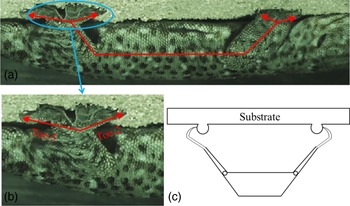
The frictional forces of various animals have opposite characteristics and hierarchical properties from toe-to-toe and leg-to-leg. These opposite frictional forces allow animals to attach securely and stably during movement [Reference Wang, Yi and Dai25, Reference Wang, Gu, Wu, Ji and Dai26]. When a gecko crawls on vertical rough sand boards, the claws mechanically interlock at substrate asperities. As shown in Fig. 1, when a gecko is attached to a rough sand board, its ipsilateral forelimbs face up and its hind limbs face down. The two hind limbs form a pair of grasping structures, where the second and fifth toes (toe numbers increase away from the body) grasp up and down, respectively, to form a mechanical interlock. This mechanical interlocking mechanism (from the toes to the limb) is the bionic prototype for our design of the attachment mechanism of a wall-climbing robot.
Multilevel locking structure of a gecko on a vertical rough sand board. (a) Locked structure formed by the limbs, (b) opposed locking structures formed by the toes, and (c) opposed gripping model.

2.2. Opposed gripping model
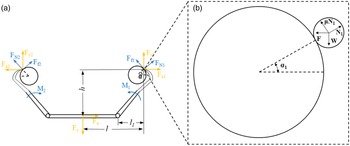
When a wall-climbing robot crawls horizontally on a vertical rough surface using opposed grappling claws, the tangential grasping force generated by the interaction between the tip of a grappling claw and wall asperities not only needs to balance gravity but also needs to keep the grappling claw on the rough surface; that is, it must also keep the grappling claw attached to the vertical rough surface. Song et al. [Reference Song, Dai, Ji and Gorb27] studied the combined effect of adhesion and claw interlocking. Dai et al. [Reference Dai, Gorb and Schwarz28] proposed a model of claw tip interaction with surface irregularities; they assumed that the irregularities of the rough surface are hemispheres attached to a smooth support and that the claw tip is a sphere. Figure 2 shows the mechanical model and the spherical contact model for opposed grappling claws attaching horizontally to a vertical rough surface. In the figure, M 1 and M 2 are the driving torques applied to claws 1 and 2, respectively, and α is the contact angle between the tip of a claw and a rough particle in the vertical direction. The normal forces of claw tips 1 and 2 on the wall are F N1 and F N2, respectively, and the friction forces are F f1 and F f2, respectively. The components of the force in the x and y directions for claw 1 (claw 2) are F x1 (F x2) and F y1 (F y2), respectively, where F x and F y are the horizontal tangential force and the vertical tangential force applied to the gripper, respectively. The force balance equation yields:
 \begin{equation}M_{1}-F_{x1}h+F_{y1}l_{1}=0\end{equation}
 \begin{equation}-M_{2}+F_{x2}h-F_{y2}l_{1}=0\end{equation}
 \begin{equation}F_{x}=F_{x1}-F_{x2}\end{equation}
 \begin{equation}F_{y}=F_{y1}+F_{y2}\end{equation}
 \begin{equation}F_{y1}\cdot 2l+F_{x}h-F_{y}l=0\end{equation}
where l is the horizontal distance between the center of mass and the claw tip, l
1 is horizontal distance between the point of action of the driving force and the claw tip, and h is the height from the point of action of the driving force to the claw tip. When the grappling claw attaches horizontally to the vertical rough surface, assuming that the point of the grappling claw’s tip on the surface rough particles is in the same horizontal plane, the force on the grappling claw mechanism is mainly used to balance the mechanism’s own weight, so here the main consideration is the vertical tangential force F
y
; the influence of the horizontal tangential force is ignored (i.e.,
 $F_{x}=0$
). The claw tip load can then be obtained as
 \begin{equation}F_{y1}=F_{y2}=\frac{F_{y}}{2}\end{equation}
 \begin{equation}F_{x1}=F_{x2}=\frac{2M_{1}+F_{y}l_{1}}{2h}\end{equation}
Mechanical model and spherical contact model when the opposed grappling claws attach horizontally to a vertical rough surface. (a) Claw tip acting on the upper side and (b) a local contact model.

The vertical load angle θ of the tip of a single claw in the vertical plane is
 \begin{equation}\theta =\arctan \frac{F_{x1}}{F_{y1}}=\arctan \frac{2M_{1}+F_{y}l_{1}}{F_{y}h}\end{equation}
For the lateral gripping of a vertical rough surface, the opposite grappling claw mainly provides the vertical tangential force F y to balance the gravity of the mechanism to realize the attachment of the opposed gripping mechanism on the vertical rough surface. From Eq. (8), it can be seen that the load angle θ of a single claw is related to the vertical height h, the horizontal distance l 1, and the driving torque M on the opposed gripping mechanism. For a given gripping mechanism structure, increasing the driving torque M reduces the load angle θ of a single claw and improves the gripping performance of the grappling claws on a vertical rough surface. With other conditions unchanged, the load angle θ of a single claw can be reduced by reducing the horizontal distance l 1. In the same way, increasing the vertical height h reduces the load angle θ of a single claw and improves the adhesion performance of the grappling claw on a vertical rough surface.
Figure 2(b) shows the spherical contact model between a single claw tip and a single asperity. Here, F is the lateral force applied to the claw tip in the direction of the inward grip, N 1 is the normal force of the claw tip via the particle hemisphere when the claw tip is acting on the upper side, W is the gravity component of the claw tip, α 1 is the vertical contact angle when the claw tip is on the upper side, and θ is the load angle of the claw tip in the vertical direction. The tangent of the load angle is the ratio of the lateral force F to the gravity component W of the claw tip.
 \begin{equation} \begin{array}{c} F+\mu N_{1}\sin \alpha _{1}=N_{1}\cos \alpha _{1} \end{array}\end{equation}
 \begin{equation} \begin{array}{c} \mu N_{1}\cos \alpha _{1}+N_{1}\sin \alpha _{1}=W \end{array}\end{equation}
From Eqs. (9) and (10), the following is obtained:
 \begin{equation}\frac{F}{W}=\frac{\cos \alpha _{1}-\mu \sin \alpha _{1}}{\mu \cos \alpha _{1}+\sin \alpha _{1}}\end{equation}
For load angle θ:
 \begin{equation} \begin{array}{c} \tan \theta _{1}=\frac{F}{W}=\dfrac{1-\mu \tan \alpha _{1}}{\mu +\tan \alpha _{1}} \end{array}\end{equation}
From Eq. (12), the following is obtained:
 \begin{equation}\theta _{1}=\arctan \frac{1}{\mu }-\alpha _{1}\end{equation}
When the claw tip acts on the lower side in the horizontal direction, the contact angle α 2 is defined by the negative value of the contact angle α 1. Similarly, the following is obtained:
 \begin{equation} \begin{array}{c} \theta _{2}=\arctan \frac{1}{\mu }+\alpha _{2} \end{array}\end{equation}
From Eq. (13), it is clear that when the claw tip is on the upper side of the asperity and the friction coefficient μ is constant, the load angle θ 1 decreases linearly with increasing contact angle α 1. When the gravity component W is constant, the action point of the claw tip on the spherical surface is on the upper side in the horizontal direction and closer to the top of the sphere. A smaller load angle θ 1 of the claw tip leads to a smaller lateral force F required for the grappling claw tip. For a given contact angle α 1, a greater friction coefficient μ leads to a smaller load angle θ 1 of the claw tip and thus a smaller required lateral force F for the active adduction of the opposed gripping claw.
From Eq. (14), when the claw tip is on the lower side of the asperity and the friction coefficient μ is constant, the load angle θ 2 increases linearly with increasing contact angle α 2. In other words, when the gravity component W is constant, the action point of the claw tip on the spherical surface is on the lower side in the horizontal direction and closer to the bottom of the sphere. A greater load angle θ 2 of the claw tip leads to a greater lateral force F required for the grappling claw tip. For a given contact angle α 1, a greater friction coefficient μ leads to a smaller load angle θ 2 of the claw tip and thus a smaller required lateral force F for the active adduction of the opposed gripping claw.
For a climbing robot with opposed gripping claws that can crawl in any direction on a vertical rough surface, the operation point of the claw tip is not fixed. The claw tip may be located on the upper or lower side of the coarse particle. A symmetrical design of the spiny foot is adopted. The grappling claw thus has a claw tip on the upper side of the asperity in any direction of the vertical surface, which improves the gripping performance of the claws. To reduce gripping failure, the angle of inclination of the two sides of the foot was reduced to improve grip performance and stability.
3. Grasping force of opposed gripping claws
3.1. Experimental setup
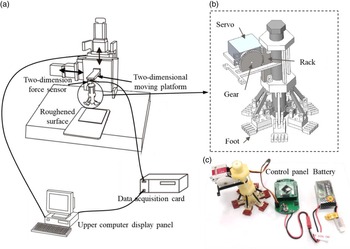
Figure 3(a) shows the experimental platform. A two-dimensional (2D) force sensor was fixed on a 2D linear platform, and the gripping mechanism was fixed on the 2D force sensor through the top screw. The sensor and gripping mechanism move along with the 2D linear platform. The gripping mechanism moved up and down with the 2D linear platform. The rough surface was a 100 mm × 100 mm square onto which quartz sand particles with a diameter of 0.425–2 mm were uniformly adhered. The rough surface was fixed horizontally directly under the gripping mechanism.
(a) Test platform for grasping force, (b) opposed gripping mechanism, and (c) control device for gripping mechanism.

Figure 3(b,c) show the mechanism and driving device of the opposed claws, respectively. The experimental opposed grasping mechanism uses a rack-and-pinion structure. The gear, which is rotated by the servo, drives the rack to move up and down. Six grasping spiny feet are evenly placed around the center of the circle on the bottom plane. The feet are connected via an umbrella-like structure to a ring that is connected to the rack. When the rack moves up and down, the feet point upward and downward to realize grasping and detachment of the whole gripping mechanism.
3.2. Processes of grasping and claw detachment
In the grasping force test for the opposed grappling claw, the rough surface was fixed horizontally, and the grasping force was tested via the vertical movement of the gripping mechanism. First, the gripping mechanism was moved down to a distance of 10 mm from the rough surface at a speed of 1.8 mm/s through the 2D linear platform. Then, the servo on the gripping mechanism drove the gear to rotate before driving the rack such that the claw could be flipped downward to achieve gripper attachment on the rough surface. At this stage, the force on the claw was the preload. Once the preload indicated by the sensor had stabilized, the claw was fully attached. Finally, the 2D linear platform was moved upward to uniformly detach the claw at a speed of 1.8 mm/s. The force generated on the claw in the detachment stage was the grasping force. The maximum grasping force during detachment was recorded.
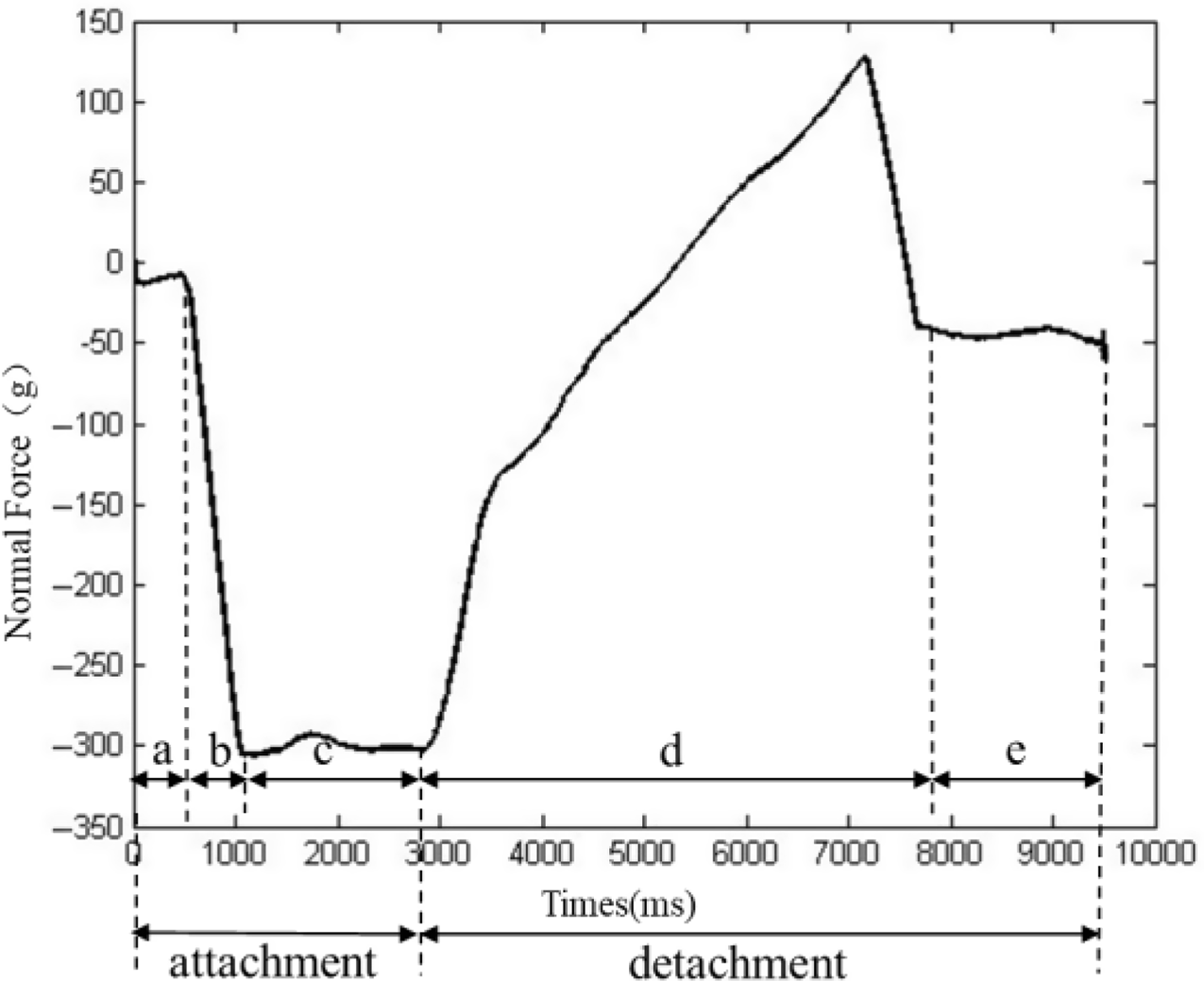
On the basis of the force of the claw recorded during grasping and detachment (see Fig. 4), the role of the claw in these two processes was analyzed. The experiment involved both grasping and detachment with a gripping mechanism with three feet on the rough surface (25-mesh quartz sand).
Force–time curve of attachment and detachment of the gripping mechanism.

In Fig. 4, stages a to c are the attachment phase. Stage a is the time before the attachment of the gripping mechanism was initiated. There is a gap between the gripping mechanism and the rough surface and thus the three feet were initially lifted without contact with the rough surface. In stage b, the gripping mechanism started the grasping process and the servo drove the feet downward. The gripping mechanism was subjected to pressure when the claws came into contact with the rough surface; this pressure is the preload of the gripping mechanism. When the feet of the gripping mechanism were pressed down, the claw tips slid along the surface of the asperities until they reached a suitable contact angle with the particle. At this point, the preload reached its maximum value and grasping was realized. Stage c is the stable gripping phase, where the claws apply a static grip to the rough surface.
In the detachment phase (stages d and e), when the 2D linear platform drove the gripping mechanism upward, the claws were still in contact with the particles on the rough surface. In stage d, due to the upward movement of the gripping mechanism, the feet deformed and drove the claws, changing the contact angle of the claw tip. The contact angle and grasping force increased. The claw tips slid upward on the coarse particles. When the claw tips were about to disengage, the grasping force of the claw mechanism reached its maximum value. Then, in stage e, the claws detached one by one or at the same time and the grasping force of the gripping mechanism decreased to complete detachment.
3.3. Effect of number of spiny feet on grasping performance
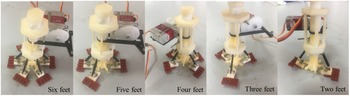
A previous section analyzed a model of a single spherical contact that acts laterally on the vertical rough surface of the opposed gripping model. When the claws act laterally, they can produce larger tangential gripping forces than those produced by a unidirectional spiny foot. In this section, we analyze the effect of the number of spiny feet on the grasping performance of the gripping mechanism using a series of experiments. Two, three, four, five, and six spiny feet were used in the experiments. For experiments with two, three, four, and six feet, the feet were symmetrically distributed around a circle centered on the grasping mechanism. For the experiment with five feet, the distribution was asymmetrical. When six feet were used, the angle between the centers of adjacent feet was 60°. The foot size was fixed. The claws on the feet were on the same horizontal plane. The size and direction of the toes of each foot were the same. The distribution of feet and claws is shown in Fig. 5.
Distribution of various numbers of spiny feet.

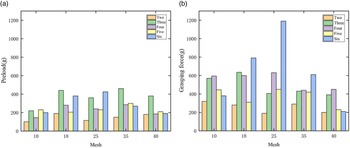
Experiments with various numbers of spiny feet were repeated five times on a surface with a given roughness. For each foot configuration, the rough surface was replaced to prevent the degradation of the surface due to repeated detachments. Then, experiments were repeated using surfaces with different roughness values. The maximum preload and maximum grasping force of the gripping mechanism with a different number of feet on different rough surfaces were recorded. The data are presented in Fig. 6(a,b).
Preload and grasping force in systems with various numbers of spiny feet for various surfaces.

As shown, the gripping mechanism with two spiny feet had the lowest preload at the beginning of grasping and the minimum grasping force at the beginning of detachment on the same rough sand boards. When the number of feet was changed from three to six, the preload and grasping force of the feet did not increase linearly. According to the contact model described in the previous section, the grasping force on the gripping mechanism is mainly due to the action between the claw tip and the asperities, which indicates that the number of claws contacting the asperities does not increase linearly with the number of feet. When the number of feet increased, because of the uneven surface, not all claw tips could contact the asperities at an appropriate angle to generate preload. As shown in Fig. 6(a,b), although the preload of the six feet was lower than that of the three feet, the maximum grasping force on the three surfaces with different roughness values was higher with six feet than with three. This indicates that during the detachment process, because of the deformation of the feet, the angle of the claws was not conducive to the claw’s grasp reaching a suitable angle, thereby increasing the grasping force.
4. Hexapod climbing robot
4.1. Opposed gripping feet
The gripping mechanism adopts an umbrella-shaped structure driven by a rack-and-pinion system. This structure drives the spiny feet through the gear and rack to achieve grasping and detachment. However, with this mechanism, the umbrella-shaped structure extends away from the robot base, making the hexapod climbing robot tall (i.e., it extends far from the wall). Therefore, when the hexapod climbing robot is crawling on a vertical surface, its center of gravity will be far from the grasping surface, and thus a large pitch back moment will be generated during crawling, resulting in poor stability of the robot and a risk of falling. To avoid this problem, we designed a robot that uses gears to drive two spiny feet, as shown in Fig. 7. Each foot is made of a rubber pad, and 10 acupuncture needles bent into hooks are installed on the front of the foot. These needles make contact with the contact surface at a 45° angle. The two feet can be driven to rotate in opposite directions to realize attachment and detachment. Tests show that the opposed gripping feet can bear a load of 400 g when attached vertically to a vertical rough surface, 400 g when attached horizontally to a vertical rough surface, and 200 g when attached to an inverted rough surface.
Physical implementation of opposed gripping mechanism and photograph of load test.

4.2. Robot structure
Figure 8 shows the design mechanism of the robot body and the whole structure of the hexapod climbing robot. The robot is mainly composed of twelve spiny feet, seven KST DS215MG servos, a set of control devices, and a 7.4-V 800-mA lithium battery. The body frame material is a 2-mm-thick sheet of carbon fiber. The torque of servo is 2.50 kg·cm when operating voltage is 4.8 V. The weight of the robot is about 428.5 g, the frame length is 300 mm, the distance between the front and rear ends of the gripping spiny feet is 320 mm, the width is 240 mm, and the distance from the highest point of the frame to the contact surface is 36 mm.
(a) Diagram and (b, c) photographs of robot structure.

As shown in Fig. 8(a), the body of the hexapod climbing robot is split into left and right frames. The left frame is connected to left feet L1 and L3 and right foot R2, and the right frame is connected to right feet R1 and R3 and left foot L2. Each gripping mechanism is fixed with a servo such that the grasping surface is parallel to the central section of the robot. As shown in Fig. 8(b), the top and bottom of the left and right racks are connected by two identical brackets such that a parallelogram is formed between the left and right brackets, while the central rack is fixed on the center connection of the two brackets. One end of the central rack is fixed to one of the brackets by a lock nut, while the other end is connected to a steering wheel fixed to the bracket through the output shaft of the central section of the robot installed on the top of the central rack, as shown in Fig. 8(c). As such, when the servo of the central section of the robot rotates, it drives the parallelogram bracket end to rotate. When the three pairs of feet on the left frame are in attachment mode and those on the right frame are in detachment mode, the rotation of the parallelogram bracket drives the detached right frame to move forward. Similarly, when the three pairs of feet on the right frame are in attachment mode and those on the left frame are in detachment mode, the rotation of the parallelogram bracket drives the detached left frame to move forward. The hexapod climbing robot advances by alternating between the left and right frames.
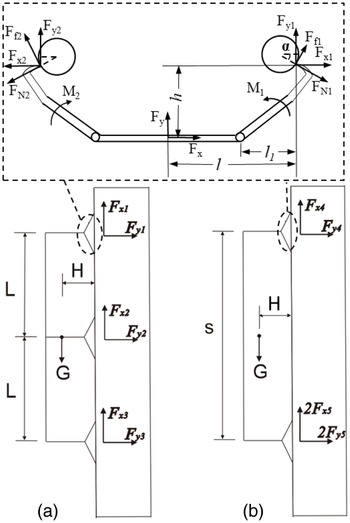
Because the left and right frames of the hexapod climbing robot alternately move forward, the crawling process can be regarded as static for the frame that is attached to the wall. Figure 9 shows the mechanical model of a robot crawling vertically when the left frame is detached and the right frame is attached. In this model, G is the gravity of the robot, H is the distance between the center of mass of the robot and the contact surface (about 26 mm), L is the distance between the center of mass and the foot (150 mm), and S is the distance between the two foot ends of the robot (180 mm). The resultant forces of a pair of grappling claws in the x and y directions are, respectively, Fx and Fy . From Fig. 9(a), when the robot is crawling in the vertical direction, the equations of equilibrium are obtained as
 \begin{equation}G=F_{x1}+F_{x2}+F_{x3}\end{equation}
 \begin{equation}G\cdot H=F_{y1}\cdot 2L+F_{y2}\cdot L\end{equation}
When the robot is crawling horizontally, the equations of equilibrium are obtained as
 \begin{equation}G=F_{x4}+2F_{x5}\end{equation}
 \begin{equation}G\cdot H=F_{y4}\cdot S\end{equation}
Mechanical model of wall-climbing robot crawling. (a) Vertically and (b) horizontally.

Under the assumption that the gripping performance of each pair of grappling claw mechanisms is the same during wall climbing, Eqs. (15) and (16) indicate that the tangential force Fx of a single pair of grappling claws attached to the vertical surface is 1.43 N and the normal force F y is 0.25 N. According to Eqs. (17) and (18), the tangential force F x of a single pair of grappling claws attached to the vertical plane laterally is 1.43 N and the normal force F y is 0.62 N. The maximum tangential load of a single pair of grappling claws is 400 g when attached vertically and horizontally, and thus the claws meet the wall climbing requirements of the robot.
4.3. Wall-climbing experiments
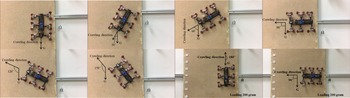
Because the gripping mechanism of the hexapod climbing robot can generate a sufficient tangent force to support the gravity of the robot in any direction, the robot can grasp and crawl in any direction on a vertical rough surface (e.g., a surface made of 0.5–1 mm quartz sand). Figure 10 shows snapshots of various crawling tests for the robot when the crawling direction on the vertical rough surface was changed in the range of 0° to 180°. The figure demonstrates that the robot is capable of climbing a vertical rough surface at a speed of 7.45 mm/s and that it can crawl in any direction. The crawling process of the robot is as follows: (i) all six legs of the robot are in the initial state of grasping, (ii) feet R1, L2, and R3 on the right frame of the robot are lifted, (iii) feet R1, L2, and R3 are moved forward by one step and then dropped for grasping, (iv) feet L1, R2, and L3 on the left frame of the robot are lifted, and (v) feet L1, R2, and L3 are moved forward by one step and then dropped for grasping. The robot then begins the next gait cycle (i.e., feet R1, L2, and R3 on the right frame of the robot are lifted).
Snapshots of robot climbing experiment.

The load capacity of the hexapod climbing robot was tested by hanging standard weights on the central servo. The load was increased in steps of 100 g until the hexapod climbing robot overturned or the foot could not complete the attachment. This value was taken as the limit load of the robot. Table I shows the load capacity of the robot during static attachment.
Static load performance of the robot on a rough wall.

The robot can also crawl on a vertical rough surface with a suspended load. The robot was suspended on the central servo through a 100-g load to carry out continuous superimposition tests. The robot was able to stably crawl on the vertical rough surface in both vertical and horizontal directions under a load of 200 g. The robot performance was limited by the torque of the servo. When the load was further increased, the feet of the robot achieved stable grasping, but the servo could not drive the frame forward because of the torque limitation. Figure 10 shows snapshots of the vertical and horizontal crawl test on a vertical rough surface for the robot with a load of 200 g.
5. Conclusion
In this paper, we developed a hexapod climbing robot based on a gripping mechanism inspired by gecko feet. The robot can crawl in any direction on a vertical rough surface. A spherical contact model of a spiny foot on a vertical rough surface was established, and the factors that affect the grappling claw attachment were analyzed. In addition, the influence of the number of spiny feet on gripping performance was experimentally studied. A robot with opposed gripping spiny feet can move in any direction on a vertical rough wall and crawl on the wall either horizontally or vertically while carrying a load of 200 g. This opposed gripping model could be used for reference for arbitrary crawling on the rough wall. In the future, we will further realize that the robot can turn when climbing on the vertical rough surfaces. We will design the robot with the opposed gripping mechanism that can crawl on an inverted rough surface.
Acknowledgments
This work was supported by National Key R&D program of China (2019YFB1309600), the National Natural Science Foundation of China (Grant No. 51861135306, 51875281); the Deutsche Forschungsgemeinschaft (DFG grant GO 995/38-1).
Author contributions
Aihong Ji and Stanislav N Gorb conceived and designed the study; Nan Jiang and Jie Hu carried out the lab experiment; Nan Jiang and Qingfei Han performed statistical analyses; Qingfei Han wrote the manuscript; all authors contributed critically to the drafts and gave final approval for publication.
Competing interests declaration
The authors declare that they have no competing interests.