



No CrossRef data available.
Article contents
AN ASYMPTOTIC EXPANSION FOR THE INSPECTION PARADOX
Published online by Cambridge University Press: 12 December 2005
Abstract
Suppose that there are n families with children attending a certain school and that the number of children in these families are independent and identically distributed random variables, each with probability mass function P{X = j} = pj, j ≥ 1, with finite mean μ = [sum ]j≥1 jpj. If a child is selected at random from the school and XI is the number of children in the family to which the child belongs, it is known that limn→∞ P{XI = j} = jpj /μ,j ≥ 1. Here, asymptotic expansions for P{XI = j} are developed under the condition E|X|3 < ∞.
Information
- Type
- Research Article
- Information
- Probability in the Engineering and Informational Sciences , Volume 20 , Issue 1 , January 2006 , pp. 87 - 94
- Copyright
- © 2006 Cambridge University Press
1. INTRODUCTION
Suppose that there are n families with children attending a certain school and that independent and identically distributed (i.i.d.) random variables X1,X2,…,Xn represent the number of children in these families. Here, P{X1 = j} = pj, j ≥ 1, and the mean μ = [sum ]j≥1 jpj is finite. A child is selected at random from the school. If I denotes the index of the family to which the child belongs, then XI is the number of children in that family. Ross [6] has shown that

and, by applications of the Law of Large Numbers and the Bounded Convergence Theorem, that

Another interesting fact here is pointed out in Stirzaker [7, p.161], namely that

Although [7] contains an elementary derivation of (3), it also follows easily from (1):

the last equality following from the exchangeability of the sequence X1,X2,…,Xn. One advantage of the representation (4) is that it leads to a fairly easy proof that

the first moment of the probability mass function jpj /μ, when the variance of X1 is σ2 < ∞. Since

with probability 1, the integrand in the first equality in (4) is bounded by X12, so the result (5) follows from the Dominated Convergence Theorem and the Law of Large Numbers.
This setup represents one instance of the Inspection Paradox, which has been studied extensively in works on renewal theory; recently, for example, it has been by Angus [1] and Ross [5]. In the present context, Ross [6] and Hu and Zhuang [4] studied likelihood ratio ordering related to XI. Here, the focus is on developing an asymptotic expansion of (1) and related results.
2. ASYMPTOTIC RESULTS
The main result is stated as follows.
Theorem 1. Suppose E|X1|3 < ∞ and let σ2 = var(X1). Then

where

As a corollary, it would follow easily that

Another corollary would be that the L1 distance (i.e., twice the variation distance) between the probability measures jpj /μ and P{XI = j} satisfies

where a+ denotes the positive part of a. To get (9) assuming (6) and (7), note that for any two probability mass functions νj and ηj on the positive integers,

so, letting qj = P{XI = j},

By (7), there is a constant K < ∞ that does not depend on j and for which the error term Rn in (6) satisfies |Rn| ≤ K/n3/2; so the condition qj > jpj /μ implies that, as long as n is large enough that Kμ/n3/2 < 1,

Now for n sufficiently large, (11) will imply that j ≤ 2(μ + (σ2/μ) + 1), and so for all sufficiently large n, by (6), there will be a constant C < ∞ that does not depend on j such that

and since [sum ]j≥1 jpj < ∞, the limit may be passed inside the sum in (10) by the Dominated Convergence Theorem. Expression (9) then follows with the help of (8).
For the proof of the theorem, let Sn = j/n + (1/n)[sum ]i=2n Xi and rewrite (1) as

Note that

Now observe the identity

and take expectations, yielding

Putting (13) and (14) back into (12) gives (6), with

Next, observe that for j ≥ 1,

with probability 1 and μ ≥ 1, so

Using these in (15) gives the bound

which is the inequality in (7). Heuristically, the right-hand side of (16) can be analyzed asymptotically by observing that

and arguing that the Levy Central Limit Theorem suggests

as n → ∞. This would give the second part of (7), namely

as n → ∞. To make the argument leading to (17) rigorous, an appeal must be made to the results of Brown [2], which are also stated and generalized in Hall and Heyde [3]. There, the following result is proved: If ν > 2 and Y1,Y2,…,Yn,… are independent with zero means and finite variances and

, then in order for

and for

to converge in distribution to the standard Normal distribution as n → ∞, it is necessary and sufficient that

For the case of i.i.d. summands with finite moment of order ν = 3, (18) obviously holds, and this completes the proof of the theorem.
3. DISCUSSION AND AN EXAMPLE
The bound presented for the error term Rn in (6) is certainly useful in deriving the corollaries (8) and (9), but it can be very conservative in terms of describing the approximation implied by (6) for small n. As an example, consider the case where the Xi are geometrically distributed: pj = pqj−1, j ≥ 1. Since the sum of X2,X3,…,Xn will have a negative binomial distribution, a computational formula can be derived as follows from (1):
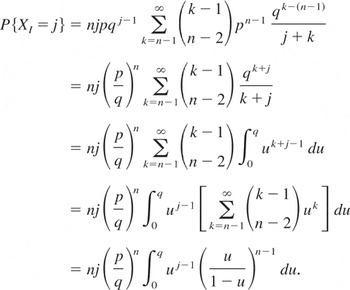
The interchange of integral and infinite sum is justified by Fubini's Theorem, since the integrand in the double integral is nonnegative. Changing variables by y = (p/q)u/(1 − u) then gives


where U(n) is distributed as the largest in a random sample of size n from a uniform(0,1) distribution.
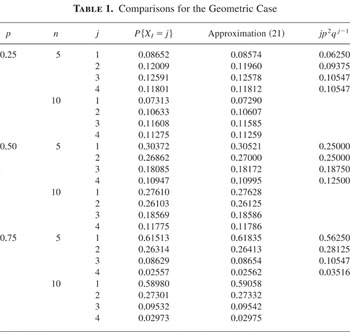
Formula (19) was used to generate Table 1, where P{XI = j}, its limit jpj /μ = jp2qj−1, and the asymptotic approximation (from (6))

are compared for j = 1,2,3,4, n = 5,10, and p = 0.25,0.5,0.75. The asymptotic error bound

is 0.14273 and 0.05046 for n = 5 and 10, respectively. For this example, the order 1/n asymptotic correction term in (6) is essential, and the accuracy of (21) is much better than the asymptotic error bound (22) would suggest.
Comparisons for the Geometric Case

References
REFERENCES
Brown, B.M.
(1970).
Characteristic functions, moments, and the central limit
theorem.
Annals of Mathematical Statistics
41(2):
658–664.Google Scholar
Hall, P. &
Heyde, C.C.
(1980).
Martingale limit theory and its applications.
New York:
Academic Press.
Hu, T. &
Zhuang, W.
(2004).
Likelihood ratio ordering of the inspection paradox.
Probability in the Engineering and Informational Sciences
18:
503–510.Google Scholar
Ross, S.M.
(2000).
Introduction to probability models,
7th ed.
New York:
Academic Press.
Ross, S.M.
(2003).
The inspection paradox.
Probability in the Engineering and Informational Sciences
17:
47–51.Google Scholar
Stirzaker, D.
(1997).
Elementary probability.
Cambridge:
Cambridge University Press.
Comparisons for the Geometric Case
 You have
Access