


I. Introduction
The EU has committed itself to an ambitious decarbonisation agenda, most notably through the European Climate Law and the “Fit for 55” package, which together seek to place the Union on a legally binding pathway toward climate neutrality by 2050.Footnote 1 As the EU moves from target-setting toward implementation, increasing pressure has emerged in sectors such as shipping and aviation, where decarbonisation depends on long investment cycles, infrastructure transformation and uncertain technological pathways.Footnote 2 Aviation and shipping are widely regarded as “hard-to-abate” sectors because they face structural constraints that make rapid decarbonisation more difficult than in sectors such as electricity generation, including dependence on high energy-density fuels, long asset lifecycles, infrastructure dependency, limited availability of mature low-carbon technologies and exposure to international competitive pressures.Footnote 3 These “hard-to-abate” sectors have consequently become a regulatory stress test for EU climate governance, exposing tensions between legal certainty, technological flexibility and the pace of transition.Footnote 4 In response, the EU has increasingly relied on adaptive legislative techniques, including omnibus coordinationFootnote 5 and “stop-the-clock” governance.Footnote 6 Omnibus legislation refers to a single legislative instrument that simultaneously amends multiple existing legal acts across different policy domains in order to streamline, simplify, postpone or substantively revise regulatory obligations.Footnote 7 In this context, “stop-the-clock” governance refers to the temporary suspension, postponement or phased deferral of regulatory obligations or compliance timelines in order to accommodate implementation difficulties, technological uncertainty or political and economic pressures during the transition process.Footnote 8
While these instruments may provide short-term coordination and flexibility advantages, their growing institutionalisation risks weakening core constitutional safeguards of EU law, including proportionality, procedural transparency, and legislative intelligibility.Footnote 9 As the EU approaches its 2030 milestones, the increasing reliance on contingent deferrals risks decoupling legal obligations from the certainty required for industrial transition.Footnote 10 Hence, this article argues that systematic legal codification provides a more resilient legislative architecture, capable of stabilising regulatory expectations while preserving the constitutional integrity of the EU’s Better Regulation framework.Footnote 11
The tension between adaptive flexibility and legal certainty is already visible in the two sectors this article examines. In aviation, the European Court of Justice (ECJ) confirmed that the EU may attach environmental conditions to flights arriving at or departing from aerodromes situated in the territory of the Member States.Footnote 12 Despite this judicial validation, the application of the European Union Emissions Trading System (EU ETS) to international aviation generated significant opposition from third countries, prompting the EU to adopt temporary derogations through the “stop-the-clock” mechanism in order to facilitate international negotiations and preserve legal certainty.Footnote 13 In contrast, maritime decarbonisation has relied on phased implementation and regulatory coordination across instruments such as the EU ETS and FuelEU Maritime rather than on formal suspensions of obligations, reflecting the sector’s technological uncertainty and infrastructure constraints.Footnote 14 Taken together, these developments illustrate a broader shift in EU climate governance toward the use of flexible legislative techniques to manage sector-specific pressures, a shift that risks undermining legal certainty and weakening the credibility of long-term decarbonisation commitments.
More recently, these adaptive techniques have been consolidated within broader omnibus legislative packages, marking a shift from sector-specific responses to a more generalised mode of regulatory coordination.Footnote 15 This development reflects an institutional attempt to manage increasing regulatory complexity through simplification, flexibility and the adjustment of compliance timelines across multiple legal instruments.Footnote 16 However, such approaches risk functionally decoupling formally binding regulatory timelines from the underlying technological and economic feasibility of sectoral decarbonisation pathways.Footnote 17 When legislative deadlines are treated as adjustable instruments within broader agendas of simplification and competitiveness, the law ceases to operate as a stable commitment device for industrial transformation and instead becomes a contingent instrument of short-term political and economic management.Footnote 18 Against this background, the article advances systematic legal codification as a more stable and coherent legislative framework capable of preserving regulatory credibility while maintaining the necessary coordination across sectors.Footnote 19
The article examines the constitutional significance of legislative technique in EU climate governance, focusing on the institutional use of omnibus coordination and “stop-the-clock” mechanisms in the aviation and maritime sectors as doctrinal test cases. It evaluates whether reliance on omnibus amendments and temporary derogations, including the suspension of certain EU ETS aviation obligations under Decision No 377/2013/EU, remains compatible with core constitutional safeguards, including legal certainty and institutional balance.Footnote 20 The article further assesses the feasibility of systematic legal codification as a stable and coherent legislative instrument capable of preserving the benefits of adaptive coordination while enhancing legal certainty and reducing fragmentation. Such codification can limit regulatory inconsistency, as reflected in the interaction between instruments such as the EU ETS and FuelEU Maritime.Footnote 21
While these instruments may provide short-term flexibility in managing the transition to low-carbon transport, their expanding use raises important constitutional and regulatory concerns.Footnote 22 In particular, omnibus legislative techniques may increase legal complexity and reduce transparency by aggregating heterogeneous regulatory decisions within a single legislative framework.Footnote 23 As EU administrative practice demonstrates, the growing role of executive actors in shaping legislative content, especially through impact assessment and consultation processes, has blurred the boundary between legislative and administrative functions.Footnote 24 This trend, combined with the emergence of hybrid executive–legislative procedures, places pressure on the principle of institutional balance and complicates effective scrutiny of regulatory choices.Footnote 25 Consequently, the move toward adaptive consolidation risks shifting the Better Regulation framework away from its accountability-oriented function toward a more managerial logic of regulatory coordination.Footnote 26
Methodologically, the article applies three methods: a sector-specific techno-regulatory analysis, a structural-legislative tracing of EU legislative technique, and a legal doctrinal analysis of EU law. These three methods are used in a sequential and cumulative manner, each supplying the foundation for the next, so that together they build toward the article’s central claim for systematic codification. First, the techno-regulatory analysis establishes the material constraints driving regulatory adaptation. It examines shipping and aviation as “hard-to-abate” systems, combining EU legislation and regulatory instruments with technical and policy materials, including Commission impact assessments, industry and institutional reports, and decarbonisation roadmaps, in order to identify the technological, infrastructural and regulatory constraints shaping EU transport decarbonisation policy.Footnote 27 Second, the structural–legislative tracing identifies how EU institutions have responded to those constraints. This method reconstructs the development of a legislative technique over time, tracing how successive legal instruments build on and modify one another in order to reveal the pattern that connects them.Footnote 28 It analyses the evolution of EU legislative technique from implicit legislative bundling under the “Fit for 55” framework toward the increasing normalisation of omnibus coordination and “stop-the-clock” governance, drawing primarily on EU regulations, directives, Commission and Council documents, legislative proposals and related policy instruments to assess how adaptive governance mechanisms have developed in response to transition complexity. Third, the legal doctrinal analysis, which carries a normative element in evaluating legislation against constitutional standards, evaluates whether that response remains sustainable under EU law.Footnote 29 Focusing on principles such as legal certainty, proportionality, institutional balance and legislative transparency, it relies on Treaty provisions, case law, and constitutional and administrative law scholarship to assess whether adaptive legislative techniques remain compatible with the constitutional structure of EU law or instead justify a shift toward systematic legal codification.Footnote 30
The article proceeds in three substantive steps. Section II frames shipping and aviation as “hard-to-abate” legislative challenges, examining their shared constraints alongside aviation rigidities and maritime fuel fragmentation. Section III analyses the evolution of EU legislative technique, from implicit bundling to omnibus legislation and “stop-the-clock” governance. Section IV develops a normative framework for systematic legal codification as a structural risk-governance strategy, focusing on legislative stabilisation, risk reduction and its limits. Section V concludes by drawing the analysis together and considering the implications of codification for the long-term stability and constitutional integrity of EU climate governance.
II. Shipping and aviation as hard-to-abate legislative challenges
Section II proceeds in two analytical steps. First, II.1 sets out the shared structural constraints that define shipping and aviation as hard-to-abate sectors, including infrastructure transformation, fuel scarcity and cost, long asset lifecycles, technological uncertainty, and global competitiveness pressures. Second, II.2 and II.3 specify and quantify these constraints sector by sector, examining how each binds aviation and shipping in distinct ways. This two-step structure establishes the cumulative profile of hard-to-abate transport before showing how it materialises differently in each mode.
1. Shared structural constraints to decarbonisation
a. The scale of infrastructure transformation required to support alternative energy pathwaysFootnote 31
Shipping and aviation face a structural mismatch between legislative timelines and infrastructure readiness, which generates a distinct form of compliance risk. Airports must adapt fuel supply chains and energy systems to accommodate Sustainable Aviation Fuels (SAF) and, potentially, hydrogen-based propulsion.Footnote 32 Ports must likewise develop storage and handling infrastructure for emerging maritime fuels such as ammonia and methanol.Footnote 33 These investments require substantial capital expenditure and long planning horizons, creating a structural time-lag between regulatory ambition and technical capacity.Footnote 34 According to the International Energy Agency (IEA), scaling global SAF production requires significant capital reallocation towards new production facilities, while the IMO has identified bunkering infrastructure as a central bottleneck for shipping decarbonisation.Footnote 35 Within the EU, the ReFuelEU Aviation and FuelEU Maritime Regulations reflect this dependence on large-scale infrastructure deployment to support low-carbon fuel uptake.Footnote 36
b. The scarcity and high cost of economically viable low-carbon fuels
In aviation, the primary short-term decarbonisation pathway relies on SAF, which are currently the only “drop-in” solution for existing aircraft engines. However, the International Air Transport Association (IATA) reports that in 2025, SAF production accounted for only 0.6% of total global jet fuel consumption, with growth projected to remain below 1% through 2026.Footnote 37 This scarcity is compounded by a significant price premium, with SAF costing between two and five times more than conventional kerosene, adding an estimated $3.6 billion to industry fuel costs in 2025.Footnote 38 These costs are further exposed to volatility linked to energy market disruptions, including geopolitical conflicts and supply chain instability. In the maritime sector, the deployment of zero-and near-zero-emission fuels such as green ammonia and methanol depends on supply chains that remain in early development. Although the IMO approved its Net-Zero Framework in April 2025, formal adoption was postponed at the October 2025 extraordinary session, so the measures have not been adopted or entered into force and do not yet impose binding obligations.Footnote 39 While EU initiatives such as ReFuelEU Aviation and FuelEU Maritime aim to stimulate these markets through phased mandates, economically viable alternatives remain limited.Footnote 40 As a result, regulatory timelines often outpace market development, creating a mismatch between legal obligations and technological feasibility. These supply and pricing constraints persist within a maritime industry shaped by long planning horizons and slow capital turnover.Footnote 41
c. Long asset lifecycles and slow fleet turnoverFootnote 42
Commercial aircraft typically remain in service for two to three decades.Footnote 43 Global aircraft retirement rates remain as low as 1.7%, while the average aircraft age has reached a record 15 years, reflecting persistent aircraft delivery backlogs and slow fleet modernisation.Footnote 44 Major network carriers continue to fly substantially older aircraft. For example, Lufthansa Group reported an average fleet age of 14.4 years at the end of 2025, and Air France–KLM reported twelve and a half years at the end of 2024 and twelve years by mid-2025.Footnote 45 Large maritime vessels may likewise operate for twenty-five to thirty years or more.Footnote 46 Fleets are renewed gradually rather than replaced simultaneously. Decarbonisation therefore cannot occur through rapid technological substitution and instead unfolds over extended investment cycles.Footnote 47 Maritime decarbonisation must occur over a period shorter than the conventional economic life of a ship. Even in decarbonisation scenarios, a substantial share of vessels built before 2020 or 2025 remains active into the 2030s and 2040s, making fleet turnover and retrofit strategy central constraints in the transition.Footnote 48
d. Technological uncertainty over future fuel pathwaysFootnote 49
Short-term strategies rely on drop-in SAF. Future pathways may involve liquid hydrogen propulsion or hybrid-electric architectures, each requiring significant modifications to aircraft design, propulsion systems and supporting infrastructure.Footnote 50 These pathways remain subject to substantial technological, economic and infrastructure uncertainty, particularly regarding fuel production, storage and system integration.Footnote 51 The International Civil Aviation Organization (ICAO) has recognised that the transition depends on fuel availability, technological readiness and the development of supporting infrastructure, while longer-term cleaner-energy pathways remain subject to further innovation and deployment.Footnote 52 In the maritime sector, ammonia, methanol and hydrogen are all being explored, but none has yet emerged as a universally cost-competitive and fully settled option for global scaling.Footnote 53 Uneven technology readiness, infrastructure gaps and evolving safety and regulatory frameworks continue to complicate long-term capital allocation and may delay investment decisions by shipowners and port operators.Footnote 54 This uncertainty extends beyond technological adoption to affect regulatory design, as policymakers must establish compliance mechanisms without knowing which solutions will prevail.Footnote 55 These risks are further intensified by the cost sensitivity and competitive pressures of global transport markets, where an incorrect investment in a fuel pathway may create stranded-asset risks and undermine long-term capital allocation.Footnote 56
e. Global competitiveness pressuresFootnote 57
A fifth structural constraint arises from asymmetric competitive pressures across jurisdictions. EU decarbonisation obligations impose higher compliance costs on European operators than on their international competitors, creating risks of carbon leakage and market distortion. This asymmetry weakens the regulatory credibility of unilateral climate measures.Footnote 58 Airlines and shipping companies compete internationally across routes and jurisdictions, with cost and price competitiveness remaining commercially significant. In aviation, jet fuel prices are not uniform across jurisdictions.Footnote 59 Carriers operating in the Middle East benefit from structurally lower fuel costs due to proximity to crude supply and favourable pricing conditions, while European carriers face higher input costs linked to refining constraints, taxation structures and market exposure.Footnote 60 This asymmetry is amplified by the transition to low-carbon fuels. Conventional jet fuel prices have increased sharply in 2026, rising from approximately $85–$90 per barrel to between $150 and $200 per barrel, with peaks exceeding $220 per barrel in key trading hubs, reflecting the impact of geopolitical disruption.
By contrast, SAF lacks a single global spot price and is consistently estimated to cost between two and five times (may exceed $300–$700 per barrel) more than conventional jet fuel.Footnote 61 In shipping, the transition to zero-emission fuels will impose a “disproportionate hit” on the operating margins of the global fleet.Footnote 62 Green hydrogen is still associated with very high production costs, commonly estimated at around US$3–6 per kilogram and roughly four to five times the cost of conventional fossil marine fuels, while lifecycle assessments also show that ammonia and hydrogen impose higher total costs than diesel-based operations in short-sea shipping.Footnote 63 Besides, green ammonia and methanol have not yet emerged as cost-competitive substitutes for incumbent marine fuels, with cost uncertainty driven by upstream electricity inputs, hydrogen production, transport, storage and safety requirements.Footnote 64
2. Technological and institutional rigidity in aviation decarbonisation
a. Dependence on high energy-density liquid fuels
A first structural constraint on aviation decarbonisation lies in the sector’s dependence on high energy-density liquid fuels. Modern kerosene provides approximately 43 MJ/kg, a level of energy concentration necessary to sustain long-haul flight, whereas current lithium-ion battery technologies at the system level remain far below that threshold, rendering full electrification impractical for long-haul operations that account for a substantial share of aviation emissions.Footnote 65 The energy-density gap helps explain why aviation has not followed the electrification trajectory observed in road transport and instead remains structurally dependent on liquid-fuel-based propulsion systems.Footnote 66 Industry assessments further indicate that, while hydrogen propulsion is entering pilot and demonstration stages for regional aviation, it remains technologically immature for large commercial aircraft, with deployment expected initially in short-and medium-range segments.Footnote 67
Moreover, regulatory strategies have focused primarily on SAF as the principal short-term decarbonisation pathway, because SAF can serve as “drop-in” replacements for kerosene in existing aircraft without major technical changes, thereby avoiding the need for radical redesign of the fleet.Footnote 68 However, this technological concentration creates a distinct regulatory vulnerability. By mandating SAF, a technology that still accounts for well below 1% of global aviation fuel consumption, the EU’s ReFuelEU Aviation Regulation effectively ties legal compliance to a market that has not yet developed at scale.Footnote 69 Hence, this technological constraint translates into systemic regulatory risk.
b. Certification rigidity and the temporal mismatch in aviation innovation
Technological change in aviation must navigate complex airworthiness certification processes designed to manage high-consequence operational risks. Aircraft propulsion systems, airframe integrity, and fuel compatibility are subject to rigorous approval procedures overseen by the European Union Aviation Safety Agency (EASA), which require formal demonstration of compliance with detailed airworthiness specifications and certification standards.Footnote 70 These processes are inherently cautious and time-intensive, and available regulatory and industry assessments indicate that certification alone may take several years, while the required regulatory adaptation must proceed in parallel with the development and maturation of new aircraft technologies.Footnote 71 While essential for safety, this regulatory caution contributes to a temporal misalignment between political ambition and technical deployment, as certification timelines and regulatory adaptation proceed more slowly than decarbonisation targets and policy expectations.Footnote 72 Radical innovations, such as cryogenic hydrogen storage or distributed electric propulsion, face significant certification and regulatory challenges, which may delay deployment and constrain commercialisation.Footnote 73 Consequently, aviation decarbonisation must operate within a tightly regulated environment where approval cycles extend far beyond the five-year policy horizons typical of EU legislative frameworks.
c. Infrastructure dependency and the systemic time-lag of transition
The transition involves more than fuel supply; it also depends on airport operations and infrastructure, which remain important constraints on the deployment of cleaner aviation technologies.Footnote 74 Project-level evidence illustrates the scale of this infrastructure time-lag. A 2025 feasibility study for Groningen Airport Eelde estimated that the required Tier 1 hydrogen infrastructure would cost approximately €7.2 million. It further indicated that subsequent Tier 2 and Tier 3 infrastructure could require investment in the range of €26–33 million, depending on the supply configuration.Footnote 75 Likewise, the EU-funded GOLIAT project received €10.8 million to develop and demonstrate LH2 handling and refuelling technologies for airport operations. The project also includes small-scale LH2 ground-operation demonstrations at airports and aims to develop the standardisation and certification framework for future LH2 operations.Footnote 76 At the sectoral level, IATA reported that, by early 2025, it had tracked over USD 4 billion in announced hydrogen-for-aviation investment, including airport infrastructure studies. It also noted that initial development remains focused on short-and medium-haul operations, while airport refuelling and storage requirements are still being assessed and developed.Footnote 77 This suggests a structural regulatory vulnerability: decarbonisation obligations are increasingly framed around technological pathways such as SAF and hydrogen even though the supporting airport, fuel-supply, and broader regulatory ecosystems remain in formation.Footnote 78 Hence, that mismatch makes the sector more exposed to temporary flexibility measures when legal timelines begin to outpace technical readiness.
d. SAF scarcity and market volatility
While SAF is a leading regulatory pathway, production remains marginal and operational use is still in its infancy.Footnote 79 In 2024, SAF output reached approximately 1 million tonnes, still well below 1% of global jet fuel production, highlighting a structural gap between policy ambition and industrial capacity.Footnote 80 IATA reported the same 2024 output level and stated that SAF accounted for 0.3% of global jet fuel production.Footnote 81 The EU’s ReFuelEU Aviation Regulation reflects this tension by requiring a 2% SAF share from 2025 and 6% from 2030, thereby presupposing a substantial and rapid expansion of SAF production and supply capacity.Footnote 82 However, SAF scale-up is constrained by persistent cost differentials and market uncertainty. SAF remains several times more expensive than conventional jet fuel, while limited production capacity and concentrated supply chains further amplify cost pressures.Footnote 83 Even major carriers face supply constraints. Airlines such as the Lufthansa Group and Air France–KLM have entered large-scale SAF offtake agreements with suppliers including OMV, Shell and Neste, yet secured volumes remain limited relative to total fleet demand.Footnote 84 This mismatch between tightening legal obligations and limited market readiness transforms supply constraints into systemic regulatory risk, as compliance timelines may outpace the deployment of production capacity and supporting infrastructure.
3. Fuel and infrastructure uncertainty in shipping as a governance risk
a. Plurality of fuel pathways and regulatory lock-in risk
Unlike aviation, the shipping sector is navigating a plurality of pathways, including liquefied natural gas (LNG), methanol, ammonia, hydrogen and advanced biofuels.Footnote 85 LNG remains a dominant alternative-fuel choice, yet it faces increasing regulatory scrutiny due to methane slip, which complicates its lifecycle emissions profile.Footnote 86 At the same time, methanol-capable vessels have expanded markedly, while ammonia and hydrogen remain at pilot or early-deployment stages because of infrastructure, storage and operational-safety constraints.Footnote 87 Rather than converging on a single pathway, the industry continues to pursue multiple trajectories with divergent well-to-wake emissions profiles. This multiplicity transforms a technical challenge into a systemic governance problem: regulators must design rules in the absence of a clear technological endpoint, creating risks of regulatory lock-in and stranded assets.
b. Port infrastructure lock-in and stranded asset risk
Fuel uncertainty exposes ports to a systemic coordination failure that risks infrastructure lock-in and stranded assets. Ports must commit to fuel-specific infrastructure such as methanol, ammonia and hydrogen before the transition has resolved into clear fuel pathways. Multiple fuel pathways continue to evolve, and current developments indicate that achieving IMO targets will require substantial acceleration of the transition.Footnote 88 Aligning action across these interconnected value chains requires coordination between upstream fuel suppliers, port infrastructure investors and downstream vessel operators.Footnote 89 The Port Readiness Level tool, launched in October 2024, shows that ports must assess readiness fuel by fuel and plan infrastructure development in advance of operational deployment.Footnote 90 The Port of Barcelona, for example, has identified large-scale methanol storage as among the largest investments in its history.Footnote 91 Besides, alternative fuel infrastructure, particularly for hydrogen, requires highly specialised cryogenic storage, safety, and handling systems, while the need to balance safety, durability and economic feasibility exposes ports and hubs to significant infrastructure and investment challenges.Footnote 92 Maritime decarbonisation is already constrained by infrastructure and fuel-supply gaps, as alternative fuels depend on bunkering capacity, refinery readiness, reliable supply and port development that remain uneven and slow to scale.Footnote 93
c. Global bunkering network coordination failure
Shipping’s decarbonisation depends on the deployment of alternative-fuel bunkering infrastructure at ports and on coordination across the maritime supply chain, including ports, fuel suppliers, and vessel operators.Footnote 94 Zero-emission shipping remains difficult to commercialise without a basic network of ports supplying green fuels, while infrastructure deployment is slowed by underdeveloped energy provision and the need for stronger economic and regulatory incentives.Footnote 95 Regulatory fragmentation further complicates the transition, as regional measures such as FuelEU Maritime operate alongside evolving international frameworks, creating overlapping compliance requirements for ship operators.Footnote 96 In addition, workforce and safety constraints, particularly in handling ammonia, highlight the absence of globally standardised operational capacity, as ammonia-fuel use requires additional crew training, specialised port infrastructure, emergency-response planning, and more developed safety rules.Footnote 97 This reveals a broader mismatch between decarbonisation ambitions and the physical, regulatory and human systems required for implementation.
These constraints demonstrate that shipping and aviation operate as “hard-to-abate” legislative systems because decarbonisation unfolds within interconnected technological, infrastructural and regulatory limitations that resist rapid policy-driven transformation. Across both sectors, long asset lifecycles, infrastructure dependency, uncertain fuel pathways, certification rigidity and fragmented implementation frameworks create a structural mismatch between legislative timelines and technological readiness. In this sense, the section reflects a broader governance problem in which legal obligations increasingly interact with uncertain transition capacity. These cumulative constraints help explain why EU climate governance has progressively relied on adaptive legislative techniques to preserve regulatory continuity under conditions of systemic uncertainty. The following section therefore examines how these adaptive techniques evolved within EU climate regulation and assesses their implications for legal certainty and constitutional coherence.
III. Legislative flexibility governance in EU climate regulation
This section examines how EU climate regulation increasingly relies on legislative flexibility to manage the complexity of the transition. It first sets out the general instruments of flexibility embedded in the EU climate framework, from the European Green Deal to the “Fit for 55”package. It then analyses the two main techniques through which this flexibility operates, namely omnibus bundling and “stop-the-clock” governance, and shows how each is applied in the aviation and shipping sectors. It concludes by assessing the governance risks that this growing reliance on flexibility creates for legal certainty and constitutional coherence.
1. Legislative flexibility for managing transition complexity
a. General instruments of legislative flexibility
EU climate policy initially developed through strategic policy instruments such as the European Green Deal (EGD), which functioned as a roadmap for long-term decarbonisation. It identified sustainable and smart mobility as a core action area before its objectives were progressively translated into binding legal measures.Footnote 98 The Fit for 55 package operationalises these objectives into binding instruments, notably by extending the EU ETS to maritime transport and tightening its application to aviation, while introducing sector-specific fuel mandates through ReFuelEU Aviation and FuelEU Maritime.Footnote 99 EU climate governance combines carbon pricing with sector-specific regulatory instruments, though the resulting architecture remains fragmented across sectors and emissions sources.Footnote 100 The EU climate regulatory architecture is highly polycentric and technically complex, relying on a large number of interconnected legislative instruments across multiple policy fields. This produces a hybrid regulatory model in which binding obligations are combined with embedded technical flexibility.
The EU has developed “stop-the-clock” governance to manage mismatches between regulatory ambition and implementation capacity, most clearly reflected in Directive (EU) 2025/794, which postpones key sustainability reporting and due-diligence obligations.Footnote 101 Transport sector progress is tethered to uncertain technological developments and global market coordination.Footnote 102 Stop-the-clock governance operates as a form of adaptive legal timing, most clearly in aviation, where phased implementation, periodic review, and safeguard mechanisms are formally embedded. By contrast, such mechanisms remain less explicitly formalised in maritime regulation within the current legislative framework.Footnote 103 This illustrates how temporal flexibility has become a central governance tool through which the EU manages implementation risk when regulatory timelines outpace sectoral readiness.
Omnibus legislation and “stop-the-clock” governance represent distinct legal techniques through which the EU manages regulatory complexity: the former by structuring interdependent measures within legislative packages, and the latter by postponing or sequencing compliance obligations.Footnote 104 This coordination is particularly significant in the transport sector, where decarbonisation is pursued through interconnected aviation, maritime and energy-related measures.Footnote 105 Stop-the-clock governance, by contrast, introduces temporal flexibility by postponing or sequencing compliance obligations while leaving the underlying legislative framework formally in place.Footnote 106 Together, these techniques distribute regulatory burdens across sectors and over time, allowing the EU to maintain legislative commitments despite technological uncertainty and market volatility.
b. Aviation
In aviation, EU climate policy is primarily implemented through the EU ETS and the ReFuelEU Aviation Regulation, both adopted within the “Fit for 55” legislative package, which combines multiple regulatory and economic instruments within a broader EU climate policy mix.Footnote 107 This regulatory configuration establishes binding SAF mandates, beginning at 2% in 2025 and progressively increasing to 70% by 2050, while simultaneously integrating aviation into a broader emissions-trading framework.Footnote 108 This reflects a cumulative and interdependent legislative design, whereby multiple instruments operate in parallel to address different dimensions of decarbonisation. In this sense, aviation further illustrates the EU’s reliance on structured legislative packages as an adaptive governance technique, constituting a quasi-omnibus legislative approach that anticipates the later emergence of formal omnibus instruments in EU climate regulation.
Stop-the-clock governance emerged as a formal legislative response within the EU ETS framework. Following the 2012 inclusion of aviation in the ETS, the EU faced significant international opposition to the extraterritorial application of carbon pricing to international flights.Footnote 109 The EU adopted Decision No 377/2013/EU, which suspended the application of the EU ETS to international flights in order to facilitate negotiations within ICAO.Footnote 110 This approach remains embedded in the current legal framework. Under Directive (EU) 2023/958 amending the ETS Directive, the EU continues to apply the ETS primarily to intra-EEA flights, while maintaining a derogation for most extra-EEA flights until at least 2026, pending the evaluation of ICAO’s Carbon Offsetting and Reduction Scheme for International Aviation (CORSIA).Footnote 111 In practical terms, this means that flights within the EEA remain fully subject to EU carbon pricing, whereas flights to and from third countries are either exempt from ETS obligations or governed through CORSIA offsetting requirements during its pilot and first phases (2021–2026).Footnote 112 This continuity demonstrates that the original stop-the-clock logic has been carried forward into the current regime through legally structured derogations and conditional alignment with ICAO mechanisms.
These policies function as a geopolitical safety valve, preserving EU regulatory authority while navigating international friction. This is best exemplified by the evolution of the EU ETS for aviation, where the EU maintained coverage for intra-European flights while temporarily suspending extra-European application to avoid the escalation of international disputes.Footnote 113 This calibrated retreat facilitated subsequent alignment with ICAO’s CORSIA, resulting in a dual-layer system where EU law and international standards operate in parallel. Simultaneously, omnibus coordination ensures that decarbonisation rests on the interaction between EU ETS and fuel mandates rather than being tethered to a single instrument (ReFuelEU Aviation).Footnote 114 ReFuelEU’s gradual SAF blending targets, starting at 2% in 2025, reflect the structural constraint that SAF remains marginal in global supply.Footnote 115 This sequencing also aligns with long certification cycles for new aircraft technologies under EASA standards. This combined design allows regulatory ambition to be maintained without exceeding current technological capacity.
c. Shipping
In shipping, the EU has responded through a coordinated package of interlocking legislative instruments rather than through a single standalone measure. Under the “Fit for 55” framework, the revised Monitoring, Reporting and Verification Regulation, the extension of the EU ETS to maritime transport, the FuelEU Maritime Regulation, and the Alternative Fuels Infrastructure Regulation (AFIR) operate together to govern emissions monitoring, carbon pricing, fuel standards and port-side energy deployment.Footnote 116 This bundled legislative design reflects the EU’s first adaptive technique: instead of relying on isolated sectoral rules, it addresses maritime decarbonisation through a structured and cumulative regulatory package that distributes compliance across connected legal instruments. In this sense, shipping illustrates an early move toward a quasi-omnibus form of climate governance, even if not through a formal omnibus act.Footnote 117
By contrast, the EU has not adopted a formal “stop-the-clock” mechanism comparable to aviation. Instead, it has relied on phased implementation and calibrated compliance within the “Fit for 55” framework. The extension of the EU ETS to maritime transport was introduced through a gradual compliance schedule: shipping companies must surrender allowances for 40% of reported emissions in 2025 (for 2024 emissions), 70% in 2026 (for 2025 emissions) and 100% from 2027 onwards. FuelEU Maritime likewise reflects an ex ante sequencing logic within a broader package of regulatory instruments.Footnote 118
This governance model in shipping enables the EU to regulate a technologically fragmented sector without requiring premature convergence on specific fuel pathways. This is achieved through the combined operation of the EU ETS, FuelEU Maritime and AFIR within a functionally “technologically neutral” framework. FuelEU Maritime requires a 2% reduction in the greenhouse-gas intensity of energy used on board from 2025, without prescribing a single fuel pathway. Instead, it sets an intensity-based standard that promotes renewable and low-carbon fuels.Footnote 119 Similarly, AFIR prioritises scalable solutions such as shore-side electricity while deferring infrastructure for less mature fuels. Developments in major ports, including Rotterdam and Antwerp-Bruges, reflect staged and reversible investment strategies under this framework.Footnote 120 Phased compliance and incremental scope expansion further align regulatory obligations with industrial readiness.
2. Governance risks of legislative flexibility
a. Risk 1: temporal instability and legal uncertainty
First, compliance planning has shifted from a stable legal timetable to an adaptive and uncertain horizon. At the level of general transport and industrial governance, regulatory timelines have become less fixed and more contingent within the “Fit for 55” implementation cycle.Footnote 121 Within the current EU decarbonisation cycle, Rotterdam has recalibrated its shore-power strategy in light of evolving regulation, technical standardisation needs, subsidy dependence, grid congestion and a pressured investment climate, illustrating how investment planning in port decarbonisation has become increasingly contingent rather than fixed.Footnote 122 The expansion of decarbonisation obligations across emissions trading, alternative fuels infrastructure and related transition measures has therefore required operators and market actors to plan under evolving regulatory, funding and infrastructure conditions rather than against a single stable timetable.Footnote 123 The source of temporal instability here lies primarily in ongoing political and regulatory recalibration, where compliance obligations remain formally binding but their operational timelines and implementation conditions continue to evolve throughout the transition process. The legal consequence is a weakening of long-term planning security, as regulated actors must continuously adapt investment sequencing and compliance strategies to changing regulatory expectations rather than to a fixed legal schedule. Because legal certainty is a constitutional principle of EU law derived from the rule of law, continuously changing climate and energy frameworks may weaken the clarity, precision and predictability required of legal rules, thereby widening the gap between formal legal commitments and their practical implementation, particularly for regulated undertakings and infrastructure investors.Footnote 124
Second, temporal instability is embedded within the design of decarbonisation instruments themselves. In both maritime and aviation, phased implementation schedules, review clauses and conditional extensions, such as the ETS phase-in for shipping and the continued evaluation of extra-EEA aviation coverage, introduce a progressively evolving compliance framework rather than a fixed regulatory baseline.Footnote 125 Rather than providing a fixed regulatory endpoint, these instruments operate through iterative adjustment, with obligations periodically modified through phased implementation, temporary derogations and ongoing alignment with international frameworks and legislative developments.Footnote 126 Here, the source of instability derives from the internal architecture of the instruments themselves, which intentionally incorporate mechanisms for periodic revision and adaptive adjustment. While this adaptive design may mitigate some transition pressures, its legal consequence is the erosion of ex ante regulatory certainty traditionally associated with compliance obligations, since operators cannot rely on a stable and foreseeable regulatory endpoint over long investment horizons. Continuously changing frameworks thereby reduce the clarity, precision and predictability required of legal rules, rendering obligations increasingly temporally contingent.
Third, at the systemic level, the interaction between EU law and external legal frameworks adds a further layer of fragmentation, as overlapping regimes and interpretive practices can produce divergent obligations and complicate the coherence of the regulatory landscape.Footnote 127 The coexistence of EU instruments, such as EU ETS and FuelEU Maritime, with international regimes like the IMO greenhouse gas (GHG) Strategy and ICAO’s CORSIA creates overlapping regulatory layers that evolve asynchronously across different legal and institutional settings.Footnote 128 This duality produces a dynamic in which operators must adjust to parallel and partially aligned regulatory frameworks, increasing compliance complexity and requiring ongoing adaptation to evolving obligations.Footnote 129 The source of instability at this level therefore lies in multi-level governance fragmentation, where different legal regimes evolve according to distinct institutional timelines, priorities, and review mechanisms. The legal consequence extends beyond increased compliance complexity to a broader challenge to regulatory coherence itself, as legal certainty becomes difficult to maintain across overlapping and asynchronously evolving governance frameworks. Temporal instability therefore extends beyond individual instruments and becomes a structural feature of multi-level climate governance.Footnote 130
b. Risk 2: erosion of legal authority and regulatory credibility
Omnibus legislation and “stop-the-clock” governance may weaken the practical authority of law where flexibility evolves from a temporary adjustment mechanism into a recurring mode of governance that renders compliance timelines increasingly contingent on political renegotiation.Footnote 131 These dynamics risk transforming EU climate law from a stable regulatory framework into a flexible but credibility-constrained governance system, in which legal authority is increasingly mediated by political negotiation rather than anchored in fixed legal commitments.Footnote 132
First, at the level of general EU transport governance, the repeated adjustment of implementation timelines suggests that compliance has become increasingly conditioned by prevailing political and economic circumstances rather than treated as an immediate and fixed legal consequence of enactment.Footnote 133 The iterative revisions within the “Fit for 55” framework have reinforced the perception that some obligations remain operationally incomplete until further specification occurs.Footnote 134 Flexibility, in itself, remains limited, clearly structured, and connected to predefined implementation objectives. However, authority may become weakened when repeated recalibration creates uncertainty as to whether obligations are genuinely fixed or remain politically adjustable over time. In that sense, the widening gap between formal legal commitment and practical implementation raises rule-of-law concerns, especially where compliance remains symbolic rather than genuinely internalised.Footnote 135
Second, in shipping, this erosion of credibility is amplified by the EU’s position within a fragmented global environment. While the EU has advanced an autonomous framework through the EU ETS and FuelEU Maritime, its reliance on phased implementation suggests that compliance trajectories remain open to political recalibration and market adaptation over time rather than being fully fixed at enactment.Footnote 136 This is particularly evident in the treatment of transitional fuels such as LNG, where shifting regulatory signals regarding methane slip and emissions accounting have raised doubts about the long-term stability of current incentives, while leading port authorities have stressed that clear legislation is necessary to preserve investment certainty.Footnote 137 Consequently, EU maritime law risks being perceived less as a fully stable regulatory anchor than as an evolving governance framework shaped by ongoing interaction with international standards and sectoral decarbonisation debates.
Third, the accommodation of ICAO is most visible in the partial suspension of the EU ETS for extra-European flights, illustrating how the EU has adjusted the scope of its climate regime in response to ongoing international negotiations.Footnote 138 While this “stop-the-clock” decision avoided diplomatic conflict, it demonstrated that the scope of EU climate obligations may be adjusted in response to international negotiation dynamics.Footnote 139 The resulting dual system, EU ETS and CORSIA, creates ambiguity regarding which framework ultimately governs carbon accountability, as overlapping and partially misaligned obligations generate regulatory fragmentation and increase compliance complexity for operators.Footnote 140 For airlines and airport operators, this signals that compliance depends on the evolving balance between EU ambition and international consensus rather than resting on a fully stable legal regime, with regulatory uncertainty contributing to hesitancy in long-term investment decisions, particularly in emerging areas such as SAF infrastructure.Footnote 141
c. Risk 3: investment distortion and strategic delay
Risk-based climate governance may not resolve uncertainty and can, in some cases, reproduce it by underestimating complexity, generating new risks, and exacerbating insecurities.Footnote 142 Investment distortion is treated here as a downstream consequence of the temporal instability and weakened regulatory credibility identified in Risks 1 and 2. Where compliance timelines become increasingly contingent and legal obligations appear politically adjustable, long-term investment signals lose part of their stabilising function. The complexity of the EGD framework, compounded by subsequent simplification efforts, can weaken the stability of long-term regulatory signals and thereby undermine investment incentives for the green transition.Footnote 143 At a general level, this occurs because obligations may come to be perceived as adjustable: where compliance frameworks are repeatedly revised, fragmented or left dependent on further specification, firms face higher regulatory risk and may incorporate expectations of future change into long-term investment planning.Footnote 144 This transforms EU climate law from a commitment device into a negotiable framework, reducing incentives for irreversible capital expenditure.
In shipping, this distortion is particularly acute given the scale of fleet investments. The coexistence of multiple fuel pathways, combined with evolving regulatory targets and uncertain compliance strategies, encourages a “wait-and-see” equilibrium.Footnote 145 Shipowners are delaying investment decisions on low-and zero-emission vessels, while ports defer or phase infrastructure investment until regulation, standards and fuel pathways become clearer, reinforcing the “chicken-and-egg” problem of maritime decarbonisation and risking investment deadlock.Footnote 146
In aviation, this distortion is reflected in the delayed scaling of SAF. Although ReFuelEU Aviation establishes mandatory targets, its phased implementation, combined with the continued division between EU ETS and CORSIA, weakens the immediacy and uniformity of compliance incentives.Footnote 147 As a result, fuel producers face insufficiently credible demand signals to justify large-scale investment in biorefineries, contributing to a persistent gap between legal mandates and fuel availability.
IV. Codification as a structural risk-governance strategy
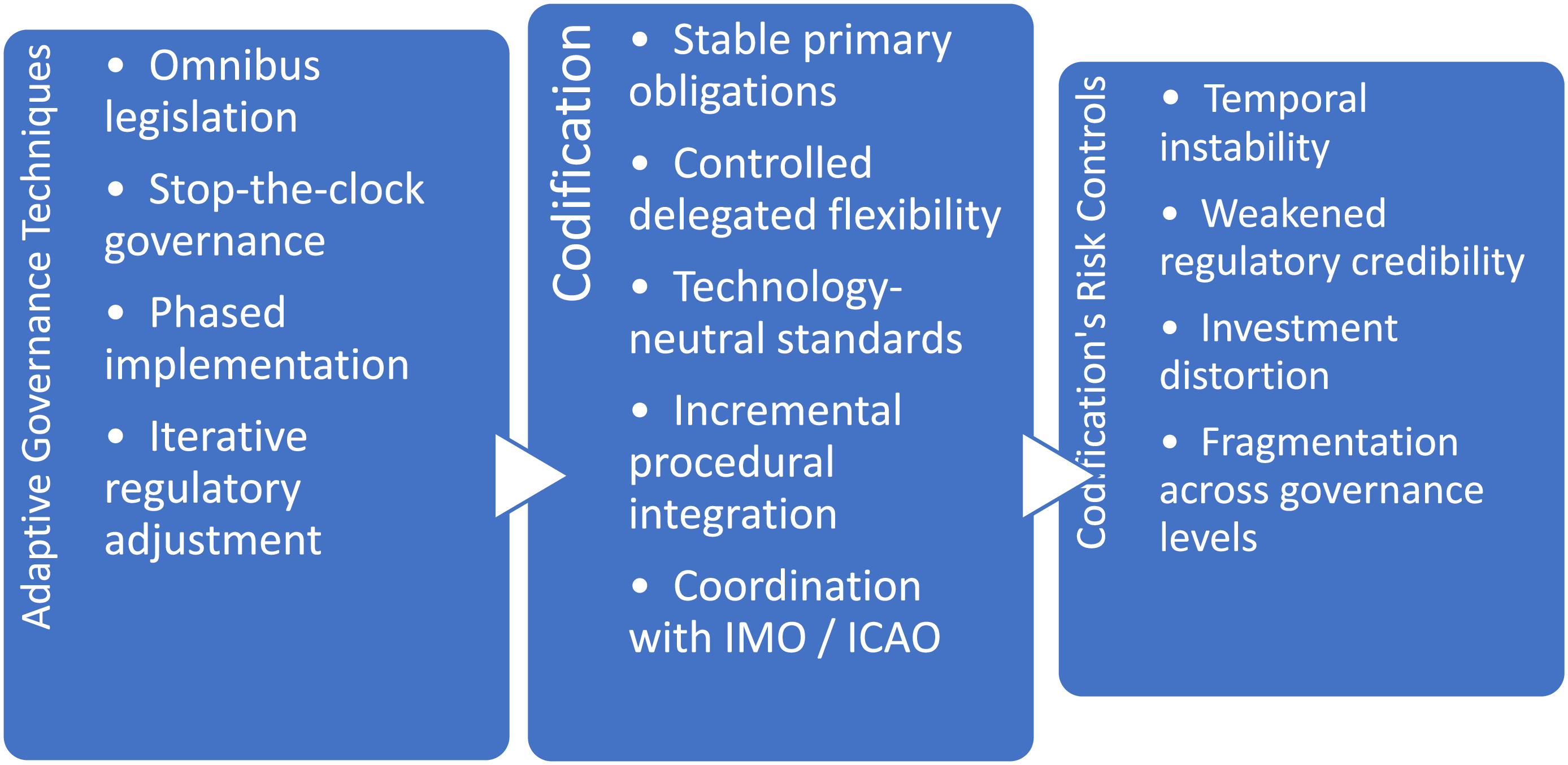
This section develops systematic legal codification as a structural risk-governance strategy for EU transport climate law. It first sets out how codification operates as a form of legislative stabilisation, resting on a framework of normative principles, structural conditions and institutional design criteria. It then explains how codification reduces the specific governance risks generated by adaptive legislative techniques. It concludes by addressing the limits of codification, including the need to preserve controlled flexibility through delegated and implementing measures. Figure 1 sets out this framework, mapping the principal governance risks of adaptive legislative techniques against the codification features that manage them.
Codification framework linking adaptive governance techniques to risks managed.

1. Codification as legislative stabilisation
A codification framework rests on three interrelated sets of elements. First, the normative principles that guide its operation include legal certainty, proportionality, technological neutrality, institutional balance and reversibility.Footnote 148 Second, the structural conditions warranting codification include high regulatory fragmentation, long compliance and investment horizons, multi-level governance interaction and limited political consensus regarding future adjustment pathways.Footnote 149 Third, the institutional design criteria that a codified instrument should satisfy include stable primary obligations, controlled flexibility through delegated and implementing acts, mandatory review mechanisms within predefined procedural limits, and clear coordination with international regulatory regimes.Footnote 150
Codification in EU transport climate law is a structured stabilisation of legal commitments rather than a move toward rigidity. It re-establishes law as a commitment device rather than a shifting regulatory reference point.Footnote 151 Codification integrates these instruments into a coherent legal architecture, making the structure of regulatory commitments more explicit and clarifying the relationship between core binding obligations and subsequent implementing or adaptive measures.Footnote 152 As a result, flexibility is not eliminated; it is relocated to controlled layers of the legal system, ensuring that adaptation becomes regulated rather than reactive.
Codification transforms adaptive governance from a dispersed practice into a legally bounded and procedurally structured system of coordination. By stabilising the internal structure of the framework, it addresses the temporal and normative fragilities of the current system.Footnote 153 Under a codified approach, core obligations are stabilised within the primary legal framework, limiting the scope for continuous recalibration. This restores the temporal function of law as a predictable benchmark rather than a contingent timetable.Footnote 154 At the same time, codification can clarify the relationship between binding commitments and subsequent implementing or adaptive measures, thereby reinforcing the authority of EU law and reducing the perception that obligations remain only operationally provisional.Footnote 155
This structural stabilisation has direct implications for industry behaviour. By providing a predictable regulatory architecture, codification strengthens the credibility of long-term signals. In shipping, this reduces uncertainty surrounding fuel pathways, enabling ports to commit to infrastructure without relying on speculative regulatory evolution.Footnote 156 In aviation, a stable interaction between carbon pricing and fuel mandates enhances the reliability of demand signals for SAF. Ultimately, codification transforms the prevailing “wait-and-see” dynamic into a framework that incentivises coordinated investment. Hence, codification directly addresses the temporal instability, erosion of legal authority and investment distortion identified above by restoring legal certainty, reinforcing the binding character of obligations and enhancing the credibility of long-term regulatory signals.
2. Risk-reduction advantages of codification
The risk-reduction function of codification arises from institutional mechanisms that restructure how regulatory obligations are generated, revised and coordinated.Footnote 157
-
(1) Codification raises the procedural and political threshold for ad hoc recalibration. It embeds core timelines and obligations within a unified primary legislative framework rather than dispersing them across evolving sectoral instruments.Footnote 158 Under the ordinary legislative procedure, amending a codified primary act requires the full participation of the European Parliament and the Council, making repeated ad hoc postponements procedurally costlier and politically more visible than adjustments through delegated or implementing acts.Footnote 159 This procedural elevation restores the distinction between stable legislative commitments and adaptive technical measures, reducing the risk that core decarbonisation obligations are quietly revised through secondary instruments.Footnote 160
-
(2) Codification reduces fragmentation. It consolidates dispersed regulatory regimes into a more coherent legal architecture, limiting inconsistencies between instruments such as EU ETS, FuelEU Maritime and ReFuelEU Aviation.Footnote 161 By establishing a unified primary framework, codification creates a single interpretive reference point that reduces the risk of conflicting obligations arising from instruments that were adopted separately and evolve on different timelines.
-
(3) Codification reduces long-term investment risk. It provides a more verifiable legal anchor against which infrastructure investors, ports, airlines and fuel producers can structure irreversible capital allocation decisions.Footnote 162 Where core obligations are fixed in primary law rather than dispersed across adjustable sectoral instruments, investors can rely on a stable legal baseline when committing capital over the multi-decade horizons typical of port, fleet and fuel infrastructure projects.
-
(4) Codification reduces friction within multi-level governance.Footnote 163 It clarifies the relationship between EU primary obligations, delegated implementation measures, and external regulatory frameworks such as the IMO and ICAO.Footnote 164 A codified primary framework makes explicit which obligations are fixed at EU level and which remain open to adjustment through delegated acts or international alignment, reducing interpretive ambiguity for operators navigating parallel EU and international compliance regimes. Together, these mechanisms position codification as an institutional response to regulatory uncertainty across interconnected layers of climate governance.Footnote 165
3. Limits of codification and mitigation strategies
Risk 1: Regulatory rigidity. Codification may risk excessive rigidity if obligations are fixed at the legislative level without preserving room for technical adaptation. The codification framework addresses this concern by distinguishing between stable legislative obligations and adaptable technical measures. Accordingly, the framework incorporates controlled flexibility through delegated acts under Article 290 of the Treaty on the Functioning of the European Union (TFEU), which allows delegated acts to amend or supplement non-essential elements of legislation, while the basic legislative act fixes the objectives, content, scope, and duration of the delegation.Footnote 166 In this way, core obligations can remain legislatively anchored while technical specifications evolve through controlled legal channels. In aviation, the importance of such a design is illustrated by recent evidence that the scheduled 2027 review of ReFuelEU Aviation has created regulatory uncertainty and encouraged a “wait-and-see approach by industry,” thereby weakening investment confidence in the scale-up of e-SAF.Footnote 167
Risk 2: Technological Lock-In: Codification may risk entrenching specific technological pathways if it is designed around assumptions that later prove premature, particularly in sectors such as maritime transport where fuel trajectories remain uncertain.Footnote 168 Current investments in maritime fuel infrastructure may face increased exposure where regulatory frameworks evolve to capture the full emissions profile of transitional fuels.Footnote 169 To avoid technological lock-in, the codification framework incorporates technology-neutral, performance-based standards that regulate outcomes rather than privileging a specific fuel pathway. By relying on greenhouse gas intensity thresholds, codification can avoid privileging specific fuels while still maintaining regulatory direction.Footnote 170 This approach is consistent with broader international policy trends, including the UN Decade of Sustainable Transport, which stresses that there is no one-size-fits-all solution for sustainable transport and warns that infrastructure choices can lock in unsustainable pathways if not designed for long-term resilience and adaptability.Footnote 171
Risk 3: Institutional and Political Constraints: A further risk lies in the political and institutional difficulty of consolidating fragmented legal frameworks into a single codified structure.Footnote 172 In sectors already governed through overlapping and partially differentiated instruments, immediate harmonisation may therefore be unrealistic.Footnote 173 For that reason, the codification framework adopts incremental codification as an inherent institutional design strategy rather than presupposing immediate substantive harmonisation. Recent EU legislation already reflects a move toward phased procedural integration, by requiring the Commission to assess the interaction between instruments and to consider possible measures to ensure coherence.Footnote 174 This gradual approach is consistent with broader fragmentation scholarship, which shows that dispersed governance frameworks are institutionally difficult to consolidate into a single coherent structure.Footnote 175 Hence, codification, in this sense, operates as a progressive strategy, reducing fragmentation over time while preserving regulatory feasibility and political acceptability.
V. Conclusion
This article has argued that the EU’s reliance on adaptive legislative techniques in transport decarbonisation, particularly legislative bundling, omnibus simplification and “stop-the-clock” mechanisms, produces a structural form of temporal instability. While intended to manage technological and political uncertainty, these instruments weaken the temporal determinacy of legal obligations, leaving compliance horizons contingent in sectors such as shipping and aviation, where long-term investment depends on regulatory predictability. This instability is systemic rather than transitional. The structural constraints of “hard-to-abate” sectors, combined with adaptive governance techniques, generate a regulatory framework characterised by iterative adjustment, partial international alignment and evolving compliance parameters. As a result, legal obligations risk becoming operationally provisional, undermining legal certainty and the credibility of EU climate commitments.
In response, this article advances systematic codification as a structural solution. Properly designed, codification reorganises flexibility within a constitutionally grounded framework rather than eliminating it, distinguishing between stable legislative anchors and adaptable technical measures under Articles 290 and 291 TFEU. By restoring a predictable temporal structure and reducing fragmentation, codification re-establishes law as a credible commitment device for decarbonisation. The central claim is therefore that the EU’s current framework achieves neither, rather than that the EU must choose between flexibility and certainty. Without a shift toward codification, EU transport climate law risks entrenching a model in which obligations remain formally binding yet functionally indeterminate, an outcome incompatible with legal certainty and the scale of the net-zero transition.
Financial support
Open access funding provided by Ajman University, UAE.
Competing interests
The author has no competing interests to declare.

 Open access

