Background
Cigarette smoking remains a major global public health problem despite a variety of individual and population-based interventions (Bala, Strzeszynski, & Topor-Madry, Reference Bala, Strzeszynski and Topor-Madry2017; Bolliger, Reference Bolliger, Issa, Posadas-Valay, Safwat, Abreu, Correia and Chopra2011; Smith, Reference Smith, McCarthy, Japuntich, Christiansen, Piper, Jorenby and Jackson2009). Behaviour modification has been an important component of quit-smoking strategies (Hartmann-Boyce, Stead, Cahill, & Lancaster, Reference Hartmann-Boyce, Stead, Cahill and Lancaster2013; Niaura, Reference Niaura2008). The stages-of-change model (Prochaska & DiClemente, Reference Prochaska and DiClemente1983), which proposes that behaviour change is a gradual process marked by progressive stages, has been widely accepted and incorporated in tobacco treatment programmes, despite a lack of good evidence for its role (Bridle et al., Reference Bridle, Riemsma, Pattenden, Sowden, Mather and Watt2005; Riemsma et al., Reference Riemsma, Pattenden, Bridle, Sowden, Mather, Watt and Walker2003; West, Reference West2005). In contrast, the ‘catastrophic’ theory (West & Sohal, Reference West and Sohal2006), which describes a build-up of motivational tension with rapid behaviour change, triggered by a specific event, is supported by large-scale surveys of ex-smokers finding that quit attempts are mostly unplanned and unaided, and made for health reasons (Larabie, Reference Larabie2005; West & Sohal, Reference West and Sohal2006). The catastrophic theory is also consistent with the ‘teachable moment,’ where an event such as a myocardial infarction (MI) or surgery motivates patients to adopt risk-decreasing behaviours, including smoking cessation (McBride, Emmons, & Lipkus, Reference McBride, Emmons and Lipkus2003). For instance, 61% of 121 smokers hospitalised for suspected MI quit and were not smoking at 12 months post hospitalisation (Tofler et al., Reference Tofler, May, Bartrop, Kirkness, Glinatsis and de Burgh2013).
Building on the importance of the teachable moment, we created a simulated teachable moment whereby smokers with no prior heart disease viewed a personalised video that depicted them having a heart attack, with potential consequences to them and their family. In addition to watching the video, a psychologist with smoking cessation expertise provided face-to-face motivational counselling and advice on quitting, and participants took nicotine replacement therapy (NRT). This protocol resulted in a 54% smoking cessation rate at 6 months (May et al., Reference May, Tofler, Bartrop, Heinrich, Baird, Jozefiak and de Burgh2010). However an important limitation of this and other face-to-face interventions is the inability to assist smokers who live remotely or whose schedule prevents them from attending a treatment facility. Recent technological advances provide the potential for a telehealth solution.
The aim of the current study was to explore the efficacy of translating our face-to-face protocol to an Internet platform, where counselling sessions would occur via video conference and the personalised video would be streamed online during counselling.
Methods
The study protocol was approved by the Human Research Ethics Committee of the Northern Sydney Local Health District.
Study Protocol
Recruitment
Smokers were recruited from multiple sources, including publicity in a national online newspaper, social media, community noticeboards, and through direct promotion to general medical (GP) practices and specialist centres where the doctors reviewed their list of patients for smokers who were potentially suitable and gave them study brochures. The GP waiting rooms also had posters and brochures that provided a link to the study website for further information and eligibility screening.
Eligibility screening
Potential participants visited the dedicated study website which provided a link to the screening form, information about the protocol, and guidelines for optimal use of NRT. Eligibility criteria were age ⩾30 years, having a non-smoking partner or spouse, not living with a smoker, and no alcohol or other drug abuse or unstable psychiatric disorder. Participants also required access to a computer with audio camera for video conferencing, and a digital camera or smartphone for picture taking. The screening form obtained current smoking level, date of birth, and gender. Initial phone contact from an investigator was made with anyone who met the basic screening criteria to confirm eligibility status. Consent to participate was then obtained by email from both the participant and partner.
Enrolment
The participants provided further data on smoking history and level of nicotine tolerance using the Heaviness of Smoking Index (Borland, Yong, O'Connor, Hyland, & Thompson, Reference Borland, Yong, O'Connor, Hyland and Thompson2010). All study questionnaires and forms were completed online using Google Forms (a provision within the Google Drive™ online storage service). At enrolment, participants uploaded photos of themselves, their partner and family to be inserted into a personalised video.
Test video conference
Two weeks prior to beginning treatment, the participants conducted a test video conference with the investigator to establish that the video conference platform was working. Video conferencing was conducted using Pexip® platform software, and the video was streamed using Jumpshare™ file-sharing service. For any technical assistance, the participants used the website instructions or telephone contact with the investigator (R.M.).
Video conference treatment sessions 1 and 2
At session 1, any change in cigarette consumption since enrollment was recorded, and a quit date agreed on, to precede session 2. Both treatment sessions, separated by approximately one week, consisted of streaming of the treatment video and motivational interviewing and counselling to assist in smoking cessation (Lai, Cahill, Qin, and Tang, Reference Lai, Cahill, Qin and Tang2010). After session 1, automated text messages were commenced to provide motivation and support to the participants. One of us (R.M.), a psychologist specialising in tobacco treatment, conducted the video conference counselling and follow-up phone calls.
Follow-up phone calls
Four brief (10-min) follow-up phone calls were made at 1, 5, 8, and 10 weeks following session 2, to collect data on NRT use and/or smoking if applicable, as well as provide supportive counselling.
Session 3 (3-month follow up)
Session 3 was conducted via video conference, including data collection on NRT use and/or smoking if applicable, as well as supportive counselling.
Session 4 (6-month follow up)
Session 4 was conducted via video conference, including data collection on NRT use and/or smoking if applicable, and completion of the programme.
Image upload for the personalised video
Using picture guides on the study website, participants obtained and uploaded digital images of themselves and their partner. A photograph of family or loved ones was also uploaded. The images were then inserted by a commercial company into an 8-min video that depicted the consequences of smoking resulting in a heart attack (death or disability) and the potential impact on their loved ones. The dramatic enactment was interspersed with a doctor describing the process of an MI caused by smoking, aided by animation and case vignettes. The uploading of images and the streaming of the personalised video was performed using the Jumpshare™ file-sharing service.
Nicotine replacement therapy
Participants were provided information on NRT at the pretreatment test video conference session, and advised to commence daily use of 21 mg/24 h patches 1–2 weeks before the first treatment session. From their quit date, they were also recommended to add 4 mg oral NRT for anticipated or breakthrough cravings. Participants were asked to purchase NRT themselves, and were encouraged to see their family doctor to provide a script for patches, making them cheaper.
Text messaging
After session 1, participants received daily motivationally themed messages suited for preparation to quit. For example: ‘Tell your family & friends that you are quitting smoking & organise to call one of them when you need help from cravings’. Between session 2 (after agreed quit date) and session 3 (3-month follow up), participants received twice weekly messages to help reinforce and maintain abstinence. For example: ‘How much money have you saved by quitting?’ After the 3-month follow-up session, the frequency of the messages was reduced to once-weekly until the end of the programme at 6 months. A research nurse established and maintained the system for scheduling text messages.
Outcome Measures
Smoking status
Smoking status was ascertained in three ways; participant self-report (primary endpoint), proxy report from the partner, and salivary cotinine for biological confirmation.
Self-report
Abstinence, or average number of cigarettes per day, was recorded at session 2 one week post quit date; and at sessions 3 (3 months) and 4 (6 months) via video conference. At 3 and 6 months, participants were asked ‘Have you smoked any cigarettes in the last 14 days? If yes, please describe your smoking use since your quit date’. Abstinence was defined as 14-day point prevalence of absence from smoking.
Proxy/partner
At 3 and 6 months, the proxy completed an online questionnaire regarding whether the partner was smoking or not smoking (Mejia, Braun, Pena, Gregorich, & Perez-Stable, Reference Mejia, Braun, Pena, Gregorich and Perez-Stable2017). The proxy was asked ‘Please confirm their smoking status. Smoking is defined as one or more cigarettes in the last 14 days’. They responded by selecting one of the following options: ‘smoking’, ‘not smoking’, ‘other (you are welcome to describe in more detail)’.
Salivary cotinine measurement
During video conference sessions 3 and 4 (at 3 and 6 months), participants were instructed on how to use NicAlert™ salivary cotinine strips (Cooke et al., Reference Cooke, Bullen, Whittaker, McRobbie, Chen and Walker2008), which had been mailed to the participant. The test strip results were viewed by the investigator during the video conference; the participants also took a picture of their strip result using their smart phone and sent the picture to the investigator via text. Salivary cotinine was used as the biological measure to confirm smoking status, although we recognised that the results would not be reliable in participants still using NRT. After field testing of the NicAlert, we deemed scores of 0 and 1 (0–6 grading) to indicate ‘non-smoking’. On testing three study workers, non-smokers living and working in a non-smoking environment, all three scored 1. If the strip results could not be determined by the participant or investigator, the results were recorded as ‘unreadable’.
Motivation scale
Participants completed a 7-point Likert questionnaire evaluating their motivation, intention and confidence to stop smoking (3 questions with responses ranging from ‘not at all’ to ‘very much’) before and after treatment sessions 1 and 2. The questionnaire prior to the first treatment session was obtained at study enrolment.
Video response scale
Immediately after each video was shown, the participants completed six questions using a 7-point Likert scale (ranging from ‘not at all’ to ‘very much’) to assess the psychological impact of the video. Participants were asked whether they felt personally involved and strongly convinced by the video, whether it felt real and was a wake-up call and emotionally moving, and whether, after viewing it, they felt determined to stop smoking. Individual scores plus a total score, as a summation of individual scores, were obtained.
Impact of event scale (IES)
At session 2, participants completed the IES to assess subjective distress in reaction to the first viewing of the video (Horowitz, Wilner, and Alvarez, Reference Horowitz, Wilner and Alvarez1979). At session 3 (3 months) the IES was re-administered.
Statistical analysis
Descriptive data are presented as individual measures or percentages, or mean values and standard deviations for eligible participants who enrolled or did not enrol. Unpaired t-tests or χ2 tests were used to compare baseline characteristics among eligible participants who enrolled or did not enrol, and paired t-tests pre and post intervention. The primary endpoint measure was self-reported smoking status at 6 months. Secondary measures were smoking status at 3 months, and smoking status by proxy report from the participant's partner, and biological confirmation via salivary cotinine, both at 3 and 6 months. We used penalised imputation in expressing quit rates and cigarette consumption, and have noted any missing data. The baseline smoking readings were entered as the final results for the four participants who could not be contacted despite repeated attempts.
Results
Study Population
Seventy-seven potential smoking subjects were screened via our website, of whom 22 did not meet entry criteria, and 5 quit by themselves before enrolling. Of the 50 remaining eligible smokers, 33 (66%) did not enrol. The 17 smokers (34%) who enrolled comprised 11 men and 6 women, aged 41.5 ± 6.9 years, range 32–56 years. All 17 participants had made prior quit attempts, and 14 had previously used quit smoking aids, including NRT (n = 13), varenicline (n = 11), and bupropion (n = 4). The Heaviness of Smoking Index score (1–6) was 3.7 ± 1.7 with average daily smoking of 20.8 ± 8.9 cigarettes, indicating that the participants were moderately heavy smokers.
When we compared the 17 subjects who enrolled in the programme to the 38 initially eligible participants who did not enrol (including the five who quit by themselves before enrolment) the only difference in the limited data was in gender. Six of 17 (35%) of those who did enrol in the study were female, whereas 25 of the 38 (67%) of initially eligible participants who did not enrol were female (P = 0.04). There was no difference in average age (41.5 versus 41.0 years), or average daily cigarette consumption at screening (20.8 versus 19.2 cigarettes/day).
Study Efficacy
Smoking status
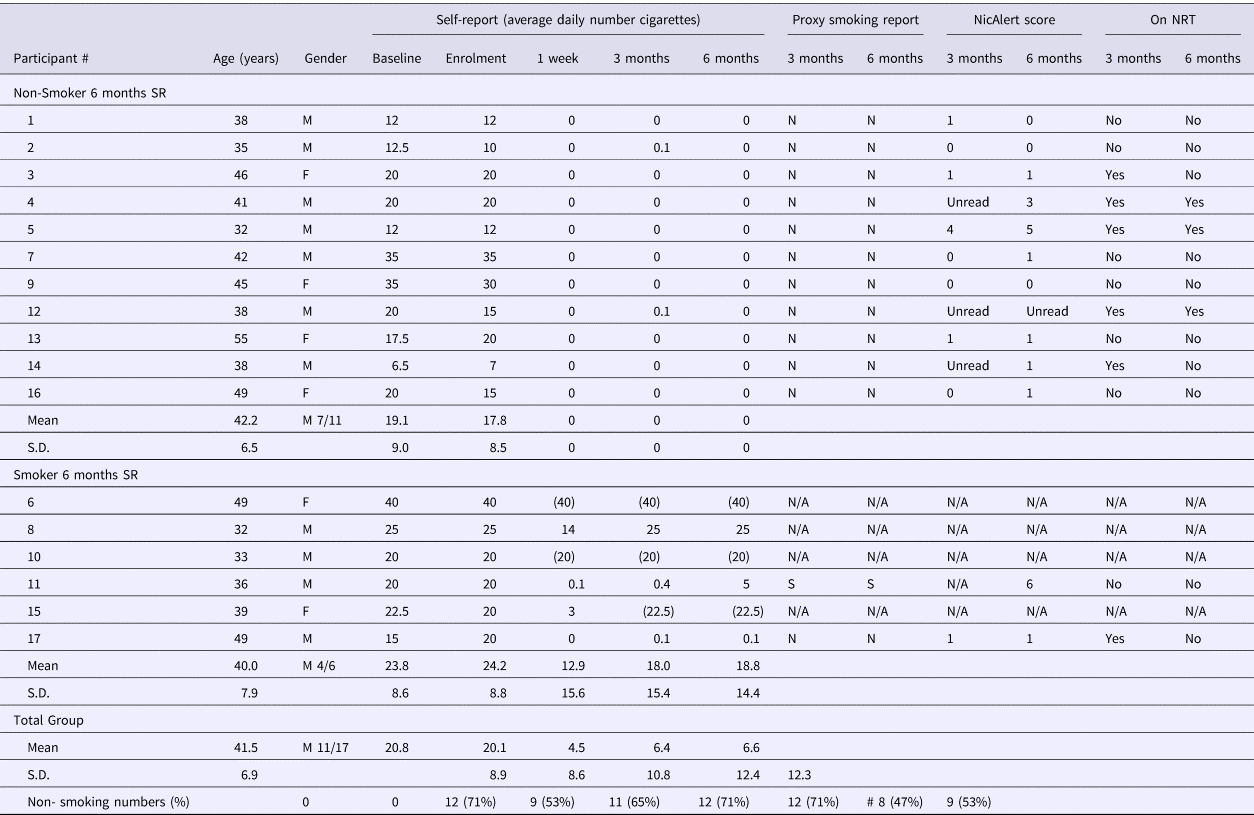
At 3 months, 9/17 (53%) of participants were not smoking by self-report while 12 (71%) were reported as not smoking by their proxy (Table 1). The three additional participants who were considered to be non-smokers by their proxy reported smoking on only one occasion within the 14 days prior to follow up, which may have explained why the proxies were unaware that their partners had smoked.
Smoking status by self-report, proxy report, and biologic confirmation

SR, self-report.
For average number of cigarettes smoked per day, 0 denotes ≥14 days of continuous abstinence. For participants who were lost to follow up, their baseline smoking level was used for subsequent smoking data (shown in brackets).
N/A, not available, ‘Unread’ denotes unreadable NicAlert Strip, # Confirmation by NicAlert was limited by unreadable strips; and levels potentially being raised and not reliable if the participant was taking NRT.
At 6 months, 11/17 (65%) of participants reported not smoking, all of whom were confirmed by their proxies; and 47% (8/17) had self-reported abstinence that was also biologically confirmed. Three additional subjects were not able to give a valid NicAlert ™ result due to current use of NRT. One participant who smoked once in the 14 days prior to the 6 months assessment was assessed as a non-smoker by proxy and NicAlert ™. The non-smoking rates at 6 months by each individual measure were 65% (11/17) by self-report, 71% (12/17) by proxy, and 53% (9/17) by biologic confirmation.
The cotinine strip results were consistent with what the participants reported (Table 1), except in instances when participants who quit were still using NRT, resulting in the expected higher levels of nicotine, or when the strips were unreadable. At 3 months, eight of 17 (47%) were cotinine-confirmed non-smoking, six (35%) were on NRT and three strips were unreadable, while at 6 months, nine of 17 (53%) were cotinine-confirmed non-smoking, one of whom by self-report smoked on one occasion within the 14 days prior to follow up. Three were on NRT (18%) of whom one strip was unreadable. No other smoking aids were used by the participants, except for one who began using e-cigarettes (vaping) 8 weeks after quitting and used it intermittently thereafter.
Motivation, intention, and confidence to stop smoking
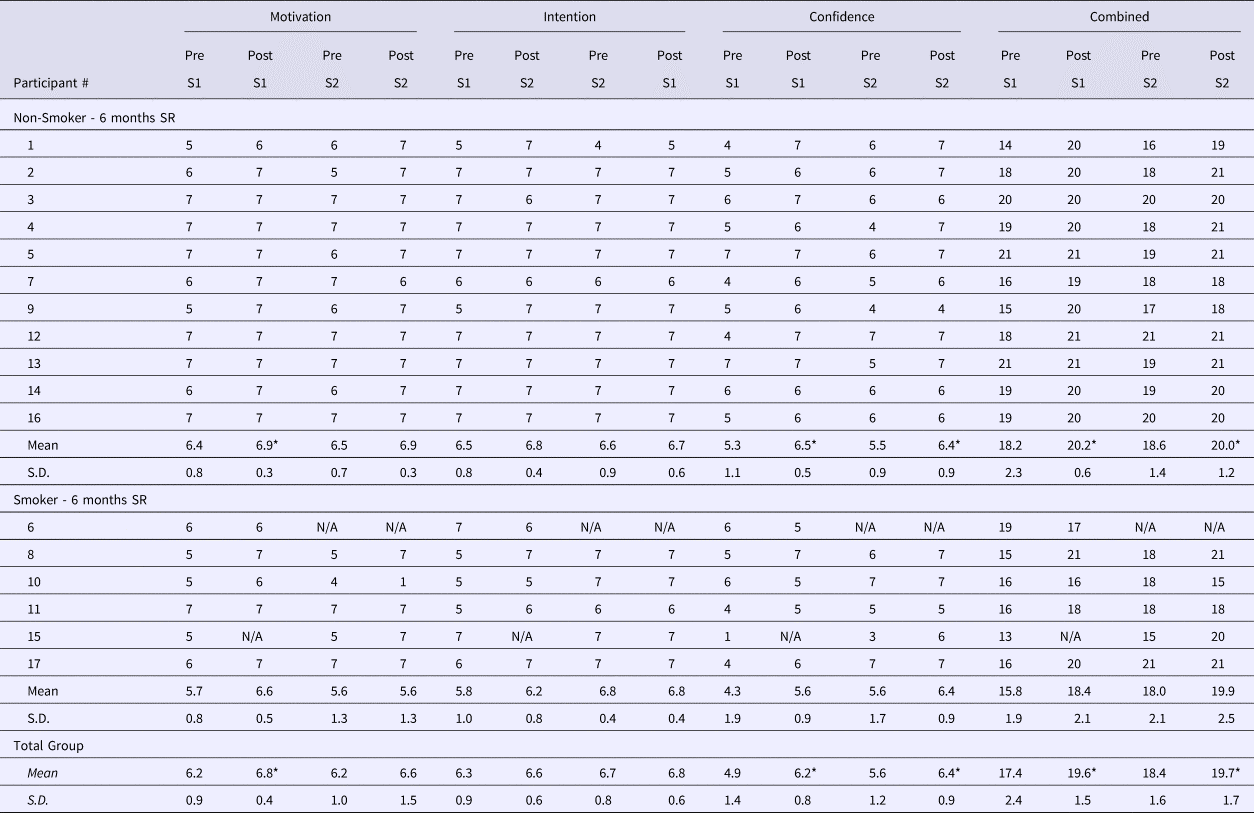
Levels at enrolment were high for motivation (6.2 ± 0.9) and intention to stop smoking (6.3 ± 0.9) but lower for confidence (4.9 ± 1.4). Motivation level increased significantly after the first treatment session while confidence and the combined score increased significantly after both treatment sessions (Table 2).
Motivation, intention, and confidence to stop smoking

SR, self-report.
S1, S2. first, and second treatment sessions in relation to video screening.
N/A, not available.
*P<0.05 pre versus post session.
Video response
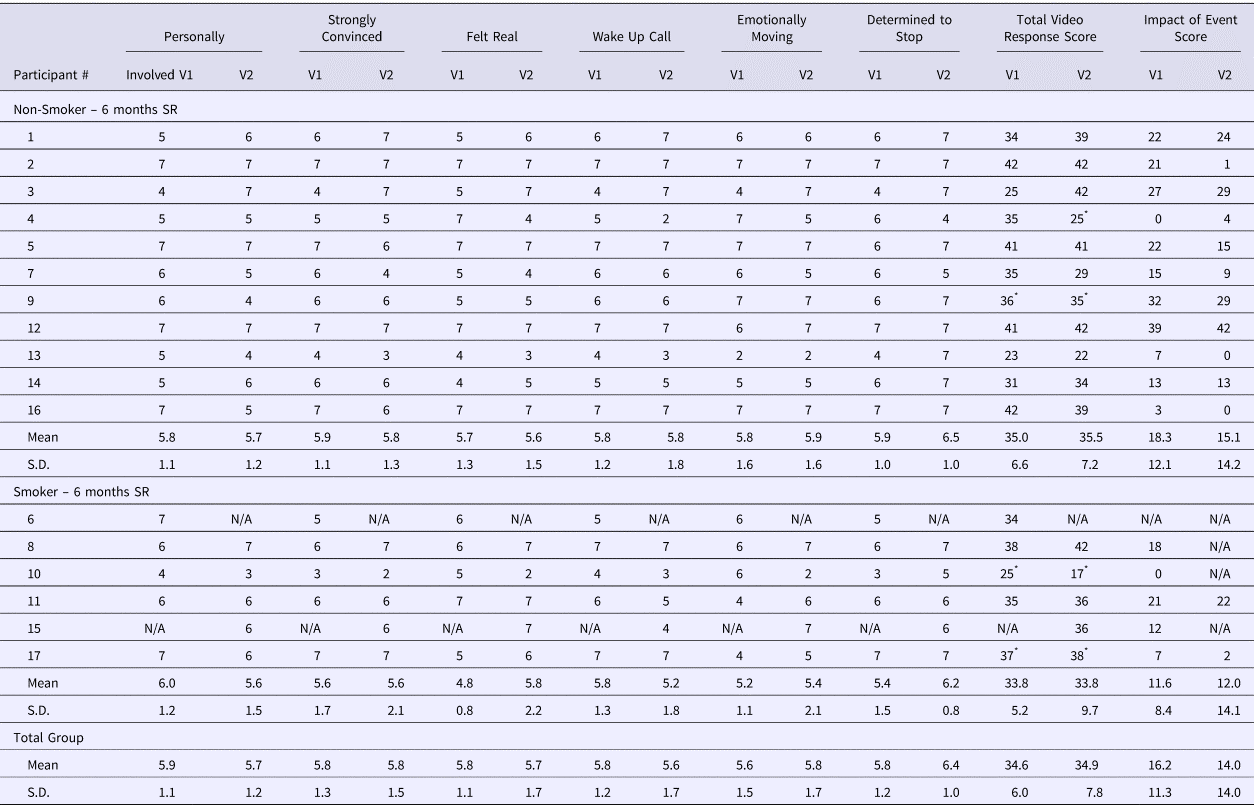
At the first video scale viewing, the participants reported feeling personally involved with the video (5.9 ± 1.1), were strongly convinced by it (5.8 ± 1.3) and found that it was realistic (5.8 ± 1.1). The second viewing of the video evoked similarly strong responses (Table 3). As a qualitative measure, the participants were also asked, ‘How did you find the video?’ At the first viewing of the video, six participants described it as ‘confronting’, three said it was ‘scary, fearful, shocking’; two reported being particularly affected by learning that following a heart attack ‘1 in 5 won't make it to the hospital alive’. Two said that seeing an image of their loved ones had the greatest emotional significance. Four participants were observably sad, appeared uncomfortable, or had tears in their eyes.
Video response and impact of event scale

SR, self-report.
Video responses were after the first (V1) and second video (V2) viewing. The impact of event score (IES) was obtained after the first video viewing before session 2, and at session 3 approximately 3 months after the second video viewing.
N/A, not available.
* Watched video after session, i.e. not concurrently.
Impact of event scale (IES) scores confirmed that the videos produced an impact that corresponded to a mild range of psychological distress both after session one (mean level 16.2) and at 3 months (14.0). The IES interpretation is subclinical (0–8); mild range (9–25); moderate range (26–43); and severe range (44+). The highest individual response, which occurred in a participant who quit smoking, was 42. No negative clinical effect of the programme was reported.
Bandwidth limitations
Due to bandwidth limitations, four participants (24%) were required to watch the video after the video conference session, rather than concurrently, either for both sessions (n = 3) or one (n = 1). Of the four participants, two were not smoking at 3 and 6 months, similar to the overall results. The four had similar scores on the video response questionnaire to those who watched the video concurrently with the video conference (Table 3).
Comparison of those who quit to those who remained smokers
Although the small number of participants limits subgroup comparisons, the persisting smokers tended to begin the study with lower levels of motivation, intention, and confidence than those who quit. While both groups showed trends to receive a boost in these measures with the treatment sessions, only those who quit showed statistically significant improvements similar to the overall group (Table 2). There were no major differences in the video responses among the two groups, although those who remained smokers tended to have smaller responses and impact from the video (Table 3).
Discussion
In a pilot Internet-based study, we have shown efficacy for a novel smoking cessation programme based on a simulated teachable moment. In the 17 participants, the 6-month smoking cessation rate was 65% (11/17) by self-report. In all 11, abstinence was confirmed by proxy, and eight of the 11 confirmed by salivary cotinine, although the remaining three were using NRT with results unable to be interpreted. The results are consistent with our previously published face-to-face protocol (May et al., Reference May, Tofler, Bartrop, Heinrich, Baird, Jozefiak and de Burgh2010) and provide support for the concept of producing a simulated teachable moment to promote smoking cessation.
In recent years, there has been a burgeoning use of websites and phone-apps, social media platforms such as Facebook and text messaging for smoking cessation, aided by improved technologies and increased Internet bandwidth (Cantera et al., Reference Cantera, Puigdomènech, Díaz-Gete, Trujillo, Camarelles, Lozano, Zapirain and Zorrilla2014; Chow et al., Reference Chow, Redfern, Hillis, Thakkar, Santo and Hackett2015; Ekeland, Bowes, & Flottorp, Reference Ekeland, Bowes and Flottorp2010; Lustria, Cortese, Noar, & Glueckauf, Reference Lustria, Cortese, Noar and Glueckauf2009; Naslund et al., Reference Naslund, Kim, Aschbrenner, McCulloch, Brunette and Dallery2017; Sampson, Bhochhibhoya, Digeralamo, & Branscum, Reference Sampson, Bhochhibhoya, Digeralamo and Branscum2013; Struik & Baskerville, Reference Struik and Baskerville2014; Ubhi, Michie, Kotz, Wong, & West, Reference Ubhi, Michie, Kotz, Wong and West2015). A recent Cochrane Review supported the beneficial impact of mobile phone-based interventions with a relative risk of 1.67 (1.46–1.90) for pooled results from 12 studies, and a relative risk of 1.87 (1.54–2.19) for six studies with biochemical verification (Whittaker, McRobbie, Bullen, Rodgers, & Gu, Reference Whittaker, McRobbie, Bullen, Rodgers and Gu2016). Some web-based interventions also include counselling by video conference. For example, Carlson et al. (Reference Carlson, Lounsberry, Maciejewski, Wright, Collacutt and Taenzer2012) used video conferencing technology to treat 184 smokers in rural and remote areas of Canada who did not have access to counselling on a face-to-face basis, and achieved a quit rate of 25.5% at 3 months (Carlson et al., Reference Carlson, Lounsberry, Maciejewski, Wright, Collacutt and Taenzer2012). Our study differs from Carlson et al., in several ways. For instance, we had a one-to-one interaction between a psychologist at a city-based hospital and a smoker in front of their personal Internet device, whereas the Carlson study was conducted in groups at community centres, with a nurse facilitating the process. Although the Carlson programme utilised a sophisticated telehealth service, which enabled multiple groups to simultaneously participate as audience, their interaction with the therapist was restricted, and only a limited number of participants in the sessions were able to ask questions. While we used self-report as the primary endpoint, confirmed by proxy and NicAlert, Carlson used self-report only.
In addition to video conference counselling and text messaging that have been used in other studies, our protocol required participants to take and upload photos of themselves, their partner and family, to be inserted into a personalised video. Once created, this video was then streamed during a video conference counselling session. These steps were successfully achieved, although insufficient bandwidth meant that four of the 17 participants watched the video after the counselling session, not during it. Although this limitation disrupted the flow of the session, these participants reported a similar psychological response to the video and had a similar quit rate to the overall group. The video response and impact of event scales indicated that the personalised video, when streamed via the Internet, was psychologically forceful. The personal and emotional involvement reported by the participants, and their acknowledgement that the video felt real and convincing and was a wake-up call, is consistent with our having created a simulated teachable moment. A body of literature supports the role of the teachable moment in smoking cessation. McBride et al. (Reference McBride, Emmons and Lipkus2003) reported cessation rates ranging from 10 to 60% associated with pregnancy, and 15 to 78% with hospitalisation and disease diagnosis. In individuals with cardiovascular disease, a nurse-based programme of in-patient counselling and telephone follow-up resulted in a 6-month quit rate of 41.5% (Chouinard & Robichaud-Ekstrand, Reference Chouinard and Robichaud-Ekstrand2005), while Gjeilo, Stenseth, Klepstad, Lydersen, & Wahba, (Reference Gjeilo, Stenseth, Klepstad, Lydersen and Wahba2010) reported that half of smokers quit after cardiac surgery, without a specific intervention. We found a 60% self-reported quit rate at 12 months in smokers after an acute coronary syndrome (Tofler et al., Reference Tofler, May, Bartrop, Kirkness, Glinatsis and de Burgh2013).
A challenge we addressed in this study was verification of smoking status. Although the distant location of participants prevented us from using a carboxymeter, which would have been possible face-to-face and provided valid results with NRT use, our combination of proxy confirmation plus salivary cotinine test strips provided complementary results consistent overall with the participants self-report. Each method has its strengths and limitations which we observed in our study (Gilpin, et al., Reference Gilpin, Pierce, Cavin, Berry, Evans, Johnson and Bal1994; Hagensa, Pietersea, van der Valk, & van der Palenc, Reference Hagensa, Pietersea, van der Valk and van der Palenc2017; Mak, Loke, Lam, & Abdullah, Reference Mak, Loke, Lam and Abdullah2005). For instance, while no proxy identified smoking behaviour when it was denied by the participant, three participants admitted smoking on one occasion which was not identified by the proxy. An advantage of using salivary cotinine strips (NicAlert) for biologic confirmation in our study, was that kits could be mailed for the participants to conduct the test during the video conference for the investigator to witness the result, and then photograph the strip result on their phone and text it to us.
While some other studies have measured serum and urinary cotinine, we considered that asking participants to obtain and mail blood or urinary samples would add time and cost, and potentially result in a low response rate as reported by Cha, Ganz, Cohn, Ehlke, & Graham (Reference Cha, Ganz, Cohn, Ehlke and Graham2017). Although cotinine measurements are well validated (Cooke et al., Reference Cooke, Bullen, Whittaker, McRobbie, Chen and Walker2008), levels are not interpretable in participants using NRT (Hagensa et al., Reference Hagensa, Pietersea, van der Valk and van der Palenc2017), as was the case for several of our participants, particularly at 3 months. The quality of the strips was overall good; however some results were not readable, possibly due to technical errors. Also, NicAlert recorded a non-smoking result in one participant who admitted to smoking once within the prior 14 days. While self-report tends to underestimate smoking prevalence compared with biologic assessment (Gorber, Schofield-Hurwitz, Hardt, Levasseur, & Tremblay, Reference Gorber, Schofield-Hurwitz, Hardt, Levasseur and Tremblay2009), we were reassured by participant honesty in admitting they had smoked once which the proxies had not known. The disclosure of single lapses by the participants may have been encouraged by their realisation that biological confirmation would be obtained.
Future Research
The study numbers of our pilot study were small, and confirmation is required in large, randomised, controlled trials. However, our high smoking cessation rates support further study of the simulated teachable moment for smoking cessation and potentially for other behaviour modifications. Since our protocol included motivational interviewing and text messaging as well as the personalised video, future study is warranted into the relative impact of the individual elements.
Our protocol required a supportive non-smoking partner. Future studies need to examine how to adapt our intervention to the important and challenging group of smokers with smoking partners. Although the presence of a smoking partner reduced quit rates in patients who had an acute coronary syndrome, they still exhibited a significant impact from the teachable moment (Tofler et al., Reference Tofler, May, Bartrop, Kirkness, Glinatsis and de Burgh2013). While the teachable moment seems to play an important role in behaviour change among different populations and national groups, future research is needed into the scientific mechanism of the teachable moment (Dohnke, Ziemann, Will, Weiss-Gerlach, & Spie, Reference Dohnke, Ziemann, Will, Weiss-Gerlach and Spies2012) , and how it may be utilised in smokers from non-English backgrounds and different cultural groups (Yu et al., Reference Yu, Shi, Kadimpati, Sheng, Jing and Schroeder2013). The conduct of our study protocol via the Internet provides encouragement for the further evaluation of Internet-based smoking cessation interventions. Interventions are urgently needed in communities away from city centres, where smoking prevalence is often higher than the national average, and access to specialist treatment is limited.
Limitations
It is difficult to estimate how widely appealing our method would be to smokers, since completing the screening form implied an initial level of motivation. Two-thirds of those who were eligible withdrew from our study, which is comparable to other Internet-based studies. In a trial of Internet and telephone treatment for smoking cessation, Graham et al. (Reference Graham, Cobb, Papandonatos, Moreno, Kang and Tinkelman2011) reported an 88% dropout, whereby 2005 of 16,021 eligible participants were randomised. Further work is needed in understanding why many eligible participants did not enrol; some smokers may prefer to avoid this sort of intervention. A higher proportion of eligible women did not enrol, however reassuringly, the women who did participate quit to a similar rate as men. Those who met eligibility criteria but did not complete enrolment may have lacked sufficient motivation or found the process somewhat arduous. The steps required to complete enrolment may have been a particular challenge for time-poor individuals, although once enrolment was completed, the level of engagement among participants remained strong. Further study is needed to address components of feasibility, including perceived usefulness, ease of use and user acceptance of the protocol, and cost-effectiveness (Ammerlaan et al., Reference Ammerlaan, van Os-Medendorp, Scholtus, de Vos, Zwier, Bijlsma and Kruize2014; Davis, Reference Davis1989).
The generalisability of our findings is limited by our exclusion criteria including having a non-smoking partner willing to participate, and having adequate computer access, and ability to download programs and upload photographs. We also excluded smokers with reported alcohol or drug abuse, or current psychiatric illness, who would benefit from face-to-face interaction and monitoring. We excluded subjects aged less than 30 years, for whom the link between smoking and heart disease would be less compelling, and who might benefit from a different teachable moment scenario. In contrast to other studies, we found no significant lapse from 3 to 6 months among those who initially stopped smoking. While this is likely to be a function of small numbers, the text messaging and phone contact resulted in an ongoing support relationship with the participants.
The main technological limitation we experienced was Internet bandwidth for video conferencing and video streaming. Even though this did not alter the study outcome, it was somewhat disruptive to the flow of the protocol. In a future roll-out of the protocol it will be advantageous to test for and ensure adequate bandwidth since video conferencing and video streaming are integral to the treatment process; also to incorporate formal feedback on perceived usefulness, ease of use, and user acceptance of the technology.
Conclusion
Our findings support the use of telehealth interventions to provide specialist smoking cessation studies not limited by geography. Although our sample was small and there were no controls, the high quit rates seen in this pilot study support further study of the simulated teachable moment for efficacy in smoking cessation. The Internet-based platform provides the potential to significantly upscale this approach to smoking cessation and reach a larger population of smokers.
Financial support
This work was supported by grants from Spark Sydney and Heart Research Australia.
Conflict of interest
Geoffrey H Tofler and Northern Sydney Local Health District, New South Wales, Australia, have a patent for the technique.