It is well documented that both internal and external variables play a role in language learning for young, college-aged adults (DeKeyser, Reference DeKeyser2012), as young adults are the traditional members of language classrooms and participants in empirical studies. Internal variables are ways in which learners differ from each other (e.g., sex, personality) while external variables are what input or instruction is provided to learners and how it is presented (Sanz, Reference Sanz and Sanz2005). Studies confirm that the internal factor of previous language-learning experience (bilingualism) enhances learning of a new language in young adults: bilinguals tend to outperform monolinguals at L2 learning Footnote 1 (Brooks & Kempe, Reference Brooks and Kempe2013; Sanz, Reference Sanz2000; Swain, Lapkin, Rowen, Hart, Reference Swain, Lapkin, Rowen and Hart1990) and biliterate bilinguals have been found to outperform other bilinguals (Sanz, Reference Sanz, Pérez-Vidal, Juan-Garau and Bel2007). Also, advantages of form-focused, explicit instruction (EI), an external factor, are generally limited for this population (e.g., Lado, Bowden, Stafford, and Sanz, Reference Lado, Bowden, Stafford and Sanz2014). However, for both internal and external variables, there is very limited research on less traditional learners, such as older adults (age 60+), despite the fact that older adults increasingly migrate, travel, or otherwise undertake language study (Cox, Reference Cox, Sanz and Lado2013). In addition, as the popular press continues to tout bilingual advantages in older age (e.g., Alexander, Reference Alexander2014), older adults are considering foreign-language study to stay active and ward off dementia. Mainstream U.S. culture generally views aging as a negative process that greatly reduces one’s memory (Levy & Langer, Reference Levy and Langer1994), thereby implicating poorer learning, but recent evidence suggests a more fine-grained interpretation of aging, where not all cognitive abilities show the same peaks or declines (Hartshorne & Germine, Reference Hartshorne and Germine2015).
Despite the growing trend of older adults undertaking language study (Cox, Reference Cox, Sanz and Lado2013), we have little direct evidence of how L2 learning may differ for older adults as compared to younger. Firstly, when age has been considered as a variable in SLA, it has typically been in terms of maturation and the Critical Period Hypothesis (e.g., Johnson & Newport, Reference Johnson and Newport1989), rather than in considerations of aging across the adult lifespan. As a result, we do not know whether instruction (and different types of instruction) has the same effect on older adult learning as has been found for young adult learners. Cognitive psychology suggests that types of L2 instruction with higher cognitive demands may impair older adult learning, as older adults are known to have more difficulty than their young adult counterparts at (a) perceiving auditory and visual input due to declines in sensory function, (b) retaining chunks of input due to reduced working memory (WM) capacity, (c) updating WM in real time due to reduced processing speed, and (d) ignoring conflicting or irrelevant cues in the input due to reduced inhibitory control (Cox & Sanz, Reference Cox and Sanz2015). A recent finding that only older adults with the largest WM capacity show significant gains in L2 learning (Mackey & Sachs, Reference Mackey and Sachs2012) supports this hypothesis, as do two studies to date that have investigated interactions between EI and aging (Lenet, Sanz, Lado, Howard, & Howard, Reference Lenet, Sanz, Lado, Howard, Howard, Sanz and Leow2011; Midford & Kirsner, Reference Midford and Kirsner2005). However, empirical research has been limited to these studies, with notable methodological differences between them, leaving many questions unanswered.
Secondly, we do not know if individual differences amongst learners, such as regular use of more than one language (bilingualism), have the same effects on learning rates and outcomes for older learners as they do for younger. Case studies of multilingual older adults suggest that learning a new language is possible for such individuals, perhaps because of their prior language-learning experience (Cohen & Li, Reference Cohen and Li2013; Schulz & Elliott, Reference Schulz and Elliott2000). However, case studies by nature are limited in their generalizability and their analyses (i.e., no interactions between variables). Turning again to cognitive psychology, bilingual advantages (e.g., in executive function) have been found more consistently for older adults than young adults (e.g., Dong & Li, Reference Dong and Li2015 for a review) and even for older adults who were not early childhood bilinguals (Bak, Nissan, Allerhand, & Deary, Reference Bak, Nissan, Allerhand and Deary2014). Although much debate remains regarding bilingual effects on executive function, older adults who regularly use two languages (bilinguals) may show advantages in learning an additional language, a cognitively demanding process that requires attention and control (Wickens, Reference Wickens2007).
To better serve older adult learners, this study takes on the framework of interactions between internal and external variables (i.e., whether individuals with certain characteristics benefit more or less from certain types of instruction) to investigate the language learning of older adults. This framework has been fruitful in studies of young adults, as illustrated in the preceding text, and is ecologically valid, as both learner-internal and -external factors are always contributors to learning outcomes. The current work expands this framework to include an understudied population.
PREVIOUS RESEARCH
Cognitive Aging and L2 Learning
Very few experimental studies have looked at older adult L2 learning, although the theoretical and practical interest of the topic dates back to the 1970s (e.g., Kalfus, Reference Kalfus1977). In lexical learning, Whiting, Chenery, and Copland (Reference Whiting, Chenery and Copland2011) taught young and older participants new names to known items. The new names followed English phonotactics and the items were either high or low frequency. They found no age effects in recall or recognition, nor did age interact significantly with frequency. In a second experiment, all items were unknown and accompanied by descriptions of their use. In this case, there were still no age effects in recall of new names, although young adults recalled more descriptions of the items than older adults did. Thus, it seems that young and older adults had similar capabilities for mapping forms to meanings in this study.
In morphosyntactic learning, Mackey and Sachs (Reference Mackey and Sachs2012) investigated the development of English question formation in older adults whose L1 was Spanish, in relation to their cognitive capacity (WM). Treatment consisted of one-on-one interaction and oral feedback. Four of the nine participants showed improvement at the immediate posttest, of which two maintained their improvement on at least one delayed posttest (1 or 5 weeks later). Notably, the participants whose question formation showed improvement were the ones with the highest WM spans, suggesting an important role for cognitive capacity in older adults’ morphosyntactic learning. These results parallel those of another study, which found that phonological WM, also a component of cognitive capacity, moderated lexical learning in older adults, but not younger (Service & Craik, Reference Service and Craik1993). A recent meta-analysis has also shown that cognitive capacity affects young adult L2 learning (Linck, Osthus, Koeth, & Bunting, Reference Linck, Osthus, Koeth and Bunting2014). Thus, older adult L2 learning seems to operate under some of the same constraints as that of young adults, but perhaps to a different degree.
External Factors: Pre-practice Grammar Explanation
SLA researchers have for years investigated the differential effects of instruction on L2 learning, including at least two meta-analyses (Li, Reference Li2010; Norris & Ortega, Reference Norris and Ortega2000). From a theoretical perspective, we expect EI to help learners overcome difficulties associated with L2 learning, such as learned attention (selectively paying attention to cues that are informative in L1 [Ellis, Reference Ellis2006]) and the First Noun Principle (instinctively interpreting the first noun in a sentence as the agent [VanPatten, Reference VanPatten and VanPatten2004]). This is because EI instructs learners as to what cues are informative in the target language (TL), often by contrasting TL cues with L1 cues or natural processing tendencies. Additionally, receiving EI seems to yield higher levels of TL awareness, which is associated with more successful learning (Leow, Reference Leow2015; Schmidt, Reference Schmidt and Robinson2001).
Meta-analyses to date indicate that theoretical advantages for EI, compared to less EI, are borne out in practice (Li, Reference Li2010; Norris & Ortega, Reference Norris and Ortega2000). However, the same researchers also emphasize the heterogeneous nature of experimental groups deemed “explicit” or “implicit”: Studies vary in their operationalization of explicit and less explicit or implicit conditions, outcome measures, and time span. In terms of operationalizations of explicit conditions, studies may present EI (a) prior to practice in a grammar explanation similar to those in many textbooks (e.g., Stafford, Bowden, & Sanz, Reference Stafford, Bowden and Sanz2012; Tolentino & Tokowicz, Reference Tolentino and Tokowicz2014); (b) as a grammar explanation interspersed between practice items, as may happen during focus-on-form language teaching (DeKeyser & Prieto Botana, Reference DeKeyser and Prieto Botana2014); or (c) as an explanation of why a participant’s selection was correct or incorrect, that is, explicit feedback (Lado et al., Reference Lado, Bowden, Stafford and Sanz2014; Stafford et al., Reference Stafford, Bowden and Sanz2012).
Across the different operationalizations of explicit conditions, a useful distinction in interpreting results has been to compare whether practice was meaningful and task-essential (Loschky & Bley-Vroman, Reference Loschky, Bley-Vroman, Crooks and Gass1993). In treatments where practice emphasizes form over meaning, receiving EI is beneficial to learners (DeKeyser & Prieto Botana, Reference DeKeyser and Prieto Botana2014; Tolentino & Tokowicz, Reference Tolentino and Tokowicz2014). When practice emphasizes meaning over form, there is no effect for receiving EI (Tagarelli, Ruiz-Hernández, Moreno Vega, & Rebuschat, forthcoming). The third option, typical of Processing Instruction studies and The Latin Project, is when practice is task-essential and forces participants to make form-meaning connections while processing structured input. EI paired with such practice yields little to no advantage compared to the same type of practice without EI, especially in retention and comprehension (Cox & Sanz, Reference Cox and Sanz2015; Lado et al., Reference Lado, Bowden, Stafford and Sanz2014; Sanz & Morgan-Short, Reference Sanz and Morgan-Short2004; Stafford, Sanz, & Bowden, Reference Stafford, Sanz and Bowden2010; see Fernandez, Reference Fernandez2008 and Stafford et al., Reference Stafford, Bowden and Sanz2012 for advantages of EI on developing production skills). In these cases, it seems that task-essential practice with simple yes/no feedback is sufficient for initial language learning.
When considering older adult L2 learning, the diversity in methodology is even more problematic because the number of studies in the subfield is so small: Where one study operationalizes explicitness as provision of a grammar explanation (Midford & Kirsner, Reference Midford and Kirsner2005), the next does so as EI in feedback (Lenet et al., Reference Lenet, Sanz, Lado, Howard, Howard, Sanz and Leow2011), thus making generalization difficult. Nevertheless, it seems reasonable to predict that provision of EI would affect older adults more adversely than it does young adults. Firstly, benefitting from EI is partly dependent on recall of EI, even for young adults (DeKeyser & Prieto Botana, Reference DeKeyser and Prieto Botana2014), and memory recall declines with age (Park, Reference Park, Park and Schwarz2000). Secondly, older adults are hyperaware that their memory has declined, which then impedes their performance on memory tasks (McDaniel, Einstein, & Jacoby, Reference McDaniel, Einstein, Jacoby, Craik and Salthouse2008). Three studies to date have investigated the role of EI in older adults as compared to young adults, with notable methodological differences between them. In the artificial grammar learning (AGL) paradigm, Midford and Kirsner (Reference Midford and Kirsner2005) manipulated complexity of the target structure, provision of the rule (EI), and age of participants (young vs. older). Young adults generally outperformed older adults, but within each age group, the same basic pattern of results obtained: With the complex structure, participants who had not been provided with the rule did better than those who had been exposed to the rule, and the opposite was true with the simple structure. This partly confirms the previously mentioned hypothesis that older adults’ learning is negatively affected by EI, adding the caveat that this may be true only when the rule is complex. Nevertheless, this study’s implications for SLA are limited by its design: AGL does not involve form-meaning mappings, an essential part of natural language learning.
The second study, Lenet et al. (Reference Lenet, Sanz, Lado, Howard, Howard, Sanz and Leow2011), took the field further by using The Latin Project to investigate young and older adults who learned Latin in a laboratory setting. They included EI as part of feedback rather than as a grammar explanation prior to practice. They used a battery of four tests: written and aural interpretation (WI and AI), grammaticality judgment test (GJT), and production. On the GJT, older adults with no EI outperformed those with EI. Moreover, the older adults with no EI, but not those with EI, showed significant learning on a composite measure that combined the four test scores. In debriefing, older adults who had EI complained that feedback was too quick (although it lasted 5 s) and therefore stressful. This is in line with the proposal that EI is detrimental to older adults’ learning. However, if the difficulty was due to timing (potentially disrupting strategies such as hypothesis formation and testing or generalizing across items) more than to EI, then EI prior to practice may not be as detrimental for older adults as EI in feedback.
For this reason, Cox and Sanz (Reference Cox and Sanz2015) also compared young and older adults (all late English/Spanish bilinguals) in The Latin Project, but in this case, all participants received EI as a pre-practice grammar explanation. Additionally, the authors administered a brief test immediately following EI but prior to practice to isolate the effects of EI. On this test, young adults outperformed older adults. All participants then completed task-essential practice with yes/no feedback as well as the same battery of Latin tests. On the two immediate interpretation tests, but not on the GJT or production tests, young adults outperformed older adults. Two weeks later, there were no significant age differences on any of the four tests. These findings suggest that any negative effects of EI for older adults are limited to very early stages of learning and may be mitigated both by task-essential practice and consolidation over time. However, this study did not include comparison groups of monolinguals or learning in less explicit conditions.
In sum, Midford and Kirsner (Reference Midford and Kirsner2005) provide preliminary evidence for a negative effect of EI on older adult learning, with the inherent limitations of an AGL study. Lenet et al. (Reference Lenet, Sanz, Lado, Howard, Howard, Sanz and Leow2011) extended their finding by using a natural language, thereby improving the ecological validity of the findings, although they complicated the picture by using EI during feedback. Cox and Sanz (Reference Cox and Sanz2015) returned to the idea of EI prior to practice, with the idea that it might be less stressful for older adults, and found negative effects for EI on older adult learning early in the learning process, but did not compare these findings to older adults who had not had EI. They also focused on a special population: bilinguals. Therefore, the current study expands this developing trajectory of research by comparing effects of EI versus no EI in older adults who are either monolingual or bilingual.
Internal Factors: Bilingualism
Because no experimental studies have investigated the effects of bilingualism on language learning in older adults, we are limited here to discussions of bilingualism in young and middle-aged adults. Although individual studies differ in details of their operationalization of bilingualism, the common thread is that bilinguals are experienced language learners, thereby theorized to differ in their approach to language learning from novices (monolinguals), as they have a “broader linguistic repertoire” to draw on, facilitating creation of associations between linguistic forms (Cenoz, Reference Cenoz2013). For example, bilinguals may have a wider range of language-learning strategies (Nation & McLaughlin, Reference Nation and McLaughlin1986) and greater cognitive flexibility (Cenoz, Reference Cenoz2013), thereby allowing them to adapt to the novel lexicon and morphosyntax of the TL more rapidly than monolinguals do. According to this perspective, bilinguals will have advantages that are not attributable to transfer from L2.
To date, evidence supporting this view is substantial, coming from naturalistic studies as well as laboratory studies, and includes early and late bilinguals. Studies of bilingual education in additive bilingual societies such as the Basque Country and Catalonia show that bilingualism predicts increased general proficiency in a later-learned language for young adults (Cenoz & Valencia, Reference Cenoz and Valencia1994; Sanz, Reference Sanz2000). More specifically, literacy skills in the minority language (Sanz, Reference Sanz, Pérez-Vidal, Juan-Garau and Bel2007) and more frequent and more varied use of the minority language (Lasagabaster, Reference Lasagabaster, Cenoz and Jessner2000; Sagasta Errasti, Reference Sagasta Errasti2003, respectively) contribute to increased L3 success. Safont Jordá (Reference Safont Jordá2003) also found a facilitative role for bilingualism in targetlike realization of request acts as well as in metapragmatic awareness, suggesting that bilinguals’ language experience made them more sensitive to pragmatic considerations than were their monolingual peers.
In cases in which bilingualism is individual rather than originating in the community, such as with immigrants or heritage speakers, findings are more mixed. In Canada, an early study found that school-age heritage speakers were advantaged at learning an additional language compared to monolingual peers as long as they were literate in their heritage language (Swain et al., Reference Swain, Lapkin, Rowen and Hart1990). However, studies in the Netherlands have found either no differences between monolinguals and bilinguals (writing skills, Schoonen et al., Reference Schoonen, van Gelderen, de Glopper, Hulstijn, Snellings, Simis, Stevenson, Ransdell and Barbier2002) or a bilingual disadvantage (reading comprehension, van Gelderen et al., Reference van Gelderen, Schoonen, de Glopper, Hulstijn, Snellings, Simis and Stevenson2003). Taking these studies in conjunction with those from bilingual communities, clearly the societal prestige of L1 and L2, as well as the degree of proficiency and use in each language, is central for the emergence of bilingual advantages in language learning.
Laboratory studies, by contrast, avoid issues of language prestige and policy while allowing for more in-depth investigation of additional factors contributing to bilingual differences. Early AGL studies pointed to bilinguals’ increased use of strategies, and more effective strategies, compared to that of monolinguals (Nation & McLaughlin, Reference Nation and McLaughlin1986; Nayak, Hansen, Krueger, & McLaughlin, Reference Nayak, Hansen, Krueger and McLaughlin1990). Studies have also found that bilinguals who learned L2 in formal classroom settings after childhood, in some cases with only intermediate-level L2 proficiency, also outperform monolinguals at learning novel morphosyntax (Lado, Reference Lado2008; Lin, Reference Lin2009). In these laboratory studies, type of instruction also played a role in results, which will be detailed in the next section.
In contrast, Kempe, Brooks, and Kharkhurin (Reference Kempe, Brooks and Kharkhurin2010) found in a laboratory study that bilingual advantages were limited to typological transfer: Only participants who had experience with languages with transparent gender marking had advantages on generalization of gender categorization in the TL, Russian. However, including age in multiple regression analyses removed the effect of this individual difference (and others). Moreover, a subsequent study from the same laboratory replicated the finding for acquisition of gender marking, but also found that overall experience (total number of languages spoken) predicted acquisition of case-marking morphology (Brooks & Kempe, Reference Brooks and Kempe2013). Therefore, some bilingual advantages in young adults seem to be global in nature, not limited to transfer between similar languages.
To summarize, evidence suggests that experience using more than one language on a regular basis yields advantages for bilinguals learning a new language when compared to monolinguals. This advantage appears to be comprehensive rather than limited to transfer between languages. Moreover, evidence comes from multiple sources: early bilinguals in bilingual communities who learn L3 in school as well as late bilinguals who learned L2 in the classroom and L3 in the laboratory. There is no reason why bilingualism would not also facilitate language learning in older adults, for the same reasons it does so in young adults, but no research to date has investigated this particular question.
Interactions: Bilingualism and Explicit Instruction
The field of SLA has begun to go beyond straightforward analyses of single factors (e.g., either bilingualism or EI) to consider interactions between variables (e.g., does EI have the same effect on monolinguals as on bilinguals?). This is a more fruitful avenue of research because it begins to approximate the complexity of real-life learning situations, in which multiple factors are at play simultaneously. However, the majority of SLA research is limited to young adult populations and again is characterized by heterogeneity in operationalization of explicitness.
In the AGL paradigm, Nation and McLaughlin’s (Reference Nation and McLaughlin1986) participants completed both an explicit and implicit learning condition. In the explicit condition, participants looked for rules whereas in the implicit condition, they paid attention to stimuli with no further instructions. Multilinguals outperformed both monolinguals and bilinguals in the implicit, but not the explicit, condition. In the explicit condition, there were no differences between language groups. Nayak et al. (Reference Nayak, Hansen, Krueger and McLaughlin1990) added referents to their design, assigning a geometric shape to each class of “word,” with individual words varying in other features (e.g., shading or orientation). As a result, there was a type of form-meaning association to be learned. Their participants were multilinguals or monolinguals who completed either an explicit (rule-search) or implicit (memory) condition. Here, multilinguals outperformed monolinguals in the explicit condition only. The authors attribute the discrepancy in results to the fact that the implicit condition was more challenging in Nayak et al.’s study (memorization) than in Nation and McLaughlin’s (simple exposure) and that deeper processing was required in Nayak et al.’s study, given the greater complexity of the target. As such, the findings from Nayak et al.’s study seem to be more applicable to L2 learning because the task included mapping form to meaning, as in natural language.
More recently, The Latin Project has investigated this topic in young adult bilinguals who learned their L2 after early childhood and L3 in the laboratory. Lado (2008) found that L1 English/L2 Spanish speakers outperformed English-speaking monolinguals on learning assignment of thematic roles in Latin, both when EI was included in feedback and when it was not. However, the between-group difference was greater in the condition without EI. Lin (Reference Lin2009) also used EI in feedback, although with a population of Mandarin speakers with low, mid-, or high proficiency in late-learned L2 English. She found an advantage for those with mid- or higher proficiency in the condition without EI only, and only on the GJT. Together, these studies suggest that within young adult populations, regular use of two languages (bilingualism) does not have to begin in childhood to yield advantages in learning additional languages. In addition, for young adults, late-learned bilingualism yields greater advantages in less explicit conditions than in more explicit conditions. However, in both of these studies explicitness was operationalized as part of feedback, which seems to disrupt older adult learning (Lenet et al., Reference Lenet, Sanz, Lado, Howard, Howard, Sanz and Leow2011).
To summarize, there is evidence that the differential effects of instruction may vary according to learner-internal variables in young adults. Theoretically, this makes sense: If bilingualism changes cognition (Dong & Li, Reference Dong and Li2015) and EI changes task demands (Wickens, Reference Wickens2007), then the two will interact. However, to date, no experimental study has investigated interactions between bilingualism and EI in older adults.
CURRENT STUDY
Motivated by the sparse empirical research on older adults, but making use of the extensive research on bilingualism and EI in young adults, this study investigated interactions between these two variables in older adult language learning. Specifically, EI was provided to learners prior to practice, as part of a grammar explanation because this type of EI is likely more suited to older adults’ cognitive capacity (Cox & Sanz, Reference Cox and Sanz2015). Bilingualism was operationalized as regular use of two languages with L2 acquired after early childhood, likely in a formal classroom setting, as in previous laboratory studies (Lado, 2008; Lin, Reference Lin2009). Therefore, the current work bridges the gap between case studies of multilingual older adults and laboratory studies of young adult bilinguals by conducting a laboratory study with older adult bilinguals. Specifically, this study addressed the following research questions:
-
1. Do older adults who receive EI before practice perform differently on posttests compared to those who only receive practice?
-
2. Do older adults who regularly use two languages (bilinguals) perform differently on posttests compared to their monolingual peers?
-
3. In older adults, does the effect of EI on learning Latin morphosyntax depend on bilingual experience? That is, if EI negatively affects older adult learning, is the effect lesser for bilinguals than for monolinguals?
To answer these questions, native speakers of English who were sixty years old or older and were either monolinguals or late English/Spanish bilinguals interacted with a computer program to learn basic Latin morphosyntax. Half of each language group received explicit grammar instruction prior to practice; the other completed practice only. All practice was task-essential and included yes/no feedback. Multiple language skills were tested to measure learning: interpretation (written and aural), grammaticality judgment, and written production.
I expected to replicate the negative effects of EI in older adults that Midford and Kirsner (Reference Midford and Kirsner2005) found for complex artificial grammars, because the target structure is complex, matching multiple morphemes to semantic as well as grammatical functions (see details in Methods section). This prediction is also supported by the Lenet et al.’s (Reference Lenet, Sanz, Lado, Howard, Howard, Sanz and Leow2011) findings of negative effects for EI in older adults, because remembering EI represents a cognitive load for older learners.
Because bilingualism has been shown to have a positive effect on additional language learning in young adults for late, instructed bilinguals (Lado, 2008; Lin, Reference Lin2009), and older adult bilinguals have spent more years using two languages than the typical young adult late bilingual, I hypothesized that older adults with bilingual experience would outperform those without such experience.
In research with young adults learning natural languages, there tends to be a greater bilingual advantage in less explicit, rather than more explicit, instructional conditions, although the evidence is limited to explicitness as part of feedback (Lado, 2008; Lin, Reference Lin2009). Because EI may be detrimental to older adult L2 learning, but bilingualism is likely to be advantageous, I expected that EI would affect bilinguals’ learning less than it would monolinguals’ learning, as bilinguals would be able to use their language experience to compensate for any negative effects of EI.
METHODS
The research design characterizing the current study was quasi-experimental: Participants were classified as monolingual or bilingual based on their responses to the language background questionnaire. Approximately half of each language group was assigned to treatment with pre-practice grammar explanation (+G) and the other to treatment without grammar explanation (-G).
Participants
Sixty-two participants were recruited from Osher Lifelong Learning Institutes, Spanish-language book clubs, and retiree associations in the metropolitan Washington, DC, area. All participants were healthy and reported normal or corrected-to-normal vision and hearing. They were compensated for their time with gift cards. Of the initial pool, 11 were eliminated from analyses for scoring above 67% on the pretest, Footnote 2 four for technical difficulties, and two withdrew due to scheduling difficulties. Therefore, a total of 45 participants were included in final analyses. Footnote 3 Twenty-seven people of the final sample were women and five were left-handed. A limited number of participants had previous experience with Latin or another case-marking language. However, such experience was limited to decades prior to the time of testing and pretest scores confirmed that participants did not have active knowledge of Latin morphosyntax. Moreover, previous experience with case-marking languages, including Latin, did not correlate with gains on any of the outcome measures; all ps > .05.
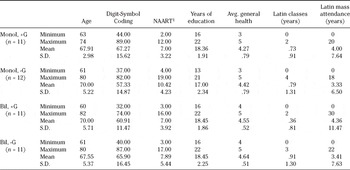
Participants were assigned semirandomly (in order of recruitment) to either the +G or the -G group. One-way ANOVAs showed no effects of Language Group, Condition, or a Language Group × Condition interaction on any background variable except those related to L2 experience; all ps > .10. See Table 1 for participant characteristics by language and treatment groups.
Participant characteristics

Note. Monol. = monolingual, Bil. = bilingual, +G = with grammar explanation, -G = without grammar explanation, S.D. = standard deviation, NAART = North American Adult Reading Test. Average general health was self-reported on a scale of 1 to 5.
1 NAART is scored inversely: lower scores indicate higher educational level.
Participants who reported using both English and Spanish on a regular basis at the time of testing were categorized as bilinguals. In all cases, bilinguals had learned the L2 relatively late (age of acquisition range = 7–62, but always at least 10 years prior to testing), mostly through classroom-based instruction. Footnote 4 See Table 2 for more details on the bilinguals’ L2 experience. A series of one-way ANOVAs showed no difference between bilinguals in the +G and -G groups on any measure of L2 experience; all ps > .10. Participants who used only English on a regular basis were categorized as monolinguals. No participants had studied additional languages in the two years prior to testing.
Characteristics of bilinguals’ L2 experience

Note. AoA = age of acquisition, +G = with grammar explanation, -G = without grammar explanation, S.D. = standard deviation. L2 speaking, writing, reading, and listening proficiency self-reported on a scale of 0 to 5. L2 percentage use at home and at work also self-reported.
Target Structure
Within Latin morphosyntax, the specific target structure of the study was the assignment of thematic roles agent and patient to simple transitive sentences. In Latin, thematic roles can be assigned using three different cues: (a) subject-verb-object (SVO) word order (the primary cue in participants’ L1, English), which is only about 33% reliable in the experimental materials; (b) subject-verb agreement (the primary cue used in bilinguals’ L2, Spanish), which is only present in items in which the subject and object are of different number, but always reliable in those cases; and (c) noun case morphology, which is always present and always reliable, but crucially is novel to both English and Spanish speakers. Additionally, as a result of the dependence on noun-case morphology for assigning thematic rules, word order is entirely free in Latin where it is not at all free in English. Spanish permits some non-SVO orders, but only for pragmatic effect (Zagona, Reference Zagona2002). See (1a, b) in the following text for glossed examples in Latin and Spanish, respectively.
-
(1a) Spectat tignarios parvula.
-
watch+SG carpenter+MASC+PL+PAT child+MASC+SG+AG
-
(1b) El niño mira a los carpinteros.
-
the+MASC+SG child+SG watch+SG +PAT the+MASC+SG carpenter+MASC+PL
“The child watches the carpenters.”
Materials
Language Background Questionnaire.
All participants completed an online questionnaire that solicited information about their language background, including what language(s) they grew up speaking, their level of education and where that education took place, self-rated proficiency in L1 (and L2 for bilinguals), and frequency of use of L1 (and L2 for bilinguals). This information was used to designate each participant as monolingual or bilingual or to remove them from the study.
Digit-Symbol Coding Task.
Due to the potential heterogeneity in older adult cognition, all participants completed the Digit-Symbol Coding Task (Wechsler, Reference Wechsler1997) as a measure of processing speed under low cognitive demands. In this task, participants are given a sheet of paper with the numbers 1–9 and nine symbols. In the rows that follow, participants fill in the symbol that corresponds to the given number. They do six practice items and then have two minutes to complete as much of the rest of the sheet as possible.
North American Adult Reading Test.
The North American Adult Reading Test (NAART) 35, a shortened version of the original NAART, quantifies educational background by testing participants’ pronunciation of 35 infrequent English words. The pronunciations cannot be guessed from the orthography; thus, the test measures level of education because higher levels of education are related to greater use of infrequent words.
Latin Vocabulary Learning and Quiz.
Many of the learning and testing materials used in this study have been reported in more detail in previous publications from The Latin Project (most recently, Lado et al., Reference Lado, Bowden, Stafford and Sanz2014). In short, participants began their Latin learning by visual and auditory exposure to a series of Latin nouns and verbs, with a photo illustrating each item. All nouns were [+human] and followed regular declensions. Input consisted of all four forms of the noun that would be used in the study (nominative singular and plural, accusative singular and plural), but the different forms were not explained. All verbs were transitive and followed regular conjugations. Both singular and plural verb forms were presented; again, the different forms were not explained. Participants were required to score 100% on the quiz that followed the lesson before the computer program continued to the next section.
Latin Prepractice Grammar Explanation.
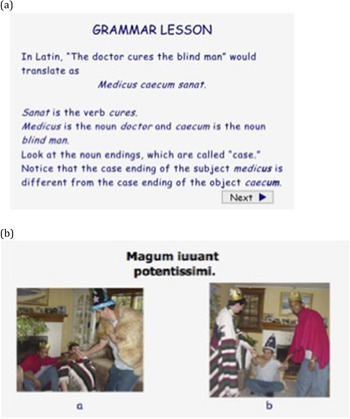
Only participants in the +G condition received this part of the treatment, which constituted their EI. The grammar explanation was interactive, requiring responses from participants. It followed guidelines for Processing Instruction (Lee & VanPatten, Reference Lee and VanPatten2003): It introduced the ideas of subject and object in participants’ L1, explained that these functions were communicated through case marking in Latin, and presented all of the relevant noun endings. It also included information on more and less effective processing strategies, that is, that learners tend to assume that the first noun in the sentence is the subject—but that is not always true in Latin. See Figure 1 for a sample screen of the EI.
Sample screens from (a) the explicit grammar instruction and (b) the task-essential practice in visual modality.

Latin Task-Essential Practice and Feedback.
Participants in both conditions (+G and -G) completed receptive practice with yes/no feedback. Practice included auditory Footnote 5 and written stimuli and was task-essential (Loschky & Bley-Vroman, Reference Loschky, Bley-Vroman, Crooks and Gass1993) in that it required participants to process the target forms for meaning; this also follows guidelines for Processing Instruction (Lee & VanPatten, Reference Lee and VanPatten2003). Namely, participants had to either decide which of two photos illustrated a given sentence or choose between two sentences to describe a photo. In all critical items (93 total), the difference between the two options was which noun phrase was agent and which was patient. Decisions on fillers could be made using lexical knowledge. For critical and filler items, immediately after the participant made his or her selection, feedback appeared on the bottom of the screen, indicating whether the selection was correct or not. See Figure 1 for an example of a written stimulus.
Latin Assessments.
A battery of four tests measured Latin learning both immediately following practice and two weeks later. No feedback was given during tests. WI and AI followed the format of practice, except there was an additional option of “I don’t know” to avoid a 50/50 chance of correct guesses. The GJT consisted of written sentences, and participants indicated whether the sentence was correct, incorrect, or that they did not know. The production test included a photo that participants described in a sentence by combining the stems (provided to them) with any of the possible endings (also provided to them). In all tests, participants were instructed to respond as quickly as possible, although no time limits were imposed. Three versions of each test were created and were counterbalanced across participants and testing times. Order was randomized, except the production test was always the last in the battery. In all sessions, each test was preceded by a vocabulary review specific to that test to ensure that all participants retained equivalent working knowledge of the lexical items used in the test.
Coding
Following standard procedures in psychology, the Digit-Symbol Coding test was scored with one point per correct answer and the NAART with one point per incorrect answer. Following previous studies in The Latin Project, the WI, AI, and GJT were scored with one point per correct answer, for a total of 12 possible points on each test. On the production test, each item earned up to three points: one for correct number in both nouns, one for correct case in both nouns, and one for correct number in the verb. Thus, there were 30 possible points on this test.
Procedure
All participants began the study by giving informed consent and completing the language background questionnaire. Language instruction was delivered on the computer through Flash and ColdFusion programming. Language instruction began with the vocabulary lesson and quiz, then the four pretests. Approximately one week later, participants completed the second session, which consisted of the Digit-Symbol Coding task, the EI grammar explanation (+G conditions only), practice, Footnote 6 and the four immediate posttests. Finally, two weeks later, participants completed the third session, which consisted of the NAART and the four delayed posttests.
Analyses
Separate repeated-measures ANOVAs were run on each of the four Latin tests with one within-subjects factor (Time: Pre, Post, Delayed) and two between-subjects factors (Language Group: Monolingual, Bilingual; Condition: +G, -G). Where significant interactions obtained, planned one-way ANOVAs and Tukey posthoc tests were conducted at each testing time to specify the difference.
RESULTS
Test Reliability
Data were analyzed using SPSS (version 22.0, IBM Corp.). Test reliability was calculated on the full dataset from which the data reported here was selected. Reliability in the full dataset ranged from acceptable to high (Cronbach’s alpha = .57–.91). An a priori power analysis, using the effect sizes from pilot data, determined the sample size needed to have a power of .80 to reveal effects, if they exist. All inferential analyses were run with alpha set at .05.
Main Effects of Time
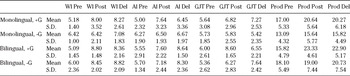
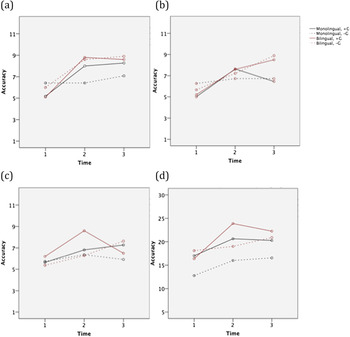
Descriptive statistics of performance on the Latin assessments are reported in Table 3 and Figure 2. All four tests showed main effects for Time, indicating that participants’ performance changed as a result of treatment: for WI, F(2, 78) = 37.01, p < .001, η p 2 = .49; for AI, F(2, 74) = 15.49, p < .001, η p 2 = .30; for GJT, Footnote 7 F(2, 68.44) = 4.97, p = .010, η p 2 = .11; for Production, F(2, 68) = 25.28, p < .001, η p 2 = .43.
Descriptive statistics of accuracy on Latin assessments

Note. +G = with grammar explanation, -G = without grammar explanation, S.D. = standard deviation, WI = written interpretation, AI = aural interpretation, GJT = grammaticality judgment, Prod = production, Pre = pretest, Post = immediate posttest, Del = delayed posttest. WI, AI, and GJT had maximum possible scores of 12. Production had a maximum possible score of 30.
Mean accuracy on Latin assessments.
Note. (a) Written interpretation, (b) Aural interpretation, (c) Grammaticality judgment, (d) Production. Time 1 = pretest, Time 2 = immediate posttest, Time 3 = delayed posttest; +G = with grammar explanation, -G = without grammar explanation.

Interactions between Time, Language Group, and Condition
WI and AI did not show significant three-way interactions, so those tests will be discussed in terms of their two-way interactions only.
Although gains on the GJT were small, the interaction between Time, Language Group, and Condition was significant, F(2, 78) = 3.42, p = .044, η p 2 = .08. One-way ANOVA follow-ups at each testing time showed no significant differences between the four groups, although the effect approached significance at the immediate posttest, F(3, 40) = 2.36, p = .086, η p 2 = .15. Visual inspection shows that the Bilingual, +G group scored higher than the others at this testing point (see Figure 2). Tukey’s contrasts confirmed that the comparison between Bilingual, +G and Monolingual, -G groups approached significance at immediate posttest, p = .073, mean difference = 2.77, 95% CI = -.18, 5.71. All other pairwise comparisons were nonsignificant; ps > .10.
On the Production test, the Time × Language Group × Condition interaction approached significance, F(2, 68) = 3.05, p = .054, η p 2 = .08. The medium-large effect size suggests that the interaction would be significant with greater statistical power. Follow-up one-way ANOVAs revealed a significant effect of the four groups at the immediate posttest, F(3, 37) = 2.93, p = .046, η p 2 = .19. At immediate posttest, the Bilingual, +G group outperformed the Monolingual, -G group, p = .033, mean difference = 7.70, CI = .48, 14.92; all other comparisons nonsignificant, p > .10. At the delayed posttest, the effect of group approached significance, F(3, 39) = 2.63, p = .063, η p 2 = .17. Again, the Bilingual, +G group marginally outperformed the Monolingual, -G group only, p = .047, mean difference = 7.08, CI = .07, 14.09; all other comparisons, p > .10.
Interactions between Time and Condition
Significant interactions of Time and Condition were found on the WI and production tests only. Follow-up one-way ANOVAs showed a significant effect for Condition on the WI at pretest only, F(1, 42) = 5.37, p = .025, η p 2 = .11, such that participants in the -G group scored higher than those in the +G group at that testing time, mean difference = 1.09, CI = .14, 2.04.
Follow-up one-way ANOVAs on Production, in contrast, showed a significant effect for Condition at the immediate posttest, F(1, 39) = 6.01, p = .019, η p 2 = .13, with the +G group outperforming the -G group, mean difference = 4.61, CI = .81, 8.42. The same effect approached significance in the same direction on the delayed posttest, F(1, 41) = 2.98, p = .092, η p 2 = .07, mean difference = 3.25, CI = .55, 7.05. Taken in conjunction with the three-way interaction reported in the preceding text, the +G advantage in Production seems to be carried by the Bilingual, +G group.
Interactions between Time and Language Group
On the WI and AI only, Time significantly interacted with Language Group without also interacting with Condition. Follow-up one-way ANOVAs on the WI immediate posttest showed an effect for Language Group that approached significance, F(1, 42) = 3.88, p = .056, η p 2 = .09, with the Bilingual group outperforming the Monolingual group, mean difference = 1.45, CI = .04, 2.93. At pre- and delayed post-tests, this contrast did not approach significance; ps > .10. On the AI, follow-up ANOVAs showed nonsignificant effects of Language Group at pre- and immediate post-tests, but the effect was significant on the delayed posttest: F(1, 42) = 7.36, p = .010, η p 2 = .15, mean difference = 1.91, CI = .49, 3.33. Again, the significant difference consisted of Bilinguals outperforming Monolinguals.
In sum, results showed changes in learners’ accuracy over time. The roles of bilingualism and instructional condition in determining changes in accuracy over time varied by test modality and cognitive demands. For tests that required transfer of knowledge (GJT and Production), the Bilingual, +G group tended to be advantaged. This pattern also appeared for the +G group overall in Production, but likely was carried by the Bilinguals in that group. The other overall effect for the +G group, on the WI, was limited to the pretest and as such will not be discussed further, as it is not an effect of the treatment. Finally, for tests that drew on interpretation, a skill practiced during treatment (WI and AI), bilinguals had advantages over monolinguals that did not depend on the type of instruction. However, the timing of this advantage (at immediate or delayed posttest) depended on the modality of the test.
DISCUSSION
This study aimed to expand research on language learning in aging adults, as well as to diversify research on interactions between learner-internal and -external variables. To do so, I empirically investigated differential learning outcomes in monolingual and bilingual older adults learning novel morphosyntax with more or less explicit information because it was the explicitness that varied. Results demonstrate that across levels of language experience and types of instruction, healthy, educated older adults were able to change their processing strategies for assigning thematic roles from L1- and L2-based strategies to new, more effective strategies in the TL. Importantly, this change was largely maintained two weeks following no exposure to the TL, indicating retention of the new processing cue. These results are encouraging for older adults who may be curious about language learning, but intimidated by the perceived difficulty of the venture (Cox, Reference Cox, Sanz and Lado2013).
Beyond simply confirming that the effects of cognitive aging do not prevent older adults from learning a novel language, this study also investigated whether in older age, experienced language learners are more successful than monolinguals, and whether success is dependent on the instructional condition, specifically, an interactive grammar lesson prior to meaningful practice. Three broad findings emerge from the results: (a) provision of EI in a pre-practice grammar explanation did not disadvantage older adults—indeed, it had little overall effect; (b) when EI did affect performance, it yielded an advantage for bilinguals but not monolinguals; and (c) in addition to advantages particular to bilinguals with EI, there were other advantages for bilinguals compared to monolinguals regardless of type of instruction. Each of these findings is discussed in detail in the following text in relation to the language skill (interpretation, grammaticality judgment, production) and modality (written, aural) in which it manifested.
Minimal Effect of Explicit Instruction
Contrary to results from the limited previous research on interactions between aging and type of instruction (Lenet et al., Reference Lenet, Sanz, Lado, Howard, Howard, Sanz and Leow2011; Midford & Kirsner, Reference Midford and Kirsner2005), the present study shows that provision of EI does not necessarily disadvantage older adults; indeed, in the current case it had little overall effect. Where it did have an effect, in the production test, receiving the grammar explanation conveyed an advantage, specifically for bilinguals, and therefore will be discussed in greater detail in the following subsection. The discrepancy in findings is likely due to differences in the treatment: Participants in Midford and Kirsner’s study learned an artificial grammar, which had no meaningful referents and therefore could not include task-essential practice. Participants in Lenet et al. (Reference Lenet, Sanz, Lado, Howard, Howard, Sanz and Leow2011) received EI in the form of feedback, rather than before practice, which is naturally more disruptive and time constrained, thereby likely problematic for older adults affected by the reduced WM capacity and poorer inhibitory control that come with aging (Cox & Sanz, Reference Cox and Sanz2015).
By contrast, this finding parallels that of studies with young adults, at least those that used task-essential practice (Sanz & Morgan-Short, Reference Sanz and Morgan-Short2004; Stafford et al., Reference Stafford, Bowden and Sanz2012) as opposed to non-task-essential, less meaningful practice (e.g., Tolentino & Tokowicz, Reference Tolentino and Tokowicz2014): With task-essential practice, EI generally is not required for significant learning to occur. Nevertheless, provision of EI aids the transfer of skills from input-based practice to production tests; as suggested by others, perhaps the novel task of selecting the form to express a meaning, rather than interpreting given forms, prompts metalinguistic reflection (Lado et al., Reference Lado, Bowden, Stafford and Sanz2014; Stafford et al., Reference Stafford, Bowden and Sanz2012). Generalizing across studies, then, older adult language learning seems to be fundamentally similar to that of young adults: When practice is task essential and thereby pushes formation of form-meaning mappings, having EI does not advantage or disadvantage learners except in the development of production skills. An anonymous reviewer noted that this might be due to the nature of the EI (following Processing Instruction guidelines), in addition to the task-essentialness of the practice. This may be true for older adults because EI in the form of explicit feedback seems to be detrimental to learning (Lenet et al., Reference Lenet, Sanz, Lado, Howard, Howard, Sanz and Leow2011) whereas EI in a pre-practice grammar explanation did not have a negative effect (the current work), although clearly more research is needed in the area to replicate these findings. For young adults, though, the operationalization of EI does not seem to change the result: EI in feedback does not affect learning any more than pre-practice grammar explanation (e.g., Lado et al., Reference Lado, Bowden, Stafford and Sanz2014; Sanz & Morgan-Short, Reference Sanz and Morgan-Short2004).
Advantages for Bilinguals with Explicit Instruction
While there were no meaningful effects for more or less explicit conditions overall, in two cases, bilinguals who received EI seemed to have a particular advantage. Specifically, this was true of written production, and to a lesser extent, making grammatical judgments. Notably, both of these were skills that were not practiced during treatment. Production abilities in particular have been noted to indicate “non-negligible language change” when following practice that did not include production (Wong, Reference Wong and VanPatten2004). If, as suggested previously, transferring processing cues from input-based practice to an output-based test encourages learners to reflect on any metalinguistic knowledge they have developed, then it is not surprising that bilinguals, who tend to have greater metalinguistic abilities (Cenoz, Reference Cenoz2013) should be particularly advantaged. GJTs may also lead learners to draw on metalinguistic knowledge, even when they are instructed to respond as quickly as possible, as was the case here. Previous research has also found an advantage for young adult bilinguals in an explicit condition (operationalized as explicit feedback), although in that case, the advantage was greater in the less explicit condition (Lado, 2008). The difference in findings may be due to the difference in age or to the different operationalization of explicitness. For instance, because older adults began their L2 study decades prior to testing, it is likely that their L2 instruction was very much form focused, even more so than traditional instruction that today’s young adults might receive. Extensive prior experience with form-based instruction could lead older bilinguals to benefit from grammar explanation more than young adult bilinguals might. Future reports on bilingual effects in young adults with prepractice explanations can help elucidate this issue.
In terms of production, Figure 2 clearly shows the superior performance of bilinguals who received EI and the inferior performance of monolinguals who did not receive EI, an effect that was significant at the immediate and delayed posttests, replicating a finding from Stafford et al. (Reference Stafford, Bowden and Sanz2012) with young adults. As the only output-based test following input-based practice, production requires a transfer of skill greater than that of the GJT, which is still receptive. It is perhaps because of this that not only an explanation of the grammar rules but also prior language-learning experience was necessary for significantly superior gains to obtain (and gains were only significantly superior to those of the group with neither rule explanation nor bilingual experience). In other words, grammar explanation was less useful to monolinguals, because they seem to not have the skills, probably metalinguistic in nature, needed to make use of it. That the difference was maintained two weeks after practice shows that the advantage bilinguals experience is lasting.
In sum, advantages in transferring skills were found only for bilinguals who received EI, and only in comparison to monolinguals did not receive EI. This suggests that there is an intersection between EI and bilingualism, such that the processes learners tend toward after exposure to EI are enhanced by bilingualism (DeKeyser, Reference DeKeyser2012). It is likely that this effect is specific to the type of bilingual experience, that is, late, classroom-instructed L2, because such exposure and learning is often more explicit than implicit.
Advantages for Bilinguals Regardless of Type of Instruction
Overall, bilinguals showed advantages in interpretation in both modalities (written and aural), regardless of whether they had EI. This is in line with general bilingual advantages for young adults when learning additional languages (Brooks & Kempe, Reference Brooks and Kempe2013; Sanz, Reference Sanz2000, Reference Sanz, Pérez-Vidal, Juan-Garau and Bel2007; Swain et al., Reference Swain, Lapkin, Rowen and Hart1990) and extends the finding to an older adult bilingual population.
In addition to drawing on skills practiced during treatment, WI and AI are also similar in that the learner’s task is to decode meaning from forms provided to them (Stafford et al., Reference Stafford, Bowden and Sanz2012). However, they differ in modality and thus in task demands. AI is the more challenging task because of its inherent memory demands: participants listen to a sentence, hold it in memory, and then select between two competing photos. In contrast, when interpreting a written sentence, the sentence remains on the screen while participants make their selection, lessening the memory load. That the bilingual advantage in WI was not maintained over time could be due to practice effects: Because WI was the less demanding interpretation task, experience with the tests allowed monolingual participants to approximate the performance of bilinguals following a period in which consolidation may have occurred (Batterink, Oudiette, Reber, and Paller, Reference Batterink, Oudiette, Reber and Paller2014). At the same time, the high cognitive demands of AI initially prevented bilinguals from showing an advantage, but over time, their performance improved where monolinguals’ did not seem to be able to do so.
Limitations and Future Research
The findings presented here are informative for the population from which the sample came: educated, active older adults, a population that is likely interested in language classes. In the case of bilinguals, findings extend to those bilinguals who learned their second language as older children or adults. Future research should continue to include less educated older adults, as in Mackey and Sachs (Reference Mackey and Sachs2012). Additionally, although these results indicate that EI is largely unnecessary for older adult learners, many participants who did not receive EI commented that they felt lost without it. Therefore, practitioners need to be aware that older adult learners may be expecting grammar explanations. Practitioners could and should demonstrate to older learners that they are able to learn without additional explanation, which would also increase students’ self-confidence in their progress (which many participants also reported lacking). Correspondingly, older adults who have become accustomed to an inductive style of learning may show even greater gains than the ones shown here. Finally, although the sample size here was not large, and as a result, 95% confidence intervals of three-way interactions were wide, the sample size was determined by an a priori power analysis and is in line with much SLA research, especially that of older adults.
CONCLUSION
Older adult participants interacted with a computer program to learn novel morphosyntax and showed significant gains in accuracy in tasks that required interpretation (written and aural), grammaticality judgment, and production (written). Often, the gains were maintained after two weeks of no additional practice or exposure. Contrary to common beliefs connecting aging and inflexibility, results indicate that older adults are able to adjust processing strategies from their known language(s) to those of a novel language. Despite predictions from cognitive psychology and two SLA studies (Lenet et al., Reference Lenet, Sanz, Lado, Howard, Howard, Sanz and Leow2011; Midford & Kirsner, Reference Midford and Kirsner2005), older participants who received EI prior to practice were not disadvantaged compared to those who did not receive such instruction. In fact, older bilinguals who received EI had advantages on GJT and production tests, similar to findings with young adults on tests that require transfer of skills (e.g., Stafford et al., Reference Stafford, Bowden and Sanz2012). Additionally, regardless of instructional condition, bilinguals showed an advantage over monolinguals in interpretation, suggesting that task-essential practice, not grammar explanation, is the driving force in older adult language learning. This has previously been seen in studies of young adults and suggested by older adult researchers (Cox & Sanz, Reference Cox and Sanz2015). In addition, the facilitative effect of bilingualism on learning a new language, attested in young adults who learned L2 through instruction and after early childhood (Lado, 2008; Stafford et al., Reference Stafford, Sanz and Bowden2010) is also present in older adults with similar language backgrounds.
This study makes significant contributions to SLA by expanding the scope of research to include older adults and bilinguals, where traditionally research is focused on young adult monolinguals. It bolsters the nascent research on older adult learning by adopting the tried-and-true paradigm of interactions between internal and external variables. Older adults’ overall success at learning complex and novel morphosyntactic patterns yields important implications for older adult classrooms and counters negative stereotypes of aging in society. Additionally, this study reinforces previous research by demonstrating that bilingual advantages in language learning continue through the lifespan.