Introduction
In the winter of 1893, Liu Chang-chun, owner and keeper of the largest inn in Yanghuaji, a village near Suqian in the poor northern part of Jiangsu province, was brought to the grand Customs House in Tianjin by a messenger sent by the Tianjin customs commissioner, Gustav Detring (1842–1913). Detring, faced with increased volumes of mail, wished to improve the mail service by instituting a change from couriers travelling by mule and horse to a cart relay service, and he needed to obtain the agreement of the innkeeper.
Liu Chang-chun, like his father before him, worked closely with Customs mail couriers in the winter season, providing animals and other necessary support. Suqian was right on the old Yellow River trading route, one of the most important stops for the Chinese Maritime Customs Service's winter mail couriers between Tianjin and Zhenjiang, a large town by the Yangtze River.
Liu and the messenger travelled for more than 10 days in order to reach Tianjin, where he stayed for nearly two weeks. During this period there were several meetings with the commissioner. During these meetings, Detring found he had difficulty in comprehending Liu's attitude towards the proposition he had made to him. Only towards the end did Liu make his views clear: he did not like the new proposal, as his profits would be reduced.
After receiving this answer from Liu, the Tianjin commissioner consulted with the head of his Chinese couriers, who confirmed that in order to make the planned changes to the area's postal arrangements, the innkeeper's cooperation as a source of animals and equipment would be essential. In the end Detring had to report to his superior, Robert Hart (1835–1911), the inspector general of the Chinese Maritime Customs Service, that changes in the postal route would need to be postponed.Footnote 1
Two years later, Francis Aglen (1868–1932), by then acting commissioner of Tianjin Customs (he later succeeded Hart as inspector general), revealed how the growth in mail volumes had been managed on what was now a network extending over 1,000 kilometres. Instead of cutting innkeeper Liu out of the business, the Tianjin Customs had begun to work even more closely with him to ensure their couriers received good supplies. Customs-appointed contractors also had a good relationship with Liu, so a tacit arrangement was reached allowing a cart to be used from time to time for heavy mail, without any formal agreement between the Tianjin Customs House and the inn.
The reality was that the Tianjin customs commissioner had no choice but to collaborate with Liu. The network relied on his good relationships with other inns along the route, which helped by replacing animals or couriers who had to stop en route due to sickness. Thanks to the connections with Liu and other innkeepers, Aglen stated that mail deliveries were satisfactorily conducted, and couriers were seldom molested on their journeys.Footnote 2 This situation, however, also meant that it was almost impossible for the Great Qing Imperial Post Office (Imperial Post Office hereafter) to undertake any experiments or initiatives if influential local people disagreed. Hence Aglen concluded that although the collaboration was necessary, it also enjoined a mode of operation that left the Customs’ postal operation, and consequently the Imperial Post Office, ‘almost entirely at the mercy of the contractor, and his friend’.Footnote 3
This experimental winter postal service, which ran between Beijing and the major five treaty ports in the North between 1878 and 1896, was the forerunner of the Imperial Post Office. Although this service was open to the general public—and its creation and running enabled the Chinese Maritime Customs Service to develop essential knowledge in postal matters—it did not manage to make a great impression on Chinese people.Footnote 4 In April 1896, soon after the conclusion of the First Sino-Japanese War, and 30 years after Hart's first recommendation that such a service be established, an Imperial Edict establishing the Imperial Post Office was finally issued. The challenge facing the Chinese Maritime Customs Service—the transformation of a geographically restricted winter postal service into an institution available throughout the world's most populous nation—was enormous and unprecedented. Aglen's conclusion above illustrates the central problem in the creation of a modern postal service in China: the provision of sufficient resources in transportation and logistics. The ‘soft’ approach required when dealing with local interests highlighted the main question in the early life of this new institution: how was the Imperial Post Office to achieve the necessary scale to become a truly national service? The response to this problem would decide whether it would thrive, or whether it would descend into irrelevance for ordinary people.
Recent studies on the history of the Chinese Maritime Customs Service, such as Catherine Ladds’ Empire Careers: Working for the Chinese Customs Service, 1854−1949; Hans van de Ven's Breaking with the Past: The Maritime Customs Service and the Global Origins of Modernity in China; Chihyun Chang's Government, Imperialism and Nationalism in China: The Maritime Customs Service and its Chinese Staff, and Donna Brunero's Britain's Imperial Cornerstone in China: The Chinese Maritime Customs Service, 1854–1949, have all successfully explored the hybrid quality of the Chinese Maritime Customs Service, particularly in terms of the mixed Chinese and foreign composition of its staff, its handling of bureaucratic procedure, and its efforts in maintaining a balanced relationship between its Chinese sponsors and the interests of foreign diplomats in China.Footnote 5 Building on this scholarship, this article explores how the Imperial Post Office came to find its own path separate from that of the Chinese Maritime Customs Service which created it. This was a necessary development, not only due to the Imperial Post Office's rapid growth (it quickly overtook its parent organization in size as it expanded beyond coasts and river deltas into the Chinese interior), but also because its primary purpose was very different: its role was to serve the whole of the Chinese population rather than just those individuals, companies, and officials concerned with foreign trade. The disagreement between the Tianjin commissioners of the Chinese Maritime Customs Service and the innkeeper Liu therefore can be seen to represent this fundamental distinction in nature between the Chinese Maritime Customs Service and the Imperial Post Office. From its earliest days, the Imperial Post Office was much more heavily reliant on the cooperation of local interests; indeed, its very success relied on its becoming a fully localized service, accepted by individual communities across China.
In order to root this new organization effectively, the Imperial Post Office adopted three critical strategies. First, incorporating the existing, privately run native letter hongs, and making use of their extensive distribution networks to facilitate delivery of inland mail.Footnote 6 Second, a focus on what today would be called ‘branding’: emphasizing the Imperial Post Office's Chinese credentials and character both to drive the general public to use the service, and to encourage local officials to collaborate in the creation of post offices and delivery networks. And third, enlarging national postal networks in parallel with the developing railway network, principally through putting pressure on the railway companies to agree exclusivity in the carriage of mail. The Imperial Post Office succeeded in acquiring a monopoly in the use of rail for postal deliveries, which in turn allowed it to differentiate itself from the native letter hongs.
As we will see, much of the preparation for the launch was carried out by two distinct groups, with high-ranking foreign staff of the Chinese Maritime Customs Service making critical decisions and setting up the framework for the new organization, while senior Chinese clerks were the Imperial Post Office's ‘face’, managing services from local branches. With a mission to promote modernization and project Qing power, the Imperial Post Office was established with a centrally controlled set of unified methods and procedures, and its success was rooted in integration with the new railway network. Despite the challenges it faced, it not only thrived in its early years, but came to outlive the Qing empire, continuing to expand after the 1911 Revolution. This article, in alignment with the other two articles in this Forum which explore communication networks in late nineteenth and early twentieth century China, seeks to uncover the untold story of the early history of Chinese Post Office through an examination of the Imperial Post Office's rationale and practice.
Native letter hongs
Right from the moment of its creation, the Imperial Post Office faced competition from both foreign postal services in the treaty ports, and from the pre-existing Chinese postal establishment. The relationship between the Imperial Post Office and the foreign mail services had little impact on the expansion of the former's activity in inland China, as foreign mail services typically only focused on the treaty ports, and they were not much used by the Chinese, either; this aspect is not the focus of this article. What was much more delicate to manage—and also critical to the Imperial Post Office's inland expansion—was the relationship with the native letter hongs.
On the Chinese side, there were two systems for transmitting mail: the Imperial Relay Service (I-zhan), and the native letter hongs. The Imperial Relay Service had a long and distinguished history, dating back to the Qin dynasty (BCE 221–207). It played a vital role in transmitting important information between the central governments and local officials.Footnote 7 In the Qing period, the Imperial Relay Service remained exclusively a service for governmental communications, so ordinary people sent their communications either in the care of travelling acquaintances or, later, through native letter hongs. In fact, the establishment of the government-owned Imperial Post Office meant that the writing was on the wall for the Imperial Relay Service, which was finally abolished in 1911 due to its inefficiency and notorious corruption.Footnote 8 As for the native letter hongs, their future was not an issue that could be resolved by central edict, as they were privately owned and their existence had a bearing on the livelihood of many common people.Footnote 9 Both Hart and the Zongli Yamen, the supervising body for both the Customs and the Imperial Post Office, decided to manage this issue with care and patience. To understand why this was necessary, a brief discussion of the native letter hongs is helpful.
The term ‘native letter hongs’ is something of a catch-all for postal services run by private, often family-owned, Chinese organizations. Their operations varied in practice, and they also labelled themselves differently according to their chosen mode of operation.Footnote 10 It is difficult to pin down exactly when the native letter hongs first came into existence. They gradually evolved to match the expansion of both populations and commercial activities. Some secondary sources suggest the period of the Ming dynasty (1368–1644).Footnote 11 This assumption is based on notable recorded growth in commercial activity, together with improvement in print technology in this period, which allowed social elites and merchants to cultivate their tastes in art, socializing, leisure, tourism, and literature. All of this indicates a leap in the exchange of commodities, ideas, and money.Footnote 12
In his study of commerce and culture in Ming China, Timothy Brook draws a sketch in which people exchanged letters, money orders, and parcels over various distances in a variety of circumstances. Using the correspondence of two Chinese scholars with their families in the late sixteenth and early seventeenth centuries, Brook illustrates how commercial networks played an important role over long distances, whereas servants delivered messages and goods locally. It was common to rely on personal acquaintances to take news and local delicacies to distant family members, or back to families in home villages. Brook also cautiously links piaohao (literally ‘ticket agencies’, which functioned as traditional banks) in the late seventeenth century with commercial mail services.Footnote 13
Despite these clear indications that reliable communications channels existed, no further evidence has yet been uncovered regarding the means and routes of mail dissemination, nor of the organizations involved. Therefore we cannot be certain whether there was any sort of regular postal service for the general public in this early period. However, thanks to the survival of several sets of family correspondence between travelling merchants and their families in the Huizhou area in the southern Anhui province, we have some useful information on the availability of mail services for ordinary people during the reigns of emperors Qianlong (1735–1796) and Jiaqing (1796–1820). Among the current available historical evidence, the Wang Tengjiao correspondence in particular provides good insights into mailing practices at this time. The Wang family lived in Shexian in southern Anhui province, and the correspondence that survives was written between the 1770s and 1820s. Wang was the eldest son, and like many local men, he did business elsewhere and left his wife and children at home with his mother. From his letters, we see that family members entrusted one or two regular messengers to deliver letters and light parcels between Shexian and Yangzhou and Changshu (both in Jiangsu province), where Wang was a manager of several pawnshops.Footnote 14
Evidence that the same few trusted faces were regularly used to deliver mail can be found in a letter from Wang Tengjiao to his mother, which states that he had given money and small presents to an acquaintance named Zhu to bring to her.Footnote 15 Zhu, known to both son and mother, was named in the letters as a regular messenger travelling between these two places. In the gaps between Zhu's visits, Wang sometimes used whoever was available to carry out this task. For example, in other letters to his mother Wang wrote that he had grasped the opportunity of spotting a ‘bianzu’ (literally someone ‘fleet-footed’), and quickly made up mail and parcels to send home.Footnote 16
Wang's response to seeing a ‘fleet-foot’ suggests that even in Yangzhou, a very prosperous town by the lower Yangtze River, there were no established native letter hongs operating from a shop front in his time. Thanks to his situation, Wang presumably had good information on ways to send messages and parcels, but none of his correspondence mentions native letter hongs. Where transmission methods are discussed, the letters demonstrate that people sent mail in the care of individuals, most likely self-employed messengers who regularly travelled between two fixed locations across relatively short distances that could be reached within 10 to 14 days.
Soon after, the function of a ‘fleet-foot’—more politely referred to as a ‘xinke’ (messenger)—evolved into a formalized system, with evidence for the existence of letter hong services starting to appear between the 1820s and the early 1850s (before the Taiping Rebellion), in response to increased demand for fast communication between ever more distant geographical areas. A number of factors drove the need for a more formalized system. The first was the expansion in China's population, which increased very rapidly in this period.Footnote 17 Particularly significant growth was concentrated in several southern provinces, including Jiangsu, Zhejiang, Anhui, and Canton.Footnote 18 This growing population put pressure on rural economies, and coincided with the greatly increased volumes of trade that accompanied the opening of treaty ports. All of these developments provoked unprecedented levels of migration and social exchange.Footnote 19
Zheng Hui, a historian of the modern Chinese postal service as well as a philatelist, has worked to resolve the puzzle of the origin of the private letter hongs for the past 30 years. He has examined surviving mail covers, letters, and franking marks, and also found a large stone plate lying neglected in the yard of Tianfeng Tower in Ningbo. One of the first five treaty ports opened after the First Opium War, Ningbo was a logical early location for a native letter hong due to the large number of travellers and traders in the area. The stone plate, roughly two metres high and 78 centimetres wide, was erected in 1844 (Daoguang emperor year 24, as inscribed on the stone). This plate was initially placed inside the local City God Temple, situated in the heart of the city, and was moved to Tianfeng Tower some time during the 1990s. This stone plate served as an order issued by the Ningbo Prefect to prohibit other letter hongs and local factions from hijacking the mail business of the Tongyü letter hong (Tongyü xinyü), which provided mail services between seven cities across three provinces: Ningbo, Hangzhou, Shaoxing, and Wenzhou (all Zhejiang province), Suzhou (Jiangsu province), and Fuzhou (Fujian province).Footnote 20 While no other historic artefacts have yet come to light to provide definitive confirmation for letter hongs at earlier dates, this stone plate provides a definitive date by which native letter hongs were indisputably in existence.
In a report on hongs in Ningbo in 1928, there were 12 of them in the city (against 30 in the whole of Zhejiang province), and they operated 209 branches in other places within and beyond Zhejiang province. The history of these hongs was varied, and some of them can be traced back between 80 and 100 years.Footnote 21 The operations of those 12 hongs in Ningbo, with more than 200 branches, are just one of many examples across China. For places that were too deep in the interior to warrant the setting up of branches, hongs hired one or more runners to provide a service, and persuaded local shops to let the hongs hang up signboards.Footnote 22
Based on the evidence from the sources we have available, the main characteristics of the native letter hongs can be drawn as follows.Footnote 23 First of all, they were privately funded, and had a headquarters and branches through which they accepted mail items from the public (many also collected from people’ homes). A second characteristic was a clear division between departments, involving separation between ‘shop’ functions and transportation—most involved in the latter owned their own means of transport, which could include boats and animals—and all had clear procedures for receiving and dispatching mail, issuing receipts, for bookkeeping, and for insurance. These procedures would include a recognizable system of stamps together with franking marks on the backs of envelopes. Third, from the examples in Ningbo and Nanjing discussed above, they had reliable networks.Footnote 24 Besides having their own regular delivery schedules, they made arrangements with water transportation companies to carry mail on regular schedules. Their branches in other counties and provinces typically worked in collaboration with other letter hongs to ensure broader geographical coverage and faster delivery, with formal agreements and contracts in place as well as standardized franking marks.Footnote 25 A final, important characteristic was a system of standardized fees according to distance. The fee might be paid by the sender, the addressees, or by both parties, while bills could be settled annually before the Chinese New Year.
By the time the Imperial Post Office was conceived, therefore, the private letter hongs made up a thriving industry. The two most successful Chinese newspapers at the time—Shenbao and Xinwenbao—relied on hongs to bring their newspapers from Shanghai to their readership beyond the city.Footnote 26 We also know that officials and intellectuals regularly relied on hongs to deliver their private correspondence, as hongs’ names often appeared in their diaries.Footnote 27 Hart was not ignorant of the hongs’ importance: in the same breath as he announced the creation of the Imperial Post Office, he asked his commissioners at treaty ports to be sensitive to the feelings of those running the hongs. He warned that the steps taken by the Imperial Post Office should be made carefully, in order to avoid direct confrontation with these well-established organizations. Referring to China as a ‘populous, industrious, and letter-loving’ country, he wrote:
. . . [new] procedures will be so planned as to avoid friction in respect of whatever might hurt deserving people's livelihoods by unnecessary interference with existing institutions or embarrass and occasion difficulties for officials and governments.Footnote 28
After waiting and lobbying for more than 30 years to be given the task of setting up a national post office, Hart wanted to introduce this new system quietly and develop it slowly. This approach might seem to contradict the keenness of his attitude of the previous three decades, but he gave three reasons: first, avoiding over-burdening the Customs staff too much at the outset, as they were the only available human resource at this point in establishing the new system; second, building up knowledge of running a postal service while doing it; and third, refraining from all unnecessary expenditure, as the Customs was also responsible for financing the Post Office.Footnote 29 However, there was another reason for caution which Hart did not communicate openly: he was aware that France wanted to control the Post Office once it was up and running, and the Zongli Yamen had agreed to this in 1898 at the height of the so-called Scramble for China.Footnote 30
Behind the scenes, neither Hart nor his core team for postal affairs had quite figured out what to do about the hongs at this early stage. In this context, one of Hart's priorities was to pacify likely opponents and avoid complaints, particularly petitions that might reach the Zongli Yamen and the Qing Court. The commissioners of Customs at the treaty ports were constantly reminded not to do anything that might provoke the locals, and were simply instructed to do surveys on the hongs in their districts.Footnote 31 For the first two years, the Imperial Post Office mainly focused on establishing accounting procedures and other financial matters, setting postage rates, and training and recruiting staff, particularly Chinese.Footnote 32 As for the hongs, they merely encouraged those who transmitted mail between treaty ports to register with the Imperial Post Office. But the hongs whose service was inland or beyond the area of the treaty ports were left to run their businesses as usual.
In hindsight, Hart's strategy for the new institution seems to have worked, for soon afterwards, some local elites expressed a wish to have the Imperial Post Office come to their areas, a development that went hand in hand with the winding down of the Imperial Relay Service. The Zongli Yamen ordered Hart to speed up the expansion of the postal networks and to prepare to take over the workload of the Imperial Relay Service in most provinces, including Yunnan and Tibet.Footnote 33
Despite the lack of either central financial support or of experienced men with professional knowledge of managing a postal system, the Imperial Post Office nevertheless gained support from the top, as well as from some influential local elites and provincial governors, such as Zhang Zhidong (1837–1909) and Liu Kunyi (1830–1902).Footnote 34 There were differing reasons for this support: support from local elites reflected their wider support for the ideals of modernization, whereas the keenness of the central government stemmed from hopes of a fresh revenue stream. Hart wrote: ‘Meantime the Yamen is urging me to push on with Postal extension, Stamp-duties, etc: but is not even giving me the soap with which to blow the bubbles.’Footnote 35 Still, it was certainly better to be wanted and welcomed than the other way round; and building on this, the Imperial Post Office started its expansion beyond the treaty ports.
China's Post Office
The ultimate goal of the Imperial Post Office was to forge for itself an identity and a role as a postal service for all Chinese people. Now that the Imperial Post Office was receiving positive recognition for its work in the treaty ports and Beijing, and was being urged by the central administration to expand, its next step was to move into the interior and promote itself to the wider general public. Given the nature of this ambition (and the somewhat contradictory impact of its origin and status as a foreign-run organization), the immediate challenge it faced was how to create a sense of its Chinese character in society at large. This question of the nature of the Imperial Post Office was certainly raised by its contemporaries; there was a mixed perception of the Imperial Post Office among the general public at this early stage in its existence: some had heard of the institution and welcomed its arrival, but many were not even aware of its existence, or they believed it to be a mail service for foreigners. Promotion of the Imperial Post Office outside the treaty ports therefore had to deal with an element of confusion: was the new Post Office foreign or Chinese? And was it a state-run institution for the whole of China, or merely another innovation principally associated with the treaty ports?
Both Hans van de Ven and Chihyun Chang have explored the shifting nature of the Chinese Maritime Customs Service, from an essentially ‘foreign’ institution at its inception, to one that became a more and more properly Chinese institution.Footnote 36 But early on, suspicion of the Customs was very much in vogue. Catherine Ladds’ study of the careers of foreign Customs officials in China illuminates the gap between the Customs’ ethos and individuals’ interests. Mindful of this issue, and anxious about its potential consequences, Hart constantly reminded his subordinates that they worked for the Qing government. He insisted foreign employees were ‘China servants’ of a ‘special kind’, and hoped that these servants of the emperor would show themselves to be representatives of a new kind of modern, efficient bureaucratic class.Footnote 37 The fundamental conflicts between loyalty to China and the self-identity of the foreign employees did lead to problems with the perception of the Customs, particularly in the late nineteenth century when ‘nationalist feeling was running high’.Footnote 38 These observations on the history of the Customs can also be applied in many ways in order to understand the hybrid nature of the Imperial Post Office. However, while the Customs mainly focused on the works in the treaty ports, the Imperial Post Office had to expand into the interior from an early stage. In consequence, the question of the relationship between the Imperial Post Office and inland local administrations was even more important.
In Fei Xiaotong and Wu Han's work on the structure of traditional Chinese society, the bureaucracy and local gentry were positioned between the emperor and the common people. The emperor did not talk to either the local gentry or common people directly, but through the bureaucracy, who were his servants and the executors of his will. The relationship between the bureaucracy and the gentry was complicated as the groups were deeply intertwined with one other, the common thread being the examination system. Between them, these prestigious groups controlled knowledge, public opinion, land, and wealth. In this structure, if an emperor did not have the support of both the bureaucracy and local gentry, his legitimacy was threatened.Footnote 39 Fei and Wu’s observations on the social mechanisms underpinning Chinese society are useful in understanding the Imperial Post Office's experience as it expanded into inland counties.
In principle, the Imperial Post Office staff, from the top leadership to the workers on the ground, saw themselves as employees of the Qing government, empowered to carry out the state's policies. For example, when Hosea Ballou Morse (1855–1934) was sent to Longzhou in Guangxi province to open a new Customs station and the Post Office in 1896, in his first few meetings with the local officials, he reinforced his status as part of the bureaucratic system of the Qing empire, and emphasized that the business of the Post Office was indeed the concern of the whole empire.Footnote 40 Morse's position of aligning his own professional identity with the postal service was echoed by J. P. Donovan (1852–1938) a few years later when he went on a tour to inspect postal work in the Yangtze River region. From his more detailed records, we can see how the Imperial Post Office tried to break through the barrier of local suspicion in order to shape its image as a properly Chinese organization.
Donovan joined the Customs service from a poor Catholic family in East London, first travelling to China in 1873 at the age of 21 and rising swiftly through the ranks. In 1900, he was ordered to take a tour to inspect postal services between Hankou and Hangzhou, in the role of inspecting deputy.Footnote 41 Travelling predominately by boat, he encountered both positive and negative responses from the local officials and people. Although the Chinese governors at the treaty ports issued proclamations intended to inform the locals that the new Post Office was indeed opening under Imperial sanction, the perceptions of people inland were slow to change, in contrast to attitudes at the treaty ports.Footnote 42 Donovan's mission had two goals: to inspect the existing postal branches, and to evaluate new places to open branches. Through his ability to speak good Nanjing-tone standard Chinese, as well as Shanghainese and a few other local dialects, Donovan was also able to communicate with locals and gained first-hand information by wandering on the high street and spending time in teashops.
After visiting Jiujiang treaty port in north Jiangxi province, Donovan went south to explore whether Nanchang Prefecture ought to be selected as a postal stop. He spent a whole day in the city and felt it was a friendly place. Both people and officials ‘were anxious for the establishment of an Imperial Office’, as the local native letter hongs were not thought to provide an adequate service, and mail was at that time being sent and received via Jiujiang overland without using steam launches. Between Jiujiang and Nanchang, Donovan travelled by steam launches in both directions, a 12-hour one way trip. During the trip, he also noticed a town called Wucheng, which was of substantial size and importance. In the report, he recommended both Nanchang and Wucheng as places where an Imperial Post Office branch should be established.Footnote 43
In his trip, Donovan attempted to call on local officials as much as possible, as he sought explain to them the function of the Imperial Post Office. In many instances, he found out that these officials only possessed a very rudimentary understanding of the national postal service, ‘and some were not aware that it was a Chinese institution owing to its being under foreign control and management’.Footnote 44 For example, when he arrived in Huangzhou Prefecture, 25 miles southeast of Hankou in Hubei province, he was initially not welcomed. Huangzhou was notorious for anti-foreigner feeling, and the local official declined Donovan's request for a meeting. But Donovan persisted, explained the reasons for his visit, and insisted on seeing the city; within a short time, an official chair with four ‘coolies’ was sent to bring him to the Yamen (official residence and office).Footnote 45 The meeting had a happy ending, and the Imperial Post Office soon added Huangzhou as an important stop between Hankou and Jiujiang.
Donovan's experience with this Huangzhou Prefect shows us two things: first, the persistence of the locals in seeing the Imperial Post Office as a foreign-led organization; second, that conflicts between the emperor's central bureaucracy and officials operating at the local level were entirely possible. The initial resistance of both local officials and local people to the central government-backed Imperial Post Office was understandable: while they may have had experience of using native letter hongs, this stamp-using, Western-style postal system would have been quite alien to them. They might also have seen foreigners stationed in the post office acting as supervisors of lower-ranked Chinese staff, thus reinforcing the view of the service as foreign-run.
In each postal district, the customs commissioner at a treaty port was also the postmaster. In an Imperial Post Office sub-office, the managers were often foreigners recently transferred from the Customs Service, either someone already familiar with postal work or from the outdoor staff.Footnote 46 The number of postal clerks varied depending on the local workload. For example, in Hangzhou office in 1901 there was one postal officer (foreign) and seven Chinese clerks. Some of these Chinese clerks had their own specific towns to look after.Footnote 47
From Donovan's reports, we learn that Chinese clerks played an essential role on a daily basis in dealing with customers and making sure letter transmission was well organized. It was clear from the beginning that using foreign staff was a necessary but temporary arrangement, as the Imperial Post Office would soon outgrow the Customs and require many more Chinese staff to work in the system.Footnote 48 The nature of the Customs and the Post Office was very different. The main revenue of the Customs derived from tariffs on merchandise passing to and from foreign countries, whereas the Post Office's main customers were native and local.Footnote 49
As mentioned above, one of the early tasks for the management of the Post Office was to recruit and cultivate Chinese to work for it. The main strategy, implemented soon after its launch, was to liaise with schools for recruitment in local areas, to avoid separating families.Footnote 50 This strategy soon paid off: within six years the lowest clerk level in the Imperial Post Office was entirely made up of trainees recruited through the school system.Footnote 51 In addition, some of the more senior Chinese staff were also trained and promoted to the role of inspecting clerk. They were to be the eyes and ears of the postmasters of each district, closely observing the movements of the native letter hongs.Footnote 52 Their job was to visit and inspect all branches, agencies, and box offices (outlets that only sold stamps and received letters but not parcels).
The order asking the Imperial Post Office to increase the speed of postal expansion came on the eve of the Boxer Uprising. During his inspection trip in the Yangtze River area, Donovan sensed the air of hostility, and decided to cut short the trip and return to Shanghai.Footnote 53 In the North, the situation was much worse: indeed, during the upheaval, many offices and facilities were burned down and destroyed along the railway line between Beijing and Shanxi province. After the experience of the Boxer Uprising, hostility towards foreigners was not immediately calmed, and the Imperial Post Office did not act to rebuild the branches right away. Instead, they waited until they were invited to do so by the Shanxi governor, Cen Chunxuan (1861–1933), who had been recently promoted to this position after protecting Empress Dowager Cixi and Emperor Guangxu in their flight from Beijing to Xi’an. In order to encourage Hart to treat his request as a priority, Cen first praised Hart's contribution and support for peace following the Boxer Uprising by saying that he (Hart) had managed to transform shield and dagger into jade and silk (hua gange wei yubo).Footnote 54 He then held out the prospect that, if the Post Office could be restored to how it was before, relations between the Chinese and foreigners could be rebuilt and even improved. Footnote 55
It might have been true that Hart needed the Shanxi governor's invitation and encouragement, but not for the reasons that the governor suggested; rather, the Imperial Post Office needed the latter's protection. The damage caused to the Post Office during the Boxer Uprising in the North was enormous, and if the Imperial Post Office wanted to return, it needed to have the governor's guarantee of its security. It also needed the governor to release orders to his subordinates across the province to collaborate with the representatives of the Imperial Post Office.
At such a sensitive moment, senior Chinese clerks became extremely useful. Two brothers—Deng Weifan and Deng Weiping—were sent to Taiyuan, Dingzhou, and Zhengding to investigate the rehabilitation scheme on the condition that the Shanxi governor would take the following actions: first, that he would issue passports for postal service staff so they could travel to wherever they needed to be; second, that local officials had to provide support and prevent violence; third, that notices should be erected and displayed in prominent locations stating that the Imperial Post Office was China’s post office; fourth, that officials should encourage local merchants and gentry to use the services provided by the Imperial Post Office rather than the native letter hongs; and, finally, that empty rooms of local administrative buildings should be provided for Imperial Post Office use in order to resolve the housing problem and reinforce the Imperial Post Office's state-run credentials.Footnote 56
Having successfully negotiated these improved conditions, the two Deng brothers soon completed their tasks, and moved on to investigate suitable locations for new branches. For example, after Taiyuan, Deng Weifan went further west to set up a network in Xi’an in Shaanxi province; two years later he was sent to Zhentou to open a branch as part of preliminary preparations for the future joining together of the Luhan and the Zhengtai railways, which eventually connected Beijing, Zhengding, and Taiyuan.Footnote 57 Deng Weifan's projects in these northern places shed light on the Imperial Post Office's strategy for postal networks, which involved both making use of available railways and anticipating future expansion around railways either under construction or in planning. Indeed, at the core of the work of restoring post offices in Zhengding, Taiyuan, and Dingzhou was an effort to combine the service with other communication systems. Many of the new postal branches were placed in towns that had both train and telegraph stations.Footnote 58
The success of the endeavour to build a Chinese identity for the Imperial Post Office was reflected in media coverage. For example, news of postal expansion was regularly reported in a positive light in Shenbao, the most influential newspaper at the time. From the time of the Imperial announcement establishing the Imperial Post Office, which it covered extensively on the front pages for days, Shenbao extended its long-term support for the Customs to the Imperial Post Office.Footnote 59 For example, in a long editorial entitled ‘An Upbeat Note on the Daily Improvement in China's Affairs’, the policy of setting up the Chinese Post Office was praised. The Imperial Post Office was seen as part of the reform of the central government, which would have both potential revenue benefits and an improved communication method for people. It was also regarded as a way to connect China properly with the West.Footnote 60 In the following few years, the movements of the senior officers of the Imperial Post Office to different locations to open new branches were also closely followed.Footnote 61
An interesting perspective on this postal project is the view, commonly held by both the Zongli Yamen and the inspector general, that, in addition to more prosaic goals like the generation of revenue for government coffers, the Imperial Post Office was also expected to promote sovereignty and project the authority of the Qing state. This can be seen as the continuing expression of a particular philosophy adopted by the central government after the 1850s. In her study on the history of late Qing China, Man-houng Lin analysed China's socio-political and economic situation in the nineteenth century through an examination of the price of silver. In her account of the debate among officials and intellectuals on whether the central government should or should not interfere with the market in silver, Lin's work illuminates the role of sovereignty, as well as the expectations surrounding sovereignty among gentry, intellectuals, and bureaucrats.Footnote 62 Lin observes that a turning point occurred during the Taiping Rebellion, when the Qing notion of sovereignty switched from an essentially passive one to a far more proactive approach. This change is directly reflected in the series of programmes associated with the Self-Strengthening Movement.Footnote 63 From this perspective, the drive to promote sovereignty, attempts to strengthen the position of the emperor, and efforts to modernize China all come together in a coherent way. Despite its ultimate failure, this combination was also demonstrated in the launch of the One Hundred Reforms in 1898.
Coming into being at such a low point in national confidence in the immediate aftermath of the First Sino-Japanese War, the establishment of the Imperial Post Office was highly symbolic. The very name of the institution—‘The Great Qing Imperial Post Office’—was a significant innovation, central to the establishment of what, in today's terms, would be the post office ‘brand’. This use of ‘imperial’ in the title was a critical element in establishing the Imperial Post Office as a truly Chinese institution, and it should be seen as a step taken to assert (or reassert) sovereignty. To reinforce this, the image of a dragon—use of which was, by long tradition, formally reserved for imperial and sovereign matters—was adopted right from the beginning for stamps. However, this might not in itself have sent a sufficiently strong message. So in 1906, a new design of letter pillar box was introduced with the clear and explicit intention of intensifying the Imperial Post Office's imperial associations. In this new design, the Chinese Maritime Customs Service's functional green colour is used on the box and pillar, highlighted with yellow, the imperial colour, while on the top of the box we see two yellow dragons playing around a red pearl—a traditional pattern related to the emperor (see Figure 1). The name ‘Daqing youzheng (Great Qing Imperial Post Office)’ appears vertically on the central top front of the pillar, along with other smaller text in Chinese. Indeed, only Chinese characters were allowed to be put on the pillar box. The flag of the Customs was one dragon with a pearl, but its role as a Qing institution was mainly concerned with trade with foreign countries, not something ordinary people would typically come across in their daily lives. The use of the twin dragons in such a public object was a significant innovation. It was unusual for something with the emperor's symbol to be quite so accessible, as the pillar boxes were to be ‘planted well in view at convenient places in streets, on roads, or by the entrance of buildings . . . mostly in Chinese centres’.Footnote 64
Letter pillar box design from 1906 with Imperial symbols.
Source: Postal Circular 156, 26 December 1906, Postal Circulars and Instructions, 1906–1911, TMA W2–2838.

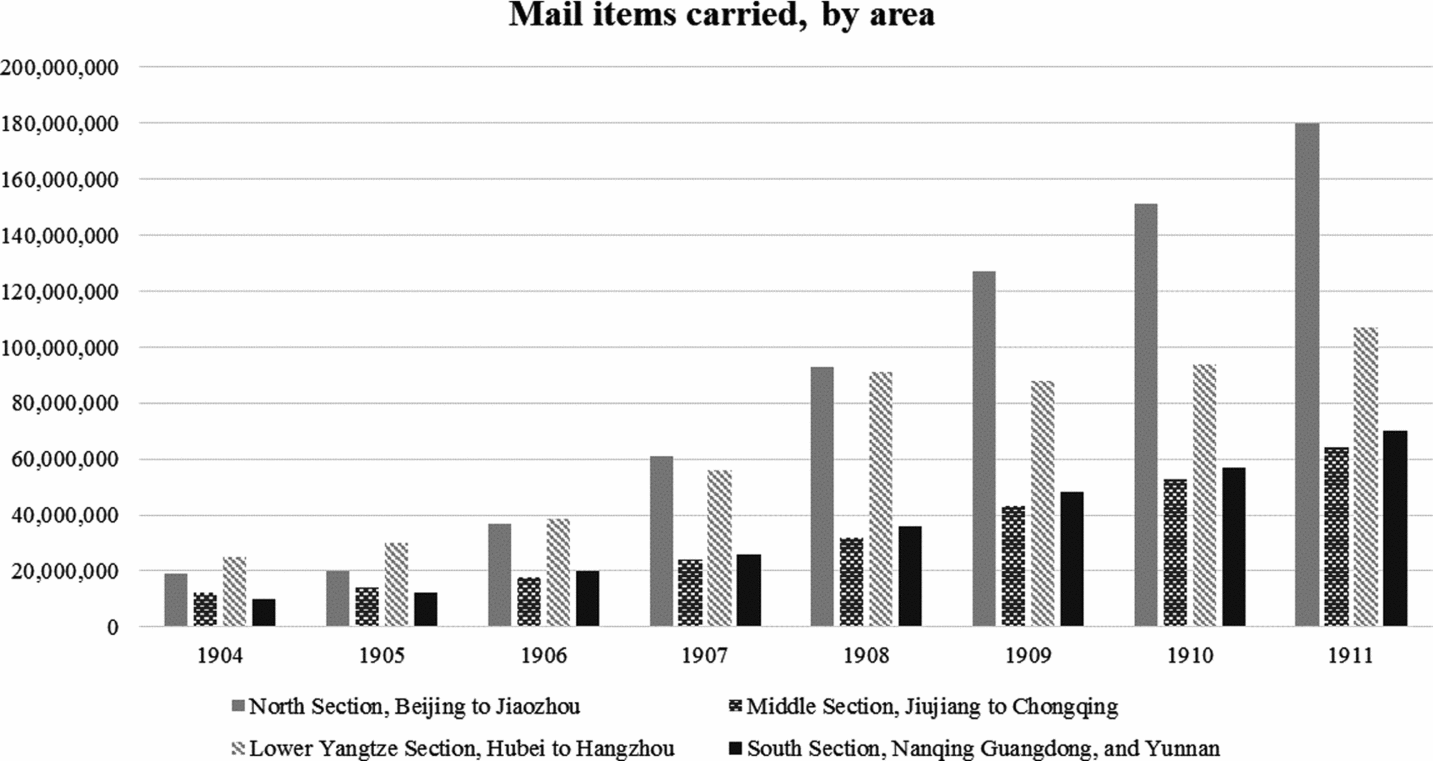
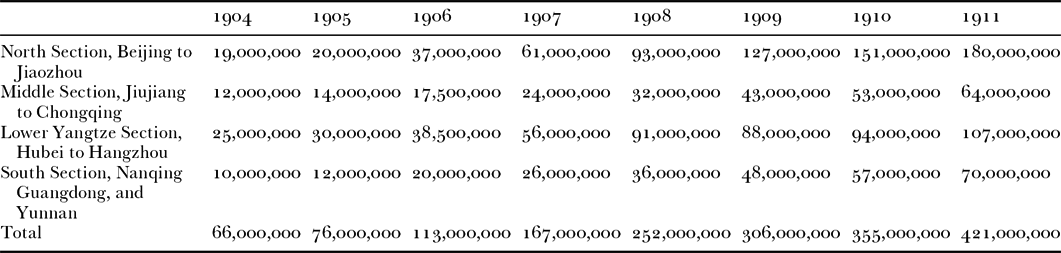
Mail items carried, by area, 1904–1911.
Source (for Table 3 and Figure 2): Information taken from ‘Report on the Working of the Imperial Post Office’, Returns of Trade and Trade Reports for the Year, 1906 –1911. Table produced by the author.Footnote 85
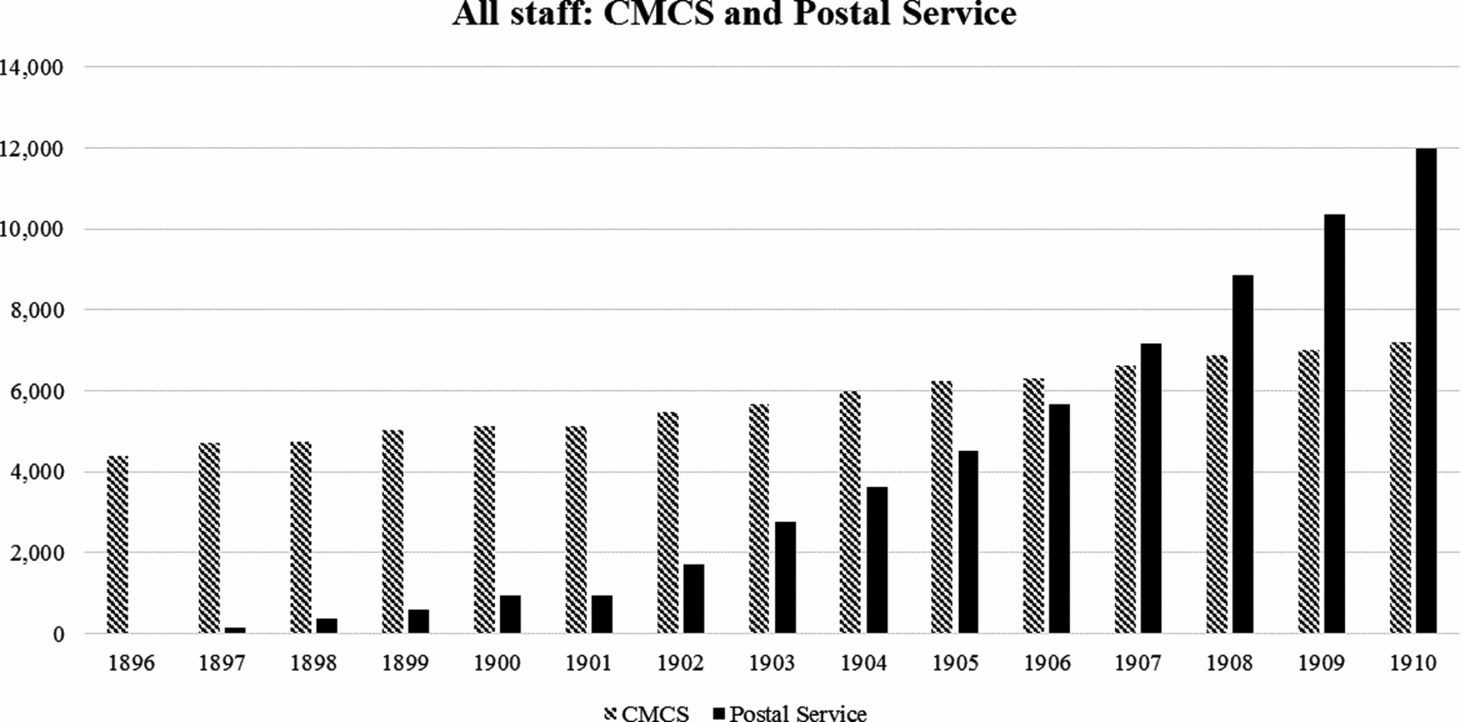
All Staff: Chinese Maritime Customs Service versus the Imperial Post Office, 1896–1910.
Source (for Table 4 and Figure 3): Information taken from China Imperial Maritime Customs, Service List, 1896 to 1910. Table produced by the author.Footnote 86
The early history of the Imperial Post Office shows that it exercised its authority on the principle that it was a genuinely Chinese organization and part of the Qing bureaucracy. This strategy not only allowed it to gain the legitimacy it needed to compete with the native letter hongs, but also to receive support from both local and central governments. Although these efforts were not necessarily immediately and universally accepted, the Imperial Post Office soon started to work itself into the mainstream of Chinese life. In the final section, this article looks at how railways brought the visibility and penetration of the Imperial Post Office to new levels, and allowed it to expand into China's interior.
Railways and postal network expansion
In the ‘Postal Working Map’, the Imperial Post Office's first large-scale postal map published in 1903, a railway is shown running from Beijing to Zhengding, passing through Dingzhou and Baoding.Footnote 65 This stretch was part of the Luhan Railway. The Luhan Railway was later renamed the Jinghan Railway: it ran from Beijing to Hankou, and was completed in 1905. The map shows how postal routes synchronized with other available rail lines: Tianjin to Newchwang via Tanggu, Tianjin to Beijing, Qingdao to Qingzhou Prefecture in Shandong province, and Hankou to Xinyang (in Henan province), the other end of the Luhan Railway. In 1907 an additional Postal Atlas was produced. This Atlas contained 20 sketch-maps to illustrate communications networks, including telegraph, water routes, and railway.Footnote 66 These maps show more advanced and sophisticated postal networks than were depicted in 1903, and demonstrate that the Imperial Post Office's postal routes now covered extensive areas of the country. Where the 1903 map revealed that a substantial part of northwest China was still without Imperial Post Office routes, the 1907 atlas shows that just four years later, all the provincial capitals were connected.
The expanded network reflected the Imperial Post Office's new-found freedom from earlier constraints. It was no longer dependent on a select group of contracted couriers and innkeepers. Further, its growth demonstrates that the Imperial Post Office had found a way to manage its relationships with the native letter hongs. There were a number of aspects to this. The Imperial Post Office found the confidence to make a case for itself as a genuinely Chinese service, and was increasingly successful because of this in reducing local resistance. But, equally importantly, it began to incorporate some of the native letter hongs into its network, turning the latter into its ‘inland agency’. This inland agency system was introduced in autumn 1902, and met with a positive response. This collaboration not only reinforced the Imperial Post Office's Chinese credentials, but also allowed it to extend inland at relatively little cost, particularly in the crucial areas of staff recruitment and the setting up of premises.
Mail volumes show a dramatic jump between 1901 and 1902: for example, in the ‘domestic ordinary articles’ category, 9.6 million items were delivered in 1901 and 18.5m in 1902, almost double the number. We see the same growth in ‘domestic registered articles’, which rose from 790,000 to 1.5 million articles in the same period.Footnote 67 However, even with this level of growth, the Imperial Post Office still had a long way to go. By the end of 1903, there were 900 post offices and agencies in all districts under the supervision of 34 head offices. Over the following six years, the expansion was dramatic: 927 in 1904, 1,189 in 1905, 1,574 in 1906, 2,250 in 1907, 2,901 in 1908, and 3,606 in 1909.Footnote 68
Not all the native letter hongs wanted to register with the Imperial Post Office in the treaty ports or inland, nor did all the inland hongs wish to take on agency status. To achieve a breakthrough and break the dominance of the franchized native letter hongs, a new approach known as the ‘Eight Rules’ was introduced in 1903. The Imperial Post Office's Eight Rules were supported by Waiwu Bu (Foreign Affairs Ministry, a new name for the Zongli Yamen after the Boxer Uprising), and focused on one main point: from now on railways in China were only to be allowed to transmit mail coming from the Imperial Post Office.Footnote 69 These Eight Rules enhanced the Imperial Post Office's advantageous position by this point in its competition with the hongs, and indeed set the terms of the relationship between the Imperial Post Office and railway companies all the way through the Nationalist government period in the late 1920s and 1930s.
The essential point was established in Rule 1, which declared: ‘The Imperial Post Office alone can send mails by trains; any other mail matter brought in by Native or Foreign Agencies or Post Offices, official or private, are to be refused by the Company. As regards military mails, which, under contract, the Company is bound to carry, they are to be handed over to the Imperial Post Office and transported with its mail matter.’Footnote 70 It is worth pointing out that the Eight Rules not only applied to existing railway operations, but also to those that were either still under construction or were planned.Footnote 71 This regulation gave the Imperial Post Office an effective monopoly over the use of railways for transmitting mail. In addition, the railway companies, both foreign and Chinese, also had to agree to give a free pass to the postal staff travelling together with the mail, and provide cars on trains to accommodate the mail.Footnote 72 At the train stations, the Imperial Post Office was also to be permitted to rent rooms for postal operations and to set up letter boxes.
Accordingly, native letter hongs were no longer able to use the railways to transmit mail unless they handed in their aggregated mail to the Imperial Post Office and paid handling fees. More hongs were thus forced to register with the Imperial Post Office, particularly those at the treaty ports or in places near train stations. The once-relaxed relationship between these two sectors changed after the introduction of this new law, and penalties were imposed on hongs that tried to smuggle mail by rail. The volume of mail carried by private letter hongs reduced markedly over time, and they were hit harder in the north than in the south, as North China had fewer water routes and also developed a rail network more quickly. Overall, the number of letters delivered by the registered hongs fell from 8,304,125 in 1904, to 4,796,100 in 1913, while the mail routes using rail transportation increased from 2,700 miles in 1904 to 6,300 miles in 1913.Footnote 73Hongs continued to operate for almost another three decades until the Nationalist government prohibited their business altogether in 1933, but there was a constant stream of complains and petitions from hongs to both the Imperial Post Office and local and central governments in this period. Footnote 74
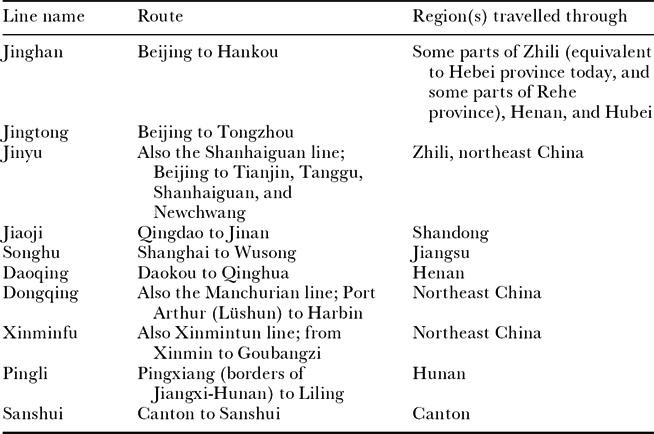
The Deng brothers’ projects in northern China, mentioned above, shows how the Imperial Post Office brought railways into its planning for branch distribution. A useful approach to exploring the impacts of the railway on the postal network is to look at the growth of the mail service in northern China. The North China postal area covered the districts of Beijing, Newchwang, Tianjin, Yantai, Jinan, Jiaozhou, Taiyuan, and Xi’an.Footnote 75Table 1 below shows the distribution of railway lines in China in 1905. There were 10 railway lines working in that year. While seven of them were in the North China postal district, the Jinghan rail line ran through the area as well. Due to the location of the capital, Beijing, and foreign interests in northeast China, these rail lines were constructed earlier, and they were also well connected with each other.
Available railway lines in North China postal district in 1905.
Source: Taken from ‘Report on the Working of the Imperial Post Office’, Returns of Trade and Trade Reports, 1905. Table produced by the author.Footnote 76
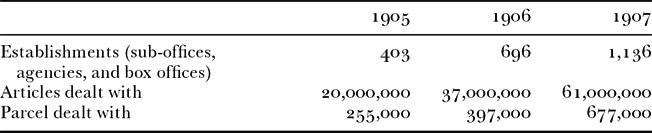
Although other postal districts also made good progress between 1905 and 1907, the growth in postal volumes in North China was directly related to the use of railways. In 1905, Théophile Piry, the postal secretary who became the first postmaster general of the Postal Service in 1911, acknowledged the progress made in this area by saying: ‘These are hopeful and healthy signs, for these districts include exclusively the hinterland of three important provinces, Chihli, Honnan, and Shantung, which railway lines now traverse, stimulating operations over large tracts of territory.’Footnote 77 A year later, more encouraging news was delivered in the postal annual report. Beijing's sub-districts of Kaifeng, Taiyuan, and Sian made good progress in that year: ‘Much interest attaches to progress in those inland districts whose possibilities were little known a few years ago.’Footnote 79 (See Table 2.)
Mail collections in North China postal district 1905–1907.
Source: Information for the North China Area, taken from ‘Report on the Working of the Imperial Post Office’, Returns of Trade and Trade Reports, 1906 and ‘Report on the Working of the Imperial Post Office’, Returns of Trade and Trade Reports, 1907. Table produced by the author.Footnote 78
The figures in Table 2 show truly dramatic growth, with a tripling of the volume of mail in only three years. The combination of railways and overland routes in North China allowed the Imperial Post Office's networks to cover every level of administration, from cities to villages, achieved through setting up sub-offices, inland agencies, and box offices. Letter pillar boxes were also placed at train stations.Footnote 80
The Post Office had now reached the point where it needed to reorganize its interprovincial communications through better synchronization of railway timetables and courier activities, and extend the ‘day-and-night system’ already introduced in Zhili and Shandong provinces.Footnote 81 Building on these improvements, at the beginning of 1909, the Imperial Post Office started to offer an ‘express mail’ service in order to put more pressure on native letter hongs. Those chosen to handle express letters were specially trained, and they had to follow even stricter protocols than usual. Each express letter was guaranteed, and the distributors, who wore a uniform with a badge number, were held responsible if promised delivery times were not met.Footnote 82
Both the express mail service and the ‘day-and-night system’ progressed well in a short period. It only took two days to transmit mail from Beijing to Taiyuan, seven-and-a-half days to Sian, 33 days to Dihua in Xinjiang, and 50 to 55 days to Lhasa in Tibet. The ailing Qing empire briefly seemed united once again, this time not through military means but through a government-run mail service for the general public.Footnote 83 The dramatic growth of the Imperial Post Office after the Boxer Uprising can be seen in Table 3 below, which shows the increase in mail volume across the Imperial Post Office's four areas of operation between 1904 and 1911. The Lower Yangtze Section, which covered areas from Huibei province to Hangzhou, was the most prosperous area among the four, and at the start contributed the most mail. The postal service in this section relied more heavily on water routes than rail during this period. However, thanks to improvements in transportation (in particular the opening of the railways), the volume of mail in the North Section nearly reached that of the Lower Yangtze River in 1906, and overtook it in the following year. Growth in all sectors, however, was impressive.
Mail items carried, by area, 1904–1911.
Beside the increase in the volume of mail, the growth of the Imperial Post Office as an organization was also significant. Table 4 shows that the number of people employed by the Imperial Post Office exceeded that of the Chinese Maritime Customs Service by 1907, and reached more than 10,000 in 1909. Just as Hart predicted, the Imperial Post Office would outgrow the Chinese Maritime Customs Service and become a larger institution than its parent organization. The growth was almost all in local Chinese staff: the number of foreign staff was a mere 17 in 1897, and still did not exceed 100 by 1910.Footnote 84
All Staff: Chinese Maritime Customs Service versus the Imperial Post Office, 1896–1910.
The Post Office remained under the wing of the Customs Service until May 1911, when it was made a fully independent entity. Hart had already retired and was living in London by this point. This occasion was marked in the final joint IG and Postal Circular, written on 30 May 1911, by Francis Aglen, now the officiating inspector general:
An Important stage in postal development and progress has now been reached, and this Circular, the last that will appear in the Customs series bearing a postal number, is to inform you that I am to-day handing over charge of the Imperial Chinese Posts to Mr. T. Piry, appointed by Imperial Decree Postmaster General under the Ministry of Posts and Communications . . . I cannot conclude this Circular without expressing, in the name of the Inspector General, Sir Robert Hart, the thanks which are due to all those members of the Customs Service, past and present, who have borne the burden and heat of the day and whose efforts have contributed so much to the success that has been achieved. The position won has not been attained without sacrifices in which all have taken a share, many receiving no other reward than the consciousness of work well done. The Service, in bidding farewell and wishing all prosperity to the Administration which has sprung from it, will, I feel sure, continue to take the friendliest interest in, and always work in the closest harmony with, the Imperial Post Office.Footnote 87
Conclusion
The Chinese Post Office outlived the Qing empire, and continued to flourish in the Republican period. Its mode of development, however, was set in the last decade of the Qing dynasty. This article has explored the history of the expansion of the Chinese Post Office from urban centres on the coasts and the treaty ports through to China's interior. To achieve what it did in less than two decades, from modest beginnings, was a feat of considerable significance. The effort began under the management of the Chinese Maritime Customs Service, and under its influence, a modern institution was forged that nevertheless became well adapted to Chinese circumstances.
An important reason for this success is that, despite its origins, the Imperial Post Office took a different path from the Chinese Maritime Customs Service. Its mission, in many ways, was a bigger one than that of its parent organization as it not only needed to expand into the interior, far beyond the treaty ports, but also sought to position itself as a universal service for all of China's people. Facing strong competition from long-established native letter hongs, the Imperial Post Office adopted a focused strategy: competing through providing a better service, while at the same time exploiting government regulations to squeeze their competitors’ operations. To achieve inland expansion, the Imperial Post Office synchronized with railway lines to plan its networks and absorbed native hongs as inland agencies. The success of this approach was shown in the increase of mail volumes in all areas of China; in North China, where the mail volume grew most, the increase was strongly related to the parallel growth of the railways.
The history of the Imperial Post Office also illustrates several unique aspects of the late Qing period. It shows first, within the context of the Self-strengthening Movement, a certain openness within the Qing government at the central level which allowed a hybrid bureaucracy to exist and operate successfully. We can see this directly through examining the roles of foreign employees. Second, in the case of carrying out the imperial order establishing the Post Office, it shows a significant gap in both actions and understanding between central and local level. Third, it touches upon an interesting area that illuminates late Qing thinking, when the Imperial government tried to shift perceptions though adopting some of the trappings of a modern empire, as it edged towards the Western concept of a modern state.
As the statistics show, the Imperial Post Office was already larger than the Chinese Maritime Customs Service before the end of the Qing dynasty, and it was, of course, to continue to grow throughout the Republican era into an institution with a huge influence on many areas of Chinese life, from transportation through to politics, the civil service, and the banking system. In successfully taking its place at the heart of daily life for China's millions, it can be truly said to have eclipsed the institution that created it and set it on its path.