INTRODUCTION
Bushmeat hunting poses a huge challenge for biodiversity conservation in many regions of the world. Hunting may have a substantial impact on wildlife species and wide-ranging consequences for ecological processes (Robinson & Bennett Reference Robinson and Bennett2000; Bennett Reference Bennett2002). Bushmeat is also an important source of essential protein for millions of people and makes up a substantial proportion of the total meat consumed in many rural areas (Muchaal & Ngandjui Reference Muchaal and Ngandjui1999). Because of the ecological and socioeconomic impacts that hunting can have, the bushmeat crisis has received considerable conservation attention, including the establishment of new conservation consortia (e.g. Bushmeat Crisis Task Force, Ape Alliance and Bushmeat Working Group in the U.K.).
Unfortunately, war has been common in many of the world's most biologically diverse regions (Hanson et al. Reference Hanson, Brooks, Da Fonseca, Hoffmann, Lamoreux and Machlis2009). However, despite the potentially substantial impacts that war can have on hunting patterns, these effects are poorly understood in many regions and at different spatial and temporal scales. In addition, where studies have occurred, effects of war on hunting have been highly variable. For example, in some locations, including Liberia (Wolkomir & Wolkomir Reference Wolkomir and Wolkomir1992), Rwanda (Plumptre et al. Reference Plumptre, Masozera and Vedder2001), the Congo Basin (Fa et al. Reference Fa, Currie and Meeuwig2003) and Mozambique (Hatton et al. Reference Hatton, Couto and Oglethorpe2001), war has had detrimental impacts on wildlife populations due to increases in hunting stemming from desperation for food or a lack of law and order. In other cases, war has had a negligible effect on hunting patterns, or has even reduced hunting in cases where armed combatants occupy hunting grounds (McNeely Reference McNeely2003; Price Reference Price2003).
The impact of war on hunting may be context specific; however, the spatial and temporal variations in the effects of war on hunting remain less explored. Theoretically, war's immediate impacts can be patchy, with large effects on hunting occurring in some areas but relatively little influence being apparent in adjacent zones. Previous studies have emphasised the impacts of war at the scale of regions, countries or whole protected areas, but have not explored war's influence on hunting at finer scales (Hanson et al. Reference Hanson, Brooks, Da Fonseca, Hoffmann, Lamoreux and Machlis2009). Similarly, the effects of war on hunting may only be temporary, or could last for decades. There is a critical gap in our understanding of war's impacts across multiple stages (i.e. prior to, during and following conflicts) (Machlis & Hanson Reference Machlis and Hanson2008).
WAR AND HUNTING IN SIERRA LEONE
Bushmeat hunting has occurred in African forests for thousands of years; however, in recent decades, growing hunting pressures have depleted vulnerable species in West and Central Africa (Robinson & Bennett Reference Robinson and Bennett2000; Bennett Reference Bennett2002; Mbotiji Reference Mbotiji2002). This region has become a focal point for conservation efforts that are aimed at reducing the impacts of hunting on biodiversity. Unfortunately, the region has also experienced war in recent decades, including long-term conflicts in Sierra Leone, Liberia, Ivory Coast and the Democratic Republic of Congo.
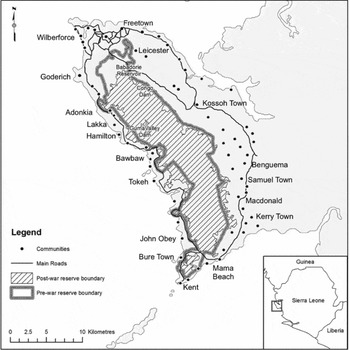
Sierra Leone is in the Upper Guinea Forest, one of the world's most diverse and threatened ecosystems (Conservation International 2007). Bushmeat forms an important dietary supplement for many Sierra Leoneans, with pre-war estimates indicating that ~55% of Sierra Leoneans consumed bushmeat, and more than 30 tonnes month−1 were exported to Liberia (Koker & Kamara Reference Koker and Kamara2002). The Western Area Peninsula Forest Reserve (WAPFR), located outside the capital city of Freetown (see Fig. 1), represents one of the few remaining fragments of Guinean forest and has served as a source of bushmeat for Freetown and nearby communities (Conservation International 2007).
Diagrammatic map of the Western Area Peninsula Forest Reserve.

The decade-long war (March 1991–January 2002) in Sierra Leone displaced thousands of people who fled conflict in rural areas. The greatest concentrations of internally displaced persons (IDPs) in the country lived in certain communities adjacent to the WAPFR. No previous studies have investigated the impact of war on hunting in Sierra Leone. Several factors may have mediated the war's impact on hunting patterns, including limited food supplies due to local population increases driven by the movement of displaced people, decreased use of hunting grounds due to rebel activities, variation in the availability of alternative livelihoods (e.g. from marine resources or employment in urban centres) and a ban on civilian use of shotguns during and after the war. Because these factors vary in time or space at our study site, we used a natural experimental design in order to test the hypothesized effects.
We examined changes in the proportion of the population engaged in hunting over different time periods and among different communities, as well as variation in hunting techniques and what sectors of the population hunted most. Data on the proportion of the population that hunts are useful as they indicate how prominent and widespread hunting is over time. Similarly, data on what sectors of the population hunt can assist in designing targeted interventions that are aimed at reducing the impacts of hunting, while also seeking to meet the needs of local populations. Hunting techniques vary in their potential impacts on wildlife. Trapping with snares is widely practised in many parts of Africa because of its affordability and reliability (Mbotiji Reference Mbotiji2002). However, snares can result in indiscriminate catching, substantial loss to scavengers and low survival rates for animals that escape injured (Bennett & Robinson Reference Bennett and Robinson2000). The more recent use of firearms has improved the efficiency of hunting for macro-fauna, especially canopy-dwelling species (Barnett Reference Barnett2000).
Here we present the first study of the effects of war on hunting in Sierra Leone, a region of great biodiversity, in which the impacts of hunting pressures may have been greatly exacerbated by war. We examine the immediate and longer-term impacts of these hunting pressures, as well as the degree to which war has altered hunting patterns at the scale of a whole protected area versus adjacent to individual human communities. The factors highlighted above that may have mediated the war's impact on hunting patterns led to predictions of increased hunting (e.g. with the influx of displaced people), decreased hunting (e.g. with more rebel activity or alternative livelihood options) or shifts in hunting methods (e.g. reduced use of shotguns).
METHODS
Study area
The WAPFR (175 km2) consists of a narrow chain of hills (150–900 m) 5 km south of Freetown and is bordered on the west and south by the Atlantic Ocean and on the east by a low-lying plain that connects the peninsula to the country's interior (Fig. 1).
Hunting is illegal in the WAPFR. More than 50 settlements surround the reserve, including Freetown (population: 1.5 million) (Statistics Sierra Leone 2004). All ethnic groups of Sierra Leone are represented, and livelihood activities include gardening, trading, sand extraction, fishing and hunting (Fofanah Reference Fofanah2003).
Sampling design
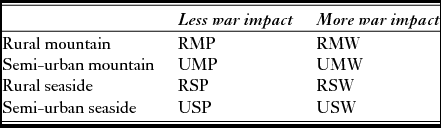
Eight communities were chosen based on attributes that allowed us to test the effects of various factors on hunting patterns. We sampled communities that experienced both high and low levels of impact from the war, and assigned codenames to these communities (Table 1). Although all communities suffered some impact from the war, the four high-impact communities experienced active combat and an influx of IDPs, which did not occur in the low-impact communities.
Attributes and codenames given to communities sampled. One community was sampled from each natural ‘treatment’. Community codes are used throughout the manuscript and indicate community conditions. First letters refer to city access (R = rural, U = semi-urban). Second letters indicate access to marine resources (M = mountain, S = seaside). Third letters refer to impact from war (W = more war impact, P = less war impact).

The diversity of livelihood options can also influence the levels of illegal hunting. Half of the communities we sampled were in the mountainous eastern boundary of the Reserve, allowing for few livelihood alternatives. The other four communities were western seaside villages with access to marine-based livelihood alternatives.
We also split our sample between communities closer to the urban centre with access to paid labour and communities farther from the urban centre with a need for more natural resource-based livelihoods.
Survey methods
We surveyed randomly selected household heads in eight communities surrounding the WAPFR. The response rate was 99% (836 of 842 households approached), and the survey respondents who did not provide complete answers to all of the questions were removed from the analysis. Prior to the commencement of the survey in each community, verbal permission was obtained from community leaders. The questionnaires were administered in Krio (the common language of Sierra Leone) by either the lead author, who is from the region, or one of four field assistants who were trained in the survey technique and fluent in both English and Krio. Respondents were provided with full details about the goals of the study and the treatment of data, and all gave verbal consent before the interviews began.
The survey investigated the changes in hunting pressure (in terms of the proportion of the population involved in hunting) and hunting patterns (in terms of the hunting methods used, categories of hunters and hunting periods) in the WAPFR over three time periods – prior (1992–1997), during (1997–2002) and after (2002–2007) the war in the city. In order to limit the effects of recall bias, time periods were bounded by dates that constitute universally recognized anchor points at the field site: 1992 marked the coup d’état by the National Provisional Ruling Council; in 1997, active conflict reached the study site for the first time and the first coup d’état against President Kabbah occurred; and in 2002, the signing of a peace treaty marked the official end of the war. Recall bias was also limited by our focus on illegal hunting, as such highly sensitive topics tend to be more memorable. Finally, recall bias was also limited by the general nature of the questions we asked (e.g. did you hunt inside the WAPFR during the war?), as opposed to more specific lines of inquiry (e.g. did you hunt in the Reserve in April of 2006?), which we avoided.
The questionnaire comprised four sections: involvement of households in hunting/trapping in each of the three time periods; use of different hunting/trapping methods; respondents’ perceptions of animal rarity in each time period; and respondents’ sociodemographic data. Past studies of the impacts of war on hunting and biodiversity have been largely dependent on indirect observations (e.g. counts of tree stumps (Gray & Kalpers Reference Gray and Kalpers2005) or landmines (FAO 2005)) or expert opinions. For results obtained via these methods, it is often a struggle to distinguish between impacts due to natural causes versus the anthropogenic influences of war, and so these results are prone to heavy bias due to underestimation or exaggeration (Gavin et al. Reference Gavin, Solomon and Blank2010). However, directly questioning respondents about sensitive topics may reduce response rates or the reliability of responses due to fear of retribution (Solomon et al. Reference Solomon, Jacobson, Wald and Gavin2007). In order to overcome these methodological challenges, we used the paired-alternative randomized response technique (RRT) question format (Fox & Tracy Reference Fox and Tracy1986). RRT guarantees respondent anonymity and therefore tends to obtain more honest and accurate responses to sensitive questions (Fox & Tracy Reference Fox and Tracy1986; Solomon et al. Reference Solomon, Jacobson, Wald and Gavin2007; Blank & Gavin Reference Blank and Gavin2009; Thomas et al. Reference Thomas, Gavin and Milfont2015).
The RRT portion of the questionnaire included the following steps:
-
1. The survey administrator explained the meaning of each photograph to the respondent. Due to high levels of illiteracy within the communities that were sampled, we followed Solomon et al.’s (2007) approach and represented hunting activities with photographs, all of which were piloted in order to ensure widespread understanding of their meanings. One set of photographs represented the sensitive questions regarding hunting activity, including separate photographs for each hunting method we examined (i.e. shotguns, nets and dogs, snares, live traps and trenches). The second set (one photograph showing the head of a coin) represented the innocuous question (i.e. the outcome of the randomizing activity: whether or not the flipped coin landed with the head of the coin facing up).
-
2. Each respondent inspected an empty opaque bag before two photographs, one from each set (i.e. one showing the photograph depicting a hunting activity and the other showing a photograph of the head of a coin), were placed inside.
-
3. The respondent conducted the randomizing activity (i.e. flipped a coin) and noted the outcome (i.e. heads or not) without disclosing the information.
-
4. The respondent randomly chose a photograph from the bag and answered ‘yes’ or ‘no’ based on the photograph. If the photograph of a hunting activity was chosen, the respondent answered ‘yes’ if any member of their household had ever hunted in the Reserve or if they ever hunted there using the hunting method shown during the focal time period (note: we repeated the activity for each focal time period: before, during and after the war). If the photograph chosen depicted the head of the coin, the respondent answered ‘yes’ if the coin flip had resulted in heads. Alternatively, the respondent answered ‘no’ if they chose the hunting photograph and no member of the household had ever hunted in the Reserve or used the hunting method shown or if they chose the coin photograph and their coin flip did not result in heads.
-
5. The respondent returned the selected picture into the bag, shook the bag and gave it back to the survey administrator, who then replaced the pictures with another set, and the process was repeated until each hunting method and time period had been assessed.
Before data collection began, we first conducted a pilot test in order to ensure that the respondents understood the questions they were asked and could clearly identify the representations of the hunting activities and the five hunting and trapping methods used for bushmeat hunting.
We also tested the impact of several sociodemographic variables on hunting. Religion, household size and residence time may affect hunting patterns (Asibey & Addo Reference Asibey, Addo and Turnham2000). For example, religious norms prohibit Muslims from consuming meat that has not been slaughtered under Islamic rites (Asibey & Addo Reference Asibey, Addo and Turnham2000). Certain hunting methods depend on the size of the household (e.g. the use of nets and dogs require a larger labour force). Residence time may influence some hunting methods that, for example, may be tied to local knowledge of trapping sites.
Semi-structured interviews were also conducted with former and current Reserve management staff, staff of environmental organisations and community leaders. Interviews focused on respondents’ perceptions of changes in levels and patterns of hunting, who had been hunting and when, species hunted, uses of hunted species and perceived species rarity in the Reserve over the three focal time periods.
DATA ANALYSES
The proportion of the population that participated in each illegal activity was estimated as follows (Fox & Tracy Reference Fox and Tracy1986):
 $$\begin{equation*}
{\pi _x} = [\lambda - (1 - p){\pi _y}]/p
\end{equation*}$$
with a variance of:
 $$\begin{equation*}
Var({\pi _x}) = \lambda (1 - \lambda )/n{p^2}
\end{equation*}$$
where π x is the proportion of the surveyed population that hunted/trapped mammals or used the different hunting methods, λ is the observed proportion of ‘yes’ responses, p is the probability of answering the sensitive behaviour question, π y is the known proportion of the non-sensitive behaviour and n is the sample size.
Because the data were not normally distributed, we used non-parametric Shapiro–Wilk tests, followed by Kruskal–Wallis H and Mann–Whitney U post hoc tests, in order to examine the differences in ‘yes’ responses to the RRT questions over time (prior to, during and after the war in Freetown), among communities and within sociodemographic groups (Breidt et al. Reference Breidt, Gavin and Lewis2015). Prior to proceeding with the analysis outlined above, we used a simulated data set to explore the use of a link function approach for multivariate analysis of our results. However, the link function analysis failed to converge and produced numerical inconsistencies. In turn, we used the bivariate analyses presented here, as these have been shown to be reliable by Breidt et al. (Reference Breidt, Gavin and Lewis2015) following similar tests with simulated data sets.
RESULTS
We found no significant differences in hunting levels based on religion (p = 0.421), marital status (p = 0.897), level of education (p = 0.851), household size (p = 0.419) or gender (p = 0.567). In addition, no significant differences were detected in the proportions of the population hunting over the three time periods when we examined data that were pooled for all eight communities around the Reserve (p > 0.05), although, in general, the percentage of households involved in hunting was highest during the pre-war period (39%), decreased during the war (29%) and increased again after the war (33%).
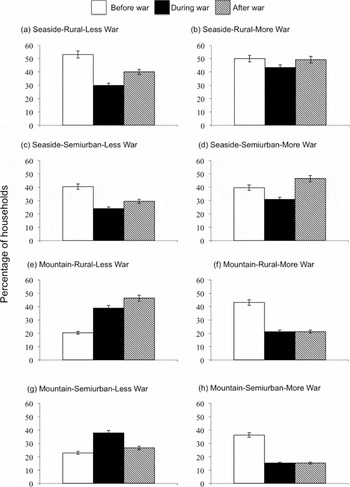
However, the proportions of the population hunting did differ significantly among the eight communities at each time period, as well as within communities across the three time periods (p < 0.05; Fig. 2). At each time period, two to three communities had significantly higher proportions of their populations hunting than any of the other communities. In each case, RSW was among the communities with the highest proportion of hunting in the Reserve, with >40% of households hunting during each time period. Before the war, RSW, along with the other rural seaside community, RSP, had a greater proportion of the population engaged in hunting. During the war, greater proportions of the populations were hunting in RSW, RMP and UMP, whereas after the war, RSW, RMP and USW had greater proportions of their communities hunting.
Histograms of percentages of households involved in hunting at different times for different communities in the Western Area Peninsula Forest Reserve.

Our results highlight four different patterns of hunting change within communities (Fig. 2). All seaside communities (RSW, RSP, USW and USP) saw changes in the proportions of their populations engaged in hunting at each time point, with dramatic decreases in hunting occurring during the war, followed by increases after the war. The two mountain communities that were also heavily impacted by the war (RMW and UMW) demonstrated decreases in the proportions of their populations engaged in hunting during the war, and hunting remained relatively low after the war (less than half of pre-war levels). RMP was the only community in which the proportion of the population engaged in hunting increased at each time period. Finally, UMP experienced an increase in the proportion of the population engaged in hunting during the war, followed by a decrease after the war.
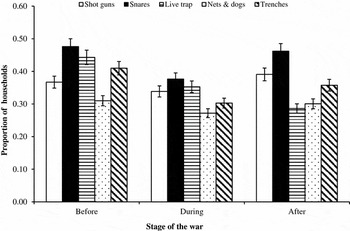
A diverse set of hunting methods was used in each community, and the choice of hunting method was relatively stable across space and time (Fig. 3). Each hunting method was used by >25% of hunters in each time period. Snares were the most commonly used method across all time periods, although this use was only significantly greater than all other methods after the war. The only hunting method that changed significantly in frequency over time was live traps, the use of which decreased after the war when compared to before the war (p < 0.0167; Fig. 3). Similarly, except for the use of snares (which were used more in community USP than in three of the seven other communities; p < 0.05), no marked differences existed in terms of the use of different hunting methods between communities. Despite the ban imposed by the government during the war, we estimated no significant changes in shotgun use over time (Fig. 3).
Histograms of proportions of households that used the different hunting methods at different times in the Western Area Peninsula Forest Reserve.

Perceived rarity of target species was measured on a Likert scale of 1–5 (1 being ‘strongly agree’ that animals were rare and 5 being ‘strongly disagree’). The perceived rarity of target species increased significantly over time (p < 0.001). Most respondents perceived that animals were not rare in the WAPFR prior to the war (median: 4), but became rare during the war (median: 1), and even more so after the war (median: 1). Almost every vertebrate known to have existed in the Reserve is now perceived to be rare by community members. As noted by one member of a hunting society: “Bushmeat is now very rare. We spend days hunting in the Reserve but can hardly get anything to shoot. . . The very few we get are mainly caught by trapping. . .”
DISCUSSION
Reviews have emphasized that the impacts of war on biodiversity vary from substantially negative, to neutral, to substantially positive depending on their location (e.g. Dudley et al. Reference Dudley, Ginsberg, Plumptre, Hart and Campos2002; McNeely Reference McNeely2003; Hanson et al. Reference Hanson, Brooks, Da Fonseca, Hoffmann, Lamoreux and Machlis2009). A smaller subset of studies has found a similar pattern with regards to the effects of war on bushmeat hunting (e.g. Plumptre et al. Reference Plumptre, Masozera and Vedder2001). Notably, however, previous studies have tended to focus their analyses at broad spatial scales, including regions, countries or whole protected areas (Hanson et al. Reference Hanson, Brooks, Da Fonseca, Hoffmann, Lamoreux and Machlis2009). We found that the effects of the war on hunting were scale dependent. Our results showed no significant impact of war on hunting at the scale of a whole protected area, but we recorded significant variation in effects within individual communities surrounding different sectors of the protected area. The war led to significant increases or decreases in hunting depending on which human community was analysed (Fig. 2). War's impacts on hunting varied greatly over relatively short distances.
We also conclude that the impact of the war on hunting varied across the different stages of conflict. Although each stage of war presents unique challenges to local communities and to protected areas, this temporal variation in the impact of war has received little research attention (Machlis & Hanson Reference Machlis and Hanson2008). In communities surrounding the WAPFR, variation in hunting over time appeared to be shaped by both the severity of war experienced in a location and access to alternative livelihoods. Communities with access to marine resources all noted a decrease in hunting during the war, followed by a return to higher levels of hunting in the Reserve after conflicts ended (Fig. 2). Interviewees in these seaside communities confirmed these trends and noted that less hunting occurred during the war due to fear of entering the Reserve, where armed rebels or military forces could have been encountered. As one seaside community member explained: “Hunting and trapping were very common in the Western Area Peninsula Forest Reserve before the war, as people went in search of bushmeat for consumption. During the war, hunting was very low (or disappeared) because of security reasons. . . After the war, hunting increased slightly, but not as common as it was before the war. The post-war increase was because there was abject poverty after the war. The World Food Programme provided food for the displaced and hungry, but people were not accustomed to some of the food and so had to go into the forest to get the food they want.”
The mountain-based communities, with less ocean access, experienced different and more diverse changes in hunting patterns than the seaside communities. The mountain-based communities that also experienced active combat noted a marked decrease in hunting during the war, and interviewees provided the same security concerns as reasons for this change. However, in these war-torn mountain communities, the proportion of the population engaged in hunting never increased after hostilities ceased. These communities experienced dramatic increases in population due to an influx of displaced people. One environmental non-governmental organisation worker noted that: “Once these rural migrants came. . . and experienced the way of life, and realised that this is the place to make life going, they refused to return [to their original communities] and so stayed on with their acquired habit of extracting resources from the forest for their livelihood.”
High population densities in these communities led to an escalating use of resources in the Reserve, which, after the war, included agriculture, logging and gravel mining for the construction industry. Community members noted that these more extreme forms of land clearing displaced hunting grounds, and thus kept post-war hunting levels relatively low.
Finally, mountain communities that experienced less of an impact from the war were the only locations at which hunting increased during the war. Local interviewees noted that access to alternative food sources diminished greatly during the war, and the forest became the best option for acquiring food, including bushmeat. The lack of active conflict in these communities led to less fear of entering nearby sectors of the reserve. However, the hunting patterns in the post-war era differed between these two mountain communities that experienced less of an impact from the war. The community with greater urban access (UMP) saw a significant decline in hunting following the war. Residents in this community mostly returned to urban-based livelihoods in the post-war period, and therefore hunting declined. As one resident of UMP noted: “During normal times, we the residents. . . do not have time for the forest. . . However, during the peak period of the war when we had nothing to eat, we had to go to the forest to help ourselves. We got fruits, tubers, firewood and even trapped animals for meat.”
On the other hand, in RMP, hunting only increased further after the war, as all minor security concerns ended and access to alternative resources remained the lowest of any community surveyed. Overall, our results demonstrate spatial and temporal variations in the war's effects on hunting at the local scale, and also highlight the importance of both the severity of localised impacts and the possible mitigating effects of alternative livelihoods in shaping war's influence on hunting.
We found little variation across space and time in the methods used to hunt. The widespread use of snares here accords with its widespread use across Africa (Noss Reference Noss1998; Robinson & Bennett Reference Robinson and Bennett2000; Fa et al. Reference Fa, Ryan and Bell2005). Despite being cheaper, more affordable and more readily available than the equipment for other hunting methods, snares kill indiscriminately and, when they are not checked frequently, a large proportion of the catch is lost to scavengers and decomposers (Noss Reference Noss, Robinson and Bennett2000). Most notably, although the interviewees generally recognized the ban that had been placed on shotguns, shotgun use for hunting did not change significantly over the different time periods or among communities. We could attribute this consistent use of shotguns by >30% of the population to a lack of government capacity to enforce any bans that had been put in place (Conteh Reference Conteh2010).
The percentage of the population engaged in hunting varied widely over space and time, but the lowest proportion of hunting in any community at any one time was 15% (highest was 53%). Given that a substantial proportion of the population of every community was hunting in the Reserve at each stage, it should come as little surprise that perceptions of rarity in wildlife populations increased over time. The additive effects of a substantial number of households hunting in the Reserve at any one time, as well as the array of other resource extraction and land clearing activities that occurred (see Conteh Reference Conteh2010), likely contributed to the significant perceived decline in wildlife populations over time.
Overall, our results shed light on the degree of spatial and temporal variation in both the proportion of the population engaged in hunting and the hunting methods used. The analytical approach we used did not allow for the exploration of multivariate models or interaction effects, which have the potential to provide additional information regarding the complex drivers of hunting patterns. We emphasize the need for statistical approaches that consistently converge and are numerically consistent in the analysis of a wide range of RRT data.
Our results have implications for conservation and development planning. Given that warfare can have long-lasting impacts on hunting patterns, rapid responses by aid and conservation agencies can play a role in mitigating the potential effects of sustained hunting in protected areas. One important step would be to address the primary use of bushmeat as a source of sustenance by providing alternative livelihood options and protein sources for local communities that are culturally appropriate and widely accepted (Roe & Elliot Reference Roe and Elliot2006; Walpole & Wilder Reference Walpole and Wilder2008; Yanggen Reference Yanggen, Yanggen, Angu and Tchamou2010). The need for food is the major driver of bushmeat hunting in WAPFR, with 87% of respondents hunting for subsistence purposes. These results also emphasize the need for a monitoring process that can assess variations in hunting pressures across different regions within a protected area, rather than treating the entire area as a homogenous entity (Conteh et al. Reference Conteh, Gavin and Solomon2015). This is particularly important because the different communities surrounding the Reserve had different levels of experience in terms of the war's impact on hunting. In turn, there is also a need for an adaptive management approach to conservation that can adjust management strategies as threats shift in intensity and in spatial distribution over time. However, for adaptive management to be effective, periodic monitoring and evaluation are critical (Salafsky et al. Reference Salafsky, Margoluis, Redford and Robinson2002; Salafsky & Margoluis Reference Salafsky and Margoluis2003). This requires sufficient resources for gathering and analysing the data that are needed in order to make informed decisions, further highlighting the importance of conservation capacity (Conteh Reference Conteh2010).
ACKNOWLEDGEMENTS
The University of Sierra Leone is thanked for granting study leave and the New Zealand Commonwealth Scholarship and Fellowship Plan and the Victoria University of Wellington Faculty of Science for funding. Drs Richard Wadsworth, Roderick Williams and Deborah Laurs are thanked for valuable comments on the drafts. J. Breidt kindly helped with testing the analytical methods, and the field assistants and research participants were essential to the success of the field work.
ETHICAL STANDARDS
The authors assert that all procedures contributing to this work comply with the ethical standards of the relevant national and institutional committees on human experimentation and with the Helsinki Declaration of 1975, as revised in 2008.