Introduction: linguistic diversity in Asia, China, and Tibet
Asia is the world's most linguistically diverse continent, containing about a third of the languages spoken on Earth today.Footnote 1 A recent investigation of global linguistic diversity found that, per area, Asia (including the Pacific) has three times as many languages as Europe and America combined.Footnote 2 Beyond the number and density of languages spoken in Asia, the region is also home to almost a third of global language hotspots—areas that contain assemblages of languages that are both diverse and endangered.Footnote 3 Asia, therefore, plays a key role in harbouring global linguistic diversity. In this article, we argue that the Tibetan regions of China (hereafter, ‘Tibet’) form a significant yet underexplored aspect of this diversity.
The distribution of linguistic diversity in Asia generally follows global patterns. More languages are spoken in lower latitudes and relatively fewer at higher latitudes.Footnote 4 Linguistic diversity in Asia also typically correlates with biological diversity, as observed at the global scale.Footnote 5 Furthermore, rugged mountainous regions, such as the Himalayas and the Southeast Asian Massif, harbour more languages than ‘smooth’ lowland terrain.Footnote 6
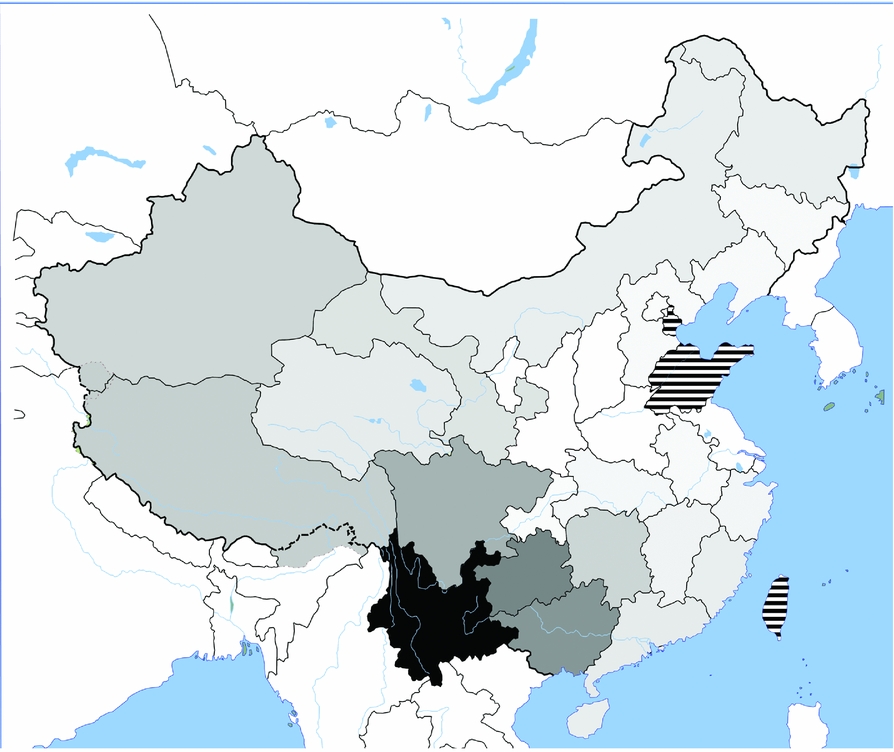
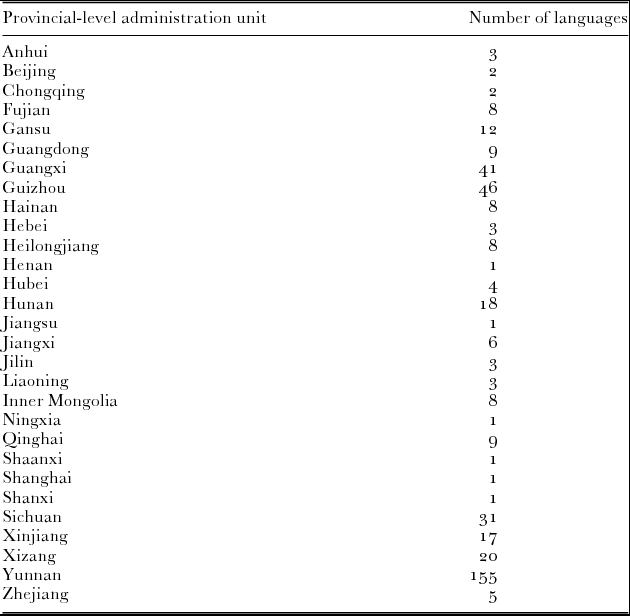
China, with 297 languages—more than all of Europe—contains approximately 13 per cent of Asia's languages.Footnote 7 Again, this diversity broadly follows global patterns, with higher diversity in the southern, tropical regions than in the north, and higher diversity in biodiverse mountainous areas (see Figure 1). In this regard, we can contrast the 155 languages spoken in Yunnan Province (one for about every 300,000 people) with the mere eight (one for every 4.7 million people) that are spoken in the north-eastern province of Heilongjiang, which is 13 per cent larger than Yunnan but has approximately eight million fewer people.
Language density in China. Shading signifies the number of languages spoken in a province, with darker provinces having more languages. See Appendix 1 for underlying data.

In light of these patterns and their applicability to Asia in general, and China specifically, Tibet is an anomaly. A common misconception, in both popular and academic representations, is that Tibet is linguistically homogenous. And yet, both global and national patterns of linguistic diversity suggest that Tibet should display some extent of linguistic diversity, due to its low latitude (in the subtropics), rugged terrain, and high biodiversity (particularly in the south and east). In fact, recent linguistic research is bearing out Tibet's conformity to these expectations.Footnote 8
Like linguistic diversity everywhere, linguistic diversity in Asia is decreasing and, therefore, Asia's role as a bastion of global linguistic diversity appears to be under threat.Footnote 9 In studies on the causes of declining linguistic diversity, one of the most robust correlations is the negative relationship between economic development and linguistic diversity.Footnote 10 Given the pace of economic development across Asia, particularly in China, this suggests that the region stands on the brink of large-scale language loss. One study, looking at global patterns of language diversity, applied the correlation between development and language loss from the United States of America at a global scale and found ‘a global drop in LD [linguistic diversity] expected overall’, with half of the world's languages becoming extinct if Africa and Asia reach the economic development levels of the Americas.Footnote 11 Current trends in China seem to fit this grim prediction. Two studies estimate that approximately 50 per cent of China's languages are endangered to varying degrees,Footnote 12 while a Chinese expert on language endangerment, Xu Shixuan,Footnote 13 has stated that ‘marginalized languages, threatened by the dominant language(s) in the area [are] gradually dying off’ with the result being that ‘the number of speakers of half of China's languages are decreasing’.
Exactly how this broad pattern of endangerment is reflected in Tibet is less clear. Tibet is mostly represented as linguistically homogenousFootnote 14—a view we contest, in light of both recent research and the broad patterns of linguistic diversity mentioned above. These articles tend to focus on the social and political relations between the Tibetan and Chinese languages, characterized as one of unequal relations between a dominant majority and marginalized minority. These authors characterize the situation as being pervaded with an anxiety that Posner has described as typical of minority-language speakers everywhere—‘the overwhelming fear [that] bilingualism and consequently diglossia are merely steps towards language shift, attrition, and even “death”’.Footnote 15 And, although these articles are unanimous in declaring the Tibetan language threatened, none provides any systematic description of the sociolinguistic situation within any of the numerous language vitality frameworks available. Furthermore, they tell us nothing about linguistic diversity in the region or how it is threatened.
Given this situation, we take as our focus the ‘minority languages’ of Tibet—that is, languages that are spoken in Tibet but are neither Tibetan nor Chinese. Our article has two aims in regard to these languages. The first is to enumerate Tibet's minority languages, and thus examine the extent to which the region conforms to global patterns governing the distribution of linguistic diversity. Our second aim is to examine what is known about the vitality of these languages, and once again to understand whether the regions’ languages fit the patterns observed at the global and national levels. The first sections of the article concentrate on establishing important definitions that frame the following discussion: how languages are defined, how we define Tibet, and how we define its minority languages. Following this, we describe three broad sociolinguistic categories that enable us to generalize about the vitality of Tibet's minority languages in the absence of detailed information on most of the individual languages. Finally, we provide several different estimates on how many minority languages are spoken in Tibet, based on different sources, and discuss what each estimate tells us about patterns of endangerment in the region. Our aim in doing so is to position Tibet's minority languages within broader patterns of endangerment, shift, and extinction that are occurring throughout Asia, giving rise to one of the most significant developments in global linguistic diversity taking place today. We begin our discussion below by examining some of the issues related to identifying and counting languages.
Defining and counting languages
Languages cannot be unambiguously distinguished from one another, nor languages from dialects—different combinations of linguistic, social, historical, and cultural criteria give radically different results. It is therefore crucial to understand the various criteria that are used to differentiate languages and how they are applied. In this section, we therefore outline some of the most common methods of linguistic differentiation employed in our sources, and by linguists more generally: mutual intelligibility, comparative linguistics, and geolinguistics. We also discuss the implications and limitations of these methods and engage with critical perspectives on such practices.
Perhaps the most commonly applied linguistic criterion for differentiating languages is mutual intelligibility.Footnote 16 Intelligibility tests are ideally administered to ‘ideal speakers’ who rarely communicate with people beyond their speech community and languages differentiated on the capacity of these ideal speakers to comprehend one another. However, mutual intelligibility is seldom an absolute criterion for distinguishing languages.Footnote 17 For instance, languages like Malay and Indonesian are considered separate languages despite their intelligibility, as are Norwegian and Swedish. Such languages, which have been deliberately differentiated from each other despite their intelligibility, are termed ausbau languages, or languages by development.Footnote 18 Nonetheless, intelligibility is still often used as the sole criterion for differentiating languages, including in many of the sources we consulted for this study.
Comparative linguistic analysis is another commonly used method for differentiating languages. This involves comparison of the sound systems and word forms of linguistic varieties, including lexicostatistic methods, which quantitatively examine the degree of lexical cognates shared by varieties. According to this methodology, phonological correspondence or lexical similarity allows us to treat close varieties as a single language, regardless of their intelligibility.Footnote 19 However, this approach faces difficulties in areas where languages are in intense contact, where it often fails to distinguish between borrowing and descent. For example, even though the lexicons of Japanese, Korean, and Vietnamese are between 70 and 80 per cent Sinitic, these are most certainly not Sinitic languagesFootnote 20 and, while over half of the vocabulary of English is non-Germanic, it remains a Germanic language.
Languages can also be differentiated by geolinguistic analysis.Footnote 21 This involves drawing isoglosses on linguistic maps, showing the distribution of linguistic features and their spatial clustering as varieties. Geolinguistic analysis can also be used to measure the extent of linguistic difference between varieties and also enables us to identify on-going language changes. However, extralinguistic factors, such as migration history, urbanization, and changes of the social environment, should also be considered.
The practice of identifying languages using these sorts of linguistic criteria has been criticized. One criticism is that, while such practices construe languages as ‘things’ that are natural, distinct, stable, ‘bounded, closed, and geographically fixed’,Footnote 22 they are more accurately and fruitfully viewed as inventions or social constructions that are constantly being redefined—as processes rather than objects.Footnote 23 In this view, identifying and enumerating languages is not a descriptive process, but rather a creative one. Moreover, it has been argued that such practices have a distinctly colonial politic, ‘heavily influenced by an ideology of racial and national essences’.Footnote 24 Such essentializing, normative metalinguistic discourses are seen to have numerous negative outcomes. For example, it has been pointed out that such definitions of language can contribute to inter-language competition, which in turn contributes to language endangerment.Footnote 25
Such classificatory practices also often contradict the understandings and perceptions of the communities being studied,Footnote 26 amounting to a form of ‘epistemic violence’.Footnote 27 This is at least partially true for the present case. In the national Chinese context, languages are defined and supported by the state on the basis of their writing systems; since languages are written, spoken varieties are dialects by default.Footnote 28 A similar situation prevails in Tibetan ‘folk linguistics’, where a distinction between yi ge ‘writing’ and skad ‘spoken languages’ is maintained. And although distinct terms for language and dialect exist (skad rigs and yul skad), individual languages are typically named in such a way that obscures this distinction, usually by appending skad to a place or people, to indicate the speech variety, rather than the language, of a place or people. We therefore find bod skad for the speech of any Tibetan person, khams skad for the speech of someone from Khams, rong skad for the speech of a farmer (versus 'brog skad—pastoralists’ speech), nyag skad for the speech of someone from the valley of the Nyagchu River, and so on. The scalar polysemy of the Tibetan term ‘skad’ is anisomorphic with the English terms ‘language’ and ‘dialect’, and therefore any attempt to describe Tibet's linguistic diversity in English will inevitably misrepresent Tibetan views of that diversity.
Finally, a focus on delineating and counting languages conceals other forms of linguistic diversity. Anderson, for example, has argued that diversity between genetic groupings above the language level is overlooked by approaches that focus on individual languages.Footnote 29 Genetic diversity, in the case of Tibet, is certainly significant, with representatives of three major phyla: Turkic, Mongolic, and Sino-Tibetan. In addition to overlooking genetic diversity, our approach also draws attention away from dialect diversity and endangerment.Footnote 30 Finally, we may note that linguistic diversity can be assessed at yet another level: that of individual linguistic features—an approach adopted in the World Atlas of Linguistic Structures.Footnote 31 A focus on language overlooks and to some extent obscures diversity at the level of genetic groups, dialects, and features.
Despite the complexities involved with differentiating languages, the valid criticisms raised against the practice and the manner in which it veils other forms of linguistic diversity, we consider differentiating and enumerating Tibet's minority languages to be of value to both the communities that speak the languages and to the international scholarly community.
First, we may note that language identification is the first step in preventing language loss. Language loss, in turn, has numerous negative consequences. For example, language often plays an important role in identity. This may not necessarily be an ethnic identity, but instead sub-ethnic, regional, local, religious, class, or polity-based identities.Footnote 32 For those languages that are associated with a distinct identity, the loss of that language is tantamount to the loss of that identity—a common occurrence in the construction of modern ethnic and national identities, equated, by some, with genocide.Footnote 33 Language loss has other negative impacts. For example, it has been demonstrated to have intergenerational impacts on health and well-being,Footnote 34 including suicide rates.Footnote 35 Additionally, differentiating languages based on intelligibility also ensures that communities can benefit from services where clear and effective communication is essential, including healthcare, education, media, and so on.Footnote 36 Identifying languages can therefore serve as the foundations for the recognition and empowerment of vulnerable subaltern groups, and thus has strong links to the pursuit of social justice for their speakers.Footnote 37
Identifying language also has outcomes that benefit both the international scholarly community and the community of speakers. First of all, language, and the oral traditions contained in it, can be an important source for historical reconstructions in the absence of written texts and can therefore support the creation of autonomous histories beyond the frames provided by written texts and the hegemonic interests they typically represent. Second, the identification and description of linguistic diversity provide linguists and others with data enabling investigation of fundamental linguistic questions, including those related to processes of language contact, change, endangerment, and shift. Investigation of these issues should, in turn, provide communities with an informed basis from which to undertake language planning, including maintenance and revitalization.
In seeking to differentiate and enumerate Tibet's minority languages, we hope this article will contribute to conversations about linguistic diversity in Tibet, and the social and political predicaments that are leading to language endangerment, shift, and loss in the region. Our aim in participating in this conversation is not necessarily a more accurate description of Tibet (though this is certainly welcome), but rather greater recognition and social justice for linguistic minorities in Tibet who are presently vulnerable and marginalized. Therefore, in recognition of our commitment to, but caution about, linguistic differentiation, we do not provide a single enumeration of Tibet's minority languages. Instead, we provide a range of estimates and reflect critically on the sources they are based on, in order to further discussion about aspects of Tibet's linguistic diversity that may presently be elided in mainstream representations. In moving towards these estimates, the following section discusses the ways in which we have defined Tibet, in order to provide a clear framework for our estimates of the number of minority languages in the region.
Defining Tibet
We divide the Tibetan regions of China into two parts. The first consists of all administrative units with ‘Tibetan autonomous’ status (the Tibetan Administrative Area, TAA), while the second includes areas where Tibetans live, but which do not have Tibetan autonomous status (the Nonautonomous Tibetan Area, NTA). Our definition is therefore based on the criteria of administrative status within the People's Republic of China. This is because, as we argue below, probably the greatest factor influencing the vitality of Tibet's minority languages is their differing administrative status—whether the language is recognized by the Chinese state and where, administratively, its speakers can receive state support. We may therefore think of the TAA as those areas where the Tibetan language has a relatively privileged status, whereas the NTA consists of those areas inhabited by Tibetans, but where the Tibetan language has no special status.
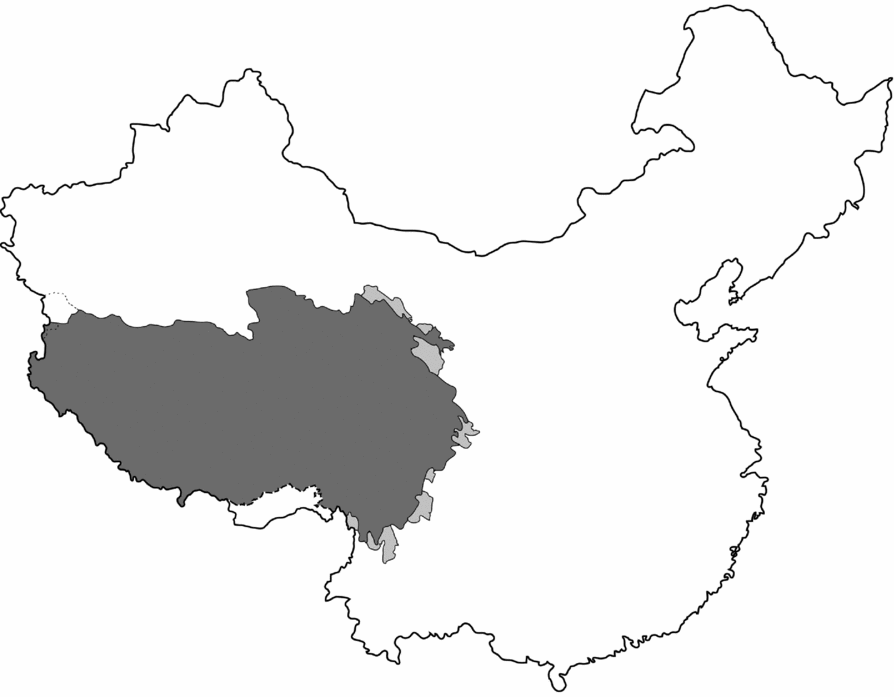
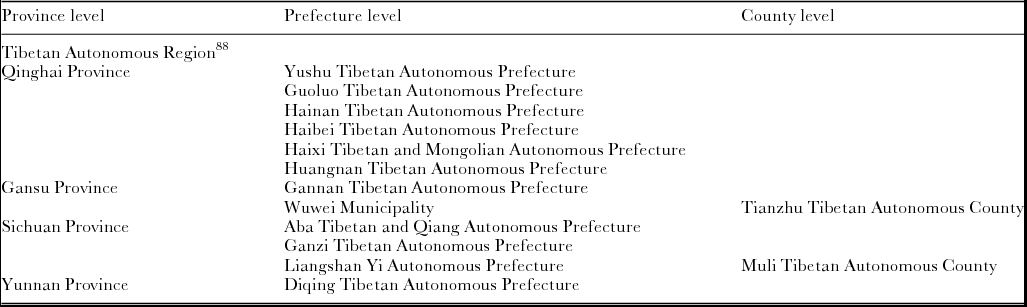
The TAA includes all areas that are designated as Tibetan autonomous districts (regions, prefectures, and counties) within the People's Republic of China (see Appendix 2 and Figure 2); it covers an area of 2,201,638 square kilometres and has a total population of 8,585,246, and therefore a population density of approximately 3.90 people per square kilometre. Reliable demographic data on the distribution of Tibetans in China are difficult to find. However, we assume that the majority of the country's 6.2 million Tibetans reside in the TAA and probably constitute 65–70 per cent of the area's population, though this proportion would vary considerably throughout the region. And, although there is no single administrative body for the TAA, its constituent administrative units nonetheless form a bloc, in theory at least, insofar as the Tibetan language and Tibetan culture are given special status within this region, though what this precisely means is decided by the governments of the different administrative units.
Tibet. The darker shaded areas are the Tibetan Autonomous Areas (TAAs)—all the administrative units that are officially recognized as Tibetan autonomous regions, prefectures, or counties. The light grey areas are the Nonautonomous Tibetan Areas (NTAs)—counties that do not have official autonomous status, but which contain significant native populations of Tibetans.

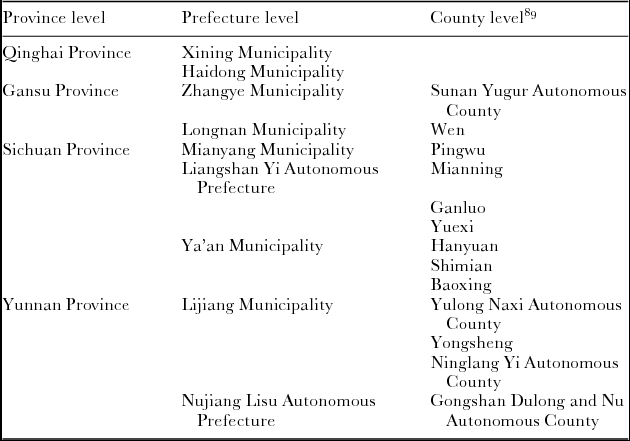
Beyond the TAA, Tibetans also live natively, namely not as recent migrants, within the area we call the NTA—see Appendix 3 and Figure 2. The NTA covers an area of 90,915 square kilometres and has a population of 6,539,812 people, giving a population density of approximately 71.93 people per square kilometre—much higher than that of the TAA. No available data allow us to identify the number of Tibetans in this region, but we estimate that they make up less than less than 5 per cent of the total population of the NTA. Within this area, Tibetan language and culture have no special administrative status.
Defining Tibet's minority languages
We define Tibet's minority languages as the non-Tibetic, non-Sinitic languages of Tibet—that is, all languages that are spoken in Tibet (both the TAA and NTA) that are not ‘Tibetan’ or ‘Chinese’.Footnote 38 This genetic criterion is intended to highlight communities that are within, but distinct from, a broader Tibetan context, but do not represent the nationally dominant Han majority. And, although the criterion we have used in defining this group is genetic, our aim is sociolinguistic—to identify a group of languages whose social and political predicament places them at risk of endangerment and extinction. This category is analytically useful in that it highlights a group of languages that are politically and socially vulnerable, as they are neither associated with the dominant national language (Putonghua) nor the dominant regional languages (the various Tibetic languages and their prestigious standard, the literary Tibetan language). Due to their political and social status, Tibet's minority languages are more likely to be lower in prestige hierarchies and to be associated with stigmatized social identities, less likely to be present in formal institutions, and their speakers more likely to experience discrimination, marginalization, exclusion, and assimilatory pressures. And, although these languages are also ‘minority’ languages in the sense of being spoken by small numbers of people, the defining features of their minority status are, as outlined above, social and political.
Although our genetic criterion appears relatively simple, there are several borderline cases that need to be considered. Broadly, there are two reasons for such ambiguous cases. One is the fact that much research remains to be done on the genetic affiliation of the region's languages. A second factor, which compounds the first, is the intense contact between languages in the area and the obscuration of languages’ genetic affiliation that this causes. Several examples will demonstrate the issues involved.
The Ngandehua languageFootnote 39 is spoken by approximately 4,000 people in eastern Qinghai Province, within the TAA. Janhunen et al. have defined Ngandehua as a Sinitic language,Footnote 40 while Dede maintains that it can equally be characterized as a ‘mixed’ language with Tibetic and Sinitic roots.Footnote 41 Speakers of Ngandehua are officially classified as Tu (Monguor) but, for the most part, strongly identify as Tibetans.Footnote 42 They live only in three villages, in a single valley where approximately 75 per cent of residents speak a Tibetic language. Ngandehua's mutual unintelligibility with other local languages, as well as both the self-identity of its speakers and the local demographic reality, make this a language that is firmly within, but distinct from, the Tibetan context. Another language in a similar situation is Daohua, which is spoken by almost 3,000 Tibetans in Yajiang County, Sichuan Province.Footnote 43 We include both Daohua and Ngandehua in our estimates of the number of Tibet's minority languages. Even though their genetic affiliations do not make their inclusion in this category clear-cut, their sociolinguistic predicaments do.
Baima, spoken by approximately 10,000 Tibetans in northern Sichuan and Southern Gansu, is another example of a language with controversial genetic affiliation. Although often classified as belonging to the (non-Tibetic) Qiangic group of languages, both ChirkovaFootnote 44 and TournadreFootnote 45 argue that it is a Tibetic language. Complicating this controversy is the issue of identity.Footnote 46 Speakers of Baima are officially classified as Tibetans. However, they have, in the past, contested this definition and requested to be classified as a separate ethnic group.Footnote 47 This means that, even if their language is Tibetic, their identity places a social barrier between themselves and surrounding Tibetans, suggesting that, socially, if not also in terms of intelligibility, Baima speakers constitute a discrete community, thus once again satisfying the criterion of being within a Tibetan context, but distinct from it. We therefore include Baima in our discussion of minority languages in Tibet.
This brings us to a final group of languages that, in contrast to the languages dealt with above, we will not discuss in this article, namely that of Tibetic varieties that can be considered minority languages either at a local scale or more broadly throughout the Tibetan region. An example of a locally minoritized Tibetic language is that spoken by the inhabitants of Shaowa Township in Chone County in southern Gansu Province.Footnote 48 This Tibetic variety was considered so aberrant from the local vernacular that villagers came to consider themselves as being ethnically distinct from other Tibetans and they therefore applied, successfully, to be reclassified as Tu (Monguor). Another example is the indigenous Tibetic variety spoken around Lhagang Monastery in western Sichuan.Footnote 49 With increasing urbanization and immigration in the township around the monastery, this local Tibetic variety has now become endangered. At the broader regional level, we may note that many Tibetic varieties are also socially and politically marginalized, in that they do not conform to folk perceptions of Tibetan dialectology that classify all Tibetic forms into three dialects: Amdo, Khams, and Ü-Tsang. Most of the Tibetic languages spoken in Chone, Thewo, and Drugchu counties in southern Gansu, for example, fall into this category.Footnote 50 However, although these locally and regionally marginalized Tibetic languages share important sociolinguistic characteristics with Tibet's minority languages, they are distinct in two important senses. First is that they share a clear, and more or less clearly perceived, relationship with the literary Tibetan language that forms the nucleus of Tibetan linguistic identity. Second is that the speakers of all these languages are unambiguously classified and perceived as Tibetans. These two characteristics place these marginalized Tibetic varieties in a sociolinguistic category that requires separate treatment from Tibet's minority languages and we therefore do not include them in our estimates of the number of Tibet's minority languages.
Categorizing Tibet's minority languages
In order to differentiate between the sociolinguistic predicament of these minority languages and the differing levels of vulnerability these predicaments entail, we present a sociolinguistic categorization of Tibet's various minority languages. Using Roche'sFootnote 51 tentative categorization, we divide Tibet's minority languages into three groups, based on two criteria: political and geographic. The first criterion refers to whether or not the language is associated with an officially recognized minzu (nationality/ethnic group), under the assumption that languages that are associated with an officially recognized minzu are less vulnerable to endangerment and shift than those that are not.Footnote 52 The second criterion refers to whether or not an officially recognized group has a formally recognized territory within Tibet associated with its population. This is significant because, in China, all linguistic rights are provided through the territorial administrative system rather than on a communal or individual basis. In addition to looking at the existence of a territorial basis for ethnic recognition, we also examine the distribution of the group's designated ethnic territory in terms of whether it falls exclusively within Tibet or not. Based on the intersection of these two criteria of recognition and territory, we identify three groups among Tibet's minority languages, each of which we describe more fully below: extraterritorial languages, enclaved languages, and unrecognized local languages.
Both the extraterritorial and enclaved languages are officially recognized by the Chinese state as being associated with one of China's 56 minzu. In theory, at least, each of these groups has a constitutionally guaranteed right to use and develop their language. However, extraterritorial and enclave languages differ in that the enclaved languages have a territorial base that falls exclusively inside Tibet, whereas the territorial base of extraterritorial languages is primarily outside of the region. This demographic base might be within China, outside of Tibet, or, in the case with several languages spoken in the Tibet Autonomous Region (TAR), it may fall outside the country altogether. We call these domestic and international extraterritorial languages, respectively. For the domestic extraterritorial languages, although they have the right to use and develop their languages within China, this applies only within their territorially defined homelands and not within Tibet. This means that, within the Tibetan context, these languages are vulnerable to local extinctions, though this may not greatly impact the overall vitality of the language as a whole. The situation of international extraterritorial languages is primarily defined by the existence of the national border between India and China, which limits contact between the two populations, essentially depriving the international extraterritorial languages of any chance to benefit from whatever rights the languages are provided with in India.
Two examples will illustrate the diversity within the extraterritorial languages. The Nuosu language is spoken by approximately two million people of the officially recognized Yi ethnicity and is also designated as the prestige standard for the approximately 7.7 million people who are classified as belonging to this group.Footnote 53 This language has a demographic and institutional base in the Liangshan Yi Autonomous Prefecture in southern Sichuan Province, and is also spoken in communities within the TAAFootnote 54 and NTA.Footnote 55 A somewhat different example of an extraterritorial language is provided by the Dakpa (Cuona Menba) language. It is spoken by about 1,300 people in China, all of whom are officially classified as belonging to the Monpa ethnicity—a group with no formal territorial base in China. The majority of the language's speakers, a further 8,600 people, live in the Tawang region—an area controlled by India but claimed by China, where they constitute a locally dominant demographic majority.
Compared with the extraterritorial languages, the enclaved languages of Tibet typically find themselves in a relatively well-supported political and social situation. Although they are surrounded by a dominant Tibetan society, they can (in theory) obtain legal protection from assimilatory pressures within their territory. The Salar language can be considered a paradigmatic case of an enclaved language. Salar, a Turkic language, is spoken by approximately 70,000 people, mostly in Xunhua Salar Autonomous County in Qinghai Province. The territorialization of the Salar language, in theory, provides a mechanism whereby the language can receive government support, for example, in the realm of education, though in practice this is not done. This potential for language support, however, can be usefully contrasted with the fate of the many Salar-speakers who migrate, permanently or temporarily, to urban centres in Qinghai and elsewhere in China, who are immersed in non-Salar-speaking communities and cannot receive any support for their language in terms of education, media, or interactions with the government.
Among the enclaved languages are several that we call ‘peripheral enclaved languages’. As the name suggests, these languages are enclaved at the edges of the Tibetan world. The sociolinguistic predicament of these languages is distinct from that of the other enclaved languages, which are subject to the policy and legal contexts of the Chinese state and to social dynamics and a cultural milieu that are primarily Tibetan. In contrast, the peripheral enclaved languages must often negotiate social contexts that are more complex, involving the dynamics of both the majority Han society and minority Tibetan society, or that involve other, locally dominant minority groups, such as the Yi. The Yugur languages of western Gansu are one example of peripheral enclaved languages. The Yugur live to the north of the Tibetan Plateau in the foothills of the Qilian Mountains, within the predominantly Han Hexi Corridor. Culturally, they share many features with Tibetans, including the practice of Tibetan Buddhism, but, socially and politically, they are within a Han majority context. The Qiang people are another example. Speaking several closely related, poorly documented languages, the Qiang people live in an area that borders the Han Chinese lowlands of the Sichuan basin to the east and the Tibetan Rgyalrong region to the west; in the past, many Qiang areas were administered by the Rgyalrong chieftains and some Qiang-speakers are presently identified as Tibetans.Footnote 56 Again, what we have here is an example of languages that are adjoined to, but not necessarily subsumed within, a Tibetan context.
The final category of Tibet's minority languages is the unrecognized languages. Unrecognized languages exist when a single minzu speaks more than one language. In China's present policy framework, only one language is typically recognized as the language that a minzu may use and develop. All other languages are unrecognized. For example, among the Naxi, at least four languages are spoken: Laze, Malimasa, Na, and Naxi. In this case, Naxi is the paradigmatic ‘roofing’ language that serves as the standard ethnic language,Footnote 57 whereas Laze, Malimasa, and Na are unrecognized languages. In the Tibetan case, the unrecognized minority languages are the non-Tibetic languages spoken by people in Tibet who are officially classified as Tibetans. These languages and their speakers lack any formal recognition that would distinguish them from mainstream Tibetans who speak the various Tibetic languages. And, since they do not officially speak a distinct language, they of course also lack any territorial basis upon which to provision the freedom to use and develop their languages. Many of the speakers of these languages accept their designation as Tibetans and consider their languages to be ‘dialects’ of Tibetan. This is the case for most speakers of such languages as Mawo Rma (Qiang), Northern Prinmi (Pumi), Lizu, Doxu, Namuyi, rTa'u, and Shuhing (Shixing/Xumi). There are also, however, people who are classified as Tibetan but who do not identify themselves as such and do not consider their language to be Tibetan. These include speakers of Baima, Ersu, and Darang Deng.
The relationship between ascribed and professed identity, ethnic autonomy, and language support can be complex, as the case of the officially recognized Tu people demonstrates. The Tu, living mostly in eastern Qinghai Province, speak at least four mutually unintelligible languages: Mangghuer, Mongghul, Manegacha, and Ngandehua; some Monguor have also shifted to the local variety of Qinghai Chinese (North-western Mandarin). The government recognizes only a single Tu language that the Tu have the constitutional freedom to use and develop. Paradigmatically, this is the Mongghul language, spoken only by Tu living in Huzhu Tu Autonomous County.Footnote 58 The other Tu languages—Manegacha, Mangghuer, and Ngandehua—can be considered unrecognized languages, even though Mangghuer is spoken in a county that is officially designated as a Tu autonomous county. Manegacha and Ngandehua present a still more complicated situation. They are spoken within the TAA by people who, for the most part, contest the state's ascribed identity and profess Tibetan identity.
We expect the categories outlined above to correlate with different levels of language endangerment. First of all, we expect the unrecognized languages to be the most endangered of Tibet's minority languages. Since state support for a language is based on official recognition within the framework of ethnic classification, from which these languages have been erased, they are exposed to a de facto state-sponsored assimilation programme. We expect enclaved and extraterritorial languages, by contrast, to have relatively higher vitality, since they have the benefit of receiving state recognition and support. However, for extraterritorial languages, this support is generally not offered within Tibet. So, although each extraterritorial language, as a whole, should be expected to have relatively high vitality, within Tibet, these languages are unsupported (although recognized) and should be expected to have relatively lower vitality, roughly equivalent to that of the unrecognized languages, since they have no territorial basis upon which to receive state support.
As a final note on the sociolinguistic classification of Tibet's minority languages, we may note that the categories described above operate differently inside the TAA and the NTA. Since we have based our classification primarily on policies linked to the territorial implementation of ethnic autonomy, the categories we suggest are obviously more influential inside the TAA. Within that context, the logic of ethnic classification and its linguistic implications produce the institutions responsible for defining and reproducing languages, and thus have significant structuring consequences within the TAA. Within the NTA, however, the logic of ethnic classification lacks the administrative power it has in the TAA, as it is divorced from the territorial basis through which that logic is expressed. Within the NTA, we may therefore speak of the classificatory resonance of these categories, rather than their administrative power. Within the NTA, the logic of ethnic classification has the power to shape individual identities, subjectivities, life trajectories, and so on, but not to create institutions that produce and reproduce language.
In the following section, we provide several estimates of the number of minority languages in Tibet, according to different sources. For each estimate, we distinguish between languages spoken in the TAA and NTA. We also indicate, for each language, whether it is an extraterritorial, enclaved, or unrecognized language according to the criteria above. In constructing the estimates below, we have excluded several types of languages that nonetheless classify as minority languages of Tibet: sign languages; writing systems; and argots, jargons, and secret languages. The diverse writings systems of the region require separate consideration from the languages considered here, whereas the other languages excluded from our survey are presently in need of much more research before they could be included. Full details of the languages included in the counts can be found in the appendices.
Counting Tibet's minority languages
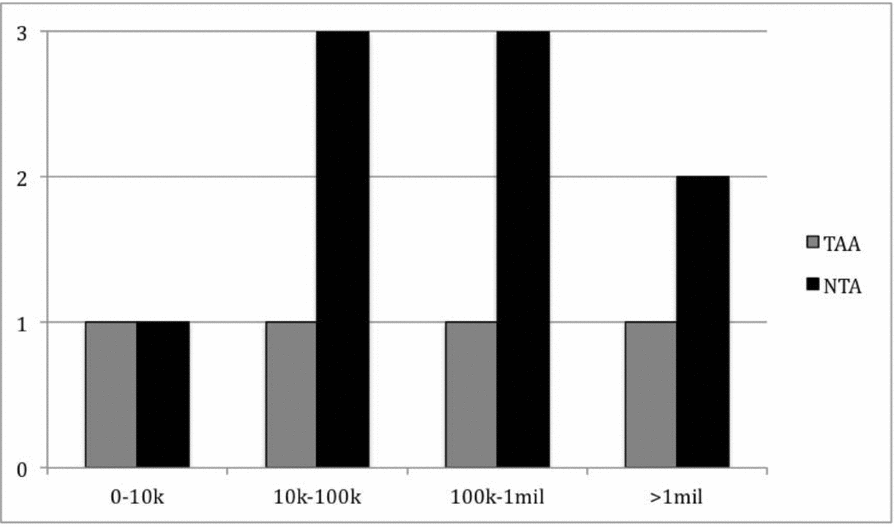
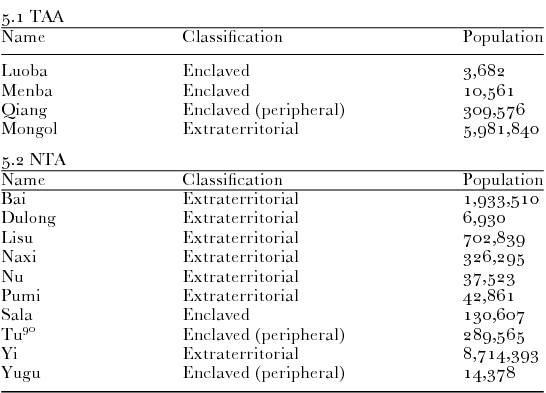
Our first estimate provides a list of officially recognized minzu in the TAA and NTA (Appendix 5). In cases where a population occurs in both, we have placed them where they primarily live, and noted their presence elsewhere. In state policy discourse and practice, each of these minzu has a single language, based on a written standard, which they have the right to use and develop; although the relevant legal frameworks, including the constitution, are vague on the precise number of languages that each minzu may use, de facto practice assigns a single language to each minzu.Footnote 59 We have excluded Han (Chinese) and Zang (Tibetans) from this count and have also excluded the many migrant populations of other minzu. This count gives a total of 14 languages, with four in the TAA and ten in the NTA. Within the TAA, 25 per cent (n = 1) are extraterritorial and 75 per cent (n = 3) are enclaved, while, in the NTA, 70 per cent (n = 7) are extraterritorial and 30 per cent (n = 3) are enclaved. There are no unrecognized languages according to this estimate. In terms of the number of people who speak these languages, available statistics make it difficult to determine the total number of speakers within Tibet but, if we look at the total national populations of these languages, however, we find the following. The minority languages within the TAA have an average of 1,576,415 speakers, but this average is skewed heavily by the large number of Mongolian speakers (5,981,840); the median—160,069—gives a clearer picture of the size of a typical minority language in the TAA. Within the NTA, the average speaker population is 1,219,890, but again this is skewed by languages with large populations: Yi (8,714,393) and Bai (1,933,510); the median speaker population in the NTA is 210,086. We therefore suggest that, according to the view from state ethnic classification, languages in the NTA are more likely to be larger than those in the TAA (see Figure 3).
Number of languages (one to three) in the TAA and NTA by number of speakers according to our minzu-based estimate. The NTA has more languages, with larger speaker populations, than the TAA.

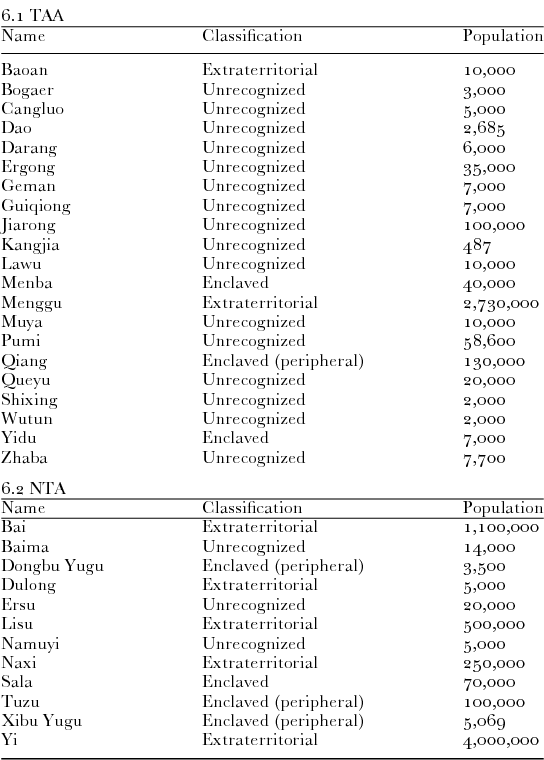
Although, in practice, each minzu is considered to speak a single language, linguists in China have long recognized that many nationalities in fact speak more than one language. For example, Sun Hongkai, who has worked extensively on China's Tibeto-Burman languages, has stated that ‘of the 55 national minorities in China, 15 (27.7 per cent) use more than two languages’.Footnote 60 Our second estimate is therefore based on two recent reference works on Chinese linguistics research: Report on the Language Situation in Life in China (Zhongguo Yuyan Shenghuo Zhuangkuang Baogao)Footnote 61 and Languages of China (Zhongguo de Yuyan) (Appendix 6).Footnote 62 Again, dividing languages into the TAA or NTA was not always unambiguous and so we have made note of more complex cases in the relevant appendix. This count gives a total of 33 languages, with 21 being spoken in the TAA and 12 in the NTA; the most significant difference between this and the previous count is the increase in the number of languages spoken in the TAA. Within the TAA, 9.5 per cent (n = 2) are extraterritorial, 14.3 per cent (n = 3) are enclaved, and 76.2 per cent (n = 16) are unrecognized. Within the NTA, 41.7 per cent (n = 5) are extraterritorial, 33.3 per cent (n = 4) are enclaved, and 25 per cent (n = 3) are unrecognized.
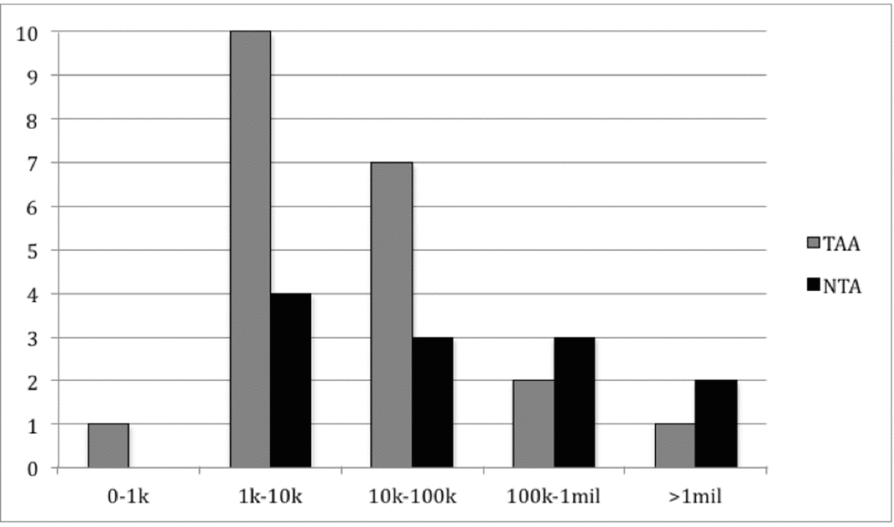
The two most obvious differences between this and the previous estimate are: the increase in the number of languages in the TAA relative to the NTA (a trend that continues in subsequent estimates) and the rise in number of unrecognized languages. Demographic data presented in Zhongguo Yuyan Shenghuo Zhuangkuang Baogao also allow us to discuss population sizes. Within the TAA, the average population size of minority languages is 152,070, while, in the NTA, it is 506,047. However, if we remove the extraterritorial languages, which have significant populations outside the target regions, we find that the gap in size narrows, with 23,867 speakers per language in the TAA and 31,081 in the NTA. As with the previous estimates, languages of the NTA are, on average, larger, though the typical number of speakers is lower than in the previous estimate (see Figure 4), and the gap between average populations sizes in the TAA and NTA has narrowed in this estimate. Finally, according to the figures contained in these sources, approximately 3.97 per cent of the 6.2 million Tibetans in China speak an unrecognized language.
Number of languages in the TAA and NTA by number of speakers, according to the Chinese reference literature. Small languages predominate in the TAA.

The next estimate comes from the Ethnologue, which describes itself as a ‘comprehensive reference work cataloguing all of the world's known living languages’Footnote 63 and is created and maintained by SIL International, ‘a faith-based non-profit organization committed to serving language communities worldwide’.Footnote 64 The curators of Ethnologue are responsible for dispensing ISO 639-3 codes—the only internationally recognized formal identification for languages. Given the controversy surrounding SIL International's simultaneous roles as a scientific and religious organization with both descriptive (language identification) and prescriptive (language support) functions,Footnote 65 an alternative reference catalogue, Glottolog, which also issues its own stable persistent identifiers for languages (Glottocodes), has also been established.Footnote 66 Nonetheless, the Ethnologue is not only ‘the most widely consulted inventory of the world's languages used today’ (increasingly through the Ethnologue Data Set),Footnote 67 but also ‘at present better than any other non-derivative work of the same scope’Footnote 68 and we therefore consult it here.
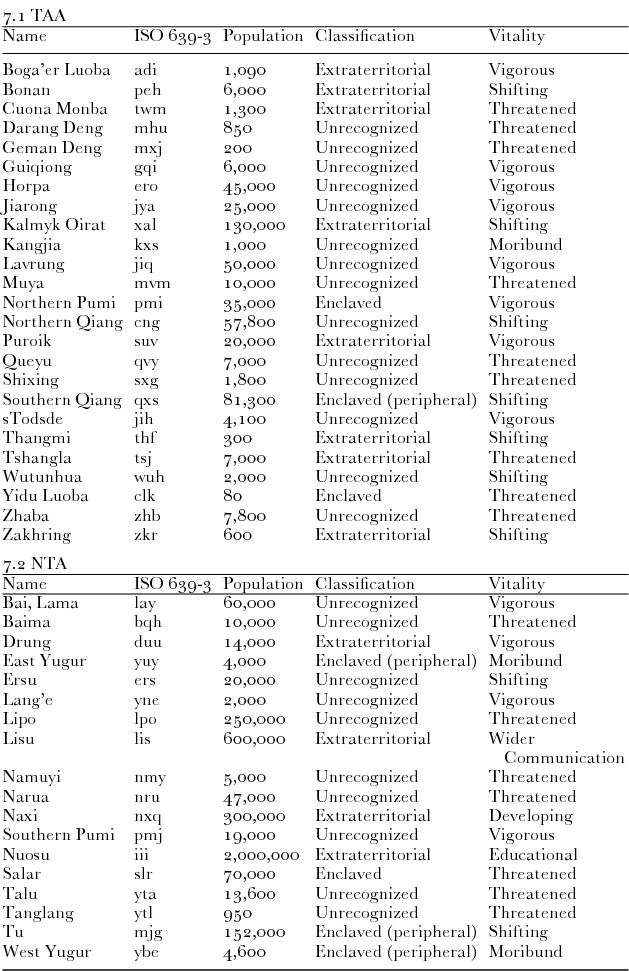
An examination of the 18th edition of the Ethnologue (released in 2015) gives a total of 43 languages, with 25 in the TAA and 18 in the NTA (Appendix 7). Once again, the main difference between this and the prior count is in the increased number of languages identified as being spoken in the TAA. Within the TAA, 32 per cent (n = 8) are extraterritorial, 12 per cent (n = 3) are enclaved, and just over half (56 per cent, n = 14) are unrecognized, whereas, within the NTA, the proportion of extraterritorial languages drops to 22.2 per cent (n = 4), while the proportion of enclaved languages rises to 22.2 per cent (n = 4) and the percentage of unrecognized languages remains slightly higher than half, with 55.6 per cent (n = 10).
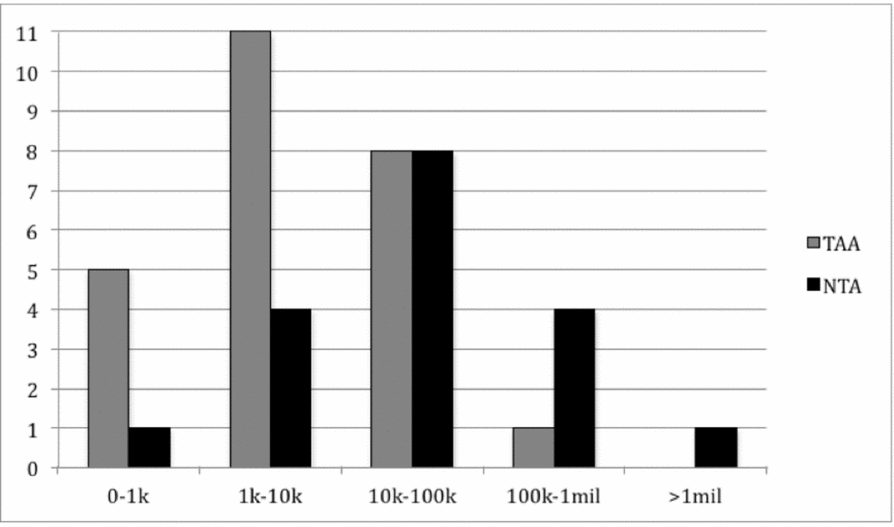
The data presented in Ethnologue also enable two additional analyses, in terms of population numbers and language vitality. Regarding the size of languages in terms of speaker numbers, languages of the NTA have a much wider range, from 950 to two million speakers (compared to 80–130,000 in the TAA). Minority languages in the NTA, on average, have more speakers than within the TAA, with 198,453 and 20,049 speakers on average, respectively. Even if we remove the extraterritorial languages, which often have large populations outside the target area, the average number of speakers for minority languages in the NTA is still larger—47,011 compared to 19,702 for the TAA; this follows the pattern seen in the previous two estimates. According to the Ethnologue, therefore, the TAA is home to more, smaller languages, which are also more likely to be unrecognized or extraterritorial, while the NTA is home to fewer but larger languages that are less likely to be unrecognized and more likely to be enclaved (see Figure 5). Finally, we can also note that, according to population statistics in the Ethnologue, approximately 3.77 per cent of China's 6.2 million Tibetans speak an unrecognized language—an estimate very close to the previous 3.97 per cent.
Number of languages in the TAA and NTA by number of speakers according to our Ethnologue-based estimate. Both the TAA and NTA have a large number of languages with fewer than 10,000 speakers. The NTA differs from the TAA in having more languages with over 100,000 speakers.

The Ethnologue data also enable us to analyse Tibet's minority languages in terms of endangerment, as every language listed is also ranked on a ‘language status’ scale, known as the EGIDS (Expanded Graded Intergenerational Disruption Scale), that ranges from International (0), through ‘Developing’ (5), ‘Shifting’ (7), to ‘Extinct’ (10). All languages that are ranked as ‘Threatened’ (6b) or higher can be considered endangered. Using this information, we see that 68 per cent of minority languages in the TAA (n = 17) are endangered to some extent. Among these, 5.9 per cent (n = 1) are ‘Moribund’, 41.2 per cent (n = 7) are ‘Shifting’, and 52.9 per cent (n = 9) are ‘Threatened’, meaning that, although over half of the TAA's minority languages are endangered, amongst these, a majority are endangered to the lowest degree possible. Meanwhile, 32 per cent (n = 8) of all of the TAA's minority languages are vigorous; none ranks higher on the EGIDS. Within the NTA, although the majority of languages are endangered to varying degrees (61 per cent, n = 11), we also find three languages with vitality levels above ‘Vigorous’: Naxi is described as ‘Developing (5)’, Nuosu as ‘Educational’ (4), and Lisu as a ‘Language of Wider Communication’ (3). Among the endangered languages of the NTA, 18.2 per cent (n = 2) are ‘Moribund’, 18.2 per cent (n = 2) are ‘Shifting’, and 63.6 per cent (n = 7) are ‘Threatened’. Four (22.2 per cent) of the NTA's minority languages are described as ‘Vigorous’, meaning that, as with the minority languages within the TAA, although over half of the NTA's minority languages are endangered, the level of endangerment for most is relatively low. On average, languages within the TAA are more endangered than those in the NTA; using the numbers assigned to each category in the EGIDS, we find that languages in the TAA average a score of 6.54—just over the threshold of ‘Threatened’ (6.5)—whereas those in the NTA average 6.19—closer to ‘Vigorous’ (6). We can also look at vitality from the perspective of our sociolinguistic categories: extraterritorial, enclaved, and unrecognized. If we average the numerical value of the EGIDS categories for each of our sociolinguistic categories, we find the following: extraterritorial languages average 6.23, enclaved languages 6.25, and unrecognized languages 6.45. This suggests that, on average, Tibet's minority languages are all somewhere between vigorous (6) and threatened (6.5), regardless of their sociolinguistic category, though the unrecognized languages are, on average, more likely to be threatened.
A third estimate can be gleaned from a wider variety of literature beyond the Ethnologue, since, as the editors acknowledge, ‘Ethnologue . . . always lags behind the reality in spite of our best efforts with a limited staff to keep up’.Footnote 69 We began this estimate by consulting Ethnologue’s ‘Change Request Index’, which lists all languages currently under investigation for inclusion in Ethnologue,Footnote 70 but did not find any relevant entries there. We therefore turned to the wider linguistic literature for our third estimate. We consulted 65 separate sources in English, Chinese, and Japanese, covering a temporal range from the 1980s until today, though the vast majority of them were published since 2000 (see Appendix 8 for relevant sources). They include journal articles, PhD and MA dissertations, and published monographs. An important note regarding these sources is that most of them describe ‘doculects’—‘a linguistic variety as it is documented in a given resource’ that is ‘deliberately agnostic as to whether or not that variety can straightforwardly be associated with a particular “language”’.Footnote 71 Very few of the sources deliberately attempt to delineate language boundaries, or provide detailed areal contextualization that allows an unambiguous understanding of the relationship between the doculect and other languages in the region.
In surveying the contemporary literature, we now find 60 languages spoken in Tibet as a whole, with 43 in the TAA and 17 in the NTA. Once again, the most significant increase here is in the number of languages in spoken in the TAA, where extraterritorial languages make up 23.2 per cent (n = 10), enclaved languages make up 4.7 per cent (n = 2), and unrecognized languages make up 72.1 per cent (n = 31). Within the NTA, extraterritorial languages make up 29.4 per cent (n = 5), enclaved languages 17.7 per cent (n = 3), and unrecognized languages 52.9 per cent (n = 9). Due to the inconsistency of the information made available by the sources consulted for this estimate, we are unable to analyse patterns in speaker population and language vitality. However, if we deploy the correlation between vitality and sociolinguistic category suggested by our the analysis of the Ethnologue data, we can see that, within both the NTA and TAA, the relatively vital enclaved languages constitute a minority, while the less vital unrecognized languages are the largest group in both areas.
To complete our range of estimates, we look at on-going and unpublished research in order to assess to what extent the above estimate, based on recently published work, is likely to expand in the near future.
Several ‘new’ languages are currently under investigation in the TAA. Suzuki and Sonam WangmoFootnote 72 briefly mention Lhagang Choyu and describe it as a heavily endangered, unrecognized language spoken in a single hamlet in Kangding Municipality. It is now very rarely spoken in daily life, by fewer than 100 people, and has for the most part been replaced by Khams Tibetan. Its basic vocabulary is most similar to Choyu; low intelligibility with Choyu is assumed. This language awaits a detailed description.
According to research currently being conducted by Hiroyuki Suzuki, South-central rGyalrong, discussed by Gates,Footnote 73 could potentially be divided into two languages—bTsanlha and Chuchen. These languages, though phonologically divergent,Footnote 74 still retain a relatively high level of mutual intelligibility. However, three factors warrant considering them as separate languages. First is that the two populations are physically isolated from each other, being separated by speakers of Geshitsa and Khams Tibetan. Second, the two populations were ruled by different chieftains in the past, and were thus attached to different local identities. Finally, bTsanlha is spoken by people officially classified as both Tibetans and Qiang, whereas Chuchen is only spoken by Tibetans.
On-going research by SimsFootnote 75 suggests, following Evans and Sun,Footnote 76 that Qiang should be treated as a cluster of related languages rather than a single language. He also suggests that the current division into Northern Qiang and Southern Qiang languages is inadequate. He examines what he calls the Merr language, which he claims does not fit the North–South division. He also suggests that the Qiang languages be renamed the Rmaic languages, following the local autonym. A great deal of research remains to be done in reviewing the classification of these languages; however, reference grammars are already available for several varieties, such as Mawo,Footnote 77 Yadu,Footnote 78 Qugu,Footnote 79 and Puxi.Footnote 80
Another significant area of contemporary research concerns Tibetan Sign Language. Theresia Hofer, at Oxford University, is presently conducting research on this topic. Her research has suggested that an unknown number of ‘village’ and ‘home’ signing systems were previously used throughout Tibet and that, now, a provisional standardized form is emerging in Lhasa, which has been recognized as the first minority sign language in China.Footnote 81 Much more research needs to be done to determine whether any of the village or home varieties formed stable, intergenerational systems that might be called distinct sign languages.
Within the NTA, the only language in possible need of revision that we are aware of is the Trung (Drung) language. From the perspective of Trung speakers, this language actually consists of two independent languages: Trung and Nung. Linguists have referred to the latter as ‘Anu’Footnote 82 or ‘Anong’,Footnote 83 regarding it as the Nujiang dialect of Trung. According to Hiroyuki Suzuki's research, the term Anu is not used as an autonym. Nung is used instead, as the Chinese character ‘nu’ is always pronounced ‘nung’ locally.Footnote 84
A final note is necessary before concluding this section. Although we consulted several Tibetan works in compiling the third estimate above, they were a conspicuous minority. In fact, it seems that there is very little Tibetan literature on the region's minority languagesFootnote 85 and none at all that seeks to identify and enumerate the minority languages of Tibet. We suggest that this is due, in part, to the persistent emphasis placed on prescriptive grammatical studies focusing on the written language, in recognition of grammatology's place among the ‘five major sciences’ of the traditional Tibetan canon. Furthermore, it is important to note the conspicuous underdevelopment of modern, descriptive linguistics in the Tibetan context. Although Tibetan language articles on descriptive linguistics appear in various journals and passing mention is made of some minority languages in Tibetan language ethnographies, there are no Tibetan language journals specifically dedicated to linguistics. Nor are there any formal programmes for training linguists in Tibetan or standard reference works on linguistics in Tibetan that cover the minority languages being discussed here.
Based on the above research, it seems that the number of identified languages in Tibet may expand in coming years, bringing the total into the mid-sixties. But, it is unlikely that any significant number of new languages will be discovered and most efforts are likely to be concentrated on clarifying linguistic sub-classification of already-known languages. However, there are still geographically less-investigated areas, where it is possible that more languages may be discovered. For example, the border areas between Muli and Jiulong-Yajiang are not well investigated and locals there claim the existence of unstudied languages. The peripheral region of the TAR is another area where future research may be productive. Much work still also remains to be done beyond identifying new languages, in terms of describing the languages that have been identified and in exploring their internal variation and geographical distribution, to say nothing of the enormous amount of sociolinguistic research that urgently needs to be carried out in order to better understand issues related to language vitality, endangerment, and shift in Tibet.
Discussion
We begin our discussion of the data by looking at patterns that remain stable across the estimates (see Figure 6). The most stable pattern is that the number of enclaved languages remains relatively unchanged across the four estimates, with two or three in the TAA and three or four in the NTA—also indicating that, in most estimates, the number of enclaved languages in the TAA and NTA are approximately equal. Another relatively stable pattern is that, in all except the first estimate, the number of languages in the TAA is greater than in the NTA, which seems reasonable given the region's larger size and population. We also find that, in all estimates, the languages of the NTA have more speakers than those in the TAA (see Figures 3–5). Finally, we may also note that, in the two estimates that contain consistent demographic information, we see that between 3.5 and 4 per cent of Tibetans in China speak a minority language.
Comparison of the estimates given above, broken into sociolinguistic categories. The numbers refer to estimates based on the state classification (1), Chinese language reference works (2), Ethnologue (3), and contemporary linguistic literature (4).

The differences between the estimates are more numerous and more interesting than the similarities. We can begin by noting that the number of extraterritorial languages varies more between estimates than the number of enclaved languages: from one to nine in the TAA and four to seven in the NTA. Furthermore, in the estimates based on ethnic classification and Chinese reference literature, the NTA has more extraterritorial languages, whereas, in the Ethnologue and new literature estimates, the TAA has more extraterritorial languages and this is due primarily to the increased number of languages identified as being spoken in the TAR, mostly near the border with India. Far more variable than the extraterritorial languages, however, are the unrecognized languages. Estimates for the number of unrecognized languages vary from 0 to 16 in the TAA and 0 to 10 in the NTA, and their proportional contribution also varies widely, between 52 and 76.2 per cent in the TAA (excluding the ethnic classification estimate) and between 25 and 55.6 per cent in the NTA (again, excluding the ethnic classification estimate). Overall, comparing the TAA and the NTA, we see that the estimates vary more for the TAA than for the NTA.
There are two possible ways to interpret the differences between the four estimates. The first is that we can assume that the four estimates represent a linear series, arranged according to the degree of centralization and conservatism of the institutions responsible for delineating the languages. In this view, the Chinese government, with its ethnic classification programme, is the most conservative and centralized institution, and accordingly provides the lowest estimate for the number of minority languages spoken in Tibet. The number of languages identified then steadily rises in each estimate, as centralization and conservatism decrease, with the least centralized and least conservative institution, the international linguistic community, providing the highest estimate.
An alternative way to interpret the variation in our data is to assume that the four estimates are independent, rather than a linear series, and that each estimate represents the unique profile and goals of the various institutions. Viewed in this way, we may note the following. The first estimate is distinguished from the others by its absence of unrecognized languages, in recognizing relatively few languages, and also in recognizing more languages in the NTA than in the TAA. These observations are all consistent with a centralized government that wishes to promote national unity through linguistic homogenization whilst simultaneously maintaining a semblance of support for ethnic minorities and attempting to promote linguistic unity through ethnic classification within the Tibetan administrative areas. Then, if we compare this with the estimate derived from the Chinese reference literature, in the context of the two remaining estimates, we may interpret the Chinese reference literature as a compromise between the state's political goals and the academy's scientific goals. What is significant in this count is the appearance of unrecognized languages and the readjustment of the balance between the TAA and NTA, with the TAA showing more languages, as in all subsequent estimates, and which, as we state above, is almost certainly correct given the size and population of the TAA. In looking at the Ethnologue estimate, we might describe it as being the result of an international faith-based scientific organization attempting to find equilibrium between its often-competing goals of community descriptive linguistics and prescriptive language development. One obvious difference between this and the previous count is that SIL's international profile enables it to compare languages spoken in India and Nepal with those spoken in the TAR, leading to an increase in the number of extraterritorial languages identified. Finally, when we look at the final estimate, we may note that the description of doculects is, to some extent, financially incentivized under present funding regimes, where support for language documentation is comparatively easier to obtain than funding for linguistic surveys, intelligibility testing, and other methods of linguistic differentiation; this has particularly been the case since around the year 2000—a time during which the majority of our sources were published.
A view that balances both the above interpretations is most likely reasonable: the differing estimates most likely arise as a result of decreasing centralization and conservatism across the institutions, as well as from the differing and unrelated agendas of the relevant institutions. Given this, can we say that any one estimate is correct, or more correct than the others? Unfortunately not. None of the estimates is entirely objective—each is based on a unique organizational politic and institutional agenda. Nonetheless, in concluding this article, we wish to discuss why we still consider it important to continue research that will help bring clarity to this issue.
Conclusion
Based on our sociolinguistic classification, all but one of the four estimates discussed here suggest that language endangerment is a widespread, but not necessarily intense, predicament for Tibet's minority languages, with approximately two-thirds of Tibet's minority languages experiencing some degree of endangerment. This suggests that, regardless of how many minority languages are spoken in Tibet, it is likely that there will be fewer in 100 years’ time if current conditions prevail. We therefore consider it imperative that work continues on identifying and describing the region's minority languages, with the aim of both supporting the sustainability of individual languages and providing data of adequate quality and quantity to support future revitalization efforts where necessary.
In this context, attempting to accurately identify the number of minority languages is important. Underestimating the diversity will contribute to the dialectization of distinct languages, and exacerbate the process of endangerment and ensuing loss of languages. Meanwhile, we should also consider the possibility of overestimating the number of languages. As seen above, the number of identified languages has increased with the growing attention being paid to the region by linguists—a trend that is likely to continue. Any overestimation of the number of languages may lead to the creation of ausbau languages, resulting not only in scarce resources being divided amongst an unnecessarily high number of communities, but also in enforcing linguistic boundaries that have no salience for local populations. An accurate enumeration of Tibet's minority languages must therefore avoid two extremes: erasure of existing diversity through underestimation and reification of non-existent diversity through overestimation.
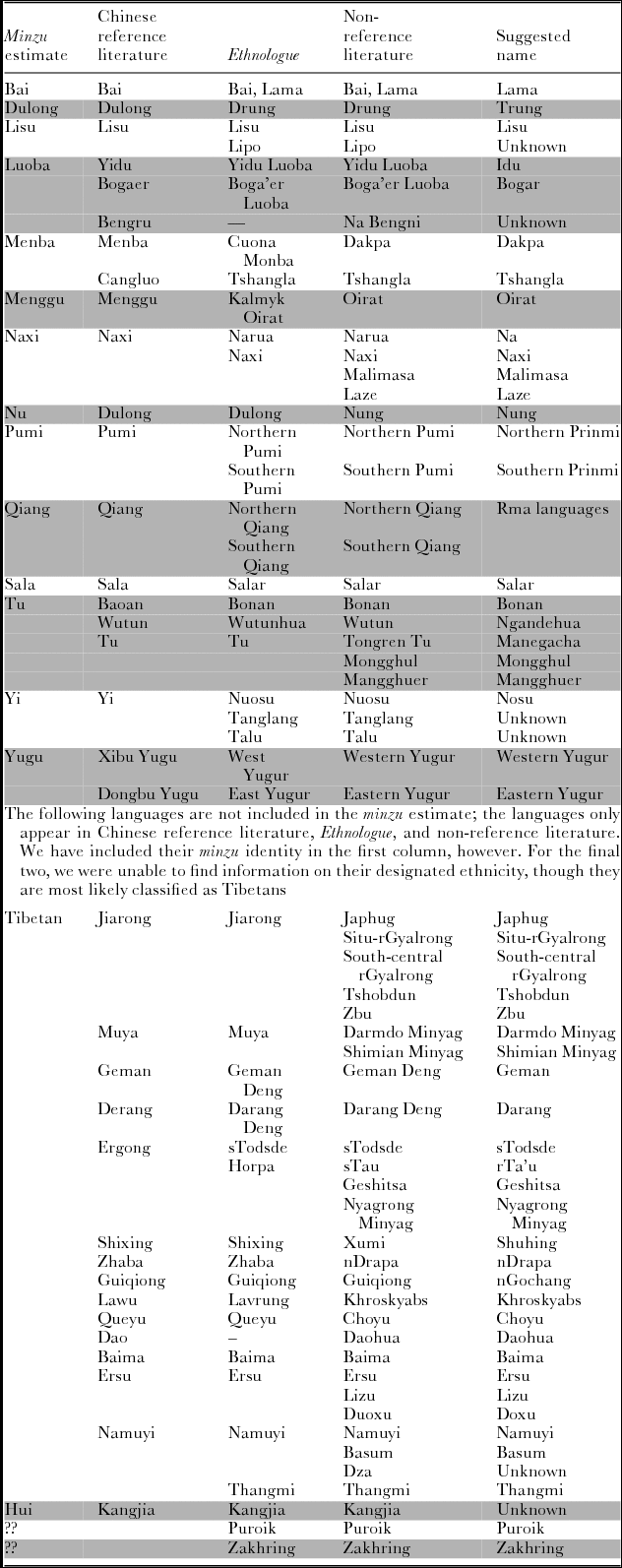
Ultimately, what constitutes an accurate estimate must be judged by the people who identify with these languages. The delineation and enumeration of Tibet's minority languages should be based on the perceptions and priorities of the relevant populations, including the use of language names that are preferred by the community (see Appendix 9).Footnote 86 We still know very little about the linguistic attitudes and ideologies of the speakers of Tibet's minority languages, and this remains a significant topic for further research. However, any study of such topics must take into account the political and social constraints under which these attitudes are formed and the extent to which they might be subject to ‘misrecognition’—the obfuscating effects of power.Footnote 87 Furthermore, even if we are able to take speakers’ attitudes into account in the future, it will still be necessary to have a better understanding of the linguistic diversity of the region in terms of intelligibility, lexical similarity, and spatial distribution, so that the linguistic community can play a role in language planning—helping local communities define, create, and support the languages that they wish to maintain into the future.
If this is done well, respectfully, and quickly, it may be possible for Tibet to avoid a fate that seems to await most of Asia, the world's most linguistically diverse continent—a drastic decline in linguistic diversity, as the countries of the region delve headlong into some of the most rapid economic development and modernization in human history and, perhaps, towards a linguistic future very much like present-day Australia, the United States of America, or Europe, where the revitalization of moribund and dormant languages is a more prevalent concern than the maintenance of healthy ones.
Appendices
Number of languages per province according to the Ethnologue.

Tibetan administrative areas. Each category also includes all subordinate administrative units. For example, the Tibet Autonomous Regions includes all prefectures in the region, Yushu Tibetan Autonomous Prefecture includes all counties in the prefecture, and so on.

Administrative units of the Nonautonomous Tibetan Areas.

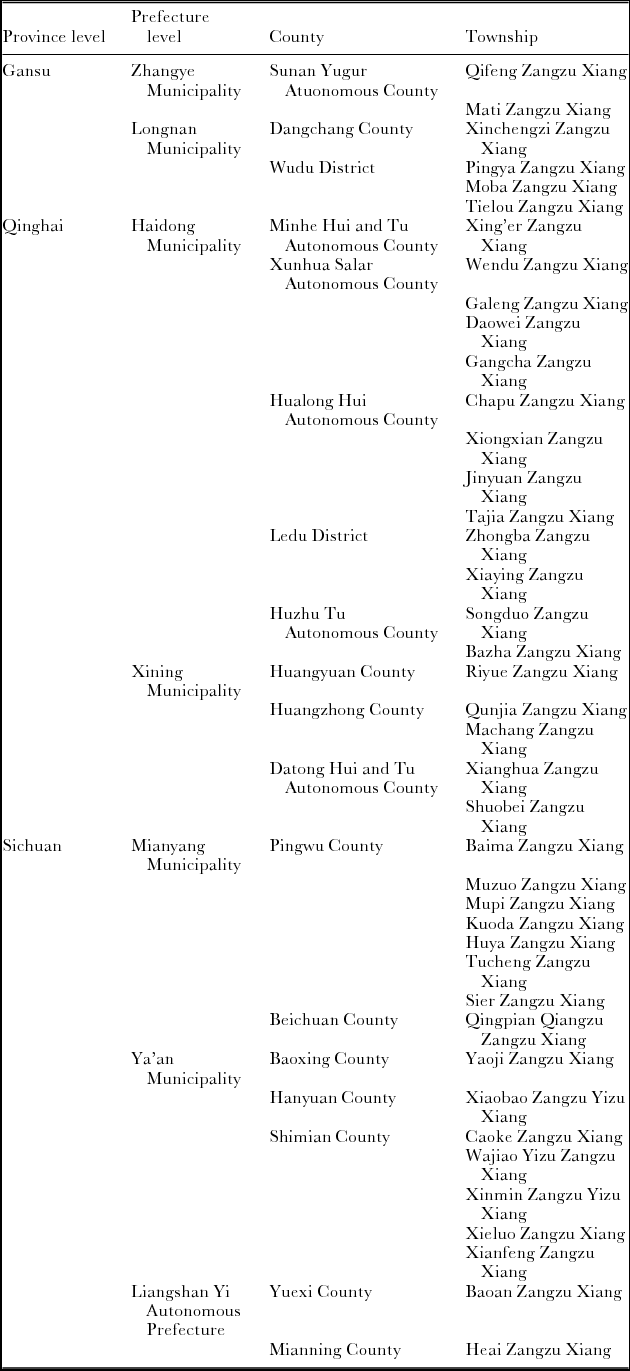
Tibetan towns and townships.

Minority languages of Tibet identified according to state ethnic policies. Population statistics (final column) are based on the 2010 national census and come from Guo Rongxiang, Uradyn E. Bulag, Michael A. Crang, Thomas Herberer, Eui-Gak Hwang, James Milward, Morris Rossabi, Gerard A. Postiglione, Chih-yu Shih, Nicholas Tapp, and Luc Changlei Guo (eds), Multicultural China: A Statistical Yearbook (2014), Springer, New York, 2015.

Minority languages of Tibet identified according to recent reference works on Chinese linguistic research. Language names are based on Zhou's Zhongguo Yuyan Shenghuo Zhuangkuang Baogao, while population estimates (final column) are based on Sun et al.’s Zhongguo de yuyan.

Minority languages of Tibet identified according to the Ethnologue.

Minority languages of Tibet identified according to recent literature. In this count, we have marked one or two key sources for each language but, in consideration of the space available, we have excluded references to the vast literature that exists on these many languages

Comparative table showing how glottonyms used in various sources are related, including our suggestions for the preferred glottonym for individual languages (where available)