Introduction
The Habsburg Empire has typically been understood as a continental power with few overseas aspirations, or as Robert Musil waxed nostalgically in his fictional Kakania: “A Ship would now and then be sent off to South America or East Asia, but not too often.” It is mostly true, of course, that Austria did not have “ambition for world markets or world power,”Footnote 1 but recently historians have begun to explore the role colonial fantasy played in an empire with no actual overseas colonies to speak of.Footnote 2 The Empire did support a series of oceanic voyages in the 19th century. None resulted in permanent settlement of course, but the voracious enthusiasm with which a Habsburg public responded to them is a testament to the weight colonial discourse had even in continental empires like Austria's.Footnote 3 A small, but exciting literature has sprung up around these expeditions, situating them in their broader political contexts.Footnote 4 The exercise has been fruitful at situating Habsburg history in a broader global context and has done much to de-provincialize what was once a relatively insular field.
Much of this work has taken note of the important intersection between exploration, colonial empire, and liberalism. I build on this scholarship by arguing that without overt political power and parliamentary representation until later in the century, German-speaking liberals had to content themselves with extra-political influence only. There was no viable liberal-democratic regime in the Habsburg Empire until at least the Constitution of 1867 and no universal male suffrage until 1907. Women would not have the franchise throughout the imperial period, and the monarchy persisted until the close of WWI. Thus, at least until 1867, and in lieu of party politics, Austrian liberals found other outlets for expressing a liberal weltanschauung.Footnote 5 During the 19th century, this weltanschauung consisted of a set of beliefs that generally included support for free markets, notions of free global trade and commerce, a rational scientific outlook, and a rejection of religious traditionalism and superstition. 19th-century Austrian liberalism also embraced freedom of the press, freedom of association, and limited institutions of representative democracy. It is important to note that 19th-century Austrian liberals (and liberals across Europe for that matter) generally did not support mass democracy as we would define it today. Liberal spaces were usually exclusionary in various ways – for instance, adherents of this kind of liberalism generally did not support women taking up public or political roles in society, and, as we shall see, supported the kinds of civilizational and racial hierarchies that justified European colonialism. In this, it seems, Austrian liberalism was not all that different from pan-European trends, as even in Great Britain or France under the Third Republic – both paragons of “liberty” in 19th-century European intellectual circles – the franchise was constrained domestically and civilizational stereotypes undergirded overseas colonialism. In any case, 19th-century oceanic exploration was among the outlets allowing Austrian liberals to promote their rational/scientific and commercial vision for the world circuitously in the form of potential future colonies.Footnote 6 The present article takes one of these expeditions – the Novara Circumnavigation of 1857-59 – as a way to shed new light on what John Boyer recently described as a “Janus-faced decade”: the 1850s.Footnote 7
Joining much existing historiography then, I see in Habsburg Europe during the supposedly “neo-absolutist” doldrums of the 1850s, a fascinating, seemingly tenuous, but also remarkably resilient equilibrium formed between the emerging bourgeoisie and the aristocratic state bureaucracy.Footnote 8 This equilibrium can also be read in colonial ventures like the Novara, and in it, historians can decipher the strategies liberals devised to navigate the convoluted political constellation at mid-century. As a result, I am interested in the overseas itinerary of the expedition, but also its domestic impacts. Surely the 1850s moment informed the voyage, but the voyage also informed political life back home.
The Novara was a colonial fantasy, then, but it was also a fantasy operating within a distinct domestic setting and towards clear political ends. In fact, the absence of real colonies made this discourse that much more effective at ameliorating the tensions between Austria's various stakeholders. For Austria's aspiring liberal, scientific, and commercial ascendency, ideas about colonies and commerce did not emanate from electoral power, but they did frame a liberal worldview in terms that were palatable to the old regime. The aristocratic state was more easily persuaded of the merits of colonial empire than, say, representative government. Interestingly, this aristocratic state did not, in the end, support actual overseas colonies, and only ten years after the departure of the Novara did it begrudgingly agree to limited representative government. While this fascinating reversal could not have been known at the time of the expedition, it does speak to the ways that in Habsburg Europe, traditional overseas colonial empire usually functioned at the level of discourse, without actual colonies. In fact, this is what made these fantasies so useful. That this discourse did not actually require the creation of formal colonies made it more effective as a form of rhetorical compromise because it did not require the large expenditures that actual colonization would have required.
Interestingly, colonial fantasy may have also functioned as a subtle form of critique: a way of disparaging aristocratic lassitude without overtly confronting it. Liberals could trigger nobles’ traditional sensitivity towards humiliation (and their pocket books) by emphasizing the Empire's alleged colonial backwardness.Footnote 9 Indeed, liberals became quite adept at employing this kind of rhetoric. In it, colonial advocates could measure Austria against the great “liberal” commercial empires of France or Britain, jimmy up support in the general population, and speak to the creaking, noble establishment, which typically showed more interest in continental territory than in dreams of colony, navy, and global trade. In talk of colonies, they compelled modernization without also drawing too much attention to the Empire's “anachronistic” monarchical absolutism and its “primitive” political institutions. Perhaps liberals could elicit nobles’ sense of traditional honor and propriety by tying overseas colonies to notions of international prestige and geopolitical standing?
And, as a discrete episode, the expedition (and press coverage) enables me to show how exactly accommodations and tensions played out between Austria's competing forces in the context of a single historical event, which was conveniently distant from the high-stakes political gambits of Vienna's key players. The expedition is also ideally situated between the revolutions of 1848 and the constitutional reforms of 1867. On the one hand, it began some ten years after the failures of 1848, in a moment of monarchical resurgence. The “March Days” and liberalism's near-triumph would also have been front-of-mind for many frustrated liberals during the famous circumnavigation. On the other hand, the Novara also left Trieste in a moment of modernization for Austria; beginning in the bureaucratic, educational, and economic spheres, but soon spilling over into politics in 1867 – only 8 years after the ship's triumphant return. The Austrian warship circled the globe just as liberalism's fortunes were on the rise. At the same time, monarchical power was waning in Austria. Even as the Novara was at sea, the Habsburg Army was defeated by a joint French-Italian force; and at the Conference of Villafranca in July 1859, Austria was compelled to cede territories in Northern Italy to Italian nationalists. Additional military defeats would progressively weaken the monarchy's standing within the Empire; culminating in the Ausgleich, which granted Hungary autonomy over its internal affairs and split the Empire into co-equal parts. Thus, the Novara expedition and its associated publicity open a window onto embattled Austrian liberalism, precisely at the moment of its nascency and growing influence. At the same time, we can see the post-1848, neo-absolutist order begin to unravel. A moment of neither uncontested liberal triumph nor unmitigated defeat, the Habsburg monarchy at neither apex nor nadir, this is a moment of convergence: when liberal aspirations and monarchical decline first started to turn towards one another.
While expeditions later in the century – for instance, the Tegetthoff Polar Expedition (1872-74) exactly 15 years after the Novara – shared much with the circumnavigation, not least a parallel resonance with Austrian liberalism, much had nonetheless changed in the Habsburg lands between 1859 and 1874. Critically, electoral politics was massively expanded in these years: from the so-called October Diploma of 1860 and the February Patent of 1861, which granted some constitutional reforms but were nevertheless increasingly viewed as an “exercise in Scheinkonstitutionalismus” (Sham-Constitutionalism),Footnote 10 to the Constitution of 1867, which finally granted fundamental rights and established an independent judiciary of sorts.Footnote 11 Thus, the Tegetthoff, setting off after liberalism had achieved a more secure footing, could afford to be more overtly liberal in deportment than the Novara. The Tegetthoff was also primarily a scientific endeavor, while the Novara was a military venture first and foremost, and a scientific/commercial enterprise second. The polar voyage also set sail after Prussia had closed the door on an old German-liberal dream of Großdeutschland. While liberals could envision a Central European German superstate in 1857-59, by the time of the Tegetthoff this was illusory. Finally, the Concordat, signed in 1855, and universally hated by the Empire's liberals, was repudiated in 1870 – also after the Novara but before the Tegetthoff. I would also add that oceanic exploration and the promotion of a rational/scientific and commercial vision of the world (or belief in Empire for that matter) did not simply disappear once more direct political avenues emerged for Austrian liberals. This is because, as I've explained above, political participation was always circumscribed before the collapse of the Habsburg Empire, and because fantasies of colonial expansion and global trade served different functions after 1867 than they did before the constitutional reforms. Perhaps most interestingly, as an increasingly mass politics generated polarization and strife around the turn of the twentieth century, empire (real or imagined) was a way of sidestepping intractable political disagreements at home in favor of a supposedly apolitical national and imperial cause further afield.Footnote 12
In any case, as Stephen A. Walsh has shown, by 1872-74 liberals’ fortunes in the Empire had noticeably improved and the popular enthusiasm for the Tegetthoff voyage seemed to prove “that wider swaths of the population were as excited about the advance of liberal rational science as they were.”Footnote 13 But the Novara venture, embedded in the “authoritarian” 1850s, was not only a way of projecting liberal power, but also another indication of the begrudging need to compromise with the centralizing, neo-absolutist state. Whatever the complex roles colonial fantasy or visions of empire played in the late-imperial period, I argue that in the 1850s it was a way for different aspects and classes of Austrian society to reach a modus vivendi of sorts.
Peopling and Writing a Round-The-World Expedition
The SMS Novara was built in Venice from the designs of master shipbuilder Colonel Joseph Paresi and was launched in 1850.Footnote 14 A man-of-war, the Novara was 165 feet long, 45 feet wide, with a draft of 20 feet, and total water displacement of 2,107 ½ Vienna Tons, and, described as the “most seaworthy sailing ship (seetüchtigste Segelschiff) in the Austrian Navy” – “A box,” it was said “that can withstand a proper jolt” (ein Kasten, der einen rechten Puff aushalten kann).Footnote 15 She set out from Trieste on April 30, 1857,Footnote 16 under the command of Commodore Bernhard von Wüllerstorf-UrbairFootnote 17 and with a compliment of 345 sailors.Footnote 18 Accompanying the naval personnel was a scientific commission of six persons. Among them, the geologist Ferdinand von Hochstetter, who would become the first director of the Natural History Museum in Vienna,Footnote 19 the zoologist Georg Ritter von Frauenfeld, and the ethnographer and economist of the expedition, Karl von Scherzer. The Austrian frigate would circumnavigate the globe and arrive back at Trieste on August 26, 1859; 28 months later. Along the way, the warship made 25 stops – Brazil, Cape Colony, Ceylon, the Nikobar Islands, Singapore, Sydney, New Zealand, and Peru – and covered some 52,000 nautical miles.Footnote 20
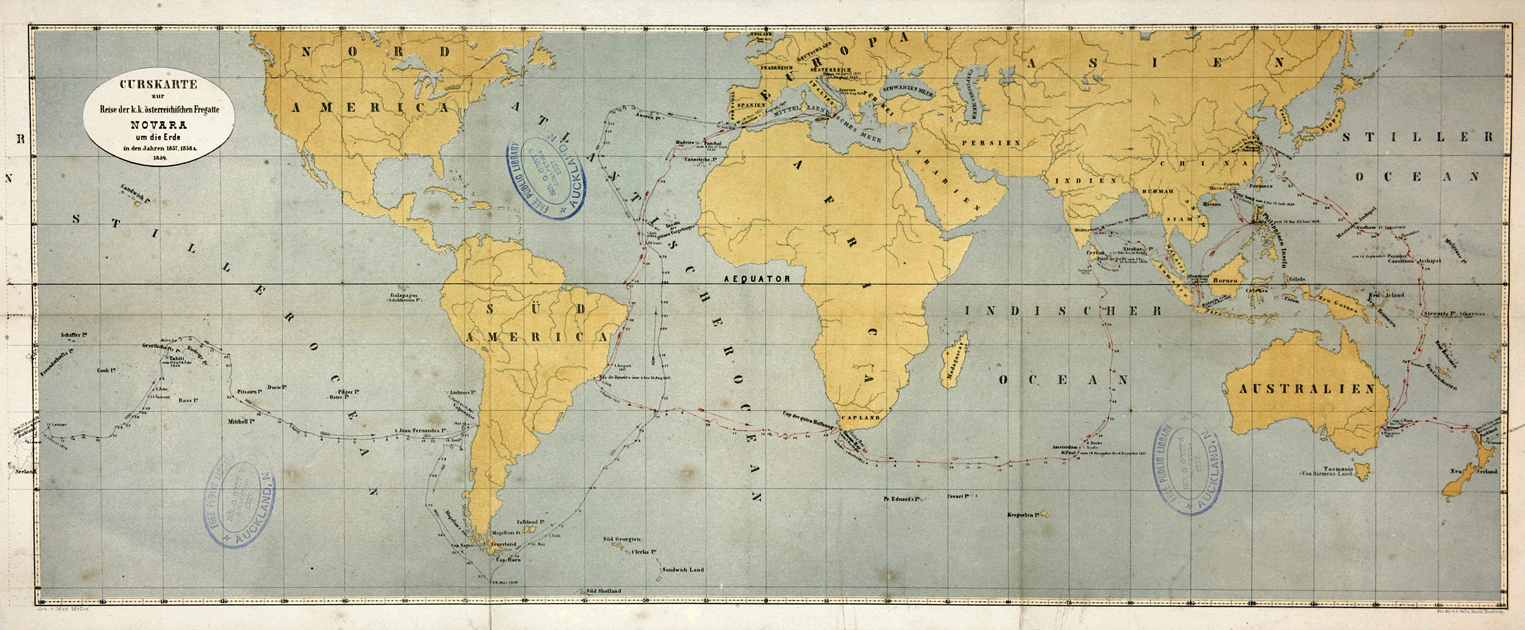
In the years after its return, former members of the scientific commission compiled the voluminous data from the expedition and published it in numerous volumes. Together with this published material, the expedition constituted one of the most elaborate scientific ventures of the 19th century. Along with the data, for instance, Scherzer published a popular account of the voyage – Reise der oesterreichischen Fregatte Novara um die Erde – complete with illustrations and a fold-out map depicting the expedition route (Figure 1). Originally released in 3 volumes in 1861, Scherzer's account was widely read and re-published. I have used material from this memoir in the present article. Additionally, Hochstetter's serial reports to the Wiener Zeitung submitted during the voyage itself – of which I have used select pieces and through which an interested reading public back home could keep abreast of the Novara's progress – were also compiled and published as a single volume in 1885 in honor of his then recent death and a testament to the continued popularity of the Novara circumnavigation almost 30 years after its conclusion. These reports – published widely in the Habsburg Press at the time – enable me to capture the participatory science that the Novara inspired. Indeed, press coverage during and after the expedition was expansive. While material from newspapers reporting on the venture alone could fill several books, I have opted to focus on a small number of pieces – for instance from Budapest-born Edmund Reitlinger, himself a scientist (Professor of Physics) and frequent contributor to the prominent liberal newspaper Neue Freie Presse, though never a member of the expedition – that speak to the liberal-scientific consensus that clustered around the enterprise. An interesting call-and-response dynamic developed between the expedition's naturalists and an insatiable liberal public back home – a veritable republic of letters in miniature. These sources, then, help me capture the intellectual and moral universe Austria's liberals conjured from the Novara.
Map of the route of the Novara in Scherzer's written account of the expedition. Max Müller, “Curskarte zur Reise der k.k. österreichischen Fregatte Novara um die Erde in den Jahren 1857, 1858, 1859,” Kaiserlich-Königlichen. Hof- und Staatsdruckerei. 1860. Courtesy of Auckland Libraries Heritage Collections.

Scherzer himself was a curious figure. Born of middle-class parents and initially trained as a printer and publisher, Scherzer was raised in a liberal milieu. Following liberal currents, he founded the “Gutenberg-Verein” during the revolution of 1848. This organization functioned as a kind of typographical union and fought to improve the working conditions for printers and typesetters. For his involvement he was charged with “subversive activities hostile to the state” (Staatsfeindlicher Umtriebe) and his writings were promptly confiscated.Footnote 21 Fearing worse, he fled into self-imposed exile in North and Central America.Footnote 22
Despite his revolutionary past, the expedition's official architects, Finance Minister Karl Ludwig von Bruck and Archduke Ferdinand Maximilian, chose Scherzer to be the voyage's ethnographer some ten years after 1848. It is interesting to note the cooperation of Franz Josef's own brother, and the royally-appointed finance minister Bruck with former revolutionary agitators, but their association hints at the broader modus vivendi reached between the Austrian bourgeoisie and the aristocracy in the 1850s.Footnote 23
In fact, the Archduke was well known for his support of the natural sciences, and, as the supreme commander of his majesty's Navy, he was a natural promoter for an expedition around the world. That he would select former revolutionaries for the venture is a testament to his willingness to cooperate with and even promote liberal ideas. Horrified at the tribunals and executions of revolutionaries after 1848, Ferdinand Maximilian noted in his journal: “We call our age the Age of Enlightenment, but there are cities in Europe where, in the future, men will look back in horror and amazement at the injustice of tribunals, which in a spirit of vengeance condemned to death those whose only crime lay in wanting something different to the arbitrary rule of governments which placed themselves above the law.”Footnote 24
While the patronage of the Kaiser's own brother hardly smacks of triumphant liberalism, Maximilian's progressive bona-fides and his peculiar personnel choices hint at the extra-political influence of Austrian liberalism. As with much else at mid-century, the Novara expedition seems to confirm liberalism's generally collaborationist attitude toward monarchical power. In the 1850s liberalism was not extinct, but it was forced to concede its overt political program in favor of more pragmatic economic, colonial, and scientific goals. While it was clear by 1856 that liberal ideals would not triumph against neo-absolutism any time soon, the Suez Canal, which had formerly only been a “pipe dream” (Hirngespinst) suddenly became feasible and with Austrian Trieste virtually at the gates of this new trade route the Monarchy felt compelled to expand its naval power. Therefore, many liberal dreams rode on the coattails of the Crown's developmental aspirations and its pursuit of trade profits. The Novara expedition, as we shall see, was representative in many ways of precisely these aspirations.Footnote 25
As scholar Siegfried de Rachewitz has argued, “the most influential actors of the expedition, most notably Scherzer and Wüllerstorf, personif[ied] the spirit of 1848 very well and … the expedition was altogether permeated by this spirit.”Footnote 26 That the expedition was infused with the spirit of liberalism was not lost on contemporaries. In typically German liberal form, Scherzer himself saw in the “development of the imperial navy the crowd-pleasing mission to promote Austrian, as well as German interests in all parts of the world, and to revive German national consciousness.”Footnote 27 This passage speaks to Scherzer's support for a German nation-state; very much at odds with the multi-ethnic Habsburg Empire and very much in line with what German-speaking liberals had agitated for in 1848 – a Großdeutsch redrawing of Central Europe.Footnote 28 From the first, the expedition conveyed liberal values, even as it proceeded under explicitly imperial auspices: evidence of liberalism's overall marginality in the 1850s.
Though partly financed by the monarch and setting out with the imperial family's official blessing, the Novara expedition was classically liberal in ethos and membership. Its vision of a new economic future for Austria based on colonial trade, export markets, and balance of trade smacked of liberal philosophy. But, while underway, the expedition was also committed to scientific method, neutrality, and objectivity. Scherzer himself also offered characteristically liberal critiques 1) of other colonial empires: their excesses and especially their reliance on slavery, and, 2) of antiquated political institutions, which could ring true for Austria as much as the “primitive” societies of Africa and South America. Scherzer seemed to walk a delicate line between praising Austria for her rejection of slavery (for instance), while also critiquing what he felt were Austria's own political and intuitional anachronisms; especially its unwillingness to support commercial and colonial ventures more vigorously. Perhaps he was projecting his frustration with the Habsburg Empire safely onto imperial rivals?
The compromise between Austrian liberals and the old order was embodied in the expedition's stated objectives: a blend of liberal scientific discovery, trade, and military venture, aimed in part at bringing about Austrian naval glory. Scherzer, for instance, reported that the main objective of the voyage was to train Austria's naval officers and cadets for a long sea voyage.Footnote 29 Moreover, the Novara had 30 cannons, 14 Marine Corps cadets, 33 infantrymen, and 14 artillerymen on board – a martial undertaking if ever there was one.Footnote 30 Only days before the expedition's departure, moreover, Scherzer had to set expectations. Before an eager audience of the k.k. Geographischen Gesellschaft on April 7th, 1857, Scherzer insisted that the purpose of the expedition was not to establish colonies on abandoned islands. Rather, it was to train Austrian sailors. Therefore, he claimed, it was important to “lower expectations to an appropriate degree on Austria's first-ever circumnavigation of the Earth.”Footnote 31 The military aims of the expedition are clear here, but I am struck by the apparent enthusiasm of the audience. That Scherzer felt the need to remind members of the Geographical Society that the Novara was not setting sail to found colonies on remote islands implies that at least a significant portion of the Society's membership harbored the hope that Austria was poised to begin actual colonization. Furthermore, Scherzer did leave the possibility of future colonization open and the expedition's itinerary called for a one-month stay at the Nicobar Islands. This was one of the longer stays planned, and the archipelago, north-west of Sumatra, was Austria's most promising colonization prospect. This is why I call the venture a colonial fantasy. In this case, members of the Geographical Society fixed their dreams of future overseas empire onto the circumnavigation. So much so, in fact, that Scherzer, the expedition's most enthusiastic colonialist, had to manage their expectations. But he teased his audience with the caveat that this was only Austria's “first” voyage round the world. Perhaps more would follow? And royal officials had ensured a compliment of naturalists and Scherzer himself would accompany the sailors on this expedition, making for a joint-military exercise, commercial prospecting mission, and scientific expedition.Footnote 32 In other imperial contexts naturalists, ethnographers, and economists were agents of colonial knowledge.Footnote 33 Could Austria's liberals expect the same from the Novara's scientific detachment?
Of course, a necessary component of colonialism (even colonial fantasy) was military force, or, at least the threat of military force. Thus, even the explicitly military purpose of the expedition likely fit nicely into colonial fantasy. Even the name of the vessel – the SMS Novara – hints at the martial nature of the enterprise and the delicate compromise secured between liberalism and autocracy on matters of empire. The warship was named after a famous Habsburg military victory over Italian/Piedmontese nationalists on March 22-23, 1849 near the Piedmont city of Novara. The shadow of 1848, then, and the threat of national-liberal independence movements hung heavy over the famous expedition. In 1860, for instance, the official minutes of the k.k. Geographischen Gesellschaft recounted Finance Minister Bruck's tribute to the expedition on February 9, 1860, six months after the Austrian frigate had safely returned. Under the name “Novara,” he insisted, men of all “estates and nationalities” (Ständen und Nationalitäten) came together in common purpose. “Novara is the name of the battlefield, where ten years ago Austria's brave army – consisting of all the peoples of Austria – secured one of the most brilliant victories [in its history], and at today's ‘Novara’-celebration” he recognized similar broad-based cooperation.Footnote 34 As a representative of the state bureaucracy and the monarchy, Bruck eagerly glossed over the internecine national struggles in the Empire; preferring instead to promote a story of collaboration in a grand endeavor. But history is not without its ironies: part way through the very expedition Bruck was applauding, Austria had been forced to cede territory in Piedmont (Northwestern Italy) to none other than Italian nationalists. It is very interesting that this Austrian frigate – on whose decks rode the dreams of overseas empire – was actually named for a battle of continental imperial expansion in Italy.
Sailing Towards Suez
If we are to understand the full breadth of the colonial fantasy that was woven around the Novara expedition, we must also recognize how this voyage fit into a larger cluster of projects in the 1850s. For instance, the SMS Novara was not the only Austrian vessel to set sail from Trieste in 1857. Another mission, under the command of Lieutenant Wilhelm von Tegetthoff and Theodore von Heuglin set off for Socotra.Footnote 35 The island, at the mouth of the Red Sea, was adjacent to any future sea lanes, which might pass through the Bab al-Mandab Strait and the Gulf of Aden should a canal at Suez be completed.Footnote 36 Their task: survey possible sites for a coal-depot and a deportation colony near the Red Sea. The Archduke's instructions for Tegethoff are revealing: “The construction of the Suez Canal has already begun, which, in securing trade with India and the rest of Asia, is important for Austria [and]…makes it desirable for her to own an island in the Red Sea…”Footnote 37 Anticipating a canal at Suez, the expedition's official mandate was to appraise suitable sites for future colonization. Socotra seemed ideal.Footnote 38
German colonial designs on Socotra go back at least to the Vörmarz period. For instance, amid the hype of Austrian-German unification and the fervor of revolution, an interesting feuilleton appeared in the Wiener Zeitung on January 17, 1849. The piece, entitled “Ueber den Handel im rothen Meere, in Bezug auf Deutschland,” and written by a self-styled German merchant “from Suez,” advocated for a German colonial protectorate on the island. Socotra could serve as a trading outpost and later, with the opening of a canal, a valuable coal-depot for steam ships midway through their long journeys to the Far East. For the purpose of “dispatching products across Egypt, as well as around the Cape of Arabia and Africa,” argued the author, “[Germany] wants a central depot, an outpost, which, in all likelihood, could have been situated nowhere better than on Socotra.”Footnote 39
It should be noted that the newspaper in which this article appeared – the Wiener Zeitung – was the official mouthpiece of the imperial court in Vienna: further testament to the Crown's support for colonial discourse, if not always enthusiastically backing colonial ventures with money and resources. And, when Tegetthoff and Heuglin set sail for Socotra almost 10 years later, they did so with royal approval – the emperor's own brother no less. Still, it is interesting the extent to which the article's anonymous author leaned into liberal orthodoxy regarding trade. Here was a self-styled German merchant supporting the establishment of a colony at Socotra. Commerce and trade were issues on which the bourgeoisie and the old regime could agree. The prospect of a canal through the Isthmus of Suez would cast this tepid relationship in new relief.
A lot had changed in the intervening years between the publication of “Ueber den Handel im rothen Meere” and Tegetthoff's voyage. Establishing a Habsburg colony at Socotra made more sense in 1857 since a Suez Canal was now a distinct possibility. Ferdinand de Lesseps had secured concessions from Said Pasha to build a canal and convened the “International Commission for the piercing of the isthmus of Suez.”Footnote 40 Actual construction would begin only two years after Tegetthoff's expedition, in 1859, but the voyage would set out amid mounting hype and a fundraising campaign for the Canal.Footnote 41
While the Suez Canal is remembered mostly as a French project, it also had Austrian antecedents and robust support from Austria's (and especially Trieste's) merchant class. Already in 1846 Austria reserved five shares in the “Société d'Etudes du Canal de Suez” on its founding – one to the Municipal Government of Trieste, another to the Trieste Stock Exchange, a third to the Austrian Lloyd, a fourth to the Lower Austrian Trade Union, and a final share went to the Venetian Chamber of Commerce. The Austrian civil and railroad engineer Alois Negrelli was ultimately put in charge of construction planning and his canal route proposal actually prevailed in 1856 before construction began.Footnote 42 Negrelli and Finance Minister Bruck were actually awarded “founders shares” in the “Compagnie Universelle du canal maritime de Suez.” The Habsburg Monarchy was also granted two seats on the governing board.Footnote 43 Thus, members of the Austrian Empire were intimately involved in the financing and planning of the Suez Canal. This involvement would also translate into a broader pursuit of island colonies in the Indian Ocean.
The specter of Suez, therefore, also haunted the Novara expedition. On April 30th, 1857, the Novara hauled anchor and set out from Trieste. It was the first circumnavigation undertaken by an Austrian ship. As with Tegetthoff's journey, the Novara's round-the-world voyage was aimed in part at colonial futures, which hinged on a small archipelago north-west of Sumatra called the Nikobar Islands. In the 18th century Maria Theresa had sent a small detachment of settlers to claim the islands for Austria, but the residents quickly ditched them for a more prosperous life elsewhere. In the interim, the archipelago had fallen into Dutch hands. Given Austria's prior claim, many Austrian liberals advocated for their reacquisition. None were more vociferous in these pleas than Scherzer himself. “The Nicobar Islands, situated on the greatest trade routes of the world,” he claimed, “will acquire more importance with the supposed opening of the Suez Canal …”Footnote 44 Scherzer hatched many schemes for the remote islands – among these a plan to deport convicts there by whose labor the islands might be developed – but all depended on the projected opening of the Suez Canal. Others in the Habsburg officialdom recognized the potentially lucrative link between a forthcoming water passage at Suez and the islands. Indeed, the expedition's architects planned the Novara's itinerary with world trade and a potential canal at Suez in mind. In a letter sent to Ferdinand Maximilian on December 6, 1856, for instance, the Austrian Minister of Finance Bruck expressed the following: “One needs only mention Australia, Japan, China and the East Indies to become enthusiastic about the thought that the expedition will in fact return over those same seas, which would become, through the piercing of the Isthmus of Suez, immensely important for Austria. Should this wish be fulfilled therefore, I would have to pay special attention to the Nicobar Islands [that still] belong to Austria.”Footnote 45 Again, we see men like Scherzer – men who had run afoul of the monarchy in 1848 – and representatives of the traditional monarchical order in lockstep on issues of world trade, Suez, and colonial acquisitions.
Aspirations were not only projected outwards: the post-1848 neo-absolutist regime in Austria also sought to link Trieste with their sprawling continental empire. Extending the Südbahn line to the port in 1857 – the same year Tegetthoff set sail for Socotra and the Novara began its voyage – conjoined the imperial capital of Vienna with Austria's jewel of the Adriatic.Footnote 46 As David G.L. Weiss and Gerd Schilddorfer rightly point out, Trieste was Austria's access point to the markets of the world and the Südbahn line, linking the continental empire with the Adriatic, was a crucial part of that ambition. Amid the flurry of excitement around the Suez Canal, many hoped that the new rail line, in conjunction with the new sea passage, would thrust Austrian shipping into a position of predominance in Europe. With the canal opened, Trieste would no longer be some backwater port, but the gateway to rich Asian waters.Footnote 47
Visions of overseas empire went hand-in-hand with domestic industrialization. Overseas colonies would not yield much if Austria did not have the industrial and infrastructural capacity to process their abundant raw materials into manufactured goods. Although the 1850s were marked by reprisals for 1848 and monarchical resurgence, liberal ideas were often appropriated by the centralizing-bureaucratic thrust of the post-1848 government. Barred from political power, liberal tenets emerged circuitously, and by other names: administrative centralization and economic development. Pieter Judson, for instance, has cautioned against only reading into the 1850s political repression. Freedom of expression was curtailed, censorship reinstated, and a harsh ban on political activity initiated, but Judson reminds us that the “modernizing program in the 1850s accomplished quite a lot of exactly what liberal reformers in the Habsburg Monarchy had desired in 1848.”Footnote 48 For instance, the abolition of serfdom in 1848, liberalized trade policies with neighbors (the Prussian-led Zollverein),Footnote 49 the long-awaited suspension of the “Tariff Wall” (Zwischenzollinie) between Austria and Hungary,Footnote 50 the enormous expansion of the Empire's rail network “from about 1300 to 3000 kilometers” in the Austrian half of the Monarchy alone,Footnote 51 and the establishment of investment banking institutions like the Creditanstalt bank on October 31, 1855.Footnote 52 These reforms were each aimed at modernizing the Empire and promoting economic prosperity, and, increasingly, at ensuring parity with Austria's European counterparts.
Consequently, liberalism's demeanor in the 1850s was certainly constrained, but able to express itself circuitously through Finance Minister Bruck's economic reforms, and, as I argue, through colonial enterprises like the Novara circumnavigation. Liberal values (free markets, liberal institutions, and scientific discovery), moreover, were increasingly upheld as the criteria for measuring geopolitical and economic progress (or, perceived backwardness). So, liberal sentiments surfaced via modernization projects, but they also surfaced via colonial fantasy, and this fantasy was grounded somewhat by the increasing feasibility of the Suez Canal throughout the 1850s. In fact, construction began in the same year that the Novara returned from its round-the-world expedition in 1859. The canal captured the imaginations of liberals and nobles alike.
Thus, before it had even been finished, the anticipated completion of a canal at Suez played an important role in the mid-century Austrian imagination. It functioned as a spatial node in Habsburg colonial aspirations, but also as a way of dealing with perceived economic and geopolitical backwardness. A forthcoming water passage connecting the Mediterranean and the Red Seas at Suez then became a veritable lynchpin in peculiar Austrian colonial expectations, even before the canal was a tangible reality.
In fact, the Suez Canal functioned as a kind of symbolic totem in the Austrian imagination. It immediately brought to mind notions of commerce, economic development, and “free” trade: each critical components of the liberal worldview. And these economic sentiments were all predicated on a very particular vision of empire that conjured images of overseas colonies and also drew on ideas of national economic autarky and export markets. It was to precisely this vision of empire, then, that Scherzer dedicated his own intellectual efforts. Indeed, one of the secondary goals of the Novara expedition was to scout new trade routes and potentially open up new markets for Habsburg goods.
Austria's liberals would also draw comparisons between the Habsburg Empire's own colonial aspirations and the paradigmatic colonial empire of its day: Great Britain. Members of the Novara's scientific commission were eager adherents of such an approach. In a report subsequently published in the Wiener Zeitung, for instance, the expedition's geologist, Ferdinand Hochstetter, expressed remorse for Austria's single, failed attempt at acquiring a colony at Nicobar. The islands, “whose climate had thus far thwarted all colonization attempts,”Footnote 53 outmatched the disorganized and scarcely supported Austrian settlers who first came ashore 80 years earlier. The intrepid colonists either died or abandoned the outrageous scheme. Hochstetter compared Nicobar to similar ventures in the British Empire. “Yes, at one point Ceylon [Sri Lanka] also counted as a tomb for the Europeans” (Grab der Europäer), he admits. “The murderous climate has scarcely changed in the decades since that time when European troops were decimated in the war against the Kandy Kings…” Indeed, the Kingdom of Kandy resisted European rule into the 19th century, finally succumbing to British sovereignty only in 1818 after the Kandyan Convention and the failed Uva Rebellion. Despite these early struggles however, “today the troops are sent to Ceylon to recuperate and restore their health; climate and the [indigenous] men are overcome. Ceylon has been turned into an ideal paradise and into the most lucrative colony under the English Crown.” So, Britain ultimately secured Ceylon despite its early misfortunes on the island, and therefore, reaped the economic rewards. The expedition geologist concludes with a provocative question: “Should not similar things be possible on the neighboring islands as well: the Nicobar Islands?”Footnote 54
In other words, why had Britain succeeded on Ceylon while Austria had only met with failure on the Nicobar Islands, especially considering that both islands lay on the same longitudinal line and shared nearly identical climatic challenges? We may have our suspicions. For one, the Nicobar Islands are significantly smaller and thus much harder to support self-sustaining colonial activities. Ceylon, of course, was a much larger island. Some commentators though tried to transform the small Nicobars into an advantage. In its Christmas Day edition on December 25th, 1856 (mere months before the Novara's departure) Die Humorist featured an article praising Austria's return to the Nicobar archipelago. “Since the islands altogether are only 50-square miles,” the author claimed, “this terrain is easy to manage militarily and economically.” Conceding that most geography handbooks described the Nicobar Islands as “unhealthy” (ungesund), the article also argued that the Nicobars were more favorably located latitudinally than Java. Like Hochstetter, the author insisted that the islands could be cultivated. If only the stagnant swamps could be drained and the virgin jungle cleared, argued the author, the islands would be ready for useful development. Again, notice the function of fantasy here. The author admits that the islands were not immediately ready for colonization, but insists that they very well could be in the future if properly managed. They also call the Novara's planned stop at the Nicobars a “meaningful step” and linked this possible future colonization to a longer history of Austrian colonial ventures in the Indian Ocean during the 18th century (for instance, the trading post at Dalegao Bay in modern-day Mozambique).Footnote 55
What is striking about the Hochsetter and the Humorist accounts of the Nicobar Islands is how they both acknowledge limitations in the present and how they anticipate a successful future. It is also interesting that in these accounts (and in Scherzer's account as well for that matter)Footnote 56 success was predicated on managing the difficult climate and ecology of the Nicobar Islands. When discussing the need to clear-cut the Nicobaren jungle and drain stagnant marshland before the land could be secured for lucrative agricultural activity and rendered safe for European habitation, these authors were engaging in a common European attitude about the natural world. European notions of civilization and progress demanded cultivation – that is, a taming of the wilderness and a certain ordering of what was perceived of as a kind of ruinous natural chaos. These ideas of managing nature also resonated strongly with European notions of managing colonies, managing indigenous populations, and managing global commerce. Each of these were aspects in an overall European view of civilization of which the Novara expedition in general, and the possible colonization of the Nicobar Islands in particular, were clearly a part.Footnote 57 And the views of experts like Hochstetter (a naturalist) and Scherzer (an economist and ethnographer) show how scientific expertise about the environment, global trade, and indigenous societies (however skewed) often reinforced and legitimized colonial projects.
In any case, Austria's colonial shortcomings were not essential, and most importantly, they were not understood as permanent. By emulating British techniques especially, the Habsburgs too could attain colonial glory. Hochstetter's final question above simultaneously defers to British success on Ceylon and hints at future Austrian colonial success at Nicobar – “should not similar things be possible on the neighboring islands?” This kind of ambiguity is typical of thinking orientated around a framework of perceived (colonial) backwardness – that is, a more or less honest accounting of one's own inadequate past and a triumphant projection into the future of a hard-earned economic equivalence with other powers.
In a feuilleton appearing in the December 21, 1864 edition of the Neue Freie Presse, Edmund Reitlinger also praised Britain as a paragon of free-market principles. The piece, entitled “Vom Markt der Welt” and reviewing Scherzer's recently published data from the Novara expedition, acclaimed British Singapore's “liberal and open-minded institutions.”Footnote 58 While in 1819 (when British rule was established) Singapore was still a “desolate, dreaded pirates’ lair, today thousands of ships run annually…”Footnote 59 Only “Half a century of English possession sufficed” to convert the island into a thriving center of commerce.Footnote 60 “The population of Singapore consists of the most heterogeneous elements of language, skin color, traditional costumes and customs imaginable.”Footnote 61
Here one finds Chinese, Malaysians, Bugis, Ambonese, Javanese, Arabians, Armenians, Persians, Siamese, Burmese, English, Dutch, French, German. Here the Parsi pray to the fire, the Indians tell of the incarnation of Vishnu [a Hindu Deity], the Ceylonese praise the Buddha for his self-sacrificing love of humanity, the son of the holiest kingdom venerates the proverbs of the wise Confucius. As [Heinrich] Heine writes, the followers of Mohamed look in prayer in the direction of Mecca – but all pay homage to the golden calf of profit and a tranquil life next to one another under the protection of English freedom and English law.Footnote 62
Put simply, Reitlinger claimed that human cultural, linguistic, and religious diversity were best preserved and safeguarded from dissolution under the alleged neutrality of British free-market capitalism and British law. This cultural pluralism in the name of good business and faith in the rule of law were central tenets of the 19th-century liberal mindset. And one might also speculate that no European power was better suited for this kind of multicultural colonial governance than the multi-ethnic Habsburg Empire.
Extoling the virtues of global trade, moreover, Reitlinger delights his educated and cultured liberal readership with a stanza from Friedrich Schiller's poem “An die Freunde.”
But Reitlinger beguiles by his omissions. In the original text, Schiller writes, “An der Themse, auf dem Markt der Welt,” (On the Thames, in the market of the world). In the Reitlinger version, the river Thames is removed. We can only speculate why Reitlinger omitted this obvious reference to London. By striking out any mention of the Thames, or by implication London, Schiller's “Market of the World” could be located anywhere: perhaps even Trieste. Leaving out the Thames, Reitlinger questions the inevitable supremacy of British world trade. Upstarts like Austria might yet aspire to the mantle. If Britain was typically the preferred exemplar, in refusing to mention the Thames, Reitlinger implicitly suggested that Britain's dominance was provisional. By emulating “good” (British) imperialism then, Austria could secure its place among the great commercial empires of Europe and proclaim its own glorious mercantile future.Footnote 63
Scherzer thought similarly. Writing on British Australia, he implored that anyone seeking to learn how “this island nation [Britain] exercises influence over the destinies of humankind should visit not Great Britain, but her colonies in America, Africa, Asia and Australia.”Footnote 64 Scherzer explains how Germany has suffered from the mass emigration of its skilled workers and its failure to harness this migration in the form of agricultural colonies. These colonies, then, might fuel industrial manufacturing back home. “England,” he explains, “has a better understanding than Germany of how to profit from the energies of its emigrant sons in foreign parts of the world.”Footnote 65 Britain “extended its support and also its protection over their adoptive home and considered each new settlement only as an extension of the borders of the British Empire…as a new stockpile facilitating commerce.”Footnote 66 Though liberals like Scherzer often argued against the aristocratic (and anachronistic) state, on the issue of colonial empire and global commerce they actually called for an explicitly interventionist state like Great Britain. In fact, this was in line with pan-European trends. Classical liberals, while adopting laissez-faire rhetoric, actually promoted and depended on robust and far-reaching state intervention on behalf of their global commercial ventures.Footnote 67
Therefore, properly managed and with sufficient state subsidy, a colonial empire like Britain's could divert surplus and emigrant labor towards its own colonial possessions, while at the same time, acquiring valuable agricultural goods with which to fuel its own domestic industrial manufacturing. The economic windfall from this strategy could be enormous, as Britain's success attested. That colonial commentators recognized this potential is undeniable. National energy draining out of the metropole in the form of emigrants could be recovered in colonies rather than lost forever, or worse, lost to another imperial beneficiary altogether should they chose to settle “unfaithfully.” The opportunity to retain skilled labor in colonies and the perilous possibility that emigrants may lend those same skills to another empire galvanized German efforts to expand and acquire overseas colonies in the late nineteenth century once it had achieved unification. It is interesting, then, that Scherzer's description of an Austrian military and scientific expedition would also serve as a venue for imperial comparisons and cautionary tales. Obviously, the Nicobar Islands were the object of such lessons.
Despite Scherzer's appeals on the issue of further state support for (and one might well imagine subsidy of) additional colonial ventures, the Habsburg dynasty was divided on the issue and only showed limited interest in the kind of formal and state-backed colonization that Great Britain exemplified. Thus, the Habsburg Empire did not capitalize on the colonial frenzy sweeping across Europe at the time. Nor did it fully satisfy in subsequent years the colonial fantasy its liberal subjects held in the 1850s. While Franz Josef's younger brother exhibited an enduring interest in the Navy, the emperor himself was never that enthusiastic about naval power or the idea of overseas empire.Footnote 68
At the time of its departure from Trieste, then, the Novara was a vision of possible Habsburg colonial empire. This is why it was a colonial fantasy. Adherents of a Habsburg colony on the Nicobar Islands, for instance, could not have known at the time that nothing would come of their proposals. But this should not dissuade historians from considering the domestic impact of these fantasies of overseas empire. A sprawling Habsburg colonial empire, anchored in the Mediterranean, and bypassing Austria's principal Central European rival (Prussia) through a future canal at Suez was a real possibility in 1857 and this historical contingency generated a great deal of social and cultural energy even if formal colonies did not ultimately emerge. Thus, the “authoritarian” bureaucratic centralism encouraged by the monarchy in the 1850s and hated by Austrian liberals, also seemed to position the Empire well for acquiring its own overseas colonies. While frustrated with the overbearing state, on this last point the Empire's liberals could hardly object. Colonial futures relied on precisely the economic modernization and centralization which the monarchy supported in domestic policy. The Novara always existed uncomfortably with the neo-absolutism, traditionalism, and Catholic resurgence also pushed by the monarch in this period, but the voyage was foremost a site of collaboration, where the Empire's various factions could reach a temporary equilibrium, projected safely abroad and far from Vienna.
As in other modernizing empires, colonies would prove more useful to Austria as export markets for manufactured goods than as repositories of cheap raw materials. Along with providing naval training to sailors, for instance, Scherzer insisted that the expedition had the “equally important task of displaying the Austrian flag on disparate and hitherto unvisited parts of the earth, and thus promoting the interests of industry, commerce and the shipping of the Imperial State by establishing new export routes for our domestic products and manufactured goods.”Footnote 69 Similarly, in his feuilleton “Vom Markt der Welt,” Reitlinger noted “the value that Austrian trade must possess merely from the appearance of an Austrian warship in far-flung seas, for example in East Asian waters.”Footnote 70 He was referring, of course, to the Novara on its round-the-world tour. Reitlinger also praised Scherzer's “most detailed appraisal of the question of the colonization of the Nicobars and the transoceanic sale of Austrian products and manufactured goods.”Footnote 71
Furthermore, the humorous weekly Der Humorist ran a short piece entitled “Industrie-Fahrt der ‘Novara’” in its April 6, 1857 edition. “Traveling with the ‘Novara,’ which carries the most glamorous products of Austrian industry to the farthest reaches of the world, are also two-dozen ‘Wiener-Humoristen.’ The expedition will leave them at the Cape of Good Hope and on its return journey it will see if they have proliferated there and whether the inhabitants have reproduced this industry.”Footnote 72 Released shortly before the Novara's departure, the comical piece satirized export manufacturing, as well as the importance attributed to it by contemporaries. Poking fun at the talk of the day – global markets and colonial circus – Der Humorist speculates amusingly on whether the Cape Colony could develop its own humor-print industry.
As we have already seen, Britain features prominently in these accounts: both as a model to be emulated and a threat to be overcome. As the premier world power in the 19th century, Britain was often considered a panacea for the challenges and problems of modernity. At other times, however, she was a threat, or as Friedrich List claimed, “British supremacy in manufactures, commerce, navigation, civil and naval, and in colonies, seems actually the greatest of all obstacles to a close union of nations.”Footnote 73 The German politician and publicist Jakob Venedey, feared British financial, industrial, and commercial might, and implored “The heavens to protect Germany from England's greatness and wealth.”Footnote 74 In either case, for many Europeans, Britain became a benchmark of sorts for assessing their own position in the European concert of powers. And as we have seen, Austrian liberals held similarly paradoxical views of Great Britain. For example, Scherzer was an avid proponent of the British deportation system and convict colony of Australia. If imperial officials could not goad voluntary settlement, then convicts – society's “undesirables” – could be compelled to conduct the hard labor necessary for establishing a colony. Scherzer proposed this very strategy for the Nicobar Islands.Footnote 75
But even as free-markets were lauded for their allegedly impartial objectivity, it was the pursuit of scientific knowledge which proved most advantageous for presenting the Novara expedition and Austrian overseas ambitions in terms of some larger European civilizing project and drained of all petty personal aspiration. In the socially constructed “neutral” space of natural science, Austrian geopolitical ambition and subjective notions of economic backwardness could be repackaged as a noble pursuit of knowledge.
Liberal Science meets Courtly Diplomacy
The Habsburg Empire's new orientation toward education signaled the ascent of certain liberal-scientific priorities. The new Education Minister, Count Leo von Thun set about restructuring pedagogy and encouraging intellectual freedom in the Monarchy.Footnote 76 As Deborah Coen claims, “Thun was in many ways emblematic of the contradictions of Austria in the post-1848 era. He was an aristocrat, a conservative, and a pious Catholic, yet he fully supported Exner and his liberal colleagues in their bid to make Austria a center of open intellectual inquiry. On the one hand, he backed the 1855 Concordat,” which restored Church authority in matters of education, while “on the other hand, he was a driving force behind modern intellectual movements at the universities…”Footnote 77 Similar liberal-scientific values were also at the center of the Novara venture.
Reflecting on the voyage years later, Scherzer emphasized the scientific neutrality of the Novara. He argued that the Novara Expedition was only dedicated to the innocent pursuit of knowledge and in so doing disguised the more overtly imperial implications of the enterprise. This rhetoric was useful in two ways: first it shielded Austria from direct confrontation with other European empires it could not well afford, and second, it enabled Austrian liberals to argue that Habsburg colonialism could be conducted more humanely than other European empires.
I want to emphasize that the practice of science on an imperial warship under the official mandate of a European state was not actually “neutral” or “apolitical,” but I am arguing that a posture of scientific neutrality was strategically deployed by Austrian liberals like Scherzer. For example, while the Novara crossed the Atlantic in the summer of 1859 on the last leg of its voyage, the ill-fated war with Italian patriots, Piedmont, and their French allies in northern Italy was turning against Austria. Even before the ship had completed her Atlantic passage the Battle of Solferino had ended in Austrian disgrace. On reaching British Gibraltar, August 7, 1859, mere days before the frigate's triumphal return to the port at Trieste, Scherzer pondered Austria's misfortune and the danger his ship had risked by crossing so near to enemy waters. Some French warship might have intercepted them during the crossing. Scherzer duly noted his concerns: “Here [in Gibraltar], no one seemed to be aware of our having been declared neutral by the most important European powers,” which the expedition enjoyed, he explained, “thanks to the prudent foresight of its illustrious architect.” Scherzer was referring to the Archduke Maximilian, at whose behest the expedition had been proposed. “We feared what would have occurred had the Novara encountered enemy warships in American waters…” for lately, Scherzer confided in his readers, “we have become well accustomed with seeing even the proper documents and treaties trodden underfoot.”Footnote 78
Although emphasizing the apparently arbitrary will of Great Power politics, especially during wartime, Scherzer regales us with promising tales of European cooperation in the common endeavor of science. In fact, for Scherzer the Novara was shielded by its scientific mandate. To commandeer the Austrian warship, in these circumstances, was to open oneself up to European-wide criticism.
For those in the Tuileries noted very well the consequences of such violence; [and were] also cognizant that in our times the most powerful can no longer violate scientific interests with impunity, that an affront to science is at the same time an affront to civilization and mankind. Indeed, so great was the worry in Paris to avoid every possible conflict with the Novara, that in spite of the existing declaration of neutrality, another special order was dispatched by the French Government and amid the tumult of battle and the thunder of cannons the call rang out: ‘The Novara may proceed on its way free and unimpeded, for she is laden with scientific treasures and science is the common property of all the peoples and nations of this earth.Footnote 79
Of course, there is a hint of anxiety in Scherzer's commentary. In declaring scientific neutrality and emphasizing its apparent triumph over Great Power politics, Scherzer was not only overtly expressing a widespread liberal maxim at the time, but also seemingly acknowledging that the Novara was actually taking a massive risk by passing through the French Mediterranean. Scherzer was attempting to revalue how European powers ought to be measured against one another: substituting military prowess for scientific discovery as the most appropriate measure of European standing. One wonders though, if this was more wishful thinking than an accurate assessment of reality.
In his accounting of the Novara's transatlantic crossing, its risky exposure to martial rivalry, and its supposed scientific neutrality, Scherzer was keen to stress France's compliance with and acquiescence to scientific priorities. He associated these priorities with European civilization itself, to say nothing of the fact that in this case an Austrian warship was permitted to pass near France unimpeded. Scherzer tells us that France wanted to avoid embarrassing entanglements with a scientific venture of this stature. But again, these statements are perhaps more accurately read as subtle admissions of weakness. Austria had already been defeated in northern Italy. Perhaps only the shield of science could protect her from a second defeat on the high seas at the hands of the much more powerful French navy.
Scherzer's account is typical of 19th-century liberal rational objectivity. That is, liberalism's penchant for projecting a certain self-professed rhetorical impartiality in opposition to what it perceived as the petty power politics, gratuitous aristocratic rivalry, and superstitious traditionalism of the ancien régime. Under the seeming neutrality of the Rechtstaat, free markets, and scientific discovery, however, cosmopolitan liberalism would thrive, spreading its modern gospel to the farthest corners of the Empire. To say nothing of the fact that the Habsburg Army had just lost a pivotal battle to, of all people, Italian nationalists seeking to create their own nation-state, free and independent of Habsburg dynastic rule.
Keeping the Geological Imperial Institute apprised of the expedition's progress moreover, Scherzer submitted a report on British courtly hospitality at Cape Colony. The correspondence arrived from South Africa and was subsequently published in the Wiener Zeitung on February 3rd, 1858. In it Scherzer praised the benefit of a joint military/scientific venture. “Fortunately, in our endeavors, we are very eagerly supported by the inhabitants of the countries visited, and are afforded great advantages from traveling on a k.k. Austrian warship on an official mission of science.”Footnote 80 “As a simple natural explorer,” on the other hand, and “traveling with the modest means of a private man, the members of a scientific expedition would surely achieve far less success, and, in spite of the greatest efforts, have far fewer results to show for it.”Footnote 81 Under the “aegis of the imperial Austrian flag,” however, the reach of science could be extended.Footnote 82 Scherzer concludes: “The interest which the expedition awakens in all circles as well as in all countries, the desire to participate personally in the struggles that accompany naturalists, at least through a gift, all this combined fundamentally to support the purposes of the expedition and, as a rule, leaves us richly laden with natural science treasures of all kinds from each of the visited places, and richer than some private scholars, who, traveling under less brilliant auspices, lingered perhaps ten times longer in the same place…”Footnote 83 Such passages point to the tentative accommodation reached between liberals and the old regime during this period. In fact, the practice of natural science backed up colonial projects across Europe, but in mid-19th-century Austria, this relationship operated on a more fantastical level in the absence of actual colonies. Furthermore, while it is true that the Novara expedition did not establish anything like the Austrian equivalent of French Algeria or the British Raj, its dedicated followers devoured its scientific reports with a voracious appetite that was typical of European empire in the 18th and 19th centuries.
Indeed, Scherzer's framing of the benefits of an expedition under military-naval auspices here is reminiscent of the gunboat diplomacy that would come to play such a prominent role in late-19th-century colonialism. It did not matter of course that the SMS Novara never fired its guns in direct engagements. What counted was the implicit threat of violence, and while Scherzer does not spell this out for us, the implication seems clear. Those guns, or rather, the threat of those guns seemed to have facilitated the acquiring (or stealing) of objects important in the study of natural history.Footnote 84
Scherzer – an ethnographer – was also grateful to be included in an official diplomatic outing to Stellenbosch with the British Governor of Cape Colony, Sir George Grey, as well as other British colonial officials and the Novara's naval representatives of Emperor Franz Josef. “Outdoors, at the communal mid-day meal under the shade of an enormous oak tree the Governor gave me the honor of being [seated] beside him and shortly after the customary toast to the King of England announced that a member of the ‘Novara’ expedition was present and drank to the health of his k.k. Apostolic Majesty, the Emperor of Austria, and to the faithful affections of the English people with immense jubilation (three times three and one more!).”Footnote 85 The ceremonial decorum and toasting reflects an older, “courtly” disposition, and here was Scherzer – a liberal scientist – quite literally sitting beside representatives of the King of England and the Emperor of Austria at an official event between two European powers. It is likewise interesting to consider Scherzer's pseudo-diplomatic role with the expedition: experience he would cultivate later in life as a Consul for the Austro-Hungarian Empire in Smyrna, Turkey.Footnote 86
In his 1864 feuilleton, moreover, Edmund Reitlinger praised the pursuit of pure knowledge that many recent expeditions had embodied. “In more recent times,” he argued, “which have been erroneously scorned as materialistic, expeditions were equipped for the pursuit of pure knowledge: they were equipped to defy the icy winds of the North, the feverish tremblings arising from breathing in the heat of the tropics too heavily, and circumnavigated the earth in the service of research.”Footnote 87 He depicts scientific expeditions as intrepid ventures into hostile environments. Only equipped with European scientific knowledge and technical know-how, naturalists braved icy winds and feverish tropical heat.
In stressing the Novara's scientific mandate and by applauding its “selfless and altruistic expansion of human knowledge,”Footnote 88 Reitlinger also denounced other colonial powers for shedding “whole streams of innocent Indian blood so as to quench their insatiable thirst for gold.”Footnote 89 While others had explored the world in the name of greed and exploitation, Austria did so for the neutral pursuit of knowledge. Pure knowledge, then, was juxtaposed against the more unsavory aspects of imperialism. For established imperial powers like Britain science functioned as an ideological smokescreen to justify economic exploitation and colonial violence. For Austrian liberals, however, such pursuits were presented as evidence of how the Habsburg Empire might colonize more humanely.Footnote 90 On the Novara science was a rhetorical remedy for perceived backwardness and enabled Austrian liberals to forge for themselves a kind of colonial moral high road.
Conclusion
Blocked from political power until 1867, an ascendant liberal bourgeoisie in Habsburg Europe had to direct its energies elsewhere. Repressed politics resurfaced in various forms, but all were more palatable to the monarchical order than revolutionary unrest and barricade fighting on the boulevards of Vienna. Economic development and profit, modernizing and centralizing bureaucracies, the flourishing of the fine arts, and the growing authority of natural science were all outlets for liberalism's frustrated political progress. I have argued in this article that colonial fantasy also functioned as politically acceptable and “safe” outlets for pent up liberal energy in Habsburg Europe in the 1850s. Colonial fantasies not only functioned as a visionary framework for economic and geopolitical parity with Western powers like France and Britain; they also gave frustrated and politically ostracized liberals a “productive” outlet for their ideas about the world, Habsburg Europe's place in it, and the proper organization of society. Colonial discourse could also obliquely criticize monarchical intransigence. “While Scherzer's official role forbade criticism,” argues Christa Knellwolf King, “his insistence that the British empire is founded on political liberty shames his native country by comparison.” Scherzer's “admiration for a foreign empire is not simply an expression of unreflected enthusiasm, it indirectly invites Austria to leave behind its social and political stagnation.”Footnote 91 Thus, the Novara episode invites us to reconsider what role colonial fantasy played in an aspiring Habsburg liberal class forced to contend with monarchical power and a neo-absolutist state bureaucracy at mid-century.
This story also gives historians of the Habsburg Empire a new way of assessing the fragile harmony reached between Austrian Liberalism and the state bureaucracy of the 1850s. As Pieter Judson has eloquently suggested, “In Austria […] few of the struggles that pitted the middle class against the crown, nobility, military, and bureaucracy were limited to the arena of formal politics, and very few of these struggles resulted in absolute victory or defeat for any one group.”Footnote 92 I have argued that one of the places where this convoluted politics played out was in the colonial dialogue and associational life that sprung up around the Novara venture. At mid-century, the Habsburg Empire was a strange amalgam of competing and collaborative forces, and the Novara – in membership and press coverage – beautifully embodied this complexity. If the 1850s was what John Boyer has called “a time of curious and fascinating tensions,”Footnote 93 then this vessel, halfway around the world, seems almost a microcosm of Austrian life – hierarchical, yet pluralistic; traditional, yet forward thinking. Indeed, the very marginality of actual colonial policy in the Empire may have counterintuitively made this highly publicized circumnavigation a perfect stage on which to work through this political constellation, and thus, useful for us historians who are attempting to decipher mid-19th-century Austrian political culture. Liberals were perhaps more able to express their worldview in a context of colonial fantasy than in one of consequential domestic policy. The same cannot be said, of course, for the empire's future political strife.Footnote 94
Acknowledgements
I would like to thank Larry Wolff, Stephen Gross, and Karl Bahm for reading early drafts of this article and for their insightful feedback. I would also like to thank the anonymous reviewers for their detailed and generous comments on my initial submission. Their suggestions significantly improved the overall quality of the final article. Finally, I am grateful to the editors at Central European History, whose guidance through the submission, revision, acceptance, and production process was very helpful.