INTRODUCTION
From June 2008 the member countries of the European Union (EU) have been working towards the implementation of the Marine Strategy Framework Directive (MSFD). The MSFD aims to provide a holistic and effective mechanism for the protection of the marine environment with the ultimate aim being to achieve Good Environmental Status (GES) of the European marine water bodies by 2020. The timeline for MSFD implementation includes an initial status assessment (2012); an identification of environmental indicators and targets (2012); establishment of a monitoring programme (2014) and the implementation of a programme of measures towards achieving GES (2016). One of the most challenging aspects of the implementation has been the development of a consistent, scientifically sound and harmonized approach for describing the marine environment utilizing indicators of environmental status at a national and pan-European level. These indicators and their associated targets provide the information required against which the appropriate policy and adaptive management tools can be used to achieve the delicate balance between environmental protection and the sustainable use of the critical marine zone.
Among the positive aspects of implementing the MSFD are that it promotes cooperation among the involved countries and institutions, particularly through the Regional Sea Conventions i.e. the Barcelona Convention for the Mediterranean; the Bucharest Convention for the Black Sea; the Oslo-Paris Convention (OSPAR) for the NE Atlantic, and the Helsinki Convention (HELCOM) for the Baltic. The MSFD also promotes the integration of approaches to inventory environmental issues at an international and national level, partly due to its robust legal and obligatory character (Milieu, 2014b). It is also intended to provide a more thorough and complete ‘picture’ of the marine environment as a whole by complementing earlier directives such as the Water Framework Directive (WFD) for transitional and coastal waters (up to 1 nm or 3 nm offshore).
Although the willingness to implement the MSFD may seem high in many countries, in practice there is a wide divergence in the degree to which new indicators and targets have been developed to operationalize the directive. Regarding the development of the indicators, there is a tendency among member states to extract parameters already used for OSPAR or HELCOM, Natura 2000, the Bird Directive or WFD (European Commission, 2012; OSPAR Commission, 2012b; BMUB, 2014c). Although this is necessary as a first step to ensure standardization across the various pieces of legislation, merely limiting the key parameters to those used in previous instruments would undermine the spirit and usefulness of the (new) MSFD directive.
A current key question therefore is to what extent are the GES descriptors and their underlying indicators developed in the different European countries. Moreover, since many countries are relying heavily on indicators and associated parameters from earlier directives, the question arises to what extent these parameters are relevant to the overlying descriptor. Both these questions are important as reported legal compliance with the directive presented as progress (against the MSFD milestones) may mask underlying issues with the basic science needed to report on progress towards GES.
The aim of the current study therefore was to assess the degree of development and operability of the indicators for MSFD using Descriptor 1 (D1) Biological Diversity as a test case. Descriptor D1 is a key descriptor focusing on whether Biological Diversity is maintained, and should be able to show whether the quality and occurrence of habitats and the distribution and abundance of species are in line with prevailing physiographic, geographic and climatic conditions (Directive 2008/56 ECFootnote 1; European Commission, 2011). Good Environmental Status for Descriptor 1 should be achieved by ensuring on the one hand no further loss of the diversity of genes, species and habitats/communities at ecologically relevant scales and, on the other hand, that deteriorated components, where intrinsic environmental conditions allow, are restored to target levels.
The assessment of MSFD D1 Biological Diversity parameters was carried out by compiling an overview of the relevance and degree of operability of the parameters across different European countries.
The difficulty of accessing all the relevant information means the study is not exhaustive but the large number of countries involved means it should be comprehensive enough to provide a unique assessment of the relative progress across member states.
MATERIALS AND METHODS
Information collation
A survey of 20 European countries was conducted to determine the actual status and degree of development of Descriptor 1 of the MSFD. The survey was undertaken by compiling and analysing national directives, legislation, regulations and publicly available reports. Where feasible, the available information was supplemented with interviews of experts from ministries and research institutes.
As some countries voluntarily have adopted the MSFD Descriptor system or installed homologous systems, the survey was extended with some neighbour countries of the EU to assess the degree of concurrence or differentiation of those countries with the EU.
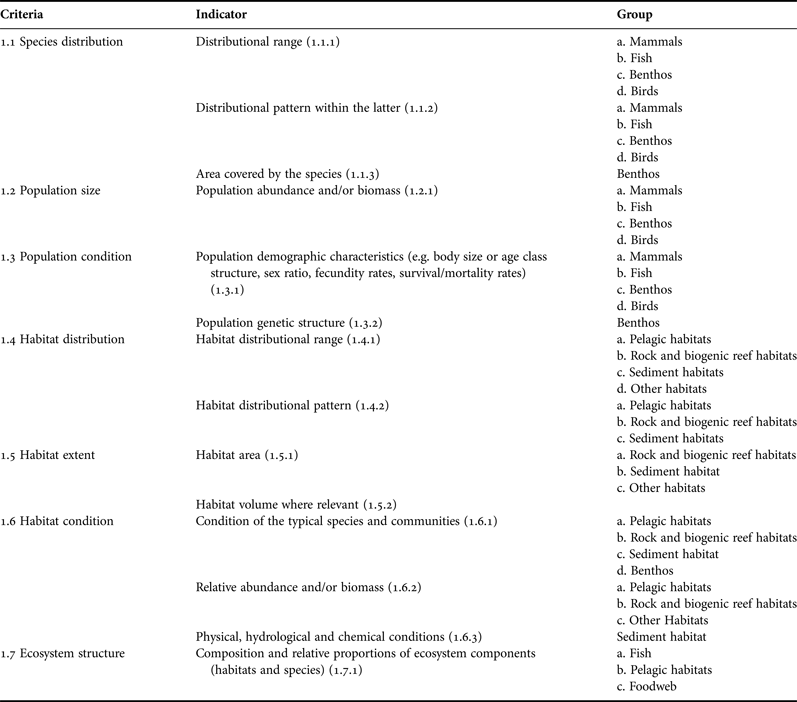
Descriptor 1 ‘Biological Diversity’ is comprised of seven criteria each including a range of associated indicators (or ‘types’ of indicators) for which parameters have been developed. Most countries have developed the indicators by breaking down the ecosystem into several components or features (i.e. functional groups and categories of taxa or habitats) (Cochrane et al., Reference Cochrane, Connor, Nilsson, Mitchell, Reker, Franco, Valavanis, Moncheva, Ekebom, Nygaard, Serrão Santos, Narberhaus, Packeiser, van de Bund and Cardoso2010; European Commission, 2011) (see Table 1); the key ones being Marine Mammals; Fish; Birds; Benthos; Pelagic habitats; Rock and biogenic reef habitats; Sediment habitats; and Other habitats. This results in about 40 ‘State Variables’, also called Parameters or Metrics (OSPAR Commission, 2012a; henceforth referred to as ‘parameters’)Footnote 2, to be classified for D1. Since not every country develops parameters for the same component set, the number of parameters may differ slightly between countries. The assessment omitted components for which few (fewer than six) countries have developed parameters such as jellyfish, turtles and cephalopods.
Overview of the criteria, indicators and most common groups for which Parameters are described with regard to Descriptor D1 Biological Diversity (codes are used in Table 2).

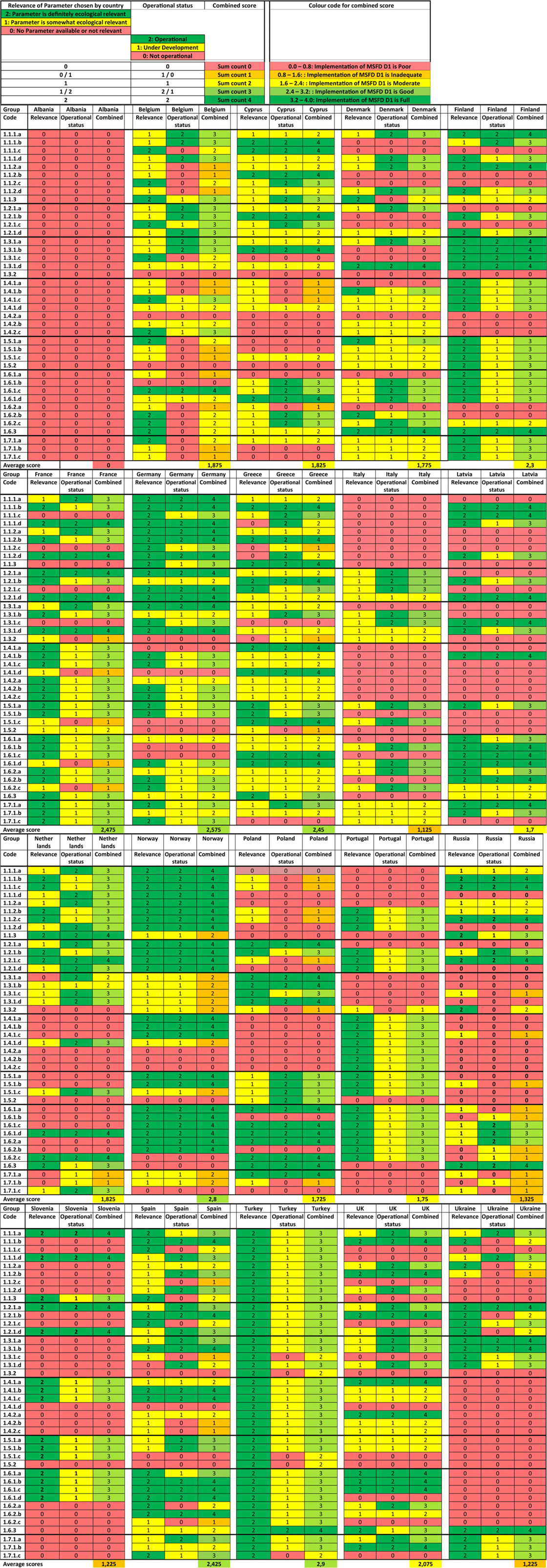
Country scores for the ecological relevance and operability of Parameters for Descriptor D1 on Biological Diversity proposed by the different countries (group codes are according to Table 1).
Analysis of information
Two criteria were used to assess the parameters as described below. The evaluation was firstly carried out in May 2013, and updated from May 2014 onwards by scientists assembled in two meetings as part of the EMBOS network (COST Action ES1003 on the European Marine Biodiversity Observatory System).
CRITERION 1
Firstly, the ecological relevance of a parameter proposed by each country was assessed as to its ecological relevance, i.e. how realistically it was likely to represent the impacts of the state of the natural species or community diversity or the natural habitats in an area. The two key determinants when considering this were firstly, whether a parameter is easy to measure or not and secondly how representative a parameter is of the structural and functional state of diversity in a coastal system. For the latter determinant, an additional consideration is how sensitive the parameter is to stressors and other impacts so state change can be identified. The parameters were classified on a scale representing not relevant (0); somewhat relevant (1); definitely relevant (2).
For example, the presence of a specific rare seabird species (as in Italy; MATTM, 2009), which is difficult to observe, would not be deemed as being a proper ecological measure of the diversity of a coastal system, both due to the problems with measuring the parameter and in being a poor link to the state of the coastal biodiversity it is supposed to be an indicator for. Thus the parameter would be judged as not relevant (0) or at most somewhat relevant (1). In contrast, parameters based on multivariate measures of diversity are more likely to be representative of the biological diversity of the habitat and can be linked to pressures through known effects on biodiversity.
In most cases, the ecological relevance of the parameter was based on the expert judgement of the scientists undertaking the assessment supplemented with information from the literature on the importance given to the different parameters (e.g. for Spain: Borja et al., Reference Borja, Galparsoro, Irigoien, Iriondo, Menchaca, Muxika, Pascual, Quincoces, Revilla, Rodríguez, Santurtún, Solaun, Uriarte, Valencia and Zorita2011; Velasco et al., Reference Velasco, Serrano, Punzón, Lens, Nogueira, González-Quirós, Tello, Macías, Módica, González-Irusta, Airbe, Díaz, de Armas and Bellas2012).
CRITERION 2
The second criterion for the assessment was the degree of operability of a parameter. Parameters were considered as not being operational when they were either still under discussion by member states or not being taken forward at all at the present time, in which case they were assigned a score of 0. If a parameter is in development (e.g. R&D is being carried out to operationalize it) then it was assigned a score of 1. Finally, if a parameter is already operational then it was assigned a score of 2.
The sum of the scores was calculated with the score for each parameter ranging from 0 to 4. A combined score of 0 means that the parameter is currently not deemed to be implemented or is poorly implemented at best; a score of 4 means the parameter is being well implemented by that member state.
RESULTS AND DISCUSSION
Marked differences were found between countries in the degree of ecological relevance as well as in the degree of implementation and operability of the parameters chosen to indicate biological diversity (Figure 1, Table 2).
Average score on relevance and operability of Parameters for Descriptor D1 on Biological Diversity proposed by the different European countries. Colour codes mean that the MSFD D1 has been implemented: poorly (red), inadequately (orange), moderately (yellow), good (light green) and fully (dark green) (see for colour codes also the legend in Table 2; data were not checked for blank countries; no country falls in the ‘fully implemented’ category).
The first thing to notice in the results of the evaluation is the wide disparity between countries in the implementation of D1 via its parameters. There is also variation within countries with some functional components and some indicator classes being better developed than others. For example, in the Netherlands, Norway and Poland some clusters of related parameters are considered relevant and operational while other clusters are neither relevant nor operational. It is also noticeable that in certain countries such as Turkey, relevant parameters have been developed for almost all groups but with a relatively low degree of operationalization. This variation illustrates strong differences between countries in their strategies for developing this descriptor, some developing parameters that are relevant and largely operational, whereas others focus on the development of a wider range of (theoretical) parameters but which are far from being made operational.
These differences between countries are corroborated by the German National Measuring Programme (BLMP, 2014) stating that the listed German indicators are at different stages of development, some being operational, while others are lacking evaluation criteria and/or monitoring.
Some differences have not even been identified across sub-regions within the same country. For example, indicators and descriptors have not been implemented/assessed in all the regions of a country (e.g. Spain).
The EU countries that scored highest in the evaluation were France, Germany, Greece and Spain, those scoring lowest were Italy and Slovenia (Figure 1, Table 2). No country achieved maximum scores by demonstrating that its parameters were all ecologically relevant (thus scientifically robust) and operational.
Among countries not belonging to the EU the results also vary. In Ukraine and Albania, for example, the implementation of instruments homologous to the MSFD seems to be rather lacking as they are not obliged to follow the EC regulation. In contrast, Turkey and Norway, although also under no obligation, have chosen to implement the MSFD. Both these countries are among the highest scoring in the evaluation meaning that they have outperformed many EU countries that were legally required to implement the directive.
Although the MSFD descriptor for biodiversity appears to be well-developed with at least 40 parameters, the evaluation as undertaken for this study reveals serious weaknesses in many of the parameters in terms of ecological relevance. Many of the parameters are no more than general qualitative statements with little quantitative underpinning or information on species groups (e.g. changes of plankton form-types, or presence of monk seal). Moreover, as the development of the indicators and underlying parameters is often based on previously available data, the degree of development is strongly biased in favour of species of commercial interest (e.g. proportion of large fish) or endangered species or habitats: these may not necessarily reflect wider marine biodiversity. Such a biased approach, often top-down (politically) driven, resulted in low numbers of relevant parameters for biological diversity (as in the Netherlands), yielding a low average score. On the other hand, in countries where in-depth consultations with experts have taken place, such a bottom-up process can result in the selection of relevant biodiversity parameters. Yet, a low degree of operationalization, as for example for Turkey having a very high score for relevance, may yield again a somewhat lower average score.
Other reasons for low performance of parameters and the wide disparity in performance deduced from the country reports to the EU or similarly relevant documentation include the lack of clear and shared homologous definitions on the criteria whereby the choice of parameters relied more on (expert) opinion than on true data. As Palialexis et al. (Reference Palialexis, Tornero, Barbone, Gonzalez, Hanke, Cardoso, Hoepffner, Katsanevakis, Somma and Zampoukas2014) stated, although some indicators of D1 are very clear and specific (e.g. 1.2.1 Population abundance and/or biomass) having a straightforward implementation, many other are more sophisticated and general (as e.g. 1.7.1 Composition and relative proportions of ecosystem components); more open to interpretation and reliant on a suite of methods and models to be implemented. Even for established parameters there may be major knowledge gaps and a lack of quantification of the targets (e.g. threshold level values) for what is, or is not, GES (Milieu, 2014b). The lack of shared definitions can be overcome by collaboration between member states. In certain cases however, lack of collaboration and coordination between governmental and research institutions, or lack of communication among regions within each country, and even conflicts between scientists and policymakers were also mentioned in interviews as a reason for a delayed development of GES indicators. A complex reporting structure and lack of funding for reaching more detailed and advanced results was often pointed out too in the interviews.
As a consequence of all these flaws in the establishment and implementation of the GES indicators and underlying Parameters, for Europe as a whole, the average combined score (for all 40 Parameters of all 20 countries) is only 1.9 (out of a possible score of 4). This means that the performance of most European countries with regard to the implementation of the MSFD is still far below that necessary if GES is truly to be achieved. There is also an urgent need for harmonized monitoring networks and standardized sampling strategies, for a full implementation of the MSFD to all European countries, as advocated by e.g. the COST Action EMBOS (Heip & McDonough, Reference Heip and Mcdonough2012, p. 19). This would facilitate the establishment of a proper internationally integrated set of parameters, and allow a full gaps and weakness analysis to be undertaken.
In conclusion, even though it is clear a lot of effort has gone in to ensuring parameters are ecologically relevant reflections of Biological Diversity, the real weakness is in the lack of operational indicators: less than half of the established Parameters at this point in the process are operational. There also needs to be more effort for coordination at the pan-European level so a consistent and harmonized approach to describing marine biological diversity with comparable parameters can be developed. Although a couple of countries are on track in implementing the MSFD, our results suggest that several European countries are not properly prepared to introduce the MSFD, partly because in those countries most parameters are neither bottom-up science driven, nor well-described. Therefore, the implementation of the MSFD Descriptor 1 for Europe as a whole can only be marked as moderate. Ultimately, the need to summarize the large environmental variability and assess impacts using a relatively small group of parameters is a hugely ambitious task. From a scientific point of view, several parameters are still under development because of the need to better understand the functional relationships between biological and abiotic factors, or on how to discriminate between the natural variability of the ecological systems in space and time and the shifts caused by human pressures. Official reports may contain parameters and monitoring as required for legal obligations but the need to scrutinize the scientific robustness of the MSFD work is more crucial than ever.
ACKNOWLEDGEMENTS
The authors wish to thank Victor Yasynsky, Oksana Savenko (Schmalhausen Institute of Zoology, Kiev, Ukraine), Juha-Markku Leppänen, Jan-Erik Bruun, Samuli Korpinen (Finnish environment institute, SYKE, Helsinki, Finland), and Martina Orlando Bonaca (Marine Biology Station, Piran, Slovenia) for their contributions.
FINANCIAL SUPPORT
Meetings to prepare this paper were made possible by funding through COST Action ES1003 EMBOS on the Development and Implementation of a Pan-European Marine Biodiversity Observatory System. Carlos Castellanos Perez Bolde acknowledges MARES Grant FPA 2011–0016 under the Erasmus Mundus framework, Marlene Jahnke has been supported by a SZN PhD fellowship, and João N. Franco by Portuguese PhD FCT grant SFRH/BD/84933/2012.