Introduction
Intraspecific body size variation is a common phenomenon in males of many beetles in the superfamily Scarabaeoidea, such as the dung beetle, Onthophagus taurus (Schreber) (Coleoptera: Scarabaeidae), the rhinoceros beetle, Trypoxylus dichotomus (Linnaeus) (Coleoptera: Scarabaeidae), and the stag beetle, Cyclommatus metallifer (Boisduval) (Coleoptera: Lucanidae), where mating success mainly depends on male–male competition (Moczek Reference Moczek1998, Reference Moczek2002; Shafiei et al. Reference Shafiei, Moczek and Nijhout2001; Gotoh et al. Reference Gotoh, Cornette, Koshikawa, Okada, Lavine, Emlen and Miura2011). Most males of these beetle species have larger body sizes than the females do, or male-biased sexual size dimorphism (Mizunuma and Nagai Reference Mizunuma and Nagai1994; Moczek Reference Moczek1998, Reference Moczek2002; Kawano Reference Kawano2002, Reference Kawano2003, Reference Kawano2006; Karino et al. Reference Karino, Seki and Chiba2004; Ek-Amnuay Reference Ek-Amnuay2008; Gotoh et al. Reference Gotoh, Cornette, Koshikawa, Okada, Lavine, Emlen and Miura2011). The biggest individuals can be three times larger than the smallest ones in the same populations (Harvey and Gange Reference Harvey and Gange2006; Kawano Reference Kawano2006; Harvey et al. Reference Harvey, Gange, Hawes, Rink, Abdehalden and Fulaij2011).
Body size variation in many insects is predominantly caused by environmental variation in their habitats, indicating phenotypic plasticity in this trait (Emlen and Allen Reference Emlen and Allen2003; Lewis et al. Reference Lewis, Tigreros, Fedina and Ming2012; Tsuchiya et al. Reference Tsuchiya, Takami, Okuzaki and Sota2012). Because external morphological characteristics of insects are relatively static after entering the adult stage due to their rigid exoskeletons, body size is therefore strongly determined by juvenile development. Quantity and quality of food are the major determinants of body size and other characteristics of adult insects, affecting growth rate, development time, hormones related to metamorphosis, or combinations of these factors during the larval stages (Nijhout Reference Nijhout1975; Shafiei et al. Reference Shafiei, Moczek and Nijhout2001; Cook and Bean Reference Cook and Bean2006).
For beetles displaying male-biased sexual size dimorphism, growth during the larval stage and secondary sexual characteristics of males tend to be more sensitive to nutrition than similar traits in females are, due to higher selective pressure from sexual selection (Tatsuta et al. Reference Tatsuta, Mizota and Akimoto2004; Kawano Reference Kawano2006; Emlen et al. Reference Emlen, Lavine and Ewen-Campen2007; Gotoh et al. Reference Gotoh, Cornette, Koshikawa, Okada, Lavine, Emlen and Miura2011). Positive correlation between food quantity and quality and weapon-like structures has been reported for some rhinoceros, dung, and stag beetles (Iguchi Reference Iguchi1998; Moczek Reference Moczek1998; Shafiei et al. Reference Shafiei, Moczek and Nijhout2001; Karino et al. Reference Karino, Seki and Chiba2004; Gotoh et al. Reference Gotoh, Cornette, Koshikawa, Okada, Lavine, Emlen and Miura2011). In O. taurus, only male larvae that reach a critical weight threshold before pupation become horned (major morph) males. In contrast, larvae that develop under low food availability conditions do not reach the critical weight and therefore become hornless (minor morph) males (Moczek Reference Moczek1998). For stag beetles, it is believed that food availability (decaying wood) in natural habitats is the major cause of intraspecific body size variation of wild stag beetles (Harvey and Gange Reference Harvey and Gange2006; Gotoh et al. Reference Gotoh, Cornette, Koshikawa, Okada, Lavine, Emlen and Miura2011, Reference Gotoh, Fukaya and Miura2012). In larvae of C. metallifer, stag beetles reared with a high food quantity showed longer mandible length, longer third-instar period, and higher pupal weight than did individuals reared with a low food quantity (Gotoh et al. Reference Gotoh, Fukaya and Miura2012). However, effects of food availability on growth and feeding performance remain largely unknown.
Because of this, we conducted an experiment with stag beetles, Aegus chelifer MacLeay (Coleoptera: Lucanidae), by breeding and rearing them in the laboratory. This species exhibits high body size variation in a population, and males show mandible dimorphism (Songvorawit et al. Reference Songvorawit, Butcher and Chaisuekul2017b, Reference Songvorawit, Butcher and Chaisuekul2018). Their larvae are found in various sizes of woody debris and decaying logs, and they live in various habitats, including urban areas, where decaying wood is scarce (Songvorawit et al. Reference Songvorawit, Butcher and Chaisuekul2017a, Reference Songvorawit, Butcher and Chaisuekul2017b, Reference Songvorawit, Butcher and Chaisuekul2018). It is therefore possible that feeding and development of A. chelifer might be highly plastic in response to food availability. To better understand the causes of body size variation and sexual dimorphism in stag beetles, we examined the effects of food quantity on the species’ feeding performance, larval growth, and adult body size.
Methods
Study beetles
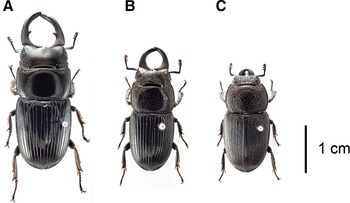
We studied the tropical stag beetle, A. chelifer. Males of this species have dimorphism and high body size variation within a population, ranging from 15 to 40 mm long (Pinratana and Maes Reference Pinratana and Maes2003; Ek-Amnuay Reference Ek-Amnuay2008; Songvorawit et al. Reference Songvorawit, Butcher and Chaisuekul2017b). Major morph males have long curved mandibles with a median tooth on each side and a smooth cuticle surface at the head and pronotum (Fig. 1A). Minor morph males have shorter mandibles without median teeth, and they also have dense punctures on the head and pronotum (Fig. 1B). Females have relatively short mandibles and are smaller in body size than males are, ranging from 18 to 25 mm long (Fig. 1C; Pinratana and Maes Reference Pinratana and Maes2003; Ek-Amnuay Reference Ek-Amnuay2008; Songvorawit et al. Reference Songvorawit, Butcher and Chaisuekul2017b). Larvae have soft whitish C-shaped bodies and rigid yellow head capsules. Female larvae can be identified by their yellow ovoid-shaped ovaries that are visible through the larval cuticle at the dorsal part of the abdomen, whereas males lack this trait (Fremlin and Hendriks Reference Fremlin and Hendriks2014).
External morphology of Aegus chelifer adults: A, major morph male; B, minor morph male; and C, female.

This species is widely distributed across the mainland of Southeast Asia, in both forest and urban areas. In urban areas, the beetle is usually found in backyards and public parks (Mizunuma and Nagai Reference Mizunuma and Nagai1994; Pinratana and Maes Reference Pinratana and Maes2003; Ek-Amnuay Reference Ek-Amnuay2008; Songvorawit et al. Reference Songvorawit, Butcher and Chaisuekul2018). Female beetles prefer to oviposit eggs inside moist, coarse woody debris, decaying stumps, and the logs of many dicots (Songvorawit et al. Reference Songvorawit, Butcher and Chaisuekul2017a). Larvae feed on woody substrates inside the logs or pieces of wood until the prepupal stage. Then they stop feeding and continue to build cocoons made of faeces and wood particles. Development time from egg to adult stage ranges from 80 to 120 days. Adults can live for 6–12 months in captivity (Songvorawit et al. Reference Songvorawit, Butcher and Chaisuekul2017a, Reference Songvorawit, Butcher and Chaisuekul2018).
In the present study, A. chelifer individuals were initially collected from natural habitats such as public parks and restricted areas in the Bangkok metropolitan area, on the central plain of Thailand. The beetles were bred and maintained in the laboratory for three to four generations before experimentation. A bulk population of larvae was reared in 4500-mL plastic containers (approximately 20–30 individuals per container) that were filled with fermented sawdust from the rubber tree, Hevea brasiliensis Müller Argoviensis (Euphorbiaceae), for food, supplemented with 10% (weight/weight) wheat flour, 60 ± 5% (weight/weight) water, pH 7.5–8.0, modified from Ek-Amnuay (Reference Ek-Amnuay2009), under constant darkness at 29 ± 4 °C and 75 ± 5% relative humidity, as described in Songvorawit et al. (Reference Songvorawit, Butcher and Chaisuekul2018).
Gut load and digestibility
Because stag beetle larvae live inside of and feed on sawdust substrate, the exact amount of food ingested could not be directly observed. An indirect method was used instead, involving chromic oxide (Cr2O3) as a marker (Kimura and Miller Reference Kimura and Miller1957; McGinnis and Kasting Reference McGinnis and Kasting1964; Holter Reference Holter1973; Hendriksen Reference Hendriksen1991; Köprücü and Özdemir Reference Köprücü and Özdemir2005). The food was prepared by mixing the fermented sawdust with Cr2O3 at a ratio of 2 g Cr2O3 to 1 kg dry fermented sawdust and adjusting the moisture to 60% (weight/weight). Third-instar larvae (six males and six females) of different weights were randomly selected and individually reared in 200-mL plastic cups filled with 110 g fresh Cr2O3 food under the same rearing conditions as mentioned above. Faecal pellets appearing in the rearing cups in the first two days were removed because they might have included food ingested before the experiment. Faecal pellets from days 3 to 5 were collected, pooled together, and stored at –20 °C until analysis of digestibility. The larvae at day 7 were weighed, killed by freezing, and stored at –20 °C for the estimation of gut load. The samples (larvae and faeces) were dried at 60 °C to a constant weight. Then, the amount of Cr2O3 in the samples was determined using the chlorine bleach method described by Suzuki and Early (Reference Suzuki and Early1991).
Food retention time
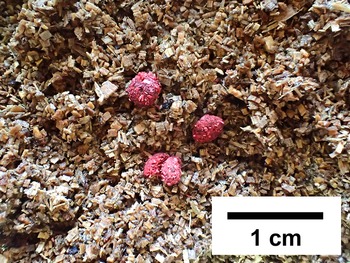
Rhodamine B dye was used as a marker in the food for the estimation of food retention time in larval guts. This dye has often been used as a tracking marker because it has little adverse effect on the feeding behaviour and development of many insects (e.g., Blanco et al. Reference Blanco, Perera, Ray, Taliercio and Williams2006; Gayahan and Tschinkel Reference Gayahan and Tschinkel2008; Mascari and Foil Reference Mascari and Foil2009). The fermented sawdust was mixed with rhodamine B at a ratio of 2 g dye to 1 kg dry fermented sawdust and moisture was adjusted to 60% (weight/weight). Larvae (16 males and 16 females) of different weights were randomly selected and allowed to feed individually on 110 g of the dye-stained food in 200-mL plastic cups for three hours. The larvae were then removed, washed with distilled water, and placed in 60 × 15-mm Petri dishes filled with the unstained food. The presence of faeces was checked hourly. Faeces resulting from ingestion of the dye-stained food had a pink colour that was easily distinguishable from the brown colour of unstained faeces (Fig. 2). Food retention time was estimated in hours from the time that the dye-stained food was introduced to the time when pink faeces were present, on the assumption that stag beetle larvae would start to feed on the dye-stained food during their first hour in the cups.
Pink faecal pellets of Aegus chelifer larvae resulting from ingestion of rhodamine B–stained sawdust.

Effects of food quantity
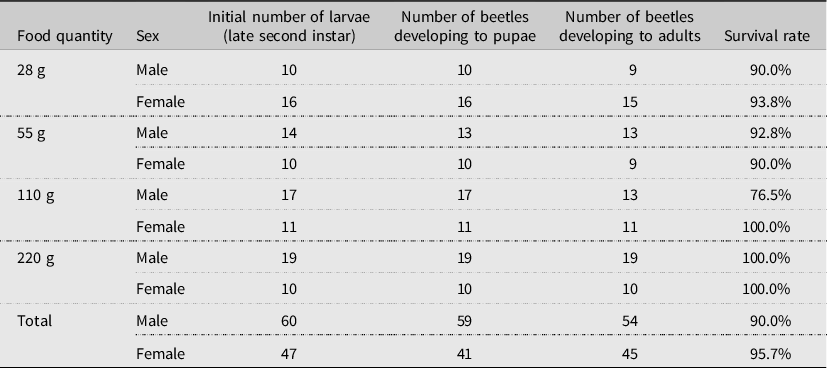
Late second-instar larvae (weight > 0.2 g; see the sample size in Table 1) were randomly selected and reared individually in plastic cups containing 28, 55, 110, or 220 g of fresh fermented sawdust. Larval weight was measured to the nearest milligram every five days until the prepupal stage, which can be identified from a decrease in weight, the turning of cuticle from clear to more turbid, and the beginning of cocoon construction. After adults emerged, they were photographed from the dorsal view using a digital camera (Olympus TG-4; Olympus Global, Tokyo, Japan), and the elytra and mandible lengths in the digital images were measured to the nearest 0.1 mm using tpsDig2 software, version 2.17 (Rohlf Reference Rohlf2013). Elytra length (used as a proxy for body size) was measured along the middle line from the base of the scutellum to the posterior end of the elytra, whereas mandible length (used as a proxy for weapon size) was measured as a straight line from the tip to the base of the left mandible. The morph of males was identified based on a previous study (Songvorawit et al. Reference Songvorawit, Butcher and Chaisuekul2017b) of the same population of A. chelifer as that used in this study. The allometric relationship between natural log of male mandible length and natural log of elytra length was best fitted to the piece-wise linear model proposed by Kotiaho and Tomkins (Reference Kotiaho and Tomkins2001). Therefore, males could be classified into major and minor morphs based on the mandible length, where minor morph males had a mandible length shorter than 5.1 mm and major morph males have a mandible length at least 5.1 mm long.
Survival of Aegus chelifer reared with different food quantities.

Measurement of nutritional properties
Nutritional properties of faeces, food before rearing, and the food remaining in the rearing cups after 30 days of rearing were measured. For collection of faeces, we conducted an experiment similar to the digestibility experiment, but 10 stag beetle larvae were reared on a normal food (without marker) instead. Faecal pellets from two larvae were pooled together. Before measurements, samples were dried in an oven at 60 °C to a constant weight. Neutral detergent fibre was analysed, as described in Van Soest et al. (Reference Van Soest, Robertson and Lewis1991). Energy was analysed using a bomb calorimeter (AC500, LECO Corporation, St. Joseph, Michigan, United States of America). We used 30-day-old food in rearing cups without larvae as a control.
Calculations of feeding characteristics
Relative growth rate was calculated, as shown in equation (1), as weight change over 15 days early in the third-instar stage, which has exponential growth:
 $${\rm{Relative}}\,{\rm{growth}}\,{\rm{rate}}\,\left( {{\rm{g}}\,{{\rm{g}}^{ - 1}}{\rm{da}}{{\rm{y}}^{ - {\rm{1}}}}} \right){\rm{ = }}{{\ln {W_{\rm{2}}}\; - \ln {W_{\rm{1}}}\;} \over t}$$
where W 1 is the weight of third-instar larvae at the first date of measurement, W 2 is their weight after 15 days, and t is the duration between measurement of W 1 and W 2 (15 days).
Gut load and apparent digestibility of the food were calculated according to equations (2) and (3), respectively:
 $${\rm{Gut}}\,{\rm{load}}\,({g}) = {{{\rm{Amount}}\,{\rm{of}}\,{\rm{C}}{{\rm{r}}_{\rm{2}}}{{\rm{O}}_{\rm{3}}}\,{\rm{in}}\,{\rm{a}}\,{\rm{larva}}} \over {{\rm{Amount}}\,{\rm{of}}\,{\rm{C}}{{\rm{r}}_{\rm{2}}}{{\rm{O}}_{\rm{3}}}\,{\rm{in}}\,{\rm{1}}\;{\rm{g}}\,{\rm{fresh}}\,{\rm{food}}}}$$
 $${\rm{Apparent}}\,{\rm{digestibility}}\,(\% ) = {\rm{100}}\; - \;({\rm{100}} \times {{\% {\rm{C}}{{\rm{r}}_{\rm{2}}}{{\rm{O}}_{\rm{3}}}\,{\rm{in}}\,{\rm{dry}}\,{\rm{food}}} \over {\% {\rm{C}}{{\rm{r}}_{\rm{2}}}{{\rm{O}}_{\rm{3}}}\,{\rm{in}}\,{\rm{dry}}\,{\rm{faeces}}}})$$
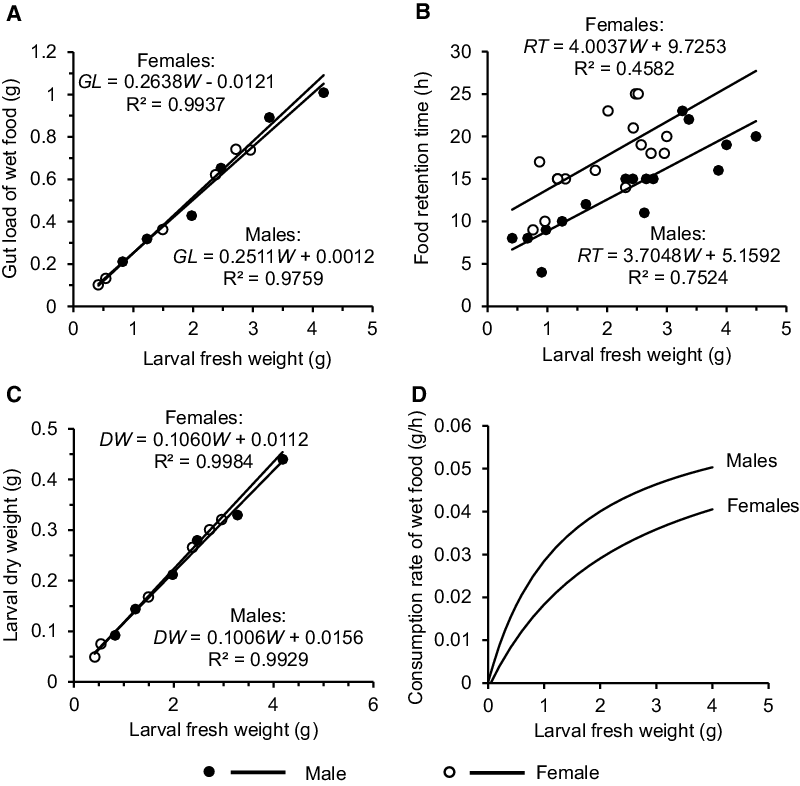
Relationships between larval fresh weight and gut load, and larval fresh weight and food retention time, were first estimated from scatter plots by visual inspection (Fig. 3A and B). Because the relationships from the scatter plots were linear, the data were fitted to simple linear equations. Then, consumption rate in relation to larval weight was estimated from gut load, divided by food retention time, as shown in equation (4):
 $$C{R_x} = {{G{L_x}} \over {R{T_x}}}$$
Relationships between larval fresh weight (W) and feeding characteristics of Aegus chelifer larvae: A, gut load of fresh food (GL; n male = 6, n female = 6); B, food retention time (RT; n male = 16, n female = 16); C, larval dry weight (DW; n male = 6, n female = 6); and D, consumption rate. The equations represent the regression lines.

where GL x is the gut load of larval weight X g, and RT x is the food retention time of larval weight X g.
Total food consumption during the third-instar stage of each larva was estimated from the area under the curve by plotting the consumption rate at larva X g (CR x ) obtained from equation (4) against the feeding period of each stag beetle (data were obtained from the earlier effects of the food quantity experiment).
Efficiency of conversion of ingested food (ECI) to larval dry weight gain was calculated from growth over the 15 days early in the third-instar stage, as shown in equation (5):
 $${\rm{ECI}}\,(\% ) = 100 \times {{{D}{W_{\rm{2}}} - {D}{W_{\rm{1}}}} \over {{\rm{Dry}}\,{\rm{weight}}\,{\rm{of}}\,{\rm{food}}\,{\rm{consumed}}}}$$
where DW 1 and DW 2 are initial dry weight (first date of measurement) and dry weight after 15 days, respectively. Dry weight was estimated from a simple linear regression of the relationship between fresh and dry weight, as shown in Figure 3C, whereas the dry weight of food consumed was calculated with equation (4).
Phenotypic variation
Inequality of phenotypic traits was used to examine variations of larval growth, larval feeding, and adult characteristics. Data of the same sex from all food quantity treatments were pooled together. Analysis was conducted by following the methods described by Harvey and Gange (Reference Harvey and Gange2006), Magura et al. (Reference Magura, Tóthmérész and Lövei2006), and Songvorawit et al. (Reference Songvorawit, Butcher and Chaisuekul2018). Initially, Lorenz curves were built. If all individuals in a sample group had the same trait value, the Lorenz curve is a straight diagonal line – a line of equality. Then, the Gini coefficient (G), which represents the deviation from equality, was quantified. The value of G ranges from 0, when every individual has the same trait value, to 1, when every individual except one has a trait value of zero (Damgaard and Weiner Reference Damgaard and Weiner2000).
Statistical analyses
Effects of food quantity, sex, and their interaction on larval and total survivals, and effect of food quantity on male morph were tested using a generalised linear model with a logit link function. Effects of food quantity, sex, and their interaction on larval and adult performances were analysed using the aligned rank test (Seaman et al. Reference Seaman, Walls, Wise and Jaeger1994). Relationships between larval fresh weight and feeding performance were compared between sexes using the analysis of covariance. Statistical analyses were performed using the base, ARTool, dunn.test, FSA, and ineq packages in R, version 4.0.3 (R Core Team 2020).
Results
Effects of food quantity
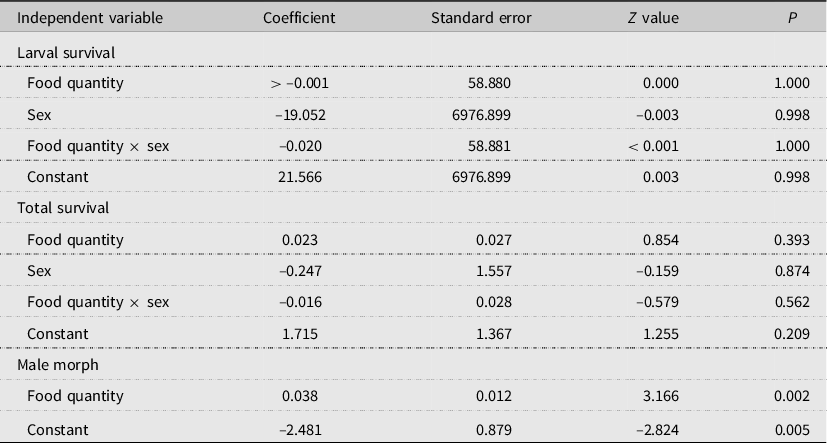
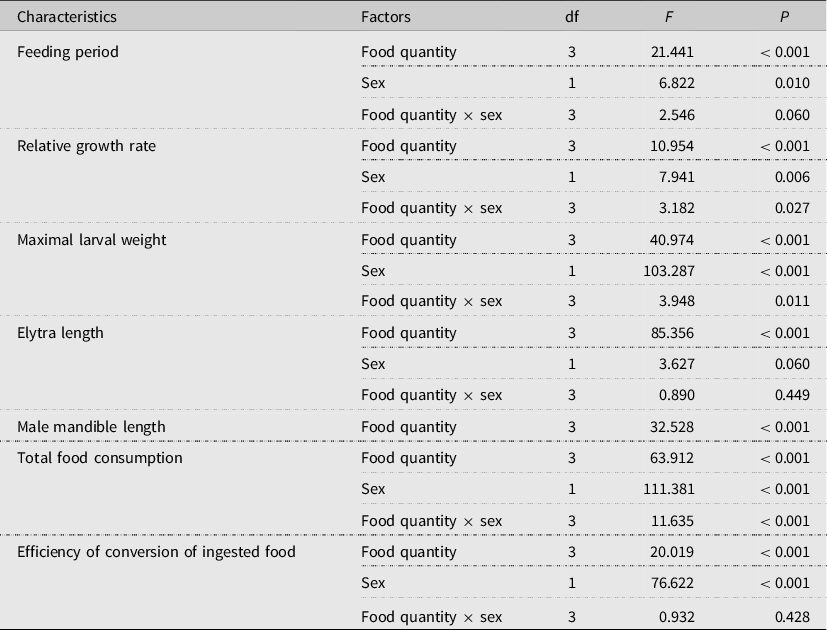
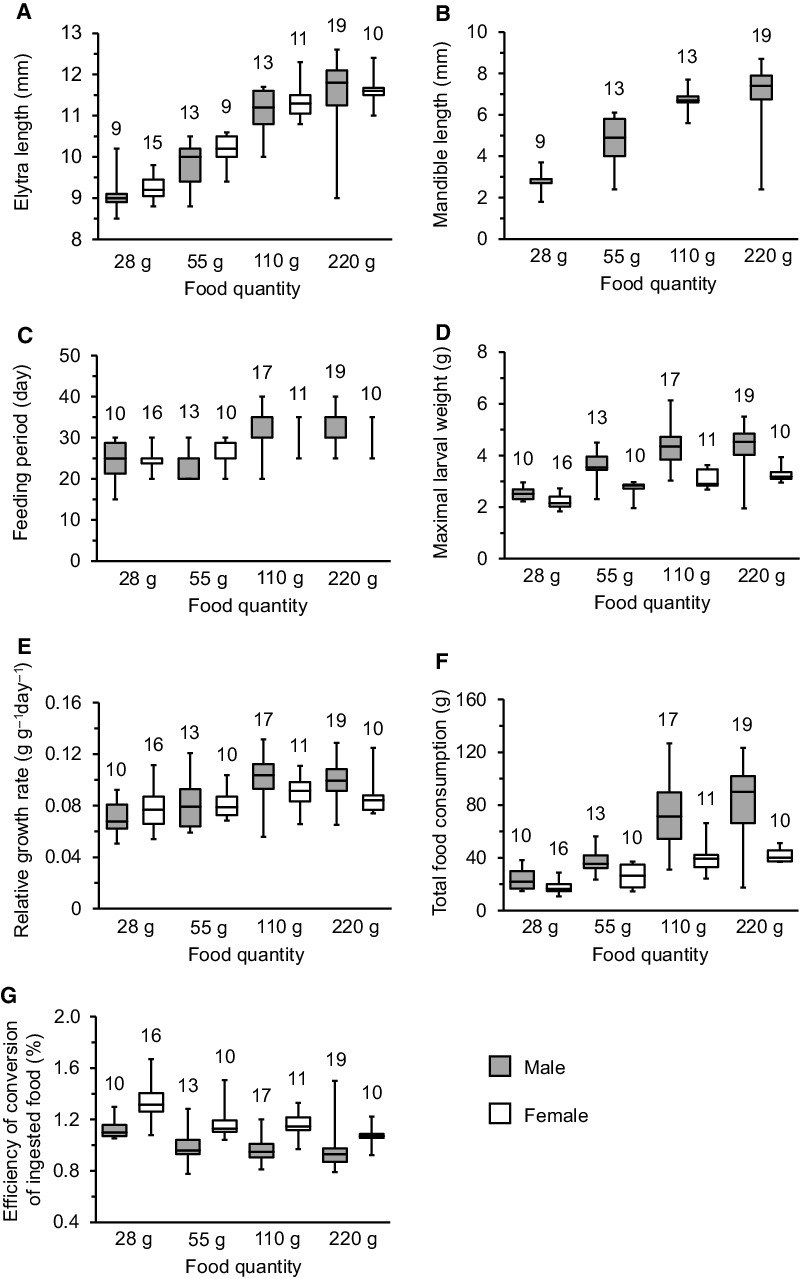
Most stag beetle larvae (92.5%) developed into adults (Table 1). Larval and total survivals were not significantly affected by food quantity, sex, or their interaction (Table 2). Food quantity affected all measured traits in both males and females (Table 3), with higher food quantity yielding longer elytra length (Fig. 4A), longer male mandible length (Fig. 4B), and longer feeding periods (Fig. 4C), without interactions with sex. Maximal larval weight (Fig. 4D), relative growth rate (Fig. 4E), and total food consumption (Fig. 4F) of males increased alongside food quantity more pronouncedly than these characteristics did in females and showed interactions between sex and food quantity (Table 3). Males had longer feeding periods and higher relative growth rates at high food quantities and higher maximal larval weight and higher food consumption than females did at mid and high food quantities, but elytra length did not significantly differ between the sexes (Table 3). Ratios of major to minor morph males were significantly influenced by food quantity (Table 2) and increased with increasing food quantity; the percentages of major morph males were 0.0%, 46.2%, 100.0%, and 94.7% in the 28-, 55-, 110-, and 220-g food treatments, respectively.
Generalised linear models for effects of food quantity, sex, and their interaction on survivals and male morph of Aegus chelifer.

Effects of food quantity, sex, and their interaction on feeding and adult characteristics of Aegus chelifer, using the aligned rank test.

Effects of food quantity on feeding, growth, and morphological characteristics of Aegus chelifer stag beetles: A, elytra length; B, male mandible length; C, feeding period of third instars; D, maximal larval weight; E, relative growth rate; F, total food consumption; and G, efficiency of conversion of the ingested food by third instars. The horizontal lines within each box indicate the median, the boxes indicate the 75th and 25th percentiles, and the whiskers show maximum and minimum. Numbers above the boxes are sample size of each treatment.

Feeding performance
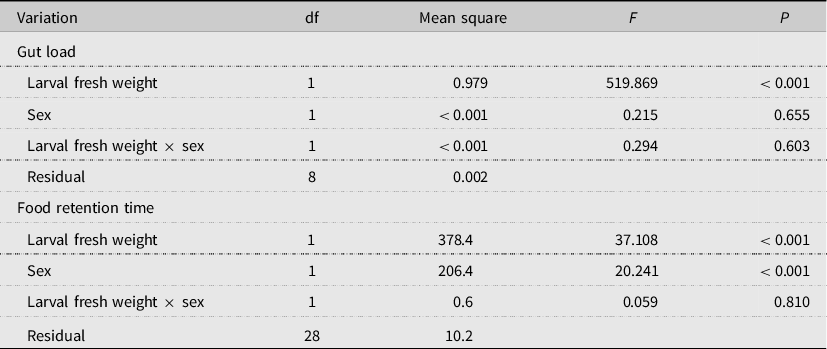
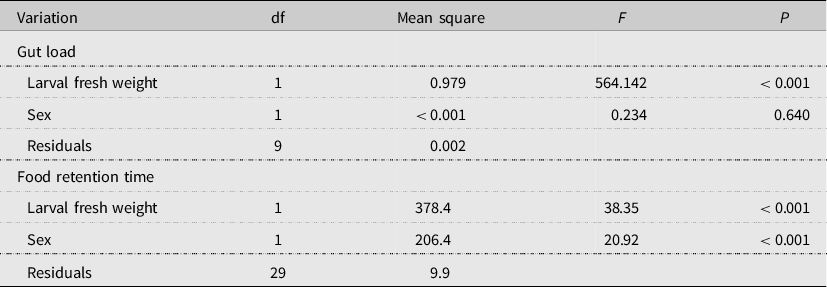
Gut load, or the capability of stag beetles to hold fresh food in their guts, was approximately 25.2 ± 0.4% of larval fresh weight (n = 12, males and females combined). Gut load was positively correlated with larval fresh weight (males: r s = 1, df = 4, P = 0.003; females: r s = 0.94, df = 4, P = 0.017), but it did not significantly differ between sexes (Fig. 3A; Tables 4 and 5). Food retention time ranged from 4 to 25 hours and was positively correlated with larval weight (males: r s = 0.91, df = 14, P < 0.001; females: r s = 0.67, df = 14, P = 0.004). Food retention time in females was longer than it was in males at the same weight (Fig. 3B; Tables 4 and 5). Correlations between larval fresh weight and consumption rate were positive, with males having higher consumption rates than females did at the same weight (Fig. 3D).
Comparison of regression slopes of larval fresh weight and feeding performance relationships between male and female Aegus chelifer stag beetles.

Comparison of regression intercepts of larval fresh weight and feeding performance relationships between male and female Aegus chelifer stag beetles.

Total amount of food consumed
In third-instar larvae, the total amount of food consumed differed significantly between sexes and treatments (Table 3) and increased with increasing food quantity (Fig. 4F). Percentages of amount of food consumed by larvae reared in 28, 55, 110, and 220 g of food were equivalent to 78.7%, 64.4%, 64.9%, and 40.9% for males, and 59.1%, 48.1%, 35.8%, and 18.2% for females, respectively.
Digestibility, conversion efficiency, and nutrients
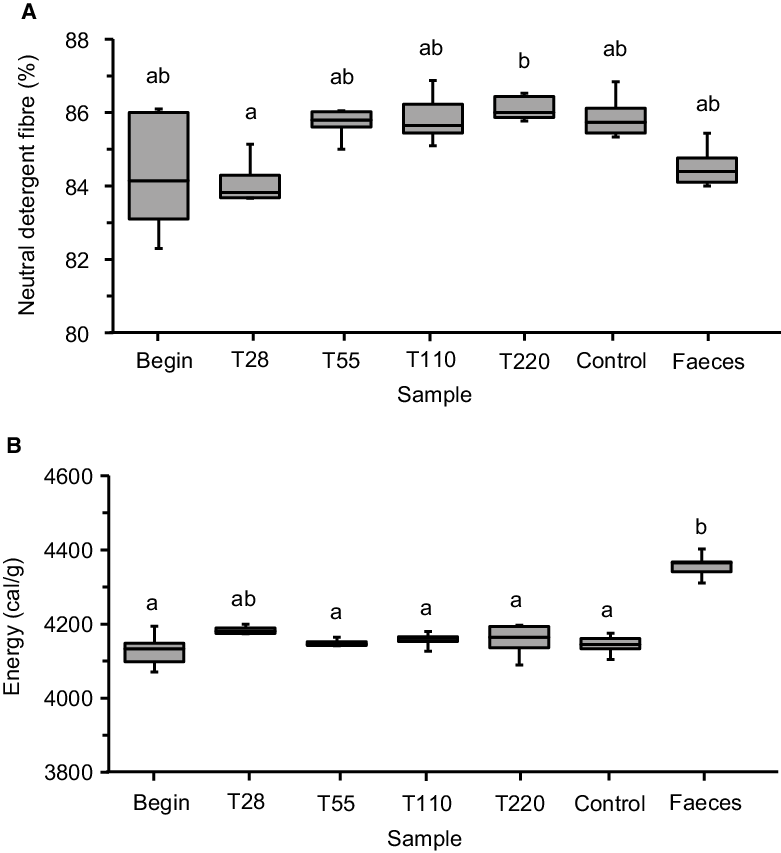
Apparent digestibility of food by the larvae was 9.74 ± 0.58% (n = 10, males and females combined). Efficiency of conversion of ingested food differed significantly between conditions of food quantity and sexes (Table 3), ranging from 0.7% to 1.7%, with females having a higher efficiency of conversion of ingested food than males did (Fig. 4G). Neutral detergent fibre of the food before and after rearing and of the faeces differed significantly (χ 2 = 17.68, df = 6, P = 0.007), with the neutral detergent fibre of food of the 28-g treatment after rearing for 30 days lower than that of the 220-g treatment (Fig. 5A), whereas the neutral detergent fibre of the other treatments was similar. The energy content of the food before and after rearing was similar, while the energy of the faeces was significantly higher than that of the food both at the beginning and end of rearing (χ 2 = 18.49, df = 6, P = 0.005), except for the 28-g food treatment (Fig. 5B).
Nutritional properties of food (n of each treatment = 5) and faeces (n = 5) from different treatments: A, neutral detergent fibre and B, energy. Begin = food before rearing (day 0), T28 = food of treatment 28 g after rearing for 30 days, T55 = food of treatment 55 g after rearing for 30 days, T110 = food of treatment 110 g after rearing for 30 days, T220 = food of treatment 220 g after rearing for 30 days. Control = 30-day-old food in the rearing cup without larvae. The horizontal lines within each box indicate the median, the boxes indicate the 75th and 25th percentiles, and the whiskers show maximum and minimum. Significant differences (P < 0.05) are denoted by different letters above the boxes.

Phenotypic variation
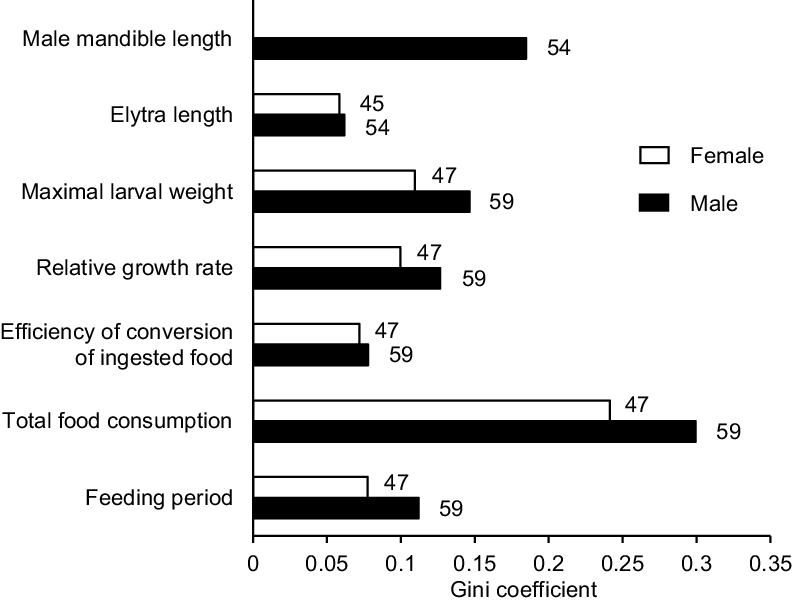
Males had greater degrees of variation in all measured traits than females did (Fig. 6). The largest difference of variation between the beetle sexes was found in total food consumption, while other larval growth and feeding characteristics were relatively similar. Variation of male elytra length was slightly greater than that of females. Male mandibles had greater variation in length than their elytra did.
Inequalities of larval growth, larval feeding performances, and adult characteristics of Aegus chelifer stag beetles. Numbers on the right of each column are sample size.

Discussion
In almost all insects, food quantity during the juvenile stage usually affects the insects’ growth and development, but the mechanisms are different among species. As shown in this study, the growth and feeding performance of A. chelifer larvae differed across food availability treatments. Stag beetle larvae seemed to adjust their feeding performance to available food, that is, individuals fed with high quantities of food consumed more food and spent longer periods feeding. Perhaps stag beetle larvae are able to estimate the amount of available food, as has been reported in dung beetles and amphibians, the juveniles of which may be similar to stag beetles in that they are unable to move from their natal sites to search for additional resources (Alford and Harris Reference Alford and Harris1988; Shafiei et al. Reference Shafiei, Moczek and Nijhout2001). This possibility could result in differences in growth performance, such as relative growth rate and maximal larval weight, and thereby could affect adult characteristics among food quantity treatments. Body size differences resulting from differences in larval feeding period have been previously reported in A. chelifer (Songvorawit et al. Reference Songvorawit, Butcher and Chaisuekul2018). In experiments on the dung beetle species O. acuminatus Harold and O. taurus, deprivation of food during the larval stage was found to be able to trigger the onset of metamorphosis into pupae, resulting in small adult body size and minor morph in males (Emlen Reference Emlen1997; Shafiei et al. Reference Shafiei, Moczek and Nijhout2001).
In the present study, the amount of total food consumed increased with increasing food quantity. However, the amount of ingested food remained less than the exact amount of the food in the rearing cups for all treatments, even though nutrients (using neutral detergent fibre and energy as proxies) in the food were slightly altered from their initial state over the course of the experiment. This result was congruent with our estimation of food digestibility, which was relatively low (9.74% ± 0.58%) compared to the results found with other xylophagous insects such as roaches and termites (40–90% digestibility; Martin et al. Reference Martin, Jones and Bernays1991). We do not know why energy in the faeces was higher than in the food. Perhaps the increase of energy (calories) in the faeces was from physiological processes, microbial biomass inhabiting in the guts, or an increase of lignin in the faeces because it is difficult for insects to digest and has higher energy content than other wood components (Kienzle et al. Reference Kienzle, Schrag, Butterwick and Opitz2001; Dillon and Dillon Reference Dillon and Dillon2004; Engel and Moran Reference Engel and Moran2013).
Female A. chelifer larvae had higher efficiency of conversion of ingested food than males did. This indicated that the females’ ability to convert food to body mass was more efficient than that of males. It is possible that the longer food retention time in females allows more food to be digested and also more nutrients to be assimilated. In contrast, males might use a different strategy to optimise their growth. The food contained a small portion of nonfibrous material (Fig. 5A), which are believed to be more easily digested and assimilated by stag beetle larvae than fibrous components are (Songvorawit et al. Reference Songvorawit, Butcher and Chaisuekul2017a). Male larvae might increase their food consumption rate so as to assimilate these pre-existing nutrients in addition to the nutrients the larvae obtain from digesting wood in their guts. However, the efficiency of conversion of ingested food of A. chelifer larvae (0.7–1.7%) was relatively low compared to other herbivorous insects, for example, it is 2–15% in longhorn beetles (Coleoptera: Cerambycidae) (Hosking and Hutcheson Reference Hosking and Hutcheson1979; Banno and Yamagami Reference Banno and Yamagami1989; Walczynska Reference Walczynska2007), 6–14% in nymphalid butterflies (Lepidoptera: Nymphalidae) (Banno Reference Banno1984), and 5–11% in Colorado beetles (Coleoptera: Chrysomelidae) (Doležal et al. Reference Doležal, Habuštová and Sehnal2007). Theoretically, larvae can consume substrate (food and faeces) for several cycles in low food quantity treatments (such as the 28- and 55-g treatments of the present study) in order to optimise their body weight, consuming the remaining nutrients in rearing cups, but only if metabolic waste accumulation is disregarded. To understand this, the digestive physiology of stag beetles needs to be examined further.
All measured traits, except for elytra length, in the present study differed between males and females. It is well known that most stag beetles have sexual dimorphism, usually making males larger than females, or male-biased sexual size dimorphism (Mizunuma and Nagai Reference Mizunuma and Nagai1994; Kawano Reference Kawano2003; Pinratana and Maes Reference Pinratana and Maes2003; Ek-Amnuay Reference Ek-Amnuay2008). Our results show that sex differences also included larval growth and feeding performance. Sex differences in body size and its plasticity can occur through differences in feeding behaviour between sexes. For example, the female larvae of the two-spot ladybird beetle, Adalia bipunctata (Linnaeus) (Coleoptera: Coccinellidae), consume more food than male larvae do, resulting in the females being the larger sex (Yasuda and Dixon Reference Yasuda and Dixon2002).
All measured traits of A. chelifer males were more variable than those of females, as shown by the Gini coefficient. Inequality of elytra length of males in this study (G = 0.0618) was slightly greater than a previous study (Songvorawit et al. Reference Songvorawit, Butcher and Chaisuekul2018) that found it to be in wild stag beetles of the same population (G = 0.0504). Generally, the degree of phenotypic variation in insects is correlated with sexual size dimorphism. For female-biased sexual size dimorphic species, the development of females tends to be more sensitive to environmental changes than the development of males is, which results in greater body size variation (Yasuda and Dixon Reference Yasuda and Dixon2002; Stillwell et al. Reference Stillwell, Blanckenhorn, Teder, Davidowitz and Fox2010). In contrast, male-biased sexual size dimorphic species, in which sexual selection favours larger individuals, have more body size variation than is found in the females of the species (Tatsuta et al. Reference Tatsuta, Mizota and Akimoto2004; Kawano Reference Kawano2006; Emlen et al. Reference Emlen, Lavine and Ewen-Campen2007; Gotoh et al. Reference Gotoh, Cornette, Koshikawa, Okada, Lavine, Emlen and Miura2011). However, most studies of phenotypic plasticity in male-biased species have been conducted in adults or have focused on hormonal regulation in males, and comparisons of feeding performance and ontogeny relating to nutrition between sexes are still very few.
Aegus chelifer males have mandible dimorphism that can be classified into major and minor morphs based on mandible length and shape. In the present study, ratios of major to minor morph males increased with increasing food quantity, as expected. Studies of morph determination in dung, rhinoceros, and stag beetles show that the development of weapon body parts is linked to nutrient-dependent hormones, such as juvenile hormone (Moczek Reference Moczek1998; Emlen Reference Emlen2000; Emlen and Allen Reference Emlen and Allen2003; Gotoh et al. Reference Gotoh, Cornette, Koshikawa, Okada, Lavine, Emlen and Miura2011; Zinna et al. Reference Zinna, Gotoh, Brent, Dolezal, Kraus and Niimi2016). This hormone plays important roles in cell division and tissue differentiation of imaginal discs of weapon body parts during the prepupal stage. Only well-fed larvae that attain a body mass before pupation that is higher than the critical weight can produce sufficient hormone titres to become major morphs (Moczek Reference Moczek1998; Emlen Reference Emlen2000; Emlen and Allen Reference Emlen and Allen2003; Gotoh et al. Reference Gotoh, Cornette, Koshikawa, Okada, Lavine, Emlen and Miura2011; Zinna et al. Reference Zinna, Gotoh, Brent, Dolezal, Kraus and Niimi2016). Furthermore, sensitivity of weapon body part development to nutritional conditions could explain why the lengths of male stag beetle mandibles varied more than the lengths of their elytra in the present study.
In conclusion, this study shows that the efficiency of woody substance digestion by A. chelifer larvae is relatively low. Nevertheless, the larvae were able to adjust their feeding performance according to food availability, which further resulted in adult body size variations. This is evidence of plasticity in the feeding behaviour and growth of stag beetle larvae, which might be an adaptive trait in order to improve their fitness under conditions of food shortage. Low digestibility and efficiency of conversion of ingested food may be related to the ability to digest woody materials. To gain more understanding, studies into the digestive physiology of this species are needed.
Acknowledgements
This research was supported by the 90th Anniversary of Chulalongkorn University Fund (Ratchadaphiseksomphot Endowment Fund).